
Previewing The August College Free Agent Market
On Wednesday, August 15th, all drafted players who went the NCAA route and graduated this spring will become free agents if they remain unsigned by the team that holds their NHL rights. Unlike the last couple of summers, which featured names like Will Butcher, Alexander Kerfoot, Jimmy Vesey and Matt Benning, there is no standout name in this year’s class of late summer college free agents. However, as of now, CapFriendly reports that 16 players are set to hit the market next week. Some of them will not be in search of an NHL contract. Brown forward Max Willman was granted an additional year of NCAA eligibility due to injury and has committed to Boston University next season as a graduate student-athlete. UConn’s David Drake has already worked out an AHL deal with the affiliate of the team that drafted him, the Philadelphia Flyers, and Wisconsin’s Matt Ustaski has a similar arrangement with the Winnipeg Jets. Cornell’s Jared Fiegl and Dwyer Tschantz have already accepted their place in the pro hockey hierarchy and signed ECHL contracts. All of these players can technically sign with an NHL team after August 15th, but it is unlikely.
So what of the other available players? Here is a quick summary of the eleven collegians you may see sign with an NHL team in the coming weeks and a prediction of where they’ll end up:
D Terrance Amorosa, Clarkson (PHI, Rd. 5 – 2013)
Amorosa is the most productive of the players on this list over his NCAA career and he accomplished that feat as a defenseman. A smooth-skating, puck-moving defenseman, Amorosa’s 27 points were key to a hugely successful season for the Golden Knights. Whether his choice or Philadelphia’s, it is not a major surprise that the young defenseman-heavy Flyers weren’t a good fit. The Quebec native has been training with NHLers in Montreal this summer and seems poised to find NHL employment somewhere, with an AHL floor. Prediction: NHL contract
D Kelly Summers, Clarkson (OTT, Rd. 7 – 2014)
The only Clarkson defenseman with more points than Amorosa last season was frequent pair-mate Summers. Not only is Summers slightly younger than Amorosa, he is also a little bigger and played in more games over the duo’s four years in Potsdam. Summers, who is also a right shot, recorded 30 points last season for the Golden Knights and possesses a great first pass. He may not want to sign in Ottawa, but he’ll be happy to sign elsewhere. Like Amorosa, hard to see Summers signing at any level below the AHL. Prediction: NHL contract
F Judd Peterson, St. Cloud State (BUF, Rd. 7 – 2012)
If anything works against Peterson, it will be age and mileage, as the hard-working forward played in two USHL seasons in addition to four NCAA seasons since being drafted out of high school by Buffalo. Yet, that has also added to his hockey IQ and leadership ability as well. The Huskies captain put up respectable offense in each of his seasons at St. Cloud and by the end was also a responsible defensive asset. He even has a summer coaching gig at St. Cloud hockey camps. Peterson got a taste of the pro game with a brief tryout with the AHL’s Rochester Americans to end the year and seems like a good bet to challenge for an energy line role with an NHL team down the road, if not right away. Prediction: NHL contract
D Steven Johnson, Minnesota (LAK, Rd. 4 – 2014)
It’s somewhat surprising to see Johnson still unsigned. After wrapping up his season with the Gophers, Johnson jumped right in with the Kings’ AHL affiliate, the Ontario Reign and didn’t look out of place in four games. The two-way defender led all Minnesota defensemen with 15 points last year and was one of the team’s ice time leaders. He will likely transition well to the AHL after facing tough Big Ten competition and could help an NHL club relatively soon as a depth option. Prediction: AHL contract
F Avery Peterson, Minnesota – Duluth (MIN, Rd. 6 – 2013)
Another strange player to see available, Peterson is a Minnesota native drafted by the Wild out of Grand Rapids High School and starring for Duluth over the past two years, including helping the team to a National Championship in April. Peterson got off to a rough start in his first two collegiate seasons at Nebraska-Omaha, but since transferring has really turned his game around. He isn’t a high-skill player, but he has the rare combination of both size and speed and can be a useful bottom-six player. He has okay odds of landing an NHL deal, but Minnesota did seem like the most likely spot. It seems more likely that he starts in the minors. Prediction: AHL contract
F Shane Eiserman, New Hampshire (OTT, Rd. 4 – 2014)
Eiserman is a good, consistent forward and a former member of the U.S. National Development Program. However, he has never quite reached the ceiling that some thought he may have. As a one-dimensional scoring forward with just pedestrian offensive numbers, Eiserman still needs to polish his game and find out where he fits at the pro level. Prediction: AHL contract
F Aidan Muir, Western Michigan (EDM, Rd. 4 – 2013)
A big, physical winger and a locker room leader for the Broncos, Muir is a nice asset for a team. However, the offense just isn’t there yet and the competition gets much harder at the next level. He can be a role player in the AHL and grow his game from there, but could slip into ECHL territory. Prediction: AHL contract
D Johnathan MacLeod, Boston University (TBL, Rd. 2 – 2014)
In this day and age, just playing for BU is a sign of talent. Add a second-round draft position and you may think that you’re looking at a Chad Krys clone. Unfortunately, MacLeod lacks similar potential. Amidst the talent of the Terriers blue line, MacLeod’s inability to make plays at the college level cost him games through the years. He never cracked double-digits in points and only mustered 3 points as a senior. Perhaps his ability will shine through at the AHL, as his resume alone should get him to that level to begin with. Prediction: AHL contract
D Michael Prapavessis, RPI (DAL, Rd. 4 – 2014)
Prapavessis put up good numbers in his college career, especially for a defenseman. Unfortunately, RPI simply isn’t an elite program and leading that team isn’t worth as much as others. Prapavessis has both talent and intelligence and could still be a surprise. He may wind up in the AHL right away, but more likely he will have to work his way up. Prediction: ECHL contract
D Jack Glover, Minnesota (WIN, Rd. 3 – 2014)
Glover may have led the Gophers in plus/minus last season and is certainly a defensive force, but his skating and offensive game simply leave too much to be desired. Prediction: ECHL contract
F Tyler Bird, Brown (CLB, Rd. 5 – 2014)
Bird got better offensively as his career with the Bears wore on, but he still was less than spectacular at putting up points. His lack of a defensive game leaves little upside otherwise. Prediction: ECHL contract
Ryan Suter Expects To Be At Full Strength To Begin Season
Back in April, Minnesota Wild star defenseman Ryan Suter stated that his broken fibula injury was extremely rare, most commonly seen in car accidents, and that if he played any other sport but hockey it may have been a career-ending injury. Four months later, Suter is now optimistic that he will have a healthy ankle and be ready for full participation come training camp next month. “I feel good right now. I feel like I’m back”, Suter told beat writer Dan Myers, “the way I feel right now, I feel like I’m going to be ready for camp.”
When Suter originally went down with the injury late in the regular season, it didn’t seem at first to be anything major. It was soon discovered that it was quite the opposite. Suter went in for surgery on April 5th and was originally given a four-month timeline before he could even put weight on his right leg. Yet, just days after that four-month mark, Suter told Myers that he skated for the first time three weeks ago. While the reliable rearguard did go through arduous rehab and spent most of the summer in discomfort and pain, he is now working out harder than ever, dedicating hours each day to the gym in an effort to get back to 100%. Suter estimates that, injury and all, he is only a few weeks behind where he would be in a normal off-season.
For those doubting that Suter will be able to step on the ice for the Wild’s opener and play up to the very high standards that he has set for himself, Myers says that Suter thrives off the skepticism. “Honestly, that motivates me, I like doubters. When people say, ‘You probably won’t be ready for camp,’ that just makes me angry. I might not be, but I’m sure as heck going to try as hard as I can.” Myers remarks that Suter seems confident and re-energized for the season. The all-world blue liner himself is openly optimistic: “I’m looking forward to getting back to Minnesota. I feel like this is going to be a blessing in disguise.” Minnesota fans who share in their defensive leader’s positive feelings can rest easy. It seems that Suter will be back leading the Wild as if nothing even happened.
Jakob Chychrun Cleared To Skate
The Arizona Coyotes are hoping to make a run for the playoffs this season after an inspiring second half and several changes this summer. The team brought in Vinnie Hinostroza, Jordan Oesterle, Alex Galchenyuk and Michael Grabner, while retaining almost all of their key players—save for Max Domi, who was sent to Montreal. In order to really push for the postseason though they’ll need to stay healthy all season, and there was some more good news on that front today. Jakob Chychrun, who underwent his second knee surgery in a year back in April, has been cleared to skate according GM John Chayka who relayed the information to Craig Morgan of AZ Sports. Chychrun is just 17 weeks out from the procedure, and is expected to be a full participant in training camp.
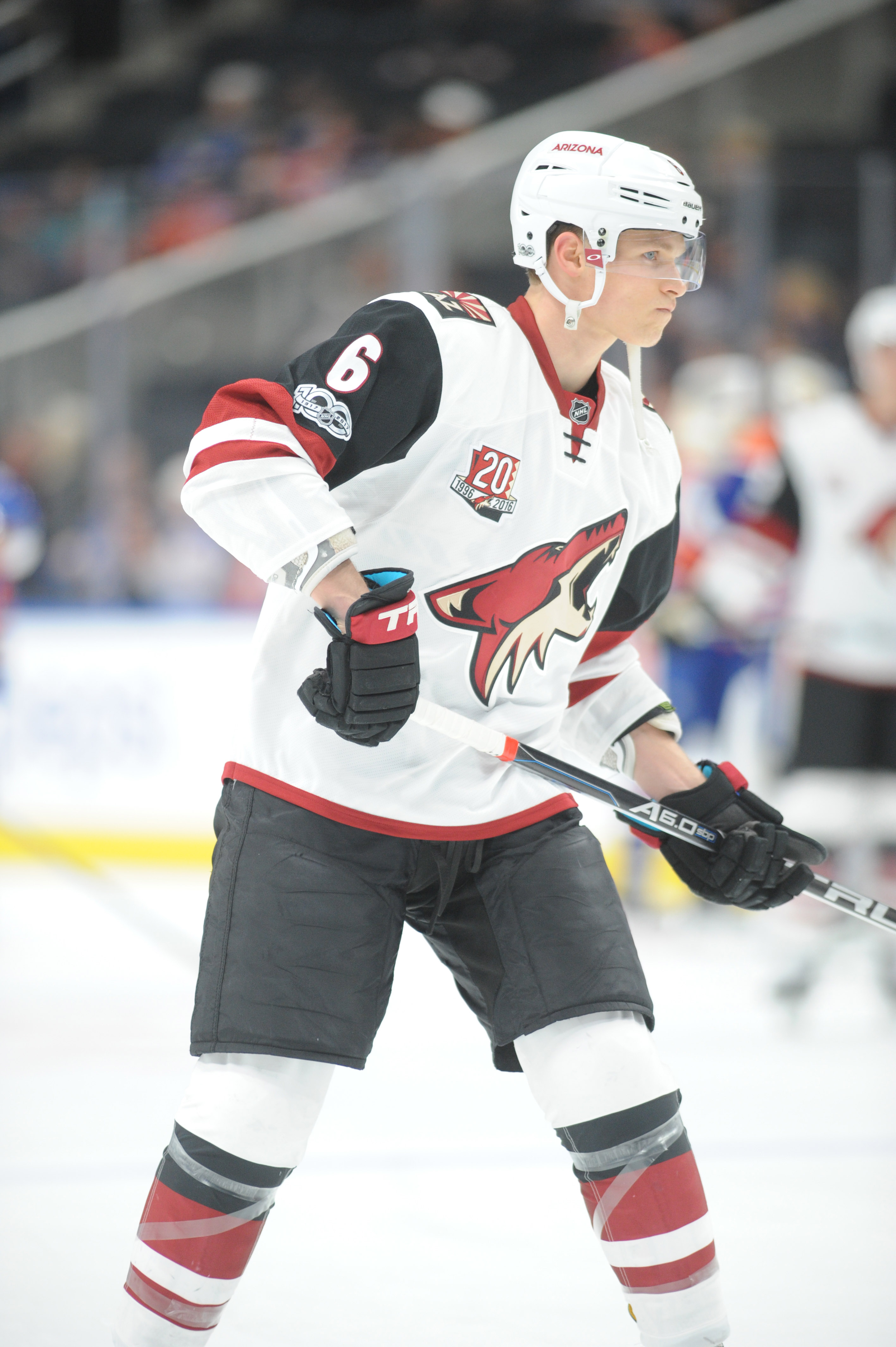 That’s huge news for the Coyotes but also is extremely important for Chychrun, who is heading into the final season of his entry-level contract without an injury-free season under his belt. The 20-year old defenseman has played just 68 and 50 games in his first two seasons, limited by two major knee injuries already. While he’s been impressive in his ability to recover from surgery, he needs to prove that he can stay on the ice for an entire season before the team commits to him going forward. He’s shown an ability to log top-four minutes in the NHL even as a teenager, and now must start to fulfill his extremely high potential and dominate the league.
Chychrun dropped to 16th overall during the 2016 draft, but many felt that was due to overexposure and perhaps some disinterest during his final year of junior hockey. He had long been projected as a potential top pick given his obvious talent at both ends of the rink, but saw Olli Juolevi, Mikhail Sergachev, Jake Bean and Charlie McAvoy all go off the board ahead of him on draft day. He’s played more NHL games than any of them—in fact Juolevi and Bean are still waiting to make their debuts—but hasn’t quite shown his full potential in Arizona. With Oliver Ekman-Larsson signed to a huge extension, Chychrun could provide the Coyotes with a rock solid second option on the left side for many years to come.
Photo courtesy of USA Today Sports Images
The Case For Expanding NHL Rosters
Last week, the NCAA passed a rule change allowing hockey teams to dress 19 skaters per game. Rather than the typical 18-man lineup – six defensemen and twelve forwards (not including goalies) – each squad is now allowed an extra man that can be used at either position. The college level is after all a developmental league and the ability to expose another player to game action each night benefits the growth of a greater majority of the roster. Yet, this rule change is one that could also benefit the NHL. For a variety of reasons, the league should consider expanding the allowable number of players who may dress for a game.
The first, and perhaps the most glaring reason, to consider this change is that hockey is the only mainstream sport that doesn’t allow an extra player to enter the game that doesn’t fit neatly into the lineup. Yes, hockey does have a large roster of 18 skaters and yes the lines and pair do substitute one another all game long. However, consider football, which has 11 starters on offense and 11 starters on defense for a 22-man starting roster that also substitutes one another. Yet, NFL game day rosters are 46 men deep, more than double the amount of starters. The same goes for lacrosse (field lacrosse), a more similar game to hockey, as only nine men play in the field but the average active roster in the NCAA is 44 players, nearly five times the starting roster. Even soccer (11 men in the field) and baseball (nine batters) allow for multiple substitutes who weren’t a part of a rather large starting lineup. Why then should the NHL limit teams to using only the 18 skaters who fit nicely into four forward lines and three defensive pairs?
There is also the fact that the NHL has reached a point that it needs to accommodate more talent at both ends of the spectrum. Young players often don’t have an easy fit on a roster. Developing offensive forwards may not yet have the ability and awareness for a top-nine role, but they certainly can’t help the team or themselves on the checking line. Young defensemen may not be ready to play major minutes against elite talent at the top level, but that doesn’t mean they aren’t ready at all. With the league trending in a more youthful direction, teams could drastically improve their development of certain players if there was an alternate choice between giving a prospect a starting job, sitting him in the press box, or banishing him to the AHL or back to juniors. If teams could slowly bring along pro-ready prospects by giving them the “extra slot” that the NCAA has approved, limiting their ice time and situations but exposing them to NHL action, it would likely be a popular move. However, some teams may instead like to use that slot on a veteran specialist. Just look at the current free agent market: last week we identified more than 40 useful players still available, yet the results of our poll strongly predict that less than ten of those players will find NHL employment. That might not be the case if each team had an extra slot to fill with an experienced penalty-killing forward or power play quarterback for example. Each off-season, more and more capable veterans go unsigned while teams still have needs due to roster limits alone. These players would rather not retire or move overseas, but they have often outgrown the minor leagues as well. Being that spare part on an NHL club would be an optimum fit.
For more evidence on the overflowing talent in the NHL, see the Vegas Golden Knights. An expansion team filled with rejects, young and old, managed to make it to the Stanley Cup Final in their inaugural season and used 35 different players along the way. Even when the league likely adds another expansion team in Seattle in the next year or two, there will likely still be players – young and old – capable of playing in the NHL but without ample opportunity. Just by allowing one more player in the game each night, it will create more opportunities for many different types of players.
The easy way to refute the idea of expanding rosters is the salary cap. Expanding the number of players who dress for a game to 19 would likely mean expanding the roster limit to 24 players and thus increasing the salary cap ceiling in turn and the owners won’t go for that. Not so fast though; with the bulk of this off-season complete, CapFriendly projects that just six teams will enter the upcoming season with less than $2.4MM in cap space, the average NHL salary last season. Consider that the “extra man” will likely be an entry-level prospect or a discounted veteran and there is a case that nearly every team in the league (except for the St. Louis Blues) could add another player right now without touching the cap. Those that would rather push to the cap with just a 23-man roster would also be welcome to do so – the league mandates a maximum roster size, but not a minimum. Teams that carry the maximum 23 players on their roster already have three players that don’t dress each night and could simply make one of them the 19th man.
The NCAA seems to be on to something with expanding game day rosters in hockey. Most sports have this option and the NHL should too. While there is no underestimating the importance of chemistry to the game of hockey, having an alternate or strategic extra man makes a lot of sense. Be it a raw young player, a specifically-skilled veteran, a bench player there as an injury replacement, or even a playoff contender using the spot for a hired gun, there are many ways that an expanded roster could benefit prospect development, elongate careers, improve game play, and simply increase overall interest and excitement due to the strategy of it all. It’s time the league take a look at the possibility.
Snapshots: Pacioretty, Lucic, Simmonds, Vilardi
The Montreal Canadiens look like they have no choice but to trade their star player in Max Pacioretty. With the 29-year-old entering the final year of his contract and little interest from Montreal to lock him up to a long-term deal, this is their only chance to move him. However, what makes things challenging for general manager Marc Bergevin and the Canadiens is that Pacioretty is coming off a disappointing year in which he produced just 17 goals in injury-plagued season after posting four straight years of 30 or more goals.
However, time is not Bergevin’s friend and the team has little choice but to try to move his contract now rather than wait to trade him as a rental in February. NBC Sports Joey Alfieri suggests five teams that might be good fits for Pacioretty with the Chicago Blackhawks leading the way. Pacioretty would be the perfect fit for Chicago considering the team’s biggest acquisition this offseason has been backup goaltender Cam Ward. However, the Blackhawks might be challenged to put together a quality package for Pacioretty.
However, another more interesting option would be the New Jersey Devils, who have the cap space to make it work and Pacioretty, a native of Connecticut – a mere 70 miles away — might be willing to stay with a team that already has an intruiging cast including Hart Trophy winner Taylor Hall.
- In a recent podcast on Spittin’ Chiclets, Edmonton Oilers forward Milan Lucic talked about his disappointing season in Edmonton which has his name and his contract being thrown around in potential trade rumors. Regardless, Lucic had nothing but great things to say about the Oilers’ organization and takes a lot of the blame for his poor season. Lucic, who signed a seven-year, $42MM deal in 2016, still has five years remaining at $6MM AAV. However, after posting 23 goals and 50 points in the first year of his deal, Lucic’s numbers took a nosedive as he tallied just 10 goals and 34 points and he didn’t miss a single game all season. “I think it was definitely more of a mental thing,” Lucic said. “It was almost like everything that could have gone wrong went wrong for our team and for me personally and it was the snowball effect or the quicksand effect. I think my mindset got very negative last year. So I was almost my own worst enemy, where this year I’m just going in with a happy, healthier mindset.”
- Dave Isaac of the Cherry Hill Courier-Post writes that Philadelphia Flyers general manager Ron Hextall has kept a close on the New York Islanders and John Tavares situation and isn’t interested in letting any of his players go. With winger Wayne Simmonds entering the final year of his contract, will probably price himself out of Philadelphia and the fact that he likely will end up on the team’s third line this year, don’t be surprised if Hextall trades Simmonds at the trade deadline next year. The 29-year-old has put up 28 or more goals for the past four years in Philadelphia, but struggled with nagging injuries last year, tallying 24 goals.
- The Athletic’s Lisa Dillman reports that Los Angeles Kings prospect Gabe Vilardi will not be participating in the World Junior Showcase for Hockey Canada after Vilardi suffered a back injury. While not considered serious, Vilardi has had issues with his back before as he missed all but 32 games this past year with the OHL Kingston Frontenacs. Vilardi, the team’s first-round pick in 2017, will have a chance to break into the Kings’ lineup if he has a good showing in training camp.
Vegas Golden Knights Building Winner From Within
The Vegas Golden Knights had an incredible season last year, but with just one offseason between a Stanley Cup Finals appearance, there are many who feel that the Golden Knights fortunes are folding. A recent poll by PHR that asked what NHL playoff team won’t make the playoffs next year has the Vegas Golden Knights receiving the most votes after the team allowed James Neal and David Perron to walk away this offseason. Much of that has to do with Neal’s 25 goals last year, while Perron himself contributed 50 assists in Vegas.
Yet, the Vegas Golden Knights, aside from signing center Paul Stastny to a three-year deal, have made it clear they don’t want to be locked into long-term deals and would prefer to see their young players continue to grow. That’s why the team let Neal go to Calgary for five years and Perron to St. Louis for four. Instead, the team feels they can build from within. The only reason that Vegas didn’t trade Neal and Perron away at the trade deadline is the team decided they would use them as their own rental players, which seemed to have worked as they went to the finals.
While the team probably has to wait another year for their top prospects in Cody Glass, Nick Suzuki, Erik Brannstrom and Nicolas Hague to start paying dividends for the team, the Golden Knights already have two players in place who they know are ready to take that next step as the team expects to move Alex Tuch and Tomas Tatar up to the second line, according to Gary Lawless of NHL.com.
Tuch, who came over in a trade with the Minnesota Wild in an expansion draft deal, played a big role on the team’s third line last year and often got playing time on the second line while Neal and/or Perron were injured. The 22-year-old winger is eight years younger than Neal as well as two inches taller. Tuch posted 15 goals, playing just almost two minutes less than Neal. Tuch’s 37 points was just seven shy of Neal’s totals of 44 points. And Tuch doesn’t have Neals’ injury issues, which kept the veteran out of 11 games last season.
Tatar came over at the trade deadline as the team unloaded a first, second and third-round pick to acquire the 27-year-old winger, but he struggled to adjust to the Golden Knights lineup and found himself a healthy scratch during much of the team’s playoff run and even when he did play, he only saw time on the team’s third line. Regardless, Tatar has proven to be a capable winger, who has tallied 19 goals or more for five straight years. With a full training camp to adjust to the team, it’s extremely likely, he should be able to take a bigger role on Vegas’ second line as well.
Lawless also suggests that fourth-line energizer Tomas Nosek is another candidate to take a larger role next season and could blossom in the right situation. The 25-year-old center has been one of the keys to Vegas’ successful fourth line, but only averaged 11:06 of playing time through the season, posting seven goals. However, his presence is the playoffs suggests he could be ready for an increased role after scoring four goals in 17 games.
Throw in the fact that many of their players are just starting to hit their prime, most of their players should continue to improve and get better.
Concerns Remain About Corey Crawford’s Health
The other day, Mark Lazerus of the Chicago Sun-Times spoke with Blackhawks head coach Joel Quenneville, who admitted that he won’t be carrying three goalies this season. With veteran Cam Ward now in the fold as backup, Lazerus took that to mean that young Anton Forsberg could be the odd man out, likely to be placed on waivers prior to the start of the season. Now, after speaking to the starting goaltender himself, Corey Crawford, Lazerus could be changing his tune. Although he was limited to only 28 appearances last season due to injury, Chicago has been confident that Crawford would be fully ready to begin the 2018-19 season. Not so fast says Crawford; the two-time Jennings Trophy winner admits that he is still not back to 100%.
Since before the disappointing 2017-18 campaign even came to an end, the Blackhawks have been adamant that Crawford would be back for training camp and the start of the upcoming season. Despite the fact that Crawford did not see any action after December as his recovery dragged on through the second half of the year, the team had all but assured the fans that he would be the Opening Night starter. To that promise, Crawford told the press this weekend:
“That’s hard to say right now, but it’s very possible. We’ve come a long way in the last couple months, and there’s a really good chance that could happen… (I am) feeling pretty good right now, [but] I am not at 100 percent yet… Treatments are going well, and we’re making small steps. And I’m getting a little better, so it’s a process,” he said. “It’s been a process since I left in December. It hasn’t been easy.”
Clearly, Crawford is heading in the right direction, but his own apprehension – as well as the strong emotions Lazerus noted – indicate that this injury saga may not be over just yet. Crawford’s injury has never been specified by the team, but whatever it is has taken a lot of work to get through. Crawford has no doubt that he will back to his old self at some point, but he just isn’t sure when that will be.
The Blackhawks desperately need Crawford to be back at his elite level as soon as possible and in shape to avoid further injury. Much of their struggle last season came from incompetent goaltending after Crawford, who began the year with a stellar .929 save percentage and 2.27 GAA, went down. Forsberg, Jean-Francois Berube, and Jeff Glass all struggled immensely in his absence, although Forsberg was the best of the three. Ward is a step up as backup and he and Forsberg could carry the torch for a short period, but a healthy Crawford is the only way that Chicago gets back to the postseason this year. That makes his news all the more troublesome for Blackhawks fans.
Poll: Who Is The Most Likely To Bounce Back The Best From Injury?
Injuries plague teams every year and are often hard to predict or prepare for. Yet every season, several key players find their seasons ruined due to an injury. While the league didn’t really lose a superstar player like the Tampa Bay Lightning did in 2016-17 when Steven Stamkos went down with a torn lateral meniscus in his knee and appeared in just 17 games. However, there quite a few players who went down for a chunk of time that definitely diminished their seasons. However, assuming everyone is back healthy, who will come back and have the best season next year?
Among those that missed the most time include Jeff Carter of the Los Angeles Kings, who missed 55 games with a leg injury. The 33-year-old posted a solid 13 goals and 22 points in 27 games when he returned and should be poised to put up big numbers next season, centering the second line likely alongside Tanner Pearson and Tyler Toffoli. The question is when will Father Time catch up with him. Speaking of Father Time, San Jose Sharks center Joe Thornton missed quite a bit of time in the second half of the season when he suffered a knee injury that knocked him out for 35 games. The 39-year-old posted 13 goals and 36 points last season in just 47 games and could put up more impressive numbers if he can get in a full season.
Several players suffered through injuries, but also saw their numbers decline due to the lack of success of their franchises, including the New York Rangers’ Chris Kreider. The 27-year-old was looked to a year ago to lead the team in scoring after he posted a 28-goal season in 2016-17, and had 11 goals before being diagnosed with a blood clot, requiring surgery. He came back to add another five, but was far from the star forward the struggling Rangers needed. Montreal Canadiens’ Max Pacioretty also struggled last year, posting just 17 goals in the first 64 games before going down for the season with a knee injury. That production was a far cry from the four straight 30+ goal seasons he has put together before that. Can he bounce back to form whether that’s with Montreal or another team?
The Rangers also were without their star defenseman Kevin Shattenkirk for 36 games with a knee injury. The team signed to a four-year, $26.6MM deal last offseason and was looked upon to quarterback the Rangers’ offense. However, the 29-year-old managed just five goals and 18 assists in 46 games. Defenseman Justin Schultz also didn’t produce the big season that the Pittsburgh Penguins were hoping for as the 28-year-old blueliner missed 19 games with a lower-body injury. He went from a 12-goal and 51-point season in 2016-17 season to just four goals and 27 points this past year.
Goaltending also has quite a few options on players hoping to bounce back and while the Chicago Blackhawks’ Corey Crawford might be an obvious candidate, the veteran goalie did post excellent numbers (2.28 GAA, .929 save percentage) before he went down with what is believed to be a concussion. However, Montreal’s Carey Price was struggling quite a bit when he went down with a concussion. Price, who had just signed an eight-year, $88MM extension last summer, did get into 49 games, but finished with a poor 3.11 GAA and a disappointing .900 save percentage. Price has bounced back before from a down season, so there is hope the superstar goaltender can bounce back. Finally Colorado’s Semyon Varlamov struggled with injuries the past two seasons, needing two hip surgeries a year ago and then had knee issues this year. In 51 games, Varlamov finished with a 2.68 GAA, but also now has to share duties with newly acquired Philipp Grubauer if he wants to bounce back, especially since he will be an unrestricted free agent in a year.
So which player will be able to rebound from injury and return themselves to an elite player?
Which injured player will have a bounce-back season?
-
Carey Price 25% (193)
-
Jeff Carter 23% (182)
-
Max Pacioretty 16% (122)
-
Justin Schultz 12% (91)
-
Kevin Shattenkirk 9% (69)
-
Joe Thornton 7% (52)
-
Chris Kreider 7% (51)
-
Semyon Varlamov 2% (17)
Total votes: 777
Pro Hockey Rumors app users, click here to vote.
The Contract Each Team Would Most Like To Trade: Part II
Nearly every team has one of those players: a top talent they were excited to sign and never thought could do anything but help them. In hindsight, history shows that more often than not, expensive, long-term free agent contracts don’t work out. It may look good at first (or it may look bad right away to the outside observer), but players struggle to make their value last throughout a lengthy contract. Those contracts come back to bite teams and are hard to get rid of. As teams begin to finalize their rosters at this point in the off-season, many are struggling to make everyone fit under the salary cap and are regretting these past signings that exasperate a cap crunch that can be tough for even a mistake-free club. We already took a look at the first third of the league; here are the contracts that each team would most like to trade, from Detroit to Ottawa:
Detroit Red Wings: Frans Nielsen – four years, $21MM remaining
As speculated by some readers in the comments section, it was no mistake that Part I ended with Dallas. Detroit deserved both some extra consideration and to lead off an article about poor contracts. There is an argument to be made that almost every single player age 28 and over on the Red Wings roster is signed to a bad contract for one reason or another. Detroit is a team that ranks towards the bottom of the standings and towards the top of the salary cap and that is not just bad luck. However, some are much worse than others and they are so bad that it is tough to choose between them. Take this scenario: Player A scored 35 points in 75 games last season. It was 14 points more than the season prior, including six more goals, and Player A also led the team in hits. He is 31 years old and signed for five more years at $4.25MM per. Player B scored 33 points in 79 games last season. It was eight points less than the season prior, and Player B also had the worst face-off percentage among the team’s centers. He is 34 years old and signed for four more years at $5.25MM per. Still undecided about which contract the team would rather trade? Player A is a Michigan native and career Red Wing and Player B is entering only his third year after signing a lucrative free agent contract. Player A of course is perennial whipping boy Justin Abdelkader. Yes, the Abdelkader contract is terrible. At no point in his career has he been worth his current contract value. Yet, he improved last season, is younger and brings a defensive element to his game, and is also loyal to the current administration – the call of the question after all is which contract the team would most like to trade. That would instead be Player B, Frans Nielsen, who at 34 is predictably declining and last year made more than Abdelkader for less production and there is no reason to believe that trend won’t continue. The team rewarded Adbelkader for years of service, whereas they took a gamble on Nielsen that hasn’t paid off. One of those moves is far more regrettable. Nielsen is the guy, but he only narrowly edged out Abdelkader and defenseman Danny DeKeyser, who also has relative age and Detroit roots to his advantage.
Edmonton Oilers: Milan Lucic – five years, $30MM remaining
The Oilers can refute trade rumors surrounding Milan Lucic all they want. The truth of the matter is that GM Peter Chiarelli signed Lucic hoping that he could both produce with and protect Connor McDavid in Edmonton as he did for David Krejci in Boston. The only problem is that the 30-year-old power forward can no longer keep up with a player of McDavid’s caliber. Lucic managed to score 34 points last season, tied for fourth on the team, but that is nowhere near what is expected of a $6MM player, especially when he scored 50 in year one with the Oilers and topped that mark many times with the Bruins. Edmonton still may be holding out hope that Lucic can turn it around and be just as much of a scoring threat as he is a physical threat, but make no mistake that the team would be quick to get rid of his contract if the right deal came along. In contrast, the team would be far more hesitant to move a hefty contract like defenseman Andrej Sekera who has been good and injury-prone, rather than healthy and underwhelming.
Florida Panthers: Roberto Luongo – four years, $18.13MM remaining
Florida is a tough one. Dale Tallon has done a good job of locking up his core long-term and, despite being right up against the cap, there are few egregious contracts on the roster right now. Give it a few years and maybe Michael Matheson will hold this title, but for now it goes to Roberto Luongo by default. Of course, Luongo is beloved in Florida and the team doesn’t even have to carry the whole of his cap hit, with the Vancouver Canucks retaining $800K each year. However, the reality is that Luongo will turn 40 this season and it will be only the first of four years left on his deal. The Panthers have almost $8MM committed to two goalies for the next few years and the other, James Reimer, is younger and outplayed Luongo in 2016-17 and in more games to boot. While they both fought injuries this past season, it was Luongo back on top performance-wise, but the impressive numbers he did post came in just 35 appearances versus Reimer’s 44. Florida paying over $4.5MM per year to a backup goalie in his forties just doesn’t make sense and the team would be better off moving forward with just Reimer and Michael Hutchinson if they could find a way to trade Luongo. Another reason this contract is bad: both the Panthers and Canucks will be hit with cap recapture penalties if Luongo retires prior to 2022.
Los Angeles Kings: Dustin Brown – four years, $23.5MM remaining
For the first time in years, Kings fans are feeling good about Dustin Brown. That is why now is the perfect time to trade him. Brown had been the bane of L.A.’s existence for four years, registering no more than 36 points each year while eating up $5.875MM in cap space, when he finally broke out of his funk in 2017-18 with a massive 61-point season and one of the league’s best plus/minus ratings. The question now is whether the past four years were an aberration with this season setting a new baseline or will Brown regress back to his bottom-six production. With a cap-strapped roster full of expensive contracts for older players, L.A. can’t take the risk of keeping Brown around if the right opportunity presents itself. They would be forced to trade the career King if a taker came forward rather than hold out hope that he doesn’t revert back to his old ways of being drastically overpaid.
Minnesota Wild: Zach Parise – seven years, $52.77MM remaining
When the Wild signed 28-year-old’s Zach Parise and Ryan Suter to matching 13-year contracts worth almost $100MM apiece, they knew that those deals would have dark days at some point in the future. However, they never could have imagined that Parise’s decline would come so soon. Parise remains one of the most popular players on the team, but injuries have kept him off the ice and affected his play when on the ice over the ice and his stock is falling quickly. Parise has never been able to reach the peaks he enjoyed in New Jersey, but he still produced at a high level over his first four seasons with the team. The past two years have been a different story and Parise appears to be trending in the wrong direction. Now 33, Parise isn’t totally beyond help and could turn it around. If back at 100%, Parise has enough natural ability and enough talent around him to still be a $7.5MM player. However, it would be nearly impossible for Minnesota to ever move the behemoth that is his contract so, if somehow they received an offer, they would take it without a second thought. Fan favorite or not, there is too much risk associated with Parise moving forward.
Montreal Canadiens: Shea Weber – seven years, $55MM remaining
I know what you’re thinking and yes, the Carey Price contract doesn’t look great right now. However, an extension of any length and value for any player coming off an injury-riddled season would bring a skewed perception. Price has been one of the best goalies in the league for years and one bad season doesn’t change that. Will he lose that title in the next eight years? For sure, but it would be a shock to see the Canadiens move their poster boy any time soon. Their #1 defenseman is another question though. When Montreal acquired Shea Weber for P.K. Subban, they never could have anticipated that his body would break down so soon after. Injuries cost Weber all but 26 games last season and he will miss the beginning of 2018-19 as well. Weber doesn’t seem like the type of player who will retire early, but there is no guarantee that these injuries won’t slow him down significantly for the remainder of his contract. In fact, the only guarantee is that he will slow down over the next seven years. At $7.86MM, the Canadiens need Weber to be his dynamic two-way self. The team already has one overpaid stay-at-home defenseman in Karl Alzner and can’t afford another. If they could move Weber, they would.
Nashville Predators: None
GM David Poile flat out doesn’t sign bad contracts. Criticize the deals for Ryan Johansen and Kyle Turris if you like, but the bargain contracts throughout the rest of the lineup have allowed Poile to overpay for reliable centers and that is a team-building model that anyone can get behind.
New Jersey Devils: Corey Schneider – four years, $24MM remaining
The easy answer is that the Devils don’t feel any pressure to trade anyone on the roster. They currently have the lowest payroll in the league with nearly every player signed to a fair deal. Those who are overpriced – Travis Zajac and Andy Greene – play important leadership role and the only player signed to a substantially long-term deal is electric young blue liner Damon Severson. The one and only player that sticks out as a potential long-term cap problem is starting goaltender Corey Schneider. This may surprises some; after all Schneider trails only Tuukka Rask among active save percentage leaders. Schneider had been elite since arriving in New Jersey, but something started to change in 2016-17. His SV% fell to .908 and his GAA inflated to 2.82 and then things only got worse last season with a SV% of .907 and a GAA of 2.93. He was also limited to just 40 appearances this year and was outplayed by journeyman Keith Kinkaid. The Devils can’t count on Kinkaid to repeat his 2017-18 performance moving forward and if Schneider’s back-to-back bad years are more than a fluke, they can’t depend on him for four more years either. He’s not going to be a $6MM backup either. New Jersey will give Schneider the time he needs to return to form, but they may not hesitate if the right trade comes their way as well.
New York Islanders: Andrew Ladd – five years, $27.5MM remaining
The Islanders without John Tavares are a totally different animal. A six-year, $30MM extension for Josh Bailey now looks bad. A $5.75MM cap hit this season for free agents Leo Komarov and Valtteri Filppula signed to make up for Tavares’ lost production looks bad. The likes of Cal Clutterbuck, Casey Cizikas, and Matt Martin now look worse on a team that needs more offense and less grit. However, the one contract that looked miserable well before Tavares bolted to Toronto is Andrew Ladd and it is only going to get much worse. The veteran forward was intended to find chemistry with Tavares when he was signed to a seven-year, $38.5MM contract two years ago. Instead, Ladd has just 60 points over the past two seasons combined and has by all accounts been relegated to a bottom-six role. The 32-year-old will now be asked to take a bigger role in Tavares’ stead and that is a scary proposition. The Islanders aren’t in any cap trouble, but the team should be thinking rebuild and would likely take any offer at all to rid themselves of Ladd.
New York Rangers: Brendan Smith – three years, $13.05MM remaining
Has any free agent contract in recent memory soured as quickly as Brendan Smith’s? Smith signed a four-year deal with the Rangers last June and was expected to play a top-four role for the team for years to come. By February, he had been placed on waivers and buried in the AHL. Smith played in only 44 games with New York and saw less and less ice time as the season wore on and he continued to turn the puck over at an alarming rate and cost his team goals. Now what? One would assume that Smith will be given a second chance this season, but the relationship between he and the team may be beyond repair. There is no doubt that the Rangers would take a re-do on that deal and would move him if possible. Marc Staal is another player that New York wouldn’t mind moving, but as a player who can eat minutes and provide solid play most of the time, his $5.7MM contract seems like nothing next to Smith’s $4.35MM deal.
Ottawa Senators: Bobby Ryan – four years, $29MM remaining
No contract in the league has become as notorious for being labeled a “bad deal” that the team is desperate to trade like Bobby Ryan’s. The Senators are so determined to move on from Ryan that they are trying to force Erik Karlsson trade suitors to take the overpaid forward as well. At one point in time, $7.25MM per year for Ryan seemed like a fair deal. At 23 years old he was a 71-point player with the Anaheim Ducks and even after moving to Ottawa, Ryan started his tenure with three straight seasons in the 50-point range. However, the last two years have been very different. Ryan has only suited up for 62 games in each campaign and has looked like a different player on offense. At his best, he looks disinterested and lucky to be in the right place at the right time and at his worst he costs his team goals. Ryan has managed to register only 58 points combined over the past two years; he had 56 alone in 2015-16. Ryan may just need a change of scenery to jump start what used to be dynamic goal-scoring game, but the Senators don’t care about that. All he is to them is a waste of cap space and of owner Eugene Melnyk‘s dwindling wealth. They want him gone at any cost.
Look out for Part III of this three-part series early next week…
Petteri Lindbohm Signs In Switzerland
The St. Louis Blues have done a miraculous job of both adding talent – bringing in Ryan O’Reilly, David Perron, Tyler Bozak, and Patrick Maroon to name a few – and retaining their own restricted free agent assets this off-season. The team has already signed Joel Edmundson, Dmitrij Jaskin, Robby Fabbri, and Oskar Sundqvist to reasonable extensions and had just two RFA’s left to sign. However, one of those players has decided to go elsewhere to continue his hockey career. Defenseman Petteri Lindbohm will not re-up in St. Louis, but instead sign with Lausanne of the Swiss NLA. The team announced the transaction today, making the one-year contract official. The Blues will retain Lindbohm’s NHL rights.
Lindbohm, 24, will likely be missed by some in the Blues organization but not by others. Although the 2012 sixth-round pick out of Helsinki, Finland showed promise, he never could quite put it all together. Both injuries and inconsistency impacted the development of a player some saw as a future top-four defenseman. When healthy, Lindbohm showed a well-rounded two-way game at the AHL level, but never stayed at the minor league level long enough to impress for a whole season. In the NHL, Lindbohm simply struggled to produce when given an opportunity and too often found himself on the wrong side of goals. This past season, Lindbohm did not make an appearance with the Blues for the first time since coming over to North America in 2014, yet he also suited up for only 23 games with the AHL’s Chicago Wolves and posted only three points. He was ruled out for the remainder of the season in early January with a shoulder injury.
The Blues may have been willing to offer Lindbohm a minimum salary two-way deal, or maybe just an AHL contract with the San Antonio Rampage, just to see if Lindbohm could ever string together a whole season of healthy, high-end play, but it seems unlikely that they would have matched the salary and certainly not the type of role that Lindbohm will get with Lausanne. The Swiss club struggled in 2017-18, having to fight off relegation, and will likely throw Lindbohm into a top pair position right away in hopes that his talent can help to jump start the new campaign, especially with the risk that he could be struck by injury at any time. Playing alongside other NHL transplants like Dustin Jeffrey and Joel Vermin, Lindbohm will look not only to improve his own stock, but also prove that he can lead a team to the postseason.
With Lindbohm departing, St. Louis has just defenseman Jordan Schmaltz to sign before they their restricted free agents are all tied up. The Blues are bankrupt for cap space, looking at just a $285K margin right now per CapFriendly, but the team won’t carry 15 forwards as projected and the demotion of a Jordan Nolan or Chris Thorburn should be enough to fit Schmaltz in under the cap for the coming season.