
Nikolay Goldobin's Performance Led To Sam Gagner's Waiver Placement
It was the performance of winger Nikolay Goldobin at training camp that ultimately led to Sam Gagner’s surprise placement on waivers, GM Jim Benning told Sportsnet’s Iain MacIntyre. The 23-year-old Russian is now waiver-eligible and the team also didn’t want to risk losing him for free on the waiver wire where there was a good chance he’d have been claimed. However, the Canucks now have to pay Gagner $3.5MM in salary this season to play at the minor league level, something that owner Francesco Aquilini acknowledged that he wasn’t particularly pleased about. It’s not even Vancouver’s farm team that will benefit from Gagner’s services as he was loaned to Toronto’s AHL squad instead. Meanwhile, Goldobin is rewarding Vancouver’s faith him with a strong showing to start the season as he has three points through the first four games so while the decision was an expensive one for ownership, it looks like the right one so far.
Vancouver Canucks To Retire Sedins’ Numbers
Vancouver Canucks fans were given an exceptional memory at the end of last season when franchise icons Daniel and Henrik Sedin played in their final game at home. The two combined for two goals and two assists—split just as you’d imagine between the twins, with Daniel scoring both—including the game-winner in overtime, and on the powerplay no less. The two would skate several laps around the rink to say farewell to their city and fan base, before eventually officially announcing their retirement at the conclusion of the season.
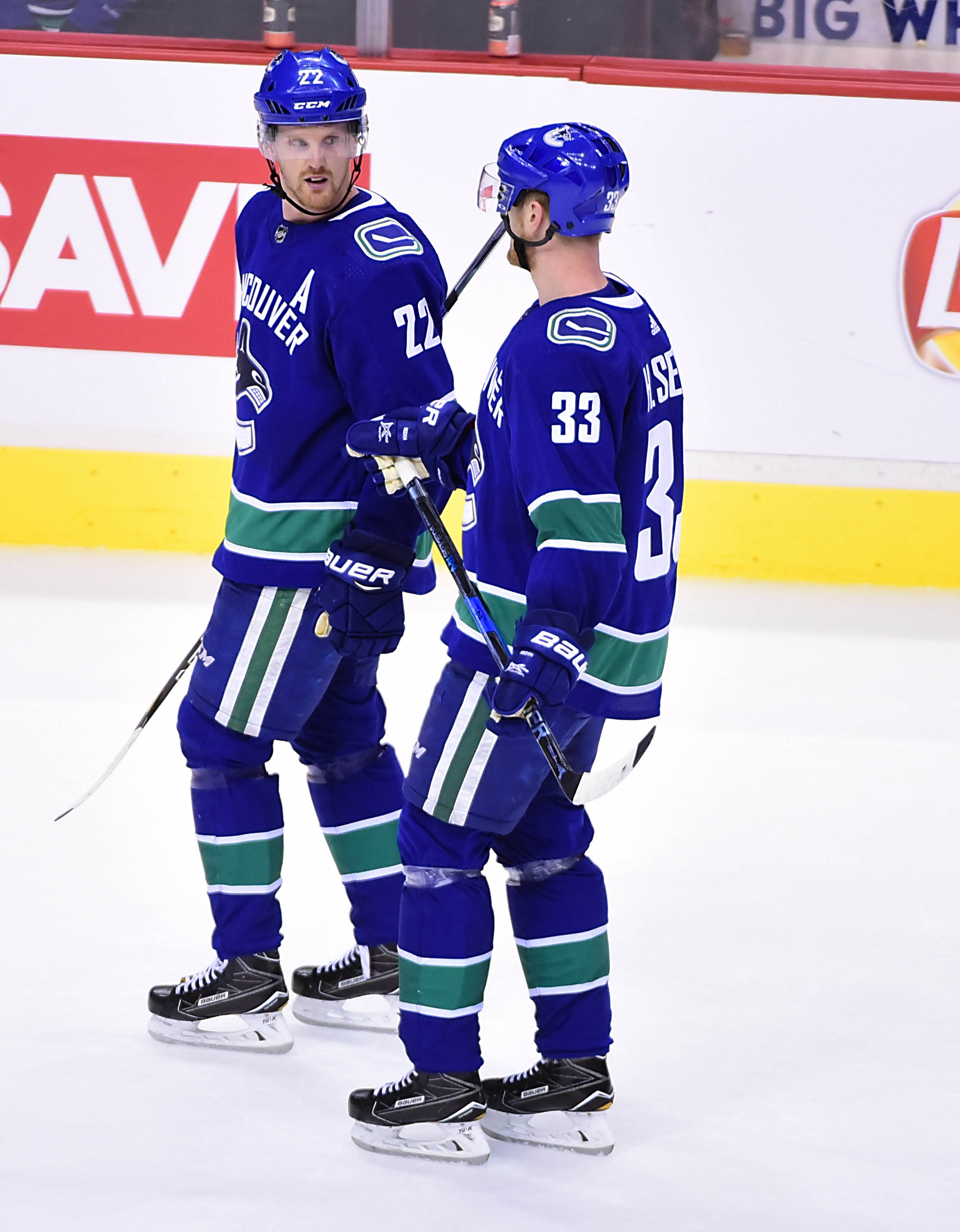 Now, the Canucks plan on giving a memory back to two of the best players in franchise history, and retire their numbers to the rafters. Owner Francesco Aquilini was on Sportsnet radio this morning and explained that the team is planning on holding the ceremony during the 2019-20 season during their 50th anniversary celebration. That doesn’t mean just a single moment on the ice though, as Aquilini explained:
Daniel and Henrik are a big part of this community. They’ve given back so much, I mean they’re just iconic players. Iconic players and iconic people, they’re just amazing. So we’re going to really do something special for them, and it’s not just going to be one night, it could be like a week’s long festivities.
The Sedin twins were the faces (or is it just face?) of the Canucks franchise for nearly two decades following the draft floor magic that then-GM Brian Burke worked to secure both of them. Selected second and third overall in 1999, they finished with nearly identical career point totals—though accomplished in different ways—and each won an Art Ross Trophy as the league’s highest scorer. Interestingly, only Henrik won a Hart Trophy as league MVP and only Daniel won a Lester B. Pearson Award (now Ted Lindsay Award) as Most Outstanding Player as voted by his peers. Inseparable both on the ice and in any hockey fan’s memory, they’ll see #22 and #33 go up to the rafters together next season.
Photo courtesy of USA Today Sports Images
Snapshots: Gagner, Despres, Flyers, Bruins-Red Wings
Count Sam Gagner among the many of us surprised by his waiver placement and subsequent loan by the Vancouver Canucks. Sportsnet’s Luke Fox recently sat down with Gagner, now re-located to Toronto to play for the AHL’s Marlies this season, and found that the veteran forward “didn’t see it coming”. Just one year into a three-year, $9.45MM contract, Gagner said he was “shocked” that the Canucks had decided to move on so quickly. “I came to camp prepared, I had a really good summer of work, I did well on the [fitness] tests, I thought I played pretty well in pre-season…”, but it was all for naught, as Vancouver decided to move forward with their young players, leaving Gagner as the odd man out. To make matters worse, the Toronto native had just re-located his young family to Vancouver, only to get reassigned to Toronto, where he currently lives with his parents. Gagner has been a serviceable albeit streaky player throughout his playing days, but after this surprising and unfortunate shift in his career, one can only hope that a more permanent solution for Gagner and his family comes around sooner rather than later.
- TVA’s Renaud Lavoie reports that veteran defenseman Simon Despres has opted not to sign with the AHL’s Laval Rocket. Despres, a former first-round pick and NHL regular with the Pittsburgh Penguins and Anaheim Ducks, struggled with injuries and was more or less forced out of the league in recent years. After finally returning to full health last season and performing well with the KHL’s HC Slovan Bratislava, Despres expressed an interest in returning to the NHL this year. Interestingly, he specifically mentioned his interest in the relatively new AHL franchise in his hometown of Laval and signed a PTO with the Montreal Canadiens this summer in hopes of landing a two-way contract where he could play in Laval and potentially work his way onto the Habs’ roster. He fell short of that goal, but a one-way AHL contract with the Rocket seemed like the next-best thing. Instead, Lavoie indicates that Despres has chosen the unknown over minor league certainty. He has no plans for the season right now, but won’t be accepting an AHL contract and could certainly entertain offers back in Europe.
- The Philadelphia Flyers have announced their support group for captain Claude Giroux, naming their alternate captains for the season. Wayne Simmonds, an impending free agent but a fan favorite and respected veteran, will wear the “A” at all times this year. On the road, the elder statesman of the blue line, Andrew MacDonald, will serve as an alternate. Back at home, 2017-18’s breakout star Sean Couturier will be the other alternate. With a substantial number of young players playing key roles for Philly, their leadership corps has an important role to play if the Flyers are to be contenders this season.
- The Bruins have made things easier for Boston sports fans this Saturday. With the Boston Red Sox eliminating the New York Yankees in the ALDS on Tuesday night, the team moves on to the ALCS to face the Houston Astros with Game One taking place on Saturday night. The Bruins were also scheduled to play on Saturday night, facing the Detroit Red Wings at 7pm ET. However, the team announced that they have re-scheduled the game for 3pm ET to avoid the conflict with the Red Sox game. Head coach Bruce Cassidy recently spoke about his support for the Bruins’ baseball counterparts and the privilege of coaching in a city with so much fan support and success across all four major sports.
Snapshots: Edler, Montreal, Kesler
The Vancouver Canucks have had an interesting start to the year, with impressive performances from rookie Elias Pettersson but bad losses at the hands of the Calgary Flames and Carolina Hurricanes. The team has allowed 14 goals in three games, and is busy shaking up their blue line to try to find answers. One player that won’t be taken out of the lineup because of his play is Alexander Edler, but there might be a break-up coming down the line anyway. Edler is scheduled to become an unrestricted free agent at season’s end, but has made it clear he wants to spend the rest of his career in Vancouver.
Still, as Elliotte Friedman of Sportsnet points out in his latest 31 Thoughts column, Edler would be an attractive rental piece at the trade deadline for a contender. The 32-year old defenseman is averaging more than 25 minutes of ice time through the first three games and is coming off his most effective offensive season in some time. Friedman notes that the Tampa Bay Lightning has shown interest in the left-hander before, and that “someone” will again even if he’s determined to return to the Canucks in 2019-20.
- The Montreal Canadiens will face a tough decision in the coming days, as Eric Engels of Sportsnet writes that the team will likely put either Jacob de La Rose or Nikita Scherbak on waivers once the former is back to full health. Both high draft selections, neither player has really found much consistency in the NHL and even their youth can’t get them into the current lineup. Engels believes that both would be prime targets for a waiver claim, given that they still hold some substantial potential. There are obviously other ways out of the roster crunch, but if it does come down to a waiver placement and attempted minor league assignment, the Canadiens could find themselves losing some of their forward depth for nothing in the coming days.
- Ryan Kesler was on the ice at the Anaheim Ducks morning skate, and even took line rushes between Andrew Cogliano and Kiefer Sherwood according to Josh Cooper of The Athletic. The veteran forward was not expected to return so soon, and head coach Randy Carlyle wouldn’t even confirm that he’ll be in the lineup tonight against the Arizona Coyotes. If he is back to health it’s at the perfect time as the Ducks are without Ryan Getzlaf and are struggling to find much offense up front. An expected Stanley Cup contender, the Ducks have been ravaged by injuries early and could use some good news on that front.
2018-19 NCAA Players To Watch
Just like their professional and junior counterparts, the college hockey season is underway. With each passing year, the NCAA’s influence on the world of hockey grows. The NHL boasts more than a few top rookies fresh out of the college ranks this season and those still in school in 2018-19 will soon join them. This year’s crop of talent is sticking with the trend, with several players in need of watching:
The Recent Draft Picks
D Quinn Hughes, Michigan (VAN): Hughes very nearly signed his first pro contract with the Vancouver Canucks this summer before deciding to return to Michigan. The seventh overall pick back in June, Hughes was the second defenseman off the board behind top pick Rasmus Dahlin, and many even saw No. 7 as being a steal for Vancouver. An electric skater who can’t help but draw the eyes of spectators as he moves effortlessly around the ice, Hughes pairs his skating ability with the vision and positioning that makes him a threat in all three zones. Hughes also has an NCAA season under his belt already and should be even more prepared to dominate opponents this season. Hughes is a complete two-way defenseman and the centerpiece of a Wolverines team that was a Frozen Four finalist last year. Hughes himself could be eyeing the Hobey Baker Award this season. Michigan almost had Hughes’ younger brother and presumptive top 2019 pick Jack Hughes joining them this season, before he decided to stick with the U.S. National Development Program for another year before almost certainly turning pro.
F Oliver Wahlstrom, Boston College (NYI): Perhaps the most gifted goal scorer of the 2018 draft class, Wahlstrom was a late addition to BC’s freshman class, changing his commitment from Harvard, and the Eagles could not be happier. Wahlstrom is a rare combination of both high-end skill and hard-nosed play who dominated with the U.S. National Development Program last year. The right winger has had the attention of scouts for his puck-handling ability since he was nine years old, but as he’s grown up he has also filled out his frame and added a menacing physical element to his game. Wahlstrom can skate and possess the puck as well as anyone, but is even more of a threat as the go-to shooter, which he will be skating with a roster of play-makers up front for BC. Wahlstrom could be the next big NHL power forward and may very well be one-and-done in the NCAA if he continues to score at a torrid pace this year and force the hand of the rebuilding New York Islanders, who selected him with the eleventh pick this past year.
F Joel Farabee, Boston Univ. (PHI): Wahlstrom’s teammate with the U.S. National Development program last season, Farabee was the one feeding Wahlstrom most of the time with 43 assists to his linemate’s 48 goals. Farabee is now a cross-town rival of Wahlstrom’s as he joins the uber-talented BU Terriers. Farabee is a threatening presence in the offensive zone, but is even more dangerous due to his two-way ability. An extremely intelligent winger who is beyond his years in terms of decision-making and positioning, Farabee is as responsible a freshman forward as you can find in the NCAA. He may not light up the score sheet right away this year, but will no doubt make a difference for the title-chasing Terriers. Farabee’s style bodes well for an NHL career in Philadelphia, after the Flyers used the No. 14 pick on him in June.
F Jay O’Brien, Providence (PHI): Some considered it a reach when the Flyers used their second first-round pick on O’Brien, another college-bound forward and one who was coming from the prep school ranks with Thayer Academy. However, the 19th overall pick more than earned his draft slot after scoring 80 points in 30 games while also displaying an impressive two-way game. O’Brien now bring his talents to Providence, a program that lost their top two scorers from last season and are looking for their next star forward. O’Brien could emerge as both the top scoring threat and dependable defensive forward for the Friars in his first collegiate season. O’Brien is also ready to take on Hockey East competition with a gritty games that all Philly and Providence fans will appreciate.
The Soon-To-Be NHLers
D Cale Makar, UMass (COL): Few will argue that Makar isn’t the best prospect in the NCAA, if not the best drafted player not playing in the NHL. The smooth-skating defenseman was the fourth overall pick in 2017 by the Colorado and would be skating on the Avs’ top pair right now if he had not committed himself to Amherst and to entering the pros as well-rounded as possible. Makar possesses elite puck-handling skills and vision and can out-skate almost anyone in the college ranks. Makar should improve upon his 21 points in an up-and-down freshman campaign and could flirt with point-per-game production from the blue line. The newly-named UMass captain, along with talented fellow defenseman Mario Ferraro (SJS) and top forward John Leonard (SJ) have the Minutemen thinking NCAA Tournament for the first time in years, while Makar could easily be a Hobey Baker candidate.
G Jake Oettinger, Boston Univ. (DAL): Oettinger nearly turned pro this off-season, but returns to BU with his sights set on backstopping the team to a national championship. A first-round pick at No. 26 in 2017, Oettinger was selected by the Dallas Stars with the expectations that he would be the heir apparent in net. Even with the emergence of Colton Point, the Dallas job is still there for the taking. The team’s veteran duo of Ben Bishop and Anton Khudobin won’t be around forever and Oettinger could conceivably compete for starts as early as 2020. Expect the big goaltender to put up stellar numbers behind a deep Terrier defense this season before joining the pro ranks next year.
F Ryan Poehling, St. Cloud (MTL): Poehling was drafted for his intelligent, professional, two-way style and Montreal hoped he would develop into a capable bottom-six center. However, they have to be pleased with the improvement in his offense, after he registered 31 points in 36 games for a St. Cloud team that was top seed in the NCAA Tournament. Poehling lacks the high-end skill of other first-round prospects, but the 2017 No. 25 pick makes up for his skating and hands with positioning and composure. Poehling should again improve this season while maintaining his elite defensive play and could be in the running for the Hobey Baker Award, especially if the Huskies are dominant yet again. The Canadiens prospect should then compete for a roster spot right away next season.
The Trade Return
F Josh Norris, Michigan (OTT): The recent centerpiece prospect of the Erik Karlsson trade, a lot of eyes in Ottawa will be on the performance of Norris this season. The entire top line of the Michigan Wolverines’ Final Four roster has moved on to the pros, leaving Norris as the team’s top center. The No. 19 pick in 2017 by the San Jose Sharks, Norris is a freak athlete who can hold his own against anyone in the NCAA. The Senators’ new addition also has a deceptively quick release on his shot and is deadly accurate with both passing and shooting. Norris simply needs to embrace his role for Michigan, both carrying the puck and shooting more often. Some more experience, specifically as the team’s top scoring option, should go a long way for the promising center’s development.
F Shane Bowers, Boston Univ. (COL): Of course, who can forget the top center prospect that Ottawa recently traded away themselves. Bowers, part of the regrettable package that the Senators sent to the Colorado Avalanche for Matt Duchene, is set to be the go-to guy up front for BU this season. Bowers’ 32 points in 40 games last season ranked third last season for the Terriers, but with Jordan Greenway and Brady Tkachuk now gone, Bowers should be the top option and could be a dark horse Hobey Baker candidate on a talented BU team that should provide plenty of scoring chances. Bowers is quick-thinking and quick-skating offensive presence who is especially dangerous on the power play and works the puck down low perhaps better than anyone in the college ranks. A breakout campaign for Bowers should give the 2017 No. 28 pick an opportunity to compete for a spot among the Avs’ young forward corps next year.
D Adam Fox, Harvard (CAR): Fox, entering his junior year with the Harvard Crimson, has already seen his NHL rights traded. Fox had allegedly expressed a resistance to signing with the Calgary Flames, but so far no such sentiment has been associated with his new team, the Carolina Hurricanes. Fox is a mature, intelligent defender who has been a point-per-game player in college and especially excels as a power play quarterback. However, Fox is more than capable on the back end as well. Assuming he is yet again producing a Hobey Baker campaign for Harvard this year, Fox seems like a prime candidate for a late-season contract and brief tryout with the Hurricanes. Carolina’s depth on defense may block him from being a full time NHLer for a few years, but when Fox finally does land that job, he has the complete game to be a dangerous presence on any blue line.
The Top Prospect
D Ben Brinkman, Minnesota: If there is one thing that the 2018-19 NCAA class lacks, it is many standout draft-eligible prospects. Brinkman alone is a candidate for early selection next June, but the Minnesota native is a surefire first-rounder. The Gophers have rarely given a true freshman defenseman the role and minutes expected of Brinkman this season, but the teen blue liner is a special talent. A smooth skater who excels with the puck on his stick, it will be no surprise to see Brinkman frequently carry the puck up and start the rush for Minnesota and he should see ample power play time as well. Brinkman is no slouch in his own zone either, as he plays a competent game that allowed him to shut down high school competition. The adjustment to the college level will come with some lumps for the young defenseman, but Brinkman should emerge from this season as a bona fide NHL prospect.
Evening Notes: 2020 World Cup, Luongo, Mantha, Hughes
NHL Deputy Commissioner Bill Daly said today that there is a chance there will be a 2020 World Cup, but one major obstacle is the collective bargaining agreement, according to The Athletic’s Corey Masisak.
With the collective bargaining agreement coming up, both the NHL and the NHL Players Association exercise their right to terminate the agreement next year. If either the NHL of NHLPA opts to do that, a World Cup would be “unlikely” to happen.
The last World Cup was in 2016 when Canada defeated Team Europe (a team made up of countries that didn’t make it into the tournament) in a two-game sweep of the best-of-three finals. If they can pull off a 2020 World Cup, it would be the fourth instalment. There was a World Cup in 1996 and 2004.
- The Florida Panthers may be without their starting goaltender again as Roberto Luongo was forced out of tonight’s game against Tampa Bay. NHL.com’s Corey Long writes that Luongo will not return after a scramble in front of Florida’s net when Panthers defenseman Mark Pysyk and forward Frank Vatrano collided in front of the net with Vatrano falling on top of Luongo’s right leg at 12:21 of the second period. Luongo, who had made 13 saves, needed assistance getting off the ice, which could force the injury-prone goaltender to miss some time again. James Reimer took over for Luongo.
- Dana Wakiji of NHL.com writes that Detroit Red Wings’ newly acquired veteran Thomas Vanek has been especially impressed by the play of Anthony Mantha and believes that the 24-year-old will develop into a top-line power forward sooner than later. “I think he can become the next power forward in this league,” Vanek said after the Wings’ practice Saturday. “His size, his skill-set, his skating, you don’t see that combination that much. He’s still young. The consistency is probably for all us, still not quite there, but he can become a real good power forward in this league.” The winger posted 24 goals last season and at 6-foot-5, 225 pounds, is capable of doing more. He will play alongside Dylan Larkin this year, which should increase his chances of goal-scoring success.
- Ryan Kennedy of The Hockey News released his list of the Top 75 collegiate players with the Vancouver Canucks and the Colorado Avalanche owning the rights to the top two college players, Michigan defenseman Quinn Hughes and University of Massachusetts defenseman Cale Makar. Hughes, the fifth-overall pick in this year’s draft had 29 points as a freshman for the Wolverines last year, while Makar, the fourth overall pick in 2017, posted 21 points as a freshman last year for the Minutemen.
Antoine Roussel Participates In Practice For The First Time
- Canucks winger Antoine Roussel participated in practice for the first time since sustaining a concussion during offseason training, notes Postmedia’s Patrick Johnston. While there is still no firm timetable for his return, he is with the team for their six-game road trip which suggests he may get the green light at some point in that stretch. As Vancouver is at the maximum-sized roster, they’ll have to free up a spot before they can take him off injured reserve.
Overseas Notes: Rodin, Haapala, Robak
Anton Rodin signed with the Anaheim Ducks this summer hoping to get a second chance at the NHL. Rodin had previously played for the Vancouver Canucks, without much luck. Rodin played in three NHL games and three AHL games in 2016-17 but was otherwise shut down for the year with injury. Then, upon failing to crack the Canucks’ roster last season, the two sides came to a mutual agreement on the termination of Rodin’s contract and he played out the remainder of the year back in Europe, again limited by injury. Unfortunately, history repeated itself in training camp this year, as Rodin was unable to land a spot with the Ducks. He requested a termination of his contract and cleared unconditional waivers last week. Now, Rodin seems to have already found a new home, returning to the Swiss club he played for last year, HC Davos. Swiss new source “Hockey News” reports that a deal is in place to bring Rodin back to Davos, where he will join fellow former NHLers Shane Prince and Anders Lindback. The former Swedish Hockey League MVP reportedly had interest from clubs throughout Europe, including the KHL and other NLA teams, but opted for familiarity, returning to Davos. While his experiments with the NHL are likely over, hopefully the talented winger cans stay healthy and return to his status as one of the top players in Europe.
- By all accounts, Henrik Haapala is still technically under contract with the Florida Panthers. However, the former Liiga scoring leader has signed with HC Lugano of the NLA for this upcoming season, the team announced. The Finnish forward signed a two-year entry-level contract with Florida last summer and even played in five games with the Panthers. After 20 games with the AHL’s Springfield Thunderbirds, Haapala was loaned back to his Liiga club, Tappara, for the remainder of the season. However, he still had a year remaining on his contract and no deal in place with Tappara and was expected to return to Florida this season. Instead, Haapala didn’t even participate in training camp and now appears slated to spend 2018-19 with Lugano. There is no word on what this means for his contract status with the Panthers, but Lugano is happy to have him. The small, speedy winger has excellent play-making ability and has the potential to be a major contributor in the NLA.
- Former Florida Panther Colby Robak is also on his way to Europe, leaving North America for the first time in his career. Robak has signed with Vassan Sport of the Liiga in Finland, the team announced. Robak, a second-round pick in 2008, has not played in an NHL game since 2014-15, in which he split the yeat between Florida and the Anaheim Ducks, but has made a living as a veteran leader in the AHL. Apparently, his time in that role ran out, as Robak was unable to find another AHL contract this summer and has made the jump overseas. Sport finished dead last in the Liiga last year and get a major boost from Robak’s arrival, as the experienced defender should easily become a leader for the team in their efforts to improve this season.
Prospect Notes: Rookies, Kyrou, ISS Rankings
After several years of incredible rookies stepping right into the NHL and making huge impacts, this year looks like it will be no different. Young players all around the league have huge expectations, and Corey Pronman of The Athletic (subscription required) took to ranking those who can qualify for this year’s Calder Trophy. Pronman leads things off with Vancouver Canucks phenom Elias Pettersson, and puts another 67 in order before mentioning some other potential call ups.
Pettersson of course is coming off an incredible season in the SHL in which as a teenager he led the entire league in scoring with 56 points in 44 games. That production didn’t slow down in the playoffs, where he scored another 10 goals in 13 games and was named playoff MVP (after already taking that honor during the regular season as well). A World Junior silver was outdone by his World Championship gold, making his one of the most successful seasons ever by a junior-aged player. He’ll try to continue that impressive stretch with a debut for the Canucks this evening.
- Another name on Pronman’s list, though a little further down is Jordan Kyrou, who will make his debut with the St. Louis Blues tomorrow night. GM Doug Armstrong spoke with reporters including Jeremy Rutherford of The Athletic, and explained that while he expected Samuel Blais and Robert Thomas to push for spots in camp, Kyrou was the one who really impressed and “opened their eyes.” If today’s practice lines are any indication, Kyrou will start on a line with Jaden Schwartz and Brayden Schenn to start the year, and incredible opportunity for the 20-year old winger as he starts his professional career.
- Looking ahead to draft season, ISS Hockey has released their Top 31 prospects for the 2019 Draft and like everyone else have Jack Hughes in the top spot. Hilariously the scouting service still has Hughes listed at 5’1″ 152-lbs—he’s actually more like 5’10” 170 lbs—but that didn’t stop them from putting him ahead of Kaapo Kakko and Dylan Cozens. The race for second overall seems to be on between those two forwards, but there are several names that could push to get into the conversation before long.
Canucks Loan Sam Gagner To AHL’s Toronto Marlies
To add insult to injury, Sam Gagner will not start the 2018-19 with the Vancouver Canucks or with their fellow depth options on their AHL team, the Utica Comets. Gagner, who cleared waivers today, has been loaned to the AHL’s Toronto Marlies, the Canucks announced. Vancouver retains the right to recall Gagner, but normally a reassignment like this is an indication that ties have been cut between the player and the organization.
To be clear, this loan is a favor to the veteran forward. While it stings that Gagner, 29, is not in the Canucks’ plans moving forward, they did him the courtesy of sending him home to Toronto, where he and his wife are raising a young family. A reassignment like this is rare, but not unheard of; for the second season in a row, the Buffalo Sabres sent forward Matt Moulson to the Ontario Reign of the AHL, the Los Angeles Kings’ affiliate, to be closer to his family in California. There is no exchange of assets and no financial strings attached in such a move, as Gagner will simply log his AHL minutes for the Marlies instead of the Comets while counting for $2.125 against Vancouver’s salary cap as a buried player, as opposed to his full $3.15MM cap hit.
Gagner was the biggest surprise of this fall’s preseason waiver wire. The talented forward just signed a three-year contract with the Canucks last summer and registered 31 points in 74 games in his first season. His production was not incredible, but it was far from egregious. He managed to maintain a top-nine role and was one of Vancouver’s top shot-producers, with a 6.1% shooting percentage that was the worst of his career and was bound to regress positively. Gagner has proven throughout his up-and-down career to be perhaps the most system-specific player in the NHL. In the right role in the right scheme with the right mix of players, Gagner has been a potent play-maker and offensive asset. He set a career high of 50 points with the Columbus Blue Jackets just two years ago and was a perennial 40+ point player to begin his career with the Edmonton Oilers. Yet, his production tailed off in Edmonton as the team’s composition began to change and he struggled mightily with the Philadelphia Flyers in 2015-16, managing just 16 points. The remains of his current contract are not an attractive attachment, but it still remains a bit of a surprise that Gagner was unclaimed on waivers given his history of having a high scoring ceiling in the right system.
This very well might not be the end for Gagner, though. At just 29, he still has the potential to play for a lot longer. Like Moulson, he very well could be one of the top scorers for his on-loan club but, unlike Moulson, maintains value around the league and could use his minor league performance to his advantage. The defending champion Calder Cup winners will give Gagner the chance to show off his ability and, with or without an uptick in shooting luck, should be able to dominate at the AHL level. Meanwhile, the Canucks would have little reason not to entertain trade offers. Even in a potential trade with retained salary, Vancouver stands to benefit rather than his current cap hit as a buried veteran. Gagner will remain an intriguing name permanently on the trade block until there is a resolution to his current situation.