
Is There Any Hope For The Sabres?
The Sabres have reached a point where they could be considered contenders alongside the New York Jets and Cleveland Browns of the NFL, and the NBA’s Charlotte Hornets for the title of the saddest team in sports. Few NHL teams have caused more misery for their fans, as the Sabres once again find themselves at the bottom of the standings. It’s safe to say new general manager Jarmo Kekäläinen is walking into one of the most unenviable situations in hockey.
Buffalo has been trying to turn the corner on a rebuild that feels like it’s been ongoing forever, but it’s actually been two separate rebuilds. The team showed promise a few years ago, narrowly missing the playoffs in what has become an annual tradition—no postseason hockey in Buffalo. The last time the Sabres made the playoffs, TikTok didn’t exist, and the NHL salary cap was $59.4MM. But it’s not just the lack of playoff appearances that is heartbreaking for Sabres fans; it’s the endless cycle of futility and star players either forcing their way out or choosing to leave at their first opportunity.
It wasn’t always like this; in fact, the Sabres were a genuine threat to win the Stanley Cup after the NHL lockout in 2005. Led by Daniel Brière and Chris Drury, both of whom became NHL general managers, the Sabres were a formidable force in the Eastern Conference and captured the President’s Trophy in 2007. They eventually lost to the Senators in five games in the Eastern Conference Final. That loss effectively marked the beginning of these years of futility in Buffalo.
The summer of 2007 saw Drury sign with the Rangers as a free agent, and Brière joined the Flyers. Neither player reached the same level of success they had in Buffalo, but without those two, the Sabres have never been the same.
Many people cite the summer of 2007 as the point when everything went wrong for Buffalo, while others point to the Pegula family taking control of the team in February 2011. The losses have accumulated over the past decade and more, and not just those on the ice. Most folks probably forget, but the 2007 Sabres were a buzzsaw—a team with top-end scorers and scoring depth for miles behind Drury, Briere, and Thomas Vanek; not to mention solid defense and Miller in the net. There was a lot of hype around the team, and the energy swept the city as the Sabres went on a deep run that ultimately ended in heartbreak.
All of that has led us to today’s version of the Sabres, who have been seen as a laughingstock in the NHL for the past 13 long seasons. From poor hires to bad drafts, to regrettable signings, and lopsided trades. Combine this with the complete mishandling of a star player’s injury in Jack Eichel, and Sabres fans have endured it all, with no signs of relief in sight.
Even this year, the Sabres are tied for last in the Eastern Conference. All of this makes you wonder how long Buffalo’s current stars will want to stay and endure tough times.
Owen Power, Tage Thompson, and Rasmus Dahlin are all committed long-term to the Sabres, but Eichel was too, and we know how that turned out—with him winning a Stanley Cup with the Golden Knights. Eichel wasn’t the only young Sabres player to effectively push his way out of Buffalo.
Ryan O’Reilly didn’t force his departure, but he was traded to St. Louis in 2018, where he went on to win the Stanley Cup in 2019. Sam Reinhart wouldn’t commit to Buffalo in 2021 and was traded to the Florida Panthers, where he has won two Stanley Cups and become one of the best two-way centers in the NHL.
Just this past summer, forward JJ Peterka also wouldn’t commit long-term to the Sabres and was traded to Utah. Whether or not he wins a Cup remains to be seen, but it’s definitely a painful pattern in Buffalo.
The Reinhart situation is especially rough because the former second-overall pick wanted to stay long-term in Buffalo after his entry-level deal expired. However, it was the Sabres who chose shorter-term contracts of two and one year, and then faced a terrible 2020-21 season, after which Reinhart was the one unwilling to play through a rebuild.
It’s hard to say for sure if the Sabres are the saddest team in sports, but they’re giving the Jets, Browns, and Hornets a run for their money. Poor drafting and development, wasted money on overpaid free agents (Ville Leino), endless rebuilds, a lack of meaningful hockey, and constant management and coaching changes have created an environment of ongoing disappointment.
Is there any flicker of hope? Possibly. The Sabres have some young, talented players in Thompson, Power, and Dahlin. But they’ve been here too many times before, and Sabres fans are aware of this, yet credit to them—they keep showing up at the rink despite the increasingly bleak environment around the team. Will their core stay together? Will the team build out the depth? Or will Buffalo continue its streak of irrelevance?
These Pending UFAs Have Increased Their Stock
The 2026 UFA class had been highly anticipated for quite some time free agency even opened this year. That excitement only grew through July and August as many potential UFAs didn’t sign extensions with their current clubs. However, that feeling was quickly dampened in the fall as players like Kirill Kaprizov, Connor McDavid, and Jack Eichel began signing new contracts, taking the energy out of the 2026 free-agent frenzy. While many stars have signed new deals, a noticeable group of talented players is still set to hit the open market on July 1, 2026, with some having significantly boosted their stock after a strong start to the season.
Jack Roslovic has encountered two difficult situations in the UFA market, with the first ending in him signing a one-year, $2.8MM deal with the Carolina Hurricanes in 2024. His second attempt this past summer saw him join the Oilers for one year at $1.5MM. This year’s outcome was quite unexpected, given that Roslovic played well last season with 22 goals for Carolina, yet a multi-year deal that suited him never materialized. Roslovic was not alone this summer; defenseman Matt Grzelcyk also couldn’t secure a multi-year contract that met his expectations, despite having a career-best season last year in Pittsburgh.
This summer, however, Roslovic seems to be positioning himself for a multi-year deal that has eluded him. Injuries could affect his market value, but through 23 games in Edmonton this season, the 28-year-old has scored 10 goals and added eight assists. He’s also averaging over three more minutes of ice time per game compared to his career average. These impressive stats could spark a bidding war for his services if he stays healthy and maintains his current level of performance for the remainder of the season.
Nick Schmaltz is another forward whose performance this season has increased his value. The 29-year-old has 30 points (12 goals and 18 assists) in 34 games, and he will likely exceed his current $5.85MM cap hit when he signs his next contract next summer. Schmaltz’s impending free agency puts the Utah Mammoth in a tough spot, as Schmaltz has recorded back-to-back 60+ point seasons and is on track to do so again, which could raise his next cap hit to around $9MM annually.
The Mammoth might not want to commit to that kind of deal for Schmaltz, which means they will either trade him before the trade deadline or let him walk for nothing at the end of the year. Utah reportedly held trade talks for Schmaltz last summer, and it doesn’t seem likely that a deal will be finalized soon, meaning Schmaltz might enter the open market at the best possible time.
Another forward whose future remains uncertain is Alex Tuch of the Buffalo Sabres. Tuch has scored 11 goals and 17 assists in 31 games and initiated contract talks at the beginning of the season, which puts the Sabres in a difficult position. The Sabres find themselves in a familiar spot at the bottom of the standings, and while Tuch has done his part, the team appears to be heading nowhere. If Tuch continues at his current pace, his value will only increase, which might be what the Sabres want if they plan to trade the Syracuse, New York native.
Two veterans nearing the end of their careers are Evgeni Malkin of the Pittsburgh Penguins and Artemi Panarin of the New York Rangers. Both entered this season with significant questions about their futures, and so far they’ve performed well, raising even more questions about what lies ahead for them.
Evgeni Malkin seems to have no interest in playing anywhere in the NHL other than Pittsburgh. This could lead to some interesting contract negotiations after the season if he maintains his current level of play. Malkin is in the final season of a four-year, $24.4MM contract he signed in the summer of 2022. Many believed last summer that the 2025-26 season could be Malkin’s last in the NHL and possibly his final season as a player at all. However, with the 39-year-old experiencing a significant resurgence this season with eight goals and 21 assists in 26 games, there’s a chance he continues playing, especially if Pittsburgh remains competitive and has a role for him moving forward. Nobody could have predicted that the Penguins would start the season as they have. With more young players emerging and an incredible amount of cap space next summer, the short-term future for Pittsburgh actually looks quite promising. It seemed unlikely that Malkin would receive a contract offer from Pittsburgh next summer, but now it seems like a real possibility he returns, assuming he can maintain his current work rate.
For Panarin, it’s not so much his play this season that has raised his profile, but rather the better options being taken off the table next summer. With many of the top pending UFAs now tied up in extensions, Panarin has risen on the list as one of the best offensive options available. The 34-year-old, for his part, remains a point-per-game player with 11 goals and 22 assists in 33 games, which should attract a healthy market despite his age by NHL standards. AFP Analytics is projecting a four-year, $41MM deal for Panarin, which, considering market conditions and his performance, looks pretty feasible.
On defense, arguably the top available player is Rasmus Andersson of the Calgary Flames. Andersson had a tough year last season but has bounced back in 2025-26, which should give him a strong market if and when he hits free agency. The Flames have started poorly this year, opening up the possibility that Andersson becomes a key trade piece before the NHL Trade Deadline, giving him a chance to play meaningful hockey in the spring if he joins a contender. The 29-year-old has been used in more defensive roles this season but has still managed 22 points in 33 games, after recording just 31 points in 81 games last season. If Andersson maintains this offensive level, his cap hit could rise closer to $9MM a season on his next contract, likely the last major deal of his career. Some teams might hesitate because of his less successful past seasons, but for now, Andersson is hitting his stride at just the right moment.
A couple of honorable mentions to round things out include forwards Victor Olofsson, Jaden Schwartz, and Kiefer Sherwood. Olofsson signed his second straight one-year “prove it” contract this summer, signing with the Colorado Avalanche for a $1.575MM AAV. Since then, Olofsson has been a steady performer for the Avalanche, recording seven goals and 12 assists in 32 games. AFP Analytics projects a three-year deal at $3.41MM per year, which would be a nice bump for the 30-year-old.
A year ago, Schwartz looked like a player who would need to accept a significant pay cut when his current contract ends. The 33-year-old is currently earning a $5.5MM AAV in the final year of a five-year deal. After scoring 49 points last season, Schwartz is on pace for a 65-point season this year, which would be a career best. Considering that level of production, AFP is predicting a two-year deal worth just under $10.8MM, which would be a slight decrease from his next contract but not the huge drop expected a year ago.
Sherwood has become a bit of a goal scorer since joining the Vancouver Canucks in the summer of 2024 as a free agent. He is on track to surpass 20 goals for the first time in his NHL career (after posting 19 a year ago), and the timing could not be better since he is expected to hit the open market next summer. His lack of long-term NHL experience may somewhat limit Sherwood’s market value, as he was a late bloomer, becoming a full-time NHLer at the age of 28. He has just one season with more than thirty points (last year), but if he can do that again, he should still attract a team willing to offer a multi-year deal at an AAV that might surprise some people.
PHR Mailbag: Atlantic Division, Rangers, Kadri, Cooper, Binnington
Topics in this edition of the PHR Mailbag include a look around the Atlantic Division, the potential for the Flames to trade Nazem Kadri, and more. If your question doesn’t appear here, check back in last weekend’s column while we’ll have one more mailbag from our last call for questions as well.
PyramidHeadcrab: Let’s do a mini Atlantic lightning round:
- Buffalo is floundering at the bottom of the East again, and bafflingly looking at offloading another top pick. How short of a leash does Kevyn Adams and the rest of the front office have at this point?
- Toronto sans Marner has been a clown show. How much of this is thanks to Stolarz regressing, and how much is due to broader roster management?
- Who’s on the rise and who’s declining in Montreal?
- Does Ottawa find the next gear and lock in a playoff spot?
- What’s the timeline on Barkov and Tkachuk returning in Florida? And if they recover in time, do we see another Cup Final run despite the below-average season thus far?
- Anyone else surprised at how Tampa continues to be competitive so consistently?
- When does Boston “blow up the team”?
- Detroit has fallen off a cliff in recent weeks–do they recover and push for a playoff spot, or extend the drought?
Let’s get right into it with some rapid-fire answers.
1) It looks like a pretty short leash with open speculation that the team is starting to talk about a potential change. Whether that’s just promoting Jarmo Kekalainen when he’s able to return from a personal leave or going external needs to be seen. But if ownership has decided that it’s time to make a change, they’re better off making it instead of dragging this out any longer.
2) It seems pretty clear to me that Anthony Stolarz was trying to play through something and the fact his return timeline keeps getting pushed back tells me it was something pretty significant. But yes, poor goaltending at the start of the season hurt them. But quietly, they’re scoring at a slightly higher rate than last year (3.3 goals per game versus 3.26 last season) and Joseph Woll – when healthy – gave them good enough goaltending to get back into the mix. Some of their moves this summer haven’t panned out which isn’t great but they’re in better shape than it might seem at first glance.
3) I’ve been really impressed by Oliver Kapanen this season. On the bubble to make the roster out of training camp, he has come in and exceeded expectations to the point of being tied for the lead in rookie goals. That hasn’t solved the second-line center problem but it’s bought them time. He and Ivan Demidov have shown some promising chemistry early on. On the decline is their goaltending. A decent tandem last season, Sam Montembeault and Jakub Dobes (despite a 6-0 start) have fallen off the proverbial cliff. It’s impressive that the Canadiens are still right in the thick of it in spite of their goaltending.
4) It’s surprising that Ottawa hasn’t picked it up since Brady Tkachuk’s return although they’re still a good week away from probably being in a Wild Card spot. I had them as a playoff team going into the season and I still think they do get there. Linus Ullmark has been a little better lately but if he can even get close to the form he’s capable of being, they should be fine.
5) Aleksander Barkov is done for the regular season with the team eventually needing to make a call on if he could be ready late in the playoffs or if he lands on season-ending LTIR. Matthew Tkachuk has been skating for a couple of weeks now but there’s no firm timeline for a return beyond that he should be good to go in the Olympics. I don’t want to write them off entirely but with the injuries they have and the fatigue of two long playoff runs, them getting back there again this season would surprise me.
6) The fact that Tampa Bay is consistently strong isn’t too shocking given their core talent and coach (more on him shortly). That they’re this good this year with a long list of injuries is particularly impressive though.
7) Considering the Bruins are exceeding expectations, I don’t think they’d be looking at blowing things up. If anything, it wouldn’t surprise me if GM Don Sweeney sees this as evidence that his approach to the summer was correct and they’re on the right track. That isn’t to say that pending UFAs like Viktor Arvidsson and Andrew Peeke won’t be moved if they’re out of contention in early March but any subtraction would be more limited compared to last season.
8) I think the drought gets extended (and I say this as they’re in a playoff spot). I liked the John Gibson pickup but he hasn’t panned out as planned as goaltending remains a big sore spot. The offense has been improved so far but it wouldn’t shock me to see that regress as the season goes on. I could easily be wrong with how tight the division is but I don’t think this group is quite good enough to really make a run.
Schwa: NYR plans with the Fox injury? How would you play rank the following scenarios in terms of likeliness…
– Let Morrow take the PP1 and hope internal options will get by.
– Drury gets aggressive and mortgages the future to try and save another season stuck in the middle.
– Long-term focused move – maybe something like trading for Mintyukov. Could you see the Ducks being interested in Othmann plus a piece?
Also, a long-term focused idea… could you see Drury trying to move Panarin early – either for someone more long-term focused or for picks and see what Perreault can do?
We know the Rangers are looking to see if there are any affordable options to bolster their firepower on the back end. Of course, with them not having much in the way of non-LTIR cap room available (when everyone is healthy), their options are pretty limited so I’m not sure they’ll have a ton of success there. They’ve tried option one a bit already without a lot of success. I think option three (long-term focused) is the likelier of the remaining two as with the struggles they’ve had at times, it’s hard to see GM Chris Drury think that this is the time to push in some trade chips.
With Pavel Mintyukov’s situation, I think back to a former Ranger in Nils Lundkvist. A youngster with some perceived potential that consistently seems to be on the borderline on the depth chart although Mintyukov has still been in the lineup more regularly than Lundkvist was in New York. The return for Lundkvist was a first-round pick and a fourth-round selection. Yes, Brennan Othmann was a first-round pick but I don’t think he holds that type of value now. He’d be more of the secondary inclusion at this point and that’s a price the Rangers don’t need to be paying.
As for the potential of moving Artemi Panarin early, it depends on the standings. If New York is in the thick of the playoff hunt, it’s harder to see them moving him and punting on the season. But if they slide a little further in the standings and the best-case scenario becomes squeaking into a Wild Card spot, then yes, I do think Drury will at least investigate the options. If Panarin isn’t willing to take a team-friendly extension (which appears to be what the Rangers are offering), then it would make sense to move him earlier with retention and maximize a trade return with a future asset (either a top pick or strong prospect) coming their way. It’s too early to make that call but if they keep underachieving, I do think that will be on the table.
@RobG64: Will Kadri get traded?
I know the question doesn’t say should but I’m going to comment on that first. He should be moved. The worst thing that happened to Calgary last season was Dustin Wolf dragging them so close to a playoff spot that the Flames think they’re close. I know they’ve been a bit better as of late but they’re not close to a playoff spot and further away from contending. Nazem Kadri is 35 years old and isn’t going to be part of the core group (or at least as impactful) by the time they get to that next level. So, from a logic standpoint, he absolutely should be moved.
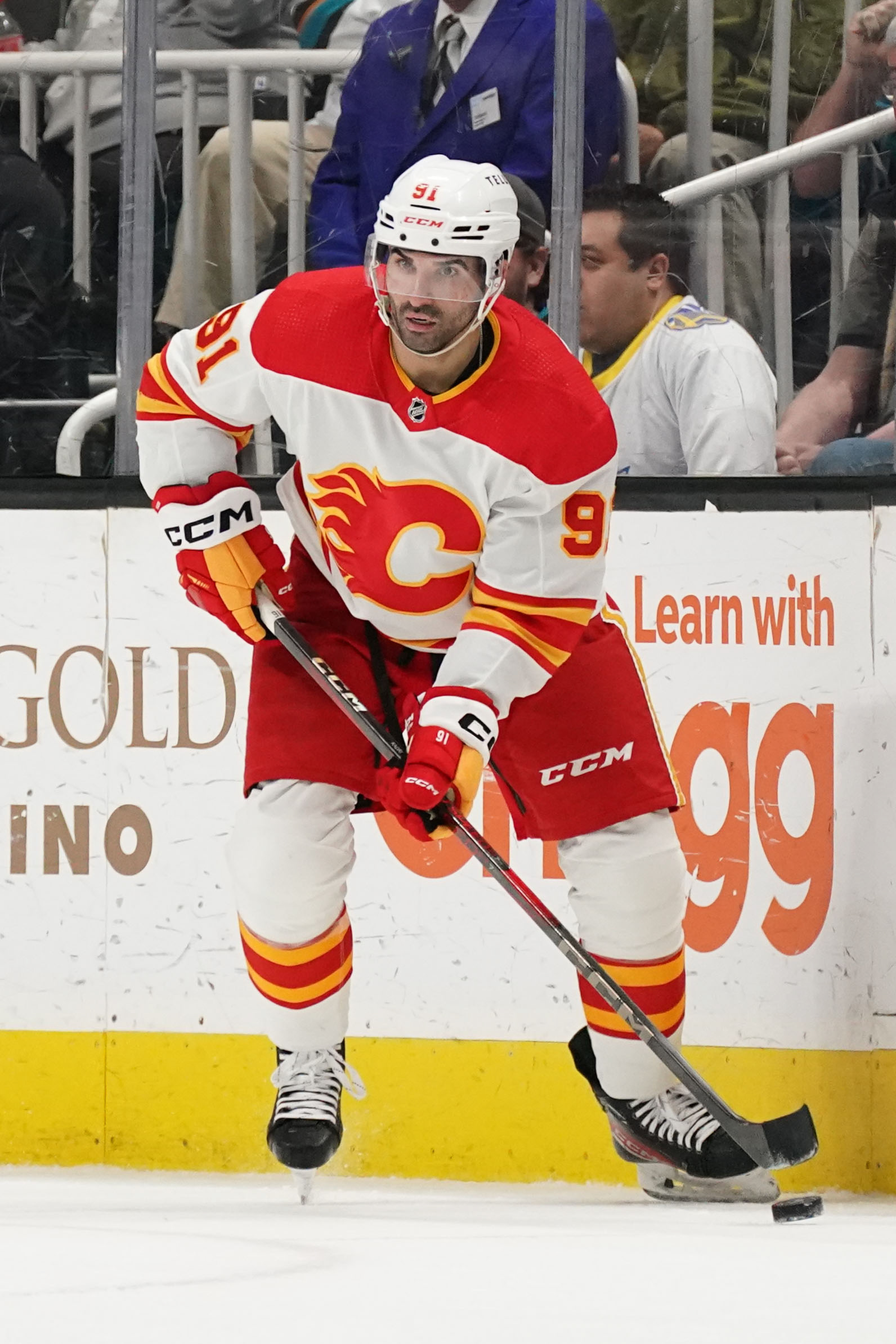 But you asked will he be moved. That, I’m not so sure about. As long as management in Calgary believes that a playoff berth is reasonably within reach, they’re probably going to want to keep him as making the postseason would be easier with him than without. On the other hand, their hand is going to get forced sooner or later with pending UFA defenseman Rasmus Andersson as they won’t want to risk losing him for nothing on the open market. (Or at least they shouldn’t want that.) So maybe when Andersson goes, they reassess on Kadri.
If I’m handicapping it, I wouldn’t go higher than a 60% chance that Kadri gets moved. The Flames should get several substantial offers for his services in a market that doesn’t have many sellers and has a lot of buyers looking for centers. The situation is there for them to get a premium return but I don’t sense their willingness to take it is as it as it probably should be.
FeeltheThunder: Do you think Jon Cooper should be a major contender for the Jack Adams Award this season? Why he hasn’t won it in the past is borderline asinine. He’s taken a Tampa team that surprisingly stumbled out of the gate in early October to start the season and was at the bottom of the Eastern Conference and then by late October changed gears. They go on a win streak and continued it through the majority of November going 11-3 and that is in spite of countless injuries to key players during it. Much more, Tampa’s depth has proven to be significant as this looks like the deepest they’ve been in a few years. What do you think of Cooper’s chances?
While the Lightning have been perhaps a bit streakier than they’d like this season, on the whole, it’s hard not to be impressed. Despite a litany of injuries (many of which have been to their top players), they have been at or near the top of the Atlantic Division. If you’d have said to me that they’d be there despite having six of their top seven scorers missing time along with Andrei Vasilevskiy, I’d have had a hard time believing that. Should he be a contender as things stand? Absolutely.
Will he be one? I’m not as confident in saying that. A lot of years, voters have leaned toward the coach of a team that has taken a big jump in the standings and really exceeded expectations. That’s not Tampa Bay. They’re a steady contender which is a big compliment to Cooper and the job he’s done but doesn’t necessarily earn him much support in a one-year award.
Off-hand, there are a couple of teams that fit the usual criteria of being a big improver and surprising in the standings. One is in the division in Boston’s Marco Sturm. Few had them as a playoff team and they’re right up there with the Lightning. Meanwhile, there was an expectation that Anaheim would be better but they’ve been atop the Pacific a lot early on this season which should push some support to Joel Quenneville. There’s lots of time for the potential contenders to change but as of today, Cooper’s streak likely continues.
vincent k. mcmahon: Does Jordan Binnington eventually get moved to the Oilers (with all the rumors surrounding a potential trade) or barring a huge turnaround he doesn’t get moved?
Assuming he were to be traded, would the return be S. Skinner and picks to St. Louis?
One of the great things with the mailbags is that we get enough questions to break them into multiple columns. The challenge is picking which ones are safe to push back. It often works out well but sometimes, well, this happens and kills the question before I have a chance to really answer it.
Clearly, the answer is now a trade to Edmonton isn’t happening. Honestly, I don’t think it would have anyway, just because of Binnington’s $6MM AAV. Yes, it’s only $625K higher than Tristan Jarry’s but the hoops the Oilers are jumping through money-wise to stay cap-compliant are significant as it is with three players on LTIR. That small difference in cap charge might have been enough for them to need to move another player or two out to create the savings to absorb Binnington’s extra cost.
I don’t get the sense that there’s a great trade market out there for Binnington at the moment. Yes, there are teams looking for goaltending help but right now, how much of a help would he be? With a save percentage of just .869, he’s already near the bottom of the league so teams aren’t looking at him and thinking he’s a sure-fire upgrade. They can hope he could be but fitting that money in plus whatever the acquisition cost is likely going to be too much grief for another team to justify right now.
Photo courtesy of David Gonzales-USA TODAY Sports.
Canucks Have A Clear Blueprint To Bring To Quinn Hughes Trade Discussions
The question of whether Quinn Hughes will sign an extension with the Canucks to keep him in Vancouver beyond the 2026-27 season remains an open book. However, the club having the worst record in the Western Conference, with a second straight playoff miss in sight, certainly doesn’t bode well for his future.
The recent uptick in reports of teams calling Vancouver about Hughes’ availability could be more rooted in conjecture than reality. With the Canucks’ lack of hesitance under the oversight of the Patrik Allvin/Jim Rutherford front office to move on from star players, though, a trade – whether this season, over the summer, or early next year – feels more probable than possible.
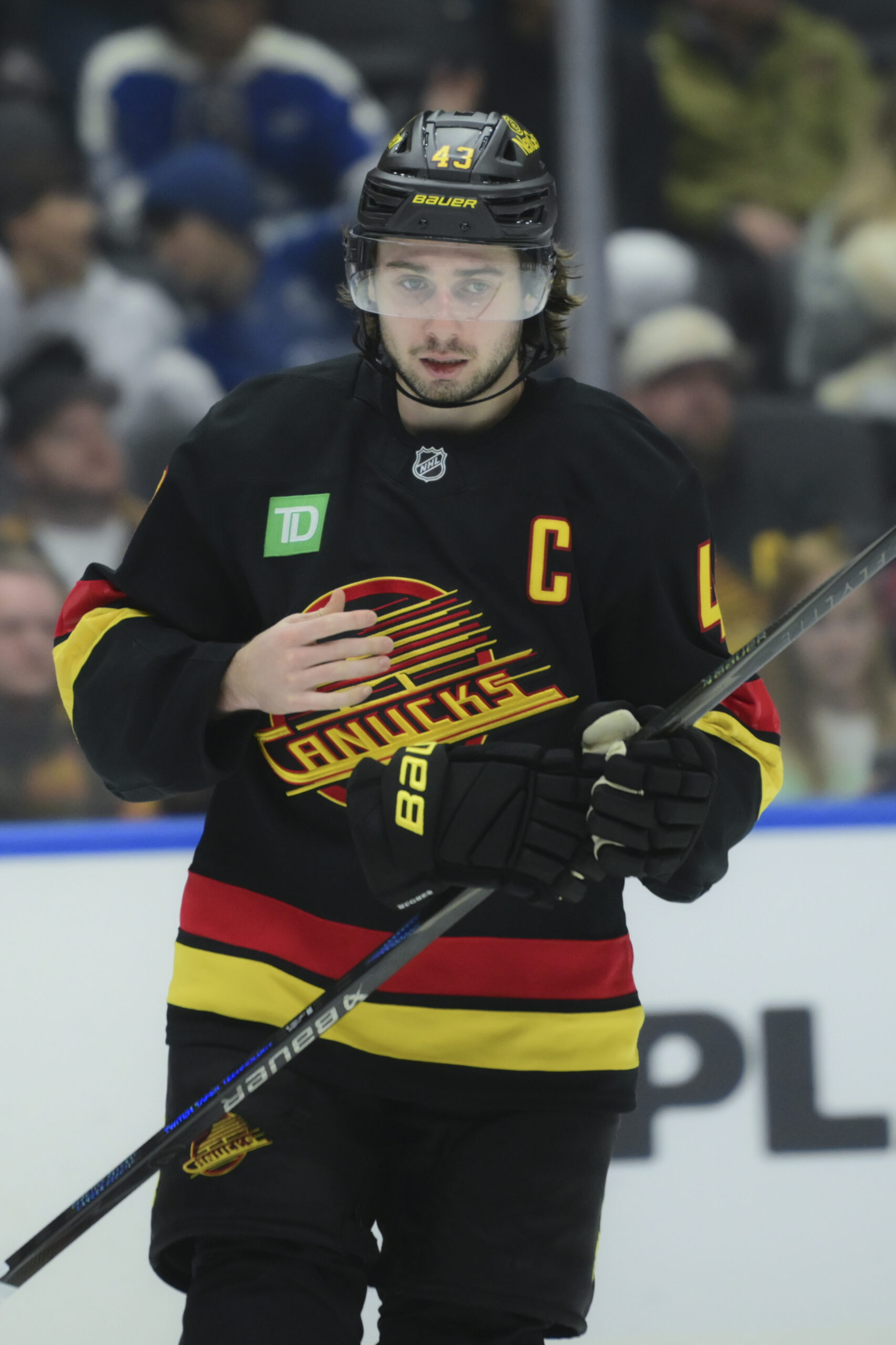 There will be rampant speculation about where he ends up and how it happens until a resolution, one way or another, comes to pass. He’s a bona fide top-three defenseman in the NHL and a top-15 player outright. At a $7.85MM cap hit (for now), he’s among the most affordable truly elite talents in the league. His lack of trade protection makes him a highly movable asset, too – especially if Vancouver pulls the trigger now, before he becomes a pending unrestricted free agent.
Even if they wait until the summer or next season to make a move, they’re still in for a gargantuan return. Those hoping for a discount because of his lack of team control past 2027 will be disappointed. No team is going to be willing to put forth a competitive-enough offer without a high degree of certainty – or at least optimism – that he will be willing to sign a long-term extension.
It feels like an exceedingly rare situation for a player of Hughes’ caliber to be legitimately available for trade with at least a full season left on his deal. There’s precedent for such a move, though.
The circumstances surrounding the first Erik Karlsson blockbuster, which sent him from the Senators to the Sharks in the 2018 offseason, are strikingly similar from both the player’s and the team’s perspective. Karlsson was a year older than Hughes at the time of the deal, but their value and reputation were extremely comparable. Both had recent Norris wins and multiple nominations. Both had top-10 MVP finishes (Karlsson had three at that point compared to Hughes’ one).
Organizationally, it’s fair to draw comparisons as well. The Senators’ record in 2017-18 had tanked to the second-worst point total in the East immediately after a resurgent 2016-17 campaign that saw them reach the Eastern Conference Final. The Canucks are trending toward a similar fate, albeit two years removed from their explosive 2023-24 regular season, when they captured the Pacific Division crown and came one game away from a WCF appearance. Both teams were center-needy. Ottawa had moved the preceding year to acquire Matt Duchene, but he didn’t last long with the Sens. Beyond Jean-Gabriel Pageau, who was also dealt within a couple of years, there wasn’t any long-term depth in the system.
Vancouver now has Braeden Cootes as a hopeful top-six option after selecting him No. 15 overall this year, but there are no other names in the system who project as everyday NHLers. Behind Elias Pettersson, there are no impact options on the NHL roster aside from a high-ceiling but independent Filip Chytil.
The Canucks, then, shouldn’t have too much trouble dictating their terms if trade negotiations do get serious. When Ottawa shipped out Karlsson (plus minor-league forward Francis Perron) with a year left on his deal, their return wasn’t entirely futures-focused.
Four players – plus three draft picks (a first and two seconds) – came back in the deal. The most high-profile skater at the time was the signing rights to center Joshua Norris, who was the Sharks’ clear-cut top prospect at the time and one year removed from being a top-20 pick. Winger Rudolfs Balcers was a fifth-rounder three years prior but was coming off a 48-point rookie season in the minors and was regarded as a top-five prospect in San Jose’s pool.
The two “help-now” names in the deal were still relatively young: Chris Tierney (24) and Dylan DeMelo (25). Tierney was coming off a 40-point breakout as San Jose’s third-line center, while DeMelo had seen his stock jump in a similar manner with 20 assists in 63 games as San Jose’s third right-shot option on the blue line.
As a result, Vancouver should be asking for – and getting – the same haul of draft picks, an under-20 center with first-round pedigree, a B-tier prospect, a young middle-six center, and a promising depth lefty on defense to help shoulder the loss of Hughes from a roster management perspective. Those hoping for a discount because he’s not team-controlled for more than two years will be disappointed. Canucks fans hoping for an immediately impactful top-six center will likely be as well.
The Devils have been the most frequently speculated destination for Hughes to unite him with his brothers, Jack and Luke. The notion of them being the favorite to acquire him – at least via trade and not free agency – falls apart when considering they don’t have a Norris-caliber center, or anything close to it, in their prospect pool. Their next wave of forwards is already relatively weak, and the top name – 2023 second-rounder Lenni Hameenäho – is a winger. Dawson Mercer would draw the comparison to Tierney, a considerably higher-value one, thanks to him tracking toward a second career 50-point season. Still, the Canucks will aim for a higher-ceiling and younger needle-mover as the centerpiece of the return down the middle to anchor the years-long retool that a Hughes trade will usher in.
With that in mind, from the Canucks’ perspective, that makes the Red Wings the most attractive suitor of the teams firmly linked to Hughes so far by a significant margin. Nate Danielson is a 2023 pick – further removed from the trade than Norris was – but was a higher selection at No. 9 overall and carries a bit more value, particularly as he’s solidifying a spot on Detroit’s roster already. They don’t have a similarly-aged comparable for Tierney, but could move veteran Andrew Copp, who’s scoring at a 40-point pace this season. That would rank eighth on the Canucks and second among centers behind Pettersson. Albert Johansson is perhaps a more well-regarded prospect than DeMelo was, but he is of similar age and role. That could help balance out the value gap between present-day Copp and 2018 Tierney. The Canucks could take their pick from Detroit’s bevy of B-level prospects.
Any team looking to match or exceed that package will need to meet the prerequisite of having a center – likely selected with a top 20 pick in the last two or three years – to start with. A name like Philadelphia’s Jett Luchanko would generate significant intrigue if paired with roster players like Noah Cates and Egor Zamula, for example.
The checklist is clear: a future high-end top-six center, a quality middle-six center, a young depth defender, a promising mid-to-late-round draft pick, plus the three picks. Let the mock trades fire away.
Image courtesy of Simon Fearn-Imagn Images.
These Summer Signings Already Look Like Trouble
NHL free agency often results in some big misses, and this past summer was no exception. Even though we’re only two months into the regular season, it’s already clear that some of the contracts teams signed could turn out to be disasters, and for some, it was obvious from the start. Let’s take an early look at a few contracts that might not age well.
When Cody Ceci signed his four-year, $18MM contract on July 1, there was real sticker shock across the league. It was a significant overpay, destined to be a poor contract from day one.
Now, after 29 games, Ceci has one goal and five assists, averaging 17:39 of ice time per game while playing a third-pairing role at even strength. Ceci ranks 516th out of 554 players in the NHL in on-ice goal share for those who’ve played over 200 minutes at 5-on-5 at 34.5%.
The tricky part for Kings fans is that this was quite predictable from the moment the contract was signed, but there was a silver lining in the potential for Ceci to provide some physicality on the back end. However, that hasn’t been the case this year, as Ceci has managed just 15 hits in 29 games.
Ceci will turn 32 later this month, and there’s no upside to his game at this stage. With three years remaining on the deal after this season, the contract might even become a buyout candidate before it expires.
Trent Frederic signed one of the more surprising deals this past summer, agreeing to an eight-year extension worth $3.85MM per season after the Oilers picked him up from the Bruins at last year’s trade deadline. While the AAV is a bit high for what he offers, the length of the deal is also extraordinary.
Two months into the contract, it looks like a miss. Frederic has only two goals in 28 games this season and has been a burden to everyone he plays with.
The 27-year-old was never expected to live up to his contract fully, but in previous seasons, he showed some goal-scoring ability and contributed other intangible qualities. While he’s still tallying 68 hits this year, he’s doing so with virtually no other positive impact, making it hard to believe that he once produced 40 points in a season.
In 51 games as a member of the Oilers (29 regular-season games and 22 playoff games), Frederic has scored three goals and three assists. This, of course, dates back to last season, but it’s hard to understand that the Oilers saw what they saw at the end of last season and decided to sign him up for another eight years.
In fairness to the Oilers, Frederic was dealing with a high ankle sprain last season, which is notoriously tricky to play through and can have effects lasting a year – a silver lining if you’re Edmonton. Maybe Frederic is still battling a nagging injury and isn’t able to play as well as he did in some of his earlier seasons in Boston. Time will tell, but for the Oilers and their fans, Frederic’s recent play is concerning.
Next, there’s goaltender Ville Husso of the Ducks – or more often, their AHL affiliate in San Diego. Anaheim general manager Pat Verbeek decided to keep Husso around last summer with a two-year, $4.4MM contract extension.
The deal didn’t make much sense at the time, as the Ducks already had Lukáš Dostál in the fold, and they signed Husso the day after trading John Gibson to the Red Wings for a package including Petr Mrázek. Some thought Husso might be the backup, and that Mrazek could be moved, but so far, he remains, and Husso has had limited NHL action.
Mrázek effectively moved into the backup spot ahead of Husso, which somewhat undermines the reason for re-signing the 30-year-old. Husso is a well-paid third-string goaltender for the Ducks, and there’s a reasonable case that he’s an average third-stringer at best.
In six NHL games this season, Husso has a 4-2-0 record with a 2.82 GAA and a .875 SV%. His numbers are noticeably better in the AHL with a 6-4-3 record, a 2.49 GAA, and a .908 SV%. However, he’s earning $2.2MM this season, a higher AAV than high-end veteran No. 2 options like Jake Allen, Jonathan Quick, and Scott Wedgewood.
Husso’s deal came shortly after a solid four-game audition in Anaheim at the end of last season, and it’s hard to imagine Verbeek was envisioning Husso as a tweener. The deal was likely made to provide Anaheim with a backup so they could trade Mrázek, but unfortunately, they couldn’t move him. Even if that was the case, Husso’s deal was a stretch, and while it isn’t overly restrictive to the salary cap, it’s a bad contract to hand out.
A couple of other deals that might not work out well are the Ryan Lindgren contract with the Kraken and Brian Dumoulin’s agreement with the Kings. Lindgren signed for four years and $18MM in the summer and has contributed nothing offensively (three assists in 25 games) for the Kraken and hasn’t been physical at all, with just 14 hits.
Lindgren was a massive drain on whoever he played with last season, giving Rangers defenseman Adam Fox all kinds of problems. However, it wasn’t that long ago that Lindgren was a top-pairing defenseman in New York, and if he ever got back to that level, he would be worth the money. But his play has been this way for over a year now, and it might just be the player he is now.
The Dumoulin deal in Los Angeles, like the Ceci one, was a head-scratcher. There was a time when Dumoulin was a legitimate top-pairing defenseman who had a great first pass, excellent gap control, and elite defensive awareness.
However, his body has slowed over time, and that terrific skating has become a liability, preventing him from getting space for his good breakout passes or closing gaps. Dumoulin has been fine this season for the Kings, but the deal has another two and a half years remaining and is unlikely to age well.
PHR Mailbag: Standings, Hot Seat Coaches, Sleeper Trade Candidate, Blues, Murphy, Lightning, Siegenthaler
Topics in this edition of the PHR Mailbag include why we might have to wait a while for a coaching change, possible trade frameworks for a pair of Blues veterans, and much more. If your question doesn’t appear here, check back in one of our next two mailbag columns.
letsgonats: At the 1/4 point, which NHL playoff teams from last year will not make it? The East, in particular, is so pinched together that it looks like three or four teams will be fighting for a spot on the last game of the season.
Also, how likely are the Capitals to figure out their power play? They are dominating 5×5 but anemic on the power play?
For playoff teams from last season missing this year, I could see Montreal slipping out. Yes, their goaltending should turn around but they’re also scoring at an unsustainable rate. Between that and several key injuries, it wouldn’t shock me if they go from just make to just miss. I’m not ready to write off Toronto just yet but it’s heading in that direction, especially if they can’t get both goalies healthy at the same time which was a huge part of their success a year ago. Florida’s trending that way as well but they’ve earned the benefit of the doubt this early. And with the East being so close, all of this could change depending on what types of injuries we see over the next few months. That’s the biggest wild card of them all.
In the West, I have a hard time seeing St. Louis getting out of its tailspin. This feels like a year where they decide to move a couple of veterans and do a quick reset. Edmonton’s out right now but at some point, they’re going to get going. Winnipeg is out and could be in some trouble if they don’t start treading water soon until Connor Hellebuyck returns but it’s too early to predict they won’t bounce back; they’ve earned a longer leash.
As for Washington’s power play, it’s around 2% below the league average this season. That’s not great by any stretch but with how it was last season (23.5%) with largely the same personnel, I think there’s a good chance it rebounds to at least league-average level. That’s still going to come in a few percent below where they were a year ago but if they’re around the middle of the pack, that’s at least a step up from where they are now.
mister noons: Who do you have finishing bottom two in each conference?
As of this asking the bottom five in the West are WPG, STL, NAS, CGY, VAN. In the East, it is DET, OTT, TOR, FLA, BUF.
For the West, I think Calgary is going to be there. Without Dustin Wolf dragging them to competitiveness, we’re now seeing the roster we thought we’d see a year ago, one that has some pieces but isn’t good enough. And with Rasmus Andersson looking like a safe bet to move, it’s probably going to get weaker. Right now, Nashville would have to be my other pick. I thought they’d be at least a bit better this season but they’re still near the bottom. And if they move out some veterans, it could get a bit worse. If St. Louis winds up selling more than I think they might, they could get into the mix as well.
The East is much harder to predict considering the bottom seems to change every few days. I want the answer to not be Buffalo just because that team needs to get going at some point but they can’t win away from home and seem to be stuck in a perpetual rut. They’re at least a safe pick. As I just noted, I can’t rule out Toronto and Florida from being playoff teams and there aren’t any pushovers in the Metropolitan this season which is rather surprising. There are some red flags with Detroit that make me think they could slip in the second half and given how tight the standings are, that might be enough to drop them to the bottom two. But I’m not very confident in that answer.
Gbear: Which Head Coach gets fired first (my pick is well known)?
If Nashville was going to make a move to try to save the season, I suspect they’d have done it already. Things aren’t going well in Buffalo but at this point, they’ll just let the season run out and let Lindy Ruff’s coaching contract expire as originally planned (and then probably shuffle him into a new role). Vancouver and Seattle aren’t doing much but have new head coaches so they’re not making changes so quickly. It’s rough in Calgary but Ryan Huska was extended not that long ago which buys him more time.
Where am I going with this? I wouldn’t be shocked if the first coaching firing came from a team with playoff expectations that doesn’t want to fall too far out of the race. If Edmonton doesn’t get going soon, Kris Knoblauch could be unfairly let go to try to shake things up without shaking up the roster. It would take some time to get to that point though. The other one that comes to mind is Jim Hiller and I write that as they’re in a playoff spot and a recent denial that they’re considering a change. But it’s a soft grip at best on a postseason position and GM Ken Holland didn’t hire him for the role. If the Kings falter over the next little while, that’s one that wouldn’t surprise me even though he’s done a decent job.
I don’t expect to see a lot of in-season firings. So many teams have changed coaches in the last 24 months which isn’t much of a shelf life for a coach. Owners don’t want to be paying a bunch of coaches not to coach so I expect we’ll see more patience, especially with the standings being tighter than usual.
lgr34561: Are there any players you think will be traded before the deadline that people are sleeping on?
If I could simply say ‘I don’t know’ here, this would be a time for me to use it. There is part of me that expects the trade market to not materialize much as the playoff salary cap is probably going to cut down on in-season swaps. With teams not really getting time to plan their rosters accordingly, this could be a quiet year. On the other hand, the level of parity could increase the number of buyers or teams willing to make ‘hockey trades’ in which case things would open up considerably and we could have a few deals that come out of nowhere.
 But that’s not a fun answer so I’ll take a stab at a sleeper trade candidate. Two years ago, Kent Johnson struggled, leading some to wonder about his future in Columbus. He signed a bridge deal and then had a breakout 57-point effort last season. However, he has really struggled out of the gate this year and some of those questions are back. But Johnson has shown enough to be appealing to some teams. The fact he has a center background (though he hasn’t played there lately) only helps his value. If there are ‘hockey trades’ coming where it’s an even swap of young core players, I could see Johnson being a viable candidate to be moved.
Gmm8811: If the Blues move on from Schenn or Faulk, what do you think a reasonable return for each would be? I’d prefer draft picks. Do they have to retain any money? Armstrong usually doesn’t like to do that.
Let’s answer these out of order. I don’t think St. Louis has to retain on either player in a trade. Brayden Schenn is a veteran center with enough of a track record to command a significant trade market and if the Blues are willing to take a player or two back to offset money short-term, that would work. Justin Faulk’s market probably won’t be as strong but with one less year left on his contract (he’s only signed through 2026-27), I think there are teams that would take on the full deal, as long as they could send a player or two back again.
However, while GM Doug Armstrong may not like to retain, the trade returns will undoubtedly be better if he did. That will have to be factored into the equation; is the extra value of the return worth the extra dead cap space? It wouldn’t shock me if it was.
As to what a return would look like, I know Schenn’s having a down year but I still think it starts with a first-round pick. The demand for centers is sky-high and that’s great news for the Blues. Last year, the believed ask was that plus two strong prospects including a high-end one. I don’t think that’s necessarily viable now but a first, a key prospect, and a young roster player (or one who is near-ready) could be doable. If St. Louis sells, I don’t see them embarking on a full-scale rebuild so the young roster player could very well be a crucial element of the return. If they have to take a more expensive player back to match money, that could ultimately expand the package a bit with the Blues adding a mid-round pick or equivalent asset.
With Faulk, a lot is dependent on if they retain or not. To stick with the premise of the question, I’ll take the no answer. In that case, the return St. Louis paid for Cam Fowler (a second and a prospect while also getting a fourth back) might be a reasonable equivalent while, again, possibly also taking someone back to balance the money. I’m not sure retaining would land them a first but it would probably give them a big boost in the caliber of the prospect coming back to them.
Erik Karlsson Is Playing His Best Hockey In Years
When the Penguins acquired defenseman Erik Karlsson from the Sharks in August 2023, they envisioned him giving their big three (Sidney Crosby, Evgeni Malkin, and Kris Letang) one last push for a playoff run. Two and a third years into the experiment, the results haven’t been promising, as Pittsburgh missed the playoffs in back-to-back seasons and has entered into a rebuild — or at least, that’s what they believed.
However, Karlsson and the big three have the Penguins in contention for a playoff spot some 26 games into the season, in a year when they expected to be one of the worst teams in the league. Karlsson is nowhere near the offensive producer he was during the 2022-23 season when he won the Norris Trophy and registered 101 points, but he has been in good form this year and has provided Pittsburgh with more of a two-way presence on their back end.
When Pittsburgh started the season, the left side of their defense looked like a black hole because they had very little depth at that position, and it was expected to be the team’s Achilles’ heel. Fortunately for Pittsburgh, recent signee free agent Parker Wotherspoon stepped up and claimed one of the spots in the top six.
Not long after, Wotherspoon was paired with Karlsson, and together they have become Pittsburgh’s top defensive pairing. There were no expectations for Karlsson or Wotherspoon this season. Still, under the guidance of first-year head coach Dan Muse, Karlsson appears to be a completely different player, and Wotherspoon has become a meaningful NHL defenseman for the first time in his short professional career.
Using the eye test, Karlsson looks like a different player compared to the past two seasons. He is playing a more focused defensive game and has shown more defensive awareness than he has in a long time. His skating in the defensive zone has been effective in recovering to get back into position, closing gaps, and, along with his instincts, breaking up plays.
On the offensive side, Karlsson remains a fantastic playmaker, still demonstrating the elite vision that has helped him win three Norris Trophies. Even if his goal-scoring isn’t what it once was, he is still an elite offensive player who could be ready to break out.
Even if his offensive stats hover around 55 to 60 points, which is about where they are this season (one goal and 17 assists in 26 games), Karlsson’s play away from the puck makes his lower offensive totals easier to accept. In fact, Karlsson and Wotherspoon have not only formed a solid defensive pairing, but they have also been highly effective at killing penalties and are Pittsburgh’s most-used defensive duo when shorthanded. Their even-strength play has been strong as well, with Karlsson and Wotherspoon limiting high-danger scoring chances, demonstrating a defensive awareness rarely seen in Karlsson’s game.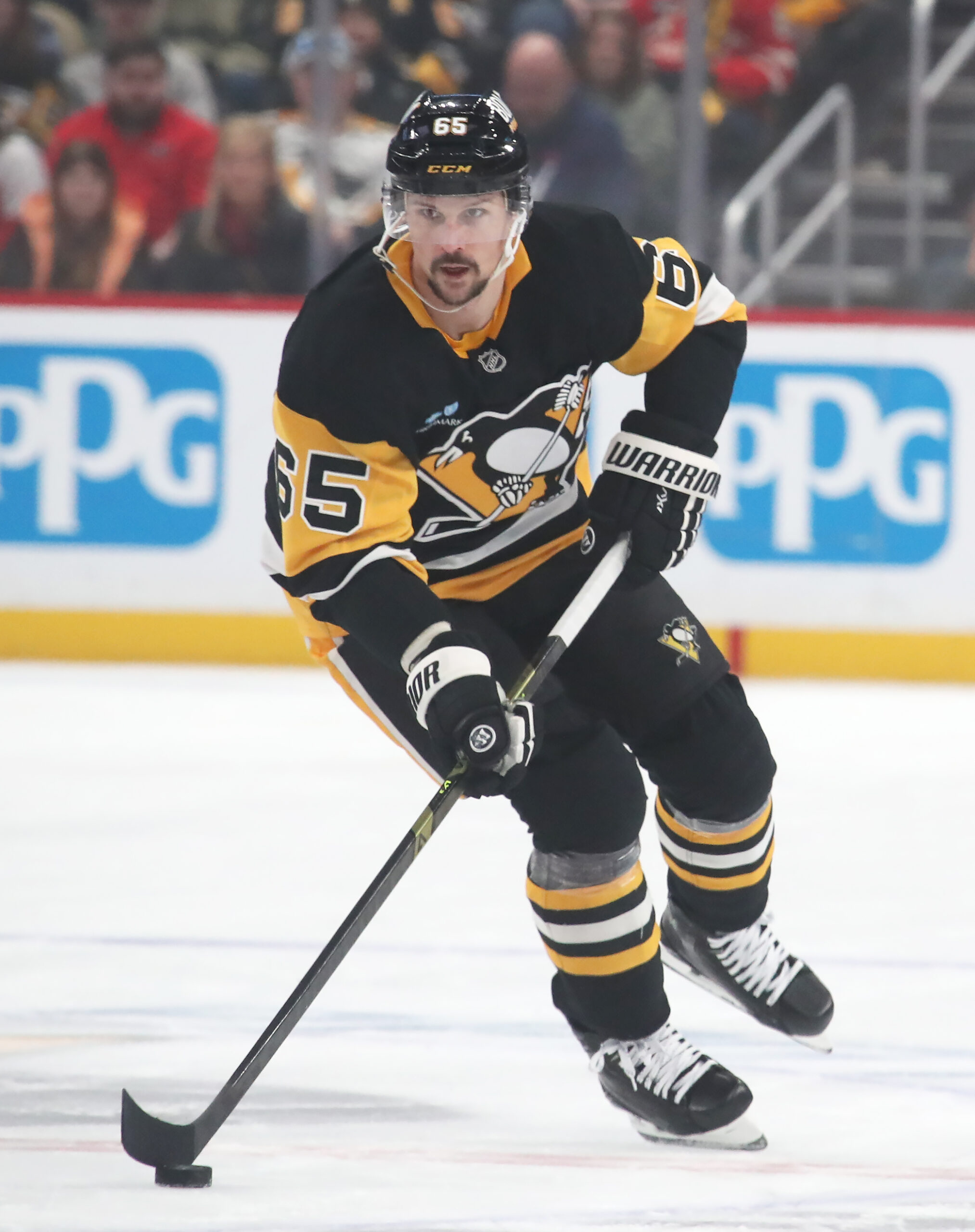
Karlsson appears more comfortable on the ice, playing loose and fast, a stark contrast to the last few years, when the 35-year-old seemed as though Father Time had caught up with him. A perfect example is this past Monday in a game against the Flyers.
With the game tied 1-1, Karlsson collects the puck, bursts out from behind his own net, skates straight to the middle of the ice in the offensive zone and drives right at the two Flyers defenders. He then cuts to the right and makes a tape-to-tape cross-ice pass to Bryan Rust, who spots the trailer (Crosby) for a one-timer that ends up in the back of Philadelphia’s net. It’s a goal that Karlsson didn’t start a year or two ago, and it highlights the change in his work rate.
It also makes one wonder where Karlsson and the Penguins will finish this season. It might even be better if not for a significant injury bug that swept through the room at the start of November, bringing down Noel Acciari, Rickard Rakell, and Justin Brazeau, among others. The injuries effectively removed one forward from each line and put the Penguins in a position where their depth was tested in November, and quite frankly, they don’t have much depth.
You could argue that Karlsson has been lucky, and that some of his mistakes are being offset by Wotherspoon’s consistent performance and the efforts of his goalies. This idea is valid, as Karlsson and Wotherspoon have been on the ice together for 14 goals for and 10 goals against (a 58.3% goals share) while their expected goals share is just 47.3%, with projections of 15.1 goals scored and 16.8 goals conceded (all numbers via MoneyPuck). These data points do tell a story, and there might be some truth to Karlsson being fortunate, but they don’t reflect Karlsson’s own defensive contributions, which have been excellent this year compared to previous seasons.
Speaking of the Penguins’ goaltending, there is a case to be made that many of the Penguins’ shortcomings as a team have been masked by the exceptional goaltending they’ve received so far. Tristan Jarry has been excellent to start the year, with a goals saved above expected of 8.2, and Arturs Silovs has also been good with a 2.5 goals saved above expected (all numbers courtesy of MoneyPuck). That kind of goaltending can’t be expected to continue for the rest of the year, especially in Jarry’s case, who has a history of struggling in the second half of the season. But, for now, it’s a significant reason that Pittsburgh is in contention for the postseason, along with the play of Karlsson and other veterans.
A consistent feature of Pittsburgh this year has been its veteran stars, including Karlsson. He’s remained a dependable presence for the team and could step up further as the season approaches the Olympics. Karlsson is clearly driven by something, and the Olympics are as good an assumption as any.
There is also the possibility that Karlsson understands the situation he’s in. Karlsson was expected to be traded in the summer, but that never happened, which means he might be stuck in Pittsburgh until next year or until his contract expires at the end of the 2027 season. The Penguins will likely make moves next summer to speed up their rebuild—Josh Yohe of The Athletic has repeatedly expressed this belief. Looking at the mix of young prospects and veterans still playing at a high level, it all makes sense. Pittsburgh isn’t a Stanley Cup contender right now and probably won’t be for a few more years. However, with the 2025 draft selections that they made and a potential superstar goalie in Sergey Murashov, that timeline could shift very soon.
If Karlsson stays with the team next season, it could be his best opportunity to chase a Stanley Cup. Even if he doesn’t, there will be motivation to extend his career beyond the 2026-27 season, and factors like money and his choice of destination will also serve as strong motivators.
Photo by Charles LeClaire-Imagn Images
Big Hype Prospects: Letourneau, Lindstrom, Surin, Pulkkinen
Welcome to PHR’s Big Hype Prospects series. Like the MLB Trade Rumors series of the same name, we’re taking a look at the performances of top prospects from across the hockey world. We’ll look at drafted prospects who are rising, others who are struggling, and prospects for the upcoming draft who are notable.
Four Big Hype Prospects
Dean Letourneau, C, Boston Bruins (Boston College, NCAA)
14 GP 6G 8A 14pts
When the Bruins selected Letourneau with the 25th pick at the 2024 NHL Entry Draft, the pick was widely classified as a significant gamble. On one hand, Letourneau offered a rare combination of size and skill, a combination that’s even more rare – and coveted – in a natural center. Letourneau stands 6’7″, 220 pounds, and managed to score 152 points in 70 games for St. Andrew’s College, at the Canadian U18 prep school level. That’s impressive production, even if it didn’t come against the highest level of competition for a draft-eligible prospect.
But with those attractive qualities came some serious risks. David St-Louis, lead scout at Elite Prospects, called Letourneau “the ultimate development pick,” highlighting his positive traits as well as the long development road required to bring those positive qualities to the NHL. The Athletic’s Corey Pronman wrote that the Bruins’ pick of Letourneau was “a big swing,” and noted that his level of competition made it “hard to gauge” Letourneau’s hockey sense and compete level.
Those reactions to the Bruins’ pick are reflective of the risk most viewed as inherent in the Letourneau selection. Likely as a result of that risk, Letourneau was a divisive prospect in the public sphere. NHL Central Scouting ranked him No. 23 among North American skaters, and the public source highest on Letourneau appears to have been Pronman, who ranked him No. 28.
Other public-facing scouts were lower on Letourneau. He was ranked No. 69 by TSN Director of Scouting Craig Button, and Future Considerations, which has since shut down, ranked him No. 135. The Bruins ended up drafting Letourneau at a higher slot than he was ranked by any major public-facing scouting outlet, a clear show of faith by the organization both in Letourneau’s qualities as a player, and also the organization’s ability to properly oversee his development.
The early returns, unfortunately, were not positive for both the Bruins and Letourneau. San Jose Sharks prospect Will Smith‘s departure from Boston College to sign an entry-level deal prompted Letourneau to start his NCAA career in the fall after he was drafted. Letourneau’s original plan was to spend the year in the USHL, but with Smith’s departure, he took the opportunity to begin his development in college.
Letourneau only scored three points across 36 games in his freshman season, and by the end of the year, Bruins management admitted to the media (including NHL.com’s Amalie Benjamin) that Letourneau’s choice to bypass the USHL for the NCAA may not have been the best choice for his development.
But 14 games into Letourneau’s sophomore season, many of those concerns appear to be fading away. Letourneau now ranks second on the Eagles in scoring with 14 points in 14 games, behind only fellow Bruins prospect James Hagens. Elite Prospects scout Whittaker Heart noted in an October game report that Letourneau “had a noticeable jump in his skating” and now is “starting to look like an NHLer.”
If Letourneau can continue to build on his apparent developmental leap over the course of the full season, it appears his projection as a future NHL scoring center would be significantly strengthened. Letourneau’s development is crucial for the Bruins, who don’t currently have any young centers on their roster who project as long-term top-six fixtures.
Hagens, Letourneau’s teammate, most readily projects as the Bruins’ future No. 1 center, but if Letourneau can continue his steep developmental climb, he could very well end up slotting in behind Hagens at the professional level, the same way he’s slotted in at Chestnut Hill.
Cayden Lindstrom, C, Columbus Blue Jackets (Michigan State, NCAA)
9 GP 1G 1A 2pts
In their entire history as a franchise in the NHL, the Blue Jackets have lacked one key asset: a high-scoring true number-one center. They’ve had some quality centers, but most Blue Jackets pivots have been more of the high-end middle-six variety. So when the club spent the No. 4 overall pick at the 2024 draft on Lindstrom, the selection made sense: Columbus was looking to acquire a center who offered a rare blend of size, strength and high-end offensive ability.
Players who fit that mold to the extent Lindstrom did are typically contenders to be selected No. 1 overall. But clouding Lindstrom’s projection, significantly, was a lingering back injury. The Blue Jackets felt confident enough in Lindstrom’s health to draft him at such a high position, but their investment instantly hit a roadblock as Lindstrom’s back injury cost him most of the 2024-25 season. He ended up playing in only four games – four playoff contests during the playoff run of the Moose Jaw Warriors.
Lindstrom entered 2025-26 with a cleaner bill of health, and the hope was that he’d enter one of the top programs in college hockey (Michigan State), get to center some high-end talent (perhaps 2025 No. 7 pick Porter Martone) and put his lost 2024-25 campaign behind him. So far, that hasn’t happened. Not only has Lindstrom missed time due to injury, his production and role have fallen below expectations for someone of his draft slot. He missed five games due to injury before returning for the team’s Nov. 28 game against Colgate, and slotted in as the Spartans’ third-line center, behind 2025 second-rounder Eric Nilson and 2023 first-rounder Charlie Stramel on the depth chart.
While there isn’t one simple explanation as to why, Lindstrom’s start, in terms of production, has been below the expectation of someone selected at his draft slot. While 2024 No. 3 pick Beckett Sennecke and No. 5 pick Ivan Demidov are battling for the rookie scoring lead in the NHL, Lindstrom is still searching for his third NCAA point. Lindstrom scored a goal and an assist in an Oct. 18 victory over Boston University, but hasn’t found his way onto the scoresheet at any other point.
For comparison, Sascha Boisvert, who is another 2024-drafted NCAA center (No. 18 overall to Chicago) has scored nine points through nine games. Of course, it isn’t exactly a fair comparison. Boisvert gets to play a steadier diet of minutes and centers higher-scoring linemates. And perhaps most importantly, Boisvert didn’t have to spend most of the past calendar year recovering from a back injury.
But while Lindstrom has certainly had circumstances out of his control working against him, the bottom-line production, through nine games, simply hasn’t been where most would expect from such a talented offensive creator and a top draft pick.
That’s not to say, of course, that the Blue Jackets erred in selecting Lindstrom fourth overall. It’s still far too early to pass final judgement on the pick. If Lindstrom puts his injuries behind him and becomes a dynamic top-six center to pair with Adam Fantilli, the Blue Jackets will likely look back on the pick more than happy taking Lindstrom over the other available options. But he has to get there first, and so far, Lindstrom’s developmental road has been a bumpy one.
Yegor Surin, C, Nashville Predators (Lokomotiv Yaroslavl, KHL)
34 GP 13G 12A 25pts
Other than the Columbus Blue Jackets, another NHL franchise that has long been searching for a true play-driving number-one center is the Nashville Predators. Historically speaking, the Predators have been able to develop defensemen and goaltenders at an impressive rate, but generating quality scoring centers has been more of a challenge.
Looking towards the future, the Predators do have a few prospects who could end up breaking that trend and becoming homegrown top-six centers in Nashville. The big name in the Predators’ system is undoubtedly 2025 No. 5 overall pick Brady Martin, but a name that likely isn’t receiving as much attention as it deserves is Surin, Nashville’s 2024 first-round pick.
While there are some who were likely disappointed that the Montreal Canadiens selected USHL standout Michael Hage with the pick directly before Surin, all Surin has done since he was drafted was continue to develop his game and impress coaches and scouts alike. He spent most of his draft campaign in the MHL (Russia’s top junior league), but broke into the KHL as a full-time player in 2024-25, at the age of 18.
The KHL is notorious for being an extremely difficult league for young players, especially teenagers, to find a way to contribute in. But despite those historical headwinds, Surin was able to stick with Lokomotiv for all of 2024-25, scoring 14 points in 41 regular-season games. He added on seven points in 19 playoff games, helping his club win the Gagarin Cup championship.
Surin’s standout competitiveness allowed him to stick in the KHL, and entering the season, most public-facing scouts were confident in his projection as a future NHLer, although most classified him as a potential future middle-six center rather than a top-six talent. The Athletic’s Corey Pronman wrote in August that Surin “has the traits to be an NHL third-line center,” while Scott Wheeler, also of The Athletic, wrote in February that Surin will “be a top-nine forward someday.” Elite Prospects Russia scout Dylan Griffing succinctly classified where Surin was in his development, writing before the season that Surin needed to “round out his offensive game to grow beyond a checking-line projection.”
So far, through 34 KHL games in 2025-26, Surin’s offensive production has taken a major step forward: his points-per-game scoring rate is up from 0.34 to 0.74. Surin is one of just two teenage players in the KHL with double-digit points production, and ranks second in scoring among all KHL players aged 22 and under, behind only Blackhawks prospect Roman Kantserov, who is 21.
Put simply: Surin’s offensive step forward, if sustained over the course of this KHL season, has the potential to materially alter his NHL projection in a positive direction. Most public-facing scouts saw a future NHL middle-sixer when watching Surin in the KHL last season. Watching how impressive he’s been this season, it’s likely that many of those same scouts now see a potential future NHL top-six talent.
Surin’s breakout also has the potential to alter how Nashville plans for its future. With 2021 first-rounder Fedor Svechkov already in the NHL and Martin on the way, Surin’s development gives the Predators three young potential NHL pivots to build around.
Development is not linear, and it’s no guarantee any player of the trio ends up reaching their potential. But in what has been a disappointing 2025-26 season for Nashville so far, Surin’s breakout is a much-needed positive development and one that could pay serious dividends for the organization at some point down the line. Surin’s KHL contract runs through the 2026-27 season.
Jesse Pulkkinen, LHD, New York Islanders (Bridgeport Islanders, AHL)
9 GP 0G 1A 1pt
Pulkkinen, a Finnish blueliner, has quite a few traits that scouts covet in defensive prospects. He’s big (6’6″, 215 pounds), he has high-level professional experience (29 games in the Finnish Liiga in his draft year) and he’s shown flashes of real value on both ends of the ice. But despite being an overage player when the Islanders selected him in the second round (No. 54 overall) at the 2024 NHL Entry Draft, he hasn’t yet looked like a real contender to make a push for an NHL call-up.
While his time in North America’s pro circuit has been relatively brief (comprised entirely of his late-season move to AHL Bridgeport at the end of 2024-25 and the start of 2025-26), his time on this side of the Atlantic has been a bit of a challenge.
On Oct. 30, Pulkkinen was reassigned to the Islanders’ ECHL affiliate, the Worcester Railers. That came after Pulkkinen played in just two games at the AHL level. Pulkkinen has been one of Bridgeport’s most sparingly deployed defensemen so far this season, with limited third-pairing usage and short-handed usage that ranks fifth among Bridgeport blueliners.
Given Pulkkinen’s experience in Finland, his draft pedigree, and his impressive set of traits, it’s somewhat surprising to see him struggle to earn the trust of his AHL coaches, and it was certainly surprising to see him sent down to the ECHL.
There have been some factors outside of his control that have complicated his development. He suffered a knee injury that cost him quite a bit of time, and also necessitated that he devote time he could have otherwise spent developing his game further on recovering from that injury. But while some things have been out of Pulkkinen’s control, the reality is he just hasn’t played up to the standard he set earlier in his career.
The Islanders have other promising defensive prospects in their system, so the organization is under no great pressure to fast-track Pulkkinen’s development. He was always seen as more of a long-term project, and his performances in North America only underline that fact. He’s still just 20 years old, and could have a bright future ahead. But as of right now, his start to his North American pro career has been an uphill battle.
Which NHLer Is Most Likely To Seek A Contract Termination?
The NHL has recently experienced an unusual trend: an increase in players choosing to forgo guaranteed contracts that still owe them millions to find a playing situation that better suits them. This process involves the player clearing standard waivers with the team anticipating they’ll refuse to report to their AHL affiliate, creating a breach of contract that allows the team to place the player on unconditional waivers, before ultimately finalizing the contract termination.
Last year, Brandon Saad did this by walking away from the remaining year and a half of his deal and over $3MM in salary. This summer, forward Conor Sheary followed suit, foregoing the final year of his contract and saving the Lightning $1.5MM. Just a few weeks ago, Maple Leafs forward David Kämpf also stepped back, forfeiting over $2MM in salary. More recently, Alexandre Texier left the Blues and signed with the Canadiens for roughly half his previous salary. In effect, all these players essentially halved their earnings to find situations better suited to them, raising the question: who might be the next player to break their current contract?
Dozens, if not hundreds, of players under NHL contracts could be described as unhappy with their playing time. However, most, if not all, would be satisfied with the current NHL paychecks they receive. Players such as Ryan Graves, Tristan Jarry, and Ville Husso will not be included for purposes of this article. While they are veterans who have earned good money in their NHL careers, they are still early in their lucrative new deals, and they have spent time in the AHL over the last calendar year. This piece will focus on players in a unique position regarding their contracts who might be willing to walk away from guaranteed money if they can’t be moved via trade or waivers.
Penguins forward Philip Tomasino is the top name on the list and has already been made available to every NHL team this month after he was placed on waivers by the Penguins and eventually assigned to the minors after passing through. Signed to a one-year, $1.75MM deal last offseason, many fans were surprised when the Penguins non-tendered him in the summer, only to re-sign him to that one-year pact.
The move kept his salary lower, but Tomasino has still failed to provide any value to Pittsburgh this season, with just one assist in nine NHL games. Tomasino also started slowly last year with Nashville, posting a single assist in his first 11 games before a midseason trade to Pittsburgh sparked a turnaround. Hence, a comeback isn’t out of the question.
Clearly, passing on waivers showed a complete lack of interest in Tomasino at his current price, but at league minimum, teams might be more willing to take a shot. However, the chances of that happening seem low, as the Penguins likely aren’t keen to use up a salary retention slot on him, and Tomasino likely doesn’t want to leave the highest salary he’s earned in his NHL career. There’s always a possibility that the Mississauga, Ontario native stays in the AHL for the rest of the season, but given his six points in three AHL games, he might find a way to work his way back to the NHL, just like teammates Graves and Jarry did over the past year.
Next up is a player who is nearly 10 years older than Tomasino: defenseman Erik Gustafsson of the Red Wings. Like Tomasino, Gustafsson is in the final year of his contract and trying to maintain his NHL career, but that is where many similarities end. Gustafsson is a ten-year NHL veteran nearing the end of his playing career, whereas Tomasino is just beginning his.
Not so long ago, Gustafsson was regarded as a capable third-pairing defenseman. Many praised the Red Wings for signing him to a two-year, $4MM contract in July 2024. That deal proved to be ill-fated. Gustafsson’s play declined last season, especially on the offensive side. His puck handling was sloppy, and he wasn’t the same contributor as in previous years.
This poor performance led to a demotion this season, with the 33-year-old playing most of his games in the AHL with the Grand Rapids Griffins. Credit to Gustafsson for stepping up and performing well in the AHL, but it does raise questions about whether he will finish the year in Detroit. The Wings might consider trading him or putting him on waivers (again), but given his recent play and salary, that seems unlikely.
Another factor in Gustafsson’s situation is the fact that he’s made $2MM or more in just three NHL seasons. One of these was the shortened 2020-21 season, which had a 56-game schedule, meaning Gustafsson’s $3MM AAV effectively amounted to a $2MM salary that year. This income would have been subject to deferrals, escrow, agent fees, and taxes, so Gustafsson actually received less than half of it. Aside from that, Gustafsson is nearing the end of his career and has earned somewhere in the range of $10MM-$12MM (gross income), so he probably isn’t willing to walk away from $1.5MM without at least the promise of another contract elsewhere.
Another Detroit defenseman who might seem like a contender is Justin Holl, who is also 33 years old and in the final year of his contract. Holl signed a three-year, $10.4MM deal with the Red Wings in July 2023, but that contract has proven to be poor value for Detroit. Like Gustafsson, Holl was a turnover machine last season and has ended up in the AHL this year. The signing never made much sense from the start, as Holl has always been a fairly average defenseman, and not the type you rush to overpay on July 1, which is precisely what Detroit did.
Holl is probably still an NHL defenseman and could likely find a role if he didn’t have a $3.4MM price tag attached. However, to move him, Detroit would probably need to include an asset and retain salary. Since he’s a pending UFA, they won’t go through the trouble. Considering he has earned over $15MM in his career, you would think Holl might be inclined to leave his contract early if given the chance. Still, it seems unlikely because this is probably his last big NHL payday, and he can wait until summer to sign a two-way deal for league minimum.
Another player to consider is Oilers winger Max Jones. Jones was acquired last season from the Bruins and played 19 games down the stretch, but didn’t contribute much with just a goal and an assist. Jones can skate and hit; beyond that, his abilities are pretty limited. He is in the second year of a two-year, $2MM deal, and since he’s earning one-way money, it’s unlikely he would walk away from it to pursue another job. Jones has spent the entire season in the AHL after passing through waivers in October, and he’s probably best served to ride out his current contract and hope for a promotion to the NHL. The 27-year-old is lucky to have time on his side and can look for a two-way contract in the off-season, but if he chooses to opt out, he’ll likely find a two-way league minimum deal that puts him in the same position he’s in now, just wearing a different jersey.
Other players who might consider terminating their contracts soon include Jets forward Tanner Pearson. Pearson has been receiving fourth-line minutes in Winnipeg and has faced challenging assignments in that role. He’s got just three goals and an assist in 23 games this season. However, with a $1MM salary, he might choose to stay the course and play the hand he’s been dealt. It’s unlikely that Pearson would find a team willing to give him a top-nine role at this stage of his career, so he’s probably best advised to stay in Winnipeg under contract.
Another possibility could be Oilers goaltender Connor Ingram, but his play in the AHL this season has been atrocious, with a 3-3-2 record and a .873 SV%. Ingram is making $1.95MM in the final year of his deal and is probably best served continuing to cash his cheques and trying to improve his game to get back to the NHL. Ingram is also in a position with the Oilers where it might be his best route back to an NHL lineup, given the issues Edmonton’s goaltending has faced this year.
A few final names of players who could be contenders to terminate their current contracts mutually include defensemen Daniil Miromanov of the Flames and Kyle Burroughs of the Kings, as well as forward Carl Grundström of the Flyers. These three players are in the final years of their deals, earning over $1MM this season, and are currently playing in the AHL.
Connor McDavid Should Have Explored Free Agency
Oilers superstar Connor McDavid struggled to find the words to describe the team’s 8-3 loss to the Dallas Stars on Tuesday night. The decision dropped the Oilers’ record to 10-10-5 for the season, and McDavid looked defeated during his post-game interview.
The team is grappling with the same issues that have plagued them since McDavid joined the NHL in the fall of 2015. Edmonton’s secondary offensive support for McDavid and Leon Draisaitl is minimal, and their goaltending remains a significant concern. Considering the Oilers have faced these problems for so long, it makes one wonder why a generational talent like McDavid chose to sign on for two more years of this, especially given the bargain he struck when he signed for just $12.5MM a season.
McDavid’s choice to sign with Edmonton before even considering free agency might become one of the biggest “what-ifs” in NHL history. However, McDavid opted for stability in a familiar market, with a team that has been competitive for most of his NHL career.
Ultimately, McDavid decided to stay loyal to the Oilers, but the two-year term seemed like a warning shot to Edmonton. So far, that warning appears to have fallen on deaf ears. The timing of McDavid’s extension was quite unusual. The superstar had a clear route to unrestricted free agency, which could have been one of the most incredible stories in NHL history if it had come to pass.
McDavid had the chance to be the highest-profile player in NHL history to reach free agency since Wayne Gretzky in 1996. He held leverage against the Oilers and could have waited out the season, sparking a bidding war for his services. This would have boosted his star power and changed what a superstar’s career could look like. Instead, McDavid chose familiarity, even though the timing of his decision wasn’t convenient.
McDavid’s signing has delayed his free agency by 24 months, and some people dismiss this decision by arguing that McDavid will still get paid and reach free agency after the salary cap has significantly increased. While both points have some truth, the counterargument is compelling. Instead of becoming a free agent at 29, McDavid will do so at 31. It might seem minor, but many NHLers see their skills decline after 30.
Another factor is that when McDavid finally signs, the new CBA rules on contract length will apply, meaning the maximum deal with his current team will be seven years, and he’ll only be able to land six years on the open market. Although this one-year reduction isn’t a significant issue, it will likely cause McDavid to leave money on the table on his next deal.
In terms of missed opportunities, McDavid would have been the first generational player in NHL free agency to test the market in the prime of his career. While it would have made great theater for the NHL, it would also have been an opportunity for McDavid to shift the league’s balance of power toward whichever team he joined, while helping reset the salary structure for superstar NHLers. McDavid is clearly not a $12.5MM player, but like many top NHLers before him, he took a ‘hometown discount’ to stay with his current team.
For some NHLers, taking that discount has worked out well (Sidney Crosby, Steven Stamkos, Nathan MacKinnon). Far more often, the savings from a reduced salary cap are wasted. Even Crosby, who traded tens of millions of dollars to play on consistently competitive teams, saw many of those seasons marred by costly mistakes on depth players with inflated cap hits (Jack Johnson, Erik Gudbranson, Nick Bjugstad). Crosby essentially subsidized poor roster decisions with his lower cap hits, and would no doubt do so again, given the Stanley Cup championships Pittsburgh has won during his career.
McDavid’s decision to re-sign essentially upholds the NHL’s long-standing tradition of superstars taking less money to stay with their team, and no doubt he did so while feeling loyalty to the Oilers fans who have endured the same heartbreaks he has. The reality is, McDavid has gone through a decade without winning the Cup, despite multiple front-office makeovers, coaching changes, cap mismanagement, and an inability to surround him with real depth. And while the depth has improved over the last few years, the “we’re almost there” mentality won’t put a Stanley Cup ring on McDavid’s finger.
All of this to say, McDavid probably owed it to himself to explore free agency at least to see if a team with a more precise winning blueprint could emerge, giving him a better chance at a title. July 1, 2026, would have offered a window into that, but McDavid chose not to look, and it could come back to haunt him if he never wins a championship. McDavid had all the leverage, which makes his decision baffling, because exploring free agency didn’t require him to leave Edmonton. He could have casually explored his options, had discussions with teams, listened to their pitches, and then re-signed with Edmonton—something that might have pushed the Oilers to step up their game and get creative with their roster. But the Oilers didn’t need to worry about losing McDavid, and it seems this has led to some apathy across the organization, as they don’t seem to be a group hungry to win.
Generational players across all leagues have frequently tested free agency. NBA superstar LeBron James famously took his talents to Miami nearly 15 years ago, and MLB superstar pitcher Paul Skenes will likely follow suit one day. It’s common, and not all players do it because they’re leaving; they do it for a variety of reasons. They can because the process gives them power, and it’s one of the few times they get to fully control their own destiny.
McDavid could have taken a different route, but he didn’t. While he’s given the Oilers a short leash to build a winner around him, he could have kept that leash even tighter, which might have pushed the Oilers to solve their roster issues more quickly. It could also have generated a story that might have become a sensation across all platforms—a broader narrative focusing on a star-driven tale on a smaller scale than MLB superstar Shohei Ohtani’s. The buzz would have been enormous and arguably the biggest NHL story since the Oilers traded Gretzky to the Los Angeles Kings.
Moving on could have been a great branding opportunity for McDavid to become even more mainstream, but he chose the safe, comfortable route in Edmonton. It’s a loyalty decision, and it’s completely understandable given that the Oilers have been close to a title in the last two years and he has built a bond with his teammates. For his legacy, though, he might need to chase greatness in a different city in the next two and a half years.