
Expansion Primer: Vancouver Canucks
Over the next few weeks, we will be breaking down each team’s situation as it pertains to the 2021 NHL Expansion Draft. Which players are eligible, who will likely warrant protection, and which ones may be on the block to avoid the risk of losing them for nothing? Each team is required to submit their protection lists by 4:00 PM CDT on July 17th. The full eligibility rules can be found here, while CapFriendly has an expansion tool to make your own lists.
When the Vegas Golden Knights entered the NHL in 2017, it was unclear who might become the expansion team’s biggest rival. Las Vegas was located close to a number of Pacific Division foes, but with deep-seated rivalries already in place in Southern California, it was unclear if there would be room for the Knight. The Seattle Kraken don’t have that problem. The Vancouver Canucks, located on the same body of water less than 150 miles north, will be immediate geographical rivals of the NHL’s newest team. While Seattle may not be as competitive right off the bat as Vegas – opposing teams learned their lesson in the last Expansion Draft – an attainable goal for the club in their inaugural season could be to get the best of the rival Canucks in the season series and the division standings. The rivalry could get off to a hot start if the Kraken can steal a player of value out of Vancouver in next month’s draft.
The problem? Just as they did in the last Expansion Draft, in which they lost stay-at-home defenseman Luca Sbisa, the Canucks have again set themselves up well to protect their key players from exposure. Seattle will have a number of options, but it is hard to picture any of them swaying the tide in the new rivalry.
Eligible Players (Non-UFA)
Forwards:
Jay Beagle, Brock Boeser, Loui Eriksson, Micheal Ferland, Jonah Gadjovich, Jayce Hawryluk, Matthew Highmore, Bo Horvat, Lukas Jasek, Kole Lind, Zack MacEwen, J.T. Miller, Tyler Motte, Petrus Palmu, Tanner Pearson, Elias Pettersson, Antoine Roussel, Jake Virtanen
Defense:
Guillaume Brisebois, Madison Bowey, Olli Juolevi, Tyler Myers, Nate Schmidt
Goalies:
Thatcher Demko, Braden Holtby
Notable Unrestricted Free Agents
D Alexander Edler, D Travis Hamonic, F Brandon Sutter
Notable Exemptions
G Michael DiPietro, F Nils Hoglander, D Quinn Hughes, F Marc Michaelis, F Vasily Podkolzin, D Jack Rathbone, D Jett Woo
Key Decisions
The Canucks really only have decisions to make at one position: forward. In goal, last summer’s free agent addition Holby was expected to be a player that Seattle might pursue, but after a poor season the 31-year-old not longer looks like an attractive option. Vancouver will protect the younger and superior Demko and won’t put any effort into a side deal to protect Holtby. No other goalies are eligible for selection. On the blue line, only five non-UFA defenseman are eligible for selection and Bowey was acquired specifically to meet the exposure requirement on defense. Barring a trade addition, the Canucks face the easy choice of protecting top-four defensemen Myers and Schmidt and choosing the younger, more experienced, and more highly-regarded young player in Juolevi over Brisebois. Even if any of their impending UFA defenders were re-signed, including veterans Edler and Hamonic, it is unlikely to change the protection plan on the back end. Signed or not, the Kraken selecting and extending career Canuck Edler would be a fun start to the rivalry albeit an unlikely result.
Up front, things are not so simple. The Canucks have a whopping 18 eligible non-UFA forwards and it is a mix of both NHL contributors and promising prospects. The locks are core forwards Horvat, Boeser, Pettersson, Miller and the recently-extended Pearson, leaving two spots available for the remaining 13 forwards. From there, it may be easier to begin with who won’t be protected. Veterans Ferland (injury), Beagle (injury), and Eriksson (overpaid and ineffective) will be exposed. Roussel is also very likely to fall into that group after consecutive seasons of poor play and injury concern. Prospects playing overseas in Jasek and Palmu also have no chance at protection. MacEwen, if only by process of elimination, is also unlikely to be protected as a one-dimensional checking forward.
What is left is a group of six bubble forwards, all with a case for why he should be protected. Despite a disastrous 2020-21 season, the best NHL resume of the bunch belongs to Virtanen Even with just five points in 38 games this year, the 2014 sixth overall pick has 100 points in 317 games, outpacing his fellow bubble candidates. The Canucks shopped the struggling Virtanen this year, but also refused to give him away for less than what they felt he was worth. If that sentiment remains, the team will not allow Seattle to get him for nothing.
With that said, Virtanen’s $2.55MM cap hit is also the heaviest of the bunch and was a roadblock in trade dealings this year. His ongoing legal troubles are also a serious cause for pause. If Vancouver feels that the Kraken will not select Virtanen based on these issues on top of his poor production this year, they could expose him. That idea becomes more likely when considering that three other, more affordable forwards outscored Virtanen on a per-game basis this year: Motte, Hawryluk, and Highmore. All three have a strong case for protection too. Motte, 26, when healthy last season, saw a major uptick in ice time to near top-six levels. A talented defensive forward involved in the checking game and serving on the top penalty kill unit, Motte has proved himself valuable to the Canucks and his timely offense in last year’s postseason helped to make him a fan favorite. However, with Motte out of the lineup down the stretch, it was Highmore who took on a similar role and thrived following a trade from the Chicago Blackhawks. Recording five points in 18 games and taking on some short-handed responsibility, Highmore, 25, looked at home in a bottom-six role with Vancouver. His ease of transition to a new team could peak the interest of Seattle. Hawryluk, 25, surprisingly has the second-best career offensive profile within the bubble, with 27 points in 98 games despite playing for three different teams over three years. Underutilized by the Canucks this year, Hawryluk showed promising flashes with more opportunity late in the year.
The two names remaining are prospects Gadjovich and Lind. Both 2017 second-round picks, Gadjovich and Lind are each high-scoring junior products who have improved every year in the pros and were point-per-game players in the AHL this year, as well as seeing their first NHL action. Both should see increased roles next year with the Canucks, potentially ahead of any of the aforementioned bubble forwards. The upside is certainly greater for either scoring winger than any of the group outside of possibly a resurgent Virtanen. If Seattle was to select either one, they would not be selecting “prospects”. Both will lose their waiver exemption next season. If the Kraken want to take and keep Gadjovich or Lind, they would need to be prepared to hand them a roster spot, as neither would be likely to clear waivers. This calculus would of course change if the Kraken plant to select then trade one of the promising young players.
One mitigating factor to the selection of Lind, as well as Hawryluk, is that they are unsigned restricted free agents. Seattle must select 20 players under contract in 2021-22. With just ten slots to use on both unrestricted and restricted free agents, the team may not feel that Lind or Hawryluk are worthy of a spot. Vancouver could extend Hawryluk to make him a more attractive selection and possible convince Seattle to take him over another more valuable forward. They will not do the same with the coveted Lind.
Projected Protection List
F Brock Boeser
F Jonah Gadjovich
F Bo Horvat
F J.T. Miller
F Tyler Motte
F Tanner Pearson
F Elias Pettersson
D Olli Juolevi
D Tyler Myers
D Nate Schmidt
Skater Exposure Requirement Checklist
When Vegas had their expansion draft, a minimum of two forwards and one defenseman had to be exposed that were under contract and played either 40 games in the most recent season or 70 over the past two combined. Due to the pandemic, those thresholds have been changed to 27 games played in 2020-21 or 54 in 2019-20 and 2020-21 combined. In creating our expansion list for each team in this series, we will ensure that these criteria are met.
Forwards (6): Jay Beagle, Loui Eriksson, Matthew Highmore, Zack MacEwen, Antoine Roussel, Jake Virtanen
Defensemen (1): Madison Bowey
With several top young players and near future contributors exempt and all core players protected, the list of options for Seattle is not strong. Vancouver does not appear to be a team that offers any UFA’s worth selecting, so the team will still lose a current roster player. However, they stand almost no chance of losing a player of any great meaning. The greatest impact would perhaps be if the Kraken went with the surprise selection of Holtby, as it would force the Canucks to find a new backup this off-season. However, this season provided little evidence that Holtby would be a worthwhile pick, especially at his current cost. There are no defenseman of value to Vancouver available and it hard to envision Seattle going in that direction anyway.
So again, it all comes back to forward. With Vancouver opting to protect defensive ace Motte and budding power forward Gadjovich with their final two protection slots, the Kraken will be looking at the other four bubble forwards and MacEwen, as barring trade incentive from the Canucks they will not touch any of the overpriced veterans. Virtanen and Lind have the highest upsides, but each come with concerns. Virtanen is expensive, has off-ice baggage, and is coming off a poor season. If selected, he likely has no trade value as the Canucks were unable to deal him themselves this year. Lind would have to be selected with the intention of being a key, everyday starter. He would not clear waivers and would require a roster spot and would take up a valuable unsigned draft slot if selected. Lind is still a very viable option in this scenario, especially if the Kraken are high on him, as his junior and minor league production shows NHL potential and he would have trade value to other teams if he cannot crack the Seattle roster. If either of these two are selected and blossom with the Canucks new rivals, it will sting.
If the issues surrounding potential top-nine forwards Virtanen and Lind are too much for the Kraken, they will likely look for a dependable fourth-liner in Highmore or MacEwen rather than a depth option in Hawryluk, who is also unsigned. In fact, Highmore’s recent success jumping from Chicago to Vancouver and thriving in a bottom-six role could inspire the Kraken. If they don’t love Lind and don’t want to risk Virtanen, then Highmore is the likely choice.
Jake Evans Improving, Could Return In Semifinals For Montreal
Sometimes “indefinitely” really does just mean unknown and not extended. The term is never intended to imply a long injury absence, but has taken on that ominous message when included in NHL injury timelines. Case in point: Montreal Canadiens’ forward Jake Evans. Just ten days after being ruled out “indefinitely” with a concussion and only four days since an update indicated there was still no timeline for a return, Evans is reportedly making progress in his recovery and traveling with the team to Las Vegas to open up their semifinal series with the Vegas Golden Knights, per TSN.
When Evans took a massive, long-distance hit from Winnipeg Jets forward Mark Scheifele at the end of Game One of the North Division finals, it certainly didn’t look good. Evans was stretched off the ice following the bone-rattling check and there was great concern for a player with a history of concussions. The play ended up ending Scheifele’s season, as his suspension outlasted the end of the Jets’ postseason efforts, but it was also expected to end Evans’ as well. Yet, TSN reports that Evans has been working out off-ice for several days without issue, skated on Saturday, and overall is making great progress while also going through the league’s concussion protocol. Evans will join the traveling party for the team’s trip to Vegas for Games One and Two, something that would definitely not be happening if he was still experiencing concussion symptoms and likely would not be happening if there wasn’t at least a chance that he might play.
With all that said, Canadiens head coach Dominique Ducharme has stated that is “not very confident” that Evans will play in Game One. It’s unclear if Evans is simply not healthy to play yet, or if this is a roster decision based on the bottom-six forward not being at full strength. Ducharme applied the same label to injured defensemen Jeff Petry and Jon Merrill as well, providing not added insight. However, Ducharme did say that he believes Evans could be “ready” in three-to-four days, which could put him in line for a Game Two start on Wednesday. If Evans returns at any point in this series, or even this postseason, it will be a surprise to many who saw his injury occur and expected the worst.
Tampa Bay’s LTIR Usage Investigated By NHL, No Wrongdoing Found
As could have reasonably been expected, the Tampa Bay Lightning have faced some criticism of their handling of the salary cap this season, especially as they race toward what could very likely be back-to-back Stanley Cup Championships. The Lightning employed the Long-Term Injured Reserve to keep forward Nikita Kucherov off the pay roll for the entire 2020-21 regular season, allowing them to re-sign other players and add at the trade deadline by using the entirety of his $9.5MM cap hit as added space. Then, when the postseason began and the salary cap was no longer a factor, the 2018-19 Hart Trophy winner was ready to return, looking fresh and looking no worse for wear. At best, the timing of it all was extremely lucky. At worst, it was salary cap circumvention.
Defending his team against these allegations, Tampa GM Julien BriseBois tells Sportsnet’s Josh Beneteau that the NHL did in fact investigate the club’s LTIR usage and found that they had not broken any rules. The league had issued a warning earlier this season, with an unusually high number of teams using the LTIR, that they would be monitoring those transactions and would investigate. This was the case with Kucherov, but nothing about the Bolts’ actual transactions raised any alarms. After all, the LTIR, for all intents and purposes, is a legal form of circumvention. If other clubs are upset with how it is being used, it is an area that will need to be addressed in the next CBA negotiation in 2026.
However, the vast majority of complaints were not how the LTIR itself is structured or was used by Tampa, but rather the suspicious timing of Kucherov’s rehab lasting through the entire regular season but not into any of the postseason. BriseBois noted that this too had to be proven to the league. “We had to be able to justify the surgery, the rehab time, (and) the return to play clearance,” he told Beneteau. “Sometimes the stars align for you,” he added, qualifying what others believed to be a designed manipulation of the LTIR system. If the NHL was convinced that the timing was just right, then other teams and fans alike should be as well. BriseBois is right though – the team certainly got lucky and that luck might just lead them to another title.
St. Louis Blues Extend Tanner Kaspick
The St. Louis Blues are already getting started with their off-season moves. The team has announced that minor league forward Tanner Kaspick has signed a new one-year, two-way contract extension. The deal includes a raise at the NHL level (by default) and AHL level, moving from his entry-level values of $739K and $70K in the minors to the increased league minimum of $750K and slight uptick to $80K in the AHL. Kaspick, 23, was set to be a restricted free agent this summer.
If Kaspick’s name is unfamiliar, it shouldn’t be a surprise. The forward has yet to make his mark on the NHL through three pro seasons. A 2016 fourth-round pick out of the WHL’s Brandon Wheat Kings following their league championship, Kaspick went on to captain the team before joining St. Louis in 2018. He spent his first two seasons with the San Antonio Rampage before joining the Utica Comets this year when the Blues’ new AHL affiliate, the Springfield Thunderbirds, announced they would sit out the 2020-21 season. In 125 career AHL games, he has recorded 27 points, but only 20 games and five points came this year as Utica tried to balance a mass amount of prospects and remained focused on developing those of their own parent club, the Vancouver Canucks.
While St. Louis clearly sees Kaspick as valuable to the club, his ceiling appears to be as a fourth-line forward in the NHL. His final two seasons in the WHL included impressive scoring, but that has fallen off tremendously in the pros. Instead, Kaspick’s high-end hockey IQ and sizeable 6’1″, 205-lb. frame appear to be his greatest assets rather than his scoring skill and could lead to him to taking on a checking and penalty kill role at the next level. However, after a relatively inactive season, not to mention a deep St. Louis forward corps, he will likely stay in the AHL for at least one more season before having the opportunity to see any consistent NHL action.
Gabriel Bourque Signs AHL Contract With Laval
After a year off from hockey, Gabriel Bourque is back. The Montreal Canadiens may still be focused on their Stanley Cup pursuit, but GM Marc Bergevin and company know opportunity when they see it and have locked in the NHL veteran and Quebec native for the 2021-22 season. Locked him into an AHL contract that is. It is the Laval Rocket who have announced the signing of Bourque to a one-year deal. After a year away from the game, Bourque will have to prove that he can still be an impact player by at least starting the season in the minors.
Bourque, 30, was unable to find an NHL contract last off-season and without much of a PTO market and a then-unknown future for the AHL in 2020-21, the experienced winger opted to take the season off rather than jump to Europe for the first time in his career in the midst of a pandemic. This is not as unusual as it may seem, as a number of players did the same thing. Included in that list is a fellow established NHL veteran in Brian Boyle, who after suiting up for Team USA at the IIHF World Championships is also hoping to make a comeback next season. Bourque also struggled through a lingering lower-body issue in 2019-20, so health may have played a part in his decision as well.
Don’t be surprised if Bourque pushes for more than just a full season spent in the minors, though. A veteran of over 400 NHL games who has also topped 100 points in that time, Bourque is a proven NHL commodity. Since turning pro in 2010-11, the versatile wing has played in at least half of his NHL team’s games in six of nine seasons, including 50+ games played in each of the three seasons leading up to his gap year. A two-way forward with a strong turnover differential and good checking ability, Bourque is an asset as a bottom-six forward. Both the Nashville Predators and Colorado Avalanche kept him around for several seasons as a result, before a one-and-done stay with the Winnipeg Jets. If the Canadiens find that they are impressed by his play in training camp or suffer a bottom-six injury during the season, it would not be a shock to see Bourque get bumped up to an NHL contract. There is also potential for a partnership beyond next season for the local product and the team.
Poll: Who Should Win The 2021 Jack Adams Award?
All of the finalists for the major regular season awards have been announced, meaning it’s time for the NHL to start naming winners. That will begin on Monday with the King Clancy Memorial Trophy awarded to one of Kurtis Gabriel, Pekka Rinne, and P.K. Subban.
It’s hard for fans to really know the nuances of each finalist for the first three awards that will be announced next week. The King Clancy and Masterton are given to players just as much because of their off-ice interactions and leadership as their performance during the season. The Willie O’Ree, which will be awarded on Wednesday, is given to a community hero.
So let’s look ahead a few days to Thursday and the Jack Adams Award to see what the PHR community thinks should happen. Does the honor belong to Rod Brind’Amour of the Carolina Hurricanes, Dean Evason of the Minnesota Wild, or Joel Quenneville of the Florida Panthers?
The year before Brind’Amour took over behind the bench in Carolina, the Hurricanes weren’t very good. Even though they had strong performances from young players like Sebastian Aho, Teuvo Teravainen, and Jaccob Slavin, the team didn’t have the goaltending to compete in the tough Metropolitan Divison, which had five teams finish with at least 97 points. Carolina finished the year with a 36-35-11 record, missing the playoffs. Assistant Rod took over (along with several major trades to shake up the roster) and the team took off. Three years later and Brind’Amour is a Jack Adams finalist following a 36-12-8 regular season, good for third in the NHL.
Evason perhaps performed an even more impressive turnaround in Minnesota. Sure, the Wild made the playoffs six seasons in a row from 2012-2018, but the core that took them to many of those postseason appearances was either long gone or in a dramatic decline by the time he took over in 2020. He had just a taste during the 2019-20 season before COVID shut things down, but it was obviously a good move for the Wild to bring him back. A year after losing in four games to the Vancouver Canucks in the bubble qualification round, Minnesota was reborn under Evason into an exciting, must-watch hockey club. Kirill Kaprizov has a lot to do with that transformation, but so does the rookie head coach, who posted the best winning percentage in Wild history at .670 this season. Minnesota’s record of 35-16-5 tied them with Tampa Bay for eighth-best in the league, but they just were unlucky enough to run into the powerhouse Vegas Golden Knights in the first round (and pushed them to the limit to boot).
‘Quenneville was lucky enough to have one of the best young cores in the league, anyone could have won those Cups with Chicago’ said many of his detractors when he signed a massive contract with the Panthers in 2019. Maybe that young Blackhawks core was lucky to have him, too. The legendary head coach had another outstanding year behind the bench, capitalizing on some savvy front office moves from Bill Zito to take the Panthers to the fourth-best record in the NHL. Incredibly, the .705 points percentage that Florida managed this season is the second-highest of Quenneville’s Hall of Fame career, only trailing the lockout-shortened 2012-13 season (which happened to end pretty well).
Of course, these weren’t the only strong head coaching performances this season. The New York Islanders’ recent playoff run would likely make Barry Trotz the favorite, but it is of course a regular season award. Mike Sullivan of the Pittsburgh Penguins navigated injuries to nearly his entire roster and had his club in a position to do some damage in the postseason. Even someone like Rick Bowness in Dallas should get some credit for managing a winning record in a year that nearly everything went wrong for the Stars (just imagine if a handful of those 14 overtime/shootout losses had gone their way).
So, PHR faithful, we ask you who you would give the Jack Adams to this season. Is it one of the finalists, or another one of the league’s head coaches? Cast your vote and make sure to explain it in the comments!
Who should win the 2021 Jack Adams?
-
Rod Brind'Amour 42% (408)
-
Dean Evason 28% (270)
-
Joel Quenneville 23% (225)
-
Other (explain in comments) 7% (66)
Total votes: 969
[Mobile users click here to vote]
Atlantic Notes: Ristolainen, Bergevin, Bruins
When the Stanley Cup Playoffs conclude later this summer, hockey fans everywhere will say goodbye to this season’s divisional structure. In 2021-22 the NHL will be going back to the Pacific, Central, Metropolitan, and Atlantic, albeit with a couple of tweaks. That means the Buffalo Sabres, Montreal Canadiens and Boston Bruins will be divisional rivals once again, so let’s check in on some notes from around the old-new Atlantic.
- Even the new divisions weren’t enough to help the Sabres, who have now missed the playoffs in ten straight seasons and face an offseason of change. Jack Eichel dominates the headlines coming out of Buffalo, but there are other players on the roster to keep an eye on this summer. In his latest mailbag, Buffalo News writer Lance Lysowski explains that he believes a Rasmus Ristolainen trade is “inevitable” at this point and it would make sense to do it before the upcoming expansion draft. The 26-year-old Ristolainen has just one year left on his contract before becoming an unrestricted free agent, so if Buffalo is going to try to turn him into any future assets, now is the time to do it.
- The Montreal Canadiens may not be very excited about going back to the Atlantic, given they just waltzed through the North en route to the third round. That playoff success has certainly turned some critics into champions of GM Marc Bergevin and as Eric Engels of Sportsnet writes, it seems to have reinvigorated the front office executive. In examining the future of Bergevin, who is under contract for just one more season in Montreal, Engels writes that he was recently offered a “lucrative, three-year deal.” Obviously, the focus right now is on the Canadiens’ quest for the Stanley Cup, but the Bergevin situation will need to be resolved at some point.
- When the Bruins come back to the Atlantic they could be a very different looking team, with names like Tuukka Rask, David Krejci, and Taylor Hall all scheduled for unrestricted free agency. In making a decision to re-sign those free agents or not, GM Don Sweeney has a little less cap space to work with. PuckPedia reports that because the Bruins decided to split their 2019-20 performance bonus overage and had another $1.05MM overage this season, they face a $2.02MM carryover penalty for the 2021-22 season. That’s certainly not a surprise to the Bruins front office, who would have been working with this knowledge all season, but it does tighten things even further in a flat cap world.
Expansion Primer: Washington Capitals
Over the next few weeks, we will be breaking down each team’s situation as it pertains to the 2021 NHL Expansion Draft. Which players are eligible, who will likely warrant protection, and which ones may be on the block to avoid the risk of losing them for nothing? Each team is required to submit their protection lists by 4:00 PM CDT on July 17th. The full eligibility rules can be found here, while CapFriendly has an expansion tool to make your own lists.
Expansion wasn’t too kind to Washington last time as they lost Nate Schmidt to Vegas and he quickly went from a depth defender to a key part of their back end for three seasons before cap constraints necessitated a move to Vancouver. While rosters can still change in the next six weeks, it certainly appears as if the Capitals will be losing another notable piece to the Kraken next month.
Eligible Players (Non-UFA)
Forwards:
Nicklas Backstrom (NMC), Nic Dowd, Lars Eller, Shane Gersich, Carl Hagelin, Garnet Hathaway, Axel Jonsson-Fjallby, Evgeny Kuznetsov, Beck Malenstyn, Anthony Mantha, T.J. Oshie, Garrett Pilon, Brian Pinho, Conor Sheary, Daniel Sprong, Tom Wilson
Defense:
John Carlson, Brenden Dillon, Nick Jensen, Lucas Johansen, Michal Kempny, Dmitry Orlov, Justin Schultz, Trevor van Riemsdyk
Goalies:
Pheonix Copley, Zach Fucale, Ilya Samsonov, Vitek Vanecek
Notable Unrestricted Free Agents
G Craig Anderson, F Daniel Carr, D Zdeno Chara, G Henrik Lundqvist, F Alex Ovechkin, F Michael Raffl
Notable Exemptions
D Alexander Alexeyev, D Martin Fehervary, F Hendrix Lapierre, F Connor McMichael
Key Decisions
Since Seattle was unveiled as the 32nd NHL franchise, there has been plenty of speculation about Oshie, who was raised just north of there. Wouldn’t it be something if a hometown player became the first-ever captain of the franchise? And hey, clearing his $5.75MM AAV through 2025 off the books would give the Capitals some much-needed cap flexibility. However, he certainly doesn’t want to go and GM Brian MacLellan has indicated that he wants Oshie back as well. Let’s not forget that he was one of their top scorers this season and they’re a team that wants to win now. It’s possible that he could be left unprotected due to his contract to allow them to protect a bubble forward but with other viable options to choose from, he doesn’t seem to be the strongest of candidates to be picked.
Let’s dig into those bubble forwards. Wingers Hagelin and Hathaway appear to be safe bets to be left unprotected as their price tags are a little high for the roles they provide and for a team in need of cap space, they’re not going to protect a role player making more than they’d get on the open market. Eller makes a little more than most third line centers but with plenty of uncertainty surrounding Kuznetsov’s future with the team (he appears to be a prime candidate to be traded), it’s hard to see them letting their insurance policy in Eller go.
That leaves a trio of forwards to ponder in Sheary, Sprong, and Dowd. Sheary had a respectable 14 goals in 53 games this season and recently signed a two-year contract with a $1.5MM cap hit, a more than reasonable price tag. However, Sprong had 13 goals in 42 games and will have an AAV below the league minimum next season. He’s also five years younger than Sheary but has bounced around already in his career and had limited usage in the playoffs. Then there’d Dowd, their fourth-line center for the past three years. He had 11 goals in 56 games this season, won over 56% of his faceoffs, and is signed for the league minimum. There’s a lot of value in that contract. Only one can be kept, however.
Having said that, it might not matter which one gets protected as in the end, their other positions appear to be riper for the picking.
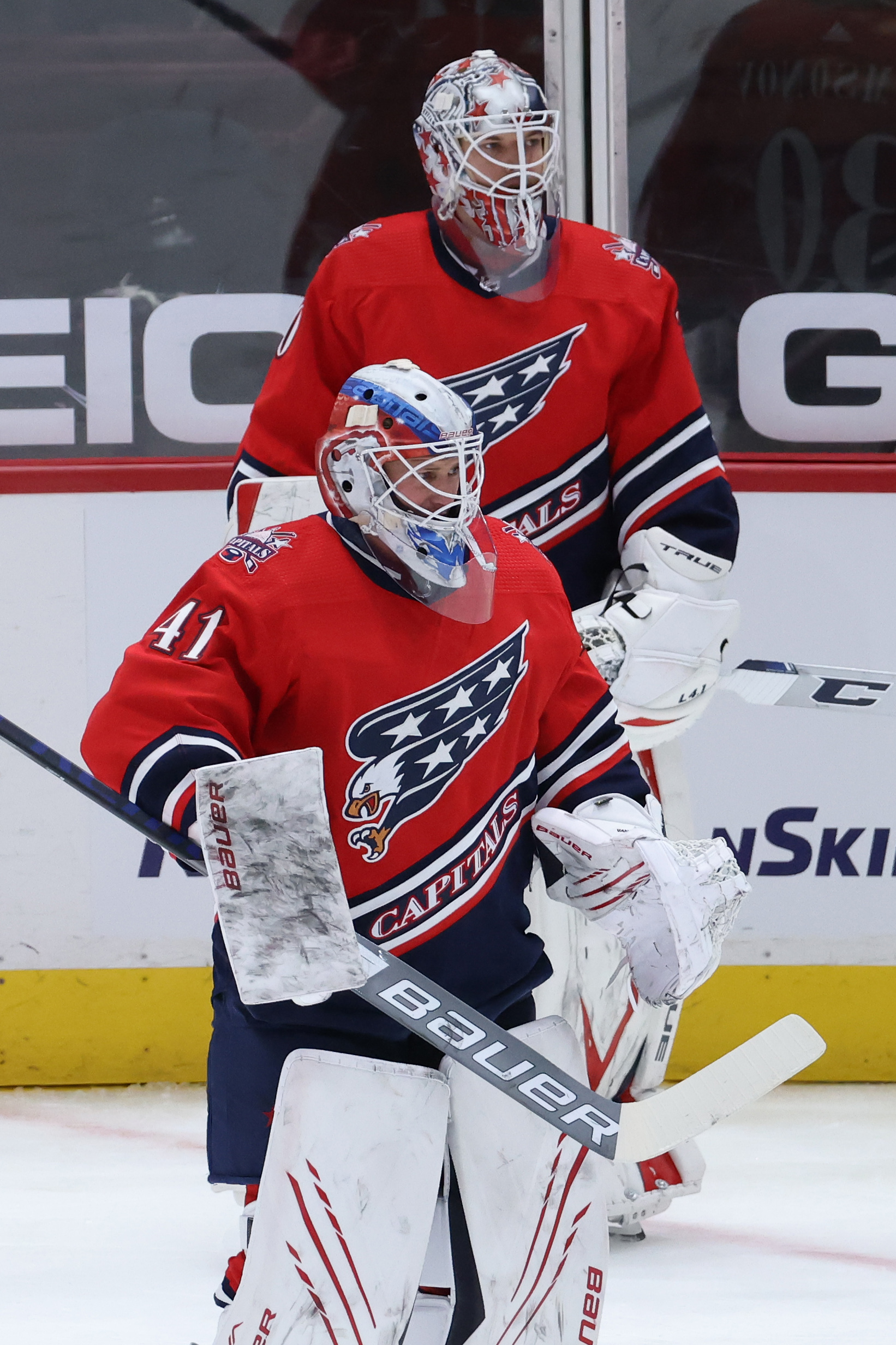 Heading into the season, Samsonov looked like a lock to be protected. However, injuries and COVID-19 limited him to just 19 regular season appearances where he didn’t play particularly well, notching just a .902 SV%. On the other hand, he has been their goalie of the future since he was picked 22nd overall in 2015 and his rookie season showed plenty of promise. There is definitely still some upside to the 24-year-old who is a pending restricted free agent.
Still, Samsonov’s struggles opened the door for Vanecek who went from having no NHL experience this season to their de facto starter where he performed a little better than Samsonov did (a .908 SV% with an identical 2.69 GAA). It’s also worth noting that he’s also signed at a cap hit that’s below the league minimum next season. Even to Seattle, a team that probably won’t go right to the Upper Limit right away, that carries a lot of value.
Unlike skaters, there is no alternate protection scheme that allows a team to protect multiple goaltenders. Barring a side agreement, one of them has to be made available and whichever one is left exposed becomes an immediate contender to be selected.
There is an interesting decision that needs to be made on the back end as well. Carlson and Orlov are locks to be protected but that only leaves one slot for several capable defenders.
Schultz was one of the bigger surprise signings last fall when he got a two-year, $8MM contract despite a tough year with Pittsburgh. To his credit, he bounced back nicely with 27 points in 46 games which is decent value for an offensive defender. On a back end that doesn’t have a lot of offensive pop beyond Carlson and Orlov, losing him would definitely hurt.
But while Dillon doesn’t provide much on the scoresheet, he brings a lot of physicality and defensive acumen to the table which earned him a four-year, $15.6MM deal after impressing in his short stint upon being acquired as a rental at the trade deadline. He brings a dimension that they were seeking for a while and with three years left, he’s more likely to be part of their long-term plans over Schultz who will be unrestricted next summer. But is $3.9MM too pricey for Seattle for a stay-at-home defender?
Kempny could have been in the mix for this final slot had he been healthy but injuries wiped out his entire season. He should be ready for next season but after not playing this season, he’s not a big risk to be selected. Jensen is a contract they wouldn’t mind unloading to free up some extra wiggle room but they’d need some incentive to take him and while van Riemsdyk has over 400 career games of experience (including the playoffs) and is signed for just $950K, it doesn’t seem likely that he’ll entice the Kraken either.
Projected Protection List
F Nicklas Backstrom (NMC)
F Lars Eller
F Evgeny Kuznetsov
F Anthony Mantha
F T.J. Oshie
F Conor Sheary
F Tom Wilson
D John Carlson
D Dmitry Orlov
D Justin Schultz
Skater Exposure Requirement Checklist
When Vegas had their expansion draft, a minimum of two forwards and one defenseman had to be exposed that were under contract and played either 40 games in the most recent season or 70 over the past two combined. Due to the pandemic, those thresholds have been changed to 27 games played in 2020-21 or 54 in 2019/20 and 2020-21 combined. In creating our expansion list for each team in this series, we will ensure that these criteria are met.
Forwards (4): Nic Dowd, Carl Hagelin, Garnet Hathaway, Daniel Sprong
Defensemen (4): Brenden Dillon, Nick Jensen, Michal Kempny, Trevor van Riemsdyk
There are definitely a couple of viable routes for Seattle to take here. Dillon isn’t flashy but is definitely dependable and would comfortably step into their top four for the foreseeable future. But Vanecek is coming off a strong first NHL season and is cheap. At least three goalies have to be picked by the Kraken and at a bare minimum, he’d be an intriguing pick-and-flip candidate. He’s also a restricted free agent at the end of next season so it’s quite plausible for him to be viewed as part of their longer-term plans. Seattle GM Ron Francis will have a tough decision to make but he will be landing a quality player from the Capitals either way.
Photo courtesy of USA Today Sports Images. Contract information courtesy of CapFriendly.
West Notes: Expansion, Nosek, Menell, Leach
Typically, the only teams that can sign a player to a max-term eight-year contract is the one they’re currently on. However, Seattle will be able to change that. As Pierre LeBrun notes in his latest piece for The Athletic (subscription link), the NHLPA negotiated a “no loss of status or rights’’ provision in the latest CBA which means that a pending free agent selected by the Kraken could still receive an eight-year deal as long as the contract is signed before free agency opens up on July 28th.
Seattle will have a 72-hour exclusive negotiating window with any free agents that are left unprotected by their current teams in advance of next month’s expansion draft. If they reach an agreement with one of those players, that player automatically becomes the selection from the team that originally had them.
Elsewhere in the West:
- Golden Knights center Tomas Nosek is getting closer to returning to the lineup, GM Kelly McCrimmon told reporters, including Ben Gotz of The Athletic (Twitter link). The veteran has missed the last 11 games since leaving their second contest against Minnesota back in the first round with an unspecified injury. Nosek has been an important depth player for Vegas since joining them in expansion and surprisingly had a career year offensively this season with 18 points in just 38 games.
- Wild defensive prospect Brennan Menell surprisingly signed in the KHL for this past season but the move worked out as he was one of the top scoring defensemen in that league with 38 points. As Michael Russo of The Athletic suggests (subscription link), that could put him in a spot to push for a one-way contract at the league minimum of $750K to come back to North America. Russo notes that Menell’s representatives reached out last month to start talks for a contract for next season but GM Bill Guerin wanted to wait until their playoffs finished first. If he does return, he’d need to play in 75 NHL games next season to avoid reaching Group VI unrestricted free agency.
- The Coyotes have interviewed Providence head coach Jay Leach for their vacant head coaching position, reports Craig Morgan of AZ Coyotes Insider (Twitter link). The 41-year-old has spent the past six seasons in the AHL including the past four as head coach of Boston’s affiliate. Leach also played in 70 career NHL games over a 13-year professional career.
Coyotes To Interview Mike Van Ryn For Head Coaching Vacancy
The Coyotes will interview Blues assistant coach Mike Van Ryn for their vacant head coaching position on Monday, reports Craig Morgan of AZ Coyotes Insider (Twitter link). That spot was opened up at the end of the season when Rick Tocchet’s contract was not renewed after four years behind the bench.
The 42-year-old played in parts of eight injury-plagued NHL seasons with the Blues, Panthers, and Maple Leafs before retiring at the age of 31 to start his coaching career. Since then, he has been a head coach in the OHL and AHL as well as an assistant in the OHL and NHL.
Van Ryn spent two years with Arizona in 2016-17 and 2017-18 as a development coach and head coach with AHL Tucson (where he coached a handful of current Coyotes including Conor Garland and Lawson Crouse) so he has some familiarity with the organization. From there, he went to St. Louis, joining their bench as an assistant coach in 2018. GM Bill Armstrong was with the Blues before joining the Coyotes so he would be quite familiar with Van Ryn as well; the two overlapped for two seasons.
Arizona isn’t in a spot where they’re hoping to become contenders right away so a pricey veteran bench boss probably isn’t what Armstrong is looking for. Most of their core group is still fairly young so a younger coach may be the better way to go. While Van Ryn hasn’t garnered much head coaching consideration elsewhere, this fit could be a good one for both sides.