
Latest On Andrew Copp
Last night, the New York Rangers won a crucial game against the Carolina Hurricanes, keeping their season alive. Andrew Copp, who the Rangers acquired from the Winnipeg Jets at the trade deadline, has been a major reason for the team’s success in these playoffs. Given his status as a pending unrestricted free agent, it’s natural to believe that Copp has earned himself some money on his next deal with how he’s performed in New York. On the 32 Thoughts segment of last night’s Sportsnet broadcast of the Rangers/Hurricanes game, Sportsnet’s Jeff Marek supported that line of thinking, reporting that it “sounds as if” Copp’s market is going to land between the deals signed by two recent comparable unrestricted free agents: Phillip Danault and Zach Hyman.
Danault signed his contract after leading the way on a Canadiens team that to the 2021 Stanley Cup final, inking a six-year, $33MM deal with the Los Angeles Kings. Hyman signed a seven-year, $38.5MM deal with the Oilers after a season where he scored at a 63-point pace. While Copp’s defensive game may not be quite at the level of Danault’s (who is a consistent down-ballot Selke candidate) and his offense may be slightly below where Hyman’s was in his platform year, Copp has proven to be an incredible fit with Artemi Panarin and Ryan Strome and is now producing better than he ever has as a professional.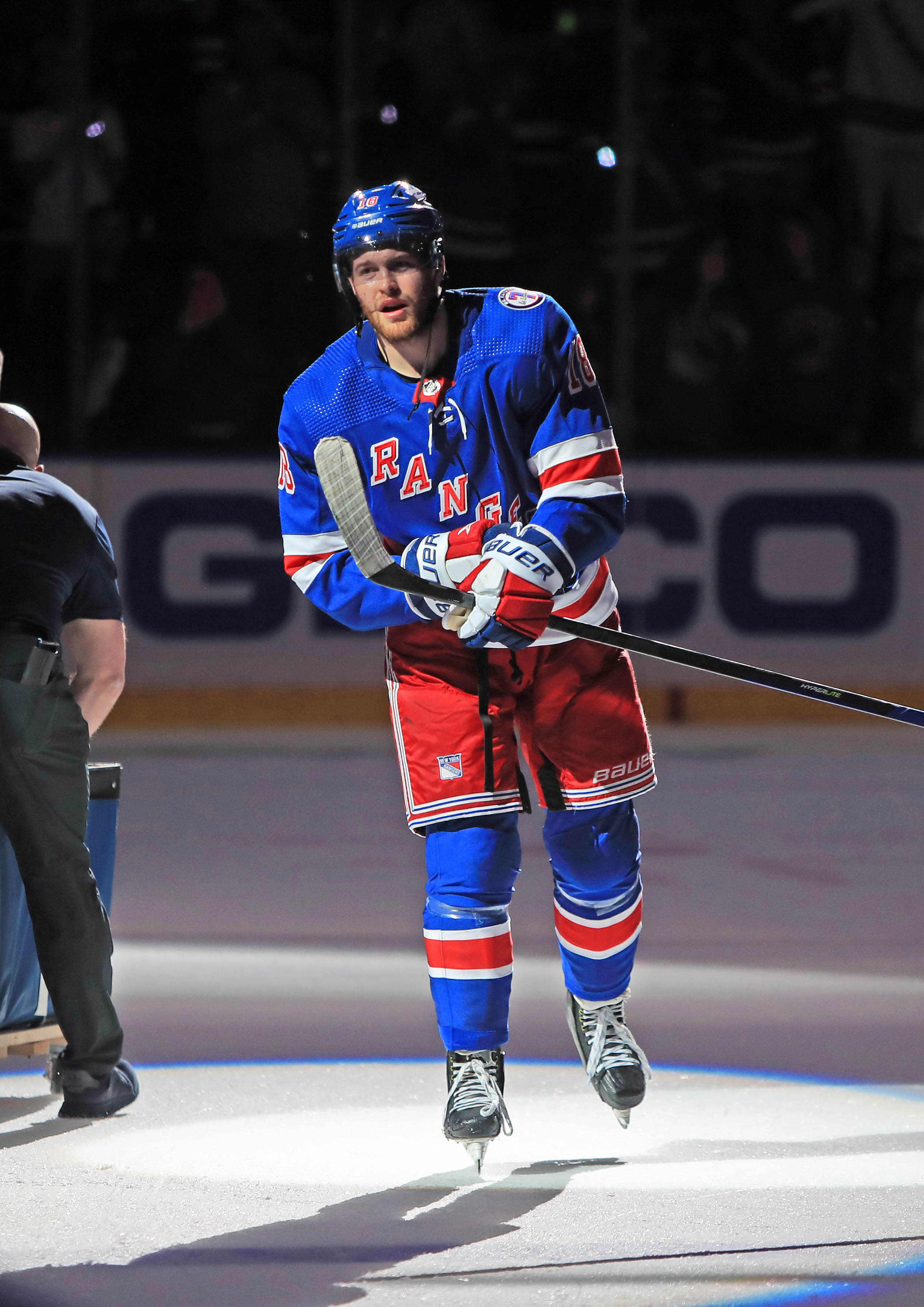
As a Ranger, including the playoffs, Copp has 28 points in 29 games, showing that in the right fit, he can be a very strong offensive producer to go along with his defensive game. The Rangers also have Strome as a pending unrestricted free agent and could find themselves forced to choose only one of the two to retain after this season, given the constraints of the salary cap. Strome may have a longer and more proven track record of chemistry with Panarin than Copp does, but Copp has outproduced him in these playoffs and offers more versatility, as well as a more well-regarded defensive game. The Rangers’ attempts to retain both or their choice between the two will be one of the Rangers’ top storylines this offseason, and recent reporting indicates that they will be aggressive in their pursuit of Copp.
Copp’s performance also still holds significance for his former team. As part of their trade with the Rangers, the second-round pick the Jets received for Copp was actually conditional, and is upgraded from a 2022 second-rounder to a 2022 first-rounder if the Rangers make it to the Eastern Conference Final (to be decided Monday) and Copp plays in at least 50% of the team’s playoff games. So while two fanbases will see their teams battle to remain alive in the chase for the Stanley Cup, there will be a third fanbase also likely to be deeply invested in the fate of Monday’s high-stakes seventh game.
Photo courtesy of USA Today Sports Images
Calgary Notes: Tkachuk, Injury Updates, Monahan
After the conclusion of the Calgary Flames’ season on Thursday, the team took some time to digest and spoke to the media today in their end-of-season media availability, touching primarily on injury news, some known and some not, as well as topics for this offseason. One of those offseason topics comes with the status of superstar forward Matthew Tkachuk, who is a RFA after finishing a three-year, $21MM contract this season. Tkachuk impressed over the life of the contract, capping it off with an incredible 42 goals and 62 assists in 82 games this season. Keeping the forward in the fold long-term is absolutely a priority for the Flames, however they also have to focus on re-signing superstar Johnny Gaudreau, who is a pending UFA, and give fairly significant raises to forward Andrew Mangiapane and defenseman Oliver Kylington.
Calgary did seem to clear one hurdle today, as Tkachuk himself told the media, when asked about an extension, that he would love to sign a long-term deal with the Flames, expressing his love for the team, the city, and the fanbase. Tkachuk’s sentiment is no small feat for the Flames considering the league has seen a number of superstar players depart their teams in free agency in recent years. Though a RFA, Tkachuk could opt for a shorter-term bridge deal and hit the unrestricted free agent market sooner than later, which would put Calgary in a tough spot, with forwards Tyler Toffoli, Mikael Backlund, and Elias Lindholm, as well as defensemen Noah Hanifin and Chris Tanev all set to become UFAs after the 2023-24 season. All of that before considering what an extension with Gaudreau would include. Keeping Tkachuk long-term won’t ease the burden of his cap hit, but will provide Calgary with the security of knowing a superstar is staying put for a certain salary while they navigate that predictably difficult 2024 offseason and the future of the franchise.
- Sportsnet’s Eric Francis provided injury updates on several Flames players, including Tkachuck, Mangiapane, Tanev, Milan Lucic, and Nikita Zadorov. Lucic, who had struggled to just one assist in 12 playoff games has an AC sprain. Tkachuck had an injured hand and Mangipane a bad wrist. Perhaps most notably, Zadorov, who had done an excellent job shutting down both Edmonton and the Dallas Stars, did so in some part with two broken ribs. Despite the number of injuries for Calgary, it appears that Tanev, who has a torn labrum, separated shoulder, and sprained neck, will be the only one having surgery (link).
- More from the injury front, as The Athletic’s Hailey Salvian also provided an update on forward Sean Monahan, who had hip surgery in the first week of April. Flames GM Brad Treliving told Salvian that Monahan’s recovery was about 5-6 weeks ahead of schedule as compared to where he was with his hip surgery last offseason, and the forward should resume skating in the coming weeks. With opening night over four months away, we will have to wait a while to see Monahan back in the Calgary lineup at full strength. However, the update on Monahan, who has struggled more and more over the past three seasons while dealing with injury, is absolutely encouraging, and getting him back to the form that saw him hit a career-high 82 points in 2018-19 could work as a “free” addition for the Flames, who are currently at-risk of losing Gaudreau in free agency this offseason.
Looking At Claude Giroux’s Impending Free Agency
With the Florida Panthers now swept out of the Stanley Cup Playoffs, many questions will arise this offseason about the future of this year’s Presidents’ Trophy winners. One of those questions will be the future of forward Claude Giroux, who the Panthers acquired at the Trade Deadline. The longtime captain of the Philadelphia Flyers was moved for what many viewed as an underwhelming return, and despite Florida’s early elimination, Giroux performed with renewed vigor on a better team. He had eight points in 10 playoff games but piled up assists in the regular season, notching 20 in 18 games with the Panthers. He still managed 42 points in 57 games with the Flyers prior to the trade on a massively struggling team, too. His eight-year extension that kicked in prior to 2014-15 is now expiring, and Giroux could hit unrestricted free agency for the first time in his 15-year career.
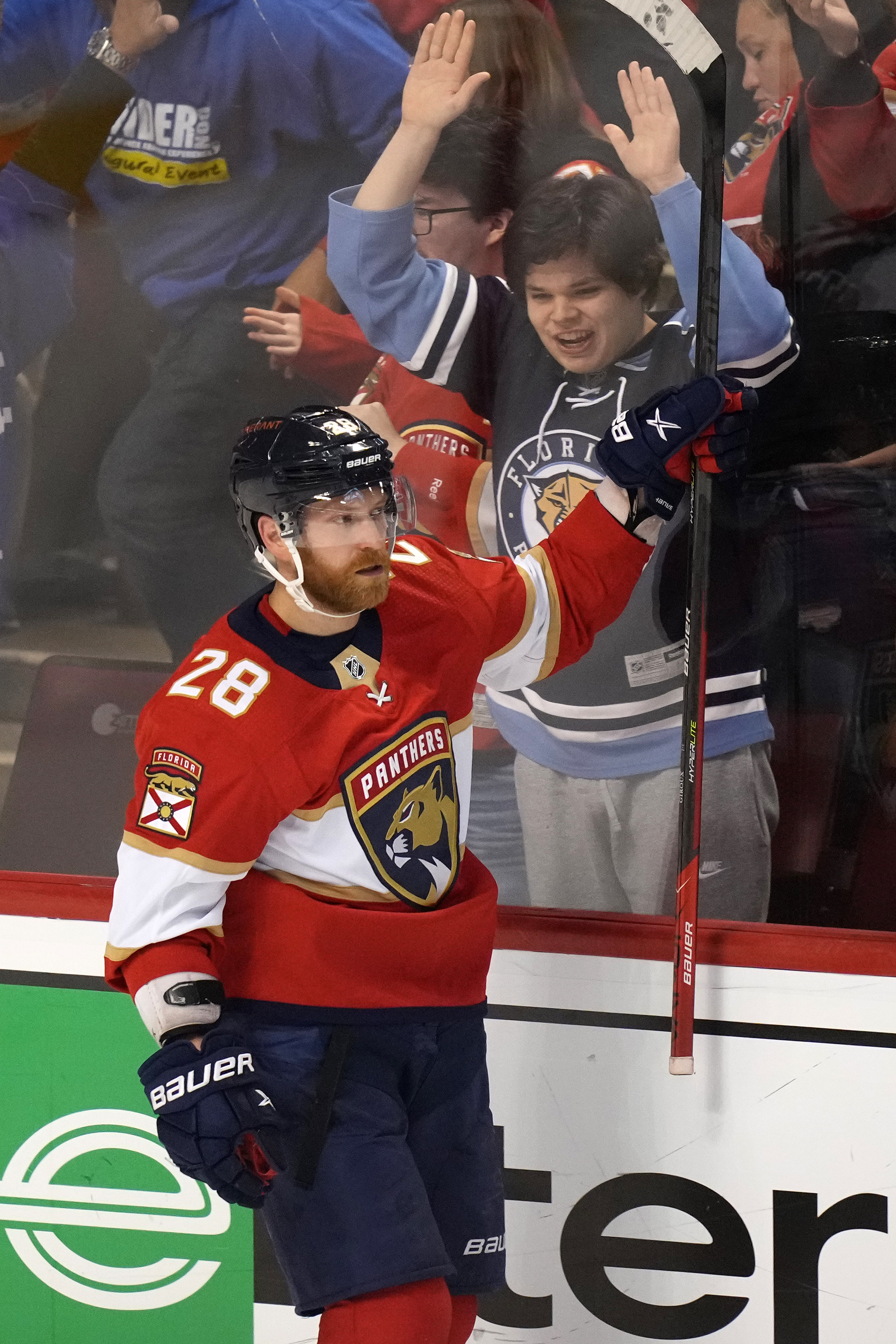 Giroux has already stated his desire to return to South Florida if the opportunity arises. However, with the worst year of the Keith Yandle buyout hitting the Panthers next season, the team has just under $4MM in projected cap space for the 2022-23 season, according to CapFriendly. That’s already an impossible number to sign Giroux unless he takes a serious old-man discount, but the team also has a handful of roster spots to fill on both forward and defense. The team could likely opt to trade Patric Hornqvist (with a limited no-trade clause) and the final year of his $5.3MM cap hit, though, which could seriously open the door for a Giroux return.
If Giroux can’t work out a return to the Panthers organization, though, teams will come prepared with serious offers for his services. The 34-year-old can still be counted on for at least 20 goals and 65/70 points in a full season, and he remains a very good defensive presence and faceoff man. Giroux is still boasting a streak of five seasons above a 55 percent mark in the faceoff circle, and although his skill set is now best used on the wing, he’s still valuable as a faceoff specialist. It’s hard to imagine Giroux receiving less than $6MM or $7MM, although a four-year term is likely an extreme maximum for Giroux at this point.
His hometown Ottawa Senators have been constantly linked to Giroux over the past few years, and the team hasn’t been quiet about their desire to improve this offseason drastically. With the team boasting nearly $25MM in cap space this offseason, they have the room and then some to make that sort of acquisition.
Is a return to the Flyers in the cards? It’s doubtful. Giroux hasn’t made a Stanley Cup Final in 12 years and he doesn’t have a ring. It’s that fact that makes it seem like a discount to stay in a team on the rise in Florida would make the most sense for Giroux. However, if the Senators play their cards right and their prospects develop properly, they could be in a position to win Cups by the end of a Giroux contract as well. Other teams in contending positions may not have the cap space to afford Giroux’s services, but it’s much too early to eliminate that scenario.
Photo courtesy of USA Today Sports Images
Dylan Larkin Changes Representation
One of the biggest items on Detroit Red Wings general manager Steve Yzerman‘s checklist this offseason is a potential contract extension with captain Dylan Larkin. The 25-year-old center is signed through 2022-23 and would become an unrestricted free agent next offseason if a deal isn’t reached. It seemed as though Yzerman and the Red Wings front office would be negotiating that extension with KO Sports, but last night Max Bultman of The Athletic reported that Larkin has changed representation. He’s now with CAA, represented by Matt Williams and NHL super-agent Pat Brisson.
It appears as though that was a very unexpected decision, given the statement that Kurt Overhardt, CEO of KO Sports, released to Bultman today:
From a relationship standpoint, Dylan Larkin worked primarily with my business partner, Joe Oliver. Throughout the past 11 years, Joe has thoughtfully guided Dylan through countless matters both on and off the ice. There was never a single issue raised between Dylan and Joe for the entirety of their professional relationship and Joe was completely blindsided by this decision. For the past several months, Joe had been working directly with Dylan in preparation to negotiate his contract extension with the Detroit Red Wings.
As with all of our clients, our work on behalf of Dylan was at the highest standard in all situations. We are very disappointed in his decision and the timing.
Obviously, the interest of the agents is to remain with a client through what should be a massive negotiation, and Overhardt’s statement should be taken with a grain of salt. But it does confirm for Red Wings fans that Larkin is ready to negotiate this offseason–or at least was with his previous representation.
While KO Sports is no small outfit, moving to CAA takes Larkin right to the top. Brisson has more than $1B in negotiated active contracts according to PuckPedia, including clients like John Tavares, Patrick Kane, Jonathan Toews, and Anze Kopitar, all players with an average annual value of at least $10MM. For what it’s worth (which may be nothing), Brisson currently has just one client with the Red Wings–Jared McIsaac–and none with Yzerman’s former outfit in Tampa Bay.
Larkin is coming off quite the platform year to start negotiating. Reinvigorated by his young, up-and-coming teammates, the speedy forward scored 31 goals and 69 points in 71 games. His overall production is similar to CAA client Matt Duchene through the early part of his career; Duchene ended up signing a seven-year, $56MM contract with the Nashville Predators when he hit the open market in 2019. He did negotiate a multi-year deal with the Red Wings for Anthony Mantha in 2020.
Players signed through 2022-23 are eligible for extensions on July 13, when free agency opens this year.
Overseas Notes: Blankenburg, Verbeek, Merkulov
Nick Blankenburg‘s World Championship is over. Brian Hedger of the Columbus Dispatch reports that the Blue Jackets’ rookie defenseman has left Team USA due to injury. Blankenburg sustained a knee injury during the international tournament in Finland and decided to return home. However, Hedger adds that the injury is not supposed to be severe and that Blankenburg’s health by the start of next season is not in doubt. Even with the early exit from the Worlds, Blankenburg has had quite the unforgettable year. The 24-year-old defender had a career season as the senior captain of Michigan, recording 14 goals and 29 points in 38 games en route to a Frozen Four appearance. He then signed with Columbus as an undrafted free agent and proceeded to record three points in seven NHL games down the stretch. Blankenburg earned a spot with Team USA at the World Championship and played in four games with the team. He will look to continue his success streak by winning a regular role with the Blue Jackets next season.
- Hayden Verbeek‘s uncle may be the new GM of the Anaheim Ducks, but the young forward won’t wait around for NHL free agency in hopes of a family deal on a new contract. Verbeek has opted to leave North America altogether and sign a one-year deal with Slovakian club HK Spisska Nova Ves, the team announced. Verbeek is no stranger to Slovakia, having played in the Extraliga early in 2020-21 while awaiting the delayed AHL season. While Verbeek played exclusively in the AHL after returning last year, he did spend some time in the ECHL this season, which could have been the deciding factor in his move overseas. Four seasons into his pro career, including the first three on an NHL contract, Verbeek has played largely in the AHL but has been demoted to the ECHL in three seasons and has seen no NHL action. Looking for a more consistent role in a top league, Verbeek will try his hand again in Slovakia next season.
- When Georgi Merkulov, a star prospect out of the MHL, left Russia in 2020 to embark on a development path in North America with the USHL’s Youngstown Phantoms and then the NCAA’s Ohio State Buckeyes, the odds that he would one day star in the KHL slipped. Then-rights holder HK Sochi decided to trade Merkulov to Amur Khabarovsk, doubting that he would ever suit up for the team. When Merkulov surprisingly turned pro after just one college season, signing with the Boston Bruins this spring, those odds fell even further. Amur has now decided to move on as well. KHL powerhouse CKSA Moscow, whose youth system Merkulov developed in, has decided to take a long-term gamble, acquiring the rights to their former prospect, per the KHL. In exchange, Amur received minor league defenseman Ilya Dervuk. Merkulov recorded 20 goals and 34 points in 38 games this season for Ohio State as one of the top freshmen in the NCAA and then added five points in eight AHL games with the Providence Bruins. Boston certainly hopes that this scoring prowess translates to the NHL and that these KHL trades are ultimately meaningless.
Columbus Blue Jackets Sign Marcus Bjork
The Columbus Blue Jackets have entered the early free agency mix, adding to their blue line with an overseas addition. Brian Hedger of the Columbus Dispatch relays a team press release announcing that Swedish defenseman Marcus Bjork has signed a one-year entry-level contract with the Blue Jackets. The 24-year-old has spent the past four seasons in the SHL.
Bjork will not be entirely new to North American hockey when he arrives in Columbus next season. In 2016-17, the young defender began the season with the USHL’s Omaha Lancers. However, he returned to Sweden after just eight games. The following year, Bjork played in Sweden’s second-tier pro league, the Allsvenskan, and earned Defenseman of the Year honors by leading the league’s defensemen in goals and points. The breakout campaign earned him a contract in the SHL, but he didn’t immediately continue his upward trajectory. Bjork has found more success in recent years with Brynas IF however, recording 39 points in 116 games over parts of three seasons.
The Blue Jackets clearly like what they have seen from Bjork, whose game has balanced out since his younger years as well. At 6’3″ and over 200 lbs., Bjork brings good size and physicality to go with his offensive game. While he may take some time to adjust to the NHL – or perhaps more likely the AHL – Bjork could become a nice two-way piece for Columbus. He joins a young blue line that includes Zach Werenski, Andrew Peeke, Jake Bean, Adam Boqvist, Nick Blankenburg, and Jake Christiansen as NHL options under 25.
Detroit Red Wings Extend Taro Hirose
The Detroit Red Wings have reached an agreement with Taro Hirose on a two-year contract extension, keeping him in the organization and away from unrestricted free agency. The financial details of the deal have not yet been released.
Hirose, 25, would have qualified as a Group VI UFA this summer, after playing just 57 games to this point in his NHL career. Just 15 of those came this season but the young forward showed just how dangerous he could be at the minor league level.
In 59 games for the Grand Rapids Griffins, Hirose had 15 goals and 53 points. He’ll likely spend a good chunk of this new contract in the minor leagues as well, though he’ll have to clear waivers in order to do it.
A highly sought-after undrafted free agent in 2019 out of Michigan State University, Hirose has 20 points in his 57-game NHL career to this point, suggesting that there actually is some upside at that level if he ever gets a more prolonged opportunity. If not, he still represents a strong injury replacement for short-term stints, as he can step into a top-six or powerplay role if necessary.
There’s also always a chance that he catches the eye of the new coaching staff, with Jeff Blashill not returning. That battle will happen in training camp now that the contract negotiations are complete.
Looking At The Impending Vegas Cap Crunch
To say the 2021-22 season was a gigantic disappointment for the Vegas Golden Knights would also be a massive understatement. After mortgaging a large part of their future to acquire superstar center Jack Eichel, albeit for the long term, the team missed the playoffs for the first time in franchise history and fired head coach Peter DeBoer earlier this week.
Now, general manager Kelly McCrimmon has an arduous offseason to retool the roster and find a new head coach. Both will need significant attention, however, the Knights are already entering free agency with the pressing need to shed cap space. With a roster size of 23, the team is already in a salary deficit of about $500,000, even with the small cap increase to $82.5MM next year (CapFriendly).
While some of those players may be sent to AHL Henderson when the team is fully healthy, the team needs to make a decision on RFAs Nicolas Roy, Brett Howden, Keegan Kolesar, and Nicolas Hague, who have all been extremely valuable to the team in their depth roles. It’s clear that unless the Knights somehow make a move to acquire significant long-term injury relief (Shea Weber?), the team needs to move on from a decent chunk of cash to be comfortable under the cap in 2022-23.
Obviously, the choice that jumps off the page is forward Evgenii Dadonov. Signed just through next season at $5MM, the veteran forward was already involved in a trade intended to dump his salary but was reversed due to his limited no-trade clause. He did hit the 20-goal mark again this year and could do so again if given good support. It’s a low-risk acquisition for teams looking for scoring depth, especially with his contract expiring at the end of the year. However, Vegas has absolutely no leverage in this situation given the failed trade in March. If that incident didn’t happen, the Knights could probably have made a decent deal involving Dadonov this offseason. They’ll likely still be able to make a trade, but it won’t involve much benefit for the team other than cap space.
Another potential option is William Karlsson. Given his offensive upside and defensive acumen, teams would probably like to have a top-six centerman under a $6MM cap hit. With the Eichel acquisition and solid play from the cheaper Chandler Stephenson, there is no longer a pressing need for Karlsson in the lineup. He had a very tough season putting pucks in the net, though, and his 40-goal 2017-18 campaign seems like decades ago for him now. He’s scored just 15, 14, and 12 goals in the past three years, and while he still puts up points, he’s signed through 2027. It would clear a tad more cap space than Dadonov, though, and the wing is more a position of need for the Knights. Yet, the relationship between Dadonov and the Knights must be considered. If the relationship is irreparably severed, the team might have no choice. That’s not to say they still couldn’t entertain the idea of moving Karlsson, however.
Lastly, there’s backup netminder Laurent Brossoit and his $2.3MM cap hit. He’s almost surely gone considering the incredibly strong play of youngster Logan Thompson down the stretch. It’s not much cap relief, though, and the team likely needs a little more wiggle room to adjust the roster as desired.
Looking Ahead To Nick Leddy’s Impending Free Agency
Despite being with his third team in the last year, Nick Leddy is back in a familiar place: the Stanley Cup Playoffs. A veteran of 12 NHL seasons, Leddy has been to the playoffs in 10 of them, suiting up for 125 playoff contests, four of which have come this postseason as a member of the St. Louis Blues, the first playoff games he has played not wearing a Chicago Blackhawks or New York Islanders jersey. Once Leddy’s season is over, whenever that may be (St. Louis currently trails Colorado 1-0 in their second round series), Leddy will find himself in uncharted territory: unrestricted free agency.
At 31-years-old, Leddy has never had the opportunity to hit the open market, initially signing extensions as a RFA with the Chicago Blackhawks, and then the New York Islanders after an October, 2014 trade. Leddy’s expiring contract, a seven-year, $38.5MM deal, was signed with the Islanders in 2015 before Leddy was set to become a RFA. That contract proved to provide good value to the Islanders, for whom Leddy played 518 regular season games and 67 playoff games, many of which were as one of the team’s top defensemen. However, with cap concerns creeping up this past offseason, Leddy would find himself once again traded, this time to the rebuilding Detroit Red Wings. The veteran was tasked to be a leader in a young dressing room, with the organization hoping they could take the next step. On the outside of the playoff picture once again, Detroit dealt Leddy at the trade deadline, where he would become a key piece on the blueline for the St. Louis Blues, who have their eyes set on their second Stanley Cup in four seasons.
Now an UFA, Leddy will look to parlay his experience into another contract to cover his early and mid-30’s. What Leddy’s next contract will look like is an interesting discussion however, as he has plenty to admire, but does pose some concerns for a team that would be committing to him. First, looking at the positives, Leddy can be described as a durable defenseman who skates and moves the puck well, and who has developed his defensive game nicely in the past few seasons. Over the course of his career, Leddy has missed very few games and would average over 40 points-person-season in his prime. After a tough 2017-18 season which would see Leddy accumulating a minus-42 rating despite having 42 points of his own, Leddy was able to reinvent his game under coach Barry Trotz. Though the strong point totals did not come back to their previous form, the defenseman showed his ability to work diligently in his own end and move the puck out routinely.
On the other hand, after being traded to Detroit and away from the system that saw him take steps forward defensively, Leddy again struggled in his own end, and played to a minus-33 rating in Detroit before being traded to St. Louis. With the Blues, Leddy would rebound, posting eight points to go with a plus-3 rating in 20 regular season games down the stretch. Still, as a 31 year old defenseman who relies heavily on his skating, Leddy’s prime is likely behind him and even with the steps he has taken to round out his game, his occasional struggles defensively do raise concern.
All of this is to say, Leddy is more than a capable NHL defenseman, but these factors will play into what his next contract looks like. He almost certainly will not receive the seven-year term he has on his current contract, and the $5.5MM AAV it carries is potentially out of the question too. However, on a shorter-term contract of three or four years, Leddy could push a number that is close to his previous salary even if he cannot reach it.
One name to look at as a potential comparison for Leddy is Toronto Maple Leafs defenseman T.J. Brodie. The former Calgary Flames blueliner signed his four-year, $20MM contract with Toronto just after turning 30 years of age, a year younger than Leddy is now, but on a similar trajectory. Brodie, like Leddy, made a name for himself in his mid-20’s as a smooth skating, puck moving defenseman who could regularly provide point totals in the mid-40’s. Then, like Leddy, Brodie’s defensive struggles would become apparent before making adjustments to solidify his defense.
Unlike Leddy, when Brodie’s defensive game took a change for the better between 2017-18 and 2018-19, his offensive output would stay the same. However, the next season, 2019-20, Brodie’s offensive numbers would dip severely, albeit still playing a sound game in his own end. It was after this season that Brodie hit the UFA market and signed with Toronto. Now for Leddy, much as it was for Brodie after making impressive changes to his defensive game, but hitting some bumps in the road, he will hit the UFA market.
Ultimately, Leddy’s market should come down to a combination of factors that should include the flat salary cap, how teams believe his game will fit in their system, and perhaps most importantly, how those teams feel his game, which is particularly skating-reliant, will age over the life of the contract. What may be his biggest selling point, however, is something mentioned in the beginning of this article: his 125 games, and counting, in the Stanley Cup playoffs, accumulated over 10 of his 12 NHL seasons, including a Stanley Cup, experience which, of course, cannot be taken away with age.
Update On Evgeni Malkin, Kris Letang
Earlier today Evgeni Malkin addressed his pending unrestricted free agency and future with the Pittsburgh Penguins, stating that he hopes to retire in Pittsburgh. For that to be possible, he must ink a contract extension with the only team he has ever known. Malkin, 35, has remained consistently productive as he has aged (42 points in 41 games this season) but has also struggled to remain in the lineup on a regular basis. So, his importance to the franchise and his strong production square up against the declining reliability of his health to make his upcoming contract situation an especially intriguing one.
Just as Malkin’s contract is expiring, so is the contract of another Penguins franchise icon: Kris Letang. Letang, who is also 35, is coming off a season where he posted a career-high in points (68) and managed to stay in the lineup for 78 games, his most since the 2017-18 season. With Malkin and Letang both up for new contracts, the Penguins’ front office (and new ownership group) has a fork-in-the-road opportunity to change the direction of the franchise.
Rob Rossi of The Athletic reported yesterday that the Penguins had offered Malkin and Letang matching three-year, $15MM extensions, offers that “did not sit well” with Sidney Crosby. While that is certainly a major development, if true, Elliotte Friedman of Sportsnet added some context to the situation in his recent 32 Thoughts blog. Friedman supported Rossi’s reporting on the Penguins offering Malkin a three-year term on his extension, stating that the team has symmetry with the three years left on Sidney Crosby’s contract in mind. He also reported that Malkin’s camp and the Penguins were “far, far apart” on the actual dollar value of the extension, a separation that could make Malkin’s return more challenging.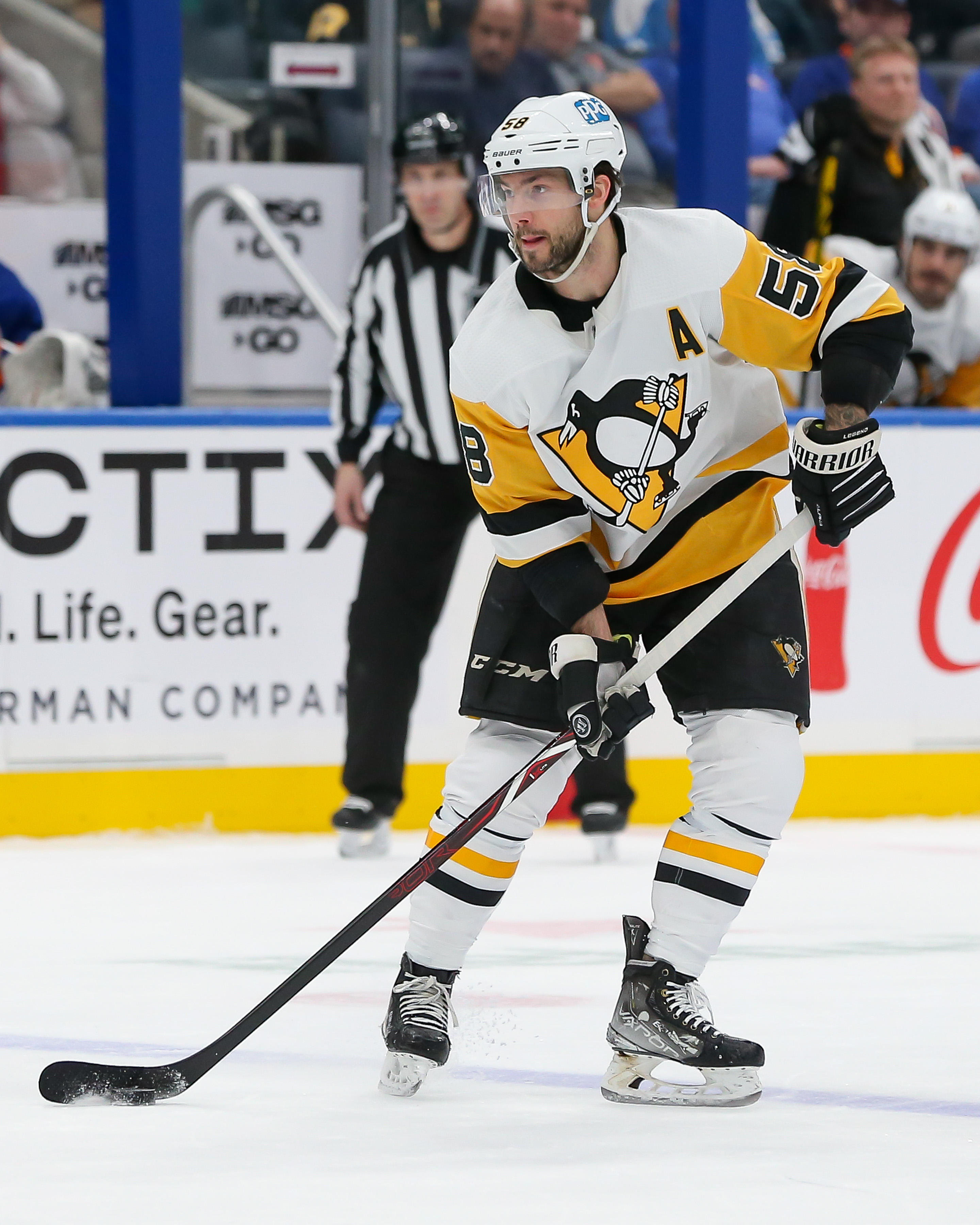
As for Letang, Friedman reported that his offer was larger than the one mentioned in Rossi’s report. Friedman says that the “last he heard” was that Letang was offered a four-year contract carrying an average annual value just “a bit less” than his current AAV of $7.25MM. Given the annual values of contracts other high-end defensemen have received (Seth Jones, Darnell Nurse, and Dougie Hamilton, as comparables, got at least $9MM AAV on deals with significantly more term) it’s an open question as to whether that reported offer will be sufficient to retain Letang’s services.
Letang did say, per Mike DeFabo of the Pittsburgh Post-Gazette, that his “main goal” is to stay in Pittsburgh, so perhaps he will not enter the market eyeing a deal comparable to those other elite defensemen. But one does have to keep in mind that this very well could be Letang’s last chance at a massive contract, due to his age. At the very least, it seems from Friedman’s reporting that while the Penguins are apparently undertaking an earnest effort to retain their two franchise legends, there are still obstacles in the way.
Photo courtesy of USA Today Sports Images