
Andreas Athanasiou Heading To Switzerland
Detroit Red Wings restricted free agent forward Andreas Athanasiou remains unsigned… for now. The latest news on the league’s last remaining RFA comes from TSN’s Bob McKenzie, who shares that Athanasiou is on his way to Switzerland to skate with HC Lugano of the NLA. McKenzie was quick to add that Athanasiou has not signed Lugano and is still evaluating his options, but his commitment to going overseas for the time being raises more doubts that he will suit up in the NHL this season.
A recent poll revealed that most fans felt Athanasiou and former holdout Josh Anderson would each re-sign with their respective teams. The second most popular answer was that the pair would both play overseas. Anderson has done his part to prove true the majority, re-upping with the Columbus Blue Jackets, but Athanasiou has not made any similar progress with Detroit and seems more likely to join in the dissenting opinion. Interestingly, it was Anderson who had been connected to the NLA this off-season, with Athanasiou reportedly fielding offers from the KHL. Athanasiou may still end up in Russia, but with an influx of talent heading to the NLA in recent years and the the past success of Lugano, who has not missed the playoffs in six years, the team is far from a poor fit. Athanasiou would be skating alongside former Red Wing Damien Brunner, as well as NHL veterans Maxim Lapierre and Bobby Sanguinetti should he sign with Lugano and the talented group could very well make a title run in 2017-18.
Still, the best thing for Athanasiou and for hockey is for the skilled 23-year-old to stay in North America. In just his second NHL season, the young center scored 18 goals and defied expectations for a Detroit team with few bright spots. The Red Wings may not want to overpay – in salary or term – for Athanasiou, who did have an unsustainable 15% shooting percentage in 2016-17 and is only in the early stages of developing a defensive game, but the best decision is always to work things out. Just ask the Dallas Stars, who missed the playoffs last season and had to go on a spending spree this summer in hopes of righting the ship. They would love to have Valeri Nichushkin back, the talented young winger who left the team in the summer of 2016 to head to the KHL, where he remains, after failing to come to terms in restricted free agency. Maybe the Red Wings would rather trade Athanasiou or maybe they’ll realize their mistake and work out a contract. Either way, there seems to be little upside to simply losing the scoring youth for this season (or longer). Athanasiou skating with Lugano may just be the straw that finally breaks Ken Holland‘s back.
Minor Transactions: 10/05/17
We’ll keep track of all the assignments around the league right here, as teams fine tune their rosters.
- The Golden Knights assigned Brandon Pirri to the Chicago Wolves after clearing waivers. The 26-year old forward was just signed to a contract yesterday, after failing to earn on in Florida’s training camp. For the Golden Knights, there is no risk to signing a former 20+ goal scorer to see if he can still compete at this level. The team may be weak on offense all year, and could look to Pirri to infuse some scoring touch on the powerplay at some point.
- The Boston Bruins sent Emil Johansson back to Providence, and will go with the more veteran Paul Postma as their extra defenseman. Johansson joined the organization last year after his European season was over, and played in six games for the P-Bruins down the stretch. A seventh-round pick, Johansson is highly regarded by the Bruins staff and could get his shot at the NHL at some point this year.
- The Calgary Flames made another move, sending Garnet Hathaway to the minor leagues in order to clear room for Jaromir Jagr. Jagr was introduced yesterday at a press conference but likely won’t suit up for the team until he gets a few practices under his belt. The Flames could have used his offense last night as they were shutout by the Edmonton Oilers, in a game where Hathaway played just 11 minutes.
- The Washington Capitals have loaned Chandler Stephenson to Hershey after clearing waivers, meaning the 23-year old will have to wait patiently for his next NHL opportunity. Since being drafted in the third round, Stephenson has only been given short chances at a job with the Capitals, playing in 13 games over the past two years. Still looking for his first NHL point, he’ll have to prove it at the AHL level once again.
- Grand Rapids will be getting some help, as the Detroit Red Wings have assigned Matt Lorito and Eric Tangradi to the AHL. Tangradi cleared waivers today, and will return to the team he helped take to the Calder Cup championship a year ago. In the playoffs for Grand Rapids, Tangradi scored 19 points in 19 games, and will try to do the same this year. The Griffins have also signed Matt Carey to a professional tryout, and sent Matej Machovsky to the ECHL.
- According to Adrian Dater of BSN Denver, the Avalanche have indeed sent Joe Colborne to San Antonio to begin the season. Colborne was among those who cleared waivers today, and will have to work his way up from the minor leagues if he wants to return to the NHL. It’s a far fall for Colborne, who was a 19-goal scorer in the league just two seasons ago with Calgary, but suffered the same fate as many Avalanche players and posted a career-low in points last season. Scoring just eight all year, his $2.5MM salary looks like a dreadful overpay.
- The Blue Jackets have assigned defenseman Markus Nutivaara to the AHL (via the Cleveland Monsters website). For the former seventh-round pick appeared in 66 games during his rookie campaign, collecting two goals and five assists. He also made his way into a pair of playoff games, compiling one goal and one assist.
Ben Levine contributed to this post.
Chris Kelly To Remain With Oilers As A Practice Player
- The Oilers have asked center Chris Kelly to remain with the team as an unsigned player, notes Paul Gazzola on the Oilers’ team website. While he won’t be able to play in any games, he’ll be able to practice with the team and can continue to battle for a roster spot that way. This is the same approach that Toronto had with Brandon Prust last season while Brooks Laich has a similar arrangement with the Kings this year.
Salary Cap Deep Dive: Edmonton Oilers
Navigating the Salary Cap is probably one of the more important tasks for any general manager to have. Teams that can avert total cap chaos by walking the tightrope of inking players to deals that match their value (or compensate for future value without breaking the bank) remain successful. Those that don’t see struggles and front office changes.
PHR will look at every NHL team and give a thorough look at their cap situation heading into the 2017-18 season. This will focus more on those players who are integral parts of the roster versus those who may find themselves shuttling between the AHL and NHL. All cap figures are courtesy of CapFriendly.
Edmonton Oilers
Current Cap Hit: $65,647,000 (under the $75MM Upper Limit)
Entry-Level Contracts
D Matt Benning (One year remaining, $925K)
F Drake Caggiula (One year remaining, $925K)
F Connor McDavid (One year remaining, $925K)
F Jesse Puljujarvi (Two years remaining, $925K)
F Anton Slepyshev (One year remaining, $925K)
F Kailer Yamamoto (Three years remaining, $925K)
D Darnell Nurse (One year remaining, $863K)
Potential Bonuses
McDavid: $2.85MM
Puljujarvi: $2.5MM
Nurse: $850K
Slepyshev: $600K
Caggiula: $425K
Benning: $300K
Yamamoto: $230K
Total: $7.755MM
Believe it or not, McDavid is still on the list as the Art Ross Trophy winner, Hart Memorial Trophy winner, and Ted Lindsay Award winner is on the last year of his entry-level deal. McDavid will also be listed later in the story under four year and more as McDavid signed his eight year, $100MM extension this summer and will be locked up long term regardless. More on him later …
The Oilers have high expectations for both Benning and Nurse to take that next step. With injuries mounting, both should be vaulted into bigger roles than they were last year. The 23-year-old Benning played in 62 games last year and played solidly while filling in for injured players. The 22-year-old Nurse also had a solid showing in 44 games this year. Both may be asked to jump onto top-four pairings on defense throughout the year.
Slepyshev, who suffered an ankle injury in the offseason looks close to being ready. He had 10 points in 41 games a year ago, but also scored three goals in the playoffs for Edmonton last year and many feel the 23-year-old is ready to take that next step. Caggiula, a big college player from the University of North Dakota, had seven goals and 18 points in 60 games a year ago in his first year with Edmonton and is also thought to be a player ready to make a jump.
Both Yamamoto and Puljujarvi (Edmonton’s 2017 and 2016 first-round picks, respectively) went head-to-head and battled it out for a final roster spot this training camp with Yamamoto getting the edge and Puljujarvi getting sent to Bakersfield, but don’t be surprised if Puljujarvi is back up at some point during the season.
One Year Remaining, Non-Entry-Level
D Mark Fayne ($2.6MM, UFA – team saved $1.025MM in cap relief by sending him to AHL)
F Ryan Strome ($2.5MM, RFA)
F Mark Letestu ($1.8MM, UFA)
F Patrick Maroon ($1.5MM, UFA)
F Jussi Jokinen ($1.1MM, UFA)
G Laurent Brossoit ($750K, RFA)
F Iiro Pakarinen ($725K, RFA)
 Perhaps the most interesting player the team must focus on will be Maroon, who had a breakout year playing next to McDavid. The 29-year-old wing scored 27 goals and has proven to be one guy who seems to play well next to McDavid. He is a presence in front of the net and a physical force for the team.
Letestu, is another player the team will have to consider. Likely to be the team’s fourth-line center, Letestu put up 16 goals last year, although that was a career high and he’s already 32 years old. Jokinen, who signed a one-year deal this offseason, put up 11 goals last year in Florida, but at 34 years old is likely not a priority to the team.
As for restricted free agents, the team will take a long look at Strome, who the team acquired in the Jordan Eberle deal. The 24-year-old center has had an inconsistent career with the New York Islanders, but put up 13 goals and 30 points last year. The Oilers hope he can keep improving on those numbers. Brossoit will get his first chance to be Talbot’s backup. The 24-year-old looked promising in eight appearances last year.
Puljujarvi’s Demotion Is Not A Bad Sign
While many on Twitter are criticizing the Oilers for demoting Jesse Puljujarvi to Bakersfield as the team would rather him get first-line minutes in the AHL as opposed to third-line minutes with the team, David Staples of the Edmonton Journal agrees with the move.
The scribe writes that what the fourth-overall pick from 2016 needs is experience and playing time. He writes that 20 minutes of even strength and power play minutes is crucial to the young prospect’s development rather than getting 10 minutes a night or even some time sitting in the press box. What Puljujarvi needs is confidence, writes Staples, and dominating in the AHL for now will give that to him. At 18, he scored 12 goals and 28 points in 39 games for Bakersfield. Most prospects are still with their junior teams. Imagine what he should be able to accomplish one year later.
Staples adds that he is 19 year old and even if he needs more time to develop, that doesn’t mean anything towards his long-term value. He adds that he believes that Puljujarvi will develop into a much better player than Drake Caggiula and Anton Slepyshev (who was hurt), who both made the NHL roster over him. However, they didn’t beat out Puljujarvi. According to Staples, Kailer Yamamoto, the team’s 2017 first-round pick, took his spot.
With Puljujarvi, he can go down to Bakersfield and play as much as he wants until the team needs him. They can recall him whenever they want. However, with Yamamoto on the team, the team doesn’t have that luxury. If they had sent him down instead of Puljujarvi, they wouldn’t have the option of recalling him as he would return to his junior team and could not be recalled until their season is over. So, Edmonton is taking a long, nine-game look at the young, speedy wing. They can send him down at that point and bring back Puljujarvi if they want. Yamamoto had a good camp, but he wasn’t perfect and his size (5-foot-8, 153 pounds) might be too much for a 19-year-old to handle.
One other fact, both Yamamoto and Puljujarvi are 19 years old. Yamamoto is only five months younger, so the age difference is not significant. On top of that, Puljujarvi has only been in the U.S. for a little more than a year, so he has much more to transition to. However, it wouldn’t be a big surprise if Puljujarvi got called up if he can show success again in the AHL.
Training Camp Cuts And Recalls: 10/1/17
Today marks the end of the preseason for all those NHL teams who haven’t yet wrapped up their exhibition schedules. With games coming to an end, expect lots of action throughout the day and keep track of it all right here:
Arizona Coyotes
D Dakota Mermis – Tucson (AHL)
Colorado Avalanche
D David Warsofsky – waivers for purpose of assignment
Dallas Stars
D Chris Martenet – Texas (AHL)
Detroit Red Wings
F Colin Campbell – released from PTO
G Jared Coreau – waivers for purpose of assignment
F Matthew Ford – released from PTO
D Joe Hicketts – Grand Rapids (AHL)
F Axel Holmstrom – Grand Rapids (AHL)
D Filip Hronek – Grand Rapids (AHL)
D Brian Lashoff – waivers for purpose of assignment
F Matt Lorito – waivers for purpose of assignment
G Thomas McCollum – Grand Rapids (AHL)
D Dylan McIlrath – waivers for purpose of assignment
F P.A. Parenteau – released from PTO
F Michael Rasmussen – Tri-City (WHL)
D Dan Renouf – Grand Rapids (AHL)
D Vili Saarijarvi – Grand Rapids (AHL)
F Dylan Sadowy – Grand Rapids (AHL)
F Dominik Shine – released from PTO
F Ben Street – waivers for purpose of assignment
F Dominic Turgeon – Grand Rapids (AHL)
Edmonton Oilers
D Mark Fayne – waivers for purpose of assignment
F Jesse Puljujarvi – Bakersfield (AHL)
Florida Panthers
F Brandon Pirri – released from PTO
F Harry Zolnierczyk – released from PTO
D Josh Brown – Springfield (AHL)
Los Angeles Kings
G Jack Campbell – waivers for purpose of assignment
F Justin Auger – waivers for purpose of assignment
New York Rangers
F Robin Kovacs – waivers for purpose of assignment
Ottawa Senators
D Thomas Chabot – Belleville (AHL)
D Ben Harpur – Belleville (AHL)
F Max McCormick – waivers for purpose of assignment
Philadelphia Flyers
F Oskar Lindblom – Lehigh Valley (AHL)
Tampa Bay Lightning
F Stefan Fournier – Brampton (ECHL)
Vancouver Canucks
G Richard Bachman – waivers for purpose of assignment
F Michael Chaput – waivers for purpose of assignment
F Jayson Megna – waivers for purpose of assignment
Recalls:
San Jose Sharks
D Nick DeSimone
D Cavan Fitzgerald
F Adam Helewka
F John McCarthy
Pacific Notes: Virtanen, Neal, Slepyshev, Sekera
One preseason game remaining and Jake Virtanen remains with his team. The former sixth overall pick in 2014, has failed to crack the Canucks roster, but a solid training camp has many believing he has a good chance to become a regular in Vancouver this year, according to NBC Sports Cam Tucker.
After getting into 55 games two years ago with Vancouver in an underwhelming season, he managed to make just 10 appearances last year and even struggled with the AHL’s Utica Comets, scoring just 19 points in 65 games. However, his skills are obvious. Canucks GM Jim Benning has stated that his size and speed just need developing. At 6-foot-1 and 229 pounds and only 21 years old, Virtanen is trying to establish himself now, but is also trying not to think about whether he makes the roster this season. He has focused on his play instead and has already notched three preseason goals.
“I’m not going to worry about that,” Virtanen said of the team’s upcoming roster decisions. “I love when I can get in games. Whatever opportunity you can get, you want to make the most of it.”
- Vegas Golden Knights’ forward James Neal, who has been out with an injured hand, is reportedly practicing today without a red jersey, according to Las Vegas Review-Journal’s David Schoen. That suggests the top scorer might be ready for the regular season next week. The 32-year-old wing, one of the team’s top players, put up 23 goals last year and is considered to be a key trade chip at the trade deadline later this season.
- The Edmonton Oilers tweeted that forward Anton Slepyshev is expected to make his preseason debut tonight in Vancouver. “We’ve got to get him up and running,” said coach Todd McLellan. Slepyshev has missed all of training camp with an ankle injury. The 23-year-old wing scored four goals in 41 games for Edmonton last year.
- The Athletic’s Sunil Agnihotri (subscription required) writes that Edmonton’s choice to not bring in a veteran defenseman to help the team out while Andrej Sekera is out until January with a torn ACL is a big mistake. The scribe details how relying on internal options to replace him such as Darnell Nurse, Matt Benning or Yohann Auvitu is unreliable as the team hopes one of them makes a jump in their development. One example in his breakdown is Sekera’s success on the power play, which the young candidates have a combined 78 minutes of experience playing there.
2017-18 Primer: Detroit Red Wings
With the NHL season now less than a week away, we continue our look at what each team has done this summer and what to watch for in the year to come. Today, we focus on the Detroit Red Wings.
Last Season: 33-36-13 record (79 points), seventh in Atlantic Division (missed playoffs)
Remaining Cap Space: $-3.02MM per CapFriendly—including Johan Franzen ($3.95MM), who will go on LTIR.
Key Additions: D Trevor Daley (free agency, Pittsburgh), F/D Luke Witkowski (free agency, Tampa Bay), F David Booth (PTO), F P.A. Parenteau (PTO)
Key Departures: F Drew Miller (free agency, unsigned), F Andreas Athanasiou (RFA, unsigned)
[Related: Detroit Depth Chart From Roster Resource]
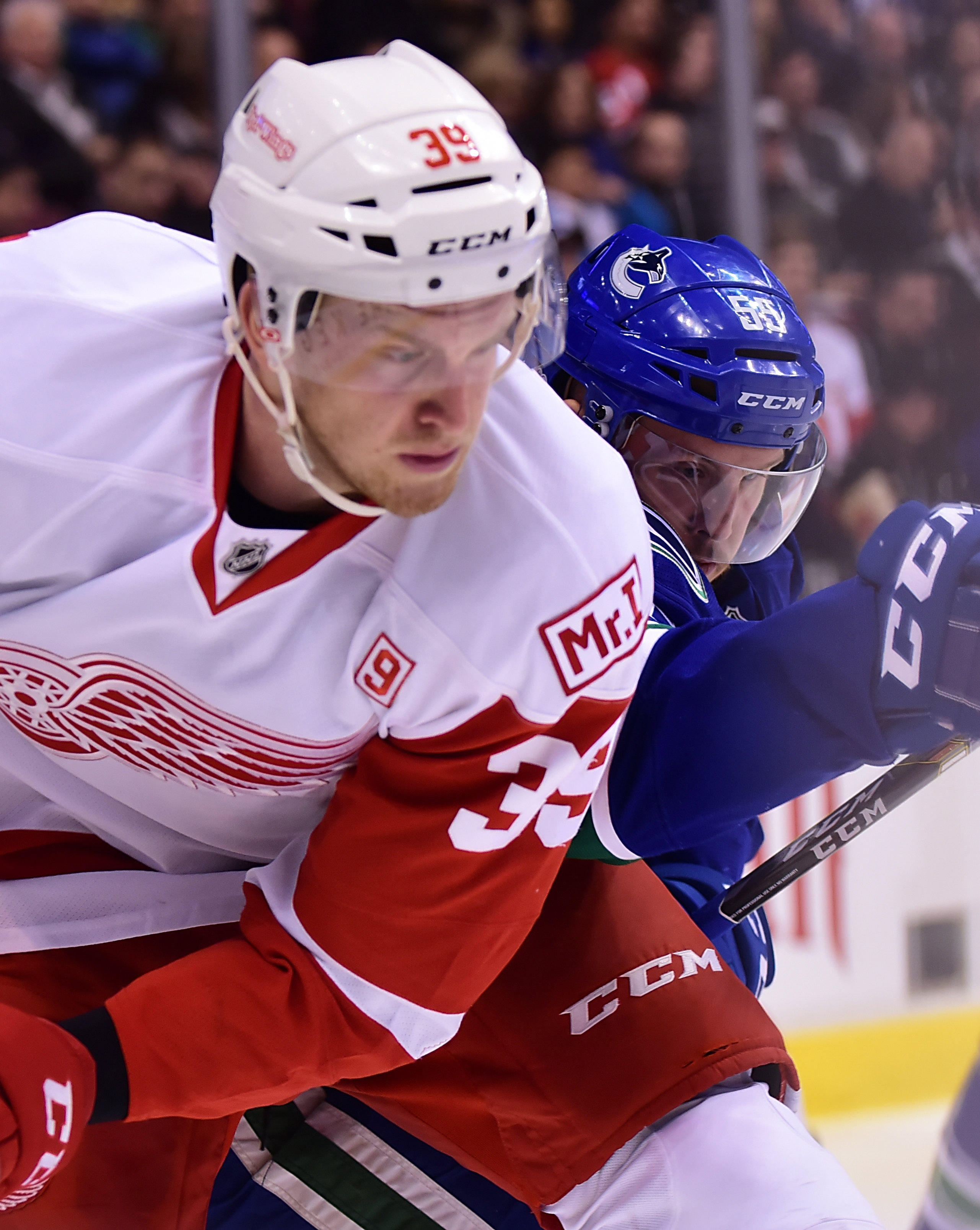 Player To Watch: F Anthony Mantha – Mantha is an enigma for many Red Wings fans. Despite having the size, strength and skating ability to be a dominant force in the league, he at times drifts into the background or disappears completely. His coaching staff has felt the same, moving him into the press box at times during his rookie campaign, and ultimately demanding more from him on a game-by-game basis.
This year will be a telling one. Mantha comes into the year after scoring 17 goals and 36 points in just 60 games, but even their distribution showed his inconsistency. Seven goals and fifteen points came in a 12-game span in the middle of the season, where he showed off just how forceful he can be with the right work ethic. He would score just 14 points in the remaining 32 games.
Now, with the Red Wings pivoting towards their youth and a sort of on-the-fly rebuild, Mantha must be better. At 23, the time is now for him to prove that he can be more than just a secondary scoring threat, and team up with other youngsters like Dylan Larkin to bring the next wave of Detroit success.
Key Storyline: Last year after the Red Wings fell out of contention, they did something they hadn’t done in some time. At the trade deadline, they moved Brendan Smith, Tomas Jurco and Thomas Vanek for future assets. That idea of selling mid-season is something almost entirely foreign to this generation of Red Wings fans, as the team hadn’t missed the playoffs since 1990.
Going into this season with a new arena and new hopes, the team will have to make a similar decision. If they aren’t competing for a playoff spot in early 2018, selling off some assets is a necessary next step. Though they’re expected to struggle once again, the team is over the cap and used some of their room to bring in a veteran Trevor Daley. That move seemed to show that they weren’t willing to go for a full rebuild, at least not yet.
While there is certainly upside in parts of their roster, players like Mike Green, Gustav Nyquist and Jimmy Howard are all unlikely to be around for the next great Red Wings team. Moving on from them whenever they can would help both the salary structure and the on-ice product down the line. Green especially will be a sought-after commodity at the trade deadline as he heads towards free agency, as the 31-year old can still provide offense from the back end. He has a full no-trade clause that would have to be worked around though, taking away some of the Red Wings’ leverage in trade talks.
Photo courtesy of USA Today Sports Images
Oilers Notes: Defense, Yamamoto, Stanton
The Oilers are coming off of their highest point total since 1986-87 and certainly look like they’re a team on the rise. Anchored by Connor McDavid and a strong supporting cast up front, GM Peter Chiarelli told Sportsnet 590 (audio link) that he’s not concerned about their offense heading into the season but that the team is still looking to add to their defense:
“Right now, the scoring, I’m not really that concerned with. We lost Sekera and he won’t be back for a while, so that’s an area that we’re working on and we feel is an area that – I’m somewhat satisfied where we are, personnel-wise, but it can always be improved.”
Edmonton was dealt a big blow back in mid-May when it was announced that Andrej Sekera would miss six-to-nine months with a torn ACL which will keep one of their top-two defenders out for the first few months of 2017-18. While they’ve added some help in recent years in Adam Larsson, Kris Russell, and Matt Benning, they still don’t have the deepest group of blueliners to work with.
[Related: Oilers Depth Chart from Roster Resource]
Finding the right addition may prove to be somewhat of a challenge for Chiarelli. It’s likely that he has set his sights on a top-four replacement for Sekera and those types of players are rarely available at this time of year. It’s also understandable that the GM would prefer to add a rental player as while they currently have more than $8MM in cap space for this season per CapFriendly, McDavid’s new eight-year, $100MM contract is set to kick in a year from now.
Other news out of Edmonton:
- The Oilers are facing a tough decision with 2017 first rounder Kailer Yamamoto, writes Postmedia’s Robert Tychkowski. While the soon-to-be 19-year-old has made a very strong case for a roster spot so far this preseason, he is on the smallish side at just 5’8 and around 155 pounds while from a longer-term perspective, having his cheap entry-level contract begin as McDavid’s massive extension does would be more beneficial on the salary cap. If they do put him in the lineup to start the season, their attack will be even deeper with Yamamoto finishing fifth overall in the WHL in points per game last season at 1.52.
- The team announced (Twitter link) that defenseman Ryan Stanton suffered a crack in his foot and will be out for a while. The 28-year-old has 120 career NHL games under his belt but has spent most of the last two seasons at the minor league level.
2017-18 Primer: Edmonton Oilers
With the NHL season now just a week away, we continue our look at what each team has done this summer and what to watch for in the year to come. Today, we focus on the Edmonton Oilers.
Last Season: 47-26-9 record (103 points), second in Pacific Division (lost to Anaheim in second round)
Remaining Cap Space: $8.33MM per CapFriendly
Key Additions: F Ryan Strome (trade, New York), F Jussi Jokinen (free agency, Florida),
Key Departures: F Jordan Eberle (trade, New York), F Benoit Pouliot (buyout), F Matt Hendricks (free agency, Winnipeg), F Tyler Pitlick (free agency, Dallas), F David Desharnais (free agency, New York), D Griffin Reinhart (expansion, Vegas)
[Related: Edmonton Depth Chart From Roster Resource]
 Player To Watch: F Jesse Puljujarvi – While most of the eyes will still be focused on Connor McDavid no matter where the Oilers are playing, Puljujarvi should command some attention as well. The fourth-overall pick from 2016 won’t turn 20 until next May, and seems to be in a dogfight to even make the roster out of camp. Kailer Yamamoto, the team’s top pick from the most recent draft is giving Puljujarvi all he can handle as he tries to prove that he’s ready to take the next step in the NHL.
That next step is an important one, as Puljujarvi had an up-and-down season a year ago. Starting the year with the Oilers, he rarely saw enough minutes to really make an impact and was eventually sent down to the Bakersfield Condors of the AHL. Once there, he slowly found his game before going on a tear to prove that he could dominate in the minor leagues. The 18-year old scored 28 points for the Condors, which actually ranked fifth among forwards despite playing in only 39 games.
The training wheels are off now though, and if Puljujarvi is to make this team he’ll have to perform. While there is no chance of him being labelled a bust this early in his career, a breakout would go a long way to helping the Stanley Cup contending Oilers reach that next level.
Key Storyline: When the Oilers committed $168MM to two players this offseason, they locked themselves into the same yearly salary cap struggles the Pittsburgh Penguins and Chicago Blackhawks have endured. While obviously both franchises have experienced immense success, they each took home their first Stanley Cup while at least one of their “Big Two” was still on a more reasonable contract. That’s this year and this year only for the Oilers, as McDavid’s record-setting $12.5MM cap hit kicks in next summer.
It’s not to say that the team won’t be able to compete once it does—Pittsburgh and Chicago have both won subsequent Cups while paying big prices—it’s that this theoretically should be one of the best chances they’ll ever have. While McDavid is sure to be among the handful of top players for the next decade, he’s already there and earning only $925K (plus bonuses) in salary. The question will be have the Oilers done enough to build a team around him for this season in order to take advantage of that.
The Oilers have $66.7MM committed to this season, and just over $60.7MM on the books for next. The difference is that this year that’s projected out from 24 roster players, while next there are only 13 under contract. The $8.33MM in cap space this year is one of their greatest assets, and no one should be shocked if they’re aggressive in-season going after rentals. While they can’t take on money for the future, they should be as close to the cap as their budget allows this year when it’s all said and done.
Photo courtesy of USA Today Sports Images