
Is Vancouver Looking To Make A Big Splash?
It is no secret that the Vancouver Canucks do not operate like a typical rebuilding team. Make no mistake, the team has accrued plenty of talented young building blocks over the past few years: Bo Horvat, Brock Boeser, Elias Pettersson, Jonathan Dahlen, Adam Gaudette, Quinn Hughes, Olli Juolevi, Thatcher Demko, Michael DiPietro and the list goes on. However, the team has also gone about business as usual, signing free agents and at times even overpaying to add veterans to the roster. Over the past two off-seasons, Vancouver has taken roster spots away from younger players in order to sign the likes of Erik Gudbranson, Sam Gagner, Michael Del Zotto, Anders Nilsson, Thomas Vanek, Darren Archibald, Jay Beagle, Antoine Roussel, Tim Schaller and more. The moves have put the team no closer to being a contender. The Canucks have not advanced past the first round of the playoffs since their 2011 Stanley Cup Final appearance and have failed to reach the postseason altogether in each of the past three years. It seems unlikely that the trend will change any time soon, either.
The Province’s Ed Willes is worried that things might get even worse. Willes claims that recently departed team president Trevor Linden ” lost his job because he favored a patient, methodical approach to the team’s rebuild”. With Linden gone, the team has been even more aggressive than usual this summer in targeting older players. Vancouver made an offer to John Tavares that was rejected and more recently has been linked to Erik Karlsson. While he isn’t convinced the team has the means to acquire Karlsson, the fear is that some player will come along on the trade market that they can afford and will deplete their promising prospect ranks to acquire. Willes firmly believes that Benning and the Canucks are in the hunt for a cornerstone player, no matter the cost.
Just as it has in recent years, even adding an elite veteran player is unlikely to get the Canucks to where they want to be. As it is currently composed, the team lacks the supporting cast to be a true contender. The greatest strength of the organization is the youth waiting in the wings, with at least two goaltenders, four defensemen, and eight forwards under the age of 25 that are all almost universally expected to be NHL regulars for a long time to come. Yet, the cost of adding a marquee player would be a package of those exact players or upcoming (early) draft picks. The patient approach that Linden fought for could transform the Canucks into one of the league’s top teams in five years time. An impatient acquisition could cost them what progress they have made and, in Willes’ opinion, cost them fans as well. So perhaps the question is not “is Vancouver looking to make a big splash?”, but “should Vancouver be looking to make a big splash?” and the answer seems to be a convincing no.
Poll: Who Will Win The Pacific Division In 2018-19?
We’re just over a month away from the 2018-19 NHL season, and players are hitting the ice with teammates to start forming chemistry. All over the league there are individual workouts underway, and rookie tournament rosters being announced. The excitement for the upcoming season is starting to bubble up to the surface, and even the smallest NHL news has fans in a frenzy.
Recently, Bovada released their over/under numbers for each team’s point totals and there are some interesting results. Though these aren’t to be taken exactly as predictions for the upcoming season—since betting odds also take into account popularity trends and other factors—fans of the Tampa Bay Lightning should still be extremely satisfied to see their club at the very top with an over/under of 107.5 points. The Lightning are expected to be Stanley Cup contenders once again in 2018-19, and have brought back nearly their entire roster.
We ran a poll asking the PHR community to decide who will win the Atlantic Division last week, and the Lightning came out on top with nearly 37% of the vote. The Toronto Maple Leafs finished in second place, but the big surprise was the Detroit Red Wings in third with 15% of all voters. While our readers have more confidence in the Red Wings than the odds makers, we’ve seen stranger things in the past.
The odds though tell an interesting story in the Pacific Division.
The Vegas Golden Knights won the division easily last season with 109 points, finishing at 51-24-7 in their inaugural season. They rode that dominance all the way to the Stanley Cup Finals, and yet aren’t the clear leader this time around. Vegas is tied with the Anaheim Ducks at a 96.5 point over/under, but actually a point behind the San Jose Sharks who come in at 97.5. Los Angeles, Calgary and Edmonton don’t lag far behind, making this one of the most interesting divisions in hockey to watch this season.
Who do you think will come out on top of the Pacific Division this year? Can Edmonton bounce back from a disastrous 2017-18? Will Marc-Andre Fleury lead the Golden Knights back to the top? Can the Coyotes go from worst to first in one season? Cast your vote below and explain how you think the season will play out in the comments!
Who will win the Pacific Division in 2018-19?
-
San Jose Sharks 27% (338)
-
Los Angeles Kings 16% (207)
-
Vegas Golden Knights 15% (184)
-
Calgary Flames 13% (165)
-
Anaheim Ducks 11% (141)
-
Edmonton Oilers 11% (135)
-
Arizona Coyotes 4% (47)
-
Vancouver Canucks 3% (43)
Total votes: 1,260
[Mobile users click here to vote]
Minor Transactions: 8/28/18
August is almost over and training camps are right around the corner. Yet, players continue to make decisions on where they’ll play this season. On a day with a surprising amount of signing news, here are some other smaller moves around the hockey world:
- The AHL’s Providence Bruins have added another body up front. Mark Divver of the Providence Journal reports that the team has signed center Brett McKenzie to his first pro contract. An unsigned 2016 seventh-round pick of the Vancouver Canucks, McKenzie just wrapped up an OHL career that featured 224 points in 328 games. Most recently, he led the Owen Sound Attack in playoff scoring with eight goals and eight assists in just eleven postseason contests. The big pivot also plays a strong physical game and can make a living lower in the lineup. The P-Bruins are already an extraordinarily deep AHL team and McKenzie may spend some time down in the ECHL, but could fight his way into a consistent role with the team during the season.
- AHL teams tend to be more interested in adding younger players out the junior and college ranks as bottom-six contributors than recycling past AHLers. Hayden Hodgson is a case in point, as the former Cleveland Monsters grinder was unable to find another AHL deal this off-season. Instead, Hodgson has signed with the Toledo Walleye of the ECHL, the league announced. Hodgson spent some time in the ECHL last year and will be able to play a bigger role at the lower level. It remains to be seen whether he can show the offensive upside to ever climb back up the hockey ranks though.
- The most common route for elite American prospects in recent years has been through the U.S. National Development Program and then into the NCAA or right into the NHL. However, that path didn’t yield the desired results for young defenseman D.J. King. Despite having great size and playing a prominent role on the blue line for both the U-17 and U-18 squads this past season, King went undrafted in June. This likely points to a lack of belief in his offensive abilities, as he produced little in the way of scoring for the USNTDP. In an effort to improve that image before his next go-round in the draft, King has signed with his junior rights holder, the defending OHL champion Hamilton Bulldogs. Hamilton has announced the deal with King, who they are excited to bring in after spending a second-round pick on him back in 2016. Former NHL defenseman and Bulldogs President and GM Steve Staios spoke to King’s upside as a prospect, citing his leadership, toughness, and puck-moving ability. Perhaps a change of scenery is all the big defender needs to boost his production this season.
Pacific Notes: Treliving, Pavelski, Bear, Sautner
The Calgary Flames seem to gamble on their success every season lately when it comes to their offseason moves. This year, attempting to address their second-half collapse, general manager Brad Treliving made several key moves to revitalize the franchise, including trading away defenseman Dougie Hamilton, Micheal Ferland and collegeiate defenseman Adam Fox for youngsters Noah Hanifin and Elias Lindholm. The team also went out and signed a 30-year-old James Neal to a five-year, $28.75MM deal as well as signing veteran bottom-six center to three-year, $9.38MM contract. Many of those moves will turn out to be quite a gamble.
The Athletic’s Kent Wilson (subscription required) wonders whether this might be the last year for Treliving if the team doesn’t show immediate improvement and return to respectability. Several of his gambles from previous seasons have failed, most especially last year’s trade for Travis Hamonic for a slew of draft picks. While the trade made sense at the time, the deal looks worse and worse as time passes.
Treliving also has used his draft assets to add players over the last two years as he has had just one pick in the top 105 over those two seasons to acquire players like Hamonic, Curtis Lazar, Michael Stone and veteran goaltender Mike Smith, most of which have made few contributions so far to the team. Throw in the team’s lack of uncertainty in net in the future and one has to wonder whether Treliving will survive the next season if the team doesn’t make immediate improvements.
- The San Jose Sharks have done an impressive job of combining veteran talent with an infusion of youth over the years and none more than last year when several of their young players really stepped up, including Tomas Hertl, Chris Tierney, Timo Meier, Joonas Donskoi and Kevin Labanc. Even on defense, their youth took another step. However, how long can the veterans hold out? The Athletic’s Kevin Kurz (subscription required) wonders how much Joe Pavelski has left in the tank and how much the team depends on him? Despite missing just one game in the last five season, the 34-year-old veteran’s production dropped to just 22 goals last year, his worst season since the strike-shortened 2012-13 season. One of the reasons for his decline was that he was banged up early in the season with a wrist injury, a broken finger and some lower-body injuries. Although Pavelski’s days of scoring 40 goals is likely over, the team hopes they can count on Pavelski’s experience and skills to help lead the team on the top-six as there is no doubt the veteran will get the lion’s share of minutes on the team again this year.
- The Athletic’s Allan Mitchell (subscription required) looks at the play of Edmonton Oilers defenseman Ethan Bear, who has been one of Edmonton’s top propsects. The 21-year-old played most of the season with the Bakersfield Condors of the AHL, but finally broke into the NHL in March, playing in 18 total games. However, Mitchell writes that while Bear showed some offensive prowess, he struggled in coverage and gap control and likely needs more time in the AHL to be successful. With the injury to Andrej Sekera, Bear could get another chance to make the Oilers out of training camp.
- With few changes in their defensive personnel, the Vancouver Canucks have to look at as many internal defensive options if they want to get better. One option is Ashton Sautner, according to Ben Kuzma of the Vancouver Sun. The 24-year-old agitator finally got recalled last season by Vancouver in hopes of providing the team with an energy presence. He played five games on an emergency recall and had an impressive showing. Unfortunately, Kuzma doesn’t think he has much of a chance to make the team out of training camp this season as the team has nine defenseman under contract, including 2016 first-round pick Olli Juolevi, giving him little to no chance in making the NHL squad.
Jim Benning States That The Canucks Are Not Involved In Erik Karlsson Talks
While the Canucks were a team that was surprisingly linked to Senators defenseman Erik Karlsson earlier this morning, GM Jim Benning told Sportsnet’s John Shannon (Twitter link) that the team is not involved in discussions for the Ottawa blueliner. Given that Vancouver appears to be heading into at least a soft rebuild, giving up considerable assets for the pending unrestricted free agent would seem to be somewhat counterproductive. However, with more than $9MM in cap room at the moment (per CapFriendly), Vancouver would make some sense as a potential fit to get involved as a third party facilitator if someone needs to clear some short-term cap room or retain on Karlsson’s deal before flipping him, similar to what Vegas did with Derick Brassard last season.
Erik Karlsson Trade Talks Picking Up
After the last few weeks have brought little in terms of trade speculation around the NHL, Elliotte Friedman of Sportsnet has sparked the fire again surrounding Erik Karlsson of the Ottawa Senators. Friedman tweets that trade talks involving the superstar defenseman have picked up recently, with Western Conference destinations—potentially including the Vancouver Canucks—as the most likely. West teams like the Vegas Golden Knights and Dallas Stars had previously been linked to Karlsson, though it’s unclear if they’re included in the recent discussions.
For Vancouver the acquisition of Karlsson would seem unlikely, given that the team is still rebuilding and there is no guarantee that the Senators defenseman would be open to an extension. Iain MacIntyre of Sportsnet tweets that Quinn Hughes, Brock Boeser, Elias Pettersson are all completely off the table for the Canucks, making it hard to imagine a package strong enough to beat any other contender for Karlsson’s services. Interestingly MacIntyre does not mention top prospect Olli Juolevi, though that doesn’t necessarily mean he would be available.
There are obviously dozens of other teams in the NHL who would be interested in Karlsson, though many of them won’t be able to afford an extension that could push towards Drew Doughty‘s eight-year $88MM contract. Ottawa would likely receive the biggest return from a team that can immediately extend Karlsson, but that could also dramatically reduce their trading partners. The Golden Knights have the prospect capital and cap space to fit a star like Karlsson in, and the Colorado Avalanche have a trade chip that no one else in the league can match. That’s the Senators own first-round pick this season, acquired in the Matt Duchene trade from last season. After Ottawa chose to keep their 2018 pick and select Brady Tkachuk, they had to give up the 2019 pick and a potential opportunity at top prospect Jack Hughes. With the Senators expected to struggle this season—especially if Karlsson departs—the Avalanche could easily be holding a top-three pick in their pocket. For what it’s worth, Adrian Dater of BSN Denver isn’t hearing any connection with the Avalanche and Karlsson.
The Tampa Bay Lightning were the other team strongly linked to Karlsson in the past, and it’s unclear if they still pose a threat to acquire the defenseman. That would require Tampa Bay moving out other salary, but would make them an absolute powerhouse in the Eastern Conference and the favorite for a Stanley Cup Finals appearance. All of the other teams in the Atlantic Division will be hoping that the Senators’ captain heads out west and signs a long-term contract to stay out of their way.
Salary Cap Deep Dive: Vancouver Canucks
Navigating the Salary Cap is probably one of the more important tasks for any general manager to have. Teams that can avert total cap chaos by walking the tightrope of inking players to deals that match their value (or compensate for future value without breaking the bank) remain successful. Those that don’t see struggles and front office changes.
PHR will look at every NHL team and give a thorough look at their cap situation heading into the 2018-19 season. This will focus more on those players who are integral parts of the roster versus those who may find themselves shuttling between the AHL and NHL. All cap figures are courtesy of CapFriendly.
Vancouver Canucks
Current Cap Hit: $70,227,845 (under the $79.5MM Upper Limit)
Entry-Level Contracts
F Brock Boeser (one year, $925K)
F Adam Gaudette (two years, $917K)
F Nikolay Goldobin (one year, $863K)
F Elias Pettersson (three years, $925K)
Potential Bonuses
Boeser: $850K
Gaudette: $850K
Goldobin: $213K
Pettersson: $2.85MM
Total: $4.763MM
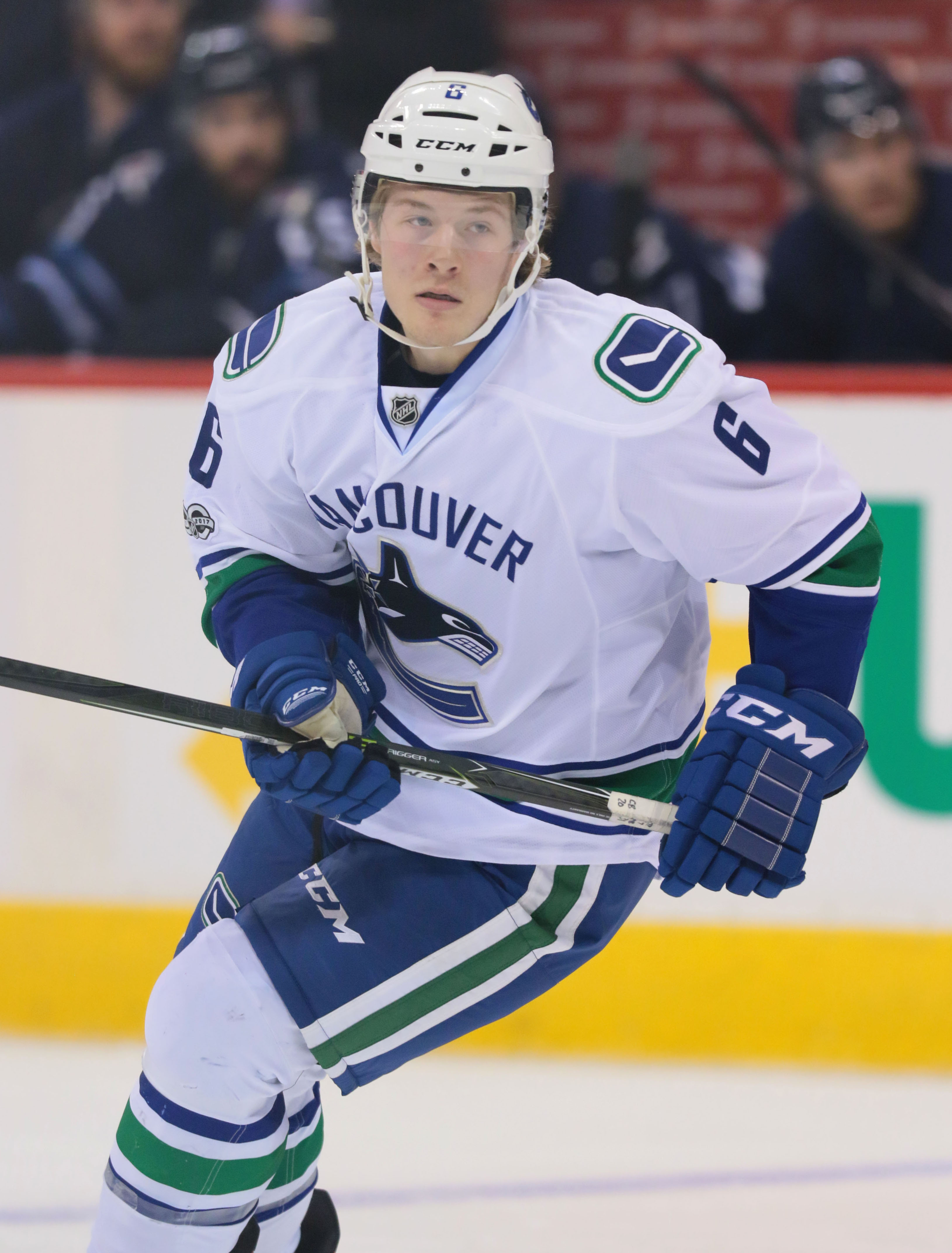 Boeser’s first full NHL season was quite the impressive one. Despite missing 20 games due to injury, he still led the team in goals with 29 and tied for the lead in points with 55. With the departures of the Sedin twins, this is now truly his team offensively already. Extension talks are scheduled for this week but Boeser’s negotiating leverage is lessened by his overall lack of NHL experience. With that in mind, unless Vancouver is prepared to go past $6MM per year already, he would be better served playing out next season where similar production would bolster his case considerably. Regardless of whether it gets done now or a year from now, there’s a good chance that Boeser will have the top cap hit in Vancouver for 2019-20.
Pettersson is coming off of a season where he won just about every award he could in the SHL (including Rookie of the Year plus MVP of the regular season and playoffs). Although they have a logjam of forwards, there’s a good chance he starts on the wing inside the top six or gets to that point before long. Goldobin split last year between the NHL and AHL and while he showed flashes of promise, he has yet to really establish himself in Vancouver. If he can do that, he should be able to improve on his current AAV but if he struggles, not only does he become a trade candidate but he also is someone that may be asked to take an NHL pay cut (with higher minor league money) on his next deal. Gaudette was the top scorer in the NCAA last year and got a cup of coffee with Vancouver. If they really go with a youth movement, he’ll be one of the beneficiaries but he could also be an opening roster casualty due to his waiver exemption.
One Year Remaining, Non-Entry-Level
D Michael Del Zotto ($3MM, UFA)
F Derek Dorsett ($2.65MM, UFA)
D Alexander Edler ($5MM, UFA)
F Brendan Gaunce ($750K, RFA)
F Markus Granlund ($1.45MM, RFA)
D Ben Hutton ($2.8MM, RFA)
F Brendan Leipsic ($650K, RFA)
G Anders Nilsson ($2.5MM, UFA)
D Derrick Pouliot ($1.1MM, RFA)
Among the forwards, Granlund is the most notable. He had a down year in 2017-18, posting just a dozen points in 53 games after collecting 32 points the year before. The deal he’s on (one that was signed back in June) likely equates to a last chance contract. If he rebounds, he’ll play himself into a nice raise with arbitration eligibility but if he struggles, he’ll be a non-tender candidate. Gaunce has failed to live up to his first-round draft billing and will simply be battling to make the roster so a sizable raise isn’t likely in the cards. Leipsic fared quite well after coming over from Vegas with nine points in 14 games. Competition for a top-six spot is much stronger now, however, so the type of playing time he was getting then is far from a guarantee. If he can secure a regular roster spot at the very least, he’ll land another deal next summer. Dorsett was forced to call it a career early last season after experiencing continued pain following cervical disc herniation surgery back in 2016-17 but won’t formally file his retirement papers until his contract expires. If Vancouver needs more cap flexibility in-season, he’ll be moved to LTIR.
The defensive group is much more interesting. Edler has been part of trade speculation for a long time now and with his deal now expiring, that will surely intensify if the Canucks get off to a slow start. When healthy, he’s still a capable second or third defender but staying healthy has been a challenge which will greatly affect his next contract. Because of the injury history, his next deal will probably check in somewhat close to his current one.
Del Zotto has been on short-term deals for most of his career and as he’s an offensive-minded depth defender, that probably won’t change too much next summer. He’ll need to improve his output if he wants to secure a raise and a little bit of stability on his next contract. It wasn’t long ago that Hutton was viewed as part of Vancouver’s long-term future. However, he struggled considerably last year and the team has been trying to move him but have had to takers thus far. He projects as a safe bet to be non-tendered at a $2.8MM qualifying offer next summer. Pouliot wasn’t given a qualifying offer back in June to avoid the potential for arbitration but they quickly reached an agreement. He took some small strides forward last season but this could be a make or break year for him. Improvement could get him a longer deal but if he struggles, he could be let go as well.
Nilsson was brought in to serve as a bridge to top prospect Thatcher Demko while pushing incumbent Jacob Markstrom for starts. His performance last season wasn’t particularly strong and a repeat of that could have him on the outside looking in on the goalie market next summer. On the flip side, with the extra emphasis on capable backups, a rebound season could allow him to get close to his current AAV. Either way though, with Demko expected to be ready for 2019-20, a return to Vancouver for Nilsson isn’t likely to be in the cards.
Two Years Remaining
D Alex Biega ($825K, UFA)
F Sam Gagner ($3.15MM, UFA)
G Jacob Markstrom ($3.67MM, UFA)
F Tim Schaller ($1.9MM, RFA)
D Troy Stecher ($2.325MM, UFA)
D Chris Tanev ($4.45MM, UFA)
F Jake Virtanen ($1.25MM, RFA)
Gagner has largely struggled in a top role but has provided capable secondary scoring over the last couple of years. That’s the role he’s likely to have with the Canucks moving forward. That said, he’ll have a hard time getting a multi-year deal on his next contract if he hovers around the 25-30 point mark. Schaller was brought in as part of their somewhat-perplexing strategy to load up on bottom-six forwards this summer. He had a career year with Boston last year and if he can repeat that in Vancouver, they’ll get decent value out of the contract. Virtanen has struggled with consistency so far which made his bridge contract the expected outcome. Within the next two years, the team should know if he’s part of their long-term plans (which will involve a big raise) or merely a filler in which case, he could be a non-tender candidate with a $1.5MM qualifier in June of 2020.
Tanev is another Vancouver defender that has been part of trade speculation for a while with nothing happening. He’s one of the more well-regarded stay-at-home blueliners in the league but he has a lengthier injury history than Edler which will hurt his market value on his next contract. Stecher took a big step back last season but his performance in his rookie year was enough to get him this deal. If he reverts back to his rookie form, this will be a good contract but if not, this could be another Hutton situation. Biega has some stability in the form of a one-way deal but he’s not likely to play much when the team is healthy.
Markstrom’s first full year as a starter had some ups and downs but all in all, it wasn’t a bad year. He’ll need to build on that if he wants to secure another contract though with Demko coming quickly. If he can show himself to be a starter, he will have several suitors down the road but if he proves to simply be a platoon player, he’ll be looking at a pay cut on his next contract.
Canucks Unlikely To Offer Any PTO Deals Before Training Camp
- The Canucks are a team that has used PTO deals in training camp in recent years but Postmedia’s Ben Kuzma reports that this will not be the case, at least as things currently stand. Vancouver shored up their depth up front this summer with a trio of bottom-six signings while they have eight returning defensemen so the vacancies just aren’t there. While some teams will bring in tryouts simply to help fill out the roster through the early goings of the preseason, it doesn’t appear that Vancouver will be among those.
Southern California Becoming A Hotbed For Young Hockey Talent
Can you name the all-time leading NHL scorer who was born or raised in California? No? It’s long-retired journeyman defenseman Lee Norwood of course with a total of 211 points. Coming in at number two is Brooks Orpik and his 185 career points and Orpik was raised in New York and played his developmental hockey in Massachusetts. The state of California has simply never been much of producer of hockey talent. Not for long. The grassroots movement in Southern California, fueled by the success of its three NHL rival teams, has begun to grow talent at a rate never before seen in the state or in many southern markets. Soon, California natives will be making names for themselves at the highest level.
For a while now, Boston Bruins defenseman Kevan Miller has been the best player in the NHL both born and raised in California. The rugged blue liner from Los Angeles is 30 years old, making him more of an outlier ahead of his time. However, younger pros are beginning to line up behind him for the title of top Californian. Chad Ruhwedel, Ian McCoshen, Matthew Nieto, Beau Bennett, Nic Kerdiles, Eric Comrie and Collin Delia make up the list of other West Coast natives that are getting play time in the NHL.
The above group is still not all that impressive. The point being that the SoCal hockey movement hasn’t hit just yet. It is the next wave that will really start to turn heads. The poster boy is Vancouver Canucks top goalie prospect Thatcher Demko. The San Diego product was an early second-round pick in 2014 and has impressed at every level: the USHL, NCAA, and AHL. Once the Canucks finally give him a legitimate role in the NHL, he could become a top goalie in the league.
Demko was a product of the Tier 1 Elite Hockey League, a nationwide premiere youth league with teams based in major cities across the U.S., some of whom have even adopted the local NHL club’s moniker. Demko played for the Los Angeles Jr. Kings U16 team in 2011-12. To take a look at how hockey has grown since, here are some other names who have suited up for the same team since:
- Robby Jackson, the leading scorer for St. Cloud State University, the No. 1 seed in the NCAA Tournament in 2017-18. Jackson turned down pro offers to return to school for his senior season.
- Jake McGrew, a 2017 sixth-round draft pick of the San Jose Sharks who currently plays a top-six role for the Spokane Chiefs of the WHL
- Cole Guttman, a 2017 sixth-round draft pick of the Tampa Bay Lightning and former top ten USHL scoring leader who heads to the University of Denver this year
- Murphy Stratton, a point-per-game power forward in the BCHL last year who is committed to the University of North Dakota
- Sahil Panwar, the 23rd overall pick by the London Knights in the OHL Priority Selection Draft this year and a 2020 NHL Draft prospect
While the Jr. Kings have had quite a run in recent years, the cross-town rival Anaheim Jr. Ducks have been keeping busy of late. In just the past year, the Ducks have had numerous major commitments. Josh Groll, on of the T1EHL’s top scorers last season, is bound for the University of Michigan. Ryan Johnson, who scored the second-most points by a defenseman in league history a year ago, is committed to the University of Minnesota. Just today, the University of Massachusetts received a commitment from forward Ethan Wothers. The top player to watch of them all though is Jackson Niedermayer, son of Hall of Famer Scott Niedermayer, who will join the Penticton Vees of the BCHL this season and promises to be an intriguing name in next year’s NHL Draft.
This is just the beginning of what grassroots hockey may grow to be in Southern California. Beaches and year round warm weather aside, the area has everything it needs to continue to grow the game: popular NHL teams, plenty of wealth to support facilities and training, an opportunity to be noticed, and now a high level of interest among the many young athletes. Kevan Miller may want to watch out, his title of being the best Californian in the NHL might not last much longer.
Pacific Notes: Juolevi, Kase, Smith, Klefbom
While asking the question of when will Vancouver Canucks prospect Olli Juolevi play his first NHL game, Ben Kuzma of The Province writes that his chances of making this year’s squad has already been hampered when he suffered a lower-back injury during offseason training. The 20-year–old fifth-overall pick in 2016 had a minimally invasive disk procedure to relieve pressure on his spinal nerve column, which was expected to sideline him for eight to 10 weeks.
Kuzma writes that defenseman Alexander Edler suffered a similar injury back in the 2010-11 season and needed a full 10 weeks to recover. Juolevi likely won’t begin full-intensive training until the end of August, therefore, and will only get about three weeks to get in shape for training camp. With his chances of making the team already a question mark before 2018 first-rounder Quinn Hughes announced he would return to the University of Michigan, what are his chances now?
“He’s on schedule,” said Canucks’ general manager Jim Benning. “He has been working out and will be ready for training camp. We expect him to come to put his best foot forward. We’ll see where he is at and go from there.”
- Eric Stephens of The Athletic (subscription required) writes that with the signing of Ondrej Kase to three-year, $7.8MM deal, the Anaheim Ducks may have quite the logjam at the forward position this year as the team likely will have to find a more prominent role for Kase, which could be challenging. The team has a logjam at the right wing position as many believe that veteran Patrick Eaves could likely join Ryan Getzlaf on the team’s top line next year. The second line will be either manned by Jakob Silfverberg or Corey Perry, which could force Kase to move to the fourth line. That’s not likely to happen. So what can they do for Kase? Move him to the left side? Stephens writes that might work for temporary situations such as injuries that come up, but is hardly a permanent solution for the 22-year-old who is just starting to enter his prime. Stephens adds that a more likely possibility, especially if Ryan Kesler is not ready for the regular season, would be to move Silfverberg off the right side to accommodate Kase.
- Kent Wilson of The Athletic (subscription required) writes that the Calgary Flames may have redesigned their team, but they are taking a big gamble in the net with 36-year-old Mike Smith. The veteran had an amazing first-half of the season before suffering an injury and never looked the same. While the hope is that Smith is fully recovered and should return to form for this season, Wilson writes that he’s entering the “danger age” for goaltenders who have historically fallen off a cliff at 36. If the team can’t get a big year from Smith, the team only has David Rittich and Jon Gillies as insurance, which could crush the team’s hopes for a playoff berth in a very deep Pacific Division.
- Jamie Umbach of NHL.com takes a look at the Edmonton Oilers defenseman Oscar Klefbom, who regressed last season after a breakout season in the 2016-17 season in which he tallied 12 goals and 38 points. However, a shoulder injury sustained in the Western Conference Finals hovered over him all of last year to the point that he five goals and 21 points in 66 games before he opted to have season-ending surgery to repair his shoulder. Klefbom has been given a clean bill of health this offseason is ready to return for a big season next year. “It feels good going home knowing the shoulder is 100 percent so I don’t have to go through this again with medications and injections,” Klefbom said.