
Largest Contract In Franchise History For Each NHL Team
Here’s our list of the largest contracts each of the 32 NHL teams has ever signed. Each contract is linked to its PHR post, except for those that predate the site’s existence. The amounts denote the total value owed to the player, including deferred money.
- Avalanche: Nathan MacKinnon – eight years, $100.8MM. Signed 9-20-22.
- Blackhawks: Patrick Kane/Jonathan Toews – eight years, $84MM. Signed 7-9-14.
- Blue Jackets: Johnny Gaudreau – seven years, $68.25MM. Signed 7-13-22.
- Blues: Jordan Kyrou/Robert Thomas – eight years, $65MM. Signed 9-13-22/7-13-22.
- Bruins: David Pastrňák – eight years, $90MM. Signed 3-2-23.
- Canadiens: Carey Price – eight years, $84MM. Signed 7-2-17.
- Canucks: Elias Pettersson – eight years, $92.8MM. Signed 3-2-24.
- Capitals: Alex Ovechkin – 13 years, $124MM. Signed 1-10-08.
- Devils: Ilya Kovalchuk – 17 years, $102MM. Signed 7-19-10. (revised to 15-year, $100MM deal on 9-3-10).
- Ducks: Corey Perry – eight years, $69MM. Signed 3-18-13.
- Flames: Jonathan Huberdeau – eight years, $84MM. Signed 8-4-22.
- Flyers: Travis Konecny – eight years, $70MM. Signed 7-25-24.
- Golden Knights: Mark Stone – eight years, $76MM. Signed 3-8-19.
- Hurricanes: Sebastian Aho – eight years, $78MM. Signed 7-26-23.
- Islanders: Mathew Barzal – eight years, $73.2MM. Signed 10-4-22.
- Jets: Connor Hellebuyck/Mark Scheifele – seven years, $59.5MM. Signed 10-9-23.
- Kings: Drew Doughty – eight years, $88MM. Signed 7-1-18.
- Kraken: Matty Beniers/Brandon Montour – seven years, $50MM. Signed 8-20-24/7-1-24.
- Lightning: Vincent Lecavalier – 11 years, $85MM. Signed 7-13-08.
- Maple Leafs: William Nylander – eight years, $92MM. Signed 1-8-24.
- Oilers: Leon Draisaitl – eight years, $112MM. Signed 9-3-24.
- Panthers: Aleksander Barkov – eight years, $80MM. Signed 10-8-21.
- Penguins: Sidney Crosby – 12 years, $104.4MM. Signed 6-28-12.
- Predators: Shea Weber – 14 years, $110MM. Signed 7-24-12.
- Rangers: Igor Shesterkin – eight years, $92MM. Signed 12-6-24.
- Red Wings: Henrik Zetterberg – 12 years, $73MM. Signed 1-28-09.
- Sabres: Rasmus Dahlin – eight years, $88MM. Signed 10-9-23.
- Senators: Tim Stützle – eight years, $66.8MM. Signed 9-7-22.
- Sharks: Erik Karlsson – eight years, $92MM. Signed 6-17-19.
- Stars: Tyler Seguin – eight years, $78.8MM. Signed 9-13-18.
- Utah (including Coyotes): Oliver Ekman-Larsson – eight years, $66MM. Signed 7-1-18.
- Wild: Zach Parise/Ryan Suter – 13 years, $98MM. Signed 7-4-12.
Trading Dylan Cozens Won’t Solve Sabres’ Issues
The Sabres are finding ways to hit new lows. On the tail of a 14-year playoff drought, the team is in the middle of a 13-game losing streak. They’ve been outscored 54-to-28 and outshot 378-to-355 along the way – reigniting the all-too-common conversation of which Sabres forward may be to blame. It’s a familiar spot for clinging Sabres fans, who saw Ryan O’Reilly traded away after a 25-win season in 2017-18; Jack Eichel traded in 2021 after a 5-3-1 start, and Casey Mittelstadt traded at last year’s trade deadline after a 7-6-0 record where three wins required extra time. This time around, it’s Dylan Cozens being pulled into the spotlight, but moving him out won’t be the piece to solve Buffalo’s skid.
The reasons why a big move likely won’t be the fix are convoluted but not complicated. Buffalo has scored the fewest (2.15) and allowed the most (4.08) goals per game since the start of their losing streak on November 27th. That’s partly thanks to a forward group that’s largely unengaged. Only five Sabres forwards have recorded 20 or more hits since the start of their skid. Of them, only two have scored five or more points: Tage Thompson (seven points and 21 hits) and Cozens (seven points and 29 hits).
Coincidentally, Cozens has also been on the ice for the second-most even-strength goals (9) of any Sabres forward, behind only Jason Zucker (10). He’s proven able to step up and make an impact when the pieces around him are quiet, helping him maintain a proud role as Buffalo’s second-line center.
Cozens maintaining his top-six role should be enough incentive to hold onto him – after all, no other Sabres are earning the second-line role. But even if Buffalo thought now was the best time to sell their 23-year-old, top-six centerman capable of scoring 20 goals and playing 20 minutes – the trade market for young forwards has been brutally harsh this year. Not even prior draft precedent can generate significant returns, with the Rangers only receiving defender William Borgen and a handful of draft picks for 2019 second-overall pick Kaapo Kakko. Philip Tomasino, Lars Eller, and Vasily Podkolzin all returned even less, netting only mid-round draft picks.
You have to go back to last season’s deadline to find a notable forward-for-forward swap: when the Penguins sent star scorer Jake Guentzel to Carolina for Michael Bunting and a litany of top prospects. Since then, only Pierre-Luc Dubois‘ move to Washington represents any notable return for middling forwards, sending goaltender Darcy Kuemper to Los Angeles. The likelihood of Cozens sparking a big-package deal or swaying a team to move on from their capable starter is slim-to-non mid-season.
That’s to say trading Cozens would do little more for Buffalo than punt away an already-down year with the hopes that they receive enough draft capital to make it worth it. The move could give rookie Jiri Kulich and hot acquisition Ryan McLeod a chance at more ice time. To his credit, McLeod is tied with Cozens in scoring – each with 15 points in 34 games – and has posted much better results defensively. But his mark on the top-six wouldn’t counteract the depleted depth behind him unless one of Kulich, Tyson Kozak, or Sam Lafferty suddenly found a new stride.
More importantly, moving on from Cozens would mean moving on from a former top-10 pick who, only two seasons ago, posted 31 goals and 68 points at the age of 21. That year stands as a flash in the pan now, but it’s also Cozens’ show of strength when he’s part of an offense that maintains their strength throughout the season. With O’Reilly winning a Conn Smythe and Selke Trophy after his move, Eichel now a superstar in Vegas, and Mittelstadt thriving in Colorado’s top-six, the Sabres seem cursed to continue moving on from impactful forwards before they find their groove. Shipping out Cozens on just the second year of an incredibly team-friendly seven-year, $47.7MM contract – with no remaining signing bonuses – risks setting the Sabres up to repeat their sins.
The Sabres need a change. They can’t win a hockey game and have too much talent in their prospect pool to continue as basement dwellers with Stanley Cup aspirations. But in the heat of a prolonged skid, their sights are again trained on the second-line center. With each trade of a top forward, Buffalo moves on from younger and younger players. Now is a chance for the team not to repeat the errors of their old ways and finally find a new way to shake up their floundering roster.
Salary Cap Deep Dive: Vancouver Canucks
Navigating the salary cap is one of the most important tasks for a front office. Teams that can avoid total cap chaos by walking the tightrope of inking players to deals that match their value (or compensate for future value without breaking the bank) remain successful. Those that don’t often see struggles and front office changes.
PHR will look at every NHL team and give a thorough look at their cap situation for the 2024-25 season. This will focus more on players who are regulars on the roster versus those who may find themselves shuttling between the AHL and NHL. All cap figures are courtesy of PuckPedia. We’re currently covering the Pacific Division, next up is the Canucks.
Vancouver Canucks
Current Cap Hit: $86,793,708 (under the $88MM Upper Limit)
Entry-Level Contracts
F Aatu Raty (one year, $837K)
Potential Bonuses
Raty: $32.5K
Raty was one of the key pieces acquired in the Bo Horvat swap but his opportunities at the NHL level have been relatively limited so far. He has played in the bulk of Vancouver’s games thus far this season (which bodes well for his games played bonus) but strictly on the fourth line. As a result, he’s heading for a short-term bridge deal, one that shouldn’t cost much more than this one.
Signed Through 2024-25, Non-Entry-Level
F Brock Boeser ($6.65MM, UFA)
D Erik Brannstrom ($900K, RFA)
D Derek Forbort ($1.5MM, UFA)
G Kevin Lankinen ($875K, UFA)
D Noah Juulsen ($775K, UFA)
F Pius Suter ($1.6MM, UFA)
Boeser seemed like a candidate for a longer-term deal a couple of years ago but wound up with what amounted to a second bridge contract. That has worked out well for him as he had his best offensive performance last season and has started strong this year. That should have him in line to add a couple million or so per year to his next deal, one that will be close to a max-term one this time around. Suter didn’t have much success on the open market last time but basically produced at the same level last season as his first three years and is off to a better start this season. He’s not the type of player who should be commanding a massive raise but a multi-year agreement with a price tag starting with three should be reachable.
Forbort received this deal in free agency in the summer and he was hoping to rebuild some value after a tough, injury-riddled year in Boston. However, the early going this season has been tough and injury-riddled. At this point, another drop in money might be coming his way while he’ll likely want another one-year deal. Brannstrom was non-tendered by Ottawa over the summer and has already cleared waivers this season which doesn’t bode well for his situation. His arbitration eligibility makes him a likely non-tender again but he could plausibly land a small raise to get back into seven figures. Juulsen has largely been a seventh defender with Vancouver, a role he’d probably have with several other organizations. Accordingly, teams will want him at or near the league minimum salary he’s currently making.
Lankinen didn’t get the type of contract he wanted early in free agency, resulting in him waiting it out. That seven-figure deal didn’t come but he has been a terrific fit with the Canucks which should give hit market value a big boost if he can keep it up. A jump back into the $2MM range might be an option for him but if he wants to stay in Vancouver, he will probably have to accept less than that.
Signed Through 2025-26
F Teddy Blueger ($1.8MM, UFA)
G Thatcher Demko ($5MM, UFA)
D Vincent Desharnais ($2MM, UFA)
F Conor Garland ($4.95MM, UFA)
F Danton Heinen ($2.25MM, UFA)
F Kiefer Sherwood ($1.5MM, UFA)
G Arturs Silovs ($850K, RFA)
D Carson Soucy ($3.25MM, UFA)
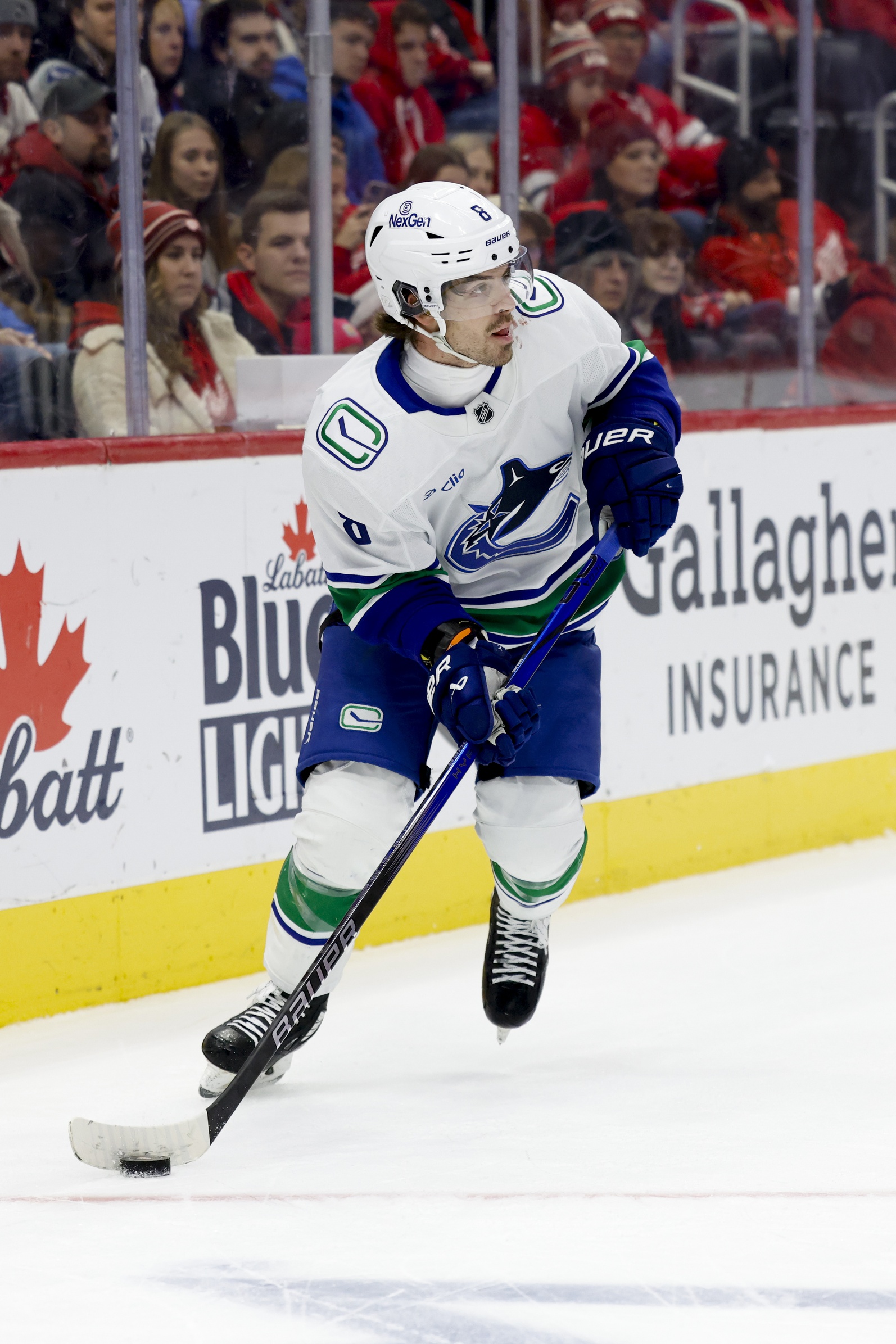 Garland has seemingly been on the trade block off and on for a couple of years now but overall, he has been relatively consistent with Vancouver. Over the first three seasons of this contract, he has recorded at least 16 goals and 46 points while his maximums over that stretch are 20 and 52, respectively. While they didn’t have much luck finding the right trade for him, his contract isn’t a significant overpayment by any stretch but the price tag and term remaining made it hard to move for full value. While his smaller stature would work against him to a point on the open market, it’s quite possible that Garland is able to command a similar contract to this one next time out both in term and salary.
Heinen had to settle for a PTO a year ago but had more success in free agency back in July with this deal. As long as he can provide some secondary scoring and hold a regular role in the middle six, they should do fine with it. Blueger took a small pay cut in June to remain with Vancouver despite matching his career-high in points. If he can hold that uptick in production, he could push past the $2MM mark on his next deal, a mark he reached at the end of his time with Pittsburgh. Sherwood impressed in his first full NHL season last year, earning this deal in July. He’s playing on the third line and is on pace to shatter the NHL record for hits in a single season. We’ve seen players like this before command sizable deals on the open market so if he keeps this up, doubling this and then some is a realistic outcome.
Last year wasn’t a great one for Soucy who dealt with some injury trouble. He’s a veteran fifth defender who can play up in a pinch but not contribute much offensively. The market for those players is more stagnant so while it’s possible he could land another raise in 2026, it’s likely going to be of the marginal variety. Desharnais only had one full NHL year under his belt as he reached free agency which likely limited his market to an extent. He’s being deployed as more of a depth defender with Vancouver and if that holds, he’ll be hard-pressed to command much more than that with a lot of teams trying to keep the back-of-the-roster spots cheaper now.
Demko was the runner-up for the Vezina last season and it looked like a long-term deal with a sizable raise would soon be coming his way. But the continued knee struggles dating back to the playoffs will hinder his market and likely take the types of deals that Jake Oettinger and Jeremy Swayman ($8.25MM) received off the table. It wouldn’t be shocking for both sides to want a short-term agreement at a small raise to give Demko time to prove that he can fully get past the injury issue. Silovs is the presumptive backup of the future after a solid run in the playoffs in relief of Demko although he’s off to a rough start this year. If Silovs can do well in that role next season (assuming Lankinen moves on), doubling this price tag with arbitration rights could be the minimum increase. But if he struggles or stays in a third role, he’ll stay around that price tag for his next deal.
Signed Through 2026-27
D Quinn Hughes ($7.85MM, UFA)
D Tyler Myers ($3MM, UFA)
Hughes skipped the bridge deal and went straight to this one, though it was two years shy of a max-term deal to help keep the cap hit lower. While Vancouver is certainly benefitting from that now, Hughes will hit the open market at 27. At that point, a max-term contract is all but a certainty considering he has emerged as a premier offensive blueliner. That deal could plausibly come in around $11MM per season if he keeps this up. Myers took a 50% cut from his last contract to remain with the Canucks for what should be a decent value deal for now as long as he can have some success on the second pairing. That said, he’ll be 37 when this expires and will quite likely be going year to year from there at a lower rate than this, assuming he’s a little further down the depth chart at that time.
NHL Draft Picks On 2025 World Junior Championship Rosters
The 2025 World Junior Championship is just around the corner. This year’s edition of the tournament, which takes place in Ottawa, will start on Boxing Day (Dec. 26) as usual. Most NHL fans looking to tune into the tournament will want to focus on Group A action – Finland, Canada and the United States comprise three-fifths of that group while Sweden is the only true NHL-heavy squad in Group B, although Czechia and Slovakia have a decent amount of NHL representation there.
Every one of the 10 squads participating in the tournament has at least one NHL-drafted player on their roster, although, in the case of relegation favorite Kazakhstan in Group B, it is just the lone representative. Out of the NHL’s 32 squads, only the Bruins don’t have a prospect suiting up in the tournament.
Wondering which countries to keep an eye on to track your team’s prospects? Here’s a list of every club’s prospects that are competing in the tournament:
Anaheim Ducks
F Austin Burnevik / USA / 2024, 6-182
D Vojtěch Port / Czechia / 2023, 6-161
F Carey Terrance / USA / 2023, 2-59
D Darels Uļjanskis / Latvia / 2024, 7-214
Buffalo Sabres
F Konsta Helenius / Finland / 2024, 1-14
D Adam Kleber / USA / 2024, 2-42
D Norwin Panocha / Germany / 2023, 7-205
D Maxim Štrbák / Slovakia / 2023, 2-45
F Anton Wahlberg / Sweden / 2023, 2-39
F Brodie Ziemer / USA / 2024, 3-71
Calgary Flames
D Axel Hurtig / Sweden / 2023, 7-208
Carolina Hurricanes
F Bradly Nadeau / Canada / 2023, 1-30
F Felix Unger Sörum / Sweden / 2023, 2-62
F Oskar Vuollet / Sweden / 2024, 5-133
Chicago Blackhawks
F Jiří Felcman / Czechia / 2023, 3-93
F Oliver Moore / USA / 2023, 1-19
Colorado Avalanche
F Calum Ritchie / Canada / 2023, 1-27
Columbus Blue Jackets
F Luca Pinelli / Canada / 2023, 4-114
G Melvin Strahl / Sweden / 2023, 5-156
Dallas Stars
F Emil Hemming / Finland / 2024, 1-29
D Aram Minnetian / USA / 2023, 4-125
Detroit Red Wings
G Trey Augustine / USA / 2023, 2-41
F Jesse Kiiskinen / Finland / 2023, 3-68
D Axel Sandin-Pellikka / Sweden / 2023, 1-17
Edmonton Oilers
D Beau Akey / Canada / 2023, 2-56
D Paul Fischer / USA / 2023, 5-138
Florida Panthers
F Linus Eriksson / Sweden / 2024, 2-58
Los Angeles Kings
D Jakub Dvořák / Czechia / 2023, 2-54
G Carter George / Canada / 2024, 2-57
G Hampton Slukynsky / USA / 2023, 4-118
Minnesota Wild
D Zeev Buium / USA / 2024, 1-12
D Aron Kiviharju / Finland / 2024, 4-122
F Rasmus Kumpulainen / Finland / 2023, 2-53
D Sebastian Soini / Finland / 2024, 5-140
Montreal Canadiens
D Rasmus Bergqvist / Sweden / 2024, 7-224
Nashville Predators
F David Edstrom / Sweden / 2023, 1-32
D Andrew Gibson / Canada / 2023, 2-42
D Viggo Gustafsson / Sweden / 2024, 3-77
G Jakub Milota / Czechia / 2024, 4-99
D Tanner Molendyk / Canada / 2023, 1-24
F Felix Nilsson / Sweden / 2023, 2-43
F Teddy Stiga / USA / 2024, 2-55
F Joey Willis / USA / 2023, 4-111
New Jersey Devils
F Herman Träff / Sweden / 2024, 3-91
New York Islanders
F Cole Eiserman / USA / 2024, 1-20
G Marcus Gidlöf / Sweden / 2024, 5-147
F Danny Nelson / USA / 2023, 2-49
F Jesse Nurmi / Finland / 2023, 4-113
New York Rangers
D Drew Fortescue / USA / 2023, 3-90
F Rico Gredig / Switzerland / 2024, 6-191
F Gabe Perreault / USA / 2023, 1-23
Ottawa Senators
G Vladimir Nikitin / Kazakhstan / 2023, 7-207
Philadelphia Flyers
F Jack Berglund / Sweden / 2024, 2-51
G Carson Bjarnason / Canada / 2023, 2-51
D Oliver Bonk / Canada / 2023, 1-22
F Jett Luchanko / Canada / 2024, 1-13
F Heikki Ruohonen / Finland / 2024, 4-107
Pittsburgh Penguins
F Tanner Howe / Canada / 2024, 2-46
D Kalle Kangas / Finland / 2023, 7-223
D Emil Pieniniemi / Finland / 2023, 3-91
San Jose Sharks
D Sam Dickinson / Canada / 2024, 1-11
F Kasper Halttunen / Finland / 2023, 2-36
G Christian Kirsch / Switzerland / 2024, 4-116
F Brandon Svoboda / USA / 2023, 3-71
Seattle Kraken
F Berkly Catton / Canada / 2024, 1-8
D Jakub Fibigr / Czechia / 2024, 7-202
F Zeb Forsfjäll / Sweden / 2023, 6-180
F Julius Miettinen / Finland / 2024, 2-40
D Caden Price / Canada / 2023, 3-84
F Carson Rehkopf / Canada / 2023, 2-50
G Kim Saarinen / Finland / 2024, 3-88
F Eduard Šalé / Czechia / 2023, 1-20
St. Louis Blues
F Adam Jecho / Czechia / 2024, 3-95
D Adam Jiříček / Czechia / 2024, 1-16
F Ondřej Kos / Czechia / 2024, 3-81
D Theo Lindstein / Sweden / 2023, 1-29
F Juraj Pekarčík / Slovakia / 2023, 3-76
D Colin Ralph / USA / 2024, 2-48
F Jakub Štancl / Czechia / 2023, 4-106
F Otto Stenberg / Sweden / 2023, 1-25
Tampa Bay Lightning
F Ethan Gauthier / Canada / 2023, 2-37
F Joona Saarelainen / Finland / 2024, 5-149
Toronto Maple Leafs
F Easton Cowan / Canada / 2023, 1-28
F Miroslav Holinka / Czechia / 2024, 5-151
Utah Hockey Club
F Cole Beaudoin / Canada / 2024, 1-24
G Michael Hrabal / Czechia / 2023, 2-38
F Vojtěch Hradec / Czechia / 2024, 6-167
G Melker Thelin / Sweden / 2023, 5-134
D Veeti Väisänen / Finland / 2024, 3-96
Vancouver Canucks
D Sawyer Mynio / Canada / 2023, 3-89
D Basile Sansonnens / Switzerland / 2024, 7-221
D Tom Willander / Sweden / 2023, 1-11
Vegas Golden Knights
F Mathieu Cataford / Canada / 2023, 3-77
F Trevor Connelly / USA / 2024, 1-19
F Tuomas Uronen / Finland / 2023, 6-192
Washington Capitals
D Cole Hutson / USA / 2024, 2-43
F Ryan Leonard / USA / 2023, 1-8
F Ēriks Mateiko / Latvia / 2024, 3-90
D Leon Muggli / Switzerland / 2024, 2-52
F Miroslav Šatan Jr. / Slovakia / 2024, 7-212
F Petr Sikora / Czechia / 2024, 6-178
Winnipeg Jets
F Brayden Yager / Canada / 2023, 1-14
Predicting The NHL’s Quarter-Century Teams
With a relatively slow news day and the NHL’s announcement last night that each franchise will be selecting Quarter-Century Teams over the next couple of months, I decided to try predicting how each team will shake out.
The league says, “Each Club’s First and Second Quarter-Century Teams will be selected by a panel of media, retired players and executives specific to that Club. Players under consideration for selection are those who have appeared in a game for the respective franchises since Jan. 1, 2000.” I’m going to take that to mean that any legacy/performance of a player who played in the 1990s who carried over into the 2000s won’t be considered. That will disadvantage guys like Pavel Bure for Florida and likely keep Patrick Roy off the Avalanche’s First Team, for example – if that’s how each team’s panel interprets the guidelines.
Balancing longevity against peak performance is always a tough tightrope to walk. I tended to examine those difficult calls on a case-by-case basis. Whether team panels lean one way or the other could really affect how things shake out for the new kids on the block, especially Vegas.
And yes, I decided to consider the Thrashers’ history for the Jets teams, and I hope their panel will, too. Leaving Ilya Kovalchuk off this exercise seems ridiculous.
Anaheim Ducks (Jan. 5)
First Team: F Ryan Getzlaf, F Corey Perry, F Teemu Selänne, D Cam Fowler, D Scott Niedermayer, G Jean-Sébastien Giguère
Second Team: F Bobby Ryan, F Rickard Rakell, F Jakob Silfverberg, D Hampus Lindholm, D François Beauchemin, G John Gibson
Arizona Coyotes (Jan. 1)
First Team: F Shane Doan, F Clayton Keller, F Radim Vrbata, D Oliver Ekman-Larsson, D Keith Yandle, G Mike Smith
Second Team: F Ladislav Nagy, F Martin Hanzal, F Nick Schmaltz, D Zbyněk Michálek, D Jakob Chychrun, G Ilya Bryzgalov
Boston Bruins (Jan. 14)
First Team: F Brad Marchand, F Patrice Bergeron, F David Pastrňák, D Zdeno Chára, D Charlie McAvoy, G Tuukka Rask
Second Team: F David Krejčí, F Glen Murray, F Joe Thornton, D Torey Krug, D Brandon Carlo, G Tim Thomas
Buffalo Sabres (Jan. 15)
First Team: F Thomas Vanek, F Jason Pominville, F Derek Roy, D Rasmus Dahlin, D Rasmus Ristolainen, G Ryan Miller
Second Team: F Jack Eichel, F Drew Stafford, F Jochen Hecht, D Henrik Tallinder, D Tyler Myers, G Martin Biron
Calgary Flames (Jan. 11)
First Team: F Johnny Gaudreau, F Jarome Iginla, F Mikael Backlund, D Mark Giordano, D T.J. Brodie, G Miikka Kiprusoff
Second Team: F Sean Monahan, F Matthew Tkachuk, F Elias Lindholm, D Dion Phaneuf, D Robyn Regehr, G Jacob Markström
Carolina Hurricanes (Jan. 17)
First Team: F Eric Staal, F Sebastian Aho, F Rod Brind’Amour, D Jaccob Slavin, D Brett Pesce, G Cam Ward
Second Team: F Jeff Skinner, F Teuvo Teräväinen, F Jordan Staal, D Justin Faulk, D Brady Skjei, G Artūrs Irbe
Chicago Blackhawks (Dec. 31)
First Team: F Patrick Kane, F Jonathan Toews, F Patrick Sharp, D Duncan Keith, D Brent Seabrook, G Corey Crawford
Second Team: F Marián Hossa, F Alex DeBrincat, F Steve Sullivan, D Niklas Hjalmarsson, D Brian Campbell, G Jocelyn Thibault
Colorado Avalanche (Jan. 20)
First Team: F Nathan MacKinnon, F Milan Hejduk, F Joe Sakic, D Cale Makar, D Erik Johnson, G Semyon Varlamov
Second Team: F Mikko Rantanen, F Gabriel Landeskog, F Alex Tanguay, D Tyson Barrie, D John-Michael Liles, G Patrick Roy
Columbus Blue Jackets (Jan. 2)
First Team: F Rick Nash, F Cam Atkinson, F Nick Foligno, D Zach Werenski, D Seth Jones, G Sergei Bobrovsky
Second Team: F Boone Jenner, F David Výborný, F R.J. Umberger, D David Savard, D Fedor Tyutin, G Marc Denis
Dallas Stars (Jan. 16)
First Team: F Jamie Benn, F Tyler Seguin, F Mike Modano, D Sergei Zubov, D John Klingberg, G Marty Turco
Second Team: F Brenden Morrow, F Jason Robertson, F Roope Hintz, D Esa Lindell, D Miro Heiskanen, G Kari Lehtonen
Detroit Red Wings (Jan. 23)
First Team: F Pavel Datsyuk, F Henrik Zetterberg, F Dylan Larkin, D Nicklas Lidström, D Niklas Kronwall, G Jimmy Howard
Second Team: F Tomas Holmström, F Johan Franzén, F Brendan Shanahan, D Brian Rafalski, D Mathieu Schneider, G Chris Osgood
Edmonton Oilers (Jan. 30)
First Team: F Connor McDavid, F Leon Draisaitl, F Ryan Nugent-Hopkins, D Darnell Nurse, D Evan Bouchard, G Tommy Salo
Second Team: F Ryan Smyth, F Aleš Hemský, F Jordan Eberle, D Steve Staios, D Oscar Klefbom, G Cam Talbot
Florida Panthers (Jan. 3)
First Team: F Aleksander Barkov, F Jonathan Huberdeau, F Olli Jokinen, D Aaron Ekblad, D Jay Bouwmeester, G Roberto Luongo
Second Team: F Stephen Weiss, F Sam Reinhart, F Nathan Horton, D Gustav Forsling, D Dmitry Kulikov, G Tomáš Vokoun
Los Angeles Kings (Jan. 8)
First Team: F Anže Kopitar, F Dustin Brown, F Jeff Carter, D Drew Doughty, D Ľubomír Višňovský, G Jonathan Quick
Second Team: F Alex Frolov, F Adrian Kempe, F Tyler Toffoli, D Alec Martinez, D Jake Muzzin, G Félix Potvin
Minnesota Wild (Jan. 7)
First Team: F Mikko Koivu, F Marián Gáborík, F Kirill Kaprizov, D Jared Spurgeon, D Ryan Suter, G Niklas Bäckström
Second Team: F Zach Parise, F Pierre-Marc Bouchard, F Andrew Brunette, D Jonas Brodin, D Mathew Dumba, G Devan Dubnyk
Montreal Canadiens (Jan. 19)
First Team: F Tomáš Plekanec, F Max Pacioretty, F Saku Koivu, D Andrei Markov, D P.K. Subban, G Carey Price
Second Team: F Brendan Gallagher, F Nick Suzuki, F Alex Kovalev, D Jeff Petry, D Shea Weber, G José Théodore
Nashville Predators (Jan. 29)
First Team: F Filip Forsberg, F David Legwand, F Martin Erat, D Roman Josi, D Shea Weber, G Pekka Rinne
Second Team: F Craig Smith, F Ryan Johansen, F Viktor Arvidsson, D Ryan Ellis, D Mattias Ekholm, G Juuse Saros
New Jersey Devils (Jan. 22)
First Team: F Patrik Eliáš, F Travis Zajac, F Zach Parise, D Andy Greene, D Brian Rafalski, G Martin Brodeur
Second Team: F Scott Gomez, F Jesper Bratt, F Nico Hischier, D Colin White, D Damon Severson, G Cory Schneider
New York Islanders (Jan. 24)
First Team: F John Tavares, F Brock Nelson, F Anders Lee, D Ryan Pulock, D Nick Leddy, G Ilya Sorokin
Second Team: F Josh Bailey, F Mathew Barzal, F Kyle Okposo, D Noah Dobson, D Adam Pelech, G Rick DiPietro
New York Rangers (Jan. 26)
First Team: F Chris Kreider, F Mika Zibanejad, F Artemi Panarin, D Adam Fox, D Ryan McDonagh, G Henrik Lundqvist
Second Team: F Derek Stepan, F Jaromír Jágr, F Mats Zuccarello, D Dan Girardi, D Marc Staal, G Igor Shesterkin
Ottawa Senators (Jan. 25)
First Team: F Daniel Alfredsson, F Jason Spezza, F Dany Heatley, D Erik Karlsson, D Wade Redden, G Craig Anderson
Second Team: F Brady Tkachuk, F Marián Hossa, F Mark Stone, D Chris Phillips, D Thomas Chabot, G Patrick Lalime
Philadelphia Flyers (Jan. 13)
First Team: F Claude Giroux, F Simon Gagné, F Jakub Voráček, D Kimmo Timonen, D Ivan Provorov, G Steve Mason
Second Team: F Sean Couturier, F Travis Konecny, F Wayne Simmonds, D Travis Sanheim, D Shayne Gostisbehere, G Roman Čechmánek
Pittsburgh Penguins (Jan. 9)
First Team: F Sidney Crosby, F Evgeni Malkin, F Jake Guentzel, D Kris Letang, D Sergei Gonchar, G Marc-André Fleury
Second Team: F Chris Kunitz, F Bryan Rust, F Patric Hörnqvist, D Brian Dumoulin, D Marcus Pettersson, G Matt Murray
San Jose Sharks (Jan. 27)
First Team: F Patrick Marleau, F Joe Thornton, F Joe Pavelski, D Brent Burns, D Marc-Édouard Vlasic, G Evgeni Nabokov
Second Team: F Logan Couture, F Tomáš Hertl, F Jonathan Cheechoo, D Dan Boyle, D Scott Hannan, G Antti Niemi
Seattle Kraken (Jan. 6)
First Team: F Jared McCann, F Jordan Eberle, F Oliver Bjorkstrand, D Vince Dunn, D Adam Larsson, G Philipp Grubauer
Second Team: F Yanni Gourde, F Matty Beniers, F Jaden Schwartz, D Jamie Oleksiak, D William Borgen, G Joey Daccord
St. Louis Blues (Dec. 30)
First Team: F Vladimir Tarasenko, F Alexander Steen, F David Backes, D Alex Pietrangelo, D Colton Parayko, G Jordan Binnington
Second Team: F David Perron, F Keith Tkachuk, F Jaden Schwartz, D Kevin Shattenkirk, D Barret Jackman, G Jake Allen
Tampa Bay Lightning (Jan. 28)
First Team: F Steven Stamkos, F Nikita Kucherov, F Martin St. Louis, D Victor Hedman, D Dan Boyle, G Andrei Vasilevskiy
Second Team: F Vincent Lecavalier, F Brayden Point, F Alex Killorn, D Mikhail Sergachev, D Pavel Kubina, G Ben Bishop
Toronto Maple Leafs (Jan. 4)
First Team: F Auston Matthews, F Mitch Marner, F Mats Sundin, D Tomáš Kaberle, D Morgan Rielly, G Frederik Andersen
Second Team: F William Nylander, F John Tavares, F Phil Kessel, D Bryan McCabe, D Jake Gardiner, G Ed Belfour
Utah Hockey Club (Jan. 31)
First Team: F Dylan Guenther, F Logan Cooley, F Clayton Keller, D Mikhail Sergachev, D Michael Kesselring, G Karel Vejmelka
Second Team: F Nick Schmaltz, F Jack McBain, F Barrett Hayton, D Ian Cole, D Olli Määttä, G Connor Ingram
Vancouver Canucks (Jan. 21)
First Team: F Daniel Sedin, F Henrik Sedin, F Markus Näslund, D Alexander Edler, D Quinn Hughes, G Roberto Luongo
Second Team: F Elias Pettersson, F Alexandre Burrows, F J.T. Miller, D Sami Salo, D Mattias Öhlund, G Thatcher Demko
Vegas Golden Knights (Jan. 12)
First Team: F Jonathan Marchessault, F William Karlsson, F Reilly Smith, D Shea Theodore, D Brayden McNabb, G Marc-André Fleury
Second Team: F Mark Stone, F Max Pacioretty, F Jack Eichel, D Alex Pietrangelo, D Nate Schmidt, G Adin Hill
Washington Capitals (Jan. 18)
First Team: F Alex Ovechkin, F Nicklas Bäckström, F Evgeny Kuznetsov, D John Carlson, D Mike Green, G Braden Holtby
Second Team: F Alexander Semin, F T.J. Oshie, F Tom Wilson, D Dmitry Orlov, D Sergei Gonchar, G Olaf Kölzig
Winnipeg Jets (Jan. 10)
First Team: F Blake Wheeler, F Mark Scheifele, F Ilya Kovalchuk, D Dustin Byfuglien, D Josh Morrissey, G Connor Hellebuyck
Second Team: F Kyle Connor, F Nikolaj Ehlers, F Bryan Little, D Toby Enström, D Neal Pionk, G Ondřej Pavelec
Players On 4 Nations Face-Off Rosters By Team
After Canada, Finland, Sweden, and the United States named their first six players for the 2025 4 Nations Face-Off over the summer, each country revealed its full 23-man roster yesterday. There’s now just over two months until the first true senior-level best-on-best action in over eight years, even if it’s a limited sampling of the world’s hockey powers.
It’s no surprise that the two most recent Stanley Cup champions are the most well-represented clubs at the tournament. The Panthers have eight representatives, while the Golden Knights have seven.
Florida is also one of two teams to have a player on every country’s roster. The Maple Leafs are the other.
Only two teams did not see one of their players selected to a roster yesterday. Kraken Team Canada hopeful on defense Brandon Montour missed the cut, as did Capitals center Dylan Strome and goaltender Logan Thompson. Washington defenseman John Carlson also missed out for Team USA despite a strong MVP candidacy for one of the league’s most surprising teams in the early going.
Here are the players each NHL team is sending to the seven-game tournament:
Anaheim Ducks
F Leo Carlsson (Sweden)
Boston Bruins
F Elias Lindholm (Sweden)
F Brad Marchand (Canada)
D Charlie McAvoy (USA)
G Jeremy Swayman (USA)
Buffalo Sabres
D Rasmus Dahlin (Sweden)
G Ukko-Pekka Luukkonen (Finland)
Calgary Flames
D Rasmus Andersson (Sweden)
Carolina Hurricanes
F Sebastian Aho (Finland)
F Seth Jarvis (Canada)
D Jaccob Slavin (USA)
Chicago Blackhawks
F Teuvo Teräväinen (Finland)
Colorado Avalanche
F Artturi Lehkonen (Finland)
F Nathan MacKinnon (Canada)
D Cale Makar (Canada)
F Mikko Rantanen (Finland)
D Devon Toews (Canada)
Columbus Blue Jackets
D Zach Werenski (USA)
Dallas Stars
D Miro Heiskanen (Finland)
F Roope Hintz (Finland)
D Esa Lindell (Finland)
G Jake Oettinger (USA)
Detroit Red Wings
F Dylan Larkin (USA)
F Lucas Raymond (Sweden)
Edmonton Oilers
F Viktor Arvidsson (Sweden)
D Mattias Ekholm (Sweden)
F Connor McDavid (Canada)
Florida Panthers
F Aleksander Barkov (Finland)
F Sam Bennett (Canada)
D Gustav Forsling (Sweden)
F Anton Lundell (Finland)
F Eetu Luostarinen (Finland)
D Niko Mikkola (Finland)
F Sam Reinhart (Canada)
F Matthew Tkachuk (USA)
Los Angeles Kings
F Adrian Kempe (Sweden)
Minnesota Wild
F Matt Boldy (USA)
D Jonas Brodin (Sweden)
F Joel Eriksson Ek (Sweden)
D Brock Faber (USA)
G Filip Gustavsson (Sweden)
Montreal Canadiens
F Joel Armia (Finland)
F Patrik Laine (Finland)
G Sam Montembeault (Canada)
Nashville Predators
F Filip Forsberg (Sweden)
F Gustav Nyquist (Sweden)
G Juuse Saros (Finland)
New Jersey Devils
F Jesper Bratt (Sweden)
F Erik Haula (Finland)
F Jack Hughes (USA)
G Jacob Markström (Sweden)
New York Islanders
F Brock Nelson (USA)
New York Rangers
D Adam Fox (USA)
F Kaapo Kakko (Finland)
F Chris Kreider (USA)
F Vincent Trocheck (USA)
F Mika Zibanejad (Sweden)
Ottawa Senators
F Brady Tkachuk (USA)
G Linus Ullmark (Sweden)
Philadelphia Flyers
F Travis Konecny (Canada)
D Rasmus Ristolainen (Finland)
D Travis Sanheim (Canada)
Pittsburgh Penguins
F Sidney Crosby (Canada)
D Erik Karlsson (Sweden)
San Jose Sharks
F Mikael Granlund (Finland)
Seattle Kraken
none
St. Louis Blues
G Jordan Binnington (Canada)
D Colton Parayko (Canada)
Tampa Bay Lightning
F Anthony Cirelli (Canada)
F Jake Guentzel (USA)
F Brandon Hagel (Canada)
D Victor Hedman (Sweden)
F Brayden Point (Canada)
Toronto Maple Leafs
D Jani Hakanpää (Finland)
F Mitch Marner (Canada)
F Auston Matthews (USA)
F William Nylander (Sweden)
Utah Hockey Club
D Olli Määttä (Finland)
D Juuso Välimäki (Finland)
Vancouver Canucks
D Quinn Hughes (USA)
G Kevin Lankinen (Finland)
F J.T. Miller (USA)
F Elias Pettersson (Sweden)
Vegas Golden Knights
F Jack Eichel (USA)
D Noah Hanifin (USA)
G Adin Hill (Canada)
F William Karlsson (Sweden)
D Alex Pietrangelo (Canada)
F Mark Stone (Canada)
D Shea Theodore (Canada)
Washington Capitals
none
Winnipeg Jets
F Kyle Connor (USA)
G Connor Hellebuyck (USA)
D Josh Morrissey (Canada)
Salary Cap Deep Dive: Seattle Kraken
Navigating the salary cap is one of the most important tasks for a front office. Teams that can avoid total cap chaos by walking the tightrope of inking players to deals that match their value (or compensate for future value without breaking the bank) remain successful. Those that don’t often see struggles and front office changes.
PHR will look at every NHL team and give a thorough look at their cap situation for the 2024-25 season. This will focus more on players who are regulars on the roster versus those who may find themselves shuttling between the AHL and NHL. All cap figures are courtesy of PuckPedia. We’re currently covering the Pacific Division, next up is the Kraken.
Seattle Kraken
Current Cap Hit: $90,108,465 (above the $88MM Upper Limit)
Entry-Level Contracts
D Ryker Evans (one year, $898K)
F Tye Kartye (one year, $859K)
F Shane Wright (three years, $887K)
Potential Bonuses
Kartye: $57.5K
Wright: $3.0625MM
Total: $3.12MM
Seattle was slow-playing Wright’s development in his first couple of seasons and even into his first full NHL campaign, his ice time is being managed carefully. Accordingly, he’s not on track to reach any of his bonuses and is probably heading for a bridge contract barring a big offensive breakout over the next year or two. If he stays on the slower development path, that bridge agreement should come in around the $3.5MM range. Kartye had a solid rookie season in the bottom six and is in that same role this year. His bonuses are based on games played so that’s something he should be able to reach if he stays healthy. Given his role and limited offensive numbers, he’s also looking at a short-term second contract, one around the $1.5MM mark.
Evans is in his first full NHL season after impressing in partial duty last season. He has locked down a spot in Seattle’s top four and is tied for the team lead in scoring among blueliners. If that holds up, it wouldn’t be surprising to see GM Ron Francis try to work out a long-term deal, one that would check in a bit below their top veterans who are making a little over $7MM per season. A bridge agreement, meanwhile, would likely fall in the $4MM range. Either way, a big raise is coming his way this summer.
Signed Through 2024-25, Non-Entry-Level
D William Borgen ($2.7MM, UFA)
F Yanni Gourde ($5.167MM, UFA)
D Josh Mahura ($775K, UFA)
F Daniel Sprong ($975K, UFA)
F Brandon Tanev ($3.5MM, UFA)
For most of his contract, Gourde has been well worth the contract, generally producing above a 40-point pace. But he struggled last season and is off to a similar start offensively this year which will hurt his value. Now that he’s being deployed as more of a third-line option, it would be difficult to see him command a similar price tag at 33. But a multi-year deal around $4MM per season should still be within reach.
Tanev’s contract felt like a steep overpayment at the time for someone who had only reached 20 points once at the time it was signed. However, he has produced enough offensively (when healthy) on this deal to at least reasonably justify the cost while providing plenty of physicality and enough defensive acumen to make it a fair deal overall. While most teams want to cut salary from their bottom six, he could be an outlier and land another contract around this price point. Sprong didn’t have much luck on the open market last summer despite his second straight year of over 40 points and things haven’t gone well for him this year. Accordingly, another dip might be coming his way.
Borgen had two straight seasons of at least 20 points coming into this one but his production and playing time have slipped through the first quarter of this year. Heading into the year, a jump to the $3.75MM range seemed possible, especially as a right-hand shot but that might come down more toward the $3.5MM level on a multi-year deal now. Mahura was only able get a minimum contract after being non-tendered by Florida and with the limited role he has had so far, he’s unlikely to command more than that next summer.
Signed Through 2025-26
F Oliver Bjorkstrand ($5.4MM, UFA)
F Jordan Eberle ($4.75MM, UFA)
D Jamie Oleksiak ($4.6MM, UFA)
F Jaden Schwartz ($5.5MM, UFA)
F Eeli Tolvanen ($3.475MM, UFA)
Schwartz was one of Seattle’s first free agent additions, a move that hasn’t panned out as well as they hoped. When healthy, he’s a capable second-line forward but staying healthy has been a serious challenge thus far. He’ll be 34 when his next contract starts and it’d be surprising if he came in at this price tag next time. Something in the $4MM range on a medium-term deal might be more likely. Bjorkstrand was acquired as a cap dump from the Blue Jackets in 2022 and he has given Seattle two straight 20-goal seasons plus a 59-point effort last year. If he can keep near 60 points, he could land another million or so on his next deal. But if he reverts to a point total more in the 40s, Bjorkstrand might have to settle for a bit less than his current salary in 2026.
Eberle signed this deal last season, taking himself off the trade block in the process. He’s still a capable secondary scorer but considering he’ll be 36 on his next deal (subject to 35-plus provisions on a multi-year contract), it wouldn’t be surprising if he went year-to-year from here on out, allowing for the possibility for a lower base salary with reachable performance bonuses to allow the signing team more flexibility. Tolvanen has turned into one of the better waiver claims in recent memory, picking up 41 points last season while being on pace for 20 goals this year. Still, he’s a bit inconsistent which has kept him out of a full-time top-six role. If that continues and he settles in as more of a middle-six option, his open market value will take a hit although he could still get a small increase if he stays in that 40-point range.
 There was definitely some risk in the contract the Kraken gave Oleksiak after selecting him in expansion. He had been a third-pairing player up to that point with the exception of one year, the one that landed him this agreement. But Oleksiak has been able to maintain a top-four slot throughout his time with Seattle while even chipping in with a career year offensively in 2022-23. Of course, his offensive numbers don’t land him this role or this type of money but rather his defensive game (and being one of the tallest players in the league). The market isn’t as strong for the more stay-at-home type of players and Oleksiak will turn 34 early in the 26-27 season but even so, a small boost to the $5MM range on a medium-term pact could still be doable.
Signed Through 2026-27
F Andre Burakovsky ($5.5MM, UFA)
G Philipp Grubauer ($5.9MM, UFA)
D Vince Dunn ($7.35MM, UFA)
F Jared McCann ($5MM, UFA)
Burakovsky was another notable splash in free agency that hasn’t worked out particularly well thus far. Signed off a career year, he hasn’t been able to produce close to those numbers since then, nor has he stayed healthy. Lots can still change in the back half of the deal but he looks like someone heading for a cap hit closer to the $4MM range, if not less next time out. McCann, on the other hand, averaged 30 goals and 62 points over his first three seasons in Seattle, two of which were played on this contract. That’s a solid return for this price point and if those numbers continue, he could land closer to $7MM next time out, especially with the ability to play center.
Dunn is the other player who could challenge McCann as being the best of their original expansion picks. With a bigger role than he had with St. Louis, he has emerged as one of the better offensive blueliners league-wide while playing in all situations. In essence, he has the numbers of arguably a number one defender, if not a top-pairing piece. He’ll be turning 31 early in the 2027-28 season so a max-term contract is a very realistic possibility and if Dunn remains as impactful as he has been, he could add a couple million per season on that next deal.
 Grubauer was a free agent acquisition that carried some risk given that he was coming off a breakout year with a career-high in games played of 40. Paying him to be the undisputed starter for that long had the potential to bust. And bust it has. After putting up a .922 SV% in his best year with Colorado, he has yet to reach the .900 mark since then. Along the way, Grubauer has gone from being their number one goalie to a part-time backup and is off to a dreadful start this season. Barring a change in fortunes, Seattle will need to seriously consider buying out the remainder of this deal this summer, even with it carrying close to a $2MM dead cap charge next season, nearly $3.1MM the following year, and close to $1.7MM for two years after that.
Flames’ Young Stars Fueling Unexpected Success
The Calgary Flames held a fire sale between last season and the summer, moving out multiple top-of-the-lineup pieces – including top forward Elias Lindholm, top defenders Noah Hanifin and Chris Tanev, and starting goaltender Jacob Markstrom. Calgary moved out more than $24MM in cap space between all of their trades, and yet – as the 2024-25 season prepares to enter December – the Flames sit comfortably in a playoff spot. They’re 12-8-4 so far, ranked third in the Pacific Division and sixth in the Western Conference. Even better, Calgary boasts the third-most cap space in the league – with a projected $25.9MM in current available funds. The hot start and open budget put Calgary in the best spot they’ve been in years, and it’s a direct result of novice general manager Craig Conroy‘s timely reliance on the prospect pool.
Conroy emphasized on Sportsnet’s Flames Talk podcast this summer that the goal of the Flames’ season would be to create opportunity for their in-house prospects. 24 games into the season and it seems every single prospect to receive a chance has seized it in full.
Dustin Wolf is quickly establishing himself as a franchise goaltender, posting eight wins and a .918 save percentage through 13 games in what is his formal rookie season. That kind of performance will command respect in the race for the Calder Trophy, even against Matvei Michkov and Logan Stankoven rivaling point-per-game scoring. Wolf is thriving in what is the first hardy starting experience of his career, continuing to dominate North American pros after taking home the AHL’s Les Cunningham ‘MVP’ award in 2023, and the Aldege “Baz” Bastien Memorial Award for goalie-of-the-year in both 2022 and 2023. He spent just a bit too much time with the NHL roster last season to rival either award, but recorded a cumulative 97 wins and .926 save percentage through 141 games and four seasons in the AHL. That ability is now directly benefiting the Flames. Wolf has posted a save percentage above .900 in 61.5 percent of his starts this year, just 0.4 percent behind Markstrom’s tally in 2021-22 – when he finished the year second in Vezina Trophy voting.
Wolf’s dazzling defense of Calgary’s garrison has given youngsters Connor Zary and Matthew Coronato plenty of space to lead the offensive charge. Zary has become Calgary’s third-most utilized forward at even-strength, with 349 minutes of five-versus-five ice time in 24 games – 13 minutes fewer than Nazem Kadri, two fewer than Mikael Backlund, and 12 more than Jonathan Huberdeau. Zary’s had no trouble keeping up with the studded veterans he’s keeping company with, scoring six points at even strength and 12 points on the year as a whole – tying Huberdeau and one behind Kadri. He’s become a core piece of Calgary’s top-six – a role flirted with when he recorded 14 goals and 34 points in 63 games as a rookie last season. The bulk of his scoring, between this year and last, has come thanks to a nonstop motor and ability to play at top speeds. But while Zary’s outskates his opponents on the top-line, Coronato has taken to outworking them in the middle-six. He’s also jumped up the Flames’ scoring chart, with six goals and 10 points in 19 games this season. That’s one fewer goal than each of Kadri and Huberdeau, and puts Coronato on pace for 26 goals across 82 games – which would mark the highest scoring from a U22 Flame since Matthew Tkachuk and Sean Monahan each surpassed the 25-goal mark three separate times before their 22nd birthday.
The surge of production from Zary and Coronato in the top-nine has helped Calgary’s lineup truly settle into place. Utility winger Blake Coleman has been able to resign to a top-notch supporting role, rather than needing to drive play on his own; while Coronato’s role of gritty scorer opens more space for Martin Pospisil to embrace his bruiser tendencies. It’s created a lineup that’s cohesive, multifaceted, and capable of taking on the NHL’s best lineups – made evident by Calgary’s recent three-game stretch of wins over the New York Islanders, Rangers, and Minnesota Wild.
A year intended for retooling has instead become a year of success for the Flames. They’re on an upward trajectory, fueled almost entirely by the team’s timely leaning into their prospect pool. Wolf’s performance as a formal rookie will have Calgary as a top mention in the Calder Trophy race, while Zary and Coronato’s mix of scoring could push the team into the postseason for the first time since 2022. Even without either accolade, the performance of Calgary’s top youngsters this season sets up plenty of reasons to be excited about their long-term outlook.
Salary Cap Deep Dive: San Jose Sharks
Navigating the salary cap is one of the most important tasks for a front office. Teams that can avoid total cap chaos by walking the tightrope of inking players to deals that match their value (or compensate for future value without breaking the bank) remain successful. Those that don’t often see struggles and front office changes.
PHR will look at every NHL team and give a thorough look at their cap situation for the 2024-25 season. This will focus more on players who are regulars on the roster versus those who may find themselves shuttling between the AHL and NHL. All cap figures are courtesy of PuckPedia. We’re currently covering the Pacific Division, next up is the Sharks.
San Jose Sharks
Current Cap Hit: $81,214,232 (below the $88MM Upper Limit)
Entry-Level Contracts
G Yaroslav Askarov (one year, $925K)
F Macklin Celebrini (three years, $975K)
F William Eklund (two years, $863K)
F William Smith (three years, $950K)
D Jack Thompson (one year, $828K)
Potential Bonuses
Askarov: $850K
Celebrini: $3.5MM
Eklund: $850K
Smith: $850K
Total: $6.05MM
Celebrini is off to a good start to his career though injuries have cost him playing time already. While that won’t hurt in the long run, it could make a Calder Trophy push a little harder which is one of the potential ‘A’ bonuses, of which he has four of. While it’s still extremely early, the Sharks are hoping that he’s their top center of the future and we’ve seen the price tag for those players hover around $8MM per season, an amount that will probably need to go higher by the time this deal is up.
Smith has stayed healthy early on but has struggled in his first taste of the pros. While they’re probably unconcerned long-term and still view him as the second option behind Celebrini, this start likely takes him out of reaching most, if not all of his ‘A’ bonuses. If he lives up to his potential, it wouldn’t be shocking to see Smith in that $8MM range on his next deal. Eklund had an impressive first full NHL season last year and is on a higher pace this year. They’re hoping he has top-line potential which could get him in the $8MM range long-term as well although the fact he’s primarily being deployed on the wing could shave a little off his price tag.
Thompson was seeing regular action for the Sharks after an early-season recall before today’s demotion, albeit primarily on the third pairing. If he can reclaim that roster spot before too long, he could land in the $1.3MM range on a bridge contract in the summer.
Askarov has already signed his second contract and we’ll get to that later on. For this section, let’s focus on the bonuses. Given that he was just recalled this week and that they’re running a three-goalie rotation, it’s hard to see him playing enough to reach any of his four ‘A’ bonuses. He needs to get to 1,800 minutes (or 25 appearances with at least 30 minutes of playing time) to have a shot at qualifying for them.
Signed Through 2024-25, Non-Entry-Level
G Mackenzie Blackwood ($2.35MM, UFA)
D Cody Ceci ($3.25MM, UFA)
F Mikael Granlund ($5MM, UFA)
F Klim Kostin ($2MM, RFA)
F Luke Kunin ($2.75MM, UFA)
D Jan Rutta ($2.75MM, UFA)
F Givani Smith ($800K, UFA)
F Nico Sturm ($2MM, UFA)
G Vitek Vanecek ($3.4MM, UFA)
F Fabian Zetterlund ($1.45MM, RFA)
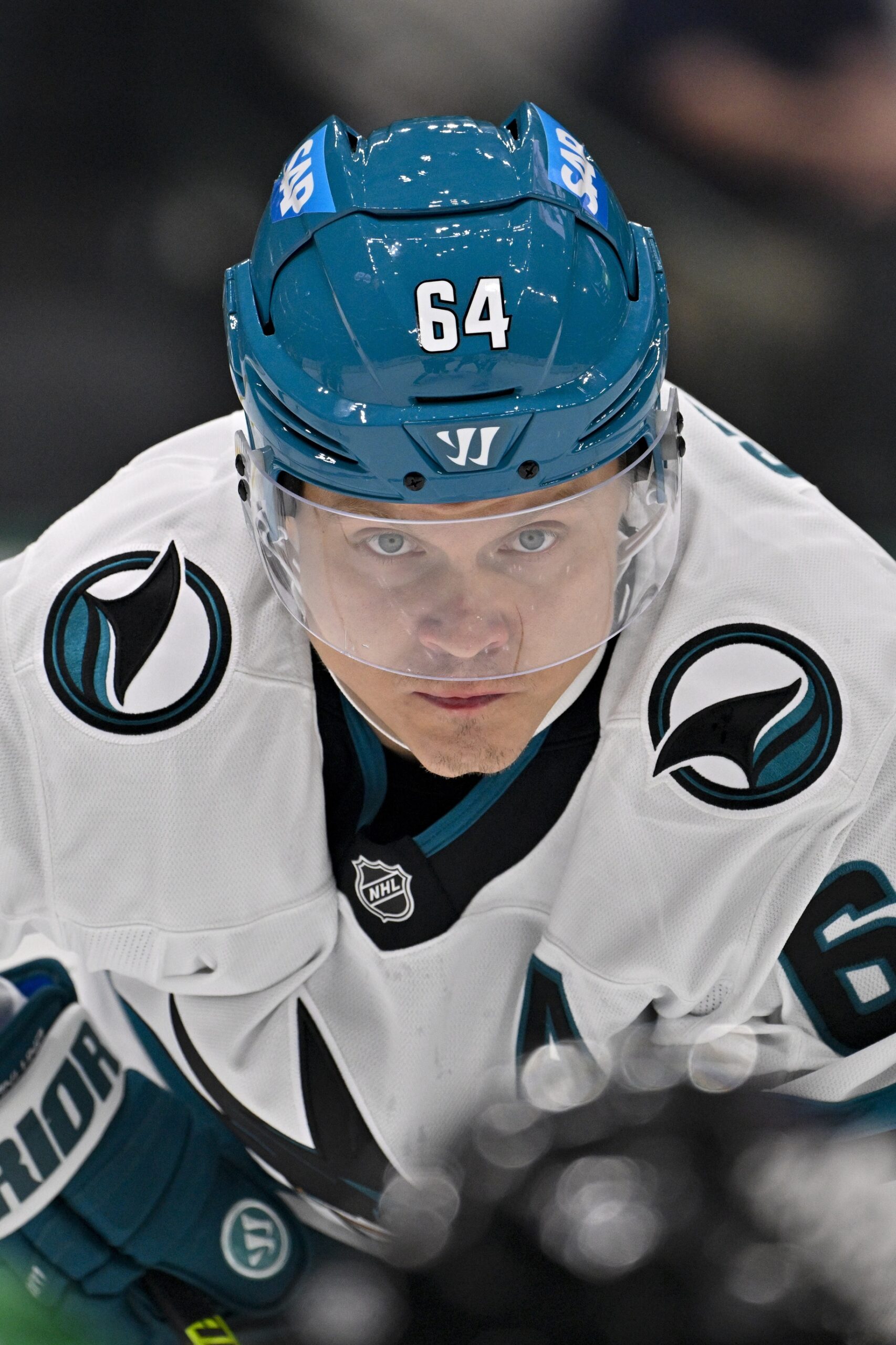 Granlund opted to sign with the Sharks in 2023 on what amounted to a pillow deal to try to rebuild some value. He might have done just that. With an expanded role, he reached the 60-point mark last season and is producing more than a point per game in the first quarter of this season. As far as straight value goes, the Sharks have done pretty well with this deal. How things go on his next contract remains in some question, however. While Granlund is playing well in a top-line role, he’s not a top-line center on most teams and he has struggled with lesser roles at times in the past. With that in mind, it wouldn’t be surprising if his market wasn’t as strong as his numbers might indicate although another deal around this price point should be doable.
Kunin was a speculative non-tender candidate after a down showing last year but the two sides settled on this deal. He’s capable of being a versatile utility forward but hasn’t been able to produce with enough consistency thus far. Still, someone who can play all three forward positions, kill penalties, and play with an edge will be of interest on the open market and a contract around this price point on a multi-year agreement could happen. On the flip side, Kostin has not played well in either season of this contract and is more of a depth forward than a regular one. His 2021-22 efforts appear to be the outlier at this point and as a result, most of his offers in the summer are likely to be at the league minimum or very close to it.
Sturm was primarily a depth player before joining San Jose but became a capable middle-six option over his first two seasons which had him on track for a decent raise next summer. However, his early-season usage has him back in his old spot on the fourth line which won’t help his market. That said, given the demand for middlemen, he could still get a small increase on his next deal. Zetterlund wound up with a bridge deal after struggling upon being acquired in the Timo Meier deal. His first full season with the Sharks was a strong one with 24 goals and 20 assists and he’s on pace to eclipse those numbers this year. With arbitration rights, he’s on pace to triple this deal at a minimum if he can keep it up. Smith, meanwhile, has been more of a depth player over the years and is likely to stay around the league minimum again on his next deal.
Ceci was acquired from Edmonton in a cap-clearing move mid-offseason. He’s getting an opportunity to play a bigger role but most teams know his best role is in more of a fourth or fifth role. As someone who is a right-hand shot and can log 20-plus minutes a night, another deal in this range for a few years is a likely outcome. Rutta’s first season with San Jose last year wasn’t bad in a third-pairing role but he has struggled this season. If things stay as is, he probably won’t be able to land this much in the summer if he winds up playing a role on a team going deep into the playoffs, that could boost his value back up to around this price point.
Vanecek was brought in at the trade deadline last season to give them another veteran to try to help stabilize things to a point. He hasn’t fared too poorly all things considered but coming off a rocky year in New Jersey, his value has taken a hit. He could be a candidate for a one-year pillow deal but a two-year agreement at a price tag starting with a two is more likely. Considering how poorly San Jose’s back end has been at times, Blackwood has fared relatively well since joining the Sharks last summer. However, his overall numbers won’t be high enough to land him any sort of sizable raise. Something around this price tag should be doable though.
Signed Through 2025-26
F Ty Dellandrea ($1.3MM, RFA)
D Mario Ferraro ($3.25MM, UFA)
F Carl Grundstrom ($1.8MM, UFA)
D Timothy Liljegren ($3MM, UFA)
D Henry Thrun ($1MM, RFA)
D Jake Walman ($3.4MM, UFA)
F Alexander Wennberg ($5MM, UFA)
D Marc-Edouard Vlasic ($7MM, UFA)
Wennberg was a beneficiary of the Sharks wanting some veteran center depth and the demand for middlemen on the open market, yielding an above-market contract for a player who hasn’t eclipsed the 40-point mark since 2016-17. If he stays in the 30-plus-point range as he has since then, a more realistic price tag would be closer to $4MM in 2026.
Grundstrom was acquired over the summer after it looked like he might be non-tendered by Los Angeles. While he has shown a bit of a scoring touch in the past, he hasn’t been able to do so with enough consistency, resulting in him playing a lot on the fourth line. This price tag is on the high side for someone in that role; he’ll need to find a way to produce more if he wants any sort of notable raise. Dellandrea was acquired from Dallas in the hopes that a change of scenery would get him going. That hasn’t happened yet and he finds himself in the same limited role he had with the Stars. If that continues, a non-tender could be on the table.
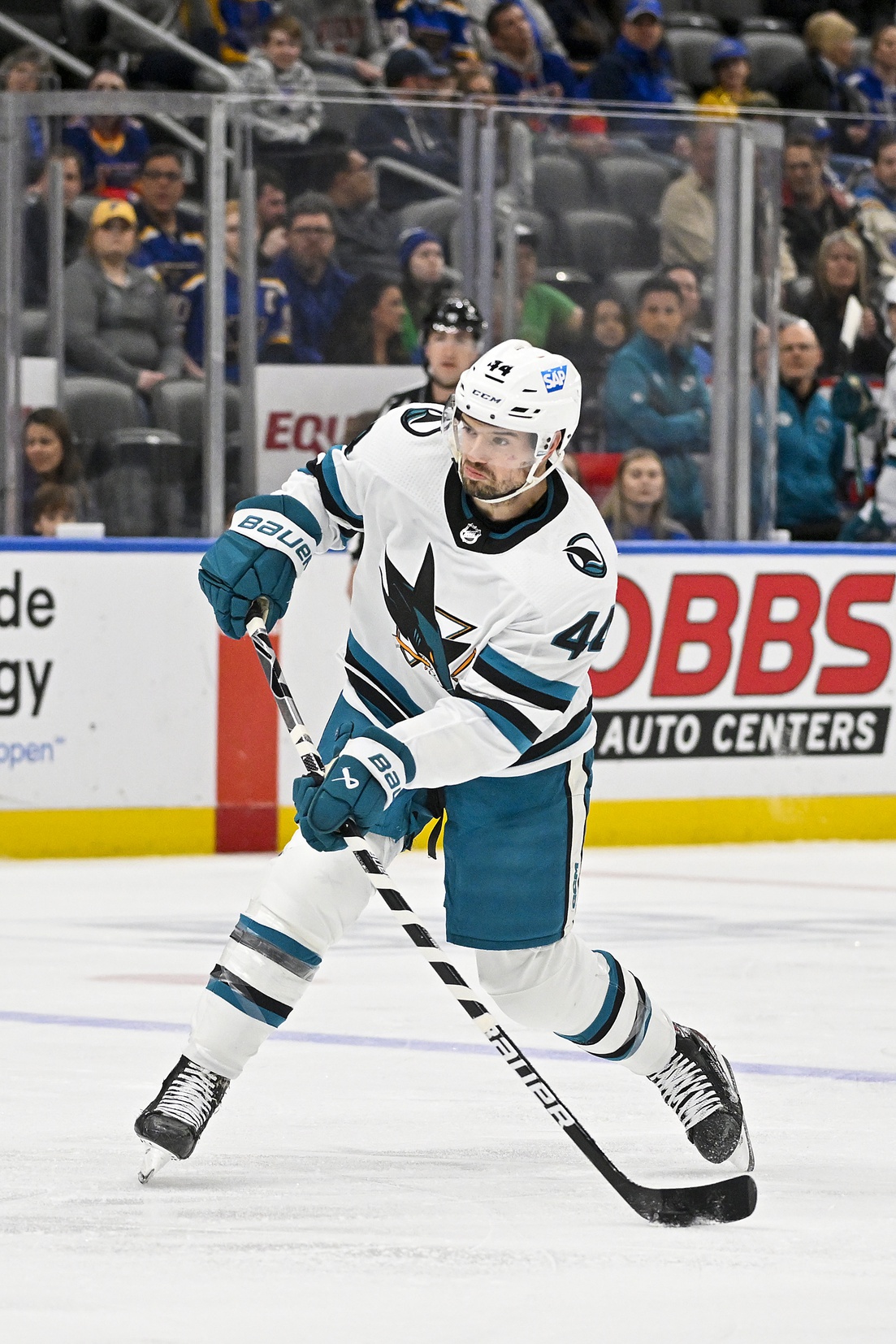 Vlasic has been a long-time core defender for the Sharks over his 18-year career, earning himself some Norris Trophy votes in the prime of his career. However, that prime was a long time ago. At his best, Vlasic was a key shutdown defender who could play on the top pairing and he signed this contract while being in that role. But for the most part since then, he has been more of a depth piece, either on the third pairing or as a healthy scratch. This season, he has yet to play due to a back injury but even when he returns, it’s likely to be in a limited role. He’s a buyout candidate next summer if San Jose decides to open up some cap space and if he was to hit the open market and consider going elsewhere, it’d be a minimum-salary agreement.
Walman was another cap casualty over the offseason, this time coming from Detroit. After being more of a fourth option with the Red Wings, he’s often on the top pairing and is doing well in that role. If that keeps up, he could make a case to push past the $5MM per season mark in 2026. Ferraro has been a speculative trade candidate for a while given his reasonable cap charge and his shutdown role. Limited offense will limit his earnings upside on the open market but we’ve seen players like that land around $4.5MM recently and that could be a reasonable price point for his next deal.
Liljegren was brought in from Toronto in yet another cap-clearing move (though this one came just recently). There was some risk had he made it to arbitration last summer, resulting in the two sides settling on this deal. Now, Liljegren needs to prove he can be a top-four player if he wants to beat this deal in his first trip through the open market. Thrun, meanwhile, is still looking to establish himself as a must-play top-six blueliner. Offensively, he can hold his own but he has scuffled in the defensive zone, resulting in him being more of a third-pairing player this season after being a top-four piece last year. He’s a safe bet to be qualified as things stand but he’ll need to show some improvement if he wants to get past the $2MM mark on his next deal when he’ll have arbitration rights.
Salary Cap/Transactions FAQs: Tax Differences, Luxury Cap, LTIR, Accruing Cap Space, And More
It’s time for more reader-submitted questions about the salary cap and the details and regulations behind day-to-day transactions. If you have more questions than the ones answered below, check out the first and second editions of our Salary Cap/Transactions FAQs from August.
PyramidHeadcrab: Has the league had any meaningful talks about cap equalization for differences in income tax in different territories? I’ve often heard that many Canadian teams can’t get top talent because the income taxes are higher, while Florida and Tennessee are popular destinations because the taxes are lower. It makes sense to modify the cap based on these numbers. If income tax is 25% in Ontario, the salary cap should be 25% higher, so the actual pay given to players is equivalent.
There’s been a rumbling occasionally, but I wouldn’t characterize any talks about tax-based salary cap adjustments as “meaningful.” If there were, especially given the big markets that would be affected (looking at you, Toronto), that would be snapped up by Sportsnet or TSN immediately and dominate a news cycle for weeks.
Given how the NHL calculates cap space (more on that later), I can’t see what you outlined as a feasible solution in practice, even though it makes sense on a macro level. It would require creating a whole new infrastructure for trades and waiver claims because a player’s cap impact for one team would be significantly different than another.
There’s likely a way for teams to deal with this on their own without the league needing to step in – changing their willingness to pay out excessive portions of contracts in signing bonuses rather than actual salary, as I believe they’re taxed differently in most jurisdictions. Some already do, so the actual dollar difference a player earns in Ottawa compared to Tampa, for example, isn’t as significant as it may seem.
Players also get taxed based on the city where the income is generated (so a Tampa player is getting taxed at New York rates if they’re playing the Rangers at Madison Square Garden, for example), so that would be an incredibly minute and complex day-by-day calculation that I don’t think the league (or teams) is willing to devote the time and money to deal with. I imagine that changes to local tax codes that go into effect during the season would complicate this further. Essentially, I don’t think it’s something that’s seriously being talked about, nor do I think it’s something that will ever be implemented.
FeeltheThunder: With the CBA discussions beginning early next year, there was a report on the NHL app that many NHL players would be open to the NHL having a luxury cap of sorts to help grow the pay rate for players (which hasn’t grown in the last 20 years or so). It didn’t explain precisely how that would work in the NHL, and I don’t think it would be a blank check for teams like those in MLB. But maybe the NHL does have a luxury cap for teams to be able to go over a certain percentage of the salary cap. Some teams that come to mind, like Tampa, Vegas, New York (Rangers specifically), Boston, Florida, and such, would be entirely willing to pay a luxury tax to bring more top-level talents to their roster. What are your thoughts on this luxury cap notion?
Again, I don’t think there have been meaningful discussions here among owners or GMs, but I believe this is at least in the realm of possibility. I don’t think it would be a considerable percentage – five percent, if that – at least not while Gary Bettman is still at the helm. It would defeat the purpose of the stone-cold hard cap he lobbied for and won in the 2004-05 lockout.
But I’m not sure if the owners would approve of it. I imagine the league would stipulate that “tax” money be added to the revenue-sharing pool, injecting even more cash for smaller-market, smaller-budget teams in the league with the most robust revenue-sharing program among the major North American leagues. If that’s where the league draws the line, I’m not sure the Bruins owner would approve of sending more of their generated revenue to the division-rival Senators, for example.
Zakis: I thought I saw an article in which the Avs would be able to bank space, but they are in LTIR. How is this possible, if at all? As an aside, can you demonstrate how LTIR works?
Matt Studley: How does accruing cap space during the season work? How does it affect trade deadline transactions? How significant is the benefit of teams like the Avalanche papering down players on off-days?
I’ll answer these questions together, mainly because of the misconceptions about how the Avalanche are using paper transactions. Zakis, you’re on the right track. The Avalanche’s paper transactions this year (constantly reassigning and recalling players like Nikolai Kovalenko and T.J. Tynan) have day-to-day salary cap implications but no long-term ones. They’re not accruing cap space because they use long-term injured reserve to stay compliant.
That doesn’t mean that these transactions are without benefit, though. Keeping veteran players like Tynan who aren’t waiver-exempt on the roster for as few days as possible helps extend their temporary 30-day, 10-game exemption until they must clear waivers again to return to the AHL. In Kovalenko’s and Ivan Ivan‘s case, they’re waiver-exempt, but since they’re on entry-level contracts and, by extension, have a two-way salary structure, stashing them in the minors for a couple of days at a time on non-game days does save the Avalanche organization actual money, because they’re paying out their prorated minor-league salary for those days instead of their NHL salary. That’s often significant financial savings daily – for example, Kovalenko’s NHL base salary this season is $775K, but his minors salary is only $70K.
 For “how LTIR works,” let’s keep using the Avalanche as an example. It’s not cut and dry. The Avalanche have $9MM worth of cap hits on LTIR in Gabriel Landeskog ($7MM) and Tucker Poolman ($2MM), but they can only exceed the cap by $8.938MM while staying compliant, not the full $9MM.
That has to do with something called LTIR capture, which is why you’ll see teams making a bunch of small moves for their opening night rosters before reversing them the next day. How much space you gain from LTIR is directly related to your current cap space when entering LTIR. Some teams do well with this – the Maple Leafs are consistently among them. Essentially, for teams needing to use LTIR, the goal at the beginning of the season is to construct a roster as close to the upper limit ($88MM) as possible. If a team could enter the season with exactly $0 in cap space, they would have full access to the cap hits they’re placing on LTIR. In the Avs’ case, they started the season with $62.5K in cap space, which was deducted from their LTIR “pool.”
As mentioned earlier, the accruing cap space discussion can be thrown out for teams who stay in LTIR the whole season up to deadline day to remain compliant. For most teams that don’t, though, it’s essential to know that cap space is calculated by the league daily, meaning all those paper transactions add up significantly. If a team starts the season with $1MM in cap space and makes no changes to their roster, they could have banked enough cap space to acquire a player with a $2MM cap hit on the 96th day of the season, exactly halfway through the 192-day in-season calendar. Making little changes to increase their cap space on non-game days where extra players aren’t required could add up and give them significantly more flexibility to add (I won’t bore you with the actual math, but I hope that’s broken down well conceptually).
Raymond: With so many teams nearing the cap limit, shouldn’t the NHL finalize the new salary cap limit sooner so these clubs can better plan?
There’s not a whole lot of choice in the matter, at least with how the upper limit is currently calculated. It’s derived directly from a percentage of hockey-related revenue from the previous season, so the upper limit for 2025-26 can’t be determined until there’s an accurate enough figure for 2024-25’s HRR. That’s why the cap for the following season is usually announced multiple weeks before free agency, enough time to give teams enough planning for draft-day trades, RFA extensions and UFA pickups, but not any earlier – they don’t have the numbers necessary to make an exact determination.
Dan Mar: Could a team hypothetically put themselves in a position where they can’t field a 20-man on-ice roster due to salary cap shenanigans? For example, if the year before, they had a lot of 35+ contract/ELC bonuses they rolled over, bought out/retained salary on transactions, then had suspensions, putting their allowable max at something like $15MM? What would happen in that case, just an automatic forfeit?
I assume you mean a cap situation so dire that they wouldn’t be able to ice a full roster of league-minimum players at any point during the season. Teams have had to play games a skater short because of day-to-day cap restraints, actually relatively often in recent memory. As far as I can tell, there’s no clear-cut language regarding the situation in the CBA, assumingly because it’s operationally impossible with an NHL-level management group. The solution/result would be at the commissioner’s discretion; without precedent, it’s not easy to speculate what that would be.
Image courtesy of USA Today Sports.