
Free Agent Focus: Chicago Blackhawks
With free agency now less than a month away, many teams are already looking ahead to when it opens up. There will be several prominent players set to hit the open market while many teams have key restricted free agents to re-sign. Chicago has several notable young players in need of new deals as well as a long-term veteran who is hoping to stick around a little longer.
Key Restricted Free Agents
F Dominik Kubalik – No one really knew what to expect from the 25-year-old entering his first season but even the most optimistic of guesses likely wouldn’t have had Kubalik getting 30 goals or finishing third in Calder Trophy voting. But that’s exactly what happened even with six forwards averaging more ice time per game than him in the regular season. He put up front line goal totals with the playing time of a fringe second liner. Now, both sides have to find a suitable compromise at a time where there aren’t really any good comparable players out there as let’s face it, rookies that come over at his age typically don’t put up 30 goals. That makes a short-term deal a more palatable scenario and with there being three years until he’s eligible for free agency, it’s the likeliest outcome as well.
F Dylan Strome – Strome’s second season in Chicago wasn’t quite as productive as his first as his output dipped from 51 points in 58 games to 38 in 58. However, that’s still a 54-point pace over a full schedule which is production equivalent to a second liner which is pretty good considering he was seemingly on the outs in Arizona just two years ago. Even so, it feels like there is still some uncertainty surrounding his upside. Is the number three pick in 2015 a core player that should be built around or is he expendable in the right situation? His production so far with Chicago suggests the former but when the beginning of Strome’s career gets factored in, the decision isn’t so easy. Suffice it to say, a long-term deal probably isn’t in the cards, especially when he doesn’t have arbitration eligibility.
F Drake Caggiula – With nine goals and six assists in 40 games, Caggiula’s numbers don’t stand out but when you factor in that he averaged less than 12 minutes a night, they look a bit more impressive. He’s an effective energy winger when healthy but staying in the lineup has been a challenge. That, coupled with his $1.5MM qualifying offer, presents a tough call for GM Stan Bowman. There’s no denying that Caggiula is a useful player on their roster but with limited cap room and other notable players ahead of him needing new deals, this could be a case where they non-tender him to look for a cheaper replacement (or to try to get him to take a bit of a pay cut).
Other RFAs: F Alexandre Fortin, D Slater Koekkoek, D Ian McCoshen, G Malcolm Subban, D Joni Tuulola
Key Unrestricted Free Agent
G Corey Crawford – Having moved out Robin Lehner and Erik Gustafsson at the trade deadline, Crawford is the one and only regular NHL player that’s set to hit the open market next month. His case is a particularly interesting one. For starters, the Blackhawks are the only organization he has been a part of since they drafted him in the second round back in 2003 and has played in 13 different NHL seasons for them. Along the way, he became a good starter which helped him pick up a couple of Stanley Cup titles.
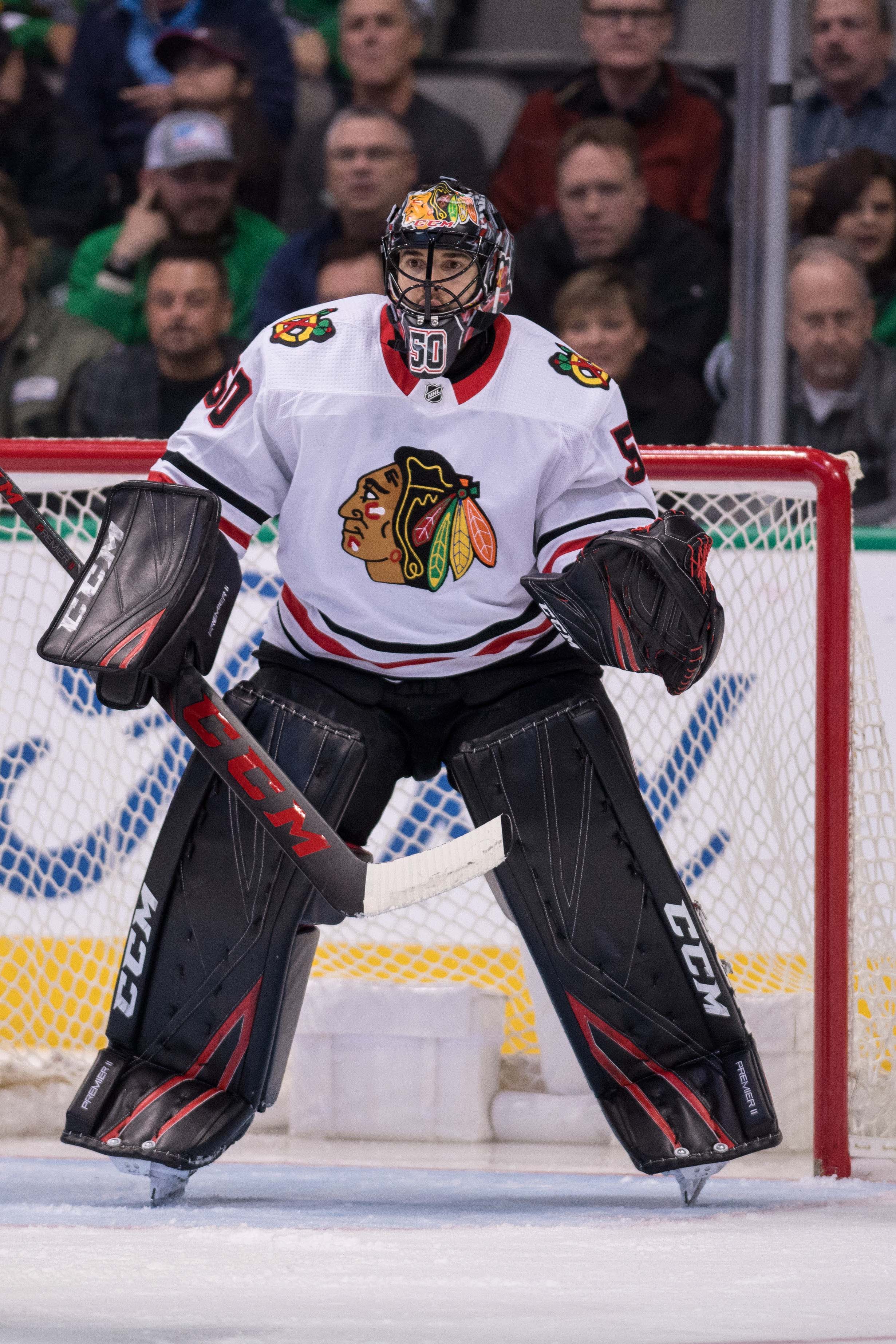 But in recent years, he hasn’t been able to stay in the lineup as frequently to the point where Bowman brought in Lehner in free agency just to have another reliable option. Crawford’s year-to-year performance has varied considerably and he’s coming off of a season where his numbers were decent (2.77 GAA, .917 SV%) but not near the top of the leaderboard either. Between that and his age (35), it’s hard to see him as the long-term solution. A multi-year deal may even be tough to do and it seems likely that his next contract will come a bit cheaper than the $6MM AAV that he has played under for the past six years.
Crawford has said that he wants to stay in Chicago but that he also wants to be a starter which is a role he hasn’t really exclusively held for a while. Can they find their way to a deal to keep him around or will he leave after 17 years with the organization?
Other UFAs: F Joseph Cramarossa, D T.J. Brennan, F Anton Wedin
Projected Cap Space
At the moment, Chicago has a little over $73.5MM in commitments to 17 players, per CapFriendly. Getting all of their impact players re-signed for the $8MM difference isn’t going to happen so some trimming needs to be done, be it through a buyout, trade, or both. While Brent Seabrook and Andrew Shaw missed significant portions of the season and didn’t suit up in the bubble, both expect to be ready to start 2020-21 which takes relying on LTIR off the table for now. Things could change in-season but for the time being, Bowman needs to free up some cap room to keep the core of his team intact.
Photo courtesy of USA Today Sports Images.
Free Agent Focus: Carolina Hurricanes
With free agency now less than a month away, many teams are already looking ahead to when it opens up. There will be several prominent players set to hit the open market while many teams have key restricted free agents to re-sign. The Carolina Hurricanes already traded away the rights to one pending free agent but still have some tough decisions to make.
 Key Restricted Free Agents
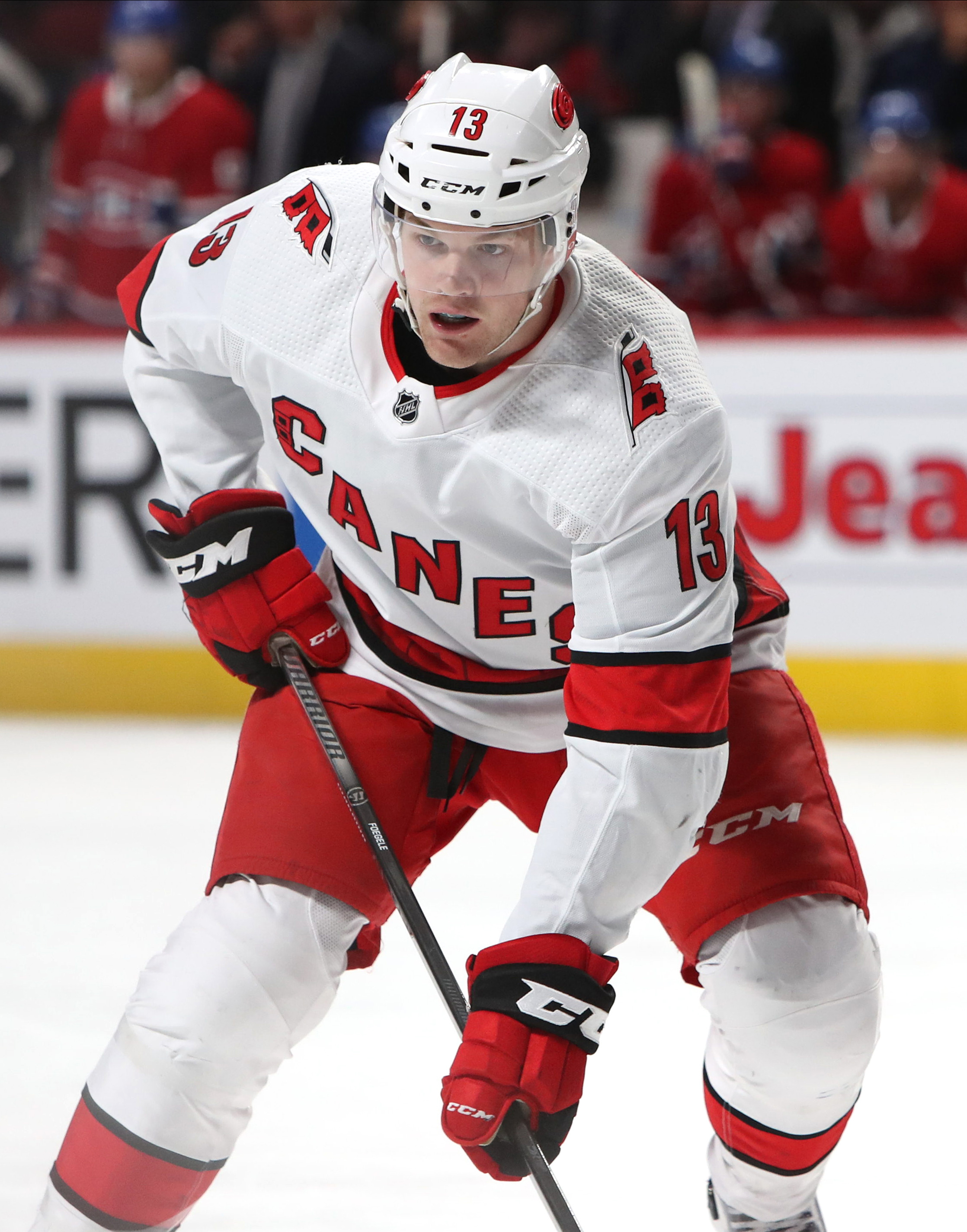
F Warren Foegele – The journey to the NHL wasn’t smooth for the 24-year-old Foegele, who actually left the University of New Hampshire in 2015 to return to the OHL and continue his development back at the junior level. A few years later and it’s clear that that was the right decision for him after two full seasons as a member of the Hurricanes. After really making a name for himself in the 2019 playoffs where he nearly registered as many points as his whole regular season, Foegele came back in 2019-20 as an integral part of the Carolina machine.
In 68 games he scored 13 times and put up 30 points despite averaging just over 12 minutes at even-strength and not touching the ice on the powerplay. That level of production won’t land him a huge raise, but it should afford him a little more ice time and a bigger role moving forward. The question will be whether or not they can work out a multi-year contract or if either of the two sides would rather test arbitration.
D Haydn Fleury – It’s easy to forget that Fleury was the seventh-overall pick in 2014, because to this point in his career he frankly hasn’t lived up to that draft billing. Selected ahead of first-round talents like William Nylander, Nikolaj Ehlers, Dylan Larkin, and of course David Pastrnak (whose selection at 25 still haunts most of the league), Fleury has still played just 132 games in the NHL. That said, his talents did start to show themselves down the stretch for the Hurricanes, with the team even giving him a chance to play more than 20 minutes in four of his last five games before the season was canceled.
In the postseason, Fleury’s role with the team was still large enough to think that they will move forward with him as a full-time member of the defense. With Joel Edmundson traded and two other defensemen set to hit unrestricted free agency, there will be minutes to go around. Like Foegele, Fleury is arbitration-eligible but still might not be able to argue for much of a raise given he played just 45 NHL games this season.
Other RFAs: F Steven Lorentz, F Clark Bishop, F Spencer Smallman, F Jacob Pritchard, D Oliwer Kaski, D Roland McKeown, D Gustav Forsling, G Callum Booth
Key Unrestricted Free Agents
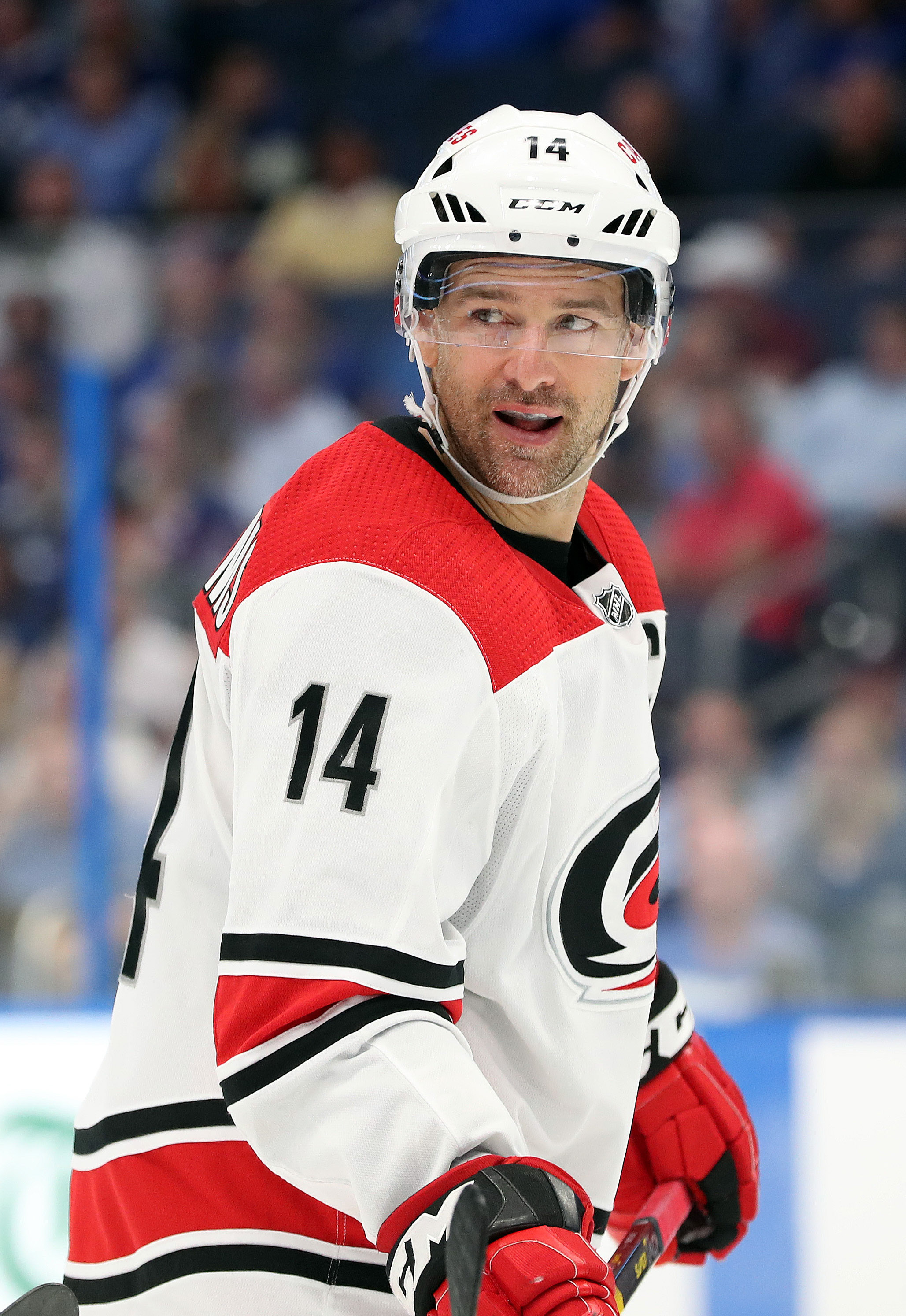 F Justin Williams – Does he come back for a 20th NHL season? It’s not clear at all what Williams’ plans are, but last time it took him until January to officially return to the league and it just so happens that that is when the next season is expected to start. Maybe the next few months will be enough time off for the veteran forward to get the itch again and if Carolina is willing, it seems like the only destination. Williams signed for just $700K (plus performance bonuses) this season and would likely do the same if he returns.
D Sami Vatanen – The bigger question is trade deadline acquisition Vatanen, who actually may have never suited up for Carolina had the playoffs not been delayed. The 29-year-old was injured when the Hurricanes acquired him at the deadline and tweaked it again meaning he never did actually play a regular season game for the team. That didn’t stop head coach Rod Brind’Amour from using Vatanen a lot in the playoffs, but even that postseason performance seems unlikely to land him a new contract with the Hurricanes this offseason.
Carolina already has five defensemen locked up for at least $4MM per season, a number that Vatanen will likely be trying to eclipse on a multi-year deal in free agency. He’s coming off a four-year contract that carried a $4.875MM AAV, and though the flat cap situation may squeeze middle-tier free agents like Vatanen, it’s hard to see how the Hurricanes could really justify bringing him back without a trade of someone else.
Other UFAs: D Trevor van Riemsdyk, F Max McCormick, F Brian Gibbons, G Anton Forsberg
Projected Cap Space
Hard to justify because the Hurricanes only have about $7.8MM in cap space going into the offseason and have more pressing needs than their third pairing. James Reimer and Petr Mrazek are both heading into their final seasons under contract and the Hurricanes have been included in plenty of goaltending speculation. There is also a new deal just around the corner with budding superstar Andrei Svechnikov, who will be a restricted free agent for the first time in 2021.
Promoting youngsters like Jake Bean can provide some more flexibility because of their inexpensive entry-level contracts, but the Hurricanes may end up more involved in the trade market than free agency given their current situation.
Photos courtesy of USA Today Sports Images
Free Agent Focus: Buffalo Sabres
With free agency now less than a month away, many teams are already looking ahead to when it opens up. There will be several prominent players set to hit the open market while many teams have key restricted free agents to re-sign. New Buffalo GM Kevyn Adams will certainly have his work cut out for him as more than half of their players are in need of new contracts in the coming weeks.
Key Restricted Free Agents
F Sam Reinhart – Two years ago, the Sabres elected for a bridge contract to see if Reinhart had another gear in him. While he hasn’t quite reached a point per game level, he has emerged as a capable and consistent top liner. He has reached at least 50 points in three straight seasons and had an outside shot at 60 had it not been for the pandemic which will help his arbitration case as will his increase in usage to over 20 minutes a night. He’s two years away from unrestricted free agency so this is the time where a long-term pact should be the focus for both sides. There aren’t a lot of core forwards in Buffalo right now beyond Jack Eichel and Jeff Skinner but Reinhart is certainly one of them.
F Victor Olofsson – It was a breakout season for the 25-year-old who went from being predominantly a minor leaguer to one of the top rookie scorers in the league with 22 goals and 20 assists in just 54 games. His lack of NHL track record makes it difficult to find possible comparables which could make his arbitration case a little more interesting. Normally, a bridge deal for a player in this situation coming off his entry-level deal would make sense but because he’s an older rookie, a two-year pact would walk him right to unrestricted free agency. There’s no doubt that Olofsson will get a substantial raise on his salary from this season which was less than $800K but Adams is going to have to decide if he’s ready to commit to a long-term deal or if a one-year contract is the better way to go.
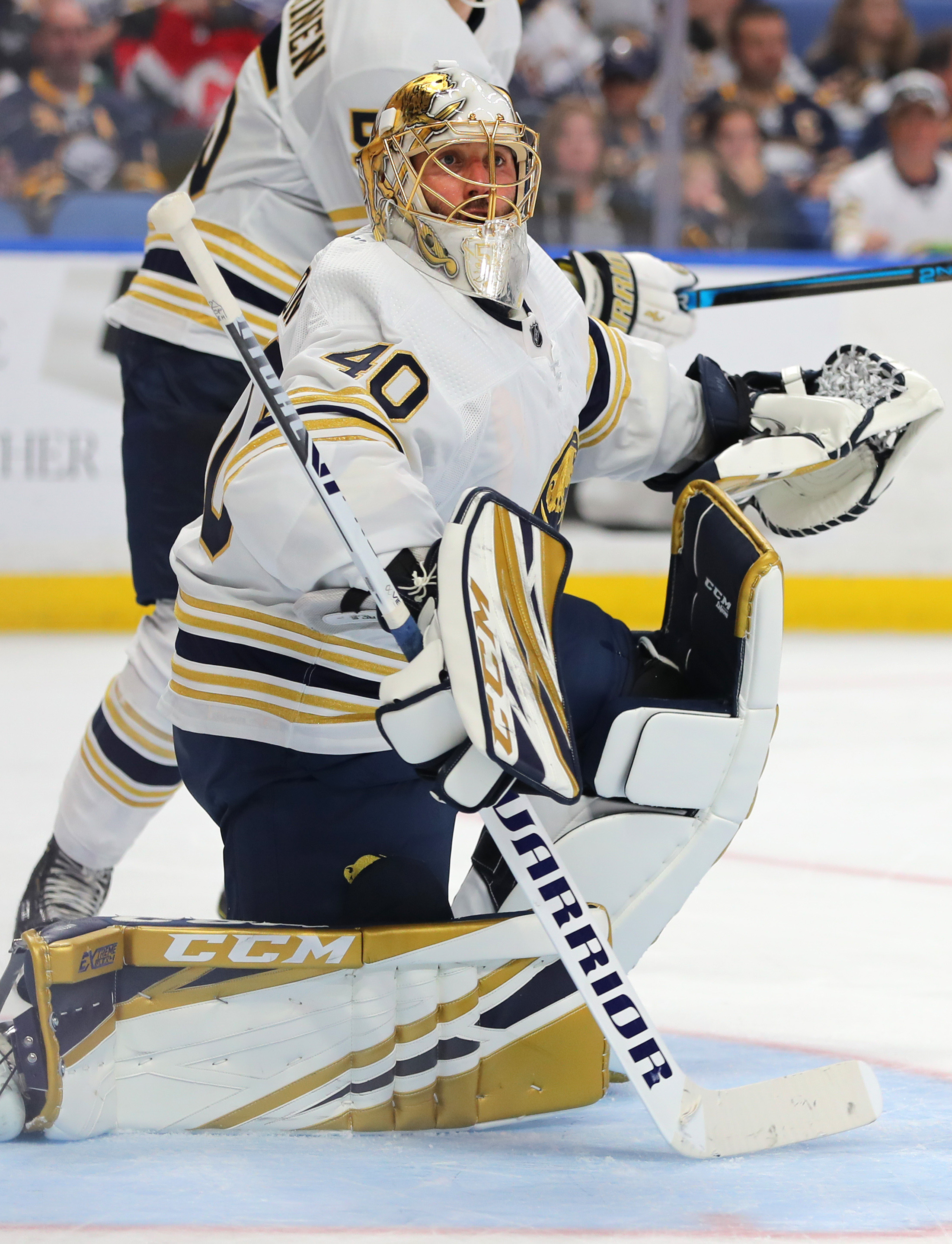 G Linus Ullmark – Ullmark has been Buffalo’s possible goalie of the future for a while but it has yet to materialize into a goalie of the present situation. Even with Carter Hutton struggling mightily, head coach Ralph Krueger saw fit to platoon the two so Ullmark only played in 34 games and while he has played in five separate NHL seasons, he still doesn’t have 100 games under his belt. At 27, he’s a year away from UFA eligibility so another one-year contract that kicks the can down the road isn’t an option anymore. They may not be ready to commit a long-term deal but a two or three-year pact that buys a bit of team control and has a price tag around the $3MM mark might be palatable for both sides; it’d more than double his salary from this season without pricing themselves out of bidding for a starter down the road.
D Brandon Montour – It wasn’t that long ago that Montour appeared to be a part of their long-term plans to the point where Buffalo gave up a first-rounder for him. However, he struggled a bit under Krueger and his ice time fell as a result. Add that to the flattened salary cap and there are questions about whether or not they should be tendering him his $3.525MM qualifying offer. He’s also a year away from UFA eligibility but it’s at least possible that he hits the open market earlier than originally planned. It wouldn’t be surprising to see him in trade discussions in the coming weeks as a result.
Other RFAs: F Remi Elie, D Brandon Hickey, G Jonas Johansson, F Dominik Kahun, F Curtis Lazar, F Andrew Oglevie, D Matthew Spencer, F Tage Thompson
10.2(c) Players: F Casey Mittelstadt (ineligible for arbitration or an offer sheet)
Key Unrestricted Free Agents
F Wayne Simmonds – The decision to take a one-year deal came with mixed results for Simmonds. While he landed more than he would have on a multi-year contract, he didn’t rebound like he or New Jersey had hoped for and didn’t improve upon being moved to Buffalo. While he’s only 32, he has shown signs of slowing down considerably the last couple of years and should now be looked as more of a depth player than the top-six option he has been for most of his career. He should still have no difficulty landing a contract this offseason but it will be much cheaper than the $5MM he made this season.
F Jimmy Vesey – Last summer’s trade to the Sabres didn’t kick-start his offense. Instead, his production took a nosedive as his nine goals and 20 points were both career lows; even had the pandemic not hit, that still likely would have been the case. So instead of entering the market as a possible second liner, he’s going to have to seek out an opportunity where he can play on an offensive-minded third line and hope to play his way up the lineup. At 27, there should be a fair bit of interest but the flattened cap may limit his chances of beating his $2.35MM salary from this season.
F Zemgus Girgensons/F Johan Larsson – I’ve lumped these two together as they’ve followed somewhat similar trajectories thus far aside from Girgensons’ voted in All-Star Game appearance. They even are coming off of near-identical contracts, $1.6MM for Girgensons and $1.55MM for Larsson. Both have spent seven years in Buffalo and have done well at times defensively but their offensive games haven’t progressed much along the way. There is a spot on the fourth line either with Buffalo or elsewhere but it may be hard to justify Adams bringing both of them back at a similar price tag but one of them re-signing could certainly happen.
Other UFAs: F Michael Frolik, D John Gilmour, G Andrew Hammond, D Matt Hunwick, F Taylor Leier, D Casey Nelson, F Vladimir Sobotka, F Scott Wilson
Projected Cap Space
With so many players needing new deals, there isn’t much on the books right now; they have about $47MM tied up in 10 players, per CapFriendly. That gives them plenty of flexibility to work with if ownership is willing to spend to the $81.5MM Upper Limit. After they re-sign their restricted free agents, they’ll have enough left to be players in free agency in the coming weeks.
Photo courtesy of USA Today Sports Images.
PHR Mailbag: Jets, Flyers Veterans, Stamkos, Rask, Avalanche, Canucks Free Agents, Officiating
Topics in this edition of the PHR Mailbag include Winnipeg’s upcoming offseason, underachieving veterans in Philadelphia, Steven Stamkos’ future in Tampa Bay, what’s next for Tuukka Rask, big game shopping for Colorado, Vancouver’s free agents, and the consistent inconsistency of officiating. If your question doesn’t appear here, watch for it in next weekend’s edition.
Dougster: What do you see the Winnipeg Jets doing?
I don’t think they’re going to do a whole lot. I know that seeing Patrik Laine and Nikolaj Ehlers in trade speculation has some thinking that GM Kevin Cheveldayoff is going to make some big changes to his roster but that goes against his general philosophy. Since going to Winnipeg, slow and steady has been the mantra with trying to add a key rental when the time is right. I can’t see that changing and with Laine’s contract expiring next offseason, they’re probably going to try to limit their multi-year commitments.
So with that in mind, I think their top priority will be trying to add some center insurance. Bryan Little’s future is murky at best and while Blake Wheeler can shift to the middle, doing so takes him off their top line. Andrew Copp and Adam Lowry have shown flashes of being ready for a bigger role but they’d feel a lot better with someone more proven in there. A rental player makes a lot of sense here and I wouldn’t be surprised if they inquired about Paul Stastny. He’s familiar with Winnipeg’s system and had some success there before while Vegas will likely need to clear money if they extend Robin Lehner. If they add a veteran and Little is able to play after all, too much center depth is a ‘problem’ that every team would like to have.
If they’re going to add anyone on a multi-year deal, it’s probably on the back end. While Neal Pionk had a strong first season, he was effectively the only impact replacement for Jacob Trouba, Ben Chiarot, Tyler Myers, and Dustin Byfuglien. The Jets patched things together this season but some more stability there would go a long way.
Beyond that, I think they’ll try to clear Mathieu Perreault’s deal (perhaps as salary ballast in a trade for one of the above elements) but with many other teams wanting to clear money, that’s far from a guarantee. They’ll need to sign a new backup goalie (there are plenty of pure backups available in free agency) and fill out the bottom of their forward group. I think they can do that without taking a core player away and that’s how Cheveldayoff will likely try to play it.
ripaceventura30: What is a realistic return for Shayne Gostisbehere and who might be interested in turning his career back around? Is JVR a buyout candidate or do the Flyers hang onto him for one more year and hope he gets back to his scoring ways/gets dangled as an expansion draft piece?
Gostisbehere’s case is a tough one. Moving a high-priced player in this current marketplace is going to be tricky. Moving a high-priced player (Gostisbehere has a $4.5MM AAV) with three years left on his deal that couldn’t crack their regular lineup down the stretch and in the playoffs is going to be much tougher. There is definitely offensive upside and his mobility is a plus as more teams look to have their defenders join the rush so this isn’t a situation where no one would want him. But the return Chuck Fletcher would probably have to settle for would be underwhelming. A second-round pick and a depth defender (to offset some salary) would be my guess at a best-case scenario and their cap situation is going to make it difficult to try to hold onto him in the hopes that he rebuilds his value next season. I could see New Jersey and Detroit being among the teams with interest, ones with vacancies on the back end and enough cap room to take on what’s currently a bad contract without too much concern.
I don’t see Philadelphia buying out James van Riemsdyk. He hasn’t lived up to his contract but he still has 46 goals over his two seasons which isn’t terrible by any stretch either. A buyout would cost them over $2.77MM for two seasons, then over $4.77MM in 2022-23 before dropping to $1.778MM for three years after that. Can they sign a 25-goal winger for the difference between his buyout cost and his $7MM cap hit? I know they want to free up some money but that’d be a tough way to do it. At this point, they either trade him with significant retention or, more likely, hold onto him and hope he rebuilds his value. If he doesn’t, he’ll be left unprotected next summer.
@warrenchris: Where will Stamkos be playing next year?
It’s well-known that Tampa Bay has to cut some significant salary for next season and whoever they want to move is going to have some form of trade protection. While players like Alex Killorn, Yanni Gourde, and Tyler Johnson have been the speculative casualties, I suppose it’s possible that they could look at how they’ve performed without Stamkos and try to move him instead. Anthony Cirelli would step into a bigger role down the middle behind Brayden Point and they’d probably still be contenders.
But from a value standpoint, there probably isn’t a worse time to try to move him. Moving expensive contracts is going to be tough this offseason given the current landscape and he’s signed at an $8.5MM cap hit for four more years. The mystery surrounding this injury that has kept him out for the entire postseason doesn’t help either. Original indications were that he was to have been back by now but he’s not progressing as well as anyone would have hoped. That’s a major red flag for other teams. If you’re going to commit to a pricey player, you at least want to know that he’s healthy and that there’s no danger of recurrence down the road. He’s now skating with the team at least but that’s not the same as game action.
In a situation where they simply have to move some players out, nothing can be ruled out entirely. But even though they’ve done well without him, it’s hard to imagine Stamkos being anywhere other than Tampa Bay next season.
sovietcanuckistanian: is Rask done in Beantown? Publicly, team/players have come out in support, but you get the feeling there is some angst/animosity from some people partly feeling that he might have bailed. I mean he’s still a top-5 goalie (I think), but his cap hit is a bit high. Do you think he gets moved or do they just run out the Halak/Rask tandem again and let their contracts run out? Thanks in advance.
I wouldn’t be surprised if some in the organization would like to see him moved despite their public proclamations to the contrary but doing so would be trickier than it might seem. For starters, he has a 15-team no-trade list which takes half of the league out of the equation right there.
 Let’s look at Rask’s numbers from the past two seasons. And I’m not talking about his sterling GAA and SV% from 2019-20 but rather his games played totals. This season, he played in 41 regular season games before the pandemic hit. The year before that, he played in 46 contests. That’s not a lot of appearances for a starting goalie, especially one that has a $7MM price tag. The tandem works for Boston with Jaroslav Halak because he’s someone that’s considered an above-average backup. Not many other teams with a potential vacancy between the pipes are in that situation and of those, how many have $7MM to spend? 2020-21 feels like it’s going to have a lot of back-to-backs with the NHL wanting to play 82 games even with a delayed start so I don’t think there would be a huge market for his services.
Let’s look at the other side for a minute. Who would replace Rask? It’s not as if there are a lot of starters available in free agency nor are there legitimate number ones available on the trade market. They could flip Rask for Marc-Andre Fleury to change things up for the sake of change but I don’t think that makes them a better team and they’re in win-now mode. Unless they can land a legitimate starter that’s going to be around for a few years (such as Jacob Markstrom in free agency), they’re probably best off sticking with a tandem that they know works for them.
Eric Lord: Do you think the Colorado Avalanche will make a run at Alex Pietrangelo? They really struggled defensively against Dallas after Johnson went down in Game One. They have the cap space and he would provide them with an experienced, top pair defenseman that could lead them to a Cup.
In terms of a fit, Pietrangelo to Colorado makes a ton of sense and he’d undoubtedly vault them into contenders. But while you mention that they have the cap space, it’s only in the short term and that’s going to limit them in this pursuit.
Let’s jump ahead a year to the 2021 offseason. They currently have $40.45MM in commitments to eight players which is manageable. But Gabriel Landeskog needs a new deal that will check in considerably higher than his $5.571MM cap hit. Cale Makar’s contract is up and at this point, you can probably add a zero to the end of his current $880K price tag. Philipp Grubauer’s deal is up which means they’ll need a starting goalie as well. Can they afford to do those three things, sign Pietrangelo, and fill out the rest of the roster under a cap that’s probably going to be around the $81.5MM it is now? I don’t think they can.
If Pietrangelo is willing to sign a one-year deal at an inflated price tag (think more than $10MM) to go to a contender and then go for a long-term contract in 2021, Colorado has a chance. In that scenario, I’d probably make them the contender for his services. But that’s a lot of risk on Pietrangelo’s end as an injury could cost him millions. Even in a deflated cap environment, he should be able to command a max-term, top-dollar contract next month; he’s that talented of a blueliner and those rarely hit the open market. He’d fit in great with Colorado but I don’t think they can fit him in beyond 2020-21 without taking away another core piece first.
Offseason Keys: Montreal Canadiens
As teams are eliminated from the playoffs, it means that the offseason has arrived for several more squads. Having covered the teams that weren’t a part of the NHL’s return and the ones ousted in the Qualifying Round, we shift our focus to the ones that were eliminated in the official first round. Next up is a look at Montreal.
The regular season was not a good one for the Canadiens who were sellers at the trade deadline. However, the expanded postseason format gave them the final spot and they went on to make the most of it, upsetting Pittsburgh in the Qualifying Round before putting up a good showing against Philadelphia before ultimately being eliminated. GM Marc Bergevin has already started his offseason work with the acquisitions of goaltender Jake Allen and defenseman Joel Edmundson but they still have some things to accomplish over the coming months if they want to get back into playoff contention.
Add Scoring Wingers
With Nick Suzuki and Jesperi Kotkaniemi showing some positive signs in their young careers, the Canadiens now have some depth down the middle which gives them an opportunity to try to work on upgrading their scoring on the wings for the first time in a while. They’re a team that’s built on trying to score by committee but as their series against Philadelphia showed, they don’t have a go-to option when they need a key goal.
Brendan Gallagher has been Montreal’s closest thing to a top goal scorer in recent years. He had surpassed the 30-goal mark in the past two years and while he didn’t get there this season, he scored at that pace (22 in 59 games). Tomas Tatar led the team in points during the regular season and was second the year before. After that, however, it thins out in a hurry; no other winger had more than 16 goals this year.
Jonathan Drouin has underwhelmed for the most part since joining the team from Tampa Bay while Joel Armia, Artturi Lehkonen, and Paul Byron are more known for their play in the defensive end. One of their better offensive contributions from a winger this season came from Ilya Kovalchuk after his contract was terminated by the Kings but he was also thrust onto the top line quickly which played a role in his brief success.
While they’ve spent a good chunk of their cap space already, Bergevin would be wise to look for another reliable scorer on the wing. The odds of being able to afford and acquire a front liner are slim but there are some players in free agency who would give them a lift offensively and at least deepen their by-committee approach towards scoring.
Domi Decision
When Montreal acquired Max Domi from Arizona two years ago, he was coming off of a tough year and a bridge deal made some sense. Since then, he had a breakout 72-point campaign in 2018-19 but had another tough year this season as his output dipped to just 44 points. While there is still some uncertainty surrounding what type of offensive player he can be, a short-term contract doesn’t make as much sense now that he’s arbitration-eligible and two years away from being eligible for unrestricted free agency unless they do a contract that’s three seasons or longer to buy a bit more team control.
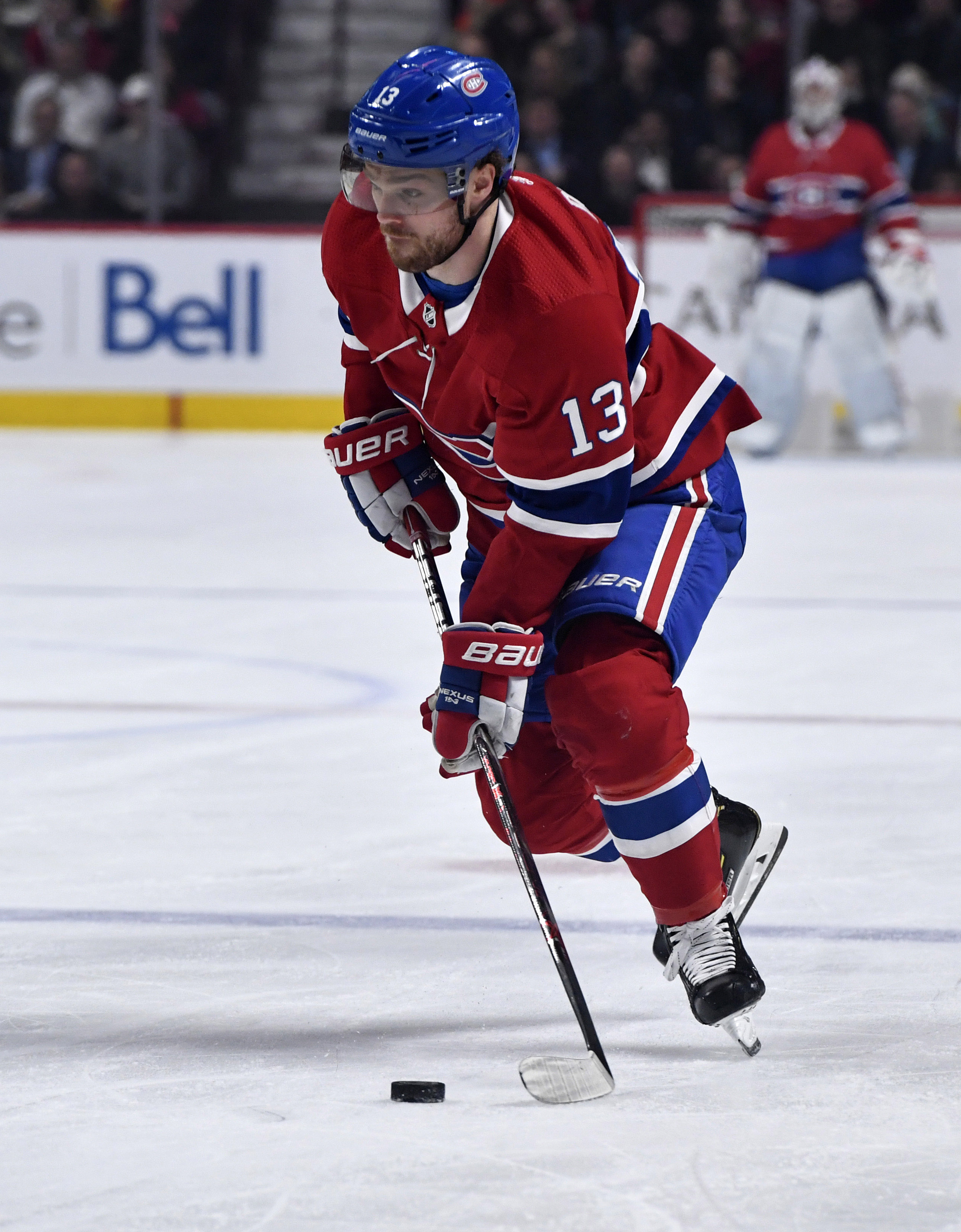 Further complicating things for Bergevin is the presence of Suzuki and Kotkaniemi, their hopeful top two centers of the future. Committing a long-term deal to Domi if they envision him as a third liner doesn’t make a lot of sense and Phillip Danault (more on him in a bit) is also in the picture as well. There’s the possibility of moving him to the wing but Domi has made it known that his preference is to remain down the middle. It’s also worth noting that he has changed agents as well, moving from Pat Brisson to Darren Ferris.
A year ago, it looked like Domi was going to be part of Montreal’s long-term core but now, that’s not as certain. If their inclination now is that he won’t be, this may be the right time to try to move him even though his output dipped this season. There are no impact centers available in unrestricted free agency and quite a few teams will be looking to trade for help down the middle so Bergevin should be able to still yield a good return if he wants to go that route.
One way or another, a decision is soon pending for the 25-year-old. Getting to arbitration is an outcome that they likely will want to avoid because of Domi’s 72-point campaign which means that they’ll have to do something in the near future and choose what their plans are for him.
Extension Talks
There aren’t many teams that have as much cap room for 2021-22 as Montreal does but there’s a reason for that. They have just three forwards signed for that year with Gallagher, Tatar, Danault, and Armia among those set to become unrestricted free agents. So will defenseman Jeff Petry. While this gives them some potential flexibility for Seattle’s expansion draft (it’s unlikely a pending UFA would be protected), having that many core players enter their walk years is certainly risky.
Petry and Gallagher are the likeliest to have early extension talks. Petry has become a strong number two defender over his time with Montreal and should be in line for a raise on his current $5.5MM price tag. Gallagher, meanwhile, has been one of the better bargains in the league at $3.75MM while other 30-goal players are getting closer to $6.5MM to $7MM on the open market. That’s probably the price range that would be needed to get an early extension done. Tatar’s quiet showing in the playoffs likely hurts his chances of getting a new deal done this offseason.
Then there’s Danault. He indicated after the season that his role in 2020-21 would play a factor in deciding whether or not to re-sign. He has been a fixture on Montreal’s top line the last two seasons but with their youngsters potentially ready for more ice time, Danault’s spot on the depth chart is probably going to change. If they can find a role that he’s comfortable with and the right price point (his cap hit is just under $3.1MM currently), it’s possible that they could get a deal done now which would further put Domi’s future into question.
After Montreal’s elimination, Bergevin indicated that he intended to be careful this offseason knowing that this situation was on the horizon. Getting one or two of these players signed would go a long way towards giving them some certainty in cap planning even if it winds up hurting them a bit when it comes to who they lose to the Kraken.
Photo courtesy of USA Today Sports Images.
Free Agent Focus: Tampa Bay Lightning
With free agency now less than a month away, many teams are already looking ahead to when it opens up. There will be several prominent players set to hit the open market while many teams have key restricted free agents to re-sign. Tampa Bay’s players are certainly focused on beginning the Stanley Cup Final on Saturday but management is undoubtedly aware of some of the core players in need of new deals soon after.
Key Restricted Free Agents
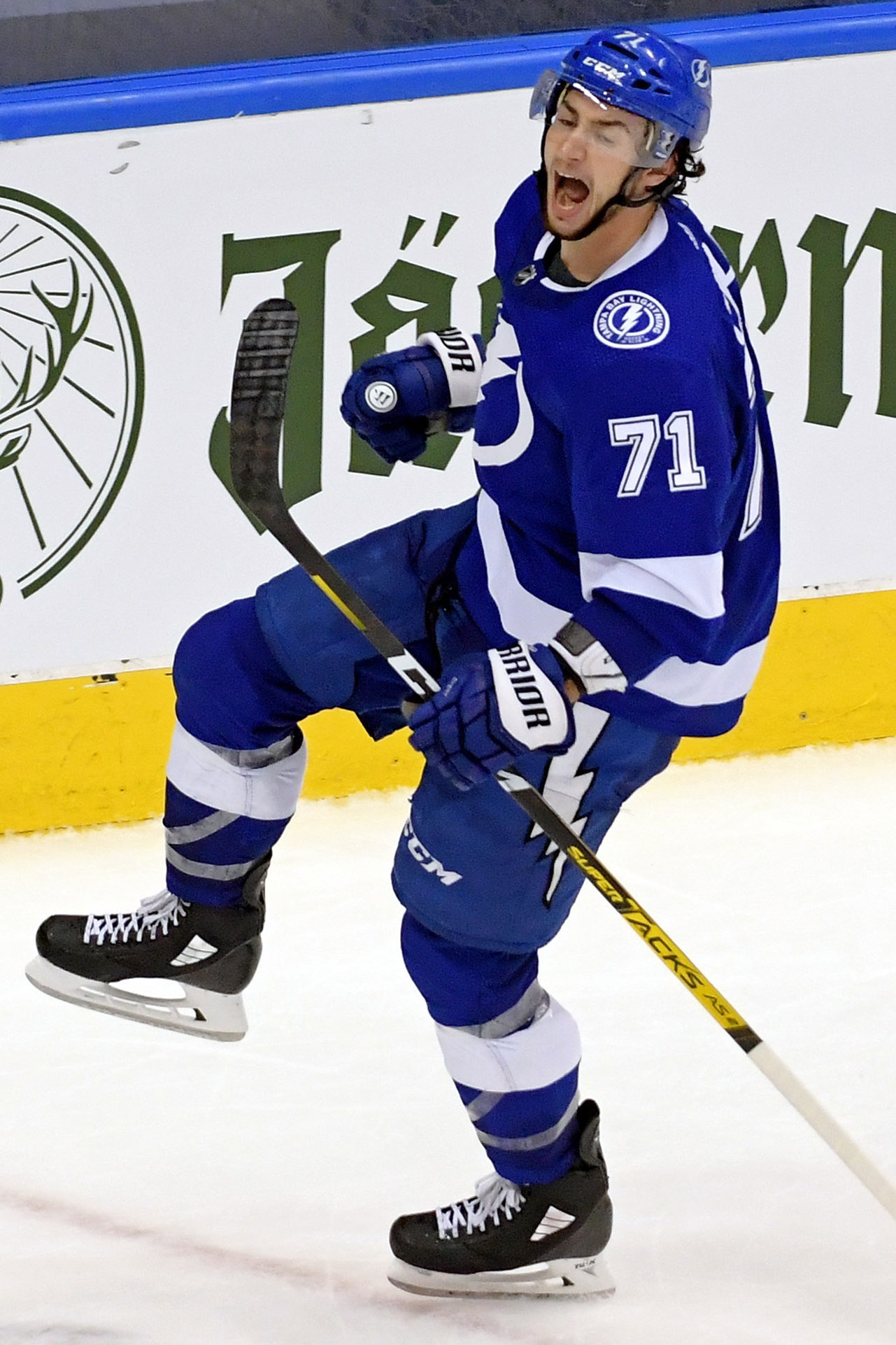 F Anthony Cirelli – Last season was his first in the NHL and while he played well, he still was a little bit under the radar. That isn’t the case now. Despite the pandemic, he set a new career best with 44 points in 69 games while establishing himself as one of the top two-way centers in the league. Writers around the NHL certainly noticed as he finished fourth in Selke Trophy voting. So far in the playoffs, his production has tapered off a bit but he has logged more than 20 minutes a night while playing in a checking role. Cirelli isn’t arbitration-eligible but there will be teams that view him as a second liner and if that’s the case, he could be a candidate for an offer sheet (especially with the Lightning’s cap situation).
D Mikhail Sergachev – The 22-year-old hasn’t had that big leap offensively since he picked up 40 points in his rookie season; he hasn’t reached that mark since. However, he has gone from being a player who had to be sheltered on the third pairing into a capable top-four defender that has shown considerable improvement in his own end. That will undoubtedly catch the eye of any GM that wants to try an offer sheet and isn’t impressed with the current trade or UFA options. If one of those doesn’t materialize (which is the likelier scenario), a short-term contract will probably be the outcome since they don’t have much in the way of cap space to work with this offseason.
D Erik Cernak – He won’t blow anyone away offensively by any stretch but Cernak has settled into a strong defensive role and has been an anchor on what has been one of the better penalty kills among teams that have gone relatively deep into the playoffs. Like Cirelli and Sergachev, he isn’t eligible for salary arbitration which will hurt his earnings upside a bit so a bridge contract is expected. Even so, he should at least triple his $735K qualifying offer.
Other RFAs: F Ross Colton, F Mathieu Joseph, D Dominik Masin, F Gemel Smith, D Devante Stephens, F Mitchell Stephens, D Ben Thomas, F Carter Verhaeghe, F Alexander Volkov, F Dennis Yan
Key Unrestricted Free Agents
D Kevin Shattenkirk – While things didn’t work out well for him in New York, Shattenkirk has fared much better with the Lightning. Instead of being counted on to be an offensive catalyst as he was with the Rangers, he’s in more of a supporting cast role and has made the most of it, picking up 34 points in 70 regular season games and nine more in 19 postseason contests so far. He has done well to restore some value and while he won’t come anywhere close to the $6.65MM AAV of his contract that was eventually bought out, he should check in higher than $1.75MM he played for this year. A multi-year pact is certainly a possibility as well.
F Patrick Maroon – Gone are the days where there were teams hoping that he could be part of a top-six forward group but Maroon has shown that he can still contribute in a more limited role. Anyone looking for grit and leadership in their bottom six should show interest in Maroon, especially if he’s willing to take a deal close to the $900K he made this season. With many teams being limited in what they can spend this offseason, he should have a longer list of suitors this time around.
D Zach Bogosian – Expectations were quite low after his deal with the Sabres was terminated but he has fit in nicely with the Lightning. Between the regular season and playoffs, he has averaged around 18 minutes per game and has held his own. It was risky walking away from more guaranteed money had he reported to Buffalo’s AHL affiliate but had he done that, there’s a good chance he wouldn’t have had much interest in free agency. He should have several suitors now so this decision is one that has certainly worked out for him.
Other UFAs: G Mike Condon, D Cameron Gaunce, G Spencer Martin, D Jan Rutta, D Luke Schenn, D Patrick Sieloff, G Scott Wedgewood
Projected Cap Space
Tampa Bay has nearly $69MM in cap commitments for next season already, per CapFriendly. That spending only gets them a goalie, two defensemen, and seven forwards. With an $81.5MM cap, that leaves them less than $13MM to fill out half of their roster while having two of the top young restricted free agents needing new deals. There’s no sugar coating it – they need to clear out a notable contract or two. However, of the 10 players signed, only two don’t have trade protection and those two – Brayden Point and Andrei Vasilevskiy – aren’t going anywhere. GM Julien BriseBois will have his work cut out for him when their series against Dallas comes to an end.
Photo courtesy of USA Today Sports Images.
Submit Your Questions For The #PHRMailbag
The Stanley Cup Finals are right around the corner and the offseason will follow quickly. With finances devastated over the last few months and teams looking at either the flat league-mandated salary cap or an even lower internal one, there should be plenty of player movement over the next few months. With that in mind, it’s time to run another edition of the PHR mailbag.
If you missed our last one, it was split into two parts which you can read here and here. The first was focused solely on the New York Rangers given they had just won the first-overall pick and answered questions regarding the future of Henrik Lundqvist and potential second-line center targets. The second part was more wide-reaching, with topics including Ottawa’s potential cap space, Alex Pietrangelo‘s future and the Detroit Red Wings offseason plans.
You can submit a question by using #PHRMailbag on Twitter or by leaving a comment down below. We’ll try to get to everything when the mailbag runs this weekend.
Offseason Keys: Calgary Flames
As teams are eliminated from the playoffs, it means that the offseason has arrived for several more squads. Having covered the teams that weren’t a part of the NHL’s return and the ones ousted in the Qualifying Round, we shift our focus to the ones that were eliminated in the official first round. Next up is a look at Calgary.
It has certainly been a disappointing last year and a half for the Flames. After a quick exit at the hands of Colorado in the 2019 playoffs, GM Brad Treliving didn’t shake things up too much and instead just tweaked a few veteran players. Things weren’t much better this season. Bill Peters resigned following reports of abusive behaviour in the past and the team played a bit better when assistant Geoff Ward took over in an interim role (and was promoted to the full-time spot just yesterday). However, it didn’t yield much in the way of playoff success; although they beat Winnipeg in the Qualifying Round, they were taken out by Dallas soon after. This time around, bigger changes are expected meaning there is a lot at stake for Calgary this offseason.
Determine The Size Of The Forward Shakeup
When a team bows out quicker than expected once, it’s understandable if a GM decides to give that core group another chance if he believes that they can turn it around. When it happens a second time in as many years as is the case here, patience isn’t going to be as justifiable. The decision to give Ward the permanent head coaching position takes one of Treliving’s potential cards out of play which means the changes are going to have to come from their personnel.
Two of their top offensive players in center Sean Monahan and winger Johnny Gaudreau are coming off of quiet regular seasons. After putting up 99 points a year ago, Gaudreau’s output dropped to just 58 while Monahan went from 82 to 48. Yes, missing the final dozen games due to the pandemic skews the numbers a little but it was still a big letdown nonetheless. Things weren’t much better in the playoffs either. Gaudreau had seven points in 10 games but all but one came with the man advantage. The ratio was only slightly better for Monahan who had five of his eight points on the power play. Gaudreau has two years left and Monahan has three. Treliving will need to decide if he’s willing to shake up the core with one of them potentially being moved or if he’ll dip a little deeper into his roster.
If he opts for the latter, Mark Jankowski is a likely trade candidate following a dreadful seven points in 56 games while Derek Ryan could be expendable in his walk year. But moving those two players isn’t going to move the needle very much. How much confidence does Treliving have in his forward group? We’re going to find out soon enough.
Find A Starting Goalie
With David Rittich coming off of a nice rookie season, the decision to go out and add Cam Talbot in free agency made sense for Calgary. Talbot was someone that was coming off of a tough year but had shown himself to be capable of playing more than a typical backup. He’d bring a bit of upside while being an insurance policy for the inexperienced Rittich.
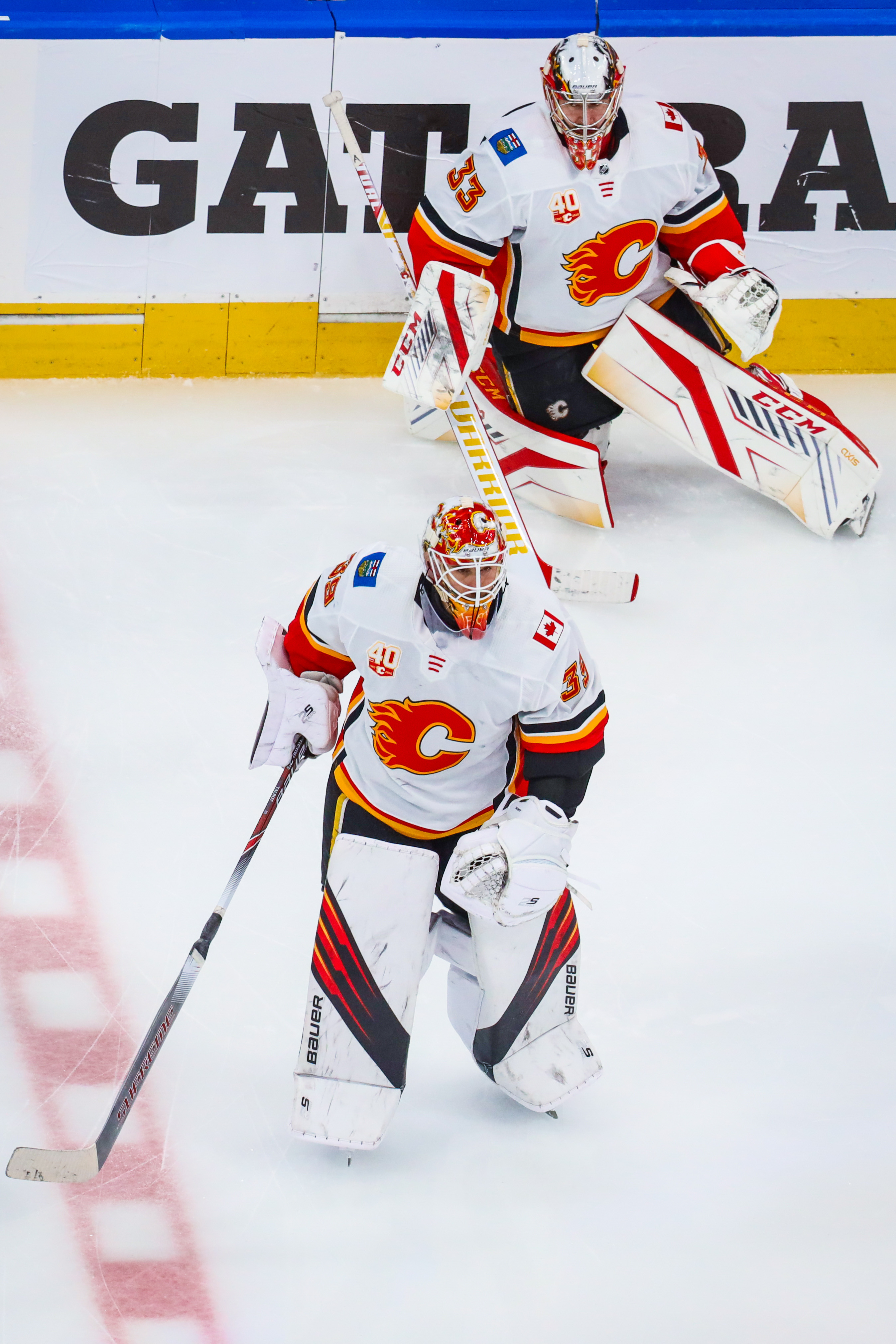 The results were mixed. Talbot played a bit less than expected but put up his best numbers in several years. That was the good news. The bad news was that Rittich took a big step back. It was telling that Talbot made every postseason start as well.
Talbot now hits the open market as one of the more intriguing goalies out there. There aren’t going to be many starting opportunities available but he is well-positioned to land at least a stronger platoon role than what he had this year. Rittich, meanwhile, is signed for another year at $2.75MM before being eligible for unrestricted free agency himself in 2021.
At this point, it’s hard to envision either of the two goalies being considered for the starting spot next season. These next few weeks figure to feature a lot of movement between the pipes between trades and free agency. With their prospects not being ready for prime time duty just yet, the Flames need to add a more proven starter ahead of Rittich if they want to head into next season feeling more confident about their chances.
Reshape The Defense
The back end has been a staple of the Flames for a while now but changes are on the horizon. No fewer than five veteran defenders are set to hit the open market next month in T.J. Brodie, Travis Hamonic, Derek Forbort, Erik Gustafsson, and Michael Stone. With more than $64MM in commitments already for next season to just 14 players, it’s unlikely that they’ll be able to bring back more than one of Brodie or Hamonic while Forbort and Gustafsson will likely find bigger roles if they go elsewhere.
As things stand, just three veterans are under contract for next season in Mark Giordano, Noah Hanifin, and Rasmus Andersson (whose six-year extension is set to come into effect). Juuso Valimaki is also signed and on his entry-level deal but he missed all of this season after tearing his ACL last summer while training. He’s likely going to be on the team but counting on him to have a big role would be risky considering how much time he missed. Oliver Kylington is a restricted free agent and should be back as well but he is more of a depth option at this point as is Alexander Yelesin who enters the final year of his deal. College free agency signing Connor Mackey is worth keeping an eye on but it’s unlikely he’d step into an impact role right away either.
This presents an opportunity for the Flames to reshape things a bit. It wouldn’t be surprising to see them try to funnel a bit of their previous spending either into adding a more prominent goalie or some more firepower up front. If they can’t bring back one of Brodie or Hamonic, they’ll likely have to try to add a new rearguard or two. Depth defenders are available in free agency but if they want a top-four option, they’ll likely have to turn to the trade market and if it’s an impact defenseman that they want to add, it’ll take more than a depth forward or two to get one. Changes appear to be on the way for Calgary’s defensive group.
Photo courtesy of USA Today Sports Images.
Free Agent Focus: Toronto Maple Leafs
With free agency now less than a month away, many teams are already looking ahead to when it opens up. There will be several prominent players set to hit the open market while many teams have key restricted free agents to re-sign. Toronto has a few veterans that are likely to move on in free agency while there are a few restricted free agents of note as well.
Key Restricted Free Agents
D Travis Dermott – While the 23-year-old hasn’t quite taken off offensively as he or the Maple Leafs had hoped, he has nevertheless secured a regular spot on their back end as a capable puck-mover. He’s squarely third on the depth chart among left-shot options behind Morgan Rielly and Jake Muzzin and that isn’t going to change anytime soon. That, paired up with his quiet offensive numbers and no arbitration rights, has Dermott on track for a short-term bridge contract.
F Ilya Mikheyev – One of the more sought-after players in international free agency in the 2019 offseason, Mikheyev made a strong first impression with Toronto before having his wrist sliced open by the skate blade of Jesper Bratt put a premature end to his rookie campaign. However, he was able to return for the Qualifying Round against Columbus so he should be good to go moving forward. He turns 26 next month and is already arbitration-eligible which makes him one of the more interesting cases. 23 points in 39 games is impressive but those are his only NHL numbers which makes finding eligible comparable players quite difficult. This feels like a situation where Toronto would like to give him a multi-year deal and buy out some UFA eligibility but with their salary cap situation, that will be difficult. Nevertheless, expect Mikheyev to sign for a fair bit more than his $874K qualifying offer.
F Evan Rodrigues – His stock fell quite a bit this season. After back-to-back campaigns of 25 points or more, it looked like he had become a regular with Buffalo. However, he fell out of favor with head coach Ralph Krueger and was dealt to Pittsburgh where playing time was harder to come by; he didn’t even suit up in their early exit to Montreal. Rodrigues was curiously part of the Kasperi Kapanen trade recently. While it’s unlikely that Toronto tenders a $2MM qualifier, they may use this time to try to see if he’s willing to take a cheaper deal.
Other RFAs: F Jeremy Bracco, F Frederik Gauthier, F Denis Malgin, F Max Veronneau
Key Unrestricted Free Agents
 D Tyson Barrie – Sometimes, a change of scenery can bring out the best in a player and other times, it doesn’t work out. Barrie’s case fits in the latter category. A year removed from a career-best 59 points with Colorado, his inclusion in the Nazem Kadri trade looked to present a big opportunity for a new benchmark in points and a pricey contract on the open market. Instead, he struggled early and never quite found his footing. Overall, his 39 points (5-34-39) is still well above average for a defenseman but instead of commanding $7MM or more in free agency, he’ll likely have to accept something closer to the $5.5MM he made on his most recent deal. On the surface, Barrie feels like a candidate for a one-year pillow deal to try to restore some value and try his hand for a big contract a year from now.
D Cody Ceci – Included as salary ballast in last summer’s Nikita Zaitsev deal with Ottawa, Ceci managed to log more than 20 minutes a night in ice time for the fourth straight season. He’s a right-shot defender and is only 26; he’s already eligible for unrestricted status due to his seven years of NHL service time. Typically, players with this profile should have considerable demand but Ceci is one of the more polarizing blueliners in the league. He has more offensive upside than the eight points he put up this season but he’s prone to some untimely mistakes as well. His defenders will point to some advanced stats that paint him in a more favorable light, making a case of the eye test versus the numbers. That might limit his suitors a little bit but he should have no issues finding another team for next season but he’ll have to take a cut in pay from the $4.5MM he made this year.
F Kyle Clifford – The veteran was brought in as part of the Jack Campbell trade to give Toronto some grit for the playoffs and he did fine in that role. There’s mutual interest in a new contract but it’s worth noting that Los Angeles paid down half of his $1.6MM price tag in the move. If Clifford wants a similar contract – and he should be able to get that even in a depressed market – he will almost certainly price himself out of the range that the Maple Leafs can afford to pay.
Other UFAs: F David Clarkson, F Tyler Gaudet, D Kevin Gravel, G Kasimir Kaskisuo, F Matt Lorito, F Nathan Horton, F Miikka Salomaki, F Jason Spezza, F Garrett Wilson
Projected Cap Space
Even after clearing Kapanen’s deal off the books, Toronto has about $77.25MM tied up in 20 players for next season, per CapFriendly; that amount assumes that KHL signings Alexander Barabanov and Mikko Lehtonen ultimately make the team. With the Upper Limit remaining at $81.5MM, that leaves them enough to fill out their roster with some depth players but if they want to add another impact player, they’ll have to either make another move to free up some space or acquire someone with the other team paying down part of the contract. As a result, their current roster may not look all that much different when the puck drops on the 2020-21 season.
Photo courtesy of USA Today Sports Images.
Free Agent Focus: Vancouver Canucks
With free agency now less than a month away, many teams are already looking ahead to when it opens up. There will be several prominent players set to hit the open market while many teams have key restricted free agents to re-sign. Vancouver has several big decisions to make concerning their team, especially in goal.
Key Restricted Free Agents
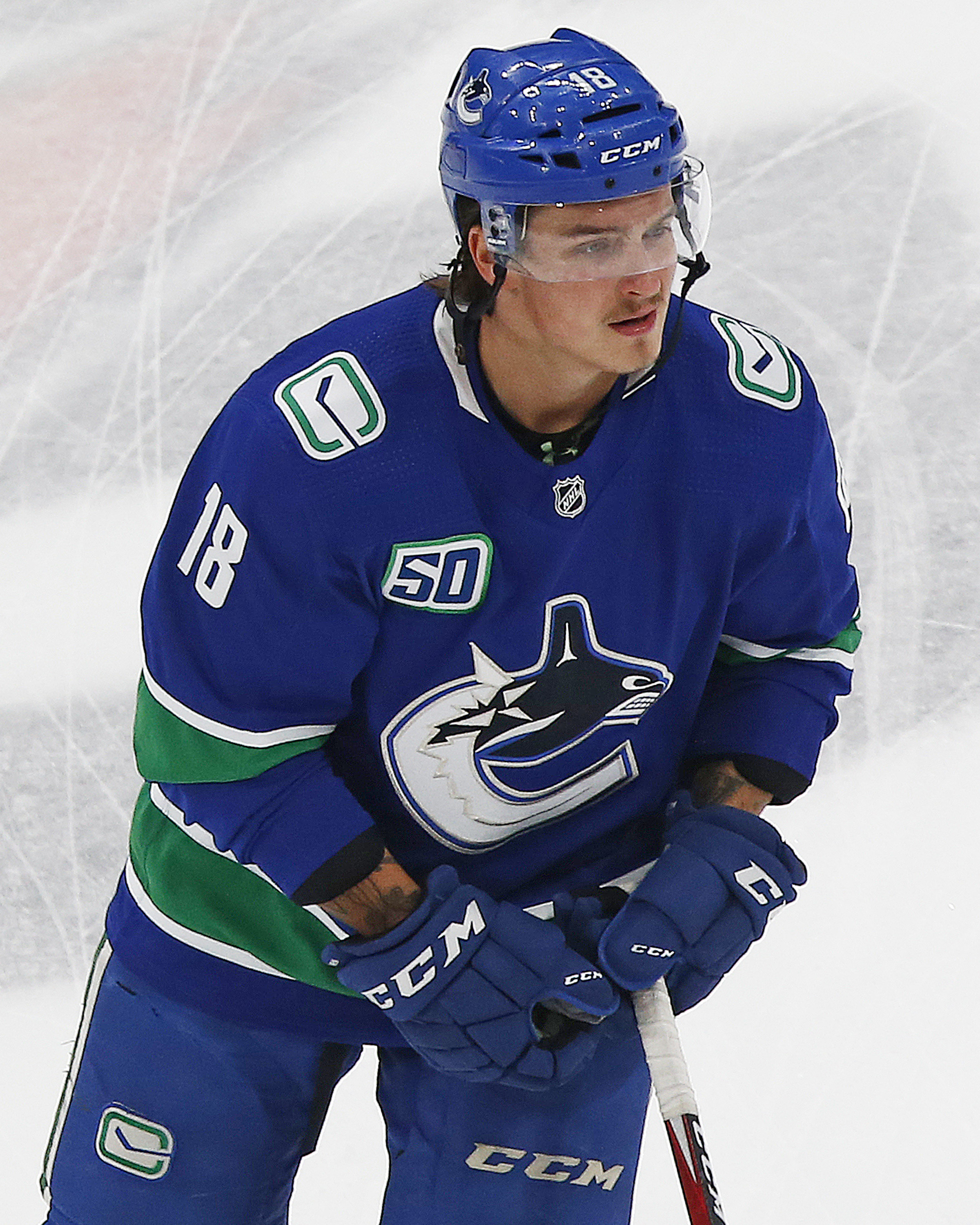 F Jake Virtanen – Virtanen is an interesting case in which the former first-round pick has made improvements every year and this year was no different. After a 15-goal, 25-point season in 2018-19, Virtanen improved to 18 goals and 36 points this season. However, while that’s a definite improvement, his playoff performance this year left a lot to be desired. He managed just two goals and three points in 16 games and saw his playing time fluctuate while spending some time on the fourth line. His time with the Canucks could be up as the 24-year-old could end up being trade bait as he has slowly worn out his welcome with Travis Green and the coaching staff. Regardless, the forward still has the potential to become a top-six forward.
F Tyler Motte – A fan favorite in Vancouver had an up-and-down year, missing a chunk of the regular season with a shoulder injury, but is a key player for the team’s fourth line. The 25-year-old only posted four goals in 34 regular season games, but then was more impressive in the playoffs with four goals in just 17 games. However, he does bring the team some much needed physicality with 318 hits over his last 108 regular season games. At just $975K, he shouldn’t require the Canucks to break the bank to sign him.
D Troy Stecher – The blueliner will be an interesting test for GM Jim Benning, who has quite a few unrestricted free agents to make decisions on and limited cap room for that. One suggestion that has been made by many is sending the 26-year-old off in a trade. He made $2.33MM the past two years and that is money that might be better spent elsewhere to retain some of their other players. Stecher also only averaged 15:21 of ATOI, not exactly the type of playing time you’d hope for for someone making that much money. With younger defensemen ready to step in such as Olli Juolevi and Jack Rathbone, the team may look to trade him during the offseason.
Other RFAs: F Justin Bailey, F Reid Boucher, D Guillaume Brisebois, D Jalen Chatfield, F Adam Gaudette, F Nikolay Goldobin, G Jake Kielly, F Zack MacEwen, F Francis Perron, F David Pope.
Key Unrestricted Free Agents
G Jacob Markstrom – What once was considered a slam dunk of a re-signing has now become less of a certainty after a three-game performance from young backup Thatcher Demko. Granted, Benning did admit that bringing Markstrom back was a priority, regardless of what Demko did in the playoffs, but with so little cap space to work with, there have to be some doubts whether signing the all-star goaltender to a long-term deal is a good idea if Demko is ready to be a No. 1 goalie. The 30-year-old Markstrom, however, has been consistent in net, boasting a .912 save percentage during the 2017-18 and 2018-19 seasons and followed that up with a .918 save percentage this year, looking almost as impressive in the playoffs before going down with an injury. It could also be more costly for Vancouver to re-sign him with several other teams reportedly interested in bringing him aboard. While his $3.67MM AAV was a nice one for their cap, he is likely ready to move into the $5-6MM range, a costly one when someone behind him might be ready to move into his place for quite a bit less.
F Tyler Toffoli – After an inconsistent career in Los Angeles, the Canucks snagged the 28-year-old forward at the trade deadline and he was exactly what the team needed, posting six goals and 10 points in 10 regular season teams with Vancouver. He provided four points in seven games too and Vancouver would like to add Toffoli as a long-term piece. That could prove to be expensive and the Canucks will likely have to move some of their other pieces to make that happen. There is also rumors that Toffoli would like to return to Southern California, which will make his status interesting to watch during the offseason. At $4.6MM for the past three years, could he make more than that now?
F Chris Tanev – The 30-year-old blueliner has spent his entire career in Vancouver and been a solid defensive player. The team would like to bring back the veteran, but again, much depends on what other moves the team makes. If the team does re-sign both Markstrom and Toffoli, it’s possible that Vancouver just won’t have the money to sign him. At $4.45MM, that’s a high price to pay for a player that is likely to begin to see his game decline over the next few years.
Other UFAs: G Richard Bachman, G Louis Domingue, D Oscar Fantenberg, F Tyler Graovac, F Josh Leivo, D Ashton Sautner.
Projected Cap Space
At the moment, Vancouver has about $14.3MM in cap space to spend with a half dozen-or-so players they must re-sign. There is little room to maneuver. The team could try to find a taker for Loui Eriksson, who is killing the team’s cap situation at $6MM for the next two years, but with the cap flattening out, it could cost the team quite a bit to unload a contract like that. Throw in two more years of Roberto Luongo‘s recapture penalty at $3.04MM, the team may have to watch as several free agents either walk away or the team trades away others to hold onto them.
Photo courtesy of USA Today Sports Images.