
East Notes: Smith-Pelly, Smith, Beleskey, Sheahan
Although Devante Smith-Pelly’s absence from Washington’s lineup so far this preseason has been conditioning-related, Isabelle Khurshudyan of the Washington Post reports that the Capitals won’t be taking the same route that Tampa Bay did with Jake Dotchin by seeking to terminate his contract. GM Brian MacLellan noted last year that Smith-Pelly’s conditioning level wasn’t ideal in his first training camp with the team but the 26-year-old wound up being an important contributor for them in the postseason. It certainly appears that his second campaign with the team will start in a similar manner.
Elsewhere out East:
- The Senators had some trade talks regarding recently-waived center Zack Smith but Ottawa was hoping to avoid taking a contract in the return, reports Postmedia’s Bruce Garrioch. Considering he has three years and $9.75MM left on his contract, it’s understandable to think that teams that have interest would want to offset the money somewhat which has led to the team putting him on waivers in the hopes that a team would assume the remainder of the contract for free. Garrioch spoke with some general managers around the league and they indicated that it’s unlikely that Smith will be picked up.
- Rangers winger Matt Beleskey sustained a shoulder injury in a fight last night against the Devils, notes Brett Cyrgalis of the New York Post. However, head coach David Quinn doesn’t believe it will be a long-term issue but adds that it’s “too early to tell”. Beleskey came to New York as part of the Rick Nash trade but spent the majority of the time at the minor league level. He was already viewed as somewhat of a long-shot to make the team despite his contract and this won’t help his cause.
- Penguins center Riley Sheahan returned to practice after missing the last ten days with a lower-body injury, notes Jonathan Bombulie of the Pittsburgh Tribune-Review. Pittsburgh hopes to get him into at least one preseason game and have a couple of chances to do so with the team playing Wednesday and Friday.
Salary Cap Deep Dive: Boston Bruins
Navigating the Salary Cap is probably one of the more important tasks for any general manager to have. Teams that can avert total cap chaos by walking the tightrope of inking players to deals that match their value (or compensate for future value without breaking the bank) remain successful. Those that don’t see struggles and front office changes.
PHR will look at every NHL team and give a thorough look at their cap situation heading into the 2018-19 season. This will focus more on those players who are integral parts of the roster versus those who may find themselves shuttling between the AHL and NHL. All cap figures are courtesy of CapFriendly.
Boston Bruins
Current Projected Cap Hit: $76,540,667 (under the $79.5MM Upper Limit)
Entry Level Contracts
D Charlie McAvoy (one year, $917K)
D Brandon Carlo (one year, $789K)
F Jake DeBrusk (two years, $863K)
F Danton Heinen (one year, $873K)
F Ryan Donato (one year, $900K)
F Anders Bjork (two years, $925K)
Potential Bonuses:
McAvoy: $500K
DeBrusk: $425K
Heinen: $213K
Donato: $850K
Total: $1.99MM
Under $5.5MM in salary and under $2MM in potential bonuses for that group of players? It would be hard to find any team in the league who wouldn’t be excited about that scenario. Carlo has played a top four role for the Bruins for two seasons already and McAvoy asserted himself not only as the top defenseman on the team as a rookie last year, but one of the best defenders in the league; they’re both just beginning to show what they can be. The other four forwards will likely make up the bulk of the top nine in Boston this season. Heinen and DeBrusk finished fourth and sixth respectively among Bruins forwards in scoring last year, each with 40+ points, and noticeably improved as the season wore on. Bjork began the year in the top six and scored at a pace that would have put him at 30+ points on the year, if not for a roster crunch and later on an injury that kept him out of the lineup for much of the year. The latest addition is Donato, who joined the team down the stretch after leading both the NCAA and Winter Olympics in goals per game. If the Bruins’ top prospect finds chemistry with a scoring line and earns substantial ice time, he could be a legitimate Calder Trophy threat.
Of course, the caveat to all of this is that the Bruins can only enjoy most of these bargain deals for one more year. All but DeBrusk and Bjork will be due extensions by this time next year. McAvoy is in line for an expensive, long-term contract that could easily surpass the six-year, $29.7MM contract just recently signed by the Calgary Flames’ Noah Hanifin. Carlo will be due a much more modest raise, but a raise nonetheless. The real intrigue lies with Heinen and Donato. If Heinen is again the best non-first line forward on the Bruins this season, he will have cemented himself as a crucial piece of the core and will be able to command a hefty bump in salary. A regression and being overshadowed by other young forward could keep his next cap hit at a more comfortable level. The same goes for Donato, who could meet his lofty expectations as a rookie and significantly raise his asking price or could fail to stand out against Boston’s other young forwards and sign a more modest second contract. Perhaps even the Bruins don’t know which outcome they would prefer: their impending RFA’s playing incredibly well and boosting their value or instead playing secondary roles and staying reasonably priced? Either way, the team will at least be glad to have DeBrusk and other incoming prospects at ELC cap hits in 2019-20.
One Year Remaining, Non-Entry Level
D Zdeno Chara ($5MM, UFA)
D Adam McQuaid ($2.75MM, UFA)
F Noel Acciari ($725K, UFA)
Not much is going to change on the Bruins roster between 2018-19 and 2019-20 if unrestricted free agency is any indicator. Given how few current players are impending unrestricted free agents and the number and value of the likely RFA contracts that they will need to hand out, it will probably be a quiet summer in Boston next year.
Of this group, the one departure that seems certain is McQuaid. As it stands now, McQuaid might not only be a bench player for the Bruins this season but could even be considered the team’s #8 defenseman and very well could land on the trade block or even waivers over the course of the campaign. The loyal veteran is one of the remaining holdovers from the team’s 2011 Stanley Cup title and has only ever played hard-nosed, competent hockey in Boston. However, frequent injuries paired with the development of Kevan Miller into a better version of McQuaid has all but made the original superfluous. Now, Boston may not carry eight defenseman all season long and if someone other than McQuaid is traded, that would open up some more opportunity for the physical veteran. However, it still seems that – given the players signed on the blue line as it is and the crop of prospects in Providence (AHL) pushing for play time – that McQuaid’s days in Boston are numbered one way or another.
Counting the days until Chara retires may be a pointless effort, though. The 41-year-old continues to defy nature in every regard. Chara led all Boston skaters in ice time with 23 minutes per night and has been the team’s average ice-time leader for a whopping twelve years straight. While his offense remains in decline, his defensive game made a major comeback last season and the league’s oldest defenseman even garnered Norris Trophy votes. In all likelihood, the Bruins will look to reduce Chara’s role this year in an effort to make him even more effective in limited minutes. If that proves successful, don’t be surprised to see Boston give Chara incentive-laden one-year contracts until he finally decides to hand up his skates. At this rate, it could be another year or two after this current contract expires.
Some may discount what spark plug Acciari brings to the Bruins and consider his impending free agency to not be much of a factor. Yet, Acciari is considered by many to be one of the more underrated defensive forwards in the league. A versatile player and punishing checker, Acciari is an ideal fourth-liner who frustrates the opposition without landing in penalty trouble or ending up on the wrong side of turnovers. Acciari logged 152 hits last season versus just four minor penalty minutes and recorded 20 takeaways to just nine giveaways. Few players in the league are so efficient with their defensive play. Acciari is a local product who fits the style and culture of the Bruins well and could certainly wind up with a multi-year extension. With that said, the Bruins’ addition of Chris Wagner this summer adds a lot of the same ability that Acciari brings to the table. If cap space or roster space becomes an issue, Acciari is not guaranteed a new contract.
Retained Salary For 2018-19
Among the ways teams can increase the value of potential trade candidates is by retaining a portion of their salary. These moves are often used on star players who may have declined slightly and are no longer deemed worthy of their big cap hits, or at the deadline in order to fit in as many contracts as possible for the playoff stretch. Any team can retain up to 50% of a player’s salary for the remainder of the contract, though a single player can only be involved in two of these transactions per contract.
Teams meanwhile are limited to three retained salary transactions on the books at any one time, and they cannot in aggregate equal more than 15% of the cap ceiling. That means, for this season a team can retain up to $11,925,000 in salary given the $79.5MM cap ceiling. Some teams have already started in on that number given the previous retained salary transactions that they are still paying off. Below is a list of all the active contracts involved in transactions like this:
Arizona Coyotes
Mike Smith – Retained $1,416,667 per season through 2018-19
Boston Bruins
Matt Beleskey – Retained $1,900,000 per season through 2019-20
Carolina Hurricanes
Marcus Kruger – Retained $308,333 per season through 2018-19
Florida Panthers
Jason Demers – Retained $562,500 per season through 2020-21
Ottawa Senators
Dion Phaneuf – Retained $1,750,000 per season through 2020-21
Toronto Maple Leafs
Phil Kessel – Retained $1,200,000 per season through 2021-22
Vancouver Canucks
Roberto Luongo – Retained $800,000 per season through 2021-22
Vegas Golden Knights
Derick Brassard – Retained $2,000,000 per season through 2018-19
While these transactions are hardly crippling the above teams, they are something to remember when the trade deadline rolls around and clubs are trying to swap contracts. Teams like Toronto and Vancouver who have retained salary for another four years might not want to get into a similar situation and lock up two of their three possible options for the future.
The other question surrounding retained salary transactions will be how they affect the upcoming CBA negotiations, after teams like Vegas have acted as a sort of middle man. Brassard was never really part of the Golden Knights, only coming there on his way from Ottawa to Pittsburgh in order to reduce his salary for the Penguins. Though Vegas received compensation, it is not how the rule was intended to be used.
Salary Cap Deep Dive: New York Rangers
Navigating the Salary Cap is probably one of the more important tasks for any general manager to have. Teams that can avert total cap chaos by walking the tightrope of inking players to deals that match their value (or compensate for future value without breaking the bank) remain successful. Those that don’t see struggles and front office changes.
PHR will look at every NHL team and give a thorough look at their cap situation heading into the 2018-19 season. This will focus more on those players who are integral parts of the roster versus those who may find themselves shuttling between the AHL and NHL. All cap figures are courtesy of CapFriendly.
New York Rangers
Current Cap Hit: $73,823,569 (under the $79.5MM Upper Limit)
Entry-Level Contracts
F Pavel Buchnevich (one year remaining, $925K)
D Neal Pionk (one year remaining, $925K)
F Lias Andersson (three years remaining, $894K)
F Filip Chytil (three years remaining, $894K)
D Anthony DeAngelo (one year remaining, $863K)
G Alexandar Georgiev (two years remaining, $793K)
Potential Bonuses
Pionk: $850K
Andersson: $850K
Deangelo: $400K
Chytil: $350K
Total: $2.45MM
With the team in quick rebuild mode, there are some entry-level deals already and if the team continues to trend in that direction, they will have quite a bit more. The team’s most prominent player at the NHL level to date would be Buchnevich, who improved on his rookie campaign with a 14-goal, 43-point season last year. He saw more ice time as well, improving from 13:16 ATOI to 15:01 as well as saw significant time on the team’s power play, potting five goals and 11 assists with the man advantage and has earned himself a solid spot in the team’s top-six. Another improved season could see him being an expensive restricted free agent.
The team has high expectations for their two 2017 first-rounders in Andersson and Chytil. Both have shown excellent skills and have received some time playing for the NHL with Andersson seeing seven games, while saw nine games. Both are expected to earn time with the Rangers out of training camp, but both may find themselves on bottom-six lines unless they can prove that they can center the second or third lines in training camp.
One Year Remaining, Non-Entry-Level
F Kevin Hayes ($5.18MM, UFA)
F Mats Zuccarello ($4.5MM, UFA)
D Rob O’Gara ($874K, RFA)
F Cody McLeod ($750K, UFA)
D Fredrik Claesson ($863K, RFA)
F Peter Holland ($675K, UFA)
D Steven Kampfer ($650K, UFA)
G Marek Mazanec ($650K, UFA)
The team agreed to a one-year deal with Hayes, avoiding arbitration, but now face the possibility that Hayes could walk away at the end of the season as he will be unrestricted, which will force the team into two possible directions, including attempting to work out a long-term deal with the team after Jan. 1, 2019, or trading him, possibly at the trading deadline if the two sides can’t agree on anything. Hayes, who has been a jack of all trades playing multiple positions, seems to have developed into a solid center as he produced his best season ever, which included 25 goals, eight more than any previous year. The question is, do the Rangers view him as a fixture in their lineup as they continue to rebuild?
At age 30, Zuccarrello still puts up solid numbers, but despite the high-end minutes that the veteran gets, he falls into a similar category to that of Hayes where you have to ask whether he is in the team’s long-term plans. The winger is penciled in to play on the team’s top line once again, but has only put up 31 goals over the past two seasons. He does produce quite a few assists (81 over the past two years), but what the Rangers need more than anything is goals. Zuccarello will also turn 32 before he begins his next contract and at that age, how long are the Rangers willing to commit to him?
Two Years Remaining
F Chris Kreider ($4.63MM, UFA)
F Ryan Spooner ($4MM, UFA)
F Vladislav Namestnikov ($4MM, UFA)
F Jimmy Vesey ($2.28MM, UFA)
F Matt Beleskey ($1.9MM, UFA)
F Jesper Fast ($1.85MM, UFA)
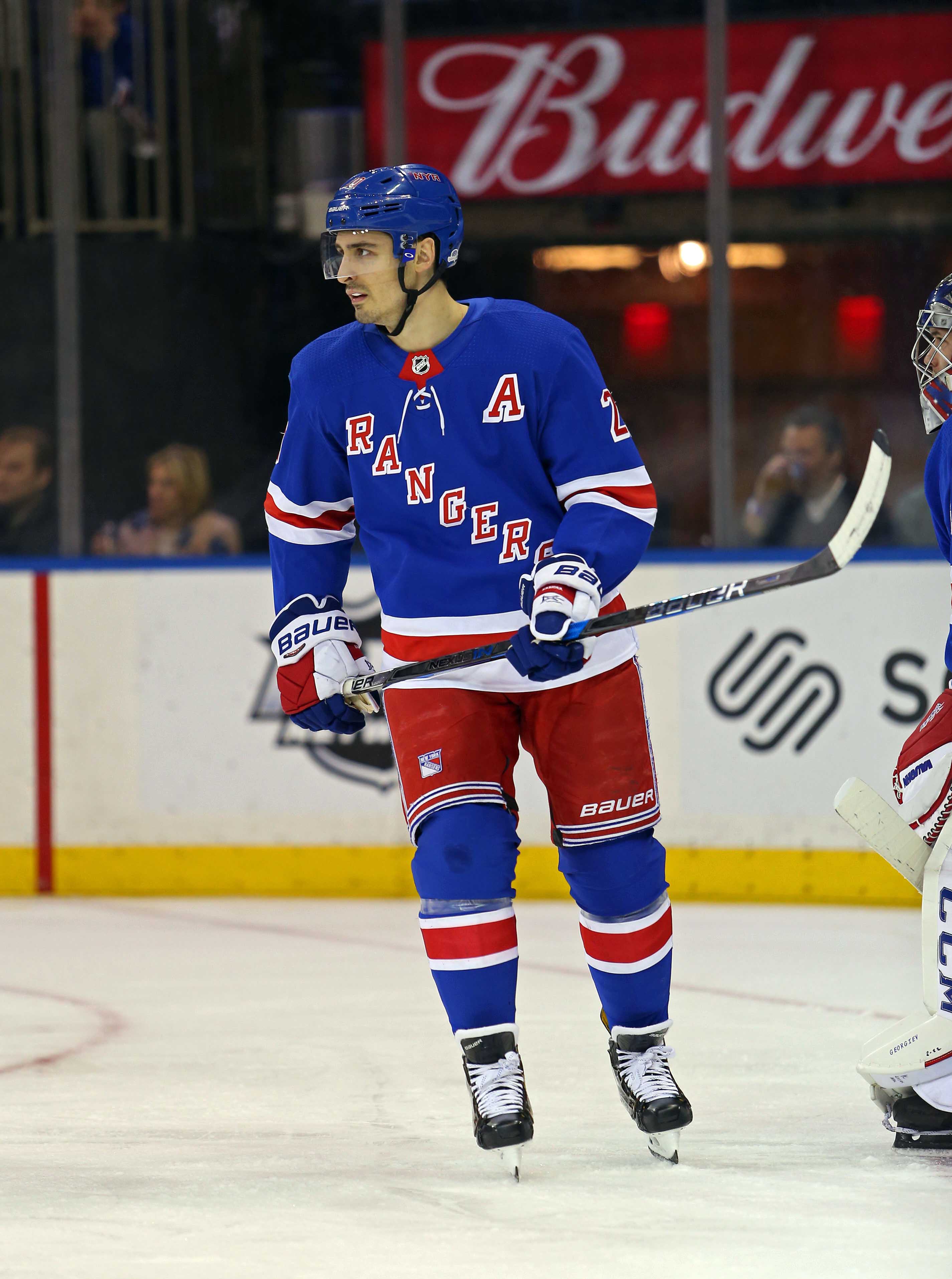
Kreider is coming off a tough year in which he had to deal with blood clots and had surgery to relieve the pressure and missed almost two months of time. The 27-year-old didn’t have as solid of a season as he tallied just 16 goals in 58 games, which is a far cry from the 28 goals he scored in 2016-17 although a lot of that is due to the fact that his playing time dipped as the team didn’t want to play him too many minutes due to the blood clot issue. Regardless with a full offseason to rest and recuperate, Kreider should be able to bounce back as one of the team’s top scorers.
The team also have high expectations from two other forwards that the team acquired through at the trade deadline a year ago in Namestnikov and Spooner. Namestnikov was the biggest name to arrive in New York in the Ryan McDonagh trade with Tampa Bay. He was a key player for the Lightning, posting 20 goals and 44 points with them, but he actually lost playing time once he arrived in New York and put up just two goals and four points in 19 games. The team hopes that a new coach and proper training camp with his new team will make quite a difference. Spooner came over in the Rick Nash trade with Boston and has posted solid numbers with the Bruins over the past few seasons and could turn out to be a top-six wing or third-line center in New York. Between the two teams, Spooner combined for 13 goals and 28 assists.
The team also expect big things from Vesey, who signed as a undrafted collegiate free agent a couple of years ago and if finally starting to show that he belongs in the NHL. The 25-year-old winger has put up solid numbers for two years, but could find himself getting more opportunities in the team’s rebuild. In two years, he’s combined for 33 goals and 55 points.
Atlantic Notes: Larkin, Lightning, Moore
The Detroit Red Wings have two options in regards to signing restricted free agent Dylan Larkin this summer. The team could go short-term or long-term. With a solid, but hardly spectacular season, the Red Wings might want to wait and see how the 21-year-old develops over the next year or two and hand out short contracts to see if he’s worth the money. That makes sense considering the team is capped out with so many long-term deals having been handed out to veterans over the past few years.
However, NBC Sports’ James O’Brien writes that the team needs to look at the long-term option instead and lock up Larkin as quick as possible as he compares Larkin’s situation to that of Leon Draisaitl of the Edmonton Oilers, who signed an eight-year, $68MM deal a year ago, which is starting to look like a bargain after the many signings since then.
Larkin, who has shown that he’s one of the few answers in Detroit still hasn’t broken out with the Red Wings. While his rookie campaign showed plenty of promise with 23 goals, he’s failed to duplicate that number since. However, while he did just tally 16 goals a season ago, his 47 assists was a career-high along with his 63 points, suggesting he might be due for a breakout season. Signing Larkin to a long-term deal now while his value isn’t through the roof might be better than waiting another two years when they will be forced to shell out top dollar in the future with the cap constantly increasing.
- While it’s already been reported that the eight-year, $76MM extension that Nikita Kucherov signed will not take the Tampa Bay Lightning out of a potential Erik Karlsson trade, the team will have to make some moves if it does pull the trigger on a trade as the team has less than $3MM in cap space for this coming year. Brandon Schlager of the Sporting News writes that the most obvious candidates that would have to be moved would be forwards Ryan Callahan ($5.8MM AAV for two more years), Tyler Johnson ($5MM for six more years), Alex Killorn ($4.45MM for five more years) and defenseman Braydon Coburn ($3.7MM for one year).
- Kevin Paul Dupont of the Boston Globe attempts to break down what the Boston Bruins defense will look like next season as well as what the team should expect out of their top free agent target, John Moore. The scribe writes that general manager Don Sweeney hasn’t struck gold yet with his long-term free agent deals, pointing to the contracts handed out to Matt Beleskey and David Backes. Beleskey was an outright failure, while Backes has been average, at best. Moore is just 27 years old and will be playing already for his fifth team, which isn’t a good sign. What the team’s plans are for his usage is also unknown as if the team intends to put him on the team’s second-line defensive pairings, then the team would force either Torey Krug or Brandon Carlo to the third-line pairing, which doesn’t make sense either unless the team intends to move Krug. However, there is still no proof that Moore is good enough to be a top-four player.
Trade Deadline Recap: Eastern Conference
After a month of lead up, a sprinkling of trades over the last week or so, and a wild deadline day today, NHL teams are done with transactions for the 2017-18 NHL season. Here are the deals that improved contenders in the Eastern Conference:
Deadline Day
Tampa Bay Lightning receive:
D Ryan McDonagh
F J.T. Miller
New York Rangers receive:
F Vladislav Namestnikov
F Brett Howden
D Libor Hajek
2018 first-round pick
Conditional 2019 second-round pick
Columbus Blue Jackets receive:
F Thomas Vanek
Vancouver Canucks receive:
F Tyler Motte
F Jussi Jokinen
Columbus Blue Jackets receive:
D Ian Cole
Ottawa Senators receive:
F Nick Moutrey
2020 third-round pick
New Jersey Devils receive:
F Patrick Maroon
Edmonton Oilers receive:
F J.D. Dudek
2019 third-round pick
New York Islanders receive:
F Chris Wagner
Anaheim Ducks receive:
F Jason Chimera
Boston Bruins receive:
F Tommy Wingels
Chicago Blackhawks receive:
Conditional 2019 fifth-round pick
Pittsburgh Penguins receive:
F Josh Jooris
Carolina Hurricanes receive:
F Greg McKegg
Boston Bruins Place Matt Beleskey On Waivers
Friday: Beleskey has cleared waivers and can now be assigned to the AHL. As CapFriendly points out, since the team activated Ryan Spooner yesterday in Beleskey’s roster spot, and moved the waived forward to “Waiver Non-Roster” to clear space, he must immediately report to the Providence Bruins. That doesn’t mean he can’t be traded, much the opposite. Any acquiring team could put Beleskey in the minor leagues right away, without him having to clear again.
Thursday: The Boston Bruins have decided that they’ve waited long enough for Matt Beleskey to make an impact, and have placed the forward on waivers today according to Elliotte Friedman of Sportsnet. Beleskey has played just 14 games for the Bruins this season, but has been held without a single point.
 Beleskey was signed to a five-year, $19MM contract in the summer of 2015 and has two more seasons after this one at a $3.8MM cap hit. His deal has become one of the very worst contracts in the entire league, as even last season saw him register just eight points in 49 games. Friedman reports that he’ll be heading to Providence to play in the AHL if he goes unclaimed.
By burying Beleskey in the minors, the Bruins would save a prorated $1.025MM in cap space. It seems very unlikely that he would be claimed by a team, meaning if the Bruins want to get rid of his contract they’ll have to find a trade partner or buy him out this summer. Beleskey does have a partial no-trade clause, but can be traded to 23 teams around the league. If the Bruins retained salary, perhaps there is someone who believes the 29-year old can still provide some value.
By winning again last night, the Bruins now hold a healthy four point lead over the Montreal Canadiens for third place in the Atlantic Division, with three additional games in hand. It’s clear the team believes they are a playoff contender this season, and is making sure they can put the best team forward every night. By burying Beleskey, the team opens up some more cap flexibility and the ability to make an addition at some point.
Photo courtesy of USA Today Sports Images
Scott Wilson, Erik Gudbranson & The Pointless Players
Last year we saw something incredible in the NHL. Riley Sheahan of the Detroit Red Wings played 79 games and took 106 shots on net without scoring a goal. Stories were written, fans were left in disbelief and Sheahan just had to go out every night and try to get one across the line. Finally, on April 9th in his 80th and final game of the season Sheahan scored—twice.
 It’s not like Sheahan had done anything like it before. He’d had seasons of 9, 13 and 14 goals the first three seasons of his career. He actually carried an above-average shooting percentage of 11.9% through that time. He was no sniper, but he could be a solid secondary scoring threat. This year there are several players that can relate with Sheahan, including one that has a solid link to him.
Sheahan didn’t score his first goal this year until a trade brought him to Pittsburgh. He has two now on the year, and eight points in 21 games for the Penguins. The player he was traded for though hasn’t been quite as lucky.
Scott Wilson, traded first for Sheahan and then again to the Buffalo Sabres later in the season, has now played 21 games this season. In those games he’s registered 172 minutes of ice time, including over 14 in his first game with Buffalo. Amazingly, he’s been held completely scoreless. Not a single goal, not a single assist. Wilson leads all scoreless forwards in games played, but there are some other interesting members along for the ride.
Matt Stajan, a two-time 50-point man has played 19 games without a point. He’s played even more minutes, 210, without hitting the scoresheet—well, at least not for scoring. Stajan has taken 10 penalty minutes, something that you can’t say for Wilson. Incredibly, the Buffalo Sabres forward hasn’t even taken a single minor penalty. Other than the 14 shots he’s recorded, he’s basically been a boxscore ghost.
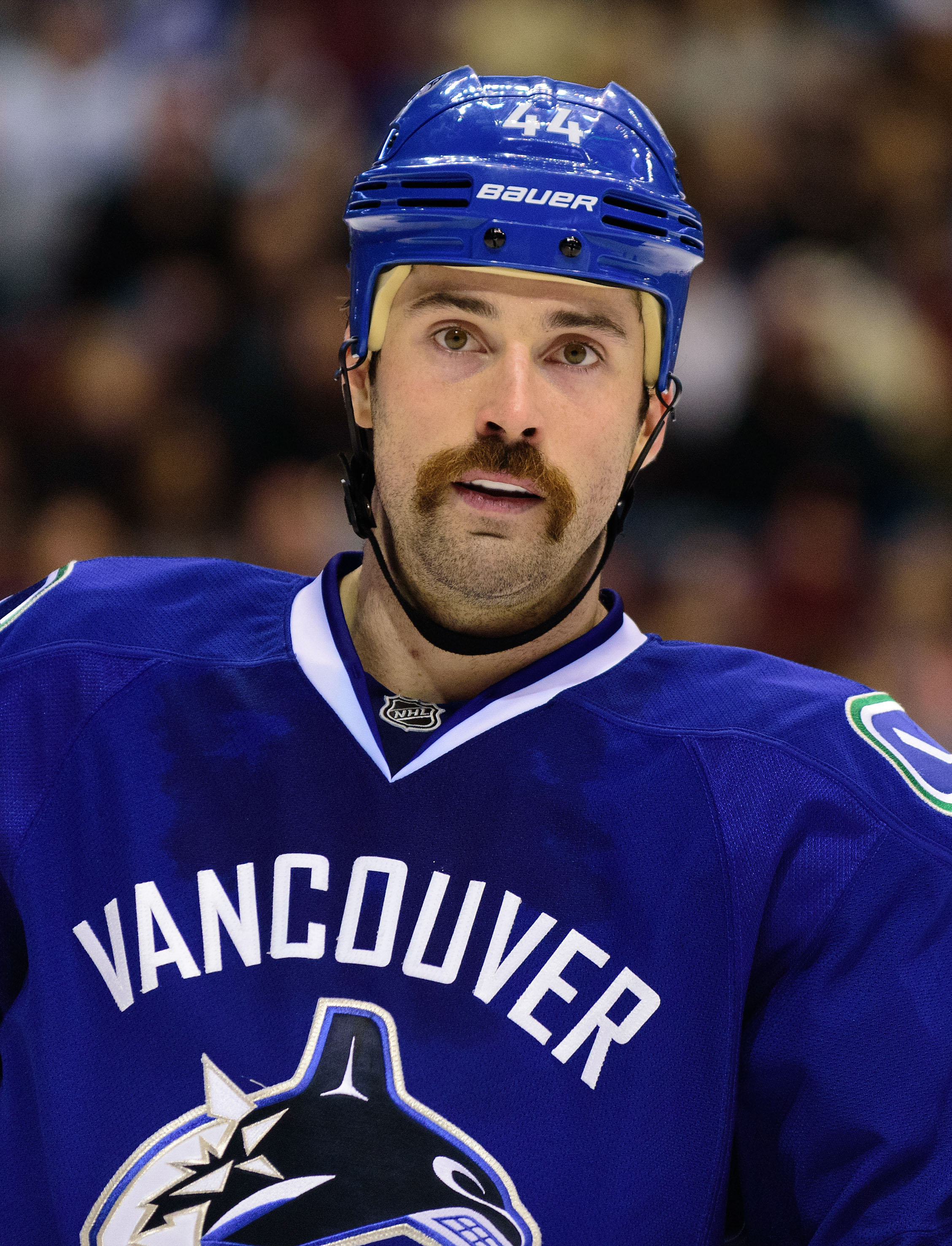 There are other forwards who are on the list, like Zac Dalpe, Torrey Mitchell and Matt Beleskey but none of them hold a candle to the leader when expanded to include defensemen. Erik Gudbranson, the Vancouver Canucks’ rough and tumble defenseman has logged 372 minutes of ice time this season and still has a big fat zero in the points category.
Gudbranson isn’t an offensive player. That much has been obvious his whole career, and it wasn’t why the Canucks went out and acquired him from the Florida Panthers. But this is impressive even for him. He’s always been a lightning rod for the argument between traditional and new analytics, but he’s actually reached a new low in his possession rates. As an unrestricted free agent this summer, some believe he’ll be a sought-after trade deadline commodity.
It doesn’t matter if he has zero points or a handful when the trade deadline comes around, it really doesn’t change the player he is. But for the third-overall pick in 2010 it’s an impressive accomplishment, even if he wouldn’t agree.
Photo courtesy of USA Today Sports Images
Injuries Unending In Boston; Krejci, DeBrusk Join Sidelined
Boston Bruins beat writer Joe Haggerty could not have said it better: “You can’t make this stuff up”. The unbelievable rash of injuries continues in Boston, as center David Krejci and rookie winger Jake DeBrusk have been ruled out for Wednesday night’s match-up against the Atlantic-leading Tampa Bay Lightning.
The sheer number of injuries suffered by the Bruins this season, especially among the forward corps, is hard to comprehend. 22 games into the 2017-18 campaign the only forward to have played every game are David Pastrnak and energy-liners-turned-top-nine-mainstays Riley Nash, Sean Kuraly, and Tim Schaller. While there is no word yet on the extent of DeBrusk’s injury, the young scorer has been one of the Bruins’ more dependable forwards with 12 points in 21 games, but of course he now joins the long list of casualties. Currently out of the lineup alongwith DeBrusk and Krejci, who had only just returned to action, are 2016-17 leading scorer Brad Marchand, veteran David Backes, power play catalyst Ryan Spooner, promising rookies Anders Bjork and Peter Cehlarik and, of course, defenseman Adam McQuaid as well. Spooner just recently re-injured the groin that had kept him out all but eight games on the season. In the same game, Cehlarik suffered a leg injury that should keep him out at least a month. Marchand and Bjork have been sidelined since November 13th and there has been no concrete information on when exactly either can be expected back. Backes has made a remarkably quick recovery from major surgery to cure his diverticulitis, but he too is not quite ready to return and there are doubts about how he will play once he is back. Other Bruins forward who have missed time already this season: Patrice Bergeron (5 games), Noel Acciari (13 games), and Matt Beleskey (2 games).
The defense has done a bit better though, with captain Zdeno Chara and talented youngsters Charlie McAvoy and Brandon Carlo all suiting up for every game. Kevan Miller has missed only one game, while Torey Krug‘s four-game absence seems like nothing. A platoon of Paul Postma, Rob O’Gara and Matt Grzelcyk has performed well enough in the absence of McQuaid.
In total, the Bruins have missed a whopping 100 man-games already this season, far more than any other team in the league and heavily weighted toward their forwards. That makes it all the more impressive that the team is still sitting pretty in the Atlantic Division. In terms of points percentage, the B’s are third in the Atlantic and just behind the two-time Cup-champion Pittsburgh Penguins overall. Their 60 goals for may a bottom-five number in the NHL, but what would you expect from a two-way team missing most of its offensive talent? A recent winning streak showed that the Bruins and head coach Bruce Cassidy can get it done, even with a makeshift roster. There is no sign of when Boston will get back to full strength, if ever this season, but if they do it could be dangerous for the rest of the NHL.
Torey Krug Out With Broken Jaw
The Boston Bruins have had some bad injury luck, as the team announced today that Torey Krug will be out for the remainder of training camp with a non-displaced fracture after taking a puck to the jaw on Tuesday night. He’ll be re-evaluated in three weeks, which casts doubt over when his season will get started. The team also announced that Jakob Forsbacka Karlsson and Matt Beleskey are both dealing with day-to-day injuries.
Krug is obviously a huge part of the Bruins defense group this year, as captain Zdeno Chara starts to slow down and more responsibility is given to the younger players. While Charlie McAvoy and Brandon Carlo are heading in the right direction, 26-year old Krug is likely the most important piece. Last season in 81 games Krug recorded 51 points and received votes for the Norris trophy as the league’s best defenseman.
The undersized talent is a deadly force on the powerplay and at even-strength, firing stretch passes and skating the puck out of trouble. After losing Colin Miller to the Vegas Golden Knights in the expansion draft, replacing Krug for any length of time could be difficult.