
Free Agent Profile: Ryan Donato
Early in his career, it looked like Ryan Donato was going to be a player who could be a capable secondary scorer for Boston. However, his production has stagnated which has resulted in a couple of trades already with San Jose opting to non-tender him over issuing a $2.15MM qualifying offer earlier this summer, sending him to the open market.
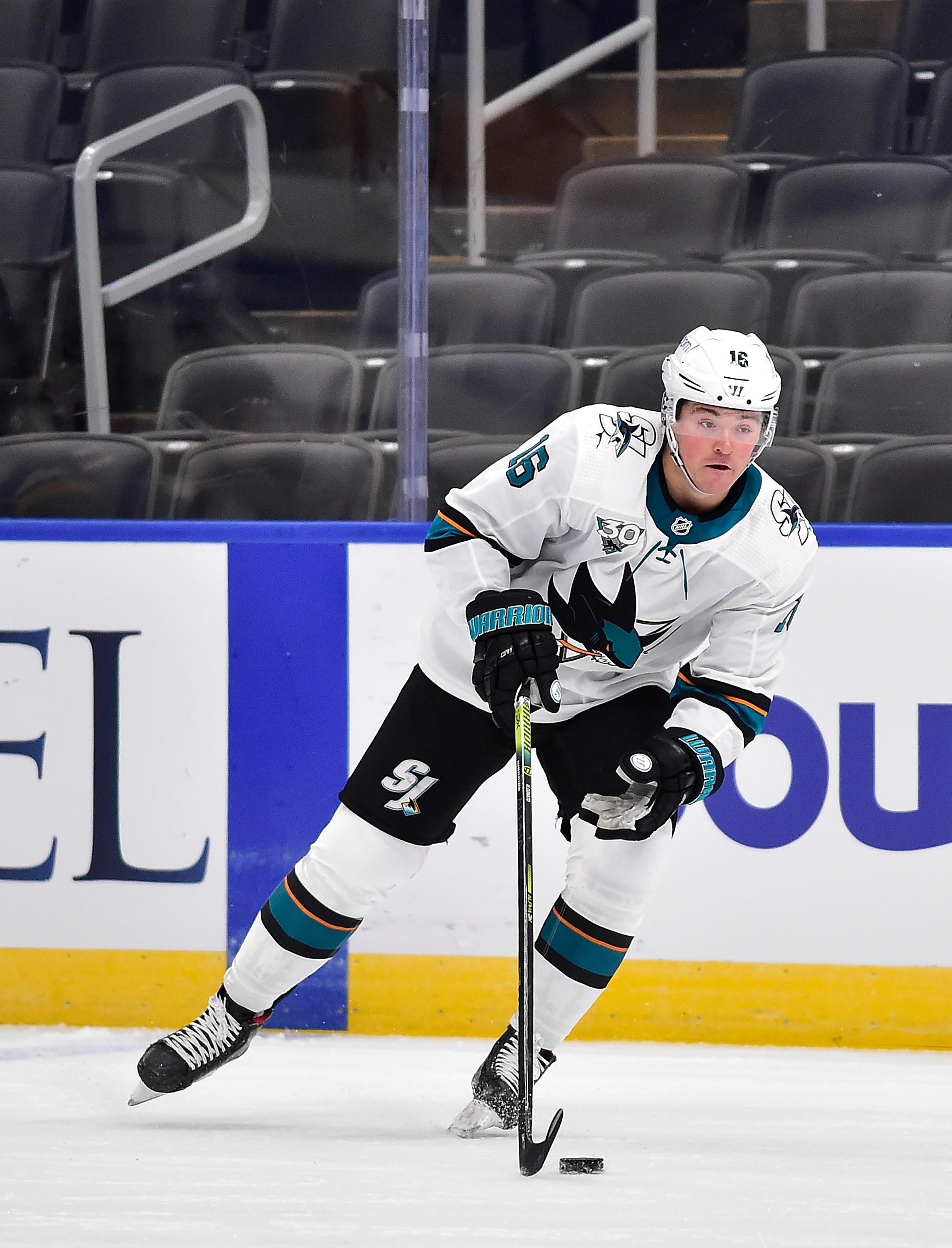 While every player still unsigned has their flaws, it is a little surprising that Donato old remains unsigned. His 20 points are the most of any remaining UFA that doesn’t already have ties to the Islanders as they look to see how long they can go without officially announcing any signings and at 25, he’s the youngest regular NHL player on the open market.
Last season was a tough one for Donato. Joining the Sharks seemed like a good fit for him as he’d have a chance to play a bit of a bigger role than he did with Minnesota. That did indeed happen but the playing time only increased marginally as he still found himself on the fourth line at times. The end result was just six goals which is likely why they opted to try someone else in his spot instead.
Still, while there aren’t many players with upside still unsigned, there’s a case to be made that Donato is one of them. He has reached at least 20 points in his three full professional seasons and is only a year removed from a 14-goal campaign with the Wild. It’s a limited track record for sure but there’s definitely a case for someone to bring him in.
Stats
2020-21: 50 GP, 6-14-20, -10 rating, 10 PIMS, 104 shots, 47.6 CF%, 12:37 ATOI
Career: 180 GP, 35-42-77, -18 rating, 30 PIMS, 362 shots, 50.9 CF%, 12:24 ATOI
Potential Suitors
Unlike some veteran players who are better fits on playoff-bound teams, no such restriction exists for Donato. He could serve as a depth piece for those teams or catch on with a weaker team that has a chance to give him a bigger role and allow him to restore some value. Donato is still controllable through 2023 which puts him in a spot like Andreas Athanasiou and Anthony Duclair were a year ago, non-tenders that had another year of control remaining; both of them eventually signed a second deal with their teams.
In the East, a team like Buffalo or Detroit that is still rebuilding could be a fit in terms of hoping that he pans out into a potentially longer-term fit. Among teams with playoff aspirations, Toronto could use him similar to what they wanted to do with Jimmy Vesey and Alex Galchenyuk last season as an offensive piece that they hope to get a bit of surplus value out of for a cost that’s close to the minimum.
Out West, Anaheim and Nashville are teams that haven’t exactly bolstered their offenses and while Donato isn’t going to make a big difference, any small upgrade would be helpful while both teams could benefit if he does well enough to earn a qualifying offer next summer. Seattle’s forward group could use a bit more offensive upside in their bottom six while Edmonton could use Donato as a low-cost replacement for Dominik Kahun, a player who was brought in to try and improve their offensive depth last fall.
Projected Contract
Donato’s non-tender came after the voting for our Top 50 UFA list although he may very well have made it on there had his release come earlier. It’s hard to see any viable multi-year offers coming his way so a one-year contract is likely all he’ll wind up with. Something around the $1MM mark would make him fit on the cap for many teams although if he wants to land with a contender, Donato may have to take a little less than that even. While there are questions regarding many of the remaining free agents as to whether or not they’ll make it on a roster for next season, that shouldn’t be the case with Donato. His stock has certainly dropped but it’s only a matter of time before someone takes a chance on Donato.
Photo courtesy of USA Today Sports Images.
Seattle Kraken Sign Gustav Olofsson
The Seattle Kraken have added some more depth on defense, signing Gustav Olofsson to a one-year, two-way contract. The deal will be worth $750K at the NHL level. Olofsson reached Group VI unrestricted free agency this summer after his most recent one-year deal with the Montreal Canadiens expired. GM Ron Francis released a short statement on his newest player:
Gustav is a smart, two-way defenseman. We believe his size and willingness to play with physicality matches the style we want to play and are happy he is joining our blue line.
As we examined recently, the Kraken are in an unusual situation in regards to their NHL roster. The team has a strong depth chart on defense, but all of them are no longer waiver-exempt and many would be at risk of a claim. Adding players like Olofsson, who will likely clear waivers without issue (as he has several times in the past) gives Francis and company some insurance to stash in the minor leagues.
That’s not to say that Olofsson can’t play in the NHL in a pinch. The 26-year-old defenseman has 59 games under his belt, most of which came with the Minnesota Wild in 2017-18. His last appearance was with the Canadiens in 2019-20, as he spent the entire 2020-21 season on the taxi squad or with the Laval Rocket, racking up 12 points in 24 games.
The Kraken are now 11-deep at defense, with Dennis Cholowski still to sign. There could be more movement to change the makeup of that group, but additions like this ensure that they’ll have call-up options even if they lose a player or two in a preseason roster crunch.
Ben Thomas Drawing Interest In Sweden
Defenseman Ben Thomas was finally able to crack the NHL this season, skating in five games with the Tampa Bay Lightning in his fifth pro season. However, it was too little too late in terms of NHL experience, as Thomas qualified for Group 6 unrestricted free agency. Yet, it seems as though the interest overseas is greater than any NHL interest that Thomas may have hoped for. Swedish source Expressen reports that the SHL’s Leksands IF has been negotiating with Thomas as they seek a top pair defenseman.
Thomas, 25, was a fourth-round pick of the Lightning in 2014. A productive two-way defenseman in the WHL, Thomas largely translated that ability to the AHL, recording 16+ points in each of his first four seasons with the Syracuse Crunch. However, he took a big step last season, recording nine points in only 16 games, not to mention a +8 rating. After years of being the “next man up” that never actually got called up, Thomas finally earned his chance with five games with Tampa Bay. While he was held scoreless, Thomas contributed defensively and his other underlying numbers were strong in the small sample size. His play across both leagues was at least enough to garner attention from overseas.
Expressen notes that Leksands is actually looking for two top defensemen and have talked to several former NHLers in addition to Thomas. This includes Anton Lindholm, who recently signed in the KHL, and Gustav Olofsson, who like Thomas played on NHL contracts last season. Joe Morrow and Matt Donovan are also in the mix. With a number of notable names on their list of candidates, it is clear that Leksands is serious about adding talent to the blue line. It also stands to reason that Leksands push to sign Thomas, described as “extensive”, could also be drawing the attention of other SHL contenders. Perhaps the opportunity in Sweden, both financially and role, is actually attracting Thomas away from a two-way NHL contract.
Free Agent Profile: James Neal
Things have fallen sharply for veteran forward James Neal since his storybook season with the inaugural Vegas Golden Knights. After scoring 25 goals and 44 points in 2017-18 to mark his 10th consecutive season of scoring 20 or more goals, Neal signed a now-infamous five-year, $28.75MM deal with the Calgary Flames on the second day of free agency in 2018. He only lasted one season in Calgary on that contract, however, scoring just seven goals and 19 points, sometimes serving as a healthy scratch.

But many thought redemption was in order for Neal when a swap with the Edmonton Oilers sent him to Northern Alberta in exchange for Milan Lucic. With the chance for Neal to play with one or both of Connor McDavid and Leon Draisaitl, 20 goals or more was again the expectation for the consistently gifted scorer. Neal didn’t quite hit the mark, but would’ve if the season hadn’t been cut short due to COVID-19 – his bounce-back season in Edmonton saw him score 19 goals and 31 points in 55 games, numbers reminiscent of his time in Vegas.
However, Neal’s decline accelerated this season, and his numbers once again plummeted to unacceptable depths for his $5.75MM cap hit. He’s now a free agent after being bought out by the Oilers on July 27th, a buyout that’ll see Neal cost them $1.917MM against the cap for the next four seasons. 2020-21 was Neal’s roughest season yet, actually, spending almost half of the 56-game season sitting in the press box. His shooting percentage and time on ice fell sharply as Neal’s lack of strong play-driving cost him a significant role at even strength.
Neal still carries veteran leadership and name recognition. It also doesn’t hurt that he’s played in 11 straight playoffs, totaling 58 points in 110 games over that timeframe. It remains to be seen whether teams will value that experience enough to extend Neal a contract offer.
Stats
2020-21: 29 GP, 5-5-10, -2 rating, 11 PIMS, 51 shots, 49.3% CF, 12:06 ATOI
Career: 850 GP, 294-261-555, +8 rating, 581 PIMS, 2,483 shots, 53.2% CF, 17:22 ATOI
Potential Suitors
The good news here for James Neal is that there are still plenty of teams looking to add affordable, experienced depth, especially on the wings. There are still a few options that make sense for the 33-year-old Ontario-born winger.
The Carolina Hurricanes come to mind immediately as a team that’s still looking to fill out their forward group, especially their depth in the bottom-six. Neal fits well in this role for them, especially considering the limited scoring upside of some current options in Jordan Martinook, Steven Lorentz, and Stefan Noesen. If paired with a strong play-driver and playmaker like Jordan Staal, Neal’s scoring touch could give a boost to Carolina’s third line.
If Neal wants to chase a Stanley Cup, and if the interest is mutual, the Colorado Avalanche also make a decent amount of sense. For a team that lost both Brandon Saad and Joonas Donskoi this offseason, his double-digit scoring upside is more palatable than that of someone like Darren Helm‘s or Stefan Matteau‘s. The New Jersey Devils also come to mind as a squad who could still use some additional veteran presence to help propel a potential playoff push this season.
Projected Contract
Neal was not included on our Top 50 UFA list, as he hadn’t been bought out at the time of publishing. But it’s still hard to imagine Neal receiving anything more than the $1MM range on a one-year contract, considering he hasn’t been inked to a deal already. Neal finds himself in a similar situation to that of Jason Spezza a few years back — a once consistent talent who’d seen his numbers drop in recent seasons. Spezza took a league-minimum $700,000 (at the time) contract to stay in the league, and it’s a strong possibility Neal will have to do the same.
Photo courtesy of USA Today Sports Images.
Free Agent Profile: Eric Staal
Less than a year ago, Eric Staal was coming off another season of being Minnesota’s number one center with Buffalo moving to acquire him in the hopes of boosting their second line. That didn’t happen and the veteran’s value took a steep hit as a result when it came time for the Sabres to trade him. Considering he remains unsigned, Staal’s value appears to have taken another hit now.
 Things did not go well at all for the 36-year-old with Buffalo although, to be fair, that can be said for basically everyone last season. He struggled to produce at a top-nine level let alone the top-line one he had been at with the Wild. The hope was a trade to a playoff team in Montreal might revitalize him but outside of an early overtime winner, there’s a case to be made that he was even worse with the Canadiens than he was with the Sabres.
What might help Staal’s case was his playoff performance. He centered their fourth line throughout the postseason and was a bit more impactful on a line that primarily slowed the play to a crawl and focused on cycling and board battles. He was able to keep up despite playing through an injury and contributed a bit more on the scoresheet as Montreal surprisingly advanced to the Stanley Cup Final.
At this point, the question is whether or not teams think last season was a one-off in declining production (perhaps in part due to injury) or a sign of things to come. The former means he can still contribute while the latter is someone that may have a hard time staying in the lineup.
Stats
2020-21: 53 GP, 5-8-13, -30 rating, 10 PIMS, 82 shots, 50.8 CF%, 14:43 ATOI
Career: 1,293 GP, 441-593-1,034, -78 rating, 828 PIMS, 3,935 shots, 52.4 CF%, 19:23 ATOI
Potential Suitors
Similar to Derick Brassard, Staal’s suitors are likely to be teams looking to add veteran depth knowing they have some unproven options or ones that would like a prospect to spend more time in the minors and would use Staal as a filler in the short term.
The Staal brothers have spoken in the past about a desire to play together but that doesn’t appear to be a viable option. Detroit has already added Pius Suter and Mitchell Stephens this summer and has Joseph Veleno pushing for a spot; the recent buyout of Frans Nielsen doesn’t really create an opening for Staal either. Meanwhile, Carolina brought in Derek Stepan to supplement their top three centers and don’t really have a spot for Staal.
Among the teams looking for depth, his old team in Minnesota makes some sense on paper based on the current composition of their roster. But GM Bill Guerin saw fit to trade him 11 months ago for a winger who was coming off a tough year at a time where they needed centers so that may not be a realistic fit. Montreal GM Marc Bergevin didn’t close the door on re-signing Staal earlier this summer and their projected top three centers have limited NHL experience. Vegas has added some younger centers to push for playing time but if Staal was willing to sign for the minimum, he could be an insurance policy. The same goes for Winnipeg who is quite capped out but lost a lot of veteran depth this summer.
As for the teams that could want Staal as a short-term stopgap to allow someone to develop, the usual teams come to mind. Columbus doesn’t have much proven depth down the middle while Ottawa has had Chris Tierney available for a while and could use Staal as a replacement.
Projected Contract
Staal narrowly made it onto our Top 50 UFA list, ranking 48th with a projected one-year, $2MM contract. That may be a bit optimistic at this point with many teams basically having their rosters finalized or close to it. Something closer to half of that may be more palatable at this point although it’s worth noting that Staal is eligible for performance incentives that could be tacked onto a lower base salary to give the signing team a little more salary cap flexibility next season. Either way, it’ll be a steep drop from the $3.25MM AAV he had for the past two years.
Photo courtesy of USA Today Sports Images.
Poll: How Many Top Unsigned Free Agents Will Play In NHL This Season?
Following a massive first day of free agency late last month, not to mention several more signings since, it may seem that there aren’t many big-name free agents left on the market. Yet, quietly there is still and abundance of quality players left unsigned. This includes ten of PHR’s Top 50 UFA’s i.e. 20% of the players that we believed were the best available. It also includes another 13 players who played in 40+ games out of 56 this past season. There’s also Bobby Ryan, who was on pace for 22 points in 53 games before season-ending injury, which would have made him the highest scoring player still unsigned, and Artem Anisimov, whose nine points in 19 games is the second-best per-game mark among remaining UFA’s. With a nice round number of 25 top players still unsigned, which still ignores plenty of other capable NHLers, how many of these can be expected to play in the NHL next season? Time is running out and so are roster spots. Late-offseason signings are not impossible and a fair number of PTO’s are expected in camp this year, but realistically how many of these players will be able to land an NHL deal?
The top available name may also be the hardest to predict because his market is just one team and he isn’t ready to play. Future Hall of Fame goaltender Tuukka Rask (No. 14) remains a free agent and at 34 and recovering from major surgery it is fair to be skeptical that he will ever play again. The career Bruin reportedly will only play in Boston and recent comments by some of his teammates suggest that they expect him to do so at some point this year. But with Linus Ullmark signing a substantial contract to play alongside rookie sensation Jeremy Swayman, do the Bruins need Rask, especially coming in cold mid-season?
While Rask stands out as the only high-end goalie left available, the same cannot be said for forwards. Kyle Palmieri (No. 16), Tyler Bozak (No. 35), Casey Cizikas (No. 36), Zach Parise (No. 37), Nikita Gusev (No. 41), Alex Chiasson (No. 47), and Eric Staal (No. 48), as well as the aforementioned Ryan and Anisimov are all unsigned. Several of these names – Palmieri, Cizikas, Parise – have been linked to the New York Islanders, but no deals have been announced. All three have seemingly done enough to earn new contracts, but are still waiting. Bozak, meanwhile, was arguably the best of the players still available last season, with the top points per game mark even in a season plagued by injury. Gusev is a unique talent that has the chance to excel in the right system, Chiasson is a hard-working, consistent contributor, and Staal is one of the most respected veterans in the game. Ryan and Anisimov each showed that they still have gas left in the tank. It is hard to envision any of these players not playing this season, unless it is their own decision. Yet, none have signed on yet.
On the blue line, top talent is more scarce. Only Sami Vatanen (No. 43) and Erik Gustafsson (No. 44) remain from the Top 50 list and while each brings considerable strengths, they also have major weaknesses. With that said, each has been a regular in the NHL and are perhaps even more valuable as a depth option. Will Vatanen and Gustafsson find the right spot once more this season?
Among the players who were regulars in 2020-21 even though they may not come to mind as top options is a mix of aging veterans, versatile depth players, and discarded youngsters. Legends Patrick Marleau and Zdeno Chara lead the way as players who should be able to find a home if they want to keep playing just purely based on their Hall of Fame pedigrees, but lack the impact they once had. Other veterans still searching for work include Derick Brassard, Travis Zajac, and Jason Demers. Capable bottom-six forwards like Riley Sheahan, Colton Sceviour, Mark Jankowski, and Tobias Rieder are still available, as it stay-at-home defender Erik Gudbranson. Finally, formerly promising prospects Ryan Donato, Jimmy Vesey, and Dominik Kahun are all still looking for another chance.
Each player brings their own case for why or why not they should be employed in the NHL this season. All have been impact players in the league, but in a game progressively more dominated by younger players, history is no longer enough on its own to win a job. The supply of talent in the NHL currently seems to be greater than the demand, even with the expansion to 32 teams. Is there enough room for these 25 top players to find a new team this summer?
How Many Top Unsigned Free Agents Will Play In NHL This Season?
-
11-15 29% (219)
-
16-20 28% (218)
-
6-10 22% (169)
-
21-24 10% (75)
-
1-5 6% (43)
-
All 25 4% (28)
-
None 2% (13)
Total votes: 765
Latest On Zdeno Chara
With one more full season, Zdeno Chara would take the lead among all NHL defensemen in career games played. He currently sits in fifth, just 43 games behind the leader Chris Chelios, who played until he was 48. Chara isn’t quite that old at 44, and is coming off a relatively effective season with the Washington Capitals. If he intends on playing again this season as expected, there’s an old rival interested in his services. According to Jeremy Rutherford of The Athletic, the St. Louis Blues have expressed interest in Chara, as they did in the 2020 offseason before he signed with the Capitals.
Chara and the Blues know each other very well from their 2019 Stanley Cup Final, which went the full seven games and resulted in St. Louis’ first franchise championship. As usual, the veteran defenseman was dealing with injuries by the time the title series came around—this time playing with a broken jaw—but still managed three points in the seven games. Chara is up to 200 playoff games in his career, but hasn’t been able to hoist the trophy since 2011.
It also wouldn’t be the first defenseman from that 2019 series that the Blues would be targeting; they signed Torey Krug to a seven-year, $45.5MM contract last fall after losing captain Alex Pietrangelo to free agency. But as Rutherford writes, Chara is a long-shot for the Blues, as the veteran defenseman would like to stay as close to his family in Boston as possible with everything else equal.
There is still a place for Chara in the league, as a defenseman that is deployed almost solely in the defensive zone and on the penalty kill, but he’s obviously not what he used to be. He agreed to a one-year deal last season that paid him just $795K in base salary with another $730K in potential performance bonuses, but even that may be more than he gets this time around. He averaged just over 18 minutes this season for the Capitals, the first time since 1999 that he was under the 21-minute mark over a full season.
Several College Prospects Become Free Agents
The middle of August is usually not a significant one on the prospect front but each year, some college prospects who have exhausted their eligibility become unrestricted free agents starting August 16 if they don’t sign an entry-level contract. Here is this year’s list plus their original affiliation and where they’ve signed, if applicable:
F Kasper Kotkansalo (DET, 71st in 2017) – signed in Finland
D J.D. Greenway (TOR, 72nd in 2016) – AHL contract with Boston
D Matthew Cairns (EDM, 84th in 2016)
G Keith Petruzzelli (DET, 88th in 2017)
F Todd Burgess (OTT, 103rd in 2016) – AHL contract with Winnipeg
F Bryce Misley (MIN, 116th in 2017) – AHL contract with Minnesota
F Kale Howarth (CBJ, 148th in 2017)
F Aapeli Rasanen (EDM, 153rd in 2016) – signed in Finland
G Kris Oldham (TB, 153rd in 2015)
F Patrick Holway (DET, 170th in 2015)
G Garrett Metcalf (ANA, 179th in 2015)
D Croix Evingson (WPG, 211th in 2017)
D Matthew Hellickson (NJ, 214th in 2017)
If the list seems a little smaller than usual, there’s a reason for that. With the pandemic adding an extra year of eligibility, some players that would have been on this list have instead opted to go back to college for a fifth season and their rights will be retained longer as a result. In Petruzzelli’s case, he’s expected to be going back to college as well but was removed from Detroit’s reserve list along with the other players above.
Free Agent Profile: Derick Brassard
For the third straight year, veteran center Derick Brassard finds himself still looking for a contract well after the free agent market opened up. Not much has changed for him over that stretch and he remains a depth offensive option for teams to consider in the coming weeks.
 Last season, the 33-year-old caught on with the Coyotes just as training camps were on the horizon, inking a one-year, $1MM contract. Brassard spent the majority of the campaign in a middle-six role, mostly on the third line but moving up to the second when needed. It’s basically the role he has held for the past few years and the results were pretty much the same.
Brassard’s per game output dipped a bit compared to his 2019-20 showing but still managed to pick up 20 points, putting him in a tie for the player with the most points still standing on the free agent market (Kyle Palmieri had more but is believed to have an agreement with the Islanders). He has even chipped in on the power play (seven goals over the last two years) and has won nearly 54% of his faceoffs over that stretch.
So why is he once again looking for a contract? Brassard’s defensive zone play has never been a strong point and while that was okay earlier in his career when he was putting up 40 or more points, teams aren’t as willing to give him playing time with him producing less. His own-zone performance isn’t going to suddenly improve so these year-to-year deals are likely what it’s going to continue to be for Brassard.
Stats
2020-21: 53 GP, 8-12-20, -10 rating, 12 PIMS, 67 shots, 50.0 CF%, 14:48 ATOI
Career: 905 GP, 194-309-503, -35 rating, 419 PIMS, 1,781 shots, 50.2 CF%, 16:05 ATOI
Potential Suitors
There are a couple of possible types of suitors for Brassard at this stage. The first is a team that is looking for a bit more depth down the middle and doesn’t want to pay up for someone like Tyler Bozak. The other is a team with some young centers that wants either an insurance policy or to bring him in to allow one of those pivots to spend more time in the minors.
In the first group, Seattle is down their top center for the first few months with Yanni Gourde out following shoulder surgery and while they signed Marcus Johansson who can fill in down the middle, Brassard, a natural center, could be a better fit. Montreal lost Phillip Danault with the only replacement down the middle being Cedric Paquette who spent most of last season as a winger. With an inexperienced group at center, Brassard could replace someone like Eric Staal who was acquired midseason from Buffalo. Minnesota still doesn’t have a particularly strong group at center, particularly when it comes to offensive upside and Brassard would give them another option without breaking the bank for the eventual Kirill Kaprizov contract.
The second group features teams that aren’t likely to make the playoffs. Columbus, where his career started after they made him the sixth-overall pick 15 years ago, is firmly in a rebuild and are banking on some unproven players making the jump. Brassard would be an insurance policy and with Max Domi out to start the year, he could have a lineup spot at the start. Anaheim has forced some of their younger players in when they haven’t been ready which hasn’t worked particularly from a development standpoint. Brassard’s presence could allow someone to spend more time with AHL San Diego. As for Ottawa, they’re believed to be sniffing around for a veteran forward and with Chris Tierney being in trade speculation dating back to last season and entering the final year of his deal, Brassard would be a low-cost option to carry in case they wind up moving Tierney at some point.
Projected Contract
Brassard has made our Top 50 UFA list in the past but didn’t this time around. He made $1MM last season and $1.2MM the year before. Another small dip at this stage is likely and a one-year deal for the veteran should check in somewhere around $900K. At a price tag that could be buried entirely in the minors, he’ll be a low-risk pickup for whoever winds up signing him in the coming weeks.
Photo courtesy of USA Today Sports Images.
Nashville Predators Turning Focus To Mattias Ekholm Extension
The Nashville Predators locked in Juuse Saros this week to a four-year, $20MM contract, but the work doesn’t end there for GM David Poile. The executive told ESPN radio that the focus will now turn to an extension for Mattias Ekholm.
Now that we’re past the Juuse situation, we’re going to turn our focus now to Ekholm. I actually spoke with his agent yesterday afternoon and we’re going to talk either later this week or next week on that.
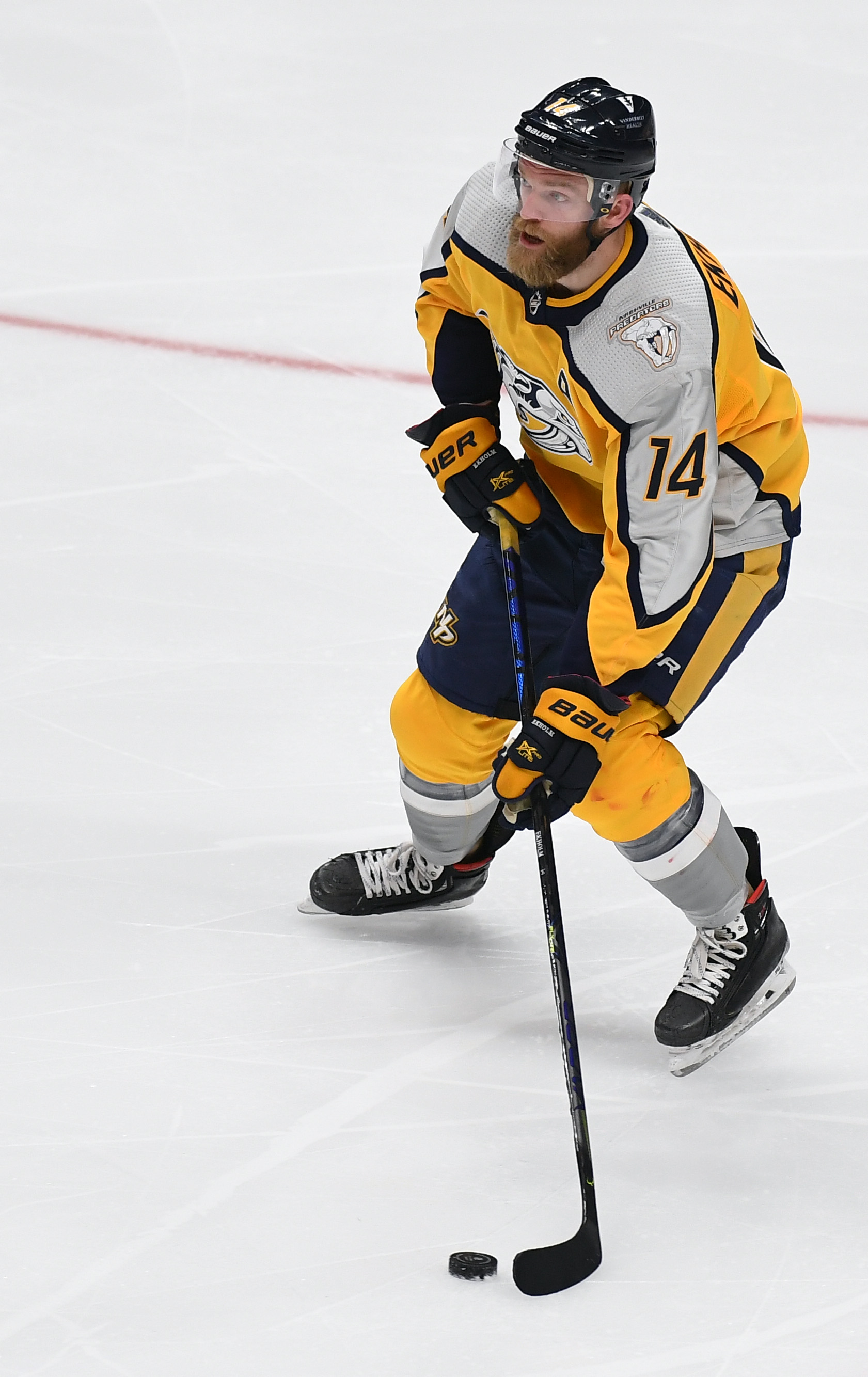 Ekholm, 31, is heading into the final season of his six-year, $22.5MM contract signed in 2015 that turned into one of the best bargains in the NHL. Originally a fourth-round pick in 2009, Ekholm has been a key member of the team’s blueline since 2014 and has averaged at least 22:52 in each of the last five seasons. This year he had 23 points in just 48 games and is part of the reason why someone like Ryan Ellis was deemed expendable this offseason. The Predators moved Ellis to the Philadelphia Flyers in a deal that cleared some cap and added some more young forward talent, but still have Ekholm and captain Roman Josi to anchor the back end.
While Josi is locked in long-term, Ekholm would be one of the top free agents if he hit the open market next summer. An extension would likely have to include a substantial raise on his current $3.75MM cap hit, with a contract like Jake Muzzin‘s recent four-year, $22.5MM deal being an easy comparable. The fact that Ekholm will be 32 whenever his next contract begins is a big factor, but he has shown no real signs of slowing down to this point. The Predators have three depth defensemen–Mark Borowiecki, Matthew Benning, and Ben Harpur–all coming off the books after this season, which could free up a little bit of space depending on their replacements. The trio currently combines for $3.8MM.
There’s another big fish in Nashville scheduled for unrestricted free agency after this season though, as Filip Forsberg will be reaching the end of his six-year, $36MM deal. Poile also explained the team’s gameplan on an extension with the 27-year-old forward:
Shortly before training camp we’ll reach out to Filip Forsberg and his camp to sort of get a lay of the land as where Filip’s thoughts are right now. Those are the next two priorities.
 Once again, Forsberg was a driving force behind Nashville’s offense (such as it is), scoring 32 points in 39 games. Incredibly, that was actually the most by any forward on the team despite him missing a good chunk of the season, showing just how important Forsberg is to the team overall. Nashville is basically running it back with almost the same group up front this season after only really bringing back Mikael Granlund in free agency, though several young players should be given a bigger role. Newcomer Cody Glass joins Eeli Tolvanen (who does not yet have a contract as an RFA) and Philip Tomasino as the team’s net wave of forward talent that could really tip the scales toward contending again.
It’s Forsberg though that will need to be the focus in a few weeks, as relying on the development of those young players without a consistent offensive player like him in the mix will be a difficult task. Ryan Johansen and Matt Duchene have both been huge disappointments thus far, Viktor Arvidsson was traded this offseason and even Calle Jarnkrok, who finished second among all Nashville forwards this year, was lost to the Seattle Kraken in the expansion draft. Losing Forsberg in free agency would create a giant hole up front similar to the one Ekholm would leave on the back end, meaning these two negotiations are extremely important if the Predators want to stay competitive in the short-term.