
Training Camp Cuts: 9/23/17
The more than fifty cuts made from training camps around the league yesterday was only the beginning. Weekend or not, expect the announcements to keep flooding in, and we’ll keep track of it all right here:
Anaheim Ducks
F Stu Bickel – San Diego (AHL)
F Maxime Comtois – Victoriaville (QMJHL)
F Alex Dostie – San Diego (AHL)
G Olle Eriksson Ek – Farjestad BK (SWE U20)
F Nic Kerdiles – San Diego (AHL)
D Brady Lyle – North Bay (OHL), released from ATO
F Antoine Morand – Acadie-Bathurst (QMJHL)
F Julius Nattinen – San Diego (AHL)
F Kyle Olson – Tri-City (WHL)
F Austin Ortega – San Diego (AHL)
D Turner Ottenbreit – Seattle (WHL), released from ATO
G Angus Redmond – San Diego (AHL)
F Kevin Roy – San Diego (AHL)
F Zach Saar – San Diego (AHL)
F Deven Sideroff – San Diego (AHL)
F Tyler Soy – San Diego (AHL)
D Jeff Schultz – San Diego (AHL)
D Keaton Thompson – San Diego (AHL)
Buffalo Sabres
F Eric Cornel – Rochester (AHL)
F Vaclav Karabacek – Rochester (AHL)
G Jason Kasdorf – Rochester (AHL)
G Jonas Johansson – Rochester (AHL)
D Brycen Martin – Rochester (AHL)
F Steve Moses – Rochester (AHL)
D Casey Nelson – Rochester (AHL)
F Kevin Porter – Rochester (AHL)
F Cliff Pu – London (OHL)
D Devante Stephens – Rochester (AHL)
G Adam Wilcox – Rochester (AHL)
Calgary Flames
F Austin Carroll – Stockton (AHL)
D Josh Healey – Stockton (AHL)
D Oliver Kylington – Stockton (AHL)
F Andrew Mangiapane – Stockton (AHL)
D Adam Ollas Mattsson – Stockton (AHL)
G Tyler Parsons – Stockton (AHL)
D Colby Robak – Stockton (AHL)
Carolina Hurricanes
F Clark Bishop – Charlotte (AHL)
G Callum Booth – Charlotte (AHL)
F Warren Foegele – Charlotte (AHL)
D Tyler Ganly – Charlotte (AHL)
F Gregory Hofmann – HC Lugano (NLA)
D Keenan Kanzig – Charlotte (AHL)
F Steven Lorentz – Charlotte (AHL)
G Alex Nedeljkovic – Charlotte (AHL)
F Andrew Poturalski – Charlotte (AHL)
F Nick Schilkey – Charlotte (AHL)
F Spencer Smallman – Charlotte (AHL)
F Sergey Tolchinsky – Charlotte (AHL)
D Josh Wesley – Charlotte (AHL)
Chicago Blackhawks
D Kyle Baun – Rockford (AHL) (cleared waivers)
G Jeff Glass – Rockford (AHL) (cleared waivers)
Dallas Stars
F Travis Morin – released from PTO, will attend AHL camp
F Greg Rallo – released from PTO, will attend AHL camp
Minnesota Wild
D Zach Palmquist – Iowa (AHL) (cleared waivers)
Montreal Canadiens
D Zach Redmond – Laval (AHL) (cleared waivers)
Nashville Predators
D Frederic Allard – Milwaukee (AHL)
F Derek Army – released from PTO, will report to AHL camp
F Bobby Butler – released from PTO, will report to AHL camp
F Tyler Kelleher – released from PTO, will report to AHL camp
F Justin Kirkland – Milwaukee (AHL)
D Joonas Lyytinen – Milwaukee (AHL)
D T.J. Melancon – Milwaukee (AHL)
F Angelo Miceli – released from PTO, will report to AHL camp
F Trevor Mingoia – released from PTO, will report to AHL camp
F Tyler Moy – Milwaukee (AHL)
D Trevor Murphy – Milwaukee (AHL)
G Matt O’Connor – Milwaukee (AHL)
D Jimmy Oligny – released from PTO, will report to AHL camp
G Jake Paterson – released from PTO, will report to AHL camp
F Stephen Perfetto – released from PTO, will report to AHL camp
D Rick Pinkston – released from PTO, will report to AHL camp
F Anthony Richard – Milwaukee (AHL)
New York Islanders
D Sebastian Aho – Bridgeport (AHL)
F Casey Bailey – released from PTO
D Kyle Burroughs – Bridgeport (AHL)
F Michael Dal Colle – Bridgeport (AHL)
F Scott Eansor – released from PTO, will report to AHL camp
F Tanner Fritz – Bridgeport (AHL)
F Ben Holmstrom – released from PTO
F Ross Johnston – Bridgeport (AHL)
F Jeff Kubiak – released from PTO, will report to AHL camp
D Kane LaFranchise – Bridgeport (AHL)
G Eamon McAdam – Bridgeport (AHL)
F Kyle Schempp – Bridgeport (AHL)
F Travis St. Denis – released from PTO, will report to AHL camp
F John Stevens – Bridgeport (AHL)
D Devon Toews – Bridgeport (AHL)
F Yannick Turcotte – released from ATO
D Mitchell Vande Sompel – Bridgeport (AHL)
D Parker Wotherspoon – Bridgeport (AHL)
New York Rangers
D Alexei Bereglazov – Hartford (AHL)
G Alexandar Georgiev – Hartford (AHL)
D John Gilmour – Hartford (AHL)
F Ryan Gropp – Hartford (AHL)
G Chris Nell – Hartford (AHL)
D Vince Pedrie – Hartford (AHL)
F Malte Stromwall – Hartford (AHL)
F Adam Tambellini – Hartford (AHL)
Philadelphia Flyers
D Mark Alt – Lehigh Valley (AHL) (cleared waivers)
D T.J. Brennan – Lehigh Valley (AHL) (cleared waivers)
F Greg Carey – Lehigh Valley (AHL) (cleared waivers)
F Corban Knight – Lehigh Valley (AHL) (cleared waivers)
G Alex Lyon – Lehigh Valley (AHL)
D Will O’Neill – Lehigh Valley (AHL) (cleared waivers)
F Phil Varone – Lehigh Valley (AHL) (cleared waivers)
Ottawa Senators
G Chris Driedger – Belleville (AHL)
G Marcus Hogberg – Belleville (AHL)
G Danny Taylor – Belleville (AHL) (cleared waivers)
D Erik Burgdoerfer – Belleville (AHL) (cleared waivers)
D Cody Donaghey – Belleville (AHL)
D Andreas Englund – Belleville (AHL)
D Macoy Erkamps – Belleville (AHL)
D Christian Jaros – Belleville (AHL)
D Patrick Sieloff – Belleville (AHL) (cleared waivers)
F Chris DiDomenico – Belleville (AHL) (cleared waivers)
F Vincent Dunn – Belleville (AHL)
F Gabriel Gagne – Belleville (AHL)
F Nick Paul – Belleville (AHL)
F Francis Perron – Belleville (AHL)
F Ben Sexton – Belleville (AHL) (cleared waivers)
F Kyle Flanagan – released from PTO (Belleville)
D Jordan Murray – released from PTO (Belleville)
F Jack Rodewald – released from PTO (Belleville)
D Charles-David Beaudoin – released from PTO
F Brendan Woods – released from PTO
F Drake Batherson – Cape Breton (QMJHL)
F Parker Kelly – Prince Albert (WHL)
Tampa Bay Lightning
F Shane Conacher – Released from PTO
F Alex Gallant – Syracuse (AHL)
F Kevin Lynch – Released from PTO (Syracuse)
F Otto Somppi – Halifax (QMJHL)
F Carter Verhaeghe – Syracuse (AHL)
D Mat Bodie – Syracuse (AHL)
D Reid McNeil – Released from PTO (Syracuse)
D Matt Spencer – Syracuse (AHL)
G Connor Ingram – Syracuse (AHL)
G Michael Leighton – Syracuse (AHL)
Minor Transactions: 9/21/17
While the big transaction news of the past week and surely the next week or so as well is training camp cuts, signings are still ongoing, with a few notable moves today:
- Back in August, AHL veteran Graham Black surprised many by giving up his pro hockey pursuits to return to school, committing to the University of Calgary. Fast forward not even a month and an even bigger name made the same rare decision today. CUSN’s Victor Findlay reports that York University announced the commitment of former Carolina Hurricanes prospect Daniel Altshuller. Altshuller, 23, was not qualified by the ‘Canes this off-season and became an unrestricted free agent. He clearly struggled to find employment elsewhere and has decided to instead return to school. However, unlike Black, a fifth-round pick who bounced around the AHL, Altschuller was a 2012 third-round pick by Carolina who was for a time seen as their goalie of the future. Although he didn’t see any action, Altshuller even earned an NHL call-up, the first (and only) of his career, in 2016-17. Yet, Altshuller could never find consistency at the AHL level. A more than capable ECHL-caliber goalie, the next level up proved to be too much and after back-to-back seasons with a 2.80+ GAA and sub-.910 save percentage, he likely realized that his NHL aspirations were unattainable. Altshuller will sit out the 2017-18 season, but will be back on the ice for Lions in 2018-19 as he continues to play hockey and now focuses on earning a degree.
- Another AHLer leaving the North American pro game is veteran Peter Mueller. Mueller is still playing hockey, but he’ll head back to Europe for the 2017-18 season. EC Salzburg of the Austrian-based EBEL announced their excitement to be signing the former NHL forward. Mueller, 29, had spent three years in Europe before returning across the Atlantic and signing with the AHL’s Providence Bruins last year following a PTO with Boston. Mueller scored 25 points in 56 games and played a leadership role on a young, talented P-Bruins squad. The former Phoenix Coyote scorer will immediately become the best and most experience player for Salzburg, bringing with him six seasons and 160 points worth of NHL pedigree.
- Mueller isn’t alone in heading to the EBEL. Former NHL goaltender Drew MacIntyre will also resume his overseas career this season, as he has re-signed with Medvescak Zagreb, formerly of the KHL and now a favorite to win the EBEL in their inaugural season. MacIntyre played in 21 games for the teams last season, posting a 2.26 GAA and .925 save percentage. Against weaker competition in the EBEL, MacIntyre has the potential to best those impressive numbers in 2017-18. A veteran of over 300 AHL games, and six NHL contests as well, the 34-year-old journeyman may just be primed for the best season of his career.
Erik Cole Signs Ceremonial Contract, Officially Retires
Though he hasn’t played NHL hockey since the 2014-15 season, Erik Cole never officially retired. Today, after signing a ceremonial contract with the Carolina Hurricanes he’ll hang up his skates for good at the age of 38. Carolina is where it all started for Cole, and he told gathered media he always hoped he could end his career by coming back to the Hurricanes. He’ll now serve as a team ambassador.
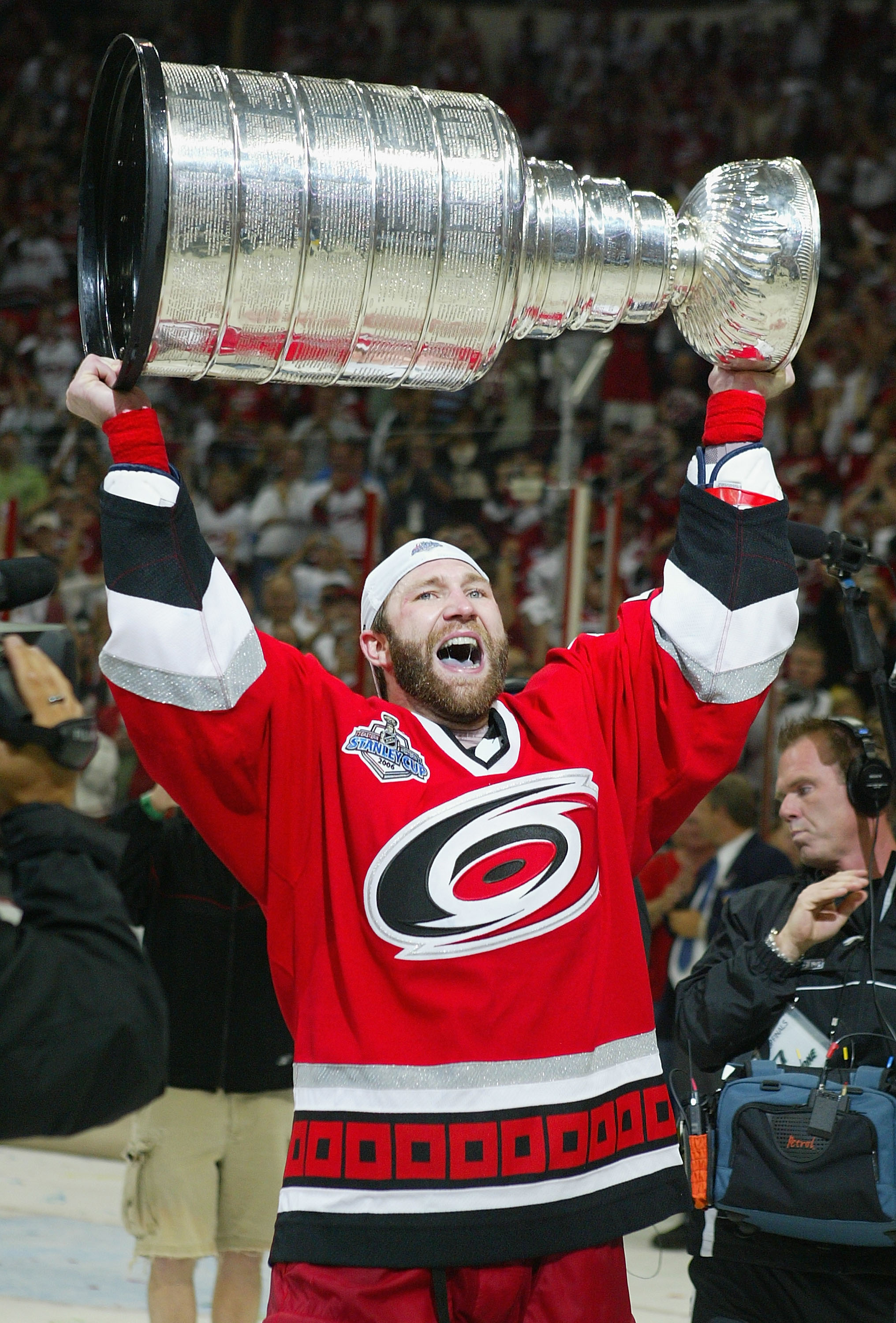 Cole was selected by Carolina in the third round of the 1998 draft, and after another pair of seasons at Clarkson University and one in the minor leagues, debuted with the Hurricanes in 2001 and would never look back. In that rookie season, Cole scored 40 points and would finish fifth in Calder trophy voting behind Dany Heatley (the winner), Ilya Kovalchuk, Kristian Huselius and Pavel Datsyuk. He went on to become an integral part of the Carolina team, scoring 30 goals in just 60 games in 2005-06 before completing an incredibly emotional comeback from a serious neck injury to help the team raise the Stanley Cup.
He would never be quite as dominant as he was during that shortened season, but Cole would continue to represent a prototypical power forward in the years to come, scoring 265 goals in his career including a career-high 35 in his one full season in Montreal. In 892 career games he recorded 532 points and 1,192 hits. He played for Carolina, Edmonton, Montreal, Dallas and Detroit during his long career.
Ryan Carter Announces Retirement
Give Ryan Carter credit. Around this time last year, it seemed as though the veteran forward’s career was already over. Carter had been unable to secure a guaranteed contract for the 2016-17 season, but was working toward a new deal with the Minnesota Wild by way of a PTO. However, when a nagging shoulder injury – a torn labrum to be exact – ended his attempt, Carter decided that he needed to move forward with surgery and, at 33, did not know if he would play again. Yet, Carter underwent his procedure, rehabbed, and by mid-February, he was back skating with the Wild. Carter ended up playing in 18 games with the AHL’s Iowa Wild and was one of Minnesota’s “black aces” come playoff time, though he never did get to fully make his NHL return.
It took a lot of effort just to get close to a comeback in 2016-17 and another try just wasn’t in the cards for Carter this year. The Athletic’s Michael Russo was the first to report that the ten year veteran has decided to hang up his skates. The Minnesota native can rest easy in retirement, knowing that he got to play his final two NHL seasons with his hometown team and gave it all he had to return for a third. Along the way, the Minnesota State standout also suited up for the Anaheim Ducks from 2006 to 2011 and the New Jersey Devils from 2011 to 2014, with brief stops with the Carolina Hurricanes and the Florida Panthers in between.
A hard-working, two-way threat, Carter was known more as a defensive specialist best-suited for a bottom-six spot and key penalty killing role than he was a point-producers. Yet, Carter finished his career off strong with a career high 15 points with the Devils in 2012-13 and three more double-digit totals to close out his NHL tenure. Carter will also be remembered for a very strong postseason performance for New Jersey in 2012, nearly matching his regular season production as the team charged to a Stanley Cup final appearance. In total, Carter notched 41 goals and 52 assists in 473 NHL games. While his scoring was far from the pace he exhibited in his college days in Mankato, Carter was still able to provide consistent two-way play, work ethic, and character throughout an NHL career built off of solid bottom-six play.
The Best Fits For Matt Duchene
Despite the tumultuous off-season for Matt Duchene and the Colorado Avalanche, GM Joe Sakic fully expects him to show up to training camp. At least, that’s what he told BSN Denver’s Adrian Dater. “He’s under contract and I expect him to be here” Sakic said, “Not everybody always comes to camp early. It’s not for me to (say), but I assume on the 14th, he’ll be here.” Sakic is referring to Duchene being one of only two Avs players under contract not to participate in captain’s practice last week. Holdouts may be rare in the NHL, but Duchene’s words and actions this summer have painted a pretty clear picture of a player who would like to leave Colorado.
If Duchene has reached his wit’s end with the trade rumors that have persisted since late 2016 and truly has no intention of suiting up for the Avalanche again, Sakic has just a few days left to trade him before this begins to enter holdout territory. The perceived problem all along is that Sakic has not dropped the asking price that has long been considered a young top-four defenseman, a first round pick, and one or two more young roster players or prospects. Not only do few (read: any) NHL teams have a young top-four blue liner to spare, but it’s hard to imagine anyone giving up such a package for Duchene, who has just two seasons remaining on his contract and is coming off a down 2016-17 season. Duchene had scored 55 or more points in five of his seven NHL seasons entering last year – and easily would have made it six had the the 2012-13 lockout-shorten seasoned been extended – yet, he ended up with only 41 points and an egregious -34 rating last season; a low point for both he and the Avalanche franchise.
Logic would seem to indicate that, holdout or not, Sakic has to continue listening to offers for Duchene and needs to lower an unreasonable asking price. TSN recently released their list of the top nine NHL trade candidates this season, with Duchene obviously at the top. They list the Columbus Blue Jackets, New York Islanders, Montreal Canadiens, Boston Bruins, Nashville Predators, and Pittsburgh Penguins as the mostly likely destinations for Duchene. The Carolina Hurricanes and San Jose Sharks have also been in the rumor mix this summer.
Right away, a few of those options can have their odds discounted. Having just traded away Travis Hamonic and traded for Jordan Eberle, the New York Islanders and their estimated $3MM in cap space likely lack the capacity and the desire to pony up for Duchene at this point. The Isles are still deep on defense, but with Thomas Hickey and Dennis Seidenberg approaching free agency next year, trading yet another young defenseman like Calvin de Haan, Adam Pelech or Ryan Pulock could put the team in hole. Without one of those three, it is hard to see New York making a suitable offer. The defending two-time Cup champs are in a similar situation. While many Pens fans would love to see the embarrassment of riches of Duchene as the third line center behind Sidney Crosby and Evgeni Malkin, Pittsburgh too lacks the cap space, currently about $3.25MM, and the pieces to get the job done. That is, unless Sakic is keen on Olli Maatta or the Penguins offer up Brian Dumoulin, Justin Schultz, or an overwhelming offer of picks and prospects including Derrick Pouliot and enough salary to offset Duchene. It’s a series of unlikely scenarios. Additionally, the Montreal Canadiens lack anything remotely close to a young top four defenseman. Duchene would be a great fit for the Habs, but they simply don’t have the pieces.
The Hurricanes and Bruins certainly have the pieces to acquire Duchene, but it seems unlikely that either will be the team to finally do it. Boston was in talks with Colorado last year, but balked at the ask of a package including Charlie McAvoy or Brandon Carlo and wouldn’t be willing to move Torey Krug either. If the price drops, the B’s have talented young defenders like Jakob Zboril, Jeremy Lauzon, Ryan Lindgren, and 2017 first rounder Uhro Vaakanainen waiting in the wings, but even if that was enough, the Bruins’ quiet off-season has indicated that they would like to move forward with their own young players this season. Carolina, on the other hand, is a Duchene-caliber player away from being a true contender and would love to add someone with his ability. However, GM Ron Francis has made it clear that he does not want to trade any of his defensemen. That hasn’t stopped TSN for listing “a Carolina defenseman” as one of their top trade candidates, but as of now there is no reason to think any of Justin Faulk, Jaccob Slavin, Brett Pesce, or Noah Hanifin are going anywhere. Like Boston, Carolina still has solid pieces if the price drops, such as Haydn Fleury and Jake Bean, but another thought has been whispered this summer that may take Carolina out of the Duchene race altogether. Since acquiring Trevor van Riemsdyk from the Vegas Golden Knights back in June, a player who by all accounts they didn’t really need, many have speculated that Carolina is looking to make a run at 2018 premiere free agent James van Riemsdyk, to bring in the scoring power forward that they desperately desire.
The Blue Jackets and Sharks would be ideal landing spots for Duchene, but both teams would need to get creative with their offers. Both squads have a need for a scoring forward, the cap space to take him on and plenty of talented defensemen, but what they would be willing up on the blue line is not exactly what Colorado desires. There is no way that Columbus includes Zach Werenski or Seth Jones in a deal, but could be open to trading David Savard or Ryan Murray. However, each have a caveat. Savard, while a solid top-four talent, has had durability issues and difficulty with consistent production over the past couple of years. While he would be a great addition to any defense, that may not be what Sakic is looking to get back. Murray, while injury prone, is a highly-skilled young rearguard, but, amazingly, the 24-year-old will be an unrestricted free agent next summer. Any deal involving Murray would first have to include a long-term extension with the league’s worst team. Columbus’ best chance of getting Duchene likely involves a package with top defensive prospect Gabriel Carlsson and a young roster player like Josh Anderson or Oliver Bjorkstrand. San Jose also has a few untouchables on defense, namely superstars Brent Burns and Marc-Edouard Vlasic. Colorado also wouldn’t be interested in veterans Paul Martin and Justin Braun. That leaves Brenden Dillon and Dylan DeMelo as the top options. While both have shown top-four potential, they have largely played shutdown roles in their young careers and bring little offensive upside. Like Savard, one would think that Sakic has a little more in mind for the Duchene return than stay-at-home defenders like Dillon and DeMelo. If the Sharks package versatile puck-moving D-prospect Jeremy Roy with either though, then talks could really get started. A package that starts like that and ends with a first-round pick and one of San Jose’s many young forwards could be enough to seal the deal.
Yet, the top candidate to bring in Duchene is likely the reigning Western Conference champs. No, the Predators are not moving any of Roman Josi, P.K. Subban, Ryan Ellis, or Mattias Ekholm, but the trick up their sleeve is top prospect Dante Fabbro. A junior teammate of Colorado top prospect Tyson Jost, Fabbro is considered one of the best prospects in hockey and should step into a top four role immediately when he leaves Boston University, much like Charlie McAvoy, who Sakic already targeted in Boston. Fabbro is not just a top-four defenseman, but a potential future #1 or at least a great option to pair with Cale Makar down the road. Sakic would be hard-pressed to find more upside up for grabs than Fabbro, but the Predators are set long-term on the blue line and desperately need to recoup the scoring lost in the Expansion Draft with the selection of James Neal. Fabbro, plus a young forward like Colton Sissons, Frederick Gaudreau, or Pontus Aberg, plus a first rounder and another pick or prospect, and Duchene could surely be on his way to Nashville.
Only time will tell where Duchene ends up, but the best case scenario for all parties is for that destination to not be Denver, Colorado for much longer. Sakic must and will eventually lower his asking price and someone will meet those demands. Could it be Nashville, Columbus, or San Jose? Definitely. Could it be Boston or Carolina? The Islanders or the Penguins? Possibly. Someone totally off the board? Of course. For such a talked-about topic, there is still so much uncertainty surrounding the situation. The next step will be to see if Duchene shows up to camp on Thursday. That decision could have a resounding effect on the trade process.
Latest On Matt Duchene & Colorado Avalanche Camp
The hockey world perked up their ears again yesterday when they heard that Matt Duchene was not at the first voluntary on-ice session for the Colorado Avalanche, the only missing forward outside of Nathan MacKinnon (who is on a press tour with the NHLPA). Frank Seravalli of TSN spoke with Duchene’s agent Pat Brisson, who said that Duchene was still skating in Toronto but would not comment on whether he would report to training camp when it opens in just over a week.
Duchene was also a topic when Elliotte Friedman joined Sportsnet 590 this morning in Toronto, saying that he believes there is some renewed interest in trading the forward, mentioning Columbus and Carolina as possible destinations. Friedman doesn’t know of anything that is pressing, but we’ve heard the Blue Jackets and Hurricanes in connection to Duchene before. Both could use some help down the middle, and both have young defensemen who would be of interest to the Avalanche.
While nothing seems to be about to break in Colorado, the continued rift between the two sides seems like something that can only end poorly. If Duchene doesn’t report, it takes even less leverage away from Avalanche GM Joe Sakic, and might force him to just sit on his hands until the player returns to the ice. The worst thing that could happen is Duchene sitting out a large portion of the season because something couldn’t get done, especially with only two years left on his contract. Every game that ticks by his value is reduced, as a buying team wouldn’t have any guarantee he’d be around past the 2018-19 season. For a player who was once seen as a potential franchise piece, it has quickly turned.
Snapshots: Chara, Hurricanes, Jagr
Even at the age of 40, Zdeno Chara figures to be a big (pardon the pun) part of the Boston Bruins’ defense this season. While he’s lost a step and isn’t as punishing in his own end, his experience and size still allows him to be a capable player at both ends. He registered 29 points last season, and feels like he can continue even past the upcoming year. Talking to Joe Haggerty of CSNNE, Chara expressed his want to stay in Boston.
I definitely want to play beyond this season. It’s really hard to put a number on it. Some people do and some people don’t. I just obviously want to keep playing beyond this season. I love this game too much. I have made no secrets about it. I want to stay here [in Boston] and continue to play.
As he enters the third decade of his playing career, Chara is going to be able to start passing on some of the responsibility to younger Bruins defenders like Charlie McAvoy and Brandon Carlo. Along with Chara, Torey Krug and the rest of the veteran options in Boston, the youngsters could make this one of the most dependable groups in the NHL. They’ll need it if they want to get back to the playoffs and make a run for the Stanley Cup before Chara finishes his career.
- Carolina Hurricanes’ GM Ron Francis spoke with media today including Chip Alexander of the News & Observer, dropping some interesting tidbits about the team’s next few weeks. Francis says that there will be no players signed to professional tryouts, and that the team will indeed name a captain after training camp is over. The Hurricanes played last season without a captain, and haven’t had one since they traded Eric Staal at the 2016 deadline. Eric’s younger brother Jordan Staal is a candidate, but could so are several of the defensemen including Justin Faulk. An interesting option might be giving it to recently returned forward Justin Williams, who has raised the Stanley Cup three times including one with the Canes in 2006.
- Jaromir Jagr once again has said that he could start the season in Europe and play in the Olympics for the Czech Republic, something that would obviously add a lot of intrigue to the Winter Games. The US and Canada will be struggling to find high caliber players while teams like Russia and the Czech Republic could ice Hall of Fame talent. While that could result in a quick defeat, it also will allow us to see college and AHL-level players against some of the best in the world.
Carolina Lacking Roster Flexibility In 2017-18
With the start of the 2017-18 season just a month away, teams are starting to entertain some options to fill out their rosters. PTO season is in full swing, several teams have made recent free agent signings with more surely to come, and even trade whispers have picked up someone. One team not expected to join the late off-season excitement are the Carolina Hurricanes. With a cap hit of $57.8MM, more than $17MM below the salary cap, the Hurricanes have more than enough space to work with. In fact, Carolina has the third lowest payroll in the league. The ‘Canes have plenty of cap flexibility, but what they lack is roster flexibility.
The NHL imposes limits on each and every roster. Of course, the active roster is held to just 23 players, but the issue facing the Hurricanes is instead the 50-contract limit. Each squad is only allowed to have 50 players at a time signed to one-way and two-way NHL contracts; it’s a mark that few teams approach. Yet, Carolina is already committed to a league-high 49 players for next season. The team has added Scott Darling, Justin Williams, Marcus Kruger, Trevor van Riemsdyk, Josh Jooris, and Brenden Kichton to the mix this summer, without losing any notable names. With those new additions, the Hurricanes hope to build upon their surprising success in 2016-17 and use their impressive depth and youthful energy to reach the postseason this season. With those aspirations, GM Ron Francis and company will surely want to leave some space for a possible trade acquisition if the team is in position for a playoff run. While trades, especially in-season, more often than not include players going both ways, all other teams are held to the same limits as Carolina and won’t be willing to take on a handful of contracts just to accommodate the ‘Canes roster restraints. The team has to be careful not to back themselves into a corner.
For that reason, Carolina will likely march toward the season without making any further moves. That won’t stop the rumors of their interest in Colorado’s Matt Duchene to stop, particularly with Duchene pushing for a resolution in prior to puck drop, but it seems more likely that the Hurricanes stand pat in the coming weeks. With little flexibility as is, adding another player by any means could put Carolina in a hard-to-manage roster spot that could be even harder to get out of.
Cam Ward Accepting Of New Role In Carolina
Ever since 21-year-old rookie Cam Ward led the Carolina Hurricanes to a Stanley Cup title in 2006, he has been the go-to guy in the Carolina net. That year, Ward shocked the world with a .920 save percentage and 2.14 goals against average in 23 playoff games en route to the championship and the Conn Smythe Trophy, despite having only 28 regular season NHL games under his belt prior. In 2011, Ward was an All-Star and even made a run at the Vezina Trophy behind a resume of the league’s most games played and saves and a .922 save percentage. Altogether, Ward is in the top ten among all active goaltenders in wins, saves, and point shares, signalling the important role that he has played in Raleigh for the better part of this century.
However, in recent years the story has been quite different. After posting five 30-win seasons in his first six full seasons, Ward has failed to reach that mark every year since before the 2012 lockout. His save percentage has held steady at below .910 in that span, while his quality starts percentage has topped 50% only once in the last five years. In fact, in the last five years, few goalies with a “starter” amount of games played have performed worse than Ward. For that reason, the Hurricanes constant has accepted that he is no longer the top net minder in Carolina. In speaking with Chip Alexander of the News & Observer, Ward acknowledged that the team’s acquisition of and extension of former Chicago Blackhawks backup Scott Darling likely signals the end of his time as a starter for the ‘Canes. The young, up-and-coming team is loaded with talent and will be for years to come, but have been held back by their goaltending. By all accounts, Darling has been one of the best backups in the league the past couple of campaigns and is ready for a starting role. And so, Ward is ready for a backup role:
“I’m realistic… I understand the situation. I know he was brought in here to sign a four-year deal for pretty good money not to be a backup.
“I know where I am in my career. … Certainly I’m a competitive guy and I still want to be able to play and I’ll do whatever I can to earn that ice time, but I’m hopeful he can make that next step. He deserves that.”
“I thought it was a great move… I’ve heard nothing but good things about Scott Darling. .. I look at a guy who’s ready to take that next step.
“I’ve been very fortunate to be here as long as I have and to be a No. 1 guy for over a decade, so I think I have something to offer to him. I think I can offer him my experience and give him the support he needs to make that next step.”
Ward certainly seems to be taking his demotion well and that could be the key to helping Darling develop into a star keeper. In the past, the Hurricanes have attempted to challenge Ward by investing in promising backups like Justin Peters, Anton Khudobin, and most recently Eddie Lack – traded this summer to the Calgary Flames – and giving those players substantial ice time. However, in each case the competitive Ward was able to hold on to his job despite just middling play, as the trio all failed to play up to expectations and embrace the position battle. Now 33, Ward is entering the twilight of his career and, though he won his Cup and Conn Smythe in year one, has accomplished so much as the franchise leader in every goaltending category for the ‘Canes. For the first time, Ward seems open to embracing his mentor role and playing second fiddle to the up-and-coming Darling. That guidance and veteran wisdom could do wonders for the young goalie, which in turn could help bring Carolina back into Cup consideration for the first time in almost a decade.
With that said, the ultra-competitive Ward isn’t about to stop working hard. He has seen young backups come and go before and, while this four-year, $16.6MM contract for Darling is a step above the rest, Ward will surely be ready to take back the reigns if need be. Should that happen, at least Carolina fans can rest easy knowing exactly what to expect from the career Hurricane.
NHL Notes: Raanta, Darling, Tolvanen, Duclair
With Antti Raanta and Scott Darling attempting to make the conversion from backup to starter this season, many believe that both will be successful. However, history suggests that’s not always the case. NBC Sports Adam Gretz writes that the best comparable for both is Cam Talbot, who was hugely successful as a backup for the New York Rangers and continued that success as a starter after being traded to the Edmonton Oilers.
Gretz writes that while Talbot is the perfect comparison, there are also plenty of goaltenders who have failed to make the full-time conversion over the last 15 years, including a few names that many have long forgotten. Eddie Lack and Anton Khudobin each struggled as starters for Carolina which forced them to go out and get Darling in the first place, while other goaltenders such as Dan Ellis, Alex Stalock, Ben Scrivens and Vesa Toskala didn’t fare particularly well.
The hope is that both Raanta and Darling are more proven as backups than a lot of the others and are more NHL ready to handle a larger workload. Raanta and Darling’s success will be critical for the team to take their team to the next step.
- Nashville Predators prospect Eeli Tolvanen, the team’s first-round pick in the 2017 draft, signed a three-year deal to play for Jokerit Helsinki of the KHL earlier in the offseason. International hockey writer Igor Eronko tweeted Tolvanen told him that his second year is a player’s option and if he has a good year, he will come stateside next year. It’s only been three games for Tolvanen, but he is currently third in the league in scoring with six points and is third in the league in shots taken.
- Gretz, in another story writes this is a critical year for Arizona’s Anthony Duclair. The 22-year-old wing got the city excited when he posted a 20-goal season two years ago, but came crashing back to earth last year after a five-goal output. Gretz points out that he scored on 19 percent of his shots in the 2015-16 season, which is extremely high and not sustainable over the long-term. Last year, Duclair’s numbers dropped to six percent. The still restricted free agent has not come to terms with the team.