
Waiver Watching: Sizing Up The Goaltender Market
With training camps on the horizon, there are still some goaltending situations around the NHL that are unsettled. Accordingly, those teams may be planning on picking up a second goaltender on waivers during the preseason as Montreal did with Samuel Montembeault last season. With that in mind, let’s examine who might be looking for a goalie and which teams have a netminder that could be of interest.
Potentially Looking
Arizona: The Coyotes have one of their two goalies locked up for three years in Karel Vejmelka but after that, there is nothing but question marks. Farmhands Jon Gillies and Ivan Prosvetov have some NHL experience but Gillies struggled last season with New Jersey and Prosvetov hasn’t posted a .900 SV% in the last two seasons in the minors. Cap space isn’t an issue for them so they can look at any of the options available on waivers or take on a bad contract for additional compensation.
Chicago: Right now, Alex Stalock is their backup goalie. He has missed most of the last two seasons battling his way back from myocarditis and struggled considerably in the minors last year. Granted, the Blackhawks certainly aren’t in win-now mode but in a perfect world, they’d like Arvid Soderblom to have an uninterrupted year with AHL Rockford. Currently, he’s third on the depth chart but if there’s a chance to bring in a low-cost second-stringer and push Stalock into the spot of being the one to be recalled if an injury arises, they might want to take it. The waiver wire could be the chance to add that.
Philadelphia: With Ivan Fedotov being blocked from going to North America this season due to a military commitment, the Flyers are going to have to turn to Plan B. Felix Sandstrom is currently their second option but he has just five career NHL appearances under his belt. They’re looking to be more competitive this season so this could be a spot for an upgrade. Granted, Sandstrom would then need to be waived to be sent back to Lehigh Valley but that would have been the case if Fedotov had been able to play so it’s a risk they might be comfortable with.
Of course, an injury or two during the preseason could add to the list of suitors in the coming weeks as well.
Teams That Could Lose A Goalie
For the purpose of this exercise, the focus is going to be on either young goalies that could be appealing or veterans with some recent NHL experience that could fill a gap.
Buffalo: Malcolm Subban was brought back to be the veteran to partner with Ukko-Pekka Luukkonen in AHL Rochester but he has 86 games of NHL experience under his belt and a deal that’s only $100K above the league minimum. He has been a full-time backup going back to his time with Vegas which would also bolster his chances of potentially being claimed.
Dallas: Right now, Anton Khudobin appears to be the odd one out again with Jake Oettinger and Scott Wedgewood set to be the goalie duo for the Stars. Khudobin is now in the final year of his deal that carries a $3.33MM AAV. It wouldn’t be shocking if he cleared waivers but if Dallas wants to free up a bit of extra money for Jason Robertson’s contract, they’ll be calling Arizona to see what it would cost for them to take that contract on.
Los Angeles: Pheonix Copley has cleared waivers without any concerns the last couple of years but also was on a pricey contract for a third-string option. Now, he’s on a much more palatable deal ($825K) and is coming off an impressive season in AHL Hershey. The 30-year-old was the backup for the Capitals back in 2018-19.
Nashville: This is the most interesting one to keep an eye on. Although Connor Ingram held his own in the playoffs for the Preds, they still went and brought in Kevin Lankinen on a one-year, $1.5MM deal. That’s a lot to pay a third-string option so it could put Ingram in jeopardy. However, if they try to sneak Ingram through, there’s a very good chance he’ll be claimed, especially with an AAV that’s below the minimum. Carrying three goalies is a possibility but generally not ideal so something might have to give here.
New York (R): The Rangers went and brought in Louis Domingue on a two-year contract to be their insurance policy but he might appeal to some other teams as well. He did alright in the playoffs for Pittsburgh and has 142 games of NHL experience over parts of two seasons. Both years are one-way which was likely to try to deter other teams from claiming him but with an AAV of just $775K, he may attract some interest.
Seattle: With Martin Jones joining the Kraken as their backup, that’s going to push both Joey Daccord and Magnus Hellberg to the waiver wire. Daccord was viewed as a possible NHL option not long ago and at 26, there could still be some upside after a strong season with AHL Charlotte. Hellberg, meanwhile, has been dominant in the KHL the last few years which prompted Detroit to give him a brief look down the stretch last season. Other teams might want to take a look as well depending on how things go over the next few weeks.
Winnipeg: Mikhail Berdin is the one goalie on this list that doesn’t have any NHL experience but at 24, he’s also the youngest in this group. If a rebuilding team wants to take a look at a younger backup to see if there’s something there, this is the type of goalie they’d probably want to go for.
Of course, there will be other goalies that will hit the waiver wire in the coming weeks that could be of interest to teams as well depending on what transpires over the preseason. There won’t be a ton of waiver activity between the pipes – there rarely is – but one or two of these players could be changing teams in the coming weeks.
2008 NHL Draft Take Two: Ninth Overall Pick
Hindsight is an amazing thing, and allows us to look back and wonder “what could have been.” Though perfection is attempted, scouting and draft selection is far from an exact science, and sometimes, it doesn’t work out the way teams – or players – intended. For every Patrick Kane, there is a Patrik Stefan.
We’re looking back at the 2008 NHL Entry Draft and asking how it would shake out knowing what we do now. Will the first round remain the same, or will some late-round picks jump up to the top of the board?
The results of our redraft so far are as follows with their original draft position in parentheses:
1st Overall: Steven Stamkos, Tampa Bay Lightning (1)
2nd Overall: Drew Doughty, Los Angeles Kings (2)
3rd Overall: Roman Josi, Atlanta Thrashers (38)
4th Overall: Alex Pietrangelo, St. Louis Blues (4)
5th Overall: Erik Karlsson, Toronto Maple Leafs (15)
6th Overall: John Carlson, Columbus Blue Jackets (27)
7th Overall: Jacob Markstrom, Nashville Predators (31)
8th Overall: Braden Holtby, Phoenix Coyotes (93)
The Coyotes’ original 2008 eighth-overall selection, Mikkel Boedker, had a long career in Phoenix, but squarely belongs in the “disappointing” category of top-ten picks. Not a bust by any means, having played over 700 NHL games, he had just 327 points in those 709 games. Those numbers aren’t great, but they are good enough for 15th in scoring among the class, which was weak for forwards overall. It also means that Boedker’s offense would have been an easily replaceable asset in free agency, so it’s reasonable to wonder if taking Holtby and his Stanley Cup-winning pedigree would’ve made a difference in the Coyotes’ fortunes.
While the organization never had elite scoring talent and failed to build consistent year-to-year performances, goaltending was usually the least of their worries. Immediately after the draft, Phoenix got the three best seasons of Ilya Bryzgalov‘s career, including a Vezina Trophy nomination in 2009-10. After his departure in 2011, Mike Smith immediately broke out, guiding them to the Western Conference Final in 2012. Over 310 starts in the desert, Smith served the Coyotes well with a .916 save percentage. While you’ll hear little argument that Holtby was the better goaltender between those three, the upgrade is marginal enough that it likely wouldn’t have made much of a difference in the team’s fortunes.
The New York Islanders stepped up to the plate for the ninth-overall selection, trading four spots down on draft day in total from the fifth overall pick. It was a move that worked out extremely well for them in hindsight. Their selection at ninth overall was Josh Bailey, who remains third in scoring among forwards from the class on this day. When comparing Bailey’s career with that of the fifth overall selection (Luke Schenn) and seventh overall selection (Colin Wilson) that they dealt away that day, it was an even smarter move from then-general manager Garth Snow. Bailey, who’s remained a career Islander ever since draft day and is currently an alternate captain, has 555 career points and will play his 1,000th game as an Islander this season.
Bailey made his NHL debut in November of 2008, just five months after he was drafted, and played nearly a full NHL season as a 19-year-old. He had 25 points in 68 games during his rookie season, good enough for ninth in scoring on an atrocious Islanders team that finished with just 61 points. From that point forward, Bailey was a surefire threat for anywhere between 30 and 50 points in a full season. He set a career-high of 71 points in 76 games in 2017-18, 15 more points than his next-best season total.
Despite the impressive career as an Islander, there may have been better selections available yet on the board at ninth overall for New York. There’s Jordan Eberle, who did end up an Islander anyway after a few seasons in Edmonton, who’s the only forward that ranks ahead of Bailey in terms of career points from the class not named Steven Stamkos. There’s also current Minnesota Wild captain Jared Spurgeon, who perenially remains one of the most underrated defensemen in the NHL.
So we ask you, who should have the New York Islanders selected with the ninth overall pick in 2008? Make your voice heard in the poll below.
2008 Redraft: Ninth Overall
-
Jordan Eberle 36% (303)
-
Jared Spurgeon 20% (168)
-
Cam Atkinson 14% (118)
-
Josh Bailey 9% (77)
-
T.J. Brodie 4% (33)
-
Tyler Myers 3% (23)
-
Gustav Nyquist 2% (20)
-
Derek Stepan 2% (17)
-
Adam Henrique 2% (16)
-
Zach Bogosian 1% (11)
-
Jake Allen 1% (9)
-
Travis Hamonic 1% (9)
-
Luke Schenn 1% (6)
-
Jake Gardiner 1% (6)
-
Marco Scandella 1% (6)
-
Matt Martin 1% (6)
-
Justin Schultz 1% (5)
-
Michael Del Zotto 1% (5)
-
Jason Demers 0% (4)
-
Colin Wilson 0% (2)
-
Tyler Ennis 0% (2)
-
Mikkel Boedker 0% (0)
Total votes: 846
Trade Rumors app users, click here to vote.
This Day In Transactions History: Max Pacioretty Traded To Vegas Golden Knights
Most teams could only hope to have a draft like the Montreal Canadiens did in 2007, selecting Ryan McDonagh, Max Pacioretty, and P.K. Subban with their first three picks. McDonagh would ultimately be dealt before he could ever dress for Montreal, sent as the centerpiece in the Scott Gomez trade, one which overwhelmingly favored the New York Rangers. Subban and Pacioretty, along with Carey Price, went on to form the core of some formidable Canadiens teams in the mid 2010’s. Following the 2015-16 season, needing to rebound from their first playoff miss in several years, Montreal dealt Subban in one of the biggest one-for-one deals in not only the league’s history, but sports history, sending him to the Nashville Predators for Shea Weber.
The Subban for Weber swap helped Montreal rebound to a playoff berth in 2016-17, but a dreadful 2017-18 forced the organization to re-think things and just before teams were set to hit the ice for training camp, they dealt their star forward and team captain in Pacioretty to the Vegas Golden Knights. Vegas, having burst onto the scene in their first season just a year prior, were looking to make a splash in order to hopefully get over the hump and win the Stanley Cup, falling just short in their first try. Acquiring the regular 30-goal-scorer wasn’t cheap though, Vegas paying handsomely in the amount of Tomas Tatar, Nick Suzuki and a 2019 second-round pick. The return, put plainly, sounds large, but perhaps fair considering the practice of giving something to get something, Vegas giving up a solid veteran point producer, a then-unproven prospect, and a second-round pick out of their bevy of draft picks and receiving a guaranteed star who immediately signed an extension in return. But, with the benefit of time and context, the perception of the deal now has certainly changed.
To give some perspective on how dynamic this trade ended up being for the Golden Knights, the Canadiens acquired a 60-point forward, a prospect who would become one of the young faces of their franchise, and a second-round pick and there is seemingly less to say on their end. Moving Pacioretty, a star and captain, was surely not an easy move for the Montreal organization to make, but one they felt necessary, especially given the return. Tatar would go on to have 58 and 61 point seasons, the latter coming in just 68 games. His third and final season with the team, 2020-21, saw him dip to 30 points, albeit in 50 games in the COVID shortened campaign, but with just five playoff games amid a deep playoff run. Worth mentioning, the second-round pick was unceremoniously flipped to the Los Angeles Kings for a third and fifth-round pick.
The real prize in the trade, and one that perhaps keeps Vegas management and fans up at night is Suzuki. The 13th overall selection in 2017, Vegas’s second of that evening, Suzuki hadn’t yet debuted for Vegas before he was dealt to Montreal. After the move, the forward spent another season in the OHL, where he wasn’t immune to trade either, dealt midseason from the Owen Sound Attack to the Guelph Storm. Still, none of it phased Suzuki, who had another outstanding junior season. The young forward made his NHL debut for Montreal the following season, finding breakout success in the shortened 2020-21 season, playing a pivotal role in Montreal’s near miss of a Stanley Cup. Following that season (more specifically, October), The Canadiens inked Suzuki to an eight-year, $63MM extension beginning in 2022-23 with the expectation that he could lead the next great set of Montreal teams.
The Vegas side of this blockbuster is a lot murkier. They certainly gave up a lot to get Pacioretty, but that isn’t always the issue with a trade. In fact, the winger brought back as much if not more value than they were expecting. Point for point, Pacioretty had some of his best seasons in Vegas, highlighted by a 51 point performance in 48 games during the shortened 2020-21 season, the only time he hit the point-per-game mark in his career. The real issues for the Golden Knights would be two-fold: (1) money, and (2) when all was said and done, what went in and what went out.
Upon acquiring the Montreal captain, the Golden Knights immediately signed him to a four-year, $28MM extension that began in 2019-20. That deal was fine at the time, Vegas then still in the envious position of being competitive but also utilizing their cap to help other teams for the right price. But, as the contract went on, Vegas continued to spend liberally to reward their successful core and also bring in new assets to help them out. With that, their cap situation became tighter and tighter and Pacioretty’s $7MM cap hit grew more and more imposing. Finally, with the addition of Jack Eichel and his $10MM cap hit part-way through last season, the bubble was set to burst this offseason and Vegas needed to shed a big contract. That would end up being Pacioretty.
As talented as Pacioretty still is, his $7MM cap hit on top of his recent injury history, made taking him on a questionable decision for many teams. Vegas was able to find a suitor, and though they didn’t have to pay anything significant to offload his contract, they received merely future considerations for a player who had 194 points in 224 games for them over the previous four seasons (as well as Dylan Coghlan).
The other troubling aspect of this deal is a completely separate trade made several months prior. At the 2018 trade deadline, with assets in hand and a surprising playoff berth in sight, Vegas made a splash by acquiring Tatar from the Detroit Red Wings. Tatar, like Pacioretty here, didn’t come cheap, as Vegas sent a first, second, and third round pick to Detroit to make it happen. The Czech winger gave Vegas just eight points in 20 regular season games on top of another two points in eight playoff contests ahead of the instant trade. The reason the earlier Tatar trade is important is to consider the context: Vegas, in effect, traded Suzuki, a first, two seconds, and a third for 28 underwhelming games of Tatar and four seasons of Pacioretty, who they then traded away for almost nothing after he actually stepped his production up.
Another interesting wrinkle to all of this, but not one that absolves Vegas of their questionable trade tree, is that Pacioretty tore his Achilles after the trade to Carolina, forcing him to miss at least six months of the upcoming season. Of course, Vegas didn’t know this would happen when they made the deal, preserving the questions regarding their logic in the handling of the forward. Realistically, had this happened before the trade, Vegas could have utilized LTIR with Pacioretty, but had he been ready to return ahead of the playoffs, it would have left the team in a difficult position.
Hindsight is twenty-twenty, as the saying goes, and that applies to any transaction, but the Pacioretty-to-Vegas trade from four years ago today is a fascinating retrospective into roster, cap, and asset management. Vegas gave up plenty for Pacioretty, but it was most likely worthwhile as they got back arguably more than they bargained for. But after four seasons and just one more to go under their current commitment, the team essentially walked away from their player while Montreal continues to reap the reward with one of the league’s most exciting young stars. One question to ponder as we consider these last four years: how is this viewed, all else the same, had Vegas won a Stanley Cup with Pacioretty in the fold?
Salary Cap Deep Dive: Vegas Golden Knights
Navigating the salary cap is one of the more important tasks for any GM. Teams that can avoid total cap chaos by walking the tightrope of inking players to deals that match their value (or compensate for future value without breaking the bank) remain successful. Those that don’t see struggles and front office changes.
PHR will look at every NHL team and give a thorough look at their cap situation heading into the 2022-23 season. This will focus more on players who are regulars on the roster versus those who may find themselves shuttling between the AHL and NHL. All cap figures are courtesy of CapFriendly.
Vegas Golden Knights
Current Cap Hit: $92,736,310 (over the $82.5MM Upper Limit)
Entry-Level Contracts
None
Signed Through 2022-23, Non-Entry-Level
G Laurent Brossoit ($2.325MM, UFA)
G Adin Hill ($2.175MM, UFA)
F Brett Howden ($1.5MM, RFA)
F Phil Kessel ($1.5MM, UFA)
F Nolan Patrick ($1.2MM, RFA)
F Sakari Manninen ($750K, UFA)
Kessel was brought in a couple of weeks ago once the Golden Knights learned that they had some extra LTIR flexibility. He’s not the high-end sniper he was in the prime of his career but he still finished third on the Coyotes in scoring last season and should be a low-cost secondary scoring option on a team that doesn’t have a lot of value contracts. Howden was limited last season due to injuries and often was on the fourth line when he was in the lineup. Despite that, he received this contract back in July to avoid any possibility of arbitration but he’ll need to take on a bigger role to justify getting qualifying him with arbitration rights next summer.
Patrick saw very limited action last season as his concussion issues continued and he might be another LTIR candidate for the upcoming season. Unless something changes, he’ll be non-tendered in June. Manninen’s strong showing at both the Olympics and the Worlds earned him his first NHL contract at the age of 30 on a one-way agreement and will have a good chance to earn a roster spot, especially if they have enough LTIR flexibility to carry more than the minimum-sized roster.
Brossoit was brought in last summer to serve as the backup goaltender and continued his trend of alternating good and bad years with 2021-22 landing in the latter category. His availability for the start of this coming season is in question due to hip surgery so he is going to have a limited window to show that he’s worthy of a similar contract next summer. Hill was recently acquired using part of their extra LTIR space and should get a good opportunity to boost his stock heading into free agency next summer, especially if he could lock down the starting role at some point. Even if not, he could get a small boost as the backup market continues to improve.
Signed Through 2023-24
F Michael Amadio ($763K, UFA)
F William Carrier ($1.4MM, UFA)
D Ben Hutton ($850K, UFA)
F Jonathan Marchessault ($5MM, UFA)
D Alec Martinez ($5.25MM, UFA)
F Chandler Stephenson ($2.75MM, UFA)
Marchessault is one of the few remaining original Golden Knights and is the leading scorer in franchise history after five strong seasons. He’ll be 33 on his next deal and if he can maintain the type of production he has provided Vegas, he could get a multi-year agreement around this rate again. Stephenson has become quite the bargain after Washington couldn’t find a regular role for him in the lineup. He has quickly become a top-six center that makes third-line money and at this point, him doubling his current AAV is definitely doable on the open market in 2024.
Carrier isn’t a significant scorer although he produces more than most fourth-liners do while providing them with plenty of physicality. This is a bit of an above-market deal for someone in that role compared to a lot of fourth-liners signing for around $1MM or less but Vegas is getting more out of him than other teams will from their depth pieces. Amadio was brought in off waivers last year and was a decent depth contributor, earning himself a one-way deal but he’ll need to become an everyday regular to do much better than that in 2024.
Martinez likely left money on the table when he signed an extension last summer but injuries really limited him last season which has hurt his value. He’ll be 37 when his next contract starts and at that point, he might have to go year-to-year at a lower rate than this one. Hutton turned a PTO into a one-year deal, then did well enough to get this extension. He has been in a fringe role for a few years now so his market isn’t likely to change much over the next couple of seasons.
Signed Through 2024-25
F Keegan Kolesar ($1.4MM, UFA)
G Robin Lehner ($5MM, UFA)
F Jake Leschyshyn ($767K, UFA)
D Brayden McNabb ($2.85MM, UFA)
F Jonas Rondbjerg ($767K, UFA)
F Reilly Smith ($5MM, UFA)
D Shea Theodore ($5.2MM, UFA)
G Logan Thompson ($767K, UFA)
Smith hasn’t been able to produce at the level he did early on in his time with Vegas but he continues to be a reliable secondary option that can play in all situations so the team opted to hand him a new three-year deal in July at the same rate of his last one. If the downtick in production continues though, he’ll be hard-pressed to get another $5MM deal in 2025. Kolesar avoided arbitration with his deal last month and did well with this agreement following his only full NHL season. Clearly, Vegas believes he has another level he can get to which would make this a team-friendly deal if he can step into a regular role on the third line. Leschyshyn and Rondbjerg were both up and down last season but are now waiver-eligible which could help them stick at the end of the roster and could boost their stock by securing a regular spot in the lineup at some point during their contracts.
Theodore has emerged as a strong top-pairing blueliner over the last few seasons which makes his deal one of the biggest bargains they have as they’re getting top production at a second-pair rate. He’ll be 30 at the end of this agreement so a max-term contract could be coming his way at a considerably higher price tag than this one. McNabb, meanwhile, isn’t a big point-producer and provides most of his value on the defensive side of things. As long as he can continue to hover around the 20-minute mark, the Golden Knights will get a good return on this contract.
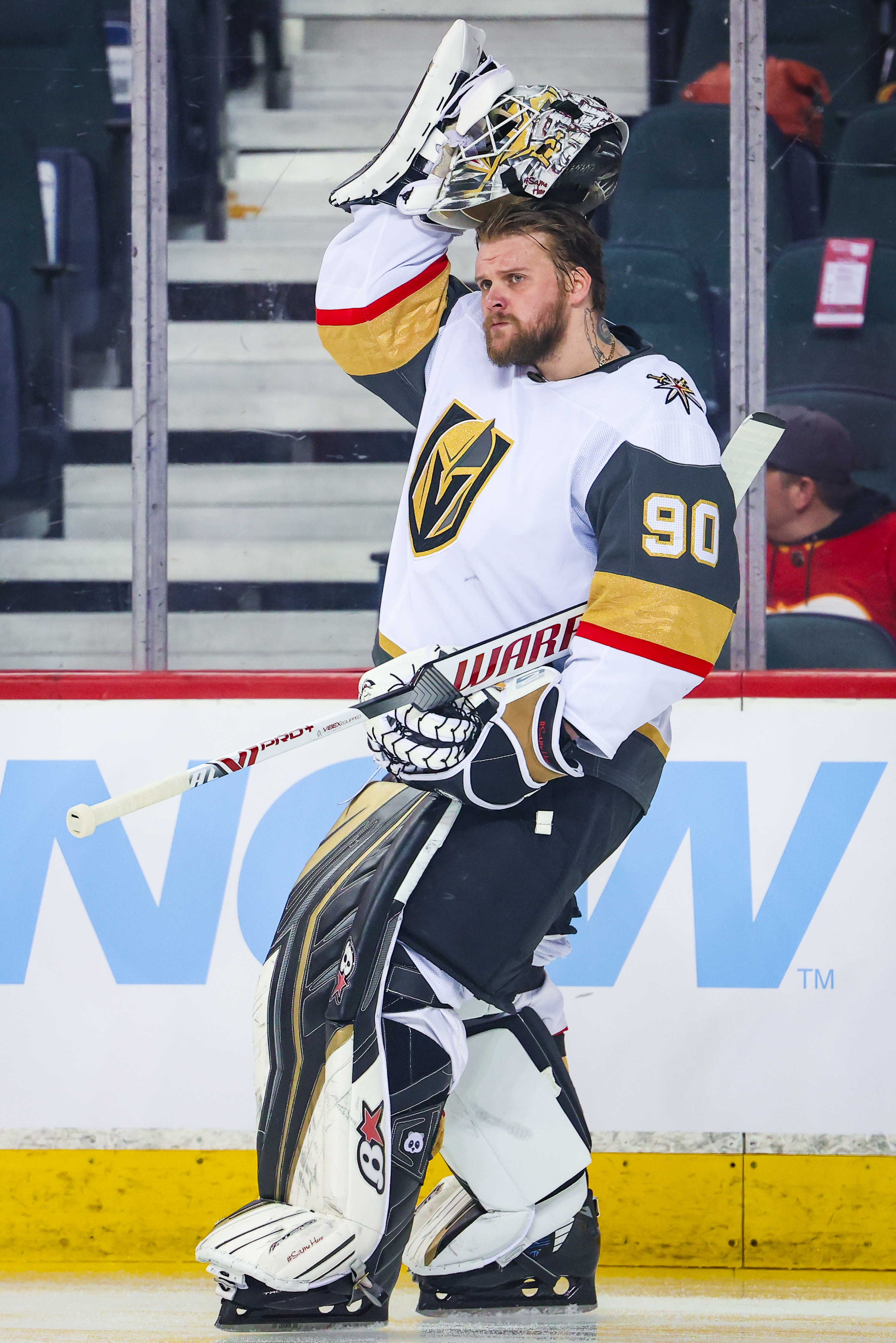 Lehner was the undisputed starter for Vegas last season with Marc-Andre Fleury being traded away last summer in a straight salary cap dump move. However, injuries limited him to just 44 games while he battled inconsistency which is hardly the outcome they were hoping for when they picked Lehner to be the starter. To make matters worse, they recently revealed that he will need hip surgery that will keep him out for all of the upcoming season. While that created the LTIR room for them to add Kessel and Hill, Lehner’s absence certainly also creates a big question between the pipes not only for the upcoming season but beyond as well since hip issues can often be a lingering issue.
Thompson will get an opportunity to be at least the short-term answer to the goaltending question as he will get a long look at being the starter this season. If he can lock down that role, his contract will become one of the top bargains in the league. If things don’t go well, however, he’s a candidate to be sent down when Brossoit is cleared to return; Thompson remains waiver-exempt for the upcoming season.
2008 NHL Draft Take Two: Eighth Overall Pick
Hindsight is an amazing thing, and allows us to look back and wonder “what could have been.” Though perfection is attempted, scouting and draft selection is far from an exact science, and sometimes, it doesn’t work out the way teams – or players – intended. For every Patrick Kane, there is a Patrik Stefan.
We’re looking back at the 2008 NHL Entry Draft and asking how it would shake out knowing what we do now. Will the first round remain the same, or will some late-round picks jump up to the top of the board?
The results of our redraft so far are as follows with their original draft position in parentheses:
1st Overall: Steven Stamkos, Tampa Bay Lightning (1)
2nd Overall: Drew Doughty, Los Angeles Kings (2)
3rd Overall: Roman Josi, Atlanta Thrashers (38)
4th Overall: Alex Pietrangelo, St. Louis Blues (4)
5th Overall: Erik Karlsson, Toronto Maple Leafs (15)
6th Overall: John Carlson, Columbus Blue Jackets (27)
7th Overall: Jacob Markstrom, Nashville Predators (31)
In the real draft, Nashville made an all-around solid pick with forward Colin Wilson, a college standout who would carry his hard-working game over into the NHL ranks. Wilson’s 286 career points are good enough for 18th among 2008 draftees. Though he wasn’t a bust, Nashville could have potentially found another outcome by selecting Markstrom with the seventh pick, which might seem peculiar at first, but may have had an enormous positive impact overall. On the date of the 2008 draft, franchise great Pekka Rinne had played just three NHL games to date, establishing himself as a star the following season.
Having Markstrom in the fold behind Rinne would have blocked the younger goaltender, but may have proven a valuable trade asset for Nashville. Markstrom’s value as a prospect was as high as it could be in the early 2010’s given his ceiling, and Florida used that to its advantage, trading him along with forward Shawn Matthias to the Vancouver Canucks for Roberto Luongo and a minor leaguer. Had Nashville opted to keep Markstrom around, it’s interesting to consider that he didn’t establish himself as a regular starter until the 2017-18 season, right around the time Rinne began to take a step back due to injury and age. This could have fit as a perfect transition, however as we have seen, Nashville found that nonetheless with Juuse Saros.
We now turn to the eighth overall selection and one of two first-round picks belonging to the then-Phoenix Coyotes. The Coyotes, much like the Predators before them and the New York Islanders right after, picked a good player and someone far from a bust in forward Mikkel Boedker. For his career, Boedker had 118 goals and 209 assists for 327 points over 709 games played, enough for 15th in points and 19th in games played among members of the 2008 draft class. Those numbers put Boedker out of an elite class of player, like Stamkos, Doughty, and Karlsson ahead of him, but fit him squarely among good, solid NHLers.
The speedy Danish winger began his career with a pair of seasons in the Frolunda development program over in Sweden prior to joining the OHL’s Kitchener Rangers for the 2007-08 season – his draft year. Boedker dominated with Kitchener, netting 29 goals along with 44 assists in 66 games. Not only that, but the forward notched six points in as many games playing for Denmark’s World Juniors squad that year.
The impressive performance was enough not only to have Boedker selected eighth-overall, but would help him make the Coyotes roster as an 18-year-old. Despite his age, Boedker showed he was ready for the NHL, putting up a relatively impressive 11 goals and 17 assists in 78 games in the desert. After his rookie effort, the Coyotes opted to give the forward more time to develop, having him spend the majority of the 2009-10 and 2010-11 campaigns in the AHL, though he didn’t take too much of a step forward there.
After establishing himself as a reliable secondary option in the seasons before, Boedker broke out in 2013-14, tallying 51 points in 82 games for the final Phoenix team, his 19 goals marking a career-high. Fast forward to 2015-16, Boedker again hit the 51 point mark, ultimately tying his career-high, but was dealt at the trade deadline to the Colorado Avalanche. The deal worked out well for Boedker, who had 12 points in 18 games down the stretch, however the Avalanche would fail to make the playoffs. The trade didn’t work out so well either for what was now known as the Arizona Coyotes. They acquired prospects Connor Bleackley and Kyle Wood, neither of whom ever played an NHL game (in fact, Bleackley re-entered the draft in 2016, and was selected by the St. Louis Blues in the fifth round), as well as veteran forward Alex Tanguay, who provided a similar 13 points in 18 games the rest of the way, retiring at season’s end.
Returning to the winner of the trade, Boedker himself, his run with the Avalanche capping off three straight seasons of solid production which helped him sign a four-year, $16MM deal with the San Jose Sharks in free agency that summer. The forward spent the first two seasons of that deal with San Jose, eventually being traded to the Ottawa Senators. At the conclusion of the contract, Boedker signed with Lugano in Switzerland, likely finishing off his NHL career.
All in all, the Coyotes got fairly decent value for their eighth overall selection, receiving 213 points in 445 games over eight seasons, fetching some worthwhile value on the deadline trade market. However, in hindsight, there were several other names available who may have had a greater impact on the franchise. Who could have had a greater impact in Arizona: an impact defenseman like Tyler Myers or Jared Spurgeon? A Vezina Trophy winner like Braden Holtby? Another scorer, but one who admittedly helped get the puck in the back of the net a bit more, like Cam Atkinson or Jordan Eberle? Or was Boedker the right choice all along?
With the eighth overall pick in the 2008 NHL draft, who will the Phoenix (Arizona) Coyotes select? Cast your vote below.
2008 Redraft: Eighth Overall
-
Braden Holtby 22% (160)
-
Jordan Eberle 22% (157)
-
Jared Spurgeon 15% (106)
-
Cam Atkinson 14% (105)
-
T.J. Brodie 5% (37)
-
Tyler Myers 4% (27)
-
Adam Henrique 3% (24)
-
Gustav Nyquist 2% (15)
-
Josh Bailey 2% (12)
-
Derek Stepan 2% (12)
-
Colin Wilson 2% (11)
-
Zach Bogosian 1% (10)
-
Jake Allen 1% (8)
-
Luke Schenn 1% (8)
-
Mikkel Boedker 1% (6)
-
Jake Gardiner 1% (6)
-
Marco Scandella 1% (5)
-
Tyler Ennis 1% (4)
-
Travis Hamonic 1% (4)
-
Justin Schultz 1% (4)
-
Michael Del Zotto 0% (3)
-
Matt Martin 0% (1)
Total votes: 725
Trade Rumors app users, click here to vote.
Salary Cap Deep Dive: Vancouver Canucks
Navigating the salary cap is one of the more important tasks for any GM. Teams that can avoid total cap chaos by walking the tightrope of inking players to deals that match their value (or compensate for future value without breaking the bank) remain successful. Those that don’t see struggles and front office changes.
PHR will look at every NHL team and give a thorough look at their cap situation heading into the 2022-23 season. This will focus more on players who are regulars on the roster versus those who may find themselves shuttling between the AHL and NHL. All cap figures are courtesy of CapFriendly.
Vancouver Canucks
Current Cap Hit: $85,261,667 (over the $82.5MM Upper Limit)
Entry-Level Contracts
F Nils Hoglander (one year, $891.7K)
F Andrei Kuzmenko (one year, $950K, UFA)
F Vasily Podkolzin (two years, $925K)
Potential Bonuses
Hoglander: $300K
Kuzmenko: $850K
Podkolzin: $850K
Total: $2MM
Kuzmenko had several suitors in the spring following a strong season in the KHL that saw him put up 53 points in 45 games. If he’s able to lock down a spot in the top nine, the Canucks will get a good return on this deal and he’ll have a chance to hit some of his ‘A’ bonuses. Notably, Kuzmenko will be an unrestricted free agent next summer again and obviously, his showing this coming season will dictate the level of interest he gets next time around.
Podkolzin’s first NHL season was a solid one as he was a capable secondary scorer with 26 points in 79 games while mostly playing only at even strength. He should have a similar role in 2022-23 which wouldn’t have him on the trajectory for a pricey second deal; a bridge contract would be the likelier route for him. A similar role will make it tough to reach his ‘A’ bonuses as well. Hoglander took a step back in his sophomore year and dropped down the depth chart. With the extra depth that they’ve brought in, his production will likely be limited, pointing him in the direction of a bridge deal as well that might check in around double his current price tag. He probably won’t hit his ‘A’ bonus but the $87.5K in games played is achievable.
Signed Through 2022-23, Non-Entry-Level
D Kyle Burroughs ($750K, UFA)
D Travis Dermott ($1.5MM, RFA)
F Justin Dowling ($750K, UFA)
F Micheal Ferland ($3.5MM, UFA)
F Bo Horvat ($5.5MM, UFA)
D Brady Keeper ($762.5K, UFA)
D Luke Schenn ($850K, UFA)
Horvat has been a reliable two-way pivot for most of his career and has been playing on a below-market contract for the last few years. That’s likely to change next summer when he’ll be one of the top centers on the open market. Adding a couple million to his current price tag is doable. Ferland missed all of the last two seasons with concussion issues and won’t play this year either. He’ll be on LTIR which will help get Vancouver back into cap compliance. Dowling split last season between the NHL and AHL and is the type of depth player that could stick around for another couple of years at the minimum.
Dermott has had a quiet couple of seasons now and this feels like a make-or-break situation for him. If he can establish himself as a capable secondary producer from the back end and stabilize the third pairing, he could land a small raise next summer beyond his $1.75MM qualifying offer. If not, he’s a non-tender candidate. Schenn showed himself to be capable of being a regular on the back end last season after being more of a reserve player and that could generate a stronger market next summer and push him past the $1MM mark. Keeper and Burroughs will be battling for a spot at the end of the roster but both are players that will be unlikely to land much beyond the minimum on their next contracts.
Signed Through 2023-24
F Jason Dickinson ($2.65MM, UFA)
G Spencer Martin ($762.5K, UFA)
D Tyler Myers ($6MM, UFA)
F Tanner Pearson ($3.25MM, UFA)
F Elias Pettersson ($7.35MM, UFA)
D Jack Rathbone ($825K, RFA)
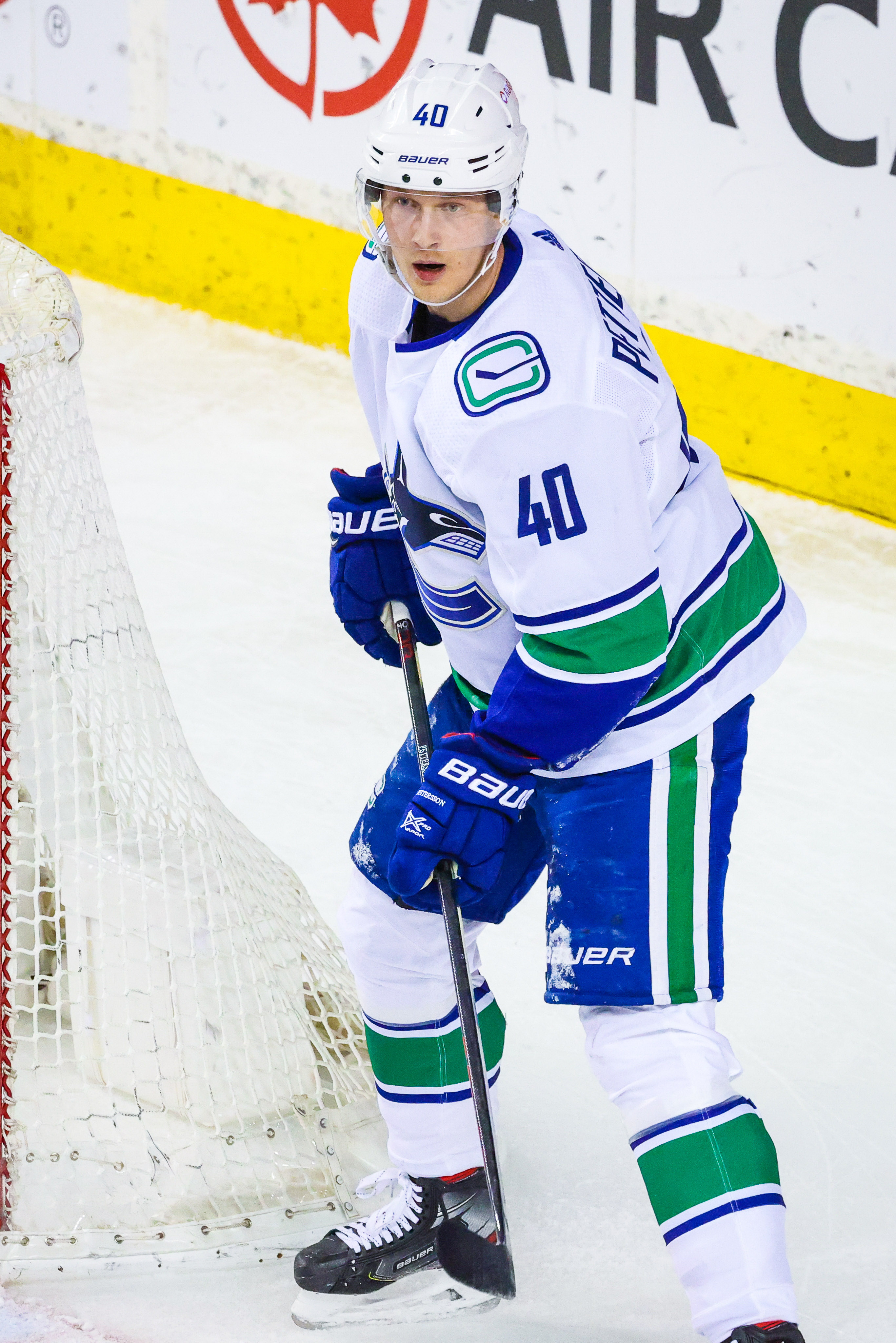 Pettersson opted for a bridge contract last summer which helped Vancouver to stay cap-compliant and give them a little more flexibility in the short term. However, the contract is significantly backloaded and carries a qualifying offer of $8.82MM next summer (the lower of 120% of the AAV or the final year’s salary of $10.25MM). At this point, the 23-year-old is well on his way to being worth that qualifying amount but the Canucks will likely need to come in above that to get him to commit to a long-term agreement. Otherwise, he could simply opt to take the minimum offer and test the open market in 2025. Horvat’s deal is the priority right now but Pettersson’s situation looms large from a planning perspective.
Pearson improved upon his performance from the year before but it was still a notch below how he did in his first full season with the Canucks. On its own, the contract isn’t an overpayment but the market has been tight for middle-six wingers lately so there’s no guarantee he’ll be able to get that two years from now. Dickinson’s first season with Vancouver was a disaster. Brought in to be the third-line center, he instead struggled mightily, putting up the worst full-season numbers of his career. At this point, he’s a candidate to be waived in training camp (which would still leave a lingering $1.525MM cap charge).
Myers hasn’t lived up to his contract from a value standpoint but he has logged some heavy minutes in a top-three role since joining the Canucks three years ago. His offensive game has tailed off which won’t help his market two years from now but he should still be able to land a multi-year deal in the $4MM range in 2024. Rathbone is another player that will be in the mix for a roster spot with Vancouver in training camp and notably received a one-way deal for both years despite having limited NHL experience. He has the offensive ability to put up some numbers that could quickly escalate his salary two years from now if he’s able to lock down a regular role in the lineup.
Martin has very limited NHL experience with just nine appearances under his belt, six of which came last season where he did well enough to earn the backup nod. If the 27-year-old can establish himself as a capable full-time backup based on performance and not his contract, there will be an opportunity to add a couple of million or more on his next deal.
Signed Through 2024-25
F Brock Boeser ($6.65MM, UFA)
F Curtis Lazar ($1MM, UFA)
D Tucker Poolman ($2.5MM, UFA)
Boeser’s case was one that had some pressure on it earlier this summer when the qualifying offer deadline was getting close. In the end, he took less than that number ($7.5MM) in exchange for a three-year commitment. Boeser produced closer to the level of a second-liner last season and if that continues, this could wind up being an above-market contract. Lazar comes over after spending last season with Boston on their fourth line and he’ll likely have the same role with Vancouver. There really isn’t much risk with this deal; $1MM for a capable fourth liner is a fair price.
Poolman is someone whose availability is certainly in question as he continues to try to work his way back from a concussion. When healthy, he is an option for the third pairing but if he’s unable to start the season, he could go on LTIR and simplify Vancouver’s short-term salary cap situation.
Poll: Who Will Win The Atlantic Division?
After asking our readers to pick the winners of the Central and Pacific Divisions next season, it’s time to turn toward the Eastern Conference. While the Pacific Division vote was split nearly evenly between the Edmonton Oilers (who held the edge) and the Calgary Flames, the Colorado Avalanche dominated the vote counter for the Central, garnering over 62% of the votes. No other team had more than 15%.
The Eastern Conference, like last season, carries a far bit more intrigue, though. With a tumultuous offseason, there’s poised to be a shuffling of the deck, with former titans falling and upstart teams emerging.
No team may exemplify that better than last season’s Presidents’ Trophy winners — the Florida Panthers. Last season’s 58-18-6 record was by far the best in team history, but they bowed out quietly in the Second Round, being swept by the eventual Eastern Conference champion Tampa Bay Lightning.
That playoff disappointment beckoned a host of changes, beginning behind the bench. Interim head coach and Jack Adams Award finalist Andrew Brunette was dismissed in favor of veteran coach Paul Maurice, who aims to gel the team’s defensive holes that ultimately doomed them. That will be a tough challenge with a defense core that’s already missing Mackenzie Weegar via trade and whose most notable additions were depth veterans Marc Staal and Michael Del Zotto. A refresh on offense also hit the team’s scoring depth, with breakout star Mason Marchment departing in free agency and franchise cornerstone Jonathan Huberdeau replaced with Matthew Tkachuk. The team will also have to manage the first few months of the season without Anthony Duclair, who’s rehabbing an Achilles tendon injury.
The Toronto Maple Leafs roared to a 115-point season last year for second place in the division, but they too have taken hits to the roster. A new goaltending tandem of Matt Murray and Ilya Samsonov begs more questions than it gives answers, and the team will miss Ilya Mikheyev and Ondrej Kase as important depth scoring. They did get some of that depth back in the form of Calle Jarnkrok signing in free agency, but the team will largely be forced to run it back with question marks in net.
2021-22 was a season of threes for the Tampa Bay Lightning, who finished third in the Atlantic en route to their third straight Stanley Cup Final appearance. After losing in the Final, though, they’ll need to figure out how to replace the losses of Ondrej Palat and Ryan McDonagh largely internally. They’ll bet on a big breakout season from forward Brandon Hagel, who they paid a steep price at the Trade Deadline to acquire just for that reason. They’ll also have to get through the start of the year without Selke-caliber center Anthony Cirelli, who’s likely out until December with a shoulder injury.
The Boston Bruins are bringing Patrice Bergeron and David Krejci back for one last ride, but they’ll have to do it without Brad Marchand, Charlie McAvoy, Matt Grzelcyk, and Mike Reilly to start the season. With that level of firepower out of the lineup, it could spell trouble in such a competitive division. An apparent downgrade behind the bench as well means the team could struggle to reach the 50-win, 100-point mark again this season.
The Ottawa Senators and Detroit Red Wings both made incredible splashes in free agency, and figure to make it a six-team race for three to five playoff spots in the Atlantic. Ottawa’s additions of Alex DeBrincat and Claude Giroux give them one of the highest-powered top-sixes in the conference, while Detroit’s additions of David Perron, Andrew Copp, and Ben Chiarot give them high-quality depth to support their growing stars.
The Buffalo Sabres and Montreal Canadiens, while likely to be at the bottom of the division again, will both look to take steps forward with significant improvement expected from their young franchise cornerstone. Owen Power‘s rookie performance will be the storyline all season in Buffalo, while Cole Caufield will look to transform his elite skill into the consistency required to be an All-Star.
So, PHR readers, we ask you again — who do you think will win the Atlantic Division next season? Make sure to vote in the poll below and leave a comment below to contribute to the discussion.
Who Wins The Atlantic Division In 2022-23?
-
Toronto Maple Leafs 31% (507)
-
Tampa Bay Lightning 27% (442)
-
Florida Panthers 20% (329)
-
Boston Bruins 6% (95)
-
Ottawa Senators 6% (95)
-
Detroit Red Wings 4% (58)
-
Buffalo Sabres 3% (50)
-
Montreal Canadiens 2% (35)
Total votes: 1,611
Mobile users, click here to vote!
2008 NHL Draft Take Two: Seventh Overall Pick
Hindsight is an amazing thing, and allows us to look back and wonder “what could have been.” Though perfection is attempted, scouting and draft selection is far from an exact science, and sometimes, it doesn’t work out the way teams – or players – intended. For every Patrick Kane, there is a Patrik Stefan.
We’re looking back at the 2008 NHL Entry Draft and asking how it would shake out knowing what we do now. Will the first round remain the same, or will some late-round picks jump up to the top of the board?
The results of our redraft so far are as follows with their original draft position in parentheses:
1st Overall: Steven Stamkos, Tampa Bay Lightning (1)
2nd Overall: Drew Doughty, Los Angeles Kings (2)
3rd Overall: Roman Josi, Atlanta Thrashers (38)
4th Overall: Alex Pietrangelo, St. Louis Blues (4)
5th Overall: Erik Karlsson, Toronto Maple Leafs (15)
6th Overall: John Carlson, Columbus Blue Jackets (27)
Instead of the underwhelming Nikita Filatov, the Blue Jackets grab one of the best offensive defensemen of the last decade. Carlson has posted at least 70 points in three of the past four years and reached his career-high of 75 in the COVID-shortened 2019-20 campaign, earning him a second-place finish in the Norris Trophy voting. He logged nearly 26 minutes a night in his 2018 Stanley Cup run and is on track to hit 600 career points early this season. It’s not often that a draft has five defensemen this capable that can dominate the early board but the Blue Jackets have followed the trend and picked their own franchise blueliner.
We now move on to the seventh selection and the first of two first-round selections by the Nashville Predators.
 There was always a chance that the Predators could change the direction of their franchise with the 2008 draft, though few would expect it to come from the second round, when Josi was selected 38th. Instead, one would have thought it was either the seventh or 18th pick that would become the franchise-altering talent down the road.
With their first selection, general manager David Poile (who has been well connected to USA hockey for a very long time) decided to dip into the college ranks and take freshman standout, Colin Wilson, from Boston University. Wilson had absolutely dominated the U18s, scored six goals in six games at the World Juniors and had NHL pedigree. His father, Carey Wilson, had scored over 400 points at the NHL level and competed in the Olympics (for Canada), his uncle Geoff Wilson was a draft pick of the Pittsburgh Penguins, and his grandfather Jerry Wilson played three games for the Montreal Canadiens in 1956-57. In fact, Carey had been acquired by the Calgary Flames just months after Poile had left his role there as AGM, making the selection of Colin a kind of odd family circle.
This wasn’t some nepotistic pick, though. Wilson was a powerhouse for BU, scoring 12 goals and 35 points in 37 games as a freshman, making him the ninth-ranked North American skater by NHL Central Scouting and a sure bet to be an impact player at the professional level. When he won the Jim Johannson Award as the USA Hockey College Player of the Year the following season and led BU to a national championship, it was clear he was ready to make the jump. He played in the World Championship that spring against NHL talent (where Poile was AGM for the U.S. team) and then transitioned to professional hockey in 2009-10.
While he may not be the best player selected that year, Wilson had a solid career, scoring 113 goals and 286 points in 632 games. He was a versatile middle-six forward for many years with the Predators, reaching a career-high 20 goals and 42 points in 2014-15.
After announcing his retirement in early 2021, Wilson continued to have a positive impact in a very different way. He released an emotional piece in The Players’ Tribune that detailed his struggles with a diagnosis of obsessive-compulsive disorder, his battle to keep a career on the rails, and his hopes that others facing similar difficulties would open up about them in the future.
I played in the NHL. I lived my dream. And I fought through hell to make a career for myself. My name might not be on the Stanley Cup, and that’s fine. Because I know there is an opportunity ahead of me to not just leave my mark on the game of hockey, but also on lives all across the world.
When Jimmy Hayes tragically died in the summer of 2021 because of an apparent drug overdose, Wilson took to the Tribune’s pages again, to go even deeper into his own history of drug abuse. It was an attempt to come clean with himself and perhaps shine a bit brighter spotlight on the growing overdose epidemic, and how it affects people with mental health disorders.
Unlike some of the other players that were picked in the first round, Wilson wasn’t a bust. He sits 18th in points among all players from the draft class. But With the advantage of hindsight, the Predators can pick a different talent, someone that would have had an even greater effect on the organization.
With the seventh overall pick in the 2008 NHL Draft, who will the Nashville Predators select? Cast your vote below.
2008 Redraft: Seventh Overall
-
Jacob Markstrom 28% (301)
-
Jordan Eberle 16% (172)
-
Braden Holtby 15% (165)
-
Jared Spurgeon 10% (112)
-
Cam Atkinson 9% (102)
-
T.J. Brodie 3% (31)
-
Josh Bailey 3% (29)
-
Gustav Nyquist 2% (22)
-
Derek Stepan 2% (21)
-
Adam Henrique 2% (20)
-
Tyler Myers 2% (19)
-
Colin Wilson 2% (18)
-
Zach Bogosian 1% (13)
-
Michael Del Zotto 1% (9)
-
Luke Schenn 1% (8)
-
Jake Allen 1% (8)
-
Justin Schultz 1% (7)
-
Jake Gardiner 1% (6)
-
Tyler Ennis 1% (6)
-
Marco Scandella 0% (5)
-
Travis Hamonic 0% (4)
-
Mikkel Boedker 0% (3)
-
Matt Martin 0% (2)
Total votes: 1,083
[Mobile users click here to vote!]
Photo courtesy of USA Today Sports Images
Poll: Who Is Next To Rebuild?
It seems every year in the NHL, a team mired in a years-long rebuild finally turns a corner and becomes a legitimate contender again while a team that has been successful for a long time finally decides it needs to start over and enters its own rebuild. One would think that the 2022-23 season wouldn’t be an exception, but while there are several teams that seem to be turning the corner, such as the Anaheim Ducks, Detroit Red Wings, and Ottawa Senators, it’s not immediately clear who is heading for an imminent rebuild. Sure, some teams already in a rebuild stepped up their efforts a bit, like the Chicago Blackhawks and San Jose Sharks, but their process had already begun. Before looking at the teams that could be in this unenviable position, we’ll attempt to classify the rest of the pack.
Window is Staying Open: CAR, CGY, COL, DAL, EDM, FLA, NYR, TBL, TOR
Up and Coming: ANA, BUF, CBJ, DET, LAK, NJD, OTT, VAN
Already Rebuilding: ARI, CHI, MTL, PHI, SEA, SJS
After trying to sort out where a large portion of the league stands on their builds, that leaves nine teams in a sort-of limbo state. These teams could, in theory, win the Stanley Cup this year, could be a team on the fringe of the playoff picture, or could find themselves needing to start things over. Once again, the remaining teams appear to fit into one of three categories on their status:
Proven Winner With A Veteran Core:
The teams best placed here would be the Boston Bruins, New York Islanders, Pittsburgh Penguins, St. Louis Blues, and Washington Capitals. With their current build, three teams have won at least one Stanley Cup (Pittsburgh, St. Louis, and Washington), one has made it to the Cup Final, Boston, and the fifth, the Islanders, made back-to-back Conference Finals. All five of these teams, for the most part, have a key group of players who are towards the later stages of their prime, if not out of it, and all have a substantial portion of that core signed for at least a couple more seasons.
A team like the Islanders who has one of the older groups, also has the largest portion of that group signed long-term. That, combined with their lack of a Stanley Cup would make them seem as though they will try at least a couple more times to be a winner. But the age and cap implications could have a volatile effect. To the opposite, Pittsburgh and Washington have achieved the ultimate goal so rebuilding when necessary would be easier to stomach. But, unlike the Capitals, the Penguins recently signed two players in their mid-30’s to long-term extensions. Either way, both teams have several veterans still at the top of their game.
Boston is in their own unique situation, as they have a few players in or entering their prime, such as David Pastrnak, Charlie McAvoy, Hampus Lindholm, and Jeremy Swayman and that group hasn’t won a Cup with the team. But time could be running out on veterans, and previous Cup winners, Patrice Bergeron, Brad Marchand, and David Krejci, not to mention Pastrnak’s looming free agency.
Lastly, St. Louis has a relatively younger core, which they’ve won with, but will be faced with nearly all of their key players hitting the UFA market in the next couple of seasons. If they can manage to keep those pieces while also managing their cap, they could easily fit in above with the windows open group but if not, a rebuild might be less of a choice than simply reality.
Cap Concerns:
The two teams included in this section, the Minnesota Wild and Vegas Golden Knights, have both impressed in recent seasons and boast a roster that would appear as though it can compete going forward. But, managing the cap will not only prove burdensome, but has already forced a number of moves that represent a step back for the organization. First, Vegas has sacrificed plenty in order to be instantly competitive and maintain themselves through their first five years in the league. That was as clear as ever last offseason when they traded Vezina Trophy winner Marc-Andre Fleury for a minor league player, and this offseason when they traded star forward Max Pacioretty for future considerations. The team has had to make sacrifices of real talent in order to stay cap compliant and keep the remainder of their group intact, which could spell disaster.
The Minnesota Wild have otherwise managed their cap situation rather well, but have put themselves in a difficult position with the buyouts of Zach Parise and Ryan Suter, which will put $12.74MM against their cap this year and $14.74MM the two years after. The Wild already had to trade the dynamic Kevin Fiala to make things work for 2022-23 and things only figure to get more difficult over the next three seasons. One bright side, the group they currently fit in with the penalties has shown they can perform as well as anyone.
Of note, one might think the Tampa Bay Lightning are a perfect fit in this section, however the recent extensions of Erik Cernak,, Anthony Cirelli, and Mikhail Sergachev show the organization has no plans on changing course for a considerably long time.
Lack Of Performance:
The Nashville Predators and Winnipeg Jets provide two of the most fascinating examples of teams that could rebuild, could breakout, or could just simply stay as a middle-of-the-road team. Both teams have a number of exciting names, many of whom are signed for at least a few years, but neither seem to be among the best of the best. This offseason the Predators re-signed Filip Forsberg and acquired Ryan McDonagh, showing their desire to stay competitive and improve. However, since their appearance in the 2017 Stanley Cup Finals, the team has made it past the first round once, back in 2018. Even with breakout performances from Forsberg, Matt Duchene, Ryan Johansen along with an all-time performance from Roman Josi, the Predators just made it into the playoffs, losing to the eventual Stanley Cup Champion Colorado Avalanche in the first round.
Winnipeg, like Nashville, carries several star players including Kyle Connor, Nikolaj Ehlers, Josh Morrissey, and Mark Scheifele along with former Vezina winner Connor Hellebuyck. Still, that group has made it past the first round once since their Western Conference Finals appearance in 2018, and failed to make the postseason altogether this year. Now with an older Blake Wheeler, as well as Scheifele an Hellebuyck each two years away from free agency, Winnipeg may need to re-evaluate their build if it can’t compete for a Stanley Cup regularly with this group.
Considering the teams that seem poised for a rebuild, who is the most likely one to blink first and tear things down? Could it be a team that’s had a good run but needs to get younger? A team that just needs to reset from a salary cap perspective? A team who just hasn’t been able to meet their goals? Or an unexpected candidate?
Who Is Next To Rebuild?
-
Boston Bruins 25% (463)
-
Winnipeg Jets 19% (348)
-
Washington Capitals 11% (199)
-
New York Islanders 10% (186)
-
Pittsburgh Penguins 10% (183)
-
Vegas Golden Knights 9% (162)
-
Nashville Predators 4% (73)
-
Other 4% (73)
-
St. Louis Blues 4% (71)
-
Minnesota Wild 3% (58)
Total votes: 1,816
Trade Rumors app users, click here to vote.
This Day In Transactions History: Ilya Kovalchuk Signs Revised Fifteen-Year Contract With New Jersey Devils
What if there had been an Ilya Kovalchuk, Jack Hughes, and Jesper Bratt line going into next season? At age 39, perhaps Kovalchuk would have been destined for the third line with some combination of Erik Haula, Tomas Tatar, Andreas Johnsson, and Dawson Mercer. It’s likely this isn’t exactly what the Devils and their fans were thinking when the team signed Kovalchuk to a 17-year, $102MM contract back in July 2010. After all, Hughes was just nine-years-old, current team captain Nico Hischier was 11, and All-Star defenseman Dougie Hamilton was looking to boost his stock in the 2011 draft with a big year for the Niagara IceDogs.
In reality, nothing went to plan when the Devils and then-GM Lou Lamoriello signed the 17-year pact with Kovalchuk, the NHL taking issue with it as a form of salary cap circumvention, an arbitrator agreeing with them. This would force a negotiation between the league and the NHLPA on how to handle the structure of long-term contracts. On top of Kovalchuk, the NHL had been looking into the contracts of Chris Pronger, Roberto Luongo, Marc Savard, and Marian Hossa, all of whom had received long-term, front-loaded contracts that carried salaries at or near the league minimum in the final few years, which served to bring down the overall cap hit of the deal.
In sum, the league and the players agreed to rules affecting new contracts (as of September, 2010) for five years or longer that lasted at least to a player’s 41st birthday which would give a more accurate reflection of the salary the player was earning. The agreement also made sure the issue wouldn’t automatically carry over into the next CBA, and of course, rules on contracts have changed dramatically since the 2012-13 lockout. Now, seven or eight-year maximums, consistent cap hits, 35+ contracts, and the like regulate at least that form of salary cap circumvention.
After the dispute, New Jersey and Kovalchuk agreed on a revised 15-year, $100MM contract on September 3, 2010 that would run through the 2024-25 season, carrying a cap hit of $6.67MM. The matter now settled, the Devils were looking ahead to their fourth Stanley Cup with their superstar in hand. Of course, as we know, the drama was far from over. During the first three years, Kovalchuk would be solid, but New Jersey would miss the playoffs in two of the three years. However, Kovalchuk and the Devils would take the Los Angeles Kings to Game Six of the 2012 Stanley Cup Finals, the winger playing a big part of that run.
Unfortunately for New Jersey, during the 2012-13 lockout, Kovalchuk would return home to Russia, playing with SKA St. Petersburg, who he had considered signing with during his 2010 free agency. The experience playing close to home and having his family nearby had an impact on Kovalchuk, who informed Lamoriello of his intention to return home to Russia after the shortened 2012-13 campaign. At just 30-years-old, Kovalchuk voluntarily retired from the NHL following the 2012-13 season, leaving 12 years and $77MM on the table. The Devils, who had already lost Zach Parise to free agency the year prior, were given a yearly $250K cap-recapture penalty, which is in effect through 2024-25, but were handed the forward’s cap hit back.
The 2013 offseason saw New Jersey bring in Jaromir Jagr to replace Kovalchuk’s production, the 41-year-old turning in an impressive 67-point campaign, but the Devils would miss out on the playoffs, finishing with 88 points. The team struggled to start the 2014-15 season, firing Head Coach Peter DeBoer and Lamoriello leaving that spring for an opportunity with the Toronto Maple Leafs. The organization would head into a full-scale rebuild, one which has, outside of a 2017-18 playoff appearance lead by Hart Trophy winner Taylor Hall, lasted through this offseason. Things look to have finally turned a corner in New Jersey, lead by Hughes, Hischier, Mercer, Hamilton, and a world class group of prospects including Luke Hughes, Simon Nemec, and Alexander Holtz, but the aftermath of trying to re-sign and then losing Kovalchuk is apparent.
The Devils and their fans may, and rightfully so, attribute this long, painful rebuild at least in part to Kovalchuk’s abrupt departure, however they may have been best-served by it. At the time of signing, New Jersey was expecting Kovalchuk to lead a team backstopped by an aging Martin Brodeur and lead up front by an older Patrik Elias. Though Cory Schneider was able to step-up as one of the league’s better goaltenders during their rebuild, the team didn’t really have the younger, supporting cast to put around Kovalchuk as he entered his 30’s. And, having his relatively large cap hit on the books would have made doing so, and likely rebuilding on-the-fly, rather difficult. That would have in turn likely delayed the inevitable: a lengthy, painful rebuild.
As for Kovalchuk, the winger got his wish to head home to play in his native Russia and have his family nearby, something he accounted for when he left the $77MM on the table back in New Jersey. He would spend five more seasons with St. Petersburg, serving as one of the league’s best players on a premier team. Following the 2017-18 season, the Devils’ NHL rights over the forward expired and a 35-year-old Kovalchuk sought a return to the NHL. He’d sign a three-year, $18.75MM contract with the Los Angeles Kings, but had his contract terminated part-way through the 2019-20 season.
The Kovalchuk mega-deal, whether it be the original or the revised, wasn’t the first or the last handed out by an NHL organization, but holds significant weight in NHL history. First, one of the league’s very best players leaving in his prime, with more money than most players will ever earn left on the table was one of the biggest and strangest transactions in hockey’s history, perhaps in sports history period. Further, the original deal and the revised, provided a roadmap that would change the framework of the NHL’s contract and salary cap systems for the long-haul. The changes brought about by the first contract sparked the league’s desire for change, which became a focal point for the 2012-13 lockout.