
PHR Originals: 4/23/17 – 4/29/17
Here’s a rundown of some of the original content produced by the PHR staff over the past week:
Seth Lawrence takes a closer look at the Red Wings and some of the challenges GM Ken Holland faces this offseason as he looks to reshape the team after missing the postseason for the first time in 25 years. Unfortunately for those looking for change, there are some pricey contracts and a tricky salary cap situation to navigate that makes any significant changes easier said than done.
Seth also broke down some of the tough decisions that the Senators and GM Pierre Dorion will soon be dealing with when it comes to the expansion draft in June. As things look now, they may be in line to lose a key component of their team to the Golden Knights but that discussion will be in the background for now with the Sens already up 2-0 in their second round series against the Rangers.
Still with expansion, our Zach Leach details how the Flyers find themselves in a bit of a tricky situation when it comes to that draft. Do they protect their best option for the present and risk losing a quality youngster or protect the prospect and potentially have to go into free agency to find a new starter?
It’s likely to be a summer where quite a few goalies of note find themselves with new teams. Seth discusses some of the teams that are likely to be on the prowl for help between the pipes. With the amount of goalies that could be available in advance of expansion, those teams could be poised to bounce on a potential buyers’ market.
In a draft class without a consensus number one choice, the time may be right to consider dealing away the top pick which the Devils own after the draft lottery on Saturday. Our Gavin Lee reviews the recent history of the number one pick being traded, something that hasn’t yielded a whole lot of extra value for teams in the past.
Trading The First Overall Pick: A Draft Lottery Timeline
Since the NHL draft lottery was created in 1995, there has been an uncertainty over who would be given the opportunity to select first overall in the year’s draft, with perceived “tanking” teams not being guaranteed the best spot. From it’s inception through 2012, teams could only move up four spots and thus the Los Angeles Kings—the very first winners of the lottery—couldn’t steal the first pick away from the Ottawa Senators in ’95.
But whenever a team is awarded the top spot, immediate pressure is put upon them to consider trading it. Questions are asked, stories are written and the seed of doubt creeps into a front office. ‘How can we be sure that he’s the best available prospect?’ they ask, especially in years without a consensus. If Sidney Crosby or Connor McDavid aren’t staring you in the face, it may be beneficial to let someone else make that decision. Teams have indeed given up the first pick in the past.
In 1998, the Tampa Bay Lightning were easily the worst team in the league. They finished with a 17-55-10 record and at the deadline decided to give themselves a bit of insurance. They dealt Bryan Marchment and David Shaw to the San Jose Sharks for Andrei Nasarov and the right to flip picks with the Sharks should they win the lottery. The Sharks had acquired the Florida Panthers pick earlier in the year, and looked like they’d have a good chance at winning the lottery. They did just that, and the Lightning’s insurance policy paid off allowing them to flip picks and select Vincent Lecavalier first overall.
The Sharks would actually trade down one more spot, giving the Nashville Predators the chance to draft David Legwand at #2. In return, the Sharks selected Brad Stuart at #3, and Jonathan Cheechoo at #29. While both were great players for the Sharks, Lecavalier would have looked mighty fine in San Jose for the better part of his career.
In 1999, the Chicago Blackhawks actually won the draft lottery but could only move up from eighth to fourth. That winning set a huge line of trades in motion, as Brian Burke desperately worked to get the second and third picks in order to draft Daniel and Henrik Sedin. First he dealt with Chicago, then Tampa Bay and finally Atlanta, giving them the first-overall pick and the chance to draft Patrik Stefan the Czech center that had elite potential.
This story ends with the Canucks getting two legendary players who are with the team to this day, the Lightning—who originally had the first overall pick—with Dan Cloutier, Niklas Sundstrom and a whack of players who never panned out, and the Thrashers with one of the biggest draft busts in history. The Blackhawks at least got Bryan McCabe out of that original deal with the Canucks.
In 2002, the Florida Panthers were all set to draft Jay Bouwmeester first overall after winning the draft lottery and moving up from third. He was their target all along, until Doug McLean and the Columbus Blue Jackets said they wanted Rick Nash anyway, and would trade up to get him. The Panthers moved back down to the third spot after making a deal with Atlanta that they wouldn’t pick Bouwmeester at #2—they chose Kari Lehtonen instead—and everyone ended up with their guy. All Florida got for moving down was the right to swap picks with Columbus the following year, but since the Panthers would again find themselves with the first-overall pick that right was never exercised.
That 2003 lottery had much of the same for Florida, who this time moved up from the fourth spot. It was the Penguins this year who were after that top spot, eyeing a goaltender named Marc-Andre Fleury. They dealt the Panthers Mikael Samuelsson, a second-rounder and their spot at #3 overall for the right to draft “Flower” and an extra third round selection. The Panthers would pick Nathan Horton at #3, and Stefan Meyer with that second rounder.
In retrospect, trading the first overall pick has rarely generated much extra value for the team, but has caused some of the most interested draft-floor dealing in history. When teams attend the lottery this Saturday, we’ll see who may hold the cards going into the June draft. With no clear consensus in the top five once again, perhaps there is another chance for a first-overall swap this summer.
PHR Originals: 3/27/17 – 4/1/17
Pro Hockey Rumors had a number of original articles this week as the regular season winds down and the playoffs beckon. Here are a few from the past week:
- Brett analyzed the Edmonton Oilers’ first line dominance and how it has played a tremendous role in the success of the team this season. While the Oilers’ renaissance certainly got its jumpstart from Connor McDavid, it’s the play of others who have certainly helped the team reach the playoffs for the first time in 11 years.
- Meanwhile, I took a closer look at the rebuild situation that the Red Wings are facing and some concerning elements that have arisen over the past few years that GM Ken Holland will have to navigate.
- Gavin highlighted the surprising yet impressive performance by Patrick Eaves, who has notched 29 goals this season between the Dallas Stars and Anaheim Ducks. He also notes that no one in the hockey world–including your humble writers here at PHR–saw this performance coming. In addition to Eaves, Gavin wrote about Toby Enstrom and how after going through a season ending knee surgery, it may be in the Jets best interest to find a way to have him waive his no movement clause.
- Finally, Gavin also answered many of your questions during a live chat. In addition to providing sound hockey analysis, he’s also open to fantasy baseball advice for replacing Jeurys Familia.
David Pastrnak & Leon Draisaitl: The Next Contract
The 2016 restricted free agent market was one of the most talented – and most entertaining – in recent memory. As hockey moves more and more toward youthful skill and speed, the dynamics of team building have changed as well, as last summer marked the “death of the bridge deal“. A multitude of massive extensions for young players were handed out, including giant new deals for forwards like Colorado’s Nathan MacKinnon, Winnipeg’s Mark Scheifele, Calgary duo Sean Monahan and Johnny Gaudreau, and Florida pair Jonathan Huberdeau and Vincent Trocheck. The 2017 RFA group is no slouch either; it features star scorers such as Minnesota’s Mikael Granlund, Vancouver’s Bo Horvat, Nashville’s Ryan Johansen and Viktor Arvidsson, the Tampa Bay trio of Jonathan Drouin, Tyler Johnson, and Ondrej Palat and more.
Yet, the two most intriguing restricted free agents are the youngest of the group: 20-year-old Boston Bruins right winger David Pastrnak and 21-year-old Edmonton Oilers center Leon Draisaitl. Last summer opened the door for the game-changing pair to skip right over an affordable short-term deal that would keep them restricted into a third contract for the “prime” of their career. Now, Pastrnak and Draisaitl have the newly-minted industry standard option of asking for a six- to eight-year deal, lasting well into their late 20’s, worth somewhere in the range of $5-7MM annually. So what exactly will the new contracts look like this summer?
Pastrnak’s agent, J.P. Barry, is on the record as saying that his client is looking for a long-term deal and they are viewing the contracts of Monahan, Scheifele, and Filip Forsberg as comparisons. Forsberg signed a six-year, $36MM extension last June, worth $6MM annually, while Monahan re-signed for $6.375 per year for seven seasons and Sheifele agreed to $6.125MM a year for the maximum eight seasons. The only problem for Pastrnak and his representation in making those comparisons is the consistency argument. Pastrnak has an impressive 64 points through 68 games so far this season, much like Monahan’s 63 point total last year. However, Monahan also put up 62 points the year before and 34 as a rookie. He was only slightly older than Pastrnak when he agreed to an extension, but had far greater production in his first two seasons when compared to Pastrnak’s back-to-back mid-20’s performances. Scheifele also had a similar season to Pastrnak’s last year with 61 points in 71 games, but he too outperformed the young Czech the prior two seasons – and was two years older – when inking his eight-year mega deal. Like Monahan, Forsberg had consecutive 60+-point seasons before earning his new deal.
The Monahan, Scheifele, and Forsberg comparison works far better for Draisaitl. Now in his third NHL season, but still just 21, Draisaitl leads all impending RFA’s with 70 points on the year, following up his breakout 51-point campaign in 2015-16. With back-to-back strong seasons, like the previously described trio, Draisaitl should be comfortably within the $6-6.5MM annual range for his upcoming contract. The Oilers will have to keep in mind the possible record-setting deal awaiting them in Connor McDavid next year, but will not hesitate to pay Draisaitl, who is already one the best #2 centers in the NHL. While a very different player, Draisaitl’s early career arc closely resembles that of Gaudreau, and “Johnny Hockey” signed on for six more years in Calgary at $6.75 per, so don’t be surprised if Draisaitl actually ends up exceeding the $6-6.5MM annual range in his new deal or agrees to seven or eight years as compensation for a lower yearly value.
So what of Pastrnak? No one doubts that he will continue producing at a high level, especially with Boston’s top offensive stars like Brad Marchand, Patrice Bergeron, David Krejci, and David Backes signed long-term and in influx of promising talent on it’s way. However, with just one – albeit unbelievable – high-scoring season under his belt, Pastrnak may not be able to crack that $6MM per year mark. Some may point to MacKinnon, the youngest and arguably most talented RFA to re-sign last year, and say that Pastrnak should get the same seven-year contract worth $6.3MM annually. However, MacKinnon was a #1 overall pick and had established himself as a top-line center with a 63-point rookie season in 2013-14, far ahead of where Pastrnak was at that point, which cancels out some of his more recent struggles. Instead, a better comparison is likely Panthers scorers Trocheck and Huberdeau. Like Pastrnak, Trocheck and Huberdeau found only middling success in their first two NHL seasons. Trocheck had a big breakout last year, jumping to 53 points in 76 games, and was rewarded with a six-year deal worth $4.75MM per year. Huberdeau had his breakout in 2014-15 with 54 points and then backed it up 59 points last season, before inking a six-year extension worth $5.9MM annually. What Pastrnak has done this year clearly surpasses anything that the Florida duo have yet to put up and Trocheck and Huberdeau were also two years older than Pastrnak will be when they re-signed, but they set up a more accurate range for what the Bruins wunderkind should expect this summer. Taking likely cap inflation into consideration, Pastrnak is looking at a six-year extension worth $5-6MM per season. Given the Bruins recent issues with retaining young talent, it’s a fair assumption that they won’t play hardball with the young sniper, so expecting the upper side of that scale is perfectly reasonable.
The Case For T.J. Oshie As This Summer’s Top Free Agent
Earlier this year, PHR put together our first draft of the 2017 unrestricted free agent class. Washington Capitals right winger T.J. Oshie finished a respectable fourth on that list, behind Joe Thornton, Alexander Radulov, and, of course, Oshie’s new teammate Kevin Shattenkirk. Those mid-season power rankings were just that, a list based on career performance and the first half of the season. Yet, free agancy often reflects “what have you done for me lately?” rather than a complete analysis of a player’s full body of work, and the second half of the season has been a windfall for Oshie. Is he now the top player on the market this summer?
After last night’s hat trick against the Tampa Bay Lightning, Oshie is now the Capitals leading goal-scorer. Yes, that’s right, Oshie leads the best team in the league in goals, not Alexander Ovechkin. The last time that any player led Washington in goal scoring at this point in the season and wasn’t Ovechkin: Robert Lang in 2003-04. Not only that, Oshie’s 49 points in 58 games makes him the most efficient scorer on the team behind Nicklas Backstrom. Oshie is sniping at a career rate in 2016-17, with a 24.2% shooting percentage, which explains his career-high in goals as well. He also has a career-best +26 rating right now, a function of the Capital’s success but also of the more careful, refined game he has shown this season.
So Oshie is having an excellent year; does that make him the top free agent? No one behind Oshie on our initial list has played significantly better, so it comes down to comparing him against Thornton, Radulov, and Shattenkirk. The first thing that should stick out between Oshie and Thornton is age. Oshie will be 30 years old at the start of the 2017-18 season, whereas Thornton will be 38. Radulov will be just 31, but has just returned to the NHL this season after a long hiatus in the KHL. Oshie and Thornton thus have him beat in terms of career consistency and dependability. If 2016-17 scoring is the main criteria, it’s a close race with Oshie at 49 points, Thornton at 48 points, and Radulov at 47 points, but Oshie has played in fewer games than the others. With an age advantage over Thornton and a consistency advantage over Radulov packaged with a scoring advantage over both, it’s fair to say that Oshie has moved into the top spot among impending free agent forwards. Making that call easier is the fact that both Thornton and Radulov are expected by many to re-sign with their current teams following the Expansion Draft in June and may not even hit the open market with Oshie on July 1st.
So that leaves Oshie vs. Shattenkirk. Especially if Washington wins their first ever Stanley Cup on the backs of these two players, both Oshie and Shattenkirk will be highly sought-after and handsomely paid on July 1st. However, can you make the case that Oshie has surpassed his new teammate in free agent value? Back in January, the PHR writers were in universal agreement that Shattenkirk was the top player available. However, when it came time for the St. Louis Blues to move him at the Trade Deadline, rumors began circulating that many teams saw Shattenkirk as a second-pair guy, were unwilling to part with top prospects and multiple high picks to acquire him, and were not planning on handing him a contract worth $7MM+ per year this summer. The Capitals ended up parting with a package that surprised many as being relatively cheap in return for the star defenseman. Shattenkirk is still the best blue liner on the market and will get his money somewhere, but no such word has come out about Oshie’s free agency prospects. It appears that teams are ready to give the skilled winger whatever he asks, as Oshie has proved time and time again that he is one of the most consistent scorers in the NHL, as well as a powerplay dyanamo and shootout specialist. The simple fact that scoring defense is always in higher demand than scoring forwards may dictate that Shattenkirk remains the top free agent this summer, but don’t be surprised to see Oshie get a similar deal to his teammate and go on to have greater success than Shattenkirk with his new team in the future.
Thoughts On The NHL Expansion Draft List Controversy
Earlier this week the NHL GMs met in Boca Raton for a series of meetings meant to improve the game. One tentative resolution, as first reported by ESPN’s Pierre Lebrun, is that the NHL will not release the list of exposed players prior to—or even after—the NHL Expansion Draft this summer. This revelation created quite the ruckus amongst fans and media alike, as almost no one expected the NHL to completely deny access to the hotly-anticipated list.
Hotly-anticipated is no misnomer. CapFriendly’s mock expansion draft tool just surpassed 30,000 user-created drafts since its November’s inception. Fan blogs across the web delved into extensive analysis on who teams should protect and expose. Commentary on every transaction so far this year always had the obligatory “how does this effect the expansion draft” question attached to it. Needless to say, the protected list of NHL players will be the hottest commodity come June.
And yet the NHL GMs have tentatively decided to permanently withhold that list, making it impossible for everyone outside the NHL GM community to stage their own mock drafts and analyze GMs’ decisions. The GMs surely have their reasons, but fans and the media have theirs in support of publishing the protected list. The following outlines both sides in an effort to understand the rationale behind both desires.
For releasing the list
The two main arguments for releasing the list are simple: to facilitate mock drafts and to provide context and analysis of both the draft itself and moves leading up to the draft. And more importantly to the NHL, both arguments produce increased exposure. Fans and media clamour for this information, and the NHL should enjoy the attention windfall that follows.
Moreover, it rewards those who follow the NHL closely enough to care about who teams protect and who they expose. The NFL and NBA all have an extensive mock entry draft culture that allows fans almost unlimited imagination as to which players go where. With an event as unique as the expansion draft, the NHL should not deny fans the opportunity to construct their own Vegas Golden Knights using an official list of players.
Against releasing the list
The two main arguments against releasing the list center on the GMs and the players themselves. One, the GMs do not want their decisions scrutinized more than necessary. Two, NHL players may not want the public to know who isn’t worthy of protection, or relatedly, the GMs do not want their players to know who gets exposed.
Protecting themselves against scrutiny may be the low-hanging fruit argument, but it merits attention. The NHL continues to announce NHL contracts without crucial details like amount, conditions, and whether there is a no-trade or no-movement clause. This is despite the popularity of sites like CapGeek, Capfriendly, and General Fanager. The argument is that fans do not need to know these details to enjoy the game, and that scrutiny begets negativity, and—more telling—criticism directed at GMs.
The second argument may have more heft. Players may not want to know that certain players in the locker room were protected while others were exposed. In a skill-based game where ego runs rampant, knowing that a team finds you dispensable may alter the relationship between teams and players. Moreover, players may not want others to know if a team finds them dispensable. In an environment with almost no privacy, players may want to cling to whatever confidentiality they can.
In the end, the pressure from fans and media alike shoud push the NHL to change its mind and release the list. The benefits outweigh the positives, and the increased exposure should be cultivated rather than ignored.
Predicting The Next “Bartkowski Deal”
The genius that was the Matt Bartkowski signing should not be understated. By now, the extension for the purpose of Expansion Draft exposure has become commonplace, but what GM Brad Treliving and the Calgary Flames did was unique. They went outside the organization to sign a player to a multi-year deal who fulfilled the criteria of having played in 40 games this season or 70 games over the past two years. Except Bartkowski hadn’t played a single NHL game this season; he had been on a minor league contract with the AHL’s Providence Bruins. What that means is Bartkowski had to have played in over 70 games last season alone, and indeed he had skated in 80 games with the Vancouver Canucks in 2015-16. In fact, Bartkowksi was the only defenseman on the planet who played in over 70 games last season yet was not signed to an NHL contract this season. Therein lies the genius that was the unassuming signing of Bartkowski. The Flames picked up the only player on the market who could automatically fill their need for an exposure-eligible defenseman.
With a reportedly quiet trade market this season, there are bound to be teams facing expansion protection problems after the March 1st Trade Deadline comes and goes, whether it’s on the blue line or up front. Will someone follow in Treliving’s footsteps and scoop up a player who played in 70 or so games last season but remains unsigned as of now? The short answer is probably not.
Looking at the short list of players who meet the games played criteria, it very well could be that Bartkowski stands alone as an unsigned player looking to continue playing hockey, even if that means signing a two-year, two-way contract and likely logging major AHL minutes. Especially on defense, a team like the Carolina Hurricanes is likely out of luck if they want to replicate the Bartkowksi maneuver. The only unsigned player who qualifies for exposure is Matt Carle, who played in 64 games with the Tampa Bay Lightning last year and six earlier this year with the Nashville Predators. However, Carle announced his retirement in November when he cleared waivers and was likely going to be moved to the AHL. Carle seems content with collecting buyout checks from the Lightning and almost certainly would have no interest is returning to hockey with a two-year, two-way deal. There are really no other defensemen that even have a reasonable chance of meeting the 40/70 criteria. Bartkowski was essentially it.
Deadline Primer: St. Louis Blues
With the trade deadline now just weeks away, we’re going to start taking a closer look at each team. Where do they stand, what do they need to do, and what assets do they have to fill those needs?
After earning a berth in the 2015-16 Western Conference Final, the St. Louis Blues were again expected to be among the top teams in the conference and to perhaps make it as far as the Stanley Cup Final. Unfortunately the Blues have underachieved on the season, ultimatley leading management to dismiss veteran bench boss Ken Hitchcock. More changes could be on the horizon as the team currently finds itself fighting for their playoff lives.
Record
27-22-5, 54 points, fourth in Central Division
Deadline Status
Buyer and perhaps seller
Draft Picks
2017: STL 1st, STL 2nd, STL 4th, BUF 5th, STL 6th, STL 7th
2018: STL 1st, STL 2nd, STL 3rd, CGY 3rd*, STL 4th, STL 5th, STL 6th, STL 7th
*Pick is conditional on whether Brian Elliot re-signs with Calgary
Trade Chips
It would be understandable if Blues GM Doug Armstrong doesn’t view this year’s edition of the team as a viable Stanley Cup contender and was therefore reluctant to part with either prospect or draft pick capital for rental players at the deadline. St. Louis boasts a shallow prospect pool after years of earning draft selections outside of the top-10. The team does possess their own first and second-round picks in each of the next two seasons and perhaps in the right deal they would be willing to include those assets but it would have to be a trade the brought back a young, controllable top-six forward.
Kevin Shattenkirk might represent both the team’s most valuable asset as well as the one most likely to be dealt. Stung by losing veterans David Backes and Troy Brouwer for nothing as free agents last summer, Armstrong might be motivated to cash in the puck-moving defenseman in order to avoid a similar fate in July. As a skilled, right-shot defenseman, Shattenkirk is a tremendously valuable commodity on the open market, especially if he agrees to an extension with an interested club prior to the deal being made, and could return multiple pieces to improve the team moving forward.
Team Needs
- A Starting Goaltender – The Blues took a risk in the offseason by splitting up the effective netminding duo of Brian Elliot and Jake Allen, moving the former to Calgary at the draft in exchange for picks. Allen was viewed as the goalie of the future but has struggled to stop the puck with any consistency this season. His backup, Carter Hutton, simply isn’t a starting-caliber backstop in this league. If the Blues decide to go for it this year, it would behoove them to look at the starting goalie market where one of Marc-Andre Fleury or Ben Bishop would easily solve their need.
- A Top-Line Center – Paul Stastny is a nice, #2 pivot but he’s miscast in St. Louis as their top option due to the absence of any other competent scoring line options. Patrik Berglund (20 points in 54 games) and Jori Lehtera (16 points in 49 games) simply haven’t gotten the job done. The team chose to let Backes go in free agency and it’s looking more and more like a mistake that they didn’t either bite the bullet and re-sign him or replace him in the offseason. If the Blues could find a top-line center under long-term control, they’d have to take a look at it.
Expansion Draft Issues At The Trade Deadline: Defense and Goaltending
This trade season is one like never before. The addition of the Vegas Golden Knights in 2017-18 and the Expansion Draft that goes along with it add a whole other layer to trade-making this year. With each and every transaction, the expansion draft protection formula can change. Even in 2000, when the Minnesota Wild and Columbus Blue Jackets were welcomed into the league, the expansion rules were not a strict and general managers did not have to be as paranoid about their moves. This time around, everything is different. What does it all mean? For fans, there is a real possibility that this could be the quietest Trade Deadline in recent memory. Buyers interested in impending free agent rentals may not have to worry about the draft implications, but the sellers potentially taking back roster players with term certainly do. Trading is hard enough, especially in a season with very few teams significantly out of the playoff race, and expansion will only increase those barriers. Luckily, there are several teams that need to make moves prior to the deadline or they could risk being in very sticky situations when the Knights get ready to make their selections. With teams like the Minnesota Wild, Pittsburgh Penguins, Columbus Blue Jackets, and Anaheim Ducks, who have so much talented, veteran depth at multiple positions, there is really not much that they can do; they’re going to lose a good player. For others, a sensible contract extension can solve all of their problems. However, for these teams, making a trade before it’s too late may be exactly what they need:
Calgary Flames – Defensemen
As currently constituted, the Flames would be forced to expose a great defenseman in the Expansion Draft. Mark Giordano, T.J. Brodie, and Dougie Hamilton are clearly the three blue liners that Calgary wants to protect from exposure. However, they are also the only three that meet the “40/70” mandate of having a player with term on their contact who has played 40 games this season or 70 games combined over the last two seasons. Each team is required to expose one defenseman that meets these qualifications, but the Flames don’t have one outside of their core three. Both Dennis Wideman and Deryk Engelland meet the game totals, but are unrestricted free agents. Jyrki Jokipakka is an unrestricted free agent. No other defenseman in the entire organization who has played more than two pro seasons is signed beyond 2017. The Flames only option right now, assuming they have no interest in bringing Wideman or Engelland back, is to extend Jokipakka for the purpose of making him available by the June 21st draft date. However, if they want to take their time negotiating a new deal with the centerpiece of their return for Kris Russell, or if they’re worried that he is more likely to be selected with a new deal than as a free agent, the Flames must look to strike a deal for a qualifying defenseman. They will need blue line help this off-season anyway, so look for Calgary to be major players in quality veteran defenseman with term, should any hit the market.
Carolina Hurricanes – Defensemen
Carolina is in a similar position to Calgary, but don’t even have a choice of three defensemen to choose from if they don’t make a change; the Hurricanes would have to expose (and would surely lose) All-Star Justin Faulk. That, of course, won’t happen, but the ‘Canes must make a move to avoid it. Carolina’s highly-touted young defense is actually what creates this problem. Jaccob Slavin, Brett Pesce, and Noah Hanifin are all amazingly still in their second pro seasons and exempt from selection. Ron Hainsey is an unrestricted free agent and a prime trade candidate. That leaves three others who could possibly fit the bill for GM Ron Francis. 23-year-old Ryan Murphy has a year left on his contract, but remains 24 games shy of reaching the 40/70 benchmark. Would the Hurricanes play Murphy, who has all but been cast aside in Carolina, for the remainder of the season just to expose him? The other option is to extend an impending free agent like Klas Dahlbeck, who otherwise qualifies, or Matt Tennyson, who needs just ten more games to reach the mark. Neither is likely to be selected by Vegas, but would at least cover the requirement for the ‘Canes. The question then becomes whether the team is willing to extend either one when they are so loaded with young talent on the blue line that they would rather not have blocked by mediocre players. Acquiring a qualifying defenseman who presents an upgrade over the pair, but not a surefire expansion pick may make more sense.
Philadelphia Flyers – Goalies
As has been touched on before, teams with goalie qualification problems have been easy to spot this season. Goaltenders don’t have a games-played mandate for exposure, but must have term on their contracts. Going into this season, the Montreal Canadiens had no protection for Carey Price, but fixed that by giving backup Al Montoya an extension, and the Anaheim Ducks had plenty of goalies, but none that qualified other than John Gibson until they extended AHL keeper Dustin Tokarski. The Minnesota Wild decided to follow in the Ducks’ footsteps recently, protecting Devan Dubnyk by extending Alex Stalock rather than backup Darcy Kuemper. That leaves just one team, the Flyers, with goalie problems (what else is new). Their situation is unique though, as Philadelphia is not looking to protect a starter by re-signing or acquiring a backup. Instead, they need to protect prospect Anthony Stolarz. With Steve Mason and Michal Neuvirth set to become unrestricted free agents, Stolarz is the only keeper in the system who qualifies for exposure, and Vegas would surely jump on the promising young goaltender. However, neither Mason nor Neuvirth have played nearly well enough this season to warrant an extension of starter-level money, especially when both would be unlikely to be selected in the draft. The Flyers have few options though, as they don’t want to spend substantial trade capital on a new starter for the future, only to watch him be selected by the Knights. The Flyers are likely scouring the NHL for backup-caliber goalies with term on their contracts and on teams who have the flexibility to move them. It’s a narrow search, and if no deal can be made, Philadelphia will have little choice but to overpay to bring back one of their underwhelming NHL keepers.
Stay tuned next week for Part II: Forwards, featuring six more troubled teams
Pre-Season Projections: The Midway Point
Back in September, Las Vegas odds-maker Bovada released their first projections for the 2016-17 season through over/unders on regular season point totals and Stanley Cup odds for each NHL team. When organized and combined, it painted a pretty clear picture of how Vegas saw the season and postseason playing out. So, how are they doing so far? As can be expected, it’s a pretty mixed bag. (Click pictures for larger images)
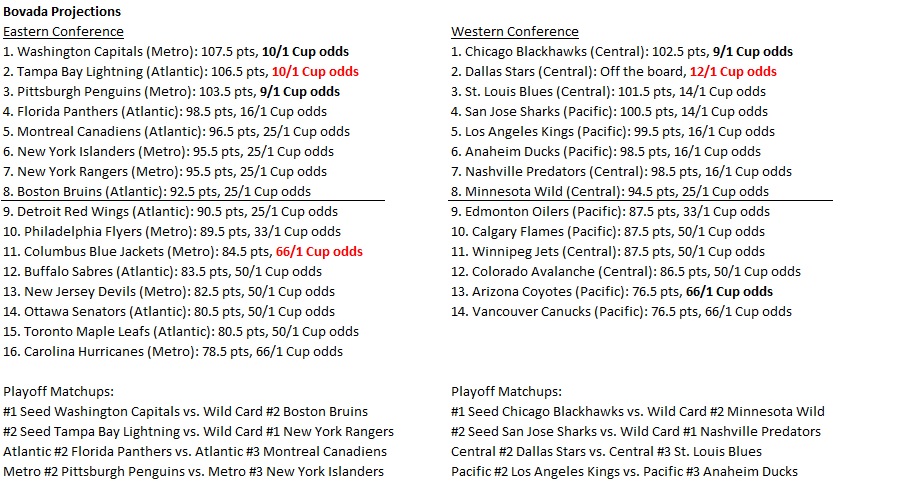
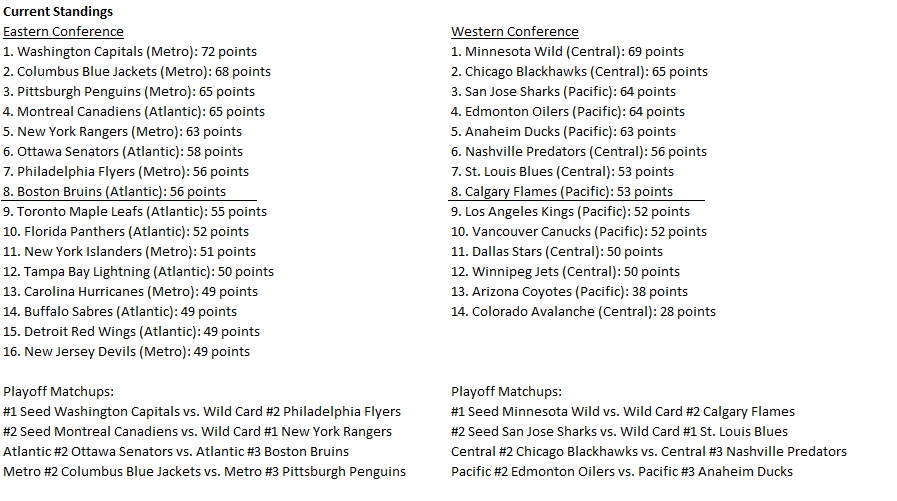
These are the original projections that Bovada made prior to the start of the season, accompanied by the resulting playoff match-ups. Any casual fan can likely spot some huge failed predictions halfway through this season. For those not up to date, here are the current standings and the playoff match-ups if they started today:
And here are the projected final standings and playoff line-up, without taking strength of schedule – competition, home and away, spacing – into account:
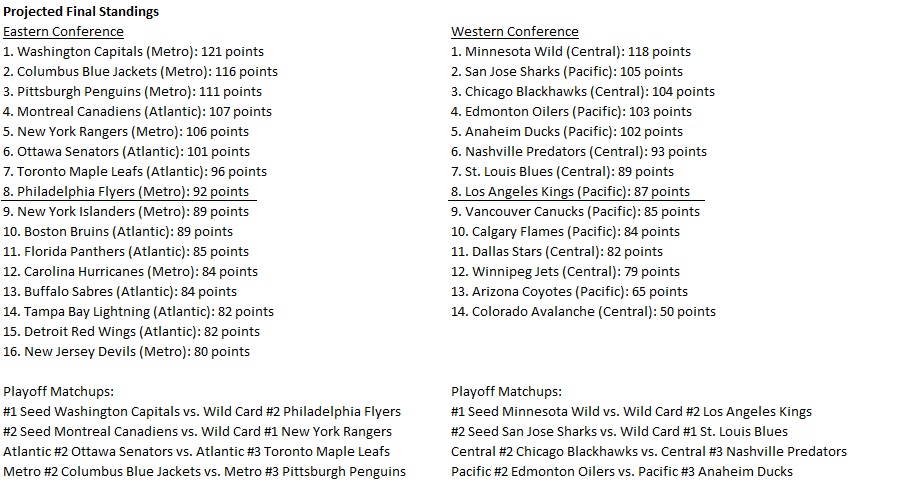
So, how did they do? If the playoffs started today, then Bovada would have correctly picked five Eastern Conference teams (Washington, Pittsburgh, Montreal, New York Rangers, Boston), including the correct seeds for the Capitals and Rangers, and six Western Conference teams (Minnesota, Chicago, San Jose, Anaheim, Nashville, St. Louis), including the correct seeds for the Sharks and Ducks. However, looking at the projected final standings as of now, the Bruins will drop out and the Los Angeles Kings will slip in, making it four in the East and seven in the West.
Which teams did they miss on? The most egregious error, and one that nearly everyone in hockey made, was counting out the Columbus Blue Jackets. The smart money back in September would have been on Columbus, as Bovada gave them the worst odds of winning the Stanley Cup at 66/1, tied with the Carolina Hurricanes, Vancouver Canucks, and Arizona Coyotes (whose Cup odds have actually gotten worse since then). If the Blue Jackets hit their projection of 116 points this season, they’ll have beaten their over/under by over 31 points in the standings, and will finish with the second-best record in the conference instead of eleventh. On the other side is the Colorado Avalanche. You know you’re having a bad season when Vegas doesn’t predict that you’ll make the playoffs, but you’re still 37 points off the set pace. The Avs are trending toward having one of the worst seasons in recent memory with just 50 points, and no one at Bovada saw that kind of struggle coming. Two other big misses, as it currently stands, have been the Tampa Bay Lightning and Dallas Stars. Bovada expected both to be the second-best team in their conference and gave them top-five odds to win the Stanley Cup. At this point in time, either club would be lucky to even qualify for the playoffs. Other teams that are way off the pace Vegas set for them are the Minnesota Wild, Ottawa Senators, and Toronto Maple Leafs, who have all overachieved this season with little off-season suspicion that they would do so.
What does Bovada have right? They deserve some credit for more or less nailing the Western Conference. Although they missed the meteoric rise of the Wild and the Edmonton Oilers’ long-awaited ascent to a playoff-caliber team, they are currently set to have seven correct playoff choices. Not only that, but the Sharks, Blackhawks, and Ducks are going to finish very close to a push on their original over/unders and the Coyotes look to be every bit the lottery team that they expected. Over in the East, the success is not as profound. Bovada did a pretty good job of pegging the Buffalo Sabres and New Jersey Devils as bottom-dwellers, but completely missed on their projections for the Blue Jackets, Leafs, Senators, and even the Carolina Hurricanes, who they believed would finish last in the East and instead was in playoff position just a couple weeks ago. The postseason picture is better, other than the Lightning, as Bovada got the easy picks and projections for the Capitals, Penguins, and Canadiens and have accurately set up the Bruins and Philadelphia Flyers as fringe teams fighting for a playoff spot.
So, the expert odds-makers at Bovada have some major misses so far, but as a whole are doing a decent job with their original predictions at this point in time. How did your favorite writers at Pro Hockey Rumors do? In short: not very well.
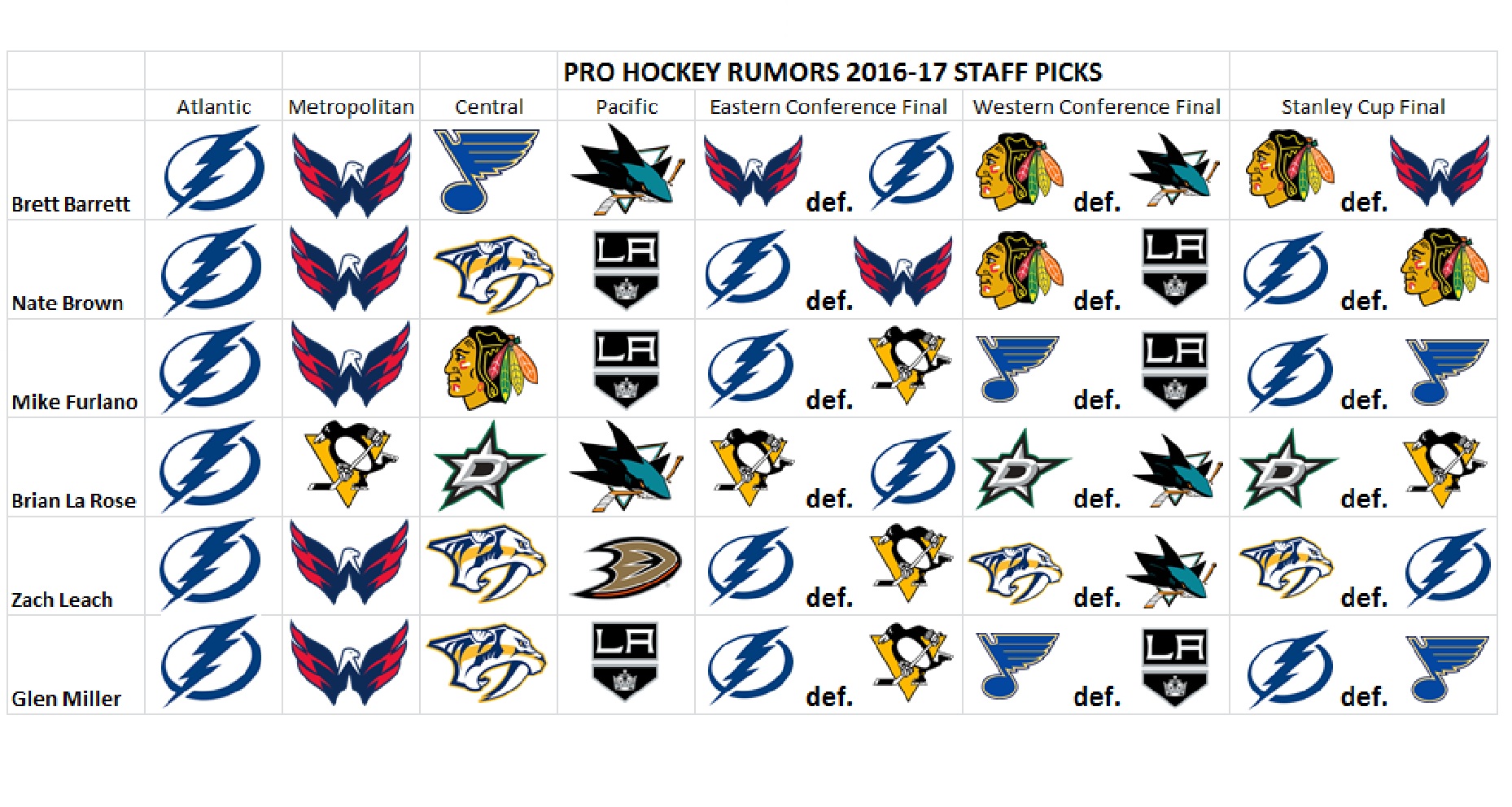
The PHR Staff Picks are not a pretty picture at this point in time. The clean sweep of the Tampa Bay Lightning as Atlantic Division champs appears to be a widespread misread. All but two of us, credit to Brett Barrett and Brian La Rose, additionally had the Bolts in the Stanley Cup final. We’re all as confused as Steve Yzerman as to what it happening in Tampa Bay. Meanwhile, the Predators, Blues, and especially the Stars as Central Division contenders seems unlikely, as does the Kings as Pacific champs. However, making the playoffs is more than half of the battle in the NHL, as many lower seeds have gone on to have postseason success. With that, projections of the Predators, Blues, and Kings in the Western Conference final are not impossible. In reality though, there are only two reasonable Stanley Cup champion picks remaining on the board, and Brett Barrett deserves a round of applause for the only plausible Stanley Cup final at this point in time, with the Chicago Blackhawks defeating the Washington Capitals.
Will the current projections hold? Will ours and Bovada’s predictions look better or worse by year’s end? Tune in to the second half of the season to find out.