Poll: Which Veteran Goalie Will Sign The Biggest Contract Next Offseason?

The goalie market this offseason was a busy one, with many teams looking to address their needs, but seeming to find less options than there were spots to fill. Some teams who had the need for several years were able to finally address it, like the Edmonton Oilers signing of All Star Jack Campbell and the New Jersey Devils acquisition of Vitek Vanecek. Some who found out rather abruptly that they would be needing help in net, like the Toronto Maple Leafs, who lost Campbell, addressed it by signing Ilya Samsonov and acquiring Matt Murray. Others, who didn’t seem to be in urgent need of goalie help went out and found it anyways, like the Ottawa Senators with Cam Talbot and the Washington Capitals with Darcy Kuemper.

With all the shuffling, it seems many teams are now set in goal, or at least hope that they are. But, just as the demand maybe subsides, the supply on next year’s market will be rather rich. There appears to only be one star that will be available, that being Pittsburgh Penguins netminder Tristan Jarry, but after that, a bevy of veteran backstops, capable of being a quality starting goalies, will be on the market. Joining them are a large group of capable backups like Jonathan Bernier, Laurent Brossoit, Jaroslav Halak, and Antti Raanta, as well as a pair of intriguing, less experienced options like Adin Hill and Alex Nedeljkovic.

But, it’s this group of veterans who could pose an interesting shuffle, obtaining potentially very similar contracts based on their performance this season. Of course, the 2022-23 campaign will have a major impact on their value heading into the offseason, but for now, a compare and contrast of these five similar options could be an interesting exercise.

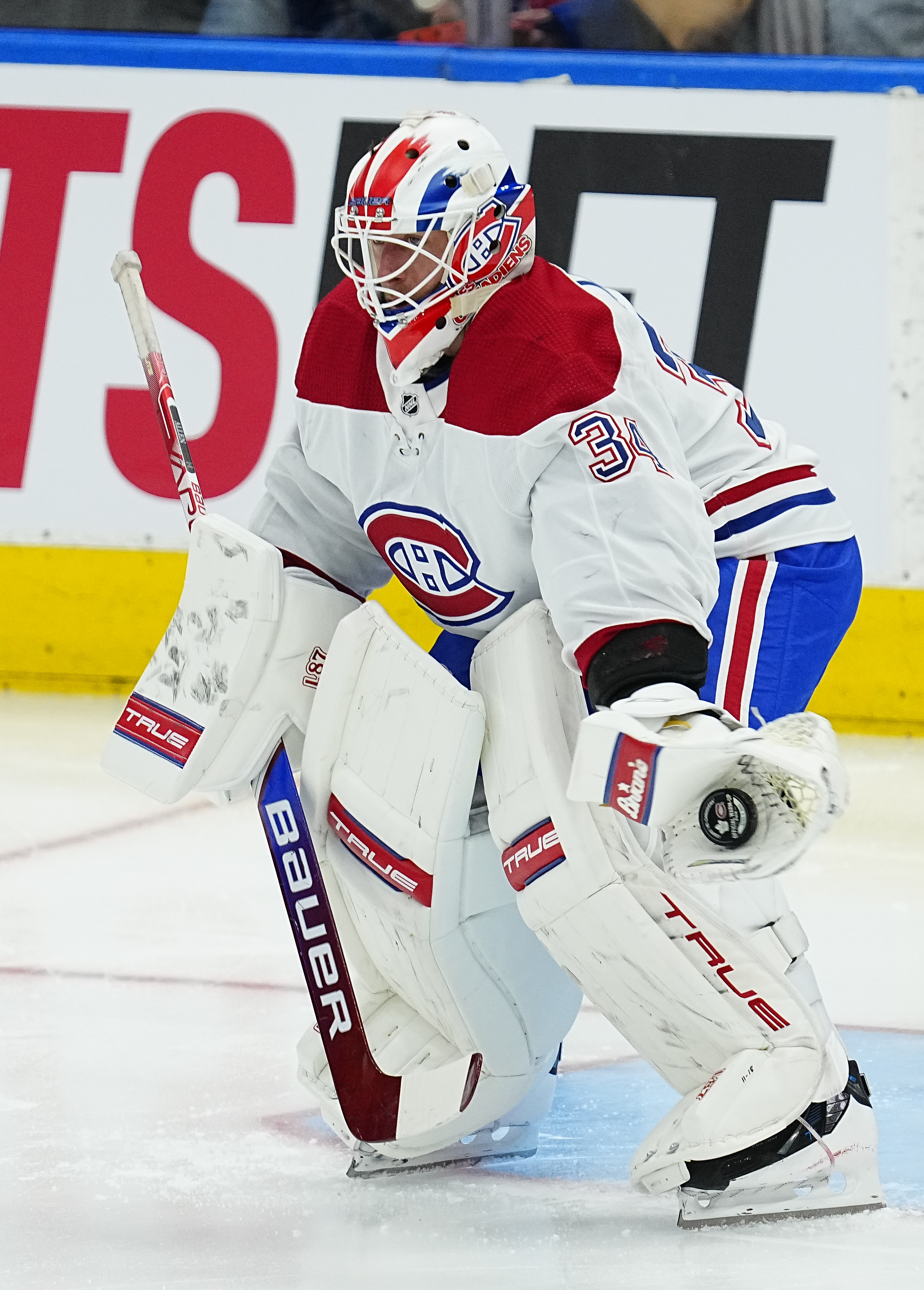
Jake Allen

Contract: Two years, $5.75MM ($2.875MM AAV)

2021-22 Stats: 35 GP, 9-20-4, 2 SHO, .905 SV%, 3.30 GAA

Career Stats: 353 GP, 168-126-35, 23 SHO, .911 SV%, 2.60 GAA

Once considered one of the most exciting goalie prospects of his generations, Allen never panned out as a superstar in net, however he has become a reliable starting and backup goalie, depending on the role he’s put in. Allen spent his first seven NHL seasons with the St. Louis Blues, earning the majority of playing time between 2015-2018, but a surprising breakout performance from Jordan Binnington in 2018-19 pushed Allen into a backup role. After the 2019-20 season, with one year at $4.35MM left on his contract, the Blues shipped Allen to the Montreal Canadiens for a pair of seventh round picks.

His numbers since heading north of the border haven’t been what they once were, but the real regression came when the team around him regressed in 2021-22. Allen’s next deal may very well resemble the one he signed in the 2021 offseason, but a strong rebound performance, considering the context of how the Canadiens perform around him, could increase not only increase his AAV, but also the term for the 32-year-old.

Frederik Andersen

Contract: Two years, $9MM ($4.5MM AAV)

2021-22 Stats: 52 GP, 35-14-3, 4 SHO, .922 SV%, 2.17 GAA

Career Stats: 445 GP, 261-114-51, 23 SHO, .916 SV%, 2.59 GAA

A four-time All Star and two-time Jennings Trophy winner, receiving one of each in 2021-22, the answer might seem obvious that Andersen would sign the biggest free agent deal of any goaltender in 2023, even better than Jarry. But, the former Maple Leafs star netminder doesn’t come without his concerns and that could hamper his open-market potential. After breaking out with the Anaheim Ducks from 2013-2016, Andersen was dealt to Toronto where he continued to develop into one of the league’s best, posting three straight seasons of at least 60 starts and no less than a .917 SV%.

The success, however, began to taper off and in 2019-20, Andersen regressing slightly to a .909 SV% and 2.85 GAA. The 2020-21 season would be no better, his numbers dropping to a .895 SV% and 2.96 GAA as the veteran dealt with injuries. Ultimately, Campbell took over the net for Toronto and that offseason, Andersen was left to hit free agency, signing his current deal with the Carolina Hurricanes. The goalie found tremendous rebound success in Carolina and was even receiving Vezina Trophy consideration before injuries ended his season on April 16th, just weeks before the playoffs were set to begin. If Andersen can continue his strong performance and show that injuries are a thing of the past, he may be the runaway favorite in this poll, but it’s been several years since the soon-to-be 33-year-old has compiled a fully-healthy season.

Jonathan Quick

Contract: Ten years, $58MM ($5.8MM AAV)

2021-22 Stats: 46 GP, 23-13-9, 2 SHO, .910 SV%, 2.59 GAA

Career Stats: 712 GP, 359-262-78, 56 SHO, .913 SV%, 2.42 GAA

An unlikely name on this list for several reasons, Quick re-emerged as an important piece in net for the Los Angeles Kings as the team itself awoke from a semi-lengthy rebuild in 2021-22. Quick still wasn’t the star he had been from 2009-2017, but after several seasons of poor play and injuries, it was a return to being the steady presence in net that the Kings had historically expected from the 36-year-old. Los Angeles had been hoping to transition the net from Quick to Calvin Petersen, especially after giving the younger netminder a three-year, $15MM contract set to begin this season, but Petersen’s struggles have given Quick new opportunity and thus new life.

Turning 37 in January, with recent history considered, even another strong showing is unlikely to propel Quick to a big payday, but if he can show that he’ll be among those goaltenders who age gracefully, his long resume as a reliable, two-time Cup winning goaltender will reward him in free agency.

Cam Talbot

Contract: Three years, $11MM ($3.667MM AAV)

2021-22 Stats: 49 GP, 32-12-4, 3 SHO, .911 SV%, 2.76 GAA

Career Staats: 396 GP, 201-142-34, 27 SHO, .915 SV%, 2.63 GAA

After several up-and-down seasons in a few cities after his trade from the New York Rangers, Cam Talbot appeared to finally settle in and take the next step with the Minnesota Wild in 2020-21, sharing the net with Kaapo Kahkonen. But, 2021-22 threw a wrinkle into the equation by no fault of Talbot, as the team dealt Kahkonen to the San Jose Sharks and brought in future Hall of Famer Marc-Andre Fleury. The Wild in turn gave the majority of the playing time to Fleury, leaving Talbot to back up. Talbot had hoped to remain in Minnesota and show he could take the net back, but after Minnesota chose to re-sign Fleury, Talbot was shipped to the Ottawa Senators, where he figures to see the bulk of playing time.

Turning 36 next July, Talbot may not see the term some of the other goalies on this list might be able to find, but much like Quick, proof he can age well in the role may ultimately work in his favor. The key for Talbot will be to show, besides his ability to age well, that his up and down career is no more, and that the solid performance in the State of Hockey was not merely an extended “up,” but is instead the new normal for the University of Alabama-Huntsville product.

Semyon Varlamov

Contract: Four years, $20MM ($5MM AAV)

2021-22 Stats: 31 GP, 10-17-2, 2 SHO, .911 SV%, 2.91 GAA

Career Stats: 560 GP, 261-211-62, 36 SHO, .916 SV%, 2.64 GAA

When the New York Islanders allowed Robin Lehner to walk after a breakout season where he was named a Vezina Trophy finalist in order to sign Varlamov, many around the hockey world raised their eyebrows. As good as Lehner has been, the decision to bring in Varlamov has paid dividends on Long Island, as the veteran teamed up with Thomas Greiss and later his fellow countryman Ilya Sorokin to create a formidable tandem in net. However over the life of the deal, Varlamov’s role has diminished, going from a starter to something closer to a backup. Part of that has been out of Varlamov’s control with the emergence of Sorokin as one of the league’s better goalies, but 2021-22 did Varlamov no favors either.

Though his numbers were not objectively bad, it was a step back from the player he had been the two years prior. A rebound from Varlamov, especially one that forces the Islanders’ hand to take time from Sorokin and give it to the veteran will certainly boost his value on the open market. Turning 35 in the spring and still capable of taking a significant slate of games in net for a team, Varlamov will have plenty of interest on the open market, but securing the largest deal out of these five will require a performance more similar to what we saw in 2019-20 and 2020-21.

Considering these options, who is most likely to find the biggest contract on the open market? All are legitimate NHL goaltenders likely capable of holding their own net in 2023-24 and beyond, though none are considered stars. Andersen may be the closest to a star, however his recent injury struggles could make teams wary. If it’s durability a team is looking for, Varlamov might be a safer bet, but recent performance is trending in the opposite direction, albeit not enough to scare an organization off. Either way, 2022-23 will go a long way to understanding what this market becomes, but entering the new season, who sits in the best position?

Which Veteran Goalie Gets The Biggest Deal?

  • Frederik Andersen 54% (469)
  • Semyon Varlamov 21% (181)
  • Jake Allen 9% (77)
  • Jonathan Quick 8% (72)
  • Cam Talbot 8% (68)

Total votes: 867

Trade Rumors app users, click here to vote.

Montreal Canadiens Announce Rookie Camp Roster

After months of quiet on the ice, rookie camps usually give hockey fans the much-anticipated signal that the season is drawing close. This year, it also signifies a return to normalcy in the schedule and off-ice operations, with the regular season beginning on time and full media access restored in locker rooms. Today, the Montreal Canadiens announced their roster for rookie camp, which will begin September 14 at the Bell Centre.

As per the team announcement, the roster consists of 28 players (15 forwards, 10 defensemen, and three goaltenders). Six of those 28 players were members of Montreal’s 2022 draft class: first-overall pick Juraj Slafkovský, right wing Filip Mešár (26th overall), center Owen Beck (33rd overall), left wing Cedrick Guindon (127th overall), center Jared Davidson (130th overall), and defenseman Miguël Tourigny (216th overall).

Additionally, the team invited four players to rookie camp on a try-out basis: right wing Pierrick Dubé, right wing John Parker-Jones, and goalies Antoine Coulombe and Riley Mercer.

The main story of the camp will be Slafkovsky’s performance. The Slovak winger’s spectacular international play this season shot him all the way up to first overall on the draft board, but it would be quite a large jump for the 18-year-old to shift from a middle-six role in the Finnish Liiga to full-time NHL minutes. Slafkovsky will play for the Canadiens organization in North America this season in all likelihood, but his rookie camp performance will be important in leaving a good first impression. Whether or not he starts in the NHL or in the AHL with the Laval Rocket remains to be seen.

There’s also the matter of which young Canadiens defensemen will make the team out of camp. Four candidates jump out on their rookie camp roster as players who could show they deserve an NHL look right away: Justin BarronKaiden GuhleJordan Harris, and Mattias Norlinder. All four except Guhle made their NHL debuts already last season, while Guhle is coming off a WHL championship with the Edmonton Oil Kings and the playoff MVP award. With at least two NHL spots available for these rookies, it should be good competition all throughout rookie camp, training camp, and preseason.

This Day In Transactions History: Max Pacioretty Traded To Vegas Golden Knights

Most teams could only hope to have a draft like the Montreal Canadiens did in 2007, selecting Ryan McDonagh, Max Pacioretty, and P.K. Subban with their first three picks. McDonagh would ultimately be dealt before he could ever dress for Montreal, sent as the centerpiece in the Scott Gomez trade, one which overwhelmingly favored the New York Rangers. Subban and Pacioretty, along with Carey Price, went on to form the core of some formidable Canadiens teams in the mid 2010’s. Following the 2015-16 season, needing to rebound from their first playoff miss in several years, Montreal dealt Subban in one of the biggest one-for-one deals in not only the league’s history, but sports history, sending him to the Nashville Predators for Shea Weber.

The Subban for Weber swap helped Montreal rebound to a playoff berth in 2016-17, but a dreadful 2017-18 forced the organization to re-think things and just before teams were set to hit the ice for training camp, they dealt their star forward and team captain in Pacioretty to the Vegas Golden Knights. Vegas, having burst onto the scene in their first season just a year prior, were looking to make a splash in order to hopefully get over the hump and win the Stanley Cup, falling just short in their first try. Acquiring the regular 30-goal-scorer wasn’t cheap though, Vegas paying handsomely in the amount of  Tomas Tatar, Nick Suzuki and a 2019 second-round pick. The return, put plainly, sounds large, but perhaps fair considering the practice of giving something to get something, Vegas giving up a solid veteran point producer, a then-unproven prospect, and a second-round pick out of their bevy of draft picks and receiving a guaranteed star who immediately signed an extension in return. But, with the benefit of time and context, the perception of the deal now has certainly changed.

To give some perspective on how dynamic this trade ended up being for the Golden Knights, the Canadiens acquired a 60-point forward, a prospect who would become one of the young faces of their franchise, and a second-round pick and there is seemingly less to say on their end. Moving Pacioretty, a star and captain, was surely not an easy move for the Montreal organization to make, but one they felt necessary, especially given the return. Tatar would go on to have 58 and 61 point seasons, the latter coming in just 68 games. His third and final season with the team, 2020-21, saw him dip to 30 points, albeit in 50 games in the COVID shortened campaign, but with just five playoff games amid a deep playoff run. Worth mentioning, the second-round pick was unceremoniously flipped to the Los Angeles Kings for a third and fifth-round pick.

The real prize in the trade, and one that perhaps keeps Vegas management and fans up at night is Suzuki. The 13th overall selection in 2017, Vegas’s second of that evening, Suzuki hadn’t yet debuted for Vegas before he was dealt to Montreal. After the move, the forward spent another season in the OHL, where he wasn’t immune to trade either, dealt midseason from the Owen Sound Attack to the Guelph Storm. Still, none of it phased Suzuki, who had another outstanding junior season. The young forward made his NHL debut for Montreal the following season, finding breakout success in the shortened 2020-21 season, playing a pivotal role in Montreal’s near miss of a Stanley Cup. Following that season (more specifically, October), The Canadiens inked Suzuki to an eight-year, $63MM extension beginning in 2022-23 with the expectation that he could lead the next great set of Montreal teams.

The Vegas side of this blockbuster is a lot murkier. They certainly gave up a lot to get Pacioretty, but that isn’t always the issue with a trade. In fact, the winger brought back as much if not more value than they were expecting. Point for point, Pacioretty had some of his best seasons in Vegas, highlighted by a 51 point performance in 48 games during the shortened 2020-21 season, the only time he hit the point-per-game mark in his career. The real issues for the Golden Knights would be two-fold: (1) money, and (2) when all was said and done, what went in and what went out.

Upon acquiring the Montreal captain, the Golden Knights immediately signed him to a four-year, $28MM extension that began in 2019-20. That deal was fine at the time, Vegas then still in the envious position of being competitive but also utilizing their cap to help other teams for the right price. But, as the contract went on, Vegas continued to spend liberally to reward their successful core and also bring in new assets to help them out. With that, their cap situation became tighter and tighter and Pacioretty’s $7MM cap hit grew more and more imposing. Finally, with the addition of Jack Eichel and his $10MM cap hit part-way through last season, the bubble was set to burst this offseason and Vegas needed to shed a big contract. That would end up being Pacioretty.

As talented as Pacioretty still is, his $7MM cap hit on top of his recent injury history, made taking him on a questionable decision for many teams. Vegas was able to find a suitor, and though they didn’t have to pay anything significant to offload his contract, they received merely future considerations for a player who had 194 points in 224 games for them over the previous four seasons (as well as Dylan Coghlan).

The other troubling aspect of this deal is a completely separate trade made several months prior. At the 2018 trade deadline, with assets in hand and a surprising playoff berth in sight, Vegas made a splash by acquiring Tatar from the Detroit Red Wings. Tatar, like Pacioretty here, didn’t come cheap, as Vegas sent a first, second, and third round pick to Detroit to make it happen. The Czech winger gave Vegas just eight points in 20 regular season games on top of another two points in eight playoff contests ahead of the instant trade. The reason the earlier Tatar trade is important is to consider the context: Vegas, in effect, traded Suzuki, a first, two seconds, and a third for 28 underwhelming games of Tatar and four seasons of Pacioretty, who they then traded away for almost nothing after he actually stepped his production up.

Another interesting wrinkle to all of this, but not one that absolves Vegas of their questionable trade tree, is that Pacioretty tore his Achilles after the trade to Carolina, forcing him to miss at least six months of the upcoming season. Of course, Vegas didn’t know this would happen when they made the deal, preserving the questions regarding their logic in the handling of the forward. Realistically, had this happened before the trade, Vegas could have utilized LTIR with Pacioretty, but had he been ready to return ahead of the playoffs, it would have left the team in a difficult position.

Hindsight is twenty-twenty, as the saying goes, and that applies to any transaction, but the Pacioretty-to-Vegas trade from four years ago today is a fascinating retrospective into roster, cap, and asset management. Vegas gave up plenty for Pacioretty, but it was most likely worthwhile as they got back arguably more than they bargained for. But after four seasons and just one more to go under their current commitment, the team essentially walked away from their player while Montreal continues to reap the reward with one of the league’s most exciting young stars. One question to ponder as we consider these last four years: how is this viewed, all else the same, had Vegas won a Stanley Cup with Pacioretty in the fold?

Allen Extension Talks Are Preliminary, Canadiens Want To Know His Intentions Sooner Than Later

  • Earlier this week, ESPN’s Kevin Weekes reported (Twitter link) that the Canadiens had opened up extension discussions with goaltender Jake Allen. Friedman clarified in his podcast that those discussions are still in the preliminary stage and that nothing is close while the team wants to get a sense of Allen’s intentions sooner than later.  The 32-year-old is entering the final year of his contract that carries a $2.875MM AAV and with Carey Price likely done for the season already, he’ll once again be their projected starter.  Between that and the recent market for veteran goalies, Allen could push closer to the $4MM range on a new deal with Montreal.

    [SOURCE LINK]

Montreal Canadiens Sign Cayden Primeau

The Montreal Canadiens have finished their RFA work for the summer, signing Cayden Primeau to a new three-year contract. Interestingly enough it is a one-way contract for all three years, paying him an average annual value of $890K. Primeau will earn $770K in 2022-23, $800K in 2023-24, and $1.1MM in 2024-25.

As CapFriendly points out, the young netminder is waiver-exempt for one more season (or 56 games, should he assume full-time duties for some reason). This will give them the chance to run a tandem of Jake Allen and Sam Montembeault this season, with the former becoming an unrestricted free agent next summer (though Andy Strickland of Bally Sports Midwest tweets that extension talks between Allen and the Canadiens have begun).

Even when Primeau does become eligible for waivers, a contract like this could potentially help him slip through. It is not as if he has proven himself at the NHL level to this point. The 23-year-old netminder has an .874 save percentage in 18 appearances with the Canadiens, and despite considerable hype, has had mixed results even at the AHL level.

This is a bet on his potential and the incremental growth he is expected to experience over the next few years. At some point, the Canadiens are hoping that he takes over one of the NHL jobs and even if he doesn’t, the deal isn’t so lucrative as to negatively affect their cap situation. The entire hit can be buried in the minor leagues if necessary, and Primeau is still young enough to be a restricted free agent at its expiry.

Carey Price To Be Moved To Long-Term Injured Reserve

If you were wondering how exactly the Montreal Canadiens were able to fit Kirby Dach‘s contract under the salary cap today, you weren’t alone. The deal seemingly put them over the 10% offseason cushion, with a team cap hit of more than $92.7MM. Arpon Basu of The Athletic has the answer – Carey Price is going on long-term injured reserve early.

Contrary to widespread belief, LTIR can actually be used in the offseason. The Toronto Maple Leafs did so in the summer of 2017 when signing Patrick Marleau, and the Tampa Bay Lightning did it with Nikita Kucherov in late 2020 when signing Mikhail Sergachev to his bridge deal.

CapFriendly notes that to use LTIR, a team must “provide doctors proof that the player in question will continue to be injured at the beginning of the regular season for 10 NHL games and 24 calendar days.” Price may not play at all this season, with general manager Kent Hughes explaining that there did not appear to be a path for him without undergoing another surgery.

Essentially, giving Price the injury designation now will increase the Canadiens’ upper limit by more than $10MM, allowing them to officially file the Dach contract without breaching the 10% cushion. It should be noted that the release this morning indicated that the two sides had agreed to terms on a contract but Dach does not yet appear on the official roster, meaning the order of operations has not been completed.

Montreal Canadiens Sign Kirby Dach

After reports had surfaced in recent days that the two sides were close, the Montreal Canadiens and Kirby Dach now officially have an agreement in place. The team has announced a four-year contract worth a total of $13.45MM, giving Dach a cap hit of $3.3625MM through the 2025-26 season. Renaud Lavoie of TVA Sports tweets the full breakdown:

  • 2022-23: $2.5MM
  • 2023-24: $4.1MM
  • 2024-25: $2.85MM
  • 2025-26: $4.1MM

A contract like this could be seen as a disappointment relative to his draft position but is also something of a surprising total for a player that has scored just 19 goals as a professional. Dach, 21, was the third overall pick in 2019 but has struggled to stay healthy and productive, reaching just 152 games played and 59 points so far. Those disappointing totals led to his jettison from the Chicago Blackhawks this summer, despite being young enough to potentially be part of their rebuild.

Notably, Dach is signing away four years of RFA status but will not be an unrestricted free agent at the deal’s expiry. He will be an arbitration-eligible player coming off a solid contract, meaning if he doesn’t progress over the next four years, there’s a chance the Canadiens could have to leave him unqualified, not wanting to risk an arbitration award.

Montreal is clearly betting that won’t be the case, signing up Dach to a relatively long-term deal in the hopes that he can unlock some of the potential that put him at the top of the draft. Kaapo Kakko, for instance, was selected just ahead of Dach and has nearly the same production, and settled for a two-year deal this summer with a cap hit of just $2.1MM. The New York Rangers took on much less risk with their 2019 draft pick, though they are in a very different place in terms of a competitive window.

Dach has all the things that make scouts drool but hasn’t been able to put it all together. His size, skating ability, puck skills, and positional versatility all should make him a perfect player for the Canadiens to build around – but to this point he has been so inconsistent it is not clear what they are even getting. In 70 games last year he generated just 116 shots on net, despite averaging more than 18 minutes a night. He lost nearly 70% of his 500+ faceoffs, took 19 minor penalties, and scored just nine goals, even while having Alex DeBrincat and Patrick Kane as two of his three most common linemates (Philipp Kurashev falls between the two).

Frankly, it wasn’t a strong year for the former Saskatoon Blades star. With this new deal, the Canadiens are betting that they can turn around his floundering career by putting him in a better situation. Since the club is not expected to compete right away, they can afford to take risks like this on high-potential players. But at some point, the Canadiens will have to turn the corner on their rebuild; Dach will need to improve by then, or risk being left behind by the rest of the talented young players in the system.

Snapshots: Dach, Sharks Rookie Tournament, Stadium Series

After being originally reported by Sportsnet’s Eric Engels last week, his colleague Elliotte Friedman confirmed the original report today on the 32 Thoughts podcast. Echoing the fact that the Canadiens and Dach are close to signing Dach to a four-year contract, he added that the team is likely working on other moves before making the deal official.

Cap implications aside, the team will likely need to trade a forward (or two) just to have space for Dach in the lineup. With the addition of Sean Monahan into the fold for next season, Dach will likely shift to wing. He has the most experience there out of Montreal’s five natural centers in their top 12 forwards. With Cole Caufield, Mike HoffmanJosh AndersonJonathan DrouinEvgenii Dadonov, and Brendan Gallagher all in the fold, there’s just not enough room in Montreal’s NHL lineup to have Dach play an appropriate role to continue developing. Cap implications are certainly a part of that, though, as a $3.5MM cap hit as surmised by Friedman and Engels would still put Montreal dangerously close to the salary cap even with Carey Price‘s $10MM cap hit on long-term injured reserve.

  • The San Jose Sharks are hosting this year’s 2022 Rookie Faceoff, a voluntary tournament for teams’ rookie camp rosters to get some game experience against each other. The Anaheim Ducks announced their participation today, noting that the Arizona Coyotes, Colorado Avalanche, Los Angeles Kings, and Vegas Golden Knights will also participate. The tournament will feature nine games in total across four days from September 16 through September 19. Anaheim has not lost a rookie tournament game in regulation since 2016, going 11-0-2 in the process.
  • The Athletic’s Sean Shapiro reports that American coverage of the 2023 Stadium Series game will be on ESPN after TNT/Turner Sports hosted coverage last season. ESPN will broadcast the Carolina Hurricanes’ first-ever outdoor game as they host the Washington Capitals at Carter-Finley Stadium in Raleigh on February 18, 2023. Shapiro also adds that the full slate of American national TV games is expected to come out later this week as the regular season approaches.

Classifying The Remaining Restricted Free Agents

When the calendar flips to September, it’s time to start paying some attention to who’s left unsigned in restricted free agency.  Usually at this point, two months have elapsed since the start of free agency (it’s six weeks this summer) which is typically more than enough time to get a deal done.

There are currently 13 remaining RFAs that haven’t signed elsewhere for next season.  As is usually the case, those players can be grouped into a few tiers which are as follows.

Star Players

Jason Robertson (Dallas)

Generally speaking, there are usually more players in this group at this time but the 23-year-old is the only star player in need of a new deal.  He’s coming off a 41-goal campaign that has the asking price justifiably high – team owner Tom Gaglardi acknowledged it’s in the $7MM range.  The Stars would likely prefer to do a long-term deal that buys out some UFA years but that could push the AAV past $9MM and they don’t have the cap space to do that.  At this point, what GM Jim Nill does or doesn’t do on the trade front might dictate what ultimately happens with Robertson; if they can free up some money, a long-term agreement becomes palatable but otherwise, it’ll almost certainly be a bridge contract.

Underachieving Former First Rounders

Erik Brannstrom (Ottawa), Kirby Dach (Montreal), Barrett Hayton (Arizona), Rasmus Sandin (Toronto)

Dach and Hayton were both top-five picks in their respective draft classes but have yet to show the type of offensive consistency to put them in the category of core players.  Dach was traded to Montreal at the draft after a quiet season that saw him put up nine goals and 26 points, both career-highs.  Despite that, it appears that the Canadiens are at least pondering a medium-term agreement that would run for four years but still leave him RFA-eligible at the end.  Something a little shorter in the $2.5MM range is also an option.  Hayton has just this last season in terms of being a regular under his belt and could fit in a different category than this but his performance relative to draft stock has been concerning.  He’s a prime candidate for a bridge contract and with fewer than 100 NHL games under his belt, he simply doesn’t have the leverage to command anything longer.  A two-year deal around the $2MM range should be where his deal falls.

As for Brannstrom, he was billed as an offensive defender but has yet to be able to produce with any consistency since joining Ottawa back in 2019.  He has just two career goals in 116 career games but that hasn’t stopped his camp from seeking a multi-year agreement in negotiations which are likely playing a role in this delay.  Sandin could also fit in a different category but the 2018 first-rounder has exhausted his waiver exemption and doesn’t appear to be a fit in their top six next season.  His agent recently bemoaned the lack of progress in negotiations.  Teammate Timothy Liljegren’s two-year bridge deal that has a $1.4MM AAV seems like a reasonable comparable but with playing time being a potential concern, might Sandin be looking for more certainty before putting pen to paper on a new deal?

Young Regulars

Michael Anderson (Los Angeles), Alex Formenton (Ottawa), Nicolas Hague (Vegas)

Formenton played his first full NHL season in 2021-22 and it was a good one as the 22-year-old speedster chipped in with 18 goals and 14 assists in 78 games.  The Sens have ample cap space this coming season so there are some options beyond the bridge contract.  If GM Pierre Dorion thinks that Formenton is part of their long-term core, a longer-term pact that buys out a UFA year or two in the $3.5MM range might be a better way for them to go.

Hague has done well in a limited role on the back end for the Golden Knights over the past two seasons and is coming off a year where he logged close to 19 minutes a night.  They’ve already spent most of the LTIR ‘savings’ so Vegas isn’t in a spot to give him a long-term deal.  But is Hague better off taking a one-year contract that would be below market value to acquire arbitration eligibility next summer?  Such a deal would be in the $1.25MM range with the promise of a better payout later on.  Otherwise, a bridge pact that’s closer to $2MM is probably in the cards.  Anderson has logged over 20 minutes a night for the Kings for the last two years but doesn’t have the offensive numbers to support a pricey bridge deal.  Los Angeles’ cap space is quite limited so, like Hague, a one-year deal in the $1.25MM range might be where they wind up settling.

Not Fully Established

Sean Durzi (Los Angeles), Ryan McLeod (Edmonton)

McLeod figures to be a part of the long-term plans for the Oilers after a promising rookie campaign but doesn’t have much leverage at this point.  Edmonton’s issue here is cap space as they’re already in a spot where they need to clear money out.  If they can move someone out, a multi-year bridge contract becomes their preferred route but otherwise, he’s a strong candidate for a one-year deal around that $1.25MM threshold as well, perhaps a tad below that.

Durzi quietly put up 27 points in 64 games last season but it’s his only taste of NHL action so the track record isn’t strong enough to command a sizable contract.  A two-year bridge deal makes a lot of sense for him as a repeat performance over that stretch would have him well-positioned to seek $4MM or more two summers from now.  However, with the cap situation for the Kings, they might be forced to push for the one-year, ‘prove it’ contract that would fall in the same range as Anderson.

What’s The Holdup?

Cayden Primeau (Montreal), Adam Ruzicka (Calgary), Parker Wotherspoon (NY Islanders)

Ruzicka played in 28 games last season for the Flames and did reasonably well with ten points but it’s not as if he’s in a position to command a sizable raise.  He’s waiver-eligible but not a guarantee to be claimed if he passes through.  The holdup might be along the lines of making next season a one-way or two-way contract with any subsequent season(s) being a one-way agreement.  Even so, it’s odd this is taking so long.

Wotherspoon’s presence on here is arguably the most perplexing of the bunch.  He opted to not file for salary arbitration which would have gotten him signed weeks ago.  He has cleared waivers in each of the last two seasons and has yet to play an NHL game.  Haggling over NHL money would be pointless as a result so accordingly, it’s safe to suggest his NHL pay would be $750K.  At this point, AHL salary or guaranteed money is the only sticking point.  In all likelihood, the gap probably can’t be more than around $25K which is a pretty small one to justify being unsigned this long.

Primeau is coming off a strong showing in the AHL playoffs but struggled mightily in limited NHL action with the Canadiens last season.  Even so, he’s viewed as their potential backup of the future as soon as 2023-24 when he becomes waiver-eligible.  This is a contract that should be a two-way pact next season and then one-way after that as a result and there are enough of those comparable contracts around the league for young goalies that the general framework should basically have been in place before talks even started.  As a result, this is another case that feels like it should have been resolved weeks ago.

There’s still plenty of time to work something out with training camps still a couple of weeks away and several of these players should come off the board by then but there will likely be a handful still unsigned when camps get underway.

Photo courtesy of USA Today Sports Images.

Snapshots: Senators Defense, Couture, Stralman

The Ottawa Senators are intent on competing for a playoff spot next season, and their offseason moves have reflected that intention. The team spent major resources in both cap space and draft picks to add some star talent, and the result of those expenditures is that Claude Giroux and Alex DeBrincat will be wearing red and black this upcoming season. But while the team’s offensive attack is significantly improved from last season, less attention has been paid to their defense.

In an interview with Postmedia’s Bruce Garrioch, Senators coach D.J. Smith revealed what his plans are for the team’s defense corps. Smith stated that he intends to pair top prospect and rookie defenseman Jake Sanderson with veteran blueliner Travis Hamonic to start camp. That pairing would go along with a more established pairing of Thomas Chabot and Artem Zub, one that will presumably handle the team’s toughest minutes. This news is not a major surprise, although it could be to those who are low on the current makeup of the Senators’ blueline. Much had been made about the Senators’ pursuit of an additional top-four defenseman this summer, but it seems that those pursuits have concluded, at least for the time being.

Now, for some other notes from across the NHL:

  • While the San Jose Sharks’ new era under GM Mike Grier began with a trade of veteran defenseman Brent Burns, don’t expect a similar departure for other Sharks star veterans, namely Logan Couture. In speaking to Corey Masisiak of The Athletic, Couture said that when asked, as Burns was, about potentially being traded, Couture “didn’t think twice about it.” (subscription link) Couture is seemingly all-in on the Sharks returning to contention next season, and for the team to have any chance of success next season they’ll need their veteran centerman to continue to play like a quality top-six center.
  • The Montreal Canadiens made some moves to shake up their team this summer, and their most significant move on defense came with the trade of Jeff Petry to the Pittsburgh Penguins. In addition to losing Petry, the Canadiens also dealt Alexander Romanov to the New York Islanders. The team added Mike Matheson in the Petry deal, but is still short one NHL defenseman from where they were last year. That has led some, including The Athletic’s Marc Antoine Godin, to suggest that the Canadiens add a veteran defenseman before this upcoming year. (subscription link) Godin specifically names veteran defenseman Anton Stralman as someone the Canadiens should target, given his experience and track record of reliability. Stralman skated in the third-most minutes per game of any Arizona Coyotes player last season and would compete for a role on Montreal’s right side with Chris Wideman, David Savard, and Justin Barron.
Show all