
Snapshots: Spezza, Brind’Amour, Komets
The Toronto Maple Leafs have plenty to talk about following their qualification round exit at the hands of the Columbus Blue Jackets, including some pending free agent decisions. One of those scheduled for unrestricted free agency is veteran forward Jason Spezza, who came to his hometown of Toronto on a minimum contract to try and chase a Stanley Cup.
Today, when speaking to reporters including Luke Fox of Sportsnet about his future, Spezza explained that “the fire still burns” and that he hopes to be back in Toronto next season. For being a part-time player at the beginning of the season and seeing fourth-line minutes throughout, Spezza was pretty impressive with nine goals and 25 points in 58 games. He even got in a fight during the postseason, trying anything he could think of to wake up the Maple Leafs.
- Rod Brind’Amour didn’t like a call in the Carolina Hurricanes-Boston Bruins game earlier today and voiced his displeasure to several reporters including Sara Civian of The Athletic. Brind’Amour got a quick fine from the league for his comments, earning a $25,000 penalty. He also received a conditional fine of $25,000 which will be collected if Brind’Amour has any other “inappropriate behavior” in the next year.
- The Vegas Golden Knights have signed a new two-year affiliation agreement with the ECHL’s Fort Wayne Komets, who have been partnered with the organization for the last two years. Fort Wayne was coached this season by Ben Boudreau, son of long time NHL head coach Bruce Boudreau. They went 31-23-6, but weren’t able to take part in the playoffs thanks to the COVID-19 cancelation.
Tyler Ennis Out Indefinitely
The Edmonton Oilers won’t have Tyler Ennis back in the lineup tomorrow as they try to stave off elimination, and even if they win he likely won’t be available for a while. The team has announced that Ennis is out “indefinitely” with the injury he sustained last night. The speedy forward was hit behind his own net by Kirby Dach and was forced to leave the game.
That may very well be the end of the line for a trade deadline acquisition that worked out very well for the Oilers. Ennis recorded four points in nine regular season games following the trade and already had two in the qualification rounds. The 30-year old helped provide the much-needed speed upfront that the Oilers had been lacking for years (other than Connor McDavid, of course).
There is always a chance that he returns if the Oilers can come back and win against the Blackhawks, but the question could now become whether or not the team wants to bring him back in free agency. An unrestricted free agent at season’s end, Ennis is coming off consecutive one-year contracts that each paid less than $1M in salary. After putting up 16 goals and 37 points total this season he’ll obviously be looking for something bigger than that moving forward.
Snapshots: Markstrom, Chayka, Hockey East
One of the more talked-about free agent negotiations this season has been between the Vancouver Canucks and starting goalie Jacob Markstrom, who has been stellar in net this season. Markstrom had a career-best season this year, recording a .918 save percentage and 2.75 GAA. As he heads toward free agency, the Canucks have prioritized keeping him in Vancouver if at all possible. The two sides have been talking throughout the league pause and GM Jim Benning even noted that they spoke again on Tuesday. However, Benning told NHL.com that all negotiations will be put on hold until after the playoffs. “We’re going to get something figured out for him,” Benning said with confidence, but added “We both decided let’s just wait until after the playoffs are done.” How long that postseason run might last remains to be seen. The No. 7 seed out West, the Canucks are set to face the No. 10-seed Minnesota Wild in the qualifying round next week. If they emerge victorious, talks with Markstrom will stay on the back burner for a while longer, but if the Canucks fall to the Wild, they could approach talks very soon. Perhaps they will even be armed with the No. 1 overall pick to help make their case for a long-term extension.
- As the John Chayka saga continues to unravel, Howie Kussoy of the New York Post has confirmed previous reports that Chayka was interested in a move from the Arizona Coyotes to the New Jersey Devils. It doesn’t end there though. Kussoy writes that Chayka lied to ‘Yotes ownership about having an interview with the Devils ownership, who also own the NBA’s Philadelphia 76ers and are a suitor for the MLB’s New York Mets. While this was not a GM position with the Devils, which Arizona had previously denied another NHL team from interviewing Chayka for, he was nevertheless deceptive about his intentions. According to Kussoy, this left his relationship with owner Alex Meruelo “irrevocably damaged” and led to the swift separation between the two sides.
- Over in the college game, the Hockey East Conference offered some hope for NCAA fans yesterday. The historic hockey conference announced their intention to have a 2020-21 season for both men and women. Due to the convenient geography of the New England-based conference, teams will play conference-heavy schedules that will limit travel and, as a result, potential COVID-19 exposure. As many of their member institutions have seen their primary athletic conferences cancel or postpone fall sports, while other hockey schools – like those Ivy League members of the ECAC – have had all fall competition canceled, Hockey East hopes to start in the fall. They have yet to announce schedules and may delay the start of the season and play a shortened campaign, but college hockey seems to be returning next season after the Coronavirus pandemic ended the season in the midst of conference tournaments and before an NCAA champion could be crowned. The hope is that other conferences can also find a way to follow in the footsteps of Hockey East.
Jesse Puljujarvi Addresses 2020-21, NHL Future
Ever since Jesse Puljujarvi left the Edmonton Oilers to return home to Finland last summer, signing a one-year deal with Karpat, there has been plenty of speculation about his future, his trade value, and his relationship with his current NHL rights holder. However, there has been little in the way of concrete news. That changed today as Puljujarvi himself spoke with Finnish news source Iltalehti about his current free agency and what to expect of his career moving forward.
First and foremost, Puljujarvi stated a return to Karpat next season is his most likely destination for 2020-21. Seeing as how his trade demands in the NHL have not been met, it makes some sense that Puljujarvi would stick to his guns and remain in the Finnish Liiga. It also helps that Puljujarvi was a superstar in Finland this season. His 24 goals and 53 points both led Karpat and were top-five marks in the league.
With that said, Puljujarvi also makes the important note that a deal is not in place with Karpat and he is keeping his options open. That could very well include the NHL, as he stated that his goal is to eventually return to North America. Would he be open to a return to Edmonton though? Puljujarvi actually revealed that he and his representation recently took part in a long phone call with GM Ken Holland and head coach Dave Tippett, neither of whom were in place when Puljujarvi last suited up for the Oilers. Usage was the main reason why Puljujarvi was so unhappy in Edmonton, but he does not know how that might change under this new administration. Puljujarvi called talks with Holland Tippet “good and constructive” and said that “it may be possible” he returns to the team, which is a major departure from his previous stance.
Should things not work out with Edmonton again this off-season and his rights are not traded to another NHL team, don’t expect Puljujarvi to move elsewhere in Europe. His KHL rights holder, Torpedo Nizhny Novgorod, has made an offer but Puljujarvi firmly stated that he would not sign with the team. He also acknowledged interest from the Swiss NLA, but again stated that he is unlikely to move their either. As a result, it seems Karpat or bust for 2020-21, with bust of course being a change of course in either Puljujarvi’s relationship with Edmonton or as a result of being traded to a new team.
Return To Play Represents Opportunity For Pending Free Agents
For an NHL player, the Stanley Cup playoffs represent a fleeting opportunity to cement your legacy. By hoisting that chalice even once in your career, you join a relatively small group of players that can be identified as champions.
It doesn’t happen for everyone.
Just ask Patrick Marleau, who played the first of his 191 career playoff games on April 24, 1998, and is still chasing that elusive Cup to this day. Or Jason Spezza, who reached the Finals in 2007 as a 23-year old but ended up taking a minimum-salary contract with the Toronto Maple Leafs this season—more than a decade later—in the hopes that he could get another chance.
After such a long break in 2020, players across 24 of the league’s 31 teams will get the chance to write their names in the history books, their legacy forever changed.
But for a select group, the Stanley Cup is not the only thing that could be raised. For those on expiring contracts, a strong playoff (or a particularly weak one) could result in a huge difference in salary they can demand this offseason.
 Take Braden Holtby, who must have licked his lips when he watched Sergei Bobrovsky sign a seven-year, $70MM contract with the Florida Panthers last offseason. Holtby, whose own deal expires after the 2019-20 season, was comparable to Bobrovsky in many ways and potentially could have demanded a similar contract. For whatever reason though, Holtby struggled this season to find the form that won him a Vezina Trophy in 2016 and a Stanley Cup in 2018. He finished the year with an .897 save percentage, easily the worst number in his ten-year career.
Holtby was also pushed by young goaltender Ilya Samsonov, who looked ready to take over as the Washington Capitals starter when the older netminder moved on. There was no guarantee that Holtby would even be the team’s starter in the playoffs, but now he has been given that opportunity with an injury to Samsonov. As we saw in 2018 after he took the net back from Philipp Grubauer, Holtby only needs a chance. Should he take Washington deep and play to his former caliber, there will be many who point to the 2019-20 season as an exception, not a trend.
What about Robin Lehner, who is battling with a playoff legend for the chance to start for the Vegas Golden Knights? The outspoken goaltender has been one of the league’s best for several years now (if not longer, despite his unfortunate record in Buffalo), but still found himself taking short-term “prove-it” deals with the New York Islanders and Chicago Blackhawks. Lehner will only be 29 when he starts the 2020-21 season and deserves a long-term contract at this point. Wrestling control of the Vegas net from Marc-Andre Fleury (a three-time Cup winner) and taking the Golden Knights deep would only strengthen his case.
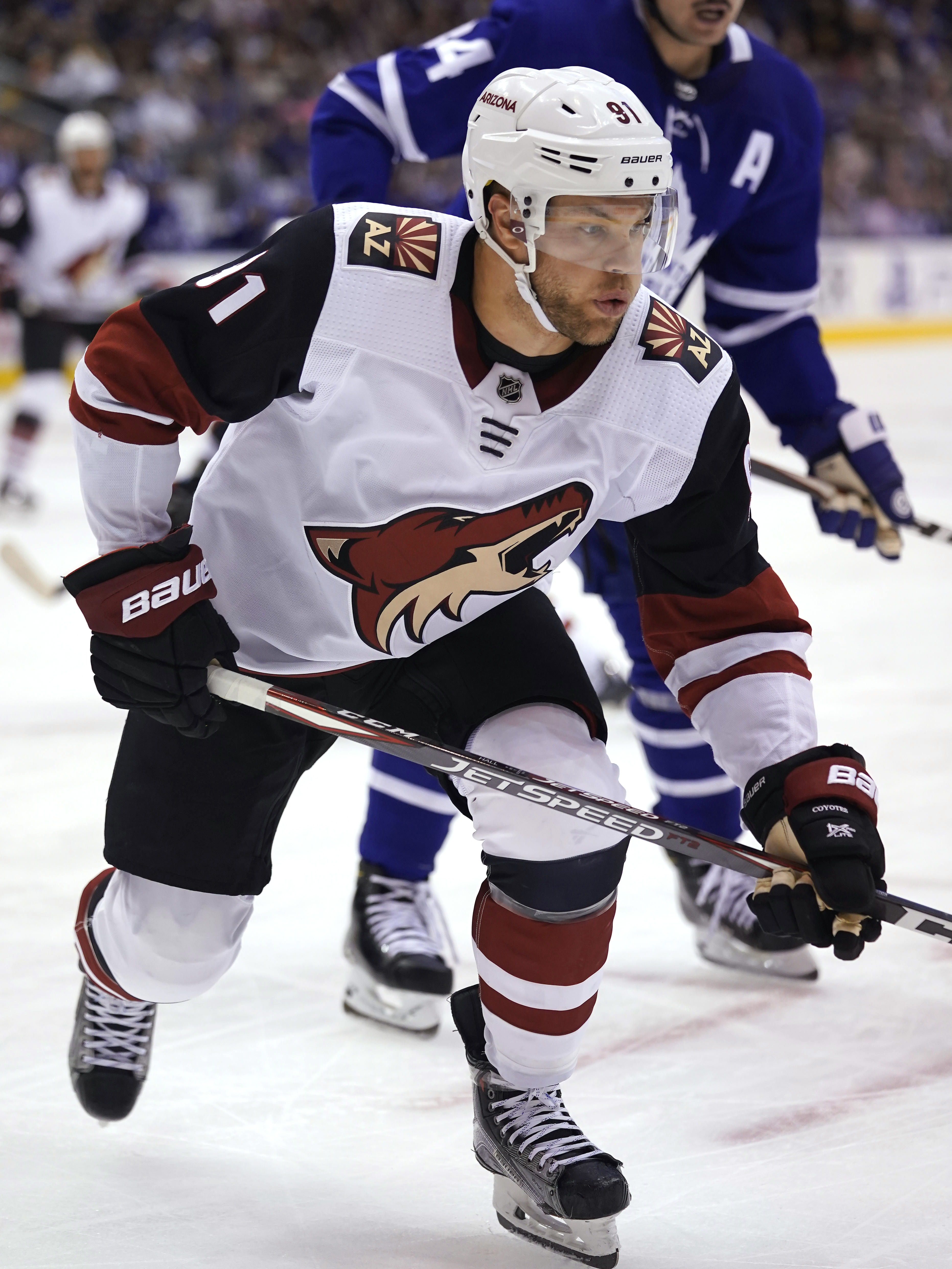 And then there is Taylor Hall, the enigmatic forward who just can’t seem to get to the playoffs. The first-overall pick from 2010 has played just five games in the NHL postseason (scoring six points), missing the tournament altogether in nine of his ten seasons.
By no means was Hall at his best this year, but his 2017-18 Hart Trophy-winning season has shown us that when he is he can carry a team nearly singlehanded. Could a strong playoff for the Arizona Coyotes push that five-year, $7.25MM price tag substantially higher?
For some pending free agents like Alex Pietrangelo and Torey Krug, an excellent playoff would just be par for the course at this point. They are expected to perform at that level and have done it many times in the past. But for others—how about Alex Galchenyuk‘s spiraling career?—this postseason is about more than just their legacy, it’s about the future.
Snapshots: Lehner, Gilbert, Sekac
One of the more interesting storylines in the NHL’s return to play playoff tournament is the extra chance it gives to players who were acquired at the trade deadline. Those that switched residence at the end of February were only given two weeks—usually just a handful of games—to show their new teams what they could do before the entire league shut down. One of those players was Robin Lehner, who went from the Chicago Blackhawks to the Vegas Golden Knights (via Toronto) and ended up playing in just three games before the season ended.
Lehner, who stopped 78 of 83 saves (a .940 save percentage) in those three games, also happens to be an unrestricted free agent at the end of the season. The playoffs then represent his last chance to show the Golden Knights why he deserves to be re-signed, something he hopes will happen according to Danny Webster of NHL.com. Lehner pointed directly to the dedication he has seen out of his new teammates as they prepare for the upcoming playoffs as a reason he’d like to stay longer. While the Golden Knights have a complex cap situation to deal with next season, there’s no doubt that Lehner will be one of the most sought-after goaltenders on the market should the team let him walk into free agency.
- One of Lehner’s old teammates in Chicago won’t get the chance to show what he can do, as Dennis Gilbert has announced he requires surgery on his wrist and will not play again this season. The 23-year old defenseman was just getting his NHL career underway, playing in 21 games with the Blackhawks this season. That’s all he’ll get for 2019-20 as he’ll now have to look forward to next year.
- Another former Blackhawk is looking for a new job, after CSKA Moscow released Jiri Sekac today. The veteran of 115 NHL games has played in the KHL for the last four seasons, putting up excellent numbers and winning the Gagarin Cup in 2018. He may not be waiting for a job long, as recently a report surfaced in the Czech Republic that Sekac would be joining Avangard Omsk for the 2020-21 season.
Troy Terry Signs Three-Year Extension
The Anaheim Ducks have locked up one of their young forwards, signing Troy Terry to a three-year contract extension. The deal will keep him from reaching restricted free agency until 2023, while Helene Elliott of the LA Times reports that the deal will pay Terry $1.35MM in the first season, $1.45MM in the second and $1.55MM in the third ($1.45MM AAV).
Terry, 22, was a fifth-round pick of the Ducks in 2015 that quickly became one of their top prospects. In his sophomore season at the University of Denver Terry exploded onto the national scene with 22 goals and 45 points in 35 games, while also helping carry Team USA to a gold medal in the World Juniors. He scored the golden goal a the tournament, before returning to DU and winning a national championship.
It was hard to overlook him at that point, and in 2018 he proved his talent once again by competing at the Olympics despite being just 20 years old. Since debuting in the NHL it hasn’t been quite as smooth sailing for the Denver native, but Terry has at least proven he has the talent to compete at that level. In 81 games spread over parts of three seasons, he has recorded 28 points. His time in the minor leagues has been much more fruitful, with Terry scoring at more than a point-per-game pace.
A three-year deal at this point shows that the Ducks believe he can be a part of their NHL future, while also securing him for a reasonable price. With so many teams blindsided by the flat cap situation, every dollar spent will have to be scrutinized heavily—even for rebuilding teams like the Ducks.
Latest On Torey Krug’s Pending Free Agency
It’s hard to know just how many more games Torey Krug will play for the Boston Bruins. He’ll be there when the team plays their round-robin against the other top teams in the Eastern Conference to determine playoffs seeding. He’ll be there in that first-round matchup with whoever comes out of the qualification games. But after that, there’s no guarantee he ever suits up for the black-and-gold again. Krug’s contract will expire at the end of the season and with a salary cap that will stay exactly where it is, re-signing him might be a challenge for the Bruins.
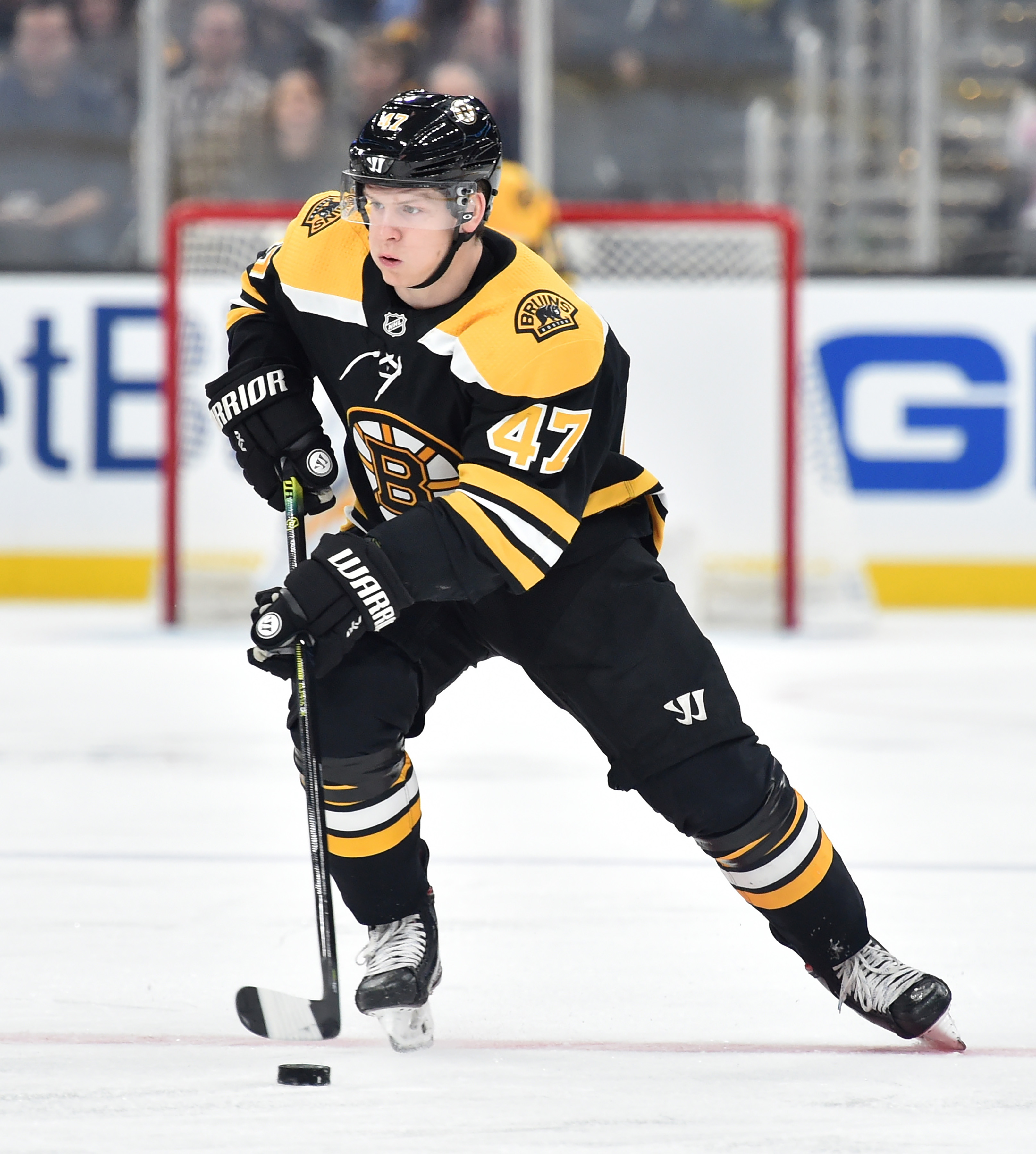 Krug understands those challenges and when he spoke with reporters yesterday including Fluto Shinzawa of The Athletic (subscription required) he explained that he doesn’t know any more than the fans who want to keep him:
I don’t really know what’s going to happen. I’m just trying to take it day by day and worry about the playoffs right now. I’ll have to probably prepare for free agency. Then we’ll see what happens there. In terms of what’s going on with the Bruins and everything else, that’s probably a question for someone else.
There’s no doubt that Krug would love to stay in Boston, he has expressed that multiple times in the past. But as he heads into free agency as one of the best available defensemen—perhaps the best if Alex Pietrangelo re-signs with the St. Louis Blues—preparing is the only prudent option.
The Bruins do have some room to play with when it comes to next year’s salary cap. They currently have just over $63.5MM committed to 18 roster players (and David Backes‘ retained $1.5MM), but there are some other contracts needing fresh ink. Jake DeBrusk is one of the team’s restricted free agents that will need a new deal, plus captain Zdeno Chara if he wants to play another year.
There is also the question of what will happen in net beyond 2020-21, when Tuukka Rask and Jaroslav Halak are both scheduled to become unrestricted free agents and will be in their mid-thirties. The Bruins have some promising young goaltending prospects, but will they be ready to take on a large role and save the team some money?
Players on expiring contracts will become free agents on the later of October 9th or seven days after the Stanley Cup is awarded. That doesn’t leave a ton of time to get an extension in place if the two sides don’t negotiate during the playoffs. Still, losing Krug would be a hefty blow even with some young players pushing for more playing time.
The 29-year old has now recorded seven consecutive seasons with at least 39 points, an impressive accomplishment in a league that has such turnover among point-producing defensemen. He’s been a constant on the Bruins powerplay during that entire stretch, tallying 136 of his 270 total assists with the man-advantage. It’s the playoffs though where he has perhaps been even more impressive, recording 46 points in 62 career games. He even led the field with 16 assists during last year’s Stanley Cup Finals run.
Krug will get at least a few more games to prove he can do it again for the Bruins in the playoffs. But beyond that, nothing is clear.
Minor Transactions: 07/09/20
The NHL off-season may not be starting until October this year, but AHL free agency is alive and well. While the league has not yet shared their plans for the 2020-21 season, that hasn’t stopped teams from extending players, signing new ones, and even importing players from overseas. Here are some recent notable minor league deals:
- Defenseman Keaton Middleton has signed a one-year deal with the Colorado Eagles, the team announced, but the Avalanche and GM Joe Sakic definitely had a hand in this signing. A former captain of the Saginaw Spirit and OHL All-Star, Middleton has the makings of a future NHLer. At 6’5” and 234 lbs., Middleton is a true shutdown defenseman who plays a strong defensive game. His size and strength earned him a fourth-round selection by the Toronto Maple Leafs in 2016, but the club opted not to sign him. However, his past two seasons with the San Jose Barracuda has shown that he has pro chops. Middleton was a +18 and added 26 points in 102 AHL games. The 22-year-old now moves to Colorado where he can continue to refine his two-way game in hopes of landing an NHL contract next summer.
- Nathanael Halbert is getting another go with the Laval Rocket. The former QMJHL defenseman who spent the past four years at McGill University played in five games at the end of the season with Laval and apparently did enough to impress the club into extending him for one year, according to a team release. The 24-year-old has never been known for his regular season production, but his playoff numbers at the college and junior level show that he has that valuable clutch gene. A native of Nottingham, England, Halbert hopes to be an unlikely hero for Laval this season and possibly beyond.
- Making his way back to North America is journeyman forward Jesse Mychan. The 28-year-old winger has signed a one-year deal with the Iowa Wild, as reported by his agency. Mychan is no stranger to the AHL, having suited up for ten games over three separate stints and nearly 200 more games in the ECHL. However, he has spent time in Wales, Germany, Austria, Slovakia, and most recently Denmark over the past few years. An experienced pro who has found great success in the ECHL in the past and starred for Denmark’s Esbjerg Energy for the past two year, Mychan hopes he is finally ready for an extended AHL stay in 2020-21.
New CBA Eliminates Free Agent Interview Period
Over the past several days, news has been trickling out about some of the new elements of the CBA. TSN’s Frank Seravalli was the first to report (Twitter link) that there is a big change coming to free agency as the interview period has been removed. Now, teams won’t legally be permitted to talk to players until the opening of free agency. While that had previously been speculated to be November 1st, that’s now projected to be October 9th as per the tentative critical dates calendar. Having said that, that seems likely to be pushed back a little bit as some of the other target dates in there (such as camps opening July 10th) have already been delayed slightly; camps won’t open now until the 13th.
This will once again fundamentally shift the free agent landscape. The interview window was put in during the last CBA to give teams a chance to speak to players in advance to gauge their interest in joining their franchise. Of course, that’s not exactly how it played out as in recent years, as deals in principle were reported a couple of days before July 1st with quite a few others getting leaked in the hours leading up to the opening of the market.
With the window not being used properly, the NHL and NHLPA have decided to go back to the old way which is no permissible contact until the market officially opens up. That will present some challenges as the market will likely go back to being one where teams make offers that expire in a very limited timeframe as they need to know whether or not they have to pivot to alternative options.
Of course, this upcoming UFA period – be it in October or early November – is going to be a rather unique one. The freezing of the salary cap at $81.5MM is going to handcuff quite a few teams and there were already some that were pegged to be having some cap trouble anyway. Accordingly, this is likely to deflate the market somewhat and adding that to eliminating any legal contact with free agents beforehand is going to create a very unique marketplace a couple of months from now.