
Snapshots: Hague, Pastrnak, Jets
When Vegas Golden Knights training camp opens tomorrow morning, defenseman Nicolas Hague won’t be there as he awaits a new contract. The Athletic’s Jesse Granger reports that he isn’t expected to be on the ice with his teammates Thursday morning at City National Arena, the team’s practice facility.
Hague is one of the few remaining restricted free agents in the NHL, alongside Toronto Maple Leafs defenseman Rasmus Sandin and Dallas Stars forward Jason Robertson as the marquee names. Granger expertly notes that Hague missing camp is more detrimental than in previous seasons, as new head coach Bruce Cassidy will be installing a completely foreign defensive system from what the Knights have been used to in past seasons. Hague, the 34th overall pick in 2017, had 14 points in 52 games last season.
- Speaking today during preseason media availability, Boston Bruins general manager Don Sweeney says it’s a priority for him to get pending free agent winger David Pastrnak signed as soon as possible. Pastrnak, while he’s expressed a strong desire to stay in Boston, hasn’t shared the same urgency in negotiations in previous reporting. Pastrnak, who’s notched 40 or more goals in his last two full seasons, will be in line for a substantial raise, and it may behoove Sweeney to get a deal done before his value rises even further.
- The Winnipeg Jets have made three scouting hires, including the first woman scout in team history, Sydney Daniels. Daniels joins the team as an NCAA scout, having previously served as the assistant coach for the women’s team at Harvard. The team also brought on Jari Kekalainen, brother of Columbus Blue Jackets general manager Jarmo Kekalainen, as a European scout, and former Toronto Maple Leafs scout Tony Martino as a USHL scout.
Mark Stone Expected To Be Ready For Camp
Everything appears to be going smoothly with Mark Stone‘s injury rehab, as head coach Bruce Cassidy told Jesse Granger of The Athletic that the Vegas Golden Knights captain is expected to be on the ice for the first day of training camp. Stone underwent back surgery in May after missing large chunks of the 2021-22 season.
Cassidy did admit that Stone may be limited by the team’s medical staff, but that his star winger feels great.
One of the biggest reasons that the Golden Knights missed the playoffs last season was the absence of Stone, who ended up playing just 37 games. Among the best defensive forwards in the game, and a top-5 Selke finalist for three years running, his ailing back kept moving him in and out of the lineup until he was finally shut down.
In those 37 games, Stone still managed to score nine goals and 30 points but averaged his lowest ice time since his rookie season. If fully healthy, he should be back in contention for the Selke and back to the point-per-game production he showed through his first two years in Vegas.
Given that the Golden Knights are dealing with a major injury to goaltender Robin Lehner and have some other holes popping up around their roster, the play of their stars will be even more important. Stone, Jack Eichel, Alex Pietrangelo, and Shea Theodore will have to be excellent for the team to get back to the postseason.
Latest On Nic Hague
While Jason Robertson takes most of the headlines regarding unsigned restricted free agents at this point, there are a number of other players still waiting to see if they’ll be under contract when training camp opens next week. One of those is Vegas Golden Knights defenseman Nic Hague, who, according to David Pagnotta of The Fourth Period on Thursday, was no closer to a deal. Hague is in Vegas but will likely return home if there is no deal at the start of camp, Pagnotta adds.
This isn’t a surprise, as the news all offseason has been pointing at a significant divide between the Golden Knights and the RFA defenseman. A week ago, reports emerged that the two sides had had “very little dialogue since early July.”
Like any negotiation, things can swing quickly with a single phone call. In this case specifically, it’s hard to see how sitting on the sidelines will benefit the 23-year-old.
Hague has played in 142 games through parts of three seasons, scoring ten goals and 14 points. But given the fact that the Golden Knights already have six defensemen signed to one-way contracts, and young players like Kaedan Korczak (or even junior superstar Lukas Cormier) ready to push for NHL minutes, there is a chance that the team will find ways to fill the lineup without him.
It’s that leverage, along with the fact that Vegas is perpetually in a salary cap crunch, that makes it a difficult situation for Hague. There is no one really doubting his talent but with relatively low offensive totals, a recent injury history, and the team’s financial situation, landing a multi-year deal for a significant raise seems unlikely.
As with any unsigned RFA, Hague will need to have a deal in place by December 1 in order to play this season.
Prospect Nicolas Guay Signed To Two-Year AHL Deal
- The Golden Knights have signed Patrick Guay to a two-year AHL contract per an announcement from their farm team in Henderson. The 20-year-old was selected in the fifth round back in July (145th overall) after a 104-point season and was expected to return to the QMJHL where his rights were traded to Blainville-Boisbriand back in July. Instead, Vegas will get a look at them in their system. The two-year term coincides with how long they have to sign him to an NHL deal as he’ll have to sign by June 1, 2024 or Guay will become an unrestricted free agent.
Examining The Recent History Of Montreal Canadiens Captains
When any NHL team names a captain, it’s big news — but even more so when it’s the most storied franchise in the history of the sport. That’s what happened today when the Montreal Canadiens named Nick Suzuki the 31st captain in team history, the first captain of Asian descent in team history (and only the second ever in the NHL after Paul Kariya), and the youngest Canadiens captain in quite some time at 23 years old.
11 months to the day after signing an eight-year extension to stay a Hab well into his prime, Suzuki adds his name to a storied list that’s worth taking a look at. While doing so would be a nearly academic-length exercise if done all the way back to the beginning of the franchise, taking a look back at the leaders of the Canadiens in recent memory still helps offer some context for the type of echelon Suzuki joined today.
Perhaps the most universally beloved Habs captain in recent memory is Saku Koivu. Serving from 1999 to 2009, his nine-year shift as captain is the longest for a Canadien since Jean Beliveau held the role from 1961 to 1971. Despite some great memories, though, Koivu’s era was not defined by playoff success. The team failed to make it out of the second round despite three appearances in that timeframe (2002, 2004, 2008). In the regular season, the Koivu-captained Canadiens had a 324-290-44-62 record, good enough for a .535 points percentage.
Ironically enough, the Canadiens finally made it to the Conference Final in 2009-10 after Koivu’s departure for the Anaheim Ducks. In their first season without a captain in their entire franchise existence, the Habs went on a memorable Cinderella run as the eighth seed, bowing out to the Philadelphia Flyers in five games in the Eastern Conference Final.
Next up at the helm was Brian Gionta, the first American to serve at least a full season as captain in franchise history. Gionta, a free agent signing prior to the 2009-10 season, was the captain for 2010-11 through 2013-14. In 242 games as captain, Gionta scored 69 goals and 127 points, a step back from his previous production in New Jersey and during his first season in Montreal. The Canadiens did make it back to the Eastern Conference Final in the last season of his tenure, though, this time losing to the New York Rangers with Carey Price injured during the final series.
After another vacant season in 2014-15, another American took the helm: Max Pacioretty. The team’s 2007 first-round pick had come off back-to-back 60-point seasons and was even named to the US Olympic team in 2014, cementing himself as one of the top players in the game at the time. He continued that production in his first two seasons as captain, rattling off 30-goal and 35-goal seasons, before taking a serious step back in 2017-18. His goal total dipped to just 17 in 64 games and he had just 37 points total on the year. The team also made just one playoff appearance with Pacioretty as captain, where he had just one assist in six games.
It turned out to be a captain-for-captain swap the following offseason, as a summer 2018 deal sent Pacioretty to the young Vegas Golden Knights in exchange for a package that included then-prospect Nick Suzuki. Four years later, Suzuki has cemented himself as the future of the franchise long-term with a captaincy and long-term extension in place.
In the bridge between Pacioretty and Suzuki, the now retired-due-to-injury Shea Weber served admirably in the meantime. His last act as captain will be remembered for years, leading the 16th-seeded Canadiens all the way through to the Stanley Cup Final in the COVID-shortened 2020-21 season before bowing out to career-ending injury.
This Day In Transactions History: Max Pacioretty Traded To Vegas Golden Knights
Most teams could only hope to have a draft like the Montreal Canadiens did in 2007, selecting Ryan McDonagh, Max Pacioretty, and P.K. Subban with their first three picks. McDonagh would ultimately be dealt before he could ever dress for Montreal, sent as the centerpiece in the Scott Gomez trade, one which overwhelmingly favored the New York Rangers. Subban and Pacioretty, along with Carey Price, went on to form the core of some formidable Canadiens teams in the mid 2010’s. Following the 2015-16 season, needing to rebound from their first playoff miss in several years, Montreal dealt Subban in one of the biggest one-for-one deals in not only the league’s history, but sports history, sending him to the Nashville Predators for Shea Weber.
The Subban for Weber swap helped Montreal rebound to a playoff berth in 2016-17, but a dreadful 2017-18 forced the organization to re-think things and just before teams were set to hit the ice for training camp, they dealt their star forward and team captain in Pacioretty to the Vegas Golden Knights. Vegas, having burst onto the scene in their first season just a year prior, were looking to make a splash in order to hopefully get over the hump and win the Stanley Cup, falling just short in their first try. Acquiring the regular 30-goal-scorer wasn’t cheap though, Vegas paying handsomely in the amount of Tomas Tatar, Nick Suzuki and a 2019 second-round pick. The return, put plainly, sounds large, but perhaps fair considering the practice of giving something to get something, Vegas giving up a solid veteran point producer, a then-unproven prospect, and a second-round pick out of their bevy of draft picks and receiving a guaranteed star who immediately signed an extension in return. But, with the benefit of time and context, the perception of the deal now has certainly changed.
To give some perspective on how dynamic this trade ended up being for the Golden Knights, the Canadiens acquired a 60-point forward, a prospect who would become one of the young faces of their franchise, and a second-round pick and there is seemingly less to say on their end. Moving Pacioretty, a star and captain, was surely not an easy move for the Montreal organization to make, but one they felt necessary, especially given the return. Tatar would go on to have 58 and 61 point seasons, the latter coming in just 68 games. His third and final season with the team, 2020-21, saw him dip to 30 points, albeit in 50 games in the COVID shortened campaign, but with just five playoff games amid a deep playoff run. Worth mentioning, the second-round pick was unceremoniously flipped to the Los Angeles Kings for a third and fifth-round pick.
The real prize in the trade, and one that perhaps keeps Vegas management and fans up at night is Suzuki. The 13th overall selection in 2017, Vegas’s second of that evening, Suzuki hadn’t yet debuted for Vegas before he was dealt to Montreal. After the move, the forward spent another season in the OHL, where he wasn’t immune to trade either, dealt midseason from the Owen Sound Attack to the Guelph Storm. Still, none of it phased Suzuki, who had another outstanding junior season. The young forward made his NHL debut for Montreal the following season, finding breakout success in the shortened 2020-21 season, playing a pivotal role in Montreal’s near miss of a Stanley Cup. Following that season (more specifically, October), The Canadiens inked Suzuki to an eight-year, $63MM extension beginning in 2022-23 with the expectation that he could lead the next great set of Montreal teams.
The Vegas side of this blockbuster is a lot murkier. They certainly gave up a lot to get Pacioretty, but that isn’t always the issue with a trade. In fact, the winger brought back as much if not more value than they were expecting. Point for point, Pacioretty had some of his best seasons in Vegas, highlighted by a 51 point performance in 48 games during the shortened 2020-21 season, the only time he hit the point-per-game mark in his career. The real issues for the Golden Knights would be two-fold: (1) money, and (2) when all was said and done, what went in and what went out.
Upon acquiring the Montreal captain, the Golden Knights immediately signed him to a four-year, $28MM extension that began in 2019-20. That deal was fine at the time, Vegas then still in the envious position of being competitive but also utilizing their cap to help other teams for the right price. But, as the contract went on, Vegas continued to spend liberally to reward their successful core and also bring in new assets to help them out. With that, their cap situation became tighter and tighter and Pacioretty’s $7MM cap hit grew more and more imposing. Finally, with the addition of Jack Eichel and his $10MM cap hit part-way through last season, the bubble was set to burst this offseason and Vegas needed to shed a big contract. That would end up being Pacioretty.
As talented as Pacioretty still is, his $7MM cap hit on top of his recent injury history, made taking him on a questionable decision for many teams. Vegas was able to find a suitor, and though they didn’t have to pay anything significant to offload his contract, they received merely future considerations for a player who had 194 points in 224 games for them over the previous four seasons (as well as Dylan Coghlan).
The other troubling aspect of this deal is a completely separate trade made several months prior. At the 2018 trade deadline, with assets in hand and a surprising playoff berth in sight, Vegas made a splash by acquiring Tatar from the Detroit Red Wings. Tatar, like Pacioretty here, didn’t come cheap, as Vegas sent a first, second, and third round pick to Detroit to make it happen. The Czech winger gave Vegas just eight points in 20 regular season games on top of another two points in eight playoff contests ahead of the instant trade. The reason the earlier Tatar trade is important is to consider the context: Vegas, in effect, traded Suzuki, a first, two seconds, and a third for 28 underwhelming games of Tatar and four seasons of Pacioretty, who they then traded away for almost nothing after he actually stepped his production up.
Another interesting wrinkle to all of this, but not one that absolves Vegas of their questionable trade tree, is that Pacioretty tore his Achilles after the trade to Carolina, forcing him to miss at least six months of the upcoming season. Of course, Vegas didn’t know this would happen when they made the deal, preserving the questions regarding their logic in the handling of the forward. Realistically, had this happened before the trade, Vegas could have utilized LTIR with Pacioretty, but had he been ready to return ahead of the playoffs, it would have left the team in a difficult position.
Hindsight is twenty-twenty, as the saying goes, and that applies to any transaction, but the Pacioretty-to-Vegas trade from four years ago today is a fascinating retrospective into roster, cap, and asset management. Vegas gave up plenty for Pacioretty, but it was most likely worthwhile as they got back arguably more than they bargained for. But after four seasons and just one more to go under their current commitment, the team essentially walked away from their player while Montreal continues to reap the reward with one of the league’s most exciting young stars. One question to ponder as we consider these last four years: how is this viewed, all else the same, had Vegas won a Stanley Cup with Pacioretty in the fold?
Salary Cap Deep Dive: Vegas Golden Knights
Navigating the salary cap is one of the more important tasks for any GM. Teams that can avoid total cap chaos by walking the tightrope of inking players to deals that match their value (or compensate for future value without breaking the bank) remain successful. Those that don’t see struggles and front office changes.
PHR will look at every NHL team and give a thorough look at their cap situation heading into the 2022-23 season. This will focus more on players who are regulars on the roster versus those who may find themselves shuttling between the AHL and NHL. All cap figures are courtesy of CapFriendly.
Vegas Golden Knights
Current Cap Hit: $92,736,310 (over the $82.5MM Upper Limit)
Entry-Level Contracts
None
Signed Through 2022-23, Non-Entry-Level
G Laurent Brossoit ($2.325MM, UFA)
G Adin Hill ($2.175MM, UFA)
F Brett Howden ($1.5MM, RFA)
F Phil Kessel ($1.5MM, UFA)
F Nolan Patrick ($1.2MM, RFA)
F Sakari Manninen ($750K, UFA)
Kessel was brought in a couple of weeks ago once the Golden Knights learned that they had some extra LTIR flexibility. He’s not the high-end sniper he was in the prime of his career but he still finished third on the Coyotes in scoring last season and should be a low-cost secondary scoring option on a team that doesn’t have a lot of value contracts. Howden was limited last season due to injuries and often was on the fourth line when he was in the lineup. Despite that, he received this contract back in July to avoid any possibility of arbitration but he’ll need to take on a bigger role to justify getting qualifying him with arbitration rights next summer.
Patrick saw very limited action last season as his concussion issues continued and he might be another LTIR candidate for the upcoming season. Unless something changes, he’ll be non-tendered in June. Manninen’s strong showing at both the Olympics and the Worlds earned him his first NHL contract at the age of 30 on a one-way agreement and will have a good chance to earn a roster spot, especially if they have enough LTIR flexibility to carry more than the minimum-sized roster.
Brossoit was brought in last summer to serve as the backup goaltender and continued his trend of alternating good and bad years with 2021-22 landing in the latter category. His availability for the start of this coming season is in question due to hip surgery so he is going to have a limited window to show that he’s worthy of a similar contract next summer. Hill was recently acquired using part of their extra LTIR space and should get a good opportunity to boost his stock heading into free agency next summer, especially if he could lock down the starting role at some point. Even if not, he could get a small boost as the backup market continues to improve.
Signed Through 2023-24
F Michael Amadio ($763K, UFA)
F William Carrier ($1.4MM, UFA)
D Ben Hutton ($850K, UFA)
F Jonathan Marchessault ($5MM, UFA)
D Alec Martinez ($5.25MM, UFA)
F Chandler Stephenson ($2.75MM, UFA)
Marchessault is one of the few remaining original Golden Knights and is the leading scorer in franchise history after five strong seasons. He’ll be 33 on his next deal and if he can maintain the type of production he has provided Vegas, he could get a multi-year agreement around this rate again. Stephenson has become quite the bargain after Washington couldn’t find a regular role for him in the lineup. He has quickly become a top-six center that makes third-line money and at this point, him doubling his current AAV is definitely doable on the open market in 2024.
Carrier isn’t a significant scorer although he produces more than most fourth-liners do while providing them with plenty of physicality. This is a bit of an above-market deal for someone in that role compared to a lot of fourth-liners signing for around $1MM or less but Vegas is getting more out of him than other teams will from their depth pieces. Amadio was brought in off waivers last year and was a decent depth contributor, earning himself a one-way deal but he’ll need to become an everyday regular to do much better than that in 2024.
Martinez likely left money on the table when he signed an extension last summer but injuries really limited him last season which has hurt his value. He’ll be 37 when his next contract starts and at that point, he might have to go year-to-year at a lower rate than this one. Hutton turned a PTO into a one-year deal, then did well enough to get this extension. He has been in a fringe role for a few years now so his market isn’t likely to change much over the next couple of seasons.
Signed Through 2024-25
F Keegan Kolesar ($1.4MM, UFA)
G Robin Lehner ($5MM, UFA)
F Jake Leschyshyn ($767K, UFA)
D Brayden McNabb ($2.85MM, UFA)
F Jonas Rondbjerg ($767K, UFA)
F Reilly Smith ($5MM, UFA)
D Shea Theodore ($5.2MM, UFA)
G Logan Thompson ($767K, UFA)
Smith hasn’t been able to produce at the level he did early on in his time with Vegas but he continues to be a reliable secondary option that can play in all situations so the team opted to hand him a new three-year deal in July at the same rate of his last one. If the downtick in production continues though, he’ll be hard-pressed to get another $5MM deal in 2025. Kolesar avoided arbitration with his deal last month and did well with this agreement following his only full NHL season. Clearly, Vegas believes he has another level he can get to which would make this a team-friendly deal if he can step into a regular role on the third line. Leschyshyn and Rondbjerg were both up and down last season but are now waiver-eligible which could help them stick at the end of the roster and could boost their stock by securing a regular spot in the lineup at some point during their contracts.
Theodore has emerged as a strong top-pairing blueliner over the last few seasons which makes his deal one of the biggest bargains they have as they’re getting top production at a second-pair rate. He’ll be 30 at the end of this agreement so a max-term contract could be coming his way at a considerably higher price tag than this one. McNabb, meanwhile, isn’t a big point-producer and provides most of his value on the defensive side of things. As long as he can continue to hover around the 20-minute mark, the Golden Knights will get a good return on this contract.
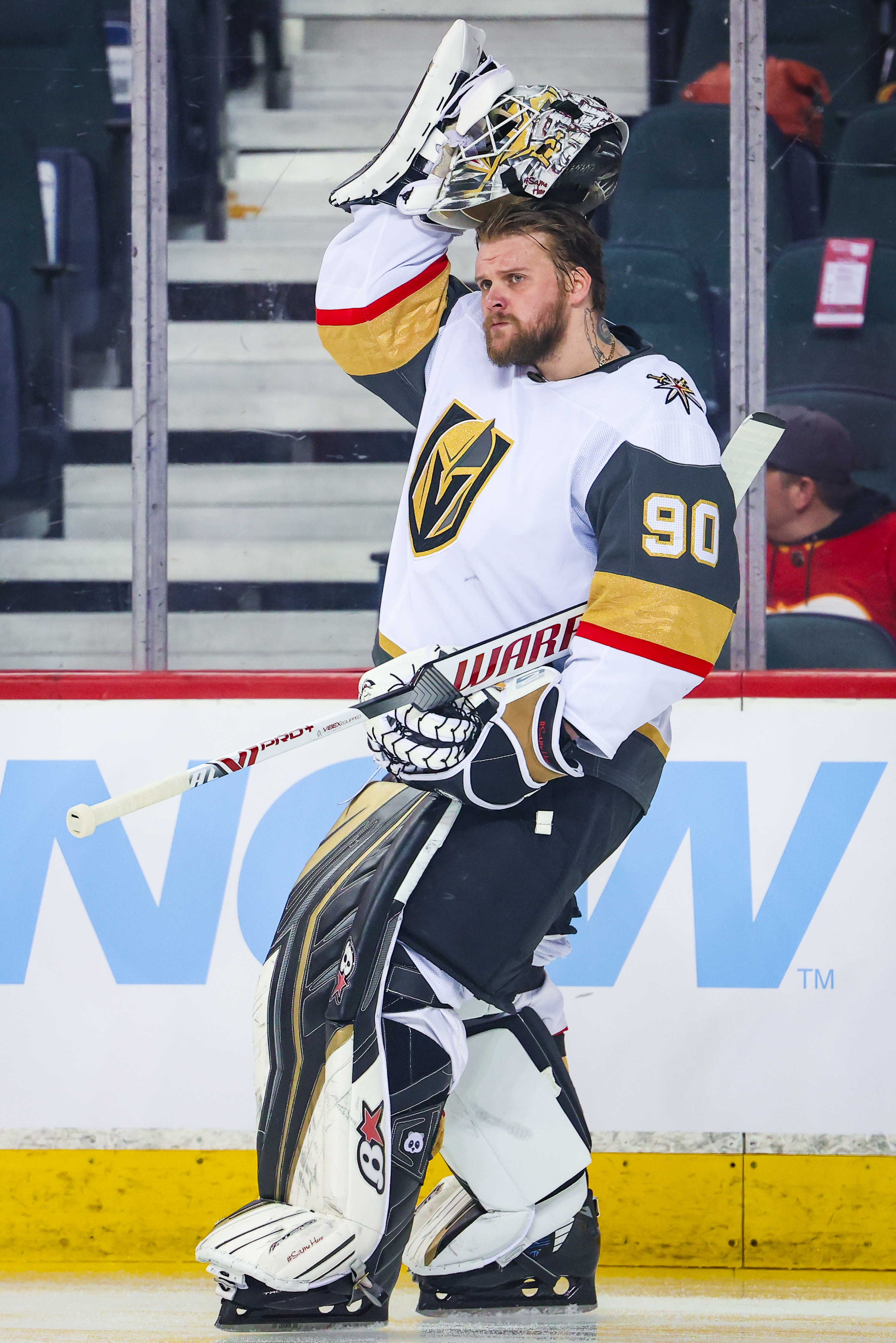 Lehner was the undisputed starter for Vegas last season with Marc-Andre Fleury being traded away last summer in a straight salary cap dump move. However, injuries limited him to just 44 games while he battled inconsistency which is hardly the outcome they were hoping for when they picked Lehner to be the starter. To make matters worse, they recently revealed that he will need hip surgery that will keep him out for all of the upcoming season. While that created the LTIR room for them to add Kessel and Hill, Lehner’s absence certainly also creates a big question between the pipes not only for the upcoming season but beyond as well since hip issues can often be a lingering issue.
Thompson will get an opportunity to be at least the short-term answer to the goaltending question as he will get a long look at being the starter this season. If he can lock down that role, his contract will become one of the top bargains in the league. If things don’t go well, however, he’s a candidate to be sent down when Brossoit is cleared to return; Thompson remains waiver-exempt for the upcoming season.
Nicolas Hague, Vegas Golden Knights Not Progressing Towards Contract
After an offseason where navigating a tricky salary cap situation dominated the headlines for the Vegas Golden Knights, the team is down to their last remaining restricted free agent, and one who we documented earlier today: defenseman Nicolas Hague. Although the organization has done a good job thus far of working within their restraints, they’re left in a bit of a tough spot with their remaining cap and one of their bright young defensemen. At the moment, Vegas sits just around $10.24MM over the upper limit of the NHL’s $82.5MM. salary cap. Somewhat fortunately, they will be able to cancel out around $12.86MM in cap hit by placing defenseman Shea Weber and goaltender Robin Lehner on LTIR, leaving them with $2.64MM in available space. The issue there is whether it will be enough to get Hague signed.
Of concern, it sounds like it may not. As Fox 5 Vegas’s Vince Sapienza reports, things apparently are not progressing between team and player, who apparently have had “very little dialogue since early July.” Sapienza adds that though Hague is in Las Vegas and ready to join the team for the start of training camp on September 21st, he and his representatives are becoming concerned with the lack of communication. Sapienza also notes that if no deal is reached by the start of training camp, Hague is expected not to report and will instead train elsewhere in the interim.
Seeing that the two sides have apparently had very little communication since the early parts of the offseason is absolutely worrisome for those following the Golden Knights. The organization has made its moves to stay below the salary cap and get creative doing so, but those tough decisions, like the one to move Max Pacioretty to the Carolina Hurricanes for merely future considerations, were seemingly meant to allow the team to extend key players like Hague. Should Hague hold out by not attending Golden Knights training camp, that itself wouldn’t be a concern, the practice happening regularly for unsigned RFAs.
If Vegas were to be without Hague into the regular season, they could field a complete roster, having six defenseman signed and on the NHL roster right now (not counting Weber, who won’t play), with several depth options available to close the gaps, but none as good, and experienced, as Hague. Looking closer at the numbers, it wouldn’t be a shock to see Vegas be able to sign Hague for less than the $2.64MM they will have available after utilizing LTIR, but the 23-year-old Kitchener, ON native has shown an ability to play reliable minutes in his own zone with his offensive ability still progressing, so an affordable deal may not be easily found. But, with the possibility of forward Nolan Patrick also landing on LTIR, Vegas could increase its available space to $3.84MM, likely enough to bring back the hulking defenseman.
Last year, Hague had four goals and 10 assists in 52 games while averaging 18:40 per night, and sports a respectable 10 goals and 32 assists in 142 career NHL games. A 2017 second-round pick of the Golden Knights, Hague just finished the final year of his ELC.
Last 10 Restricted Free Agents
And then there were ten. After Cayden Primeau inked his deal yesterday, there are now ten restricted free agents who have not yet signed contracts for next season. These players must be signed by December 1, or they will not be eligible to play in the NHL at all.
Jason Robertson, the young Dallas Stars forward, leads the way as the most impressive name, though many others represent key players for their respective teams.
The Los Angeles Kings, for instance, have two young defensemen on the list who each showed last season that they could be big parts of the future. Michael Anderson and Sean Durzi were each key in the team’s playoff run, with the former averaging more than 20 minutes a night during the regular season.
Arizona’s Barrett Hayton is a bit of a headscratcher, given how much cap space the team has, but his development has been anything but normal to this point, so it fits the pattern. The 22-year-old forward has played in 94 games at the NHL level and just 35 in the minor leagues since he was selected fifth overall in 2018.
The full list is:
Arizona Coyotes
Calgary Flames
Dallas Stars
Edmonton Oilers
Los Angeles Kings
New York Islanders
Ottawa Senators
Toronto Maple Leafs
Vegas Golden Knights
Several of these players are likely already signed, with teams only waiting to clear additional cap space before officially filing the deals. Others may end up missing part of training camp or even the regular season, as they try to work out the best contract for the present and the future.
Vegas Golden Knights Announce Rookie Tournament Roster
- We recently covered how the San Jose Sharks would be hosting a tournament for prospects from six NHL teams. Today, each of those six teams (the Sharks, Kings, Ducks, Coyotes, Avalanche, and Golden Knights) announced their rosters for the camp. There are quite a few notable names to look forward to at that tournament, including first-round picks Quinton Byfield, Mason McTavish, William Eklund, Conor Geekie, Oskar Olausson, and Brendan Brisson, among others.