
What Your Team Is Thankful For: Buffalo Sabres
As Thanksgiving and the holiday season approaches, PHR will be taking a look at what teams are thankful for in 2023-24. There also might be a few things your team would like down the road. We’ll examine what’s gone well in the early going and what could improve as the season rolls on for the Buffalo Sabres.
Who are the Sabres thankful for?
The Sabres raised a lot of eyebrows when they signed the 23-year-old to an eight-year $88MM contract extension back in October that made him one of the highest-paid defensemen in NHL history. The signing made sense from Dahlin’s perspective as he cashed in on a career year and became one of the highest paid players in the league.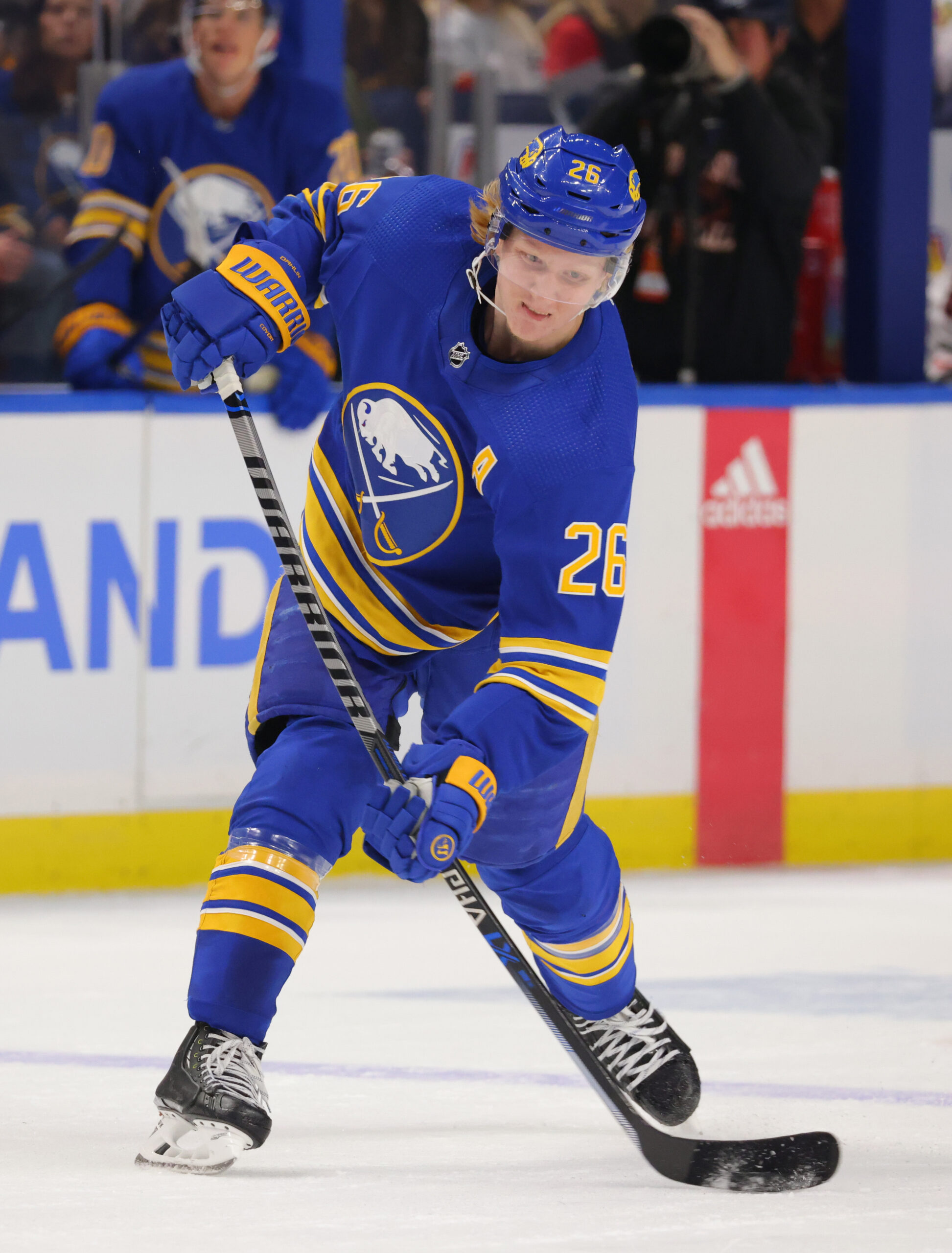
From the Sabres perspective, there were a few question marks. Dahlin has never finished above eighth place in Norris Trophy voting and has only garnered consideration one time. However, the Sabres bet on Dahlin’s continued development going forward and are hoping he will turn into a perennial Norris Trophy contender throughout the life of the deal.
A month after signing the deal, Dahlin has given the Sabres everything they could ask for. He has averaged almost 25 minutes a night of ice time, playing in all situations. He has been terrific for the Sabres at even strength, while remaining a threat on the power play and has even worked on the penalty kill, putting up solid numbers in the process.
Dahlin has really demonstrated his value to Buffalo while center Tage Thompson has been out of action. The Sabres desperately needed someone to step up in Thompson’s absence and so far, Dahlin has been one of the leaders to fill the void. In Sunday night’s game against the Chicago Blackhawks Dahlin had a goal and two assists and was pivotal in the Sabres ending their three-game losing streak
Dahlin posted 73 points in 78 games last season while averaging almost 26 minutes a night in ice time, this season his numbers thus far are almost identical. He is averaging about a minute less of ice time per game, but offensively he is on pace to come close to last season’s totals. Dahlin has four goals and 12 assists in the first 19 games of the season and has been much more physical and has also been more responsible with the puck than in seasons past.
What are the Sabres thankful for?
Their fanbase.
Buffalo sports fans are some of the most enduring fans in the world. You don’t lose four Super Bowls in a row without learning a thing or two about remaining passionate in the face of adversity. But still, credit to the fans of the Buffalo Sabres for still turning up in droves year after year to see a team that hasn’t made the Stanley Cup playoffs for 12 straight years.
Some people will point to the Sabres attendance this year and say that their numbers are down (which they are), but for the most part, the fans are still turning up in person to watch a team that hasn’t given them anything to cheer about for over a decade. The Sabres crowds might be smaller than in years past, but the crowd is still loud and passionate and firmly behind the team.
It will be interesting to see what the attendance numbers look like for the remainder of the season as Buffalo came into this year with playoff aspirations and thus far hasn’t looked like a playoff team. The Sabres have started the year 8-9-2 and if their season starts to go sideways, they could see more nights where there are over 5,000 empty seats in the KeyBank Center like we saw a few weeks ago.
What would the Sabres be even more thankful for?
A solution to their three-goalie situation.
The Sabres have been rolling this season with three goaltenders which hasn’t been an ideal set of circumstances for a team that needs help in the goal-scoring department. The Sabres have been unable to bring up any of their scoring prospects from the AHL because of the roster spot being occupied by the third goaltender. And make no mistake, Jiri Kulich and Isak Rosen are both recent first-round picks that could both help the Sabres with their scoring woes.
The three-goalie situation also hasn’t been great for all the goaltenders involved either. Ukko-Pekka Luukkonen has been solid thus far for Buffalo going 4-3-1 with a .911 save percentage, but Eric Comrie has been uneven going 1-2 with an .898 save percentage. While all those numbers are pretty run-of-the-mill, poor Devon Levi has struggled to gain any traction with a 3-4-1 record and a .879 save percentage.
The solution to the situation would likely be unpopular in Buffalo, but it would be the most practical. One goaltender needs to be sent to the minors and given their contract situations it would most likely be Levi as he is exempt from waivers and could be sent down without the risk of the Sabres losing him. Luukkonen and Comrie could be sent down to the AHL, but they would likely be claimed by another team should Buffalo elect to do that.
Levi doesn’t exactly deserve a demotion, but given Buffalo’s struggle to score, his contract situation and play, it would be the most pragmatic move that Buffalo could make.
What should be on the Sabres holiday wish list?
An offensive forward.
As I mentioned before, the Sabres need to score more, and an offensive-minded forward would go a long way to adding some punch to their offensive attack. The Sabres do boast a fair amount of young offensively gifted players, but many of them are just learning the pro hockey game and have yet to find the consistency that Buffalo needs to get back to the playoffs.
The Sabres have been tied to hometown boy Patrick Kane, and while Kane certainly has the offensive pedigree, he is a bit of an unknown given the situation with his hip recovery. If he could regain some of the form he showed in Chicago just two years ago, Kane could be a solution to Buffalo’s problems, but it would be asking a lot from a player who is coming off major surgery.
The fact that Buffalo is in on Kane is an indication that they would like to add a high-end offensive forward which should be encouraging to Sabres fans. If Buffalo can find space to bring up one of their young scoring forwards from the AHL and find an offensively talented forward from outside the organization, they might be able to finally optimize their offense.
What Your Team Is Thankful For: Boston Bruins
As Thanksgiving and the holiday season approaches, PHR will be taking a look at what teams are thankful for in 2023-24. There also might be a few things your team would like down the road. We’ll examine what’s gone well in the early going and what could improve as the season rolls on for the Boston Bruins.
Who are the Bruins thankful for?
Jeremy Swayman and Linus Ullmark
Boston’s goaltending wasn’t just great last season, it was historically great. And with the litany of NHL all-stars that departed Boston this summer, many pundits figured that the Bruins’ historical 65-win season would be a distant memory as they struggled through this season. That has not been the case, in fact, the Bruins aren’t just as good as last year. Thus far this season, they are actually better. Last season at this time Boston was sporting an incredible .823 points percentage, but this year they are sitting at an unfathomable .861.
Sure, they still have some of the pieces from their strong core kicking around, but the real reasons they are historically good once again this season are Swayman and Ullmark.
Swayman and Ullmark have split goaltending duties almost directly down the middle this season with incredibly close comparables. Swayman is currently sporting a record of 7-0-2 with a 2.09 goals-against average and a .933 save percentage. Ullmark on the other hand is 7-1-1 with a 2.10 goals-against average and a .932 save percentage.
To find a discrepancy between the two netminders it requires a deep dive into the numbers. According to Money Puck, Swayman has saved one full goal more when you look at both goaltenders’ goals saved above expected. Swayman has posted a 7.6 goals saved above expected while Ullmark has posted 6.6. The calculation by Money Puck is done by taking the goals that a goalie is expected to allow and then subtracting the actual number of goals the goalie has let in. Both Ullmark and Swayman are well above average in this category and every other goaltending metric.
There was talk in the summer that maybe the Bruins would like to move on from Ullmark, but it is hard to fathom Boston breaking up such an incredible duo. Goaltending is a notoriously difficult position to project and it’s rare for teams to get one goalie playing as well as Swayman or Ullmark, and having two is unheard of.
What are the Bruins thankful for?
Surprising play from their top centers.
When Patrice Bergeron and David Krejci announced their retirements in August, many thought that it could be curtains for the Bruins time atop the NHL standings. But, from the moment the puck dropped to start the NHL season they have received quality work from their top two centers Pavel Zacha and Charlie Coyle.
Zacha’s year didn’t start out great as he had just a single assist in the first five games of the season, but since that time he has posted seven goals and six assists in his past 13 games. On top of finding his offensive game, Zacha is averaging almost three and a half minutes more ice time per game than his career average and is finding far more success in the faceoff circle winning draws at a rate that is almost five percent higher than last season.
Coyle on the other hand is on pace for a career season and has fit the role of a top-6 center perfectly. At the moment the 31-year-old is on pace for 32 goals and 41 assists should he dress in all 82 games. Now a lot would have to go right for Coyle to hit those numbers, but the odds are pretty good that he will top the career-high 56 points he put up in the 2016-17 season. Coyle isn’t just doing good work on the offensive side of the game; he has also been a huge part of Boston’s penalty kill and has been dominant in the face-off circle.
What would the Bruins be even more thankful for?
More scoring from the backend
It’s hard to be wishing for more when your team is 14-1-3 to start the season. But if the Bruins were looking for a little something extra it would be more scoring from their defense core. So far this season, Bruins defensemen have accounted for just seven goals and 28 assists. Now, those numbers aren’t horrible, and they certainly don’t paint a fair picture of all their defensemen’s contributions. But the collective 35 points from the Bruins defense core barely tops the 31 points that Vancouver Canucks defenseman Quinn Hughes has put up on his own this season.
Bruins head coach Jim Montgomery has said in press conferences that he would like to see the Bruins’ defensemen adopt more of a shot-first mentality and he would especially like to see his rearguards be in shot-ready mode at any time.
There is merit to what Montgomery is preaching. The Bruins have a ton of big forwards who can drive to the net and get sticks on pucks, or at the very least cause disruption and perhaps create a seam for a seeing-eye shot from a defenseman to find its way into the back of the net.
The Bruins could certainly look to conference foe the Carolina Hurricanes to see how an active defense core can score a lot of goals from the point just by simply being selfish and shot-happy when the shooting lanes open.
What should be on the Bruins holiday wish list?
A top-6 forward.
To be fair, the Bruins really don’t have any needs at the moment. And if there is anything that can be taken away from last year’s playoff collapse it is that often it doesn’t payoff to go all in.
The Bruins don’t have many trade chips to bolster their lineup at this year’s trade deadline, but that doesn’t mean they won’t. If they were to decide to make an impact move at the trade deadline, acquiring a top-6 forward must be top of mind for general manager Don Sweeney.
The Bruins current top-6 is formidable, but it is hard to imagine a team with Stanley Cup aspirations feeling overly comfortable with 34-year-old James van Riemsdyk eating up big minutes come playoff time. That’s no slight on van Riemsdyk, who has been terrific this year, but the reality is that he would be better suited to dress on the team’s third line with Matthew Poitras and Jake DeBrusk
Photo courtesy of USA Today Sports Images
What Your Team Is Thankful For: Arizona Coyotes
As Thanksgiving and the holiday season approaches, PHR will be taking a look at what teams are thankful for in 2023-24. There also might be a few things your team would like down the road. We’ll examine what’s gone well in the early going and what could improve as the season rolls on for the Arizona Coyotes.
Who are the Coyotes thankful for?
Durzi is quickly looking like one of the more shrewd trade acquisitions of the offseason. The now-25-year-old defender had decent stock as a young prospect coming up through the Maple Leafs and Kings systems – he was one of the core pieces in the trade that brought Jake Muzzin to Toronto in 2019. Emerging into the NHL with the Kings two years later, Durzi showed promise as a capable puck-mover, notching 65 points in 136 games while playing over 19 minutes per game.
There were some defensive holes in his game, though. When the Coyotes picked him up for the price of a second-round pick last summer, most viewed him as a higher-ceiling, higher-risk project.
So far, he’s brought most of the ceiling with little of the risk. Durzi has taken the title of undisputed number-one defenseman in the desert and ran with it. He leads the team’s blueliners in average ice time (23:20), points (12 in 18 games played), and leads the team’s regular defenders with a 50.8% Corsi share at even strength. Quickly, he’s become a more well-rounded player than most expected at this stage, helping transform a long-lowly Coyotes squad into a team that looks likely to be playing competitive games late into the season.
What are the Coyotes thankful for?
An aggressive offseason from GM Bill Armstrong.
It’s not just Durzi. Armstrong’s moves this summer showed a willingness to believe in the core he’s constructed – spending significant short-term money to bring in players like Jason Zucker and Alexander Kerfoot up front and Mathew Dumba on the backend. Even if all the signings haven’t worked out wonderfully thus far, it does seem to have precipitated a bit of a culture shift that the squad sorely needed.
Combining that veteran leadership with a solid development coach in André Tourigny, as well as solid netminding from Connor Ingram, has positioned the Coyotes as one of the more entertaining squads this season.
Perhaps bringing in Nick Bjugstad for a second stint with the squad has been the best out of the team’s UFA additions. With 11 points in 18 games, he’s tied for sixth on the team in scoring and is logging nearly 17 minutes per night. He’s been far more consistent and productive than Kerfoot or Zucker while taking on a larger role.
What would the Coyotes be even more thankful for?
Arena certainty.
Things seem to be on a sustained, upward on-ice trajectory for the Coyotes for the first time in quite a while. The same still can’t be said off the ice, however, as concerns about an NHL-capacity home in the Phoenix area continue to grow as weeks go by without any update of real progress.
The timeline has been rather drawn out since voters in the City of Tempe struck down plans to build a multi-purpose entertainment district that would house a new arena for the Coyotes in a well-located area near Phoenix Sky Harbor airport. Coyotes owner Alex Meruelo has continued to pursue potential sites in the Phoenix metro area, likely one that would not require public approval.
The local tide on the Coyotes may be turning, however, if their TV numbers are any indication. Moving to more public-access TV mediums and dropping the regional sports network model has increased their viewership an incredible amount over a year-to-year basis, although a much more exciting team headed up by a strong first line and a flashy rookie in Logan Cooley has piqued public interest. If the team truly has aspirations of being championship-caliber in the next few seasons, though, they’ll need to give their players certainty around a long-term home.
What should be on the Coyotes’ holiday wish list?
A true fit at center between Clayton Keller and Nick Schmaltz.
The Coyotes will be in a bit of a bind over the next few weeks without Barrett Hayton due to injury. The team’s fifth-overall selection in 2018 appeared to have a breakout campaign in 2022-23, scoring 19 goals and 43 points, both by far career-highs. But so far this season Hayton has been almost entirely unable to find the scoresheet and has registered just four points in 16 games.
For a Coyotes team that could seriously contend for a Wild Card spot this season, that isn’t going to cut it from the first-line center role. In Hayton’s absence, the Coyotes are trying Cooley in the first-line center role.
While Cooley is undoubtedly the most gifted player, at least offensively, that they could have tapped for that job, it’s a lot to ask of a rookie to not only play center, but also play center on a team’s first line next to two star scorers.
It remains to be seen whether Cooley will mesh with Schmaltz and Keller, but regardless of if it’s Cooley or someone else Coyotes fans will have to hope that there will be a pivot that emerges as a consistent, lasting fit between Schmaltz and Keller.
Photo courtesy of USA Today Sports Images
Submit Your Questions For The #PHRMailbag
American Thanksgiving is generally viewed as a good point for teams to assess where they are and what they might be looking to do on the trade front. One team – Edmonton – didn’t even wait that long before deciding to make a coaching change while another – Calgary – has flipped from looking to extend its key pending UFAs to putting a hold on those discussions; one has already requested a trade.
With that in mind, it’s a good time for our next mailbag segment. In our last one, topics included the Shane Pinto situation in Ottawa, possible teams that could be looking to make an early trade, Mike Sullivan’s future in Pittsburgh, and much more.
You can submit a question by using #PHRMailbag on Twitter/X or by leaving a comment down below. The mailbag will run on the weekend.
What Your Team Is Thankful For: Anaheim Ducks
As Thanksgiving and the holiday season approaches, PHR will be taking a look at what teams are thankful for in 2023-24. There also might be a few things your team would like down the road. We’ll examine what’s gone well in the early going and what could improve as the season rolls on for the Anaheim Ducks.
Who are the Ducks thankful for?
Greg Cronin.
An improved defensive structure is the largest reason the Ducks have been among the more surprising teams to kick off the 2023-24 campaign. A 9-9-0 start may not be much to write home about for some, but it’s a stark improvement for a team that finished last in the league last season. Consider that a .500 points percentage currently ties them for the second Wild Card spot in the Western Conference with the Coyotes, and the Ducks’ rebuild looks right on track.
The offseason parting of ways with Dallas Eakins and the hiring of Cronin, a first-year NHL head coach, as his replacement looks to be the right call early on. Higher-ups in the organization preached Cronin as someone who could mold a group of young players into a more well-rounded style – a shift that’s played out in front of fans quickly this year.
Luck has certainly been on the Ducks’ side. After all, Frank Vatrano‘s 12 goals in 18 games (and his sky-high 19.4% shooting percentage) seem unsustainable. Their tandem of young Lukáš Dostál and John Gibson in the crease is providing them with truly above-average netminding for the first time in years, as well.
However, that shouldn’t take away from the mindset Cronin has instilled. The numbers back Cronin’s impact up – at even strength, their 47.1% Corsi share, 47.3% share of scoring chances, and 47.5% share of high-danger chances are all significant improvements over last season’s numbers, which resided in the low 40s. Their 56 goals allowed sits right in the middle of the NHL as Thanksgiving rolls around, and while they likely won’t be one of the 16 teams to make the 2024 Stanley Cup Playoffs, Cronin’s coaching has 2025 looking like a realistic bet.
What are the Ducks thankful for?
Their scouts.
The Ducks have one of the better prospect pools in the league, especially on defense. While they’ve had some high-value picks, the majority of their pool is coming from strong choices outside the top five.
19-year-old Pavel Mintyukov earns an obvious shout here. The tenth overall pick in 2022, he already looks right at home on an increasingly competent NHL defense and had ten points through 18 games. 2022 second-round pick Tristan Luneau has earned an earlier-than-expected NHL look and remains on the active roster, while 2021 second-round pick Olen Zellweger just wrapped up a stellar junior career and has eight points in 12 games with AHL San Diego this season.
And while it will take years to settle the debate between Adam Fantilli and Leo Carlsson as the second-best player behind Connor Bedard in the 2023 class, Carlsson is looking right at home in the NHL thus far and has six goals through his first 12 NHL games, good enough for third on the team. He’s logging heavy usage for a rookie at over 18 minutes per game and is posting positive possession numbers in the process.
What would the Ducks be even more thankful for?
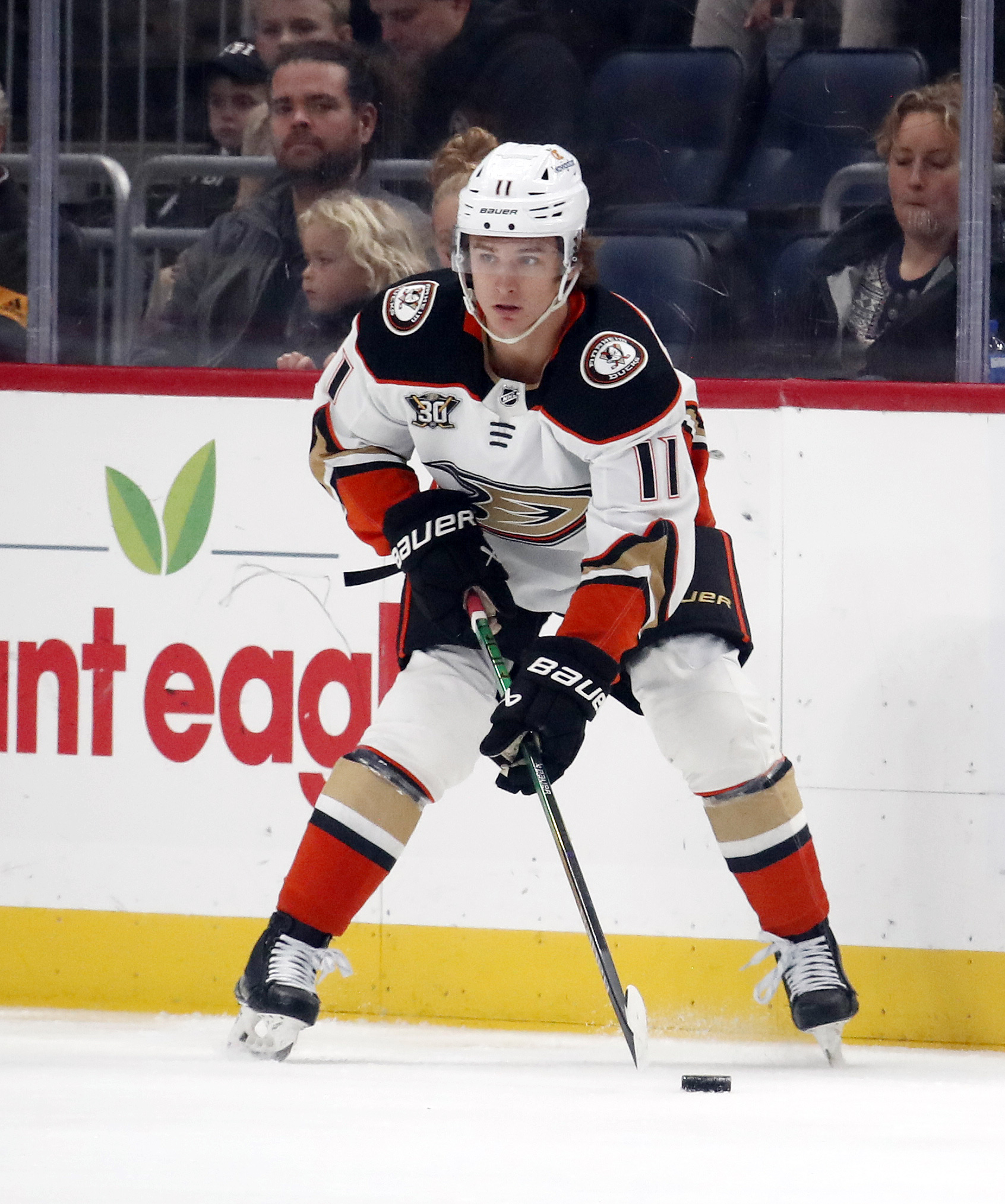 A happy and healthy holiday season for Trevor Zegras.
Last summer’s drawn-out contract negotiations between the Ducks and the face of their franchise were one of the more surprising storylines. It was even more surprising that Zegras settled for a relatively tame three-year, $17.25MM deal after posting back-to-back 60-point seasons, even if he did have his struggles defensively.
In a small sample size this season, it seems the Ducks’ hesitation around a rich long-term commitment was justified. Zegras has just two points through 12 games and is now dealing with a nagging lower-body injury that’s kept him out of the lineup for the past two weeks. There’s no clear timetable for his return, certainly a concerning development.
What should be on the Ducks’ holiday wish list?
Consistency from John Gibson.
Quietly, the Ducks’ netminder with a former all-world reputation is playing some of his best hockey in years. In six appearances in the month of November, Gibson has posted a .942 SV% and has not posted a save percentage under .900 in a single game since leaving an October 30 contest against the Penguins with an injury.
Dostál is looking like the future in the crease for Anaheim, making Gibson more expendable than ever. That timing lines up well with a resurgence for the American netminder, who is quickly rebuilding his trade value and could earn the Ducks quite a haul if the team does end up moving him after years of trade rumors.
Gibson does have a ten-team no-trade list and four seasons left at a $6.4MM cap hit, but that’s similar to what he would earn on the open market should he hit free agency next summer if he keeps this level of play up for the rest of the season.
Photo courtesy of USA Today Sports Images
Salary Cap Deep Dive: Vancouver Canucks
Navigating the salary cap is one of the more important tasks for any GM. Teams that can avoid total cap chaos by walking the tightrope of inking players to deals that match their value (or compensate for future value without breaking the bank) remain successful. Those that don’t see struggles and front office changes.
PHR will look at every NHL team and give a thorough look at their cap situation for the 2023-24 season. This will focus more on players who are regulars on the roster versus those who may find themselves shuttling between the AHL and NHL. All cap figures are courtesy of CapFriendly.
Vancouver Canucks
Current Cap Hit: $86,578,549 (over the $83.5MM Upper Limit)
Entry-Level Contracts
None on the active roster
Signed Through 2023-24, Non-Entry-Level
F Anthony Beauvillier ($4.15MM, UFA)
F Teddy Blueger ($1.9MM, UFA)
D Ian Cole ($3MM, UFA)
G Casey DeSmith ($1.8MM, UFA)
D Mark Friedman ($775K, UFA)
F Dakota Joshua ($825K, UFA)
D Filip Hronek ($4.4MM, RFA)
F Sam Lafferty ($1.15MM, UFA)
D Tyler Myers ($6MM, UFA)
F Elias Pettersson ($7.35MM, RFA)
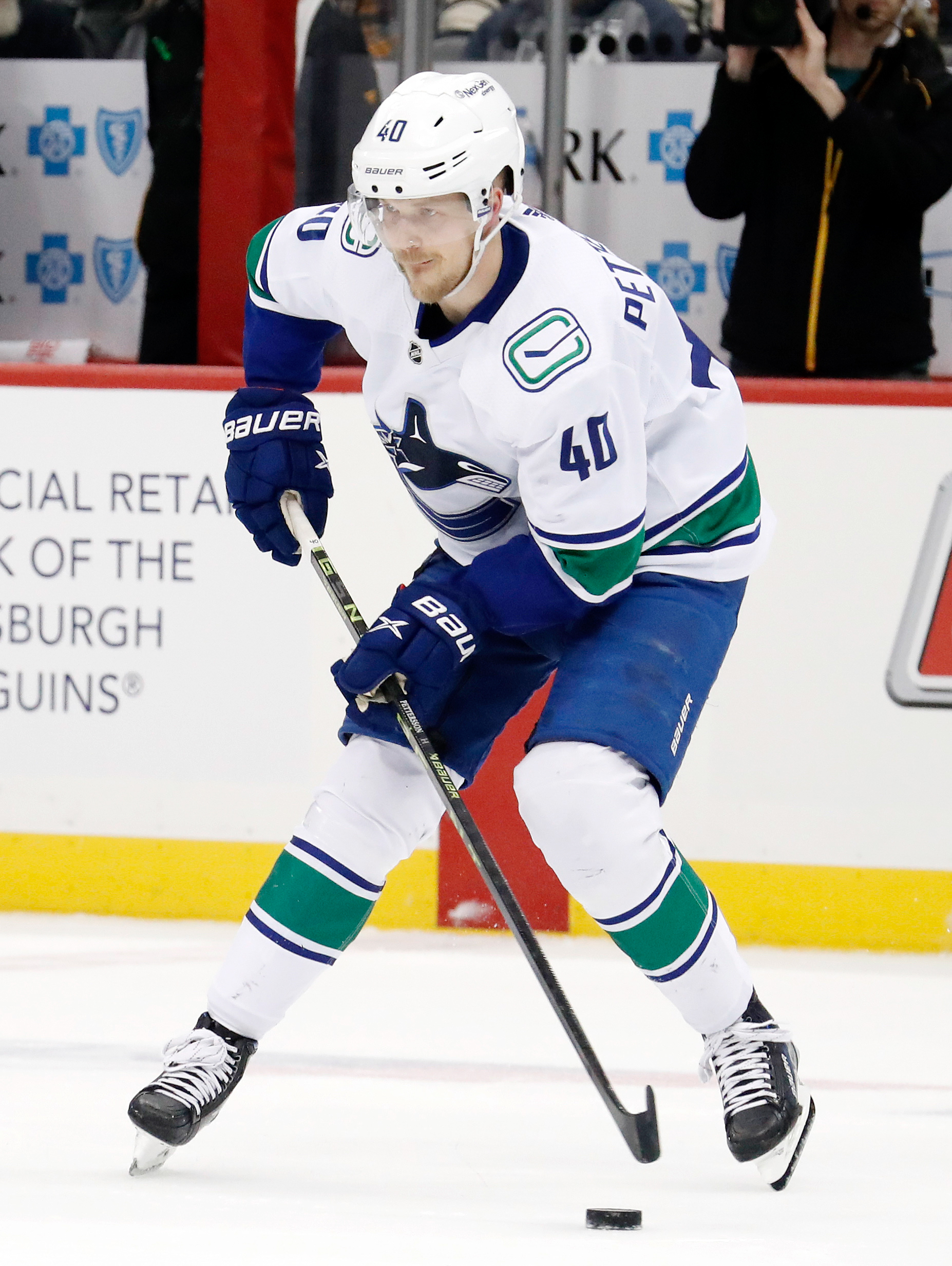 Headlines were made when discussions about an extension with Pettersson were called off by the center’s camp, citing a desire to play out the season and see where things sit. That apparently is on hold now as GM Patrik Allvin acknowledged recently that they’re working on a new deal. It’s fair to say it will be a very pricey one. After a career year last season, he’s off to an even better start in 2023-24 and has been among the league leaders in scoring (at times the outright leader). He plays a premium position and is a year away from UFA eligibility which also works in Pettersson’s favor. Heading into the year, an AAV between $10.5MM and $11MM felt like a possible landing spot. Now, it seems likely to fall about a million higher.
Beauvillier came over as part of the Bo Horvat trade last season and did well with his new team down the stretch but has underachieved this season. He has reached at least 18 goals in four of the last six years, however, and that type of offensive consistency will help on the open market. A big raise doesn’t seem likely but something near this on the open market could be doable. Blueger opted for a one-year deal over the summer after splitting last season between Pittsburgh and Vegas. As a bottom-six forward, his market shouldn’t be much stronger next summer unless he’s either able to hit new benchmarks offensively or is able to sustain his 56% success rate on the draw that he had down the stretch with Vegas.
Lafferty was acquired late in training camp with Toronto needing to clear salary. When he was with Chicago, he did well in a middle-six role but was a lot quieter on the fourth line with the Maple Leafs. Things have gone well so far with his new team which could push his AAV closer to the $2MM mark in the summer. As for Joshua, he did quite well in his first year with Vancouver last season, his first full year of NHL action. If he gets to the double-digit-goal mark again while bringing plenty of physicality, he could double this on the open market.
Myers was the subject of trade speculation throughout the summer but remains with Vancouver. He’s still capable of playing in the top four although his best role might be as a fifth that moves up when injuries arise. In free agency, that’s closer to a $3.5MM player. It’s worth noting that the bulk of his salary was paid in September as a signing bonus so if he was to be acquired midseason, his new team wouldn’t have to pay much in the way of actual money. Hronek was brought in from Detroit at the trade deadline, a confusing move on the surface for a team that was selling. He has been quite productive early on so far and should be in good shape to land much more than his $5.28MM qualifying offer this summer. Like Pettersson, he has just one year of club control remaining. Friedman has played regular minutes since being acquired early in the year but has cleared waivers in two straight years now, suggesting that he will probably stay near the minimum moving forward.
DeSmith is another newcomer to the team after being acquired at the start of training camp. Over the last few years, he has been a capable backup and with that market going up in recent years, a good showing this season could propel him to a deal closer to the $3MM mark next summer.
Signed Through 2024-25
F Brock Boeser ($6.65MM, UFA)
D Guillaume Brisebois ($775K, UFA)
F Phillip Di Giuseppe ($775K, UFA)
D Akito Hirose ($787.5K, RFA)
F Nils Hoglander ($1.1MM, RFA)
D Noah Juulsen ($775K, UFA)
F Andrei Kuzmenko ($5.5MM, UFA)
D Tucker Poolman ($2.5MM, UFA)
F Pius Suter ($1.6MM, UFA)
Boeser was in trade speculation last season when things weren’t going too well offensively. He stated his desire to stay and got his wish. That has worked out quite well considering the hot start he has had. That said, if he stays in the 25-goal range, it’s hard to see this price tag going much higher; he’ll need to carry this hot start to a career year to have a shot at any sort of significant raise. Kuzmenko had a very strong first NHL season but with his track record being short, the two sides ultimately worked out a bridge extension. If he has two more years of 70 or more points, he could push past the $7MM mark in 2025.
Suter was a late signing in free agency after a down year with Detroit. That said, he has scored at least 14 goals in each of his first three NHL seasons and spent most of that time at center. As long as he holds down a regular spot on the third line, they’ll do well with this contract. Meanwhile, a couple more years scoring at that rate would give Suter a much better platform to hit the open market with. Hoglander spent most of last year in the minors but did enough before that to get a seven-figure bridge deal. Now, it’s about re-establishing himself as a regular and if he can produce in a top-nine role (he’s not an ideal fourth line candidate), he could push for closer to $2MM with arbitration rights. Di Giuseppe has largely been a journeyman, often splitting time between the NHL and AHL with several organizations but has found a home with Vancouver where he’s seeing regular minutes and producing. Given his age (30), it’s unlikely a significant bump is coming his way but if he stays a regular, a one-way deal around the $1.5MM mark could be doable.
Poolman is once again on LTIR with concussion issues that have limited him to just 43 games with the Canucks over the last two seasons, only three of which came last year. At this point, it’s hard to see him playing again. If he does try to push through it and play after this deal, his injury history will limit him to a league-minimum contract. Hirose impressed after signing as a college free agent down the stretch, earning this deal for his efforts, one that converts to a one-way salary next season. If he’s established as a roster regular at that point (even if he’s in the sixth or seventh depth role), arbitration eligibility would push him past $1MM. As for Juulsen and Brisebois, both are depth defenders who are likely to continue to stay at or close to the minimum moving forward.
Signed Through 2025-26
G Thatcher Demko ($5MM, UFA)
F Conor Garland ($4.95MM, UFA)
F Ilya Mikheyev ($4.75MM, UFA)
D Carson Soucy ($3.25MM, UFA)
Garland has been a capable secondary scorer throughout his career but his contract was viewed as a negative with Arizona and he’s now in that situation with Vancouver despite starting off rather well with them. While his agent has been given permission to try to facilitate a move, that will be hard to do without salary retention and possibly taking a contract back. Meanwhile, Garland will need to get back to the 50-point mark if he wants a shot at another deal like this. Mikheyev’s contract raised some eyebrows given his limited track record and injury history with Toronto. However, when healthy, he has produced at a rate worthy of this type of contract. If he can continue that and stay off the injury list, he could tick past the $5MM mark next time.
Soucy came over from Seattle as a pricey third pairing option. He does well in his limited role, however, which helps to justify the price tag. Given his playing style and the fact he’ll be entering his age-32 year on his next contract though, it would be surprising to see a big raise coming his way.
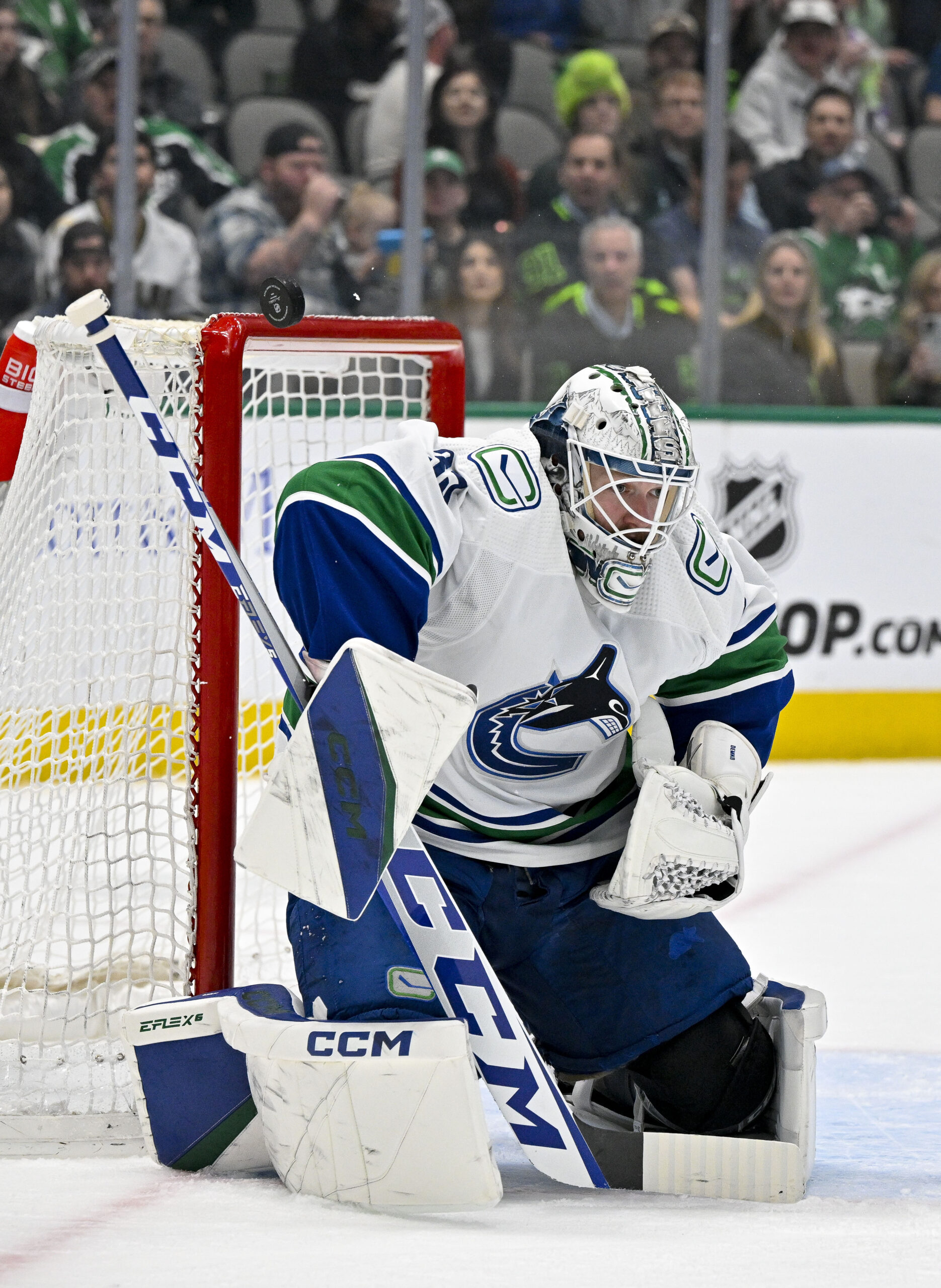 When Demko is on his game, he can be among the top goalies in the league. We saw it a couple of years ago when Vancouver nearly pulled off the improbable comeback to make the playoffs (coming up just short) and we’re seeing it early on this year. When things are going well, this is a contract that’s well below market value. Of course, things didn’t go anywhere near as well last season which was a big reason for their drop in the standings. While the starting goalie market has largely stagnated lately with the backups getting a boost in free agency instead, Demko could help break that trend. If he plays up to his capabilities for the rest of this contract, a long-term deal worth $7MM or more should be doable. If it goes really well, he’ll be eyeing Connor Hellebuyck’s $8.5MM but his track record isn’t as strong at the moment.
Hypothetical Goalie Trade Targets For The Edmonton Oilers
There is no doubt that the Edmonton Oilers have struggled defensively this year, and have struggled to generate much offense outside of their top-six forward group. However, the team has had a uniquely poor start with their goaltending, as the duo of Stuart Skinner and Jack Campbell have produced a 5-10-1 record in 16 games played, as well as carrying a .873 SV% and a 3.70 GAA collectively.
Even looking deeper into the numbers of the tandem, according to Hockey Reference, they have generated a -14.0 Goals Saved Above Average, a 3.76 Adjusted Goals Against Average, and a 37.5% Quality Start Percentage.
In any trade to improve their goaltending, the Oilers’ dream scenario would be to include Campbell and his $5MM salary, but with most other teams carrying limited cap space through the season, that option becomes much more improbable.
The most recent comparable to Campbell’s situation would be a June 6th trade between the Columbus Blue Jackets, Los Angeles Kings, and the Philadelphia Flyers. The Kings were able to unload the two-year, $10MM remaining on Calvin Petersen‘s contract, as well as the contract of defenseman Sean Walker, but did have to send a prospect, as well as a first-round pick in 2023, and a second-round pick in 2024 to Philadelphia just as a facilitator in the deal.
Essentially, the cost of $5.6MM in cap space for Los Angeles, without acquiring anything of value in return, was a prospect, and two high draft picks. If the Oilers are looking to improve their goaltending in a similar trade, the cost would certainly increase beyond that price.
To set the table, Edmonton does have all three of their first-round picks over the next three seasons, as well as two of their second-round picks (the 2025 selection is owned by the Arizona Coyotes) over the same time. Also, if any acquiring team is willing to buy out Campbell this offseason, they would be on the hook for $10.5MM spread out over the next six seasons.
Now, let’s look at a list of options and work a potential deal around them:
Petr Mrazek – Chicago Blackhawks (one-year, $3.8MM)
Not only would Chicago be able to absorb the contract of Campbell even after a buyout, but Mrazek is quietly having a very productive season even with a poor team in front of him. In 10 games played for the Blackhawks this season, Mrazek has a 4-5-0 record, coupled with a .915 SV% and a 2.89 GAA.
With only one year remaining on his contract, a trade for Mrazek would allow the Oilers to improve their goaltending situation down the stretch while giving them the financial flexibility to pursue a different goaltender in the offseason if they choose to do so.
In order to rid themselves of Campbell’s contract, Edmonton would need to attach their first-round pick in 2024, as well as their second-round pick in 2026, and potentially a third-to-fourth-round selection in either of the next three years simply to acquire Mrazek from the Blackhawks in the first place.
Karel Vejmelka – Arizona Coyotes (two-years, $5.45MM)
Even behind a struggling Coyotes defense for the last three seasons, Vejmelka has put up decent numbers and could benefit from a stronger team in front of him. Over the last three seasons in Arizona, he has played in 112 games and carries a 33-62-11 record coupled with a .899 SV% and a 3.51 GAA.
As the Coyotes are looking to exit their rebuild soon, they may not be inclined to take on Campbell’s contract, or even be inclined to buy him out after acquiring him. However, if the Oilers were willing to part ways with defenseman Cody Ceci in this hypothetical deal, Arizona could be more tempted.
With Matt Dumba, Troy Stecher, and Josh Brown all headed for free agency next summer, the Coyotes are going to have quite the hole on the right side of their defense. Ceci will be signed for one more after this season at $3.25MM and has offered quality defensive play over the course of his career.
Elvis Merzlikins – Columbus Blue Jackets (four-years, $21.6MM)
It’s tough to think of a more direct comparable to Campbell than the situation of Merzlikins over in Columbus. Both goalies are signed for the next four years, they are both coming off of poor 2022-23 seasons, and both have had a tough start to this year.
If Edmonton was able to frame this deal in the right way, it could become a change-of-scenery swap, with the Oilers not having to add too much extra in return. Even from the viewpoint of Columbus, playing in a much smaller market, Campbell may even be able to regain some of his lost confidence.
Unfortunately, there is a very real possibility that Merzlikins will fail to improve Edmonton’s goaltending situation, even after a change of scenery. In a disastrous year in the net for him last season, Merzlikins held a 7-18-2 record, carrying a horrid .876% and a 4.23 GAA.
Jake Allen – Montreal Canadiens (two-years, $7.7MM)
Similar to where the Canadiens are in the rebuild like the Coyotes, it is unreasonable to think Montreal would be inclined to take on the contract of Campbell, even in a buyout situation. With Allen making $3.85MM for this season, and next, Edmonton will once again look to salary match through different positions.
Over the last two seasons, the Canadiens have built up some serious young depth on defense, meaning the Oilers may have to part with some forwards to acquire Allen and his cap hit. Given this, a realistic package would revolve around Ryan McLeod and Warren Foegele.
As a pending unrestricted free agent, Foegele will simply be on the Canadiens roster for the rest of the year, and move on next summer. When healthy, McLeod represents a bottom-six center option with the ability to play on both sides of the puck, allowing the Canadiens to comfortably replace Sean Monahan next year, and give them a long-term option on the third-line.
Juuse Saros – Nashville Predators (two-years, $10MM)
At last year’s trade deadline, the Oilers and Predators connected on a massive trade, sending Mattias Ekholm to Edmonton in exchange for a package surrounding Tyson Barrie, a prospect, and two draft picks. In the summer, Nashville showed a few more veterans the door and took a very aggressive approach to free agency.
Sitting at 28th place in the NHL entering Thanksgiving week, and unlikely to contend over the last two years of Saros’ contract, the Predators could be inclined to trade him this season. Saros has gotten off to a slow start this year but has finished top-10 in Vezina Trophy voting in each of the last three years.
Due to his track record, it will take a mammoth offer to pry Saros out of Nashville, and the Oilers would need to give up serious capital in return. If they are also willing to take on the contract of Campbell, a package including a young roster player such as McLeod or Dylan Holloway, one of Edmonton’s better prospects such as Philip Broberg or Xavier Bourgault, Edmonton’s first-round pick in 2024, as well as a conditional second-round pick in 2026 with the ability to turn into a first, that may be enough to get Saros from the Predators.
Salary Cap Deep Dive: Seattle Kraken
Navigating the salary cap is one of the more important tasks for any GM. Teams that can avoid total cap chaos by walking the tightrope of inking players to deals that match their value (or compensate for future value without breaking the bank) remain successful. Those that don’t see struggles and front office changes.
PHR will look at every NHL team and give a thorough look at their cap situation for the 2023-24 season. This will focus more on players who are regulars on the roster versus those who may find themselves shuttling between the AHL and NHL. All cap figures are courtesy of CapFriendly.
Seattle Kraken
Current Cap Hit: $81,456,607 (under the $83.5MM Upper Limit)
Entry-Level Contracts
F Matthew Beniers (one year, $898K)
F Tye Kartye (two years, $859K)
F Shane Wright (three years, $918K)
Potential Bonuses
Beniers: $1.85MM
Kartye: $57.5K
Wright: $3.0625MM
Total: $4.97MM
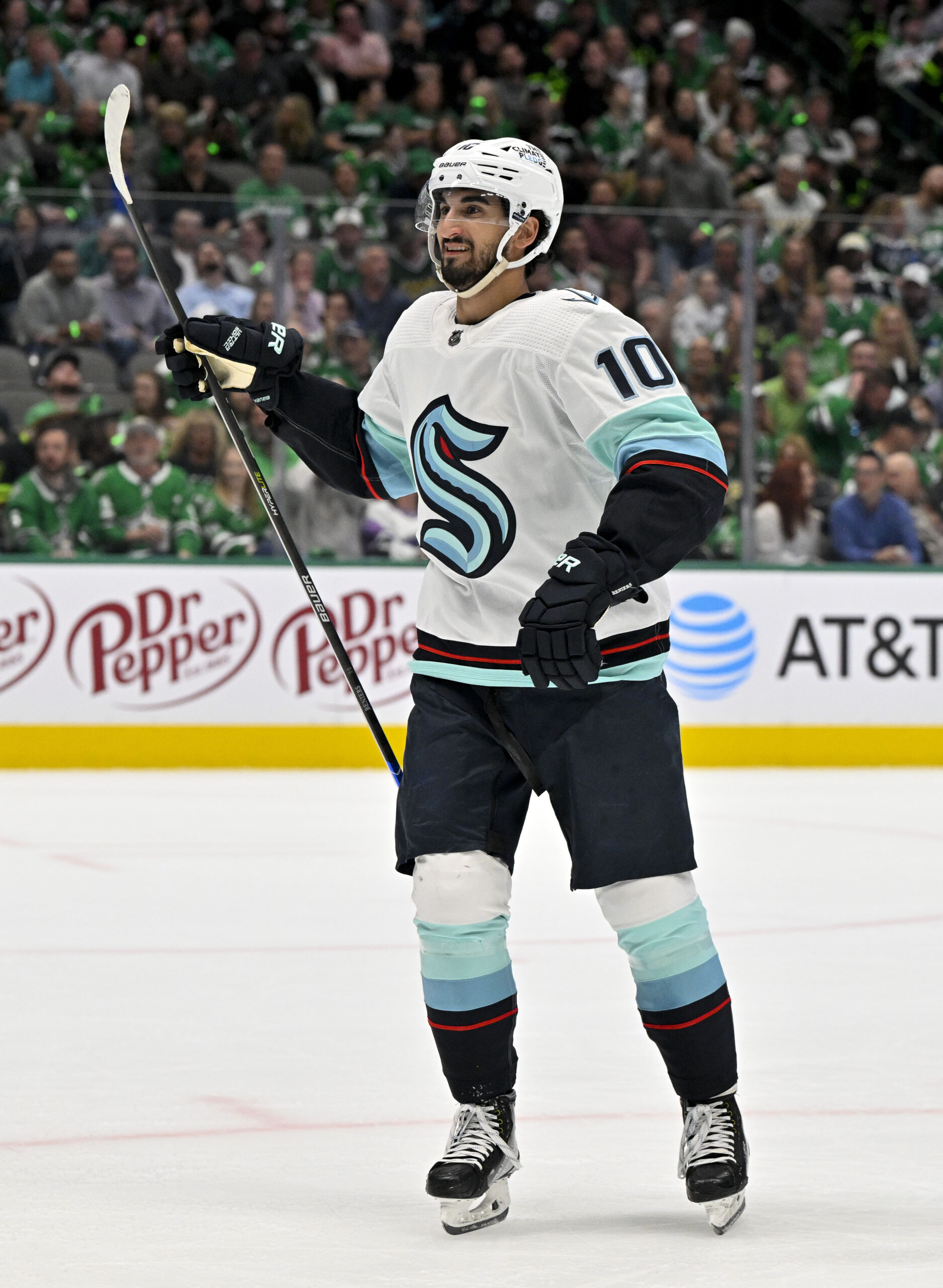 Beniers’ first full NHL season was certainly a strong one as he finished fourth on the Kraken in scoring while taking home the Calder Trophy as the NHL’s top rookie. He followed that up with a good showing in the playoffs. Basically, the second overall pick in 2021 has cemented himself as a key part of Seattle’s long-term plans. Accordingly, it wouldn’t have been too surprising had he signed a long-term extension over the summer, one in the $8MM for eight years range, one we’ve seen quite a few core young centers sign in recent years. That didn’t happen and now he’s off to a bit of a slow start this season. Even if he winds up with a bridge deal though, it will still be pricey; Anaheim’s Trevor Zegras (three years, $5.75MM AAV) could be a suitable comparable. He should have a chance at hitting several of his four ‘A’ bonuses at $212.5K each.
Wright was recently recalled, beginning the nine-game clock before the Kraken will need to decide about officially burning the first year of this deal. However, they’ve since sent him back down, deferring that decision for the time being. Assuming they avoid starting the contract, they’ll be able to lower the cap hit slightly for next season while avoiding the bonuses. As for Kartye, he has been a regular in the bottom six in his first taste of regular season action. If he can hold down that role this season and next, he might be able to double this price tag. His bonuses are games-played based so it’s likely he’ll hit some of them at least.
Signed Through 2023-24, Non-Entry-Level
F Pierre-Edouard Bellemare ($775K, UFA)
G Chris Driedger ($3.5MM, UFA)
F Jordan Eberle ($5.5MM, UFA)
D Jaycob Megna ($762.5K, UFA)
D Justin Schultz ($3MM, UFA)
F Devin Shore ($775K, UFA)
F Eeli Tolvanen ($1.45MM, RFA)
F Alexander Wennberg ($4.5MM, UFA)
F Kailer Yamamoto ($1.5MM, RFA)
Eberle has put up back-to-back 20-goal seasons in his first two years with Seattle, actually faring better offensively than he was with the Islanders. In doing so, he has given himself a chance of securing another deal at a similar price tag as this one although it’ll be a shorter-term agreement with him turning 34 in May. Wennberg has done better with the Kraken compared to his time with Florida but he hasn’t gotten back to his early-career numbers when he had 40 points in his sophomore year and 59 the following season. The fact he plays in all situations and is a center will certainly help him on the open market but at this point, it feels like something closer to $3.5MM or $3.75MM might be where his next contract lands.
Yamamoto was bought out by Detroit (who ate the charge to acquire Klim Kostin’s rights) and quickly landed with his hometown team in unrestricted free agency. Unless he’s able to produce at a higher level than he did with Edmonton though, he could be facing a non-tender in June. Otherwise, a small increase could come his way. Tolvanen fit in quite well after being claimed off waivers and is off to a good start this year. If that can be maintained, he’d be worthy of a deal crossing the $2MM mark. That said, the fact Daniel Sprong was non-tendered this past offseason after a 46-point year is a cautionary tale; they’re only willing to commit so much to that particular slot on the depth chart. Bellemare and Shore were only able to get minimum-salary deals over the summer and there’s little reason at this point to think they’ll be able to command more next time out.
After struggling in his final year with Washington, Schultz has rebounded well with Seattle when it comes to his production, notching 34 points last season and is on a similar pace this year. That, coupled with being a right-shot player, should give him a good market next summer which might allow him to land a small raise. Megna was acquired before the trade deadline last season but has played just six times with his new team (including playoffs), all of which came last year. Unless something changes, he’s likely to stay close to the league minimum.
Driedger landed this contract after a strong showing as Florida’s backup for a year and a half but things haven’t gone well with Seattle. He struggled in his first year, then tore his ACL at the Worlds, causing him to miss most of last season; the bit he did play was in the AHL. That’s where he is now as well, leaving a $2.35MM dead cap charge while he’s down there. He should still land a seven-figure one-way contract next summer but something closer to the $1.5MM mark could be doable.
Signed Through 2024-25
D William Borgen ($2.7MM, UFA)
G Joey Daccord ($1.2MM, UFA)
D Brian Dumoulin ($3.15MM, UFA)
F Yanni Gourde ($5.167MM, UFA)
D Adam Larsson ($4MM, UFA)
F Brandon Tanev ($3.5MM, UFA)
Gourde was another one of Tampa Bay’s cap casualties with Seattle picking him up in expansion. He has put up back-to-back 48-point seasons with the Kraken while being a key two-way center along the way, just as he was with the Lightning. Unless he can get back to the 60-point level he reached in his first full NHL campaign, it’s hard to see a sizable raise coming his way but another long-term deal around this price point could be doable if he stays close to the 50-point mark. Tanev, when healthy, has been more productive with Seattle compared to his time with Pittsburgh and Winnipeg despite having the same type of role. That said, with the injuries and his bottom-six role, it seems unlikely that he’ll be able to command a big raise either. That said, another deal in this range could work, if he can stay healthy.
Larsson has done quite well with a much bigger role since signing with Seattle, posting back-to-back career years offensively while logging over 23 minutes a night on average. This is more like what New Jersey was expecting when he was the fourth overall pick in 2011. If Larsson can continue to produce at that rate while remaining a key shutdown defender, he could push for closer to $6MM on his next contract.
Dumoulin joined Seattle this summer in free agency after a down year with Pittsburgh. His ATOI is down around five minutes a night from last year as he has primarily been on the third pairing. If that holds up, he’ll be hard-pressed to get an offer near this price as third-pairing players are closer to the $2MM mark now on the open market. Borgen landed this deal on the heels of an arbitration filing thanks to a career year on the offensive front where he had 20 points. However, for someone whose usage is fairly limited (generally below 17 minutes a night), it’s hard to see a scenario where he can command much more than that on the open market unless there’s a team that’s confident he can play in the top four.
Daccord was someone who benefitted from the increased value of third-string goalies, getting a seven-figure one-way deal despite playing in just ten NHL games combined over the past two seasons. Now set as the backup, he could position himself to double this price tag if he holds that role through the end of 2024-25.
Signed Through 2025-26
F Oliver Bjorkstrand ($5.4MM, UFA)
D Jamie Oleksiak ($4.6MM, UFA)
F Jaden Schwartz ($5.5MM, UFA)
Schwartz was somewhat of a surprising signing after Seattle didn’t spend much in the expansion draft. When healthy, he’s a capable top-six piece and while he managed to put up 21 goals last season, he has missed double-digit games in each of the last three seasons. He’ll need to stay healthy more consistently to have a chance at eclipsing this price tag next time out. Bjorkstrand was a cap casualty in Columbus and while his output dipped in his first year with the Kraken, he still put up his fourth 20-goal season out of the last five years. If he continues at that pace, he could be in line for a contract similar to this one in 2026.
Oleksiak’s contract felt like an overpayment at the time for someone who hadn’t been in the top four a lot. However, he has filled that role relatively well with Seattle while continuing to be one of the better shot-blockers. This deal still is a bit high with the limited offense he brings to the table but it’s not a negative-value pact either. He’ll be 33 when this contract is up, however, which could restrict his price tag somewhat.
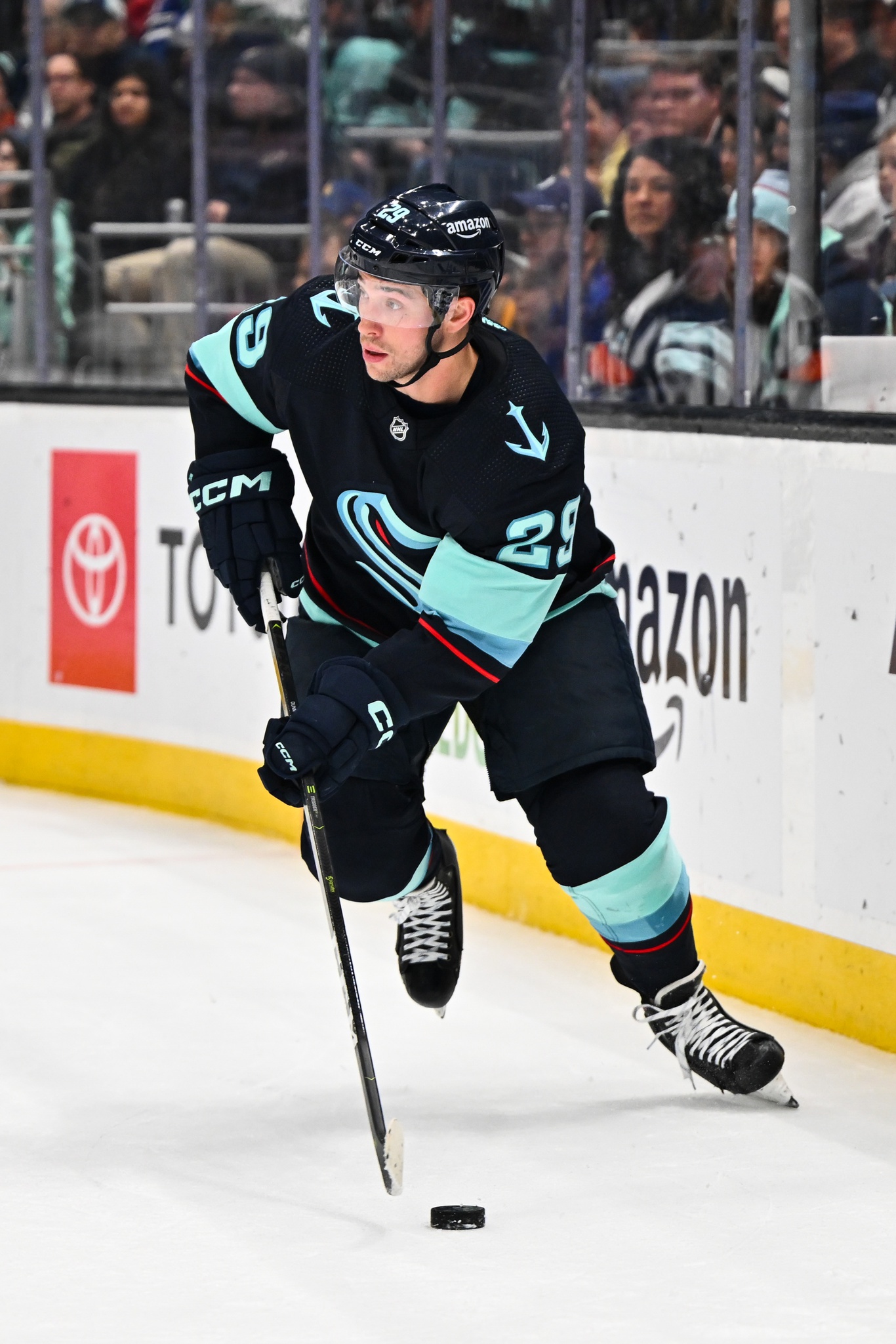
Salary Cap Deep Dive: San Jose Sharks
Navigating the salary cap is one of the more important tasks for any GM. Teams that can avoid total cap chaos by walking the tightrope of inking players to deals that match their value (or compensate for future value without breaking the bank) remain successful. Those that don’t see struggles and front office changes.
PHR will look at every NHL team and give a thorough look at their cap situation for the 2023-24 season. This will focus more on players who are regulars on the roster versus those who may find themselves shuttling between the AHL and NHL. All cap figures are courtesy of CapFriendly.
San Jose Sharks
Current Cap Hit: $81,392,547 (under the $83.5MM Upper Limit)
Entry-Level Contracts
F William Eklund (three years, $863K)
D Nikita Okhotyuk (one year, $789K)
Potential Bonuses
Eklund: $850K
Okhotiuk: $82.5K
Total: $932.5K
The Sharks have slow-played things with Eklund, giving him a taste of NHL action over the last two years but not enough to actually start his contract. Now that his deal can’t slide anymore, he’s a regular in the lineup. He’s off to a slow start this season and San Jose’s offensive woes will make it tough for him to hit on his four ‘A’ bonuses.
Okhotiuk is essentially waiver-blocked. San Jose isn’t using him much but they also don’t want to risk losing him for nothing on waivers. The end result is a lot of time on the bench which doesn’t bode well for his next contract or reaching some of his games played bonuses.
Signed Through 2023-24, Non-Entry-Level
D Calen Addison ($825K, RFA)
F Alexander Barabanov ($2.5MM, UFA)
F Ryan Carpenter ($775K, UFA)
F Anthony Duclair ($3MM, UFA)
D Ty Emberson ($775K, RFA)
F Mike Hoffman ($4.5MM, UFA)
G Kaapo Kahkonen ($2.75MM, UFA)
F Luke Kunin ($2.75MM, RFA)
F Kevin Labanc ($4.725MM, UFA)
F Oskar Lindblom ($2.5MM, UFA)
D Jacob MacDonald ($762.5K, UFA)
D Radim Simek ($2.25MM, UFA)
F Filip Zadina ($1.1MM, RFA)
After Labanc took a team-friendly one-year deal back in 2019-20, things have gone downhill as he has failed to pass the 33-point mark since then. At one point last month, it looked like he’d be waived. A change of scenery would likely do him some good but it’s almost certainly going to come at a fraction of this price. Hoffman appears to be heading for a sizable dip in pay as well after a tough couple of years in Montreal and a particularly rough start to this season. His shot is still dangerous but he might be better suited for a deeper team who can use him on the power play but hide him a bit at five-on-five. Those teams won’t be able to offer anywhere close to the type of money he’s making now.
Duclair was acquired from Florida over the summer with the Panthers looking to free up some cap space. A big year in a prominent role could also bode well for the winger but, as is the case with pretty much every other forward, he’s off to a tough start. Still, after a 31-goal showing in 2021-22, Duclair should at least have a chance at another short-term deal around this price. Barabanov is coming off a career year that saw him record 47 points in 68 games, a pretty nice bargain at his price. However, a finger injury is likely to keep him out for another month which won’t help his bargaining power. That said, a small raise could be achievable if he’s able to produce upon his return.
Kunin’s tenure with San Jose hasn’t gone great so far. Injuries limited him to just 31 games last season where he managed 13 points and he’s producing at a lower clip in the early going this year. Owed a $3MM qualifying offer in June, that price tag might be too rich for the Sharks. Lindblom landed this deal after being bought out by Philadelphia but has struggled with his new team to the point where he cleared waivers in camp and is now in the minors with a dead cap charge of $1.35MM. As things stand, even getting that much next summer could be difficult.
Zadina walked away from guaranteed money with Detroit to take a lot less with San Jose in the hopes that a new environment could help him revive his game. The results have been spotty so far but with him being controllable through restricted free agency until 2027, they can afford a gradual development curve. A small raise with arbitration eligibility should come his way. Carpenter has seen limited minutes so far and is likely to stay in a depth forward role which will keep him around this price point moving forward.
Simek has been a depth piece for the majority of this contract (which is in its fourth year) which resulted in him clearing waivers in training camp. Accordingly, he has a dead cap charge of $1.1MM which, like Lindblom, might be more than what he’ll be able to get on the open market this summer. Addison was recently acquired from Minnesota in a move that basically gives him a fresh start where he’ll play more frequently. After putting up 29 points last season, the Wild basically had no choice but to give him a low-cost, one-year deal. Next summer, Addison will be arbitration-eligible and should see this price tag double at a minimum.
Emberson was picked up on waivers in training camp and is getting his first taste of NHL action. He has held his own so far but a larger sample size is needed to see if he’s worthy of a bigger raise and a multi-year deal or another one-year pact if he winds up being a depth defender. MacDonald is another depth piece who, at 30, is almost certain to stay around the minimum salary on his next deal.
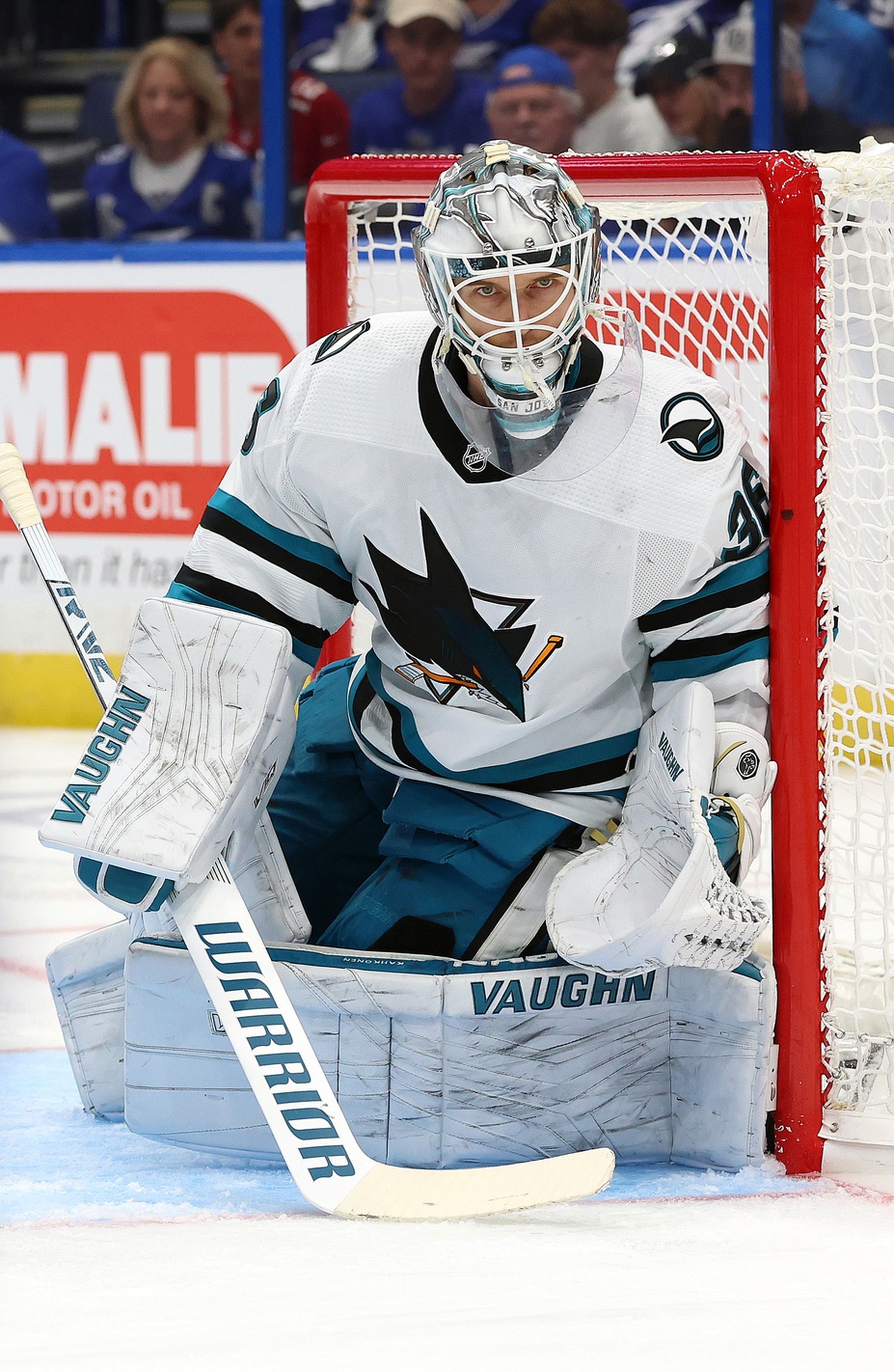 Things haven’t gone quite as planned for Kahkonen. Former GM Doug Wilson moved a capable blueliner in Jacob Middleton to get the netminder back at the 2021-22 trade deadline with the hopes that he’d be their goalie of the future. The way he finished off that season provided some cause for optimism but since then, it has not been pretty. He posted a save percentage of just .883 last season and this year, it’s even worse early on; with how bad the Sharks are, there’s no guarantee it will improve either. He’s one of the more intriguing goalies in this free agent class; is it a case of him just needing a more structured environment to succeed in? Or did he peak a couple of years ago? How teams feel will ultimately decide if he gets a contract similar to this one or if he’s heading for a sizable pay cut as well.
Signed Through 2024-25
G Mackenzie Blackwood ($2.35MM, UFA)
F Mikael Granlund ($5MM, UFA)
D Nikolai Knyzhov ($1.25MM, UFA)
D Jan Rutta ($2.75MM, UFA)
F Givani Smith ($800K, UFA)
F Nico Sturm ($2MM, UFA)
F Fabian Zetterlund ($1.45MM, RFA)
Yes, things didn’t go well for Granlund in Pittsburgh but before that, he had 100 points in his last 138 games with Nashville. Accordingly, a bounce-back performance is doable in theory but this might not be the best situation for that to happen. At the moment, it’s hard to see him getting this type of money two years from now but if things stabilize somewhat and Granlund is a key part of that happening, he might be able to come closer than some might think. Sturm had a career year last season, his first with San Jose as he put up career bests across the board while providing some positive value on his contract. If he can stay close to 25 points while being a faceoff specialist, his market should be a bit stronger in 2025 where he could push for closer to $3MM.
Zetterlund did well with New Jersey last year but struggled mightily after being acquired in the Timo Meier swap. This season, he has looked a bit more comfortable and is the early team leader in goals. He’ll be looking to establish himself as a dependable middle-six winger moving forward and if he does, his next contract should at least go past the $2MM mark. Smith has been a depth player when he has been on an NHL roster and that’s unlikely to change with the Sharks which should keep him around this price point two years from now.
Rutta is best utilized in a complementary role and the state of San Jose’s depth chart makes that somewhat difficult to accomplish. When he signed this contract with Pittsburgh, it seemed like an overpayment at the time and if he winds up languishing with the Sharks for most of the remainder of it, he could also be looking at a small cut on his next contract. Knyzhov has battled significant injury trouble and at this point, it’s just about re-establishing himself as a regular, a role he last had in 2020-21. If he can do so and stay healthy, he could push for closer to $2MM but would need to become a top-four piece with the Sharks to aim much higher.
Blackwood struggled with injuries and inconsistency with New Jersey, resulting in his rights being dealt to San Jose in the spring. They non-tendered him but quickly agreed to this deal. The 26-year-old has fared better than Kahkonen but is struggling behind a weakened back end. He’ll need to fare at least a bit better if he wants a shot at another deal around this price point; even keeping them competitive most nights might be enough.
Signed Through 2025-26
D Matt Benning ($1.25MM, UFA)
D Kyle Burroughs ($1.1MM, UFA)
D Mario Ferraro ($3.25MM, UFA)
D Marc-Edouard Vlasic ($7MM, UFA)
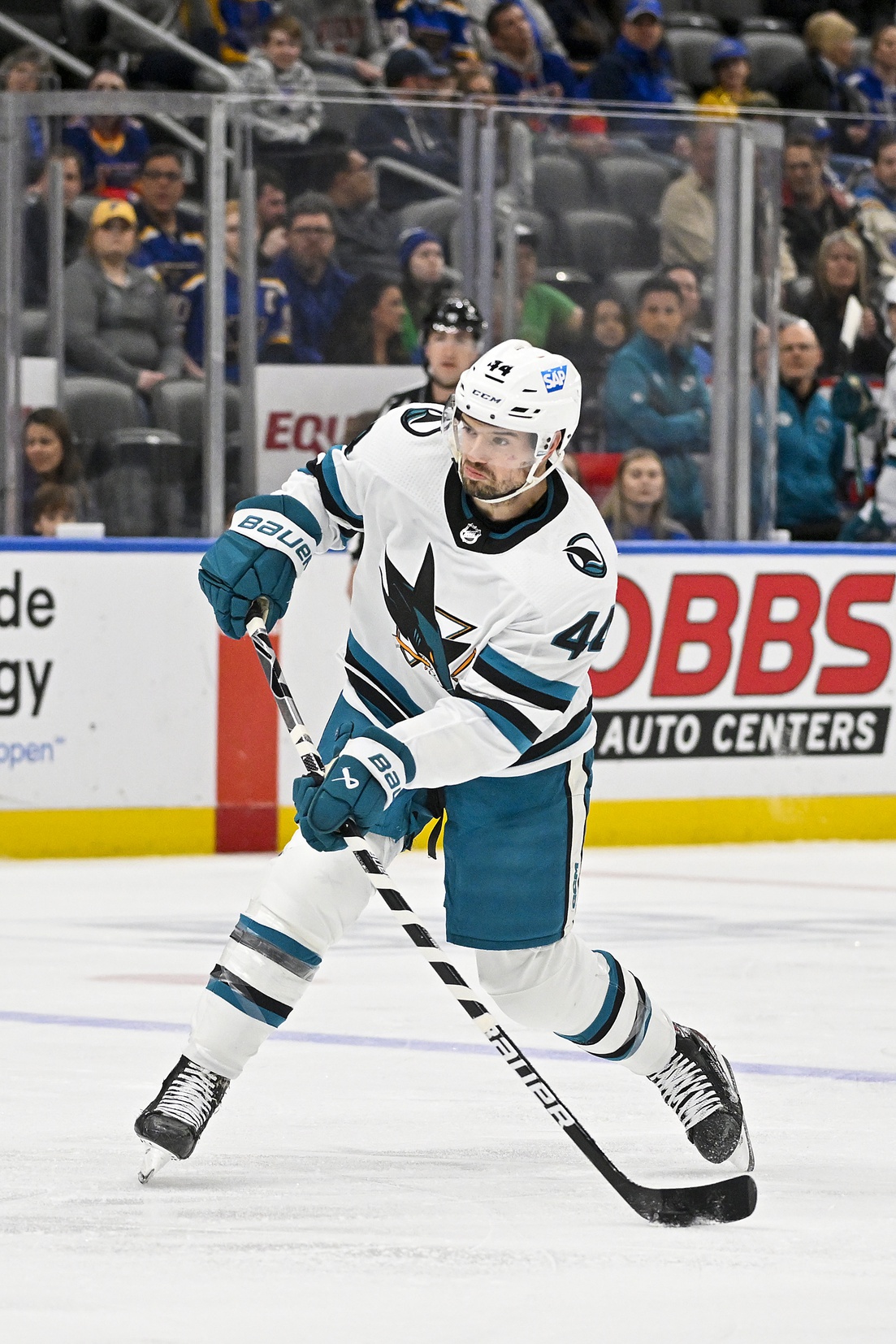 To say that Vlasic’s contract hasn’t aged well would be an extreme understatement. The decline in performance started in year two and has continued since then. In his prime, Vlasic was a prime shutdown defenseman but now, he’s struggling to handle even number six minutes and has been healthy scratched at times. There is signing bonus money in each of the remaining years of the contract which must be paid in full with a buyout. Even so, a buyout starts to look a bit palatable this summer when the cost would be $3.833MM, $4.833MM, and then two years at $1.333MM. San Jose isn’t in a spot where they need to free up cap space but keeping an aging veteran around at the expense of a younger player isn’t the best option either and a trade just isn’t palatable.
Ferraro’s contract was interesting at the time it was signed in that it brought him right to unrestricted free agency with no extra years of club control. He’s playing a bigger role than he probably should but in a fourth or fifth role, he’d fit in well with quite a few teams. Unless things really don’t go well between now and 2026, he should be positioned to earn an increase on this deal even with his struggles as a top-pairing player.
Benning’s contract was another somewhat curious one in that sixth defenders usually don’t get four-year deals. He actually had a career season offensively last year, making him a bit of a bargain at the moment although he’d need to continue to produce near that level to earn any sort of significant raise. Closer to the trade deadline, he could be an under-the-radar trade candidate. Burroughs also inked a multi-year deal to be a role player on the back end, pretty good stability for a player who had less than 100 NHL games under his belt at the time he signed. He’s also playing a bigger role than he should but if he can hold his own at the 20-minute mark, his market should be stronger in 2026.
Calgary Flames Reportedly Shopping Defensemen
As the Calgary Flames transitioned behind the bench from Darryl Sutter to Ryan Huska over the summer, many of the players scheduled to hit unrestricted free agency next offseason wanted to take the ‘wait-and-see’ approach in regards to signing a contract extension in Alberta. Needless to say, the Flames have not gotten off to a solid start, starting off 3-7-1, quickly alienating any chances that certain players will want to re-up on a new deal.
Aside from the potential departure of Elias Lindholm, Calgary is also set to lose five defensemen to the open market next July, leading the team to some difficult choices moving forward. This past summer, many reports indicated that defenseman Noah Hanifin was unwilling to sign an extension with the Flames, leading to plenty of trade rumors surrounding him and the organization.
In an earlier report today, Rick Dhaliwal relayed a note from Sportsnet’s Elliotte Friedman, saying that the Flames are actively engaging the market on Hanifin, Chris Tanev, and Nikita Zadorov. Furthermore, it was reported that the Toronto Maple Leafs, Vancouver Canucks, and Edmonton Oilers are showing the most interest in these defensemen.
It is reasonable to assume, especially if Calgary continues its current trajectory on the season, that more and more teams will come calling as the season nears the trade deadline. Of the three teams listed as having interest, the Oilers seem the least plausible, given that the Flames and Oilers have only made three trades with each other, the last one being the James Neal – Milan Lucic swap in 2019.
Especially if all three players are seen as rentals, the Buffalo Sabres, Boston Bruins, Colorado Avalanche, Detroit Red Wings, Los Angeles Kings, and New York Rangers could all come calling at this year’s trade deadline. If any or all three are open to signing extensions with the respective acquiring clubs, teams such as the Anaheim Ducks and Arizona Coyotes could certainly become interested, as well.
Given his ability to play a high amount of minutes each night, Hanifin will likely net Calgary the biggest return, although Tanev and Zadorov will also bring significant interest given their skill sets. If they are open to retooling or even a short-term rebuild, trading these three would be a logical way to start that process.
Nevertheless, there is a chance the Flames could turn their season around, leading them to hang onto their pending unrestricted free agents for a playoff run. However, if they are unable to straighten the ship, aside from a few trades over the years, there isn’t a precedent set for a trade of this magnitude being made so early in the season. If Calgary hangs on to all three as we get closer to the deadline, other playoff-bound teams’ desperation will increase their return overall.