
Wild Remain Confident That Quinn Hughes Will Sign Extension
The Minnesota Wild remain confident that star defenseman Quinn Hughes will sign an extension with the club, head coach John Hynes told Star Tribune Sports. Hughes has one year remaining on the six-year, $47.1MM deal he signed with the Vancouver Canucks in 2021. The looming expiration made him eligible to sign an extension on July 1st, something the Wild have yet to vindicate.
Hughes has said that he is open to an extension in Minnesota, though those statements have been clouded by the likelihood that his next contract is a three-year deal to align with brother Jack Hughes, whose contract with the New Jersey Devils expires in 2030. Debating the term could be the piece that keeps the eldest Hughes from finding a new deal in Minnesota before the 2026-27 season kicks off. The Wild could be on the hook for a major increase in pay if that’s the case, with Colorado Avalanche star Cale Makar likely to set the market with his looming contract extension. Hughes scored 68 points in 59 games with the Wild after joining the club partway through the season.
That is a 95-point pace across 82 games, a mark that would narrowly beat out the 92-point career-high that Hughes set in 2023-24. Behind a high-octane Wild offense, it’s not unlikely that Hughes can become the first member of his family to crest the 100-point mark. If that occurs, Minnesota could end up signing their top defender to a deal north of $17MM or $18MM, even if it’s only for a few seasons. After giving up top youngsters Marco Rossi and Zeev Buium, among other things, to acquire Hughes – netting five seasons of his support would go much further than only landing two.
The Wild will move through the rest of the summer with that anxiety in mind. Signing a deal sooner rather than later could come with a contingency on term, while waiting could give the former Norris Trophy-winner a chance to find another gear or follow behind the mark set by his superstar peers. Any situation will put the Wild in a tough spot, as they anticipate a 2027 summer marked by Ryan Hartman, Blake Coleman, Jared Spurgeon, and Jesper Wallstedt potentially reaching free agency – in addition to Hughes.
Latest On Quinn Hughes
During his end of season comments two months ago, Minnesota’s Quinn Hughes offered that he is “definitely open to re-signing” with the Wild, with a preference to work something out over the summer if so. That time is now here.
An opportunity for players to hold final press conferences before departing for the off-season, such discussion doesn’t always hold the most weight; Exhibit A being Brady Tkachuk shutting down trade rumors only to be off to Florida some 53 days later. Back to the present with Hughes, however, David Pagnotta of The Fourth Period reported yesterday on Hello Hockey that the Wild and he are “getting there” on an extension with an AAV of at least $17MM, if not higher.
A side comment by Pagnotta on Hughes while primarily discussing rising NHL salaries as a whole, there’s surely still uncertainty and work to be done, however it’s at least encouraging to hear for Minnesota fans. Thought to be a huge gamble, buying about a year and a half of the superstar before facing the real chance of losing him for nothing, perhaps general manager Bill Guerin’s “all in” mentality has done enough to win over Hughes.
Not that there was doubt but Hughes was a perfect fit with the Wild, elevating their play on the back end tremendously. Having been among the lower scoring clubs from defensemen, bringing aboard the lefty who averaged over 27 minutes a night, putting up 53 points in 48 games, did wonders in that department. He led the entire NHL in ice time per game, a minute over the second-ranked Zach Werenski. Hughes finished fifth among defenders for points (76 combined between Vancouver and Minnesota), 33rd highest in NHL skaters, interestingly one spot behind his brother Jack.

Speaking of his sibling, the hope, if not optimistic expectation of certain parties in the Northeast was that Quinn would roll along to free agency and head to New Jersey, teaming up with Jack and their brother Luke for a trio able to make an impact never seen in the league. It’s easier said than done though, as the Devils offer $6 million more in cap space than the Wild as of today, however, to meet Hughes’ free agent value hypothetically, they’d have to move out a contract such as Dougie Hamilton’s $9MM. Another team where the electric skating defensemen wouldn’t be the final piece, New Jersey will spend under 4% of their cap space on goaltending next season. As fun as it would be to imagine, the ball is firmly in Minnesota’s court for plenty of time to work something out.
Assuming the Newark family reunion is not meant to be, and that at some point before long Hughes re-ups on another record-setting contract in Minnesota, what’s fascinating to consider is the rest of their roster. With the salary cap set for 2026-27 at $104 million, it’s realistic to predict another increase the following season, as much as $8.5 million, but on current figures paying $17 million to Hughes and Kirill Kaprizov would equal nearly 33% of their total salary allocation. Not even the Oilers, boasting Connor McDavid and Leon Draisaitl, fork over that much for their two stars with the duo set through 2027-28 at a combined $26.50MM cap hit. Their abilities hardly require further analysis, but to do so anyway, McDavid and Draisaitl combined for 235 points in 147 games last year, on the Oilers’ 282 total goals-forced. To justify a level of payment on Kaprizov and Hughes which would exceed that, NHL-best production would be a requirement.
This time next year, if Guerin secures what would be at least a $10 million raise for Hughes, he’d be left with limited space on other players. Captain Jared Spurgeon, the club’s longest tenured player and annual Lady Byng vote-getter, will expire after 2026-27 on a current $7.58MM cap hit, along with Ryan Hartman and Blake Coleman. There’s no telling what the roster may look like by next July, but it’s safe to assume at least 4-5 bottom six forward holes will need to be filled, and that’s not even counting their bigger needs. A team thought to require an upgrade down the middle to break through in the Western Conference, it’s hard to see where Guerin could fit in someone like Dylan Larkin and his $8.7MM ticket. In net the Wild made a long-term commitment to Filip Gustavsson, with standout 23-year-old Jesper Wallstedt a luxury for the time being at $2.2MM. It’s practically a foregone conclusion that one of their two excellent netminders, a major strength of the team, will have to be moved out to help out the center ice position, as well as open the space for a Hughes extension. With all of those items coming in the future, Minnesota has already dealt with cap casualties, having lost key veteran Mats Zuccarello, likely to end up the same with Vladimir Tarasenko, Guerin will have to get seriously creative to build a supporting cast on team-friendly contracts similar to 38-year-old Nick Foligno’s $900k for the upcoming season.
By no means an attempt to criticize Guerin, the 2025-26 NHL general manager of the year who has raised the bar in Minnesota and brought the most exciting times for the franchise, their #1 order of business in locking up Hughes will present a new series of challenges to follow. His attempts to be as aggressive as possible are commendable, but at some point the concern is raised on what to make of the rest of the Minnesota roster. Especially as recent history suggests that top-heavy constructed teams lack the ability to comfortably roll lines in the playoffs and take home the Stanley Cup. Regardless, Guerin and his Wild would much rather take a shot at proving that wrong, rather than the possibility of the all-world defenseman walking away after a short stop in Saint Paul.
Image Credit: Nick Wosika-Imagn Images
What This NHL Season Showed Us About Small Players
For years, a subset of NHL general managers has steered clear of drafting small players, fearing they would not be able to physically handle the grind of the NHL playoffs. That line of thinking may finally be dead after this past season, as three of the players who led the Carolina Hurricanes in the playoffs were under 6’0” and the team ranked 25th in average height in the NHL. Seth Jarvis, Logan Stankoven and Jackson Blake were key contributors for the Hurricanes in their run to the Stanley Cup and were all drafted within the last six years. The Hurricanes are hardly the only team to have embraced smaller, skilled players, but this year may have given the entire league enough evidence that selecting smaller players is a worthwhile gamble if they have the skill to play in the NHL.
For years, teams such as the Philadelphia Flyers, Los Angeles Kings, St. Louis Blues and New York Islanders favored size and physicality in their prospects, often opting for brawn over skill. It’s hard to say definitively whether that was a successful line of thinking, as the Kings and Blues combined for three Stanley Cups during the 2010s, but for the Flyers, it certainly didn’t pan out.
You don’t have to look far to find additional proof of this thesis, as the team Carolina beat to reach the Stanley Cup Finals has also followed this roadmap. The Montreal Canadiens featured a lineup in this year’s playoffs led by Lane Hutson, Nick Suzuki and Cole Caufield, three players who are all under 6’0”. Montreal has wholeheartedly bought into drafting the best available talent rather than concerning itself with size, which probably suits their head coach, Martin St. Louis, just fine, given that he is one of the pioneers for small players, having gone undrafted before eventually making it to the NHL and becoming a Hart Trophy winner and Hall of Famer.
Staying on the topic of smaller players, it is interesting to see former NHLer Daniel Briere at the helm in Philadelphia, given that he, too, was a smaller player and seems to have embraced selecting prospects on the smaller side. This has not historically been the Flyers’ strategy, but as more evidence of small players’ success has emerged, teams have adapted and changed their philosophies.
Looking strictly at first-round defensemen drafted from 2005 to 2020, the results for those over 6’4” and those 6’0” and under aren’t dramatically different. In terms of Norris Trophy winners, Victor Hedman is the only defender at 6’4” or taller to have won the award, while Quinn Hughes and Cale Makar are both Norris Trophy winners in the 6’0” and under category. That tiny shred of evidence doesn’t prove the thesis, but as you go down the list of taller defenders, it isn’t exactly a list of household names. Dougie Hamilton is in there and has had a great career, but beyond that there are Tyler Myers, Jamie Oleksiak, Erik Gudbranson, Nikita Zadorov, and Jared Cowen.
On the shorter players’ side, we mentioned Makar, but for every Makar you get a Ty Smith, and that is true of the taller group as well, since you could be drafting Hedman or a bust such as Mirco Müller. The list of defensemen 6’0” and under includes Ryan Ellis, Tony DeAngelo, Cameron York, Rasmus Sandin and Jamie Drysdale. While that is a solid list of defenders, there is a case to be made that more smallish players don’t make the NHL when drafted in the first round, such as the aforementioned Smith, Ryan Murphy, Ryan Merkley, and Nicolas Beaudin.
There could also be an argument that smaller defensemen don’t get afforded the same amount of leeway as their much larger contemporaries, which limits their chances of becoming full-time NHLers. It’s hard to fault NHL coaches, who are in a results-based business and likely see smaller players as potential liabilities as they try to break into the NHL full-time.
There is no better evidence that the NHL as a whole is much less concerned with size than the scoring leaderboards, where three of the top five scorers in the league were 6’0” or shorter, and 10 of the top 20 were as well. This aligns with a major shift in drafting philosophy that Sports Illustrated reported on in 2024, citing 15 years of draft data showing teams selecting smaller players on average than in previous years. That doesn’t mean teams still don’t value size, but the NHL is moving in a direction where teams will gamble on a highly skilled player, even if that player is undersized.
There is perhaps no better example of this than the Pittsburgh Penguins, who took undersized center Benjamin Kindel 11th overall in last year’s NHL Entry Draft and were criticized for selecting him so high, with many pundits calling it a reach. Kindel was marvellous for the Penguins this season, despite being just 5’11” and 182 lbs. Drafting a smaller player didn’t preclude the Penguins from going big later in the first round, as they drafted 6’2” Bill Zonnon 22nd overall, 6’5” Will Horcoff 24th overall and Peyton Kettles 39th overall.
With so many teams finding success by building around smaller players, the next few years will be particularly interesting to see whether more teams embrace this line of thinking or whether a few select teams continue to target size and toughness earlier in the draft. Just like with anything else in the NHL, it’s hard to forecast what the game will look like in a few years, but with the focus on speed and skill increasing, it could prompt teams to look for size and toughness in the later rounds and try to hit on slightly high-end skilled players.
Quinn Hughes “Open To” Extension In Minnesota
In his end of season media availability today, superstar defenseman Quinn Hughes said he is “definitely open to re-signing” with the Minnesota Wild. (quote via Joe Smith of The Athletic) He also indicated that he would prefer to get a contract signed over the summer, but it isn’t a requirement. Hughes expressed confidence in GM Bill Guerin’s ability to construct a championship-caliber team, and said he likes playing in Minnesota, his teammates, and his interactions with management.
Hughes’ status is the single most important storyline surrounding the Wild, and it will be until he either signs an extension or departs the team in any manner.
Hughes is one of the game’s very best defensemen, and the Wild surrendered a major package of assets including young players, prospects, and draft picks, in order to acquire him, even with less than two years of team control remaining at the time.
With franchise forward Kirill Kaprizov committed on an expensive new contract, the Wild are locked into trying to compete for a Stanley Cup in the immediate future. Re-signing Hughes is essential to maximizing those efforts.
Smith and colleague Michael Russo wrote this morning that “it wouldn’t be a surprise for Hughes to sign a three-year extension this summer,” as such a term would align Hughes’ deal with the expiry of his brother Jack Hughes‘ contract with the New Jersey Devils. Doing so would allow for a timeline where the two older Hughes brothers could decide where to play together – forming a kind of superstar package deal unlike any other in NHL history.
As for what Hughes might be able to earn on his next contract, there really isn’t an upper ceiling on the amount of money he could command. Kaprizov’s AAV of $17MM on his next deal is unlikely to be surpassed, of course, but Hughes has just as strong of a case to earn a market-shattering AAV on his next deal as Kaprizov had. The 2024 Norris Trophy winner earned $7.85MM on his last contract, one he signed in October 2021. With the way the cap is set to rise, Hughes could conceivably push to double his AAV figure on his next deal.
The Wild’s interest in the Hughes family does not appear to stop at the eldest brother. Russo and Smith reported this morning, citing league sources, that Guerin “made a pitch to former Devils GM Tom Fitzgerald” to acquire Luke Hughes this past season.
The youngest Hughes brother, who scored 35 points in 68 games in 2025-26, is under contract at a $9MM AAV through 2031-32. It seems far-fetched that the Wild will be able to unite all three, especially since Jack and Luke already play together. But at the very least they appear positioned to retain Quinn beyond next season, and given the amount Guerin had to surrender to acquire him, that’s a significant win on its own.
Many things can change between now and whenever Hughes might put his signature on an extension with the Wild. That he expressed interest in re-signing today is no guarantee that he actually does so. But after such a disappointing end to their season at the hands of the Colorado Avalanche, Hughes’ comments today should come as a much-needed positive development for fans in Minnesota and the Wild organization overall.
Photos courtesy of Nick Wosika-Imagn Images
Assessing The Canucks’ Direction
Reports surfaced earlier this month that the Canucks had re-engaged in contract talks with pending free-agent forward Kiefer Sherwood and were discussing a potential five- or six-year deal worth over $4MM per season. It’s hard to say whether the reports had merit, or whether the Canucks were serious about retaining Sherwood – or merely posturing to get a better trade return before the trade deadline.
Regardless of their true intentions, the Canucks’ direction is tough to figure out. They currently sit last in the NHL standings and, since New Year’s Day, are 0-7-2 and have been outscored 40-14. They don’t appear close to a winning run, yet there is little talk of a sell-off or a pivot into a rebuild. Their fans certainly like to talk on social media about embracing the tank, and the Canucks are reportedly willing to listen to offers for Elias Pettersson.
The truth about Vancouver is that it’s been a mess, off and on, for the better part of the last 10 to 15 years, from the top of the organization down to the players. There have been highs and moments of hope when it looked like the team was on the cusp of greatness, but those highs have been short-lived, followed by rapid declines.
The last two years are a clear example: the Canucks went from a team that was a win away from the Western Conference Final to one that missed the playoffs last season and appears destined to do the same this year. Those falls aren’t all that common (although the Rangers are living through a familiar descent) and are generally the result of self-inflicted missteps or a run of terrible luck.
In Vancouver’s case, it appears to be a mix of both, but there is no doubt that the J.T. Miller/Pettersson rift did irreparable damage that could have long-standing effects on Vancouver’s locker room.
Miller’s departure should have signaled the Canucks’ direction. Still, a quick trade for defenseman Marcus Pettersson and forward Drew O’Connor then implied that Vancouver intended to compete for a playoff spot last season, and the subsequent re-signing of both players certainly reinforced that notion.
Internal and external pressures aside, the trade to bring in Pettersson and O’Connor added to the Canucks’ depth, and they shed some bad contracts (Danton Heinen and Vincent Desharnais) in the deal with Pittsburgh. But the trades showed a lack of direction for Vancouver, and that carried into last year’s trade deadline as well as the summer, when the Canucks showed a lack of forward thinking. All of that leads us to this season, where Vancouver has spun its wheels despite rostering an ageing, expensive core.
The Miller trade to the Rangers had to happen, and while the return wasn’t great, it wasn’t awful either, as Miller has struggled to regain his form in the Big Apple. But the moves that followed the trade felt reactionary and forced, and ultimately proved in vain.
Pettersson was a top-pairing defender in Pittsburgh, but this season with the Canucks has been perhaps the worst of his career. The 29-year-old looks to be a shell of his former self and, like many players in Vancouver, has been terrible.
O’Connor has been fine in Vancouver, tallying 10 goals and seven assists in 47 games thus far while continuing to use his speed and size to be disruptive on the forecheck. That move, while tainted by Pettersson’s play this year, made sense at the time, but as the Canucks approached the trade deadline, some of management’s decision-making left a lot to be desired.
There was a moment after the Miller trade when the Canucks could have pivoted to a quick retool that might have been tough to stomach for the rest of last year and this season, but it would likely have yielded results next season. Instead, the Canucks did what they did, extended both Pettersson and O’Connor, and inked backup goaltender Kevin Lankinen to a deal that pays him $4.5MM per season for five years. All of it was reactionary, in the hope of getting the Canucks into the postseason last year. They didn’t.
The Canucks also tried to trade Brock Boeser last year at the deadline, but weren’t able to come to terms on a deal. It seemed all but certain he would bolt elsewhere in free agency last summer, but there he was on July 1, surprisingly signing a seven-year agreement with Vancouver that appears set to age like milk.
The Canucks added to their forward depth in another move, acquiring Evander Kane via trade from Edmonton. It was an acceptable deal in a vacuum; however, given Vancouver’s overall roster construction, it was a head-scratcher, as the Canucks used much of their cap space to fix the wing while watching their already thin center position get worse when Pius Suter departed in free agency.
Vancouver spent the rest of the summer making small roster changes in hopes that the core would find its mojo again. Still, a few months into the season, it was clear that wasn’t going to happen, which sparked trade rumours for their star defenseman, Quinn Hughes, whom they eventually dealt to Minnesota towards the end of 2025. The Hughes deal was actually a great haul for Vancouver given the circumstances, but it has officially put them into a hybrid retool that probably should’ve happened a year ago.
Hindsight is 20/20, but had Vancouver pivoted in early 2025 after trading Miller, they might have avoided some of the mistakes they’ve made over the past year, which have effectively set them back a few years. Instead, Vancouver is locked into long-term deals with underperforming forwards, a talented yet expensive goalie tandem that has injury and inconsistency issues, and a defense core that is now average at best.
Sure, they do have some nice young players who will likely become NHLers, but they will be surrounded by an old, pricey core unless the Canucks can start moving out from under some of the contracts they’ve locked in. No one is taking Boeser’s deal this year; the same could probably be said for Elias Pettersson’s.
But Vancouver could move their pending UFAs before the trade deadline and have nearly $17MM in cap space next summer to sign just two roster players (as per PuckPedia). That type of wiggle room could allow for additions before next season, but it’s not clear whether Vancouver should do that in the midst of what appears to be either a retool or a rebuild.
Patience might be the best thing for the president of hockey ops, Jim Rutherford and general manager Patrik Allvin to exercise, but given their track records, that has not been their strong suit, and it is a big part of the reason the Canucks find themselves where they are.
Quinn Hughes Wanted To Go To Red Wings
In yesterday’s iteration of 32 Thoughts, Sportsnet’s Elliotte Friedman claims that defenseman Quinn Hughes wanted to go to the Detroit Red Wings when the Vancouver Canucks were entertaining trade offers. However, Friedman indicated that General Manager Steve Yzerman was unwilling to pay the lofty price if an extension wasn’t guaranteed.
Hughes was eventually traded to the Minnesota Wild for Marco Rossi, Zeev Buium, Liam Ohgren, and a 2026 first-round pick. Detroit was known to be one of the speculative suitors at the time. However, many pundits believed that defenseman Simon Edvinsson was the major sticking point in negotiations, as being a player the Red Wings were unwilling to part with. Yesterday’s report from Friedman certainly alters that narrative.
Additionally, given that he’s not scheduled to hit unrestricted free agency until after the 2026-27 season, Hughes isn’t eligible to sign an extension until July 1st, 2026. Friedman’s report indicates that Yzerman was hoping for a verbal commitment from Hughes and his agent, Pat Brisson, that the former Norris Trophy winner would sign a long-term contract with Detroit. Although Hughes can’t sign an extension until the upcoming summer, he’s able to begin negotiating one whenever he pleases.
While it ultimately didn’t work out with Detroit on the trade front, they will certainly be a team to look out for if Hughes reaches free agency in 2027. However, that’s a big if.
There’s no doubting the connection. Hughes played for four years in southeast Michigan with the United States National Team Development Program before attending the University of Michigan in Ann Arbor for two years. Still, he’s had a seamless transition to the Wild organization, scoring one goal and 16 points in 15 games while averaging nearly 28 minutes of ice time per game.
It appears that the lack of extension could be a major sticking point for Yzerman leading up to the trade deadline. In the same episode on Monday, Friedman discussed the recent speculation connecting the Red Wings to Calgary Flames defenseman Rasmus Andersson, noting that Detroit would likely avoid him if he is not willing to commit long-term.
Regardless, it’ll be a breath of fresh air to a Red Wings fan base that has been starving for a big-time addition by Yzerman, particularly on defense. The team is on pace to get over the playoff hurdle, sitting in first place in the highly competitive Atlantic Division with a 28-15-4 record. However, it’s important to remember that Detroit has played the most games of any team in the division.
The Red Wings should be comfortable with their top pairing. The combination of Edvinsson and Moritz Seider is one of the league’s best at even strength, averaging a 55.2% xGoals%. However, there’s a stark drop-off in performance from the second pairing. Veteran Ben Chiarot and rookie Axel Sandin Pellikka have combined for a 45.8% mark, which ranks 81st out of the 99 defensive pairings that have played in 200 or more minutes together.
If Detroit can remain healthy after the Olympic break, all rumors suggest a significant addition to their defense. However, regarding the rental market, the quality of potential trade candidates is thin. Given the desire to stay away from a player who isn’t willing to stay with the team long-term, the Red Wings could look to the market for defensemen signed beyond this season.
What Will Quinn Hughes’ Next Contract Look Like?
Now that the dust has settled on the Quinn Hughes trade to the Minnesota Wild and the superstar defenseman has settled into the Twin Cities, it’s fair to speculate about his future and whether it will include the Wild. Hughes is a little over 18 months away from becoming an unrestricted free agent. At a time when many superstars are taking the guaranteed money and staying put, it will be interesting to see whether he forgoes the free market for stability with the Wild. Hughes’ free agency case could be a landmark one, with so few players going to UFA and a salary cap soaring.
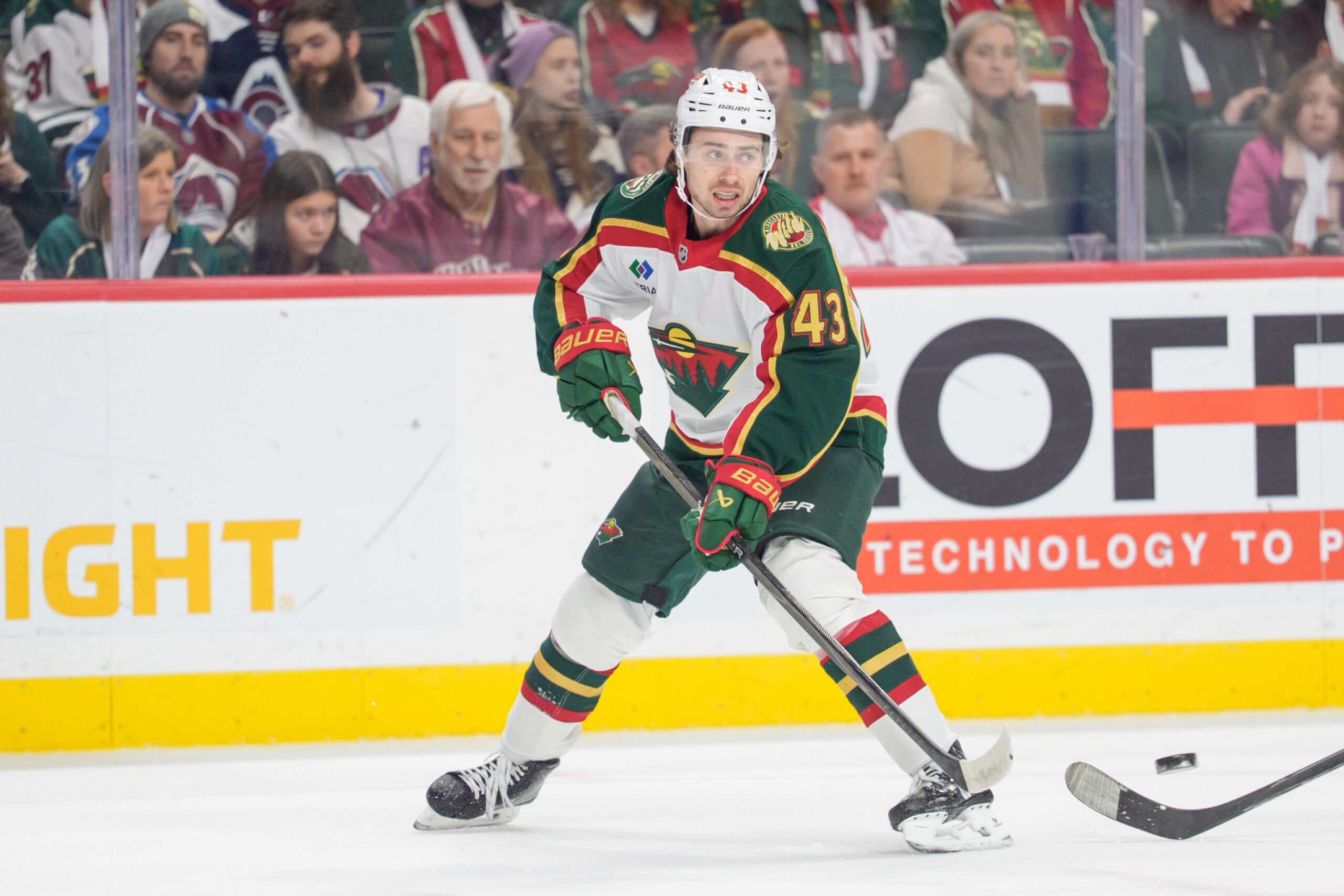 While the 27-year-old is a UFA on July 1, 2027, he can sign an extension in about six months. With the new CBA rules that cap the term at seven years instead of the previous eight, it could impact the term that Hughes will take. Does he lock in for the seven years early with his current team – or still eight if he signs before Sep. 15 – or will the allure of going to market convince him to accept a six-year term? The money will be there for Hughes either way, as will the term, but whether he wants to leave money on the table will be up to him.
In early October, Matt Sekeres and Blake Price discussed with Daily Faceoff’s Jeff Marek the potential for Hughes to become the NHL’s first $20MM player. Marek didn’t outright say he believed Hughes could become that player. Still, he did discuss the cascading effect of other players around the NHL coming to terms on lucrative deals, which will no doubt impact Hughes’ negotiations.
Many wondered if Connor McDavid could become the NHL’s first $20MM man, but he punted that opportunity and opted to remain in Edmonton at his current rate of $12.5MM. Hughes could make a similar move to McDavid and take a short-term deal at a discounted rate, but given that he was just traded, one has to think he won’t feel the same loyalty to the Wild that McDavid showed to the Oilers. Another wrinkle for Minnesota in getting Hughes to sign for a discount is that the Wild has already demonstrated they will pay a superstar’s market value to retain them, as they did with Kirill Kaprizov when they signed him to his massive record-setting extension earlier this year.
Given that the cascading effect is in play, there’s no greater impact than looking over at a talented teammate who got every cent they wanted and believing you should get it too. No one knows whether Hughes feels that way except himself, but with the allure of the free market and the temptation of playing with his brothers on a talented team in New Jersey, it’s hard to believe Hughes is going to leave money on the table to sign with the Wild.
That’s what makes the possibility of Hughes hitting a $20MM AAV all the more likely. The Wild gave up a ton to get the defenseman and aren’t going to let him walk for nothing. So, they have one of two choices: pay him what he wants or trade him after this season.
But who are Hughes’s comparables, and what kind of money is realistic on a long-term contract? The best comparable to Hughes is fellow defenseman Cale Makar of the Colorado Avalanche. Hughes and Makar have flipped the Norris Trophy in recent seasons as the league’s top defenseman. At this point, Makar is a step or two ahead of Hughes in terms of numbers and hardware. Makar has 470 points in 431 games, along with two Norris Trophies and a Calder Trophy, while Hughes has a single Norris Trophy and 435 points in 464 games. This also doesn’t factor in Makar’s Stanley Cup ring or his 4 Nations win this past year. Both men are slated to become free agents at the same time, which should make the parallel negotiations fascinating to watch. Outside of Makar and Hughes, there really is no comparable from a contract standpoint.
Thomas Harley of the Dallas Stars is a possibility after signing a long-term extension two months ago. Still, he isn’t nearly the contributor Hughes is and was only a restricted free agent next summer. Harley does have youth on his side, as he is just 24, but he doesn’t have a resume close to Hughes’ and isn’t in the same stratosphere offensively with just 117 points in 223 career NHL games. Harley is still a terrific player, but his $10.587MM cap hit isn’t remotely close to the number Hughes should command.
Odds are, Makar will ink his deal first, as he is pretty comfortable in Colorado and they have the cap space to make him a top offer, which should eclipse Kaprizov’s $17MM AAV if he goes for full value. As Tyler Yaremchuk and Carter Hutton discussed on DFO Live back in October, the escalating cap is going to allow guys like Makar to call their shots on their next deals. Still, there is no way to gauge whether money will be the driving force for Makar, or for Hughes, for that matter.
While Makar and Hughes will be linked by their free agency timelines and play, the similarities taper off after that. Hughes has family dynamics at play and no personal connection to his team yet. Those dynamics will be primary considerations for both players and could change the money they are ultimately willing to play for. Makar has been part of a winning environment for quite some time, while Hughes has two brothers playing on the same team and a potential path to join them in New Jersey. Makar has better career numbers than Hughes, but as we saw with Connor McDavid, loyalty, fit, family, and friendship can shave millions off a player’s cap hit. In the case of Hughes and Makar, time will tell if that happens.
Image courtesy of Matt Blewett-Imagn Images.
Morning Notes: Hughes, Pitlick, Jiricek, Johansson
More information rolls in regarding the Vancouver Canucks’ trade negotiations involving defenseman Quinn Hughes. We now know that several teams were scared of parting with significant value due to the perception that Hughes is far from a guarantee to sign a long-term extension.
According to The Athletic’s Michael Russo, Hughes is keeping an “open mind” when it comes to re-upping with Minnesota on July 1st, 2026. Russo noted that Hughes believes the Wild have “an amazing core.” He also shared that Hughes is happy with how close the team is to Michigan, and for being the organization that actually stepped up to get him, regardless of his perceived hesitancy to sign an extension.
Now, unlike other teams, the Wild have more than six months to convince Hughes to sign immediately when eligible, and even longer if both sides are comfortable with him entering the 2026-27 season as a pending unrestricted free agent. They got off to a good start last night, beating the Boston Bruins by four goals, with Hughes scoring his first goal with the team in the third period.
Additional morning notes:
- Likely because they’ve added forward Samuel Poulin to their AHL roster, the Bakersfield Condors connected with the Rockford IceHogs on an AHL trade yesterday. According to an announcement from Rockford, the Condors have traded forward Rem Pitlick to the IceHogs for defenseman Tyson Feist. Rem, cousin of Tyler Pitlick, is a veteran of 132 NHL contests, scoring 21 goals and 54 points. Meanwhile, Feist has only played in the ECHL this season, scoring one goal and seven points in 14 games for the Indy Fuel.
- Back in Minnesota, there were a few negatives that came from last night’s contest. Both defenseman David Jiříček and forward Marcus Johansson left yesterday’s game with lower-body injuries. According to Joe Smith of The Athletic, the Wild didn’t offer any updates for either player during the post-game media availability. Minnesota doesn’t play again until tomorrow, so more information should be provided before then.
Wild Eager To Integrate Quinn Hughes
As the dust begins to settle from Friday’s blockbuster trade which sent Vancouver’s Quinn Hughes to Minnesota in exchange for a haul including Zeev Buium and Marco Rossi, the next step is the Wild’s need to integrate their new superstar. Michael Russo of The Athletic wrote earlier today that while the team has rolled the dice with no guarantees, they are confident. Tonight’s electric home debut, a convincing win over Boston, is step one in what will be Minnesota’s ultimate goal to make Hughes happy in his new home, and keep him for the long haul.
The news that Hughes was headed to Minnesota came as a shock to many, as they had not been thought of as a top suitor. However, as mentioned by Elliotte Friedman of Sportsnet on yesterday’s edition of Saturday Headlines (link), several teams were “scared off” by Hughes’ lack of long-term commitment. Friedman says that only Minnesota and New Jersey remained unfazed.
New Jersey was naturally aggressive in their pursuit, as it has long been thought that Quinn would like to join his brothers Jack and Luke to form a one-of-a-kind trio in Newark. However, it has become apparent that salaries were unable to work out. The Devils had several older, higher dollar candidates which could have been moved to open up space, but with ample full or modified no trade clauses throughout, such a move would be difficult. Even if a player such as Ondřej Palát or Brenden Dillon would be willing to move, Vancouver, in their current state as a franchise, would have no real use for them. GM Tom Fitzgerald’s loyalty to his veterans seems to have seriously limited his options, when an unforgettable trade opportunity presented itself.
Minnesota GM Bill Guerin swooped in aggressively, and as noted by Russo, he wasted no time. The offer of Rossi, Buium, Liam Ohgren, and a 2026 first-round pick was the first and only one made.
While losing a 26-year-old franchise level player has massive implications for Vancouver, they were able to bring in a young and highly capable second line center, a rookie defenseman with high end potential to fill a Hughes-type role eventually, along with other assets. Such a return is an ideal scenario, as it came with no “baggage” of sorts, unlike what they would have likely received from New Jersey. Sure enough, much like Hughes, Buium also scored in his Canucks debut tonight, in a two-point effort, as Vancouver ironically defeated their trade suitors, the Devils. The 20-year-old rookie played in a second-pair deployment alongside veteran Tyler Myers, a favorable scenario as the team looks to shelter Buium early on.
Meanwhile, the window for Minnesota is as open as ever. After locking up Kirill Kaprizov, Guerin has assembled a seriously formidable group. The loss of Rossi leaves a hole down the middle, but Ryan Hartman, 31, may have an opportunity to return to a top six level offensively. For now, he has 12 points in 26 games, remaining a solid player on both ends, but such is a far cry from his 34 goal output in 2021-22. Even if not, the Wild could pursue a 2C on the trade market, perhaps the affordable contract of Ryan O’Reilly, if they are able to pry the veteran from their divisional rivals in Nashville.
Hughes’ debut tonight went as well as could have been expected. He led all Minnesota defenders with 26:55 of ice time, and scored a goal. His Wild tenure is just in infant stages, but after the game, Hughes said he is “very open minded” to staying long term in Minnesota, as shared by Joe Smith of The Athletic. Guerin’s aggressiveness also made an impression, as Hughes mentioned his respect for the esteemed GM for going out to get him in such a big trade package.
Although they are tired of hearing it, the Wild have not won a playoff round in a decade. The fan base has patiently waited for another deep push, which has not happened since their Cinderella run in 2003. With Hughes in the fold, 2026 could be a year to remember for Minnesota. Thankfully, as he is signed through next season, the contract status of their franchise defenseman won’t yet be a major distraction, but for now, the Wild must make him happy and set the stage for a long future together.
Latest On Quinn Hughes Trade Aftermath
As the dust begins to settle from Friday’s Quinn Hughes trade, an era-defining transaction for two NHL franchises, more and more information is being reported regarding the circumstances that led up to the deal.
Minnesota Wild GM Bill Guerin addressed the media yesterday regarding the trade, and revealed a few things about how it all came together. He said that he took a direct, aggressive approach in negotiations with the Canucks, stating “we had to go to them with something real, right away, to tell them that we’re serious,” and adding that the eventual package the Wild sent to the Canucks was the first offer Guerin made.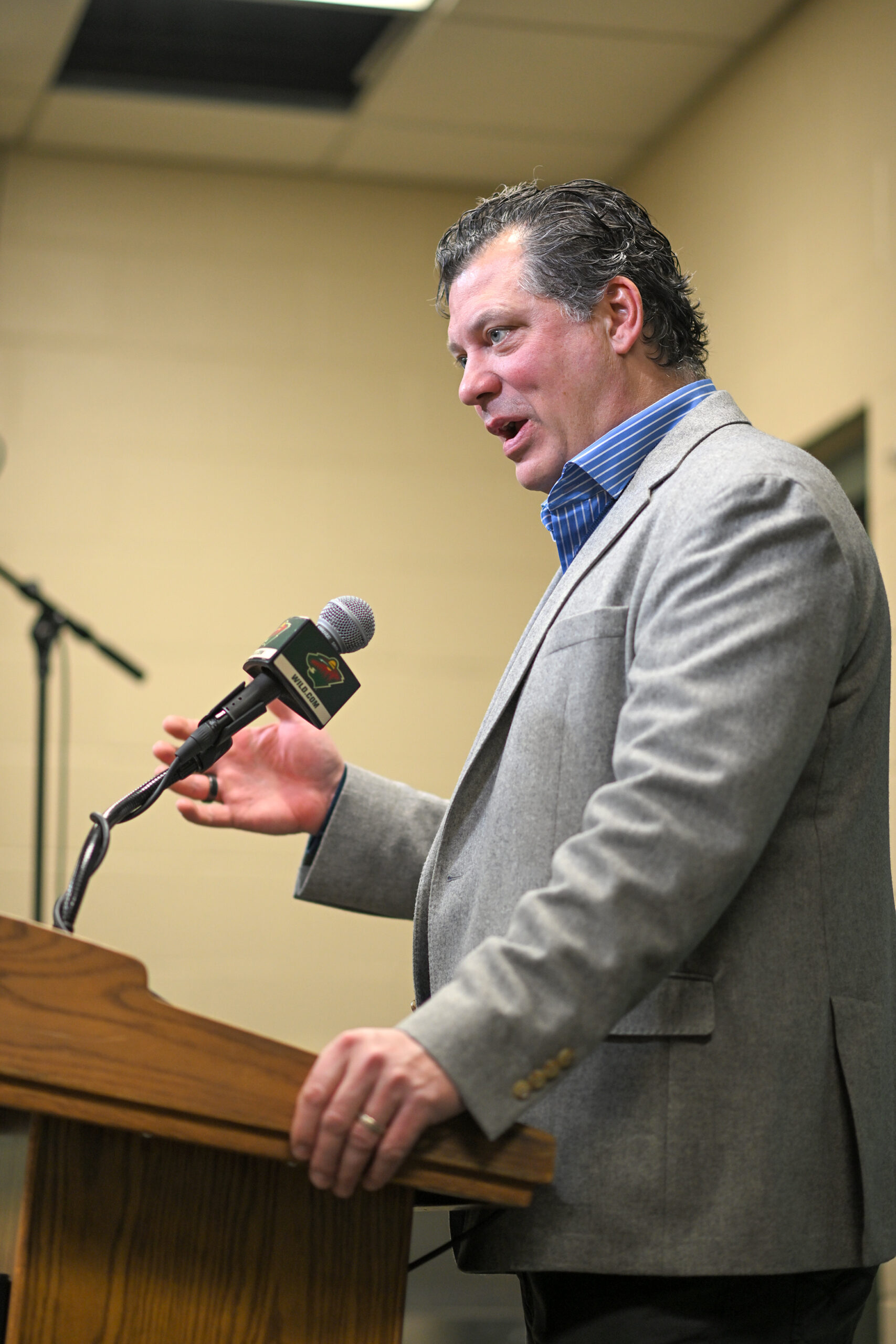
That bit of information sheds some light on the Wild’s overall strategy regarding their path to contention. Guerin’s willingness to part with key future pieces such as Zeev Buium to acquire Hughes, who has less than two years of team control remaining, indicates that the club sees itself as a legitimate Stanley Cup contender within that period.
Of course, the simple fact that they acquired Hughes sends that signal as well, but it’s also notable that the Wild did not hesitate to include players such as Buium in their initial trade offer to the Canucks.
From the Canucks’ perspective, it’s easy to see why the Wild were able to push through the other bidders for Hughes’ services and get a deal done.
It’s been reported (by The Athletic’s Pierre LeBrun) that other clubs, such as the Philadelphia Flyers, didn’t feel willing to surrender the caliber of assets the Wild were willing to part with, like a high-upside young player who is either NHL-ready or nearly NHL ready. The Wild were in a unique position where they were able to offer key players who brought a rare combination of youth, upside, NHL-readiness, and positional value.
Buium is a supremely intelligent defenseman who could very well quarterback the Canucks’ top power play unit in short order. Marco Rossi is a center who has a 60-point season on his record and hasn’t turned 25 yet. In a trade market where it’s extremely difficult to acquire centers, let alone young, productive ones, that’s a major piece. And then the willingness to add a player like Liam Ohgren into the deal, someone who has preexisting chemistry with key Canucks youngster Jonathan Lekkerimaki, is something that likely pushed the Wild even further in the Canucks’ eyes.
It’s extraordinarily difficult to “win” a trade where your franchise is parting with a player of Hughes’ caliber. The Wild’s initial offer was strong enough that it, at the very least, gave the Canucks a fighting chance given the key factor of Hughes’ limited team control.
LeBrun also revealed a few other teams that were involved in the race to acquire Hughes. He reported that the New Jersey Devils, Detroit Red Wings, and New York Rangers “made legitimate offers” for Hughes, while the Buffalo Sabres and Carolina Hurricanes “showed interest.”
LeBrun also added that “despite rumors to the contrary,” the Washington Capitals “were never real players” to acquire Hughes and cited the organization’s unwillingness to part with a player such as Cole Hutson as a key reason for their reluctance. Hutson is the younger brother of 2024-25 Calder Trophy winner Lane Hutson and has 20 points in 17 games this season at Boston University.
Looking at the deal from a different angle, Canucks head coach Adam Foote also spoke to the media yesterday and addressed an aspect of Hughes’ departure that could be key to the Canucks’ off-ice player dynamics. Per The Athletic’s Thomas Drance, Foote said that he hasn’t had an opportunity to speak with the club’s senior hockey operations leaders about naming a new captain, but added that defenseman Filip Hronek will be an alternate captain in the meantime.
The Canucks’ current alternate captains, besides Hronek, are Brock Boeser, Elias Pettersson, and Tyler Myers. The fact that Myers is now 35 and has just one year remaining beyond this one on his contract lowers the odds that he’d be a long-term solution as a captain, but both Boeser and Pettersson are in their late-twenties and under contract through 2031-32, making them more logical candidates for such a role, though it is also possible that the next Canucks captain is not currently on their roster.
Photos courtesy of Nick Wosika-Imagn Images