
These Players Are The Best Value In The NHL
A few weeks ago, we took a look at some of the worst-valued contracts in the NHL, and now today, we will do the opposite and look at some of the players that are giving the best value to their team in terms of performance compared to cap hit. For this, we will not utilize any players currently playing under an entry-level contract. We will only consider players playing under an agreement signed after their ELC has expired.
We begin in New Jersey with forward Stefan Noesen, who played last season under the first year of a three-year $8.25MM contract he signed as a free agent last summer. The 32-year-old journeyman did not have a perfect first year in his return to the Devils, but he did post over 20 goals for the first time in his career and was highly effective on the power play. His even-strength numbers were also good, and he set a career-high in hits with 152. Noesen played more than he ever has in an NHL jersey and was probably asked to do too much sometimes, leading to incredibly high turnover numbers (73 turnovers in 78 games). Overall, it’s not a bad return for a player making just $2.75MM per season.
Sticking in the Metropolitan Division, we move to Washington center Dylan Strome, who just completed a career year with 29 goals and 53 assists in 82 games. The 28-year-old was non-tendered by the Chicago Blackhawks in the summer of 2022, a move that has been a disaster for Chicago, given that the 2015 third-overall pick has developed into a top-six scoring center. Washington was happy to scoop up Strome on a one-year deal for $3.5MM, then extended him a short time later to a five-year, $25MM contract.
In the first two years of that deal, Strome has not missed a game and has averaged 28 goals and 46 assists while playing 17:40, which is not bad for $5MM annually. With three years left on that deal, it’s not impossible to imagine Strome replicating his production in the future, and there is an outside chance he will find another gear. Washington has Strome locked in for three more years and should be able to extract more value from him going forward.
Next up is defenseman Jaccob Slavin of the Carolina Hurricanes. Slavin’s game is somewhat unheralded, given that he is one of the top defensive defensemen in the NHL. Slavin was extended last July and will go into the first year of that eight-year deal in the fall. The contract is heavily loaded with signing bonuses, and the 31-year-old will carry an AAV of $6.395MM.
As good as Slavin has been defensively, his deal has a risk if the aging curve is not kind to him, which often isn’t with more defensively minded players. However, for at least next year, he will be underpaid for his elite work in Carolina’s defensive zone, and it should be a while before his game starts to slip dramatically.
Switching over to the Western Conference, Winnipeg Jets defenseman Josh Morrissey’s contract has been of incredible value to the team. The 30-year-old just completed his fifth year of the deal, and he has been unbelievable for Winnipeg, particularly in the past three years, where he has averaged over 24 minutes of ice time per game and has garnered Norris Trophy consideration every year.
Morrissey is making just $6.25MM against the cap, and with three years left on the contract, he will likely finish his deal just as his age begins to affect his production. He has remained a solid two-way defenseman who found another level offensively; that said, his offensive production has fallen a bit in the past two seasons, but he still produces points at a much higher level than when he initially signed his eight-year extension. The contract is a steal.
Next, we begin to get into some of the more obvious candidates, and it starts with Cale Makar, who just posted a career year offensively with 30 goals and 62 assists in 80 games. Aside from being elite offensively, Makar has developed a sneaky defensive side to a game that relies on his terrific skating and positional awareness. Makar is making $9MM annually for another two seasons and will be eligible for an extension next summer. Until he signs a new deal, Makar should continue to comfortably outperform his contract, which is saying something for someone making the kind of money he is.
Remaining in the West, we look at the best player in the world. Connor McDavid was once the highest-paid player in the NHL, but will enter next season possibly as low as fifth. That shouldn’t last long, though, as McDavid is eligible to sign an extension this summer and will most likely be the top-paid player in the game again in 2026-27 when his new deal kicks in. McDavid will carry a $12.5MM cap hit into next season and should considerably outperform it, given that he has posted 100 points in every season except for his rookie season (in which he was injured for nearly half of it) and the 2019-20 season (which was shortened due to the pandemic).
McDavid remains the best in the world, and if he indeed signs in Edmonton, he will top Leon Draisaitl’s $14MM AAV. McDavid has stated publicly that his first desire is to win, which, if true, means he will likely leave money on the table. However, if it does go for a significant number, it’s not impossible to imagine him getting close to the $20MM annual figure.
Moving back to the Eastern Conference and Tampa Bay Lightning winger Nikita Kucherov. The soon-to-be 32-year-old has registered three straight 100-point seasons and has picked up plenty of hardware along the way, including back-to-back Art Ross Trophies in the last two years. Kucherov has two years left on his contract with a cap hit of $9.5MM and should have plenty of good production left in him as he moves into his mid-30s. Kucherov’s eight-year $76MM contract has been a massive steal for Tampa Bay as Kucherov has done nothing but win cups and pick-up awards during this run.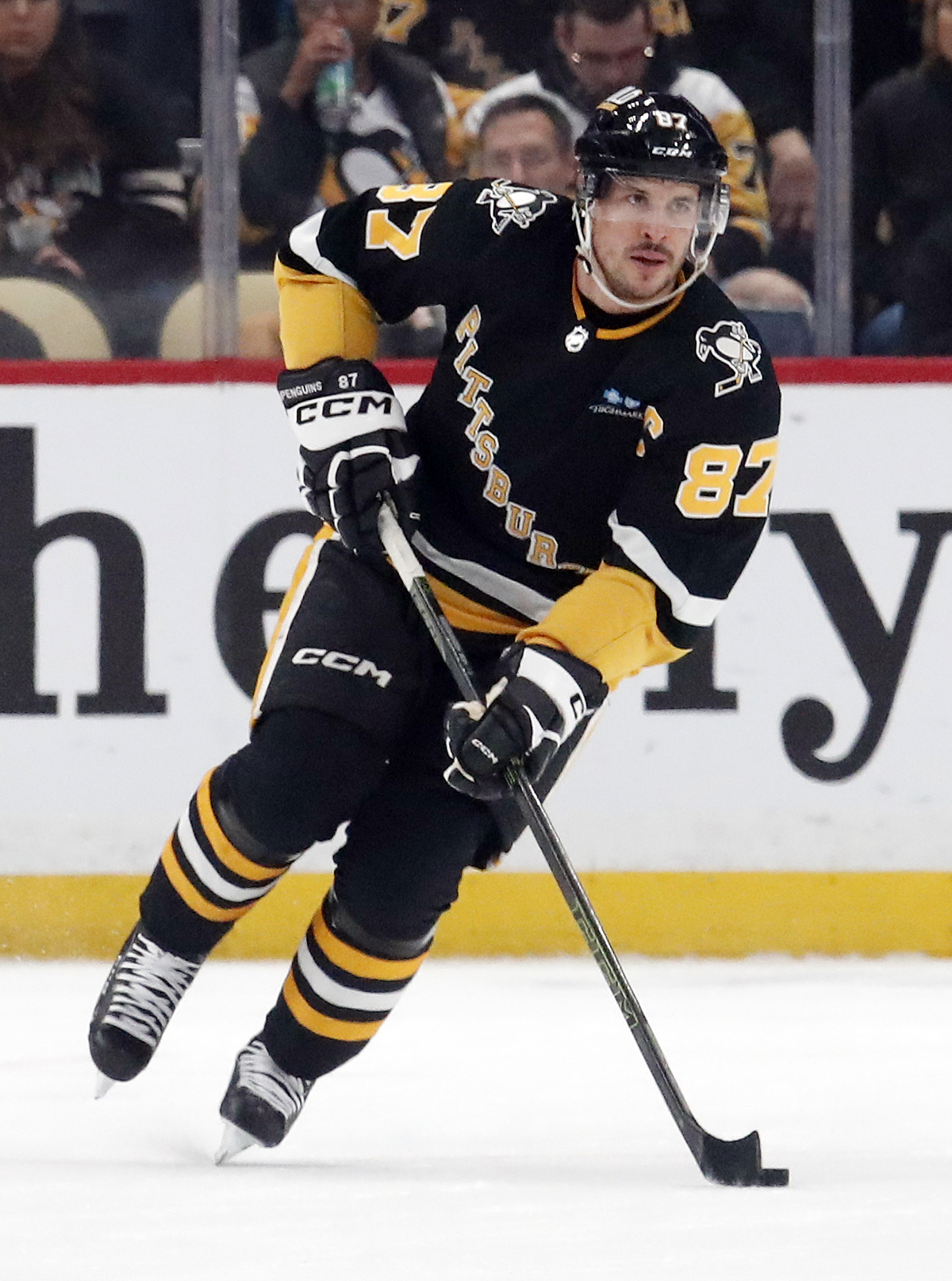
Next, we have a pair of Hughes brothers, defenseman Quinn Hughes and forward Jack Hughes. Quinn is entering the second-to-last season of his contract, and at $ 7.85MM, he has been a massive bargain for the Vancouver Canucks. Quinn will hit free agency at 27 years old and should finally get a contract much closer to the value he is producing on the ice. In the meantime, Vancouver should continue to see incredible value from last year’s Norris Trophy winner for top defenseman in the NHL.
Vancouver could face an issue in talking extension with Hughes because he has expressed an interest in playing with his brothers, who are both currently in New Jersey. That takes us to Devils forward Jack, who, like his brother Quinn, has been outplaying his contract for quite some time. Jack has five years left on his contract and is making a tick more at $8MM annually, which should remain an excellent value for the Devils until he is a restricted free agent in 2030. Some might argue that Jack misses too many games, and it’s a fair point to bring up, but given the production on the ice the past three seasons, it’s fair to see that it is one of the best values in the NHL.
Finally, we wrap up with the most outstanding value ever in the NHL: Pittsburgh Penguins forward Sidney Crosby. Despite being the best player in the world for most of his 20-year run in the NHL, Crosby has never carried a cap hit higher than $8.7MM and just re-signed last fall on a two-year deal for the same number. Crosby might be turning 38 in a few months, but at this point in his career, he remains one of the most valuable in the NHL and should continue to put up points for the Penguins even if they stay in a rebuild for the entirety of his two-year deal.
Photo by Charles LeClaire-USA TODAY Sports
Offseason Checklist: St. Louis Blues
The offseason has arrived for all but two teams now with the playoffs nearing an end. Accordingly, it’s time to examine what they will need to accomplish over the coming weeks with free agency fast approaching. Next up is a look at St. Louis.
It was an eventful year for the Blues who made an early-season coaching change and wound up going on a significant late-season run to propel themselves into a playoff spot before being ousted by Winnipeg in the opening round. GM Doug Armstrong doesn’t have a lot of salary cap flexibility to work with but he will be tasked with making at least some tweaks to his group this summer.
Continue To Reshape The Defense
A good chunk of the back end for the Blues has been around for quite a while now with three veterans being around for at least the last four years. While they made a key addition early in the season with the acquisition of Cam Fowler following the summer signing of Philip Broberg, there’s still some work to be done.
Colton Parayko isn’t going anywhere. Neither is Broberg. Fowler is heading into the final year of his deal but at this point, he’s more of an extension candidate than a trade candidate. After that, there are some question marks.
Justin Faulk is no stranger to trade speculation and was even in some recent speculation heading into the trade deadline when it looked like St. Louis would be selling, not standing pat. He has two years left on his contract with a $6.5MM cap charge. Originally, it looked as if those last couple of seasons could be tough from a cap perspective but he’s still logging 22 minutes a night and is above-average offensively. With the UFA class not exactly being deep, he’s a viable trade chip not just to clear money but to get real value in return. With Broberg, Fowler, and Parayko being capable of playing the offensive roles, Faulk could become expendable.
Nick Leddy is entering the final year of a four-year, $16MM deal. The first two years weren’t bad but he battled injuries this season and struggled when he was in the lineup. It would be surprising if they could offload the final year of the deal but if they wanted to retain salary or take a player back in a change-of-scenery type of swap, there might be a chance to move him as well.
Torey Krug seems unlikely to play next season which could give them some extra flexibility. They have around $5MM in cap space per PuckPedia although Krug landing on LTIR could give them up to $6.5MM in additional spending room. Meanwhile, Matthew Kessel and Tyler Tucker have shown they can be useful players in a depth role but aren’t ready for top-four duty just yet.
In a perfect world, Armstrong would add a top-four defender, one who is a bit more geared toward filling a shutdown role. If Faulk is still around, they’d be in a good spot of having five top-four blueliners. Or if that acquisition makes Faulk expendable, they’d have a chance to cash in on a solid trade chip. Broberg and Fowler have helped reshape the back end but there’s still some work to be done there.
Extension Talks For Bridge Deals
The Blues went with bridge deals for the two players they signed on offer sheets from Edmonton (Broberg and Dylan Holloway). Both will be entering the final year of their respective contracts on July 1st, making them extension-eligible. While getting both of them signed would be a tall task, getting a sense of what those next deals might cost would be worthwhile for long-term planning as Alex Steen gets set to take Armstrong’s spot as GM next year.
Broberg was a wild card coming over from Edmonton. After not locking down a regular spot in the lineup in 2023-24 during the regular season, he played a little more often in the playoffs but even with that, his $4.581MM offer sheet was still a wild overpayment based on what he had to that point of his career.
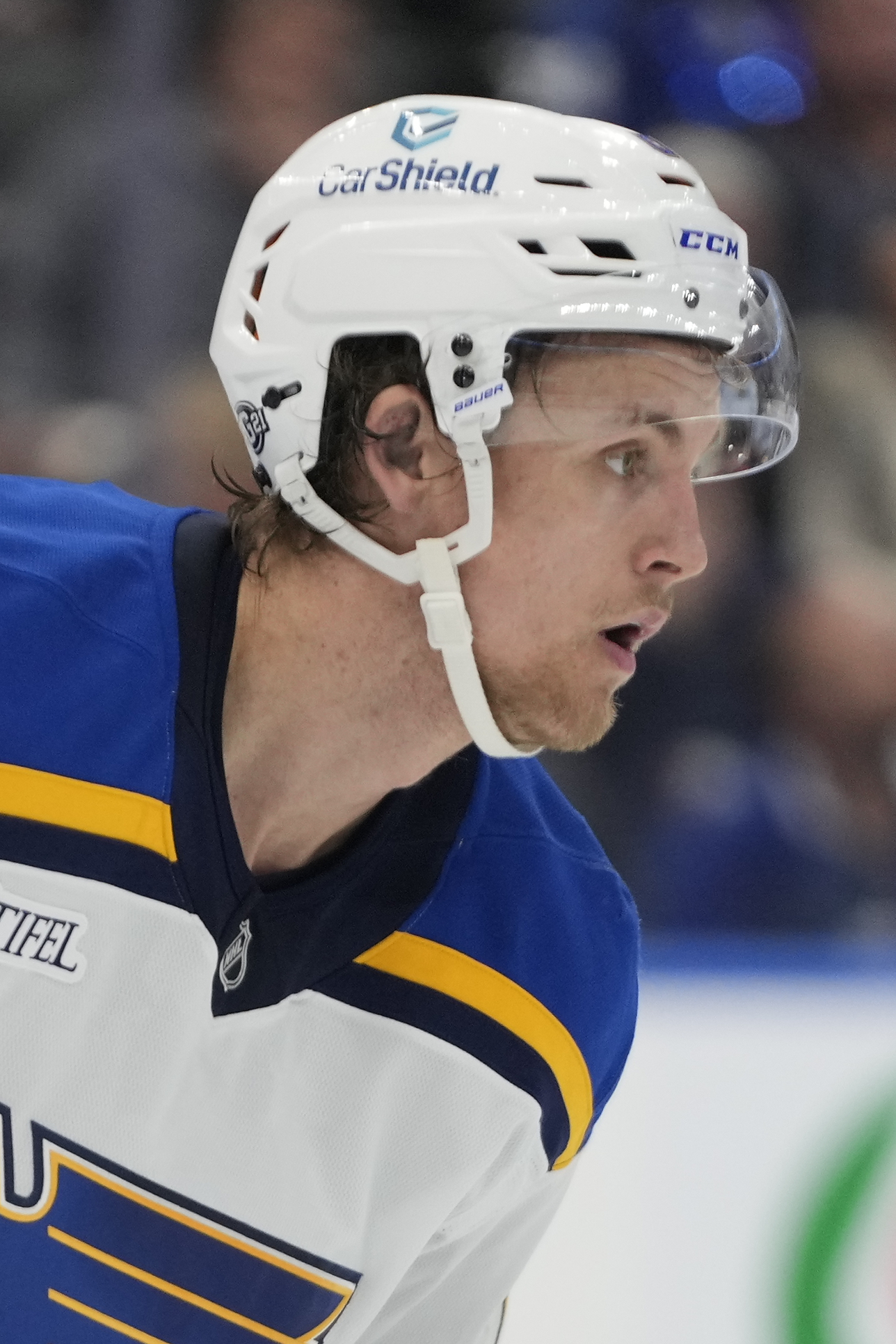 But Broberg managed to not only live up to that deal this season but even make it look at least a little bit like a team-friendly pact. He quickly became a top-four threat, logging over 20 minutes a night and did pretty well offensively considering the low power play time he had. Basically, he lived up to his eighth-overall billing. Now, it’s fair to say that an extension is going to be a step or two above this rate. Broberg has two RFA years left after next season so this will be the contract they’ll want to go long-term on. With the anticipated jump coming to the Upper Limit and the projection that Broberg can build off the year he had, that type of agreement could conceivably push past the $7MM threshold, if not a little higher.
As for Holloway, he was the bigger bargain of the two, taking a $2.29MM contract and finishing third in the team in scoring with 26 goals and 37 assists, numbers that seemed unfathomable given his usage with the Oilers previously. We saw Calgary’s Matthew Coronato get seven years at $6.5MM without hitting the 50-point mark, a plateau that Holloway already has gone through. Like Broberg, he’ll have two RFA years left after this contract and it wouldn’t be surprising to see his camp asking for something starting with an eight on a long-term deal.
It would be surprising to see either player sign this early after just one year. But even knowing how much extra money they’re going to need to set aside for 2026-27 could affect how they approach this summer.
Find A ‘200-Foot Offensive Player’
If this seems like an oddly specific category, there’s a reason for that. At the end of the season, when Armstrong was asked what he’d like to add to his roster, this was his answer. With that being a stated goal, it’s fair to say they’re going to go out and try to add one of those pieces.
The Blues finished 13th in offense this season so this type of player doesn’t necessarily have to be a high-producing one, just one that can play a two-way game and move around the lineup when needed. Speculatively, a 40-to-50-point player fits the bill, preferably a center to give them some extra depth while also giving them options if Brayden Schenn were to find his way back into trade talks.
Of course, this is not necessarily the easiest profile of player to find. There are only six UFA forwards in that particular point range and realistically, only two of those profile as two-way players, winger Reilly Smith and center Pius Suter. Each of them would likely take up the bulk of their remaining base cap space, forcing them back into using LTIR for Krug.
With that in mind, it wouldn’t be shocking to see Armstrong try to land this type of player on the trade market. While his second-round picks are off the table for the next three years, they still have all of their first-round selections and boast a prospect pool that has been improved as of late. That should be enough trade capital for him to work with if he wants to swing a deal to add to his group up front.
Re-Sign Hofer
Joel Hofer has been one of the better bargain goalies in the NHL over the last couple of seasons. Signed to a league-minimum contract, he has been an above-average backup to Jordan Binnington over that span, posting a 2.65 GAA and a .909 SV% in 65 games over that span. It’s safe to say that the bridge contract worked for both sides; St. Louis got a team-friendly deal while Hofer got a chance to prove himself and did exactly that.
Now is the time for him to cash in. That is, at least in theory. Knowing their desire to add a 200-foot offensive forward and the speculated desire to continue to build up their back end, it’s fair to wonder how much they’re going to have left for the backup goalie position.
Armstrong probably wouldn’t mind working out a long-term deal with Hofer, giving the Blues at least some stability with Binnington only having two years left on his contract. But the longer the contract, the higher the price tag will be, cutting into what they can spend elsewhere.
With that in mind, it wouldn’t be surprising to see the Blues pursue a second bridge deal with Hofer. He has three RFA-eligible seasons remaining and though they’re all arbitration-eligible, they can use the extra club control to kick this one down the road. A two-year deal would see him expire at the same time as Binnington and should cost around $3MM per season while a one-year pact would see the price tag go a bit lower, potentially around the $2.5MM mark. Hofer is the lone NHL RFA St. Louis has so Armstrong can push this past the start of free agency and potentially let what happens there dictate what they do with Hofer.
Photo courtesy of John E. Sokolowski-Imagn Images.
Offseason Checklist: Colorado Avalanche
The offseason has arrived for all but two teams now with the playoffs nearing an end. Accordingly, it’s time to examine what they will need to accomplish over the coming weeks with free agency fast approaching. Next up is a look at Colorado.
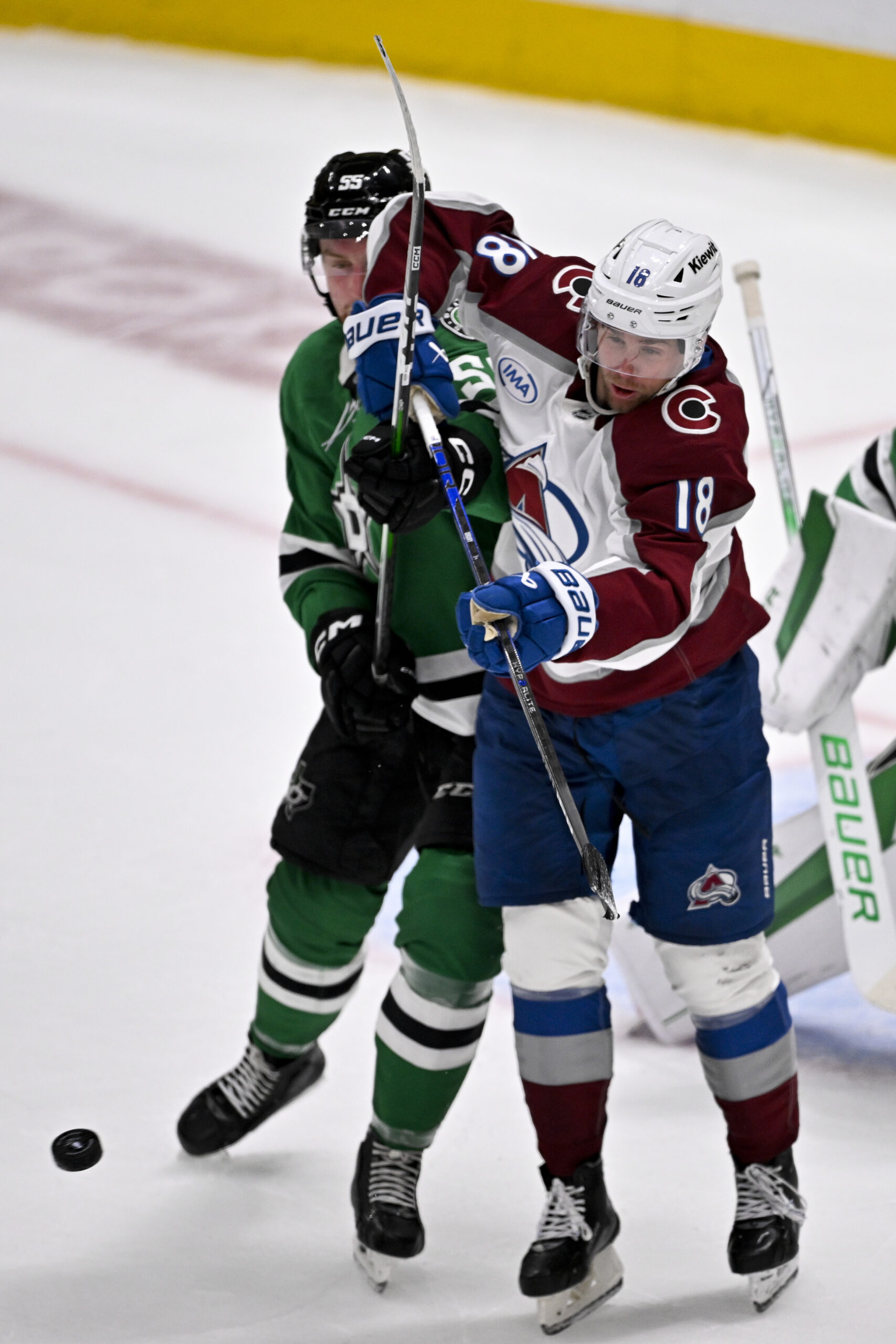
The Avalanche set a franchise record with three straight 100-point regular seasons in 2023-24 and extended that streak in 2024-25, although their .622 points percentage was still their worst in six years. That record was influenced by one of the biggest in-season resets in recent memory, carried out by general manager Chris MacFarland, who managed to give his club a new goaltending tandem and swap out a large portion of their forward group between opening night and the postseason. While the team had an excellent record down the stretch, winning 16 of their last 23 games, they lost a seven-game heartbreaker to the Stars in the first round. With a brand-new support staff for Nathan MacKinnon and Cale Makar in tow, Colorado has a few items to tend to this summer to extend their championship contention window.
Solidify Nečas’ Future
Star winger Mikko Rantanen was a pending unrestricted free agent last summer; extension talks for him were an item on their 2024 offseason checklist. They now enter the same situation with Martin Nečas, the centerpiece of their return when they sent Rantanen to the Hurricanes in January following unproductive contract negotiations. He’ll become a pending UFA on July 1 as he enters the back half of the two-year, $13MM bridge deal he signed with Carolina as a restricted free agent in 2024.
Nečas’ trade value had never been higher than when Carolina dealt him. The Czech forward was on pace to break the point-per-game mark for the first time in his career with a 16-39–55 line in 49 games at the time of the trade. Even though 55 points was his career average per 82 games entering the season, the Avs hoped that might be sustainable if they plopped Nečas in Rantanen’s spot next to MacKinnon, a higher-caliber center than he had in Raleigh-Durham.
Instead, things went about as expected for Nečas in Colorado. He saw his minutes increase, skating over 20 minutes per game after averaging 17-18 during his time in Carolina, but his production tapered off slightly from his early-season tear. He still managed 11 goals and 28 points in 30 games to end the year, which still would have been a career-high 0.93 points per game pace over a full season on their own, but predictably didn’t click at the well above a point per game rate Rantanen had over the last five years in Denver.
Nečas will still be one of the Avalanche’s better-value contracts last season at a $6.5MM cap hit if he can play a full season, something he’s had no trouble doing, and remain around that 75-80 point pace. However, unlike waiting until after the season started to have aggressive extension talks with Rantanen, they’ll look to kick Nečas’ discussions off earlier to avoid a repeat and force another in-season blockbuster to avoid losing him for nothing next summer. Yet with a rising cap, he’s due a considerable raise. AFP Analytics projects a Nečas extension with a $9.9MM cap hit for seven seasons, considering the salary cap’s projected jump to $104MM for the 2026-27 campaign. MacFarland needs to begin weighing if that’s a price he’s willing to pay with Makar becoming extension-eligible in the summer of 2026.
Create Cap Flexibility
Outside of Nečas, the Avs don’t have much in the way of major contract business to attend to. They’ve had a busy past few weeks, keeping new second-line center Brock Nelson in the fold on a three-year extension with a $7.5MM cap hit. They also got their new starting goaltender, Mackenzie Blackwood, signed to a five-year extension shortly after acquiring him from the Sharks in December.
The good news is they already have 19 of 23 roster spots locked in for next season as a result. The bad news is that they have just $1.2MM in cap space, per PuckPedia, only enough to sign one league-minimum player and carry a roster with no healthy extras. At present, they stand no chance of re-signing their two top UFAs, winger Jonathan Drouin and defenseman Ryan Lindgren. Even one cap-dump trade likely won’t be enough to bring back one of them, but it would at least allow them to add more cheap pickups (or re-sign a few of their own) while having in-season flexibility in case short-term injuries arise.
 The few inefficient contracts on Colorado’s books will be under scrutiny as a result. They sent Casey Mittelstadt to the Bruins at the trade deadline to acquire veteran Charlie Coyle to serve as their new third-line center, but he carries a $5.25MM price tag. With MacKinnon and Nelson, their top two centers, now making a combined $20.1MM against the cap, that’s not an affordable number for a No. 3 – even if he ended the year strong with 13 points in 19 games. With only one year left on his deal and one year removed from a career-high 60 points with Boston, they wouldn’t have much trouble moving him at first glance. However, they’d need to convince Coyle to waive his no-movement clause, something he may not be eager to do again after waiving it to join a championship contender in Colorado.
There’s also Ross Colton, whose $4MM cap hit is fine value in a vacuum but, again, a tad pricey for a third-line winger. Moving Coyle and saving an additional $1.25MM in space would be far preferable, but it would be easier to move Colton, who only has a modified no-trade clause and had a 16-13–29 scoring line in 61 games last season. Injury-prone depth winger Miles Wood, who’s less expensive at $2.5MM per season, could also be someone Colorado looks to ship out, but that could also prove semi-challenging with four years left on his contract. He also has a six-team no-trade list.
That might mean Colorado turns to their defense, where their depth is far weaker, as a necessity to free up space. They wouldn’t be looking to deal either of their major trade candidates, second-pairing fixtures Samuel Girard and Josh Manson, purely as a cap dump as a result, particularly without many suitable options to replace them in free agency. They’d be looking to attach an asset to them to gain a more cost-efficient roster player back, even if they’re getting a worse overall player, to be able to spread the wealth a little more behind their elite top pairing of Makar and Devon Toews. Girard has two years left on his contract at $5MM per season with a nine-team no-trade list, while Manson has one year left at $4.5MM with a 12-team no-trade list.
Find A New Power Play Coach
While the Avalanche continued to boast a top-10 power play in the regular season as they have for many years, they converted at just a 13.6% clip against Dallas in the first round. That was 14th out of 16 playoff teams and enough of a margin of error to cost assistant coach Ray Bennett, who had been responsible for the man-advantage unit under head coach Jared Bednar for the last eight seasons, his job.
Bennett has since landed with the Isles, but the Avalanche, who only operate with two assistants (not including a goalie coach) under Bednar instead of the standard three anyway, have yet to name his replacement. That means Nolan Pratt currently serves as Bednar’s lone assistant. This arrangement obviously won’t stretch into the regular season, but for a team with scoring talent of Colorado’s caliber, they need to find their desired option as Bennett’s successor quickly amid other teams filling their AC vacancies.
One name to speculatively watch out for is former Oilers head coach Jay Woodcroft. He was a finalist for a few head coach vacancies this offseason but was passed over for all of them. There’s now a potential new opportunity for him in Dallas after the Stars fired Pete DeBoer, but if he’s not considered for the gig, he has experience managing a wealth of high-end scoring talent in Edmonton with good results and could be a natural fit.
Add Defensive Depth
As alluded to earlier, the Avs simply need more behind Makar and Toews on the blue line. This item is a bit of a TBD based on how they handle any potential Girard or Manson trade.
Assuming they manage to open up a bit of flexibility somehow, they still need some third-pairing upgrades even if Girard and Manson remain on next year’s roster. Big lefty Keaton Middleton is a fine press-box option at his peak but not a legitimate everyday third-pairing option on a contender. Righty Sam Malinski played 76 games this season and, while a pending RFA, should be cheap to re-sign and would be a good value piece as Colorado’s 3RD if so. They need a more competent two-way partner for him than Middleton at the very least, though.
That will presumably be the focus of their likely minimal activity in free agency. While not particularly inspiring, there are affordable pending UFAs like Marc Del Gaizo, Joel Hanley, and Jonathon Merrill who can comfortably average more than the paltry 11:29 per game of deployment Middleton received in his 41 games this season. If they manage to clear up more considerable cap space, they could begin to consider some higher-caliber lefties like Brian Dumoulin, Matt Grzelcyk, or Nate Schmidt to play sheltered minutes behind Toews and Girard on the left side, or potentially even bring back Lindgren.
Image courtesy of Jerome Miron-Imagn Images.
Free Agent Focus: New York Islanders
Free agency is now under a month away, and teams are looking ahead to when it opens. There will be several impact players set to hit the open market in July, while many teams also have key restricted free agents to re-sign. We continue our look around the NHL with an overview of the free agent situation for the Islanders.
Key Restricted Free Agents
D Noah Dobson – Dobson’s second trip through restricted free agency should be interesting. After scoring 10 goals and 70 points in 79 games during the 2023-24 season, Dobson could only muster 10 goals and 39 points in 71 games this past season, being severely limited by injuries. Dobson’s name had popped up in a few trade rumors during the regular season, and those were exacerbated when he changed his representation in mid-February. Given the new regime change in the Islanders’ front office, it’s hard to speculate if they’ll give Dobson a short-term deal, lock him up long-term as the team’s top defenseman, or gauge his value on the trade market. 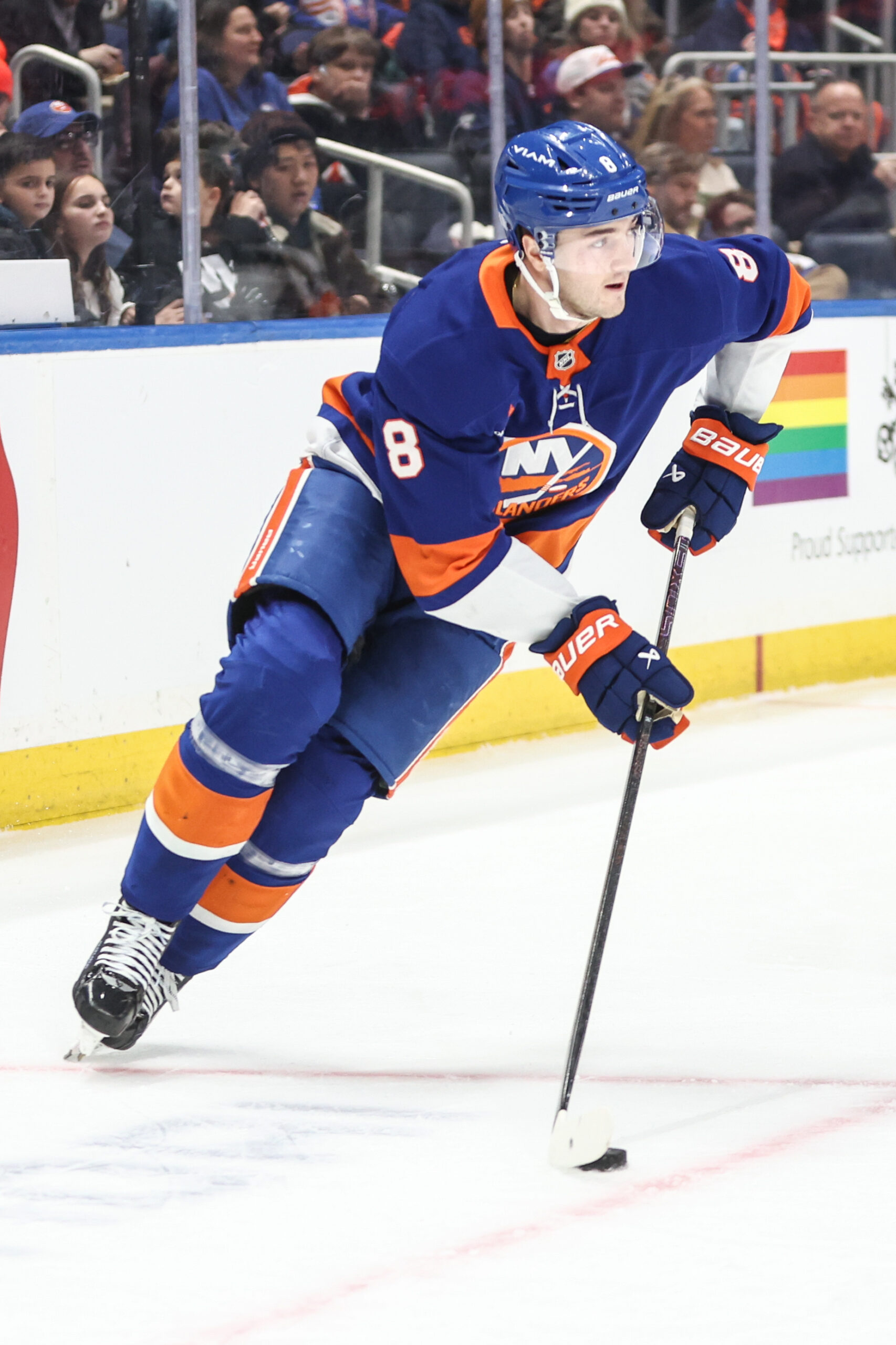
F Simon Holmström – Holmström continues to grow as a quality scorer for the Islanders. He increased his pace this past season, going from 15 goals and 25 points in 2023-24 to 20 goals and 45 points in 2024-25. Those numbers were good for fourth on the team in scoring, and the Islanders hope that Holmström can continue his upward trajectory and get into the 25 to 30-goal range in 2025-26. Depending on the new front office’s aggression this offseason, Holmström could be a sneaky winger to retain on a long-term contract for a lower price point than many of his peers on Long Island.
D Alexander Romanov – Assuming the Islanders re-sign Dobson for next season, they’ll already have six defensemen on the active roster without Romanov. Like Dobson, Romanov’s 2024-25 campaign was limited by injuries, managing fewer than 70 games for the first time since his rookie campaign. He maintained a quality scoring pace, but his defensive metrics declined significantly this past season, which could make Romanov a trade piece this summer. The Islanders shouldn’t expect to get a top-15 selection in return (like they gave up to acquire him), but it could provide them an avenue to re-stock the prospect cupboard.
Other RFAs: F Maxim Tsyplakov, F Marc Gatcomb, D Scott Perunovich, F Liam Foudy, F Ruslan Iskhakov, F Adam Beckman, D Samuel Bolduc, D Travis Mitchell, D Aidan Fulp
Key Unrestricted Free Agents
D Tony DeAngelo – Unlike the situation regarding their restricted free agents, the Islanders don’t have much to worry about regarding their pending unrestricted free agents. DeAngelo is the only one of note after he was brought in mid-season to help the Islanders defensive core recover from a slew of injuries. The offensive-minded defenseman stayed true to form for the Islanders, posting four goals and 19 points in 35 games, eating more than 23 minutes of ice time per game, and posting some of the worst defensive metrics on the team. Given his apparent shortcomings in the defensive zone, it’s unlikely the Islanders pursue an extended relationship with DeAngelo.
Other UFAs: F Hudson Fasching, F Matt Martin, D Mike Reilly, F Julien Gauthier, F Fredrik Karlström, F Tyce Thompson, D Grant Hutton, G Jakub Skarek
Projected Cap Space
Unfortunately, the Islanders will only have approximately $21MM to spend this offseason, which should get used to retain their crop of restricted free agents. It would behoove Mathieu Darche and his new administration to trade Jean-Gabriel Pageau and his $5MM salary this summer, opening up more financial flexibility for other additions. The Islanders have the benefit of making the first-overall pick of the 2025 NHL Draft, so they’ll get a top player regardless, but this team has more holes to fill than one player can fix.
Contract information courtesy of PuckPedia.
Photo courtesy of Wendell Cruz-Imagn Images.
Free Agent Focus: Nashville Predators
Free agency is now under a month away, and teams are looking ahead to when it opens. There will be several impact players set to hit the open market in July, while many teams also have key restricted free agents to re-sign. We continue our look around the NHL with an overview of the free agent situation for the Predators.
Key Restricted Free Agents
F Luke Evangelista – The Predators have just one restricted free agent on their NHL roster. It’s forward Luke Evangelista, who appeared in 68 of Nashville’s games this season while working around a lower-body injury suffered midseason. Despite the missed games, the 23-year-old Evangelista was able to continue his hot performances in the NHL lineup. He posted 10 goals and 32 points on the year, putting him on pace to match his 39 points in 80 games last season, had he appeared in all 82 games. That’s stout consistency down Nashville’s roster, bolstered by Evangelista’s growing confidence in being the physical forward on his line. His growth marks one of the team’s few true positives from a down year. A short-term deal could carry Evangelista into the golden years of his career – and hopefully his first 40-point season – at a minimal price.
F Jesse Ylonen – Nashville acquired Ylonen ahead of the 2025 Trade Deadline in a minor-league swap for Anthony Angello. Both players were impactful in their new landing spots – each netting 10 points in 19 games through the remaining regular season. But Ylonen seemed to really cement a top-six role in the AHL with four points in nine playoff games. He finished the season with 29 points in 75 games – bleak scoring, but enough of a footing to provide a solid ramp into next season. Ylonen has managed 12 goals and 29 points in 111 career games in the NHL, all coming with the Montreal Canadiens. A league-minimum deal could offer him his first chance to break out of the AHL with a new club – and could land Nashville a bottom-line winger with the ability to hit and push play.
Other RFAs: F Jordan Frasca, F Ondrej Pavel, D Luke Prokop
Key Unrestricted Free Agents
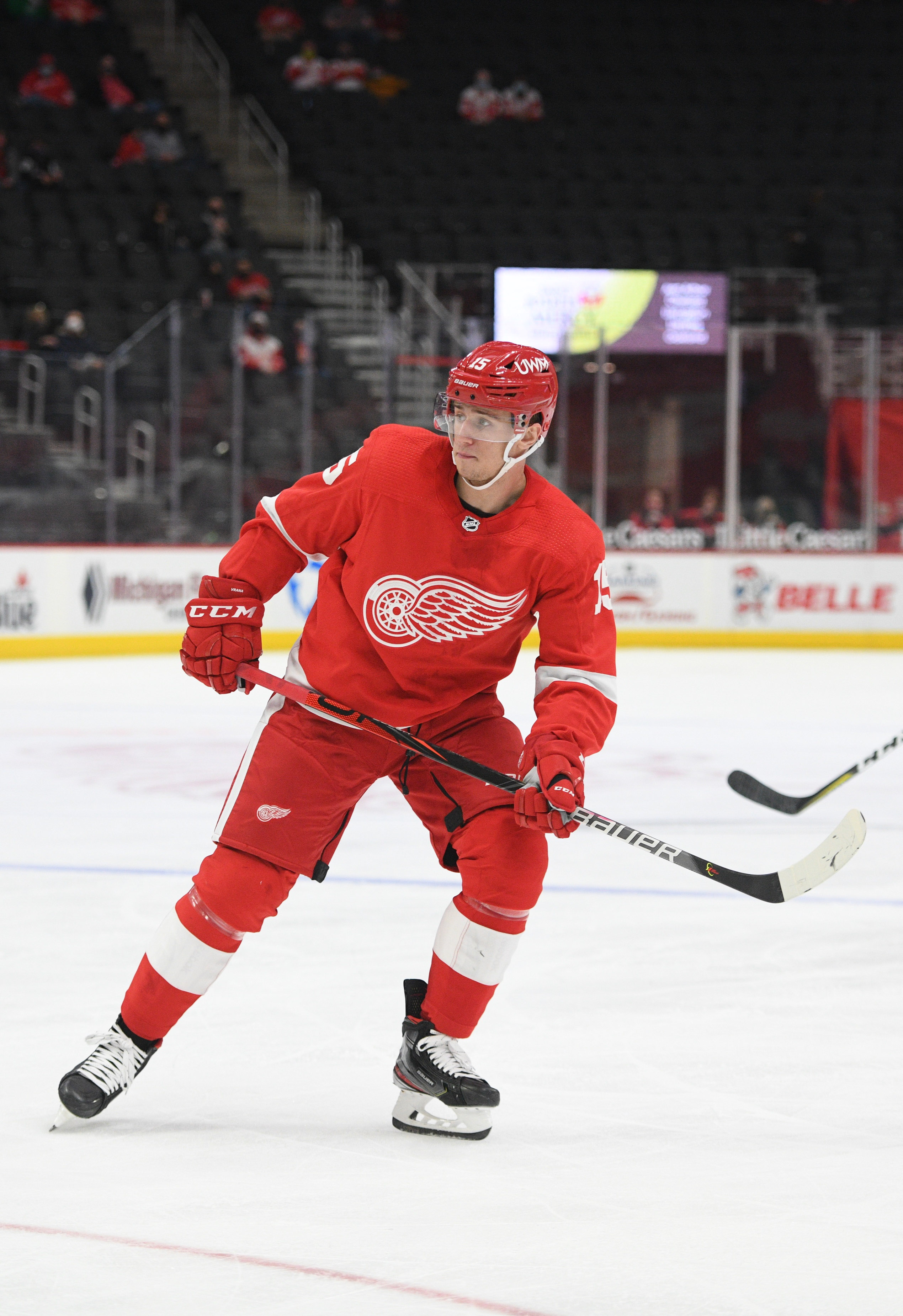 F Jakub Vrana – Vrana was another midseason addition in Nashville, joining the team via waivers from the Capitals in early March. He played the rest of the year in the NHL, appearing in 13 games in Nashville’s bottom-six. He posted a bleak three points and minus-10 in those appearances, again appearing to struggle with NHL responsibility. That was despite netting 11 points in 26 games with the Capitals earlier in the year. Vrana has run through the last few seasons unable to land a solid role at the NHL level, but he scored 36 points in 42 games of his most recent AHL stint (2023-24). That’s strong scoring, and could convince Nashville to bring him back as a focal piece of the Milwaukee Admirals lineup.
D Marc Del Gaizo – Of all of their pending free agents, Del Gaizo is absolutely Nashville’s most important. He played through his formal rookie season this year, appearing in 46 games and netting nine points. Those appearances were intercut with 30 games and 12 points in the AHL – then five points in 10 AHL playoff games. The stats may not jump off the page, but the former UMass standout looked more and more comfortable handling an NHL role. He’ll come at a low cost this summer, but could find his way into a near-permanent NHL role as soon as next season.
F Kieffer Bellows – Bellows was one of many productive veterans on the Admirals this year. He ranked sixth on the team in scoring with 15 goals and 31 points in 44 games – then posted a fantastic nine points in 10 playoff games. He also added four points in 19 NHL games. Those appearances held Bellows close to a pro role throughout the entire season, and maintained his momentum after netting 49 points in 52 games with the Toronto Marlies last year. He’s a minor-league fixture, but a certainly productive one that Nashville may struggle to replace one-for-one on the open market.
Other UFAs: F Grigori Denisenko, D Mark Friedman, D Jake Livingstone
Projected Cap Space
The Predators have little to worry about with the off-season approaching. Even after a dismal season, the team’s NHL lineup and top prospects are all signed through next season. That means that the team will be able to dedicate the vast majority of their $17.31MM in projected cap space to bringing in new additions from the open market. They’ve been one of the team’s most active teams on the transaction wire since general manager Barry Trotz took over. That should continue as Trotz handles plenty of firepower this summer.
Contract information courtesy of PuckPedia. Photo courtesy of Tim Fuller-USA TODAY Sports.
How The Canucks Need To Approach This Summer
The Vancouver Canucks are fresh off one of the most tumultuous years in franchise history, which is saying something, given some of the unusual seasons the team has had over the past 20 years. The relationship between star forwards Elias Pettersson and J.T. Miller cast a black cloud over a team expected to compete for a Stanley Cup in 2024-25. Still, the Canucks ultimately missed the playoffs and have a lot of work to do this summer if they want to get back into contention. This summer will be crucial in their re-emergence and could be one that either reopens their window to win or slams it shut, forcing Vancouver to consider another potential rebuild.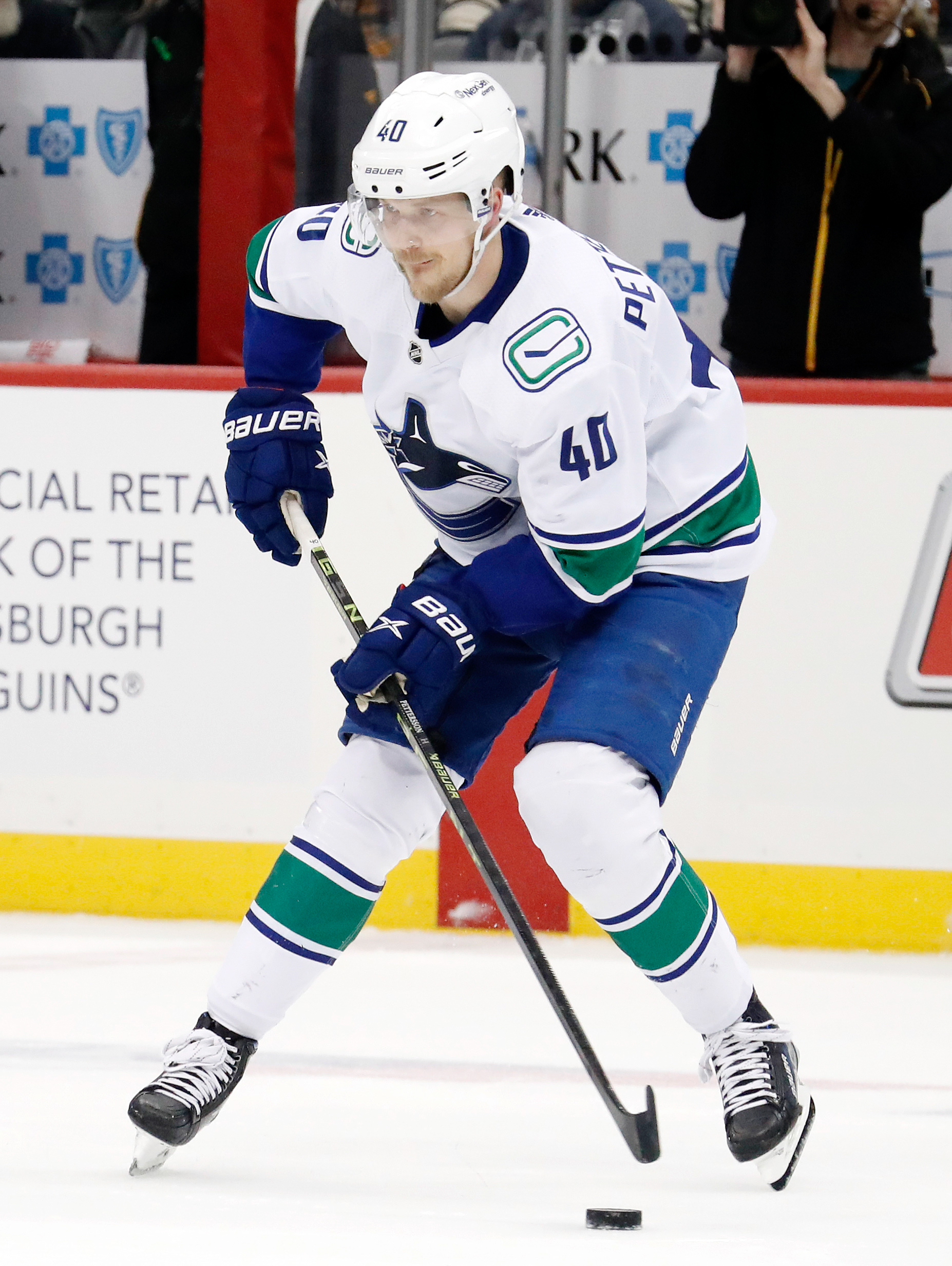
At some point very soon, the Canucks are going to need to decide who the core members of this team are. Pettersson is locked up for another seven years, and it’s hard to imagine him being a trade candidate, given his play last season. This locks him in as a core member, whether or not the team wants him to be. He is indeed a candidate to bounce back; if he does, it would be welcome news for the team. Beyond Pettersson is where it starts to get murky concerning the core Canucks.
Any team in the NHL would want defenseman Quinn Hughes in their defense core, but there is a lot of speculation as to whether or not the 25-year-old wants to remain in Vancouver long-term. Hughes has two years remaining on a six-year deal and carries a cap hit of $7.85MM. He isn’t eligible for an extension until July 1, 2026, and rumors will run wild until he signs one with the Canucks or is traded.
Hughes has made it known that he would like to play with his brothers in the NHL, and Canucks president of hockey operations Jim Rutherford has commented publicly on the idea of acquiring the other Hughes brothers to keep Hughes in Vancouver. One thing is for sure, the Canucks are never dull when it comes to storylines off the ice, and the Hughes story will continue until a resolution is met.
The Canucks also have a tough decision to make on goaltender Thatcher Demko, who has dealt with numerous injury issues and was limited to 23 starts last season, during which he posted a .889 SV%. Demko has one year left on his contract at $5MM and will be eligible to sign an extension this summer. It will be interesting to see if that happens, given how last season unfolded for the 29-year-old.
Vancouver will have to decide very shortly whether or not they view Demko as part of their future, or if they can rely on recently extended Kevin Lankinen as their starting goaltender going forward. The hitch with Demko is that he is just a year removed from finishing second in Vezina Trophy voting and could very well recapture his form next season, or he could continue to struggle with injuries. Either way, there is a considerable risk for Vancouver and Demko.
Besides making a call on their core, Vancouver must address the hole left by trading Miller to the New York Rangers. The Canucks acquired Filip Chytil in the trade; however, he is likely best suited for third-line duties, given the stage of his career. Vancouver’s general manager, Patrik Allvin, might be hard-pressed to find a suitable replacement given the demand for centers around the NHL, but there are options available.
In free agency, the Canucks are in a position where they could target Sam Bennett, Matt Duchene, or John Tavares. Vancouver has roughly $12.156MM under the salary cap and has 21 of 23 roster slots filled (as per PuckPedia). This means they could sign any of the players mentioned and still have money left over to fill their final roster spot. Nothing suggests that any of those players would have Vancouver at the top of their list, particularly after the past 12 months. However, financially, the Canucks have as good a shot as just about any other team.
Outside of free agency, Vancouver could look to trade for a center such as Minnesota’s Marco Rossi. The Canucks might not want to explore that option if they can help it, as it might cost them one or both of their top prospects, Jonathan Lekkerimaki or Tom Willander. Vancouver doesn’t have a great prospect pool (21st in the NHL, as per Scott Wheeler of The Athletic) and likely wouldn’t want to deplete it further if they can help it. Lesser targets such as Trevor Zegras and Mika Zibanejad might be options, but given the circus that went on in Vancouver last season, they might steer clear of those two.
The Canucks should also look to bolster the right side of their defense core to allow Tyler Myers to slot in lower in the lineup. Vancouver dealt with many injuries at the end of the season (including Myers) and could use the added depth. The Canucks have several promising young defensemen who could be solutions on the ride side in the future, but they need someone for the short term to patch them over until Willander is ready for a significant role. The free agent market doesn’t offer much help for Vancouver unless they want to go big-game hunting for Aaron Ekblad.
If the Canucks wanted to make a trade for a top-four defenseman on the right side, they could look to Pittsburgh for Erik Karlsson or Philadelphia and Rasmus Ristolainen. While those are both big names, they have massive warts to their game and might not be a good fit in a dressing room that is as fragile as the Canucks have. Right-shot defensemen are always in demand, and even those with obvious flaws generally command a premium, which could force the Canucks to look at other areas of their roster to improve.
Regardless of whether Vancouver addresses their second-line center position and the right side of their defense, they have to add scoring to the lineup. The Canucks finished 23rd in the NHL in goals last season and desperately need to add to their offense, particularly in the bottom six. There are two ways Vancouver could achieve this. The first is to add a top-six forward to the group, and they might need to do this to balance the scales and replace the potentially departing Brock Boeser. The second option would be to add some depth scoring to the bottom six.
Vancouver likely won’t be in on wingers Mitch Marner or Nikolaj Ehlers, which means they will need to look at secondary options to try to add scoring by committee. Mikael Granlund could be an interesting option, as he is an excellent passer and almost always finds a way to put up numbers. Fit could be a concern with him, but he could be a cheaper option for the top six forwards, and Vancouver could use the remaining cap space to find the bottom six forwards to fill out their depth.
Photo by Charles LeClaire-USA TODAY Sports
PHR Mailbag: Tkachuk, Blackhawks, Dobson, Red Wings, Jets, Kings
Topics in this edition of the PHR Mailbag include talks on what Chicago and Detroit could try to do this offseason plus a center option for the Jets that they haven’t explored yet. If your question doesn’t appear here, check back in our last two mailbag columns.
Gmm8811: What would it take for the Blues to pry Tkachuk away from Ottawa? Kyrou and what else?
The short answer would be an awful lot. I don’t see any reason why the Senators would move Brady Tkachuk. But if they did, they would want someone with some grit. The power forward nature of his game is a big part of his value and with all due respect to Jordan Kyrou who is a strong player, that particular element is not in his toolbox.
The other challenge with Kyrou as the foundation is that his money basically matches Tkachuk’s. This might seem a little odd as matching money is normally a good thing. In a case of a player for a player plus some future assets, that’s normally perfect. But Ottawa isn’t taking an add-on of a first-round pick and a prospect. No, they would want some other NHL-established talent.
Jake Neighbours would have to be in there at a minimum as the power forward piece. I would think they’d want another core piece from that age group, maybe Philip Broberg. Remember, for a ‘unicorn’ type of player, the price has to really hurt. But those two make over $8MM now (and will make much more than that in 2026-27). To keep matching money, the Sens would then need to include or offload at least some of that money, possibly further increasing the ask. And round and round we go to the point where it’s simply not feasible.
There is probably only a handful of players in the league that Ottawa would trade Tkachuk for. The Sens are on the rise; trading your captain who plays a pivotal role as you’re just emerging from the rebuild is a tactic that is very unlikely to happen. And if it did happen, they’d want a similar-value core piece back, not a package. I don’t think there’s a buildable fit here.
tucsontoro1: Put on your Kyle Davidson hat for a minute.
Who do I target in FA?
Ekblad, Marner, Bennett?
Davidson opted to spread the money around last summer on short-term contracts for veterans to help raise the floor of the group and lead them through what was likely to be a turbulent season. They didn’t do the former but it was indeed another turbulent season. But that aside, there’s light at the end of the tunnel. The prospect pool is well-stocked, a good group of youngsters is coming, and Jeff Blashill is a decent coach which is an upgrade on what they had last year. Things are looking up.
This makes it the time for Davidson to strike. They have nearly $30MM of cap space per PuckPedia with their only pricey RFA of note looking like a near-lock to be non-tendered (Philipp Kurashev). The young core group will get a lot more expensive over time but even so, they have the financial flexibility to go and try to buy a core piece on the open market. It will probably require an overpayment given that they’re probably still a bit away from coming out of the rebuild but when the acquisition cost is zero, it’s justifiable.
Basically, the easiest way to answer the question is this. Is the free agent a core player and projects to be one for years to come? If the answer is yes, the Blackhawks will probably be calling.
Of the three you listed, Mitch Marner feels like the most likely to potentially sign. Chicago is a big market which he’s accustomed to but the spotlight won’t be on him as much in that market compared to Toronto. Connor Bedard is a solid running mate to potentially partner with or have Marner be the catalyst of a second line to help elevate some of the up-and-coming core group. There’s a compelling case to make although a lot of teams will have compelling cases to make if he reaches the open market next month.
tucsontoro1: With the Hawks having the second-worst GA this season, don’t they target at least one solid d-man in free agency?
In theory, yes. The point from the last question applies to defensemen too. If there’s a long-term core player out there, I expect Davidson to try to sign him.
How many core defenders are out there though? Aaron Ekblad would be a good fit – they could turn around and flip Connor Murphy and have youngsters Artyom Levshunov and Sam Rinzel apprentice behind him for a little while and then as Ekblad gets a bit older, move him down the depth chart. But can they make the best pitch when there will undoubtedly be more win-now options available? (This is a question that applies basically to any core guy.)
Ivan Provorov and Vladislav Gavrikov are solid on the left side. Team one of them up with Alex Vlasic and that side of the back end definitely looks better.
But if we’re talking about key defenders that would move the needle in a real way, that’s about it. The leading point-getter among UFA blueliners is Matt Grzelcyk. Ryan Lindgren is coming off a quieter year but can be a fourth defender. Cody Ceci, Brent Burns, and Dante Fabbro are the next-best options on the right side – a player who was moved in a salary cap dump less than a year ago, a 40-year-old, and a player who was on waivers after no one wanted to trade for him earlier in the season. These are good, useful players, but I doubt it’s the caliber you were thinking of with this question.
I’m sure Davidson will try to add a key blueliner on the open market but it’s a pretty small pool to try to draw from.
breakaway: If the Islanders draft Schaefer, do they look to trade Dobson and what could they get in return for him?
I’ve seen this idea out there and while I can track the logic, I don’t really agree with it. Adding Matthew Schaefer to the roster does not make Noah Dobson redundant. This is not a roster full of puck-moving defensemen by any stretch. Beyond Adam Boqvist who is more of a depth piece, Dobson is the only other proven one in that category they have with any sort of meaningful NHL experience. He and Schaefer can absolutely co-exist, especially since they play separate sides of the ice.
I wonder if adding Schaefer might make them move one of their lefties, however. Adam Pelech’s $5.75MM price tag is a bit on the high side although with the way the free agent market could go, it might be viewed as an asset this time next month. Alexander Romanov is a pending restricted free agent with arbitration rights like Dobson. Keeping them would push their back end spending past the $30MM range. But if one of Pelech or Romanov were to be moved, the remaining one, Schaefer, and Isaiah George could comprise the top three on the left side on opening night, keeping the cap charge a little more reasonable along the way.
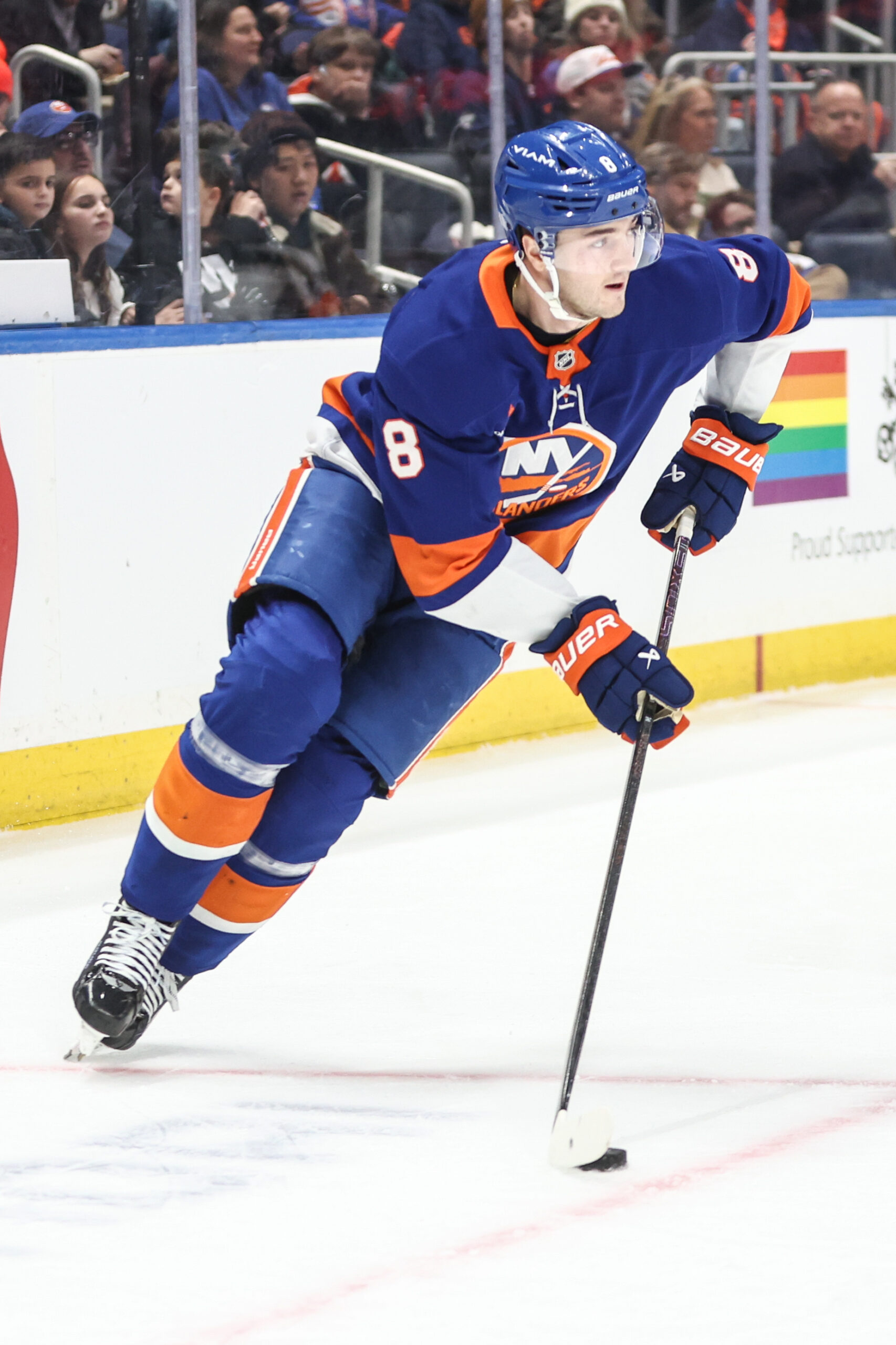 Coming up with a trade value for Dobson isn’t easy. Don’t get me wrong, his trade value is quite high. But I have no idea what direction the Islanders are going here under new GM Mathieu Darche. To me, I think they need to rebuild. And if they opted to move Dobson in that situation, I think two first-round picks, a top prospect, and some sort of salary offset (ideally a defenseman) is attainable. But if they’re not rebuilding (and if I had to guess today, this would be my pick of the route they take), now you’re looking at more of a player-for-player type of swap. Maybe a two-for-one with a top-four blueliner and a key forward coming the other way with both players being signed or under club control for the long haul. Going for a short-term veteran or two wouldn’t make sense.
With each scenario, the potential suitors vary considerably with a very strong return coming in either approach. But I don’t think drafting Schaefer would push Dobson out, not unless Dobson’s contract demands ultimately have Darche leaning toward trading him.
Thefiend313: With Steve Yzerman under pressure from Detroit Red Wings fans, do you think he can pull off a blockbuster move and sign Mitch Marner?
Thefiend313: What do you think the Red Wings will target once free agency starts: Mitch Marner, John Tavares, Vladislav Gavrikov, or someone else?
Thefiend313: What does Steve Yzerman need to accomplish for the Red Wings to contend for the playoffs?
Let’s start with Marner. Do I think Yzerman will target him? Of course. I expect somewhere around two-thirds of the league to at least passively kick the tires. Detroit would be a tier above that and they have the money to afford him outright (more than $21MM per PuckPedia) without needing to clear out or offset money somewhere else. That’s a good thing as not every team has that. But if I’m Marner, the marquee UFA in this class, the Red Wings don’t feel like the most compelling team to sign with. If I want to win now, they’re not a team to consider. If I want top dollar and don’t care about short-term success, I can probably get the same money or more out of Chicago or Utah (or even Anaheim), teams that would appear to have a clearer trajectory to long-term success. Marner leaving his hometown team to sign with a non-playoff division rival would be quite something but that doesn’t feel like a particularly likely scenario.
I’ll use a similar answer to the second question as I did for Chicago as it’s the same philosophy. You need to get better and you have a lot of money with an RFA group that isn’t going to cost much. It’s an even cleaner one for Detroit though. While a short-term veteran doesn’t necessarily make sense for the Blackhawks, it does for the Red Wings who are indeed trying to win now, they just haven’t had much success at that lately. So the question is basically this. Is the player a core piece? If the answer is yes, Yzerman will probably be targeting him. In a perfect world, a viable second center emerges, potentially allowing them to flip one of J.T. Compher or Andrew Copp whose terms remaining on their contracts aren’t as concerning now for other teams to acquire. But I doubt Yzerman would be too picky position-wise. If there’s an upgrade, take it; it’s as simple as that.
As for what he needs to accomplish to be a playoff threat (that’s as far as I’d go, not a contender), they need a top-four upgrade on the back end. You could sell me on two top-four additions if they want to ease Axel Sandin-Pellikka into the mix. But you just saw the last answer about Chicago; getting two in this market would be tough. Another legitimate scoring threat would help as well. Patrick Kane coming back would help but another one on top of that, basically to fill the role that Vladimir Tarasenko was signed to fill last season. Defensive improvements should get their roster near the middle of the pack in goals allowed and one more top-six threat might get the offense near the middle of the pack. That should be enough to get them in the mix. Not a lot of teams can add or re-sign that much talent in one summer though so this won’t be easy for Yzerman to accomplish.
Offseason Checklist: Los Angeles Kings
The offseason has arrived for all but two teams now with the playoffs nearing an end. Accordingly, it’s time to examine what they will need to accomplish over the coming weeks with free agency fast approaching. Next up is a look at Los Angeles.
Nothing much has changed in Hollywood in recent years. In 2023-24, a streaky regular season dotted by a coaching change ultimately led to a familiar fate – a first-round elimination at the hands of the Oilers. With a full season under head coach Jim Hiller and strong play from offseason and in-season pickups to bolster the forward group, most thought this would finally be the year L.A. escaped a first-round date with Edmonton after three failed tries. Instead, after their best regular-season record in 50 years, they blew a 2-0 series lead and headed for the exits early again. That triggered a big change with new GM Ken Holland succeeding Rob Blake, and he’s got some things to address in his first summer on the job.
Look Ahead To Kempe, Kopitar Expiries
Two years ago, franchise center Anže Kopitar put any retirement speculation to rest early when he signed a two-year, $14MM extension five days after becoming eligible to do so. After an age-37 season in which he saw the lowest average ice time of his career but was still a top-10 defensive forward in the league, he becomes extension-eligible again on July 1. Given his slow decline so far, it’s likely he has more than one season left in him.
While it may make sense for the Kings to wait to see how Kopitar starts next season to gauge where he’s at in his aging curve, it would also be smart to get what will likely be a short-term, team-friendly extension for Kopitar out of the way now. That’s primarily because winger Adrian Kempe‘s contract expires following next season and, on the heels of a second straight 70-point season, will shatter his current $5.5MM cap hit on a new deal with Los Angeles.
Of course, the Kings could flip-flop their priorities and enter talks on a long-term deal with Kempe now while kicking Kopitar’s contract down the road until they have cost certainty on the former. Jumping the gun on an older player with less earning potential signing a short-term deal is a smarter financial move than over-committing to Kempe too early, though, especially with the rising cap, meaning extension projections for Kempe fall in the $9MM range (per AFP Analytics).
L.A. has enough cost-effective deals with term, particularly at forward, that they don’t have to stress too much about losing one of the two next summer outside of a surprise retirement decision from Kopitar. Still, knowing both top-liners have contractual business to attend to in the next 12 months will certainly impact how Holland doles out his cap space this summer.
Be Aggressive With Gavrikov
The Kings made an unlikely win-win trade with the Capitals involving Pierre-Luc Dubois and Darcy Kuemper last offseason, opening up around $3MM in cap space for them in the process. That increased flexibility will be pertinent for them this offseason as they try to land more of a game-breaking forward to help put them into the league’s upper echelon of offensive clubs. They have nearly $22MM in projected cap space this summer to do so, but while they can let all of their pending UFAs at forward walk with mostly no ill effect in pursuit of a higher-caliber addition, the same can’t be said on the blue line.
Vladislav Gavrikov was a rock on L.A.’s defense this season, particularly with Drew Doughty missing over half the campaign. Unlike the Kings’ top UFA forward, trade deadline Andrei Kuzmenko, there’s no backup plan involving a similar-caliber UFA pickup if the Kings can’t come to terms with Gavrikov on an extension. From now until July 1, working on numbers with him will presumably be priority No. 1 for Holland.
They simply don’t have another player with his skillset and ceiling in their system, and he provided legitimate top-pairing value this year with 30 points, a +26 rating, and 140 blocks while playing all 82 games and averaging over 23 minutes per night. But with most of the top UFA defensemen signing extensions and taking themselves off the market early, he’s the top left-shot option available. That could drive up his extension price, although the Kings have the benefit of being able to offer him an eighth year on his contract to award him the same (or higher) total compensation while keeping his cap hit down.
AFP Analytics’ open market projection for Gavrikov is a seven-year deal at $7.6MM per season for a total value of $53.25MM. The Kings could offer Gavrikov $55MM total on an eight-year deal while keeping his cap hit at a much lower $6.875MM per season, though. That’s a significant difference as they try to keep their options open for going big-game hunting at forward.
Decide Clarke’s Future
Gavrikov isn’t the only name potentially in flux on L.A.’s blue line. Righty Brandt Clarke, the 2021 eighth-overall pick, is slated to be a pending RFA coming off his first full-time NHL season, but still found himself as trade fodder at the deadline.
 That’s despite the 21-year-old serving as the offensive cornerstone of the Kings’ defense in Doughty’s absence. He put together a 5-28–33 scoring line in 78 games and managed a +13 rating to boot, but never seemed to earn the organization (or Hiller’s) full trust. He averaged decidedly bottom-pairing minutes at just 16:17 per game.
With the Kings’ questionable usage of their top U-22 player, the feeling might be mutual if Clarke doesn’t feel Los Angeles is the right environment for him to maximize the rest of his development years. He would have immense trade value this summer, not just for his potential impact in a top-four role for a club next season, but because he’d be doing so on a six-figure cap hit in the final year of his ELC.
His trade value would be enhanced further by a weak UFA market, even more so among right-shot defenders than lefties. He would presumably be the No. 2 target at the position if he were on the open market this summer behind Aaron Ekblad, taking both his 2024-25 performance and his still-untapped ceiling into consideration.
If Holland strikes out on the upper echelon of UFA forward talents like Nikolaj Ehlers and Mitch Marner, expect him to leverage Clarke again as he pursues a higher-ceiling winger, potentially Buffalo’s JJ Peterka. In any event, it’s highly unlikely the Kings commit resources to a Clarke extension this summer, particularly with some aforementioned bigger fish to fry.
Sign Laferriere Quickly
Moving away from UFA talk, the Kings do have one notable RFA to deal with this summer. That would be winger Alex Laferriere, whose negotiations could become a headache if the Kings get a Gavrikov extension done and blow the rest of their cap space on a big forward pickup.
The 23-year-old is a highly intriguing top-six winger with a physical edge, finishing third on the team with 124 hits this season. He also logged a +22 rating, put together a 19-23–42 scoring line in 77 games, and averaged 16:32 per game – a legitimate needle-moving depth piece the Kings would likely prefer to retain given his age.
Getting cost certainty on Laferriere, even if it’s a bridge deal to keep his cap hit down, is important for Holland to know if he needs to make any cap-clearing moves to maintain flexibility for Gavrikov and their clearly desired forward pickup. Locking him in could make an older player with a similar price point and offensive ceiling, such as winger Trevor Moore, an expendable asset if L.A. needs to open up some roster space or spending money.
Image courtesy of Robert Hanashiro-Imagn Images.
Free Agent Focus: Montreal Canadiens
Free agency is now under a month away, and teams are looking ahead to when it opens. There will be several impact players set to hit the open market in July, while many teams also have key restricted free agents to re-sign. We continue our look around the NHL with an overview of the free agent situation for the Canadiens.
Key Restricted Free Agents
G Jakub Dobes – Dobes’ NHL career couldn’t have gotten off to a better start. He won his first NHL start against the eventual Eastern Conference champion Florida Panthers, stopping 34 of 34 shots. He finished the season with a 7-4-3 record in 15 starts with a .909 SV% and 2.74 GAA. If he were allowed to remove three difficult starts against the Rangers, Kings, and Kraken, Dobes would have finished the year with an impressive .924 SV%. Unfortunately for Dobes, with Sam Montembeault signed through the 2026-27 season and prospect Jacob Fowler rising through the ranks, he likely doesn’t have a long-term future with Montreal.
F Emil Heineman – Heineman came exactly as advertised to the Canadiens this season. Despite missing a chunk of games due to injury, the Leksand, Sweden native scored 10 goals and 18 points in 62 games, while averaging 11:24 of ice time per night. He was one of the most physical forwards on the team and managed solid possession metrics. Like many younger players, he has a few things to clean up in the defensive zone, which he’ll want to prioritize during offseason training if Martin St. Louis continues to utilize him in a defensive role next season. 
D Jayden Struble – Struble serves as one of the more obvious non-tender candidates on the Canadiens’ roster. Montreal already has six defensemen signed through next season, and that’s without taking into account David Reinbacher competing for a spot on the roster during next year’s training camp. Still, Struble is an effective depth option, scoring two goals and 13 points in 56 games this past season while averaging nearly 15 minutes of ice time, with 124 hits.
Other RFAs: F Rafaël Harvey-Pinard, F Sean Farrell, F Xavier Simoneau, D Gustav Lindström, D Noel Hoefenmayer, D William Trudeau, G Cayden Primeau
Key Unrestricted Free Agents
F Christian Dvorak – Before the 2024-25 campaign, the Canadiens had been looking to offload Dvorak and his $4.45MM salary. Dvorak rewarded Montreal for keeping him, scoring 12 goals and 33 points in 82 games, while leading the team with a 55.6% faceoff percentage by a healthy margin. He’s becoming a better defensive player as he ages, and the Canadiens could use Dvorak’s skill set as a veteran player as they become more competitive, albeit at a far lower price point.
F Joel Armia – Similarly to Dvorak, Armia has been the subject of trade rumors for the last few years. Montreal went as far as to pass Armia through waivers at the beginning of the 2023-24 campaign in an attempt to rid themselves of his $3.4MM salary. In almost identical fashion, Armia rewarded the Canadiens for keeping him, scoring 11 goals and 29 points in 81 games, with many of those points coming at even strength. Still, Armia has significantly poorer possession metrics compared to his peers, and Montreal may look elsewhere for secondary scoring this offseason.
Other UFAs: F Michael Pezzetta, F Brandon Gignac, F Alex Barré-Boulet, G Connor Hughes
Projected Cap Space
The situation in Montreal becomes more convoluted when looking at their salary cap availability. The team only has around $6MM to spend, with much of their core intact. According to PuckPedia, the Canadiens already have 13 forwards, six defensemen, and two netminders penciled on next year’s roster. Still, if the Canadiens are looking to capitalize on their surprise return to the postseason this season, they could look to trade Carey Price’s contract with it’s $10.5MM (with a sweetener, of course) to a team like the San Jose Sharks, giving Montreal the capability to pursue nearly any player they’re interested in this summer.
Contract info courtesy of PuckPedia.
Photo courtesy of John Jones-Imagn Images
Free Agent Focus: Minnesota Wild
Free agency is now under a month away, and teams are looking ahead to when it opens. There will be several impact players set to hit the open market in July, while many teams also have key restricted free agents to re-sign. We continue our look around the NHL with an overview of the free agent situation for the Wild.
Key Restricted Free Agents
F Marco Rossi – Much has already been made of Rossi’s trip through restricted free agency this summer. The former ninth overall pick of the 2020 NHL Draft is reportedly looking for a seven-year, $49MM contract with the Wild this summer, and the team has countered with a five-year, $25MM deal. It doesn’t seem like a bridgeable gap at this point, though much can change over the summer months. Despite having his name in the rumor mill for a few years, the trade rumors surrounding Rossi are reaching a peak, meaning it’s more than likely he’s moved this summer. 
F Declan Chisholm – Minnesota acquired Chisholm on waivers from the Winnipeg Jets last season, and he quietly had a productive season for the Wild in 2024-25. He reached a career-high in scoring with two goals and 12 points in 66 contests, averaging just shy of 17 minutes of ice time per game. Furthermore, even though he started many of his shifts in the defensive zone, Chisholm finished the season with a quality 50.4% CorsiFor% at even strength, and a 91.5% on-ice save percentage at even strength. Chisholm would make for a reliable depth option to retain on a saturated defensive core.
Other RFAs: F Graeme Clarke, F Adam Raska, F Michael Milne, F Luke Toporowski, D Ryan O’Rourke
Key Unrestricted Free Agents
F Gustav Nyquist – The second iteration of the Nyquist experiment in Minnesota didn’t go as well as the first time. The last time the Wild acquired Nyquist at the 2022-23 season, he scored one goal and five points in three regular season contests, with another five assists in six playoff games. This time around, the Halmstad, Sweden native scored two goals and seven points in 22 games after a trade from the Nashville Predators, and went scoreless in the Wild’s opening-round matchup against the Vegas Golden Knights. There will be better options available to Minnesota on the free agent market to address their secondary scoring needs.
F Justin Brazeau – Like Nyquist, the Wild acquired Brazeau at this year’s trade deadline from the Boston Bruins. He was tasked with giving Minnesota more grit and defensive prowess in their bottom-six for their playoff push, and that’s exactly what he gave them. His ice time was cut by more than four and a half minutes when he was moved to the Wild, and his scoring followed. Still, Brazeau managed nearly two hits a game for Minnesota, and added 22 more in six postseason contests.
D Jon Merrill – Merrill is unlikely to sign another contract with the Wild. Unfortunately, he doesn’t do all that much aside from eat limited minutes. He managed a quality 91.4% on-ice save percentage at even strength in 70 games, but that was only good for fifth on the team among blue liners, meaning the Wild can easily replace his value internally.
Other UFAs: F Travis Boyd, F Devin Shore, F Tyler Madden, D Cameron Crotty, G Troy Grosenick, G Dylan Ferguson
Projected Cap Space
The time has finally come for Minnesota to forget about the buyout burden from Zach Parise and Ryan Suter. After paying the pair of former-veterans nearly $15MM last season, the Wild’s payment drops down to $1.7MM for the 2025-26 season, giving them nearly $16MM in salary cap flexibility with few roster spots to fill. Minnesota have already placed a priority on signing superstar Kirill Kaprizov to a long-term extension this summer, so they’ll have to game out any free agent additions with that extension in mind.
Contract info courtesy of PuckPedia.
Photo courtesy of Nick Wosika-Imagn Images