
Trade Deadline Primer: Columbus Blue Jackets
With the All-Star break now upon us, the trade deadline looms large and is just a month away. Where does each team stand and what moves should they be looking to make? We continue our look around the league with the Columbus Blue Jackets.
When the Columbus Blue Jackets signed Johnny Gaudreau to a seven-year, $68.25MM contract last summer, and followed it up with a four-year, $34.8MM deal for Patrik Laine, the message was clear: it’s time for a new identity. Seth Jones had been traded, and there was to be a new duo leading the way to contention. Gaudreau and Laine seemed like a perfect fit stylistically, and the team committed nearly $20MM per season to put them together.
Unfortunately, you can’t predict injuries, and the absences have decimated the Blue Jackets. Laine has missed time on several occasions, Zach Werenski was ruled out early for the season, Jakub Voracek‘s career is in doubt, and the injured reserve list has had at least five or six players on a constant rotation through the year. The Blue Jackets’ season is over, and now they will be focused on securing the best draft position by losing as many games as possible down the stretch. Trading off expiring assets is a must.
Record
15-32-4, 8th in the Metropolitan
Deadline Status
Seller
Deadline Cap Space
$8.87MM in LTIR relief (with the possibility for much more), 0/3 retention slots used, 45/50 contracts used, per CapFriendly.
Upcoming Draft Picks
2023: CBJ 1st, CBJ 2nd, CBJ 3rd, CGY 3rd, CBJ 4th, WPG 4th, CBJ 6th, CBJ 7th
2024: CBJ 1st, CBJ 2nd, CBJ 3rd, CBJ 4th, CBJ 5th, CBJ 6th, CBJ 7th
Trade Chips
The big one in Columbus this year is Vladislav Gavrikov, who has already drawn interest from a number of contending teams. The pending free agent defenseman has likely had his name mentioned more by NHL media over the last few months than his entire career to this point. While he won’t offer a ton of offensive production, the 6’3″ shutdown defender has averaged nearly 21 minutes a night for his four-year NHL career, racking up nearly 400 blocked shots, and over 300 hits during that stretch.
 This isn’t a bruiser, exactly – Gavrikov did have 33 points last season for Columbus – but he also isn’t going to come in and run a powerplay. His fit is likely on a contender’s second or third pairing while logging big penalty-killing minutes. Luckily, for the Blue Jackets, that’s exactly what playoff hopefuls are looking for. Most top teams already have their powerplay quarterbacks and top-pairing roles secured internally and are just looking to add a competent defender to the mix before a long playoff grind. With Gavrikov’s $2.8MM cap hit, almost anyone in the league could afford to fit him in, given the right circumstances.
There is also someone like Joonas Korpisalo, who could be acquired as a backup goaltender, though his performance the last few years has been anything but consistent. On an expiring $1.3MM contract, he has a .908 save percentage this season through 23 appearances but was sub-.900 in each of the last two years. As a break-glass option, he might be useful, but there aren’t any true contenders looking at him as a legitimate starter.
One of the most interesting chips that the Blue Jackets have is Gustav Nyquist, who recently was ruled out for the rest of the regular season. That doesn’t mean playoffs, and his camp immediately put the word out that the veteran forward would work hard in hopes of returning for some postseason action. If that is possible, any team currently in LTIR could acquire him (as long as they can creatively open the required space for one day), stash him until the playoffs, and then activate him whenever he’s ready.
The Blue Jackets are actually experienced in this kind of transaction. In 2021, Columbus traded Riley Nash to the Toronto Maple Leafs while he was injured, in exchange for a conditional seventh-round pick. If Nash was able to rehab and appear for the Maple Leafs in the playoffs, the pick would upgrade to a sixth-rounder – which it did. Nyquist is a much better offensive piece than Nash ever was, and the Blue Jackets may be able to secure something even better, should his rehab go well over the next month.
Other potential trade chips: D Marcus Bjork, D Gavin Bayreuther, F Eric Robinson
Team Needs
1) Centers: Unlike some of the other teams fighting for the basement, Columbus isn’t going through a tear-down rebuild. They are actually on their way up, with young players installed all over the roster. One of the biggest problems to this point, however, has been the lack of depth down the middle. As much as the team loves captain Boone Jenner, to be competitive he can’t really operate as a first-line player. Jack Roslovic has never taken that next step, and youngsters like Cole Sillinger and Kent Johnson are still finding their way. The Blue Jackets may be one of the rare teams that actually want a veteran back in deadline deals, someone who can step in and play meaningful minutes for them right away. That doesn’t mean over-the-hill stars, but in-their-prime players who can have an impact.
2) Draft picks: That’s not to say they won’t be loading up on picks. Capital in this year’s draft is precious, especially if the Blue Jackets want to make any offseason moves to improve the roster. The goaltending is currently an issue, and they probably need to target another defenseman at some point to replace Gavrikov’s outgoing minutes. Adding some picks at the deadline would give Jarmo Kekalainen a lot more flexibility in making deals on the draft floor.
Photo courtesy of USA Today Sports Images
Trade Deadline Primer: Boston Bruins
With the All-Star break now upon us, the trade deadline looms large and is just over a month away. Where does each team stand and what moves should they be looking to make? We continue our look around the league with the Boston Bruins.
Unlike the two prior teams covered in this series, the Anaheim Ducks and Chicago Blackhawks, the Boston Bruins’ goal is not to sink as far down in the standings as possible to ensure the best possible chance at landing Connor Bedard. In fact, the Bruins’ play so far this season makes such a plan at this point almost impossible.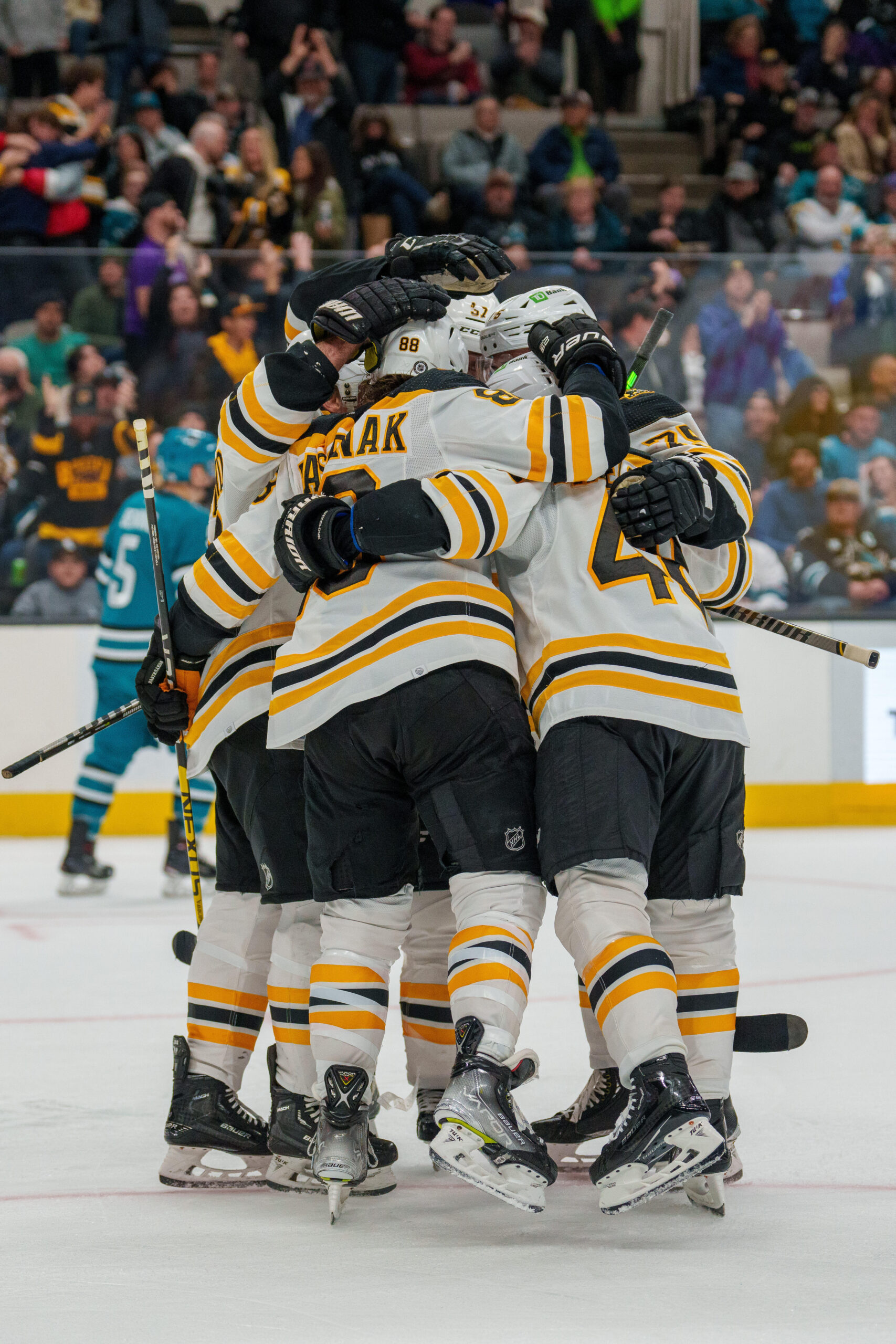
The Bruins have been the best team in hockey so far this season, and it’s not really up for debate. The team is 39-7-2 with 83 points.
Last season, the Washington Capitals made the playoffs out of the Eastern Conference. They won 44 games.
The Bruins have already won 39.
This is a team looking to win a Stanley Cup this season, a year that could potentially be the final campaign for core pieces such as Patrice Bergeron and David Krejci.
But where the trade deadline is concerned, the team’s success is a double-edged sword. On one hand, the Bruins players have absolutely earned some reinforcements. Should GM Don Sweeney remain entirely passive during the trade frenzy, that could send a poor message to the Bruins’ players, that their immense efforts this season were not rewarded with some additions to their lineup. But on the other hand, it would be reasonable for Boston to be weary of making changes to a lineup formula that has worked so well.
That leaves the team in an intriguing position heading into trade season. There are definitely ways for Boston to bolster its already formidable lineup, and there are quite a few high-end players who would fit very well in coach Jim Montgomery‘s lineup. But with how well the team has done as currently constructed, the team’s trade deadline strategy may not be as simple as just trying to add the most talented player available.
Record
39-7-2, 1st in Atlantic
Deadline Status
Buyer
Deadline Cap Space
$3.25MM today, $3.25MM in deadline space, 0/3 retention slots used, 47/50 contracts used, per CapFriendly.
Upcoming Draft Picks
2023: BOS 1st, BOS 3rd, BOS 4th, BOS 5th, BOS 6th, BOS 7th, LAK 7th
2024: BOS 1st, BOS 3rd, BOS 4th, BOS 5th, BOS 6th
Trade Chips
This is where things get a bit more complicated. The Bruins’ success this season makes it unlikely that they would entertain removing a roster player from their lineup as part of a trade. It’s not impossible, of course, but subtracting from the current lineup in order to add outside talent would be a risk.
But on the other hand, it may be a risk the Bruins are forced to take. Outside of players currently on their roster, the Bruins have one of the thinner pools of assets to deal from in the entire NHL. The Athletic’s Scott Wheeler recently ranked the Bruins’ prospect pool as the 30th-best in the NHL, and the team is missing both this year and next year’s second-round picks. (subscription link)
So if the Bruins want to go all-in on this season and have the best chance at putting together a winning offer for a top-end player, their best trade chip is likely 2021 first-round pick Fabian Lysell. Lysell, 20, has played this season for the Providence Bruins, and scored decently well. He has 22 points in 27 games, and has the potential to be a top-six forward in the NHL.
Like any prospect, there are question marks regarding Lysell’s future and the eventual NHL career he’ll end up having. But he’s an undoubtedly talented offensive threat and clearly the Bruins’ top prospect. If the team is engaged on a player such as Timo Meier, the Bruins may not be able to compete with the offers other clubs can make without including Lysell.
Other trade chips from the team’s prospect pool include Ohio State defenseman Mason Lohrei, undrafted winger Georgii Merkulov, and OHLer Matthew Poitras, though it’s unlikely anyone in that trio would be able to center a trade offer the way Lysell could.
Should the Bruins be forced to deal from their NHL roster in order to get a trade over the line, potential names they could deal include speedy winger Jakub Lauko, whose path to success on the team’s left side seems cloudy, or Trent Frederic, who is in the midst of a breakout year offensively but will be an arbitration-eligible restricted free agent in the summer.
Other potential trade chips: 2023 first-round pick, 2024 first-round pick, Jakub Zboril, Mike Reilly, John Beecher
Team Needs
1) Another high-end offensive weapon: It’s difficult to really pick any major “needs” on the Bruins’ roster, as the team is extremely well-rounded. When the roster is at full health, 2018 Hart Trophy winner Taylor Hall is the Bruins’ third-line left winger. That’s the kind of depth and roster balance most teams can only dream of. But if there’s one thing the team could prioritize going into the deadline, it’s adding another high-end piece to really solidify their spot at the top of the NHL. Sweeney hasn’t been shy about adding big-name players in the past, whether it’s in trades for players such as Hall, Hampus Lindholm, or Rick Nash. If the Bruins are committed to going all-in on this year’s team, they could shop at the top of the market once again.
2) Left-Shot Defenseman: At the current moment, the Bruins have Reilly, an NHL veteran, in the AHL due to not only his cap hit but also the immense amount of depth the team has on the left side of their defense. But if the Bruins want to add major cap dollars to their roster, trading Reilly could be one of the more viable ways for the team to get that done. In that case, adding another left-shot defenseman could end up being a priority. Sportsnet’s Elliotte Friedman wrote on his 32 thoughts column that the Bruins are “believed to be in the left-defense market,” citing names such as Jakob Chychrun and Vladislav Gavrikov as possibilities.
Photo courtesy of USA Today Sports Images
PHR Mailbag: Blues, Flyers, Rangers, Penguins, Avalanche, Predators, NHLPA
Topics in this edition of the PHR Mailbag include the future of Flyers GM Chuck Fletcher, the challenges the Penguins will face if they try to rebuild, the trade deadline challenge for the Avalanche, and more. If your question doesn’t appear here, check for it in next weekend’s mailbag. Unless you asked about Dylan Larkin. He’ll be the focus of a bonus mailbag column tomorrow.
Gmm8811: It pains me to say this but I fear the Blues are in need of a major overhaul from top to bottom. Their fiscal situation isn’t sustainable. They need to start stockpiling draft picks. Their reserve list is ok but pretty bare of any significant talent. Tarasenko and O’Reilly could bring some nice draft picks. Parayko has become the fans whipping boy…I can see him being moved. Maybe Krug goes too. Binnington overpaid for the return the team gets from him. Defense needs to get tougher and bottom six forwards need to improve. This team is not set up for the future at all in my opinion.
I would be surprised to see anywhere this level of an overhaul coming from St. Louis in the coming weeks before the deadline. Yes, some changes will be coming, largely because of their cap situation when $10.65MM gets added to their books with the new deals for Jordan Kyrou and Robert Thomas kick in and that won’t allow them to re-sign or replace both Vladimir Tarasenko and Ryan O’Reilly. Barring a drastic improvement over the next few weeks, the pending UFAs could be traded but I doubt we’ll see much more than moving out their rentals by March 3rd.
I do think there’s a desire for the back end to be tougher but this is an easier-said-than-done scenario. Colton Parayko’s injury history hurts his value, as does the fact he’s signed until 2030. There’s some concern that his contract won’t age well. Given his importance on their current back end, I don’t think they want to sell low on him. Torey Krug has four years left at $6.5MM as well. Look at what happened with Shayne Gostisbehere a couple of years ago with Philadelphia having to pay to get the last two years of his deal off their books. I don’t think that’s a route they want to take. Jordan Binnington is in a similar situation, four years left at $6MM is a negative-value deal right now. In the short term, creating a spot for Tyler Tucker to play regularly on the third pairing will give them a bit more physicality while I wouldn’t hold your breath about big improvements coming to the bottom six for cap reasons.
There’s a changing of the guard underway with Kyrou and Thomas becoming the new centerpieces of their forward group. I think that change will continue but it will be gradual. Once some of these longer-term contracts start to get shorter (think a couple of years from now) and become easier to move, that’s when I think we’ll start to see some more of the veteran core changing up.
DonnieBaseBallHOFer: How surprising is it that Fletcher still with the Flyers? If he is allowed to make moves at the deadline, doesn’t that pretty well mean he stays even into next season? Not fair to a potential new GM to let Fletch make any moves now…is Briere ready to take the next step? If so, do they risk losing him to another team by sticking with Fletch now?
I’m not that surprised that Chuck Fletcher is still at the helm for Philadelphia. This season hasn’t been pretty but injuries certainly haven’t helped things which could be a factor. It’s also year one of a coaching change. To me, the fact the team allowed Fletcher to give John Tortorella a four-year, $16MM contract means they still had a lot of faith in him at that time. They’re six points out of a playoff spot despite not having Sean Couturier, Ryan Ellis, and Cam Atkinson all season long. I don’t think there’s a big appetite internally to change things as a result. I wouldn’t say Fletcher has a long leash but I don’t think there will be any restrictions on him at the deadline.
As for Daniel Briere, I don’t think the Flyers are at much risk in terms of losing him. Yes, he was in the mix for Montreal’s job last season but they’re a team that places high importance on speaking French which doesn’t give them a deep pool to choose from. Since then, I don’t think Briere has been a serious candidate for the few openings that have come up.
He’s still pretty inexperienced in the NHL in terms of management. He has been a consultant for a year and a half and a special assistant for a year and a half. Sure, some experience building up ECHL Maine from the ground helps but is he a little too green to take over a team? I think other organizations think he is. Give it a year or two, then he should come up in speculation a bit more. Who knows, perhaps at that time, Fletcher moves up to Team President and Briere takes over as GM, something we’ve seen other organizations do? I’m sure that’s not your favorite scenario but unless this team completely nosedives next season, I wouldn’t be shocked if it happened.
mhaftman7: The Flyers DESPERATELY need to go all in on a rebuild. Is Provorov to the Kings for a package including Byfield realistic? Could Hayes, JVR, Konecny, and Ristolainen all be moved?
 On paper, I like the fit of your trade idea. Ivan Provorov would certainly fill a need in Los Angeles and while his value is down, so too is Quinton Byfield’s so it’d be an interesting buy-low move on both sides assuming the other pieces are in place to make the money work (and we’d be talking about needing to match his $6.75MM contract, more or less). Is it realistic right now? I’m not so sure. I think the PR element from what happened last month during Philadelphia’s Pride Night is going to come into play in trade talks. On top of that, these types of trades are likelier to happen at the draft or in the summer than they are now.
As for the need to do a rebuild, I don’t disagree. At best, this is a team that’s spinning its wheels. But a healthy Couturier and Atkinson (I’ll leave Ellis out as who knows if he’ll play again) probably get this team a few more points in the standings and then they’d be right in the Wild Card battle. I don’t see a big blow-it-up scenario happening as a result.
But let’s look at your trade options. Kevin Hayes has too pricey of a contract to move. Same for Rasmus Ristolainen. At best, they’re summer swaps for other expensive deals but I expect them to stay put. I think James van Riemsdyk goes with 50% retention for a draft pick. Travis Konecny though, that one’s tricky. If they intend to go for the playoffs next season, he stays. If they actually consider taking a step back though, this is a sell-high situation for someone in the prime of his career with two years left after this on what’s looking like a team-friendly $5.5MM. I wouldn’t put him in the likely-to-be-dealt category but in the back of my head, he’s an interesting dark horse candidate.
NYRFan 2: The Rangers NEED to get more ❤️ not prettier. Any chance they package some younger talent like Hajek, Robertson, Jones, or Blais and a pick or so for players like Jeannot (who is struggling) and Xhekaj who plays a game Jeff Gorton hates? Instead of multiple firsts and talent for a rental when I don’t think we are there yet. Need guys to hammer pucks and bodies!
Let’s look at your trade chips first. Libor Hajek’s trade value right now is next to non-existent. He can’t go to the minors and hasn’t played well enough to stay in the lineup which has limited him to just ten games. He’s a throw-in piece at this point. So is Sammy Blais who is basically salary ballast. Matthew Robertson still has some value but he’s not a headliner in a move for an impact player. Zachary Jones could be though. I think his value is down a bit this year but there will be rebuilding teams that look at him and think there’s a spot on the depth chart. Jones, a pick, and one of the throw-ins is a package that could be of some interest to fill a need in the coming weeks.
That said, I don’t think Nashville has any interest in selling low on Tanner Jeannot and that trade combo as a result would certainly be selling low. I could see a scenario where Montreal considers moving Arber Xhekaj as they have a lot of left-side depth in their defenseman pipeline but that would be to fill another organizational need, not replacing him with another left-side defender in Jones.
Maybe it’s just me but I don’t look at New York’s back end and think that they need more toughness. Adam Fox is a finesse player, sure, but there isn’t anyone else that I’d put in that category. (Ryan Lindgren isn’t the most physical but he’s capable of playing a hard game.) I think they need an 18-minute player to partner with Braden Schneider, one that can kill penalties and move up if injuries arise. That player doesn’t really profile as the intimidator that you’re aiming for.
Offensively, I think they should be targeting someone that can score as the Rangers have a middle-of-the-pack attack. A key top-six addition could push them closer to a top-ten offense which, coupled with Igor Shesterkin, would make them very dangerous heading into the postseason. They could benefit from adding a heavy player in the bottom six (preferably one that could kill penalties) but you’ll need to set your sights lower than Jeannot.
koz125: I’m embarrassed to be a Penguins fan at the moment. Shouldn’t they just start the rebuild with how terrible GMRH has screwed the team over? Obviously, they’re no longer a serious contender and likely not a playoff team either.
On the surface, it’s one thing to say they should start the rebuild. But how exactly do they do that? Sidney Crosby, Kris Letang, and Evgeni Malkin aren’t going anywhere; even if Pittsburgh wanted to move them, I think they’d invoke their no-trade protection. That’s a sizable chunk of their veteran core right there which makes a full-scale rebuild a lot harder to do.
Could they move Jeff Petry? Sure. Jake Guentzel would fetch a nice return as well. But Bryan Rust probably isn’t movable with his long-term contract and lower production. Rickard Rakell has had a nice year but his up-and-down track record will give teams pause, especially in the current cap environment. Jason Zucker would bring back a draft pick at the deadline as a rental so I suppose that’s something but that’s not moving the needle much. Brian Dumoulin has had a tough year so his value isn’t great and I think if they could have moved Marcus Pettersson by now, he’d be playing somewhere else. That doesn’t leave them much of tradable options in terms of their core (or at least higher-priced) players.
This is probably going to sound a little goofy but staying on the current path might make more sense. If you can’t rebuild properly, why go halfway and sit in the mushy middle of non-playoff teams? If the other veterans don’t want to move or can’t be moved, they can’t really do a full-scale rebuild. I agree that this team isn’t a contender but they’re close enough to the playoffs to justify staying the course for now.
It’s not a great spot to be in but quite frankly, none of their options are ideal at this point – do nothing, take a step back to become a non-playoff team that’ll finish 12th in the conference, or spend to try to sneak into a Wild Card spot. If they fall out of the race a bit more in the coming weeks (Tristan Jarry’s injury will play a role there), then sure, flip Zucker and get a future asset for someone that you’d otherwise lose for nothing. But that’s about the only rebuilding move I can see them making over the next few weeks.
Trade Deadline Primer: Chicago Blackhawks
With the All-Star break now upon us, the trade deadline looms large and is just over a month away. Where does each team stand and what moves should they be looking to make? We continue our look around the league with the Chicago Blackhawks.
Just like the Anaheim Ducks, who we covered yesterday, the aim for Chicago is to lose as many games as possible down the stretch. The coaching staff won’t be trying to lose, meaning the front office will have to do the work for them by stripping the roster of as much NHL talent as possible.
That doesn’t mean just older players on expiring contracts, either. General manager Kyle Davidson has made it clear with the trades of Alex DeBrincat, Brandon Hagel, and Kirby Dach that he’s gutting this team before building it up with the players he chooses. Contract term or youth doesn’t mean off-limits for the Blackhawks, who are one of the most interesting teams to watch over the next few weeks.
Record
15-29-4, 8th in the Central
Deadline Status
Seller
Deadline Cap Space
$16.06MM today, $26.77MM in deadline space, 0/3 retention slots used, 44/50 contracts used, per CapFriendly.
Upcoming Draft Picks
2023: CHI 1st, TBL 1st, CHI 2nd, TBL 2nd, CHI 3rd, DAL 3rd, CHI 4th, CHI 5th, CHI 7th
2024: CHI 1st, TBL 1st, CHI 2nd, VAN 2nd, CHI 3rd, OTT 3rd, CHI 5th, CGY 5th, CHI 6th, CHI 7th
Trade Chips
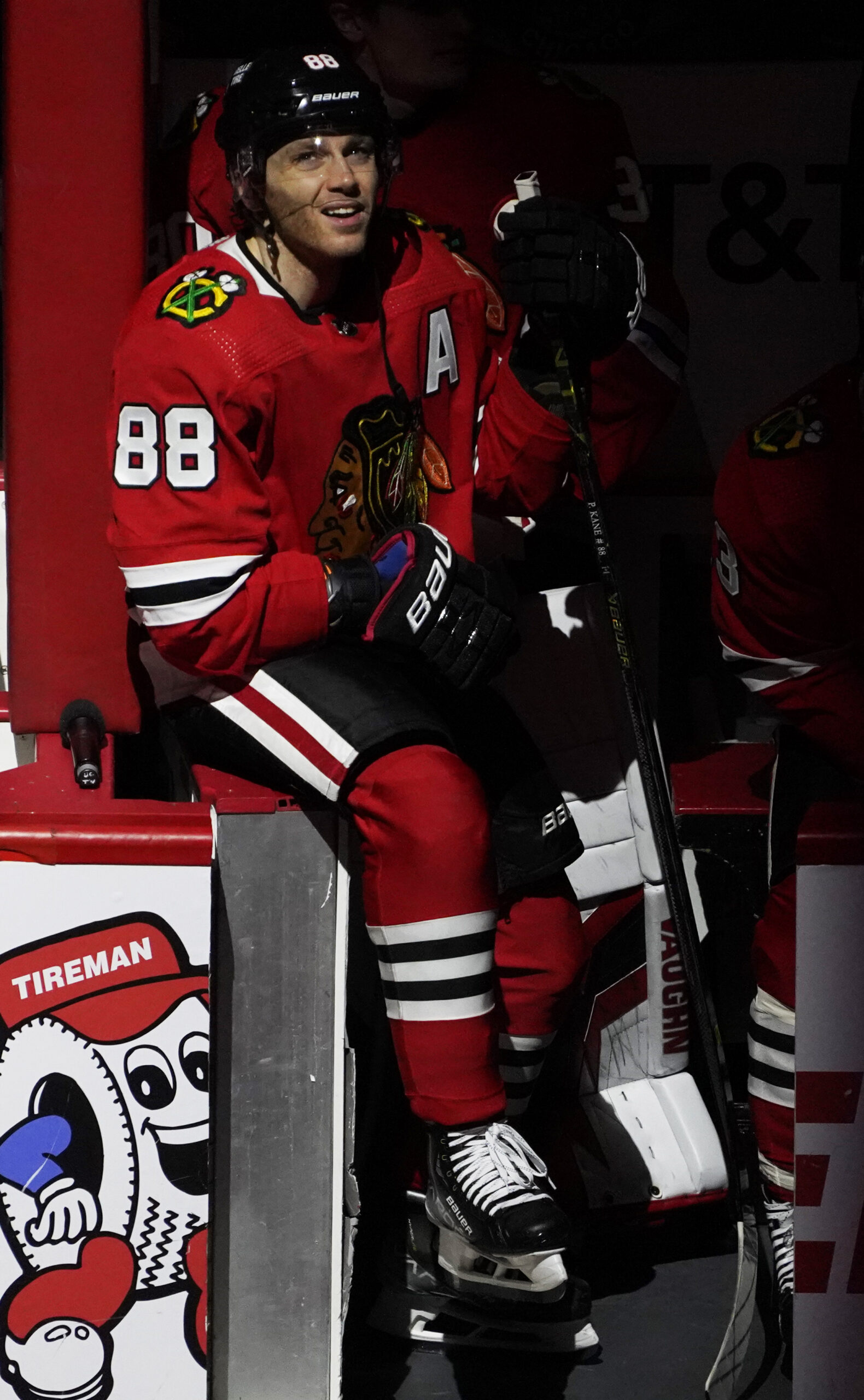 All eyes are on Patrick Kane and Jonathan Toews, who are coming to the end of their matching eight-year, $84MM contracts. Both have full no-movement clauses, meaning they can control their destiny, and both have $10.5MM cap hits with barely any actual salary left to pay out. These are two Blackhawks legends who have won three Stanley Cup championships, multiple individual awards, and have never suited up for another team.
In a normal situation, it would be easy to assume they re-sign and spend their entire careers in Chicago. But this isn’t a normal situation, and it appears that new homes are coming for them one way or another. If it’s going to come in the summer anyway, perhaps Kane and Toews agree to help the franchise they have dedicated themselves to for so long, and waive their protection to bring assets back to the Blackhawks. But they won’t be easy trades to pull off given those massive cap hits.
Beyond the two franchise icons there are a number of other pieces that should be in play. Max Domi and Andreas Athanasiou signed one-year, $3MM deals last summer that immediately looked like deadline bait, while defensemen like Connor Murphy and Jake McCabe have seen their names in trade rumors. The latter two both have significant term left on their contracts (Murphy is signed through 2025-26 and McCabe through 2024-25), making them a little more complicated than a deadline rental deal, but could still be strong additions for contenders looking to beef up the back end.
What about Stanley Cup champion Jack Johnson, who is on an expiring deal of his own? Or Sam Lafferty, signed through next year at a reasonable amount and enjoying a nice season in Chicago?
Other potential trade chips: D Ian Mitchell, G Alex Stalock, F Philipp Kurashev
Team Needs
1) Draft picks: The Blackhawks aren’t trying to rebuild on the fly. They don’t need NHL-ready talent. It’s all about the draft, and how they can build up a class of players to support what will likely be several top-five picks over the next few years. If they can secure the next potential Kane and Toews – Connor Bedard and Michael Misa, for instance – they’ll need to find all the support players that are required to really contend. That’s what you can get at the deadline, and that’s what they’ll be after.
2) Potential flips: Don’t think that Chicago didn’t notice the way the Arizona Coyotes had dealt with a player like Shayne Gostisbehere. They had cashed in when acquiring him, and were about to cash in again at the deadline, had he not been injured. Acquiring a good player on a bad contract (along with a sweetener) just to turn around and sell him down the road after powerplay time boosts his numbers? Sounds like a recipe for success, and exactly the kind of opportunity that the Blackhawks front office will be looking for.
Photo courtesy of USA Today Sports Images
PHR Live Chat Transcript: 02/02/23
Click here to read a special All-Star break live chat with PHR’s Gavin Lee. Our chats will be making their return every Thursday evening moving forward. Come join us next week!
Poll: Will The Buffalo Sabres Make The Playoffs?
The Buffalo Sabres are no strangers to hot starts that fade quickly. Despite being among the league’s best well into November multiple times over the past few seasons, the franchise has still failed to make a playoff appearance since 2011.
2022-23 seems to have a different vibe for Buffalo, though. The team sits eighth in the Eastern Conference by points percentage at the end of January, with teams over halfway through their regular-season schedules. They’ve surged past an injury-laden Washington Capitals squad to sit in playoff positioning, and they’ve kept pace ahead of other up-and-coming Atlantic Division teams like the Detroit Red Wings and Ottawa Senators.
With 33 games left to play in their season, though, can they keep up their play?
Buffalo hasn’t exactly been a model of consistency for defensive play, but that was never the expectation for such a young team. While they sit among the bottom third of teams in terms of goals against, their 185 goals scored rank third in the NHL at the time of writing.
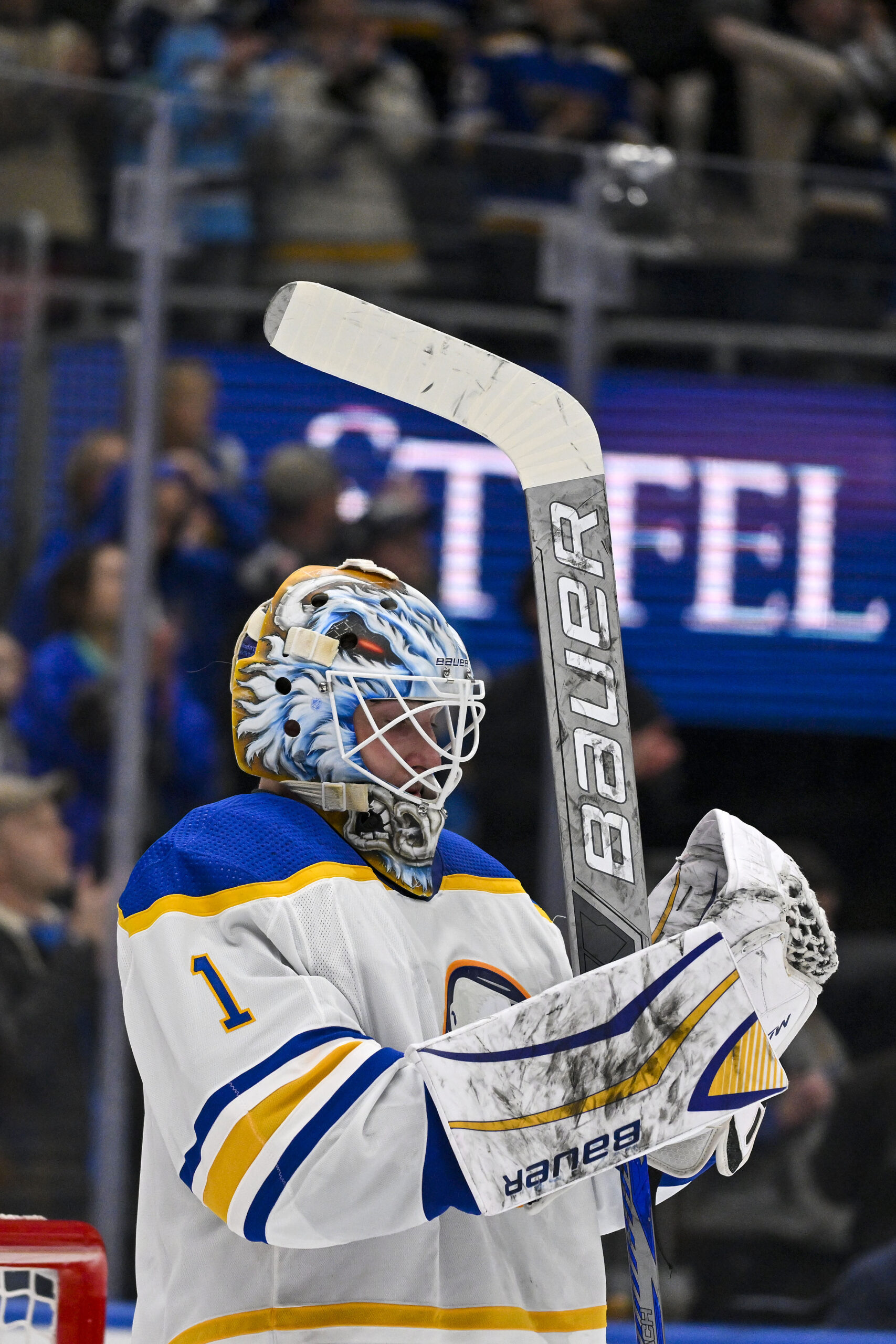
Their patchwork goaltending tandem of 41-year-old Craig Anderson and career backup Eric Comrie raised many eyebrows at the beginning of the season. Now, it’s turned into a more capable trio, including the 23-year-old Ukko-Pekka Luukkonen. He’s started 20 games in Buffalo this year, the most among all Sabres netminders and his .900 save percentage is in line with the league’s average. Anderson, while he hasn’t played often, has exceeded all expectations with a .918 mark in 16 games.
Buffalo already has four 20-goal scorers, with Tage Thompson (34), Alex Tuch (23), Victor Olofsson (23), and Jeff Skinner (20) leading the way. Thompson, Tuch, Skinner, and Rasmus Dahlin all produce over a point per game. 21-year-old Dylan Cozens is enjoying a true breakout campaign with 43 points in 48 games. 20-year-old Owen Power is near the top of the Calder Trophy conversation and is playing more than any other rookie defenseman this year, averaging 23:39 per game.
There are many reasons to be optimistic. But with such an inexperienced and young team, along with the franchise’s recent history of disappointment, there are obviously questions about sustainability.
However, many questions can also be raised about their competitors for Wild Card positioning in the Eastern Conference. Alarm bells are sounding in Pittsburgh, as the Penguins have won just three games in regulation since Christmas. Similar concerns can be had about the aging Capitals, who are cooling off after a December hot streak and continue to encounter injury news at an uncomfortable pace.
Both the Red Wings and Florida Panthers, their closest Atlantic Division threats, have dipped into negative goal differential territory and have hovered close to the .500 mark for most of the past couple of months. It still may be premature to discount the Panthers, considering their tantalizing scoring depth on paper, but they also haven’t been able to keep the puck out of their own net with any consistency this year. Unlike other teams in the conversation, Florida also has no salary cap flexibility to add at the trade deadline.
That’s one area where Buffalo shines. Despite being in playoff position, Buffalo has the most cap space of any NHL team. While some may argue it would be premature for general manager Kevyn Adams to ship out assets at this year’s March 3 trade deadline, a non-rental addition could help solidify Buffalo’s already impressive core for future seasons.
So, we ask you, PHR readers: can the Buffalo Sabres hang on and make their first playoff appearance in 12 seasons, ending the NHL’s longest active drought? Make your voice heard by voting in the poll below.
Will the Buffalo Sabres make the playoffs in 2023?
-
Yes, just barely 60% (1,136)
-
No, just miss 23% (441)
-
Yes, comfortably 14% (265)
-
No, fall out of the picture completely 3% (55)
Total votes: 1,897
Photo courtesy of USA Today Sports Images
Seeking Writers For Pro Hockey Rumors
Last year around this time, Pro Hockey Rumors put out a call for new writers. We were lucky enough to find two excellent candidates and grow the PHR family with the addition of Ethan Hetu and John Gilroy. Now, with the calendar turning to 2023, we’re looking to grow our staff again.
PHR is looking to hire part-time writers with strong evening and weekend availability. The position pays on an hourly basis.
Applicants must meet all of the following criteria:
- Exceptional knowledge of all 32 NHL teams, with no discernible bias.
- Knowledge of the salary cap, CBA, and transaction-related concepts.
- At least some college education.
- Extensive writing experience, with professional experience and a background in journalism both strongly preferred.
- Keen understanding of journalistic principles, ethics, and procedures. Completion of basic college-level journalism classes is strongly preferred.
- Attention to detail — absolutely no spelling errors, especially for player and journalist names.
- Ability to follow the site’s style and tone.
- Ability to analyze articles and craft intelligent, well-written posts summing up the news in a few paragraphs. We need someone who can balance quick copy with thoughtful analysis. You must be able to add value to breaking news with your own insight, numbers, or links to other relevant articles.
- Familiarity with Twitter, Tweetdeck, and other relevant platforms. In general, you must be able to multitask.
- Flexibility. You must be available to work on short notice.
If you’re interested, email prohockeyrumorshelp@
We understand that many of those who read this have applied in the past. If you have previously submitted an application for PHR and are still interested, please submit it again. Many will apply, so unfortunately we cannot respond to every applicant.
(Update: With recent developments for Vox Media and SB Nation affecting many hockey writers, we have re-opened the application process for another week.)
Salary Cap Deep Dive: Ottawa Senators
Navigating the salary cap is one of the more important tasks for any GM. Teams that can avoid total cap chaos by walking the tightrope of inking players to deals that match their value (or compensate for future value without breaking the bank) remain successful. Those that don’t see struggles and front office changes.
PHR will look at every NHL team and give a thorough look at their cap situation for the 2022-23 season and beyond. This will focus more on players who are regulars on the roster versus those who may find themselves shuttling between the AHL and NHL. All cap figures are courtesy of CapFriendly.
Ottawa Senators
Current Cap Hit: $79,572,602 (under the $82.5MM Upper Limit)
Entry-Level Contracts
F Mark Kastelic (one year, $821.7K)*
F Shane Pinto (one year, $925K)
D Jake Sanderson (two years, $925K)
F Tim Stutzle (one year, $925K)*
*-Have already signed a second contract
Potential Bonuses
Pinto: $600K
Sanderson: $925K
Stutzle: $2.5MM
Total: $4.75MM
Pinto is healthy after missing almost all of last season due to a shoulder injury and he’s off to a decent start with ten goals already. That also has him on track to hit one of his ‘A’ bonuses worth $150K each but a small uptick in production could add to that total. With a limited track record (he had just 17 games in his first two seasons), he might be tricky to lock up long-term; a bridge deal in the high-$2MM/low $3MM range depending on the term is where he could wind up. We’ll look at Stutzle and Kastelic’s new deals later on but it’s worth mentioning that Stutzle is on pace to hit all four of his ‘A’ bonuses which are worth a total of $850K. Ottawa will need to budget room for that to hit the books after the season if they look to add a piece to help them get back into the playoff picture that pushes them closer to the cap.
Sanderson’s first professional season has gone quite well as he has very quickly become one of their most trusted blueliners. He’s someone that they’re likely going to want to sign to a long-term second contract as well and optimistically, if he follows the same path as Thomas Chabot, a deal around his $8MM might be possible. He’s tracking towards reaching all four of his ‘A’ bonuses as well.
Signed Through 2022-23, Non-Entry-Level
D Erik Brannstrom ($900K, RFA)
F Derick Brassard ($750K, UFA)
F Alex DeBrincat ($6.4MM, RFA)
F Dylan Gambrell ($950K, RFA)
D Travis Hamonic ($3MM, UFA)
D Nick Holden ($1.3MM, UFA)
F Tyler Motte ($1.35MM, UFA)
G Cam Talbot ($3.667MM, UFA)
F Austin Watson ($1.5MM, UFA)
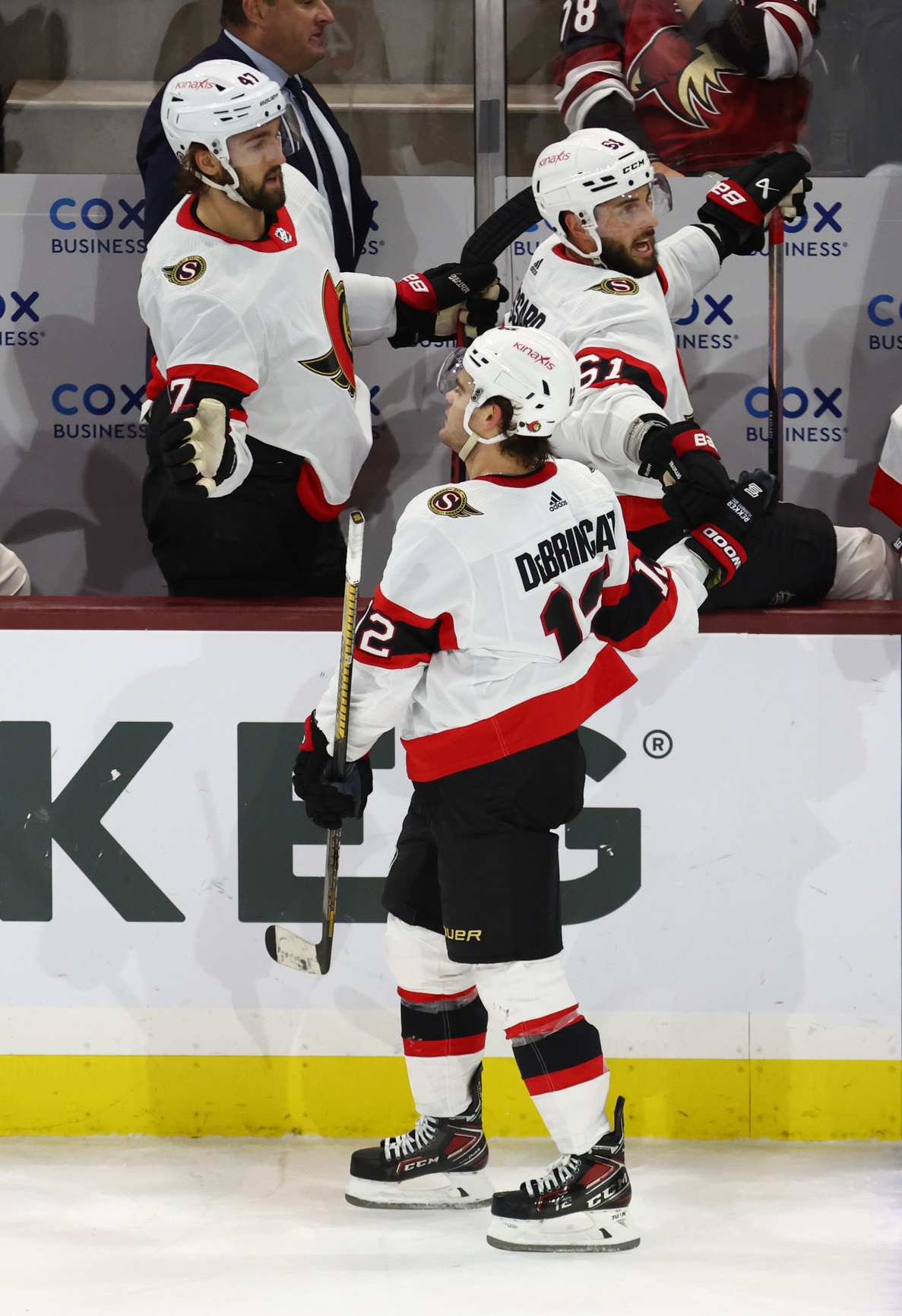 DeBrincat was Ottawa’s first big splash this past offseason as they picked him up from Chicago on draft day. He is a bargain from a cap perspective relative to his output with the Blackhawks but that’s about to change. He’s subject to the old qualifying offer rules which means his $9MM salary this season also represents his qualifying offer. At that point, he’ll also have salary arbitration eligibility for the first time and be a year away from UFA eligibility. GM Pierre Dorion made the move with the hope that he’d be able to get the 24-year-old to commit to a long-term extension. Such a move is going to cost somewhere around that qualifier on a max-term agreement which would make him the highest-paid player on the team.
Watson hasn’t been able to get back to the goal totals he had with Nashville but he has been a regular on Ottawa’s fourth line for the past two-plus seasons while providing them with plenty of grit. He’s near the ceiling of what a player in that role can typically get on the open market but another contract around this price range is doable. Motte didn’t get the contract offers he was looking for early in free agency and had to eventually settle for this one-year deal. His production has been limited early on so instead of perhaps looking more favorably on the type of offer he turned down in July next summer, his next deal might also check in around this price point.
Gambrell is a serviceable fourth liner but he hasn’t brought much more to the table beyond the ability to cover eight to ten minutes per game. This isn’t overly pricey for someone in that role but his arbitration eligibility could work against him next summer as it’s unlikely they’ll want to give him that option. Accordingly, an early contract around this price tag like they did last offseason could happen once again. Otherwise, he’s a non-tender candidate. Brassard had to settle for a PTO, one that he got converted into a full contract. He’s giving the Senators a pretty good return on that early on but at this point of his career, he’s likely to be in the six-figure or PTO range on any future contracts.
Hamonic is no longer the core stay-at-home defender he was with the Islanders but he’s a reliable veteran in his own end that can still be effective on the third pairing and penalty kill. There’s still a role for those types of players but he’ll be hard-pressed to make this much on the open market next summer. Holden has had a much more limited role this season which is closer to the role he has had for long stretches of his career – more of a prototypical sixth defender. At 35, it’s hard to envision a multi-year agreement coming his way and teams feel that he is starting to slow down, he might have to accept a bit less than his current price tag. Brannstrom wanted a multi-year deal in the summer but it failed to materialize. It seems unlikely that they’ll get one done in 2023 as well as his playing time has been considerably more limited. With arbitration rights, he should be able to get a bit more than his $945K qualifying offer but it should be another short-term agreement since he still hasn’t been able to establish himself as a productive option on Ottawa’s back end.
Talbot was acquired from Minnesota to try to shore up the goaltending and while he got off to a bit of a tough start with injuries not helping things, he has settled in nicely as their starter. However, he’ll turn 36 just after free agency opens up and a long-earned reputation as more of a platoon player is going to still exist. There’s still some room for a small increase – a two-year deal around the $4MM range is certainly possible – but a long-term deal that makes him a concrete starter isn’t likely to happen.
Signed Through 2023-24
F Parker Kelly ($762.5K, RFA)
D Nikita Zaitsev ($4.5MM, UFA)
Kelly has become a capable fourth liner that kills penalties and plays with a physical edge and even while he doesn’t produce much offensively, he still provides a fair bit of value as someone that’s on a minimum contract. Assuming he stays in that role through next season, Kelly should be able to jump past the $1MM mark with arbitration rights but his limited production will certainly limit his earnings upside.
Zaitsev is a contract the Sens are very much interested in moving. He cleared waivers already this season and it’s likely he’ll be back on there at some point. He can still fill a limited role if need be but players like that are typically closer to the $1MM mark, not four times that amount.
Signed Through 2024-25
G Anton Forsberg ($2.75MM, UFA)
F Claude Giroux ($6.5MM, UFA)
F Mark Kastelic ($821K in 2022-23, $835K in 2023-24 and 2024-25, RFA)
Giroux opted to head home in free agency on what amounts to a bit of a team-friendly deal for someone that’s still capable of playing on the top line when needed. He has fit in nicely in a secondary scoring role and is giving them a good return so far. However, he’ll be 37 when this contract is up so his next one, if there is a next one, is quite likely to check in considerably cheaper than this one. Kastelic has become a serviceable fourth liner and having one of those that doesn’t make much more than the league minimum is always good. If he sticks in that role throughout the contract, he’ll position himself to get past the $1MM mark with arbitration rights in 2025.
Forsberg had a strong showing in 2021-22 and really gave Ottawa some stability between the pipes. He was rewarded for his efforts with this deal, one that will hold up well as long as he’s able to play in a platoon and put up reasonable numbers. Those numbers aren’t as good so far this season but relative to the rest of the league, he has been close to average which, for this price tag, isn’t a bad return. He didn’t have a long track record when he signed this contract but that should change after this one. If Forsberg does well in this role, he could add another million or more even as a platoon goalie on the open market.
Free Agent Stock Watch: Goalies
With the new year upon us, the NHL season is in full swing. Teams are jockeying for playoff position, and many players with expiring contracts across the NHL are playing games that could ultimately determine what type of payday they might receive in the summer.
In a multi-part series, we’ll take a look at each position group of the upcoming free agent class, and do a rundown on how those upcoming unrestricted free agents have performed this year. Which players have increased their odds of landing a massive contract? Which players have potentially hurt their earning potential with their play? We’ll break it all down here.
The Marquee Names
Frederik Andersen, Carolina Hurricanes
Andersen didn’t have the best platform year heading into his last trip to unrestricted free agency two years ago. The Danish netminder lost the starting role on the Toronto Maple Leafs to Jack Campbell, relinquishing a number-one slot he’d held tightly to for four straight seasons.
Andersen had posted a .909 save percentage in 2019-20, and had an .895 in his final year in Toronto, the first time in his professional career that his save percentage dropped below .900. Past the age of 30, he wasn’t nearly the type of sure-fire investment he had once seemed to be, and he settled for a relatively modest two-year $4.5MM AAV guarantee from the Carolina Hurricanes.
In his first year in Carolina, Andersen completely flipped the narrative surrounding his career trend. He was no longer a declining asset, he was now a two-time Jennings trophy winner who may have been a contender for the Vezina trophy had Igor Shesterkin not authored the most impressive season by a goaltender since Carey Price‘s Hart Trophy-winning campaign.
In 52 games played Andersen went 35-14-3 with a 2.17 goals-against-average and a .922 save percentage. Although some might attribute such impressive success to the fact that the Hurricanes have one of the NHL’s best defenses, Andersen still ranked near the top of the league in goals saved above expected, meaning he was making more than just the saves any goalie would be expected to make.
This season, Andersen hasn’t had as much success thanks to an injury that’s knocked him out for quite a while. He has just a .903 save percentage in 10 games played, but that sample size isn’t large enough to make any larger claims about a decline from last season’s impressive form.
If Andersen hits the open market, he’ll do so in far better standing than he was two years ago, and his next contract is likely to reflect that.
Tristan Jarry, Pittsburgh Penguins
Like Andersen, Jarry was in a shaky place after the 2020-21 season. That year was his first as the unquestioned starter in Pittsburgh, and although he was impressive at times in the regular season, he lacked consistency.
In addition to that up-and-down regular season, Jarry made several significant mistakes in the Penguins’ playoff series against the New York Islanders, mistakes that were a major reason why the Islanders were able to eliminate Pittsburgh. As a result, there were serious questions as to whether the Penguins could afford to trust Jarry as the goaltender to carry them through the twilight years Sidney Crosby, Evgeni Malkin, and Kris Letang‘s careers.
Jarry has answered those questions resoundingly with his performance in these past two seasons, though. Last year he played 58 games and posted a .919 save percentage, a performance that earned him one Vezina Trophy vote.
An unfortunate late injury kept him from playing a major role in the Penguins’ brief playoff run, although one could certainly make the case that with a healthy Jarry, the Penguins would have likely prevailed over the Rangers. The Rangers took seven games to eliminate Pittsburgh, despite the Penguins being backstopped by third-stringer Louis Domingue for a significant portion of the series.
Had he not lost time due to injury, it’s possible Jarry would have shown the Penguins organization that his ability to play on hockey’s biggest stage wouldn’t be defined by the mistakes he made in the series against the Islanders. But the injury cost him that chance, although he will get another opportunity if the Penguins make the playoffs.
Jarry, who will turn 28 in April, is in a strong position heading into the expiry of his contract. A deep playoff run could potentially vault him above Andersen to the top of this free agent class.
The Solid Contributors
Cam Talbot, Ottawa Senators
Just a year ago, Talbot looked to have found a nice landing spot as a starter with the Minnesota Wild. Then the team acquired Vezina Trophy winner Marc-Andre Fleury, and, after an offseason saga not lacking in drama, Talbot was off to Ottawa.
With the Senators, Talbot has performed solidly, although perhaps not quite to the standard he set in Minnesota (or all the way back in 2016-17, when he was a workhorse starter for the Edmonton Oilers.) Talbot has posted a .906 save percentage in 24 games played, and has had some hot stretches and some games he’d likely want to have back.
For example, from December 10th to December 27th, Talbot went 5-1-1 with a .927 save percentage. Since that point, in his last four games, Talbot has gone 1-3 with an .854 save percentage. While judging a goalie by his hot and cold stretches is always going to yield a semblance of inconsistency, the reality is Talbot has not provided the Senators with the type of goaltending they’d need to emerge as a playoff contender.
Over the course of his full tenure so far in Ottawa, Talbot has been adequate, but nothing more. At 35 years old, the market for solid-if-unimpressive goaltenders isn’t known to be robust, so Talbot may not receive the type of deal he was lined up for just a year ago. But for a team looking to stabilize their situation in the crease and add an experienced veteran, Talbot is a highly respectable option.
Martin Jones, Seattle Kraken
Jones’ season isn’t the easiest to explain. His career path has been a bit of a rollercoaster, as he’s gone from promising young Sharks starter to underperforming salary cap anchor, to unexciting backup with the Philadelphia Flyers. Last summer, Jones signed a one-year deal with the Seattle Kraken after the team’s presumptive backup goalie, Chris Driedger, went down with a major injury.
Jones has taken the opportunity afforded to him in Seattle and run with it, seizing the role of number-one goalie from Philipp Grubauer. He’s played in 31 games to Grubauer’s 14, and has posted an extremely impressive 21-5-3 record, bolstered by back-to-back shutouts against Montreal and Boston.
But despite all that good news, Jones’ save percentage remains below .900. Whether that says more about Jones’ performance or the value of using save percentage as a be-all-end-all metric to evaluate goalie performance is for others to decide, but the fact remains that goalies posting below .900 save percentages aren’t typically hot commodities in free agency, especially when those goalies haven’t been above .900 in a half-decade.
That’s the battle Jones could be fighting if his numbers remain where they currently are, although given his current performance there’s strong reason to believe they’ll improve. Given his age and inconsistent track record, it’s difficult to imagine any team investing in Jones on a long-term basis with an expensive average annual value.
But if a team is hoping Jones’ breakout performance can continue on their roster, it’s possible Jones could net a nice raise from the $2MM he’s making this season.
James Reimer, San Jose Sharks
Jones’ replacement in San Jose, James Reimer, has long been a respected veteran option for NHL teams looking to add a tandem netminder.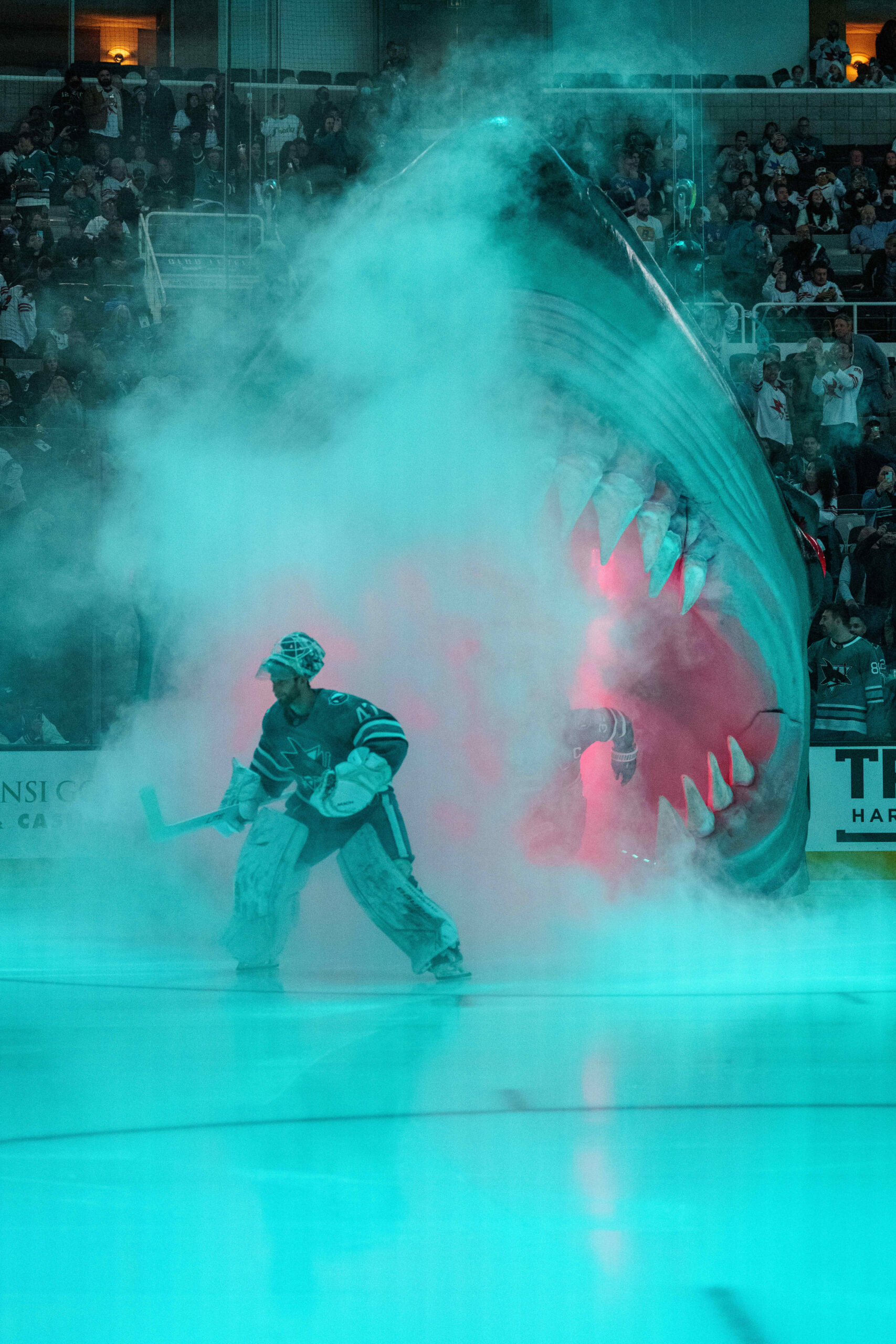
Last season, Reimer set a career-high in games played, appearing in 48 contests and posting a .911 save percentage and a 2.90 goals-against-average.
Reimer’s performance is made all the more impressive by the fact that the Sharks defense he was playing behind was among the NHL’s weaker units.
Reimer has been particularly good on the penalty kill in San Jose, but this season he’s seen his overall numbers decline sharply.
He’s at an .895 save percentage now and has an .879 since returning from injury on December 13th. If his numbers remain around this range, let alone get worse, Reimer will likely go from being one of the better tandem options on the open market to more of a bounce-back candidate.
Semyon Varlamov, New York Islanders
As Ilya Sorokin has taken the reins on Long Island and become one of the NHL’s top netminders, Varlamov has faded somewhat from where he once was. The Russian earned a first-place Vezina Trophy vote in 2020-21, posting a highly impressive .929 save percentage in 36 games.
Since that point, Varlamov has ceded his role as the Islanders’ number-one goalie to Sorokin, and his save percentage has declined from .920 and above to the low teens. Since he’ll be 35 years old when the market opens, it’s possible that teams now view Varlamov as more of a tandem or backup option than the slam-dunk starter he was just a short time ago.
Even so, it’s undeniable that Varlamov was seen as one of the NHL’s best goalies quite recently. If he’s able to be had at a more affordable price than some of the big-name goalies on the open market, signing Varlamov could pay major dividends. There’s risk to investing in any player getting into their mid-thirties, but there also is a precedent for goaltenders being able to play well even to the age of 40, as we saw with Mike Smith.
He may have to take a pay cut from the $5MM he’s making now, but Varlamov should have a solid market to consider should be be available on the open market in the summer.
Jonathan Quick, Los Angeles Kings
One of the more legendary playoff performers in modern NHL history, Quick’s performance in recent years has been highly uneven. In 2020-21, it looked as though Quick’s days as a number-one goalie were over, as Cal Petersen played in far more games than Quick and posted a far better save percentage.
Then last season, Petersen struggled and Quick re-took the starter’s crease, leading the Kings back to the playoffs with a 23-13-9 record, 2.59 goals-against-average, and .910 save percentage. It seemed Quick was back.
Now, this season, as the Kings have struggled as a whole in their own end, Quick’s numbers have taken a major hit. He’s rocking an .883 save percentage and ranks near the bottom of the NHL in MoneyPuck’s goals saved above expected metric.
Quick will turn 37 later this month, and with players his age it’s more likely that sharp declines in performance end up permanent, rather than temporary setbacks.
If there’s anything Quick has shown over the course of his storied career, it’s that people who bet against him will end up paying a high price. So knowing how well he’s played in the past, it’s impossible to write him off after a difficult 23-game start to this season. But if he keeps letting in goals at this rate everything is on the table.
Joonas Korpisalo, Columbus Blue Jackets
There are few netminders in the NHL who have been dealt a worse hand this season than Korpisalo. The Blue Jackets have been besieged by injuries, particularly on the blueline where they quickly lost franchise defenseman Zach Werenski to a long-term injury.
The severe struggles of Elvis Merzlikins have put even more pressure on Korpisalo to play well, and all things considered, he has done an admirable job tending the crease for one of the NHL’s worst teams.
Through 18 games Korpisalo has a .908 save percentage, one that is significantly higher than the .865 mark Merzlikins has posted in just about the same number of games. That .908 mark also represents a massive improvement from the save percentages he’s had in the last two years, including the nightmarish .877 he posted last season.
All things considered, there’s a lot for Korpisalo to be proud of in his performance this season. MoneyPuck’s work marks him as having a higher goals saved above expected than netminders such as Jarry, Vitek Vanecek, and Stuart Skinner, starters for teams that are likely to be in the playoffs.
Whether his impressive performance through 18 games will earn him a solid next contract is still a mystery, though. Korpisalo’s inconsistency looms large over any strong runs he has this year, and it could be difficult for interested clubs to justify a sizeable investment in a player with such a shaky track record.
But the struggles Korpisalo faced in the past are not something he can change now. All he can do is attempt to weather the storm the Blue Jackets have faced this season and play well in these adverse conditions. So far, he’s done exactly that, and his efforts won’t go unnoticed by other clubs.
Antti Raanta, Carolina Hurricanes
Raanta, now 33 years old, has settled into a comfortable role as a backup netminder in Carolina. Due to injuries to Andersen, the team’s starter, Raanta has been able to showcase his talent on a bigger stage than he’d likely anticipated, and under that microscope he’s impressed.
He posted a .922 save percentage in 13 playoff starts last season, a hugely impressive performance in a league that places major value on playoff goaltending. In the regular season, he went 15-5-4 with a .912 save percentage. This year, Raanta’s save percentage is down, but he’s still winning the Hurricanes hockey games and his 2.63 goals-against-average is only a minor decline from last year.
This decline in save percentage likely won’t be the largest factor working against Raanta on the open market, it’ll be his struggles to stay healthy. Raanta hasn’t started more than 32 games since 2017-18, and hasn’t been able to stay consistently healthy throughout his NHL career.
When he does manage to get on the ice, he’s shown he can be one of the better backups in the NHL, capable of even providing impressive performances on hockey’s biggest stages. But one of the best things a backup goaltender can provide, beyond quality performances, is reliability and consistent availability.
That’s been Raanta’s biggest weakness in his NHL career, and despite solid performances in Carolina it’ll likely be what costs him in his return to unrestricted free agency.
The Role Players
Adin Hill, Vegas Golden Knights
In the summer of 2021, the Sharks surrendered a second-round draft choice in order to acquire Hill from the Arizona Coyotes. Yet just a year later, they traded him to Vegas for a fourth-rounder. Hill never quite found his footing in San Jose, posting a .906 save percentage in 22 starts.
He had some strong performances, but injuries took their toll and by the end of the year the Sharks made the choice to look elsewhere to fill out their crease. In Vegas, Hill’s numbers are remarkably similar to what he posted in San Jose, only he’s already at 15 starts this season, just seven away from his total from the entirety of 2021-22.
By staying healthy, Hill has enhanced his value. He’ll be 27 if he hits the open market in the summer, and if he can keep up his sound run of health he’ll be a quality option for a team looking to add a younger option to their crease.
Kevin Lankinen, Nashville Predators
After an impressive rookie season that resulted in him picking up some down-ballot Calder Trophy votes, Lankinen had a nightmarish 2021-22, his save percentage crashing from .909 to .891 and his goals-against-average ballooning from 3.01 to 3.50.
That decline led to his departure from Chicago, which paved the way for him to sign in Nashville to be Juuse Saros‘ backup. In a more minor role than the one he shouldered with the Blackhawks, Lankinen has thrived.
He’s posted a .918 save percentage in 10 games, and his performances have been a moderate help toward the Predators’ efforts to remain in the hunt for a Wild Card spot. That ten-game sample size is, of course, not enough to make any long-term decisions about Lankinen’s future.
But what it does indicate is that Lankinen is perhaps better suited to perform well in a role as a true backup, rather than as the number-one goalie he was in his rookie year or the tandem netminder he was last season. Lankinen is earning $1.5MM against the cap this season, and if he can keep up his performances for a full year, he’ll get a pay raise as one of the better backups on the market in the summer.
Alex Nedeljkovic, Detroit Red Wings
The Hurricanes made a somewhat controversial decision in the 2021 offseason, trading Nedeljkovic, a Calder Trophy finalist and goalie they had spent several years developing, rather than give him the contract he felt he’d earned as a restricted free agent.
The Red Wings were happy to pounce on a still-young goalie who had posted a .932 save percentage that year, but it’s fair to say at this point that the Hurricanes’ choice to go with Andersen over Nedeljkovic was the right one.
While Andersen became a Vezina Trophy contender in Carolina, Nedeljkovic struggled in Detroit. On a team far weaker than what he’d played behind in Carolina, Nedeljkovic’s numbers declined, and he finished 2021-22 with a .901 save percentage through 52 starts.
Nedeljkovic’s lack of size means he relies more on his athleticism than other goalies, and on a team less capable of playing quality defense in front of him Nedeljkovic suffered. With an .880 save percentage this season in nine games played, Nedeljkovic finds himself battling with Magnus Hellberg for the right to back up Ville Husso.
Heading into free agency, it’s likely Nedeljkovic will be viewed as a bounce-back candidate rather than someone to invest in for a role where a team requires reliability and consistency.
Pheonix Copley, Los Angeles Kings
With only 45 NHL games to his name, Copley’s resume is far thinner than most of the goalies he’ll hit the open market with in the summer. Yet unlike many of the goalies with more extensive track records, Copley has performed well this season, posting a hugely impressive 12-2 record in 14 starts.
His actual performance hasn’t been all that flashy, but he’s given the Kings a chance to win in each night he’s played, which is something any team can appreciate.
Without a major track record, it’s difficult to imagine Copley having a massive market when his contract expires. But if he keeps winning like this, anything’s possible.
Others Of Note
Anthony Stolarz, Anaheim Ducks
After posting a rock-solid .917 save percentage in 28 games on a bad Duck’s team last year, Stolarz has declined to an .895 this season. Stolarz has proven all he can prove at the AHL level, meaning his floor in terms of role is as a team’s number-three goalie.
Whether he is signed to be a backup or as a competitive third-stringer could depend on how well he performs over the course of the rest of the season.
Alex Stalock, Chicago Blackhawks
Stalock has seemingly overcome the major health issues he faced in recent years and re-established himself as a legitimate NHL goaltender. That alone is worthy of celebrating. But Stalock’s actual performance this year makes his return to the ice all that more impressive.
On a team stripped for parts and built for the future, Stalock has posted a .918 save percentage in 14 games. MoneyPuck’s goals saved above expected stat ranks him in the upper portion of the NHL, ahead of some big-name players.
At 35 years old, it’s not particularly likely that Stalock has suddenly become an elite goaltender, despite his elite numbers. But what he’s done this year has definitely raised his stock leaguewide, and could earn him a raise on his next contract from the $750K he’s making this season.
Pictures courtesy of USA Today Sports Images
Free Agent Stock Watch: Right-Handed Defensemen
With the new year upon us, the NHL season is in full swing. Teams are jockeying for playoff position, and many players with expiring contracts across the NHL are playing games that could ultimately determine what type of payday they might receive in the summer.
In a multi-part series, we’ll take a look at each position group of the upcoming free agent class, and do a rundown on how those upcoming unrestricted free agents have performed this year. Which players have increased their odds of landing a massive contract? Which players have potentially hurt their earning potential with their play? We’ll break it all down here.
The Marquee Names
John Klingberg, Anaheim Ducks
If we travel back in time to just a year ago, there’d be no doubt that Klingberg would qualify as a “marquee name” for any free agent class. The Swedish blueliner had been an offensive force all season, and he finished the 2021-22 campaign with 47 points in 74 games.
Klingberg had a long record of success as a pace-pushing, offensive defenseman with tons of power play value. He was just the second defenseman in Dallas Stars franchise history to cross the 60-point plateau when he did so in 2017-18, and his 67 points that season ranks just behind the legendary Sergei Zubov‘s 2005-06 campaign as the best offensive season by a Stars defenseman in history.
But unfortunately for Klingberg, that sterling reputation as an offensive defenseman didn’t materialize into a major contract. With a slower-than-expected market for his services, Klingberg took a one-year, $7MM deal with the Anaheim Ducks.
He took that contract presumably in order to put forth a productive season and re-enter the market next summer, as many had projected 2023 to be the year where the salary cap would finally meaningfully rise once again.
Things haven’t gone according to that plan, to say the least. Not only is the salary cap potentially slated to stay flat for another summer, but Klingberg is also mired in the least productive offensive season of his NHL career. He has scored just 13 points in 35 games, and the Ducks power play he was acquired to rehabilitate currently ranks as the second-worst in the NHL.
As a result, Klingberg’s stock heading into another trip to unrestricted free agency has taken a nosedive. There is potential for redemption, though, as Klingberg remains a likely candidate to be traded to a contending team in the coming months.
If Klingberg gets traded to a contender and plays well for his new team (including hopefully a productive playoff run) that could go a long way toward rehabilitating his stock and landing him a lucrative new contract.
The Solid Contributors
Nick Jensen, Washington Capitals
Stylistically, Jensen is about as far away from Klingberg as one can get, and he is firmly in the running to be the top defensive defenseman available on the open market next summer.
Acquired by the Capitals at the 2019 trade deadline, Jensen has been a high-quality blueliner for Washington, providing stabilizing defensive play at their back end. The Minnesota native is now 32 years old and took a while to reach the NHL. He was a 2009 fifth-round pick and made his NHL debut more than a half-decade after being drafted.
Since breaking into the NHL in 2016-17, Jensen has developed himself into a valuable top-four piece. He’s currently slotted on the Capitals’ top pairing next to fellow pending free agent Dmitry Orlov and is averaging nearly 21 minutes of ice time per night.
Jensen’s defensive play is his calling card, and he leads the Capitals in short-handed ice time, helping Washington’s penalty kill to a top-ten ranking leaguewide this season.
While offense isn’t what he’s getting his minutes to provide, the 19 points in 44 games he’s produced this season is certainly appreciated by coach Peter Laviolette.
The total package Jensen offers is one that is likely to garner extensive interest should he hit the open market. While his age may keep him from earning as long of a deal as he might like, blueliners who are as good in their own end and can weather as difficult minutes as Jensen does don’t grow on trees.
He’ll be a coveted option on the market should he be allowed to walk by the Capitals, and his play so far this season has certainly helped.
Damon Severson, New Jersey Devils
On paper, Severson is having a disappointing season so far this year. He scored 46 points last season and played a whopping 23:36 per night. This year, he’s averaging under 20 minutes a night and is only on pace to score 21 points.
But before dismissing Severson’s stock as on a major decline, additional context must be added to his profile. The Devils have added significant defensive talent in recent offseasons, and the additions of Ryan Graves, Jonas Siegenthaler, and John Marino have meant that the team doesn’t need to rely on Severson as extensively as they once did.
Additionally, the addition of Dougie Hamilton (who is now healthy after suffering an injury-plagued debut season for the Devils) has meant Severson’s impact on the team’s power play has waned.
But despite the fact that Severson is no longer the Devils’ unquestioned top defenseman, he’s still managed to play well. His offensive points production is down, but he’s still managing to generate his fair share of chances from the back end, and is still moving the puck well.
Defensively, Severson has played a supporting role on a penalty kill that is one of the better units in the NHL. He’s not a stalwart defensive force like Siegenthaler is, but he’s definitely a capable defender in his own right.
The balanced two-way value Severson provides the Devils is something any team in the NHL could use, and his ability to play higher up in the lineup if needed will help him on the open market.
While he likely won’t receive the type of contract next summer that he would have gotten had he repeated his 46-point, 23-plus minutes per night performance, he’s still lined up to receive a nice contract from a defense-needy team.
Matt Dumba, Minnesota Wild
The subject of intense trade rumors for the past several seasons, Dumba is on an expiring contract and set to potentially hit unrestricted free agency for the first time in his career.
He’ll be 29 when he hits free agency, and he’s in a bit of an odd place. On one hand, leaguewide reputation is rock-solid.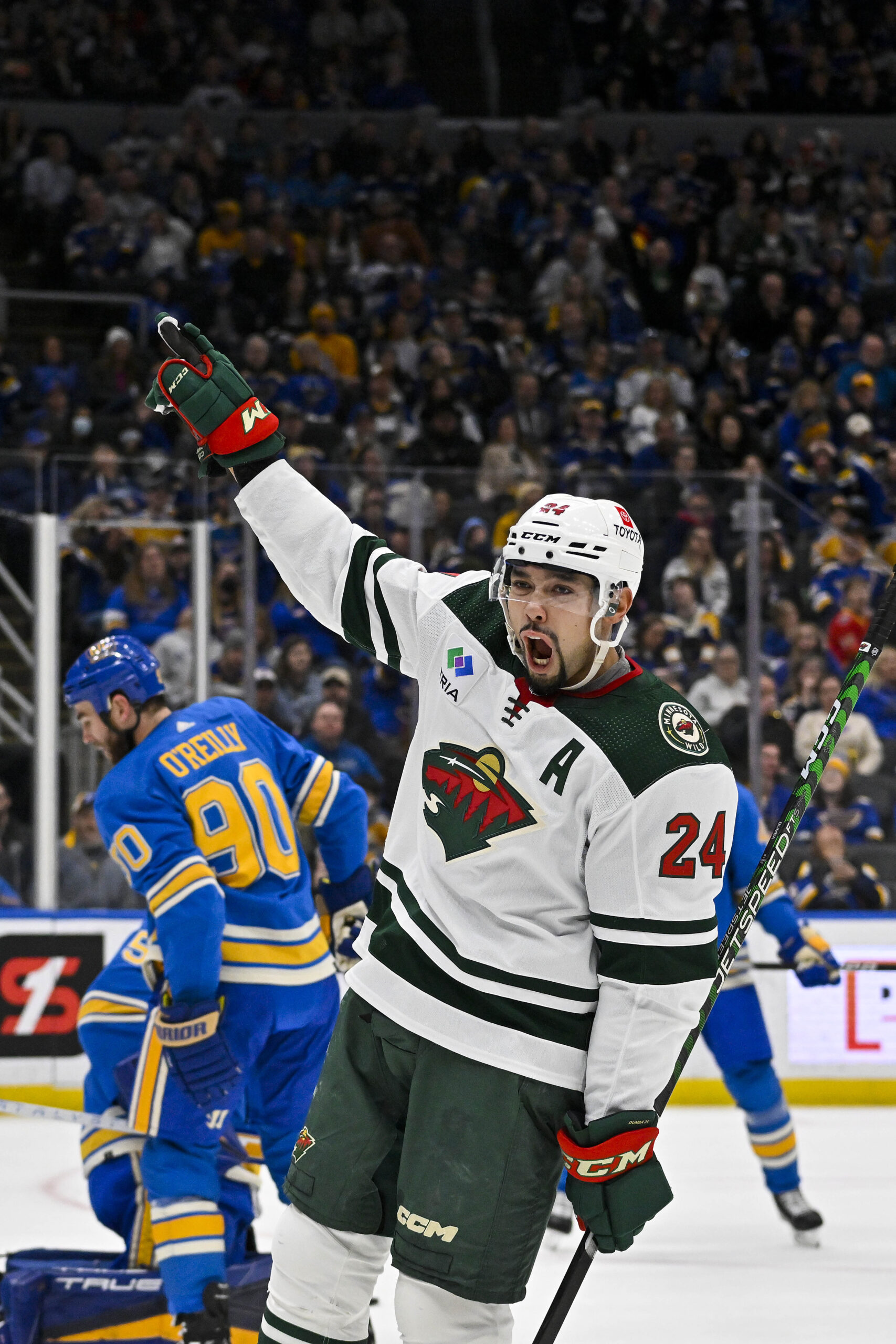
The 2020 King Clancy Memorial Trophy winner has averaged over 21 minutes of ice time per night every season since he was 22 years old and has been a consistent top-four presence on Wild teams that have missed the playoffs just twice since he made his NHL debut.
On the other hand, it’s difficult to ignore signs that Dumba’s reputation isn’t totally aligned with the on-ice value he provides.
While the energy he brings to defense is undoubtedly valuable and the minutes he consistently handles are undoubtedly difficult, his on-ice results have been uneven.
Dumba’s role has declined since last season, and his offensive production isn’t where it once was. He’s scored just 11 points in 40 games this season, and he hasn’t reached 30 points in quite a few seasons.
He’s not the 50-point defenseman he once appeared to be in 2017-18, and in the absence of major point production, his transitional ability and defensive play need to be at a high level to justify his $6MM price tag. It’s an open question as to whether the other areas of Dumba’s game are at that level.
But despite those question marks, Dumba is still a beloved professional who has made a major, positive impact on the Wild over the course of his career there.
The evaluation of defensemen across the league can vary significantly between teams, meaning there are likely to be a few teams very bullish on what Dumba can offer. But even so, it’s not difficult to see what Dumba has put forth this season and be left wanting a little more.
The Role Players
Scott Mayfield, New York Islanders
Mayfield is in his fifth season earning $1.45MM against the cap, a number that isn’t exactly an adequate reflection of the value he’s provided to the Islanders.
The former Denver Pioneer, now 30, has averaged around 20 minutes per night for the past few seasons and has been a key stay-at-home contributor for Islanders teams that made some deep playoff runs.
His offensive production won’t count for more than 20 points per year, although he has chipped in at some very important moments.
The defensive game is where Mayfield truly shines, though, and it’s where he’ll make his money on the open market. He leads all Islanders averaging over 3 minutes of short-handed time per night, and that puts him tied for 13th in the NHL in most average penalty-killing ice time.
Mayfield will be 31 at the start of next season, meaning he’s reaching the tail-end of his prime years. But teams have in the past shown they’re willing to pay for quality players into their thirties, and there’s no reason Mayfield should be any different. He’s been a legitimately valuable defensive difference-maker on Long Island.
Connor Clifton, Boston Bruins
The Bruins have been an absolute juggernaut so far this season, and their success as a team has been fueled by the individual successes of their players. Clifton, who will be 28 when the market opens next summer, is part of that equation.
The 2013 fifth-round pick has grown from part-timer to everyday piece in Boston, and is on the final year of a $1MM AAV dea that severely underpays him relative to the value he brings on the ice. Clifton has been a steady contributor on the Bruins’ third pairing, giving coach Jim Montgomery over 18 safe minutes each night, as well as nearly two minutes a night on the penalty kill.
The track record isn’t huge with Clifton, who has under 200 NHL games on his resume. Clifton’s record of offensive production is also thin, although his 12 points in 40 games this season are a career-high.
Helping the Bruins to a long playoff run would do great things for his potential to earn a nice deal on the open market, but even in the absence of postseason play Clifton has helped himself well in what has been a nice platform season.
Luke Schenn, Vancouver Canucks
Schenn, 33, hasn’t had the smoothest career track. The former Kelowna Rocket was the fifth-overall pick at the 2008 NHL draft, and never quite managed to live up to the lofty expectations placed on his shoulders as a top prospect in a hockey-mad market.
Even though he has largely been viewed as a disappointment relative to his draft position, Schenn is now just 97 games away from reaching the 1,000-game plateau. He’s also now a two-time Stanley Cup champion, and his play for the Canucks has done wonders to enhance his reputation league-wide.
In Vancouver, Schenn has gone from a number-six or seven defenseman to a true everyday contributor. He’s currently playing over 17 minutes a night for coach Bruce Boudreau, including nearly two minutes per night on the penalty kill.
Schenn’s agent, Ben Hankinson, took to Twitter last month to sing Schenn’s praises, perhaps giving us a look at what his pitch will be to teams in order to get the most lucrative possible contract for his client.
As he’s a 33-year-old physical defenseman with major tread on his tires, it’s fair to wonder if paying a sizeable chunk of change to Schenn is a wise investment for any team. But Schenn’s improvement in Vancouver is undeniable, and if he’s traded to a contending team and manages to put forth quality play on the major stage that is the Stanley Cup playoffs, anything’s possible.
Justin Holl, Toronto Maple Leafs
While Holl has been the subject of some significant criticism from the Toronto market in past seasons, he’s quietly played some quality hockey this year. He’s currently partnered with Maple Leafs number-one blueliner Morgan Rielly on the team’s top pairing, and is averaging over 21 minutes played per night.
Holl is on pace to set a career-high in minutes played, and he’s also averaging the most short-handed ice time on the Maple Leafs’ roster, playing in over three minutes on the penalty kill per game. The former Minnesota Gopher will turn 31 later this month and could leave the Maple Leafs, the only NHL team he’s ever played for, next summer.
He won’t be mistaken for a top-end defensive defenseman, but it’s difficult to say Holl has done anything but present improved play this season. If the Maple Leafs can finally vanquish the first-round demons that have plagued them for a half-decade, Holl’s standing going into unrestricted free agency could improve even more.
Radko Gudas, Florida Panthers
The days of Gudas being viewed as just a bruising enforcer defenseman are no more. While Gudas has retained his signature no-holds-barred physical style in Florida, he’s grown into a much more well-rounded blueliner during his time in South Florida.
Gudas’ average ice time has leaped up more than a full minute in Florida compared to how he was played in Washington and his later years in Philadelphia, and his play helped the Panthers go on an incredible run last season that was capped off by winning the President’s Trophy.
With just six points in 32 games and just 16 last season on the highest-scoring team of the cap era, it’s clear Gudas’ offense isn’t what keeps him in the lineup each night. But if a team is looking for a defensive defenseman who brings an intimidating edge, Gudas could be the most ferocious option on the market.
Trevor van Riemsdyk, Washington Capitals
Although he’s perhaps been a bit hidden in the shadow of his high-scoring, former top prospect older brother James van Riemsdyk, Trevor has become a quality NHLer in his own right.
He’s an undrafted player with 500 NHL games on his resume, and this season he’s been a rock on coach Laviolette’s back end. Paired with Jensen on the Capitals’ top penalty-killing unit, van Riemsdyk has helped the Capitals rank as one of the better shorthanded units in the NHL.
Public analytics models are quite bullish on van Riemsdyk’s work in his own end, and although reputation can sometimes drive a defenseman’s market value more than it likely should, van Riemsdyk’s name value is steadily increasing as the Capitals rise in the standings.
Frequent partner Erik Gustafsson has run wild thanks to the freedom afforded by van Riemsdyk’s sound defensive play, the Swedish blueliner’s 25 points in 43 games are not only a testament to his own on-ice improvement but also how well he’s played in tandem with his partner.
With his play this season, van Riemsdyk has put together a strong resume for any team seeking a quality stay-at-home defenseman to pair with a more offensively-inclined puck mover to consider.
Kevin Shattenkirk, Anaheim Ducks
Once a marquee name sitting atop an offseason free agent class, Shattenkirk has settled into a more low-key role since being bought out of his major contract by the New York Rangers.
After winning the Stanley Cup with Tampa Bay, Shattenkirk signed in Anaheim and has had an up-and-down tenure in Southern California.
A strong run on the power play led Shattenkirk to score a respectable 35 points last season, but other than that two of his three seasons as a Duck have been major disappointments. He’ll be 34 years old when the market opens, and he’s on pace to score just 20 points.
Although a trade to a contender could spark a return to form, it’s likely that Shattenkirk will hit the open market next summer in a significantly diminished position to where he was last summer.
Erik Johnson, Colorado Avalanche
A longtime leader on the Avalanche’s back end, Johnson finally won the first Stanley Cup of his career last summer. Once the Avalanche’s clear top defenseman, the emergence of Cale Makar, Devon Toews, and Samuel Girard has allowed Johnson to settle into a more suitable role as the team’s fourth or fifth defenseman, depending on the health of Bowen Byram.
In that role, Johnson has been solid. He’s given the Avalanche nearly 18 minutes per night and provided sound defensive play, some penalty killing, and some physicality in those minutes.
At this stage of his career, it doesn’t seem particularly likely that Johnson would choose to uproot his family and sign with another club after over a decade in Colorado. But given the challenge the Avalanche face under the salary cap, it’s likely that another team could be in a position to offer Johnson a more lucrative deal than what Colorado is poised to afford.
As a result, Johnson could have a difficult choice to make next summer. He’s made it clear he still belongs in the NHL despite the fact that he’ll turn 35 later this season, and his play has earned him another contract.
But if he wants to maximize his earnings on his new deal and minimize the decline in pay he’ll likely face after making $6MM against the cap for the past seven years, he may be forced to sign elsewhere.
Others Of Note
Travis Hamonic, Ottawa Senators
It was somewhat curious when the still-rebuilding Senators traded a third-round pick to the Canucks for Hamonic last season, but what that deal came to signify was an end to rebuilding and a return to attempting to contend for the playoffs in Ottawa.
Unfortunately for Ottawa, Hamonic’s addition hasn’t brought the Senators all that much closer to the playoffs, and now as a pending unrestricted free agent, his future seems cloudy. Playing largely with rookie defenseman/top prospect Jake Sanderson, Hamonic has had an uneven year.
There are some positive aspects to the season he’s had. Hamonic has the second-most average short-handed time on ice among Senators skaters, and the penalty kill he helps anchor currently ranks as the fifth-best in the NHL. He’s respected for the sacrifices he makes in his own end, and has registered 66 blocked shots.
But public analytics models are quite bearish on his work in his own end, with the work of The Athletic’s Shayna Goldman and Dom Luszczyszyn, for example, holding Hamonic in the fourth percentile leaguewide in 5v5 on-ice defensive impact. (subscription link)
So opinions on Hamonic are definitely split. But like with many of the defensemen on this list, a trade to a contending team and a role on a squad making a deep playoff run could earn him some money.
While some of the more analytically-inclined front offices might shy away from investing in Hamonic next summer, he should have some suitors among some more traditional teams who place more value on the particular set brand of play Hamonic provides.
Justin Braun, Philadelphia Flyers
Braun will turn 36 in February and is currently playing out a one-year, $1MM deal with the Philadelphia Flyers. Braun’s actually been pretty good in his own end, helping out on the Flyers’ penalty kill and generally just playing sound hockey for coach John Tortorella.
But more recently, he’s found himself in the press box as his offensive production of zero points in 33 games is becoming harder and harder to ignore. With a cheap expiring contract and a long track record of safe stay-at-home play, Braun is a candidate to be traded at the deadline, just as he was last season.
Given the lack of any sort of offensive element to his game, Braun’s market next summer will be somewhat restricted. But since his defensive game is still NHL-caliber, he should be able to catch on with a team as a veteran depth addition capable of giving safe, low-event minutes.
Michael Stone, Calgary Flames
A staple in Calgary for over a half-decade, Stone has provided the Flames with defensive depth at a cheap price. This year has been no different, as he’s played 32 games for coach Darryl Sutter’s squad at just a $750k cap hit.
Since he doesn’t play on either special teams unit, his value in a specialist role is limited. But coach Sutter still clearly trusts him enough to dress him regularly, and the two-time Stanley Cup champion’s endorsement carries weight.
He’ll be 33 by the time the market opens next summer, and expecting him to sign another deal with Calgary near the league minimum would be a safe bet.
Pictures courtesy of USA Today Sports Images