
Hayley Wickenheiser Announces Her Retirement
At the age of 38, Hayley Wickenheiser – arguably the greatest female hockey player of all-time – has decided to hang up her skates. She sent out a tweet Friday night that (fittingly) showed her on a public rink bench with the caption: 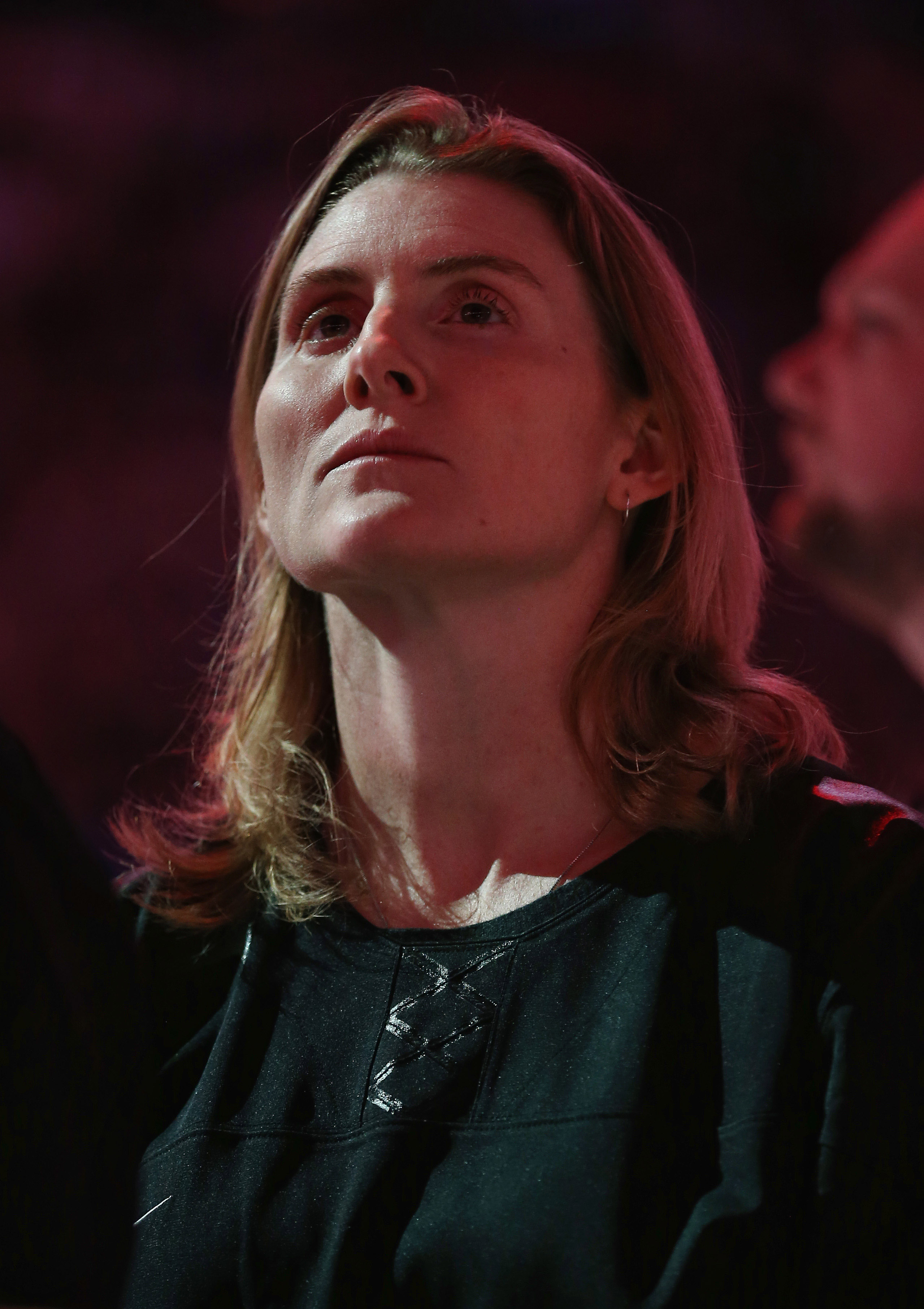
Dear Canada. It has been the greatest honour of my life to play for you. Time to hang em up!! Thank you! #grateful #graduationday #canada
If you haven’t followed women’s hockey over the past couple of decades, Wickenheiser is a name you need to learn. She is a four-time Olympic gold medalist in consecutive winter games (and add a silver from 1998 for good luck), and the first woman to play full-time professional hockey at a position other than goal.
In 2003, Wickenheiser signed on with a Finnish men’s team and played 23 games with the club that season, breaking a barrier for women around the world. She scored 12 points for the team in those 23 games (including 7 in 11 playoff matches), but left the league after just 10 scoreless games the next season. Years later she would play for a Swedish men’s team, scoring three points in 21 games. In 26 Olympic matches, she scored 51 points.
An incredible athlete, Wickenheiser also represented Canada in softball at the 2000 Summer Olympics. Once offered a contract to play in the ECHL by Phil Esposito (though she would never play for the team), her journey in hockey simply outgrew where the women’s level was at that time. She will be a no-brainer inductee to the Hockey Hall of Fame, with discussion already beginning on whether the waiting period will be waived for her.
If it weren’t for Wickenheiser, there is no guarantee women’s hockey would be as developed as it is today. She, and other legends like her, inspired a generation of young women to pick up a hockey stick, get on the ice, and challenge the notion that hockey was only for men.
Dear Hayley. It has been a great hono(u)r to watch you play. Thank you.
Auston Matthews Scores 20th Goal Of Rookie Season
Since the 2005-06 season when the NHL brought itself into a new era, 33 players have scored 20 or more goals in their rookie year. Headlined by the unbelievable rookie campaigns of Sidney Crosby and Alex Ovechkin (the latter of which who scored more than 50, the first of seven such seasons) it’s a group of all-stars and perhaps even more than a handful of hall of fame players. It also includes Petr Prucha and Peter Mueller, showing that it’s not a guarantee for success though a pretty good indicator.
This year, the group will likely have a handful of entrants. With players like Patrik Laine in Winnipeg and Matthew Tkachuk in Calgary having great success, this may be the best rookie crop in years. But today it’s Toronto that took the rookie spotlight, with Mitch Marner, Connor Brown and Auston Matthews all scoring in the Centennial Classic. Matthews, who scored twice (including the overtime winner) has already punched his ticket as the 34th player to score 20 as a rookie in the salary cap era.
The rookie phenom now has 32 points in 36 games, and is on pace to score more goals that even Crosby did as a rookie. The league hasn’t seen a teenager score 40 goals in his rookie season since Eric Lindros did it in 1992-93, and there may be two (with Laine) that do it this year. That exclusive group includes just five players: Lindros, Wayne Gretzky, Mario Lemieux, Dale Hawerchuk and Sylvain Turgeon.
When you add Connor McDavid to the teenage mix (though no longer a rookie), it’s an unbelievable group that is doing unprecedented things in the NHL. With 14 goals in his last 17 games, Matthews is likely on an unsustainable pace, just as Laine was earlier in the year. But even if his production slows down, he’s already in the discussion as an elite center in the NHL and should be for a long time.
The Calder Trophy run should be a heck of a battle down the stretch, with no clear winner emerging so far. We’re excited to watch.
Blackhawks Notes: Anisimov, Hossa, Goalies, Gilbert
The Chicago Blackhawks announced via Twitter that they have activated center Artem Anisimov from IR while placing winger Marian Hossa on IR retroactive to December 20th. Hossa is expected to miss the first half of the team’s upcoming road trip which runs from December 27th through January 2nd, according to Scott Powers of The Atlantic. Powers adds that Blackhawks head coach Joel Quenneville hopes to have Hossa back for the Winter Classic game against St. Louis.
Hossa, who will turn 38 on January 12th, is having a resurgence of sorts with 16 goals and 23 points in 34 contests. Last season, the gifted two-way winger posted the lowest offensive numbers since his rookie campaign in 1998-99, tallying 13 goals and 33 points in 64 games.
Anisimov, who has been out of action since December 17th, is in the midst of a career season with 14 goals and 27 points through 32 contests. His previous best output came during the Russian pivot’s second full campaign when Anisimov registered 18 goals and 44 points in 82 games.
In other Blackahwks news:
- Mark Lazerus of the Chicago Sun-Times hosted a mailbag segment addressing a number of Blackhawks items, including the team’s goaltending situation. With Artemi Panarin set to hit restricted free agency this summer and the team short on available cap space, one scenario that has been suggested to clear salary is moving starting goaltender Corey Crawford and his $6MM cap charge. While acknowledging Scott Darling‘s solid play this season in relief of Crawford and arguing the pending unrestricted free agent will be in the position to look for a starting job, Lazerus argues that job will have to be elsewhere. As Lazerus points out, Darling is already 28 and time is running short for him to find either an outright starting job or at least a timeshare. Also, Crawford is among the best netminders in the league, as Lazerus opines, and the Blackhawks would be best served keeping him between the pipes.
- Scott Powers, writing for The Atlantic, tells the story of defenseman Dennis Gilbert, an unheralded third-round draft pick in the 2015 draft who is quietly developing into one of the team’s top prospects (subscription required). As Powers notes, Gilbert first came to the attention of Chicago evaluators at the behest of Hall of Fame head coach Scotty Bowman, whose son Stan is the Blackhawks GM. Gilbert is currently in his sophomore season patrolling the blue line for Notre Dame and has contributed six assists in 17 games.
Jaromir Jagr Ties Mark Messier For Second-Most Points
Jaromir Jagr played his first NHL game on October 5, 1990 in Washington. He scored the first goal and point of his Hall of Fame career two nights later at home versus the New Jersey Devils.
So far, 766 players have played in the NHL this season. Just 455 of those, or 58%, were born before the end of 1990. Jagr has played against players born from 1951 (Guy Lafleur) to 1998 (Patrik Laine). Yet he’s still here, and reached an incredible milestone on Tuesday night: Jagr is now tied with Mark Messier for second all-time in NHL scoring.
With three assists against the Sabres, Jagr now has 755 goals, 1,132 assists, and 1,887 points. That’s 524 points more than the next highest active player, Joe Thornton. The 45-year-old Jagr is now playing in his twenty-third NHL season, and has played for eight teams.
The new top five for all-time points looks like this, until Jagr gets his next:
1. Wayne Gretzky – 2,857 points in 1487 games
T2. Jaromir Jagr – 1,887 points in 1662 games
T2. Mark Messier – 1,887 points in 1756 games
3. Gordie Howe – 1,850 points in 1767 games
4. Ron Francis – 1,798 points in 1731 games
5. Marcel Dionne – 1,771 points in 1348 games
Jagr has said that he wants to play until he’s at least 50-years-old. Should he average 50 points from now until then, he would end up in the neighborhood of 2,150 points. While he would still be 700 points behind Gretzky, he would be the first, and likely only NHLer to ever surpass Gretzky’s assist total. The first years of fantasy hockey pools had a rule: no one could take Gretzky, it was either his goals or his assists. That rule was there for a good reason, as Gretzky still has more assists than any other player in history has points, with 1,963. TSN’s Frank Seravelli wrote that Jagr would need to start another Hall of Fame career to even come close to Gretzky, but says “finishing second only to Gretzky, though, is sort of like being first among the rest of the nearly 6,000 other mere mortals to play in the NHL.”
While it may seem like a longshot for anyone to play until the age of 50, Jagr is still having fun. He’s brought back his legendary mullet from the 1990s and is still one of the most dedicated players in the league when it comes to staying in shape. He once told Sportsnet Magazine:
“The time between when I quit hockey and I die, I want it to be the shortest. It’s not going to be as exciting, that time. So as long as I can play, that’s what I’m doing. If I can play ’til I die, that’s what I will do. What else are you gonna do?”
Notable NHL Players Who Made Comebacks
In light of Eric Lindros‘ comments yesterday about former Philadelphia Flyers’ GM Paul Holmgren suggesting he attempt a comeback to the NHL in 2012, five seasons after retiring, let’s take a look at few notable NHLers who did come back after some time away:
Richard Zednik and Clint Malarchuk – Zednik and Malarchuk survived two of the scariest on-ice incidents in NHL history. In 1989, Malarchuk, then a Sabres goaltender, had his cartoid artery sliced by a skate. His life was saved by the trainer Jim Pizzutelli, who was a former US Army Medic who served in the Vietnam War. Nineteen years later, Zednik had his exterior cartoid artery sliced by the skate of Olli Jokinen. Both men survived and ultimately returned to the NHL the next season, though neither man played much longer.
Gary Roberts – After playing parts of 10 seasons with the Calgary Flames, Roberts was forced to retire at age 30 because of nerve issues in his neck. However, he began working with a chiropractor on a new form of physiotherapy and was able to return to the NHL after missing the 1996-97 season. The Flames traded his rights to Carolina, where the travel would be better than in the Western Conference, and he played 11 more seasons with a handful of teams before retiring in 2009. He founded the Gary Roberts High Performance Centre and Fitness Institute in Ontario, where he trains several high-end athletes including Steven Stamkos and Connor McDavid.
Saku Koivu – The longest-tenured captain in Montreal Canadiens history made an unforgettable comeback in the 2001-02 season. In September of 2001, Koivu was diagnosed with non-Hodgkin’s Lymphoma. He missed nearly the entire season, but made a triumphant return in the Canadiens’ third last game of the season. He was welcomed back with an eight-minute standing ovation by fans, and had two assists in three games as the Canadiens clinched a playoff spot. They went on to beat the first-seeded Boston Bruins in six games before losing to the upstart Carolina Hurricanes, who were on their way to a Stanley Cup Final appearance. Koivu won the Masterton Trophy that season for dedication to hockey.
Mario Lemieux – Lemieux retired after the 1996-97 season. While he was still dominating the NHL, scoring 50 goals and 122 points in 76 games that season, he stepped away from the game at age 31. He was just a few years removed from his battle with Hodgkin’s Disease, a form of cancer. The Hockey Hall of Fame waived the mandatory three-year waiting period and immediately inducted Lemieux. He was part of a team that bought the Penguins to keep them in Pittsburgh in September 2000. Four months later, the team announced that he would be returning to the lineup. In his second NHL debut, Lemieux had an assist on his first shift and ended up with a goal and two assists versus the Maple Leafs. Lemieux went on to captain Team Canada to gold at the 2002 Olympics and 2004 World Cup. He scored 229 points in 170 NHL games over the next five seasons, including a 91-point performance in 2002-03, before an irregular heartbeat sidelined him once more.
Eric Lindros Talks Career On Eve Of Hall Of Fame Enshrinement
Perhaps no player who has ever suited up in the NHL offered the size-skill combination that former Philadelphia Flyers center Eric Lindros brought to the table. Before ever playing a game in the league Lindros was being compared to some of the game’s greats and had already been given the nickname, “The Next One,” which was a play on Wayne Gretzky’s “The Great One” moniker.
Ultimately, concussions would derail his career, causing him to miss substantial time throughout his playing days. Just once did the big pivot appear in more than 73 games in a single season. Still, Lindros tallied 1.14 points-per-game throughout his career and recorded better than a point-per-game average in each of his first nine NHL campaigns. His accomplishments have finally been rewarded with his election to the Hockey Hall of Fame following a six year wait.
Lindros talked about his career today and among other topics, Dave Isaac writes that at one point in 2012, four years after he initially retired from the NHL, Flyers GM Paul Holmgren talked with the “Big E” about a comeback.
Evidently, while participating in the alumni game just prior to the 2012 Winter Classic, Lindros impressed Holmgren enough that the Philadelphia executive approached him about rejoining the Flyers for the stretch run.
“Yeah, I did place a call to Eric in 2012 to see whether he would consider coming back. He looked that good at the outdoor alumni game. I thought he could help our team.”
Apparently Lindros was unsure if Holmgren was serious or not:
“We were playing in that baseball stadium and I think he had the worst seat in the house. He must have been up in the bleachers or something. I don’t know what game he was watching, but I got a call.”
“I don’t know! He was talking cap space. He was going right into it. I don’t know if he was pulling my leg or not. I don’t know. I think he was pretty serious, but I was laughing. Wow.”
Of course the idea sounds far-fetched today given Lindros would have turned 39 in February of 2012 and hadn’t seen any NHL action since the 2006 – 2007 campaign. But it’s interesting to imagine how Lindros would have fared had he decided on a comeback.