
Salary Cap Deep Dive: San Jose Sharks
Navigating the salary cap is one of the more important tasks for any GM. Teams that can avoid total cap chaos by walking the tightrope of inking players to deals that match their value (or compensate for future value without breaking the bank) remain successful. Those that don’t see struggles and front office changes.
PHR will look at every NHL team and give a thorough look at their cap situation heading into the 2021-22 season. This will focus more on players who are regulars on the roster versus those who may find themselves shuttling between the AHL and NHL. All cap figures are courtesy of CapFriendly.
San Jose Sharks
Current Cap Hit: $78,138,334 (under the $81.5MM Upper Limit)
Entry-Level Contracts
D Mario Ferraro ($925K in 2021-22)
D Nikolai Knyzhov ($797K in 2021-22)
F John Leonard ($925K in 2021-22)
Leonard managed to hold down a regular spot in the lineup in his rookie season, albeit in a limited role. Barring a jump forward offensively, he’s unlikely to land much more than his current price tag on his second contract which would almost certainly be a short-term one.
Ferraro’s sophomore season didn’t see him upping his production all that much but his role certainly changed. Instead of being on the third pairing in sheltered minutes, the 22-year-old was a regular on the top pairing, playing in all situations. There’s little reason to think that will change this coming season and while limited production will limit his earnings upside, Ferraro could triple his current AAV on a bridge deal. Knyzhov had the role that Ferraro had in his rookie season, seeing some sheltered minutes on the third pairing but played in every game. Even if he stays in that role in 2021-22, he’ll be able to pass the $1MM mark on his second contract.
One Year Remaining, Non-Entry-Level
F Alexander Barabanov ($1MM, UFA)
F Andrew Cogliano ($1MM, UFA)
F Jonathan Dahlen ($750K, RFA)
D Dylan Gambrell ($1.1MM, RFA)
F Tomas Hertl ($5.625MM, UFA)
D Nicolas Meloche ($750K, RFA)
F Nick Merkley ($750K, RFA)
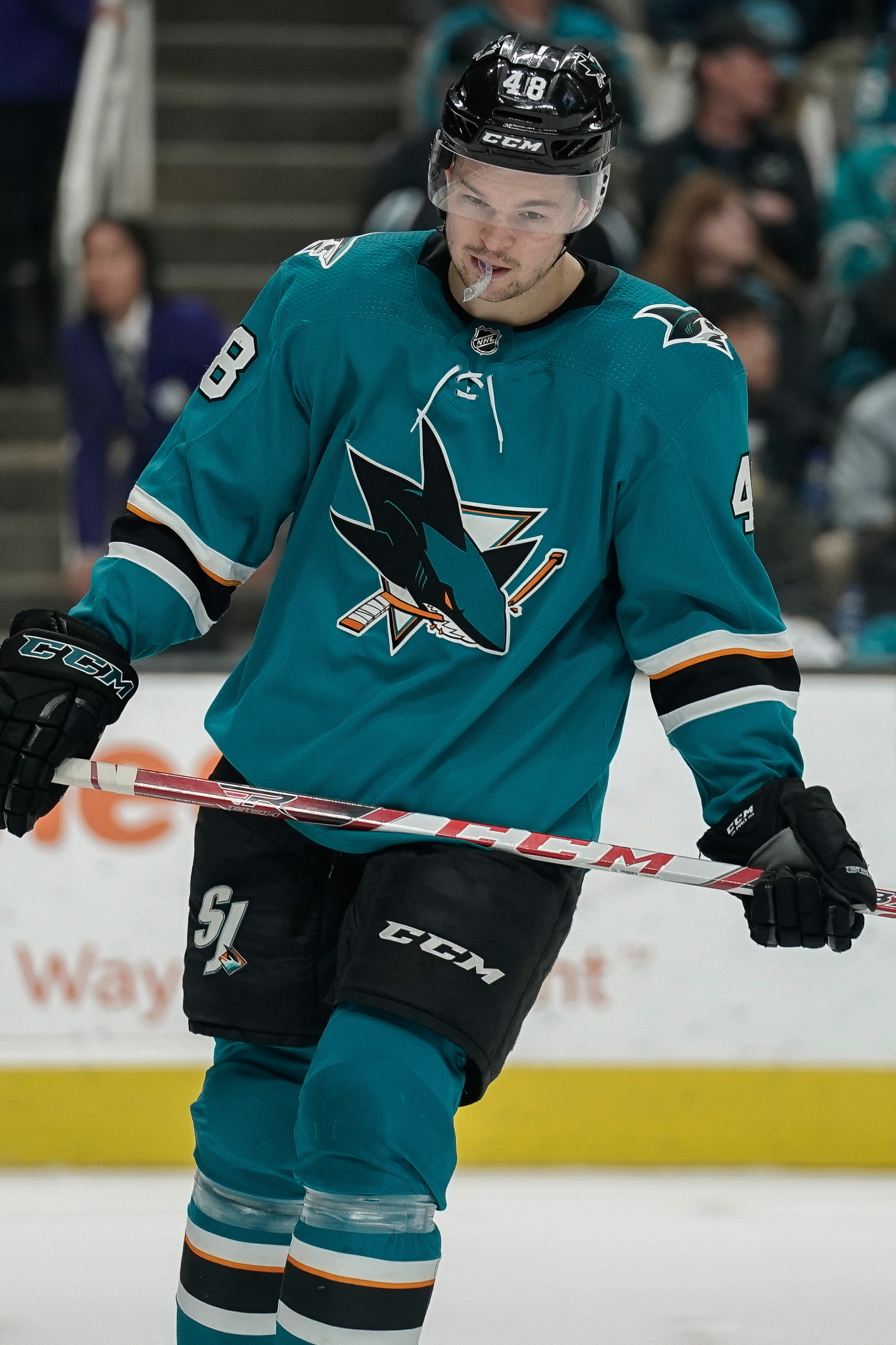 Hertl’s name has been in trade speculation over the last couple of weeks following some comments earlier this month that suggested he may not be with the Sharks beyond the upcoming season. He has become their top-producing center, successfully making the transition from playing the wing at the start of his career. In doing so, his market value has increased considerably. While he may not be able to market himself as a true number one center, quality middlemen are always in high demand and low supply on the open market. Accordingly, a $2MM jump in AAV seems realistic and if it’s not coming from the Sharks, will whoever acquires him closer to the trade deadline hand him an extension as part of the swap?
Gambrell had a big jump in playing time last season but the production was still middling. He’s serviceable in a limited role and can kill penalties but that’s not a spot where they can afford to pay much more than what they’re currently paying and his arbitration eligibility could work against him. Cogliano is a capable placeholding veteran that could be a trade candidate if they’re out of contention at the trade deadline. He’ll be subject to the 35-plus designation next year so he’ll probably be going year-to-year from here on out. Barabanov did well in a very limited stretch after coming over from Toronto and should get a shot at a bigger role. A good showing could have him in line for a considerable raise but if that doesn’t happen, he’ll be a candidate to go back to the KHL. Dahlen managed to land a one-way deal which is impressive for someone who played in Sweden’s second division last season. He’ll get a shot at earning a regular spot in camp and if that doesn’t happen, his time in North America could be short-lived. Merkley came over in an offseason trade from New Jersey and will push for a spot on the fourth line; that roster spot will likely continue to be filled by someone making the minimum or close to it moving forward.
Meloche split last season between the Sharks and the taxi squad and at this point, they’re likely to carry a seventh defender that can clear waivers and go back and forth when needed. He’ll battle Jacob Middleton ($725K) for that role unless someone else is brought in between now and then.
Two Years Remaining
F Rudolfs Balcers ($1.55MM, RFA)
F Nick Bonino ($2.05MM, UFA)
D Adin Hill ($2.175MM, UFA)
F Timo Meier ($6MM, RFA)
F Matt Nieto ($850K, UFA)
F Lane Pederson ($750K, RFA)
G James Reimer ($2.25MM, UFA)
Meier hasn’t been able to get back to the per-game production he had before signing this contract, one that carries the poison pill of a $10MM qualifying offer at its expiry. It’d be hard to justify paying him that much while that qualifier also hurts his trade value unless an early extension can be worked out in 2022-23. Bonino came over in free agency, signing a deal that was below our projection for him. As far as third centers go, he’s a decent one on a below-market contract. Balcers has been one of the better recent waiver claims around the league and is in a spot where he can play a regular middle-six role. As long as he stays there, they’ll get a good return on this deal. Nieto and Pederson will be cheap depth players and will be retained around that price point or replaced by someone else making that money.
Hill hasn’t had much of an NHL opportunity but he’ll get one now as he goes from being Arizona’s backup to the starter with the Sharks. We’ve seen the type of money even top backups get let alone starters; both are price points well beyond what he’s making now so the opportunity for a big jump in salary will soon be there. Reimer returns for his second stint with the Sharks and after effectively being relegated to third-string duty in Carolina by the end of the year, he still landed a decent contract. He’ll be 35 for next trip to free agency and likely will have to go year-to-year at that point.
Three Years Remaining
F Kevin Labanc ($4.725MM, UFA)
D Radim Simek ($2.25MM, UFA)
Labanc’s contract was a pricey one for the year he was coming off of but it was also a reward for taking a very team-friendly deal the year before. Unfortunately for him and the Sharks, last season wasn’t much of an improvement. If he gets even close to his 2018-19 numbers, they will get a reasonable return on his deal but right now, this one is a bit of an overpayment.
Simek’s deal also falls under that category. He was their sixth defender some nights and that type of term and money for someone in that role is not good value.
Winnipeg Jets Need To Make Changes To Be Cap-Compliant
The Winnipeg Jets are a team looking to improve after a couple of subpar regular seasons. Most of their shortcomings have been due to the team’s defense after unexpectedly losing Dustin Byfuglien after the 2018-19 season. Winnipeg made a flurry of moves to address that issue this offseason, acquiring Nate Schmidt and Brenden Dillon to replace Derek Forbort and Tucker Poolman, both of those replacements being undeniable upgrades. While the team looks poised to have more success than in the past few seasons.
They brought Paul Stastny back into the fold on a one-year, $3.75MM deal to help continue to solidify their top-six forward group. But one long-time important piece won’t be returning to Winnipeg this season — Bryan Little. Little suffered a concussion and ruptured eardrum after playing just seven games in 2019-20, and it’s unlikely that the longtime Thrashers/Jets forward suits up ever again. Instead, his $5.3MM cap hit will go on long-term injured reserve for yet another season.
Still, that maximum of $5.3MM as a cap cushion isn’t enough for Winnipeg right now, as they currently sit at $5.8MM over the cap with a full roster. While Winnipeg could send just one forward down to become cap-compliant, it leaves them with very little wiggle room throughout the season in case of injury and hinders their flexibility at the trade deadline.
The most likely short-term solution is to send forward David Gustafsson to Manitoba. He’s one of only two players who aren’t waiver-eligible on the Winnipeg active roster. But after scoring 19 points in 22 AHL games last year, he’ll likely push for an NHL role throughout the season. They also could opt to send defender Sami Niku down to the minors, as his tenure with the club hasn’t gone very smoothly, but risk losing him on waivers to a team willing to take a chance on his development. They’ve tried to deal Niku in the past with no takers, as teams likely anticipate that he’ll be available for them to select on the waiver wire at some point in the future.
There are other names, such as Dominic Toninato and Jansen Harkins, that could see some time in the AHL as a short-term solution to Winnipeg’s salary cap situation. The reality stands that Winnipeg likely needs to make an additional move to create some cap flexibility for a team that needs it to be a contender this year.
All cap figures courtesy of CapFriendly.
West Notes: Yamamoto, Demers, Olausson
This weekend continues to be a slow one for the hockey news cycle. With less than two weeks until the start of preseason, teams and players remain in limbo alike on remaining negotiations. One of the more prominent restricted free agents remaining is Edmonton Oilers forward Kailer Yamamoto, who needs a new deal after scoring eight goals and 21 points in 52 games last season. It’s a step back in production after he broke onto the scene in 2019-20, scoring 26 points in just 27 games. But as names like Joel Farabee and Drake Batherson, both decent comparables to Yamamoto, have signed larger, longer-term contracts recently, The Edmonton Journal’s Jim Matheson surmises that this likely won’t be the case for Yamamoto. As the addition of Zach Hyman and Warren Foegele into the picture puts Yamamoto’s top-six role in a small amount of jeopardy, combined with a tight salary cap picture for the Oilers, Matheson suggests Tyson Jost‘s two-year, $2MM cap hit deal as a closer comparable for the former first-round pick. As of now, that deal would still push Edmonton over the maximum $4.17MM that they’ll be able to exceed the cap by due to Oscar Klefbom being placed on long-term injured reserve. Edmonton is listed as having a full 23-man roster on CapFriendly, though, and could send players like William Lagesson and Brendan Perlini to the minors to become cap-compliant.
Elsewhere from around the Western Conference:
- PHNX Sports’ Craig Morgan writes that unsigned free agent defenseman Jason Demers is still skating in Arizona, hoping to land an NHL role for the upcoming season. While Demers was never known for his offensive production, he scored only four assists in 41 games this year and saw his ice time dip below 20 minutes a night for the first time since 2016-17. His defensive game struggled this season as the 32-year-old defender combatted injury but still remains an effective third-pairing option. Morgan also notes that once Demers is done in the NHL, he plans to make a stop in the Swiss National League, noting it’s always had an appeal to him.
- The Athletic’s Peter Baugh reports that Avalanche prospect Oskar Olausson has confirmed his intention to join the OHL’s Barrie Colts this season. Attending Avalanche development camp at the moment, Olausson signed his entry-level contract at the end of August. While he was a first-round pick this last season (28th overall), it was unlikely that he’d make the team out of training camp, and now confirms that he won’t return to Europe, reaffirming the news from late August that he’d joined Barrie.
Minor Transactions: 09/12/21
With NHL training camps opening up later this month, those unsigned players who aren’t willing to wait around for a PTO will have to start making tough decisions. That could mean settling for a contract in the minors, making the move overseas, or perhaps even retiring. Keep up with all of those moves for familiar names right here:
- Former NHL forward Jordan Caron has called it a career. The 30-year-old has retired “surprisingly”, reports the ICEHL’s Vienna Capitals, who only signed Caron in July. The team reports that he has decided to return home to Quebec for personal reasons. A first-round pick of the Boston Bruins in 2009, Caron was never more than a depth asset in the NHL with Boston, Colorado, and St. Louis, with highs of 48 games and 15 points set early in his career. However, he has been a much more dominant scorer over the past five years in Europe, playing Germany, Russia, Switzerland, and Austria.
- For the first time since leaving the NHL in 2018, Christoph Bertschy is on to a new team, though not making a return to North America (any time soon). The Swiss forward is staying at home, but moving on from the NLA’s Lausanne HC to HC Fribourg-Gotteron. This is not a small commitment, either. Gotteron has announced a whopping seven-year contract with Bertschy, who was considered one of the top names on the Swiss market. At 27 years old with three seasons of strong production in the NLA before missing most of last season, Bertschy has proven himself a valuable asset and Gotteron stated that he will play a “central role”. The former Minnesota Wild may have been a candidate to return to the NHL if he continued to excel in Switzerland, but seems content to likely play out his career in his native country.
- After playing on an AHL contract with the Iowa Wild last season but only seeing ECHL action with the Allen Americans, veteran journeyman forward Jesse Mychan has signed a one-year deal with the ECHL’s Kansas City Mavericks, the team announced. A former WHL standout power forward who has produced at a high level in the ECHL and proved himself valuable as an enforcer in the AHL, Mychan’s career has also taken him to the UK, Germany, Austria, Slovakia, and Denmark.
- A former OHLer and longtime ECHL player, Matt Carter has opted to continue his career with the Fife Flyers in the EIHL after taking the 2020-21 campaign off. Carter has been playing professionally since 2011-12 after the now 34-year-old forward finished his college career with the University of Prince Edward Island. Undrafted after scoring 30 goals in 2007-08 for the Owen Sound Attack, Carter was a true journeyman, playing ECHL contests for the Phoenix Roadrunners, Cincinnati Cyclones, San Francisco Bulls, Las Vegas Wrangles, Elmira Jackals, and Fort Wayne Komets. He’s spent the majority of his career in the EIHL and French Ligue Magnus since going overseas in 2014-15.
This post will be updated throughout the day.
Atlantic Notes: Cozens, Seider, Sogaard
With the never-ending rumors of Jack Eichel‘s eventual trade on top of the departures of several other core Sabres this summer, its fair to wonder who will fill the leadership vacuum in Buffalo. However, young standout Dylan Cozens is more than ready to take on that role. Appearing on WGR 550 in Buffalo, the 2019 seventh overall pick stated that he is confident in his ability to lead this next generation of Sabres. “I think definitely I could go out and be a leader on this team,” Cozens said. “Just by the way I play, leading by example and being a voice in the room. I think it’s something I’m ready to do. I want to lead by example and be a guy that guys can look to if they need anything or look to to inspire them. That’s what I’ve always been growing up – the guy that wants to lead and do things the right way.” Part of what makes Cozens a great candidate to lead Buffalo for years to come is an optimism that has been missing from other core members through a dark stretch for the franchise. “I think that we’re going to surprise a lot of people this year,” Cozens believes. “Everyone’s doubting us because we’re a young team, but if you look at the second half of last season, we were beating those veteran teams. So I think we’re going to surprise a lot of people and we’re going to have a good year.”
-
- The Detroit Red Wings are looking forward to prodigious defenseman Moritz Seider developing into a leader for their club in the future. Yet, he was nowhere to be found on the team’s roster for the upcoming Traverse City Prospects Tournament. However, Red Wings Director of Player Development Shawn Horcoff tells The Athletic’s Max Bultman that this is actually an endorsement of Seider’s position in the organization rather than an indictment. Although Seider has yet to see any NHL action, Detroit is so confident in his ability to make the roster this season that they did not feel they needed to use a roster spot on him in the development tournament. “With Moritz, he’s played two years of pro now – he spent a full year in Grand Rapids, spent a full year over in Europe playing,” Horcoff explained. “Frankly, there’s some younger players that we wanted to see on the (Traverse City Tournament) roster and we just wanted to make sure that Mo was ready to go for main camp.” Fear not, Wings fans; the team clearly has no concerns about their top prospect stepping into the NHL lineup and making an impact this year.
- The Ottawa Senators could face a difficult decision with young goaltender Mads Sogaard this season. As Bruce Garrioch details for the Ottawa Sun, the impressive prospect keeper could very well be in line for a roster spot at the Olympics for Team Denmark, making their first men’s hockey appearance at the Winter Games. Sogaard served as the team’s backup in qualifying tournaments this summer and while the those contests were played without presumptive starter, the Carolina Hurricanes’ Frederik Andersen, Sogaard is still likely to be the Danes’ first choice at third-string behind Andersen and qualifying starter Sebastian Dahm. The problem is that the AHL does not have an Olympic break like the NHL. While Ottawa’s players will have full flexibility to attend the Games if selected, Belleville’s may not. Garrioch points out that the farm team has ten games during the NHL’s Olympic break and, depending on how the organization’s goalie depth plays out this season, that could be a number of missed starts for Sogaard and a detriment to Belleville as well. The massive 6’7″ keeper had a strong first pro season last year and if fellow promising youngster Filip Gustavsson cracks the Ottawa roster, Sogaard could be the starter for Belleville. Will the Senators allow him to leave the team for an extended period in order to ride the bench for his country?
Buffalo Sabres Limited By Salary Cap Floor
The Buffalo Sabres will be over the NHL’s salary cap floor by the start of the season, that much is obvious. While CapFriendly currently has the club sitting $2.3MM below the $60.2MM benchmark, that is with a 22-man roster that does not include unsigned RFA defenseman Rasmus Dahlin. While the 2018 first overall pick is not quite yet proven himself worthy of the considerable long-term deals signed by other top defenseman this off-season, he will surely make more than $2.3MM AAV on his next contract.
Yet, that does not end the Sabres’ battle with the cap floor. Just because they begin the season over the floor, does not mean that they will remain as such all season – or at least not if they wish to have flexibility with their transactions. Buffalo is again expected to be among the NHL’s worst teams this season and will be open to selling current members of the roster. Of course, Jack Eichel is the biggest name who could be available. However, at $10MM AAV it has been brought up numerous times that an Eichel trade is not as easy as it may seem. A team may offer a plethora of top picks, prospects, and entry-level players, but the Sabres would not be able to make that deal alone, as it would leave the team well below the salary cap floor regardless of Dahlin’s contract. Buffalo would have to acquire a nearly equal amount of salary back in the deal or else be prepared to quickly turn and add that salary in another deal. As a rebuilding team, the Sabres also won’t eager to add high-priced veterans who serve little purpose to a team with no title hopes. It makes an already difficult situation with Eichel all that much more tricky.
Even if Eichel begins the season with Buffalo, which seems increasingly likely, and even plays out the year with the team, the cap floor will still come into play. As the trade deadline approaches, the Sabres want to be in position to take full advantage of their valuable trade assets. The team has four forwards, four defensemen, and two goalies who are impending UFA’s and whose expiring contracts would be worth far more to another team. Colin Miller ($3.875MM), Will Butcher ($2.823MM), Cody Eakin ($2.25MM) and Vinnie Hinostroza ($1.05MM) stand out as potentially popular trade candidates at the deadline. Depending on Dahlin’s contract, could they move Hinostroza or maybe even Eakin or Butcher without going below the floor? Probably. But Miller? Or multiple moves? Likely not. The deadline is also not a place that is likely to offer even salary swaps.
If GM Kevyn Adams and the Sabres want to enter the 2021-22 season with the confidence that they can make any move they want without limitation, they need to find a way to sensibly add salary to the roster. For a rebuilding team, it may be difficult to think about adding salary to a team that won’t contend, but it would be a short-term sacrifice to ensure their long-term plans are not affected. The team could explore the trade market for a veteran or two that can help to develop the young roster or perhaps a young, but overpaid reclamation project. Or maybe they could entertain adding a legitimate starting goalie. They could also explore the free agent market which, even late in the summer, still has some attractive names available. With the Sabres pegged to give roster spots to minimum-salary fourth-liners like Drake Caggiula and John Hayden, it might make more sense to give those slots and more importantly more salary to a high-upside project like Ryan Donato, Alex Galchenyuk, or Nikita Gusev or a veteran leader like Tyler Bozak, James Neal, or Jason Demers.
The Sabres have plenty of options to solve their salary cap floor conundrum beyond just re-signing Dahlin. However, those options could disappear if they don’t act quickly, and with it their transactional flexibility this season.
NHL Teams Facing Decreased Daily Cap Expenses In 2021-22
While the general sentiment surrounding the NHL’s return to the Olympics at the 2022 Winter Games is excitement, it isn’t without its downsides. The momentum of the regular season will be halted, participating players will face injury and COVID-19 risks, and non-participating players growing cold over the 19-day break. One additional issue is the extended timeline for the regular season and the impact it has on salary cap expenditures. As noted by cap resource PuckPedia, the length of the 2021-22 regular season is expected to be 200 days whereas the typical season is about 186 days. Those extra 14 or so days decrease the value of daily cap hits, making it more difficult for teams to accrue cap space over the course of the regular season. In yet another flat cap year, this could pose problems for some teams close to the cap ceiling.
While the salary cap and individuals salaries are often viewed in a season-long, overarching fashion, cap maintenance is in fact a series of daily calculations. The cap is tolled each day by the salaries on the active roster as a value of each cap number divided by the total days in the season. As a result, in a longer season each daily cap expense is worth less than in a normal year. Where this comes into play is with cap-driven demotions. Each year there are a number of teams who are close to the cap limit that open up additional space by removing salary from the active roster in the form of reassigning players who are exempt from waivers or have otherwise cleared waivers to the AHL. These can just be off-day paper transactions, extended demotions during homestands, or sometimes waiving and burying larger salaries in the minors. However, during a longer season these maneuvers are less effective as the daily gain from demoting a player will be lower.
Daily salary cap calculations only matter to those teams with salary cap space, so the nine teams currently expected to begin the season using Long-Term Injured Reserve are not as worried about this predicament. Daily tolling also impacts teams with ample cap space far less and there are currently a dozen teams who sit $7MM or more below the cap ceiling with at least nine or ten expected to stay in that range. However, for the Maple Leafs, Flames, Penguins, Flyers, Capitals, Bruins, Panthers, Blues, Avalanche, Kings, Canucks, and Wild, this lesser daily cap expenditure is not irrelevant. A team like Toronto, which is in fact currently over the salary cap limit with a projected roster than includes only one waiver-exempt player in defenseman Rasmus Sandin, will have possibly their only source of additional cap relief diminished. The Pittsburgh Penguins, who currently have just $122K in cap space with a projected roster than contains only the minimum contract of Radim Zohorna as waiver-exempt, are in the same boat.
Fortunately, PuckPedia points out that the same source of cap distress could also provide relief. During the Olympic break, teams with the ability to safely demote players will almost certainly do so. Those 19 days not counting against the cap will help to offset the reduced daily hit over the rest of the season. It could also allow those players to stay fresh with AHL action during that time.
Snapshots: Hertl, Penguins, Forsberg
Tomas Hertl’s comments earlier this month which expressed some uncertainty about his long-term future with the team have thrust him into trade speculation. For the time being, it seems likely he’ll start the season and he and the Sharks will re-assess things from there. However, if San Jose opted to trade him, Kevin Kurz of The Athletic examined (subscription link) what the framework of a potential deal might look like. He suggests that San Jose’s preference likely wouldn’t just be draft picks but that adding a top prospect that’s a little closer to being NHL-ready – one that fits the timeline of their recent top selections – would likely be a goal for GM Doug Wilson. Hertl carries a $5.625MM AAV for this coming season and stands to earn considerably more on his next contract and if they opt to set that high of a price point whenever the decision is made to move on, an extension may need to be part of the trade in order to justify the higher acquisition cost for the other team.
More from around the NHL:
- While the Penguins haven’t had much playoff success as of late, team president Brian Burke told Sportsnet’s Eric Francis that he doesn’t feel the time is right to rebuild yet. Pittsburgh wasn’t able to add much to their roster this summer – Brock McGinn was their biggest acquisition – but he feels the core is still good enough to contend. With both Evgeni Malkin and Kris Letang set to become unrestricted free agents next summer, that will be the key time for a decision to be made on whether this core can still contend or it’s time to change things up.
- Matt Porter of The Boston Globe posits that the Predators should consider trading winger Filip Forsberg. The 27-year-old is entering the final year of his contract and with Nashville heading into what appears to be some form of a rebuild, extending him would go against that direction and take away some potential assets to add to their future core. Forsberg carries a $6MM AAV without any form of trade protection which would give the Preds some extra flexibility to find him a new home if they decide to go that route at some point during the season.
Rangers Begin Extension Talks With Mika Zibanejad
The Rangers have started discussions on a contract extension with center Mika Zibanejad with a mutual objective of getting an agreement in place, reports Larry Brooks of the New York Post (subscription link). The 28-year-old has played on what has become a very team-friendly deal for New York over the past four seasons and that contract, which carries a $5.35MM AAV, is now in its final year, setting him up to hit unrestricted free agency next summer.
Zibanejad has seen his offensive production increase sharply over the past three seasons. He notched 74 points in 82 games in 2018-19, then managed to beat that total by one in 25 fewer games in 2019-20. While his output dipped last season, he still managed to put up 50 points in 56 contests. While it took him a while to get there, Zibanejad has produced like a legitimate number one center over the past three years.
Accordingly, Brooks pegs his asking price of being upwards of $10MM per season on a long-term pact of either seven or eight years. Interestingly enough, that price tag is what Buffalo’s Jack Eichel costs and New York has been linked to him in trade speculation all summer long and adding his contract would all but eliminate the possibility of being able to afford an extension for Zibanejad.
One comparable that GM Chris Drury will likely want to point to is Philadelphia’s Sean Couturier, who inked an eight-year extension with a $7.75MM AAV earlier this summer. He also recently had a two-year spike in offensive production before settling down a bit last season. Something at or slightly above that price point is where they’d likely want to go.
While the idea of signing Zibanejad to a max-term contract may not necessarily be desirable as he’ll be 37 at the end of such a deal, if the inclusion of that extra season helps bring the cap hit down, it may be worth doing. Right now, cap space isn’t an issue but that will change fairly quickly.
Next summer, they have nearly $53MM in commitments to 14 players, per CapFriendly, but that amount would dwindle quickly with a deal for Zibanejad and defenseman Adam Fox who is undoubtedly heading for a substantial raise of his own. Youngsters Kaapo Kakko and Vitali Kravtsov will also be restricted free agents of their own while a year later, 2020 top pick Alexis Lafreniere will need a new deal as well. As their cheap entry-level contracts expire, the price tag of this roster will go up quite quickly.
Even with those extensions, there is still room for one pricey middleman. If they eventually wind up with Eichel, it won’t be Zibanejad sticking around barring one of their other high-paid players being moved elsewhere. But if those talks continue to prove unfruitful, a long-term agreement with Zibanejad – who has made it clear that he wants to stay with the Rangers – may very well be the next best thing. Brooks adds that talks have been productive so far so that process at least appears to be off to a decent start.
Oilers Re-Sign Cooper Marody
The Oilers have taken care of one of their remaining restricted free agents, announcing the re-signing of winger Cooper Marody to a one-year, two-way contract. The deal pays the league minimum of $750K at the NHL level, meaning he accepted less than what his qualifying offer was for. 630 CHED’s Bob Stauffer reports (Twitter link) the AHL portion of the contract is worth $150K. Marody was eligible for salary arbitration earlier this summer but opted not to file.
The 24-year-old tied for the team lead in scoring last season with AHL Bakersfield, recording 21 goals and 15 assists in 39 games. Over parts of four seasons, Marody has produced at close to a point per game clip, recording 120 points in 130 contests. Despite that, his NHL opportunities have been limited to just six games with Edmonton back in the 2018-19 season.
Marody will be waiver-eligible for the first time in training camp and that type of production at the minor league level could get him on the radar of teams if he was to be placed on the wire to send back to Bakersfield. Before it comes to that, however, he’ll have a chance to battle for an end-of-roster spot with the Oilers in training camp.
Edmonton GM Ken Holland still has some work to do on the RFA front as winger Kailer Yamamoto remains unsigned with the start of camps less than two weeks away. With limited cap space, the expectation is that he will ultimately have to take a short-term contract in order to keep the cap hit down.