
Ondrej Pavelec Announces His Retirement
For any teams considering Ondrej Pavelec as a potential backup goaltending option for this season, they’ll have to look elsewhere. The 31-year old goaltender announced his retirement today on Instagram, ending his NHL career after 398 regular season games.
Originally selected in the second round of the 2005 draft, Pavelec quickly made an impression on the Atlanta Thrashers and made his NHL debut soon after his 20th birthday. He would eventually take over as the starter in Atlanta, and be a big part of the first season in Winnipeg after the city’s team returned in 2011. Though he’d continue to start for the Jets, Pavelec was never really able to establish himself as an upper echelon goaltender in the NHL. During his best season in 2014-15, he took the Jets to the playoffs but was swept in four games while allowing fifteen goals.
This past season Pavelec finally departed the only franchise he ever knew and played as the backup for Henrik Lundqvist in New York. In 19 games he recorded a .910 save percentage, but wasn’t retained and became an unrestricted free agent. Though it seems early for Pavelec hang up his pads, former Thrashers beat writer Ben Wright shared on Twitter that the goaltender “always said he’d stop when it wasn’t fun anymore.”
Chris Lee Retires From Professional Hockey
For fans tuning into the 2017 World Championships, a player stuck out like a sore thumb on the blue line for Team Canada. Wearing number 42 among the other NHL stars was a face that few recognized, but would learn to appreciate by the end of the tournament. Chris Lee stepped into a roster spot and ice time vacated by an injured Tyson Barrie and recorded two points in seven games en route to a silver medal. Lee had never played in the World Championships—or any major international tournament—for Canada before, and had no prior NHL experience.
Lee at the age of 36, had parlayed a 65-point season in the KHL into an invitation to the tournament where he played exceptionally well. Success in the KHL wasn’t a new experience for Lee, who had been one of the best offensive defensemen in the league since coming over from the German DEL and Swedish SHL—two other leagues he dominated in his short time there. There was also successful stints in the AHL prior to that, but they never even earned him an NHL contract let alone a sniff of the highest level of professional hockey.
The undrafted defensemen signed a professional tryout with the Los Angeles Kings for their 2017 training camp, but didn’t make the team. He returned to the KHL and Metallurg Magnitogorsk while also suiting up for Canada at the Olympics. He wore an “A” as an alternate captain of that squad, which wasn’t allowed to include NHL players this time around. An Olympic bronze medal came about this time around, but the Gagarin Cup was out of reach in 2018 for his KHL squad.
Last night in a lengthy ceremony, Lee’s retirement and career was honored by Magnitogorsk as his number was raised to the rafters. The team released a “thank you” article, and Lee even received a star outside the arena. A two-time Gagarin Cup champion, Lee goes down as one of the extreme oddities in the history of Canadian international hockey competition, at least in the modern era. Never given a chance at the NHL level and overlooked for much of his career, he still found incredible success on the ice as a player.
Keith Aucoin Retires From Professional Hockey
If you’re a fan of only the NHL, you may only barely recognize Keith Aucoin‘s name. The 39-year old forward played just 145 games in the league, and recorded just 49 points. But if you’ve watched AHL hockey throughout the last 15 or so years, you’ll understand that an incredible playing career ended recently when Aucoin announced his retirement. One of the best minor league players in recent history, Aucoin also dominated in Europe for the last four seasons.
Aucoin ranks seventh on the all-time AHL scoring list with 857 points in just 769 games, and fifth on the all-time assist leaderboard. His minor league career started in 2001-02 after an incredible career at Norwich University, and ended in 2013-14 when he finished the season with 43 points for the Chicago Wolves. During that time he also suited up for the Carolina Hurricanes, Washington Capitals, New York Islanders and St. Louis Blues, but was never given a full season to show what he could do at the NHL level.
The forward went undrafted in a time when small, undersized players were often overlooked, but still quickly proved his offensive prowess. Aucoin won two Calder Cups during his minor league career and was named AHL MVP in 2010 after scoring 106 points in 72 games for the champion Hershey Bears. According to Barry Scanlon of the Lowell Sun, Aucoin has taken a coaching position with the Boston Junior Rangers after a long an prosperous hockey career.
“A Lot Of Doubt” Still Surrounds Henrik Zetterberg’s Future
Reports have surfaced every few weeks this summer that Detroit Red Wings captain Henrik Zetterberg may not play in the 2018-19 season due to a lingering back injury, and last week GM Ken Holland muddied the water even further. Holland called Zetterberg an “unknown” when speaking to reporters, and indicated he would know more in September. That timeline is what head coach Jeff Blashill repeated to Ted Kulfan of the Detroit News, but seemed even less confident in Zetterberg’s ability to play this season:
He’s had a hard summer and I don’t think his back is reacting great. Certainly we’ll know more in a month, but as of today, there’s a lot of doubt as to whether his back will be healthy enough to play.
If Zetterberg does sit out the year, the Red Wings could put his $6.08MM cap hit on long-term injured reserve to create some more cap flexibility. The actual salary of his deal drops to just $3.35MM this season, and the contract will pay him just $1MM in each of the next two years. That seems like quite the coincidence given that Zetterberg hasn’t missed a regular season game in three straight seasons, but Blashill was quick to point out that his captain was also forced to stop practicing entirely for the last two months of the 2017-18 season.
From 1990-91 to 2015-16 the Red Wings never missed the postseason, and Zetterberg played a crucial role in many of those seasons. He, Pavel Datsyuk and Nicklas Lidstrom formed the core of a powerhouse team for years, until the latter’s retirement in 2012. Now having missed the postseason in back to back years, the Red Wings will try to form a new young core of players like Dylan Larkin, Filip Zadina and Anthony Mantha to get them back to the promised land and compete for the Stanley Cup once again. It never seemed like Zetterberg could be a real part of that, even without a career-threatening injury popping up. The 37-year old has seen his offensive numbers decline in recent years, to the point of just scoring 11 goals last season. That was the lowest full-season total of his career, and one that the team should be able to replace.
They won’t as easily replace his leadership though, which will put even more pressure on Larkin to develop into a true first-line center. Without that the Red Wings could be in for a tough season, given their cap problems and lack of real elite talent throughout the lineup.
If it is the end for Zetterberg, he would be leaving the game with 960 career points in 1,082 regular season games. The veteran forward has been in Selke contention for nearly his entire career as one of the better defensive forwards in the league, and took home a Conn Smythe trophy during the Red Wings 2008 Stanley Cup run. Undoubtedly one of the most well-respected and beloved Red Wings players in history, this would be a tough way to see his career come to an end.
Snapshots: Sharks, Trottier, Vitale
Are the San Jose Sharks done for the summer? In a mailbag for The Athletic, Kevin Kurz addresses the concerns of some fans that the team has not done enough this off-season after missing out on John Tavares. Kurz states that GM Doug Wilson still has the full faith and support of ownership – as he should seeing that the Sharks have the highest average finish in the league during his tenure – and reiterates that Wilson always says that the roster isn’t complete until the trade deadline. Given that San Jose hit a home run with the Evander Kane trade this past spring and fueled their Stanley Cup run in 2016 by adding James Reimer, Nick Spaling, and Roman Polak, that mantra has been proven true. However, is waiting until March going to cut it this season? Kurz points out that between Tavares, Ilya Kovalchuk, and Max Pacioretty, it seems that the Sharks wanted to do more this summer. Pacioretty is still one of several potential trade targets prior to the beginning of the season, but it seems more likely that the Sharks will go into the season as is and let their play in the first few months of the season dictate whether a big move is necessary or not. However, a slow start or a major injury could cause Wilson to reinvigorate his search for scoring depth.
- The New York Islanders have had a far worse summer than the Sharks and maybe any team in the league, but one of the franchise legends is still confident in the direction of the team. Hall of Famer Bryan Trottier sat down with NHL.com’s Dave McCarthy recently and spoke about the “bright future” of Mathew Barzal and the Islanders, despite the departure of John Tavares. “For him to… have the kind rookie season he had, he’s not disappointing anyone… I see wonderful things for Mathew in the future and for the Islanders”, Trottier stated. Between a legitimate rising star in Barzal and an impressive pipeline featuring the likes of Kieffer Bellows, Oliver Wahlstrom, Noah Dobson, Bode Wilde, and Robin Salo, Trottier is right that the future is bright, but the Isles will likely have to endure a few brutal years before they reach that point. Yet, Trottier also spoke to the credibility that new GM Lou Lamoriello and new coach Barry Trotz bring to the team and feels that with their leadership and the talent on the roster, the team can still succeed if others step up. This first season without Tavares will be telling as to how the team will fare in the coming years.
-
One recently retired NHLer is getting back into the game. The Blues have hired St. Louis native Joe Vitale as their new radio analyst for next season, writes Jim Thomas of the St. Louis Post-Dispatch. Vitale announced his hiring live on the Blues’ radio affiliate, KMOX, saying:
“This is my city… I always wanted to be a Blue. I’m so passionate about this team, since I was born from the very get-go with my dad bringing me to games as a kid.”
Vitale played six seasons in the NHL, mostly with the Pittsburgh Penguins but wrapping up his career with the Arizona Coyotes after head injuries forced him into premature retirement. Now, he’s feeling positive about getting back into the game with his hometown team. Vitale was a high-energy player, a checking line regular and face-off specialist during his career, and will likely bring that same energy to the Blues broadcast.
Snapshots: Middleton, Sharks, Morrisonn
The Boston Bruins will add another memorable name to the rafters of TD Garden this season, as the team announced today that they will retire Rick Middleton‘s #16 on November 29th. Middleton starred for the Bruins for twelve seasons from 1976-1988 and recorded 898 points in 881 games, fourth-most in Bruins history. His 402 goals rank third on a long list of impressive Boston alumni, behind only Johnny Bucyk and Phil Esposito, while his 496 assists rank sixth behind the likes of Bucyk, Esposito, Ray Bourque, Bobby Orr, and Wayne Cashman. Seeing as all but Middleton and Cashman of that group have had their numbers retired, it seems fitting that “Nifty” was next up. Yet, Middleton was surprised to receive a call from President Cam Neely today, saying he was “knocked off (his) feet” by a “dream come true”. Middleton’s number retirement will be the eleventh by Boston and will ironically be the first for the Bruins since Neely himself was honored in 2004. Who could be next for Boston? A past great like Cashman or perhaps a current long-time star like Patrice Bergeron or Zdeno Chara?
- The San Jose Sharks made some changes to their front office today that included players previously believed to still be active. The team named Ryan Hamilton, J.P. Cote, and Neil McKenney to their scouting staff, replacing Jimmy Bonneau and Michael Chiasson who have been promoted to AHL coaching roles. The release essentially served as a retirement announcement for Hamilton and Cote. Hamilton, 33, had been the captain of the AHL’s Bakersfield Condors for the past three years and last played in the NHL for the Edmonton Oilers in 2014-15. Cote, 36, has been playing in Europe for the past three years, but was a member of the Tampa Bay Lightning in 2013-14. McKenney has been hired away from his position as Director of Hockey Operations for Quinnipiac University in Connecticut.
- Former NHL defenseman Shaone Morrisonn is embarking on a interesting twist to his playing career. The 2001 first-round pick is entering his 17th pro season and will do so in largely uncharted territory. Morrisonn has been playing in the KHL since 2012, but will now move to the Oji Eagles of the Asia League. The league was only established in 2004, after Morrisonn had already begun his pro career, and has not attracted many well-known North American names over the years. Perhaps in closing out his own career, Morrisonn will open the door to more former NHLers continuing their careers in Japan, South Korea, and China. Hockey is certainly spreading to Asia and a player with at least some name recognition playing in the local pro league could go a long way in continuing to grow the game.
Jarome Iginla Officially Retires From Professional Hockey
One of the greatest power forwards to ever play in the NHL has officially called it quits today, as Jarome Iginla hangs up his skates for the last time as a member of the Calgary Flames. Though he hadn’t played professionally in over a year, today still marks the end of what has been an incredibly productive career for the 41-year old, who will finish up with 1,554 regular season games and 1,300 career points.
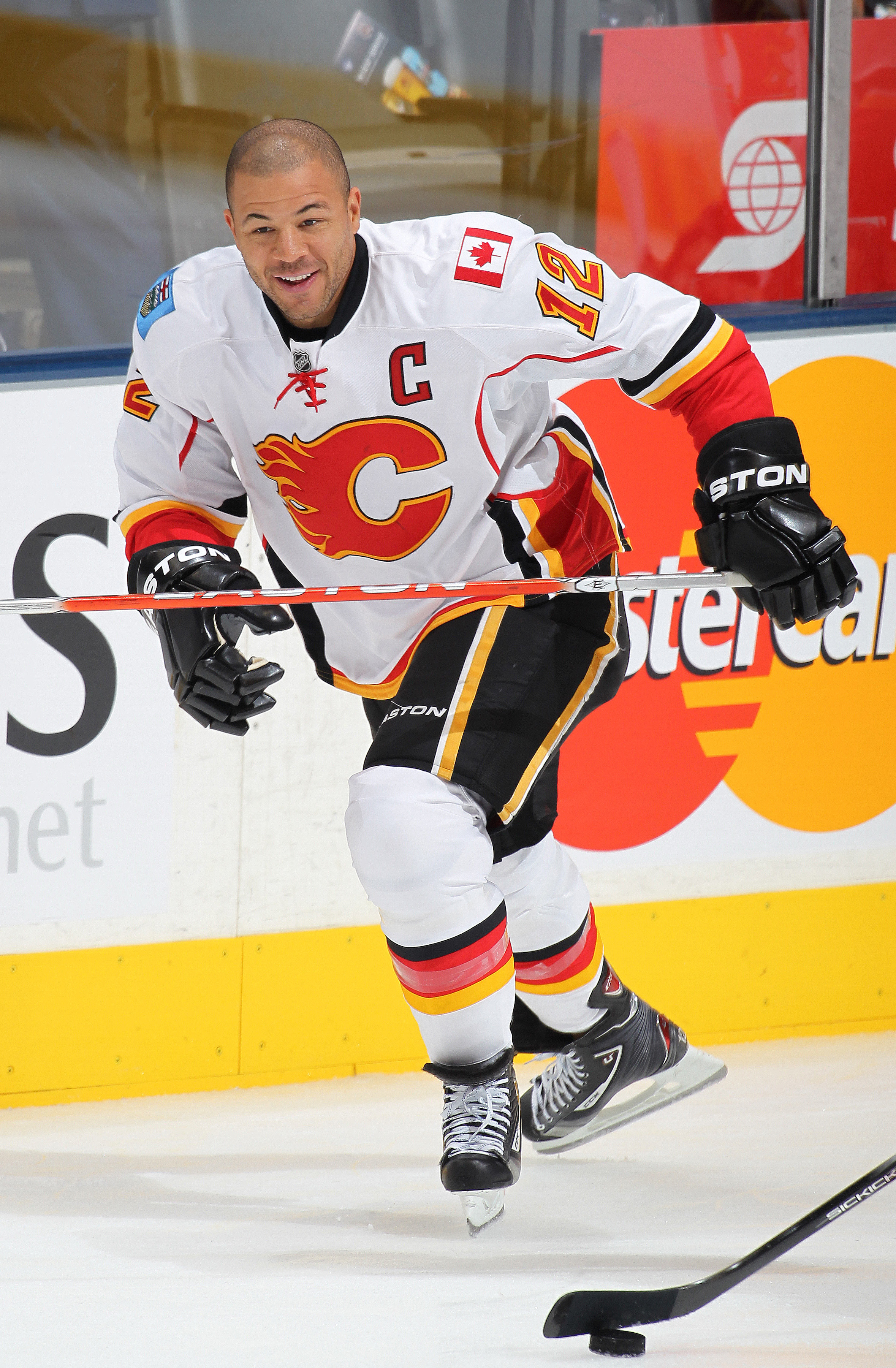 Though many remember him most as a young player for the Flames, Iginla was actually originally drafted by the Dallas Stars in 1995. Before he ever suited up in a professional game, he was already included in a deal for Hall of Fame forward Joe Nieuwendyk, who had won a Stanley Cup with the Flames but was embroiled in a contract dispute. Nieuwendyk would go on to help the Stars to another Cup in 1999, while Iginla would become one of the greatest Flames of all-time. In his first season during the 1996-97 season he scored 21 goals and was the runner-up to Bryan Berard—the first-overall pick from 1995—for the Calder Trophy as the league’s best rookie. Those 21 goals were a sign of things to come, as Iginla would go on to score 504 more in a Calgary uniform (532 including playoffs) and 625 (662) in his entire career.
Scoring goals was a huge part of Iginla’s game, but there was so much more to the Calgary forward. A physical specimen who seemed to never tire, Iginla would continually punish defenders with his physical play and protect the puck all over the ice. Willing to drop his gloves to protect a teammate or spark his club, the eventual captain of the Flames was feared for his hands whether they had a stick in them or not. Even in a sport that has had an incredible history of tough players, Iginla was unique in his approach. He twice led the NHL in goal scoring, and won the Art Ross trophy as the league leader in points in 2001-02. He would be named a Hart Trophy finalist multiple times, and was the Flames MVP for more than a decade.
Outside of his on-ice accomplishments though, Iginla was a beloved player off the ice as well. Though opponents would not ever want to face him, he was almost universally respected by the hockey world and extremely popular among fans all over the world. Countless former teammates have told stories over the last few days about Iginla’s generosity towards fans, recalling times when he would be still signing autographs long after the rest of the team had left. In Canada, a country for who Iginla won two Olympic gold medals, he was one of the faces of a generation of hockey players that took over after the Wayne Gretzky and Mario Lemieux years. That was no more apparent than when he set up Sidney Crosby for the “Golden Goal” in the Vancouver 2010 Olympics, once again battling physically in the corner to retrieve a puck and get it to a teammate in a dangerous location.
In the latter part of his career, Iginla bounced around the league trying to find a fit and bring home a Stanley Cup. Playing for Pittsburgh, Boston, Colorado and Los Angeles, Iginla would continue to find a way to score goals but never did bring home the elusive chalice. Though he’ll go down as one of the best players in NHL history to never win a Stanley Cup, he did find success at so many other levels. In addition to the two Olympic gold medals, Iginla won two Memorial Cups, and gold at the World Juniors, World Championships and World Cup.
There are few players who can truly be called unique in the game of hockey, and Jarome Iginla is one of them. Today he finished his professional career with the Calgary Flames and it won’t take long for him to get into the Hall of Fame.
Snapshots: Iginla, Kirk, Greco
The Calgary Flames announced today that Jarome Iginla will officially retire from professional hockey on Monday, though he hasn’t been an active player for a full season. Iginla, 41, did attend some AHL practices this past season and was a potential candidate for the Canadian Olympic team, but failed to actually play in any games. Monday will mark the end of a more than two decade long playing career that is sure to put him into the Hall of Fame without much delay.
Iginla ended up with 1,554 career regular season games in which he scored exactly 1,300 points. He never did raise the Stanley Cup—though Flames fans will still tell you how they deserved to win in 2004—but will still go down as one of the game’s all-time power forwards. With 625 career goals he ranks 15th on the career leaderboard, tied with Olympic teammate Joe Sakic. Iginla did win two gold medals at that tournament, and was the player who sent an incredible pass to Sidney Crosby for the “Golden Goal” in Vancouver in 2010. We’ll have more on Iginla’s retirement when it becomes official on Monday.
- Liam Kirk, the first English born and trained player to ever be drafted into the NHL, has signed on to play with the Peterborough Petes of the OHL this season. Kirk was selected 189th overall by the Arizona Coyotes in June, and will have to compete at a brand new level next season. Playing for the Sheffield Steelers last season in the EIHL, Kirk recorded just 16 points in 52 games. He’ll be asked to do more than that this season for the Petes, but will have the luxury of playing against players his own age.
- The New York Islanders have struggled for quite some time to find above-average starting goaltending, and they’ll try a different approach this season. The team has hired Piero Greco to replace Fred Brathwaite as their goaltending coach, taking him from the Toronto Maple Leafs organization where he has worked with their minor league affiliate for the past few seasons. Greco is credited for developing Maple Leafs goaltender Garret Sparks from a seventh-round afterthought into the AHL Goaltender of the Year, and will now try to turn around the careers of Robin Lehner and Thomas Greiss. Both goaltenders have shown high-level ability in the NHL, but will find some consistency if the Islanders are to compete in the Metropolitan Division this season.
Will O’Neill Signs AHL Contract With Wilkes-Barre/Scranton
In a somewhat surprising move, veteran defenseman Will O’Neill was unable to land an NHL contract this off-season. The 30-year-old blue liner was one of several signings announced today by the AHL’s Wilkes-Barre/Scranton Penguins. O’Neill returns to the Pittsburgh affiliate with whom he played for during the 2015-16 season on an NHL contract.
By any measure except age, O’Neill’s career trajectory appeared to be trending upward and certainly away from a minor league contract. The 2006 Atlanta Thrashers draft pick has spent almost all of his six-year pro career in the AHL, but every season except one has been played on an NHL contract. In fact, when O’Neill was last a free agent two years ago, he landed a two-year deal from the Philadelphia Flyers as a valued depth asset. This past season, O’Neill finally made his NHL debut and did not look out of place in a November contest against the St. Louis Blues. He also watched on as the extra man for several games with Philadelphia. In the AHL, O’Neill was a strong defensive presence and also recorded 19 points in 59 games with the Lehigh Valley Phantoms – well off his career-high 50-point mark in an All-Star campaign with the Penguins two years ago, but also in far fewer games and in a more conservative role.
At 30, O’Neill was unlikely to be an NHL regular for anyone this season or in the future, but it certainly seemed like he had established himself as a viable depth option for a team. Obviously, that wasn’t the case as the veteran opted to sign an AHL contract. O’Neill could be the latest victim of a slow market for older defenseman. Similarly situated aging extra defender Taylor Chorney decided to sign overseas last week, while the Boston-area native O’Neill instead chose to stay at home in the U.S. on a minor league basis. Several other veteran defenseman could be choosing between the same two routes – or retirement – in the coming weeks as a quiet off-season wears on.
The Salary Cap Implications Of A Shea Weber Early Retirement
When Shea Weber signed a 14-year, $110MM offer sheet from the Philadelphia Flyers in 2012, everyone knew right away that it would end badly. Yes, Weber was 27 years old and one of the top defensemen in the league, but the contract was top-heavy and carried a $7.86MM cap hit through his age-40 season. The chances of him playing to a level matching that value over a full 14 years was very slim. The Flyers knew this and specifically structured it in a way that they hoped would scare the Nashville Predators and frugal GM David Poile away – it didn’t. The Predators had just watched Ryan Suter walk in free agency and couldn’t afford to let Weber leave as well. They matched the deal and held on to their superstar defenseman.
When Weber was then traded to the Montreal Canadiens for P.K. Subban in 2016, the risk in Weber’s contract increased exponentially. The league had since banned all similarly long-term contracts – setting a limit of seven years on the open market and eight years for an extension – nevertheless the front-loaded, cap-circumventing type that Weber had signed. To combat teams continuing to front-load contracts, the NHL implemented salary cap recapture penalties. This system punishes teams for lengthening contracts with low-salary seasons in order to lower the cap hit during prime years by issuing a salary cap charge if the player retires prior to the end of the contract, thereby negating the years that lowered his cap hit. The calculation is the difference in total salary and total cap hit over the course of the contract with which the player played with the team, divided by the number of years remaining on the contract after retirement. In Weber’s case, the scenario looks like this:
Year Team Cap Hit Salary Difference
2012-13 NSH $7.857MM $14MM $6.143MM
2013-14 NSH $7.857MM $14MM $6.143MM
2014-15 NSH $7.857MM $14MM $6.143MM
2015-16 NSH $7.857MM $14MM $6.143MM
2016-17 MTL $7.857MM $12MM $4.143MM
2017-18 MTL $7.857MM $12MM $4.143MM
2018-19 MTL $7.857MM $6MM -$1.857MM
2019-20 MTL* $7.857MM $6MM -$1.857MM
2020-21 MTL* $7.857MM $6MM -$1.857MM
2021-22 MTL* $7.857MM $6MM -$1.857MM
2022-23 MTL* $7.857MM $3MM -$4.857MM
2023-24 MTL* $7.857MM $1MM -$6.857MM
2024-25 MTL* $7.857MM $1MM -$6.857MM
2025-26 MTL* $7.857MM $1MM -$6.857MM
So far over the course of Weber’s contract, both Nashville and Montreal have paid him far beyond what his cap hit would suggest. If Weber was to retire today, they would both be penalized. Nashville’s total penalty is $24.572MM, while Montreal’s is fluid. However, next season marks a drop for Weber below his cap number for the remaining eight years of his contract. Now, Weber is not going to retire this off-season. However, the chances that he retires early are very high. Earlier this week, it was reported that Weber had undergone a second off-season surgery and would likely be out until mid-season. Many expected when Weber was traded to Montreal that he still had many years left of strong play in him, but it appears that the deterioration of his body has already begun. Facing a decreasing salary for the remainder of his contract and concerns about his long-term health, it would be no surprise to see Weber retire in the next two years or so nevertheless by the end of the remaining eight years. By year, here is how the penalties would play out for both Nashville and Montreal:
If Weber retires before: Penalty per year – NSH Penalty per year – MTL
2019-20 $3.51MM $918K
2020-21 $4.1MM $762K
2021-22 $4.91MM $543K
2022-23 $6.14MM $215K
2023-24 $8.19MM None
2024-25 $12.29MM None
2025-26 $24.57MM None
Obviously, the Predators have a lot to lose if Weber retires early. It is very unlikely that Weber, if he makes it that far, is likely to retire with one or even two years left on his contract. At that point, it is likely the Canadiens would just place him on long-term injured reserve to finish his career, as has become a growing trend in the NHL. However, if Weber is unable to get over the injuries that have plagued him in Montreal, could he call it quits within the next few years and stick Nashville with a $3.5-$5MM yearly penalty? Absolutely. It is a scary possibility for the Predators and a situation worth watching as Weber battles back from injury yet again next season and beyond.
All salary and cap figures are approximations. Data courtesy of CapFriendly.com.