
Offseason Checklist: Calgary Flames
The offseason has arrived for half of the league’s teams that aren’t taking part in the playoffs plus those already eliminated through the first couple of rounds. Accordingly, it’s time to examine what they will need to accomplish over the coming months. Next up is a look at Calgary.
Heading into the season, expectations were quite low for the Flames, a team that some felt would be closer to the bottom five in the standings to a playoff spot but instead, they were in a battle for the final spot in the West until the dying days of the regular season. Even so, GM Craig Conroy likely recognizes that his team isn’t a piece or two away from contention. Accordingly, their checklist was designed with the thought that their offseason could be relatively quiet from a transactions perspective as they look to allow their young core continued time to develop before making a move or two to take the next step in a year or so.
Find A Backup Goalie
For the first half of the season, the Flames were effectively platooning their netminders. Daniel Vladar was healthy after returning from hip surgery and while hopes were high for Dustin Wolf, they understandably didn’t want to put too much on him too soon. In the second half, Wolf grabbed the top job and ran with it, playing a crucial role in Calgary’s late-season push for a postseason position.
While they know who their starter will be next season, the backup is in question. Vladar is eligible for unrestricted free agency this summer and is one of the more intriguing options available in a UFA class that isn’t particularly deep at that position. While he has expressed a willingness to return, it would likely be in a more limited role than he had this season which means Calgary’s offer might come in below the $2.2MM he made in each of the last two years. It’s possible that there is a better opportunity for him elsewhere.
Assuming Vladar moves on, the Flames have a couple of options they can go with. The first is turning to the UFA market to fill the spot. A veteran like Jake Allen could make sense as someone who could mentor Wolf while taking on a bigger workload if needed. Ilya Samsonov and Alexandar Georgiev are former starters who could view that post as a chance to try to rebuild some value while Anton Forsberg and Alex Lyon also make some sense as well. Adding one of those over giving up assets to trade for a second-string option would likely be a better move for them.
The other option would be to promote from within. Devin Cooley had a fantastic first half of the season with AHL Calgary and looked to be pushing for a recall but he struggled down the stretch. Signed on a one-way deal for 2025-26, they could give him a shot at earning the job in training camp while back-filling with a veteran third-string option who could hold his own if he needed to be the backup. In that case, adding someone like Kaapo Kahkonen or Ville Husso would be the move they’d likely look to make. No matter what, Conroy will need to sign a goalie over the next six weeks.
Wolf Extension Talks
Meanwhile, there could be a signing to come with their other goalie as well. Wolf is entering the final year of his two-year bridge deal, one that carries a very team-friendly cap hit of $850K. Once July 1st comes around, he’ll be eligible to sign a contract extension.
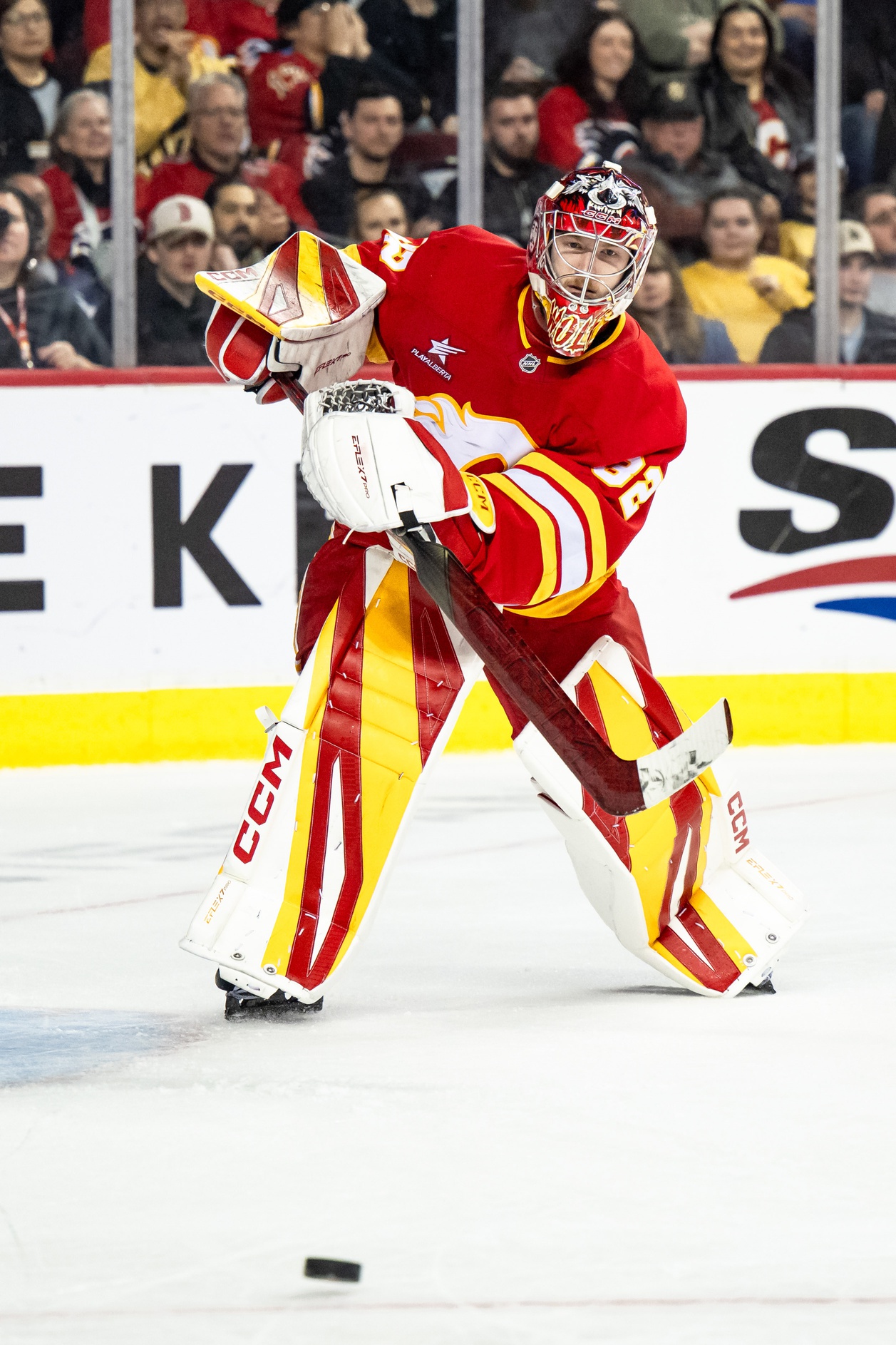 This case is a particularly interesting one. Wolf has just 71 career NHL appearances under his belt which isn’t much of a sample size. 53 of those came this season and he posted a 2.64 GAA with a .910 SV% while being a finalist for the Calder Trophy as the NHL’s top rookie. It wouldn’t be surprising to see him on some Vezina Trophy ballots as well although he didn’t finish in the top three in voting there. At this point, any doubts about Wolf being their goalie of the future (and present) have basically been erased so the Flames will undoubtedly want to get him locked up to a long-term deal.
Pricing out such a contract this summer could be tricky, however, given the limited track record. The prudent play would generally be a shorter-term contract in these situations but Wolf is only two years away from UFA status and will be arbitration-eligible if unsigned by next summer. Accordingly, the options may just be a medium-term pact that buys out two or three UFA years or a long-term (or max-term) agreement.
For the former, Wolf would likely point to the five-year $25MM contract Seattle gave to Joey Daccord last year as a starting point. Daccord had similar numbers and experience at the time, making that one of the cleaner comparables. While all of those years were UFA years and Wolf has two RFA years remaining, the projected higher salary caps moving forward would largely offset that, allowing Wolf to likely push for more than that.
As for the latter, we’ve seen the market for starters recently push past the $8MM mark with some consistency, including Jeremy Swayman, Linus Ullmark, and Jake Oettinger who all recently joined Ilya Sorokin at $8.25MM per season. Wolf doesn’t have as much success as those four but in talks, both sides will probably be forecasting him having a similar performance next season. That could help him get into that range to the point where an eight-year deal could start with an eight. Conroy will need to decide if he’s comfortable going to that level now or if the team is better off waiting to see how next season goes and adjusting their offers from there.
Center Decisions
As is the case with many teams across the NHL, Conroy has made it known that he’d like to add down the middle. More specifically, he’d prefer to add someone around the same age as his core group which is something that’s especially much easier said than done. Given that the intent is to acquire a player who would be with the team long-term, striking to acquire that piece when it becomes available makes sense even if they’re not likely to be in contention for another couple of years.
Of course, it’s worth noting that Conroy managed to swing a move to add a middleman in that age group when he acquired Morgan Frost from the Flyers this season, taking on the full freight remaining on Joel Farabee’s contract to do so. The thought was that a change of scenery could reinvigorate him after a relatively quiet first half of the season in Philadelphia. However, that didn’t happen as he managed just three goals and nine assists in 32 games despite an increase in playing time after the swap.
Unfortunately for Calgary, they need to make a big decision on Frost’s future in the coming weeks. He’s a restricted free agent with arbitration rights this summer but more importantly, he’s a year away from UFA eligibility. Now, a short-term bridge deal would walk Frost right to the open market. Assuming they’d like to avoid that, they’ll have to find a common ground on at least a medium-term agreement, on that would come in around double his $2.4MM qualifying offer. Is that a price they’re willing to go to for a player who certainly struggled in his first few months with the team. With arbitration eligibility, this one will have to be handed over the next couple of months.
The other center they have to make a decision on is Connor Zary, who split time between playing down the middle and on the wing. Over his first two seasons, he has been a secondary scorer and is coming off a year that saw him put up 13 goals and 14 assists in 54 games. A pending restricted free agent with his entry-level deal coming to an end, Conroy will need to decide if he wants to do a long-term deal with the 23-year-old as he did with Matthew Coronato or if a bridge agreement makes the most sense. They can certainly afford the former given their cap situation (more than $28MM in room, per PuckPedia) but the latter seems more likely on a deal that could land around the $3MM mark per season.
Determine Andersson’s Future
Veteran defenseman Rasmus Andersson has been a fixture on Calgary’s back end for the past seven years (plus brief stints for his first two pro campaigns). Back in 2020, he signed a seven-year contract that carried a $4.55MM AAV, a deal that carried some risk at the time but has turned out to be quite the bargain. The Flames have one year left at that price before the 28-year-old becomes eligible to test the open market next summer.
Given that Calgary is a fair ways away from being a legitimate contender, Conroy fielded lots of calls about Andersson’s availability heading into the trade deadline but he opted to stand pat. Now that he’s entering the final year of his deal, those calls are going to pick back up.
While the Flames certainly wouldn’t want to move him, the question becomes how much they’re willing to pay him. As an all-situations right-shot defender and a rapidly rising salary cap, Andersson is likely poised to push for $8MM or more on his next contract as things stand even though he’s coming off bit of a down year. If they’re willing to go to that number and Andersson’s willing to sign, a long-term extension getting done early in the summer – he can sign as of July 1st – wouldn’t be a surprise at all.
If that doesn’t happen, then trade speculation will undoubtedly be cranked up. Calgary still wouldn’t have to deal him right away knowing that if need be, he’d yield a strong return in an in-season swap but that comes with a risk if injuries come into play. Still, Conroy has three options here – extend, trade, or hold, and all have positives and negatives tied to each approach. He’ll have to figure out the best one over the next couple of months.
Photo courtesy of Brett Holmes-Imagn Images.
Liiga Forward Jesse Kiiskinen Offers Red Wings Upside
The Detroit Red Wings acquired Finnish forward Jesse Kiiskinen and a second-round pick from the Nashville Predators ahead of last year’s draft, in a deal that sent shutdown defender Andrew Gibson back the other way. The Wings followed the deal up by flipping the second-round pick to the San Jose Sharks, as a sweetener to get the team to acquire NHL defenseman Jake Walman. Detroit acquired nothing of value in their ditching of Walman – and even then, their pre-draft swap of Kiiskinen and Gibson already appears to be paying dividends.
Kiiskinen was originally drafted by Nashville in the third-round of the 2023 NHL Draft, following a year where he ranked sixth in point-per-game scoring in Finland’s U20 league. He was a clear bet on frame – standing at six-foot-1 and 185-pounds in his draft year and playing a game centered around using a mix of speed and strength to create space. Kiiskinen played through his rookie season in the Liiga following his draft selection, but his early struggles quickly cast doubt on his upside. He scored just 10 points in 38 pro games – fewer points than most of his younger peers in the 2024 draft class. But Kiiskinen stepped up to the plate in Finland’s continental friendlies, and shined through a glimmer of hope with 16 points in seven games with the country’s U19 squad.
It was on the heels of those international performances that Nashville chose to trade the Finnish winger – surely hoping that they could bank on a few strong performances masking an otherwise quiet year. But, on top of their many blunders this year, Nashville was also forced to pay for their impatience with Kiiskinen – as he emerged as one of Finland’s top underage talents. The skillful winger broke out in full with 30 assists and 44 points in 46 Liiga games. That scoring stands as the most a U20 Liiga player has scored since Aleksi Heponiemi (46 points in 2018-19), Sebastian Aho (45 points, 2015-16), and Aleksander Barkov (48 points in 2012-13). In fact, 14 of the 15 names at the top of the Liiga’s U20 scoring leaderboards have gone on to play in the NHL. With this scoring output, Kiiskinen also joins peers like Teuvo Teravainen, Jani Nyman, Juuso Parssinen, and Kaapo Kakko.
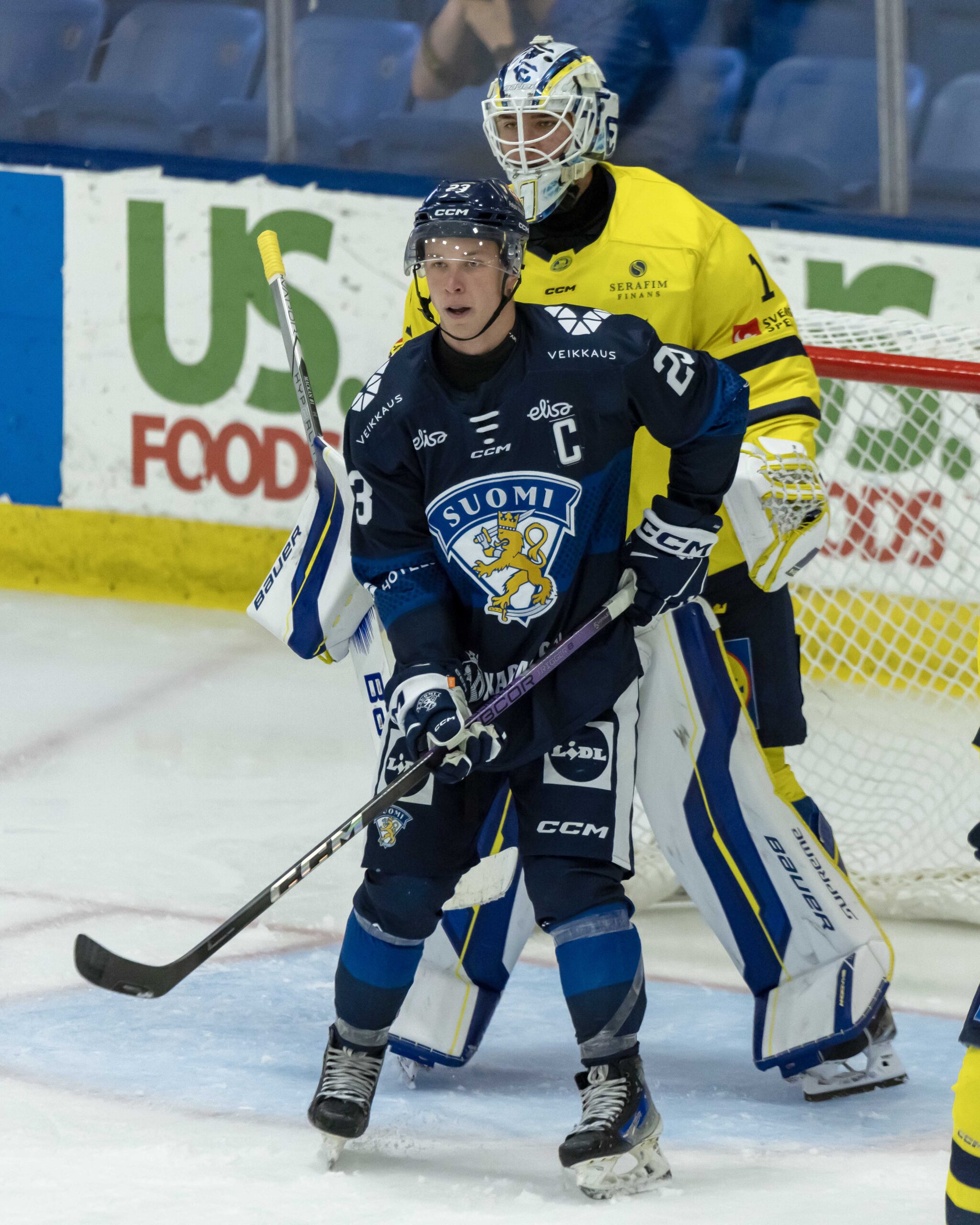
Kiiskinen is still multiple steps – and an entry-level contract – away from contributing to the NHL; and the array of talent from his NHL peers ranges from superstar to healthy scratch. But there’s plenty to life from Kiiskinen’s season. He looked strong and in-control throughout the year, with quick feet and little hesitation to throw the body. He dominated possession through the neutral zone and on the outskirts of the offensive end, and used quick hands and cheeky passes to take advantage of tight lanes that opened in the defense. Kiiskinen also maintained his strong offense into international play, recording a team-leading six goals and seven points in seven games of the 2025 World Junior Championship. No other Finn managed more than three goals.
The Red Wings may not have a shiny new winger just yet, but they must be ecstatic about the upside Kiiskinen offers. He was a final cut for Finland’s World Championship squad, and will now entertain the possibility of returning to a top-end Liiga role or moving on to the AHL next season. If he pursues the latter, he’ll undoubtedly be following in the footsteps of top Pittsburgh Penguins prospect Ville Koivunen – who managed 56 points in 63 AHL games this year after scoring as many in 59 Liiga games last year. It’s a path that’s been trailed already, and one that could lead Kiiskinen to a quick NHL debut once he makes the decision to come over. While it’s certainly comparing apples to oranges, it’s hard not to be excited about that outcome – especially after acquiring it for a stout defender who scored just 24 points in 54 OHL games this season.
Photo courtesy of David Reginek-Imagn Images.
Free Agent Focus: Boston Bruins
Free agency is just over a month away, and teams are looking ahead to when it opens. There will be several impact players set to hit the open market in July, while many teams also have key restricted free agents to re-sign. We continue our look around the NHL with an overview of the free agent situation for the Boston Bruins.
Key Restricted Free Agents
D Mason Lohrei – Lohrei has been a revelation for the Boston Bruins. Only 24 years old, the Louisiana native managed to cement himself into the lineup this season on the back of 33 points in 77 games. His minus-43 plus-minus is the worst the team has seen in at least a decade – though he’s joined at the bottom of the leaderboard by three other players from this year’s squad. The statline paints what seems to be a fitting picture of Lohrei: flashy and successful at his best, and woefully out-of-place at his worst. But as time goes on, those bright spots are shining through more-and-more. Lohrei just managed three points and a plus-four in five games of Team USA’s Gold Medal run a the World Championship, and will enter the summer as the clear-cut top RFA for Boston. With 46 points and 118 games of NHL experience, Lohrei is likely to sign a sort of bridge deal that can carry him to a top line role within a few years.
F Morgan Geekie – Geekie holds a strong bid for surprise of the 2024-25 season. He broke out in a big way, recording a career-high 33 goals and 57 points – second to only David Pastrnak in team scoring. That was largely helped along by a 22-percent shooting percentage – nearly nine-percent more than the 13.1 percent that led Geekie to 17 goals and 39 points last season. Still, Boston has struggled to find scoring outside of perennial superstar Pastrnak. Geekie’s 30-goal season makes him just the third Bruin to hit the mark in the last four seasons – alongside Pastrnak and now-Florida Panther Brad Marchand. That’s upside worth locking in, even if signs point towards Geekie coming back down to Earth next season. Boston will need to walk a tightrope to land a value deal amid a rising salary cap and poor free agent market.
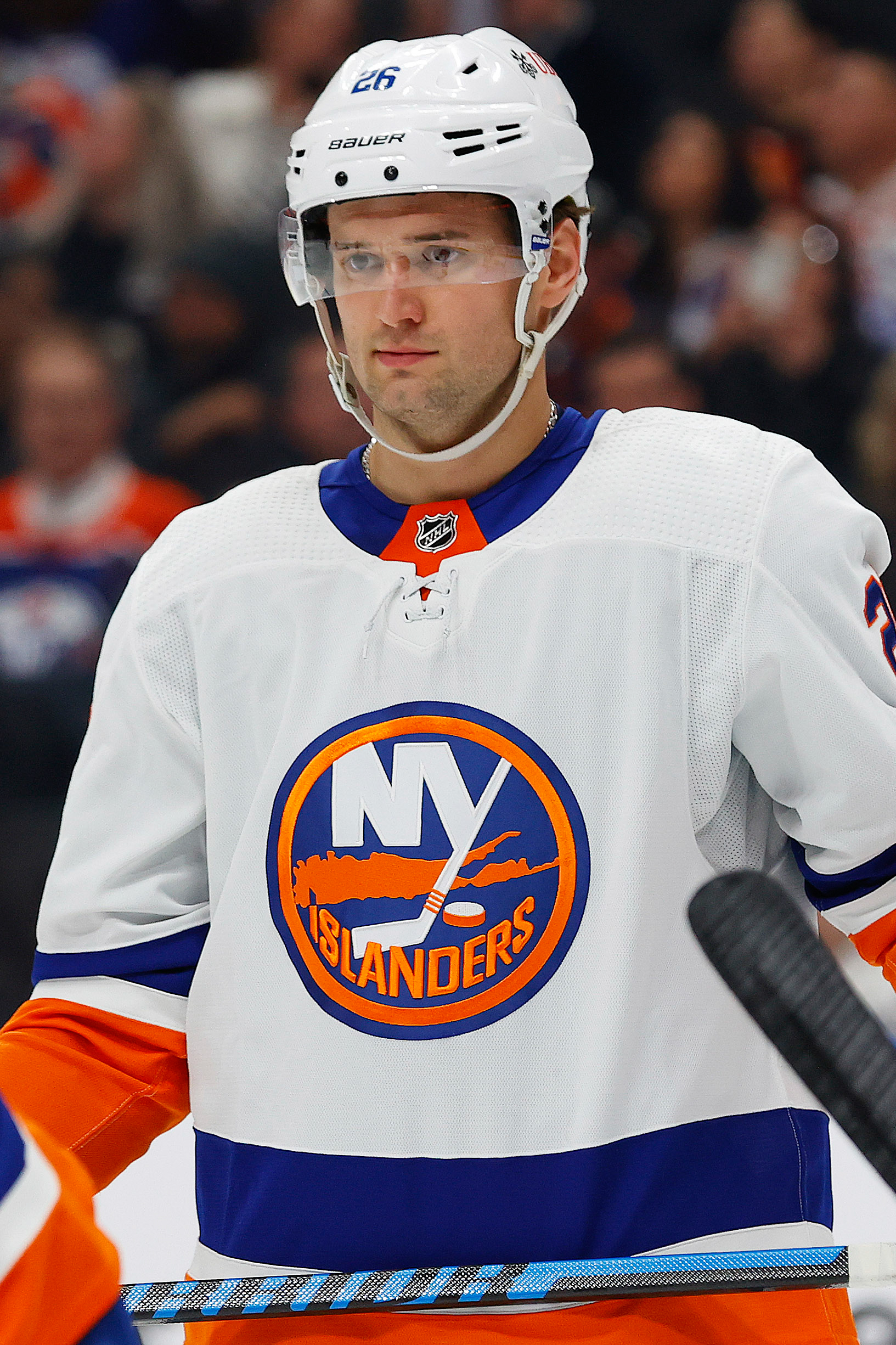 F Oliver Wahlstrom – The Bruins claimed Wahlstrom off of waivers from the Islanders in mid-December. He joined the squad for two months of action but could only muster two points and 28 penalty minutes in 16 games before Boston had seen enough. They waived Wahlstrom and assigned him to the minors in late-February. But then he thrived in the AHL, netting nine goals and 15 points in just 19 games – the highest scoring pace of his professional career at any level (save for a 10-game stint in Sweden in 2020-21). Wahlstrom is a hard bet after spending the last six seasons trying, and failing, to secure an NHL role. But a wave of strong play could be exactly what the doctor ordered. A cheap, two-way deal this summer could set Boston up to be the beneficiary of any resurgence next year.
F John Beecher – Beecher spent the full season on the NHL roster for the first time in his career. Unfortunately, the promotion didn’t spark any one part of his game. He ended the year with just 11 points in 78 games – just one more point than he was able to score in 52 games last season. Beecher carries first round precedent, having heard his name 30th-overall in the 2019 class. But now a few years removed, Boston should have a reasonable glimpse at what he brings to the lineup. If they’re looking for a big-body to continue holding down the fourth line, Beecher should come at little cost. But the open market may have more productive options to shore up Boston’s depth.
F Marat Khusnutdinov – Khusnutdinov joined the Bruins in the waning moments of the Trade Deadline. Boston seemed to have a carved-out role in the bottom-six for the Russian youngster, and he rewarded them with five points in 18 appearances. That may be moot, but it’s just two points shy of his totals in 57 games last year. The 22-year-old Khusnutdinov seemed to catch a spark in the Bruins’ system. He’ll offer the team a glimmer of upside on a new deal – but it could be tough to narrow down the price point of a former second-round pick with 91 games of experience but just 16 points.
F Jakub Lauko – Lauko joined Khusnutdinov in the late-Deadline move. He had spent the last two seasons in the Bruins organization, but traveled West for 38 games with the Minnesota Wild at the start of this season. Through the move, Lauko’s emposing physical presence continued to shine through – even as he ran into persistent injury issues with the Wild. Combined between Minnesota and Boston, Lauko finished the year with 11 points, 47 penalty minutes, and a minus-13 in 56 appearances. Those numbers don’t jump off the paper, but his continued bruiser role and Boston’s desire to re-acquire him this season both point towards a new deal coming soon.
Other RFAs: F John Farinacci, F Trevor Kuntar, F Georgii Merkulov, F Jaxon Nelson, D Ian Mitchell, D Daniil Misyul, D Drew Bavaro
Key Unrestricted Free Agents
D Henri Jokiharju – Jokiharju rounds out the trio of Trade Deadline acquisitions. He scored the lowest of the bunch – netting four assists in 18 games, one point fewer than either forward. But that number shouldn’t be the highlight of Jokiharju’s first stint in Boston. Despite low-scoring, the 25-year-old defender looked plenty comfortable on the Bruins’ blue-line – and played upwards of 24 minutes a night while filling in for Brandon Carlo‘s second-pair vacancy. Boston needed help on the backend and Jokiharju supplied it en masse. He scored 20 points in 74 games with the Buffalo Sabres last season – a mark that could look mighty fine with a continued minutes in Boston. Jokiharju will be one of the Bruins’ pricier re-signings – albeit among a cheap bunch – but the shimmer potential he has as a top-six lock will make the deal worth it.
F Cole Koepke – Boston led with a quiet bottom-six all season long – and Koepke’s role on the fourth-line highlighted the group. He scored just 17 points in 73 games on the season, but never looked too terribly out of place with the big club. Koepke entered the year with just 26 games of NHL experience under his belt, all coming with the Tampa Bay Lightning over the last two seasons. He had otherwise been a productive minor-leaguer, with flashes of goal-scoring upside and two-way play. Those attributes could still shine through as he becomes more adjusted to the top flight. Boston will be left with the question of whether that upside is worth buying into, or if they’ll be able to find a better depth-winger on the open market… or in their prospect pool.
D Parker Wotherspoon – Wotherspoon operated as Boston’s true bottom defenseman this season, with his 18 minutes of average ice time the lowest of any blue-liner to spend the bulk of their year with the NHL club. He recorded seven points, 10 penalty minutes, and a minus-10 in 55 games to show for the role, falling one point shy of his career-high eight points from 41 games last season. Wotherspoon will be 28 years old by the time the 2025-26 season begins, and could be better suited for a return to the minors after platooning between leagues over the last two seasons. If not a demotion, Wotherspoon will likely continue on in a low-depth role for the Bruins – offering a low-cost, but low-upside option.
G Michael DiPietro – The Bruins will lose both of their minor-league goaltender to free agency this season. Both carry fantastic cases to be re-signed after effectively splitting starts this season. DiPietro performed best in the spotlight, though – ending the year with a .927 save percentage and 26-8-5 record through 40 games. He was once a top goalie prospect for the Vancouver Canucks, before injuries and lack of opportunity sent him on a spiral through the minors. DiPietro finally seems to be on the other side of those struggles, and could find a push back to the NHL on whatever new deal Boston can construct. That will make him worth a long look this summer, even if backup Brandon Bussi offers a plenty suitable replacement.
Other UFAs: F Tyler Pitlick, F Riley Tufte, F Vinni Lettieri, D Michael Callahan (Group-6), G Brandon Bussi
Projected Cap Space
The Bruins will enter the summer with a projected $26.27MM in cap space. That should be plenty of space to not only re-sign their top options entering free agency, but also take runs at aggressive free agent singings or summer trades. The Bruins missed the postseason for the first time in eight years – and just the third time since 2007-08 – this year. That’s an unacceptable result for the fixture of summer hockey. Ample signing room, strong candidates for re-signing, and open lineup spots should all give freshly re-signed general manager Don Sweeney a chance to show he can still build a playoff contender.
Photo courtesy of Perry Nelson-USA TODAY Sports. Contract information courtesy of PuckPedia.
Offseason Checklist: Vancouver Canucks
The offseason has arrived for half of the league’s teams that aren’t taking part in the playoffs plus those already eliminated through the first couple of rounds. Accordingly, it’s time to examine what they will need to accomplish over the coming months. Next up is a look at Vancouver.
While there were some questions about the Canucks heading into the season despite a solid showing in 2023-24, this past season was a strange one. From struggles to injuries to in-fighting, the team never found its footing, missed the playoffs, and couldn’t come to terms with Rick Tocchet on a contract extension, leading to a coaching change with Adam Foote being promoted into the top job. Even with that item checked off, GM Patrik Allvin has some work to do in the coming months.
Add Impact Center
With the J.T. Miller situation coming to a head midseason, the Canucks were able to get a center back as part of the return in Filip Chytil. But with all due respect to Chytil, the two players are at considerably different levels. One has been a recent top liner, the other more of a middle-six piece with a concerning concussion history. If they were mapping out more of their ideal center situation, Chytil would probably head into next season as a third liner. They have Elias Pettersson locked up long-term (more on him shortly) but there’s still a need for a top-six middleman.
In terms of internal options, Aatu Raty should be a full-time NHL player soon but he’s more of a bottom-six option himself. Dakota Joshua and Teddy Blueger are capable bottom-six pieces but don’t produce enough to be a top-six piece. Pius Suter acquitted himself quite well this season and stepped into a bigger role, scoring 25 goals. However, he’s a pending unrestricted free agent and his market should be much stronger than it was two years ago when the Canucks got him on a low-cost deal that proved to be quite the bargain. Basically, there is no internal option beyond hoping Chytil can stay healthy and find a level he has yet to reach offensively.
Team president Jim Rutherford suggested earlier this month that the team might look to get the bulk of its spending done before free agency opens up. Accordingly, they may be intending on trying to acquire another middleman via a trade, a lofty goal considering few impact centers are typically made available. Unless the Canucks are looking to make another core-shaking swap, they may have some difficulty finding a fit in a trade.
The good news is that, at least for now, the UFA market down the middle is a bit deeper than usual. There are short-term options like John Tavares and Claude Giroux on expiring deals. Matt Duchene, Brock Nelson, Mikael Granlund, and Ryan Donato could plausibly command multi-year agreements though nothing overly long-term. Sam Bennett will land a lucrative long-term deal that probably won’t age the greatest but he’s out there too. It’s never easy to add a key center but the free agent route may make more sense for them to go here.
Examine Pettersson Options
Having just gone over how Vancouver already needs one top-six center, it feels a little counterintuitive to suggest they also need to look into their options with the one top-sixer they have in Pettersson. But after the way his season went, it feels like this is something they have to look into.
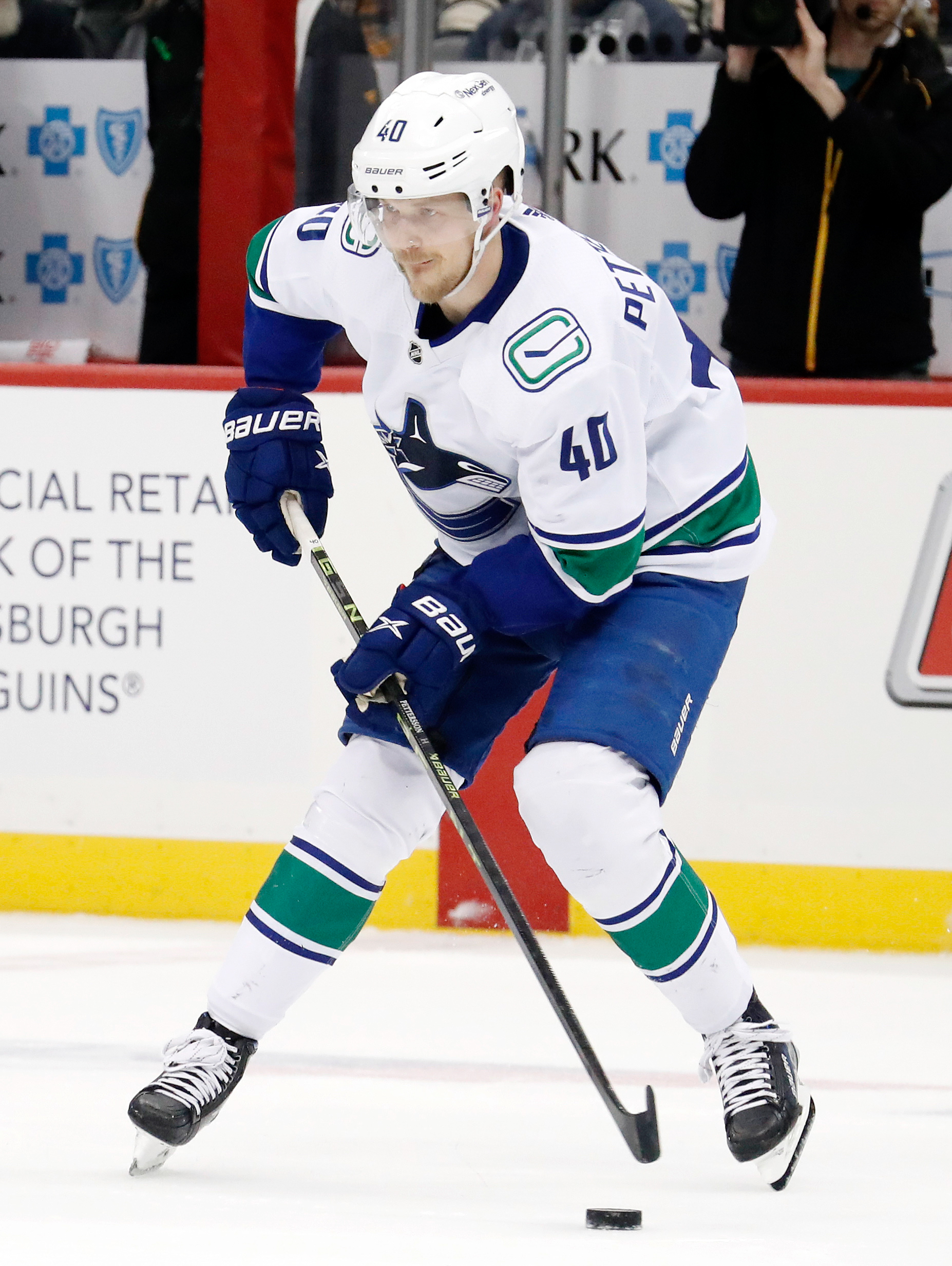 The 26-year-old signed an eight-year, $92.8MM contract in early March 2024, the first season of which is now in the books. At the time he signed the deal in 2024, he had 75 points in 62 games, a pace that would have given him a shot at a second straight 100-point season. After that point, he limped to the finish line with just 14 points in his final 20 outings.
Unfortunately for him and the Canucks, that proved to be a sign of things to come. This season was nothing short of disastrous. On the ice, Pettersson put up the lowest full-season point total of his career with only 15 goals and 30 assists in 64 games. Effectively, he was giving them second-line numbers while playing top-line minutes and making $11.6MM, making him one of the top-paid pivots in the NHL. And, of course, there was the off-ice issue of his feud with Miller that ultimately led to the veteran being moved away while the distraction seemed to linger all season long, even after the trade.
While Pettersson’s value is far from its peak (given the contract, it might be at its worst), Allvin will still likely look into what options might exist. As players who aren’t UFA-eligible aren’t eligible for trade protection, Pettersson still has another month and a bit without any sort of restrictions until July 1st at which point, a full no-move clause kicks in for the life of the contract. At that point, dealing Pettersson would become harder with his ability to veto deals, something that isn’t the case for the next five weeks and change. Getting them to retain significant salary is unlikely with seven years left on the contract but if there’s a big shakeup option out that would see them get an impact center back as part of the return, it would behoove them to look into it at the very least.
Replace Boeser
The last few months have been a little strange when it comes to winger Brock Boeser. He looked like a strong candidate to be moved before the trade deadline with Vancouver being out of the playoff picture and the two sides not close on an extension but a move never materialized. Allvin then took the rare step of admitting that the offers for the pending UFA were not particularly strong, a decision that some interpreted as trying to push back against a higher asking price from Boeser’s camp.
Then, at the end of the season when pending free agents generally at least say they’d like to return, Boeser stated that it was unlikely that would happen, suggesting he fully intends to hit the open market. While there’s still time for things to change on that front – Allvin suggested as much recently – that doesn’t seem likely to happen. Accordingly, this is an instance where the focus is likelier to shift to replacing the 28-year-old, not re-signing him.
Vancouver enters the offseason with around $16.7MM in cap space, per PuckPedia. With no impactful restricted free agents to deal with and a handful of roster spots to fill (including a spot or two on the back end), they have enough flexibility to make at least one addition of note. However, if their big add is down the middle, they might not be able to aim at a player in Boeser’s tier to replace him, one that’s likely to cost somewhere around the $8MM mark which might take Nikolaj Ehlers off the table.
It wouldn’t be surprising if the Canucks are looking for someone more around the $5MM range, allowing them to spend a bit of money on those final spots on the back end. Options around that price point could include Kyle Palmieri, Jonathan Drouin, Patrick Kane, and former Canuck Andrei Kuzmenko. To be able to afford that top tier on the wing, they’d likely have to commit to re-signing Suter as their other center before getting to July 1st. Otherwise, who they bring in probably won’t be as good as the winger they’ll be losing.
Demko Extension Talks
This was a tough season for goaltender Thatcher Demko. His injury from the playoffs lingered, resulting in him missing the first two months of the season and getting a pretty light workload beyond that point as he made just 23 starts. The 29-year-old also posted a career-low .889 SV% while Kevin Lankinen, brought in early in training camp as insurance, wound up getting a five-year extension in-season, cementing him as part of the plans moving forward.
Demko is entering the final season of his contract next season and considering the year he just had, it would make sense for both sides to see how 2025-26 plays out or at least starts before entertaining the idea of an extension. However, Rutherford made a point of saying back in April (video link) that it’s something they intend to look into:
We would like to extend him. It’s going to be a matter of how much risk is the team willing to take and how much risk is he willing to take as to the term of that contract.
Going into this season, Demko’s contract looked like a team-friendly one. Signed at a $5MM price tag and coming off a year as a Vezina runner-up, it looked like he could be heading toward top-end territory. Based on recent comparables, that would push his AAV past the $8MM mark on a long-term deal. But with the uncertainty around his injury and the year he just had, Demko isn’t in a spot to command that.
While Rutherford expressed optimism that a different approach to training should help keep Demko healthy moving forward, this feels like a case where they’d likely prefer a shorter-term agreement. Speculatively, it wouldn’t be shocking if their target price point was around the current one, keeping their combined goalie spending around the $10MM mark. Unless Demko is worried about his struggles carrying over, it would be surprising to see something get done here but considering it’s a stated goal of the organization to work on this summer, it warrants the final spot on this list.
Photo courtesy of Charles LeClaire-USA TODAY Sports.
What Can The Avalanche Do This Summer?
The Colorado Avalanche were bounced in the first round of this year’s playoffs in catastrophic fashion, blowing a third-period lead in Game 7 to the Dallas Stars. Despite the early exit this year, Colorado remains a team that will be in playoff contention again next season. However, as their core ages and pieces start to move out, their window to win another Stanley Cup is quickly closing. Colorado has 18 players signed for next season (11 forwards, five defensemen, and two goalies) for $86.8MM (per PuckPedia). While that isn’t a terrible position to be in, that is where the rosy outlook ends, as the Avalanche do have some notable free agents to try and retain and a few contracts they would probably like to shed. So, what can they do to remain a contender?
The Avalanche faced a situation that wasn’t dissimilar to that of previous Stanley Cup Champions. Their depth has been eroded, their prospect cupboard emptied, and their draft pick capital dwindling. A lot of that happened because Colorado took healthy runs at essential players, which worked out well as they won a championship in 2022. But since then, Colorado has had to patch the holes in their lineup with less-than-ideal solutions.
For the Avalanche, one of the key areas of concern has become their center depth, which has become a weakness following the departure of Nazem Kadri in free agency. On their second line, the Avalanche have tried Casey Mittelstadt, Ryan Johansen, Alex Newhook, J.T. Compher, Brock Nelson and Charlie Coyle. That’s a list of talented players, but none have been able to stick, which has created a major issue for Colorado.
If the Avalanche hope to contend again, they need to solidify that position, which will be easier said than done. There are a few options available in free agency. Still, unless the Avalanche dump a contract such as Ross Colton ($4MM) or Josh Manson ($4.5MM), they will not have the required cap space to compete for a free agent center such as Nelson, John Tavares or Sam Bennett and fill out the rest of their roster.
One might think that if Colorado can’t make a move in free agency, they could look at trading for a center. However, their lack of draft picks and prospects makes acquiring an impact center nearly impossible on the trade market unless they can trade a player on their roster and recoup some significant assets. Colorado has no picks in the first three rounds of the subsequent two drafts and only has maybe two or three prospects who project to make an impact in the NHL.
A player like Manson might be an option to move, as he doesn’t appear to be a top-four NHL defenseman anymore and probably needs to be at his current salary ($4.5MM) and Colorado’s cap constraints. Teams likely wouldn’t line up to acquire him at that price, but if Colorado could move him, it would allow them to upgrade their second defensive pairing and maybe take some of the pressure off Cale Makar and Devon Toews. The Avalanche could also move Manson via trade and slide Sam Malinski into the top four, but it would be a massive gamble as he probably isn’t ready for that type of assignment. With limited cap space, it is unlikely that Colorado can keep Manson and try to upgrade their top four, which means they will need to make some type of decision this summer or opt to remain status quo and focus their attention on the forwards.
Trading players off the current roster could help Colorado move to restock the cupboards, but it will leave them in a challenging position for this upcoming season if they further reduce their team depth. The Washington Capitals pulled off a similar move just a few years ago, shedding several costly veterans but keeping their core players to make another run eventually. It worked out well for the Capitals as they have now reaped the rewards of their gamble, but there are no guarantees that their strategy could work in Colorado. It’s a delicate line to straddle as Colorado will try to avoid the same fate as previous Stanley Cup Champions who either constructed their roster poorly or waited too long to pivot into a retool.
A key for Colorado is not to panic because of a first-round playoff exit and to recognize the unique position that the club is in. They were a period away from advancing to the second round of the playoffs over Dallas, and likely would have gotten past Winnipeg to reach the Western Conference Finals. The window is open for them to contend, and their star players remain at a high level. The Avalanche need to be aggressive with the cap space and remaining tradeable assets and try to push to position the team for another deep playoff run. It seems counterproductive for Colorado to subtract from their current roster depth in an attempt to get younger for future playoff pushes. Colorado must steal a line from John Cena and understand, “My time is now.” It should make for interesting theatre to see how keen they are on taking calculated risks this summer after a playoff loss that has undoubtedly left a bad taste in everyone’s mouth.
The pipeline is bare, the cap space is limited, but Colorado has pieces in place that would be the envy of almost every NHL team. The so-called heavy lifting is done; now it is up to Joe Sakic and Chris MacFarland to put a series of moves together that will elevate the likes of MacKinnon and Makar to try and win another Stanley Cup before the Avalanche’s window to contend slams shut.
Photo by Ron Chenoy-USA TODAY Sports
Free Agent Focus: Anaheim Ducks
Free agency is just over a month away, and teams are looking ahead to when it opens. There will be several impact players set to hit the open market in July, while many teams also have key restricted free agents to re-sign. We start our look around the NHL with an overview of the free agent situation for the Ducks.
Key Restricted Free Agents
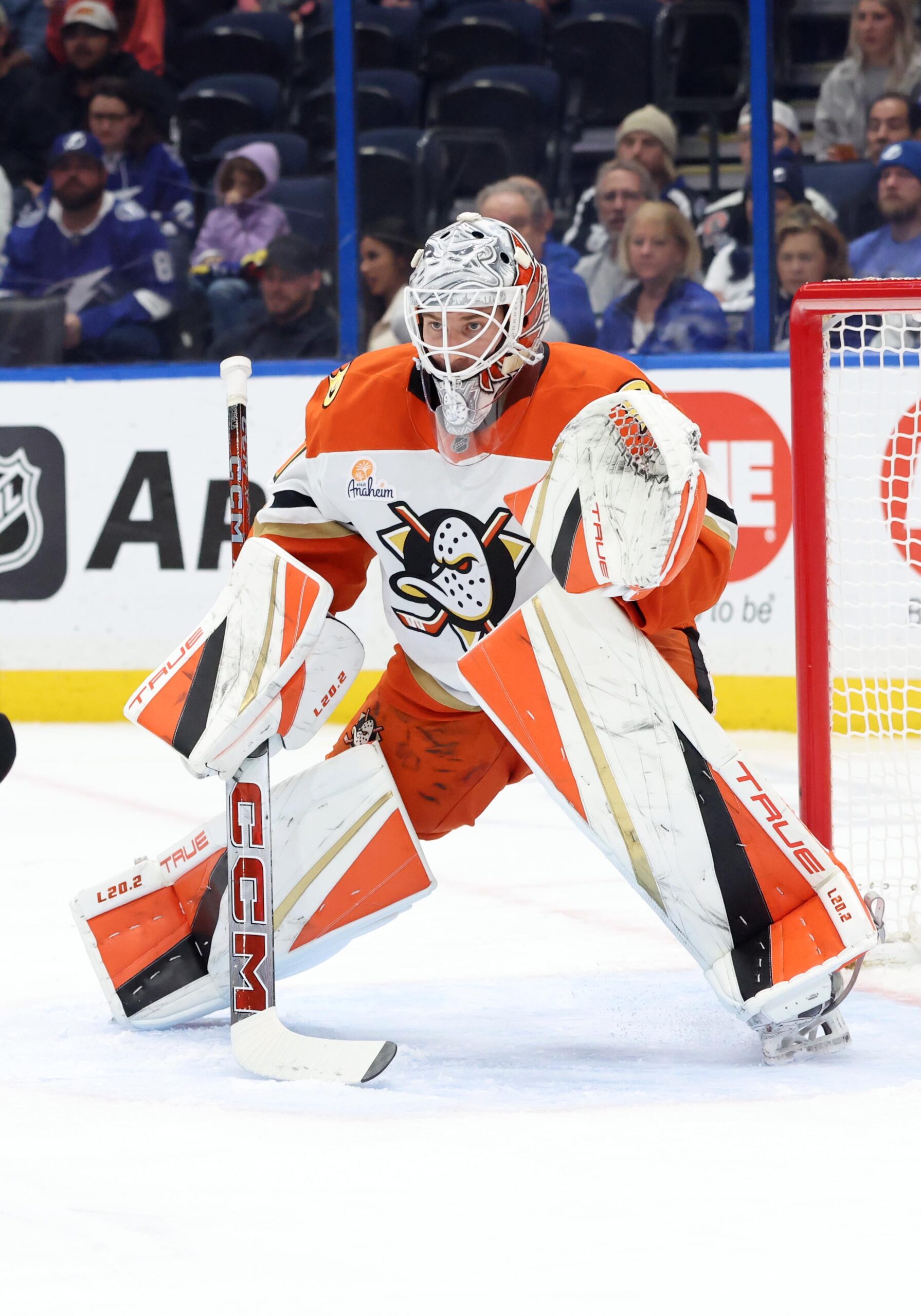 G Lukas Dostal – Dostal had been viewed as Anaheim’s goalie of the future for some time now. He rewarded the franchise’s faith in spades with a breakout 2024-25 campaign. Now entirely supplanting John Gibson as the team’s No. 1 option between the pipes, his numbers slipped a bit down the stretch but still managed a 23-23-7 record, a .903 SV%, a 3.10 GAA, and one shutout in a career-high 54 appearances behind one of the league’s worst defensive teams. He’s owed a qualifying offer of just $892.5K coming off a cheap partial two-way deal, but will land much more than that on his coming deal, especially with arbitration rights in his back pocket. A one-year bridge likely keeps Dostal in the $4MM range, but for a Ducks club with ample salary cap flexibility, general manager Pat Verbeek could award him something in the $5MM-$6MM range on a mid-term deal if they’re unprepared to go eight years.
F Mason McTavish – McTavish’s game has steadily improved since being drafted third overall in 2021, and this season was no different. While the 22-year-old was robbed of a full 82-game schedule due to a few here-and-there injuries, he still set career-highs with 22 goals, 30 assists, and 52 points in 76 appearances. Now a legitimate top-six center with still room to grow, he’ll significantly outpace the $874,125 qualifying offer he’s owed as he comes off his entry-level deal. A deal in the $4MM range on a shorter-term commitment seems apt if the Ducks are still uncertain about his ceiling. Still, with his linear development so far, he could earn a long-term deal approaching the $7MM mark to lock him in as Anaheim’s No. 2 center behind Leo Carlsson long-term.
F Isac Lundestrom – A first-round pick back in 2018, Lundestrom’s role hasn’t fluctuated much since establishing himself as a full-timer in the shortened 2020-21 campaign. His ice time has steadily decreased as the player they once thought could be a long-term, defensively responsible third-line pivot hasn’t produced the level of offense they’d like for that role. 2024-25 was Lundestrom’s worst offensive performance of his five-year run as a full-time NHLer at just 0.19 points per game (4-11–15 in 79 GP). That’s not to say he’s not valuable – he’s one of the Ducks’ top penalty killers, and his possession metrics this season were passable given his extended defensive zone deployment at 5-on-5. Still, he’s likely more of a high-end fourth-line option long-term than a third-line one. It wouldn’t be surprising to see him accept his $1.5MM qualifying offer as a result, or take a multi-year deal in that range annually to gain some added stability in Anaheim if he desires.
F Brett Leason – Claimed off waivers from the Capitals at the beginning of the 2022-23 season, Leason capped off his third year in Anaheim with nine healthy scratches in 12 games. He was still serviceable in bottom-six minutes, scoring 17 points in 62 games with a minus-two rating in similarly heavy defensive deployment to Lundestrom. Still, he’s at risk of being non-tendered for the second consecutive year. Of course, he signed a one-year, $1.05MM contract on the first day of free agency to return to the Ducks despite not receiving a qualifying offer, but his willingness to do so again may be diminished after his lack of usage to end the campaign.
D Drew Helleson – Helleson, 23, somewhat surprisingly emerged as a roster fixture this year. He didn’t play anywhere close to a full schedule, suiting up 56 times, but remained on the Ducks’ roster for the balance of the season after being recalled from AHL San Diego in mid-November. The 6’3″, 214-lb righty did better than most would have expected given his limited minor-league success, posting 13 points and a plus-six rating in bottom-pairing minutes (16:21 ATOI). A 2019 second-round pick of the Avalanche who was acquired for Josh Manson in 2022, Helleson’s likely earned an opening-night job in the fall. He could even challenge Jacob Trouba for top-four minutes next year since the latter was a non-factor after his early-season acquisition from the Rangers.
Other RFAs: F Judd Caulfield, G Calle Clang, F Sam Colangelo, F Josh Lopina, F Jan Mysak, F Nikita Nesterenko, F Tim Washe
Key Unrestricted Free Agents
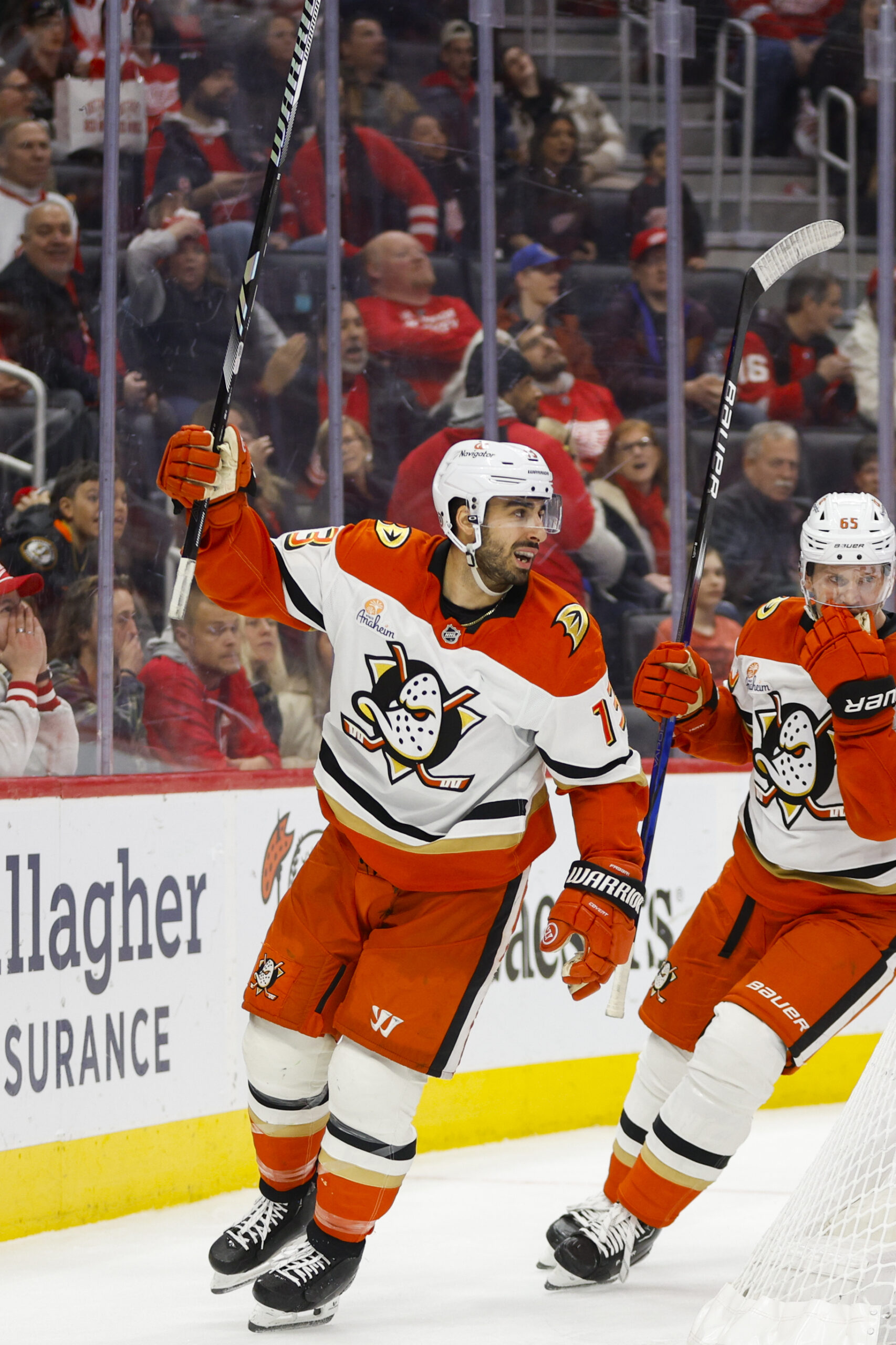 F Robby Fabbri – When healthy, Fabbri has been a decent secondary scorer throughout his nine-year NHL career. However, injuries have been a constant, and this year was no different. Knee surgery and a hand injury took away nearly half of his 2024-25 campaign, and he ended the year with an 8-8–16 scoring line in 44 contests. The 29-year-old has still hit at least 30 points twice in the last four years despite significant absences, which should help his case on the open market. With 2024 No. 3 overall pick Beckett Sennecke pushing for an opening-night job and the Ducks likely to be active in free agency, though, there may not be a fit for him on next year’s team. If they want to retain him, his injury concerns should make him a low-cost pickup around $1MM.
F Brock McGinn – From one injury-prone winger to another, McGinn’s season ended back in December due to ACL reconstruction. His recovery timeline may stretch into next year’s training camp, so his hope will likely be for a PTO opportunity somewhere, which could still be Anaheim, instead of searching for a guaranteed contract. Still, the defensive-minded winger has made just 50 appearances over the last two seasons combined with 11 points and a minus-four rating. They could still want to keep him in the fold with his over 500 games of experience, though, compared to some more unknown quantities in the system as a 13th or 14th forward.
D Oliver Kylington – Acquired at the deadline in what was effectively a three-team deal with the Avalanche and Islanders involving Brock Nelson, Kylington didn’t get much of an opportunity down the stretch in Anaheim. He averaged just 10:48 per game in six appearances, including his time in Colorado, where he spent most of the year in the press box with only 19 appearances to his name. The 28-year-old is now three years removed from his 31-point, +34 campaign with Calgary, and hopes of returning to those heights as a No. 2 left-shot option are slimmer than ever. He’s ticketed for a league-minimum or even two-way deal this summer, and it likely won’t be with the Ducks, who have plenty of young defenseman still to rotate/graduate into NHL minutes.
G Ville Husso – Husso began the season with the Red Wings, where he’d tumbled down to No. 3 on the depth chart and had cleared waivers in the final season of a three-year, $14.25MM contract. Anaheim, who had injuries to their AHL netminders and Gibson missing significant chunks of action, picked him up down the stretch to serve as a veteran backup option for Dostal. He did quite well in the few starts he received, posting a .925 SV% and 2.99 GAA in four appearances. While it’s a small sample size, that could go a long way toward earning Husso a chance at a No. 2 job next year on the open market instead of settling for a two-way deal and likely lengthy AHL assignments.
Other UFAs: F Justin Bailey, G Oscar Dansk, F Carson Meyer
Projected Cap Space
Few teams have more cap space than the Ducks this summer. They check in at $38.7MM, including $2.5MM worth of retention on the final season of Cam Fowler‘s contract. A good amount of that will get eaten up by new deals for Dostal and McTavish, but they’ll still have over $25MM to spend after getting those deals done. As a result, expect them to be active on both the trade and free agent markets this summer as they aim to end their playoff drought at seven years.
Photos courtesy of Kim Klement Neitzel-Imagn Images (Dostal) and Brian Bradshaw Sevald-Imagn Images (Fabbri). Contract information courtesy of PuckPedia.
PHR Mailbag: Coaches, Cup Winner, Hellebuyck, Lightning, Panthers
Topics in this edition of the mailbag include predictions for the three remaining head coaching vacancies around the NHL, Connor Hellebuyck’s playoff struggles, and more. If your question doesn’t appear here, check back in one of our next two mailbag columns.
yeasties: Just for funsies, predict who gets hired for the remaining head coach openings?
Let’s jump right in with a tough one, shall we? There are three remaining openings after Jeff Blashill got the nod in Chicago: Boston, Seattle, and Pittsburgh. Here are my picks for those three spots.
Bruins: I’ll go with Marco Sturm for them. While internal options Joe Sacco and Jay Leach are believed to be in the mix still, can they really justify promoting from within after suggesting their intention is to get back to the playoffs next season? Sturm has plenty of familiarity with the market after spending a lot of time there as a player which might appeal to management and ownership and he has been in the mix for a few top jobs now with experience as an NHL assistant and an AHL head coach. He’s bound to get one soon and I think it might be here.
Kraken: The sense was that they were waiting for a candidate or two which tells me that Mitch Love may have been on their radar. After Spencer Carbery did well as a first-time coach in Washington, it stands to reason that one of his assistants would get poached relatively quickly. While I doubt management will come out and say this, this feels like a spot where they need to do a bit of a reset. Getting a bit younger and taking a step back feels like a good opening for a first-time NHL head coach to allow him some time to get his feet wet without a lot of pressure.
Penguins: It wasn’t that long ago that Jay Woodcroft was viewed as one of the up-and-coming coaches before he got a short stint in Edmonton where a poor start last season cost him his job. He has lots of experience working with younger players and at some point, Pittsburgh has to start getting younger. On the flip side, he also has experience working in a win-now environment which, for better or for worse, appears to the fine line that they’re trying to walk, remaining competitive while getting younger. A coach with some experience in both worlds like Woodcroft makes some sense here so I’ll go with him.
Schwa: Curious on your cup pick from the Final 4.
It’s hard not to go with Florida here. The way they came back against Toronto and the way they’ve started against Carolina has been quite impressive. The way that series is going, they could be in line for a bit of an extended break if it ends quickly which would be critical for a veteran-laden team who went all the way last season. That would put them in a great spot to start.
My pick to come out of the West is Dallas but that’s not going to be a short series. After needing 13 games to get this far and likely six or seven in this one, I’m a bit concerned that they might be a bit too worn down by the end of it. And if Edmonton makes it a repeat of last year’s Final, their goaltending is even more erratic than it was a year ago with more inconsistent special teams. It’s not that neither team couldn’t win but for me, the Panthers are the current favorite.
PyramidHeadcrab: So, what’s the deal with Connor Hellebuyck? If we look at advanced stats of the team around him, is it truly a case of an elite goalie consistently collapsing in the playoffs? Or is it the defense around him?
It’s absolutely stunning to see the Jets go from winning the Presidents’ Trophy to seeing Hellebuyck post the worst numbers of any goaltender in the playoffs – an unacceptable 0.866 save% (and it was worse than that at various points).
And I guess the follow-up question is… Where does the team go from here? Is this something that can be corrected?
I think there are two parts to it. One is that the recent road struggles are in his head. And it’s really only the road games that are the issue. His home save percentage in the playoffs was .913 and while a pair of shutouts boosted that, those were his last two home games against a tough Dallas team. I don’t want to take the easy way out and say it’s the yips but that’s a roadblock he’s going to have to get over and generally, the only way to do that is to keep throwing him out there in those situations. And really, as their sure-fire starter, they’re going to keep doing that. With the contract he has and not a particularly deep goalie pool of prospects, he will continue to be Winnipeg’s starter for the long haul. This playoff run doesn’t change that.
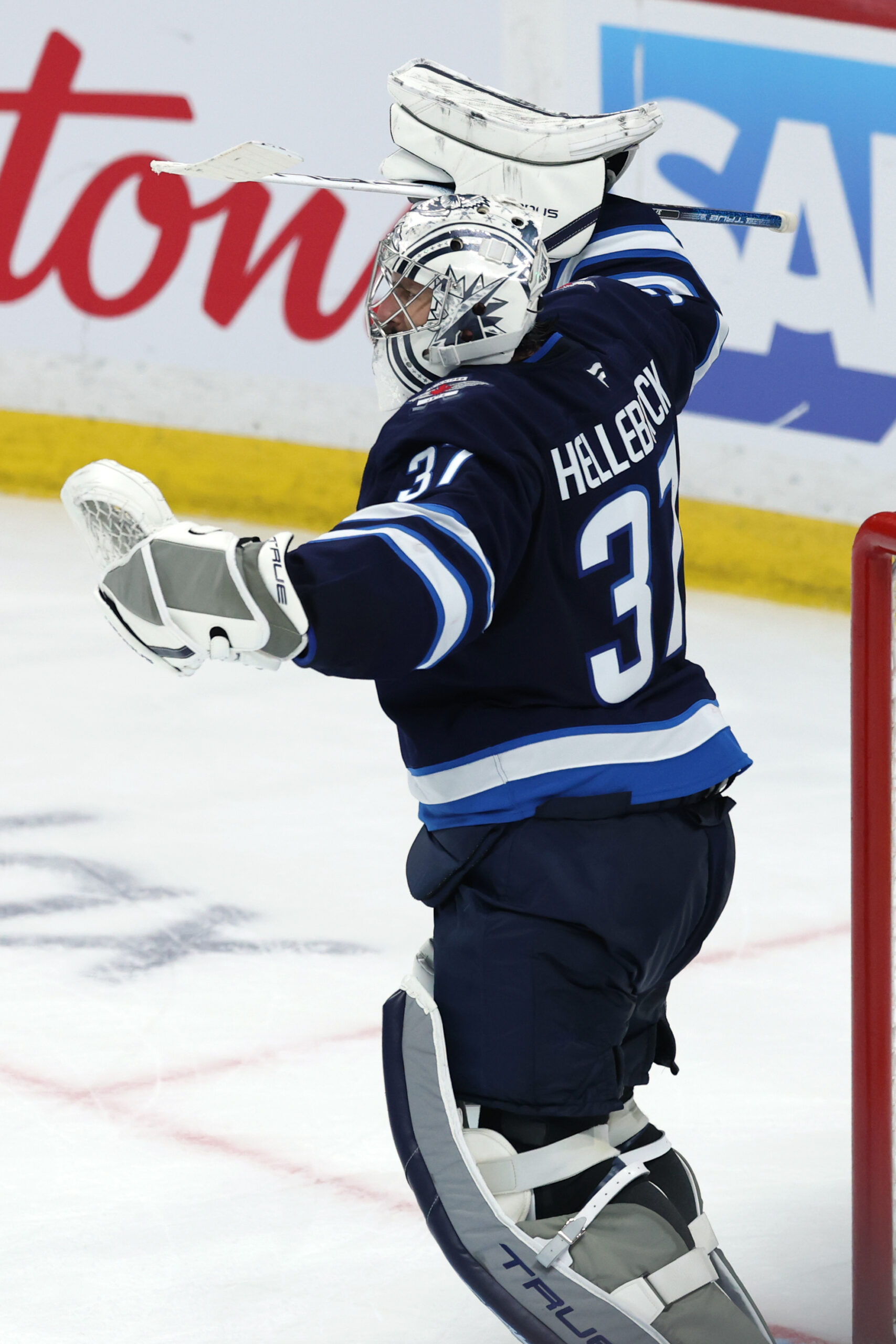 The other factor at play that hurts here is game planning. The book on Hellebuyck is that he’s more prone to be beat when he has to go side to side, suggesting more cross-ice play is the way to go. If you’re a team playing Winnipeg in game 46 of the regular season, you’re aware of the scouting report but if you don’t play that way, you’re not going to overhaul your strategy for a random game in January. But if you’re playing them in a best-of-seven series, you’re going to make some changes to try to maximize that particular weakness. And that has happened for the last couple of years now. The fix there is goalie coach Wade Flaherty coming up with some adjustments to help Hellebuyck improve in those situations or at least mitigate that weakness. Considering how long he has been in the league for, I think the latter is more realistic than the former of those two options.
I have a hard time pinning a lot of this on the defense aside from perhaps not making adjustments of their own to take away some of the cross-ice options. But they only allowed 23 shots per game in the playoffs which, while it’s a bit simplistic, is a number any team would be happy with. I think Hellebuyck can get past this but there will definitely be question marks for his next playoff run.
The Duke: Lightning Round!
Is Merilainen Ottawa’s backup next season – and eventual #1?
More goals: Gauthier or Carlsson.
Is Snuggerud Top-6 and #1 PP unit?
Is Levshunov or Korchinski Chicago’s PPQB?
Levi’s short- and long-term future?
1) With Ottawa locking in with Linus Ullmark on a long-term pricey deal, it makes sense that the Sens would look to go with a low-cost backup. That should give Leevi Merilainen the edge but with all of 14 NHL games under his belt, I think they’re going to want an insurance policy. I could see them going after a lower-tier backup that could push for the backup spot or be on standby in the minors if Merilainen struggles. Something sort of along the lines of what Buffalo tried to do this year with James Reimer although that didn’t work quite as planned.
2) Short-term, probably Cutter Gauthier. But if Leo Carlsson’s training wheels eventually comes off and gets into that top-line role, he could be a 35-40-goal player if all went well. I don’t see Gauthier reaching that level on an annual basis.
3) If all goes well, that should be the outcome for Jimmy Snuggerud. He got a bit of time in those spots in the playoffs but I wouldn’t expect him to be a fixture in those spots next season as he’ll likely be moved up and down the lineup at times.
4) Out of the two, I’d say Artyom Levshunov since Kevin Korchinski didn’t exactly have a great season and I could see him back in Rockford, to be honest. With how well Sam Rinzel played down the stretch, he probably will get a shot in that role as well.
5) I think it’s hard for Buffalo to call Devon Levi their starter of the future but I could still see him being viewed internally as a goalie of the future for him. Whether that’s as a backup or platoon piece remains to be seen. If it were up to me, he’d play in Rochester next season with Buffalo getting a more proven backup. But if they need cap space to fill other holes, Levi could start next season as the backup once again.
FeeltheThunder: I’m quite curious about Tampa’s offseason plans. GM Julien BriseBois stated about a week ago that the organization is still debriefing on their offseason plans. However, the belief is they need to boost their bottom-six with more secondary scoring and some additional grit. Furthermore, there is speculation they also need to possibly upgrade their 3rd defensive unit. I’m wondering (and have some ideas) who they should look into or go after in FA whether it’s UFAs or even RFAs in retooling these areas to certain degrees as I would like to hear your thoughts?
Also, with Jeff Blashill leaving as an assistant, does this potentially open the door for Derek Lalonde to return who many Tampa fans want back on the staff?
One last thing, Tampa needs to move Conor Sheary which would give them an additional $2MM in cap space as that $2MM that could be used elsewhere, wouldn’t you agree?
Let’s answer these out of order as the last two are pretty quick. I agree that they could better use Sheary’s $2MM but he also has negative trade value at this point. They will have to attach an asset to clear his contract outright and is that better than waiving and burying him in the minors again, clearing $1.15MM off the books? It depends on what they have in mind for adding to their roster. As for Lalonde, it’s certainly a possibility if he wants to go back to that role. But if he wants to be a head coach again, he could opt to stay on the sidelines and be available for any in-season openings, something that wouldn’t be an option if he were an assistant coach somewhere.
Tampa Bay has less than $6MM in cap space to work with, per PuckPedia. With that, they have a forward or two to add or re-sign and probably at least one defenseman. That doesn’t leave a lot of flexibility to work with although Gage Goncalves shouldn’t cost too much to re-sign. Basically, they want to find someone who can fill Sheary’s spot better than Sheary and I agree, helping the third pairing would be ideal. They’re going to have to aim low to do those things though with their lack of space.
I don’t see them targeting any restricted free agents as they lack the draft capital to go after some of the better options via an offer sheet while diluting their cupboards to fill a depth role doesn’t make a lot of sense when they can probably get a similar UFA to fill the spot where the only cost is money.
Some of the trade deadline candidates I suggested for them before make some sense here. Luke Kunin won’t score a lot but gives them some positional versatility. Joel Armia plays a good possession game that would fit on the third line and might only cost a bit more than Sheary. I think Justin Danforth would be someone they’d like, a player who can play all three forward spots and can cover different roles in the lineup when needed. When cap space is limited, flexibility becomes a lot more appealing.
For defensemen, assuming that Nick Perbix prices himself out of town, I think they’ll look at a short-term veteran on a one-year deal where they can get creative with bonuses to lower the 2025-26 charge. Ryan Suter signed a contract like that this summer and might be willing to again. If they want a right-shot option, Jeff Petry in a limited role could fit. Jan Rutta, a familiar name for Tampa fans, could be open to a return to the role he had a few years ago.
In a perfect world, they bank some in-season cap space so out of that $5.8MM or so that they have, they might only spend $4.5MM this summer. With a few players needing to be paid from that, they’re going to be bargain hunting for each role they’re trying to fill.
frozenaquatic: What do you think about this idea that the Panthers are franchise killers? They run roughshod over teams who have no answer for their combination of grit, compete, execution, and opportunism. I’m not a fan, but I’m in awe of how they dismantle teams and expose their flaws — with the Canes it looks like they’re being patient, goading them into taking penalties, and using their size advantage. If they win again this year, would you consider them a dynasty, or do they need one more championship?
Do you think they’ll try and retain Bennett? It seems like Ekblad is out the door, and I think he’s definitely a huge part of their imposing backend. Lastly, what do you think about the talk of them being “dirty,” “headhunting,” and Paul Maurice basically being a bounty coach (obviously not explicitly)?
Back-to-back championships would be impressive but that’s not enough to qualify as a dynasty. They’d need at least a third in a short period of time to get into that discussion. I also wouldn’t call them franchise killers. They’re a well-balanced team with few weaknesses and a deeper roster than it might seem at first glance. That, coupled with above-average physicality, makes them a tough team to beat but they’re far from unbeatable. Toronto gave them a good run in five of their seven matchups, at least and had they not fallen apart in one of those, we could easily be seeing a Maple Leafs-Hurricanes matchup here.
I do expect them to try to keep Sam Bennett and I do think he’ll re-sign close to the start of free agency. He won’t get top dollar from them but their no state tax situation should allow Florida to get close enough where it makes sense for him to stay. I agree that Aaron Ekblad is likely gone; I think the move they made to get Seth Jones was his preemptive replacement while getting the benefit of having both for this playoff run.
I don’t think they’re necessarily a head-hunting team but they know where the line is and step over it from time to time. I wouldn’t put Maurice in that category though. He encourages his teams to be physical but that alone isn’t enough to put that particular qualifier on him. But his roster has some players who, again, will go over that line at times but I feel that’s of their own volition, not from a sense of expectation from the coach that it needs to happen.
Photo courtesy of James Carey Lauder-Imagn Images.
Offseason Checklist: Utah Mammoth
The offseason has arrived for half of the league’s teams that aren’t taking part in the playoffs plus those already eliminated through the first couple of rounds. Accordingly, it’s time to examine what they will need to accomplish over the coming months. Next up is a look at Utah.
A year ago today, the Utah franchise didn’t even have its initial Hockey Club moniker, nor was the sale officially giving Smith Entertainment Group ownership of the deactivated Coyotes franchise hockey operations assets formally complete. They gave their new fans in Salt Lake City an entertaining inaugural season in the Beehive State, but some notable injuries on defense early in the season put them in a hole they couldn’t get out of, and they finished seven points out of a playoff spot. However, with a young core and high-end possession numbers to build on, general manager Bill Armstrong will be looking to add once again to thrust the Mammoth franchise out of its years-long rebuild that started in Arizona. Here’s what he’ll look to do to make that happen.
Start Working On Extensions
While Utah has a mammoth amount of salary cap space to work with this summer (more on that later), it’s never too early to start looking ahead, especially when your No. 1 center is entering the final season of his entry-level contract. That’s the case with 21-year-old Logan Cooley, who took a demonstrable step forward for Utah in the second year of his NHL career this season. There’s no real rush – Cooley is a restricted free agent in the summer of 2026 and won’t be arbitration-eligible. Still, it may be advantageous for all parties involved for the two sides to come to terms on a long-term agreement shortly after he becomes eligible to sign an extension on July 1.
Cooley finished the year second on Utah with 65 points in 75 games and averaged nearly 18 minutes per game, up almost two minutes from his rookie deployment. After a corresponding 0.33 points per game improvement between his sophomore and freshman years, there’s reason to believe he can be a point-per-game threat alongside star winger Clayton Keller or sniper Dylan Guenther in 2025-26. It’s worth noting he did operate at a point-per-game pace over the final 18 games of the campaign with Utah in a playoff race.
Utah’s already shown a willingness to give max-term extensions to their foundational pieces early on. Armstrong did so with Guenther last offseason, awarding him an eight-year, $57.14MM extension after just 78 career appearances over two seasons. He rewarded the club with a 60-point effort in 70 games this season. With Cooley entering his first extension-eligible offseason with more than twice the career games played, it stands to reason Armstrong will have no hesitation in pushing for an eight-year contract.
With the salary cap projected to jump to $104MM for 2026-27, it will likely be pricey. AFP Analytics projects a long-term extension for Cooley at a $9.5MM price tag per season for seven years if signed this offseason. Waiting well into next year, if Cooley continues his upward trajectory, could very well mean he demands a price tag in the $10MM range. It’s likely better for the Mammoth to commit now and get a deal across the finish line to ensure any big free-agent spending this summer is amicable toward their long-term salary cap picture.
Stabilize The Goalie Tandem
2024-25 was a pivotal season for Karel Vejmelka. The 28-year-old netminder was inconsistent over his first three NHL seasons in Arizona but emerged as a legitimate No. 1 for Utah this season, starting 55 games with a .904 SV% and 2.58 GAA and ranking 18th in the league with 14.2 goals saved above expected, per MoneyPuck. He earned a five-year extension in March for his work, which included a stretch of 23 straight starts at the tail end of the season with a playoff spot on the line.
The same can be said for Connor Ingram, but not in the same light. After tying for the league lead in shutouts last year, he started just 22 games and regressed to a .882 SV%, 3.27 GAA, and an -11.6 GSAx that ranked 98th out of 103 NHL goalies this season despite his limited workload. The fallback was understandable. He battled through injuries early in the campaign and also lost his mother. He entered the NHL/NHLPA Player Assistance Program in March, and he remains there today with his status for the beginning of 2025-26 uncertain until the program’s doctors clear him.
With Ingram under contract through next season at $1.95MM, it would make sense for the Mammoth to pursue another backup option in free agency to supplement Vejmelka. Ingram can’t be traded or waived while in the program, although he could be placed on long-term injured reserve to begin the season if he’s expected to miss at least the first 10 games and 24 days of the campaign.
If Ingram returns and plays closer to his 2023-24 form, the UFA pickup can be waived or traded. They already have three minor-league goaltenders signed through next year in Jaxson Stauber, Anson Thornton, and Matt Villalta, so there isn’t a need for another name in the mix with everyone healthy.
Consider Moving Underperforming Forwards
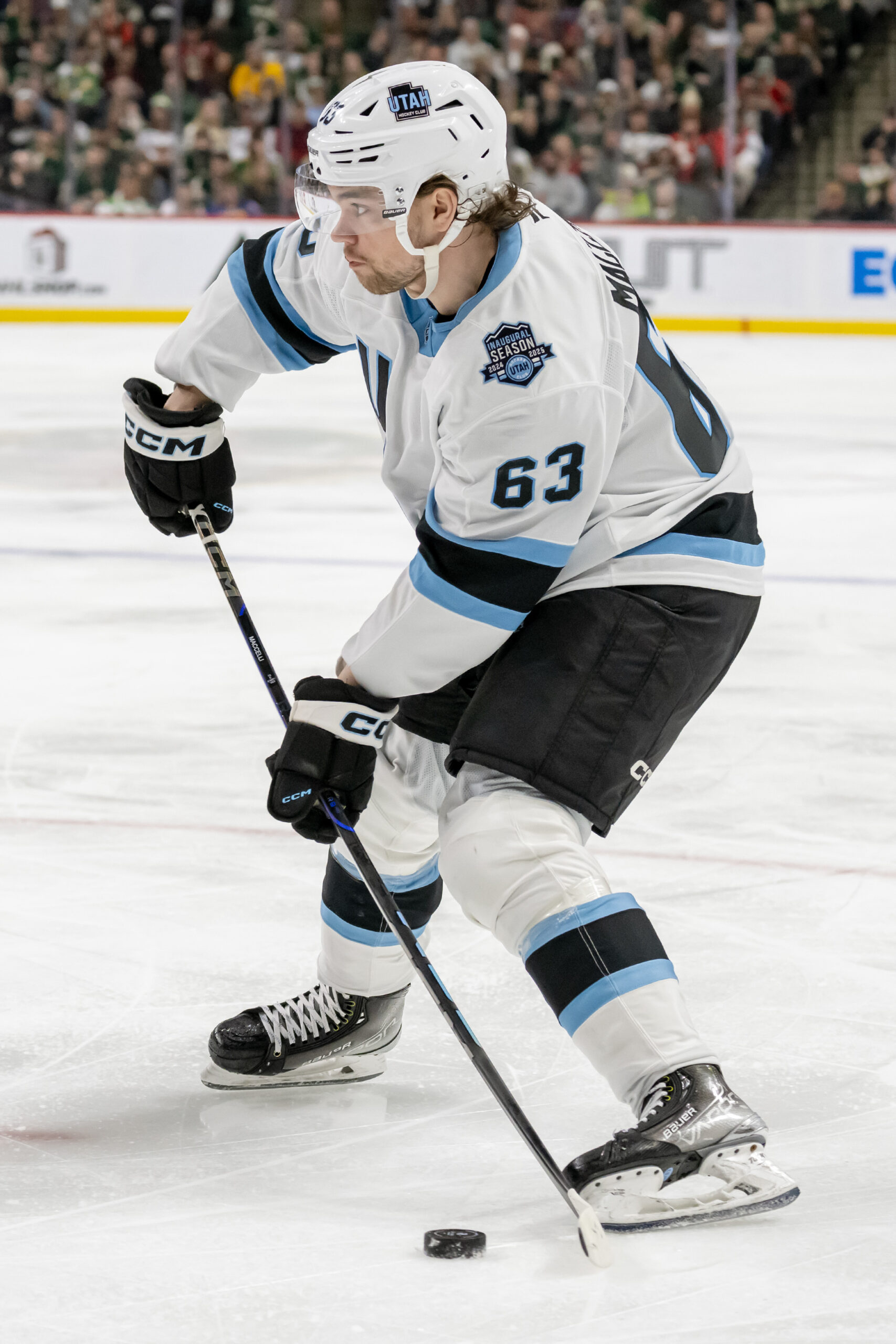 The Mammoth’s first season in Utah was marked by near across-the-board improvement. Wingers Lawson Crouse and Matias Maccelli were notable exceptions to the rule. Crouse, who’s been with the Arizona/Utah skater group for his entire NHL career and had established himself as a consistent 20-goal, 40-point force, dropped off the map entirely in 2024-25. The 6’4″, 214-lb power forward had just 12 goals and 18 points in 81 games and had his ice time slashed along the way. His 13:44 worth of deployment per game was his lowest in five years.
Maccelli’s regression was also quite disappointing. The 24-year-old Finn looked well on his way toward being a top-nine fixture for the franchise after scoring at a 60-point pace over the 2022-23 and 2023-24 seasons. He scored just eight goals and 18 points in 55 games this year, though, spending most of the last few months of the campaign as a healthy scratch due to his limited effectiveness in a checking role compared to Crouse.
Both are making significant cash. Crouse is signed through 2026-27 at a $4.3MM cap hit, while Maccelli has one year left on his deal at $3.425MM. The latter is probably worth keeping around and hoping for a bounceback. Trading him now would mean parting ways at the lowest point of his market value, and his signing rights will still be under team control as an RFA in 2026 if they still want to recoup an asset for him. Crouse, who has a much lower offensive ceiling but boasts a more consistent track record, may draw more interest.
Even with the Mammoth expected to be aggressive in free agency this summer, there isn’t a substantial financial urge for them to move either player. It might be more prudent to hope for rebounds for both next year. They have $21.2MM in cap space to fill just three roster spots, per PuckPedia, enough for them to potentially land the top UFA available in Mitch Marner, re-sign their lone notable RFA in Jack McBain, and land another serviceable depth piece on the open market. Mulling a trade for either Crouse or Maccelli would purely stem from fit and roster construction as the motivating factor.
Land A Needle-Moving Forward
Even with Sean Durzi and John Marino missing significant time on defense and their goaltending outside of Vejmelka putting up poor performances, Utah was still league-average defensively in 2024-25. Some natural improvement will come, especially with underlying metrics painting a much rosier picture of their defensive showing at 5-on-5 than their actual goals against indicate.
But the Mammoth, despite boasting five 20-goal scorers, ranked 20th in the league in offense in 2024-25. They have goal-scoring help coming soon in the form of top prospects Daniil But and Tij Iginla, but for a club with cap space to burn and an eagerness to bring postseason hockey to a new market, they’ll be in on the top names on this year’s UFA market.
They’ll consider the top name available in Marner, but landing a center, particularly one with size, might be the priority to serve as a more veritable second-line option behind Cooley. Former top-five pick Barrett Hayton has finally established himself as a quality two-way piece. He hit 20 goals and 46 points this year and averaged north of 16 minutes per game, but he’s likely best served as a No. 3 option long-term on a contending team.
That’s not to say they won’t look at wingers as well. They have an excellent top-three group at present with Guenther, Keller, and Nick Schmaltz, and Iginla and But will likely fill the last second-line winger role in a few years, but their current options of Crouse, Maccelli, or Josh Doan in the 2RW slot leave a little bit of uncertainty. But whether it’s a name like Marner, Sam Bennett, Nikolaj Ehlers, Brock Nelson, or someone else, expect them to have a fresh face near the top end of next year’s lineup to give them an added layer of scoring depth.
Image courtesy of Nick Wosika-Imagn Images.
The Anatomy Of A Stanley Cup Champion
A lot has been made of the Toronto Maple Leafs’ elimination from the playoffs this week, with fans stating that ownership should tear the core apart. However, winning in the NHL has never been more challenging as parity has become the norm, creating a league where the line between winning and losing is razor-thin. The introduction of the salary cap in 2005 effectively eliminated the age of the dynasty. Still, the Pittsburgh Penguins, Chicago Blackhawks, and Tampa Bay Lightning managed to win multiple Cups, using a similar formula that relied on a mix of homegrown stars, bold and aggressive trades, and savvy free-agent signings. Looking back on the past decade, a clear pattern emerges, revealing a common thread that links all the Stanley Cup Champions from 2015 to 2024. These teams were built from the ground up and relied on similar roster construction to chase their championships, and could serve as a template for teams such as the Maple Leafs to follow.
Every Stanley Cup roster between 2015 and 2024 had an elite center running the first line, from Jonathan Toews in Chicago to Sidney Crosby in Pittsburgh and Jack Eichel in Vegas. These champions built their dominance from the center of the ice out. That dynamic point producer anchoring the top unit set the tone for teams, allowing them to drive play at five-on-five and usually run an elite power play. Oftentimes, these centers were two-way players who didn’t skimp on their defensive game or shy away from physicality. Crosby and Toews have consistently demonstrated this, as well as many other intangibles that set the tone for their respective teams.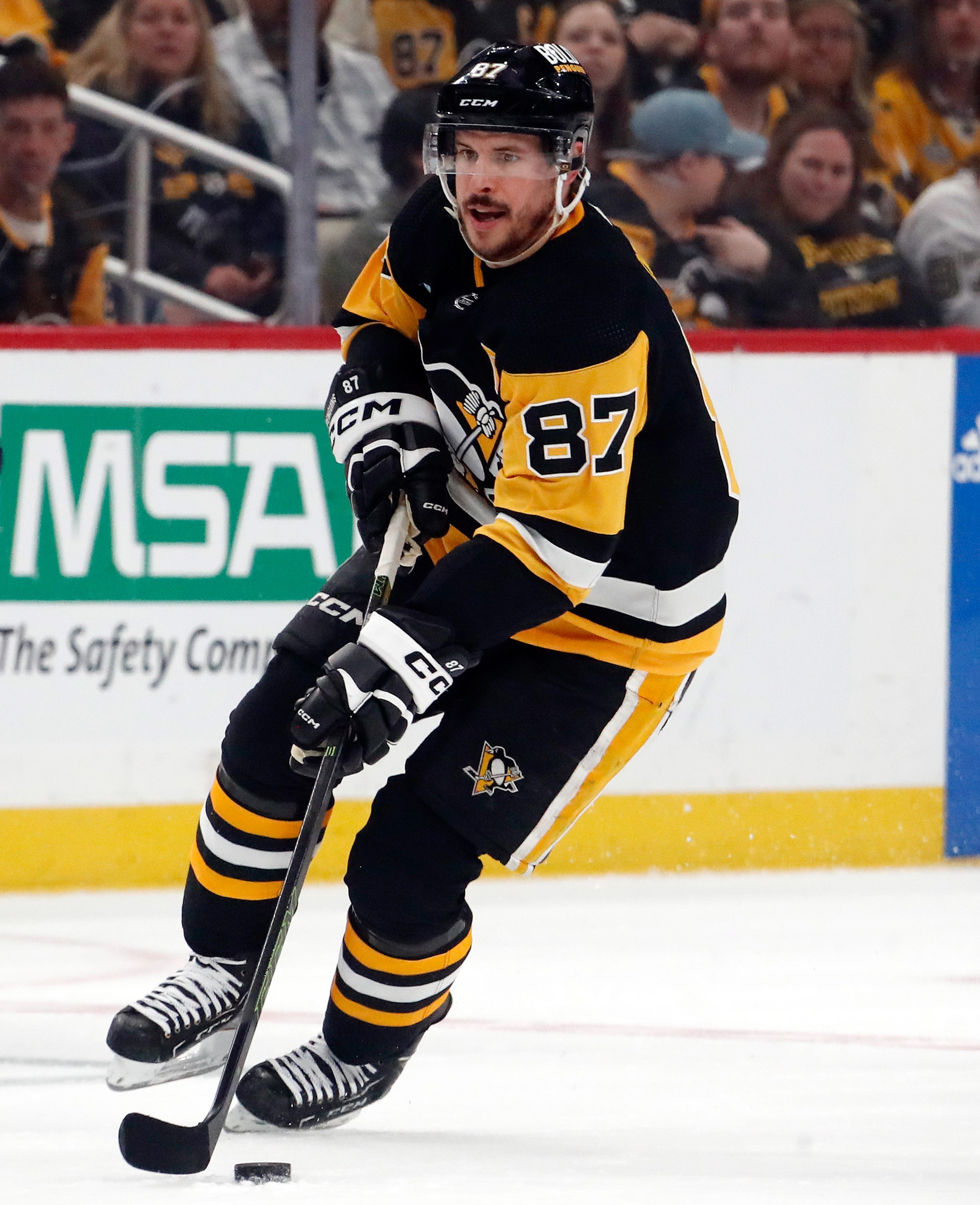
Outside of an elite center, the champions have all had a strong 2C that could operate as a first-line center on most other NHL teams. The ability to roll out two top centers has given teams the ability to overwhelm their opponents by essentially running two first lines. There is no better example of this than Pittsburgh with Crosby and second-line center Evgeni Malkin. During their runs to the Stanley Cup, Pittsburgh was able to get more out of Malkin on the nights that Crosby didn’t have his game and vice versa.
Behind that, top teams almost always have substantial center depth beyond their top six, and in many cases, they can play matchup minutes against the other team’s top players. Pittsburgh had Nick Bonino, who centered the HBK line (with Phil Kessel and Carl Hagelin) that became a force during the Penguins’ 2016 run, while the Washington Capitals of 2018 had Lars Eller, who could match up against an opposing team’s top line or contribute offensively if played against similar level competition.
Beyond the middle of the ice, championship teams had one game-breaking winger. Pittsburgh had Kessel, Chicago had Patrick Kane, and Tampa Bay had Nikita Kucherov. Even in the past two years, the Champions (Vegas and Florida) have been able to deploy Mark Stone and Matthew Tkachuk, respectively. Having a winger who can take over a game gives the elite centers a pressure valve if they are having a bad game or are being tightly checked. Crosby had some off nights during the Penguins’ runs, but Pittsburgh was fortunate to have Kessel around to pick up the pieces. In Game 2 of the 2017 Eastern Conference Finals against Ottawa, the Senators did a phenomenal job checking Crosby and Malkin. However, Kessel was there to score the game’s only goal as the Penguins won 1-0.
Slipping back to the defense, nearly every team has had a top-pairing defenseman that is at or close to Norris-caliber over the past decade. This defenseman can play at a high level for 25-plus minutes per night and drives play at even strength while running an effective top power play unit. The one exception here might be the 2017 Penguins, who had Kris Letang, but he was sidelined due to injury and missed the entire playoffs. However, running it back to 2015, teams have had that minute-eating star defenseman who dominates at both ends of the rink. The list of players is elite: Cale Makar (Colorado 2022), Victor Hedman (Tampa Bay 2020 & 2021), Alex Pietrangelo (2019 in St. Louis and 2023 in Vegas) and John Carlson (Washington 2018), to name a few.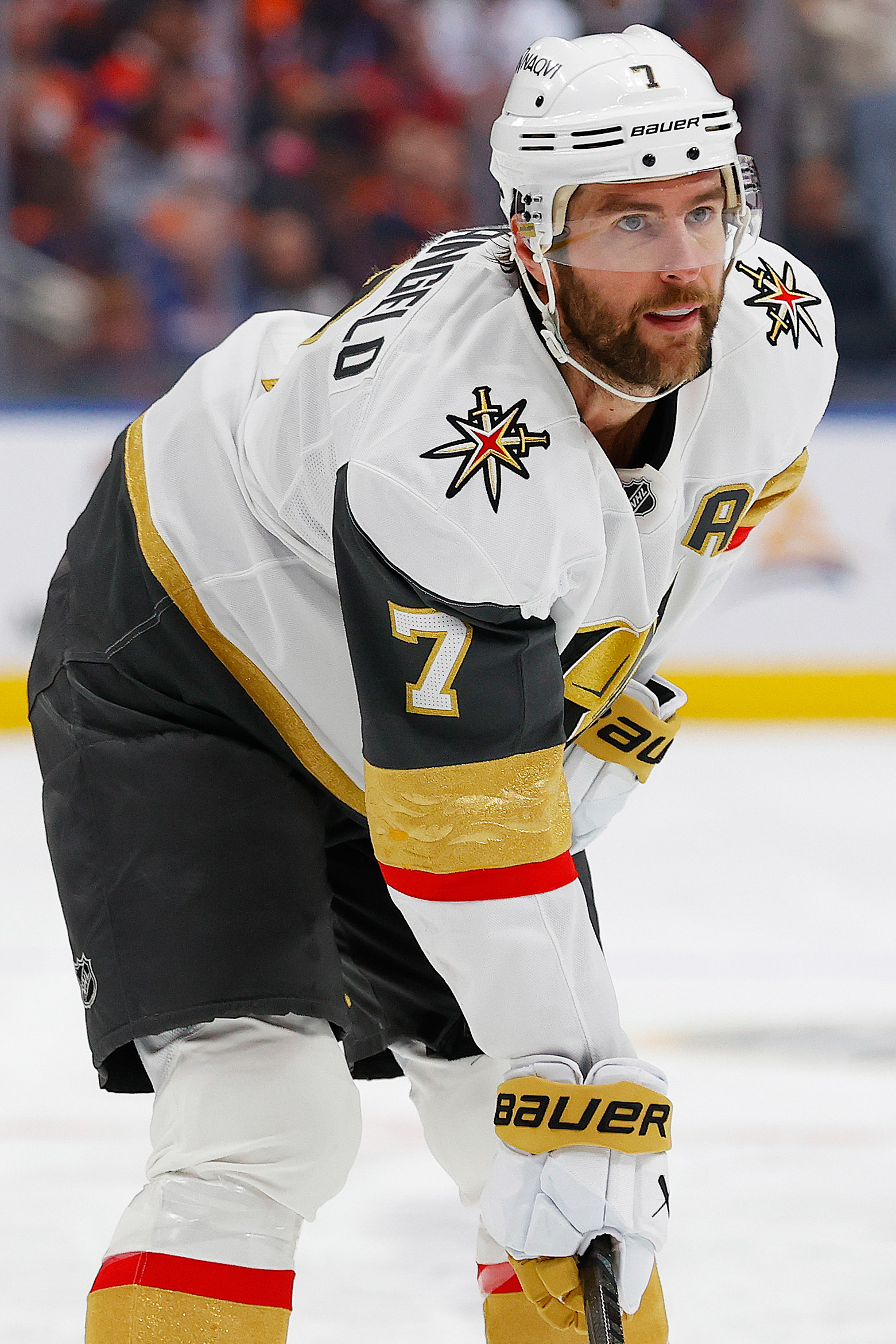
The depth is also essential for these Cup-winning rosters, as the bottom six can play a critical role depending on matchups and how many teams can roll four lines. Teams that can throw out a strong forechecking bottom two lines can wear down their opponents over a seven-game series using a mix of speed, grit and defensive reliability. The Penguins won two cups with this style, as did the Tampa Bay Lightning, who could deploy the likes of Pat Maroon, Tyler Johnson and Ross Colton on their bottom two lines during their back-to-back Stanley Cup championships. Teams that can keep sending over fresh legs shift after shift can eventually overwhelm their opponents in a seven-game series as the top players on the opposing team start to wear down from being relied upon to carry the water for a weaker team.
The teams that can build out depth can keep their core players together for a long time, which is also a massive piece of building out a Stanley Cup-winning roster. Most of the teams that won a title over the past decade did so by having a core that was largely intact for over a few years, which built chemistry, resilience, familiarity and a buy-in from the players who remained in that organization. The core continuity allowed all those components to grow and mature, eventually becoming an advantage when the games matter the most. Teams that lacked that stability often would have difficulty competing year after year, which happened to Pittsburgh after 2017, as the organization became a revolving door for the past decade.
Lastly, goaltending is always a significant factor in playoff success, but it isn’t always about who has the best goaltending; it is more about which team has the timeliest goaltending. Most of the teams that have won championships have done so without a Vezina Trophy winner and simply had a goaltender who got hot at the right time of year and carried the team through a round or two. In some cases, teams relied on two goalies who heated up when the games mattered most and were able to get the job done, or in the case of Vegas in 2023, they relied on upstart Adin Hill, who was fantastic in his 11 wins on the way to the franchise’s first Stanley Cup. In rare cases, teams didn’t even need average goaltending to win the cup and could get the job done despite poor netminding (Colorado 2022).
So, to recap, using the last ten Stanley Cup Champions: a team must acquire an elite first-line center, a strong second-line pivot, solid bottom-six depth up front, a Norris Trophy-calibre defenseman, and a goaltender that can get hot at precisely the right time. The ability to acquire the right mix of players at the right time is incredibly complicated and is something that Toronto has had to grapple with over the past decade; it isn’t easy to win in today’s NHL, and even the greatest of plans can be foiled by that reality. The Maple Leafs will be in tough to turn this era into a Stanley Cup, even if their blueprint isn’t far off from past winners.
Photos by Charles LeClaire-USA TODAY Sports & Perry Nelson-Imagn Images
The Maple Leafs Can Keep Their Contention Window Open
It’s too early for most Toronto Maple Leafs fans to speculate on what to do this summer to get this team to the next level. Fans are understandably emotional right now due to another playoff disappointment in a long line of playoff disappointments, and many have called for a complete levelling of the personnel from management down to the players. And while very few pieces on the team have performed up to expectations, it’s unrealistic to expect a complete teardown. So, what should the Maple Leafs do this summer?
First, it’s essential to understand the current state of Maple Leafs management. President of hockey operations Brendan Shanahan has no contract for next season, and it sure doesn’t seem like he will get one with Toronto. Not after the complete collapse of this Maple Leafs team that just could never win when it mattered the most. Shanahan came into Toronto and unveiled the Shanaplan, which was objectively a failure as the Maple Leafs never made it out of the second round and lost every Game 7 they ever played in under his watch. Regardless of the results, Shanahan never wavered from his plan, even when it became apparent that he needed to pivot. Ultimately, he remained steadfast, and it likely cost him his job, or at the very least, it should have.
That should be the first significant domino to fall, and it will be another major shakeup in Toronto after they let general manager Kyle Dubas walk two years ago and sent former head coach Sheldon Keefe packing last summer. But that can’t be it, Toronto can’t just march in another president of hockey operations and call it a summer; they need real change on the ice, palpable, brutal, change that shakes the makeup of their hockey team. It cannot be tinkering around the edges like the team has done in the summers past.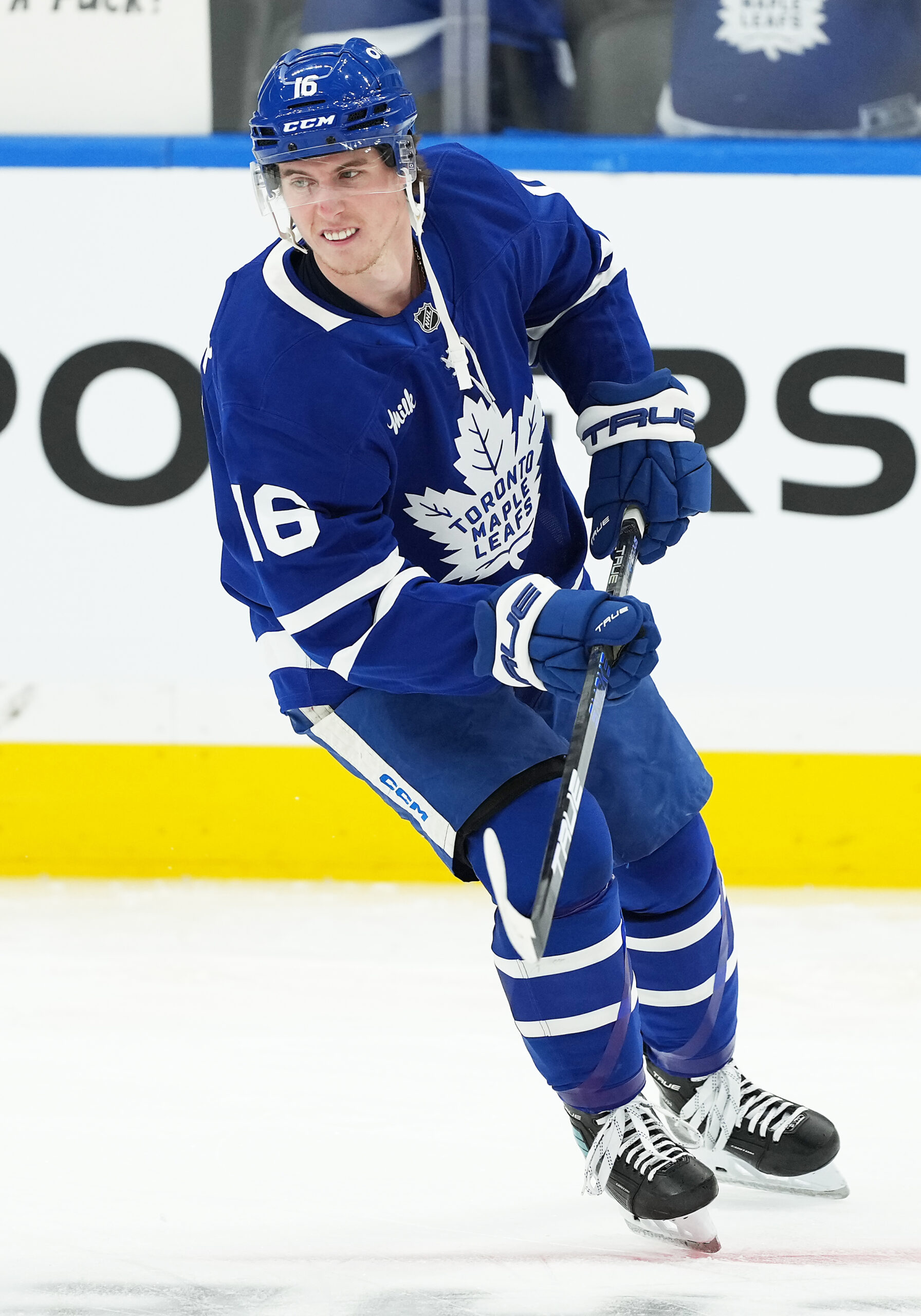
Toronto needs to let Mitch Marner walk; unfortunately, he will set sail for nothing in return. Toronto will gain significant cap space, and how they use it will be imperative to their future success. During his nine years in the NHL, Marner was an incredible point producer in Toronto, producing 221 goals and 520 assists in 657 career NHL games. The 28-year-old was also solid defensively and killed penalties, averaging 92 points per 82 games. But his playoff numbers were abysmal by his standards, tallying just 13 goals and 50 assists in 70 career playoff games. Marner went quiet when it mattered most, and he was never a game breaker for Toronto when the stakes were at their highest. Toronto can no longer afford to pay top dollar for a winger who disappears at inopportune times, no matter how effective he is in the regular season. Marner will surely command a lot of money in free agency, and he may go on to eventually win a Stanley Cup, but his time in Toronto ran its course, and running it back with him would be hazardous for both him and the Maple Leafs.
Toronto must also decide how badly it wants to keep John Tavares in the fold. The 34-year-old is at the tail end of his career and remains a solid point producer, but he is not the fleetest of foot, and his underlying numbers this season were some of the worst of his career. Tavares had 38 goals and 36 assists in 75 games this year, but couldn’t replicate his offensive pace in the playoffs despite some timely scoring. Tavares could still chase significant money in free agency, but the Maple Leafs should avoid paying market value to a player who has posted just 31 points in 51 playoff games with Toronto. If Tavares wants to remain close to home in Toronto, the Maple Leafs should play hardball and try to finally have one of the members of the core four sign a contract that is significantly under market value. If Tavares isn’t interested in offering a discount, Toronto should use those savings elsewhere and try to bring in another free agent to give the forward group a fresh look.
Beyond that, the Maple Leafs should let their remaining UFAs go and lock up Matthew Knies to a long-term extension. If Toronto opts to sign Knies long term AFP Analytics projects his deal to be in the neighborhood of $7.22MM per season long term, which would leave the Maple Leafs with 17 players signed for next season and $17.6MM in available cap space (if Matt Benning and Ryan Reaves are buried in the AHL once again). That lack of wiggle room makes it impossible for Toronto to bring back Marner and Tavares, even if they wanted to (Marner is projected to receive $12.95MM annually, while Tavares is at $7.94MM annually). Still, they should consider other options unless Tavares takes about half that projection.
So, what can Toronto do to fill out those final six roster spots? Well, the short answer is not a lot, at least not on the trade market, since they don’t have a first-round pick until 2028 and lack impact prospects outside Easton Cowan, Topi Niemela, and Ben Danford. The Maple Leafs have two choices: sign players through free agency or make hockey trades using roster players. Regarding where the changes might occur, the likeliest changes will occur upfront, where the Maple Leafs have seven forwards under contract, not including the aforementioned Knies. On the backend, Toronto’s entire defense is locked up for next year, as are both goaltenders.
The good news for the Maple Leafs is that the defense and goaltending free agent markets are weak, while the forward UFAs are stronger. This could open up the Maple Leafs to move out a defenseman for a reasonable return and to acquire salary cap room to sign a forward. Oliver Ekman-Larsson played reasonably well this season and has a 16-team no-trade clause, so he could certainly be dealt, but a move like that would put added pressure on the bottom defensive pairing, which they might not want to do.
The Maple Leafs have some contracts up front that they would no doubt love to rid themselves of. The final year of Calle Järnkrok’s contract could probably be moved with a late-round sweetener, and perhaps that is something Toronto will explore to give itself an extra $2.1MM in cap space for next year. Another option would be to try to move Max Domi and his $3.75MM cap hit, but with three years on that deal, it might be something Toronto has to hold onto. Domi wasn’t terrible last season but was miscast in the bottom six and struggled in the playoffs at times, despite having seven points in 13 games.
All the options in Toronto create many moving parts, but the Maple Leafs have to be careful not to change for the sake of change. They must be strategic about shuffling the deckchairs and targeting players who can insulate their remaining stars. So, who should Toronto target to bring into the fold?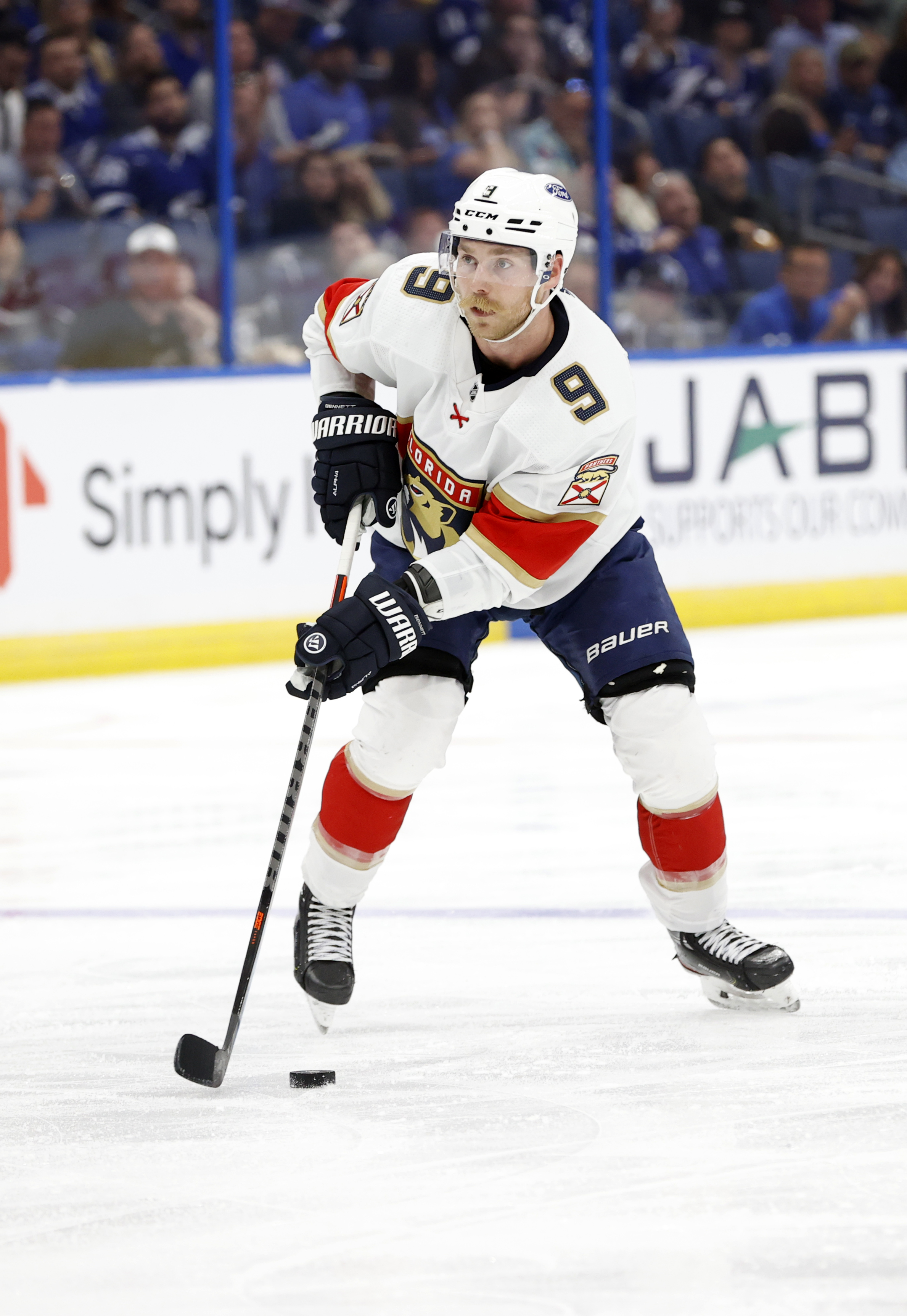
Florida center Sam Bennett would be a top target, particularly if Tavares moves on. Bennett is a true warrior who is battle-tested and still reasonably young at 28. He gave the Maple Leafs a front row seat to see what he could do and would give Toronto an element of skill and sandpaper that had been missing during their past decade of struggle. Bennett is from Holland Landing, Ontario, which is a little less than an hour North of Toronto and may welcome a return to home, but cost could certainly become an issue as he will be one of the most sought-after free agents. AFP Analytics projects Bennett to receive a six-year deal for $6.64MM annually, which could become problematic in a few seasons given his style of play, but it would be a price worth paying if he plays at his current level for even half of the deal.
Speaking of Florida Panthers forwards, Brad Marchand should be a target simply so he can stop torching the Maple Leafs in the playoffs annually. Marchand is no longer a top-end forward, but he has proved his worth in these playoffs, particularly against Toronto. Marchand is projected to sign a two-year deal worth just north of $5MM per season, which would be a very reasonable ask given his resume and ability to get better as the games get bigger. Toronto desperately needs the intangibles that a Marchand-type player can provide, and his personality would probably thrive in a big market such as Toronto.
An off-the-board target that wouldn’t provide a massive impact but could be an under-the-radar signing is two-time Stanley Cup Champion Brandon Saad. The 32-year-old can still produce at a 40-point clip and remains a decent skater who can play off the rush. Saad still does well to get to the net, and he can cause issues for opposing goaltenders, using his hands in tight to provide offense. Toronto doesn’t have much of what Saad offers, and he isn’t likely to cost much more than $2MM on a one- or two-year deal. Saad also has considerable big-game experience, which the Maple Leafs lack, and like Marchand, could provide some veteran leadership to help Toronto’s stars in those uncertain big-game situations.
Change is necessary in Toronto this offseason, as the team can no longer tinker around the edges of the roster. Big moves need to be made, and the Maple Leafs will likely need to replace one or two of the core four by committee rather than with one player. It’s a difficult task, but not impossible, as Oakland A’s general manager Billy Beane once said in the film Moneyball, “Guys, you’re still trying to replace Giambi. I told you we can’t do it, and we can’t do it. Now, what we might be able to do is re-create him. Re-create him in the aggregate.” While Billy Beane is discussing replacing one of the best hitters in baseball, the Maple Leafs might be tasked with replacing one of the best offensive producers in the NHL, and given the constraints in place, they will need to do it by committee. It’s a tall task, but as Beane showed back over two decades ago, it’s not an impossible one.
Photos by Nick Turchiaro-Imagn Images and Kim Klement-USA TODAY Sports