
Latest On Zach Aston-Reese, Evan Rodrigues
The calendar has now turned to September, only turning up the heat on both free agents looking for contracts and teams looking to fill roster holes ahead of training camp. A marginal salary cap increase over the past few seasons has made late-offseason moves tougher to make work, though, and it’s becoming more and more common to see situations get resolved at the last minute due to a lack of other options.
Two players who could be in that boat are a pair of former Pittsburgh Penguins forwards Zach Aston-Reese and Evan Rodrigues. Pittsburgh Hockey Now’s Dan Kingerski reported today that sources tell him both Aston-Reese and Rodrigues have interest and multiple offers from NHL teams but are “holding out for better situations.” Kingerski named both the Calgary Flames and Vancouver Canucks specifically as teams that have kicked tires on Rodrigues, which had been previously reported. He noted that Aston-Reese had interest from two or three NHL teams, but that the bottom-six utility player is looking for more offensive opportunities on his next team.
Kingerski also mentioned to a lesser degree, that veteran center Brian Boyle has an interest in returning to Pittsburgh, although there isn’t much space for him on the organizational depth chart.
Whichever team does sign Aston-Reese will be getting one of the most valuable bottom-six threats (if not the most valuable) still on the market. His career-high of 17 points may not jump off the page, but he’s made a name for himself as one of the top defensive players, at least analytically speaking, in recent years. The 28-year-old product of Staten Island was dealt to the Anaheim Ducks at this year’s trade deadline in the Rickard Rakell trade and had four points in 17 games during his brief stint as a Duck.
An obvious fit for Aston-Reese would be the Winnipeg Jets, who still have some cap space to burn after signing Sam Gagner earlier this week. The Jets have some weak bottom-six depth that would allow Aston-Reese to see some more offensive looks, and his services could help solidify a historically defensively inept team.
Minor Transactions: 09/04/22
Just a few weeks from now, NHL teams will be taking the ice to do battle in the preseason. Meanwhile, minor league and European clubs continue to make additions to their own rosters in preparation for the regular season. As always, we’ll keep track of today’s notable minor moves right here.
- Veteran defenseman Adam Almqvist, a 2009 seventh-round pick of the Detroit Red Wings, has signed a one-year deal with KHL club Traktor Chelyabinsk. Almqvist spent 2021-22 with another KHL club, Dinamo Minsk, and scored 26 points in 41 games. The Swedish blueliner has 2 games of NHL experience under his belt, both coming in 2013-14, and he played a major role for the 2012-13 Grand Rapids Griffins, who won the Calder Cup. By playing in the KHL, Almqvist, who has represented Sweden in international tournaments in the past, will be ineligible to be called up to the Swedish national team.
- Minor-league fixture Arvin Atwal, who has served as an AHL/ECHL tweener defenseman for most of his professional career, is headed back to North America. After spending 2021-22 with HK Spisska Nova Ves of the Slovakian league, Atwal has chosen to sign a one-year deal with the ECHL’s Cincinnati Cyclones. The 26-year-old blueliner has 583 PIM’s in 177 career ECHL games and should bring some physicality to a Cyclones franchise he played for from 2016-17 through 2018-19.
- Dominik Furch, a longtime starting netminder in European leagues, has signed closer to home. The 32-year-old Furch backstopped Farjestad BK to an SHL championship last season and has signed a three-year contract with HC Kometa Brno. Furch, who has spent much of his career as a quality starting goalie in the KHL, brings championship experience to a Brno club that had a mediocre 2021-22. Perhaps most notably from an NHL perspective, the addition of Furch could displace Matej Tomek as the team’s starting goalie, which would be a setback in the career of the Philadelphia Flyers 2015 third-round pick.
This page will be updated throughout the day.
Leo Komarov Signs In Sweden
In early August, we covered rumors that veteran NHL forward Leo Komarov would be spending the 2022-23 season in the SHL. While it turns out that Brynas won’t end up being the club that features Komarov next season, Komarov has ended up in the SHL after all. Per a team announcement, Lulea HF has signed Komarov to a one-year contract.
Komarov, 35, is a veteran of nearly 500 NHL games. He played for two teams in his NHL career, the New York Islanders and Toronto Maple Leafs, and has scored 170 points in his 491 career NHL games. Komarov’s most recent run was with the Islanders, where he played as a low-scoring bottom-sixer on a squad that went to back-to-back Eastern Conference Finals.
The best years of Komarov’s career came with the Toronto Maple Leafs, highlighted by a 2015-16 season where he scored 19 goals and 36 points and represented the Maple Leafs at the 2016 All-Star Game. A sixth-round pick in 2006, Komarov’s NHL career came after a long stretch of development in the KHL.
Komarov made his KHL return last season, skating in 18 regular-season contests and 16 playoff contests for SKA St. Petersburg, scoring a combined nine points. Komarov helped Finland win gold at the 2022 Beijing Winter Olympics and joins a Lulea team that fell just short of winning the SHL championship last season.
While a return to the NHL for Komarov is likely out of the picture, it’s definitely possible that he spends the remainder of his playing days as a quality forward in European leagues while also featuring in international tournaments.
Poll: Who Is Next To Rebuild?
It seems every year in the NHL, a team mired in a years-long rebuild finally turns a corner and becomes a legitimate contender again while a team that has been successful for a long time finally decides it needs to start over and enters its own rebuild. One would think that the 2022-23 season wouldn’t be an exception, but while there are several teams that seem to be turning the corner, such as the Anaheim Ducks, Detroit Red Wings, and Ottawa Senators, it’s not immediately clear who is heading for an imminent rebuild. Sure, some teams already in a rebuild stepped up their efforts a bit, like the Chicago Blackhawks and San Jose Sharks, but their process had already begun. Before looking at the teams that could be in this unenviable position, we’ll attempt to classify the rest of the pack.
Window is Staying Open: CAR, CGY, COL, DAL, EDM, FLA, NYR, TBL, TOR
Up and Coming: ANA, BUF, CBJ, DET, LAK, NJD, OTT, VAN
Already Rebuilding: ARI, CHI, MTL, PHI, SEA, SJS
After trying to sort out where a large portion of the league stands on their builds, that leaves nine teams in a sort-of limbo state. These teams could, in theory, win the Stanley Cup this year, could be a team on the fringe of the playoff picture, or could find themselves needing to start things over. Once again, the remaining teams appear to fit into one of three categories on their status:
Proven Winner With A Veteran Core:
The teams best placed here would be the Boston Bruins, New York Islanders, Pittsburgh Penguins, St. Louis Blues, and Washington Capitals. With their current build, three teams have won at least one Stanley Cup (Pittsburgh, St. Louis, and Washington), one has made it to the Cup Final, Boston, and the fifth, the Islanders, made back-to-back Conference Finals. All five of these teams, for the most part, have a key group of players who are towards the later stages of their prime, if not out of it, and all have a substantial portion of that core signed for at least a couple more seasons.
A team like the Islanders who has one of the older groups, also has the largest portion of that group signed long-term. That, combined with their lack of a Stanley Cup would make them seem as though they will try at least a couple more times to be a winner. But the age and cap implications could have a volatile effect. To the opposite, Pittsburgh and Washington have achieved the ultimate goal so rebuilding when necessary would be easier to stomach. But, unlike the Capitals, the Penguins recently signed two players in their mid-30’s to long-term extensions. Either way, both teams have several veterans still at the top of their game.
Boston is in their own unique situation, as they have a few players in or entering their prime, such as David Pastrnak, Charlie McAvoy, Hampus Lindholm, and Jeremy Swayman and that group hasn’t won a Cup with the team. But time could be running out on veterans, and previous Cup winners, Patrice Bergeron, Brad Marchand, and David Krejci, not to mention Pastrnak’s looming free agency.
Lastly, St. Louis has a relatively younger core, which they’ve won with, but will be faced with nearly all of their key players hitting the UFA market in the next couple of seasons. If they can manage to keep those pieces while also managing their cap, they could easily fit in above with the windows open group but if not, a rebuild might be less of a choice than simply reality.
Cap Concerns:
The two teams included in this section, the Minnesota Wild and Vegas Golden Knights, have both impressed in recent seasons and boast a roster that would appear as though it can compete going forward. But, managing the cap will not only prove burdensome, but has already forced a number of moves that represent a step back for the organization. First, Vegas has sacrificed plenty in order to be instantly competitive and maintain themselves through their first five years in the league. That was as clear as ever last offseason when they traded Vezina Trophy winner Marc-Andre Fleury for a minor league player, and this offseason when they traded star forward Max Pacioretty for future considerations. The team has had to make sacrifices of real talent in order to stay cap compliant and keep the remainder of their group intact, which could spell disaster.
The Minnesota Wild have otherwise managed their cap situation rather well, but have put themselves in a difficult position with the buyouts of Zach Parise and Ryan Suter, which will put $12.74MM against their cap this year and $14.74MM the two years after. The Wild already had to trade the dynamic Kevin Fiala to make things work for 2022-23 and things only figure to get more difficult over the next three seasons. One bright side, the group they currently fit in with the penalties has shown they can perform as well as anyone.
Of note, one might think the Tampa Bay Lightning are a perfect fit in this section, however the recent extensions of Erik Cernak,, Anthony Cirelli, and Mikhail Sergachev show the organization has no plans on changing course for a considerably long time.
Lack Of Performance:
The Nashville Predators and Winnipeg Jets provide two of the most fascinating examples of teams that could rebuild, could breakout, or could just simply stay as a middle-of-the-road team. Both teams have a number of exciting names, many of whom are signed for at least a few years, but neither seem to be among the best of the best. This offseason the Predators re-signed Filip Forsberg and acquired Ryan McDonagh, showing their desire to stay competitive and improve. However, since their appearance in the 2017 Stanley Cup Finals, the team has made it past the first round once, back in 2018. Even with breakout performances from Forsberg, Matt Duchene, Ryan Johansen along with an all-time performance from Roman Josi, the Predators just made it into the playoffs, losing to the eventual Stanley Cup Champion Colorado Avalanche in the first round.
Winnipeg, like Nashville, carries several star players including Kyle Connor, Nikolaj Ehlers, Josh Morrissey, and Mark Scheifele along with former Vezina winner Connor Hellebuyck. Still, that group has made it past the first round once since their Western Conference Finals appearance in 2018, and failed to make the postseason altogether this year. Now with an older Blake Wheeler, as well as Scheifele an Hellebuyck each two years away from free agency, Winnipeg may need to re-evaluate their build if it can’t compete for a Stanley Cup regularly with this group.
Considering the teams that seem poised for a rebuild, who is the most likely one to blink first and tear things down? Could it be a team that’s had a good run but needs to get younger? A team that just needs to reset from a salary cap perspective? A team who just hasn’t been able to meet their goals? Or an unexpected candidate?
Who Is Next To Rebuild?
-
Boston Bruins 25% (463)
-
Winnipeg Jets 19% (348)
-
Washington Capitals 11% (199)
-
New York Islanders 10% (186)
-
Pittsburgh Penguins 10% (183)
-
Vegas Golden Knights 9% (162)
-
Nashville Predators 4% (73)
-
Other 4% (73)
-
St. Louis Blues 4% (71)
-
Minnesota Wild 3% (58)
Total votes: 1,816
Trade Rumors app users, click here to vote.
This Day In Transactions History: Ilya Kovalchuk Signs Revised Fifteen-Year Contract With New Jersey Devils
What if there had been an Ilya Kovalchuk, Jack Hughes, and Jesper Bratt line going into next season? At age 39, perhaps Kovalchuk would have been destined for the third line with some combination of Erik Haula, Tomas Tatar, Andreas Johnsson, and Dawson Mercer. It’s likely this isn’t exactly what the Devils and their fans were thinking when the team signed Kovalchuk to a 17-year, $102MM contract back in July 2010. After all, Hughes was just nine-years-old, current team captain Nico Hischier was 11, and All-Star defenseman Dougie Hamilton was looking to boost his stock in the 2011 draft with a big year for the Niagara IceDogs.
In reality, nothing went to plan when the Devils and then-GM Lou Lamoriello signed the 17-year pact with Kovalchuk, the NHL taking issue with it as a form of salary cap circumvention, an arbitrator agreeing with them. This would force a negotiation between the league and the NHLPA on how to handle the structure of long-term contracts. On top of Kovalchuk, the NHL had been looking into the contracts of Chris Pronger, Roberto Luongo, Marc Savard, and Marian Hossa, all of whom had received long-term, front-loaded contracts that carried salaries at or near the league minimum in the final few years, which served to bring down the overall cap hit of the deal.
In sum, the league and the players agreed to rules affecting new contracts (as of September, 2010) for five years or longer that lasted at least to a player’s 41st birthday which would give a more accurate reflection of the salary the player was earning. The agreement also made sure the issue wouldn’t automatically carry over into the next CBA, and of course, rules on contracts have changed dramatically since the 2012-13 lockout. Now, seven or eight-year maximums, consistent cap hits, 35+ contracts, and the like regulate at least that form of salary cap circumvention.
After the dispute, New Jersey and Kovalchuk agreed on a revised 15-year, $100MM contract on September 3, 2010 that would run through the 2024-25 season, carrying a cap hit of $6.67MM. The matter now settled, the Devils were looking ahead to their fourth Stanley Cup with their superstar in hand. Of course, as we know, the drama was far from over. During the first three years, Kovalchuk would be solid, but New Jersey would miss the playoffs in two of the three years. However, Kovalchuk and the Devils would take the Los Angeles Kings to Game Six of the 2012 Stanley Cup Finals, the winger playing a big part of that run.
Unfortunately for New Jersey, during the 2012-13 lockout, Kovalchuk would return home to Russia, playing with SKA St. Petersburg, who he had considered signing with during his 2010 free agency. The experience playing close to home and having his family nearby had an impact on Kovalchuk, who informed Lamoriello of his intention to return home to Russia after the shortened 2012-13 campaign. At just 30-years-old, Kovalchuk voluntarily retired from the NHL following the 2012-13 season, leaving 12 years and $77MM on the table. The Devils, who had already lost Zach Parise to free agency the year prior, were given a yearly $250K cap-recapture penalty, which is in effect through 2024-25, but were handed the forward’s cap hit back.
The 2013 offseason saw New Jersey bring in Jaromir Jagr to replace Kovalchuk’s production, the 41-year-old turning in an impressive 67-point campaign, but the Devils would miss out on the playoffs, finishing with 88 points. The team struggled to start the 2014-15 season, firing Head Coach Peter DeBoer and Lamoriello leaving that spring for an opportunity with the Toronto Maple Leafs. The organization would head into a full-scale rebuild, one which has, outside of a 2017-18 playoff appearance lead by Hart Trophy winner Taylor Hall, lasted through this offseason. Things look to have finally turned a corner in New Jersey, lead by Hughes, Hischier, Mercer, Hamilton, and a world class group of prospects including Luke Hughes, Simon Nemec, and Alexander Holtz, but the aftermath of trying to re-sign and then losing Kovalchuk is apparent.
The Devils and their fans may, and rightfully so, attribute this long, painful rebuild at least in part to Kovalchuk’s abrupt departure, however they may have been best-served by it. At the time of signing, New Jersey was expecting Kovalchuk to lead a team backstopped by an aging Martin Brodeur and lead up front by an older Patrik Elias. Though Cory Schneider was able to step-up as one of the league’s better goaltenders during their rebuild, the team didn’t really have the younger, supporting cast to put around Kovalchuk as he entered his 30’s. And, having his relatively large cap hit on the books would have made doing so, and likely rebuilding on-the-fly, rather difficult. That would have in turn likely delayed the inevitable: a lengthy, painful rebuild.
As for Kovalchuk, the winger got his wish to head home to play in his native Russia and have his family nearby, something he accounted for when he left the $77MM on the table back in New Jersey. He would spend five more seasons with St. Petersburg, serving as one of the league’s best players on a premier team. Following the 2017-18 season, the Devils’ NHL rights over the forward expired and a 35-year-old Kovalchuk sought a return to the NHL. He’d sign a three-year, $18.75MM contract with the Los Angeles Kings, but had his contract terminated part-way through the 2019-20 season.
The Kovalchuk mega-deal, whether it be the original or the revised, wasn’t the first or the last handed out by an NHL organization, but holds significant weight in NHL history. First, one of the league’s very best players leaving in his prime, with more money than most players will ever earn left on the table was one of the biggest and strangest transactions in hockey’s history, perhaps in sports history period. Further, the original deal and the revised, provided a roadmap that would change the framework of the NHL’s contract and salary cap systems for the long-haul. The changes brought about by the first contract sparked the league’s desire for change, which became a focal point for the 2012-13 lockout.
Snapshots: Miller, Sabres, Oettinger
As part of his seven-year, $56MM contract that was signed yesterday, Canucks forward J.T. Miller received a full no-move clause. That in itself isn’t noteworthy but he was eligible to have it apply to the upcoming season as part of the contract as well since he’s of UFA age. However, CapFriendly reports (Twitter link) that this was not the case. As a result, Miller does not have any sort of trade protection between now and July 1st when the NMC kicks in so if things don’t do well next season or Vancouver decides to shake things up, Miller will be trade-eligible even with his new deal in place.
Elsewhere around the hockey world:
- Sabres GM Kevyn Adams told Lance Lysowski of The Buffalo News that part of the reason they weren’t overly active in free agency this summer was to give them the flexibility to extend their internal core as their contracts come up. We saw an example of that recently with the seven-year agreement with center Tage Thompson while Dylan Cozens is a year away from a pricey new deal of his own; Rasmus Dahlin, Owen Power, and Peyton Krebs are extension-eligible next summer. If Adams intends to work out long-term deals with all of those players, they’ll need all the flexibility they can get so their discipline this summer will be worth it later.
- While Jake Oettinger ultimately settled for a three-year, $12MM bridge deal, the netminder told reporters including Matthew DeFranks of the Dallas Morning News that has made it clear to his representatives that he wants to stay in Dallas for the long haul. The contract still represents quite the raise for someone that actually spent a month in the minors last season before being recalled for good in mid-November and his AAV will get a notable bump three years from now as he’ll be owed a $4.8MM qualifying offer.
Classifying The Remaining Restricted Free Agents
When the calendar flips to September, it’s time to start paying some attention to who’s left unsigned in restricted free agency. Usually at this point, two months have elapsed since the start of free agency (it’s six weeks this summer) which is typically more than enough time to get a deal done.
There are currently 13 remaining RFAs that haven’t signed elsewhere for next season. As is usually the case, those players can be grouped into a few tiers which are as follows.
Star Players
Jason Robertson (Dallas)
 Generally speaking, there are usually more players in this group at this time but the 23-year-old is the only star player in need of a new deal. He’s coming off a 41-goal campaign that has the asking price justifiably high – team owner Tom Gaglardi acknowledged it’s in the $7MM range. The Stars would likely prefer to do a long-term deal that buys out some UFA years but that could push the AAV past $9MM and they don’t have the cap space to do that. At this point, what GM Jim Nill does or doesn’t do on the trade front might dictate what ultimately happens with Robertson; if they can free up some money, a long-term agreement becomes palatable but otherwise, it’ll almost certainly be a bridge contract.
Underachieving Former First Rounders
Erik Brannstrom (Ottawa), Kirby Dach (Montreal), Barrett Hayton (Arizona), Rasmus Sandin (Toronto)
Dach and Hayton were both top-five picks in their respective draft classes but have yet to show the type of offensive consistency to put them in the category of core players. Dach was traded to Montreal at the draft after a quiet season that saw him put up nine goals and 26 points, both career-highs. Despite that, it appears that the Canadiens are at least pondering a medium-term agreement that would run for four years but still leave him RFA-eligible at the end. Something a little shorter in the $2.5MM range is also an option. Hayton has just this last season in terms of being a regular under his belt and could fit in a different category than this but his performance relative to draft stock has been concerning. He’s a prime candidate for a bridge contract and with fewer than 100 NHL games under his belt, he simply doesn’t have the leverage to command anything longer. A two-year deal around the $2MM range should be where his deal falls.
As for Brannstrom, he was billed as an offensive defender but has yet to be able to produce with any consistency since joining Ottawa back in 2019. He has just two career goals in 116 career games but that hasn’t stopped his camp from seeking a multi-year agreement in negotiations which are likely playing a role in this delay. Sandin could also fit in a different category but the 2018 first-rounder has exhausted his waiver exemption and doesn’t appear to be a fit in their top six next season. His agent recently bemoaned the lack of progress in negotiations. Teammate Timothy Liljegren’s two-year bridge deal that has a $1.4MM AAV seems like a reasonable comparable but with playing time being a potential concern, might Sandin be looking for more certainty before putting pen to paper on a new deal?
Young Regulars
Michael Anderson (Los Angeles), Alex Formenton (Ottawa), Nicolas Hague (Vegas)
Formenton played his first full NHL season in 2021-22 and it was a good one as the 22-year-old speedster chipped in with 18 goals and 14 assists in 78 games. The Sens have ample cap space this coming season so there are some options beyond the bridge contract. If GM Pierre Dorion thinks that Formenton is part of their long-term core, a longer-term pact that buys out a UFA year or two in the $3.5MM range might be a better way for them to go.
Hague has done well in a limited role on the back end for the Golden Knights over the past two seasons and is coming off a year where he logged close to 19 minutes a night. They’ve already spent most of the LTIR ‘savings’ so Vegas isn’t in a spot to give him a long-term deal. But is Hague better off taking a one-year contract that would be below market value to acquire arbitration eligibility next summer? Such a deal would be in the $1.25MM range with the promise of a better payout later on. Otherwise, a bridge pact that’s closer to $2MM is probably in the cards. Anderson has logged over 20 minutes a night for the Kings for the last two years but doesn’t have the offensive numbers to support a pricey bridge deal. Los Angeles’ cap space is quite limited so, like Hague, a one-year deal in the $1.25MM range might be where they wind up settling.
Not Fully Established
Sean Durzi (Los Angeles), Ryan McLeod (Edmonton)
McLeod figures to be a part of the long-term plans for the Oilers after a promising rookie campaign but doesn’t have much leverage at this point. Edmonton’s issue here is cap space as they’re already in a spot where they need to clear money out. If they can move someone out, a multi-year bridge contract becomes their preferred route but otherwise, he’s a strong candidate for a one-year deal around that $1.25MM threshold as well, perhaps a tad below that.
Durzi quietly put up 27 points in 64 games last season but it’s his only taste of NHL action so the track record isn’t strong enough to command a sizable contract. A two-year bridge deal makes a lot of sense for him as a repeat performance over that stretch would have him well-positioned to seek $4MM or more two summers from now. However, with the cap situation for the Kings, they might be forced to push for the one-year, ‘prove it’ contract that would fall in the same range as Anderson.
What’s The Holdup?
Cayden Primeau (Montreal), Adam Ruzicka (Calgary), Parker Wotherspoon (NY Islanders)
Ruzicka played in 28 games last season for the Flames and did reasonably well with ten points but it’s not as if he’s in a position to command a sizable raise. He’s waiver-eligible but not a guarantee to be claimed if he passes through. The holdup might be along the lines of making next season a one-way or two-way contract with any subsequent season(s) being a one-way agreement. Even so, it’s odd this is taking so long.
Wotherspoon’s presence on here is arguably the most perplexing of the bunch. He opted to not file for salary arbitration which would have gotten him signed weeks ago. He has cleared waivers in each of the last two seasons and has yet to play an NHL game. Haggling over NHL money would be pointless as a result so accordingly, it’s safe to suggest his NHL pay would be $750K. At this point, AHL salary or guaranteed money is the only sticking point. In all likelihood, the gap probably can’t be more than around $25K which is a pretty small one to justify being unsigned this long.
Primeau is coming off a strong showing in the AHL playoffs but struggled mightily in limited NHL action with the Canadiens last season. Even so, he’s viewed as their potential backup of the future as soon as 2023-24 when he becomes waiver-eligible. This is a contract that should be a two-way pact next season and then one-way after that as a result and there are enough of those comparable contracts around the league for young goalies that the general framework should basically have been in place before talks even started. As a result, this is another case that feels like it should have been resolved weeks ago.
There’s still plenty of time to work something out with training camps still a couple of weeks away and several of these players should come off the board by then but there will likely be a handful still unsigned when camps get underway.
Photo courtesy of USA Today Sports Images.
Pacific Notes: Moore, Samorukov, Keeper
Trevor Moore was one of the bright spots for the Kings last season as he broke out with 48 points in 81 after putting up 41 in his first 123 NHL contests. He’s under contract for the upcoming season at a below-market $1.875MM and is eligible for unrestricted free agency next summer for the first time. Eric Stephens of The Athletic suggests (subscription link) that if the team feels that this type of production is a sign of things to come, offering the 27-year-old a shorter-term extension in the $3MM range might be enough to get something done. The UFA market hasn’t been kind to middle-six wingers lately and Moore’s limited track record at this point doesn’t help from a leverage standpoint so that type of offer might be good enough to get him to commit early.
More from the Pacific Division:
- Dmitri Samorukov’s NHL debut with the Oilers last season was one to forget. He played 2:28 of the first period, was on the ice for two goals allowed, and then was on the bench the rest of the way before being quickly sent down to the minors. However, Bruce McCurdy of the Edmonton Journal points out that despite the fact that his NHL experience is limited to that one appearance, Edmonton might be hesitant to try to sneak the 23-year-old through waivers next month in training camp. After all, young defensemen with some size at a low price tag ($775K) are often appealing to rebuilding teams which could result in him breaking camp with the team over someone like Philip Broberg who remains waiver-exempt.
- Canucks defenseman Brady Keeper has fully recovered from the broken leg he sustained back in training camp, notes Patrick Johnston of the Vancouver Province. The 26-year-old signed with Vancouver as an unrestricted free agent last summer and had a chance to push for a spot on the roster but instead, he wound up missing the entire year. Depending on Tucker Poolman’s availability, Keeper could have a chance to push for the sixth or seventh spot on the back end in training camp.
Extension Candidate: Bo Horvat
One down, one to go. That’s the situation that the Canucks find themselves in when it comes to their impact 2023 unrestricted free agents. J.T. Miller is now off the board after signing a seven-year, $56MM extension on Friday which allows them to now turn their focus to re-signing captain Bo Horvat.
It’s telling that while Miller had been in all sorts of trade speculation in the days, weeks, and even months leading up to his eventual extension, it has been the exact opposite for Horvat. There has long been an expectation that the two sides would work something out and discussions are ongoing according to Sportsnet’s Iain MacIntyre. But what might a new deal look like?
2021-22
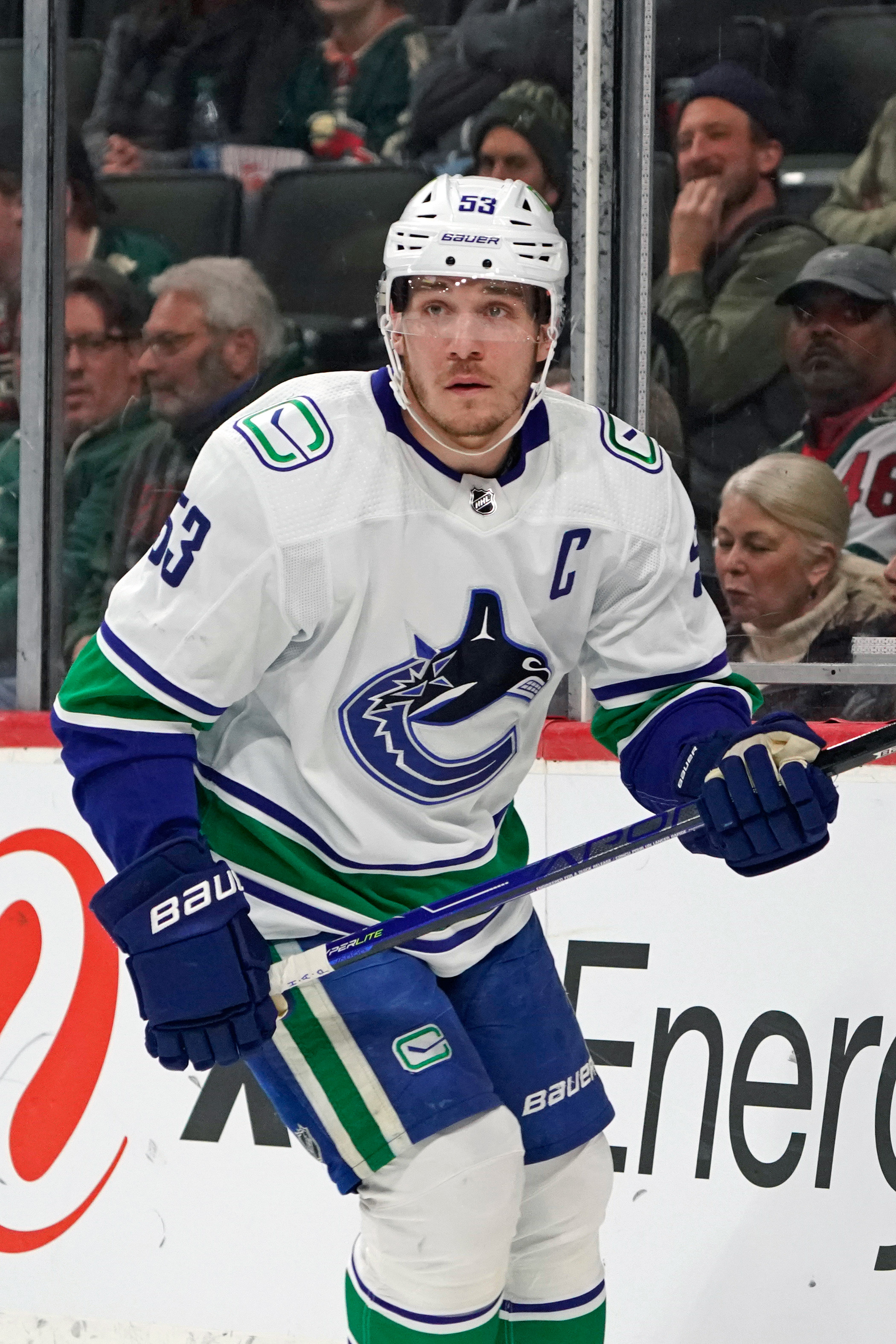 Horvat quietly is coming off a career year in the goal department, surpassing the 30-goal mark for the first time in his career. It didn’t affect his defensive game too much as he still took a regular turn on the penalty kill, logged nearly 20 minutes per night, and won the sixth-most faceoffs in the league. Notably, over the final six weeks of the season when Vancouver was in the midst of trying to pull off quite the second-half comeback to get into the playoffs, Horvat was better than a point-per-game player, showing an ability to step up in crucial moments. While they ultimately fell a little short of achieving that goal, it certainly wasn’t his fault while the improved production under Bruce Boudreau creates some optimism for what’s to come.
Statistics
2021-22: 70 GP, 31 goals, 21 assists, 52 points, +3 rating, 40 PIMS, 194 shots, 57.0% faceoffs, 19:31 ATOI
Career: 572 GP, 170 goals, 196 assists, 366 points, -68 rating, 188 PIMS, 1,294 shots, 53.6% faceoffs, 18:20 ATOI
The Market
Center has always been the premium position among the three forward spots with the extra responsibilities that are always placed on a middleman. Horvat has more than handled those challenges well and certainly isn’t the type of player that a team could think about moving to the wing. Plain and simple, he’s a center and top centers get paid big bucks in free agency or, at least, when they become eligible for free agency.
Last season was basically a continuation of what Horvat has been in his career. He doesn’t necessarily produce like a number one center does but with all of the other elements he brings to the table, he gets to the level of a low-end number one or a high-end number two. There is enough of an established marketplace for players like that to get a reasonable idea of what Horvat’s next deal is going to cost.
Comparable Contracts
Sean Couturier (Philadelphia) signed an eight-year, $62MM extension ($7.75MM AAV) a little over a year ago in the same spot that Horvat is now, a year away from UFA eligibility. From a points-per-game perspective, they’re nearly identical (.638 for Couturier, .639 for Horvat) while both players have averaged close to 20 minutes per game in recent seasons while playing in all situations. Couturier’s top offensive years have been better than Horvat’s which is worth noting although Horvat will be beginning his next deal at 28, one year younger than Couturier.
Brayden Schenn (St. Louis) is playing on an eight-year, $52MM deal ($6.5MM AAV) that was signed back in 2019. His five-on-five production has been quite close to Horvat over the past few seasons but it’s worth noting that he doesn’t have the same defensive responsibilities that Horvat does. The current-day equivalent of this contract is $6.584MM and with the extra roles that Horvat has, it’s safe to pencil this contract in as the floor when it comes to extension discussions.
Kevin Hayes (Philadelphia) received a bigger contract than many expected back in 2019 when he signed for seven years and $50MM ($7.142MM AAV). He was coming off a career-best 55 points that summer and also was an all-situations player that often was on the second line offensively like Horvat. Since then, his production has tapered off so Horvat’s camp would likely be looking to come in higher than this rate. From a cap percentage perspective, a deal equal to this is worth just over $7.4MM per season today.
Tomas Hertl (San Jose) signed his extension last season, one that was worth $65.1MM over eight years ($8.1375MM AAV). He’s the same age Horvat is now and only has one more 30-goal season that Horvat does. The two were used very similarly last season and Hertl’s career point per game average (.661) is quite close to Horvat’s. Some feel that this was an overpayment on the part of the Sharks but that doesn’t matter for Horvat’s camp who will undoubtedly be using this deal as a comparable in negotiations. This is the high end of the scale for where his next contract should fall.
Dylan Larkin (Detroit) is also one to watch for but we don’t know his next contract yet as he’s in the same situation as Horvat. The two are fairly similar – Larkin is a bit more productive, Horvat more involved defensively – and whichever one doesn’t sign first will quite likely be looking at the contract of the one that does sign as a viable comparable.
Projected Contract
Based on the above comparables, something above the current equivalent of Hayes’ deal and a little below Couturier’s appears to be a reasonable sweet spot for an agreement. That would put the AAV in the $7.5MM (or slightly higher) range and he should be able to command a max-term agreement, either an eight-year one with Vancouver or a seven-year one elsewhere.
The big question that Canucks GM Patrik Allvin will have to ponder is whether they can afford Horvat’s next deal in their cap structure. Miller checks in at $8MM on his new deal which pushes their commitment in 2023-24 to nearly $69MM to 14 players. The Upper Limit is only expected to go up to $83.5MM for 2024-24 so Horvat would be taking up close to 60% of their remaining space. Fitting everyone else in would be a challenge.
Vancouver also has to keep in mind that Elias Pettersson’s qualifying offer two years from now is $8.82MM (120% of his $7.35MM cap hit). While Pettersson has spent a lot of time on the wing, he’s also a natural center and spending over $24MM on three centers could be a luxury that they can’t afford. That shouldn’t affect Horvat’s specific situation unless he’s willing to leave money on the table to stay but they’ll be factoring in their own cap situation in discussions with their captain over the coming weeks and months.
Photo courtesy of USA Today Sports Images.
Central Notes: Robertson, Blackhawks, Kayumov
There has been a greater emphasis on paying young stars big money early in recent years and it would appear that at least one team owner isn’t a fan of that. Speaking on the Cam and Strick Podcast (audio link) earlier this week, Stars owner Tom Gaglardi lamented the current contract landscape across the league:
A kid in the third year of his entry-level (deal) puts up 40 goals and now he wants to make $7 million. If you want term with that player, he’s going to take you higher than that. … The stars are taking all the money, and the guys in the middle are getting squeezed.
I think there’s a lot of players in the league making a million dollars who are better players, and then the guys who can put the puck in the net are getting too big a piece of the pie. … I don’t like it, but that’s the market, and that’s the way it works.
While not naming him specifically, it’s quite clear that the 40-goal player he’s referencing is Jason Robertson who led the Stars with 41 goals in 74 games last season. If the asking price on a short-term deal is in the $7MM range as Gaglardi suggests, Dallas will almost certainly have to do a bridge deal to get the 23-year-old under contract without having to part with another player. They have a little over $6.3MM in projected room at the moment, per CapFriendly, but that could jump closer to $7.5MM if Anton Khudobin is healthy and is sent to the minors.
Elsewhere in the Central Division:
- There is some uncertainty on the injury front for the Blackhawks with training camps just a few weeks away. GM Kyle Davidson told Ben Pope of the Chicago Sun-Times that they are still waiting for a firm update on the status of forward Jujhar Khaira who underwent back surgery back in February. At the time, he was supposed to be away from hockey activities for 10-12 weeks so the fact that his availability is still in question would suggest that there has been a setback. The 28-year-old had three goals in 27 games in his first season with the Blackhawks. Davidson also indicated that there are a couple of other players that they’re waiting for information on regarding their availability for the start of camp but didn’t identify who those players will be.
- Still with Chicago, the Blackhawks were hoping to sign prospect Artur Kayumov this summer, reports Scott Powers of The Athletic (subscription link). However, the 24-year-old winger opted to remain with Yaroslavl of the KHL citing family reasons as he signed a one-year deal to stay there instead. Kayumov had 19 points in 42 games last season and his agent indicated that there’s a chance he could sign with the Blackhawks following the KHL campaign.