
Florida Panthers Hire Blue Jackets’ Bill Zito As GM
Wednesday: The Panthers have officially announced the hire, introducing Zito as the team’s next general manager. In the release, owner Vincent Viola included an explanation for the move:
We are thrilled to welcome Bill Zito as General Manager of the Florida Panthers. Bill is an excellent mind in our game today who proved during his time with the Columbus Blue Jackets that he possesses great prowess for evaluating talent and building success. He brings great experience to our club and possesses a strong business acumen.
Chris Johnston of Sportsnet reports that Zito received a five-year contract from the Panthers, quite a commitment as the team tries to figure out the roster and return to the playoffs.
Tuesday: After all the hype in recent weeks over Florida’s ongoing search for their next general manager – a list of candidates that included executives and scouts from a number of teams as well as several television analysts – it seems the team will in fact go with a name that had not been publicly mentioned. Sportsnet’s Elliotte Friedman reports that the Panthers are closing in on a deal to make Columbus Blue Jackets Associate GM Bill Zito their next GM. TSN’s Pierre LeBrun adds that a formal announcement is expected on Wednesday.
Zito, 55, has served as an executive for the Blue Jackets since 2013. Initially an assistant GM, Zito eventually took on the role of GM of the club’s AHL affiliate, the Cleveland Monsters, and this season was elevated to Associate GM and Sr. VP of Hockey Operations. Prior to his time with Columbus, Zito was a player agent and one of the founders of Acme World Sports.
Now joining the Panthers, replacing Dale Tallon as GM, Zito has his work cut out for him. Fortunately, his familiarity with goaltender Sergei Bobrovsky could help the veteran to settle in during year two after a disastrous first season with the Panthers. More reliable results in net would be a major step for Florida. The team also needs to improve its defense while finding a way to re-sign or replace top forwards Mike Hoffman and Evgenii Dadonov. The Florida Panthers have not won a playoff series since 1996, the worst drought in the NHL, and Zito’s task will be to put together a contender and end that sorry streak as soon as possible.
Coaching Notes: Washington, Ward, Tortorella
The Washington Capitals decided to move on from Todd Reirden after just two years as head coach and won’t be taking another risk with their next hiring. That’s what Pierre LeBrun of The Athletic says in his latest column, explaining that the Capitals are focused on bringing in a proven head coach instead of giving another newcomer an opportunity.
That means the names are familiar ones when discussing the Capitals coaching vacancy. Gerard Gallant, Peter Laviolette and Mike Babcock are the first three names that LeBrun mentions, though even former Capitals coach Bruce Boudreau gets a few paragraphs as well. Washington went 89-46-16 under Reirden since winning a championship in 2018 but were quickly dumped in the playoffs both years. Still in their win-now window with Alex Ovechkin and Nicklas Backstrom leading the way, Washington is also looking for a coach that will “hold the team’s top players accountable.”
- Geoff Ward spoke to reporters including Pat Steinberg of Sportsnet yesterday and explained that he would consider a return to the organization even if the Calgary Flames decided to go in a different direction at head coach. Ward would obviously rather take the head coaching position himself, but declined the opportunity to campaign for it through the media. He took over as head coach when Bill Peters resigned early in the season and led the Flames to a 24-15-3 record, but was also part of the collapse against the Dallas Stars. The Flames allowed seven straight goals in an elimination game and Ward pulled starter Cam Talbot and then reinserted him during the collapse. With substantial changes likely coming in Calgary, they may also want to go with a different face behind the bench.
- One coach that likely isn’t going anywhere this offseason is John Tortorella, even though his Columbus Blue Jackets failed to advance past the first round. Even getting that far was seen as quite the accomplishment for the veteran coach, but he’ll lose out on a little salary in the process. The league today fined Tortorella $25,000 for his comments (or more specifically his lack of comments) after game five against the Tampa Bay Lightning. Tortorella took two questions and then stormed out of the press conference, obviously frustrated with the loss. The penalty is actually a collection of the conditional fine that was assessed on January 1 after a previous incident. This is the 13th time Tortorella has been disciplined by the league.
Blue Jackets’ Calvin Thurkauf Signs With EV Zug
Just two months after EV Zug of Switzerland’s NLA publicly lamented that alumnus Calvin Thurkauf was working on an extension with the Columbus Blue Jackets and was unlikely to play for the team again, the narrative has gone in the opposite direction. Zug has announced that Thurkauf has returned to his hometown team and will be ready to start the NLA season.
However, before EVZ fans get too excited or Blue Jackets fans get too worried, it is important to note that Zug’s press release specifically states that Thurkauf is only expected to begin the season in Zug. As an unsigned RFA, Thurkauf could not be loaned overseas like many other NHL prospects and instead needed to sign a contract. However that deal is only valid until Thurkauf signs an NHL or AHL contract for the 2020-21.
Thurkauf, 23, is likely to find work, if not with Columbus then elsewhere in the NHL, after recording 26 points in 53 AHL games this season. He also made his NHL debut, suiting up for three games with the Blue Jackets. A big, physical forward who has proven himself capable in the WHL and AHL, Thurkauf is likely to push for a fourth-line role if he returns to Columbus. Zug fans will simply have to enjoy the homecoming while it lasts.
Columbus Blue Jackets Eyeing Big Splash This Off-Season
Last off-season, no team took a bigger hit than the Columbus Blue Jackets. The club lost two of their franchise stars in forward Artemi Panarin and goaltender Sergei Bobrovsky to free agency, along with expensive rental forwards Matt Duchene and Ryan Dzingel. Panarin, Bobrovsky, and Duchene were in fact the three largest UFA contracts handed out last summer. No one expected the Blue Jackets to be able to rebound from those losses, but one year later the team knocked out a talented Toronto Maple Leafs team in the qualifying round and gave the Tampa Bay Lightning, one of the NHL’s best, a run for their money in the the first round.
Columbus showed that they still have what it takes to be a contender even with last year’s major losses. The team has discovered not one but two reliable options in net, has one of the top defensive pairs in the league and solid depth behind them, and a mix of youth, experience, skill, and grit up front. If there is one thing that the Blue Jackets still lack, it is what they lost in Panarin and Duchene: elite top-six forwards. While the team has a number of young players who may grow into that role, the club does not appear content to sit in wait, instead hoping to take action this off-season. The Athletic’s Aaron Portzline writes that whispers out of the organization is that GM Jarmo Kekalainen is preparing to add at least one if not two high-skill forwards this off-season, with a bona fide top-six center as the priority.
On the surface, this plan makes perfect sense. Portzline notes the Blue Jackets ranked second-to-last in forward scoring this season, which undoubtedly was partially the result of a rash of injuries up front but is still an indictment of the forward corps’ ability to produce. The team also has roughly $68MM committed to 20 players who were regular players this season with just a few restricted free agents to take care of, so there could be cap space to spare on the free agent market.
However, adding impact forwards will be easier said than done. While Columbus has approximately $13.5MM in cap space, should they opt for long-term contracts for budding top-six center Pierre-Luc Dubois and solid young defenseman Vladislav Gavrikov, much of that space could be eaten up. On top of that, the team will have to make decisions on re-signing RFA forwards Josh Anderson and Devin Shore as well. If both return, the team will be right up against the cap ceiling without even touching the free agent market. They will also be facing a roster crunch with 17 players already signed to one-way contracts worth $1.6MM or more, including recent KHL import Mikhail Grigorenko but not any of the aforementioned RFA’s.
Even if the team does have space to explore the top names on the open market, they may find that no one fits their top-six center criteria. While the team will surely kick the tires on big names like Taylor Hall, Tyler Toffoli, Mike Hoffman, and Evgenii Dadonov, none of that group is a solution down the middle. The second tier also only offers players that are not necessarily natural centers: Mikael Granlund, Carl Soderberg, or even old friend Derick Brassard. Columbus’ best bet may be to target a younger, more moldable player with some center experience, such as Vladislav Namestnikov, Erik Haula, or Alex Galchenyuk. However, there really isn’t an ideal target to sure up the center position in the top six.
For both internal and external reasons, Kekalainen seems likely to explore the trade market in his efforts to add at least one of his target top-six forwards and most likely at center. Portzline also opines that this is a likely route and that the team could deal from their depth at forward or defense to make a deal. On the blue line in particular, the team will have eight experienced NHL defenseman once Gavrikov is re-signed and will likely have to thin that group. Portzline believes that David Savard would be the easiest to move, while talented but oft-injured Ryan Murray or useful Markus Nutivaara could also draw interest. Up front, the rights to Anderson or Shore could certainly be dealt and the team will likely dangle Alexander Wennberg again this off-season. The real question is whether the team would give up on a top young prospect like Emil Bemstrom, Alexandre Texier, or Liam Foudy. Portzline also believes that teams could come calling on goaltenders Joonas Korpisalo and Elvis Merzlikins, but dealing either one could just create another hole in the lineup.
With plenty of trade chips, the Blue Jackets could cash in on a desperate market. Given both the flat salary cap and the looming threat of the 2021 Expansion Draft, there will likely be many teams open to moving established forwards this off-season and Columbus has a much better chance of finding a true top-six center – and perhaps even another top forward – via trade. One way or another, the club has been inspired by its playoff run and has its sights set on improving immediately, so don’t be surprised to see the Blue Jackets make a big splash this summer.
Snapshots: Stars-Avalanche, Dubois, Seabrook
The NHL hasn’t even finished the first round, with two series playing game six tonight, but they’re already moving on with at least one second-round series. The Colorado Avalanche and Dallas Stars are set to start their battle tomorrow night according to several reports including Elliotte Friedman of Sportsnet.
The league obviously wants to take advantage of a Saturday night, but also is determined to get through the bubble-playoffs as quickly as possible. Both first-round game sevens, should they be needed, are scheduled for Sunday.
- Pierre-Luc Dubois wasn’t able to carry the Columbus Blue Jackets to a first-round victory but did show that he’s an emerging star in the NHL. That will only help him when he negotiates his next contract this fall. Pierre LeBrun of The Athletic examines the young center’s situation, explaining that he believes a three-year deal would make sense. Interestingly though, LeBrun writes that “if Dubois signs longer term, it’s going to be for tangibly more than [William] Nylander.” The Toronto Maple Leafs forward signed a six-year, $45MM deal in 2018.
- The Chicago Blackhawks are still hoping that Brent Seabrook can be an impact player for them in 2020-21, even after his major surgeries limited him to just 32 games this season and took him out of the postseason. Seabrook, who rehabbed hard to try and be a part of the team in the bubble, will have his role “figured out in training camp” according to Blackhawks GM Stan Bowman, who spoke to reporters including John Dietz of the Daily Herald. The 35-year-old defenseman has four years remaining on his contract.
Brandon Dubinsky Unlikely To Play Again
The Columbus Blue Jackets were without Brandon Dubinsky for the entire 2019-20 season thanks to a chronic wrist injury, but he does have another year under contract with the team. Unfortunately, at this point, it doesn’t appear as though he will be able to return at any point. Blue Jackets GM Jarmo Kekalainen told reporters today including Aaron Portzline of The Athletic that Dubinsky will “most likely” not play again because of the injury.
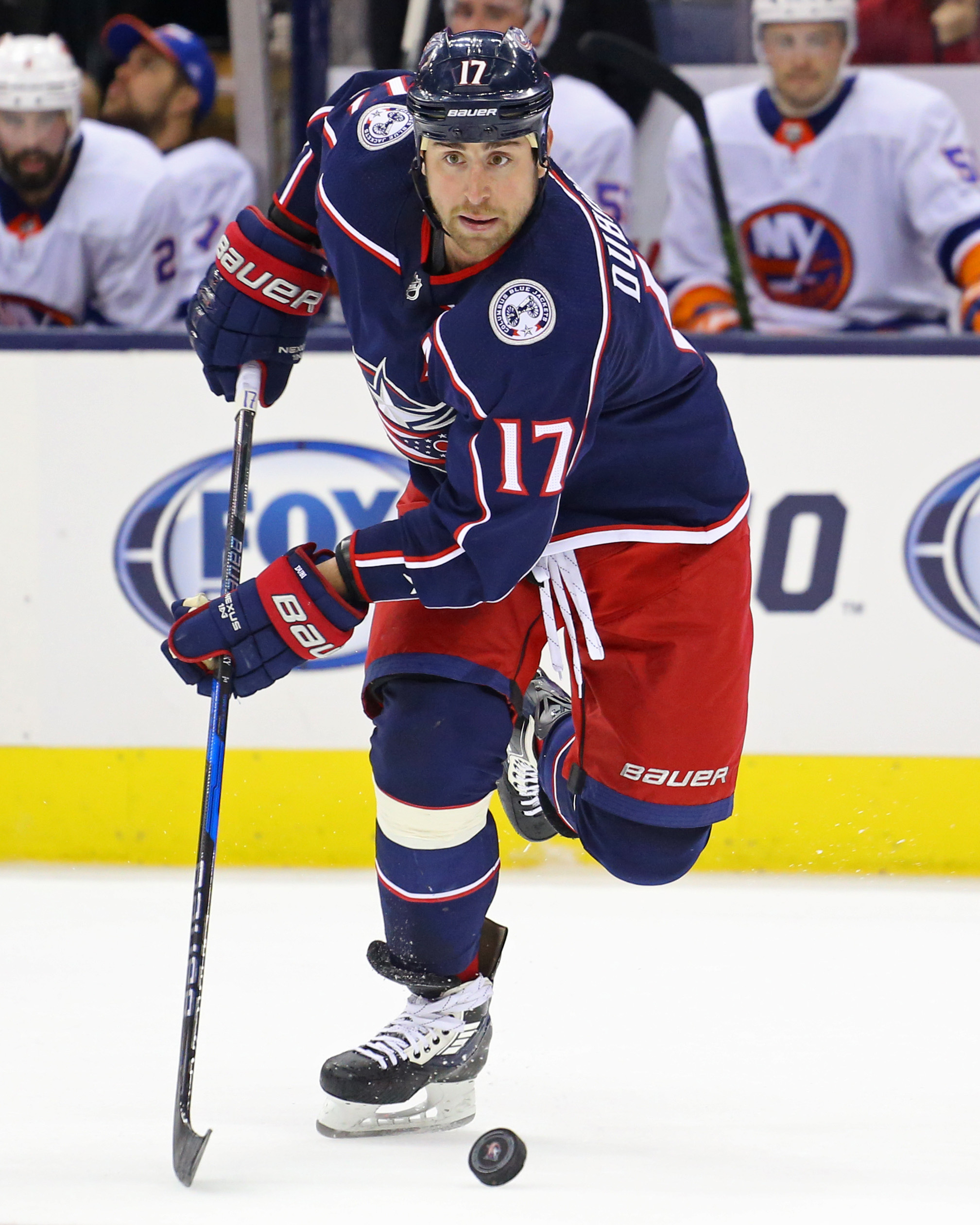 If that’s it for the veteran forward, he leaves the NHL with quite a successful career. A second-round draft pick of the New York Rangers in 2004, Dubinsky was in the NHL before his 21st birthday and never looked back. A heart-and-soul contributor for the Rangers throughout the first five full seasons of his career, he recorded 213 points in 393 regular season games on broadway.
In 2012 he was part of the massive trade that took Rick Nash to New York, heading back to Columbus beside Artem Anisimov and a first-round pick. Dubinsky would sign a long-term extension with the Blue Jackets in 2014, one that will still pay him $5.85MM next season even as he hits long-term injured reserve.
For the Blue Jackets, this actually may be something of a blessing in disguise, despite the leadership role that Dubinsky serves on the club. The team can move him to LTIR and gain a bit of extra cap flexibility instead of seeing his contract—which carries the second-highest cap hit on the team—anchor their finances next season.
Alternatively, because Dubinsky’s contract still owes him a full $5.85MM in salary, the Blue Jackets could move it to another team. Clubs all over the NHL will be looking to cut costs as revenue plummets, leading to an opportunity for those that are still financially stable. Columbus have made moves like this in the past, initially swapping Nathan Horton and David Clarkson‘s contracts with Toronto because of a difference in insurance coverage, and then giving up draft picks to Vegas in order for them to take Clarkson’s deal off the books as well.
It is unfortunate how it looks like it will end for Dubinsky, but the 34-year-old can look back and be proud of an 823-game career. He is currently sixth all-time in Blue Jackets scoring, and had 438 points overall.
Snapshots: Lindblom, Pastrnak, Myers, Merzlikins, Predators
There was quite the reaction when the Philadelphia Flyers opted to bring forward Oskar Lindblom with them into the bubble. The Flyers’ forward was diagnosed with Ewing’s sarcoma on Dec. 13, but has been treated and is training with the team. Despite it being unlikely that Lindblom was going to take the ice during the playoffs, that could conceivably change, according to Flyers head coach Alain Vigneault. Lindblom skated with the team Sunday and he intends to return for the playoffs, according to Sportsnet’s Chris Johnston.
Vigneault was unclear when Lindblom might return. “A couple of practices? A couple of weeks?”
Lindblom hasn’t played in a game since Dec. 7, but the 24-year-old was looking to have a career-best season with 11 goals and 18 points in 30 games. Of course, getting back into playoff-level shape could take him some time. The Flyers are currently tied at 1-1 with the Montreal Canadiens in the first-round of the playoffs, so it makes sense that the Flyers will need to at least advance one round if they hope to get Lindblom back into their lineup.
- The Boston Bruins got some good news at an optional skate Sunday when winger David Pastrnak was on the ice with his team. The 24-year-old has only appeared in four playoff games thus far with as he has been termed “unfit to play.” Bruins head coach Bruce Cassidy said there is a chance that Pastrnak could play in Game 4 on Monday. “I’d say 50/50 I guess at best right now. Of course that could change over 24 hours,” said Cassidy (via Boston Globe’s Matt Porter).
- TSN’s Matthew Sekeres reports that Vancouver Canucks defenseman Tyler Myers will miss Game 3 on Sunday with a shoulder injury, not a concussion like many thought. Whether he can return for Game 4, which immediately on Monday again, is unknown. Myers took an awkward hit from St. Louis’ Brayden Schenn in Game 2. There is talk that Jordie Benn could step in for Myers in the lineup, but since he missed some time for the birth of his child, he may not be ready to play. Other candidates are Olli Juolevi or Jack Rathbone.
- The Athletic’s Aaron Portzline (subscription required) writes that Columbus Blue Jackets goaltender Elvis Merzlikins, who was “unfit to play” ever since the Game 4 loss to the Toronto Maple Leafs, tweaked a groin muscle during the game, the same game in which he allowed three Maple Leafs’ goals in less than four minutes (plus the OT goal). Merzlikins will be out of the lineup indefinitely.
- NHL.com’s Brooks Bratten reports that Nashville Predators general manager David Poile said he isn’t sure what will happen with their top two unrestricted free-agent forwards in Craig Smith and Mikael Granlund. The GM said he expects to communicate with their respective agents in the next couple of weeks to discuss potential contracts. However, with their cap situation looking dire next season, it’s unlikely the team will bring back both UFAs. Smith finished with 18 goals and 31 points, while Granlund finished with 17 goals and 30 points.
Blue Jackets Will Burn First Year Of Liam Foudy's Deal With His Next Game
Blue Jackets forward Liam Foudy has been a key player for Columbus so far this postseason. After starting in a lower role, he has spent time on the top line recently and there’s little reason to think he’ll be coming out of the lineup. Accordingly, the team will be burning the first year of his entry-level contract once he suits up for his next game which should be later today for the third game of their series against Tampa Bay. While this will only be Foudy’s eighth appearance since the NHL returned, he also got into a pair of games close to the trade deadline while on emergency recall which means that this will be his tenth game of the year. Considering his impact so far, it’s a decision they’ll certainly be comfortable making even if it means his second contract will come a year earlier.
Prospect Notes: O’Brien, Berni, Patera
Philadelphia Flyers draft pick Jay O’Brien will fulfill his commitment to Boston University, following a year in the BCHL as he sat out due to transfer rules. O’Brien struggled mightily in his first year of NCAA hockey with Providence College in 2018-19, scoring just five points in 25 games, but will try again after showing exactly why he was a first-round pick in 2018.
The 20-year old forward tied for fourth in BCHL scoring with 66 points in just 46 games, earning himself a first team All-Star selection in the process. While there is still a long way to go for O’Brien before he provides any kind of value for the Flyers, getting back into college hockey (whenever it happens) is a good step.
- Columbus Blue Jackets prospect Tim Berni will be playing in Switzerland for the next few months, after being loaned to the ZSC Lions for the time being. Berni will be allowed to return to North America for NHL training camp in November, though it is extremely unlikely at this point that he would make the Blue Jackets roster. The 20-year old was a sixth-round pick in 2018 but has played the last two full seasons in the NLA, recording 11 points in 45 games this year.
- Jiri Patera, who only signed his entry-level contract with the Vegas Golden Knights a little over a month ago, will begin the year in the Czech Republic with Motor Ceske Budejovice. The goaltending prospect put up a .921 save percentage for the Brandon Wheat Kings this season and will try to continue his development this season against professionals.
Injury Notes: Pastrnak, Backstrom, Vehvilainen
The Boston Bruins dropped a game time bomb on Thursday night, announcing that star forward David Pastrnak had been deemed “unfit to participate” and would miss Game Two. There is no official word on Pastrnak’s condition and whether he will miss any future games with this current ailment. It could be that the Rocket Richard winner simply could not bounce back from a minor injury sustained on Wednesday in just over 24 hours’ time. Pastrnak did appear to be in discomfort following his assist on the game-winning goal in double overtime of Game Two. However, others have noted that Pastrnak also missed practice on Monday and could be nursing a lingering issue. The Bruins certainly do not want their elite scorer to be out of the lineup for too long, so any further clarification on Pastrnak’s injury will be key to Boston’s Stanley Cup hopes this postseason. In the meantime, Anders Bjork has replaced Pastrnak on the team’s top line while Karson Kuhlman has been inserted into the lineup.
- The Washington Capitals will also be missing one of their stars for Game Two on Friday. First line center Nicklas Backstrom has entered the league’s concussion protocol, reportscom’s Tom Gulitti, and will not be able to return to the lineup just yet. Backstrom was the recipient of high hit from the New York Islanders’ Anders Lee, which cost him two penalty minutes, early in the first period of the Capitals’ Game One loss on Tuesday. Backstrom played through the period but did not return after the break. There is no word on how long Backstrom may be out of the lineup. While Backstrom is certainly a major loss, his absence fortunately lines up with a return for fellow center Lars Eller, who had left the Toronto bubble due to the birth of his son and missed Game One.
- Veini Vehvilainen has arrived in Toronto to join the Columbus Blue Jackets as their No. 3 goalie, with Elvis Merzlikins still nursing an injury. The Columbus Dispatch’s Brian Hedger notes that Vehvilainen has already officially joined the roster after landing Wednesday, while adding that he will not count against the 31-man maximum bubble roster limit as goalie injuries allow for an exception to be made. In the unlikely event that Vehvilainen has to make an appearance for Columbus, it would be his NHL debut. The well-regarded Finnish product finally made the jump to North America this season, but played exclusively in the AHL.