
New Jersey Devils Place Three On Waivers
According to a team announcement, the New Jersey Devils have placed Evgenii Dadonov, Luke Glendening, and Maxim Tsyplakov on waivers. If all three players clear, they would have added flexibility on the trade market by tomorrow afternoon, given they can be freely reassigned to the AHL by the acquiring club.
The placement of all three on waivers is the Devils’ way of trimming some fat off the roster ahead of the deadline. Dadonov and Glendening will become unrestricted free agents at the end of the season, whereas Tsyplakov is signed through next year at a $2.25MM cap hit.
After some fruitful years with the Dallas Stars, Dadonov joined New Jersey on a one-year, $1MM contract last offseason. There are performance bonuses included in his contract that would bring the salary to $3.25MM, and he has a full no-trade clause through the end of the year. Despite being brought in to add additional firepower to the team’s bottom-six, Dadonov’s 2025-26 campaign has been completely derailed by injuries.
Scoring 35 goals and 78 points in 154 games with the Stars, Dadonov has yet to register his first point with the Devils. He’s had multiple stints on the injured reserve due to hand and wrist injuries, and he has registered only 17 appearances this year.
Meanwhile, Glendening likely has the least value of the trio. Earning a professional tryout agreement in September, Glendening officially joined New Jersey on a one-year, league minimum contract. Isolated to a fourth-line role, the 36-year-old center has tallied four assists in 52 games, averaging 9:54 of ice time. Still, he has immense value in the playoff dot, averaging a 55.6% success rate throughout his career while beginning 73.5% of his shifts in the defensive zone.
Lastly, Tsyplakov has only been a Devil for a little while. He was the only player acquired by New Jersey in last month’s trade, sending Ondřej Palát to the New York Islanders. During his brief tenure in New Jersey, Tsyplakov has yet to register a point in nine contests. Even if he does clear waivers, the Devils may be hard-pressed to find a landing spot for him, even at a lower cost.
Brett Pesce Out Day-To-Day
- New Jersey Devils defenseman Brett Pesce did not play in tonight’s shootout win over the Toronto Maple Leafs due to an injury, head coach Sheldon Keefe announced pregame. The Devils replaced Pesce in their lineup with Johnathan Kovacevic, who did not play in the team’s prior two games. Pesce is New Jersey’s No. 3 defenseman by ice time, playing 20:18 per game, including a team-high 2:29 per game on the penalty kill. Kovacevic was a leading penalty killer for New Jersey last season, but has seen his ice time decline as he missed much of the first half of the year with an injury. Kovacevic is playing 16:43 per game this season, including just over a minute per game on the penalty kill.
Devils Discussing Simon Nemec In Trade Talks
The Devils are clear sellers this winter, trailing the Bruins for the wild-card cutoff by 11 points, but they are looking to wheel and deal with success next season in mind rather than sell off players indiscriminately. As the team seeks help in augmenting their forward group, Pierre LeBrun of TSN reports that they’ve been listening to calls on defenseman Simon Nemec with “no shortage of teams checking in.”
Nemec being dangled in trade talks is nothing new. The Islanders made a push to land the 22-year-old last summer, and that came after Nemec had expressed frustration over a lack of NHL ice time the previous season.
The 2022 second overall pick has had a monstrous third season in the NHL, though. After bouncing between the Devils and AHL Utica for the past two seasons, he’s locked himself in as New Jersey’s third right-shot option (for now) behind Brett Pesce and Dougie Hamilton. His 9-12–21 scoring line in 47 games has surpassed his rookie totals from 2023-24 in significantly fewer games and ranks ninth on the team on a per-game basis. He’s averaging 19:42 per night while seeing time on their second power play unit.
Nemec’s possession impacts remain an understandable area of concern, though. For someone touted by prospect evaluators as an “all-around” defenseman ahead of his draft day, the Devils want better quality control out of him than a 46.3% expected goals share at 5-on-5 that is the worst on the team (min. 200 minutes).
In a more normal situation, Nemec would be clear-cut trade bait for a team with relatively short-term playoff aspirations like New Jersey. He’s blocked by Pesce and Hamilton and is a high-value but flawed developing player. The Devils have been looking to move Hamilton since last offseason, to no avail, though there was renewed interest last month. Even if they did move him, his lower trade value is unlikely to net the impact forward they’re dangling Nemec for.
Devils Sign Matyas Melovsky To Two-Year, Entry-Level Contract
The New Jersey Devils have signed forward prospect Matyas Melovsky to a two-year, entry-level contract. Melovsky is playing through his first pro season with the AHL’s Utica Comets on a minor-league contract. He has three goals, 13 points, and a minus-eight in 35 games.
Melovsky, 21, was a sixth-round pick to the Devils in the 2024 NHL Draft. He earned his selection on the heels of a standout year with the QMJHL’s Baie-Comeau Drakkar and Czechia’s international U20 team. Melovsky recorded 42 assists and 60 points in 53 QMJHL games that season – but caught the most attention during the 2024 World Junior Championship. Playing on a line with Buffalo’s Jiri Kulich and Seattle’s Eduard Sale, Melovsky racked up 10 assists and 11 points in seven tournament games, good for second on the team in scoring behind Kulich’s 12 points. That mark helped push Czechia to a Bronze medal finish and earned Melovsky a must-buy status late into the draft.
The bump-and-grind forward followed his draft selection with 26 goals and 83 points in 57 games with Baie-Comeau last season. It was a stellar encore, even without a return to the World Juniors after Melovsky aged out of eligibility. With three point-per-game seasons in the QMJHL and a sizable, 6-foot-1 and 190-pound frame, Melovsky had stamped his right for a pro role. He has slotted into Utica’s top-nine this season. He has found his scoring touch recently, after a quiet start to the year, racking up seven points in his last 14 games. The Devils will acknowledge that hot streak by signing Melovsky to the first NHL contract of his career, set to begin in the 2026-27 season. That deal will give the bulky forward a chance to compete for NHL minutes as soon as his second pro season.
Devils Activate Luke Hughes, Assign Colton White To AHL
The Devils will welcome back a key part of their back end today against St. Louis. The team announced (Twitter link) that they have activated defenseman Luke Hughes off injured reserve. To make room on the roster, blueliner Colton White has been sent back to AHL Utica.
After two very promising seasons to start his career, 2025-26 hasn’t gone quite as well for Hughes this season. The 22-year-old had a long contract standoff, resulting in a deal only getting done a few days before the start of the season, resulting in him missing the majority of training camp.
Meanwhile, his production hasn’t taken a meaningful step forward despite a jump in ice time to more than 23 minutes per game. Hughes had 47 points in 82 games in his rookie season and 44 in 71 outings in 2024-25 but has been limited to five goals and 21 assists so far this season in 49 appearances. He missed nearly six weeks with a shoulder injury but only wound up missing 10 games overall thanks to the Olympic break.
Notably, when New Jersey had a fully healthy back end earlier this season, trade speculation around Dougie Hamilton picked up. Those talks faded when Hughes went down but once again, the Devils now have their top seven blueliners healthy and available which could ultimately kickstart those trade talks before Friday’s deadline. For now, it’s unclear who will be the scratch as team reporter Amanda Stein relays (Twitter link) there are players dealing with an illness and a decision on who’s out will be made closer to warmups.
As for White, he was recalled when practices resumed during the Olympic break but had served as a healthy scratch since then, keeping his games played total with the Devils this season at 23, where he has four assists in a little over 12 minutes per night of ice time. The 28-year-old has also suited up 10 times with Utica and is still looking for his first AHL point of the season.
Mammoth Interested In Dougie Hamilton
Add the Mammoth to the list of teams that have kicked the tires on Devils defenseman Dougie Hamilton, says David Pagnotta of The Fourth Period.
Whether the feeling is reciprocal remains to be seen. Hamilton has a full no-movement clause accompanied by a 10-team trade list. That extensive trade protection already nixed a deal that would have sent Hamilton to the Sharks last summer. Nonetheless, Pagnotta adds that while “his agent is trying to help facilitate a move” and that he’s “open to exploring options outside of his preferred list,” his market isn’t particularly fervent. The Maple Leafs had some interest, but their recent slide has likely taken them out of the buying conversation, especially in terms of taking on a player with a steep cap hit like Hamilton’s $9MM. San Jose still has some degree of interest, according to Pagnotta, but it’s unclear whether Hamilton has changed his tune on a move there.
While Hamilton’s initial cost is pricey, he only has two years left on his deal and will be a UFA in 2028. The cost of entrance will take many playoff hopefuls out of the picture, especially if the Devils aren’t keen on retaining salary, but that type of structure works for a team like Utah that has loads of present cap space, some money coming off the books this summer, and no big-ticket RFAs to negotiate with until after Hamilton’s contract expires.
Talks apparently slowed regarding Hamilton last month after fellow righty Luke Hughes exited New Jersey’s lineup with a shoulder dislocation. With the Devils well out of the playoff picture and Hughes close to returning, though, they should be more willing to re-engage in conversations. Hughes’ absence has opened the door for Hamilton to get reps as New Jersey’s top power-play quarterback once again, though, and he’s delivered a 2-5–7 scoring line in his last 10 as a result. The Devils are hoping that’s boosted his stock to some degree, although his 22 points in 54 games this season are still on track for his worst offensive showing in over 10 years.
That’s understandably a sign of concern for a defender on the wrong side of 30 whose offensive acumen was always his selling point. It’s also a testament to just how consistent a producer he’d been up to this point, though. From 2014 to 2025, Hamilton averaged 16 goals and 52 points per 82 games and finished top 10 in Norris Trophy voting four times. It’s now been three years since he received any award consideration, and his output has been on a somewhat consistent decline since a left pectoral muscle tear limited him to just 20 games in the 2023-24 campaign.
Still, for a playoff hopeful in Utah that’s being held back by a relative lack of depth scoring and a bottom-two power play, Hamilton’s fit would be natural as an established, successful PP1 option. Any concerns about his defense should be quelled by a system under head coach Andre Tourigny that’s consistently held possession control since the franchise’s inception last season, controlling 53.7% of shot attempts and 53.6% of scoring chances at 5-on-5 this year.
It could also come with a relatively low acquisition cost, depending on how desperate the Devils are to clear the bulk of Hamilton’s money. They likely would have been willing to take less for him earlier in the season when they were still in the playoff conversation and were looking to boost their cap flexibility to make additions. The latter is still likely a long-term priority, but is no longer a pressing short-term concern with them on a five-game losing streak and 13 points out of the playoff picture.
Devils Reassign Dennis Cholowski
Feb. 24: Not surprisingly, New Jersey shared today that Cholowski has been re-assigned to AHL Utica. The former first round defenseman was able to practice with the team during the break, but will not add to his 15 game season total with New Jersey at this time. The Devils host Buffalo tomorrow in their first game post-Olympics.
Feb. 18: The Devils made Hameenaho’s and White’s recalls official today. They also summoned defenseman Dennis Cholowski and goaltender Jakub Malek from AHL Utica to serve as extra practice players while they await the return of their Olympians.
Feb. 13: The Devils will recall forward Lenni Hameenaho and defenseman Colton White back to the NHL roster after the Olympic break, per James Nichols of New Jersey Hockey Now. As things stand, they won’t need to make any corresponding moves.
Hameenaho, 21, appeared in the first nine games of his NHL career in the weeks leading up to the break. The early returns were strong for the 2023 second-round pick. He notched two goals and four points with a +1 rating. The right-winger played his natural position, usually on a line with Arseny Gritsyuk and Cody Glass. That trio controlled a dominant 75% of expected goals at 5-on-5, per MoneyPuck. It’s easy to see why New Jersey wants to squeeze as much momentum as they can out of that group when league play reconvenes later this month.
Hameenaho’s adjustment to the NHL game is a great sign that a rough campaign for the club’s AHL affiliate in Utica hasn’t steered him too far off his development path. The 6’1″ Finn has a 9-13–22 scoring line and a -13 rating through 34 minor-league games, a figure that improbably leads the team in scoring.
He made his offensive ceiling evident with a pair of spectacular post-draft campaigns in his home country for Ässät. In 2024-25, he erupted for 20 goals and 51 points in 58 Liiga games to lead under-20 players in scoring.
Now, as one of New Jersey’s brightest prospects, he appears set to finish out the season in a top-nine role. While playoffs are essentially out of the question, a strong finish should position him well to crack the opening night roster next fall.
White, 28, has spent most of his pro career in the minors but has been a pleasant surprise as a call-up option when needed this season. Injuries have forced the lefty in 23 appearances, in which he’s recorded four assists and a +2 rating. They’re his first games at the top level since suiting up a career-high 46 times for the Ducks in 2022-23.
A stay-at-home specialist, White is averaging just 12:15 of ice time per game but has been a no-fuss option in bottom-pairing minutes. He’s controlled 47.7% of shot attempts and 53.9% of expected goals at even strength, so he’s done a good job of helping the Devils control quality scoring chances against lesser competition.
Trade Deadline Primer: New Jersey Devils
With the Olympic break upon us, the trade deadline is under a month away. Where does each team stand, and what moves should they be looking to make? We continue our look around the league at teams on the playoff bubble, next up: the Devils.
This season hasn’t gone as anyone hoped in New Jersey. After rebounding from a disappointing 2023-24 campaign to make the postseason again last year for the second time in the Jack Hughes era, they looked to be well on their way to their first consecutive playoff appearances since 1997-2010 after starting the campaign 8-1-0. Since that torrid start, though, they’re 20-26-2 and entered the break on a three-game skid. Breaking through the crowded Eastern Conference field, even if they go on a tear, to make the playoffs at this point is unreasonable. That said, with a skilled base and multiple long-term commitments on the books, a full teardown won’t be in the cards.
Record
28-27-2, 7th in the Metropolitan (2.4% playoff probability)
Deadline Status
Short-term sellers/long-term buyers
Deadline Cap Space
$7.66MM on deadline day, 0/3 retention slots used, 48/50 contracts used, per PuckPedia.
Upcoming Draft Picks
2026: NJD 1st, NJD 2nd, WPG 4th, NJD 5th, NJD 6th
2027: NJD 1st, NJD 2nd, NJD 4th, NJD 5th, NJD 7th
Trade Chips
The Devils already made a move this month, swinging a deal for veteran center Nick Bjugstad from the Blues on the last day before the Olympic roster freeze. Given Bjugstad’s under contract through next season, it was more of a cheap add to fill out their bottom-six forward depth for 2026-27, more than anything else.
General manager Tom Fitzgerald could make similar pickups before March 6. With the playoffs out of reach and New Jersey’s arsenal of mid-to-late-round draft picks over the next couple of years looking light, though, he’d be remiss not to examine the market for his few pending UFAs.
That list is short, at least among those in the NHL right now: forwards Evgenii Dadonov, Luke Glendening, and Zack MacEwen. New Jersey was hoping Dadonov could have been a shrewd veteran pickup on a one-year deal in free agency last summer, but hand and wrist issues have cost him most of the season. That’s interrupted his confidence, and he’s a -3 rating with no points in 17 games as a result. Contenders may nonetheless take note of his decent playoff showings for the Stars over the last few seasons, though, plus the fact that he put up 20 goals and 40 points in a third-line role just last year.
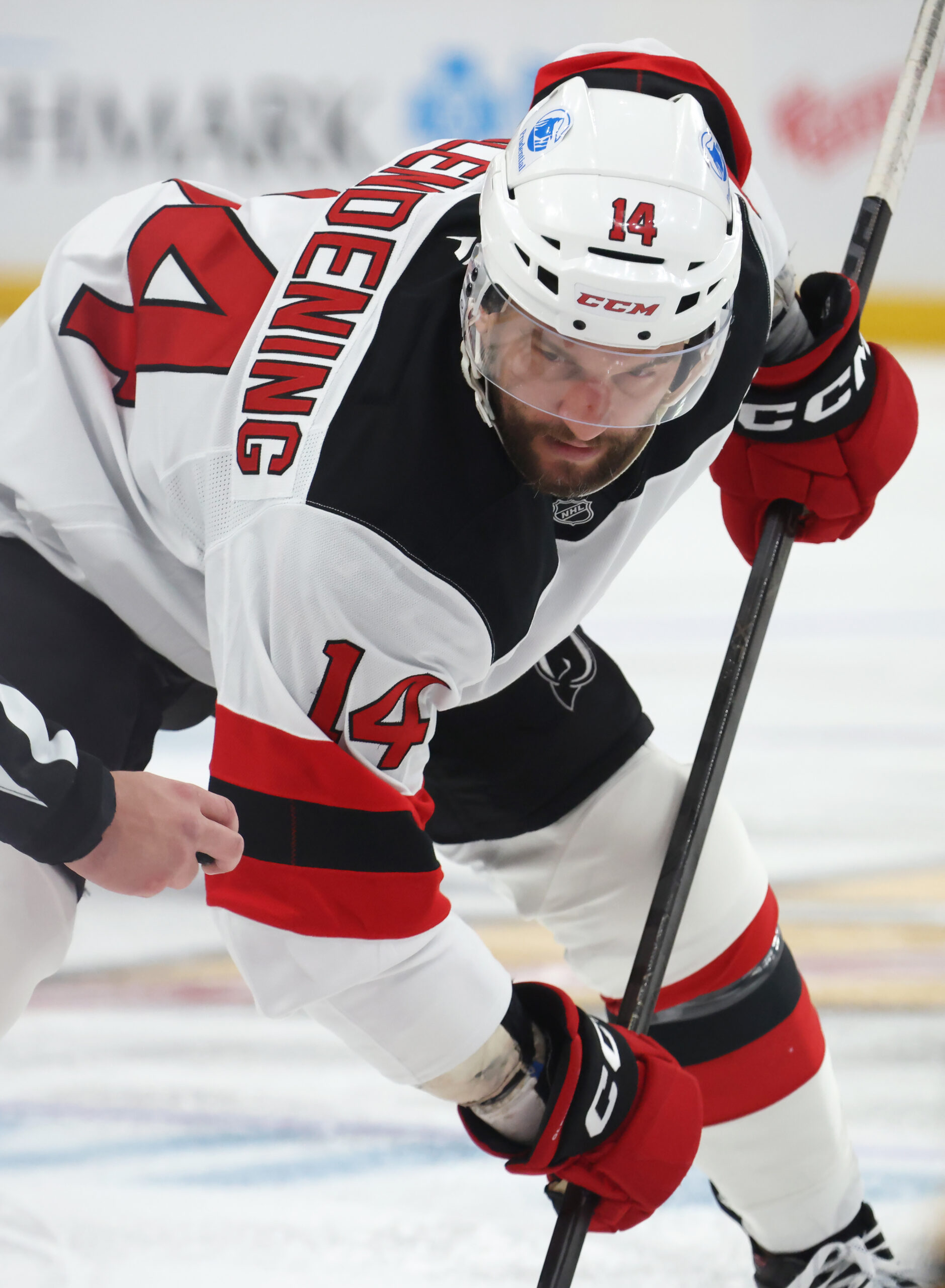 Glendening has already been largely rendered redundant by the Bjugstad pickup. The former has struggled as New Jersey’s fourth-line pivot after a successful professional tryout in training camp, limited to four assists in 52 games with a -11 rating. Even for a defense-first bottom-six piece like Glendening, that’s disappointing output on both ends. He’s not providing any penalty-killing value, averaging a career-low 9:54 of ice time per game, and has won 51.7% of his draws after hovering near 60% for much of the last few years. While Dadonov could have some intrigue, there likely won’t be any callers on Glendening.
MacEwen has only suited up in three NHL contests this year because of injuries, but he’s accumulated 240 games of NHL experience and could fill a token enforcer role for a contender looking to beef up their 13th forward spot.
Long-term cap space is something of a concern for the Devils. Arseny Gritsyuk needs a new deal this summer, and captain Nico Hischier‘s deal is up in 2027, along with Dawson Mercer‘s. It would make sense for New Jersey to consider moving a player with term at a position of excess if the deal lowered their cap spend while getting at least some NHL-ready talent in return. They already made a similar swap by sending Ondřej Palát to the Islanders for Maxim Tsyplakov, although they had to attach a mid-round pick to do so.
There are multiple candidates on defense who jump out. Dougie Hamilton has seen his name pop up in rumors for the Devils to clear cap space as far back as last offseason, but his no-movement clause – which runs until the deal expires in 2027-28 – has allowed him to block at least one deal. For his $9MM cap hit and limited defensive utility, teams would want to see more production than the seven goals and 21 points he has in 52 games this season, too.
Johnathan Kovacevic earned a five-year, $20MM extension off his breakout 2024-25 campaign, but knee surgery has limited him to two assists and a -6 rating in 11 games. Getting a team to take on a four-year risk without seeing more of a post-surgery sample size might be difficult, though.
Team Needs
Goaltending Help: Jacob Markström simply hasn’t been a passable starting option this season. With a two-year, $12MM extension set to kick in next year, that’s a problem. He’s posted a .882 SV% in 30 games while allowing -10.9 goals above expected. Veteran Jake Allen remains a high-end 1B option but can’t handle more than 30 or so appearances a year. Third-stringer Nico Daws has been excellent in call-up action but is having a very difficult year in AHL Utica, where he owns a .881 SV% and 6-13-10 record in 28 games. 2024 second-rounder Mikhail Yegorov once looked like he could compete for NHL time as soon as next season, but he has taken a considerable step back with Boston University this year. That’s left the Devils in a tough spot organizationally, top to bottom. Moving Markström would be difficult, but attempting to swap Daws for someone who could serve in a three-goalie rotation with him and Allen might be worth exploring.
Depth Scoring: Everybody’s had a tough time finishing in Jersey this season outside of Hughes, who’s held up his end of the bargain with another point-per-game season. Injuries have limited him to just 36 appearances, though, and the Devils’ offense is in the basement as a result. At 2.51 goals per game, only the Flames are scoring at a lower rate. Sure, Jesper Bratt and Hischier and Timo Meier have all had offensive step-backs, but they’ve gotten minimal support from bottom-sixers like Paul Cotter (5 G, 10 P in 54 GP) and Stefan Noesen (3 G, 7 P in 38 GP). Adding a more consistent middle-six scoring option, either at center or on the wing, should help the push for a playoff spot next season as Bratt’s, Meier’s, and Hischier’s numbers rebound.
Image courtesy of Charles LeClaire-Imagn Images.
Devils Place Marc McLaughlin On Waivers
The Devils announced they’ve placed center Marc McLaughlin on waivers for the purpose of assignment to AHL Utica. The transaction implies he’s ready to come off the injured non-roster list after sitting out the entire season to date with an undisclosed injury.
McLaughlin, 26, found his way to the New Jersey organization last season by way of a minor trade with the Bruins, with whom he began his professional career as an undrafted free agent out of Boston College in 2022. After recording just 14 points in 68 AHL games in 2023-24, he hit the same mark in 34 appearances last year before the trade. He finished out the season with six assists and a +5 rating in 16 games for Utica, also recording an assist in two NHL games for the Devils.
The Massachusetts native has 28 NHL games to his name and has suited up at least once in four consecutive seasons. With so much time missed, that streak is in jeopardy. He has a career 6-1–7 scoring line with a -3 rating while averaging 9:54 of ice time per game. Teams have controlled 48.0% of shot attempts with McLaughlin on the ice at even strength.
A strong defensive-minded center at the minor-league level, he won’t do a ton to help Utica’s scoring woes (2.40 goals per game) but should help the struggling AHL club shore up its two-way game. After signing a two-way extension to remain with New Jersey last June, he’ll be a Group VI unrestricted free agent this summer.
The Danger Of Signing Goalies To Lucrative Contracts
The New York Rangers and Vancouver Canucks are two of the NHL’s worst teams this season and are both on the verge of massive roster changes. While both teams face unique challenges, one parallel is that they’ve made a mess of their goaltending finances with pricey extensions that were miscalculations.
The Rangers and Canucks are far from alone in this predicament. High-priced extensions have also burned several other teams at the bottom of the standings, leaving them with goaltenders who had been performing well but whose play fell off a cliff after signing their new deals.
That isn’t necessarily the case for Shesterkin, however, it is the case for Linus Ullmark of the Ottawa Senators, Juuse Saros of the Nashville Predators, and Jacob Markstrom of the New Jersey Devils, who are all making big money on recent contract extensions, with no guarantees their play will turn around. This has left three teams with win-now rosters featuring goaltenders who are vastly overpaid.
It’s become a trend over the past five-plus years that teams signing goaltenders to expensive deals must be seriously concerned about their performance throughout the term of the agreement.
There is concern about every player’s performance after they sign a lucrative long-term deal. However, goaltenders have become a unique cause for concern lately, and it’s hard to say why.
In the late 1990s and throughout the 2000s, many veteran goaltenders on the wrong side of 30 would sign expensive long-term deals without so much as a second thought from their new teams. In July 2002, for example, goalie Curtis Joseph signed a three-year, $24MM contract with the Detroit Red Wings, even though it wasn’t the best offer on the table.
Joseph had a three-year $26MM offer from the Toronto Maple Leafs but opted to move to Detroit. Toronto then pivoted and signed Ed Belfour to a two-year, $13.5MM deal.
By today’s standards, those contracts aren’t eye-popping, and the term is relatively short. But Belfour and Joseph were 37 and 35, respectively, and there was a chance their play would drop off significantly during the brief time they were signed.
Nowadays, it’s hard to imagine a team giving $8MM a season to a 35-year-old goaltender, and Joseph’s deal was inked 23 and a half years ago. The Senators gave Ullmark four years and $8.25MM annually just last year, but he had just turned 32 and was two seasons removed from a Vezina Trophy as the league’s top goaltender.
It was a pricey gamble for Ottawa and hasn’t looked like good value this season, but Ullmark has been dealing with personal issues, so it’s hard to project how the deal will work out long-term.
Circling back to the Rangers and Canucks, they are a tale of two teams whose expensive goaltending has led to team-wide issues, but for wildly different reasons. In Vancouver, Thatcher Demko was signed to a lucrative three-year deal at the start of free agency, worth $8.5MM annually.
It was a gamble by Vancouver, as they hoped the former Vezina Trophy finalist could bounce back from a poor showing last season. Had Demko had a good year, he would have been a candidate to get $9MM or more on a new contract, but Vancouver thought it was wise to jump the queue. It has not turned out well.
If Demko had played well, Vancouver likely would have paid him an AAV slightly higher than the $8.5MM they gave him, but would’ve been on the hook for more term, which would’ve been riskier. Instead, Vancouver made a different bet and is now on the hook for more term than Demko would’ve received in free agency. But hindsight is 20/20, and for the Canucks, they are stuck with the Demko deal, one they’d love to have back.
In New York, it was a different calculation. Rangers’ general manager Chris Drury believed he had a Stanley Cup contender on his hands, which meant doing everything he could to retain his Vezina Trophy-winning goaltender, Igor Shesterkin. Drury moved out his captain, Jacob Trouba, to open up space to sign Shesterkin to a record-breaking eight-year, $92MM contract.
While it was the right on-ice move given Trouba’s cap hit relative to his play, the Rangers have never been the same since the trade. New York fell off a cliff last season and has remained at the bottom of the league this year, despite Shesterkin being good.
But that is the issue: Shesterkin has only been good. In the years leading up to his extension, Shesterkin was elite.
His play in those seasons masked many of the Rangers’ problems and led Drury and New York management to think the team was much better than it actually was. Shesterkin’s goaltending was a mask, hiding the fact that Drury had built a fatally flawed roster that relied too much on out-of-this-world netminding, which was clearly unsustainable.
While the Rangers, Canucks, Devils and Predators aren’t the only teams with pricey goaltending, they are the most apparent examples of paying a premium for goaltending. But even middle-of-the-pack teams can run into issues where their extensions turn into disasters.
There are good examples in Washington: a few years ago, with Darcy Kuemper, who had just won a Stanley Cup, and Philipp Grubauer, who had been solid for years before signing as a free agent with Seattle and becoming unplayable in the NHL. Matt Murray in Ottawa was the same story, but none is more egregious and obvious than Tristan Jarry in Pittsburgh, who was recently dealt.
Pittsburgh is a relevant example because of Stuart Skinner, who has been a revelation with the Penguins but is a UFA at the end of the season. Pittsburgh already has its goalie of the future in tow in Sergey Murashov, and the Penguins would be wise to ride Skinner into the playoffs and then let him walk in the offseason if his salary demands exceed $5MM annually, which they surely will. It should be interesting to see the Skinner story unfold, but there is plenty of evidence that the Penguins would be wise to avoid giving term to a netminder who is unpredictable.