
Trade Deadline Primer: Nashville Predators
As we stand on the eve of the trade deadline, moves are coming in faster and faster. Where does each team stand and what moves should they be looking to make? We finish our look around the league with the Nashville Predators.
In 2020-21, after their season started disappointingly, many observers were clamoring for the Nashville Predators to begin a rebuild. But they went on an impressive stretch run and made the playoffs. Then, the Predators put up a valiant fight against the Carolina Hurricanes in the first round before falling in six games, and this season they have built on that momentum. Coach Jon Hynes’ squad has battled hard since the start of this year’s campaign and is now in the thick of the Western Conference’s playoff race. Anchored by resurgent performances from the $8MM men in Matt Duchene and Ryan Johansen, along with an otherwordly season from captain Roman Josi, the Predators are firmly in the Western Conference’s playoff race and set to steer clear of the “seller” status GM David Poile has worked so hard to avoid. But with Filip Forsberg (who is now the franchise’s all-time leading goal scorer) a pending unrestricted free agent, the team has an intriguing trade deadline to navigate.
Record
36-22-4, 4th in the Central
Deadline Status
Buyer
Deadline Cap Space
$49.65MM today, $50.8MM in full-season space, 0/3 retention slots used, 42/50 contracts used, per CapFriendly.
Upcoming Draft Picks
2022: NSH 1st, NSH 2nd, NSH 3rd, LAK 3rd, NSH 4th, NSH 5th, NSH 7th
2023: NSH 1st, NSH 2nd, NSH 3rd, NSH 4th, NSH 5th, NSH 6th
Trade Chips
Given his importance to the team and his status as a pending unrestricted free agent, much of the conversation around the Predators’ trade deadline approach has centered around Forsberg. Many expect the team to pursue an extension with their talented winger, but the two camps are “not close” on extension talks, as a source told David Pagnotta of The Fourth Period. As mentioned earlier, Forsberg has been brilliant this season. He’s been an offensive engine for the team and is one of the major reasons for their success. He has 58 points in 49 games, including 33 goals this year. Forsberg has been inconsistent in the past and also somewhat injury-prone, so it makes sense that there could be a divide between Poile and Forsberg. Forsberg could very well want to be compensated with a contract fitting for a player producing as he has been producing, and Poile could respond by pointing to Forsberg’s inability to have a season like this one in the past. It’s a very tricky situation, and it’s unlikely that Forsberg receives an extension he deems acceptable before the deadline. As a result, one has to wonder if Forsberg ends up traded. It would be a catastrophic blow to the Predators’ season, and a move that would be highly polarizing, but Poile has made bold moves before. If he’s sure that he cannot get Forsberg on a reasonable contract, and he isn’t confident that his team is a true Stanley Cup contender, could he move Forsberg for what would inevitably be a significant return package? It’s something to consider.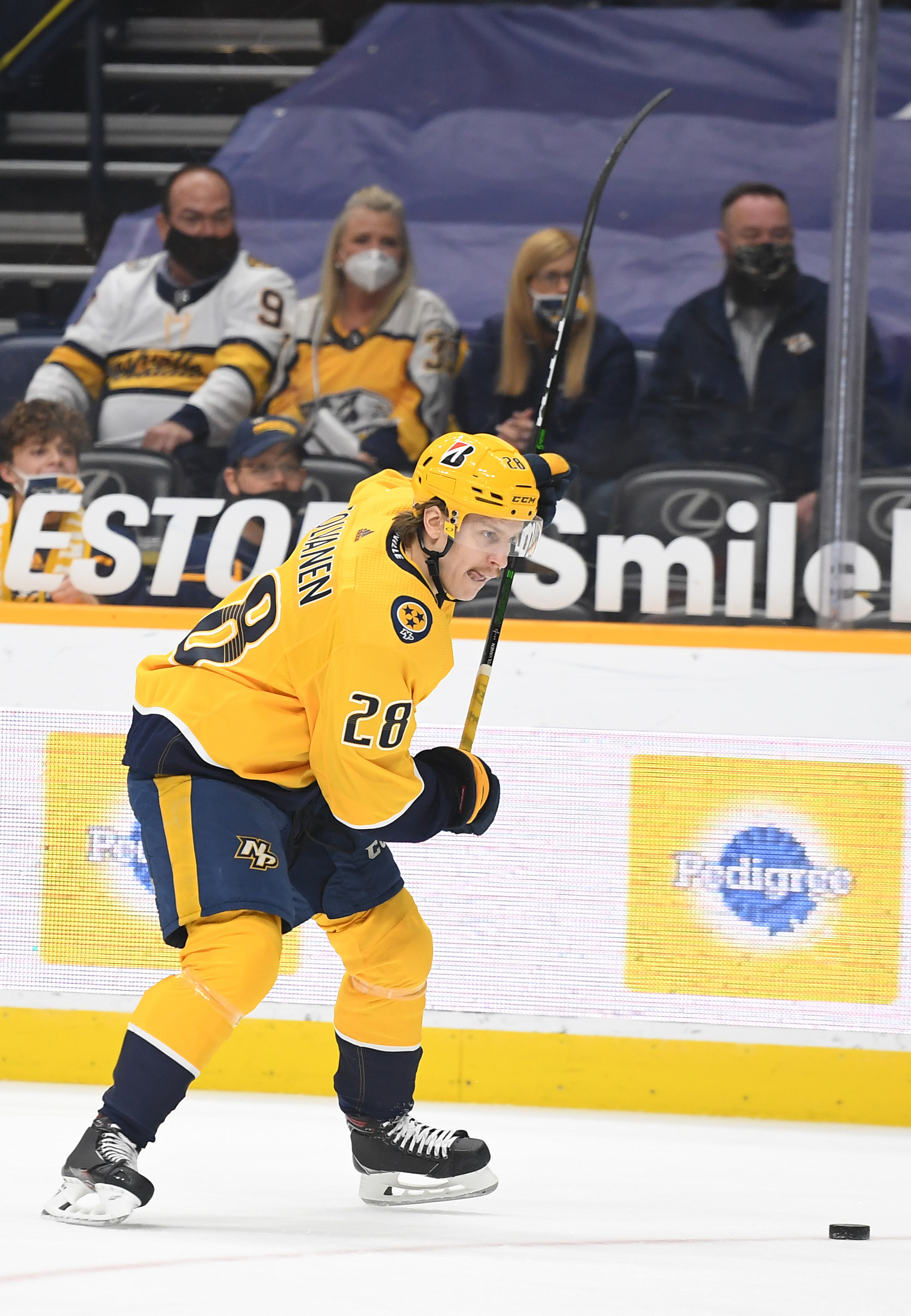
If the Predators choose to take a different approach to the deadline and decide to add a significant player to bolster their roster, one trade chip they could move to facilitate a deal is winger Eeli Tolvanen. Tolvanen, 22, is currently slotted in as the left winger on Mikael Granlund and Luke Kunin‘s line, which is a prominent role, but his production this season has not been up to the level one would expect for a top-six winger, and especially one who was as touted of a prospect as Tolvanen was. He has nine goals and 20 points this season in 59 games and is on pace to finish with 13 goals and 28 points in 82 games. Tolvanen’s calling card is his shot, but his offensive tools have yet to translate into consistent production. If the Predators want to make a big trade before tomorrow’s deadline but don’t want to part with top prospects such as Yaroslav Askarov, Fedor Svechkov, or Luke Evangelista, maybe Tolvanen is the one that goes the other way. For an acquiring team, Tolvanen represents an NHL-ready upside play whose raw talent could finally be fully realized with a change of scenery.
One potential player who could be moved to help the Predators facilitate a trade is Philippe Myers. Nashville has mountains of cap space to work with at the deadline, so they aren’t in a situation where cap necessarily needs to move out if they want to make a deal. That being said, should Poile have designs on making big moves this offseason, trading Myers may become a priority, so they may get ahead of that now. Myers recently went unclaimed on waivers, so the Predators could need to attach a sweetener asset, maybe a draft pick or a prospect to be able to move him. Myers, 25, has a $2.55MM cap hit that extends into next season, and he has struggled to fit in on the Predators’ team after arriving in the Ryan Ellis trade this past offseason. Myers was a promising, smooth-skating young defenseman in his Philadelphia days, so maybe a team is willing to bet on that version of him re-appearing if Nashville is willing to retain some salary. Either way, it seems that Myers’ days in Nashville could be coming to an end before they ever really had a chance to get going.
Others to Watch For: D Ben Harpur, F Rocco Grimaldi, D Matt Benning
Team Needs:
1) Defensive Help
The Predators’ top pairing of Josi and Dante Fabbro has worked out very well for them this season, so no issues there. Their second pairing is anchored by Mattias Ekholm and features Alexandre Carrier who has had a bit of a breakout season. Their third pairing has been where they’ve had more trouble. As Mark Borowiecki and Benning have battled injuries, players like Harpur, Jeremy Davies, and Matt Tennyson have all seen time on the bottom pairing. That’s not a group that inspires confidence, especially for a team currently looking like a playoff contender. If the Predators decide they want to buy some reinforcements at the deadline, expect adding a defenseman to be their top priority.
2) More Scoring
The engine of the Predators’ offensive attack is their Forsberg-Johansen-Duchene line. Forsberg and Duchene are above point-per-game and Johansen is close to that pace. Granlund has had a strong year as the team’s second-line center, but after him, the scoring gets thinner. Tanner Jeannot, Yakov Trenin, and Colton Sissons form the heart-and-soul line that the team relies on, but this is a team with two clearly defined lines to drive them, and then Granlund with some question marks surrounding him. They could use some more scoring punch to help Granlund out, but it’s not an absolute priority. The defense should be the focus, but if possible, adding a proven scoring winger to help reinforce Granlund’s line would ease the pressure on the two lines the team is currently heavily reliant on.
Photo courtesy of USA Today Sports Images
Trade Deadline Primer: Chicago Blackhawks
As we enter the middle of March, the trade deadline is inching closer. Where does each team stand and what moves should they be looking to make? We continue our look around the league with the Chicago Blackhawks
The Chicago Blackhawks have been among the most successful teams in recent NHL history. They won three Stanley Cups with their core of Patrick Kane, Jonathan Toews, and Duncan Keith, but their last win was in 2014-15, and times have gotten leaner since. Former GM Stan Bowman made a blockbuster trade last offseason to acquire defenseman Seth Jones, but the team has disappointed, and under new GM Kyle Davidson, the team looks set to begin a large-scale rebuild in order to return to proper contention. That rebuild began today, with the team’s trade of Brandon Hagel for a large haul of picks and prospects. With that move done, and Davidson’s issued statement on the trade, it is clear that big changes are coming to the Blackhawks sooner rather than later.
Record
22-30-9, 7th in the Central
Deadline Status
Seller
Deadline Cap Space
$2.26MM today, $2.26MM in full-season space, 1/3 retention slots used, 47/50 contracts used, per CapFriendly.
Upcoming Draft Picks
2022: CHI 1st (only receive pick if slotted #1 or #2), CHI 2nd, EDM 3rd,* TOR 3rd, VGK 3rd, CHI 6th, CBJ 6th, CHI 7th
2023: CHI 1st, TBL 1st,** CHI 2nd, TBL 2nd, CHI 3rd, CHI 4th, CHI 5th, CHI 6th, CHI 7th
* If EDM makes it to the 2022 Stanley Cup Final and D Duncan Keith is inside the team’s top-four in terms of time-on-ice, CHI will receive EDM’s 2022 2nd
** 2023 TBL 1st is top-10 protected.
Trade Chips
Chicago’s recent trade of Brandon Hagel clearly shows that Davidson is serious about the Blackhawks’ rebuild. Hagel is only 23 years old, productive, and on a steal of a contract that costs $1.5MM against the cap until 2024-25, when he will be a restricted free agent. He’s the kind of player that most teams– even rebuilding ones– would want to keep. A player to build around, even. But for Davidson, a scorched-earth rebuild is in order, and his apparent goal is to stockpile as many picks and prospects as possible to build the Blackhawks into a mid-to-late 2020’s powerhouse. So in order to do so, it seems as though any player on the team’s roster is potentially available at the right price. Which means a “trade chips” section could be a bit wide open. That being said, there are a few likelier candidates.
One more likely candidate is defenseman Calvin de Haan. De Haan, 30, is a veteran defenseman on an expiring contract with a $4.55MM cap hit. He plays a style of hockey that is largely unremarkable, but also commendably steady. He has gotten into 55 games this year and posted only five points, so teams seeking offense should look elsewhere, but if a team wants a player who they can stick on their bottom-pairing and not have to worry about, De Haan fits the bill there. The asset cost for a team to acquire him should also be lower than many of the other defensemen on the market, although one does wonder if the asking price gets increased thanks to the aquisition cost the Florida Panthers paid to acquire Ben Chiarot. But regardless of what that prior trade may have done to his market, De Haan represents an attractive trade chip for contending teams who are in need of steady defensive reinforcements but leery of paying the high prices associated with the other available blueliners.
Another player on the team more likely to be moved is forward Ryan Carpenter. Carpenter is similar to De Haan in that he plays a bland-but-steady style of hockey, although perhaps that is more of a virtue for a defenseman than it is for a forward. Even so, Carpenter, 31, has carved out an NHL career nearing 300 games in length through his hard work, determination, and character. He hasn’t and probably never will cross the 25-point threshold, and he’s not an overwhelming defensive or physical presence, but he plays a reliable game of hockey that a coach might desire for his bottom-six. He has 26 games of playoff experience and a coach with a less established bottom-six could prefer Carpenter to a less proven, more inexperienced player once the rigors of playoff hockey truly set in. Like De Haan, Carpenter also should not cost very much to acquire, and his cap hit is only $1MM, so expect him to be one of the likelier Blackhawks to be dealt by monday.
While Carpenter and De Haan are both assets where an acquiring team knows what they are receiving, with a player like Dominik Kubalik, things are far less certain. Chicago is reportedly interested in trading Kubalik, and after the Hagel trade, it certainly seems more likely. Kubalik, 26, broke into the NHL in 2019-20, scoring 30 goals in his first season as a professional in North America. He followed that up with a decent 2020-21, with 17 goals and 38 points in 56 games. This season, though, as the Blackhawks team around him has struggled, Kubalik’s production has not improved as many may have expected. Through 61 games Kubalik has just 11 goals and 21 points, and his linemates are more frequently players like Philipp Kurashev and Henrik Borgstrom than they are Kane. As a pending RFA with arbitration rights, his situation in Chicago has gotten more dicey. Could a contending team, or even a team seeking to contend in the near future, take a leap of faith and trade for Kubalik, hoping that he re-gains the scoring touch he had in his first two seasons? A source indicated (subscription required) to Mark Lazerus and Scott Powers of The Athletic that the asking price on Kubalik could be just a 2nd round pick, so this is the kind of trade that could be a home run if a team gets it right.
Others To Watch For: G Marc-Andre Fleury, F Patrick Kane, F Dylan Strome
Team Needs
1) Draft Picks
As previously mentioned, it’s clear that Davidson’s vision for this team includes stockpiles of draft picks and prospects. So, in terms of what the Blackhawks need at this deadline, their number-one priority should be fulfilling that vision. That means that if there is a reasonable trade on offer that involves the Blackhawks receiving a beneficial amount of draft compensation in return, the teams should do it. They don’t have a ton of cap space available, but perhaps after moving veterans as expected Chicago could have enough room to function as a cap-space broker as well, in order to add a few more depth picks.
2) Reclamation Projects
One of the best ways a team can speed up their rebuild is by identifying and acquiring struggling players who can be developed into quality NHL players. As an example of this, the Rangers got a top-six center in Ryan Strome as part of their rebuild, and the Vancouver Canucks got a point-per-game force by trading for J.T. Miller, whose production was stagnant in Tampa Bay. The Blackhawks already have a history of doing this, with former top prospects like Strome on their roster, but as more and more NHL ice-time gets freed up by rebuild-oriented trades, trying to find diamonds in the rough should be a goal for Davidson.
Photo courtesy of USA Today Sports Images
Chicago Blackhawks Sign Alex Vlasic To Entry-Level Deal
Adding to today’s growing list of NCAA players signing their entry-level contracts, Alex Vlasic has signed a three-year entry-level deal with the Chicago Blackhawks. Per the team, the deal will carry an $824,167 cap hit. Vlasic was drafted by the Blackhawks 43rd overall in the 2019 draft, only just before another of today’s signings, Drew Helleson.
Vlasic, 20, is perhaps best known for being among the biggest players in his draft class. Standing at six-foot-six, Vlasic’s size has made him an intriguing prospect as he’s developed in the NCAA. There’s not a lot of offense to his game, as he has only 20 points in his 82-game career at Boston University, but his aforementioned size, which is highly coveted and difficult for teams to find, has made it so that lack of offense hasn’t tarnished much of his shine as a top prospect. Just by being as big as he is, Vlasic offers high defensive upside thanks to his reach and potential to be a menace along the boards. He’s the cousin of Marc-Edouard Vlasic, and while that has little bearing on his actual play on the ice it should excite fans who know the connection and remember Vlasic in his prime when he was among the NHL’s most fearsome defensive defenders. Even if Vlasic’s offensive game never comes along, he should be able to carve out an NHL career as a defensive specialist.
Speaking of his potential ability to carve out an NHL career, his doing so could be closer than many would think. Vlasic is heading straight to Chicago to be with the Blackhawks team, according to Bartlett Hockey, Vlasic’s representation. While it is not confirmed if Vlasic will make his NHL debut this soon after signing, the Blackhawks getting him into Chicago and with the team this quickly should signal their excitement over his upside and their confidence that he is ready for the rigors of NHL hockey. Given the uncertainty NHL fanbases often wrestle with when it comes to NCAA prospects and their signability, seeing Vlasic fast-tracked to the NHL like this should relieve and excite a Blackhawks fanbase that looks headed into uncharted waters under new GM Kyle Davidson.
Anaheim Ducks Sign Drew Helleson To Entry-Level Deal
After acquiring him from the Colorado Avalanche yesterday as part of the Josh Manson trade, the Anaheim Ducks have announced that they have signed defender Drew Helleson to a three-year entry-level contract. Helleson was drafted 47th overall in the 2019 draft by the Avalanche, and he was packaged alongside a 2023 2nd round pick in exchange for Manson, a quality top-four defenseman. His inclusion in such a high-profile trade combined with the team signing him this quickly after acquiring him indicates that Helleson is likely viewed quite highly by the Ducks’ front office.
Helleson’s deal carries a $925,000 average annual value, per CapFriendly. He is paid $832,500 in base salary every season, with a $92,500 signing bonus. His AHL salary is $70,000.
Helleson, who is set to turn 21 later this month, has blossomed this season at Boston College. While he may have been previously characterized as a somewhat one-dimensional, “all-defense” prospect in his draft season, applying that notion to Helleson’s game today would be a mistake. In his second season as an Eagle, Helleson improved his offense significantly, going from six points in 28 games to 15 in 22. This season, Helleson’s offense jumped again, and he posted 25 points in 32 games. While some scouts might still be bearish on the odds of that offense translating to the NHL level, it is clear that Helleson’s game has an added offensive dimension to it that was not apparent when he was drafted.
For the Ducks, signing Helleson may add an immediate boost to their defense as they reel from the departure of Manson, a staple on their blue line since he established himself as an NHL regular in the 2015-16 season. While Helleson may start his professional career with the San Diego Gulls of the AHL, an NHL debut should not be too far away. Helleson was selected by Team USA to play in the 2022 Winter Olympics in Beijing, where he had one assist in three games, indicating that his game is polished enough to compete with some of the world’s best talent outside of the NHL. For a Ducks blueline that already features high-end young talent such as Jamie Drysdale and may yet lose more established NHL-ers as the deadline nears, (such as Hampus Lindholm) signing Helleson to his entry-level deal is a move that could bear fruit sooner rather than later.
Boston Bruins Sign Marc McLaughlin
The Boston Bruins have signed Boston College Eagles captain Marc McLaughlin to a two-year entry-level contract. The contract carries an $883,750 per year cap hit. McLaughlin, 22, is an undrafted player who has grown from being a light-scoring bottom-sixer at Boston College to among their best players. He is from North Billerica, Massachusetts, and now he gets to continue his hockey career in his home state as a Bruin.
On the ice, McLaughlin is a six-foot, 210-pound center. As previously mentioned, McLaughlin has grown in role for Boston College. He had 20 points over 73 games in his first two seasons as an Eagle, playing in a lesser offensive role than he was perhaps used to. At the USHL level, he captained the Cedar Rapids RoughRiders as a point-per-game player before arriving at Boston College. In his third year in the NCAA McLaughlin settled into a larger role and posted 24 points in 24 games, while also becoming the team’s captain. This season he had 21 goals and 32 points in 33 games and also appeared in two games at the 2022 Winter Olympics in Beijing, representing Team USA.
For the Bruins, McLaughlin is an interesting prospect and a signing that should be celebrated by their fans. He’s grown into an impact player at Boston College, a program that faces stiff competition as a member of the Hockey East conference. McLaughlin has a leadership element to his game, as evidenced by the “C” he’s had sewn to his sweater for the Eagles and the RoughRiders. And in a fact that should excite the ever-rivalrous Bruins faithful, Boston’s offer won out over “20-plus” competing offers from other NHL clubs, according to Mark Divver of New England Hockey Journal. As an undrafted player whose only cost to the team is taking up one of their maximum of fifty contract slots, (alongside his minimal cap hit) he’s essentially found money for an organization that routinely extracts top talent from college free agency.
Trade Deadline Primer: Vancouver Canucks
As the calendar turns to March, the trade deadline is inching closer. Where does each team stand and what moves should they be looking to make? We continue our look around the league with the Vancouver Canucks.
A lot has changed in Vancouver over the course of this season. The team entered with Jim Benning as the general manager and Travis Green as the head coach. After a dismal run of results to start the season, both were fired from their roles. Veteran head coach Bruce Boudreau was brought in to man the team’s bench, and Jim Rutherford, the architect of the Pittsburgh Penguins’ back-to-back Stanley Cup victories, was brought in to oversee hockey operations. Rutherford then hired Patrik Allvin, the former interim GM of the Penguins after Rutherford’s departure, to be the GM of the Canucks. Since those changes occurred, the Canucks’ play has drastically improved and they now find themselves playing meaningful hockey as they attempt to gain ground in the Western Conference playoff race. But despite that run of success, there have been many whispers of the Canucks’ new brain trust potentially making big changes at the trade deadline. Only time will tell what course Rutherford and Allvin will chart for the franchise, but at the bare minimum, we know at least something is likely to happen in Vancouver.
Record
29-23-6, 5th in the Pacific
Deadline Status
It’s complicated.
Deadline Cap Space
$2.4MM today, $2.4MM in full-season space, 47/50 contracts used, 0/3 retention slots used, per CapFriendly.
Upcoming Draft Picks
2022: VAN 1st, WPG 3rd, VAN 4th, VAN 5th, VAN 6th, VAN 7th
2023: VAN 1st, VAN 2nd, VAN 3rd, VAN 4th, VAN 5th, VAN 6th
Trade Chips
The most talked-about trade chip on the Canucks’ roster has to be forward J.T. Miller. Ever since he arrived from the Tampa Bay Lightning for the 2019-20 season, Miller has been an exceptionally productive, extremely valuable player. He had 18 points in the Canucks’ surprising run to Game 7 of the Western Conference Semifinals in 2019-20, and has posted 189 points in 178 games for the Canucks overall. Miller adds a quality defensive game to his dynamic offensive ability, and has been a steal for the Canucks at a cap number of $5.25MM. But Miller only has this season and next remaining on his deal before becoming an unrestricted free agent, which is why many are debating the possibility of the Canucks dealing him in order to maximize the long-term value they can extract over that final season-and-a-half. If they do decide to deal Miller, it will likely take a significant haul to pry him loose. But given his offensive talent, positional versatility, and extra year of team control, Miller is among the NHL’s most talented players to be realistically available at the deadline.
Another talented player who could be traded is Brock Boeser, a 2018 Calder Trophy Finalist. It has been previously reported that Boeser is the “most likely” Canucks player to be traded among the trio of Miller, Boeser, and Conor Garland, and a major part of the reasoning for that is Boeser’s contract situation. Thanks to his $7.5MM base salary, Boeser is due a significant qualifying offer from the Canucks should they wish to retain his rights as a restricted free agent, and his production this season (34 points in 52 games) hasn’t been quite enough to warrant that cost on its own. That production is 53 point pace, and despite posting a very solid 49 points in 56 games last season, it is possible that the new leaders in the Canucks front office don’t view Boeser as the same kind of franchise cornerstone many believe him to be. Given his scoring pedigree and youth (he only just turned 25 years old) it’s possible that Boeser could be part of a significant trade for the Canucks, and could net them the high-end young defenseman they reportedly covet. Trading Boeser would certainly be a polarizing move for a new front office to pursue as it makes its first mark on the team, but if Rutherford and Allvin believe it’s the right thing for the team to pursue then it’s most definitely going to be something they legitimately consider.
Pivoting from the star players, one lower-importance trade chip the Canucks could offer is forward Tyler Motte. Motte is a pending unrestricted free agent with a $1.225MM cap hit, and at 27 years old could be an in-demand bottom-six rental player. Motte has seven goals and 14 points in 43 games this season and has a career-high of 16 points, which he scored in 74 games in 2018-19. But despite that pedestrian production, Motte has been able to find his place as an NHL regular, providing energy, versatility, and sporadic scoring touch to the Canucks’ lineup. It’s unclear if Motte is in the team’s long-term plans, and if the Canucks decide that winning this season isn’t an absolute priority, they could receive offers for Motte strong enough to make him worth trading.
Others to watch for: D Luke Schenn, F Conor Garland, F Nils Hoglander
Team Needs
1) Cap Flexibility
This might seem like an odd need for a team currently in the middle of a playoff race, but take one look at the Canucks’ cap sheet and the issue will be apparent. The Canucks have a lot of talented players. It is incredibly difficult to win in the NHL without a top center, top goalie, and top defenseman, and the Canucks have top players at each of those positions who are 26 years old or younger. But as a whole the Canucks’ team is flawed, and the roster boasts many players who aren’t bad on their own but a touch too expensive for what they provide. Take Jason Dickinson, for example. The Canucks gave up a third-round pick this past offseason to acquire him, and he currently has six points in 49 games. He’s a solid defensive center and natural centers are hard to come by at the NHL level, but for $2.65MM through 2023-2024, the Canucks need a bit more than six points from him. So while subtracting players on marginally overpaid contracts could make the Canucks a bit worse in the short-term, if Rutherford and Allvin want to shape this team into a true contender they need to clean up the cap situation from where it is now. A contender needs to be able to maximize every dollar the cap allows them to spend, and right now the wasted dollars on the Canucks’ books are hurting their ability to build the best team they possibly can.
2) A Blue-Chip Young Defenseman
Much has been reported about the Canucks’ desire to acquire a high-end young defenseman, and it’s easy to see why. Young defensemen are among the most coveted assets in the NHL and quality ones are exceptionally difficult to come by. The Canucks already have a star in Hughes, but the rest of their defense is staffed by older, pricier veterans like Oliver Ekman-Larsson, Tyler Myers, Travis Hamonic, and (when healthy) Tucker Poolman. The Canucks could use another young defenseman to build their defense around, perhaps one that offers more of a two-way game than the offensively-minded Hughes, and it looks like the Canucks’ trade interests are trending in that direction.
Photo courtesy of USA Today Sports Images
Snapshots: Johnsson, Fleury, Vejmelka
With the salary cap set to stay flat for the near future, the battle for most NHL clubs is being able to fit their payrolls under that cap’s $81.5MM upper limit. For the Arizona Coyotes, though, the upcoming battle seems to be managing to ice a roster above the NHL’s salary floor. Per CapFriendly, the Coyotes’ projected cap hit for the 2022 season currently stands at only $37.9MM, and the team’s only major pending free agents are Lawson Crouse and Phil Kessel, two players who very well could be traded before this season’s trade deadline. Essentially, the Coyotes are going to need to add some significant salaries to their cap sheet to get above the cap floor, which currently sits at just over $60MM.
The Coyotes’ need to add salary to reach the cap floor is made more complicated by the team’s arena situation and the finances involved with it. The team is already not known as a financial powerhouse and has historically struggled with inconsistent ownership. The team recently agreed to a deal to play in Arizona State University’s new multi-purpose arena project, settling there on an “indefinite” basis until the team can secure a new long-term home. With a home arena capacity set to be under 5,000, and the team already receiving the maximum amount of support from the league’s revenue-sharing system, it stands to reason that budgets could be tight for the Coyotes moving forward. This means that their effort to get above the salary cap floor for next season could be more complicated than simply doling out a few big contracts. The team may be looking to get a bit more creative, and to take advantage of how the NHL calculates salary cap hits.
The NHL calculates a player’s cap hit through the average annual value of the contract. So if a player signs a 2-year contract worth a total of $10MM, the yearly cap hit is going to be $5MM, regardless of how the individual years’ salaries to be paid out are structured. This means that there are players on teams’ rosters with higher cap hits than actual dollars due to be paid to them for that season, and it seems as though the Coyotes could target those players to be able to get above the cap floor without needing to pay the full $60MM or so that the cap floor is set at.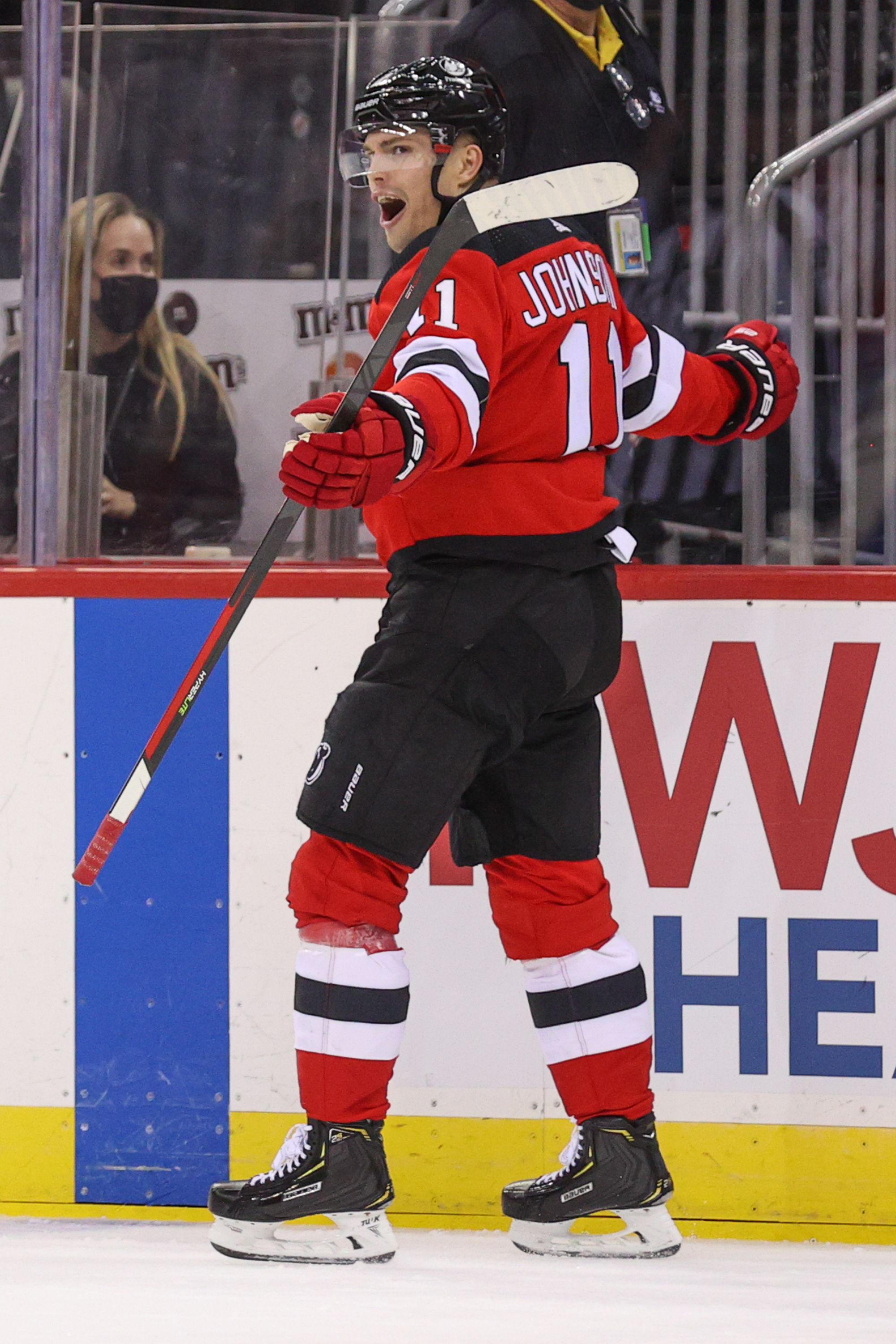
One of those players with a cap number exceeding actual cash owed is Devils winger Andreas Johnsson. Johnsson, 27, is set to have a base salary of only $750k next season. His signing bonus is set at $1.75MM, but his cap hit is going to be $3.4MM. This makes Johnsson an ideal candidate for them, and TSN’s Darren Dreger links Johnsson with the Coyotes for this exact purpose. Johnsson could be a fit with the Coyotes for not only all the financial reasons previously mentioned but also for his play on the ice. Johnsson has 11 goals and 28 points this season, and his 28 points would make him the fourth-highest scorer on the Coyotes. He is an accomplished offensive player at lower levels who has flashed talent at the NHL level, and has scored 20 goals before. The Coyotes went all-in on mining value from unconventional sources when building their roster this season, as evidenced by the out-of-nowhere success of Travis Boyd. Acquiring Johnsson, as Dreger reported they could, would represent a continuation of that philosophy for GM Bill Armstrong.
- In more news about the Coyotes coming from TSN’s Insider Trading panel, TSN’s Chris Johnston reports that the Coyotes are “going to have to look” at potential trades for goaltender Karel Vejmelka if the team is unable to reach a deal with him on an extension. Vejmelka is one year away from being an unrestricted free agent, and although the Coyotes, per Johnston, really like Vejmelka and are engaged in trying to get him signed to an extension, their organizational mandate to accumulate as much long-term value as possible could mean that Vejmelka gets dealt to a goaltending-needy team. On a Coyotes team that has struggled all season, Vejmelka has been occasionally brilliant and posted decent overall numbers, with a 3.38 goals-against average and a .904 save percentage. Again, the Coyotes team Vejmelka plays behind has been among the league’s worst this season, so while these numbers aren’t impressive on their own they are more impressive with proper context. From what Johnston is reporting, it seems as though the Coyotes genuinely do want to keep Vejmelka as a first priority, but the realities facing the team mean they could be forced to deal him.
- Pierre LeBrun of TSN has reported that the Toronto Maple Leafs “have spoken” with the Chicago Blackhawks about the 2020-21 Vezina Trophy-winning goaltender Marc-Andre Fleury. Toronto’s goaltending has faltered in recent weeks, with starter Jack Campbell struggling to find his game and backup Petr Mrazek enduring season-long issues. Maple Leafs GM Kyle Dubas has repeatedly reiterated his faith in the team’s goaltending tandem, but this reported “due diligence” conversation between the two clubs is an indication that perhaps the goaltending situation in Toronto is not as settled as it may seem. LeBrun does note that Toronto is unlikely to be Fleury’s ideal trade destination if he elects to be moved. But regardless of Fleury’s specific situation, this reported contact between the Maple Leafs and Blackhawks is an indication that the Maple Leafs are potentially searching for upgrades in net, and if they end up doing so their pursuit could drastically change the trade market, as the pool of available goaltenders is generally believed to be thin.
Photos courtesy of USA Today Sports Images
2022 NHL Draft Confirmed For Montreal
The city of Montreal was set to host the 2020 NHL Entry Draft, but those plans were scuttled when the world was turned upside-down by the COVID-19 pandemic. Continued pandemic restrictions meant that the city was unable to hold the draft in 2021 as well, but things finally seemed to change when fans returned to the stands at NHL arenas and the city was awarded the 2022 NHL draft. But as the Canadiens were once more forced to play games behind closed doors this season, the possibility of the draft being moved out of Montreal once again became a very realistic thought. In his annual meeting with the media at the NHL All-Star Weekend, Commissioner Gary Bettman stated that the NHL “would consider” moving the draft out of Montreal if the pandemic restrictions were still in place.
This was a disheartening development for many in the city who were eager to see Montreal host its 27th NHL Draft, but it seems that those fears can now be laid to rest. According to Chris Johnston of TSN, speaking on TSN’s Insider Trading program, the threat of the draft being moved out of Montreal again is “totally gone.” Johnston reports that the expectation is for the draft to be held as it was pre-pandemic, meaning with representatives from every NHL club on the draft floor and the hosting arena featuring a full-capacity crowd. NHL officials will “be heading to Montreal” next week to finalize all the details, but the bottom line is that it looks as if the vision of a draft in Montreal will finally be realized after a significant wait.
For Montreal as a market, this announcement can have particular significance because of the state of the Canadiens’ season. Despite their resurgence under coach Martin St. Louis, the team is still last in the NHL with 37 points. Should they stay in that place in the standings, they will have the highest odds of winning the #1 overall pick in the 2022 draft, and be guaranteed to be picking inside the top-3. For a hockey-mad market like Montreal, the Canadiens potentially being able to select a future franchise cornerstone like Shane Wright at a draft hosted inside the Bell Center is an exciting prospect and a nice consolation prize for a fanbase that has been through a largely miserable season.
Update On Kris Letang
The Pittsburgh Penguins have been possibly the most successful team of the salary cap era. Their core of Sidney Crosby, Evgeni Malkin, and Kris Letang has brought the team three Stanley Cups and has kept them competitive for an entire generation of hockey. But as that core continues to age deeper into their thirties, there are more and more questions about how much longer the three can remain together as Penguins. Recently, there has been a focus on Letang specifically and his future with the team, given that he is a pending unrestricted free agent. According to Frank Seravalli of Daily Faceoff, Letang’s future in Pittsburgh is unclear.
Seravalli reports that there are “big gaps” between the team and the player, with the major sticking point being the term on Letang’s next contract. According to Seravalli’s sources, Letang’s representation is seeking a five-year deal with an average annual value beginning at $7MM, and the Penguins are “simply not willing” to even consider Letang on an extension that takes him to the point where he is nearing 40 years old. Letang is currently 34 and will be 35 by the time next season starts, meaning any extension for him carries a significant risk of becoming an albatross, despite how good Letang still is at the NHL level. For a Penguins team that is navigating which direction to go as a franchise long-term, it is understandable for their relatively new management team of Brian Burke and Ron Hextall to be wary of signing Letang to such a massive extension.
The Penguins expect to compete for a Stanley Cup this season, and that’s a very reasonable expectation. Coach Mike Sullivan has been brilliant, leading the squad to a safe position near the top of the Metropolitan Division standings. Letang has been a crucial part of this team’s success, as he typically has been. He has 49 points in 54 games, third on the team behind Crosby and Jake Guentzel, and those 49 points rank just outside the top-5 in defensive scoring league-wide. Letang is also averaging nearly 26 minutes of ice time this season and is the Penguins’ most important defenseman by a mile. Replacing Letang would be extremely difficult for the Penguins to do, and if they have any intentions of competing for a Stanley Cup for the rest of Crosby’s contract (expires after 2024-2025) they will need to have a defenseman like Letang. So those on-ice factors combined with Letang’s importance to the Pittsburgh hockey market in general (he is nearing his 1000th NHL game and has spent his entire career with the Penguins) make his contract situation an incredibly tricky one for Burke and Hextall to navigate. But if Seravalli’s report is any indication, some major changes could be coming to a Penguins’ core that has been the heart of the franchise for a generation of fans.
Deadline Notes: Giroux, McBain, Boeser
A new team may have entered the Claude Giroux sweepstakes. As the Philadelphia Flyers’ franchise player mulls his future as a pending unrestricted free agent, it is expected that multiple teams will be in conversation with Flyers’ GM Chuck Fletcher to attempt to land Giroux. Much of the conversation has so far centered around the Florida Panthers and Colorado Avalanche as potential fits, but as Elliotte Friedman of Sportsnet writes in his 32 Thoughts blog, there could be another team entering the mix. According to Friedman, “several sources” have said to “not count out” the interest of the St. Louis Blues when it comes to acquiring Giroux.
The Blues currently sit second in the Central, behind the Avalanche, and the benefit of adding Giroux would be massive for a variety of reasons. First and foremost, the Blues’ forward corps, which is already incredibly well-stocked, would add the most accomplished offensive player set to be available at the deadline. Giroux could take Ivan Barbashev‘s spot next to Ryan O’Reilly and David Perron, or he could even unseat Brandon Saad next to Brayden Schenn and Pavel Buchnevich. Regardless of where he plays, adding Giroux to an extremely deep and talented forward corps would give Blues coach Craig Berube an embarrassment of riches to work with when constructing his forward lineup. But beyond Giroux’s impact on the ice for the Blues, acquiring him holds an additional benefit: by making him a Blue, GM Doug Armstrong would be keeping Giroux out of the hands of his team’s closest divisional rival. In a league where the margins of victory in the playoffs are so thin, keeping the juggernaut Avalanche away from a player like Giroux could be an important angle to consider when the Blues are considering making a trade for the Flyers’ captain.
- As has been previously covered, the Minnesota Wild are considering shopping the signing rights they hold over prospect Jack McBain, who is currently starring for Boston College in the NCAA. In another bit of information from his 32 Thoughts blog, Sportsnet’s Elliotte Friedman reports that the Wild’s asking price for McBain is a second-round pick. In 2019, the New York Rangers traded two second-rounders to the Carolina Hurricanes for the rights to defenseman Adam Fox, so a price of a second-rounder is not one without some precedent, although an inquiring team could make the argument that McBain isn’t the same quality of prospect that Fox was at the time. Beyond reporting a potential asking price, Friedman also floats the Winnipeg Jets as a potential candidate to acquire McBain, specifically noting that Andrew McBain, Jack’s father, played six seasons for the Jets from 1983-84 to 1988-89.
- Now under new leadership thanks to the hiring of former Pittsburgh Penguins GM Jim Rutherford, the Vancouver Canucks have had a significant amount of attention paid to them in advance of the trade deadline. Much of it has centered around J.T. Miller, who has only one more year left on his contract after this season, but in an appearance on TSN’s TradeCentre program, TSN Hockey Insider Chris Johnston points in a different direction. Johnston states that instead of Miller it is Brock Boeser, a 2018 Calder Trophy finalist, who is “most likely to be dealt.” He states that the rationale for trading Boeser would be the Canucks wanting to “maximize an asset” in advance of Boeser’s restricted free agency this offseason. Whereas he may have once been considered an untouchable franchise centerpiece, it seems as though the trade winds are blowing hard in Boeser’s direction and his time as a Canuck could be winding down.