
Chicago Blackhawks Sign Jaxson Stauber
The Chicago Blackhawks have landed a coveted NCAA free agent. Providence College’s Jaxson Stauber, an undrafted goaltender, has signed with the team, inking a two-year entry-level contract carrying an $883K cap hit. The signing comes off the heels of the team’s trade of starting goaltender Marc-Andre Fleury to the Minnesota Wild. While it is unlikely that the trade of Fleury had any direct impact on this signing, in a statement Blackhawks GM Kyle Davidson emphasized the importance of “making sure there is no drop-off in our goaltender development” for his rebuilding club. As it stands the Blackhawks’ two goalies on their NHL roster combine for under 100 games of NHL experience, so Davidson’s statement indicates that repairing the team’s organizational situation between the pipes will be a priority.
While Stauber was passed over in every NHL draft he was eligible for, that hasn’t stopped him from developing into a viable goaltending prospect in his own right. Stauber is a Hobey Baker nominee this season and his play through two seasons at Providence College has been stellar. In 37 games this season Stauber registered a .921 save percentage, and in 2020-2021 he posted a .916 in 23 games. Stauber also stands six-foot-three, meaning he isn’t tagged with the “undersized” label that has plagued many goaltending prospects across hockey. Should he be able to continue the success he found at Providence College with the Blackhawks organization, it would greatly help a club with far more questions than answers regarding its goaltending situation.
For the Blackhawks, signing Stauber helps add talent to a team in need of some goaltending reinforcements. As previously mentioned, after the trade of Fleury the crease in Chicago is relatively wide open. The current tandem of Delia and Lankinen is unproven and without much recent success. Delia has a .750 save percentage in his 28 minutes of action at the NHL level this season, and Lankinen has a .889 mark through 17 games so far in this campaign. Arvid Soderblom, with a .920 save percentage this season in 23 games for the AHL’s Rockford IceHogs has promise, but otherwise, this is potentially one of the best opportunities for quick advancement should Stauber want to reach the NHL as fast as possible. Should he exceed expectations, he could find himself quickly rising through the organizational ranks in net. He could get the chance sooner rather than later, too, as Charlie Roumeliotis of NBC Sports Chicago reports that although Stauber’s contract “kicks in next season,” if he chooses to start in Rockford he could be able to under an amateur tryout agreement.
Philadelphia Flyers Acquire Brennan Menell
The fact that the NHL’s trade deadline was Monday hasn’t stopped some team executives from wheeling and dealing. The Philadelphia Flyers announced that they are acquiring defenseman Brennan Menell from the Toronto Maple Leafs in exchange for future considerations. Again, the timing of this deal could be seen as curious due to the recent passing of the trade deadline. But the AHL, where Menell has played this season, actually has its own trade/loan deadline on March 28th, which could be a potential explaining factor for why this deal was made.
Menell, 24, signed in Toronto this offseason (after a trade from Minnesota for a conditional 7th, conditions that will not be met) coming off of a spectacular season playing for Dynamo Minsk in the KHL. In 2020-21 he had 38 points in 47 games for Minsk. He originally left the Minnesota Wild, where he signed as an undrafted free agent, for the KHL seeking a better opportunity to develop his game, as he told Michael Russo of The Athletic. (subscription required) That decision helped pave his way to becoming a group-six unrestricted free agent this past offseason. Menell signed with the Maple Leafs, who likely made the signing with the idea that Menell’s strong record of offensive production at the AHL and then KHL levels would translate to their organization and potentially their NHL team. The team signed Menell to a one-year, two-way deal worth $750k, a deal that included a $400k AHL salary for Menell, a not-insignificant financial commitment for a league where the minimum salary is just over $50k. But despite those hopes and that commitment, this season has not gone well for the player. He has only managed to play 20 games for the Marlies, and his scoring has seemingly dried up. He has one goal and five points in those 20 games, a significant decline from his last AHL season where he had 47 points in 57 games. Despite that decline, Menell gets a chance at a change of scenery with the Flyers, where he can potentially make an impact with their AHL affiliate, the Lehigh Valley Phantoms, and show that he deserves a place in their organization before he is once again an unrestricted free agent.
For the Maple Leafs, this trade allows them to give a struggling player a change of scenery while also clearing up a coveted contract slot. The Maple Leafs are at 47 contracts out of the maximum of 50, per CapFriendly, but after this trade, they will be down to 46. With teams around the league looking to snap up NCAA free agents and Toronto even eyeing Europe for potential reinforcements, this move could help GM Kyle Dubas clear some room for any potential additions he wants to make as the Leafs enter a crucial stretch of their season. It also comes at a convenient time for the team, as the Marlies got some help in the form of a loan for Philippe Myers from the Nashville Predators, making the loss of Menell potentially easier for the team to stomach.
The trade was first reported by ESPN’s Kevin Weekes.
Arizona Coyotes Acquire Jack McBain, Sign Him To Entry Level Contract
Monday, 7:53 pm: As expected, after acquiring him, the Arizona Coyotes have signed forward Jack McBain to an entry-level contract. The contract is for two years and carries a cap hit of $884K. What is most notable about this contract is that it begins this year, perhaps giving the Coyotes a chance to give McBain an NHL look this year. The 22-year-old just finished his fourth season at Boston College and was set to be granted free agency this summer if he did not sign. One wrinkle to this story, however, is that McBain is currently injured and is in a walking boot, reports Craig Morgan of PHNX Sports. Once healed, McBain can begin to work his way back and into an NHL lineup for the first time in his career.
Monday, 10:45 am: The deal has now been made official. Coyotes GM Bill Armstrong had the following statement about his new center:
We are very pleased to acquire Jack McBain. He is a big, strong, highly-skilled center who had a tremendous season with Boston College. We are thrilled to have him join our organization.
Sunday: The Arizona Coyotes have acquired the rights to prospect center Jack McBain from the Minnesota Wild. They are acquiring the Vancouver Canucks’ 2022 second-round pick from the Coyotes in return, and McBain is expected to sign an entry-level contract with Arizona shortly. The trade was first reported by Frank Seravalli of Daily Faceoff. McBain’s name was first entered into the trade deadline conversation by Sportsnet’s Jeff Marek and has been floating in deadline rumors ever since. McBain had made it clear that he would not be signing in Minnesota, and Sportsnet’s Elliotte Friedman reported that the Wild and GM Bill Guerin were asking for a second-round pick from any interested party in return for McBain’s rights. They have gotten their asking price with this trade, as Arizona cashes in one pick from its impressive stockpile to acquire a player who many believe is ready to step into the NHL as soon as he signs his contract.
For the Wild, this trade represents Guerin being able to take advantage of McBain’s development as a college prospect to recoup some value from his rights. As mentioned above, McBain had communicated to the Wild that he would be signing his entry-level contract elsewhere, and from that point, it became imperative for Guerin to gain something from holding McBain’s rights. In previous trades, such as Zach Hyman to Toronto in 2015, a low-value pick is all the rights-holding team can get in return, given that their leverage is low due to their player’s pending free agency. But more recently, as we saw with Adam Fox‘s trade to the New York Rangers in 2019, teams have become more willing to part with valuable assets to acquire the rights to sign an NCAA prospect. So while Guerin and Wild fans may be disappointed that McBain chose not to sign in Minnesota, being able to get a second-round pick in exchange for a prospect’s soon-to-be expired rights is a good bit of business.
This trade is also good business for Arizona and GM Bill Armstrong. The Coyotes have built their team around a bold, scorched-earth plan to stockpile as much long-term value as possible. They have traded significant, in-their-prime, team-controlled players such as Conor Garland and Christian Dvorak, and have also weaponized their enviable amount of cap space to take on other teams’ unwanted contracts for draft pick compensation. The result of their efforts has been a stable of upcoming draft picks larger than any other franchise in the NHL. For the 2022 draft, before this trade, the Coyotes were set to have three first-round picks and five second-round picks. Now, they still have three first-rounders and four second-rounders. Second-round picks are assets that the team currently has an abundance of, but what they are lacking is quality talent at the center position. By trading for him, it is clear that Arizona believes McBain is exactly that, and through this trade, the Coyotes are subtracting from a position of strength to add to a position of pretty severe weakness. The Coyotes’ top four players down the middle are currently Travis Boyd, Riley Nash, Christian Fischer, and Barrett Hayton. Only Boyd is under contract for next season. By acquiring McBain, who had 33 points in 24 games this past season for Boston College, the Coyotes add a high-upside prospect who is ready to step in and bolster their lineup immediately. He might not have the tools to become a do-it-all star first-line center, but regardless of what role he ends up settling into his acquisition by the Coyotes is a shrewd move from Armstrong to help diversify the team’s immediate and long-term outlook down the middle.
It’s not often that a trade can truly please the fanbases of both teams involved, and given McBain’s reluctance to sign in Minnesota there still could be bitterness from that side. But that being said, this looks like a trade where both sides, given their respective situations, seem to come away on top.
Edmonton Oilers Acquire Brett Kulak
The Edmonton Oilers have entered into the trade deadline fray. They have acquired defenseman Brett Kulak from the Montreal Canadiens in exchange for William Lagesson, a conditional 2022 second-round pick, and a 2024 seventh-round pick. The Canadiens will retain 50 percent of Kulak’s remaining salary. If the Oilers reach the Stanley Cup Final this season, the conditional pick will become a 2023 second-round pick.
In Kulak, the Oilers get a defenseman who, like most of the Canadiens team, has come into his own with the departure of former GM Marc Bergevin and the arrival of new coach Martin St. Louis. He has been given a larger role in Montreal’s lineup compared to the more inconsistent roles he dealt with in the past and has responded with one of the best stretches of games of his career. He’s a good skater who can help in the transition game, although his offense isn’t anything to write home about. He has 13 points this season in 56 games and had eight points in 46 games last season. He can hold his own defensively enough to not be a liability but it would be a mistake for Oilers fans to expect a minute-munching penalty killer. He also isn’t an overwhelming physical presence but as the Canadiens have lost defensemen to injuries and trades, and relied more on a younger and more inexperienced defensive corps Kulak has been able to show a bit more snarl to his game. At an expiring $1.85MM cap number, Kulak is a reasonable add for an Oilers’ blueline that could use another solid contributor like Kulak. Though, with the cost being a second-rounder and Lagesson, one wonders if the price is a bit too steep. But with the prior trades of Jeremy Lauzon for a second-rounder and Ben Chiarot for a first-rounder, it is clear that defensemen are at a premium.
For the Canadiens, getting a second-rounder alone is a great return for Kulak, a pending unrestricted free agent. While the team is surging and Kulak has been a big part of that, building the team’s future is more important than the rest of this season. They add another high draft pick to an ever-increasing stable of picks, and unless Kulak gets an extension in Edmonton they still do have the option of approaching him in free agency this summer. The team also gets Lagesson in return. Lagesson, 26, is a Swedish defender who cleared waivers earlier this season. He has gotten into 30 games so far this year and has four points. He needs to play in eighteen more games for the Canadiens to be eligible to retain his rights as an unrestricted free agent. He’s a defense-first defender who should be able to help them down the stretch as they recover from the loss of Kulak and Chiarot. Overall, it’s a bit of a steep price to pay for the Oilers but not a totally unreasonable one, and for the Canadiens, they get a valuable draft pick for a player set to hit unrestricted free agency.
Los Angeles Kings, Nashville Predators Complete Minor Trade
Amid a flurry of moves containing NHL-caliber players, the Nashville Predators and Los Angeles Kings have finalized a swap of two players with one game of NHL experience between them. The Kings have acquired defenseman Frederic Allard from the Predators in exchange for forward Brayden Burke. This is a swap of AHL players right as both teams’ AHL affiliate squads look set to qualify for the AHL’s Calder Cup Playoffs. The Kings’ affiliate, the Ontario Reign, are second in the AHL’s Pacific Division. The Milwaukee Admirals, the Predators’ affiliate, are third in the AHL’s Central Division, so this trade was likely done with their seasons in mind.
The Kings, in getting Allard, get the player in the deal that has made it to the NHL before. Allard has played in one game, in 2020-2021, and was one of the Predators’ two 2016 third-round picks, along with Rem Pitlick. The 24-year-old defender has five points in 36 AHL games and spent time playing in Austria in 2020-2021. The Kings’ defense is currently ravaged by injuries, and a whole host of players including Drew Doughty, Sean Walker, Matt Roy, Tobias Bjornfot, and Mikey Anderson have been unavailable. They recently traded a seventh-rounder to Detroit for defenseman Troy Stecher, and now make this deal as another move to help shore up that beaten-up blueline. Allard is also a pending restricted free agent, which means that the Predators will have the opportunity to retain him should they deem him a good fit in their organization.
The Predators deal Allard for Burke, who has been an AHL player since 2018-19. He has been a decent scorer at that level, with his best season coming in 2019-20, when he had 52 points in 51 games. He now has 17 points in 31 games for the AHL’s Tucson Roadrunners this season and figures to help as a secondary scorer for the Admirals. Given that he is a pending group-six unrestricted free agent, it is unlikely that the Predators have Burke in their long-term plans. But he should be able to reinforce Milwaukee for their playoff chase, and the Predators have historically been interested in having success at the AHL level, which is where Burke has been for the entirety of his professional career.
Arizona Coyotes Acquire Bryan Little
The Arizona Coyotes have made a bit of a creative move. The team has acquired Bryan Little and the rights to prospect Nathan Smith from the Winnipeg Jets for a fourth-round pick. Both teams have announced the deal. Little, 34, has only played in seven games since 2018-19 and does not figure to play in the NHL again due to injuries. He was on long-term injured reserve for the Jets and has a contract worth $5.29MM against the cap through 2023-2024.
For the Jets, this move paves their path to being able to avoid the use of long-term injured reserve in the future. Long-term injured reserve (LTIR) is an incredibly complex area of the NHL’s salary cap and one that is difficult for many to wrap their heads around. One of the major reasons a team would want to avoid the use of LTIR is so they could accumulate cap space throughout a season. The Jets now only have Kristian Reichel and Cole Perfetti on LTIR, two players that are not going to be long-term fixtures on that list, so moving Little allows them to get away from relying on LTIR to be cap compliant.
For the Coyotes, this move is designed to help them navigate what should be a tricky financial situation for the foreseeable future. The team is set to move into an arena far smaller than NHL teams are typically used to, meaning their revenues will likely be hurt by the lower amount of tickets they can sell. The Coyotes have a significant amount of their team on expiring contracts, meaning they have very little money tied to their roster for next season. With that in mind, the team still needs to be able to clear the salary cap floor for next season. By acquiring Little, the Coyotes gain a contract of a player costing over $5MM against the cap, a decently large amount, who will also cost them a relatively minimal amount of actual dollars paid. Little’s contract, according to Mike McIntyre of the Winnipeg Free Press, is covered by insurance, meaning that the Coyotes will not be on the hook for paying Little most or even potentially all of the cash he is owed. As a result, the Coyotes can inch closer to the required cap floor while minimizing the number of dollars they themselves need to pay.
For their trouble, the Coyotes also receive an intriguing prospect in Smith. By getting Smith as part of the deal, GM Bill Armstrong adds another NCAA prospect on the back of yesterday’s trade for Jack McBain. Smith, 23, was the 91st overall pick in 2018 and has had an immensely productive season at Minnesota State University. He has 18 goals and 49 points in 34 games and is likely close to NHL-ready given his age and college production. Getting potentially NHL-ready NCAA prospects seems to be the strategy for Armstrong, whose team is set to share an NCAA arena as their home for the next few years.
The trade was first reported by ESPN’s Kevin Weekes. TSN’s Bob McKenzie was first on the compensation.
Bruins Sign Jake DeBrusk To Two-Year Extension
Despite a trade request that is still active, Jake DeBrusk has chosen to accept an extension offer from the Boston Bruins. DeBrusk’s new contract is a two-year, $4MM AAV pact that will take him through his age-27 season. TSN’s Chris Johnston reports that “the belief” is that the Bruins “still want to trade” DeBrusk, and believe that signing him to this extension makes him a more attractive trade asset. DeBrusk was due a $4.41MM qualifying offer this offseason from a team looking to retain his rights as a restricted free agent, but now that situation is swapped with a much clearer two-year deal that takes DeBrusk straight to unrestricted free agency when the contract expires.
For the Bruins, this contract makes DeBrusk a more cost-controlled asset than he previously was. Given how long the DeBrusk trade saga has lingered, it is possible that Boston was simply not getting the offers they deemed acceptable for DeBrusk and found that the uncertainty of his contract situation impeded making a satisfactory trade. With the extension, they have cleared up those murky financial waters and paved a path for an acquiring team to have a much clearer sense of the value they’d be receiving if they choose to acquire DeBrusk. It is a bit curious though, given that players looking at sign-and-trade situations typically get traded first and then sign their extension, as Boston did recently with Hampus Lindholm. One thing to note is that DeBrusk’s actual salary this season is $4.85MM, a significant increase from his $3.675MM cap hit, which may be a barrier keeping the Bruins from making a trade given how many teams are still reeling from the financial impact of the COVID-19 pandemic.
By signing this extension, DeBrusk cashes in on his recent performance and also bets on himself by signing for only a two-year term. DeBrusk has recently found a better fit in Boston as a winger on their first line. He has 15 goals and 26 points so far this season, numbers that are a nice improvement from last year’s miserable five-goal, 14-point campaign. Some still believe that DeBrusk, the 14th overall pick in the 2015 draft, has the potential to become a 30-goal scorer in the NHL, and any team acquiring him would likely be buying into that potential. Things can change quickly in the NHL, and DeBrusk is no stranger to that, having gone from 27 goals in 2018-19 to five in 2020-2021, so naturally there is risk for the player in signing a deal only two years in length. But with this extension, DeBrusk is betting on himself and the possibility of him realizing his potential with a long-desired change of scenery.
Winnipeg Jets Re-Acquire Mason Appleton
The Seattle Kraken aren’t done. The Kraken have sent winger Mason Appleton to the Winnipeg Jets, the team the Kraken selected him from in the Expansion Draft. In exchange, the Jets are trading the Kraken a 2023 fourth-round pick. Both teams have announced the deal. With tonight’s trades of Appleton and Jeremy Lauzon, two more members of the Kraken’s original Expansion Draft roster are no longer with the team. The Kraken now have 23 picks in the next two NHL drafts, up from the normal 14 (one per round) allotted automatically to each club, and it is clear that GM Ron Francis has decided to prioritize building a strong prospect pool for his franchise over keeping players who could help his team in the short and medium-term.
Appleton himself did seem to be a player who could help Seattle not only this year but in the next few seasons as well. The Green Bay, Wisconsin native is a pending restricted free agent (with arbitration rights) currently costing his club $900k against the salary cap. His play this season has not led many to believe he would be deserving of a significant raise, which means the motivations for moving Appleton likely could not have been financial. Instead, this trade seems to be about cementing Francis’ front office going full-steam ahead in the direction of building a draft pick stockpile that can rival the Central Division rival Arizona Coyotes’ impressive hoard. The Kraken’s roster is undoubtedly made worse for this season and next by the loss of Appleton, but in trading him they do get to add another pick to help them build a prospect system they hope will become the envy of the league. Ultimately, finding a third or fourth-line winger who plays energetically to fill the role Appleton is vacating is not the hardest task in the offseason, so if the Kraken didn’t believe that Appleton specifically was worth keeping long-term, adding a fourth-rounder is a nice way to fill out an unsurprisingly barren prospect cupboard.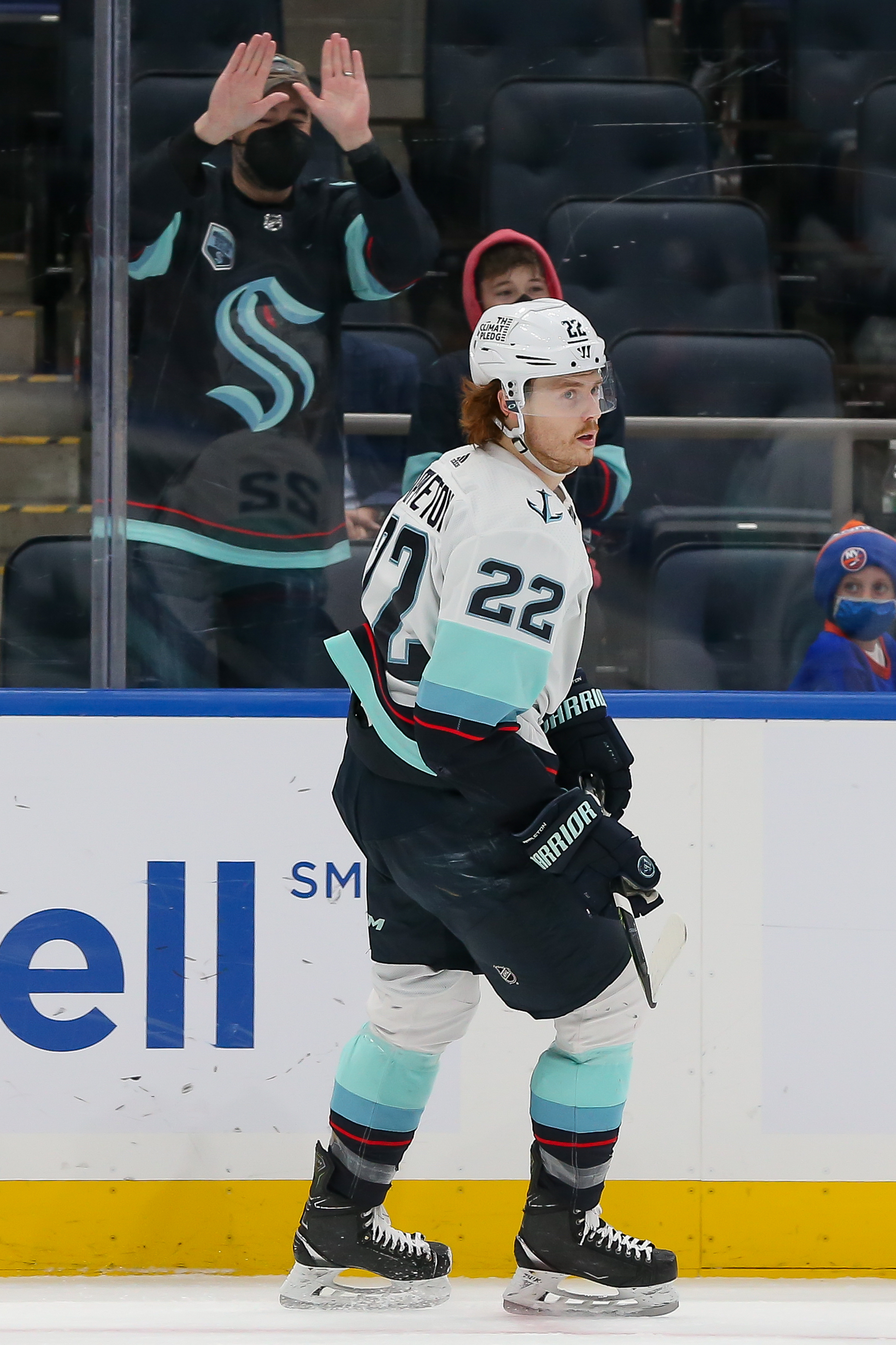
For the Jets, this trade helps them this season and next as they anticipate the exit of middle-six staple Andrew Copp. Appleton is an energetic, fast bottom-six winger who plays relentlessly on the forecheck and can add a little bit of offensive touch. Appleton had his first campaign as an NHL regular last season, scoring 12 goals and 25 points in 56 games, and his success was what led him to be selected by the Kraken in the first place. This season, as the Kraken overall struggled to find their form, Appleton’s production suffered, and has only six goals and 17 points in 49 games. If Appleton can return to being the player he was in Winnipeg, this will be a solid use of a 2023 fourth-rounder by Jets GM Kevin Cheveldayoff. The Jets have been a disappointment this season, and one of their better forwards in Copp is set to depart sooner rather than later, but this trade reinforces Cheveldayoff’s long-held belief that his team is not too far off from re-establishing themselves as a contender. Adding Appleton is another minor piece of evidence reinforcing the generally-held idea that the Jets don’t plan on rebuilding any time soon, and that 2022-23 is going to be a big year in determining the future of the franchise. With this trade, Appleton will again play a role on the Jets and will now have a say in how the team fares in that all-important year.
Elliotte Friedman of Sportsnet reported Appleton returning to Winnipeg. TSN’s Darren Dreger was first on the draft pick compensation returning to Seattle.
Photo courtesy of USA Today Sports Images
Dallas Stars Acquire Scott Wedgewood
The Dallas Stars have added another goaltender to help in their playoff race. They have acquired Scott Wedgewood from the Arizona Coyotes in exchange for a conditional 2023 fourth-round pick. The pick becomes a 2023 third-rounder if the Stars make the playoffs this season. Both teams have announced the trade. This is now the second time in his career that Scott Wedgewood has been traded by the Coyotes. In 2018, he was part of the team’s trade for Darcy Kuemper, and now he finds himself likely experiencing a bit of deja vu.
This seems to come as a bit of a disappointment for Wedgewood, as according to Craig Morgan of PHNX Sports he “desperately wanted to stay in one place” after having moved so much over the course of his career so far. But what can’t be disappointing for Wedgewood is the fact that a team in the middle of a playoff race values him highly enough to trade as much as a third-round pick to acquire him. The Stars clearly believe he can help them, and it’s easy to see why. Wedgewood has a .911 save percentage in 26 starts this season, backstopping one of the league’s worst teams. He has received little help from the defense in front of him far too often this season and has come out of those difficult games with highly respectable numbers. Wedgewood is 29 years old and has an expiring $825k cap hit, meaning he is unlikely to be a long-term fixture in Dallas, but he certainly will help them right now. Their need for Wedgewood is exacerbated by the recent injury trouble that has hit Jake Oettinger‘s usual partner in net, Braden Holtby. Holtby is battling a lower-body injury, and Jeff Marek of Sportsnet speculates that Holtby could be headed for long-term injured reserve. So if Holtby’s injury does prove to be more significant than one may have previously anticipated, this move for Wedgewood is an important one to help protect Oettinger as he backstops the Stars in his first real season as a number-one goaltender.
For the Coyotes, getting a fourth-rounder that can potentially become a third-rounder is solid value for Wedgewood, a pending UFA. The Coyotes’ crease seems to belong to Karel Vejmelka for the near and potentially long-term future, so for a team that is in the NHL’s basement adding a decent draft pick to their already impressive stockpile is a shrewd move. Perhaps they could have been more accommodating to the journeyman Wedgewood’s wish to have more stability in his career, but this trade is one more reminder of the businesslike nature of NHL roster-building, and how valuable draft picks have become to rebuilding clubs. Overall, the Coyotes get good value for a player they likely didn’t have as part of their long-term plans, and the Stars get a goaltender in the middle of the best season of his career to help as they desperately try to make the playoffs in what is a win-now season for the club.
ESPN’s Kevin Weekes was the first to report Wedgewood being traded to Dallas. Matthew DeFranks had the conditions on the pick being sent to Arizona.
Nashville Predators Acquire Jeremy Lauzon
The Nashville Predators have made a move to shore up their defense. The Predators have acquired defenseman Jeremy Lauzon from the Seattle Kraken. The Predators have traded the Kraken a 2022 second-round pick in exchange for Lauzon. Both teams have announced the trade. Lauzon was one of the Kraken’s picks from their Expansion Draft, and he now moves to the third team of his NHL career, having played a total of 53 games as a member of the Kraken.
As was written in our recent trade deadline primer, the priority for the Predators approaching the deadline was likely to be their defense, specifically their bottom pairing. The team just waived defenseman Philippe Myers and is giving NHL minutes on their bottom pairing to Matt Tennyson, a 31-year-old AHL/NHL tweener, and Jeremy Davies, who has a total of 18 NHL games to his name. For a team that has designs on making the playoffs and potentially going on a run, that was a glaring weakness on their roster, and it seemed as though with every passing hour until the deadline, with players like Mark Giordano, Ben Chiarot, Hampus Lindholm, and more already being dealt, GM David Poile would be harder pressed to find a fit to improve his team. It seems as though that pressure may have motivated Poile, as a second-round pick is a steep price to pay for Lauzon. Lauzon is still only 24 years old and was a well-regarded prospect from his days in Boston, but since arriving in the NHL he has been unable to truly impress in any specific area of the game. He brings physicality and size, which are two admirable traits to have as a blueliner, but has struggled to be a well-rounded defensive defenseman and found particular trouble in the Bruins’ playoff exit against the Islanders last season. He has virtually no offensive element to his game as well, with only 17 career points in 129 games. In all honesty, it seems as though this trade is the clearest reflection of how expensive defensemen have been at this deadline, given the prices Boston and Florida paid for Lindholm and Chiarot, respectively. Lauzon for a second-rounder may be the price giving fans the most sticker shock of them all. Poile is a highly accomplished GM with a long track record of success in building the many Predators’ bluelines he has overseen, so he has earned a lot of credibility when it comes to his evaluation of defensemen. But it is difficult to fully rationalize the second-round price tag he paid for Lauzon. Lauzon is young, and theoretically has room to grow, but his play in the NHL so far in his career leaves more questions than answers.
For the Kraken, this trade is a strong one for GM Ron Francis and one that signals their intention to fully enter a long-term “rebuilding” plan for the team. Some may have expected this Kraken squad to find immediate success, especially given the success of the Vegas Golden Knights in their expansion season. The Pacific Division was viewed to be among the NHL’s weakest, and some observers even believed that the Kraken could come close to hitting the all-important 100 point mark in the standings. But that success did not come for the Kraken, and as a result, it seems as though they are fully pivoting to a more long-term strategy to build their team. They have already traded Calle Jarnkrok, and tonight also shipped Mason Appleton for another draft pick. Francis clearly believes the road to his team being a contender runs through the draft, and the Kraken are quickly building a strong stable of draft picks. In 2022, they now have four second-rounders and are set to pick at the top of the first round. This may be disappointing for the Kraken fanbase that likely wanted to see competitive hockey a bit sooner, but at least tonight the fanbase should rest easy. Getting a second-round pick for Lauzon is a strong return for a team in need of some good news.
Pierre LeBrun of The Athletic was the first to report Lauzon’s trade. Kevin Weekes of ESPN was first on the compensation returning to Seattle.
Photo courtesy of USA Today Sports Images