
Free Agent Focus: Winnipeg Jets
Free agency is now under a month away, and teams are looking ahead to when it opens. There will be several impact players set to hit the open market in July, while many teams also have key restricted free agents to re-sign. We continue our look around the NHL with an overview of the free agent situation for the Jets.
Key Restricted Free Agents
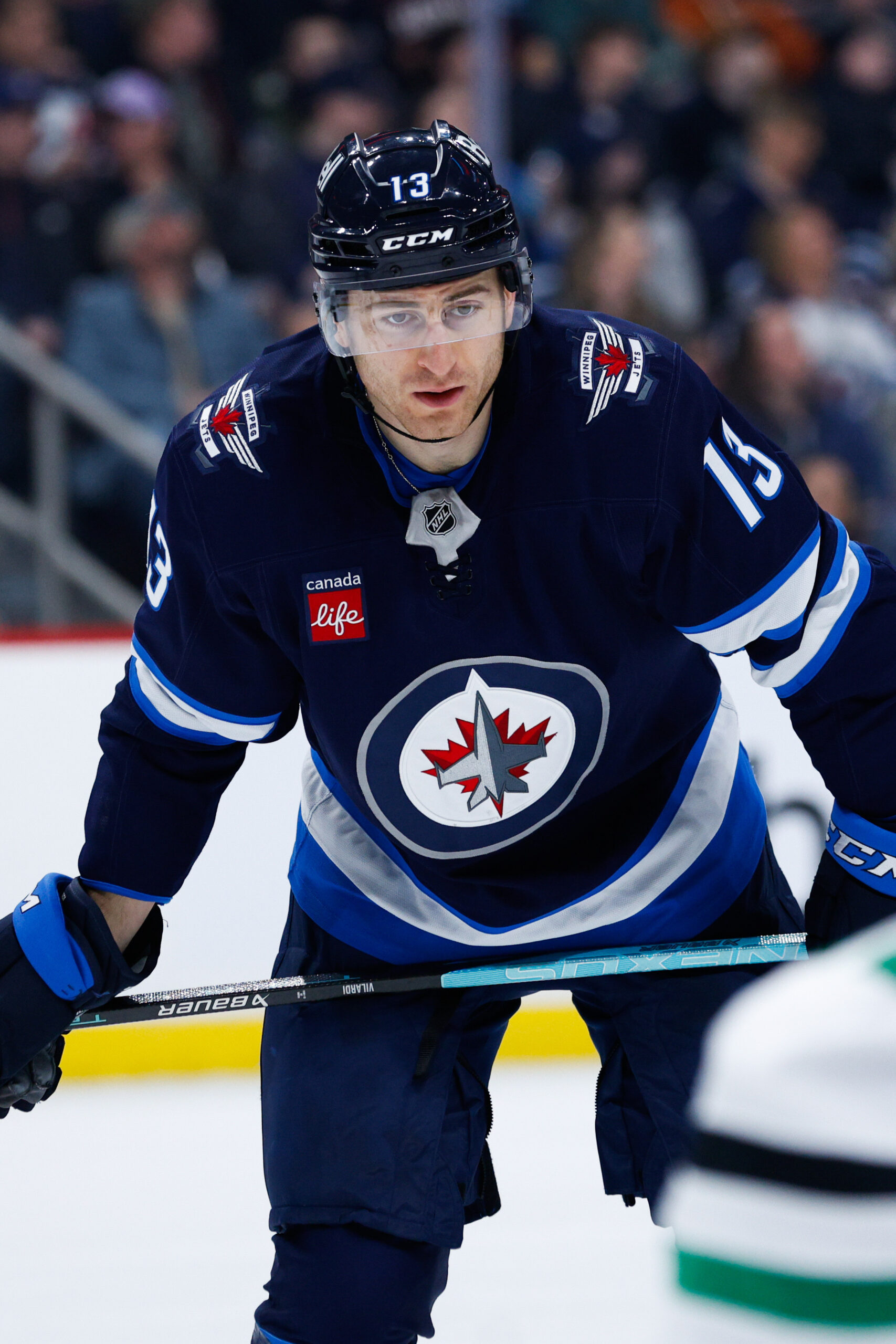 F Gabriel Vilardi – Winnipeg enters the off-season with a few big names at the top of their list – but re-signing Vilardi will have to be their first order of business. The 25-year-old centerman finally had his breakout season this year, after years of flashing high upside through battles with injuries. He scored a career-high 27 goals, 34 assists, and 61 points in 71 games this season – while confidently manning the second-line center role behind Mark Scheifele. The performance was a natural ramp-up after Vilardi potted 23 goals in 63 games of 2022-23, and 22 goals in 47 games last year. He averaged over 18 minutes of ice time this season, and also potted 25 points on the power-play – second-most on the club behind Kyle Connor. Vilardi’s breakout year was helped along by a 20.8 shooting-percentage, two percent higher than his career-average, and a heap of power-play scoring. But even then, it seems hard to deny that he’s the right man to command Winnipeg’s second-line moving forward. That sentiment could set Vilardi up for a major, long-term contract sometime this summer.
D Dylan Samberg – Another top-of-list item will be finding a new contract for hefty defender Dylan Samberg after he graduated into top-end minutes this season. He averaged north of 21 minutes a night as part of a Jets blue-line that leaned heavily on their top-four. His sheer compete and willingness to make plays on both sides of the ice made the heavy utilization look wise. Samberg led the Jets lineup in blocked shots (120) and takeaways (33), while also working his way to a career-high 20 points and plus-34 through 60 games. He’s still only four years into his career, but has so far found strong defensive metrics and a positive plus-minus in every season. That’s an impressive bit of reliability, especially in a Jets’ defensive group that’s often unwavering. Samberg’s offensive upside may never fully come along, but his ability to step up and make plays against top-end competition will be hotly coveted. He seems like a sure bet to sign a long-term and pricey deal this summer.
F Morgan Barron – Barron’s lineup role doesn’t shimmer the same as his RFA company – but he’s found a firm groove on Winnipeg’s fourth-line that would likely be hard to replace. The 26-year-old winger stands at 6-foot-4, 220-pounds and used that size to great effect this season. He ranked fourth on the team in hits (122) despite averaging just a little over 10 minutes of ice time a game. He was also strong when he needed to step up to the faceoff dot – winning 52 percent of his 163 attempts. Best of all, Barron was able to fill the physical and often defense-first role while only accruing 16 penalty minutes through 74 games on the season — a career low in terms of penalties-per-game. He did only score 15 points across the full year, which continued his fall in scoring after netting 23 points last year, and a career-high 31 points the season before. But Barron is a hardy fourth-liner who isn’t at risk of assignment to the minor-leagues. He should be a confident and cheap re-signing for the Jets.
F Rasmus Kupari – Playing alongside Barron was depth center Rasmus Kupari – another player who found his keep from making the responsible plays, rather than high scoring. Kupari totaled just eight goals, 16 penalty minutes, and a minus-one through 59 games this season – but he also recorded a 52.5 percent faceoff win-rate on 499 draws, the highest success rate of any of Winnipeg’s predominant centermen. He was an impactful depth forward capable of making plays in every direction – and standing up to physical play when the moment called for it. Winnipeg may be enticed to try and find a better scoring fit on the open market, but Kupari would still be worth a cheap contract to fill the role of extra forward and toolsy centerman, if nothing else.
Other RFAs: F Kristian Vesalainen, F Mason Shaw, F Parker Ford, D Simon Lundmark, D Isaak Phillips, D Tyrel Bauer
Key Unrestricted Free Agents
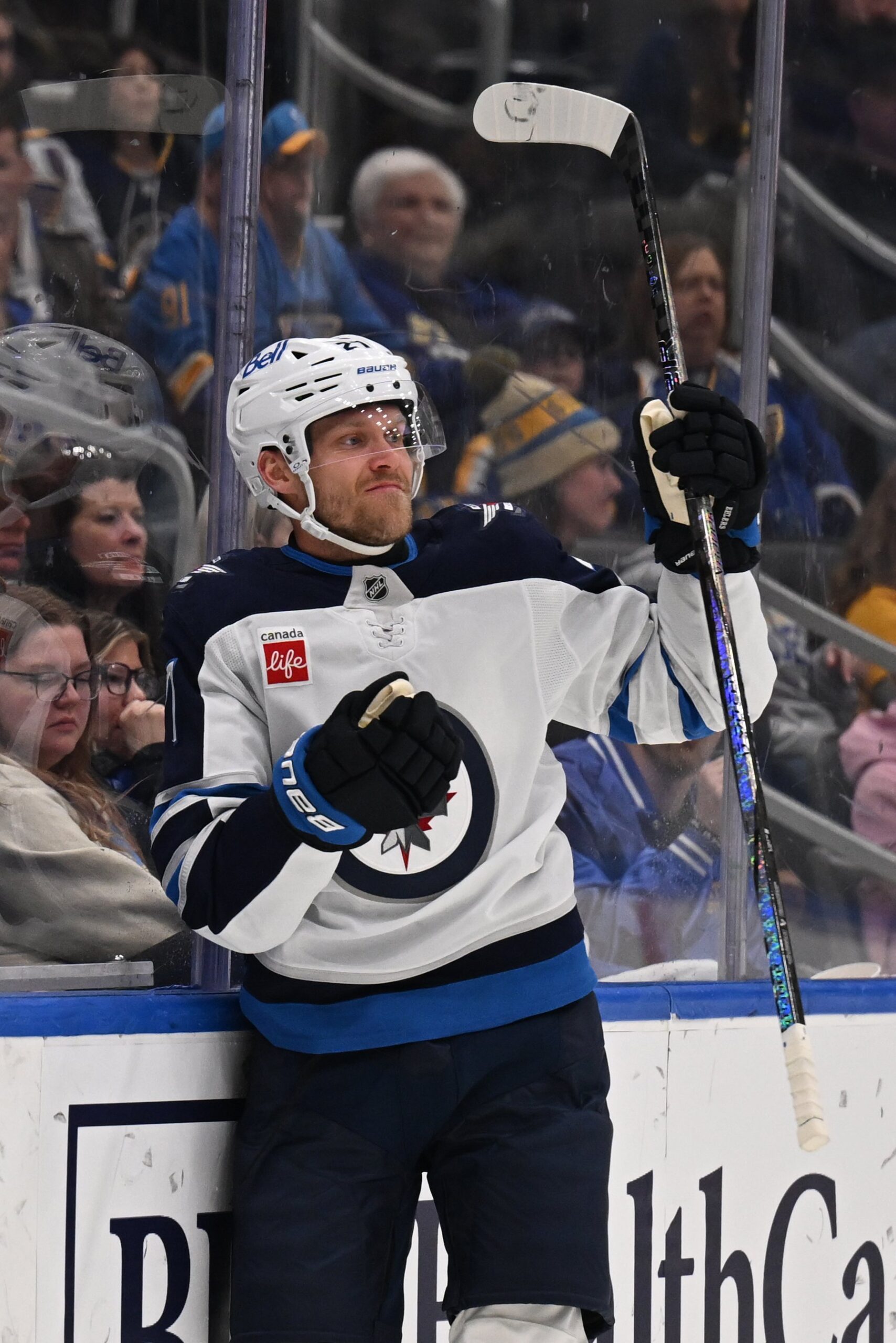 F Nikolaj Ehlers – The headliner of Winnipeg’s summer will be the decision that Ehlers makes in free agency. He is set to head to the open market, and potentially bring a close to his decade-long tenure with the Jets franchise. Only three Jets have scored more than Ehlers’ 520 points in 674 games since he joined the club in 2015-16: Scheifele (720), Connor (582), and Blake Wheeler (560). That’s impressive company. Even more impressive is Ehlers’ ability to stay consistent. He scored his career-high 64 points in 82 games of the 2016-17 season, his sophomore year. But he managed to notch a new career-high in scoring pace with 24 goals and 63 points in just 69 games this year. Ehlers looks well cemented into his prime years right now, and should only continue to serve as a persistent scorer and transition monster wherever he lands next. 10 years in Winnipeg will be hard to leave behind – and the door isn’t closed yet – but after back-to-back, 60-point seasons, Ehlers is making the wise choice to find a payday while he still can.
F Mason Appleton – Appleton has expressed his interest in remaining apart of the Jets’ core, but that could be a hard sell after his scoring returned to Earth a bit this season. He saw a late-stage breakout last season, netting 14 goals and 36 points while appearing in all 82 games of the 2023-24 campaign. But that mark teetered on an 11.5 shooting percentage, and Appleton fell to just 10 goals and 22 points in 71 games on the back of a 9.3 shooting percentage this year. His career average shooting percentage sits somewhere between those two marks, suggesting that Appleton could find consistency scoring in the high-20s over the next few seasons. That could be enough to warrant an inexpensive contract, especially as Appleton continued to provide impact away from the puck. He recorded a plus-seven, 76 hits, and 15 takeaways on the year – fine-enough numbers for a player split between lines two and three. But the Jets have prospects beginning to knock on the door to NHL minutes. If any veteran would be set to lose on a role, it’d reason to be middle-six winger Appleton. He’s played with the Jets in all eight of his NHL seasons, though did take a trip to the Seattle Kraken for 49 games of the 2021-22 campaign. That familiarity will make him a name to watch in Winnipeg.
F Brandon Tanev – The Jets acquired Tanev from the Seattle Kraken at the Trade Deadline for a 2027 second-round pick. He had 17 points in 60 games on the season up until then, but dwindled to just five points in 19 games of Winnipeg’s second-half. But even with low-scoring in mind, the Jets seem to have gotten what they paid for out of the burly Tanev. He recorded 46 hits in his short time on the team, enough to earn the highest hits-per-60 mark on the roster and bring his year-long total up to a daunting 168 hits in 79 games. He also stayed out of the penalty box, with just six penalty minutes in a Jets jersey. Tanev began his career in Winnipeg way back in the 2016-17 season. He played through three full seasons with the club, before kicking off on a journey that’s winded through two years in Pittsburgh and four years in Seattle. But now, Tanev has found his way back home – and while he certainly won’t offer flashy upside, the chance to lock up his imposing physical presence for a full season would be tough for the Jets to ignore.
D Haydn Fleury – Once a top-10 pick in the NHL Draft, it seems Fleury is now headed towards a split with the NHL. He’s appeared with five different clubs over the last eight seasons, and not yet found a true role with any of them. The Jets awarded Fleury with 39 games this season – the most he’s played since the 2020-21 campaign – and he returned just seven assists, a minus-12, and six penalty minutes. Even his intangible stats raise an eyebrow, with only 56 blocked shots and 48 hits on the year. Fleury stepped up to the chance to earn a role, but ultimately ended his season with little flash. He’ll be a depth defender moving forward, and will likely only command a league-minimum salary and an extra-defender role, if he’s re-signed into the NHL.
Other UFAs: F Dominic Toninato, F Axel Jonsson-Fjallby, D Dylan Coghlan, G Chris Driedger
Projected Cap Space
Winnipeg is entering the off-season with plenty of money to pursue whoever they’d like. They sit with $24.463MM in projected cap space. That mark could dwindle to just under $12MM, or less, by the time that Vilardi and Samberg sign career-defining contracts — but that should still be more than enough for the Jets to re-sign depth skaters and land big fish on the open market. It would also be enough to give Ehlers a much-deserved pay-raise, should he decide to return. The Jets led the Western Conference with a 56-22-4 record this season, and now enter the summer with enough money to bring in some impactful additions. Their off-season will be one to follow.
Contract information courtesy of PuckPedia. Photo courtesy of Terrence Lee-Imagn Images and Connor Hamilton-Imagn Images.
What Do The Golden Knights Have Planned This Summer?
The Vegas Golden Knights quietly exited the playoffs this year in the second round and didn’t make many waves around the NHL off the ice either. The traditionally flashy franchise has made a habit of making big splashes during summers and trade deadlines, but has been quiet for the last 12 months.
Vegas spent most of the past year re-signing current players to long-term deals, bringing in veteran depth players, and making a few smaller trades. It’s been very un-Vegas-like for a team that routinely acquires the most desirable players available, contrasting sharply with how they built the 2023 Stanley Cup Championship roster.
The Knights also have significant needs; they need help on the wing, preferably a winger with some speed. They are also in desperate need of a right-shot defenseman, as well as a backup goaltender, although that is a lower priority. Given all of that, it certainly feels as though something significant is brewing in Vegas, and this could be another summer where they make some major headlines.
This assumption is based solely on gut instinct and recent history, and it does not account for the complex challenges that Vegas is likely to face if it wants to make significant moves this summer. The Golden Knights have a very weak prospect pipeline and were ranked 22nd in the NHL back in January of this year when Scott Wheeler of The Athletic conducted his rankings. It also does not reflect their salary cap situation, which has them with only $5.615MM in cap space and four players to sign (as per PuckPedia).
Nor does it consider their lack of desirable draft capital, as Vegas will go without their first-round draft pick in the subsequent two NHL Entry Drafts. Therefore, their room for improvement is severely limited, and they are heading towards some leaner years soon, which suggests they will need to go all in very soon. This situation resembles those that long-time contenders have faced before. Both Pittsburgh and Chicago have exhausted their resources in pursuit of multiple Stanley Cups, as has Tampa Bay, which is nearing the end of its window and has been aggressive every year for the past five years.
The Golden Knights have been linked to top free agent forward Mitch Marner in the past, but they would face significant obstacles trying to sign him this summer. Marner earned just under $11MM last season, and it is doubtful he will take a pay cut this summer, which would remove Vegas from the conversation as currently constructed. However, Vegas has always seemed to find a way to get their man, bringing in players like Jack Eichel, Mark Stone, Tomas Hertl, and Noah Hanifin through trades and acquiring Alex Pietrangelo in free agency.
At the time of those transactions, they had room or were able to create space through salary cap maneuvers. With Marner, though, it would be another level of difficulty to fit him under the cap, requiring Vegas to shed multiple contracts and then fill their roster with players making the league minimum. Vegas likes Marner; however, the numbers don’t lie, and signing him would be extremely difficult, not impossible, but very challenging. While they do need a top-six forward, the cost on Marner could prevent Vegas from getting involved.

Vegas could try trading salary cap space to make room for a Marner-type signing. Still, much of their depth is already on reasonable contracts, and they might be sacrificing value by overpaying in free agency. William Karlsson could be a candidate for a trade, as he has two more years remaining on his deal at $5.9MM per season. However, he is an original Golden Knight and has a modified no-trade clause (10-team no-trade list). Trading the 32-year-old would free up cap space but would also create a roster gap that would need to be filled with cheaper depth.
The same logic applies to trading forward Nicolas Roy. Sure, he earns $3MM annually, but his contract offers good value, and trading him would only create another hole that’s hard to fill. Roy has two years remaining on his deal and has scored over 30 points in each of the last four seasons, consistently providing Vegas with value that’s tough to replace.
All of this is to say that Marner is probably not in the cards for Vegas. I would never bet definitively against the Golden Knights, given their track record of pulling rabbits out of their hat, but this one would be their biggest trick yet. However, Vegas could still land a big name through free agency, and that player is Nikolaj Ehlers, who would be a perfect fit for what Vegas needs on the wing.
Ehlers still has good speed and high hockey IQ, which would fit in nicely with the Golden Knights’ forward group. Ehlers is likely gone from Winnipeg, but his market will be robust, which could take Vegas out of the running unless they can find a way to move out some salary.
So, how exactly could the Golden Knights move out some salary? Well, there is only one actual seller on the market right now, and that appears to be the Pittsburgh Penguins. Now, you might ask, why would the Penguins take on salary from Vegas? The answer is simple: they’ve done it before on multiple occasions.
The issue for Vegas is that they don’t really have any terrible contracts on their roster, and certainly none that they would pay a team like Pittsburgh to take off their hands. Vegas could move any contract on their books if they wanted to, and might have to make that difficult decision if they’re going to make changes.
Now, looping back to Pittsburgh, the Penguins have been linked to Vegas defenseman Nicolas Hague, who is an RFA and is projected to earn $2.6MM on a two-year deal this summer (per AFP Analytics). His salary isn’t included in Vegas’s salary cap projections at this point, so simply trading Hague doesn’t resolve the Golden Knights’ cap issue for next year.
However, Hague could be moved for an asset or two, which could then be used in a bigger deal. Alternatively, suppose Vegas is looking for a right-shot defenceman. In that case, they might consider Penguins veteran Erik Karlsson, who is definitely on the trade block this summer and could come relatively cheaply for the Golden Knights, with his salary retained by the Penguins.
Shayna Goldman of The Athletic recently wrote about Karlsson, loosely linking the defenseman to the Golden Knights and citing the situation surrounding Vegas defenseman Pietrangelo and his injury. It is not yet known whether the Golden Knights will place the 35-year-old on LTIR, which would significantly alter the direction of their summer spending.
All of these options are likely on the table for Vegas, which can’t be happy with its early playoff exit and needs a bit of a facelift as it nears the end of its contention window.
Photo by Jeff Curry-USA TODAY Sports
PHR’s 2025 Top 50 NHL Unrestricted Free Agents
The past two weeks have already seen the offseason enter a period of high activity. Still, many big-ticket names remain available with just four days left to go until July 1. There’s only been a handful of last-minute re-signings, and while there’s sure to be more before the market opens, most of the top names look to be available.
While the depth of this year’s class doesn’t sniff last year’s, it does feature perhaps the highest-caliber player to test free agency since Artemi Panarin six years ago. As a reminder, our rankings and predictions are voted on by the entirety of our writing team based on a combination of talent perception and expected demand.
All predictions are independent and have no bearing on each other, while each player is presumed to be signing a one-way contract. Due to this year’s compact offseason schedule, voting was done before the buyout window opened and the June 30 qualifying offer deadline.
1. RW Mitch Marner / Anaheim Ducks / 7 years, $14.25MM AAV
Josh Erickson: It would surprise no one to hear that Marner was the unanimous No. 1 UFA among our writers. He’s the only bona fide top-line forward available and one of the league’s premier playmakers – not to mention he’s coming off a career-high 75 assists and 102 points in 2024-25. Since beginning his NHL career in 2016, the lifelong Maple Leaf is eighth in the league with 741 points in 657 games. After failing to advance past the second round with Toronto again, it’s become a foregone conclusion that he’ll be testing the open market and landing a well-compensated package to take his elite talent to another team.
Sign-and-trade with Golden Knights, 8 years, $12MM AAV
2. LW Nikolaj Ehlers / Carolina Hurricanes / 7 years, $8.5MM AAV
Josh: After Ehlers was limited to 0.74 points per game in 2023-24, his worst per-game showing in five years, there were questions about his long-term fit, and there was a legitimate chance of Winnipeg trading him before his walk year. The Jets stayed the course. While Ehlers lost a few games to injury, he rebounded with one of the better seasons of his career with 63 points in 69 games. A consistent top-six scoring threat who’s a slam dunk for 25 goals and 60 points, he’ll be among the most well-compensated players this summer, whether he stays in Winnipeg or not.
Signed with Hurricanes, 6 years, $8.5MM AAV
3. C Sam Bennett / Florida Panthers / 8 years, $8.25MM AAV
Josh: No one on this list has seen his stock rise more in the last few months than Bennett. The Flames selected him fourth overall in the 2014 draft, but it was a trade to Florida at the 2021 deadline that truly sparked his career. He’s got 196 points in 289 games since joining the Panthers and has served as their second-line center in back-to-back Stanley Cup wins, leveraging his hard-nosed and sometimes over-the-line style of play physically into a 15-goal, 22-point showing in this year’s playoffs that earned him a Conn Smythe Trophy. He’s a high-priority target for the Panthers to retain, and since they still haven’t worked out deals for their other pending UFAs, there’s little reason to believe this one won’t result in an extension.
Re-signed with Panthers, 8 years, $8MM AAV
4. C John Tavares / Toronto Maple Leafs / 4 years, $5MM AAV
Josh: While the veteran center is in no position to command the $11MM cap hit his expiring contract boasted, he’s still an extremely effective second-line center as he enters his mid-30s and would be a No. 1 option on weaker teams. He averaged 18:14 per game last season – his highest workload since COVID – and returned the favor with 38 goals and 74 points with a +10 rating in 75 games. While age-related decline is a valid fear in signing Tavares to any mid-to-long-term contract, he finished second in points among the players on his list and led them in goals by a significant margin. Whether he forgoes an extension with his hometown team and tests the market is the biggest question.
Re-signed with Maple Leafs, 4 years, $4.38MM AAV
5. D Aaron Ekblad / Florida Panthers / 7 years, $7.75MM AAV
Josh: It’s beginning to look like Ekblad may test the open market and find a new home after spending the first 11 years of his career with the Panthers. The 2014 first overall pick had dealt with health issues and declining point totals the past few years. He at least overcame the latter in 2024-25, rebounding for 33 points in 56 games while receiving expanded power-play deployment. He stayed healthy for the most part, too – most of his absence was due to a PED-related suspension late in the year.
Re-signed with Panthers, 8 years, $6.1MM AAV
6. RW Brock Boeser / Minnesota Wild / 6 years, $8.35MM AAV
Josh: Boeser will almost certainly move on from the Canucks this summer; they’re the only NHL organization he’s ever known since being drafted No. 23 overall in 2015. The 6’1″ winger seemingly delivered on his season a year ago, potting a career-high 40 goals and 73 points as the Canucks marched to a division title. Scoring woes plagued Vancouver this season, though, and his production dropped off to 25 goals and 50 points in 75 games. Injuries have been an issue for him over his entire career – he averages 64 points per 82 games but has only ever surpassed the 60-point mark once in actuality. While that would typically mean teams would be wary of giving him too large a contract this summer, his recent burst of production – and the fact he’s still just 28 – will be enough to make him one of the more well-compensated players on the open market this summer.
Re-signed with Canucks, 7 years, $7.25MM AAV
7. LW Brad Marchand / Toronto Maple Leafs / 2 years, $8MM AAV
Josh: While Marchand goes by many nicknames, Big Game Brad may be the most apt. After spending his entire career with the Bruins, the now-former Boston captain was shipped to the Panthers at the trade deadline. The 37-year-old had a somewhat underwhelming offensive showing in the regular season, which was presumably set to limit his market this summer. That all changed with a spectacular postseason showing, finishing as the runner-up to Bennett for the Conn Smythe after scoring 20 points in 23 games, including six goals in six Stanley Cup Final games. Age-related decline is a legitimate concern here, but teams may find him so desirable to give him more term than usual/expected to fend off other suitors.
Re-signed with Panthers, 6 years, $5.25MM AAV
8. D Vladislav Gavrikov / Detroit Red Wings / 7 years, $7.75MM AAV
Josh: Gavrikov enters the market as the top left-shot and top shutdown defenseman available after something of a breakout season in Los Angeles. The 29-year-old was given an extended run in top-pairing minutes for the first time to begin the season with Drew Doughty injured, and he delivered with his best NHL season out of his six. The 6’3″ Russian provided 30 points and a +26 rating while averaging north of 23 minutes per game. He also had spectacular possession impacts for his heavy defensive zone deployment. He’s shown he may not be the best fit on a weaker team in the past (his two-way numbers weren’t nearly as strong in his days with the Blue Jackets), but that likely won’t scare teams off, considering the strength of his platform year.
Signed with Rangers, 7 years, $7MM AAV
9. D Ivan Provorov / New York Rangers / 6 years, $7.25MM AAV
Josh: Provorov could be on the move to the third team of his career this summer. The Blue Jackets took a swing on retaining the pending UFA at the trade deadline – unfortunately, it didn’t materialize in a playoff berth and extension talks have reportedly been slow. He’s coming off a decent but not career year, posting 33 points and a +11 rating while logging heavy minutes in Columbus. One thing working in his favor despite historically average possession impacts and some visual defensive faults – he’s extremely durable, playing 696 out of 699 possible games since making his NHL debut in 2016-17.
Re-signed with Blue Jackets, 7 years, $8.5MM AAV
10. RW Claude Giroux / Ottawa Senators / 2 years, $5.25MM AAV
Josh: While Giroux is squarely in his twilight years, the 37-year-old still projects as an effective middle-six piece for the next couple of seasons. He still managed 15 goals and 50 points in 81 games for the Senators this season. While he’d likely prefer to remain with his hometown team after their first playoff appearance in a while in 2024, he remains without an extension a few days from the market opening. He’s a better fit stylistically on the wing at this stage of his career, but could be a great fit for a team looking for a veteran piece to pair with a young center who struggles in the dot. Giroux still takes a huge amount of faceoffs, winning a career-high 61.5% of them in 2024-25.
Re-signed with Senators, 1 year, $2MM AAV + $2.5MM in performance bonuses
11. C Mikael Granlund / Montreal Canadiens / 3 years, $5.5MM AAV
Brian La Rose: A couple of years ago, Granlund was basically salary ballast as part of the three-team Erik Karlsson trade. But the opportunity to play a top-line role in San Jose gave the 33-year-old a chance to showcase that he can still be a solid offensive contributor with back-to-back seasons of at least 60 points while playing important penalty killing minutes as well. That made him a key addition for Dallas at the trade deadline, and while he was a winger with them, he’ll be viewed as one of the better available centers in this market, putting him in a good position for another multi-year deal.
Signed with Ducks, 3 years, $7MM AAV
12. D Brent Burns / Carolina Hurricanes / 1 year, $5MM AAV
Josh: A Hall-of-Fame career is expected to continue for Burns in 2025-26 as he gears up for his 22nd NHL season. While he was still a top-pair threat heading into his age-39 season, Father Time began to catch up to him in 2024-25. He’ll enter the season at age 40 and coming off a highly underwhelming 29 points in 82 games while seeing a sharp reduction in minutes. He did finish as high as 10th in Norris Trophy voting as recently as two years ago and can still be a good top-four presence – something there aren’t many of on the open market this summer – but he likely won’t receive any multi-year offers.
Signed with Avalanche, 1 year, $1MM AAV + $4MM in performance bonuses
13. D Dmitry Orlov / Los Angeles Kings / 3 years, $5.5MM AAV
Josh: Orlov was No. 1 on this list in 2023 amid an exceptionally weak class. He was coming off a career season then, not so much now. There’s no denying Orlov, 34 next month, can still be an effective top-four piece, but he never lived up to the $7.75MM cap hit he signed for on his two-year deal with Carolina. That was mostly due to his deployment; he averaged only 18:36 per game for the Canes after seeing over 20 minutes per night for most of his career. The undersized but physical lefty posted 28 points and a +16 rating in 76 games this year but saw his stock fall due to a tough postseason in which his declining foot speed was exposed.
Signed with Sharks, 2 years, $6.5MM AAV
14. C Pius Suter / Minnesota Wild / 3 years, $5MM AAV
Brian: Two years ago, Suter didn’t have a particularly strong market, eventually needing to wait nearly six weeks before signing a low-cost two-year deal with Vancouver. That shouldn’t be the case this time around. Suter is coming off a career year with the Canucks, one that saw him score 25 goals, putting him in a tie for third-most among pending UFAs. He was tied with Bennett and Boeser and behind Tavares and Marner. Pretty good company to be in. However, his shooting percentage jumped over 18%, a rate that’s usually viewed as unsustainable while he has only surpassed the 30-point mark once. That means there’s some risk with the signing if he reverts more toward his career numbers but as a versatile two-way player, he can be an effective addition even if the offense takes a step back.
Signed with Blues, 2 years, $4.125MM AAV
15. LW Jonathan Drouin / Washington Capitals / 3 years, $4.5MM AAV
Josh: Reuniting with former junior teammate Nathan MacKinnon in Colorado has re-ignited Drouin’s career. The 2013 third-overall pick is still by no means a standalone top-line threat but has had two of the three best offensive seasons of his career with the Avalanche since first arriving in Denver as a free agent in 2023. While injuries, a common theme in Drouin’s career, limited him to 43 appearances this season, he still managed 11 goals and 37 points for the highest point-per-game output of his 11 NHL seasons. His value will be limited on the open market based on his career numbers outside of Colorado; in Tampa Bay and Montreal, Drouin averaged only 13 goals and 48 points per 82 games.
Signed with Islanders, 2 years, $4MM AAV
16. D Dante Fabbro / Columbus Blue Jackets / 6 years, $4.5MM AAV
Josh: Fabbro landed on waivers at the beginning of the season after he fell out of the regular lineup in Nashville. It was a blessing in disguise for the 2016 first-rounder, who was picked up by the Blue Jackets and emerged as a top-pairing threat alongside Zach Werenski. The 27-year-old had his birthday just last week and is one of the youngest options as a result. He had 26 points and a +20 rating in 68 games between Nashville and Columbus, averaging 20:54 per game with the best possession impacts of his career. He’s the second-best right-shot option on the market behind Ekblad and will get a nice bit of security if he doesn’t extend with the Jackets.
Re-signed with Blue Jackets, 4 years, $4.125MM AAV
17. RW Patrick Kane / Detroit Red Wings / 1 year, $5MM AAV
Josh: Kane has successfully rebounded from his major hip surgery two years ago. While not the perennial All-Star he was a decade ago, he’s still an effective top-six producer and future Hall-of-Famer. He’s scored 106 points in 122 games over the last two years with Detroit. His extreme defensive deficiencies at this stage of his career take away from his on-ice value, but the 36-year-old remains an effective point producer and a fine second-line option. Whether he’ll continue serving that role in Hockeytown remains to be seen, but it wouldn’t surprise anyone to see him extend what’s been a mutually beneficial fit so far.
Re-signed with Red Wings, 1 year, $3MM AAV + $4MM in potential performance bonuses
18. G Jake Allen / Philadelphia Flyers / 2 years, $3.5MM AAV
Brian: Allen hasn’t been a full-fledged starter for several years but is still considered the top goalie available on the open market this summer. He’s coming off a solid showing in New Jersey as the backup to Jacob Markstrom and has played in at least 30 games in four straight seasons. While there won’t be teams necessarily looking at him to be a number one option, he’s someone who can come in and stabilize the backup position and play starter minutes in the short term when injuries arise. In a market bereft of proven and reliable options, Allen stands out as the one goaltender who can be counted on to be a steady performer, which will give him plenty of suitors.
Re-signed with Devils, 5 years, $1.8MM AAV
19. LW Andrei Kuzmenko / Los Angeles Kings / 3 years, $4.5MM AAV
Josh: Kuzmenko’s inconsistency has caused him to suit up for four different teams in his three-year NHL career, including two trades in 2024-25. It’s his high-end flashes and good timing that should lead to significant interest this summer, though. While he had just 11 goals in 66 games on the year after starting his NHL career with seasons of 39 and 22 tallies, respectively, he still put up a strong 5-12–17 scoring line in 22 games for the Kings after they picked him up from the Flyers at the deadline. He also had six points in six playoff games. While by no means a play-driver on his own, he’s proven time and again he can be a good fit as the third-best player on a line and a spectacular complementary scorer if deployed correctly.
Re-signed with Kings, 1 year, $4.3MM AAV
20. C Jack Roslovic / Philadelphia Flyers / 3 years, $3.5MM AAV
Brian: Roslovic has had his ups and downs and recent years and has been with three different organizations over the last 16 months. However, while he’s prone to streakiness, he’s also one of the more consistent secondary scorers in terms of point production in this free agent class as he has surpassed the 30-point mark for the past five years. Roslovic is coming off a 22-goal season and has shifted between center and the wing routinely over the years, a versatility that should be particularly appealing in a market that has lost some of its better options at center recently.
Blues’ Blueline Needs A Retooling
The St. Louis Blues made a surprising playoff push this past season, and even more unexpectedly, they pushed the Winnipeg Jets to the very limit in the first round, ultimately losing a Game 7 in overtime after Winnipeg scored in the final second of regulation to tie the game.
It was a heartbreaking end to a season where St. Louis amazed many by putting together a performance strong enough to qualify for the postseason. The Blues achieved this despite having one of the oldest defensive units in the NHL, and many expect St. Louis to retool its defense this summer. The team made several moves last year to bring in new faces, but with Torey Krug‘s career over and Nick Leddy in the final year of his contract, the Blues will probably add one or two new defensemen.
On the right side, the Blues have a decent lineup, with Colton Parayko in the top pairing. However, fellow veteran Justin Faulk likely needs to move down the lineup to the bottom pairing, which isn’t ideal given his $6.5MM cap hit for the next two seasons. Faulk’s salary has put St. Louis in a position where they must utilize him higher in the lineup than may be appropriate, considering his capabilities at 33 years of age.
While Faulk remains a decent power-play producer, he hasn’t registered an above-water Corsi or expected goals percentage since the 2019-20 season, his first in St. Louis. Last season, he recorded four goals and 28 assists in 78 games but had a 47 CF% at even strength, which was the second worst among St. Louis defenders. He’s now a third-pair defenseman, suggesting that the Blues need to find a top-four right-shot defenseman.
If that is the case, which it should be, St. Louis will need to line up behind several other teams that also require help on the right side of their defense. There will be options available for those who can play there, but many will come at a steep cost or have significant flaws in their game. Rasmus Andersson is a name that fits the former and is likely to be in play this summer (as per Elliotte Friedman of Sportsnet). Andersson would be a great fit with the Blues, but cap space and trade assets could pose an issue.
The Blues have just over $5MM in cap space available for next season; however, Krug’s $6.5MM salary is expected to go onto LTIR, which would open up room to accommodate Andersson’s cap hit. On the draft pick front, the Blues don’t have much to offer in this draft since they only possess their first-round pick, along with their fifth and sixth-round picks. They could explore options beyond this year or tap into their prospect pool, which is a solid group (ranked 14th in the NHL by Scott Wheeler of The Athletic). Given the demand for Andersson, it might require the Blues to part with a top prospect like defenseman Adam Jiricek or forward Dalibor Dvorský.
If the Blues want to trade for a top-four defenseman without heavily investing in their future, Pittsburgh’s Erik Karlsson could be an option. Karlsson’s name often comes up in discussions about right-shot defensemen, but since few are available via trade, he has to be mentioned. While he hasn’t fully fit in with the Penguins, he has still produced his signature offense, contributing little on the defensive end. Nevertheless, he might find a role under head coach Jim Montgomery in St. Louis.
Montgomery values structure and accountability – traits that aren’t exactly Karlsson’s strengths. Still, he could thrive in a modern offensive system that emphasizes controlled zone entries and exits, as well as maintaining puck possession. Montgomery has coached several players to career-best years (like David Pastrňák and Hampus Lindholm), and while it may be less likely for Karlsson, he could help the three-time Norris Trophy winner regain a higher level of play.
Now, St. Louis could also explore free agency to find a suitable fit. They only need two more roster players: a defenseman and a contract for backup netminder Joel Hofer. Even with more than $11MM in cap space, things might get tight with the next target, Aaron Ekblad. There are no guarantees that Ekblad will hit free agency, and if he does, he will be in high demand given his role in back-to-back Stanley Cups in Florida. AFP Analytics projected Ekblad to receive a seven-year contract worth $7.8MM per season. Still, that projection seems relatively low at the moment, considering the robustness of his market.
The Blues might pursue another UFA defenseman, but there’s a significant decline in quality after Ekblad. Dante Fabbro could be the best available option, with a projected four-year deal around $18MM in total, which is quite steep for a defenseman claimed off waivers just seven months ago.
Shifting to the left side, St. Louis is likely set in the top four with Philip Broberg and Cam Fowler contributing. Broberg had a breakout year last season, and Fowler showed notable improvement after being traded to the Blues. The 33-year-old was able to leverage his stretch pass and offensive instincts while minimizing some defensive mistakes that troubled his last few seasons with the Anaheim Ducks. Much of that can be credited to playing for a stronger team, but the Blues’ move to take a chance on Fowler has paid off.
The Blues could improve by finding an upgrade for Leddy. To be fair to the 34-year-old, he missed 49 games last season due to a lower-body injury, but when he played, it was clear his game had declined. Leddy still skates well enough, but he’s no longer the reliable zone exit threat he once was, as his transition game isn’t as strong as it used to be. Defensively, Leddy has never excelled, and his numbers have also fallen recently, making it hard to use him beyond bottom-pairing minutes. The Blues might find better value for the $4MM they are paying him in the final year of his contract and use the savings to strengthen the right side of their defense or upgrade other areas. Trading Leddy won’t be easy, but some teams may still be looking for a puck-moving depth defenceman after the first wave of free agency.
The other significant issue with keeping Leddy is that if the Blues plan to use Faulk on the bottom pairing, Leddy and Faulk might struggle as a duo since neither player excels defensively. This could lead to some challenging nights for the veterans, as neither skill set can effectively support the other. A free agent veteran like Brian Dumoulin, who can offer a steadier defensive game, might align better with what Faulk needs in a partner.
The Blues need some adjustments once again this year, and it’s yet to be seen whether they will make minor tweaks or undertake significant changes. Either way, it’s unlikely that the Blues are done making defensive modifications. If anything has been learned over the past 12 months, it’s that Doug Armstrong will be proactive about making changes and will utilize every tool available to improve his team.
Photo by Sergei Belski-USA TODAY Sports
Offseason Checklist: Edmonton Oilers
The offseason has arrived with the draft and free agency fast approaching. Accordingly, it’s time to look at what each team needs to accomplish this summer. Next up is a look at Edmonton.
Like usual, the Oilers were one of the league’s streakier teams in the regular season. They had a couple of ruts, and although they weren’t as offensively dominant as they were in years past, they still managed third place in the Pacific Division with a 101-point season. That didn’t mean much as the Oilers dominated their way to the Stanley Cup Final, going 12-4 in the first three rounds before losing the championship series to the Panthers for the second season in a row. General manager Stan Bowman now has to navigate another offseason of limited spending flexibility in Edmonton while having some must-needed improvements to make.
Lock Up Bouchard
The Oilers haven’t had many impact players arrive through the draft since Connor McDavid ended their string of high-end picks (for the most part) in 2015. They have hit on one of them, though, selecting defenseman Evan Bouchard 10th overall back in 2018.
Bouchard became a full-time NHL player in 2021-22 and had a good rookie season with 12 goals and 43 points, averaging nearly 20 minutes per game. He took a small step back offensively in his sophomore campaign, putting up 40 points in 82 games, but found a new gear in the postseason as he posted 17 points in just 12 games to lead the 2023 postseason in scoring among defensemen despite Edmonton being eliminated in the second round. That was a sign of things to come, but the cap-strapped Oilers opted to bridge him upon expiry of his entry-level contract that summer, signing him to a two-year, $7.8MM deal instead of freeing up space to commit to Bouchard long-term.
That’s a decision that may come back to haunt them. Now an RFA again, Bouchard has finished top 11 in Norris Trophy voting each of the last two seasons and, while he has some visible defensive faults, plays an elite possession game and has established himself as one of the league’s top offensive rearguards. He’s scored 149 points in his last 163 games, averaged a career-high 23:28 per game in 2024-25, and he’s one of the most productive playoff defensemen in league history. Among D-men with at least 50 postseason games, his 1.08 points per game are second only to Bobby Orr‘s 1.24.
There’s no other option here besides a max-term extension for Bouchard, and they need to do it quickly to avoid the threat of a short-term offer sheet with a high AAV that would be too prohibitive to match. According to AFP Analytics, that deal is projected to cost the Oilers in the high $10MM range per season. They did themselves a favor today by opening up $5.125MM in cap space by trading Evander Kane to the Canucks with no salary retention. Still, they likely need to make another cap-clearing move, too – potentially underperforming winger Viktor Arvidsson and his $4MM cap hit – to be able to sign Bouchard and make some other roster alterations comfortably.
Work On McDavid Extension
There’s been little doubt in the past few seasons that this summer would result in a max-term extension for McDavid to avoid any talk of a free-agency departure in 2026 and restore his place as the league’s highest-paid player. After a second straight Cup Final loss, though, doubt has crept into public opinion. Those fires were stoked more over the weekend when Pierre LeBrun of TSN and The Athletic reported that no deal was expected to come across the wire in the near future and that it may not be an eight-year deal if it gets done. TSN’s Ryan Rishaug added that informal negotiations will begin this week, but they’re not close to a position of exchanging initial numbers.
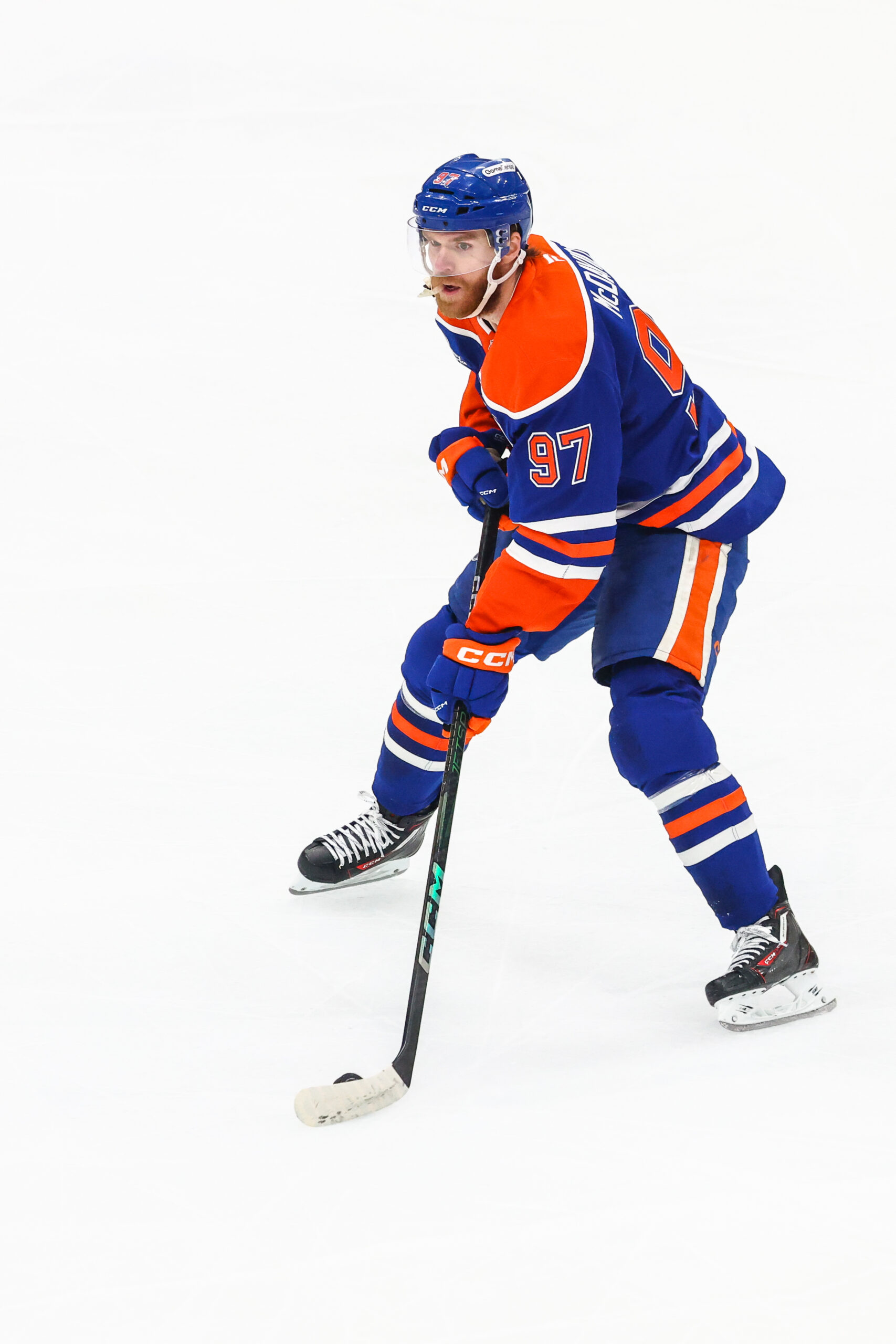
Those talks come after somewhat of a down season for the 28-year-old. He dealt with injuries and a suspension that limited him to 67 games, his lowest total in an 82-game schedule since a collarbone fracture limited him to 46 appearances in his rookie campaign. Of course, a “down season” for the best player in the world still means 74 assists and 100 points, even if his 0.39 goals per game were his lowest total since the 2016-17 campaign. 2024-25 also marked the first time McDavid went without a First Team All-Star selection in back-to-back seasons.
Nonetheless, he will assuredly eclipse teammate Leon Draisaitl‘s $14MM cap hit and once again become the league’s highest-paid player sometime in the next 12 months, no matter the team and no matter the length of the contract. Draisaitl signed his extension for 14.67% of the salary cap – if McDavid signs for 15% at the projected $104MM for 2026-27, that would mean a $15.6MM cap hit. He’ll likely get even more – AFP Analytics‘ extension projection is a four-year deal at $16.35MM per season, a reasonable bet if he opts for a bridge deal to maximize his career flexibility, particularly if the Oilers enter next season with a weaker roster.
It all comes down to how soon and for how long McDavid is willing to commit to Edmonton. They’ll almost certainly write him a blank check, so the ball will be in his court throughout extension talks. Winning a championship, not cash, will be his top priority. While that gives the Oilers some leverage, they at least need to provide McDavid with the hope/promise that Edmonton is his best chance of winning a Stanley Cup.
Improve Goaltending Situation
Saying goaltending has been an issue for Edmonton in recent years would be an understatement. They haven’t had a legitimate No. 1 netminder since Cam Talbot‘s brief peak from 2015 to 2018. Stuart Skinner has been a high-ceiling option at times, but at least so far, simply doesn’t have the game-to-game consistency to get Edmonton to their first Cup win since 1990.
He’s also coming off an exceptionally difficult 2024-25 campaign. His .896 SV% in the regular season was a career-low among his seasons as a full-timer, and that figure dropped to an .889 mark in the postseason. The Oilers faced enough high-profile offensive clubs that Skinner was actually still a league-average goalie compared to the quality he faced, but the last team to win a championship without high-end playoff goaltending was the Avalanche in 2022.
Skinner is still an extremely cost-effective option for the club at a $2.6MM cap hit, though, as is backup Calvin Pickard for $1MM. They’re both entering the final year of their contracts and will be UFAs in 2026. Neither warrants entering extension discussions now with much bigger fish to fry in Edmonton. It might make sense for the Oilers to trade away one of them – either in an in-kind trade for an upgrade or to help open space to pursue the top UFA option in veteran Jake Allen. Either way, it’s hard to imagine Edmonton running things back with the same tandem in 2025-26.
Look At Depth Scoring Upgrades
The Oilers were one of the more active teams in free agency last summer, at least in terms of the volume of signings meant for the NHL roster. They were all veteran wingers on short-term deals, namely Arvidsson and Jeff Skinner, while also retaining Corey Perry. Aside from the last name, those pickups didn’t work out. Both Arvidsson and Skinner were healthy scratches in the playoffs, and neither one had more than 30 points in the regular season.
Their cap situation dictates they’ll need to take a similar approach this summer. They’ll need to be better at identifying who has the upward mobility to play with McDavid or Draisaitl, though, and should be open to younger reclamation projects as well. They’ve already added some cheap insurance in the form of reigning SHL scoring leader David Tomasek on the open market, but will look for NHL-experienced options too as cap space allows. There’s an extension in the works for deadline acquisition Trent Frederic, which should go a long way toward solidifying their middle-six group if he can rediscover his 40-point ceiling.
Image courtesy of Sergei Belski-Imagn Images.
Examining Potential Penguins And Sabres Trades
Matthew Fairburn and Shayna Goldman of The Athletic wrote an article outlining 12 potential teams interested in trading for forward JJ Peterka of the Buffalo Sabres. The Sabres are trying to end a 14-year playoff drought and hope to add pieces this summer, while also considering trading one of their best young players, Peterka. The Sabres urgently need veteran help to take the next step and could also benefit from a right-shot defenseman. Enter the Pittsburgh Penguins, who have several veteran players on the trading block, including a three-time Norris Trophy winner who is a right-shot defenseman.
Connecting with the Penguins is achievable, as they intend to get younger this summer and might benefit from a player like Peterka to lead their initial wave of prospects aiming to move up to the NHL next season. Pittsburgh has substantially increased its prospect pool over the past 15 months, but it has concentrated more on quantity than quality and lacks top-tier prospects. Peterka would fill that role as a top-tier player, the oldest among them, and likely act as an informal leader for the Penguins.
The Penguins have multiple draft picks over the subsequent three drafts and might send a bunch of picks to Buffalo; however, the Sabres want roster players, of which Pittsburgh has a few that could meet Buffalo’s needs. Bryan Rust is the most valuable of the Penguins’ available veterans and is probably the one Pittsburgh would prefer to trade the least. Nonetheless, his no-movement clause expires in the next week, and with three years remaining on his contract at $5.125MM per season (according to PuckPedia), he holds significant value. He would be an excellent addition for Buffalo. The 33-year-old just finished a career year with the Pens, scoring 31 goals and 34 assists in 71 games, and remains one of Pittsburgh’s key leaders. He is also a two-time Stanley Cup Champion who has scored crucial goals in important games. While Rust alone wouldn’t fetch a player like Peterka, the Penguins could consider trading Rust along with another roster player or include additional assets, such as the draft picks they have in abundance.
Another potential fit for Buffalo would be Rickard Rakell, who has three years remaining on his deal at $5MM annually (per PuckPedia). Like his teammate Rust, Rakell had a career year this past season, recording 35 goals and 35 assists in 81 games. Rakell has an eight-team no-trade list included in his deal with the Penguins, which could be an issue if the Sabres are on it. Rakell doesn’t bring the same intangible qualities as Rust and wouldn’t come close to netting the Penguins a player like Peterka. Still, when combined with several other pieces, he could be the centerpiece of a trade benefiting both teams.
The last player who could partake in a deal benefiting both teams is Erik Karlsson. The Sabres need a right-shot defender, and with limited options available, Karlsson is a potential target for them. This is the least likely scenario, considering Karlsson has a full no-movement clause and probably isn’t eager to join another team that might miss the playoffs. That said, the Sabres can offer a stronger roster (on paper) than the Penguins and have a more direct path back to contention.
Karlsson remains somewhat productive offensively, posting over 50 points in each of his two seasons with Pittsburgh. However, he carries a $10MM cap hit (per PuckPedia), and the Sabres likely won’t be eager to take on such a hefty salary for a 34-year-old defenseman who struggles defensively. That said, the Penguins have retention slots available and could absorb a significant portion of the deal to facilitate a trade.
Now, there is no chance that Karlsson brings the Penguins a player like Peterka; however, depending on the retention, it could result in them acquiring another RFA, such as forward Jack Quinn. This hypothetical would require many ‘maybes’ to align, but it is just another example of how the Sabres and Penguins could find several mutually beneficial moves.
Finally, Penguins general manager Kyle Dubas has said he wants to get younger and find a left-side defenseman. Coincidentally, Buffalo has a player who fits both of those needs in Bowen Byram. The 24-year-old was the fourth overall pick in 2019 and possesses all the skills you’d expect in a top-pair defenseman. However, the gap between his skillset and his on-ice results has often been significant, although last season was better. However, some of his underlying numbers were not great. Byram set a career high with 38 points in 82 games, but struggled when playing alongside anyone other than Rasmus Dahlin. The Penguins don’t have a Dahlin or anyone similar, which could leave Byram exposed on the blueline – probably not advantageous for him or the team.
The Penguins and Sabres are two teams heading in different directions this summer and have been in other places for the past 15 years. While their trajectories might differ, this could be a situation where opposites attract, and perhaps even lead to a trade.
Photo by Charles LeClaire-USA TODAY Sports
Free Agent Focus: Vegas Golden Knights
Free agency is now less than two weeks away, and teams are looking ahead to when it opens. There will be several impact players set to hit the open market in July, while many teams also have key restricted free agents to re-sign. We continue our look around the NHL with an overview of the free agent situation for the Golden Knights.
Key Restricted Free Agents
 D Nicolas Hague – Hague has been no stranger to the rumor mill in recent weeks with several teams believed to be inquiring about his services. With Vegas looking to maximize its salary cap flexibility, it’s believed that the 26-year-old is available. It wasn’t that long ago that Hague was viewed as a key young cog for the Golden Knights but while he started off his career in an encouraging fashion, his development has largely plateaued in recent years as he has settled in as more of a fifth or sixth defenseman. He’s owed a qualifying offer of $2.7MM with arbitration eligibility and projects to earn a bit more than that, likely on a multi-year deal even coming off just a 12-point effort.
F Alexander Holtz – Things just have not gone as planned for the 2020 seventh-overall pick. Unable to live up to expectations in New Jersey, Vegas picked him up last year in a draft-day swap with the thought that he’d build off the 28-point effort he had in 2023-24. Instead, he struggled considerably, notching just 13 points in 53 games while being a healthy scratch at times and was even sent to AHL Henderson for a 16-game stint. It’s unlikely that Vegas is ready to give up on Holtz just yet but a one-year deal at or around his $874K qualifying offer seems likely, giving him one more chance to lock down a spot.
F Cole Schwindt – A waiver claim from Calgary at the end of training camp, Schwindt stuck with the big club all season long but only got into 42 games, managing just eight points. With less than 50 career NHL games under his belt, arbitration rights shouldn’t be too concerning for the Golden Knights so if they want to keep him around, they should feel comfortable extending the $840K qualifying offer. If he winds up staying, it wouldn’t be surprising if that qualifying offer winds up being his next contract.
Other RFAs: D Lukas Cormier, F Raphael Lavoie, F Ivan Morozov (signed in Russia), F Jonas Rondbjerg, G Isaiah Saville
Key Unrestricted Free Agents
 F Victor Olofsson – Olofsson elected to take a one-year, $1.075MM deal last summer with the Golden Knights in the hopes of rebuilding some of his value. While injuries limited him to just 56 games, he did rebound somewhat, managing a respectable 15 goals and 14 assists despite seeing basically third-line minutes. That’s not going to be enough to get him to what he made on his last deal when he was in Buffalo ($4.75MM) but it’s possible that he can get a multi-year deal somewhere around the $3MM range. Olofsson had six goals with the man advantage this season; he has reached or beat that mark five times in the last six years, making him an intriguing option for teams looking for a little more firepower on the power play.
F Tanner Pearson – Pearson was one of the few players whose training camp tryout was successful as he inked a one-year deal for the minimum and gave them solid fourth-line minutes while staying healthy for the first time in several years. Pearson probably is going to be viewed as someone earmarked for a similar role moving forward so his offers should come in at or around the $1MM mark. But after having to play his way onto Vegas this season, he should have a bit more success on the open market this time around.
F Brandon Saad – After clearing waivers with St. Louis, Saad walked away from more than $5MM in guaranteed salary through next season in the hopes of finding another NHL opportunity. That came with Vegas where he inked a pro-rated $1.5MM contract. He fared reasonably well with them, notching 14 points in 29 games which is decent secondary scoring. Now, he’ll look to recoup more of that money back on the open market but it would be surprising to see any offers come near his old $4.5MM AAV. Something closer to half of that might be more realistic but he might be able to get a multi-year agreement out of it.
G Ilya Samsonov – Like Olofsson, Samsonov took a one-year deal last summer in the hopes of rebuilding some value following a particularly rough year in Toronto. He probably didn’t hurt his value with a 2.82 GAA and a .891 SV% but he likely didn’t help it too much either and it has already been decided that he won’t be back in Vegas. Coming off a $1.8MM contract, he could land something around a similar price tag this year but a multi-year commitment seems unlikely.
F Reilly Smith – Brought back for a second stint with the team in a trade with the Rangers at the trade deadline, Smith wasn’t able to produce at the same level as he did the first time around but, like Saad, provided decent secondary scoring. Still, he has reached 40 points in each of the last two seasons so his camp may try to market the 34-year-old as a two-way middle-six option. Coming off a $5MM AAV, it would be surprising to see him get a raise but his next contract might not be too much below that either.
Other UFAs: F Callahan Burke, F Mason Geertsen, D Robert Hagg (signed in SHL), D Dysin Mayo, F Mason Morelli, F Gage Quinney
Projected Cap Space
Vegas enters the summer with around $9.6MM in salary cap space which is better than it often has been for this franchise at this time of year. However, they have a few players to sign with that money and they have been linked as a speculative landing spot for some of the more prominent pending unrestricted free agents. They’ll need more cap space to do so, meaning a trade might be needed although the availability of Alex Pietrangelo for the start of next season is also in question. If he’s going to be out long-term and the team goes back into LTIR, they could be in line to make a splash over the next few weeks.
Photos courtesy of Timothy T. Ludwig (Hague) and Sergei Belski (Olofsson)-Imagn Images. Contract info courtesy of PuckPedia.
Examining The Sabres’ Alex Tuch Dilemma
The Buffalo Sabres have been spinning their wheels for quite some time and appear headed for a summer that will define the franchise’s future. The team has plenty of attractive roster pieces but will need to make some significant contract decisions in the coming months regarding forward Alex Tuch, among others. Tuch is just over a year away from unrestricted free agency and can sign an extension on July 1. Buffalo will need to make a tough decision in the next few weeks about whether to sign Tuch to a lucrative extension or trade him away for what would hopefully be a sizable return.
The 29-year-old is entering the final season of a seven-year, $33.25MM contract he signed in July 2018 with the Vegas Golden Knights. He was eventually traded along with other assets for center Jack Eichel, and despite the Golden Knights winning the cup with Eichel on board, Tuch has proven to be an excellent addition for the Sabres. Tuch’s $4.75MM cap hit has represented a massive bargain for Buffalo over the last four seasons, as the Syracuse, New York native has been nearly a point-per-game player, accumulating 106 goals and 137 assists in 281 games with the Sabres. Although Tuch hasn’t been able to replicate his success from 2022-23, when he scored 36 goals and 43 assists in 74 games, he has continued to be a solid point producer, hitting 36 goals again this season along with 31 assists in 82 games.
So, what do the Sabres do with a player from Western New York who embodies the city’s culture but probably doesn’t fit the team’s timeline? Therein lies the Sabres’ difficulty with this decision, along with another complicated situation involving RFA forward JJ Peterka. The Sabres are reportedly listening to offers for Peterka and could trade him. The return would likely influence whether Tuch wants to remain a Sabres member or if the team wants to keep him. He has expressed a desire to stay, which isn’t surprising given that he grew up in the area.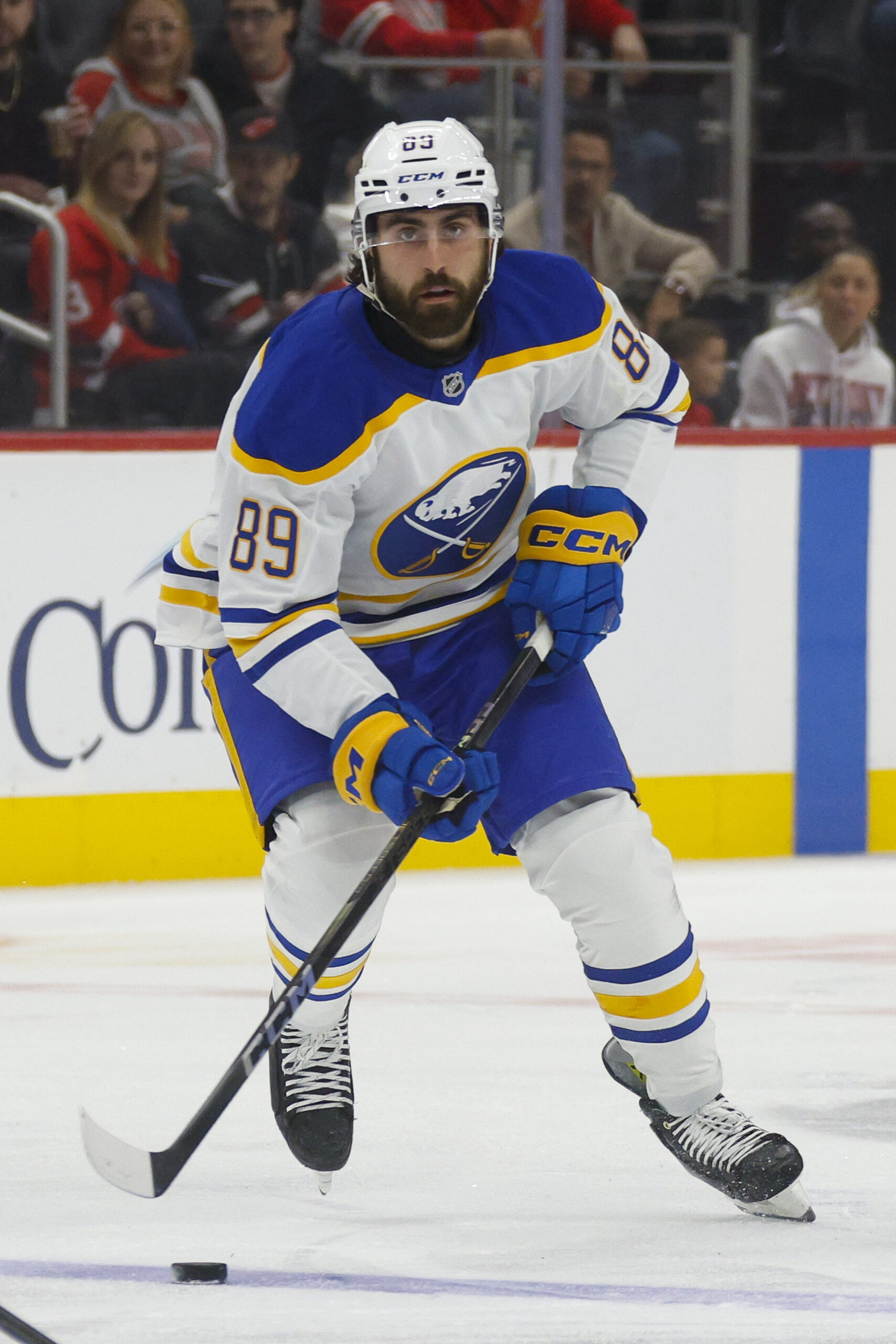
Tuch will be 30 by the time he starts an extension, and if Buffalo went to seven or eight years on term, he would be in his late 30s on a high-ticket contract. Now, that’s not to say he would get such a term, but he will undoubtedly be seeking the most extended contract possible since it’s very likely that he might not sign another lucrative deal after this one.
There is no disputing Tuch’s on-ice value, leadership, or the fact that he is a fan favorite in Buffalo. However, the Sabres must ask themselves what is best for the franchise’s future. Do they want to pay top dollar for a forward on the wrong side of 30 years old? Can they get a lucrative return if they trade him this summer? And what message would they be sending their fans (and other Sabres players) if they moved on from Tuch and Peterka in the same summer?
Buffalo is uniquely positioned as a franchise, not in a good way. They haven’t made the playoffs since 2010-11 and haven’t finished higher than fifth in their division since 2011-12. The team has undergone multiple unsuccessful rebuilds, but it has finally assembled a solid core of players to build around. However, if they trade Tuch and Peterka for futures instead of roster players, veterans like Tage Thompson and Rasmus Dahlin may start to grow restless, fearing it could lead to another few seasons of losing. At the same time, they wait for the young players to develop.
Tuch is a candidate for an extension, given his performance and intangibles. Examining the Sabres’ history as an organization, it is evident that they have often prioritized culture and loyalty over results. If that pattern continues, Tuch will likely be re-signed. This situation isn’t unique to Buffalo, as it’s common for teams to extend contracts for players they know may age poorly in the latter half, understanding that Buffalo’s loyalty could lead them to retain Tuch.
On the flip side, Buffalo has yet to experience a winning season during Tuch’s time with the team, and perhaps it’s time for the Sabres to allow new leadership voices to emerge. It’s not a reflection on Tuch as a player or person, but sometimes, when an organization struggles for too long, the old guard needs to depart before a fresh culture can develop. This has occurred with many teams trying to turn a corner after a rebuild, and often, teams recognize the need to part with veteran players to make way for younger stars to step up as leaders. Edmonton did this when they moved on from Taylor Hall in 2016, and nearly 20 years ago, the Penguins followed suit by letting go of almost every veteran, effectively entrusting the team to their young stars, Sidney Crosby and Evgeni Malkin.
Another factor for Buffalo to consider is that there are very few teams selling right now, which could increase their return on Tuch, as some teams will be left empty-handed after the initial scramble of unrestricted free agency. Buffalo could wait a bit after July 1 to assess the trade market and see if any moves pique their interest; if not, they could then consider an extension. There are a few wingers available, such as Rickard Rakell and Bryan Rust, who will be cheaper from a cap-hit perspective, but with Tuch being a few years younger, he could fetch a better haul than either of those players.
Buffalo finds itself in a tough spot with Tuch, and time is running out. If they can’t either move him or extend his contract, they risk losing him for nothing a year from now or trading him at the NHL Trade Deadline for a lesser return. Neither scenario is ideal for Buffalo, which is why they need to act promptly. The situation would be less complicated if they weren’t also trying to move Peterka, but this is the reality the Sabres are facing, and they must choose a direction.
Photo by Brian Bradshaw Sevald-Imagn Images
Offseason Checklist: Toronto Maple Leafs
The offseason has arrived with the draft and free agency fast approaching. Accordingly, it’s time to look at what each team needs to accomplish this summer. Next up is a look at Toronto.
The Maple Leafs’ consistent run of strong regular-season play continued in 2024-25 with an 108-point season and their first division title in an 82-game season since 2000. While they did advance further in the postseason than in 22 years, they blew a 2-0 series lead in the second round against the eventual champion Panthers and failed to make their first Eastern Conference Final of the Auston Matthews era. General manager Brad Treliving now faces the most pivotal offseason in Toronto in years with multiple high-profile pending free agents and significant spending flexibility.
Identify Marner Replacements
Mitch Marner was the team’s third-highest-paid player at a $10.9MM cap hit as he completed the seven-year deal he signed as an RFA in 2019. He was easily set to become Toronto’s second-most or even highest-paid player ahead of Matthews this summer – that is, if he stayed with the Leafs instead of testing the open market. That won’t be the case, and the Leafs must now change from devoting resources to a Marner extension to identifying who can most effectively replace his production and add depth to the forward lineup.
Treliving is not finding a direct replacement for Marner’s 100-plus points; that much is certain. The trade-off for losing one of the league’s premier playmaking wingers will be the freedom of cap space re-allocation to improve the club’s depth lines while putting more trust in Matthews to anchor the top one. There will be at least two wingers acquired in Marner’s stead, either via trade or free agency. They already struck out on one – they were pretty interested in Mason Marchment before the Stars traded him to the Kraken last week.
They haven’t been heavily linked to the consensus No. 2 and No. 3 wingers on the market behind Marner this summer in Nikolaj Ehlers and Brock Boeser. There has, however, been heavy speculation about a fit between them and veteran Brad Marchand. Coming off a second-place finish in Conn Smythe Trophy voting after rattling off 20 points in 23 games in Florida’s Stanley Cup win, the Leafs are in a better position to give him a lucrative mid-term deal compared to most other contenders and would give him the opportunity to play at home in Canada for the first timem in his 13-year career. Even at his highest feasible price point, they’d still have another $2.5MM to $3MM to spend on a middle-six winger to complement names like William Nylander and Max Domi while presumably slotting Marchand in Marner’s slot alongside Matthews and Matthew Knies (more on him later).
After striking out on a player with upward top-nine mobility at a cheap price point in Marchment, that appears to be a path Treliving is heavily considering. Former 35-goal man Andrew Mangiapane is heading to the market after a tough season with the Capitals and should be available around that aforementioned price point. Toronto is among the teams reportedly showing a keen interest in signing him when free agency opens on July 1.
Ramp Up Knies, Tavares Talks
The more cost certainty they have, the more active the Maple Leafs can be in achieving checklist item No. 1 in nine days. Right now, they have very little. Their top RFA, Knies, and their top UFA with a chance of extending/returning, center John Tavares, remain without new deals. It’s not the best omen. The tone around the Leafs and Knies’ negotiations has been overwhelmingly positive from the outset, with reporting last month indicating neither side was worried about an offer-sheet threat and that there was a mutual understanding of what the final deal would end up looking like. There seemingly hasn’t been any notable progress in talks since that point, David Pagnotta of The Fourth Period said Friday.
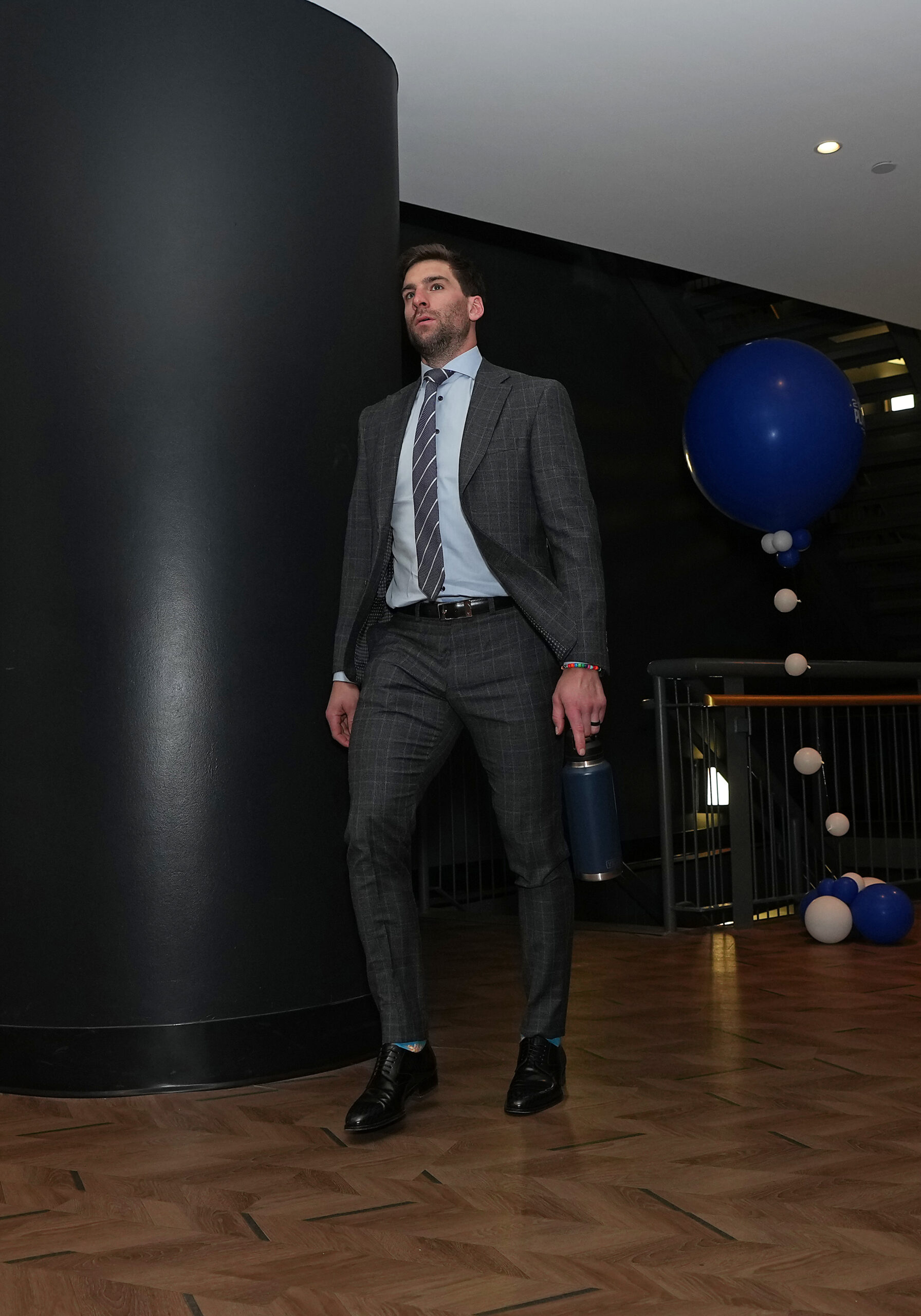 There’s similarly no extension imminent with Tavares, Pierre LeBrun of The Athletic relayed in the last couple of days. That’s the more concerning bit of news. An offer sheet is always a possibility for Knies, but he at least remains under team control past July 1, and he has to actually sign the offer sheet for it to be of any significance. Tavares hitting the open market and leaving without a quick succession plan in place could result in disaster down the middle without a ton of suitable 2C replacements on the open market, particularly after Matt Duchene recently extended with the Stars on a quite team-friendly pact.
The act of re-signing Tavares frees up cap space, not limits it. His next deal won’t come anywhere close to his expiring $11MM cap hit, cementing both a discount at the center position for Toronto behind Matthews and added cost certainty to firm up the roster around the edges behind whatever the largest open-market splash they’re able to make ends up being.
There’s also the stipulation that while losing Marner’s point production without being able to get close to reconstructing it by committee would be tough to swallow, losing Tavares’ output in the same manner would be disastrous. While the 34-year-old may not have been fully worth the cap space he was taking up at the end of his deal, he was still an incredibly high-end producer last season. His 38 goals in 75 games were 12th in the league and marked his second-best goal-scoring season as a Leaf. He was also top-40 in the league in points per game at 0.99. Aside from veteran stopgap Mikael Granlund, there’s no UFA center with that kind of output as his ceiling. Among trade options, young Wild pivot Marco Rossi would be the only one fitting that bill, but Toronto wouldn’t be willing to part with the NHL-ready assets Minnesota wants in return, considering their existing issues navigating roster turnover this summer.
Explore Cap-Clearing Trade
Despite the lack of easily attainable potential replacements for their pending free agents, the Leafs at least have nearly $26MM in spending flexibility at the start of free agency to remove that as an immediately limiting factor. They could still open up their window of options even wider and prevent an August/September cap crunch by shedding a low-value contract now. They don’t have many, but there are a few among their depth forwards. Veteran winger Calle Järnkrok is entering the final year of his contract at a $2.1MM cap hit and has minimal trade protection with a 10-team no-trade list. He could be well-positioned to land them a legitimate return at that price point, but he could also be a cost-effective rebound candidate for them, too. Injuries limited him to just 19 regular-season games last year and he was underwhelming in the playoffs, but he’s averaged 38 points per 82 games since signing in Toronto three years ago.
A more desirable deal to move if possible would be David Kämpf, making $2.4MM against the cap through 2026-27 with a 10-team no-trade list that lapses in the summer of 2026. That’s notable as a team acquiring Kämpf now could flip him again next season without any contractual obstacle. He was an increasingly frequent healthy scratch last year, had 13 points and a minus-one rating in 59 games, and saw his ice time dip to a career-low 12:24 per game when dressed. He’s a true redundancy with a cheaper, higher-ceiling offensive option in the mix next year in Scott Laughton after being acquired from the Flyers at the trade deadline.
There’s also the matter of veteran enforcer Ryan Reaves, who remains under contract at a $1.35MM cap hit. They can reduce that to just $200K by waiving him and burying him in the minors like they did for the home stretch last year. They’ll presumably do that again if he’s still on the books, but if they can make the deal someone else’s problem for a low-round draft pick, they’ll presumably explore that to open up as much spending flexibility as possible.
Upgrade Scoring Depth
Any cap savings created by Toronto’s turnover this summer outside of direct replacements or new deals for pending UFAs should be staying with the forward group. There are a few reasons for this. For one, there’s little to no maneuverability (or motivation) to alter the personnel anywhere else on the roster. The Leafs have one of the league’s most cost-effective goaltending tandems, and their veteran defense corps shone bright under head coach Craig Berube last season. Even if they wanted to make a change, they already have nine defenders signed to one-way deals for next season, most with significant trade protection.
The secondary roster construction goal for Treliving this summer needs to be helping the club rediscover its offensive ceiling. Their 3.26 goals per game was still top 10 in the league in 2024-25, but their lowest output since the 2016-17 campaign nonetheless. While they had six 20-goal scorers last year, the dropoff after them was steep, and only eight players hit the 30-point mark.
In the past couple of years, these types of pickups have needed to wait until closer to training camp, as was the case with Steven Lorentz and Max Pacioretty in 2024. This offseason, Treliving has the spending flexibility up front to get cheap depth pickups out of the way early, but he might be better served to wait a couple of weeks for prices to come down.
Image courtesy of Nick Turchiaro-Imagn Images.
Free Agent Focus: Vancouver Canucks
Free agency is now under a month away, and teams are looking ahead to when it opens. There will be several impact players set to hit the open market in July, while many teams also have key restricted free agents to re-sign. We continue our look around the NHL with an overview of the free agent situation for the Canucks.
Key Restricted Free Agents
F Aatu Räty – Vancouver has a sneaky list of talent headed to the RFA market. The group is headlined by Aatu Räty, who split this season between the major and minor-league rosters. He performed beautifully in the AHL, netting 17 goals, 40 points, and a plus-nine through 43 appearances. The performance was a strong step up on Räty’s 52 points in 72 AHL games last season, though his impact at the NHL flight left something to be desired. The 22-year-old center did manage seven goals and 11 points through 33 appearances – a stat line complemented by his 57.7 percent faceoff win-rate. Those are stout numbers, but despite them, Räty wasn’t able to command more than a third-line role in the lineup. He’s shown flashes at the minor-flight, but will sign his next deal hoping for the promise of a hardy NHL chance next season. That could cap the potential price tag and term Räty can receive this summer, though he’ll be a must-sign option based on upside alone.
F Arshdeep Bains – The only Abbotsford Canuck to score more than Räty this year was Arshdeep Bains, who finished the season with 11 goals and 43 points in 50 games. The performance was a slight dip from the 55 points he scored in 59 games last season – but held Bains as one of the most important pieces of Vancouver’s minor-league lineup. Bains racked up 136 points in 175 AHL games, and one point in 21 NHL games, on the entry-level contract that pulled him out of undrafted free-agency in 2022. But he hasn’t yet found the imposing, physical edge that’d push him into Vancouver’s bottom-six. Vancouver would be hard-pressed to find a way to replace Bains’ top-end drive in the minors – and his performances so far suggest NHL upside in the near future. But with no breakout just yet, Bains is likely to also earn a cheap, prove-it deal this summer.
F Vitali Kravtsov – Once a top-10 pick in the 2018 NHL Draft, there now seems no certainty that Kravtsov will ever have a full NHL career. He returned to Russia’s KHL last season, after spending parts of two seasons trying and failing to earn standing in the New York Rangers and Canucks lineups. He’s totaled just 12 points, split evenly, across 64 career games in the NHL – but had an incredible breakout season in the KHL this year. Kravtsov finished the year with 27 goals and 58 points in 66 KHL games, then added six goals and seven points in 19 playoff games. He looked every bit like the dangerous prospect that was once headed for NHL stardom. There seems to be a scant chance he entertains an NHL contract anytime soon, but his player rights will be invaluable for Vancouver to retain should he ever want another change of scenery.
Other RFAs: F Ty Glover, F Max Sasson, F Tristen Nielsen, D Jett Woo, D Cole McWard, D Christian Felton, G Nikita Tolopilo
Key Unrestricted Free Agents
F Brock Boeser – The Canucks’ off-season will be headlined by their handling of Brock Boeser. The high-scoring winger has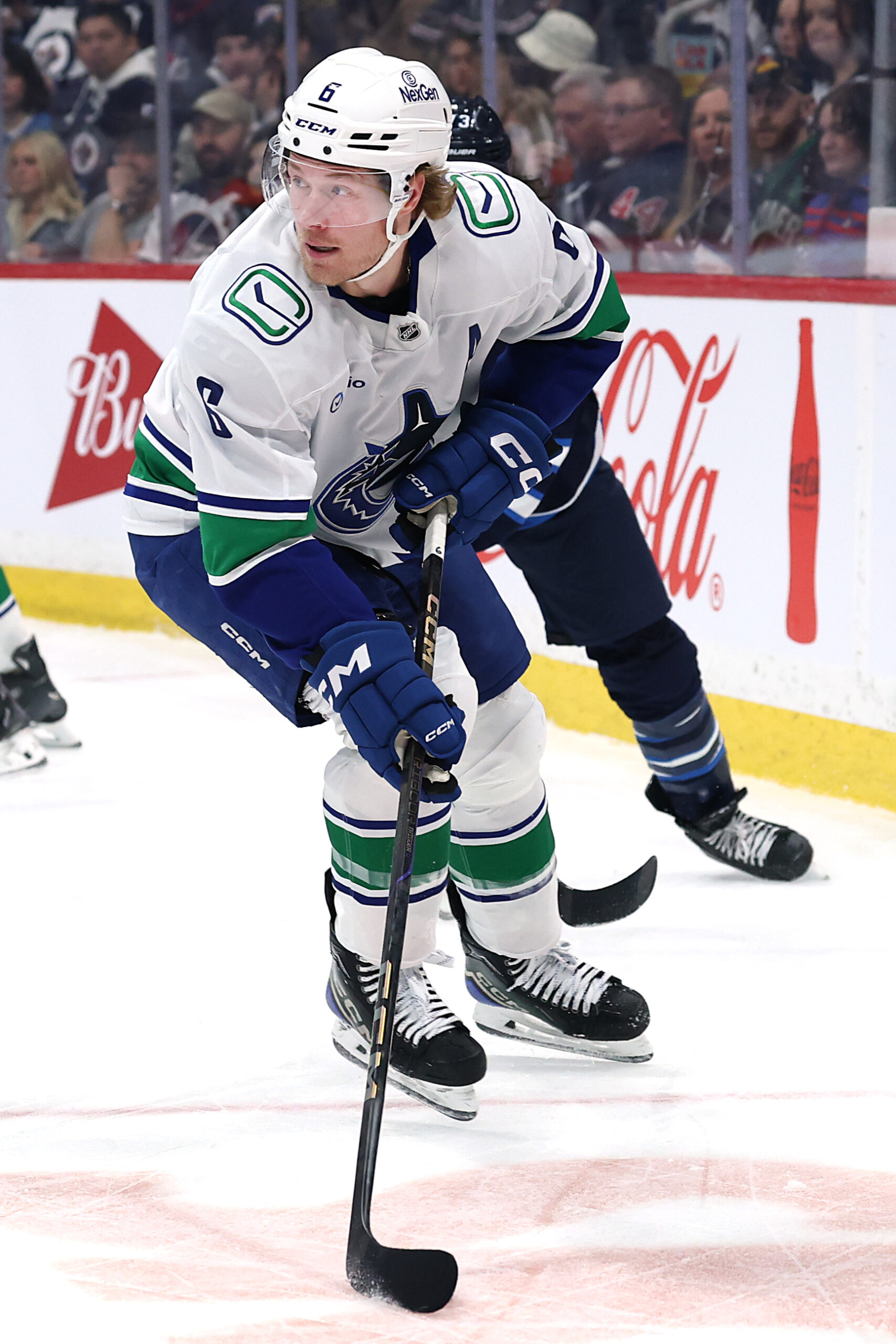 been on the fastrack to a separation with the Canucks for much of the year, with the team even shopping him around, unsuccessfully, at the NHL Trade Deadline. It will be the end of an era if and when Boeser leaves the Canucks lineup. He has been a perennial scorer since the 2017-18 season, and either paced for or exceeded the 25-goal mark in every single season excpet for the 2019-20 campaign. His career year came in 2023-24, when Boeser potted 40 goals and 73 assists – the most goals from any Canuck since Daniel Sedin and Ryan Kesler reached 41 in the 2010-11 season. That scoring upside will earn Boeser a hardy contract on the open market, though teams will need to be careful to not overpay a player who fell back to 25 goals this season.
F Pius Suter – Pius Suter will be another name to follow closely as Vancouver approaches the open market. He scored a career-high 25 goals and 46 points in 81 games this season – while holding down a reliable role in Vancouver’s middle-six. But Suter’s 18.1 shooting percentage this season stands five percent higher than his career-average of 13.1. He’s seemingly due for some regression, and there’s a good chance Vancouver doesn’t want to be the one holding a pricey bill when that comes. They also have to find ways to promote Räty into a notable role on his next deal, which will directly hurt Suter’s ice time. Should the Canucks get him signed to a reasonable contract, Suter would be a stout veteran to have in the lineup. But an expensive asking price should push the cap-strapped Canucks elsewhere.
D Noah Juulsen – For the last four seasons, Juulsen has served as a depth defender for Vancouver to lean against when they’re faced with injuries or slow play. But his quiet play hit a trench this year, as he posted no scoring and a minus-12 through 35 games in the lineup. With a new contract due, it seems unlikely that Vancouver brings back Juulsen into an NHL depth role. He’ll instead be set for a minor-league option, or change of scenery, as the Canucks attempt to open more space for their young prospects.
Other UFAs: F Philip Di Giuseppe, F Nathan Smith, D Guillaume Brisebois, D Christian Wolanin, D Akito Hirose
Projected Salary Cap
Vancouver faces a busy summer with little in the way of financial capital. They have just $12.16MM in projected cap space – a number that could be cut by as much as a third after Vancouver signs Suter, Raty, and Bains. With so little to work with, the Canucks’ summer should be headlined by cap-clearing moves and free agent additions, rather than re-signings.
Contract information courtesy of PuckPedia. Image courtesy of James Carey Lauder-Imagn Images.