
PHR Originals: 8/25/25 – 8/31/25
With the end of August typically being very quiet around the NHL, we had plenty of original content here at PHR over the past seven days. Here’s a recap of those columns.
When July 1st came, the unrestricted free agent defenseman with the most points was Matt Grzelcyk. He was coming off a career-best 40 points while also logging more than 20 minutes a night for the first time. In a market bereft of top-four defenders, he was an exception. And yet, nearly two months into free agency, he’s still looking for a contract. Josh Cybulski examined Grzelcyk’s situation, noting the rarity of a player coming off a “show me” contract, performing better than expected, and remaining in free agency this late. While his play was worthy of a raise from the $2.75MM he made last season, it’s looking less likely that he’ll actually beat that.
Our Summer Synopsis series continued with our writing team taking looks at Toronto, Tampa Bay, and St. Louis. The Maple Leafs lost one of their top players this summer with Mitch Marner heading to Vegas while the team added some extra grit and defensive acumen up front. Meanwhile, the Lightning largely had a quiet summer with their biggest move being the re-signing of 33-year-old center Yanni Gourde to a six-year contract, one that carries a team-friendly $2.33MM AAV. Meanwhile, the Blues had plenty of trade speculation over the summer but made just one move, a swap of 2021 first-round picks while they shored up their center depth in free agency.
Meanwhile, our Salary Cap Deep Dive series continues its tour through the Central Division as I examined the situations for Colorado and Dallas. Last season, the Avs weren’t able to re-sign a key pending UFA winger and they could be in a similar situation this year with Martin Necas, especially with Cale Makar due a significant raise two years from now. Meanwhile, Dallas is a year away from an intriguing summer with both Jason Robertson and Thomas Harley in line for significant raises without a ton of cap room. This season, both teams have limited room below the Upper Limit so making moves of significance won’t be easy unless they’re sending a key piece out as part of the swap.
With training camps fast approaching, one of the early storylines is always about trophy contenders. It’s an impressive-looking field for Rookie of the Year, headlined up front by Canadiens winger Ivan Demidov, Capitals winger Ryan Leonard, and 2025 Hobey Baker winner Isaac Howard, acquired by Edmonton this summer, among others. It’s arguably even more crowded on the back end with the group including Islanders first-overall pick Matthew Schaefer, Minnesota’s Zeev Buium, Chicago’s Sam Rinzel, and Carolina’s Alexander Nikishin. Will one of them take home the Calder Trophy or someone else? You can make your prediction here.
While the Flyers haven’t had a ton of success as of late, their latest attempt at rebuilding kicked off a couple of years ago. Josh took a look at how things have gone so far with a prospect pool that is improved but still not among the NHL’s best while their roster isn’t particularly young for a team that’s in rebuilding mode. Still, GM Daniel Briere has made some progress as he continues to reshape Philadelphia’s group.
Our latest mailbag was posted, wrapping up the series of questions from a few weeks ago. Topics in this one included my predictions on some teams who could find themselves back in the playoff picture this season if all goes well, a possible breakout candidate, and rounding out Toronto’s top-six forward group.
Lastly, there was certainly an expectation of a busy summer in terms of transactions. The increase to the salary cap was supposed to open up more flexibility, leading to an active free agency and trade period. Instead, it has been much quieter. Josh looked into why the frenzy that was widely expected turned largely into a flop. As it turns out, the extra cap flexibility allowed more teams to keep the core they had, leading to less player movement than expected.
Why Was The Summer Frenzy Such A Flop?
Many NHL fans entered this summer expecting a flurry of transactions as teams anticipated a rise in the NHL salary cap after years of it remaining flat. On the surface, that expectation made sense; aggressive NHL general managers would finally have wiggle room to make bold moves after the pent-up frustration of having to pinch pennies to stay under the threshold.
However, that frenzy never materialized, and this summer was mostly a flop. Most moves were completed by July 1, and the summer blockbusters never materialized. So, where did it all go wrong, and what happened to the supposed bold moves that were expected this summer?
Many folks had expected the additional cap space to lead to trades, as aggressive teams would aim to use that room to strengthen their rosters. However, the extra space actually had the opposite effect, since most teams finally had enough cap room and didn’t need to spend the summer offloading bad contracts. This had been a common theme in previous years, as teams often had to dump one or two poor contracts to stay under the salary cap. This year, only a few cap dump trades have occurred, with defensemen Matt Dumba and Connor Clifton being traded separately to the Penguins.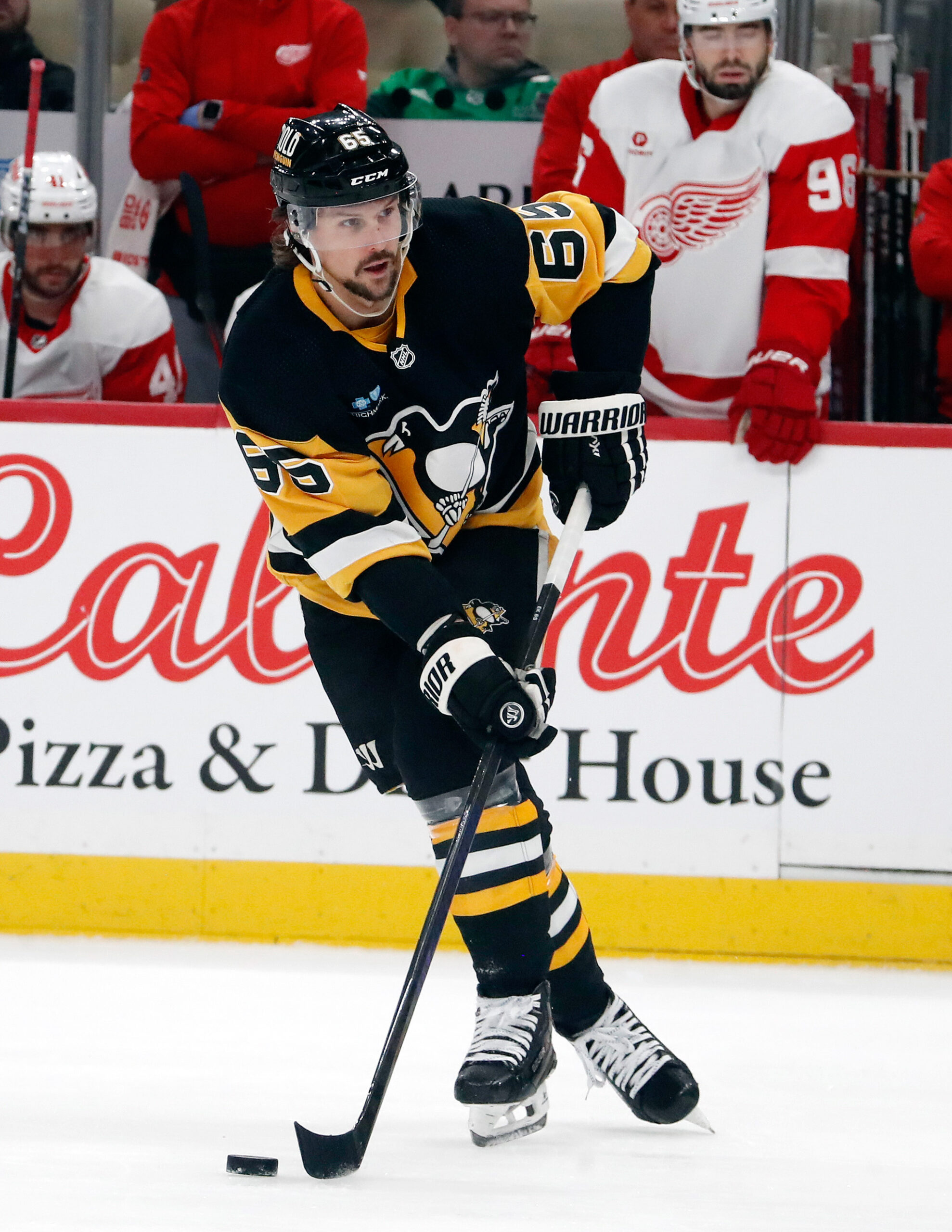
The mere mention of the Penguins brings up another factor in the summer of silence: most teams entered this summer looking to improve, with the glaring exception being the Penguins, who were the only team firmly in seller territory. Pittsburgh came into the summer with three major trade chips—Bryan Rust, Rickard Rakell, and Erik Karlsson. So far, they haven’t been able to move any of them, despite many NHL teams holding salary cap space and being eager to get better.
This restraint is unusual in NHL circles, as general managers often rush to overpay for veterans. This summer, they haven’t been knocking on the Penguins’ door to acquire their available veterans. That could be due to Penguins GM Kyle Dubas holding firm on a high asking price, but with Pittsburgh’s apparent desire to rebuild, one would think there’s a middle ground that could facilitate a trade.
Rust and Rakell are both on bargain contracts with three years remaining, so it’s hard to believe they can’t be moved for close to what’s being asked. Yet, to this point, nothing has happened on the trade front. In fact, only a handful of trades have been completed since July 1, and with training camp just a few weeks away, it will be interesting to see if the pace picks up.
The trading market was clearly tight, and it’s hard to pinpoint exactly why, but there could be a few factors at play besides high asking prices. Teams with cap space, such as San Jose, Chicago, and Utah, clearly weren’t eager to spend big on win-now players and opted to look at free agency for minor improvements or, in the case of Utah, trade for younger pieces.
Meanwhile, teams aiming to make big moves couldn’t because they lacked the assets to trade. The Toronto Maple Leafs, Colorado Avalanche, and Tampa Bay Lightning would have likely loved to get better, but they all lacked first-round picks from previous big trades and just didn’t have the assets to make moves.
Now, speaking of those teams, and you could also include the Dallas Stars here, these contending teams were already close to being “capped out” even with the salary cap increase. Dallas had to make the aforementioned Dumba trade to stay compliant after re-signing their free agents, while Colorado had to send Miles Wood and Charlie Coyle to Columbus. Those teams were eventually able to create salary cap room, but even then, they used it to re-sign their own RFAs and UFAs, as well as find depth on the free agent market, rather than making trades.
Another factor was that no one was surprised by the salary cap increase, as teams had known for a while that it was going to rise after being flat for so long following the COVID-19 pandemic. This led teams and players to assume that the salary cap would go up, which is why players like Nathan MacKinnon, Auston Matthews, and eventually Leon Draisaitl managed to set new records as the NHL’s highest-paid players. Instead of having a bonus room this summer, teams like the Maple Leafs and Edmonton Oilers had already used the extra space to cover raises they had already given their players. Signing superstars to groundbreaking contracts is not new, but it explains why the summer frenzy never really took off.
Handing out those contracts to stars kept players with their current teams and also contributed to the thin free agent market this summer. Besides Mitch Marner and Nikolaj Ehlers, most stars who were potential UFAs stayed with their former clubs rather than testing the market. This meant that teams with cap space didn’t spend large just for the sake of spending; instead, they chose to hold onto their cap space for future moves or to be aggressive in 2026 free agency when bigger names might be available.
Finally, some teams may have learned from their mistakes during the flat salary cap era. There’s an old saying that NHL general managers tend to make more errors on July 1st than at any other time of the year, which might have prompted GMs to think more carefully about their moves to avoid repeating those mistakes.
Dubas in Pittsburgh serves as a prime example, as his decisions on July 1st, 2023, have essentially saddled the Penguins with multiple bad contracts (Tristan Jarry, Ryan Graves, and Noel Acciari) for years to come. The Ottawa Senators are under new management, but even they handed out an ill-advised two-year $8MM deal to David Perron last year that they might want to redo. It appears that at least for this summer, GMs chose to be cautious with their new cap space, and it will be interesting to see if they maintain that careful approach into the NHL Trade Deadline—especially if the race for playoff spots remains tight and many teams stay in the hunt.
To summarize, there wasn’t just one reason why this summer was a flop for fans hoping for a frenzy. A weak UFA class, cautious management, and money being spent on retaining players ultimately derailed those plans. The NHL Entry Draft was busy, as were moves around July 1st, but since then, it’s been a quiet summer. The coming weeks might not bring much more news until teams start playing, injuries happen, or players don’t meet expectations, which could put teams in a tough spot, especially if they fall short of expectations.
Photo by Charles LeClaire-USA TODAY Sports
Summer Synopsis: St. Louis Blues
With training camps now less than a month away, the bulk of the heavy lifting has been done from a roster perspective. Most unrestricted free agents have found new homes, the arbitration period has come and gone, and the trade market has cooled. Accordingly, it’s a good time to take a look at what each team has accomplished this offseason. Next up is a look at St. Louis.
Last summer, the Blues were relatively quiet early on before striking with a pair of successful offer sheets to bring in a couple of potential core players. A second-half push helped propel them into the playoffs, and in his final summer at the helm as GM, Doug Armstrong largely elected to keep the status quo with only a few moves of consequence.
Draft
1-19 – F Justin Carbonneau, Blainville-Boisbriand (QMJHL)
5-147 – F Mikhail Fyodorov, Magnitogorsk (MHL)
6-179 – G Love Harenstam, Skelleftea (Sweden U20)
If this section feels a little light, there’s a good reason for that. The silver lining for St. Louis is that most of the missing draft picks turned into established players. The second rounder went in the offer sheet for Philip Broberg after being reacquired from Pittsburgh. Broberg showed lots of promise in his first full NHL season. The third rounder went in the offer sheet for Dylan Holloway. He finished third on the team in scoring. Even the fourth rounder yielded a roster regular as it went for Alexandre Texier. His first year wasn’t great, but he still has one more year left on his contract to turn things around. With the thought that a draft class should ideally yield two NHL players, they already got there before even drafting anyone. Not too shabby.
Carbonneau was one of the better offensive wingers in this year’s class and isn’t just a one-trick pony as he’s a deft playmaker with an above-average shot. There was some talk that he might make the jump to college hockey this season, but he decided to return to QMJHL Blainville-Boisbriand, although he notably hasn’t signed his entry-level deal yet, keeping his NCAA options on the table. Carbonneau is a few years away from being NHL-ready, but he has legitimate top-six upside. Fyodorov is a late-round project as he finds himself still in the Russian junior ranks, while Harenstam did okay in Sweden’s junior level last season and will now look to make the jump to the second-tier Allsvenskan. Both players are longer-term development pieces.
Trade Acquisitions
D Logan Mailloux (trade with Montreal)
While there was a lot of trade speculation surrounding the Blues, including one of their top-paid players in Jordan Kyrou, there was only one trade made. And while the Canadiens were one of the teams believed to be interested in Kyrou, the two sides made a much different deal, one that we don’t see occur too often with the teams swapping fairly recent first-round picks, with St. Louis dealing from their winger surplus to bring in an intriguing blueliner.
Mailloux has played the bulk of his two-year professional career in the minors, where he has been quite productive for a blueliner, recording 80 points in 135 regular-season games. With five points in eight NHL contests, he has done well in the offensive zone at the top level as well. There remain questions about his overall defensive game and how he’ll adapt to playing against tougher competition, but Mailloux should be able to be a capable secondary producer from the back end while likely starting in a depth role as he gets his first taste of extended NHL action this season. The ceiling is enticing, though if he can put everything together.
UFA Signings
F Nick Bjugstad (two years, $3.5MM)
F Milan Lucic (signed to PTO)
F Matt Luff (one year, $775K)*
F Pius Suter (two years, $8.2MM)
*-denotes two-way contract
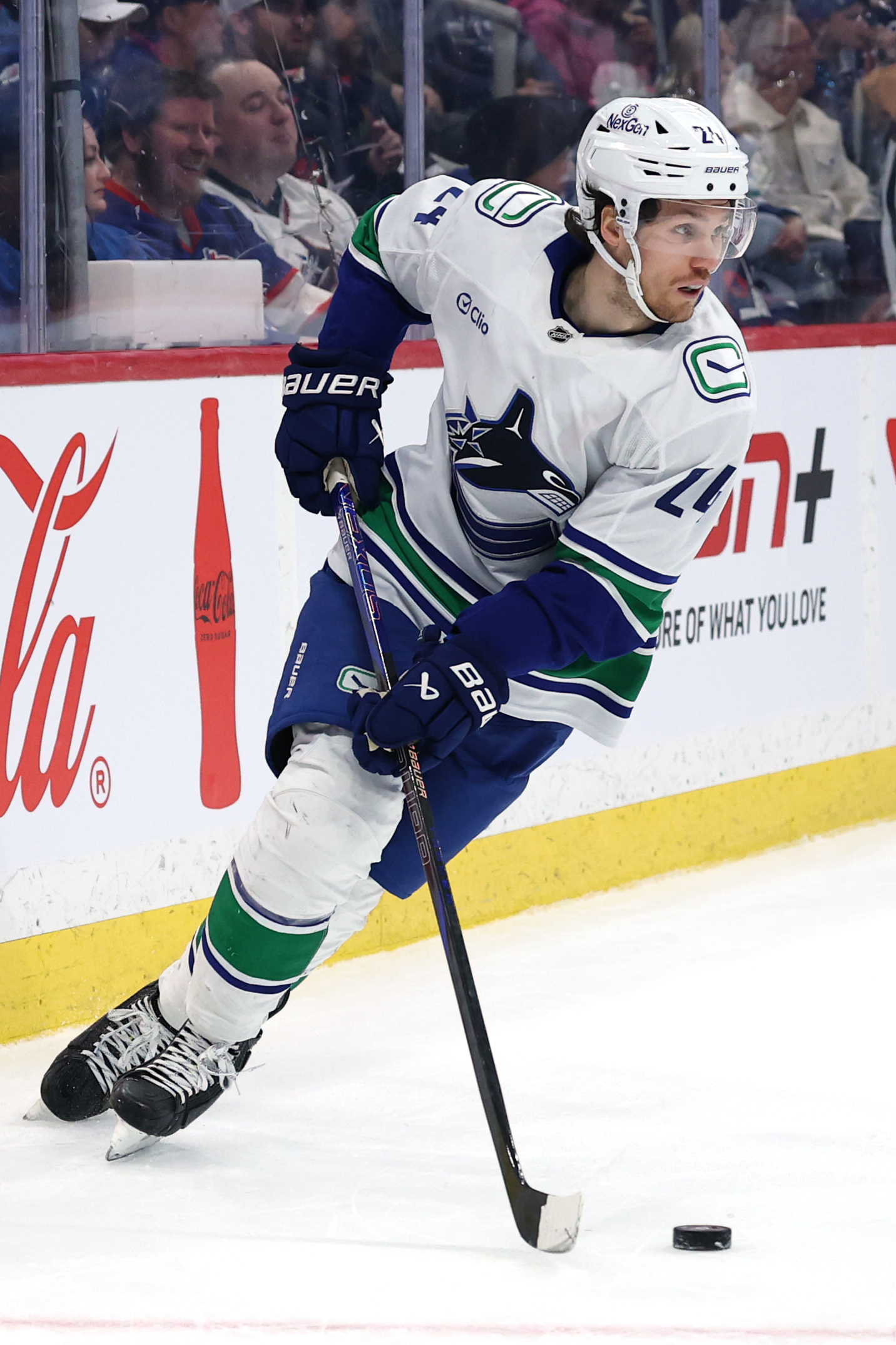 Shoring up their center depth was the theme of Armstrong’s summer signings. Suter picked the perfect time for a breakout year last season, really boosting his stock heading into a free agent period that was lacking in terms of impactful middlemen. After being more of a middle-six player for the first few seasons of his career, Suter was able to produce at a much better rate, earning himself a near-permanent spot in Vancouver’s top six on the heels of a 25-goal, 46-point effort. While there are some reasonable questions as to whether he can repeat that performance, the Blues aren’t necessarily paying him to be that player. If he settles in behind Robert Thomas and Brayden Schenn and helps anchor the third line while helping out on the penalty kill, he’ll fit in pretty well even if the production reverts closer to the usual high 20-point mark.
Bjugstad is only a year removed from a 45-point effort in Arizona, but he wasn’t able to sustain that production following the move to Utah. His playing time fell by more than five minutes per game as he was deployed pretty much exclusively in their bottom six. That’s about the same role he’ll have with St. Louis, but having him as a fourth center is a nice luxury to have, while he could also move up and play alongside Suter on the third line, where the two could only focus on strong-side draws, with their overall faceoff success rate being limited.
Lucic is one of the more intriguing PTO candidates this fall. Between injuries, charges that were later dropped, and a stint in the Player Assistance Program, he hasn’t played in the better part of two years. While he’s far from the top-six power forward he was in his prime, he could come in and give St. Louis some extra grit on the fourth line if all goes well, giving them a bit more depth to work with.
RFA Re-Signings
F Nikita Alexandrov (one year, $775K)*
G Joel Hofer (two years, $6.8MM)
D Hunter Skinner (one year, $775K)*
G Vadim Zherenko (one year, $775K)*
*-denotes two-way contract
Despite the lack of prospect pedigree, Hofer is quickly becoming the heir apparent to netminder Jordan Binnington, making him the most important RFA for the Blues this summer. The new two-year pact will run through the 2026-27 season, the same time that Binnington’s six-year, $36MM extension expires.
As Binnington ages the next two years, Hofer should have access to additional playing time. In the past two years, Hofer has achieved a record of 31 wins, 20 losses, and 4 overtime losses in 61 games, with a .909 SV%, a 2.65 GAA, and 11.0 goals saved above average while serving in a backup role.
Outside of Hofer, Alexandrov is the only recent RFA that should feature on the Blues’ roster next season. Throughout the past two years, although he has typically played in the AHL, Alexandrov has scored three goals and nine points in 51 games in a bottom-six role.
Departures
F Corey Andonovski (unsigned)
F Zachary Bolduc (trade with Montreal)
F Tanner Dickinson (signed in Slovakia)
F Radek Faksa (signed with Dallas, three years, $6MM)
D Nick Leddy (waivers, claimed by San Jose)
F Mackenzie MacEachern (signed with Vancouver, two years, $1.55MM)*
D Anton Malmstrom (signed in Sweden)
D Ryan Suter (unsigned)
*-denotes two-way contract
St. Louis didn’t lose too much on the offensive side of the puck this offseason, but the jury is still out on whether they’ll be kicking their butts about trading Bolduc. In their defense, the Blues have sufficient depth in their top six, and prospects like Jimmy Snuggerud and Dalibor Dvorsky are ready to make an impact.
Still, Bolduc is one year removed from a solid sophomore campaign, scoring 19 goals and 36 points in 72 contests, typically situated in a middle-six role. In contrast, Mailloux is the same age as Bolduc, and although it usually takes defensemen longer to develop, he only has eight games of NHL experience.
Outside of Bolduc, the Blues lost solid, albeit replaceable, veterans in Leddy and Faksa. It didn’t take long for the team to replace either, as Leddy’s minutes will be replaced by one of the multiple young defensemen on the roster, while the Blues signed Suter and Bjugstad to balance out their center depth.
Salary Cap Outlook
As things stand, St. Louis projects to have around $625K in cap space to start next season, per PuckPedia. That doesn’t make for much wiggle room when the minimum salary is $775K. However, that number does not include potential LTIR flexibility. After missing all of last season due to an ankle injury, Armstrong noted this offseason that he doesn’t expect Krug to play again, meaning his $6.5MM is eligible to land on LTIR. The exact amount of cap space that would provide depends on their roster at the time they place him on there, but it’s safe to say they’d be able to use around $6MM of that if they have to go that route. There’s more wiggle room here than it might appear at first glance.
Key Questions
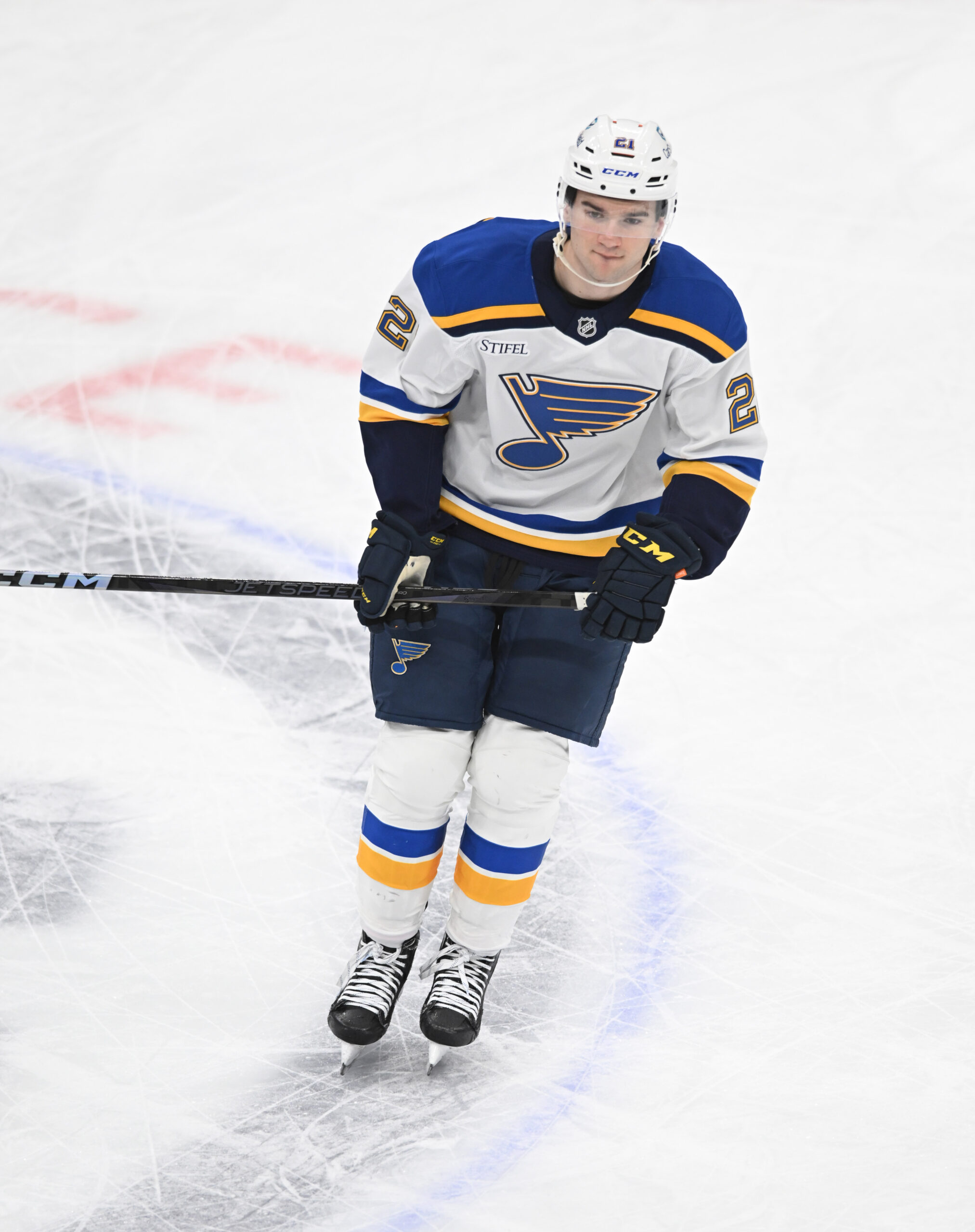 How Will Snuggerud Fare In His Rookie Season? As one of the more exciting prospects coming up through the Blues’ system, Snuggerud will have every opportunity to make a positive impact on St. Louis this season. Finishing off the 2024-25 campaign, Snuggerud scored one goal and four points in seven contests before matching that total (two goals, two assists) in seven games in the 2025 Stanley Cup playoffs. There were a few instances, especially during the postseason, where Snuggerud’s lack of experience showed. Still, if Snuggerud can match his brief scoring pace from last season, he may compete for the Calder Memorial Trophy by the end of the campaign.
Will The Penalty Kill Improve? Without a doubt, one of the biggest weaknesses for the Blues last year was their penalty kill. St. Louis finished with a 74.35% kill rate, ranking 27th in the NHL, and was the second-lowest among playoff teams. Retaining most of their team from last season, it begs the question of whether the additions of Suter and Bjugstad will be enough to change their fortunes. Suter has maintained an impressive on-ice save percentage throughout his career, while Bjugstad displays his skill in the faceoff dot and with his physicality. Hopefully, for the penalty kill’s sake, the combination of the two can prove beneficial.
PHR’s Brennan McClain also contributed to this post.
Photos courtesy of James Carey Lauder and Walter Tychnowicz-Imagn Images
PHR Mailbag: Maple Leafs, Senators, Breakout Player, Playoffs, Salary Floor
Topics in this edition of the PHR Mailbag including a prediction for a breakout player, potential teams to make and miss the playoffs, and more. If your question doesn’t appear here, check back in our last two mailbag columns.
Spaced-Cowboy: Who do you expect to be the top 6 forward group for the Leafs come opening night or perhaps the deadline?
Let’s get the easy ones out of the way first. The top two centers will continue to be Auston Matthews and John Tavares. On the wing, William Nylander and Matthew Knies, fresh off a new deal this summer, are sure bets to play similar roles as they did last season.
But then it starts to get interesting. I’d pencil in Matias Maccelli for one of the remaining winger spots. It’s not that Toronto paid a high price to get him that warrants a look in a key role, nor does his performance from last season which left a lot to be desired. But he’s a pure playmaker and with Mitch Marner departing, Maccelli could plausibly slide into that same role alongside Matthews and Knies to try to keep the same general line structure intact. He showed enough skill in Arizona to make me think that he can have some success in that role.
The other winger might be Max Domi, more by process of elimination. I expect head coach Craig Berube to put a third line together that will have some size and defensive acumen with a trio of newcomers Dakota Joshua and Nicolas Roy with possibly Bobby McMann on the other wing. Domi doesn’t fit on that line, nor is he a great fit on the fourth line either. At this point, Toronto’s preference is probably to keep him on the wing anyway so his spot on the second line feels like a mixture of fit and convenience. Easton Cowan could play his way into the mix but starting with the AHL Marlies feels like the likeliest outcome.
Forecasting the trade deadline is a little difficult as like many, I don’t think Toronto is done yet this summer. We know they want to move out David Kampf and Calle Jarnkrok and doing so would greatly change their salary cap forecast, unless that money is going to Jack Roslovic who has been linked to them for a while now (but might not supplant Domi in that top-six spot anyway). If they wind up opening up more room before the season and hold it heading into the deadline, they could afford a top-end acquisition while if they can only move one and spend those savings plus more on Roslovic, they could be shopping in more of the secondary market. How they operate these next few weeks could materially impact their plans in March.
sluggersdad: What is Ottawa’s next move in upgrading their roster? Thanks…
This is a hard one to project. They have nearly $4.3MM in cap space per PuckPedia which has them in a good spot in theory to add before the season starts. However, we also know that they are a ‘cash over cap’ team as owner Michael Andlauer alluded to back in June. Why that matters is that because of that status, GM Steve Staios acknowledged that he wasn’t going to have the green light to spend to the cap ceiling this summer. So, while they have close to $4.3MM in cap room, how much budget room do they have left?
There’s also the matter of bonuses, of which they have $3.75MM between Claude Giroux and Lars Eller. Some of them are pretty easy to reach based on games played while others will require some playoff success as well. But for a cash over cap franchise, any achieved bonuses become payable when reached. Honestly, I’m not sure they have much, if any, wiggle room in the budget right now to upgrade their roster.
I’d like to give you a specific answer here but in the short term, I don’t think they’re going to do anything. I could see them sniffing around the PTO market a little bit, especially on the back end if it looks like Nick Jensen is indeed going to miss some time to start the season even though he’s ahead of schedule in his recovery and maybe there’s a minimum-salary contract that comes out of that. But beyond that, their next move might be at the trade deadline when they have a better sense of their revenue situation that will dictate if they can actually go ahead and add to their player cost budget. At that point, it would be assess the team’s biggest need and go from there.
NhaTrang: Training camp looms soon, so it’s time for me to come out with my annual “Tage Thompson” question for Brian: who is the guy who comes out of absolutely nowhere to be a significant impact player this season?
Unfortunately, my track record continues to go in the wrong direction. Thompson was a great pick the first time. Taylor Raddysh had 20 goals the year I picked him but wasn’t a big breakout player. I was a year early on Morgan Geekie as it turns out; I picked him in his 39-point year, not his 33-goal effort last season. And last year’s was arguably the worst one as Kirby Dach battled injuries, as did his projected linemate in Patrik Laine. The end result was 22 points in 57 games so that one’s a whiff.
 For 2022-23, I put in a self-imposed criterion that a player couldn’t be in the top 300 in scoring. Otherwise, that player wouldn’t exactly be coming out of nowhere. Given my recent track record, it’s tempting to change it but I’ll continue to stick with it for this year.
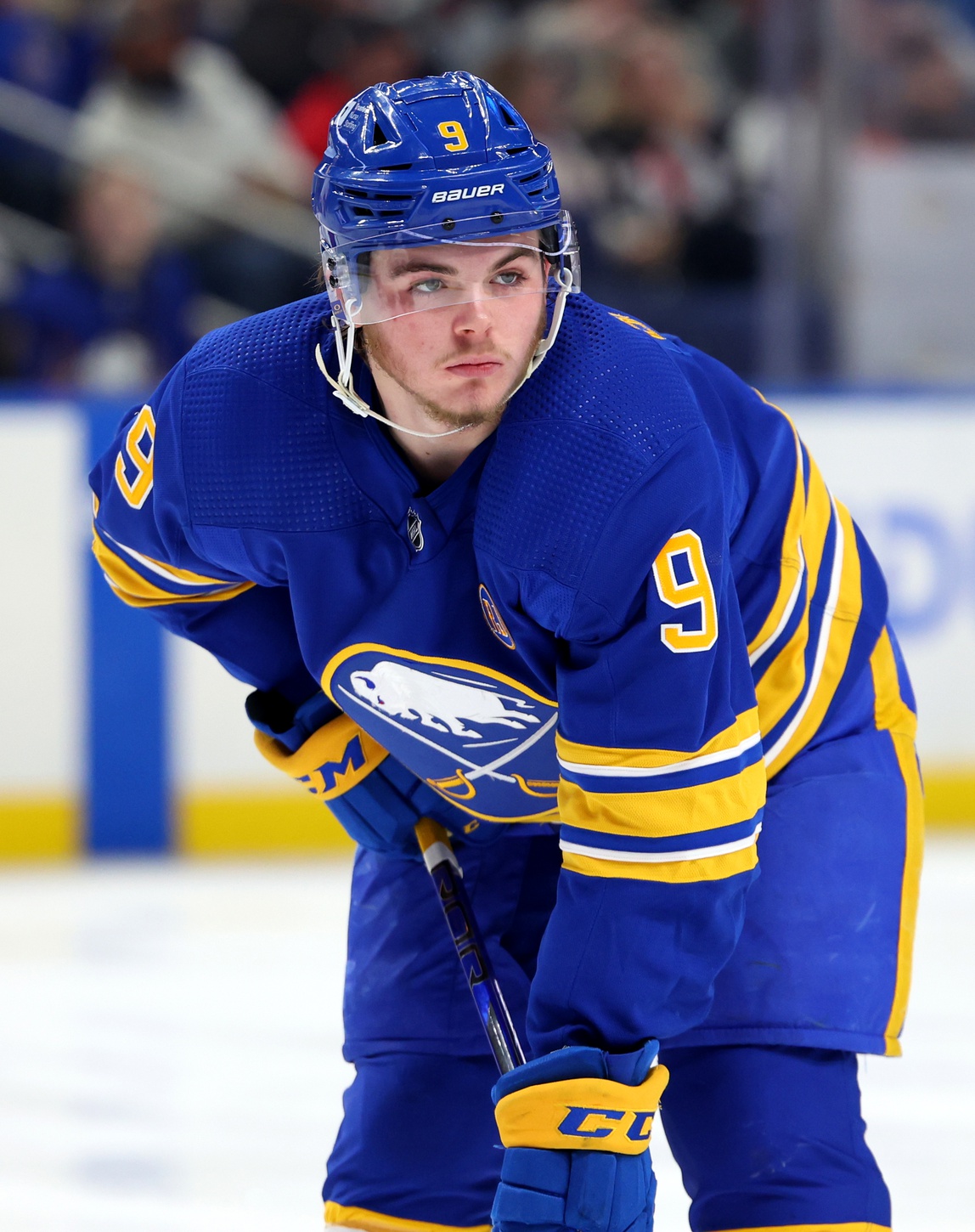
I had my best pick with Buffalo so it’s time to go back to that well with winger Zach Benson. Yes, his sophomore year wasn’t really any better on paper than his rookie campaign but 28 points in 75 games is still respectable for someone who still could have been playing at the major junior level. And the underlying numbers were pretty solid. Benson should have a top-six role this season (possibly even playing with Thompson) and I expect him to have a breakout effort. If all goes well, doubling last year’s point total could be doable and that would be a nice rebound after last year’s pick.
Breakaway: 4-in and 4-out.
Name one team from each division that made the playoffs last year that will not make the playoffs this year. And what four teams replace them?
Atlantic: I would say Toronto and Tampa Bay remain safe bets to get back in. Florida should be unless Matthew Tkachuk’s absence proves to be a big problem and they start out how they played down the stretch last season before flipping the script in the playoffs. Ottawa is more or less the same and on the way up so I’m pretty comfortable penciling them in as well. By process of elimination, that would mean my pick would be Montreal. They had some good luck on the injury front last year and their underlying numbers weren’t great. I could see a scenario where they actually play a bit better this season but instead of just making the playoffs, they just miss them.
The challenge is that I have to pick one of the other three to replace them, something I’m not overly confident in. I expect Boston’s lack of offense to be their downfall and as much as I think Buffalo is capable of improving, their annual self-destruction makes it hard to actually predict that happening. So I guess it’s Detroit by default with John Gibson giving their goaltending enough of a boost. But really, this side of the bracket could largely remain the same next season.
Metropolitan: Carolina is always a top regular season team and they’ve improved so they’re in. New Jersey slipped down the stretch due to injuries but I still think they’re on the way up so I’d have them in. On the one hand, Washington won the division last year and didn’t change their roster up much but on the other hand, many felt they were a bubble team at best heading into last season. Did they overachieve? I guess since I have to pick one to fall out of the race, it’s them.
On the other end, I don’t expect Pittsburgh, Philadelphia, or the Islanders to be real threats. Columbus is on the way up but as I noted in a recent mailbag, I don’t trust their goaltending to be good enough to get them in there. That leaves the Rangers. Things have to be better for them this season, doesn’t it? Odds being odds, some of their underachievers will turn things around which might be enough to get them back in.
Central: I see no reason to take Dallas or Colorado out. Winnipeg may very well drop a bit but as long as Connor Hellebuyck remains one of the top netminders, they should be fine. That leaves St. Louis and Minnesota. I could make a case for either one making or missing but I’ll go with the Blues continuing their strong play under Jim Montgomery and getting a Wild Card spot and the Wild missing. For all the cap space they had this summer, they didn’t get a whole lot better unless Vladimir Tarasenko has a resurgence. A full season from Kirill Kaprizov would help but given Jesper Wallstedt’s struggles in the AHL last year, their goaltending is more of a question mark than they probably hoped.
As for who gets in, Chicago is a safe no. I think Nashville will be better than last year and they have the veteran talent to surprise and get back in. But I’ll go with Utah, a team that’s slowly getting better and just added a top-six talent in JJ Peterka. That, coupled with continued improvement from their young core, means that this could be the year for them to get back in.
Pacific: There’s no reason to think Edmonton and Vegas won’t get back in. I have no reason to think the Kings won’t get back in either but since I have to pick one who made it to miss, I guess it’s them as the third-place team.
San Jose isn’t ready to push for a playoff spot yet. Anaheim is better and a bit of a Wild Card but I think they’re still on the outside for one more year. Seattle can’t stop treading water with a core group that’s not good enough so they’re probably in the same boat as a year ago. That leaves Calgary and Vancouver. I feel Dustin Wolf made the Flames more competitive than they actually were so them taking a step back wouldn’t surprise me. That would mean Vancouver, a team that struggled mightily last year, finds a way to turn it around. Having said that, five Central teams and three Pacific teams might be what happens again.
SirCobblestone: How do you think teams with low cap hits (San Jose, Chicago) will navigate the ELC of players worthy of staying in the show while respecting the cap floor? (23 roster player limit also.)
This cap part of this question shouldn’t be overly difficult this season. All 32 teams are already above the $70.6MM floor and once Anaheim eventually signs Mason McTavish, every team should be $5MM clear of that floor. Eventually, once they start selling, they’ll open up some space but there will surely be salary retention on some players while if they wait until closer to the trade deadline to make those moves, they should be able to comfortably stay above the floor. Any achieved bonuses from their entry-level players would also count on the books this season, also helping them stay above that minimum spending amount.
As to the roster element, most of the lower-spending teams have veteran fillers on their roster that aren’t really part of their plans. They’re placeholders, if you will, until those entry-level prospects show they’re ready. And when they’re ready, they’ll get the spot and the veteran will either be traded or waived and demoted to the minors.
I’ll use a San Jose example since you brought them up. Let’s say Sam Dickinson shows in training camp that he’s ready for NHL duty, or at least a look with the Sharks to start. Yes, they already have eight blueliners on their roster but someone like Vincent Desharnais is clearly not part of their long-term plans. He was acquired as a low-cost roster filler before they knew they’d be adding three veteran blueliners over the summer. If they have to trade or waive him to open up a spot for Dickinson, they’re not going to think twice about it, they’ll just do it. And if it’s the latter with him passing through unclaimed, the net savings to San Jose would only be just over $200K, barely enough to make a difference from a cap perspective while a player in and a player out keeps them in compliance with the roster limit.
I think you might be ahead of the game with this question. A few years from now when the cap is much higher and more teams are operating with an internal budget that’s closer to the floor than the ceiling, I could see this question being asked as those teams might not have pricey placeholder veterans anymore but rather lower-cost ones. Perhaps at that point, this could be an issue but for the upcoming season, teams should be able to navigate through this just fine.
Photo courtesy of Timothy T. Ludwig-Imagn Images.
Salary Cap Deep Dive: Dallas Stars
Navigating the salary cap is one of the most important tasks for a front office. Teams that can avoid total cap chaos by walking the tightrope of inking players to deals that match their value (or compensate for future value without breaking the bank) remain successful. Those who don’t often see struggles and front office changes.
PHR will look at every NHL team and give a thorough look at their cap situation for the 2025-26 season. This will focus more on players who are regulars on the roster versus those who may find themselves shuttling between the AHL and NHL. All cap figures are courtesy of PuckPedia. We’re currently covering the Central Division, next up are the Stars.
Dallas Stars
Current Cap Hit: $95,094,916 (below the $95.5MM Upper Limit)
Entry-Level Contracts
D Lian Bichsel (two years, $918K)
Potential Bonuses
Bichsel: $500K
Bichsel split time between Dallas and AHL Texas last season before being a regular for them in the playoffs, albeit with limited playing time. He should crack the roster on a full-time basis this year but still in a third-pairing role, which doesn’t bode well for reaching his bonuses. Given their longer-term cap situation which we’ll get into as we go along, it would be surprising if his next deal isn’t a short-term bridge contract, likely around the $2MM range.
Signed Through 2025-26, Non-Entry-Level
F Nathan Bastian ($775K, UFA)
F Jamie Benn ($1MM, UFA)
F Mavrik Bourque ($950K, RFA)
D Thomas Harley ($4MM, RFA)
D Nils Lundkvist ($1.25MM, UFA)
D Alexander Petrovic ($775K, UFA)
F Jason Robertson ($7.75MM, RFA)
Potential Bonuses
Benn: $3MM
Robertson’s situation has garnered plenty of attention with his name coming up in trade speculation. He’s averaging over a point per game for his career and has notched at least 79 points in four straight seasons. That’s top-line numbers and he’ll be looking for top-line money next summer which should push his cap charge well past the $10MM mark. Notably, his qualifying offer is $9.3MM with salary arbitration rights. Benn re-signed this bonus-laden deal to allow Dallas to keep cap-compliant this season, one that is team-friendly even with the bonuses. $2MM of that is games-played based while the other $1MM is based on team playoff success. If he wants to remain with the Stars beyond this season, it’s probably going to be on a similarly structured agreement.
Bourque was a speculative offer sheet candidate this summer but agreed to this deal before the draft to take that off the table. Had he tested restricted free agency, he’d have landed more than this but the one-year term sets him up for arbitration eligibility and a shot to triple this or more next summer if all goes well. Bastian was a recent signing from the Devils and has been a physical fourth liner throughout his career but his offensive production has largely been limited. That should keep him around the minimum salary barring a big jump in output.
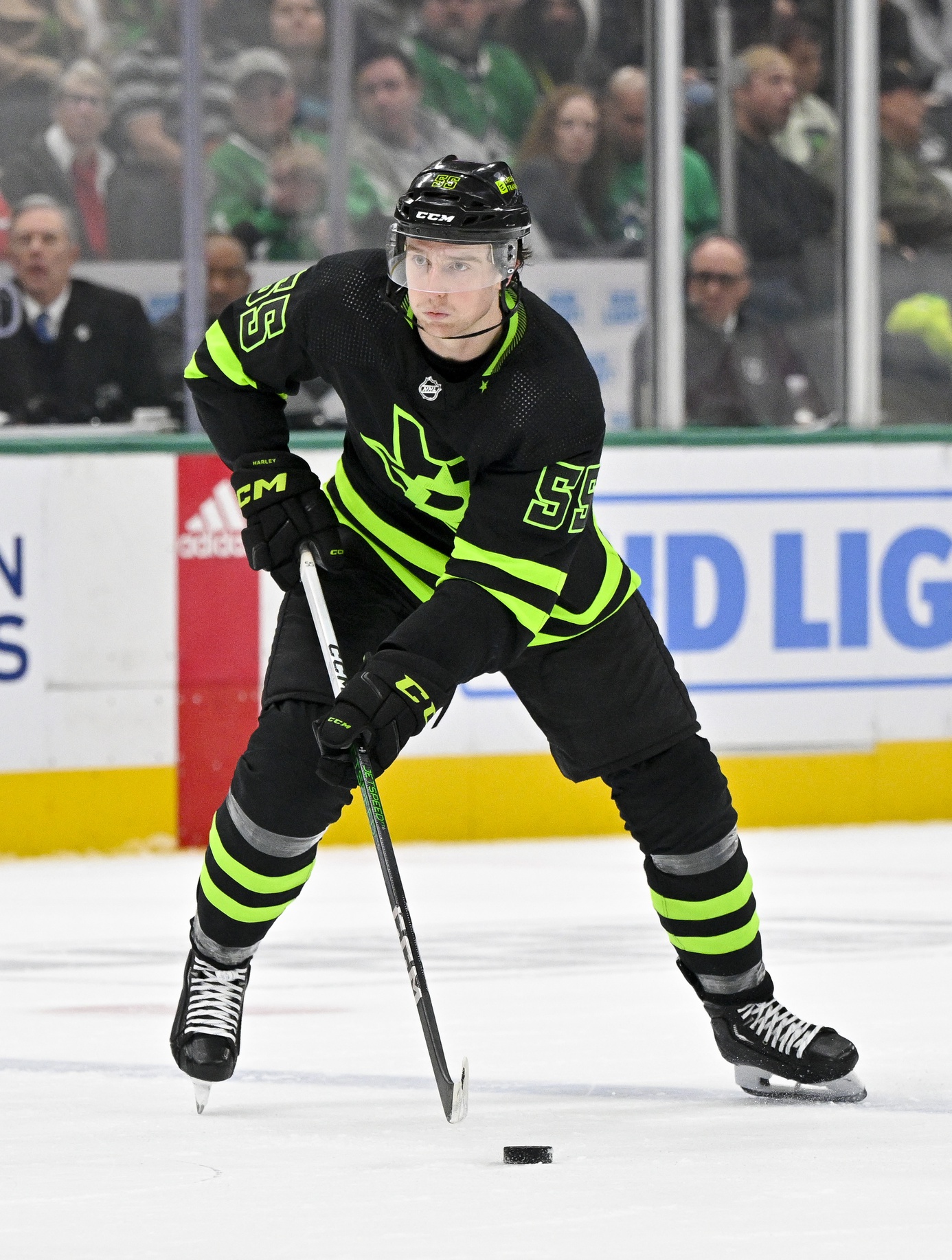 While Robertson’s case has garnered the majority of the attention for next year’s free agency, Harley’s is arguably just as significant. He showed last season that his 2023-24 breakout effort was no fluke, taking on an even bigger role and being just as productive. He is now a legitimate top-pairing player. As a result, this could be a situation where his pay increase next summer is higher than what Robertson’s is going to be. Noah Dobson’s eight-year, $9.5MM AAV contract signed this summer looms large as a viable comparable while ticking past $10MM per season is a real possibility as well. Notably, he’s not UFA-eligible until 2029 so one option that could be considered is another two-year bridge deal more in the $7MM range which could allow their reported desire to work within an internal cap to happen. That would buy them a bit of short-term flexibility at a time when cap space is going to be tight so GM while Jim Nill likely doesn’t prefer to go that way, he might have to.
Lundkvist looked to be heading toward a non-tender to duck arbitration rights for the second straight year before signing this contract for the same amount he made last season. Between some struggles and injuries, 2024-25 was largely a write-off so he’s getting near the point of either needing to take that step forward or understanding that he might not be more than the depth player he currently is. Petrovic spent most of last season in the minors before playing in most of the playoffs in Dallas which should give him a leg up for a full-time spot to start this year. Even so, his track record has only been that of a depth defender thus far and at 33, that’s unlikely to change. He should stay around the minimum salary moving forward although a full year in the NHL could flip his next deal to a one-way pact.
Signed Through 2026-27
F Oskar Back ($825K, UFA)
F Colin Blackwell ($775K, UFA)
G Casey DeSmith ($1MM, UFA)
D Ilya Lyubushkin ($3.25MM, UFA)
F Tyler Seguin ($9.85MM, UFA)
F Sam Steel ($2.1MM, UFA)
A hip issue sidelined Seguin for most of last season although he was a little over a point per game in his limited action. However, he has generally been more in the 50-point range in recent years and this price tag for that type of production isn’t great. He’ll be 35 when his next deal starts and while a multi-year pact should still be doable then, it’s going to come with a multi-million-dollar drop in AAV. Steel inked this deal back before the trade deadline in the midst of his fourth straight season with at least 20 points. Between that and his ability to kill penalties, he should be able to provide decent value on this contract but unless his point production starts to go up, he might not be able to go too much higher than this.
Back had a decent rookie year, getting into 73 games while holding his own in a bottom-six role to secure this deal at a rate that will be below the minimum salary next season. Assuming he remains a regular in this type of role for them, this should work out just fine while Back should be able to push more into the $1.25MM range on his next deal. Blackwell fit in nicely in a depth role last season, earning this new contract along the way. While he had a couple of years in the past with a seven-figure salary, he’s someone who should be staying around the minimum salary on any future contracts.
Lyubushkin was brought in to bring some physicality to the back and stabilize the bottom pairing. He was able to do that for the most part although this contract is on the higher side for that type of role which led to some speculation about his future when they needed to open up cap space. It would be surprising to see him beat this by any significant amount two years from now but another contract in this price range might be doable.
DeSmith is certainly at the lower end of the salary scale for backup goalies as he opted for stability and a winning environment over trying to get the highest price tag. He certainly had a solid first year with numbers that should have him toward the higher end of the backup scale (more in the $3.5MM territory). He’ll be 36 when this deal expires so it’s unlikely that he’ll find a contract in that range but value-wise, he should double this if he looks for top dollar next time out.
Signed Through 2027-28
F Radek Faksa ($2MM, UFA)
Faksa returns after a one-year stint in St. Louis after Dallas needed to clear his contract last summer. While he showed some offensive upside early in his career, he has settled into more of a pure checking role in recent seasons. Between his penalty killing utility and his faceoff skills, he should be able to provide a good return on this contract, even with the points remaining hard to come by. But unless his production improves, he likely won’t command much more than this moving forward.

Summer Synopsis: Tampa Bay Lightning
With training camps now less than a month away, the bulk of the heavy lifting has been done from a roster perspective. Most unrestricted free agents have found new homes, the arbitration period has come and gone, and the trade market has cooled. Accordingly, it’s a good time to take a look at what each team has accomplished this offseason. Next up is a look at Tampa Bay.
Last summer, the Lightning made a big splash, adding Jake Guentzel while parting ways with longtime franchise icon Steven Stamkos among their series of moves. This time around, GM Julien BriseBois has been much more tempered with his roster movement, opting to work on the fringes while keeping a key trade deadline acquisition in the fold.
Draft
2-56 – F Ethan Czata, Niagara (OHL)
4-108 – F Benjamin Rautiainen, Tappara (Liiga)
4-127 – F Aiden Foster, Prince George (WHL)
5-151 – D Everett Baldwin, St. George’s (USHS-RI)
7-193 – G Caleb Heil, Madison (USHL)
7-206 – F Roman Luttsev, Yaroslavl (MHL)
7-212 – D Grant Spada, Guelph (OHL)
7-215 – F Marco Mignosa, Sault Ste. Marie (OHL)
The Lightning managed a surprisingly stout draft class despite little in the way of pick value. Their class is full of interesting skill and projectable upside, housed within a shell of unrefined skills and clear areas for growth. Czata stands as the true playmaker of the bunch and earns the highest pick as a result. He’s a heads-up center who plays the low-zone well on both ends of the ice. He already has the frame and muscle to work his way to a pro build, but will need to compliment it with improved skating before he can boom at the pro level.
The Lightning reeled in a line of upside picks behind the projectable Czata. Rautiainen was in his final year of draft eligibility, but earned a selection after netting an impressive 37 points in 58 Liiga games last season. He’s an upside bet who could translate to North America soon. Foster is the bruiser of the bunch, having already racked up 260 penalty minutes in just two WHL seasons. Baldwin was seen as a true draft gem in NHL circles, with some New England scouts praising him as a second-round talent at his peak. He’s a nifty, fast-moving defender with the ability to drive play and throw big hits – though he hasn’t yet had a chance at the top level. He’ll get his first in a move to the QMJHL’s Saint John Sea Dogs this season.
The Bolts had to save their energy for a busy seventh-round. They landed a very well-rounded bunch for their effort. It features the flashy athleticism of goaltender Heil, downhill offense of center Luttsev, heavy hitting of defender Spada, incremental, all-around improvement of Mignosa. All four players show flashes of upside as true NHL hopefuls, even despite having to wait until the final picks to hear their name called.
Trade Acquisitions
F Sam O’Reilly (trade with Edmonton)
After Isaac Howard decided that he didn’t want to sign with the Lightning, he immediately because their top trade chip. They elected not to move him at the deadline but found a viable one-for-one prospect swap that saw him flipped for another late first-round selection. O’Reilly isn’t NHL-ready like Howard is but he plays the more premium position as a natural center and produced over a point-per-game in both the regular season and playoffs with OHL London. Already signed to his entry-level deal, he could be in the mix for NHL ice time as soon as 2026-27.
UFA Signings
F Nicholas Abruzzese (one year, $775K)*
F Tristan Allard (two years, $1.745MM)*
G Ryan Fanti (one year, $775K)*
F Gage Goncalves (two years, $2.4MM)^
F Yanni Gourde (six years, $14MM)^
F Pontus Holmberg (two years, $3.1MM)
F Boris Katchouk (one year, $775K)*
D Simon Lundmark (two years, $1.55MM)*
F Jakob Pelletier (three years, $2.325MM)
F Scott Sabourin (one year, $775K)*
D Steven Santini (two years, $1.55MM)*^
*-denotes two-way contract
^-denotes re-signing
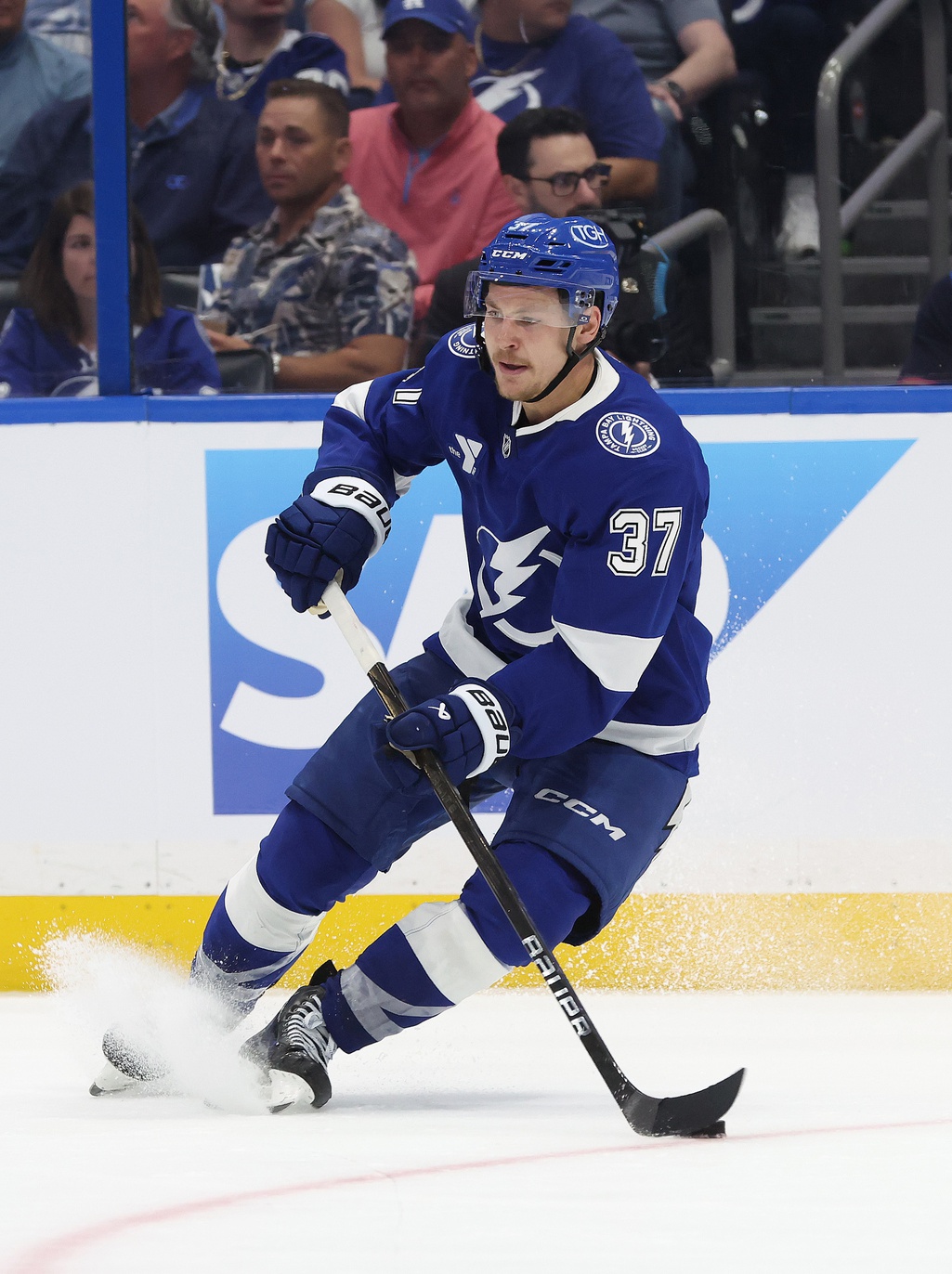 BriseBois paid a high price to acquire Gourde and Oliver Bjorkstrand at the trade deadline so it made sense that he’d try to keep Gourde in the fold. Few expected him to sign a six-year deal at the age of 33, however. That’s a long contract for someone that age but the trade-off is a cap charge that is well below what he likely would have received in free agency in a market that had few centers of significance. Gourde is coming off a pretty quiet season by his standards but he was impactful after the trade, notching 14 points in 21 games. If he comes anywhere close to this, he’s going to be a nice bargain in the early going of this deal and really help bolster their bottom six, an area of need for a while now.
Speaking of bottom-six pickups, both Holmberg and Pelletier qualify. Holmberg had his first full NHL season last year with Toronto, playing somewhat regularly on their fourth line during the regular season and in the playoffs. He doesn’t bring a lot of offensive upside to the table but it’s still an improvement on what Tampa Bay’s fourth line provided last season while he could help a bit on the penalty kill as well. Pelletier cleared waivers to start last season but wound up getting into 49 NHL games between Calgary and Philadelphia. A 2019 first-round pick, it doesn’t appear as if he’ll be able to live up to his draft billing but he should have a chance to secure a regular spot on that fourth line and, like Holmberg, give it perhaps a bit more offensive upside as well.
Goncalves was able to establish himself as a regular for the most part with the Lightning last season but Tampa Bay wanted nothing to do with arbitration, opting to non-tender him before re-signing him in early July at a price tag higher than what his qualifying offer was. Last season, he cleared waivers twice. That’s probably not going to be an option this time around. Abruzzeze has had some good offensive success in the minors with Toronto but hasn’t had much of an NHL opportunity, allowing him to reach Group Six free agency. He’ll be in tough to lock down a full-time spot with the Lightning but he could be a good candidate for a midseason recall.
RFA Re-Signings
D Maxwell Crozier (three years, $2.325MM)*
F Jack Finley (three years, $2.325MM)*
*-denotes two-way contract
Most of Tampa Bay’s contract work was done before the summer came along so there wasn’t much to do here. Crozier and Finley signed identical contracts, deals that will carry a two-way salary this season before converting to one-way pacts for the other two (at rates that will be increased due to the changes to the minimum salary in the CBA). Crozier could have a shot at earning a seventh defenseman role with the Lightning this season while Finley – who made his NHL debut last season – is ticketed for regular minutes with AHL Syracuse once again.
Departures
D Anthony Angello (unsigned)
F Cam Atkinson (unsigned)
D Derrick Pouliot (signed with Rangers, one year, $775K)*
F Gabriel Fortier (signed with Leksand, SHL)
F Logan Brown (signed with Los Angeles, one year, $775K)*
F Luke Glendening (unsigned)
F Isaac Howard (trade with Edmonton)
D Tobie Paquette-Bisson (signed with Laval, AHL)
D Nicklaus Perbix (signed with Nashville, two years, $5.5MM)
F Conor Sheary (contract termination, signed a PTO with Rangers)
F Simon Ryfors (RFA rights lost, signed with Davos, NL)
G Matt Tomkins (signed with Edmonton, two years, $1.55MM)*
*-denotes two-way contract
Despite a large list of names to leave the organization, the Lightning and GM Julien BriseBois did a good job of not losing anyone of significance. Perbix, 27, is coming off of a nice season to earn a solid two-year deal with the Predators. In 74 games, Perbix put up 19 points while averaging 14:41 of ice time per night. Perhap the biggest departure came in the form of Howard, who never actually suited up in Tampa Bay. Following the trade, the Oilers announced Howard has signed a three-year, entry-level contract beginning in 2025-26.
Salary Cap Outlook
The Lightning are projected to have a little under $1.2MM in cap space for next season, per PuckPedia, and that’s with a 23-player roster. That’s a luxury they haven’t been able to afford too often in recent years and if they elect not to operate with that to start the season, they could wind up opening up nearly $2MM below the cap ceiling. That’s a much cleaner spot to be in compared to where they’ve been at times over the last few seasons.
Key Questions
Can Geekie Lock Down A Key Role? One of the wild cards for Tampa Bay this season is forward Conor Geekie. A key piece of the return in the trade that saw defenseman Mikhail Sergachev go to Utah at the draft last year, the 2022 11th overall pick broke camp with the Lightning last year but played a relatively minor role overall, only playing more than 15 minutes in four of his 52 games while only collecting 14 points. In February, the decision was made to let him go to Syracuse and he was much more successful with the Crunch, notching 11 goals and 20 points in 24 games, earning a late-season recall and some playoff time. If Geekie can truly lock down a full-time spot on the third line, a step forward from him coupled with their bottom-six additions could really help shore up what was one of their biggest weaknesses last season.
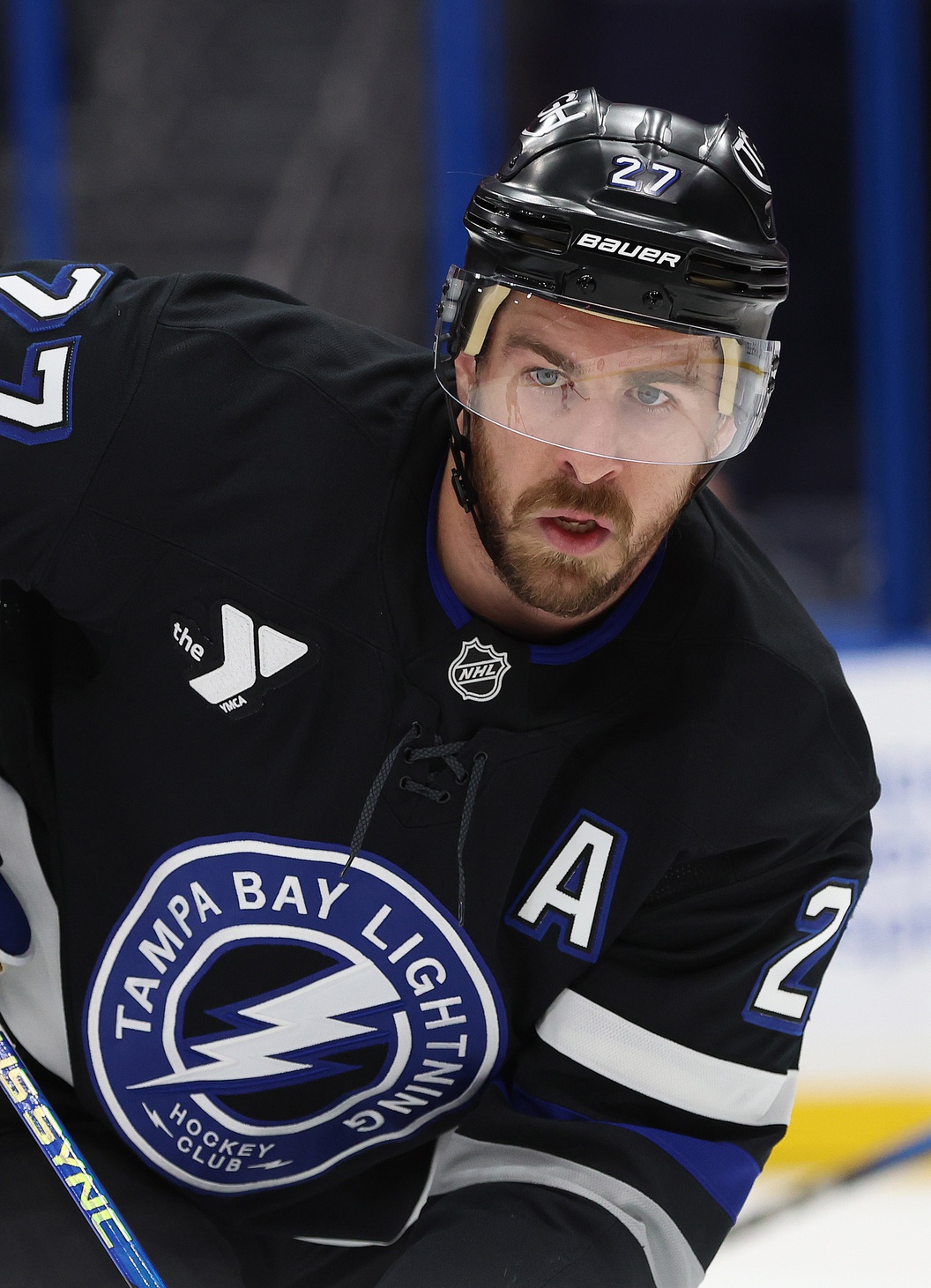 Will The Lightning Do Any Early Extensions? Over the years, BriseBois has often elected to sign his pending free agents a year early and avoid any potential distractions of having a player in his walk year. (Stamkos, their former captain, was a rare notable exception.) There is a trio of veterans who could be candidates to sign new deals. Bjorkstrand has reached at least 20 goals in six of the last seven seasons, making him a reliably consistent secondary scoring option that should land more than his current $5.4MM price tag on the open market so working to sign him now makes some sense. Meanwhile, on the back end, veteran Ryan McDonagh and J.J. Moser are both extension-eligible as well. McDonagh is unlikely to command the $6.75MM cap cost that he currently has but there is likely mutual interest in seeing him stick around in a mentoring capacity for another year or two. As for Moser, his first season with the Lightning after coming over in the Sergachev trade was a little quieter than expected but he’s still expected to be a top-four piece for them for the foreseeable future. If they’re confident he can rebound, looking to sign him now when his value might be a little lower would be a wise move.
Can They Match Last Season’s Offensive Production? The Lightning led the NHL in regular season goals last season (292), good for a 3.56 goals per game. The team is returning its core offensive threats, so can it make another push toward the top of the offensive rankings? The answer likely hinges on whether it can replicate last season’s power play success, when it ranked fifth in the league with a 25.9 percent conversion rate. That efficiency was complemented by impressive even-strength production, as the team finished third in the league in even-strength goals, trailing only the Washington Capitals and, perhaps surprisingly, the Columbus Blue Jackets. If Nikita Kucherov can produce something close to last season’s 121 points, and players like Guentzel, Brandon Hagel, and Brayden Point continue to produce at a point-per-game rate, the Lightning should once again find themselves near the top of the league in goals per game and in a strong position to contend heading into the playoffs.
Photos courtesy of Kim Klement Neitzel-Imagn Images
PHR’s Gabriel Foley and Paul Griser also contributed to this post.
Salary Cap Deep Dive: Colorado Avalanche
Navigating the salary cap is one of the most important tasks for a front office. Teams that can avoid total cap chaos by walking the tightrope of inking players to deals that match their value (or compensate for future value without breaking the bank) remain successful. Those who don’t often see struggles and front office changes.
PHR will look at every NHL team and give a thorough look at their cap situation for the 2025-26 season. This will focus more on players who are regulars on the roster versus those who may find themselves shuttling between the AHL and NHL. All cap figures are courtesy of PuckPedia. We’re currently covering the Central Division, next up are the Avalanche.
Colorado Avalanche
Current Cap Hit: $94,170,000 (below the $95.5MM Upper Limit)
Entry-Level Contracts
F Ivan Ivan (one year, $835K)
There was no shortage of entry-level players trotted out on the fourth line at times last season and chances are that some of them will be back and forth once again. But Ivan got into 40 games with the Avs in 2024-25 and projects to have a similar role this season. Given his limited output, he’s someone who shouldn’t be able to command much more than this on his next deal, especially if he lands a one-way pact.
Signed Through 2025-26, Non-Entry-Level
D Brent Burns ($1MM, UFA)
F Jack Drury ($1.725MM, RFA)
F Daniil Gushchin ($775K, RFA)
F Joel Kiviranta ($1.25MM, UFA)
D Sam Malinski ($1.4MM, UFA)
F Martin Necas ($6.5MM, UFA)
F Victor Olofsson ($1.575MM, UFA)
G Scott Wedgewood ($1.5MM, UFA)
Potential Bonuses
Burns: $4MM
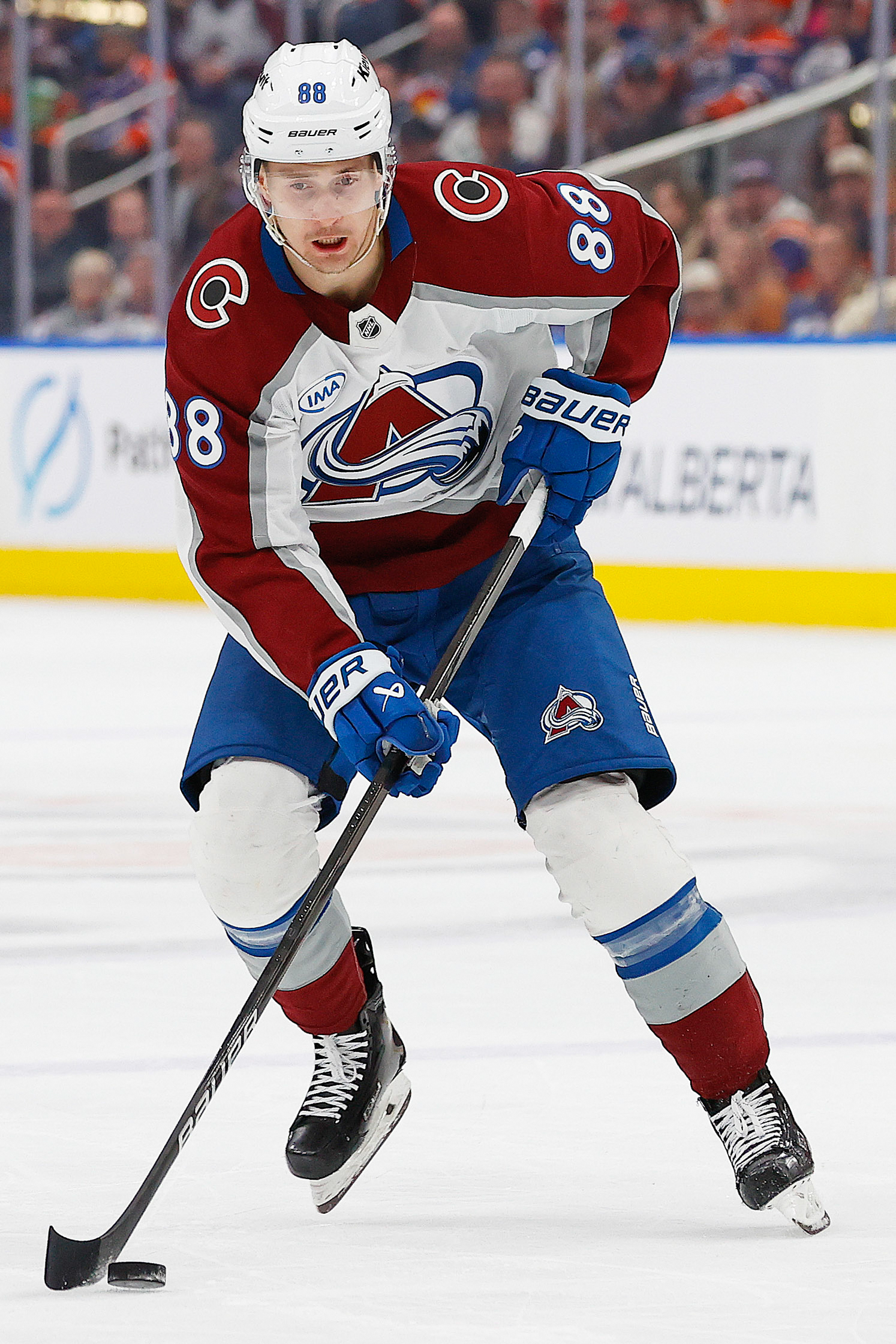 After being unable to agree to terms with Mikko Rantanen on an extension and not wanting to run the risk of losing him for nothing in free agency, GM Chris MacFarland opted to move him for Necas (and Drury). A year later, they might be in the same situation. Necas is coming off a career year and couldn’t agree to terms on a long-term pact last summer in Carolina with the belief that he wanted to test the open market. Now, that price tag has only gone higher given the year he had and the pending changes to the cap. It wouldn’t be shocking to see a long-term contract creep close to the $10MM mark now and if Colorado doesn’t want to pay that, they might have to look into moving him during the season.
Drury wasn’t as impactful of an acquisition as Necas but he certainly gave them some needed extra depth down the middle. He wasn’t able to repeat his 2023-24 performance offensively, however, which could limit his earnings upside. His qualifying offer checks in at $1.675MM with arbitration rights and while he should be able to beat that on another short-term deal, it won’t be a significant increase barring a breakout year. Olofsson had a decent season with Vegas in a supporting role and should have a similar type of role this season. He has had to settle for one-year deals in his first two trips through unrestricted free agency. Barring an uptick in production, he’ll either stay on that path or have to settle for a multi-year pact at a lower price tag than the $4.75MM he was making at the end of his time with Buffalo.
Kiviranta had a career year last season, notching 16 goals. By comparison, his previous personal best in points was 11. Not surprisingly, teams weren’t willing to pay him much more than his usual contract, being unconvinced that this improvement is repeatable. If he can match that this season, he might be able to land closer to $2MM. If he goes back to normal, he’ll be back in league minimum territory for 2026-27. Gushchin is one of many players who will be fighting for a back-of-the-lineup spot but given his production in the minors last year with AHL San Jose and the fact he’s now waiver-eligible, he might have a small leg up on the competition for a spot. Given his limited NHL opportunities so far and the likelihood of limited playing time given how Jared Bednar deploys his fourth line, Gushchin should stay around the minimum salary for next season even if he locks down a roster spot.
Burns comes over from Carolina in a deal that was set up to work within Colorado’s limited cap flexibility. Of the $4MM in bonuses, he’ll each $3MM with his tenth game of the season while the other million will be harder to reach (70 GP with over 23 minutes per contest). While he’s 40, he has shown himself to be capable of still playing in the top four which should make his base salary quite a bargain; they’ll be paying off the bonuses next season though. This type of contract structure could come his way again if he plays beyond this season. Malinski held his own in his first taste of full-time NHL action last season on the third pairing. If he has that same role this year, he should push past the $2MM mark if he remains as effective as he was in 2024-25.
Wedgewood signed this contract with Nashville last summer but he wasn’t there for long, being moved to Colorado not even two months into the season. He thrived in limited action with the Avs and while that probably isn’t repeatable, he’s establishing himself as a late-bloomer in terms of being a legitimate backup option. That should be enough to push him past $2MM per season on his next deal if he can give them even an adequate level of goaltending this year.
Signed Through 2026-27
F Ross Colton ($4MM, UFA)
D Samuel Girard ($5MM, UFA)
F Artturi Lehkonen ($4.5MM, UFA)
D Cale Makar ($9MM, UFA)
D Keaton Middleton ($775K, UFA)
Lehkonen has found another level offensively since being acquired from Montreal while still being a strong defensive player. Now producing as a top-six forward (and playing top-line minutes), his price tag should shoot up on his next deal. Given his quality of linemates though (a quality that few teams can match), that could be a limiter on a new contract, especially if he makes it to the open market. If Colorado re-signs him, a cap charge starting with a six should be doable. Colton wasn’t able to sustain the hot start he had last season but stayed within a similar goal and point-per-game range as he had the previous three years. At this point, that starts to become the trend, not the outlier. He didn’t play much at center last season but his ability to do so will also be a boost to his value. As long as he stays around the half-point-per-game range, Colton should be able to land closer to $5MM on his next contract knowing the demand that will be out there for help down the middle.
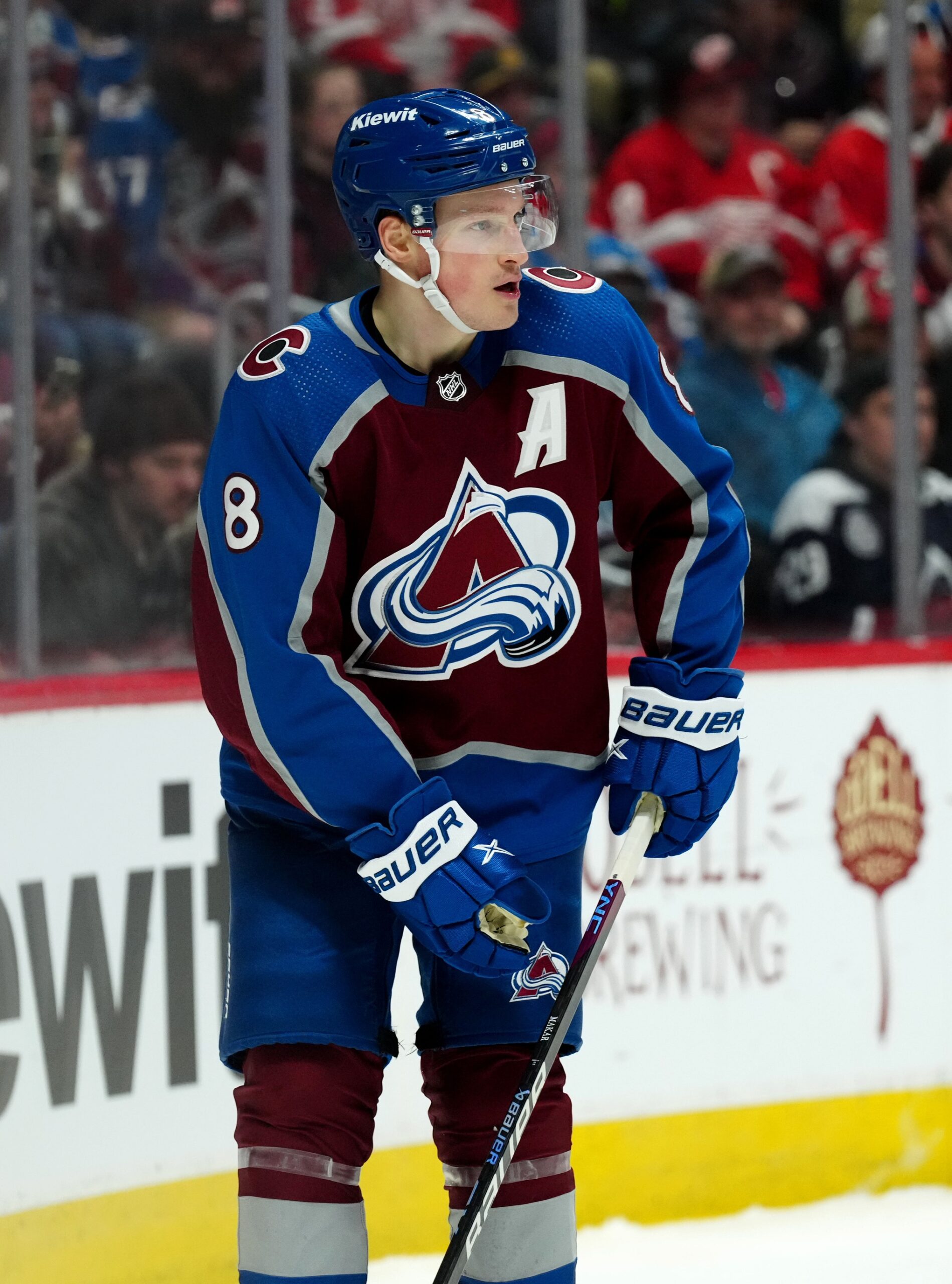 It’s hard for a $9MM contract to be a bargain but Makar more than fits the bill. At a time when older top blueliners landed $11MM or more several years ago, Makar has outproduced them since then and has a couple of Norris Trophies under his belt, putting his contract several million below market value already. He will be in line to sign a record-setting contract for a defenseman and while the Avs might prefer to operate on an internal cap and not have him make more than their top forward, that could be a tough sell knowing where the Upper Limit of the cap will be in 2027 (around $113.5MM). $14MM or $15MM on a max-term agreement certainly feels achievable at this point, especially as new benchmarks get set over the next couple of years.
Girard has been a steady second-pairing defender for the bulk of his eight-year career at a time when consistency is highly valued. However, given that he is one of the smallest blueliners in the NHL, his name has been speculated as a possible trade candidate for a while now. Meanwhile, with a lot of teams currently aiming for their back ends to get bigger, that could limit Girard’s earnings potential. Based on his performance, a raise past $6MM should be doable but if his market cools because of his size, that could make reaching that a challenge. Middleton is a depth defender who projects to be the seventh option more often than not. Those players tend to stay close to the minimum salary and that should be the case for him as well on his next contract.
Signed Through 2027-28
D Josh Manson ($4.5MM in 2025-26, $3.95MM in 2026-27 and 2027-28)
F Brock Nelson ($7.5MM, UFA)
Nelson didn’t exactly play great after being acquired but with the Avalanche looking to shore up a second center position that has been in flux as of late, they paid a high price to keep him from hitting the open market. Frankly, given the dearth of impact centers in this year’s class, he likely would have received this or more had he tested free agency. He’ll be 36 (nearing 37) when this deal is up and assuming his production starts to decline by then, he might be more in the $4MM to $5MM range on his next contract which could still be a multi-year pact.
Manson is still a capable physical defensive defender when healthy. But staying healthy has been an issue as he hasn’t made it to 70 games in a season since 2018-19 and that’s factored into the cost of the extension, a small pay cut. It’s on the high side for someone who should be more of a fifth option by then but if they can afford it, it’s not a bad luxury to have.
Are The Flyers Close To Turning The Corner On Their Rebuild?
It feels like the Philadelphia Flyers have been in a perpetual rebuild for the last decade, but really, it’s been two separate attempts at a rebuild. This most recent edition essentially kicked off in March of 2023 when prior Flyers general manager Chuck Fletcher was fired and replaced by current GM Daniel Briere.
Flyers fans might not have had much to cheer about the past ten years; however, that window of futility is beginning to close, and a new window, one of opportunity, is starting to open. The issue for the Flyers, and this could be one for their cross-state rivals, the Pittsburgh Penguins, is that they don’t have those high-impact top-end young assets, which will hurt their ability to build around their young pieces.
That’s not to say that the Flyers have failed their rebuild, but their prospect pool isn’t overly impressive for a team that has been in what feels like a forever rebuild and is currently ranked 18th overall by The Athletic’s Scott Wheeler, although that was before their 2025 draft haul. Some fans might have concerns about a repeat of the Flyers’ last rebuild that Ron Hextall oversaw, but Briere appears to be more assertive than Hextall and likely won’t be so passive when it comes to building the team he wants.
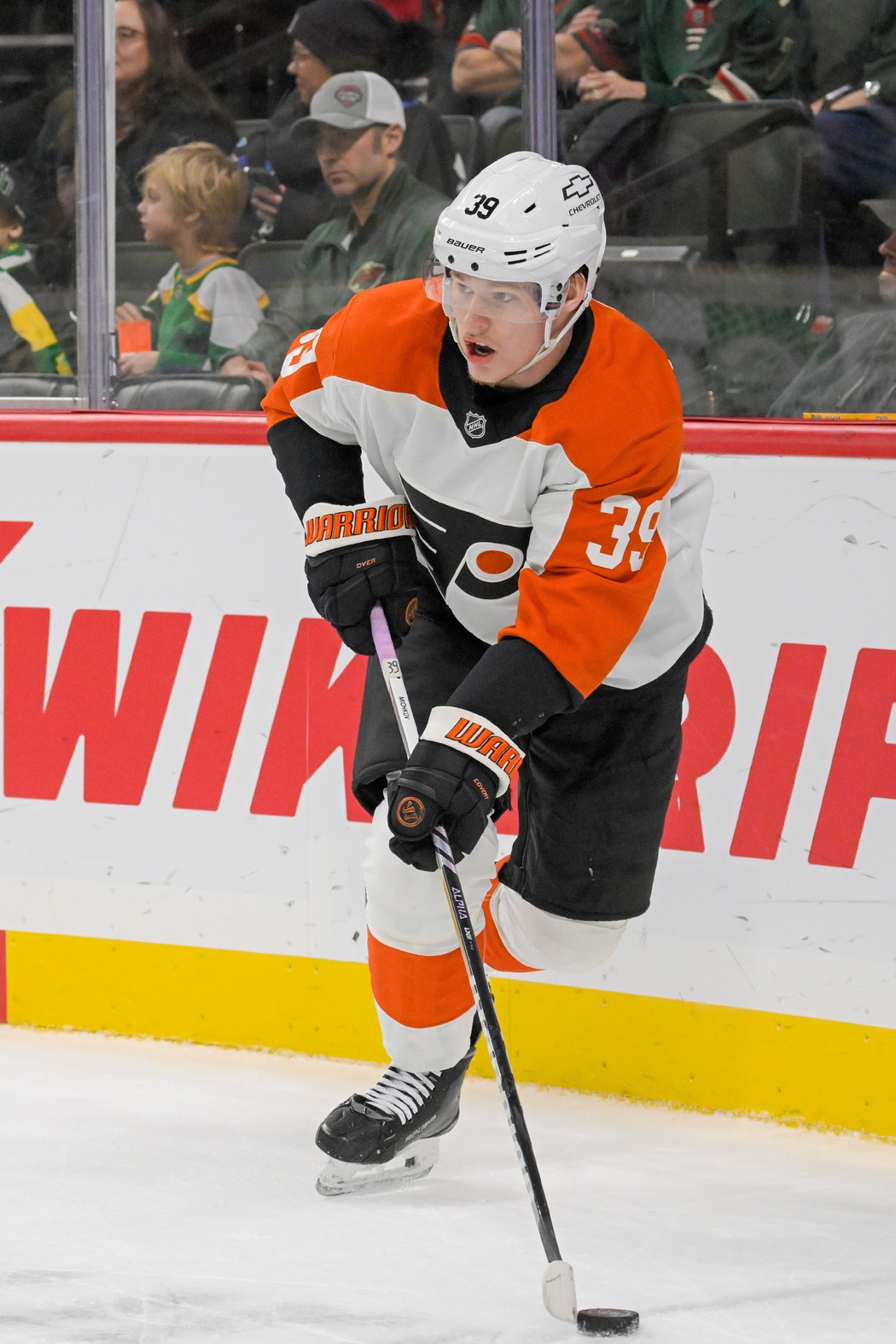 Now, in fairness to the Flyers’ prospect ranking, they have graduated a couple of terrific prospects to the NHL already, in Bobby Brink and Matvei Michkov, which lowers their ranking. They also had several players age out of Wheeler’s rankings, making it somewhat premature to say that the pool is devoid of future talent.
That being said, if you look down the Flyers’ NHL roster, there isn’t a lot of talent under the age of 25, and the rebuild seems to lack the cohesiveness that some of the better rebuilds and retools have shown. When a team like the Pittsburgh Penguins emerged from the basement of the NHL standings, they did so with two significant waves of talent entering the NHL full-time in back-to-back summers.
Sidney Crosby didn’t start his NHL career alone; he was joined by Marc-Andre Fleury, Ryan Whitney, and Maxime Talbot. The following season, Evgeni Malkin, Jordan Staal, and Kris Letang arrived, and the Penguins remained in the Stanley Cup picture for the next decade.
The Flyers don’t seem to have such waves of talent inflows in their rebuild, which is certainly not ideal. That isn’t to say that Philadelphia can’t or won’t go through a rebuild like that.
Still, it does seem like the waves of talent are becoming fewer and farther between, which could delay the process and lead to a few more years of struggles for the Flyers before they finally turn the corner. The 2025-26 season could get ugly in Philly, as they still lack solid goaltending and have gaps all over their roster.
There will, however, be signs of hope this season as Jett Luchanko, Oliver Bonk, Alex Bump, and Nikita Grebenkin will likely all compete for NHL roster spots, which should lead to some exciting competition. Speaking of fun, bringing in Trevor Zegras from the Anaheim Ducks was one of the most entertaining moves of the summer and could make for great theater if Zegras can get close to the form he showed a few years ago.
Injuries and inconsistency have lowered the 24-year-old’s trade value, and the Flyers managed to acquire him cheaply from the Ducks. If he can return to his 2021-22 level, the Flyers will have the chance to sign Zegras long-term and make him part of their future, or trade him for a better return than what they sent to Anaheim.
The trade was a smart move for Briere, who was aggressive in acquiring the talented forward. It’s possible that the deal doesn’t work out, but since Philadelphia gave up so little (Ryan Poehling, a 2025 second-round pick, and a 2026 fourth-round pick), it was worth the risk.
The other significant move the Flyers made this summer was hiring former Flyers player and Jack Adams Award winner Rick Tocchet as Philadelphia’s new bench boss. Tocchet, who has won two Stanley Cups as an assistant, should bring some structure and accountability to the Flyers, which was missing last season.
Tocchet’s relationship with Zegras will be interesting to watch develop, as he has a history of getting through to talented players who may not be interested in playing two-way hockey. In Pittsburgh, Tocchet was respected as Mike Sullivan’s go-between when it came to Phil Kessel, and those years in Pittsburgh were some of Kessel’s best NHL seasons, with likely some of the credit going to Tocchet.
Aside from those two major moves, the Flyers stayed quiet this summer. They made only depth signings with Christian Dvorak (one-year deal), Dan Vladar (two-year contract), Noah Juulsen (one-year deal), Dennis Gilbert (one-year deal), and Lane Pederson (one-year deal). These signings won’t propel the Flyers into the playoff race, but they will strengthen the team’s depth and give some of the younger prospects more time to develop in the pro ranks.
Despite all the changes, this season will probably still be a tough one for the Flyers since they lack enough young players to step up and compete in the Eastern Conference. And that’s okay; in fact, it could work out well for the Flyers if they start to rise while the New York Rangers and Islanders begin to leave their peak years.
The Flyers are in the later stages of their rebuild, but it’s still too early to call it the home stretch, as they await another wave or two of quality prospects that will form the next core.
Photo by Nick Wosika-Imagn Images
Summer Synopsis: Toronto Maple Leafs
Now more than a month into the new league year, the bulk of the heavy lifting has been done from a roster perspective. Most unrestricted free agents have found new homes, the arbitration period has come and gone, and the trade market has cooled. Accordingly, it’s a good time to take a look at what each team has accomplished this offseason. Next up is a look at Toronto.
The Maple Leafs were big spenders at the trade deadline, augmenting their roster for what they hoped would be a long playoff run. However, they were ousted in the second round by Florida, leading to the resumption of calls to shake things up. They did just that, parting ways with one of their top players, using those savings to shore up their overall depth in the hopes that this will be the year that they take that next step forward.
Draft
2-64 – F Tinus Luc Koblar, Leksand (Sweden U20)
3-86 – F Tyler Hopkins, Kingston (OHL)
5-137 – F William Belle, U.S. U18 (NTDP)
5-153 – F Harry Nansi, Owen Sound (OHL)
6-185 – D Rylan Fellinger, Flint (OHL)
7-217 – F Matthew Hlacar, Kitchener (OHL)
The Maple Leafs took a unique approach to this year’s draft. They leaned into projectable floors, rather than high ceilings, in what was widely considered a shallow draft class. That approach did elicit some surprise, namely Luc Koblar’s selection at the end of the second-round. The lanky, high-tempo Norwegian was considered a mid-round pick across many public and private draft boards, though many claimed that was due to a lack of attention rather than a lack of skill. He does boast smooth skills in his 6-foot-3, 190-pound frame – with capable and quick skating and stickhandling. That foundation, and a snappy ability in the middle lane, could leave Luc Koblar just a few years away from a meaningful pro role. He’ll define his long-term potential with how well he adds a stronger first step, and sharper physical presence.
Toronto curbed a confident reach in the second-round by selecting a scout’s favorite in the third. Hopkins was praised by many for his simple, effective, and imposing drive throughout the Kingston Frontenacs season. He plays heavier than his 6-foot-1, 179-pound frame suggests, and showed a strong ability to keep tempo with smaller and faster linemates. He’ll offer the upside of an all-three-zones, physical presence. The same can be said about Belle and Nansi, the former a high-motor forechecker who began his hockey journey in China; and the latter a growing support winger. Both Fellinger and Hlacar will offer hard-hitting ability to round out a class of unexciting, but seemingly projectable, draft picks.
Trade Acquisitions
F Dakota Joshua (from Vancouver)
F Matias Maccelli (from Utah)
F Nicolas Roy (from Vegas)
D Henry Thrun (from San Jose)
With the understanding that Mitch Marner was likely heading to Vegas one way or the other via either a sign-and-trade or free agency, GM Brad Treliving was at least able to salvage something out of the situation with Roy’s acquisition. He has reached the 30-point mark in four straight seasons, ranging between 13 and 15 goals in each of them. More importantly, he’s a natural center, giving them a much-needed option down the middle which should allow them to use Max Domi on the wing, a position he’s better suited to playing. Between Roy and deadline acquisition Scott Laughton, Toronto’s center group is much deeper than it has been in recent years while giving them a much bigger group of bottom-six middlemen, fitting in with Treliving’s goal of getting the team tougher to play against.
That last bit also helps justify the acquisition of Joshua on a buy-low pickup from Vancouver. He’s only one year removed from a breakout 18-goal, 32-point campaign but last season was a struggle as he worked his way back from testicular cancer plus some nagging in-season injuries. If all goes according to plan, he’ll help out their depth scoring and penalty killing.
Treliving also bought low on Maccelli, grabbing him from Utah for a conditional third-round pick. Last season was a tough one as he slid down the depth chart but two years ago, he was fourth in Calder Trophy voting. In between those two years, he finished third on the Coyotes in scoring with 57 points. He has shown legitimate top-six upside early in his career and with Marner gone, they’ll be counting on him to help replace some of the playmaking that they lost.
UFA Signings
F Travis Boyd (one year, $775K)*
F Benoit-Olivier Groulx (two years, $1.55MM)
F Vinni Lettieri (one year, $775K)
D Dakota Mermis (two years, $1.55MM)
F Michael Pezzetta (two years, $1.55MM)
* denotes two-way contract
After making a splash on the open market last summer with some moves on the back end, Toronto’s free agent activity was on the depth front this time around. Of the above signings, only Pezzetta was on an NHL roster for the entire season and he played in just 25 games. However, he had been more of a regular on the fourth line with Montreal for the previous three years and has 200 games at the top level under his belt. He’s someone who will be in a battle for a spot at the back of the NHL roster.
The Group Six UFA market wasn’t particularly strong this year and most players went from being on low-cost two-way contracts to being on low-cost two-way contracts with another organization. Groulx was one of the exceptions, securing a two-year, one-way agreement with Toronto. He’s only a year removed from playing in 45 games with Anaheim but he didn’t get a sniff of action at the top level last season, instead playing exclusively with AHL Hartford. The team is likely eyeing him for depth with the AHL’s Marlies but he could be an under-the-radar add.
Experience is the name of the game with their other pickups. Boyd has a pair of 30-point-plus seasons in the NHL under his belt in nearly 300 games but has been more of an AHL regular in recent years and is likely ticketed to be a big scorer with the Marlies. Lettieri was a regular with Boston for a good chunk of the second half of last season which helped earn him a one-way salary but he’s probably heading for the AHL as well. Mermis was claimed off waivers twice last season although it didn’t help him play much in the NHL as he suited up just four times. He’ll be among their more experienced recall options in the minors, assuming he gets through waivers unclaimed in training camp.
RFA Re-Signings
F Matthew Knies (six years, $46.5MM)
F Nicholas Robertson (one year, $1.825MM)
D William Villeneuve (one year, $775K)*
* denotes two-way contract
Speculated as a potential offer sheet candidate had he made it to July 1st, the Maple Leafs made sure that Knies didn’t get there, agreeing to terms of this contract not long after the draft. In his two full NHL seasons, he has worked his way into being a legitimate top-line winger and at 22, there’s still room for optimism that he has another level to get to offensively. In an ideal world, they would have been able to get him locked up for longer as they ultimately only picked up one extra year of club control with this contract but the price tag to do so would have pushed past the $8MM AAV mark which would have limited their flexibility to add other pieces. With Auston Matthews still having three years left on his deal, two-thirds of Toronto’s top line will be in place for at least that long.
Robertson came pretty close to going to an arbitration hearing but the two sides were able to get this deal done beforehand. He put up a career-best 15 goals in 69 games last season despite averaging only 12 minutes a night which helped him nearly double his previous price tag. Nonetheless, his future with the Maple Leafs still seems a little murky, especially with his trade request from a couple of years ago but this agreement buys both Robertson and the team a little more time to assess his long-term fit.
Departures
F Nicholas Abruzzese (Tampa Bay, one year, $775K)*
F Roni Hirvonen (signed with Karpat, Liiga)
F Pontus Holmberg (Tampa Bay, two years, $3.1MM)
D Mikko Kokkonen (signed with Linkoping, SHL)
F Mitch Marner (trade with Vegas)
D Nicolas Mattinen (signed with Adler, DEL)
G Matt Murray (Seattle, one year, $1MM)
D Topi Niemela (signed with Malmo, SHL)
F Max Pacioretty (unsigned)
F Ryan Reaves (trade with San Jose)
F Alex Steeves (Boston, one year, $850K)
F Ty Voit (contract termination, signed with Utah, ECHL)
* denotes two-way contract
Toronto’s summer was overcast by the departure of star winger Marner, coming off the first 100-point season of his career. He was traded to Vegas after agreeing to a max-term, eight-year extension with the Maple Leafs. The sign-and-trade netted Toronto centerman Nicolas Roy as a consolation, though Marner’s presence will be hard to replace on a night-to-night basis. Luckily, Toronto was able to get through the rest of the off-season without many notable changes to their NHL roster. Holmberg will vacate a hardy role in the team’s bottom-six, after netting 19 points in 68 games last season. Pacioretty also helped filled space on the wings, though he was limited to only 13 points and 37 games on the season by a long-term, lower-body injury. The Leafs also landed a positive return for Reaves, who filled the enforcer role through 35 games last season.
The Leafs otherwise enter the season unscathed, replacing much of their minor-league turnover with an active summer. They will maintain the NHL rights for Hirvonen and Niemela through their move to Finland, opening the door for the club to still bank on the former second and third round picks. Steeves and Abruzesse will look to jump above their AHL roles after sitting near the top of Toronto Marlies scoring over the last few seasons. Meanwhile, Murray will look to continue his return from bilateral hip surgery, after posting an encouraging 10-5-4 record and .934 save percentage in 21 AHL games this season. Murray contributed a 15-9-2 record and .901 save percentage over 28 games, and three seasons, with the Leafs.
Key Extensions
F Steven Lorentz (three years, $4.05MM)
F John Tavares (four years, $17.56MM)
Toronto’s summer kicked off on a high note when former captain Tavares signed a team-friendly extension, with an annual cap hit of just $4.38MM. The deal didn’t change the Leafs’ chances at retaining Marner, but landing Tavares at a salary nearly $7MM cheaper than last year did support the team’s push to sign Knies long-term. Tavares continued to produce at a top-level last season, with 38 goals and 74 points in 75 games. He’ll be a true discount headed into next season, where he’ll chase his 1,200th NHL game (currently at 1,184) and 500th goal (currently at 494).
Lorentz will also stick in Toronto, after playing through his first year with the club last season. He finished the year with 19 points in 80 games, operating out of a fourth-line role. This deal is just the second three-year deal of Lorentz’s career. It’s a nice bode of confidence for a depth, two-way winger who has already won a Stanley Cup with the 2024 Florida Panthers, and a Calder Cup with 2019 Charlotte Checkers. He has 62 points in 310 career NHL games, and hasn’t appeared in the minor-leagues since 2020.
Salary Cap Outlook
After years of operating with often multiple players on LTIR, the Maple Leafs project to have $1.919MM in regular cap space heading into the season, per PuckPedia. That’s not enough to add anyone of consequence in free agency which is why they’re believed to be shopping some of their extra forwards while also being linked to UFA Jack Roslovic if they can free up the money to sign him. If that doesn’t come to fruition, they’re at least in a spot where they can afford a couple of injury recalls before needing to rely on emergency cap-exempt ones. That might not sound like much but that’s a big step up from where they have been. And if they’re able to stay relatively healthy, Treliving might have a bit of wiggle room to work with at deadline time.
Key Questions
Can The Team Replace Marner’s Production? No matter where you stand on Marner moving on, the Maple Leafs still face the challenge of replacing over 100 points. To offset the loss of not only Marner’s offensive production but also his steady two-way play, Treliving prioritized depth signings over chasing a big-name free agent. However, none of those additions bring proven offensive capabilities at the NHL level. To truly offset Marner’s production, the team will likely look for continued growth from players who were already on the roster. This includes the continued rise of the recently extended Knies, who could continue to grow in his age-23 season. The same expectations could be placed on Robertson, who flashed potential with 15 goals in 69 games last season. Trade acquisitions like Roy and Joshua should also be able to chip in. Either way, it’s going to take a committee approach to replace what Marner provided every night.
Is The Goaltending Strong Enough? Joseph Woll is coming off of a solid season, where he posted a solid .909 save percentage, right in line with his career average of .910. However, he struggled with an .886 save percentage in the playoffs, surrendering 23 goals through seven games. Backup Anthony Stolarz fared better in his seven postseason appearances, posting a .901 save percentage, but it too was a far cry from his robust .926 save percentage through 34 regular season appearances. While the duo found success in the regular season — guiding the team to 108 points and an Atlantic Division title — key questions remain: can they elevate their game in the playoffs, steal a must-win game, or go toe-to-toe with the likes of Sergei Bobrovsky?
Can This Team End The Streak? When the Maple Leafs last won the Stanley Cup, Frank and Nancy Sinatra topped the music charts and the Super Bowl hadn’t even been invented. After 57 years without a championship, the question of when the drought will end only grows louder. So, can this roster, as it stands, finally get over the hump? The Leafs certainly appear to have the offensive firepower to contend with the top teams in the league. The team finished seventh in the league in goals for last season, and still have stars like Matthews, Taveres, and William Nylander leading the way. But does the team have the depth, defense, and goaltending needed to truly make a run?
PHR’s Brian La Rose and Paul Griser also contributed to this post.
Assessing The Curious Case Of Matt Grzelcyk
It’s rare for an NHLer to sign a “prove it” deal in free agency, have a career year offensively, and then remain unsigned just a few weeks before training camps start. Whether this is unprecedented or not, it perfectly describes defenseman Matt Grzelcyk, who is still without a contract for the upcoming season despite posting his best offensive season last year with the Pittsburgh Penguins.
The Charlestown, Massachusetts native recorded one goal and 39 assists over 82 games last year. While his numbers were somewhat boosted by his position in the Penguins’ lineup, he had a solid season when it mattered most, and it’s surprising to see him still in limbo so late into the summer.
Regardless of projections or past performance, the reality is that Grzelcyk doesn’t have a spot for next season after nearly two months of being available in free agency for little more than cap space and cash. With the rising salary cap and team needs for offense, his situation remains unusual.
Regarding those projections, PHR predicted that the 31-year-old would sign a three-year deal this offseason with an AAV of $3.67MM. While that figure looks different now, AFP Analytics was even more optimistic about Grzelcyk’s contract chances, estimating a three-year deal at $3.77MM per season.
It’s easy to look back at those numbers now and scoff, but there haven’t been many cases like this where a player comes off a “show me” contract, performs better than expected, and remains in free agency.
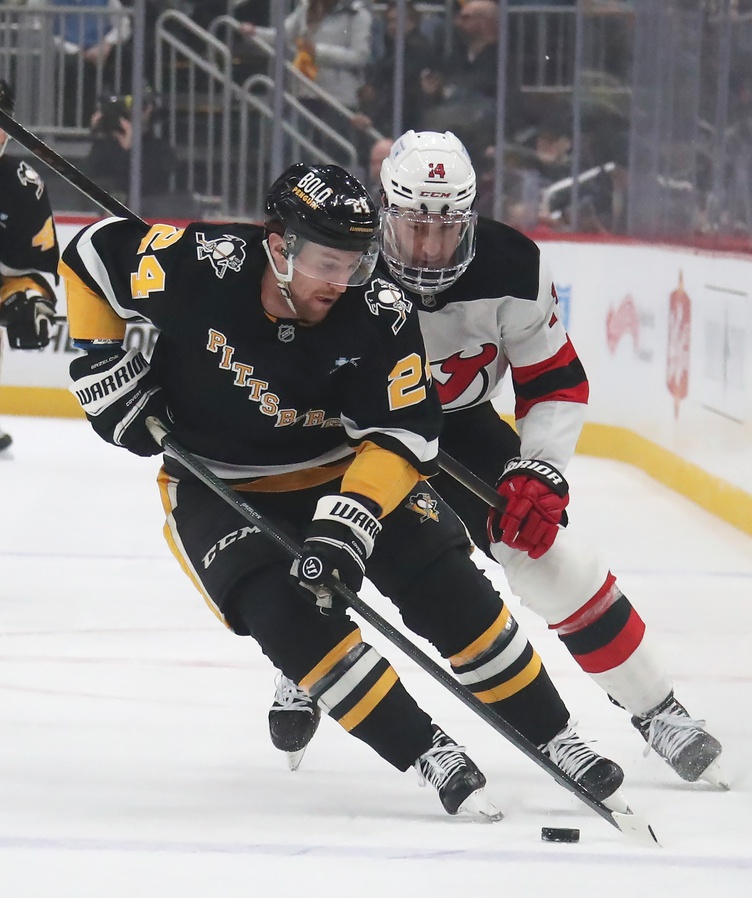 It’s not as though Grzelcyk lacks upside; he can operate on the second power-play unit, handles the puck well, and is quite active in transition. He averaged a career-high 20:37 per game, which should have boosted his stock this summer, along with his offensive output. So, why hasn’t Grzelcyk signed?
Grzelcyk’s stats are probably inflated because he was often paired with Erik Karlsson, and despite Karlsson’s flaws, he has a track record of making his teammates better, significantly better. Sure, Grzelcyk has a history of posting solid underlying numbers, but he didn’t show that last year, even though he spent a lot of time with Karlsson. His possession numbers weren’t significant in Pittsburgh, and in the years before his move there, many of Grzelcyk’s numbers were starting to decline, as shown by data from Top Down Hockey.
Numerous other significant issues are working against Grzelcyk. He is undersized, over 30, and there seems to be a trend among NHL general managers to move away from smaller defensemen, following the successful Florida Panthers model.
Grzelcyk specifically struggled during the playoffs and was a healthy scratch for the Boston Bruins on several occasions. Any team in its competitive window would be concerned about Grzelcyk’s poor playoff performance and likely deterred by his age and size.
Also, regarding Grzelcyk’s play, he is most effective on the power play (with 15 points last season), but he isn’t quite at the level to secure a spot on a top power-play unit. Most teams aren’t interested in bringing in a depth defenseman to run the second power-play unit.
That said, some teams might consider it, but most top NHL teams already have multiple defenseman who can do this role, or they might deploy four forwards on their power plays. Grzelcyk clearly provides value on the power play, but that role is probably better suited to a weaker team. Those teams usually aren’t in the market for an undersized defenseman who doesn’t excel defensively and is over 30.
Grzelcyk’s move through free agency might surprise some, but it feels like the signs were there well before July 1. The Penguins signed Grzelcyk last summer, and it seemed they were aiming to trade him at the NHL Trade Deadline for future assets.
After all, they did the same with Cody Glass and Anthony Beauvillier, but for some reason, Pittsburgh couldn’t pull the trigger on a trade for Grzelcyk. Maybe the Penguins didn’t want to move him, or perhaps they couldn’t get the fair value they deemed appropriate, but, strangely, a team with no playoff hopes and no reason to keep Grzelcyk past the deadline chose not to move him.
Finally, we come to Grzelcyk and what he was seeking this summer. No doubt, he was aiming for a raise from the $2.75MM he earned last season and was likely eyeing that three-year deal outlets projected for him.
However, the market never materialized for Grzelcyk, leaving him without a seat as the music nears its end. This isn’t the first time a player’s perceived value exceeds the market—it has happened many times across professional sports, including with former Penguins players like Evan Rodrigues in 2022, who had to wait until nearly mid-September to sign a one-year deal with Colorado after reportedly turning down better offers earlier in the summer.
Regardless of the reason for Grzelcyk’s current situation, one thing is likely clear: he will need to sign another one-year deal for the next season if he wants to stay in the NHL. A team could benefit from him if they put him in the proper role.
It’s unlikely to be Pittsburgh again, since they have around 14 defensemen of different skill levels who could play in the NHL this season. However, many other teams still need a puck-moving defenseman who can contribute at a low cost. Grzelcyk could fill that role, although he’s probably not joining a top contender given his limited playoff success.
Photo by Charles LeClaire-Imagn Images