
Poll: Who Wins The 2022 Stanley Cup Final?
With the only multi-day break in the 2022 Stanley Cup Final occurring between Games 1 and 2, both the Colorado Avalanche and Tampa Bay Lightning have plenty of time to process the events of a tight first game and adjust for the rest of the series. The Colorado Avalanche took a crucial overtime win at home to kick off the series, but both teams had their own flashes of brilliance to open the series.
As the Lightning have shown so far in these playoffs, though, no series lead against them is safe. One thing they can count on is the improvement of two important players: Brayden Point and Andrei Vasilevskiy. Point had an assist in 17:59 of ice time in Game 1, his first game in over a month and first game since the First Round. As he gets back to game speed, his ice time and compete level will only go up throughout the series, making the matchups tougher for the Avalanche and Jared Bednar. Vasilevskiy was also noticeably off his game at points on Wednesday, having issues tracking some pucks early in the game. He settled in, though, and as he has throughout these playoffs, will only get better as the series goes on.
The Avalanche are still waiting on Nazem Kadri to return to the lineup, who continues to practice and improve as he battles a thumb injury. Even if/when Kadri returns, he won’t be at 100%, and with how well the unit of Valeri Nichushkin, J.T. Compher, and Andre Burakovsky performed in Game 1, it might be better to try Kadri in a more limited role regardless. That would surely help the matchup game for Bednar, who would suddenly have a huge weapon to throw out with his depth forwards. Andrew Cogliano was also a full participant in today’s practice and could return for Game 2 on Saturday.
The question remains: will the Avalanche be able to hold onto their series lead and end the Tampa Bay run of championships despite their injuries and disadvantage in the crease? We ask you, PHR readers, to give us your take. Vote who you think will win the 2022 Stanley Cup Final in the poll below.
Who wins the 2022 Stanley Cup Final?
-
Colorado Avalanche 65% (610)
-
Tampa Bay Lightning 35% (322)
Total votes: 932
[Mobile users, click here to vote!]
Snapshots: Husso, Ducks, Penguins
It’s no secret that St. Louis Blues goaltender Ville Husso had a large breakout season in 2021-22. Written off as a bust as he dealt with injury issues in the minors, the organization’s former goalie of the future finally exploded for a 25-win rookie season, earning a .919 save percentage and two shutouts along the way. It was good enough to win him the starting job for the Stanley Cup Playoffs, but he had just a 2-5 record and a sub-.900 save percentage as Jordan Binnington reclaimed control of the crease (before his injury, at least).
Now, the 27-year-old Finn with just 53 NHL starts will be one of the top options for teams perusing the unrestricted free agent market for goalies. On The Jeff Marek Show earlier in the week, Sportsnet’s Elliotte Friedman mentioned the possibility of the Edmonton Oilers being interested in Husso this offseason. Friedman notes that there were rumors of the Oilers making Husso a mid-season acquisition around the turn of the calendar year, also making note of the fact that the Oilers could be without Mike Smith next season, either due to retirement or long-term injury reserve. With Edmonton already losing Mikko Koskinen this offseason, the organization needs more than just promising youngster Stuart Skinner in the crease. While Smith being unavailable may still force Skinner into an NHL role next season, it prevents him from having to be “the guy” too early in his development.
- The Anaheim Ducks are entering what could be a transformative offseason under new general manager Pat Verbeek after the organization’s young talent took big steps forward in 2021-22. In a piece for The Athletic, Eric Stephens names a list of young players who the Ducks could take a flier on to add to that talent pool, including Carolina’s Martin Necas and Ethan Bear, Edmonton’s Jesse Puljujarvi, Detroit’s Filip Zadina, and Chicago’s Dominik Kubalik. All of them have been mentioned in trade rumors recently after falling down the depth charts of their respective organizations. With a lot of turnover expected in Anaheim this offseason, due in part to the retirement of captain Ryan Getzlaf, Anaheim could give a chance to one of these players to excel in more important roles.
- Continuing their run of front office announcements, the Pittsburgh Penguins today named Teena Murray as their senior vice president of integrated performance. As the Pittsburgh Post-Gazette’s Mike DeFabo notes, Murray will oversee the strength and conditioning staff, rehabilitation, sports science, and medical staff, reporting directly to general manager Ron Hextall. Considering Pittsburgh’s long history of injury-prone seasons, it’s an important role to fill for this team.
Philadelphia Flyers Officially Name John Tortorella Head Coach
9:02 AM: The Flyers have officially announced the hiring of Tortorella, but did not confirm the financial terms. The Athletic’s Arthur Staple reports that the finalists for the job were Peter DeBoer and former New York Islanders head coach Jack Capuano.
4:25 PM: ESPN’s Kevin Weekes reports that Tortorella’s deal with the Flyers is a four-year, $4MM per year contract.
3:21 PM: After days of it seeming like an eventuality, John Tortorella is expected to officially be named the next head coach of the Philadelphia Flyers. The Athletic’s Charlie O’Connor reported this morning that final negotiations were underway and that an official announcement could come tomorrow, but The Fourth Period’s Anthony Di Marco now reports that an official announcement could come as soon as tonight and that the organization is “moving forward” with Tortorella as their new head coach.
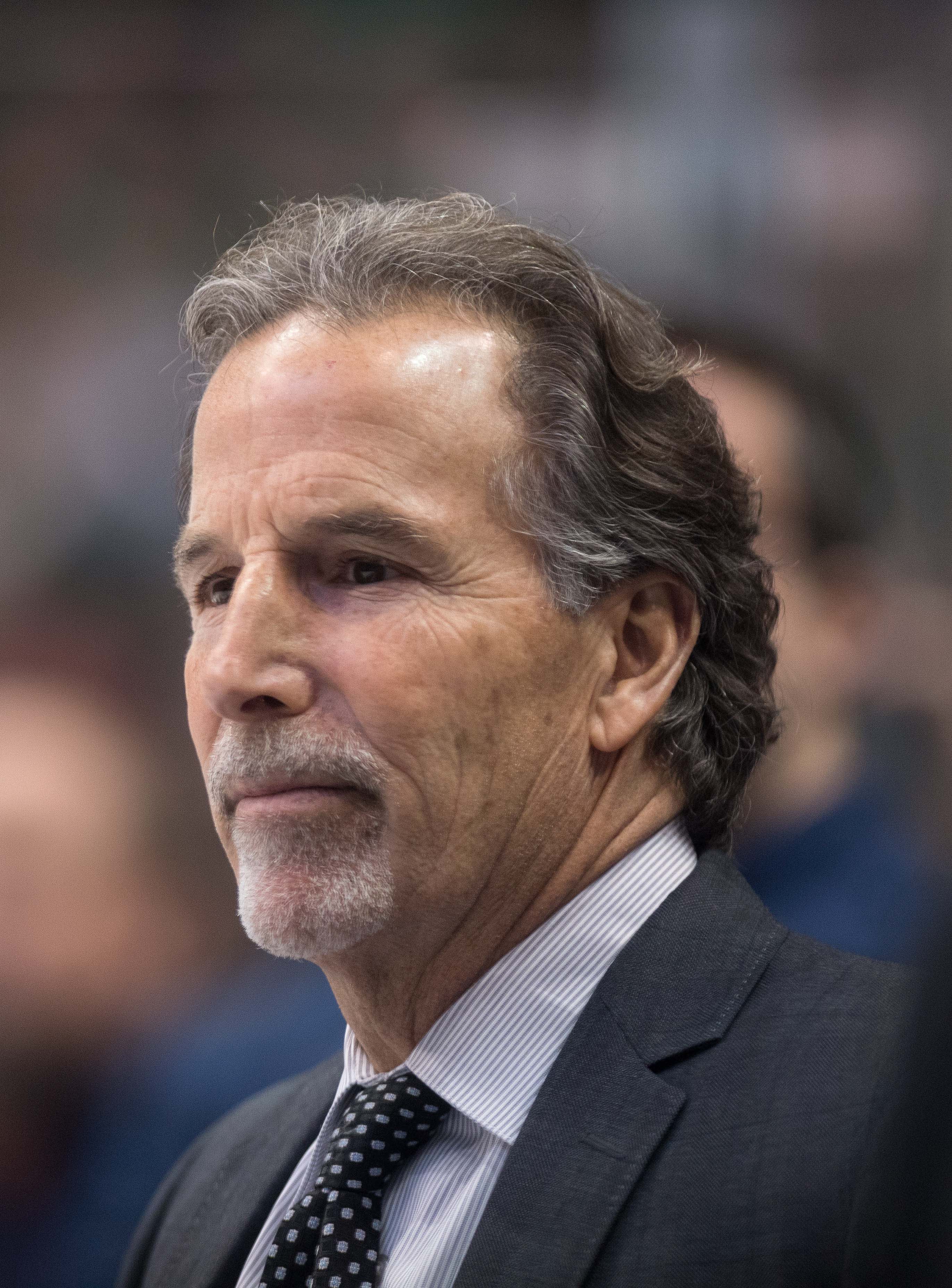 We’ve gotten an unusually extensive amount of reporting on the Tortorella hiring process. It’s been known for a few days now that the team had zeroed in on Tortorella as a candidate and that the hiring was likely, but negotiations between the two sides had not been completed. Now, it seems like that process is done, although it’s unclear whether the terms of the deal will be made public.
Tortorella joins his fifth NHL team as a head coach and his fourth Eastern Conference team, with his one season spent in Vancouver as his lone Western Conference head coaching experience (2013-14). He ranks 13th all-time in games coached (1,383), 14th in wins (673), and has a 2004 Stanley Cup ring with the Tampa Bay Lightning to show for his illustrious career.
After his second gap year in the past decade, Tortorella returns to the NHL with the goal of quickly restoring a competitive team in Philadelphia. Whether that happens is a different story entirely. Of note, in his first entire season as coach of the Columbus Blue Jackets in 2016-17, he took a team that had finished below the .500 mark the previous year to their only 100-point season in franchise history. However, that was a team spearheaded by a list of quality young players, most notably Zach Werenski and Seth Jones on defense, that the Flyers simply don’t have to offer. Nor do they have a goalie with the track record that Sergei Bobrovsky had at that point, who earned his second Vezina trophy that season with a .931 save percentage and 41-17-5 record.
While a healthy Sean Couturier and Ryan Ellis should give the Flyers a large boost next season, Tortorella will be tasked with the job of helping the team navigate their post-Claude Giroux era. He’ll be charged with restoring the ceilings of players like Travis Konecny and Oskar Lindblom up front and continuing the positive development of Joel Farabee. He’ll also need to institute a system that can help Ivan Provorov and Rasmus Ristolainen on the back end after some rough defensive seasons.
None of it will be an easy job in the Metropolitan Division. With the New York Rangers and Carolina Hurricanes poised to dominate again next season, they’ll also have the Blue Jackets and New Jersey Devils as on-the-rise teams to battle with.
Free Agent Focus: Philadelphia Flyers
Free agency is now less than a month away and many teams are already looking ahead to when it opens up. There will be several prominent players set to hit the open market in mid-July while many teams have key restricted free agents to re-sign as well. Next up is a look at the Flyers.
Key Restricted Free Agents
F Morgan Frost — Frost, 23, has had high expectations placed on him since he was drafted 27th overall at the 2017 draft. Frost was a prolific scorer at the junior level, notching over 100 points in his final two seasons for the Soo Greyhounds of the OHL. In Frost’s first professional season he flashed that scoring talent as well, potting 13 goals and 29 points in 41 games. Frost also got into 20 NHL games, and posted a respectable seven points, although he did at times struggle with the pace and physicality of the NHL game. A dislocated shoulder cost Frost almost all of the 2020-21 season, and this past season was one that wasn’t the clear developmental step forward that many hoped it’d be. Sure, he scored well at the AHL level, with 19 points in 24 games, but he was shuttled between the NHL and AHL level multiple times before settling in and getting into a total of 55 games for the Flyers. He finished with 16 points in 55 games at the NHL level, including four in his last five games, and at times flashed the offensive upside that made him such a tantalizing prospect in the first place. His two-way game is still a work in progress, though, and it remains to be seen if Frost can truly stick down the middle long-term at the NHL level. His overall upside is still very much a mystery, and as a result, his next contract is complicated. If the Flyers remain major believers in his upside, he could always ink a long-term deal, but that seems highly unlikely, especially since he was not a draft pick of GM Chuck Fletcher. A one or two-year bridge contract seems most likely.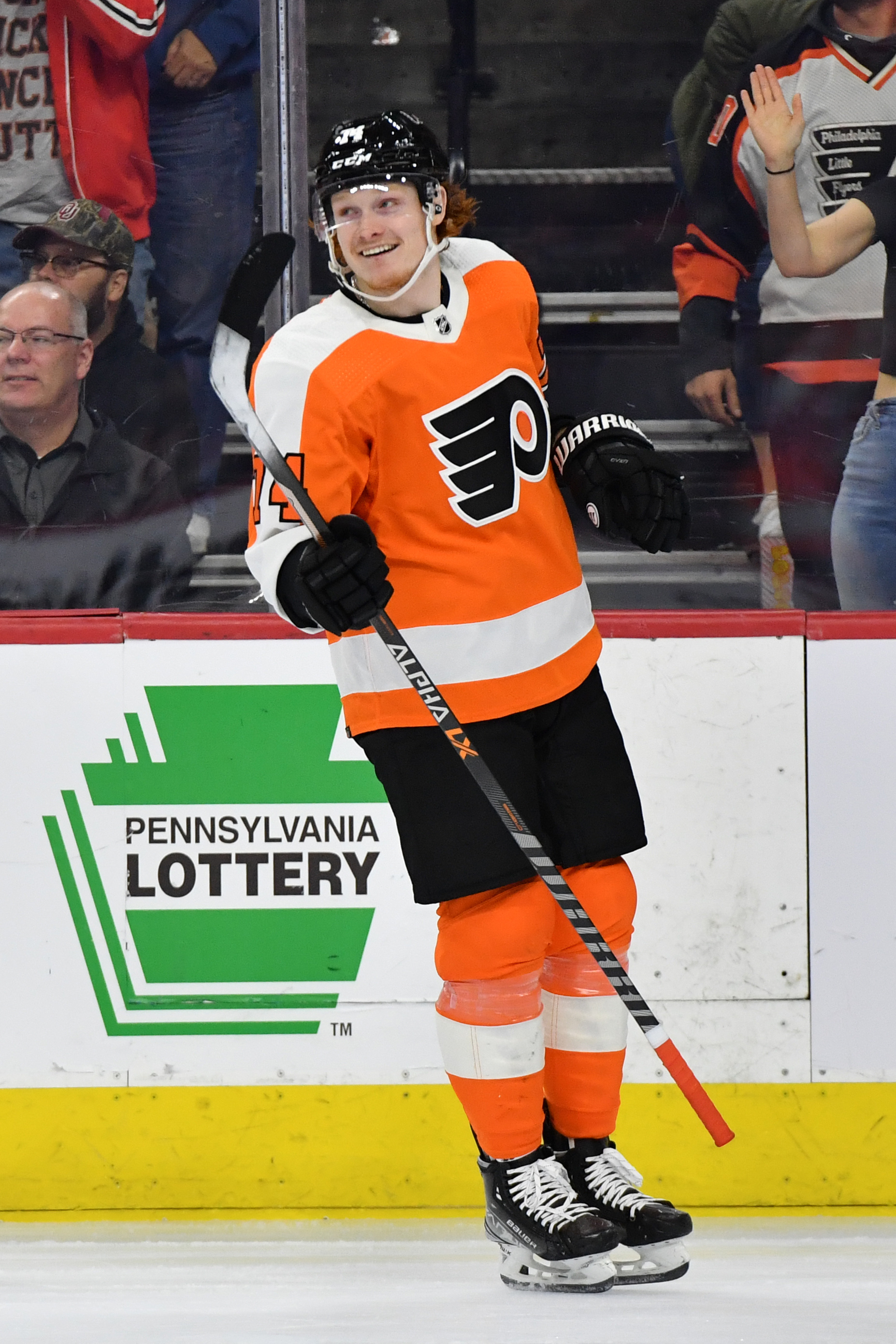
F Owen Tippett — Tippett, in some ways, is a lot like Frost. He’s also a 2017 first-rounder who has yet to establish himself as a full-time NHL-er but has also flashed the potential that got him drafted so high in the first place. Tippett came to Philadelphia as part of the Claude Giroux trade, and in his stretch as a Flyer (often playing on a line with Frost) Tippett had the up-and-down play that one would expect out of a highly skilled but also flawed young player. Tippett finished with seven points in 21 games, and also had 18 points in 14 games at the AHL level, a more clear reminder of the offensive talent he possesses. Like Frost, a short-term bridge makes the most sense for Tippett, who should come in at around a $1MM cap hit, if not lower.
F Zack MacEwen — MacEwen was claimed off of waivers from the Vancouver Canucks at the start of the 2021-22 season, and was one of only seven Flyers to reach the 75 games played mark. MacEwen, 25, is a hard-nosed grinder whose NHL minutes come thanks to his physicality and relentless motor. MacEwen isn’t much of an offensive producer — he had only nine points in 75 games in 2021-22 and has 18 points in his 130 career NHL games — but he plays a role many coaches still want in their lineup and does so at a cheap price. MacEwen played on an $825k cap hit this year and as he’s an arbitration-eligible restricted free agent, expect a small raise from that number to reward his hard work and availability.
Other RFAs: F Wade Allison, F Jackson Cates, F Hayden Hodgson, F Tanner Laczynski, F Isaac Ratcliffe, F Matthew Strome, F Maksim Sushko, D Linus Hogberg, G Kirill Ustimenko
Key Unrestricted Free Agents
F Nate Thompson — It’s been clear what Nate Thompson can bring at the NHL level for many years now. The 37-year-old center has been a bottom-six staple for nine NHL teams since making his debut in 2006-07. Thompson plays around 10-12 minutes per night, helps a second penalty-killing unit, and wins over half his draws. Thompson may not have a ton of gas left in his tank as he gets deeper into his late thirties, but if he still wants to play it’s easy to imagine him finding another suitor for the well-defined package of skills he brings. He clearly has an affinity for Philadelphia as well, as he signed up to return to the organization as a free agent after a year in Winnipeg, having first joined the Flyers as part of a 2020 trade with the Montreal Canadiens. It remains to be seen if the team’s expected next head coach, John Tortorella, will want Fletcher to retain his services, but if he does then Thompson could probably be had for around the $800k cap hit he played on this past season.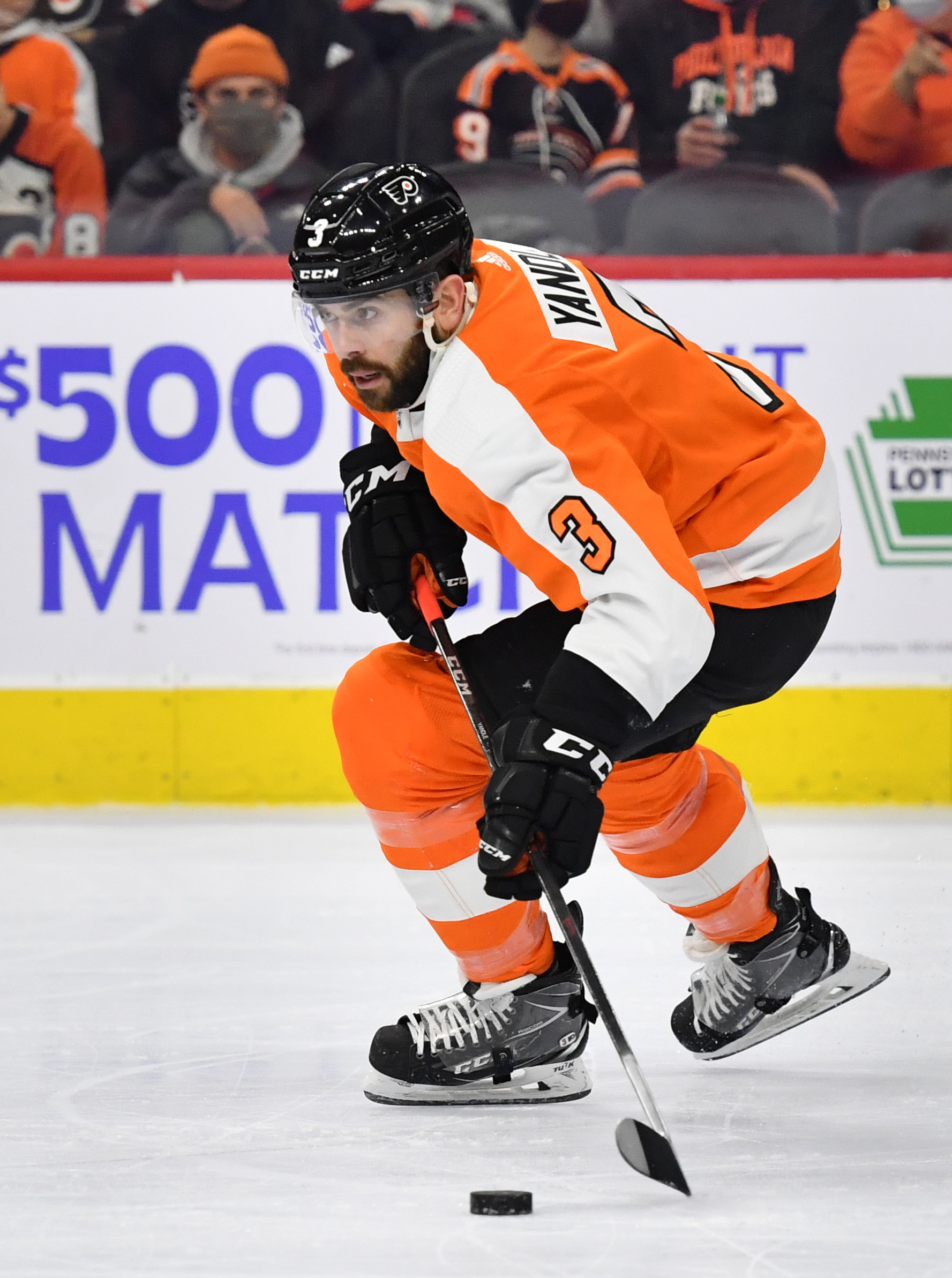
D Keith Yandle — Yandle was the subject of some controversy this season, as the Flyers snapped an “iron man” streak of consecutive games played that had lasted since 2009. Yandle is a well-liked locker room voice and a highly respected veteran, although his play on the ice has slipped considerably. After being bought out of his massive seven-year, $44.45MM deal, Yandle signed a one-year, $900k deal with the Flyers. He provided his trademark offense, albeit to a decreased degree, notching 19 points in 77 games. He also showed the defensive deficiencies that have plagued his game for years, deficiencies that have become even more pronounced as he’s aged. While Yandle is a player deserving of the utmost amount of respect for the career he’s had so far, it’s difficult to imagine a return to Philadelphia is in the cards for him. But given all that he’s put forth to date, he should probably be able to catch on somewhere this summer with a chance to make a team at a training camp next fall.
G Martin Jones – Like Yandle, Jones joined the Flyers after an offseason buyout forced an exit from his previous team. Unlike Yandle, though, Jones’ 2022 season was a quiet one. He got into 35 games and posted a .900 save percentage, a performance that isn’t anything to write home about. That production is made more palatable, though, by the fact that he was playing behind one of the NHL’s worst teams. The Flyers were a mess last season, and Martin Jones was far down on the list of their biggest issues. Jones is a veteran of nearly 400 NHL games and has flashed brilliance in the past, like when he led the San Jose Sharks on a run to the Stanley Cup Final in 2015-16. He’s a backup goalie who has in the past shown an ability to handle starter-level workloads, so another contract around the $2MM he earned this year, if not a touch lower, seems fair.
Other UFAs: D Kevin Connauton, F Ryan Fitzgerald, D Adam Clendening, D Brennan Menell, G Felix Sandstrom
Projected Cap Space
The Flyers enter an offseason where getting the team on track after two hugely disappointing years is a number-one priority. They have just over $5MM in cap space at the moment and their pending restricted free agents figure to occupy a small chunk of that. The real “X-factor” for this Flyers’ offseason, from a cap perspective, comes from whatever they choose to do with some of their highly-paid veterans. Defensemen Ivan Provorov and Travis Sanheim, making $6.75MM and $4.675MM against the cap, respectively, have each been the subject of trade rumors, as has winger James Van Riemsdyk, who is entering the final year of his $7MM-AAV deal. If the Flyers want space to aggressively upgrade their roster next month, they’ll likely have to move one of their major contracts.
Photos courtesy of USA Today Sports Images. Contract information courtesy of CapFriendly.
Tampa Bay Lightning Extend Sean Day
While the Lighting’s main focus has to be on tying their Stanley Cup Final series against the Colorado Avalanche, that hasn’t stopped their front office from getting some offseason work done early. Today the Lightning announced that they have re-signed defenseman Sean Day to a one-year, two-way contract. Per CapFriendly, the deal carries a $750k cap hit, a $750k NHL salary, a $200k AHL salary, and $225k in total guarantees.
Day, 24, is perhaps best known for being one of the few players granted exceptional status by the Ontario Hockey League. As an “exceptional player,” Day joined an elite group of OHL players including John Tavares, Connor McDavid, and Aaron Ekblad. Unfortunately, Day did not live up to his exceptional-status billing. While he wasn’t a bad OHL-er by any means, he struggled to be a true difference-maker until he got older and ended up on three different OHL teams during his five-year major junior career.
Day was drafted with the New York Rangers’ top pick at the 2016 draft, going 81st overall. The Rangers signed Day to his entry-level deal and at the conclusion of his OHL career plugged him into their minor league system. He bounced between the AHL and ECHL levels for his first two professional seasons before his contract was terminated, he became a free agent and signed with the Tampa Bay Lightning. With the Lightning’s affiliate, the Syracuse Crunch, Day become an AHL regular and this past season registered his most successful year as a pro, scoring 40 points in 69 games. Day averaged just under 19 minutes of time on ice per game, and his breakout AHL year led him to his first NHL call-up. Day got into two NHL games this year and averaged 10:43 time on ice per game.
Day’s one-year extension gives him the chance to stay in Syracuse and continue a career trajectory that’s pointed upwards ever since the start of 2021-22. While he may never end up fulfilling the potential he held as a junior, he seems to be on his way toward carving out a role as dependable organizational depth for one of the top franchises in the NHL.
Canadiens Notes: Anderson, Petry, Richardson
After dealing his team’s captain to the Vegas Golden Knights, Montreal Canadiens GM Kent Hughes met with the media to discuss the trade and answer questions. As part of the press conference, Hughes was asked about winger Josh Anderson, who has recently become the subject of trade rumors. Hughes was transparent about the situation, saying that they have had “many” teams call about Anderson, both around the trade deadline and more recently. Hughes said that while he wouldn’t be actively seeking to trade Anderson, he would be listening to any deal that could help the Canadiens.
While Anderson didn’t have a season to remember in 2021-22, it’s not hard to see why he would be of interest to contending clubs. The former 27-goal scorer has the rare combination of speed and power in his game that many GM’s covet, and he’s under contract through 2026-27. While the way Anderson’s contract will age as he accumulates more wear-and-tear on his body and gets deeper into his late twenties is an open question, it’s clear that GM’s are willing to look past those potential issues in order to acquire the unique player that Anderson is today. Whether a trade will actually happen, though, is unknown. But what we did learn from Hughes today is that the possibility of an Anderson trade is very much real.
Now, for some other notes regarding the Montreal Canadiens:
- One of the other Canadiens players often mentioned in trade rumors is defenseman Jeff Petry. Hughes has previously attempted to accommodate Petry’s desire for a trade, but has been unable to find a deal so far. Today, Hughes was asked about Petry’s situation and clarified that it’s unlikely to be a deal that gets consummated at this stage of the offseason. Hughes noted that teams are still “evaluating their needs,” and as a result, it could be harder to move the defenseman, especially given that he is 34 years old and carries a $6.25MM cap hit. While Petry undoubtedly had a down season in 2021-22, he did play better after the Canadiens hired Martin St. Louis. Under St. Louis, Petry had 21 points in 30 games and flashed the high-end form he displayed in 2020-21, when he had 42 points in 55 games. So while he’s certainly not an untradeable asset, Hughes’ comments indicate that the contract situations of fellow right-shot offensive defensemen such as Dallas’ John Klingberg may need to reach their conclusions before Petry’s can be solved.
- It was previously reported that Canadiens assistant coach Luke Richardson had interviewed with the Chicago Blackhawks for their head coaching vacancy, and Hughes confirmed as much in his media availability, stating that Richardson and the Blackhawks had met within the last 48 hours. Hughes also noted that Richardson was “in line” for a second interview with the Blackhawks and that he would not leave the Canadiens for anything other than a head coaching job. While the Canadiens’ coaching staff looks set for next season, the departure of Richardson, the most experienced coach on the staff, would create a hole that would need to be filled. With little NHL experience shared between head coach Martin St. Louis and assistants Alexandre Burrows and Trevor Letowski, the departure of Richardson would likely mean that the Canadiens would enter the market for an experienced assistant to help their young coaches handle the challenges that come with NHL life.
NHL Officially Announces Salary Cap, Salary Floor For 2022-23 Season
Two effectively retired players have been traded so far this offseason, and the reason for those deals has been simple: the salary cap. While the importance of effectively managing the salary cap is ever increasing, the cap itself is not. The NHL and NHLPA officially announced today that the league’s payroll upper limit (salary cap) for next season would be $82.5MM. The league also announced that the lower limit, or salary floor, would be set at $61MM.
The announcement confirms what many believed, that the salary cap would rise only $1MM from this past season’s number, a small increase due to the financial implications of the COVID-19 pandemic on the league. Because the NHL and NHLPA have collectively bargained a 50-50 split in terms of the league’s hockey-related revenue, a portion of player salaries are held in escrow and potentially surrendered to the league in order to ensure the integrity of the 50-50 split. The NHL lost a significant amount of money during the pandemic, in large part due to the fact that they needed to play games in arenas without fans or with significantly reduced capacity crowds. While the NHL’s clubs lost significant sums due to that lost revenue, the players’ salaries were unchanged, meaning the players have a “debt” that they owe to the league in order to ensure a proper 50-50 split, and that “debt” is paid through the escrow system. So, until the players fully “pay off” the “debt” that they owe as a result of the pandemic, the cap will rise only a minimal amount as we see for next season.
For some teams, this “flat-cap” reality has created significant problems. Many teams gave out significant, long-term contracts likely with the idea that those contracts would age better as the salary cap rose. That hasn’t happened yet, though, which is part of why we’ve seen such increased attention to how teams manage the salary cap. For other teams, the salary cap staying flat is largely irrelevant to their own payroll management. Teams like the Buffalo Sabres are actually below the cap floor, meaning their main concern is adding enough salary to stay above the league’s minimum team payroll. The Sabres and other teams now have certainty on the league’s cap floor, and it’s possible that we see more trades like the recent Ben Bishop deal as rebuilding clubs look to reach the cap floor with as much efficiency and as little real cash paid as possible.
New York Rangers Extend Sammy Blais
While the Montreal Canadiens and Vegas Golden Knights make major trades, the New York Rangers have been content to spend their early offseason getting some smaller business done first. A few days ago, the Rangers signed prospect Vitali Kravtsov to a one-year extension, and now they have reached another one-year extension with one of their players. Per CapFriendly, the Rangers have signed forward Sammy Blais, who was a pending restricted free agent, to a one-year, $1.525MM extension. The deal comes in just below what Blais’ qualifying offer was set to be.
Blais, 25, receives his next contract at a lower mark than his qualifying offer, likely because he only got into 14 games this season. After being acquired from the St. Louis Blues as part of the Pavel Buchnevich trade, Blais entered the Rangers lineup and played with his trademark physical, crash-and-bang style. The six-foot-two, 210-pound winger registered four assists on almost 13 minutes of ice time per game before going down with a torn ACL, an injury that ended his season. Blais hasn’t been able to cement himself as a true NHL regular, although his injuries have definitely played a role in that. With this one-year deal, Blais gets an opportunity to finally prove he is an everyday player on a strong Rangers team.
This extension makes Blais a pending unrestricted free agent entering next year, heightening the importance of next season for the player. For the team, getting Blais at a number just below his qualifying offer is a nice early step in the Rangers’ offseason. With major contracts for Mika Zibanejad and Adam Fox set to kick in, there will be some belt-tightening this offseason in New York. The Rangers have several crucial players set to hit either unrestricted or restricted free agency, including Ryan Strome, Andrew Copp, and Kaapo Kakko. Getting as much certainty on free agents lower on New York’s depth chart, like Blais and Kravtsov, should help GM Chris Drury enter the more high-stakes summer negotiations with a clearer sense of his team’s cap position.
Vegas Golden Knights Acquire Shea Weber
On the day that the Vegas Golden Knights introduced their new head coach to their fans, they also completed a major trade. The Montreal Canadiens and Golden Knights have each announced a deal: Shea Weber for Evgenii Dadonov. The Athletic’s Pierre LeBrun confirmed that neither player is being traded with salary retained.
While this trade is a one-for-one deal, it’s anything but simple. Weber, the Canadiens’ captain, is effectively retired due to his injuries and is not expected to ever suit up for another NHL game. One might wonder, then, why the Golden Knights would be interested in acquiring him. But the motivation for the Golden Knights is simple: because Weber is expected to stay on long-term injured reserve for the remainder of the four years left on his contract, his $7.8MM cap hit for each of those years effectively does not count against Vegas’ cap. LTIR is quite a bit more complicated than that in reality, but in easily explainable terms that’s basically what will happen.
So, the Golden Knights rid themselves of Dadonov’s $5MM cap hit, a deal they already attempted to trade at the deadline, in exchange for Weber’s contract that must be placed on LTIR. Teams using LTIR cannot accumulate cap space over the course of a season, meaning the Golden Knights will be harder-pressed to go on a trade deadline spending spree like the New York Rangers were able to do this year thanks to their stockpile of accumulated cap space. But given Vegas’ aggressive use of LTIR in the past it’s likely the team is making this deal assuming they would be using LTIR already, regardless of Weber’s presence.
With all that explained, this trade helps Vegas alleviate the cap crunch that had the potential to wreck their offseason. We previously covered how the Golden Knights were actually above the salary cap, and urgently needed to find a way to clear space. With this trade, the Golden Knights commit themselves to being an “LTIR team” for the remainder of Weber’s contract in order to rid themselves of Dadonov’s cap hit without needing to trade any picks or prospects.
For the Canadiens, GM Kent Hughes had already expressed an interest in moving Weber’s deal, indicating that they were close to a deal with the Arizona Coyotes at the deadline. The Coyotes ended up acquiring Bryan Little‘s contract instead, nixing the possibility of that trade. Now, Hughes has found another avenue to trade Weber’s contract, and instead of needing to trade prospects or draft picks like the Jets needed to trade Little to Arizona, the Canadiens simply needed to take on Dadonov’s unwanted cap hit to facilitate the deal.
In Dadonov, the Canadiens acquire a player with one year left on his contract at a $5MM cap hit. Dadonov was one of Vegas’ better players last year, riding a scorching final two months of the season to a 20-goal, 43-point campaign. The Canadiens could definitely opt to play Dadonov next year to help their scoring, but it’s also possible that their front office chooses to dangle Dadonov to other teams looking for a scorer. Of course, if Dadonov could be easily dealt for a quality return, the Golden Knights would likely have done that themselves. But the Canadiens do have the option to retain 50% of Dadonov’s deal to make him a more attractive asset, something the Golden Knights would likely not have been able to do.
In a world where many look to find a “winner” and a “loser” of every trade, this deal looks like one that should reasonably benefit both sides. The Golden Knights get something they desperately desire: cap relief, and at a cost that does not siphon even more assets from their depleted stock of draft picks and prospects. The Canadiens, depending on the health of Carey Price, of course, make it so they no longer need to utilize LTIR to remain cap compliant, and they add a player who can help their forward corps for the one year remaining on his deal.
Photo courtesy of USA Today Sports Images
Hockey Canada Names Men’s U20, U18 Team Selection Camp Rosters
As the 2022 event cycle begins to come to a close, aside from the postponed 2022 World Juniors set to take place in August, national team organizations begin to look to the 2023 calendar. Today, Hockey Canada named their rosters for the National Men’s Junior Team summer development camp, as well as the National Men’s Summer Under-18 Team selection camp.
The National Men’s Junior Team roster is comprised of talent from the 2021 NHL Draft, as well as the upcoming 2022 and 2023 NHL Drafts. Among the top NHL-affiliated talent attending the camp is Chicago Blackhawks D Nolan Allan, Columbus Blue Jackets D Corson Ceulemans, Dallas Stars F Wyatt Johnston, Los Angeles Kings D Brandt Clarke, Nashville Predators F Zachary L’Heureux, New Jersey Devils F Chase Stillman, New York Rangers F Brennan Othmann, St. Louis Blues F Zachary Bolduc, and Vegas Golden Knights F Zach Dean. Clarke was notably snubbed from the 2022 World Juniors roster.
In terms of 2022 eligibles to watch at selection camp, the list is as follows: F Luca Del Bel Belluz, F Jagger Firkus, F Nathan Gaucher, F Conor Geekie, F Ryan Greene, F Tucker Robertson, F Matthew Savoie, F Reid Schaefer, D Kevin Korchinski, D Christian Kyrou, D Tristan Luneau, D Denton Mateychuk, D Owen Pickering, G Tyler Brennan, G Chase Coward, and G Thomas Milic. Forwards Nate Danielson and Adam Fantilli also made the camp roster as 2023 eligible. Really, the only 2022 top-ten lock from that list is Savoie, but Geekie, Korchinski, and Mateychuk are also names that could work their way into the first selections.
The U18 roster is made up of 2023 and 2024 eligible players, and it’s highlighted by a trio of 2023 forwards: Zachary Benson, Matthew Wood, and Brayden Yager.