
The Devils Have Spent Efficiently This Summer
The Devils had a disappointing first-round exit in this year’s playoffs, which capped off a frustrating season marked by injuries to key players, inconsistent play, and a bottom six that underperformed. The team started the season well but struggled in the second half, failing to meet the high expectations that had been set for them.
While it was undoubtedly a disappointment, there were lots of takeaways for the young Devils stars, and it should help them in the long run. The Devils entered the summer with a handful of small holes and did well to make some improvements without overspending in the free agent market. This should enable them to maintain their core and surround their stars with a formidable supporting cast.
New Jersey entered the off-season with just over $12MM in cap space and a few issues to resolve. Their first move was to trade forward Erik Haula and his $3.15MM cap hit to the Nashville Predators for a fourth-round pick and Jeremy Hanzel. The 34-year-old Haula had been a dependable player for the Devils, but his decline in offensive production last season (11 goals and 10 assists in 69 games) made him expendable, and the Devils acted quickly to make the trade. This move allowed the Devils to enter free agency with $15MM in cap space, which they promptly used to sign forwards Connor Brown and Evgenii Dadonov.
The 31-year-old Brown regained his form last season with the Edmonton Oilers, reaching the 30-point mark for the first time since the 2021-22 season. Brown was once a reliable depth scorer, but injuries and inconsistency interrupted his production for a couple of seasons before his resurgence last year.
Brown signed a four-year, $12 million contract and is expected to provide the Devils with steady bottom-six minutes while creating offensive chances for himself and his teammates. He remains a good skater, which helps him defensively and also allows him to carry the puck effectively and drive transition plays.
While his deal might be a bit lengthy, the cap hit is quite manageable and shouldn’t hinder New Jersey too much in the latter part of the contract. He could see time on New Jersey’s third line, possibly alongside Dawson Mercer.
The one-year deal that Dadonov signed for a $1MM base salary was a significant discount for a player who recorded 20 goals and 40 points last season in 80 games. The 36-year-old received less than a minute per game on the power play and did most of his offensive work at 5-on-5, tallying 33 of his 40 points.
Dadonov doesn’t drive play like he used to, but he remains a capable passer who can still skate well and should be able to provide the Devils with valuable minutes at minimal cost. Surprisingly, he had to accept such a low number, but considering his age and the fact that teams are prioritizing youth, there might not have been much of a market for his services.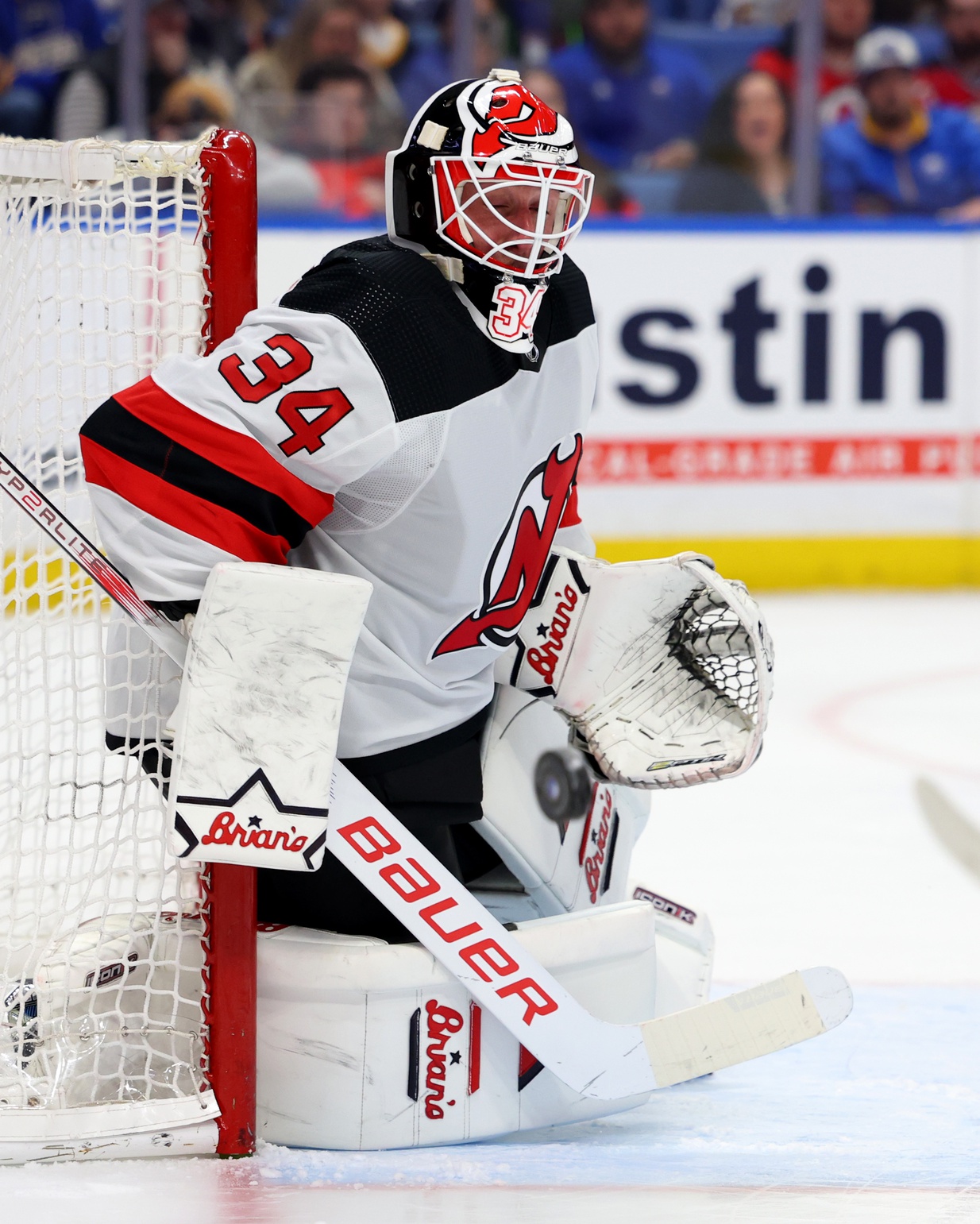
Another solid move the Devils made was re-signing backup goaltender Jake Allen to a five-year, $9MM contract. The 34-year-old was the top goaltender available in free agency, and many thought he would earn over $4MM per season, with AFP Analytics projecting a two-year deal worth $7MM.
Allen did better financially, spreading his earnings over an additional three years, but it was well short of the $5MM per season he reportedly sought at the end of June. Last season, Allen’s numbers were well above average, with a 2.66 goals-against average and a .908 SV%.
A closer look reveals he was more excellent with the Devils than those numbers indicate, posting 18.4 goals saved above expected (per MoneyPuck). The Devils did a great job keeping Allen’s cap hit as low as possible and retained one of the better backup options in the NHL for less than the typical rate for backups.
The deal might cost more in total years, but by years four and five, New Jersey could likely bury Allen’s cap hit in the AHL for minimal cost if needed. The rising salary cap will also influence years four and five, as Allen’s $1.35MM salary could be near league minimum depending on revenues at that time.
The Devils also made several depth AHL signings, adding forwards Angus Crookshank and Juho Lammikko, as well as defenseman Calen Addison. These moves are likely to have minimal impact at the NHL level but should provide Utica with valuable players and potential call-up options.
Now that much of their business is done, the Devils will focus on signing defenseman Luke Hughes to a long-term deal. AFP projected he could receive $5.75MM annually on a three-year bridge deal or $8.386MM on a six-year long-term contract.
With the Devils holding about $6.9MM in available cap space, they may decide to go short-term with the 21-year-old and delay more permanent commitments to maintain flexibility heading into next season.
The Devils’ summer won’t blow anyone away, but adding a couple of forward pieces and keeping their goaltending depth with minimal cap space was a good move for a team that plans to run it back with almost the same core, assuming they re-sign Hughes. This time, the Devils will be hoping for better luck and more consistency.
Photo by Timothy T. Ludwig-USA TODAY Sports
Submit Your Questions For A CBA Q&A
The NHL and NHLPA today released the full text of their new Collective Bargaining Agreement and Memorandum of Understanding, set to take effect ahead of the 2026-27 season. The two sides officially ratified the four-year extension on Tuesday, with many key details about the document already reported.
Still, some of the finer details may have gotten lost in translation or were not completely made public before today. As a result, we’re running a special-edition mailbag/Q&A about the new CBA and MOU. Submit your questions about the extension in the comment section below, and PHR’s Josh Erickson will comb through both documents to find the answer.
The mailbag will run on Tuesday, July 15.
Tristan Luneau Poised To Make Big Impact For Ducks
The Anaheim Ducks have quietly built an impressive stockpile of talented, young defenders. Players like Jackson LaCombe, Olen Zellweger, and Pavel Mintyukov are beginning to prove as much on the left-hand side, but Anaheim is still searching for that same kind of breakout on the right-side. After a fantastic rookie season in the minor leagues, Tristan Luneau who seems best positioned to bring exactly that jolt as soon as next season.
There’s a steep learning curve for young defenders transitioning to the pro flight – especially for slight-framed, puck-movers who don’t engage physically like Luneau. He showed signs of those struggles in the seven NHL games, and six AHL games, he played through in the 2023-24 season. While Luneau’s three points in the NHL was an impressive jump to production, he struggled to clear out the front of the net or stop opponents from entering the defensive end. Luneau was set to mitigate those early-career learning pains with a trip to the 2024 World Junior Championship – where he surely would’ve dominated his younger peers – before an illness and eventual knee infection effectively ended his season before the tournament even began.
With that, Luneau’s first year of pro hockey – and his first chance to represent Team Canada – came to an abrupt close. It left the Victoriaville-native in a confusing spot. His nifty puck-handling and blue-line playmaking translated seamlessly to the top flight, but he showed through multiple areas of needed growth. With a long-term absence to boot, Anaheim opted for the safe approach for Luneau’s return in the 2024-25 season – defaulting him to the minor-leagues for the entire season after a brief, six-game stint in the NHL in October.
A year removed, that decision has paid dividends. Luneau finished the year with 52 points in 59 games. That scoring pace – 0.88 points-per-game – is the third-highest a U21 defender has managed in the AHL since 2000, and interestingly the highest from a defender outside of the Los Angeles Kings pipeline (Brandt Clarke, 0.92 in 2023-24; Jordan Spence, 0.91 in 2021-22). On top of reaching a tremendous scoring height, Luneau also added a heap of confidence in the gritty areas of the ice. He was diving into puck battles and scrums in the slot with the prowess his 6-foot-1, 195-pound frame should provide. The result was not only an increased ability to win pucks in the corners, and hold his ground in the slot – but truly more opportunities for Luneau to win possession and command movement up the ice.
He, in many ways, returned to the end-to-end commander role he became known for in the QMJHL. Luneau was creating as many plays as he joined, and worked his way onto the AHL’s end-of-season All-Rookie team as a result. He was once an incredibly high-regarded prospect, earning first-round acclaim through points of his juniors career. Anaheim eventually landed Luneau in the middle of the 2022 second-round, and early returns seem to suggest he’s on the way to becoming a day-two steal. Luneau showed his ability to score at a top level through his first seven games in the NHL two seasons ago. Now – after vindicating that ability with a dominant year in the minors – he’s added the additional oomph needed to stretch his offense across a full season.
With a season-ending injury now well in the rearview mirror, Luneau seems poised to jump quickly back into the NHL, where his downhill-drive could pair perfectly with the all-three-zones ability of LaCombe or Mintyukov. He’ll be a favorite to make the Ducks roster directly out of training camp, and could soon be yet another young player to find his way to success on the Anaheim blue-line.
Players With Trade Protection In 2025-26
The following players have some form of trade protection for the duration of the 2025-26 league year, according to PuckPedia.
Trade protection comes in three forms: no-movement clauses (NMCs), no-trade clauses (NTCs), and modified no-trade clauses (M-NTCs). No-movement clauses are blanket protection save for buyouts, so the player is also protected against a waiver placement and subsequent AHL assignment unless they approve it.
No-trade clauses limit a team from trading a player to any other club without their approval, but if they’re trying to send a player somewhere where he won’t approve a deal, the team can still waive the player and have the team in question claim them.
Modified no-trade clauses do not prevent all trades. Players can submit a trade list with a preset number of teams, which is either in the form of a no-trade list or an approved trade list. The former is far more common. If a player has an approved trade list, the number of teams they can be traded to is asterisked. If there is no asterisk, the number of teams they can block a trade to is shown next to their name in parentheses.
NMCs and M-NTCs can be combined to provide guardrails for discussions when a team is approaching a player about waiving their NMCs. No-move and no-trade clauses can also differ over the life of a contract, or sometimes, mid-season. Only players who would otherwise be eligible for UFA status are eligible for trade protection.
Anaheim Ducks
NMCs: none
NTCs: Mikael Granlund
M-NTCs: Radko Gudas (10), Alex Killorn (15), Chris Kreider (15), Troy Terry (10), Jacob Trouba (12), Frank Vatrano (7)
Boston Bruins
NMCs: Viktor Arvidsson, Elias Lindholm, Hampus Lindholm, Charlie McAvoy, David Pastrnak
NTCs: Tanner Jeannot, Nikita Zadorov
M-NTCs: Henri Jokiharju (8), Joonas Korpisalo (10), Pavel Zacha (8)
Buffalo Sabres
NMCs: Rasmus Dahlin
NTCs: none
M-NTCs: Jordan Greenway (5), Tage Thompson (5), Alex Tuch (5), Jason Zucker (5)
Calgary Flames
NMCs: Mikael Backlund, Jonathan Huberdeau, Nazem Kadri
NTCs: MacKenzie Weegar
M-NTCs: Rasmus Andersson (6), Backlund (15, begins Jan. 1), Blake Coleman (10*), Yegor Sharangovich (10)
Carolina Hurricanes
NMCs: Sebastian Aho, Frederik Andersen, William Carrier, Jalen Chatfield, Nikolaj Ehlers, Taylor Hall, Jaccob Slavin, Jordan Staal
NTCs: none
M-NTCs: Andersen (20), Shayne Gostisbehere (15), Jordan Martinook (10), Eric Robinson (8), Andrei Svechnikov (10*), Sean Walker (15)
Andersen’s M-NTC reduces to a five-team no-trade list on Feb. 23 if he does not play in at least 33% of the Hurricanes’ regular season games by Feb. 15.
Chicago Blackhawks
NMCs: none
NTCs: none
M-NTCs: Tyler Bertuzzi (10), Andre Burakovsky (10), Ryan Donato (10), Ilya Mikheyev (12), Connor Murphy (10), Teuvo Teravainen (8)
Colorado Avalanche
NMCs: Gabriel Landeskog, Nathan MacKinnon, Devon Toews
NTCs: Brock Nelson
M-NTCs: Mackenzie Blackwood (6), Ross Colton (12), Samuel Girard (9), Artturi Lehkonen (12), Landeskog (12), Josh Manson (12), Valeri Nichushkin (12), Logan O’Connor (6)
Columbus Blue Jackets
NMCs: Charlie Coyle, Sean Monahan, Ivan Provorov, Zach Werenski
NTCs: Damon Severson
M-NTCs: Coyle (3), Erik Gudbranson (10), Boone Jenner (8), Elvis Merzlikins (10), Mathieu Olivier (10), Miles Wood (6)
Dallas Stars
NMCs: Jamie Benn, Matt Duchene, Miro Heiskanen, Roope Hintz, Mikko Rantanen, Tyler Seguin
NTCs: Esa Lindell
M-NTCs: none
Detroit Red Wings
NMCs: none
NTCs: Patrick Kane, Dylan Larkin
M-NTCs: Ben Chiarot (10), J.T. Compher (10), Andrew Copp (10), Alex DeBrincat (16), John Gibson (10), Justin Holl (10)
Edmonton Oilers
NMCs: Leon Draisaitl, Trent Frederic, Adam Henrique, Zach Hyman, Connor McDavid, Ryan Nugent-Hopkins, Darnell Nurse
NTCs: Andrew Mangiapane
M-NTCs: Mattias Janmark (10)
Florida Panthers
NMCs: Aleksander Barkov, Sam Bennett, Aaron Ekblad, Gustav Forsling, Seth Jones, Brad Marchand, Sam Reinhart, Matthew Tkachuk, Carter Verhaeghe
NTCs: none
M-NTCs: Sergei Bobrovsky (16), Reinhart (16)
Los Angeles Kings
NMCs: Kevin Fiala, Anze Kopitar
NTCs: none
M-NTCs: Cody Ceci (10), Phillip Danault (10), Drew Doughty (7*), Brian Dumoulin (10), Joel Edmundson (10), Warren Foegele (5), Adrian Kempe (10), Darcy Kuemper (10)
Minnesota Wild
NMCs: Joel Eriksson Ek, Marcus Foligno, Kirill Kaprizov, Jacob Middleton, Mats Zuccarello
NTCs: none
M-NTCs: Eriksson Ek (10), Filip Gustavsson (5), Ryan Hartman (15), Jared Spurgeon (10), Vladimir Tarasenko (8*)
Montreal Canadiens
NMCs: Brendan Gallagher, Carey Price
NTCs: none
M-NTCs: Josh Anderson (5), Gallagher (6), Patrik Laine (10), Mike Matheson (8)
Nashville Predators
NMCs: Filip Forsberg, Roman Josi, Jonathan Marchessault, Juuse Saros, Brady Skjei, Steven Stamkos
NTCs: none
M-NTCs: Erik Haula (6), Skjei (15)
New Jersey Devils
NMCs: Jesper Bratt, Dougie Hamilton, Jacob Markstrom, Timo Meier, Ondrej Palat
NTCs: Jake Allen, Connor Brown, Evgenii Dadonov (through March 1), Brenden Dillon, Johnathan Kovacevic, Brett Pesce
M-NTCs: Dadonov (10 after March 1), Hamilton (10*), Nico Hischier (10), Stefan Noesen (10), Palat (10*), Jonas Siegenthaler (10)
New York Islanders
NMCs: Ilya Sorokin
NTCs: Anthony Duclair, Bo Horvat, Scott Mayfield, Kyle Palmieri, Ryan Pulock
M-NTCs: Mathew Barzal (22), Jonathan Drouin (16), Pierre Engvall (16), Anders Lee (15), Jean-Gabriel Pageau (16), Adam Pelech (16), Semyon Varlamov (16)
New York Rangers
NMCs: Adam Fox, Vladislav Gavrikov, J.T. Miller, Artemi Panarin, Igor Shesterkin, Mika Zibanejad
NTCs: William Borgen
M-NTCs: Jonathan Quick (20), Carson Soucy (12), Vincent Trocheck (12)
Ottawa Senators
NMCs: Claude Giroux, Brady Tkachuk, Linus Ullmark
NTCs: none
M-NTCs: Thomas Chabot (10), Lars Eller (14*), David Perron (15), Artem Zub (10)
Philadelphia Flyers
NMCs: Sean Couturier, Travis Konecny
NTCs: Travis Sanheim, Nick Seeler
M-NTCs: Dan Vladar (8)
Pittsburgh Penguins
NMCs: Sidney Crosby, Erik Karlsson, Kris Letang, Evgeni Malkin
NTCs: none
M-NTCs: Noel Acciari (8), Ryan Graves (12), Kevin Hayes (12), Danton Heinen (12), Tristan Jarry (12), Rickard Rakell (8)
San Jose Sharks
NMCs: none
NTCs: John Klingberg (through Jan. 30), Dmitry Orlov, Jeff Skinner (through Jan. 30), Tyler Toffoli
M-NTCs: Logan Couture (3*), Barclay Goodrow (15), Klingberg (14 after Jan. 30), Skinner (8* after Jan. 30), Alexander Wennberg (15*)
Seattle Kraken
NMCs: Chandler Stephenson
NTCs: Jordan Eberle, Adam Larsson, Brandon Montour
M-NTCs: Joey Daccord (12), Vince Dunn (16), Frederick Gaudreau (15), Philipp Grubauer (10), Ryan Lindgren (6), Mason Marchment (10), Jared McCann (10), Jamie Oleksiak (16), Jaden Schwartz (16)
St. Louis Blues
NMCs: none
NTCs: Pavel Buchnevich, Jordan Kyrou, Colton Parayko, Robert Thomas
M-NTCs: Jordan Binnington (14), Justin Faulk (15), Cam Fowler (4*), Torey Krug (15), Brayden Schenn (15)
Tampa Bay Lightning
NMCs: Jake Guentzel, Victor Hedman, Brayden Point
NTCs: Erik Cernak, Anthony Cirelli, Yanni Gourde, Nick Paul
M-NTCs: Oliver Bjorkstrand (10), Zemgus Girgensons (16*), Nikita Kucherov (10*), Ryan McDonagh (12), Andrei Vasilevskiy (10*)
Toronto Maple Leafs
NMCs: Auston Matthews, William Nylander, Morgan Rielly, Chris Tanev, John Tavares
NTCs: Jake McCabe
M-NTCs: Brandon Carlo (8), Max Domi (13), Oliver Ekman-Larsson (16), Calle Jarnkrok (10), David Kampf (10), Anthony Stolarz (8)
Utah Mammoth
NMCs: none
NTCs: Clayton Keller, Mikhail Sergachev
M-NTCs: John Marino (8), Olli Maatta (10), Nick Schmaltz (10), Nate Schmidt (10), Brandon Tanev (10), Karel Vejmelka (10)
Vancouver Canucks
NMCs: Brock Boeser, Jake DeBrusk, Filip Hronek, Kevin Lankinen, Tyler Myers, Elias Pettersson, Marcus Pettersson
NTCs: none
M-NTCs: Teddy Blueger (12), Dakota Joshua (12), Evander Kane (16*), Drew O’Connor (12)
Vegas Golden Knights
NMCs: Jack Eichel, Mitch Marner, Alex Pietrangelo, Mark Stone
NTCs: Noah Hanifin, Brayden McNabb, Brandon Saad, Reilly Smith, Shea Theodore
M-NTCs: Ivan Barbashev (8), Tomas Hertl (3*), Adin Hill (10), William Karlsson (10)
Washington Capitals
NMCs: Jakob Chychrun, Pierre-Luc Dubois, Alex Ovechkin
NTCs: none
NMCs: John Carlson (10), Ovechkin (10), Matt Roy (15), Logan Thompson (15), Tom Wilson (14)
Winnipeg Jets
NMCs: Connor Hellebuyck, Mark Scheifele, Jonathan Toews
NTCs: none
M-NTCs: Kyle Connor (10), Dylan DeMelo (10), Adam Lowry (6), Josh Morrissey (15), Neal Pionk (15)
PHR Mailbag: Maple Leafs, Miller, Byram, Tuch, Goaltending
Topics in this edition of the PHR Mailbag include Carolina’s acquisition of K’Andre Miller, the Bowen Byram situation in Buffalo, and more. If your question doesn’t appear here, check back in one of our next two mailbag columns.
MoneyBallJustWorks: I imagine the Maple Leafs aren’t done tinkering with their lineup. What do you see as the next move for this team and do you think they are a tougher team to play against today than they were at the end of last year?
Technically, it turns out that the next move was them finding a taker for Ryan Reaves with them getting Henry Thrun from San Jose for him. Maybe Thrun makes the team as a seventh or eighth defenseman, maybe he winds up on waivers. But with Reaves set to count for $200K against the cap had he been back with the AHL’s Marlies (he makes $1.35MM and the maximum buriable amount is $1.15MM), they at least saved a bit of cap space.
I think there’s some smoke to the Jack Roslovic speculation. He was recently connected to Toronto and while the talk of reconnecting with Auston Matthews seems a bit overblown, I think there’s a fit. The Maple Leafs feel like a team that’s going to shake up the lines a bit more next season so having some players who can move up and down in the lineup with some positional flexibility makes sense. A short-term deal with him that gives him a soft landing and allows Toronto to keep its options open soon after feels like a reasonable move to make.
As for being tougher to play against, it depends on what you mean by tougher. If you mean are they more physical, maybe. Nicolas Roy isn’t overly physical but he plays more of a heavy game than Mitch Marner. Matias Maccelli is one of the least physical players in the league so if you say he takes Pontus Holmberg’s spot on the roster (not in terms of line placement), that might offset any physicality gain from Marner to Roy. But if you mean more difficult to play against, no. I like Roy and Maccelli but that’s a big drop in talent compared to Marner. If I’m an opposing coach, one less star player to gameplan against means they’re probably less difficult of an opponent (but still a strong team in general).
William 12: Is K’Andre Miller worth the price Carolina paid to get him? Also, who is your pick for best sneaky good/under-the-radar trade or free agency acquisition so far this offseason?
If Carolina can get Miller to settle down a bit defensively, he should be. He is already a top-four defender who has shown flashes of being closer to a number two option at his best. In this market, $7.5MM for a player with that ceiling isn’t bad, if, again, he becomes more reliable in his own end.
In terms of the trade cost, it would have cost them a first, a second, and a third had they offered $7.5MM on an offer sheet. They’d have been capped at offering six years at that price as well. The maximum denominator for an offer sheet is five years so a six-year offer would have been $45MM divided by five or $9MM for offer sheet purposes, keeping them just inside that threshold. Was it worth parting with Scott Morrow to get two more years on the contract? If they’re convinced that Miller can be the player they think he can be, I’d say yes. Meanwhile, New York is probably quite pleased with the return as well.
I think Brent Burns to Colorado is a signing that hasn’t gotten a lot of attention. Yes, he’s slowing down but he can still play on a second pairing and be a secondary contributor offensively. With a bonus-laden structure, the contract gives the Avs extra flexibility to add another piece at some point either this summer or in-season and they’ll just have to absorb the bonus hit in 2026-27, cutting into their spending room then. But when you’re in win-now mode, adding that good of a player for a $1MM base salary is pretty good.
Now, if you’re looking for someone more under the radar than that, I’ll nominate Jakob Pelletier. He signed a three-year, minimum-salary deal with Tampa Bay with an AAV that will ultimately rise each year thanks to the pending increases to the minimum salary with the CBA extension. He did pretty well in a bottom-six role last season in 49 games and has a track record of success at the lower levels. He brings more upside to Tampa’s bottom line than they’ve had in recent years at as low a price tag as possible. For a no-risk move, there’s some upside to it.
12Kelly: Now that Adams has filed arbitration on Byram, does that hamper any trade the Sabres were working on? I am very disappointed in our GM and I think we will end up keeping Byram as an unhappy player and go through this next year. Why can’t Adams make a good trade, especially since the Blues are really interested in Byram? Another year of missing the playoffs is on the horizon.
In the immediate term, Buffalo’s decision to take Bowen Byram to arbitration doesn’t necessarily hamper any trade talks. If there’s a team out there – St. Louis or otherwise – who wants him, they can swing a trade and try to sign him before the arbitration hearing which will be scheduled between July 20th and August 4th. If the hearing is more toward the back of that range, there’s still upwards of three weeks to work something out. That’s still ample time, especially if the acquiring team has a good indication of Byram’s asking price already.
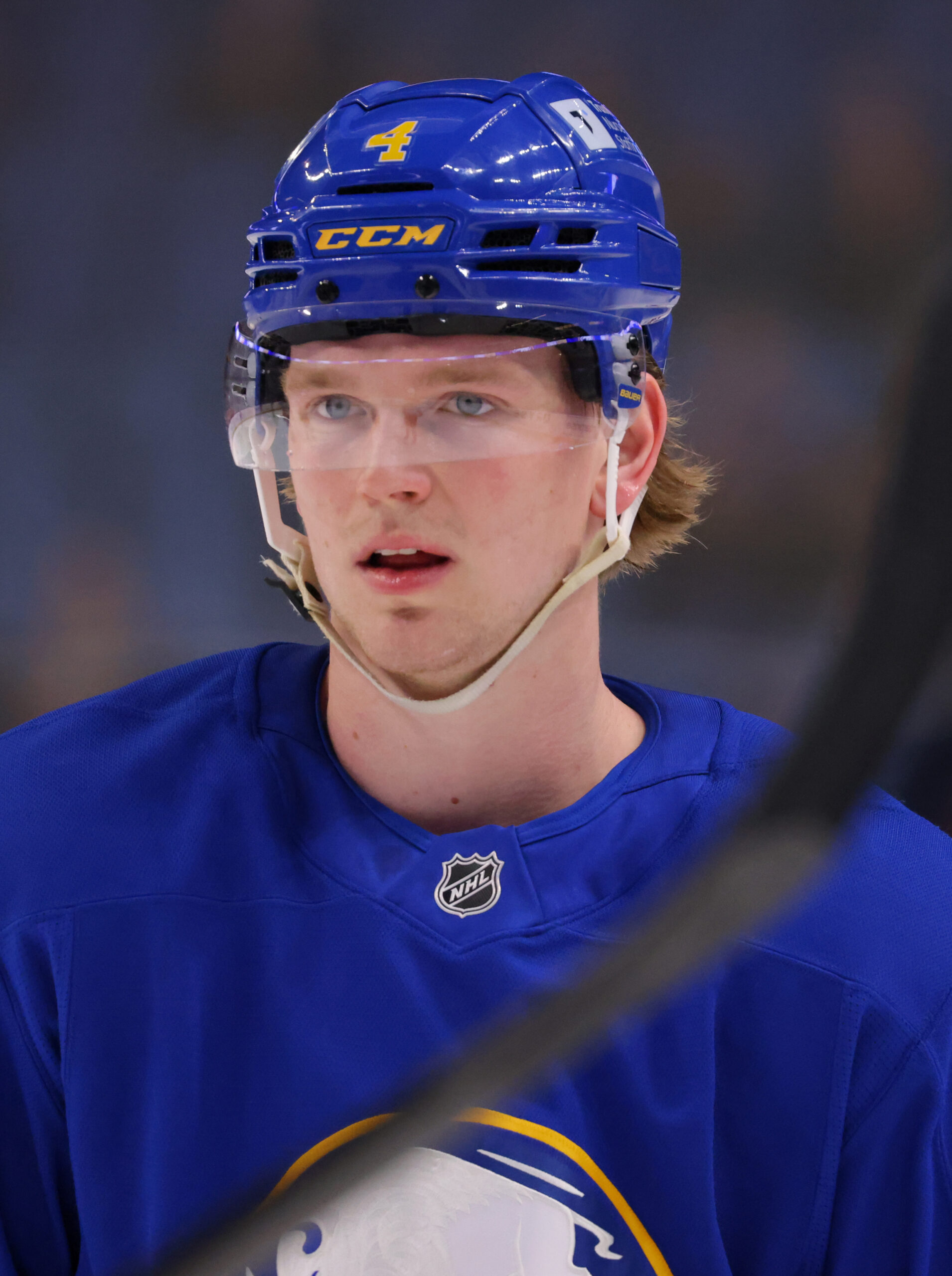 But once things get closer to the hearing, then it’s going to hamper talks. Because the Sabres were the team to file against Byram, Byram gets to pick the term of the contract – either one or two years. The latter would walk him right to UFA eligibility at the age of 26 so that definitely is going to be a temptation. Once they get to the point of starting the hearing, that’s it and if Byram does pick the two-year deal, his trade value is going to dip as there won’t be the ability to work out a long-term agreement as part of the swap. Suffice it to say, there’s a firm clock now and it’s definitely running.
The decision to take him to arbitration was to take the threat of an offer sheet off the table, one that would have secured Buffalo only draft-pick compensation. And at this point, it feels like some of the suitors are preferring to go with futures-based offers which is what GM Kevyn Adams doesn’t want as his goal is to get the Sabres back to the playoffs. That’s a goal that already seems unlikely and without Byram, it would be even tougher. The decision to take the offer sheet option off the table hedges against that happening but it cranks up the pressure.
ljfranker: What would the Blues have to pay for Byram? Is Jiricek, Stenberg, and offer sheet compensation reasonable?
haubrick: Do the Blues ultimately pull off a trade for Bowen Byram?
Let’s put the St. Louis questions together here. I assume the projected contract offer for Byram is in the $7.02MM to $9.36MM tier which carries a return of a first-round pick, a second rounder, and a third rounder. That plus two first-round prospects in Adam Jiricek and Otto Stenberg feels like quite the overpayment. That’s more than what Montreal gave up for Noah Dobson who is a more proven player. And yet, I don’t think Buffalo would say yes to that even though the offer would be in their favor.
As noted above, the Sabres aren’t thinking about rebuilding. They’re banking on this group taking a step or two forward and getting into the mix for a Wild Card spot this season. While it’s fair to question whether that’s the right approach, achieving that goal would be much harder by taking out a top-four defender and replacing him with a bunch of future assets that aren’t NHL-ready yet.
For St. Louis or any other team to get Byram in a trade, there has to be a key core player coming back to get Buffalo at least more open to the idea of moving him. Think Jake Neighbours, Dylan Holloway, Philip Broberg, or even Jordan Kyrou who has popped up in trade speculation although he has a no-move clause that could scuttle that thought in a hurry. If they want to avoid dipping into Torey Krug’s LTIR pool, they’ll basically need to match whatever they give Byram in terms of outgoing salaries which could add another player or two to the swap as well. I’m not sure the Blues are willing to part with that core piece (making it a change to the core, not a true addition) which is why I’m skeptical that they can get this over the finish line.
Dan from Buffalo: Lifelong Sabres fan, I’m 100% hoping we re-sign Alex Tuch at some point this offseason. I know he’s due for a nice raise from his current deal, should I be worried the longer the summer goes with no news?
I wouldn’t be worried if the summer comes and goes without an extension. While some players move quickly to sign contract extensions as soon as they’re eligible – we saw that with a few players on July 1st – many more haven’t yet. And it’s a pretty prominent list of those eligible who haven’t, one that includes Connor McDavid, Kirill Kaprizov, Artemi Panarin, Kyle Connor, and Jack Eichel, among many others. Those teams shouldn’t be worried yet so it’s not time to worry about Tuch just yet either.
At this point, it feels like players seem a bit more open to waiting things out and it wouldn’t surprise me if that’s the case with Tuch here. I don’t question his stated desire to stick around but at the same time, I think he might want to see where things stand before putting pen to paper on a new contract. If Buffalo winds up having a change of heart and moves Byram for futures or struggles out of the gate in the first half, leaving Adams to seriously start to ponder another rebuild, Tuch’s enthusiasm for sticking around for the long haul might be tempered.
If Tuch remains unsigned a couple of weeks before the trade deadline, that’s when I’d start to get concerned from a Buffalo perspective. While the Sabres re-signed a pair of pending UFAs close to the deadline back in March, there’s a big talent difference between Tuch versus Jason Zucker and Jordan Greenway. Those two wouldn’t yield the type of impactful future-based return that Tuch would, one that would be difficult for Adams to pass up at that point. But for now, the fact that an extension hasn’t been signed less than two weeks after being eligible isn’t too concerning.
PyramidHeadcrab: Is there a goaltending shortage in the NHL? It seems like quite a few teams are searching for a true starter where none are available, with a large drop-off in quality after the top 20-25 netminders. This doesn’t seem to be an issue with other positions, though those positions typically take less time to cook.
If true, how could this problem be systematically rectified within the league? And considering the goalies in development and those yet to be drafted, does relief appear to be on the horizon?
It certainly feels like there’s a goaltending shortage in the NHL right now. And there definitely is a drop-off quality-wise. But I’m not sure there’s a big fix that can be made.
More teams appear to be navigating toward a lower-cost platoon system which means there isn’t necessarily a big differentiator between the starter and the backup goalie. While top goalies like Igor Shesterkin can break the bank, I don’t think there are a ton of organizations who would be willing to go really high on a contract for a player that might only play in 70-75% of the games.
There’s also the matter of shooters being better. I don’t know how many times I’ve caught myself when writing about a goalie’s save percentage, for example. I might have something along the lines of so-and-so struggled with a SV% of just .902 before I remember that a mark just over .900 is now considered above average whereas a few years ago, it was below average. A few years before that, if you could barely scrape above .900, you weren’t a guarantee to stay in the NHL. Yes, some of that is a drop-off in the supply of good goalies but shooters now are better than they were not even a decade ago.
I suppose the fix could be to try to restrict some of the technological improvements for skaters or allow some equipment improvements for goalies but I doubt there’s much appetite for that beyond the goaltenders themselves wanting some extra help.
You could look at it from a grassroots perspective in that goaltender is the most expensive position for kids growing up. But there’s no way around that and it’s not the NHL’s responsibility to be funneling money into youth hockey programs worldwide to offset the price of equipment so I don’t think there’s a fix there either.
I don’t expect things to change much moving forward. There are a handful of above-average goalies in various prospect pools but certainly not an overwhelming amount that will eventually lead to a material improvement in goalie performance in the NHL. Lots of the prospects out there carry the ceiling of a platoon netminder which, for a lot of organizations, isn’t viewed as a bad thing.
If I’m being honest, I don’t think the NHL truly considers this a problem. For years, there were summits on how to increase goal scoring and now that this is happening, they’re probably pleased with that result. There is still enough of a supply of higher-end starters that some teams have some flexibility in structuring their rosters (go for a true starter and a low-cost backup versus the more common 50/30 type of split) so it’s not a cookie-cutter situation in terms of roster-building. Frankly, instead of it being a problem to solve, I suspect the NHL hopes that this is the new normal moving forward.
frozenaquatic: There was a discussion on r/hockey where we were talking about “best trades that benefited both teams.” There were a lot of obvious answers: Iginla for Nieuwendyk, ROR for Tage, RBA for Keith Primeau. But it got me thinking, what is the real answer to this question? We could only come up with one instance ALL-TIME where traded players won Cups with their new respective teams. STL trades Ian Cole to PIT for Robert Bortuzzo and a 2016 7th on March 2nd, 2015. Both Cole and Bortuzzo won cups with their new teams, both of them playing significant roles in the Cup run. Is this really the only case of this ever happening? Is this the greatest trade in NHL history?
Off-hand, I started looking through several seasons of old trades to see if I could spot one. It served as a stark reminder about how a lot of trades wind up making very little of a difference in the long run but I couldn’t spot another one that met the criteria of both players winning a Stanley Cup with their new team. I can’t sit here and say that’s the only instance of that happening – it easily could have back in the Original Six days (and I tried to look through some trades from those days to see if one popped) – but it has to be a pretty short list.
Does that make it the best trade in NHL history? That’s one of those questions where the answer is in the eye of the beholder. Was it ultimately a big win-win move (literally) for both sides? It sure was. But I suspect a lot of fans would have a different ‘best trade ever’ in mind.
Photo courtesy of Timothy T. Ludwig-Imagn Images.
Submit Your Questions For The #PHRMailbag
It has been a busy few weeks across the NHL. We have a repeat Stanley Cup champion, the draft has come and gone, and many players find themselves on new teams following some big trades and plenty of free agent signings with the bulk of the heavy lifting now finished on the offseason.
With that in mind, it’s a good time to reopen the mailbag. Our last call for questions yielded enough topics for three columns. The first discussed Connor Hellebuyck’s playoff struggles, Florida’s playoff proficiency, and more. Topics in the second included an assessment of the Avalanche, ideal second center options for Montreal, and some offseason predictions. The third included some talk about the Blackhawks, a Noah Dobson prediction (that didn’t quite hold up), and what Detroit needed to do this summer to have a successful offseason.
You can submit a question by using #PHRMailbag on Twitter/X or by leaving a comment down below. The mailbag will run this weekend.
Canadiens Still Have Work To Do This Summer
The Canadiens have had a fantastic summer so far as they aim to build on their first playoff appearance since 2021. The Habs lost some forwards but have been busy improving their defence and fixing other gaps in their roster.
The team is expected to once again fight for a playoff spot in the Eastern Conference, and with these additions, some Canadiens fans are wondering if the team can contend for a place at the top of the Atlantic Division. The Florida Panthers will have something to say about that, but it’s fair to ask if Montreal has leapfrogged Ottawa, Toronto, and Tampa Bay. Even if the Canadiens are among the top three teams in the Atlantic Division, the path to the Stanley Cup will go through Florida, and Montreal still has a long way to go to catch the Panthers.
The Canadiens started their summer with a significant acquisition, bringing in defenseman Noah Dobson from the New York Islanders. The Canadiens traded forward Emil Heineman and two first-round picks in 2025 back to the Islanders in exchange for Dobson, igniting a summer that has Canadiens fans excited for the upcoming season.
Dobson was considered for the Norris Trophy just a year ago after scoring 10 goals and 60 assists in 79 games, but his production declined this past year, with only 10 goals and 29 assists in 71 games. Despite the reduced output, Dobson remains a clear top-pairing defenceman capable of generating plenty of offense and leading transition play.
He’s not the most reliable defensively, but he isn’t a complete liability in his zone and should improve his defensive metrics in Montreal. The trade was a smart move for the Canadiens, filling a noticeable gap in their lineup and providing stability on the right side of defense for the next eight seasons.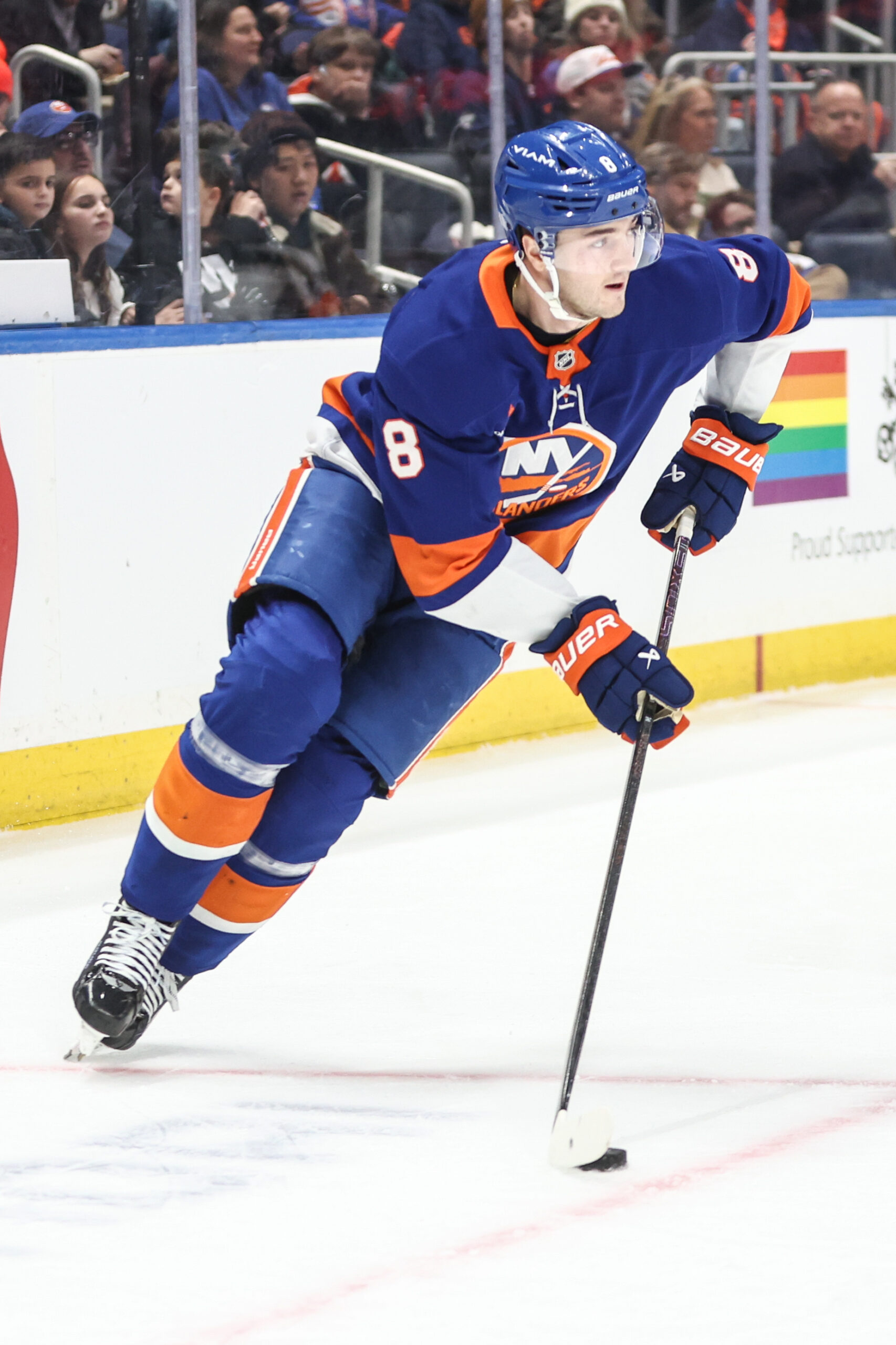
A few days after the Dobson trade, the Canadiens made another bold move, sending defenseman Logan Mailloux to the St. Louis Blues for forward Zachary Bolduc. Both players were chosen in the first round of the 2021 NHL Entry Draft, but they are at different points in their development, with Bolduc further along than Mailloux.
It’s common for forwards to develop quicker than defensemen, and the Habs are counting on that, hoping to accelerate their path to contention. The 21-year-old Bolduc is expected to add toughness and offense to the Canadiens, as he’s a strong forechecker and scored regularly while playing fourth-line minutes last season for St. Louis. Bolduc recorded 19 goals and 17 assists in 72 games last year and is likely to see more ice time in Montreal next season.
The Canadiens also made a few depth signings on July 1st, signing goaltender Kaapo Kahkonen, forward Sammy Blais, and defenseman Nathan Clurman to one-year contracts, along with several other players in between. These moves were all necessary to strengthen Montreal’s depth, but some gaps have appeared due to free agency.
The Canadiens have seen several players leave this summer, and while none are big stars, they were essential depth players that the Canadiens will need to replace either from within the team or through free agency and trades. The players mentioned, Heineman and Mailloux, were traded away, while defenseman David Savard retired, and forwards Christian Dvorak and Joel Armia found new teams in free agency.
Dvorak now plays for the Flyers, while Armia signed with the Kings. These departures could affect Montreal’s faceoff performance and penalty killing.
All this to say, the Canadiens’ additions have been nice, but there’s still work to be done on their forward group. Their penalty killing seems like a potential weakness, as does their second line with the current setup. If the season were to start today, Montreal’s second line would likely feature Kirby Dach at center along with Patrik Laine and Ivan Demidov on the wings. While the wing options aren’t terrible, Dach playing on a second unit isn’t ideal at this stage, and he would benefit from being bumped down the lineup by a true top-six forward.
That task is not quite as challenging as finding a top defenseman, but it is still a challenge given the limited number of trade options. Jordan Kyrou of the St. Louis Blues has been mentioned as a possibility, and he would be an ideal fit for Montreal in that second-line role.
Kyrou has averaged over 70 points per season over the past four years and would enable the Canadiens to better position forwards like Dach in more suitable roles. The 27-year-old Kyrou has plenty of term remaining on his contract, with six years left at a $8.125MM AAV. If Montreal pursues Kyrou, he will likely not come cheaply and might require more high-end assets — something they might not be willing to give up.
If the Habs can’t land Kyrou, they could always turn to the Pittsburgh Penguins and target Rickard Rakell or Bryan Rust, both of whom could handle top-six minutes in Montreal. The Penguins appear to be seeking young, NHL-ready players, which could be prohibitive to any trade. However, the cost would likely be lower than Kyrou’s, and the difference in impact could be negligible, depending on the fit.
In any event, the options are out there for Montreal to put a bow on this summer and enter next season as one of the top three teams in the Atlantic Division. They have their work cut out for them, though, as nearly every team in the NHL is trying to get better, and the market isn’t exactly flush with top players that can be traded.
Photo by Wendell Cruz-Imagn Images.
Jack Roslovic, Matt Grzelcyk, Victor Olofsson Among Top Remaining UFAs
Our list of top 50 UFAs saw many of its top names land a “re-signed” designation before the 2025-26 league year even began. Now, 10 days into free agency, 44 of those players have signed new contracts, leaving just six without deals:
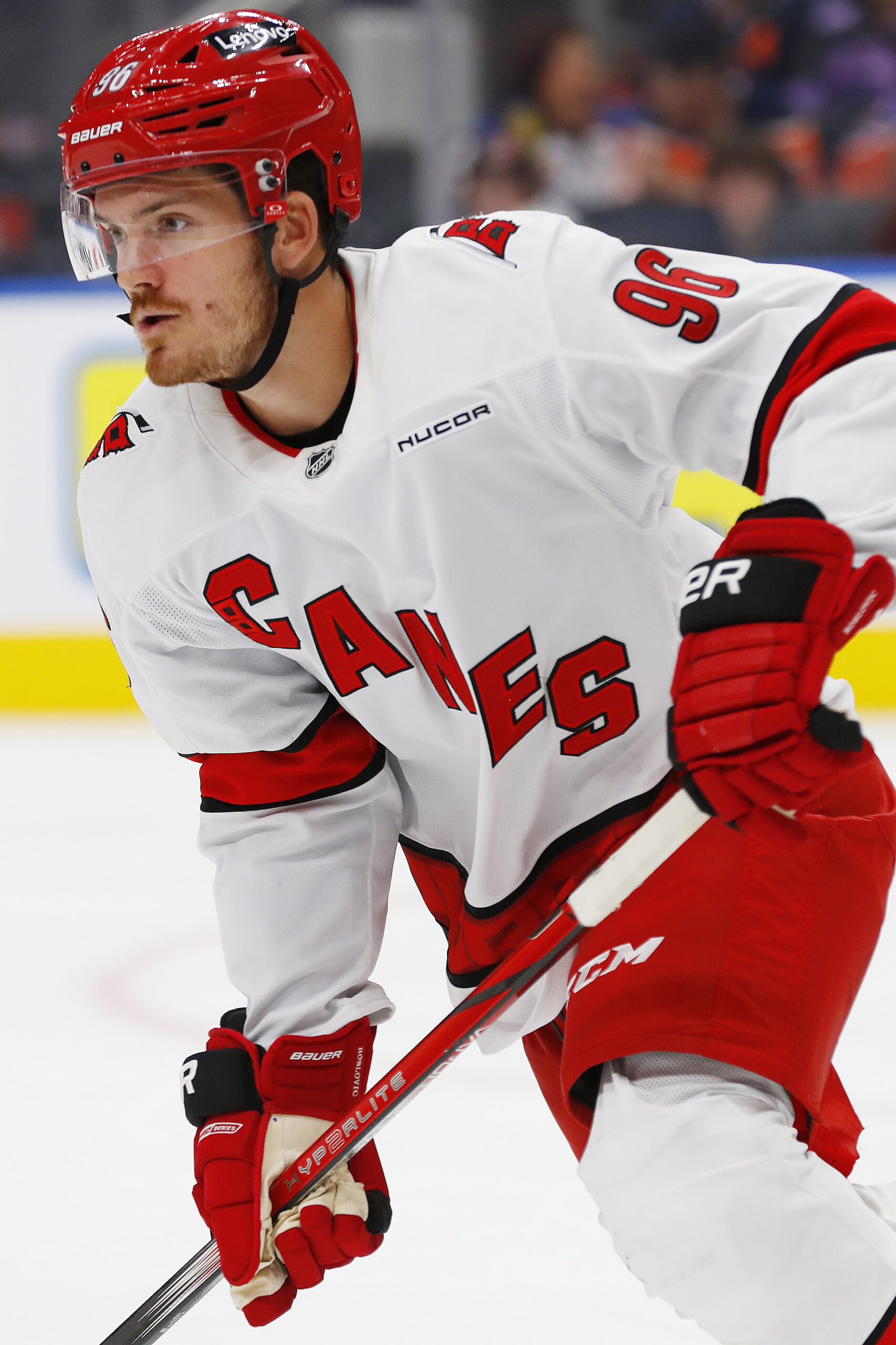 20. C Jack Roslovic
22. D Matt Grzelcyk
27. LW Victor Olofsson
42. G Ilya Samsonov
46. LW Jeff Skinner
48. G Alexandar Georgiev
Roslovic still being on the market isn’t particularly surprising. It seems there’s always an odd man out in the top 20 range that lingers well into week two, particularly with the depth of this year’s class being as thin as it is.
His ongoing availability likely isn’t a knock on how teams perceive his value, either. Many clubs have already solidified their middle-six group with UFA pickups like Andrew Mangiapane and Pius Suter, and the ones that haven’t likely have interest in Roslovic as a backup option if they can’t land more of a needle-moving, first-line caliber player in a trade. That’s the case with the Maple Leafs, one of the few teams that have been linked to Roslovic in the last few days.
While far from being a bang-and-crash forward, Roslovic holds value in his positional versatility and has emerged as one of the more consistent depth scorers in the league. A third-line piece, ideally, he tied his career-high in goals last season with 22 in 81 games with the Hurricanes, adding 17 assists for 39 points. He’s scored between 30 and 45 points in each of the last five seasons.
Roslovic was projected to receive a three-year contract worth $4.09MM per season by AFP Analytics, while we forecasted a more conservative $3.5MM cap hit on a three-year deal. Either way, with most teams having filled out their rosters, only 11 teams have under $3.5MM in cap space and should likely be considered out of the running. Teams in need of added middle-six depth, like the Avalanche, Wild, and Red Wings, might be names to watch in the coming days.
The lack of capped-out teams this deep into July, a direct result of the quickly rising cap, likely means that players who were left without contracts after the first week of free agency may not need to take as steep a discount on their initial market value as they have in years past. That principle should at least apply to players like Roslovic and Grzelcyk, who at least have interest but are likely at the mercy of teams preferring trade options before they circle back with a firm offer. For someone like the offensively gifted but defensively challenged Olofsson, though, he’s likely abandoning hope of cashing in on his resurgent season with the Golden Knights.
Nonetheless, Olofsson is arguably the highest-ceiling name left on the market. He’s a three-time 20-goal scorer with the Sabres, with whom he spent the first six seasons of his career, but became a free agent in 2024 on the heels of a seven-goal, 15-point showing in 51 games.
Vegas took a flyer on him, and he settled quickly for a one-year, $1.075MM deal on July 2 last year. Injuries again limited him to less than 60 games, but he did get a few reps in the Knights’ top six, putting together a 15-14–29 scoring line in 56 outings. That was a 43-point pace – still the second-worst of his career behind his disastrous 2023-24.
He needs sheltered even-strength minutes and power-play deployment to be effective, but he’s a relatively safe bet for 20 goals and 40 points if he stays healthy. Only he and Roslovic can realistically provide that production among the remaining UFAs.
Grzelcyk is the only defenseman left on the board among our top 50, and he actually had the most points among any remaining UFA last season with 40. That was a career-high for the 31-year-old, who departed Boston for Pittsburgh last summer on a one-year deal and saw considerably more power-play deployment than he had in the past.
The Sharks looked like a potential fit for Grzelcyk at the start of free agency, but their slew of other additions has now led to a logjam of blue-liners, so they’re out of the market. Grzelcyk may have to expect a reduction in minutes on the 20 per game he saw last season, and look for another one-year commitment on a team looking for power-play help.
The most likely outcome for the ‘tenders, Samsonov and Georgiev, may be contracts in Europe at this point. There’s no team with a glaring hole at the No. 1 or No. 2 positions, and teams looking for an upgrade are likely looking for a more consistent option than the roller-coaster play those two have provided over the last couple of seasons.
Some other names still available include wingers Joel Kiviranta, Luke Kunin, Craig Smith, and Michael Carcone. Nikolai Kovalenko leads the way among intriguing non-tendered forwards, assuming he doesn’t sign in the KHL. The top defenseman outside of Grzelcyk, both in terms of name value and scoring last season, is Ryan Suter.
Image courtesy of Perry Nelson-Imagn Images.
Strategic Drafting Will Keep Capitals Competitive
The Washington Capitals seemed well on their way towards reclusion a few seasons ago. They managed to win the first Stanley Cup in franchise history in 2018 – but by 2022, only eight members of the Cup-winning roster were still in Washington. The club fell entirely out of the postseason by 2023, marking their first summer absence since 2015. That miss sparked an upheaval of the Capitals’ coaching staff. The new group – headmanned by rookie NHL head coach Spencer Carbery – has returned the Capitals to the playoffs on the back of a clear ability to develop certain styles.
The Capitals have leaned into Carbery’s vision for the lineup in all aspects of their roster building – but most notably, in their draft selections. A team once honed in on finding the balance between high-offense forwards and all-defense defenders has steadied over the last two draft classes. In doing so, Washington has not only found their way back to the postseason – but also managed to surge to the top ranks of NHL prospect pools.
Their class is undoubtedly led by first-round picks Ryan Leonard, Terik Parascak, and Lynden Lakovic. All three play a chippy, physical style of hockey – with strong shots and a clear ability to find space off of the boards and in the corners. Their physical upside speaks to some layer of certainty in the bump-and-grind Capitals lineup, even if it requires the extra years of development, akin to Connor McMichael and Hendrix Lapierre, the latter of who appeared to come along with a hot year in the AHL.
But the Capitals reach the tops of prospect value with their picks outside of the first-round. Their group may be most truly headlined by defender Cole Hutson, who posted an absurd 48 points in 39 games of his freshman season at Boston University. He was the Terriers’ top defender as they raced to a National Championship loss, and is the younger brother of Montreal’s Lane Hutson, who recorded a record-setting 62 assists in his rookie NHL season this year.
Hutson is followed by towering forward Ilya Protas, the younger brother of current Capitals forward Aliaksei Protas. Ilya was drafted out of the USHL, but moved to the OHL for this season. That proved an incredibly lucrative bet, as the 6-foot-5 forward blazed his way to 50 goals and 124 points in just 61 games with the Windsor Spitfires. He improved across the board – adding smoother skating and more confident stickhandling – and seems well set on paving his way into the pros.
But through the top names, it’s winger Eriks Mateiko – a burly Latvian recently dominating the QMJHL – and Swiss-defender Leon Muggli who offer the truest glimpse into what Washington has prioritized. The team has consistently found ways to land not only tall, heavy draft picks — but players who play with a physical edge and truly know how to utilize their size to their advantage. That’s the exact trait that’s elevated players like Protas and McMichael to early-career success. Even the recent resurgence of Dylan Strome and Pierre-Luc Dubois can be attributed to Washington’s unique ability to take a calm and assertive approach to offense, rather the run-and-gun style many teams attempt to skill their way into.
Washington impressively flaunted their ability to land that style of player in the 2025 draft. Lakovic is a hefty winger who could improve his ability to break-through the defense – making him a perfect match in Washington – and fellow top-pick Milton Gastrin is a lumbering and slow centerman capable of making quick plays. But it’s, again, their late picks that define Washington’s potential. They swept up re-entry forward Jackson Crowder in the fifth round, folding in a layer of responsible and physical play in a 6-foot-3 frame. Better than that, Washington managed to land hefty Swedish defenseman Aron Dahlqvist in the sixth round — nearly three rounds later than many pundits predicted. Dahlqvist is a ball of grit and aggression, with powerful strides and fundamental hitting. He digs into opponents – and that physical prowess earned him 16 games in Sweden’s SHL this season, even despite the fact that Dahlqvist didn’t score in any of those appearances.
Both scouts and fans have raised questions with, seemingly, every Capitals prospect. But the team is clearly confident in the style they’re searching for. The focus is squarely on landing physically mature, and capable, players at every group — players that well fit into the development style that Carbery has already utilized on some of the 2024-25 squad’s top players. That should glean multiple NHL roster players, especially given the acknowledgement Washington’s pool has earned from the public sphere. The Capitals are back in the postseason and, with most of the roster locked up for the short-term, seem well positioned to return to their yearly summer hockey. With the boost of smart, situational drafting backing the NHL lineup – Washington, and head coach Carbery, could be well on their way to landing even more successful draft picks, and maintaining their status for many years to come.
Teams With Adequate Draft Capital To Tender Offer Sheets
Yesterday, we examined players who are still technically eligible to receive and sign offer sheets this summer. That list has decreased by a few names in the last 24 hours, thanks to a pair of team-elected arbitration cases and one re-signing, but there are still many names who could be targets.
Now, it’s a good time to look at the teams that can realistically tender an offer sheet. The required compensation for each tier is below. Each team must have its own draft pick to satisfy the requirement – if a club acquires a different team’s draft choice for the round in question, that can’t be used for an offer sheet. Teams can reacquire their own picks via trade to facilitate an offer sheet. The Ducks, Flames, Blackhawks, Red Wings and Penguins are the only clubs with enough draft picks and cap space to offer-sheet an RFA at every salary/AAV tier.
$1,544,425 – $2,340,037: 2026 third-round pick
Able: ANA, BOS, BUF, CGY, CHI, CBJ, DET, LAK, MIN, NSH, NJD, NYI, OTT, PHI, PIT, TOR, UTA, WPG
Able, but not enough cap space: EDM, MTL, NYR, STL, TBL, VGK
Unable: CAR, COL, DAL, FLA, SJS, SEA, VAN, WSH
$2,340,038 – $4,680,076: 2026 second-round pick
Able: ANA, CGY, CHI, DET, LAK, NSH, NJD, PHI, PIT, SJS, SEA, UTA
Able, but not enough cap space: BOS, DAL, EDM, FLA, MTL, TBL, VAN, VGK
Unable: BUF, CAR, COL, CBJ, MIN, NYI, NYR, OTT, STL, TOR, WSH, WPG
$4,680,077 – $7,020,113: 2026 first-round pick, 2026 third-round pick
Able: ANA, BUF, CGY, CHI, CBJ, DET, LAK, MIN, NSH, NJD, PIT, UTA, WPG
Able, but not enough cap space: BOS, MTL, NYI, NYR, PHI, STL
Unable: CAR, COL, DAL, EDM, FLA, OTT, SJS, SEA, TBL, TOR, VAN, VGK, WSH
$7,020,114 – $9,360,153: 2026 first-round pick, 2026 second-round pick, 2026 third-round pick
Able: ANA, CGY, CHI, DET, NSH, PIT, UTA
Able, but not enough cap space: BOS, LAK, MTL, NJD, PHI
Unable: BUF, CAR, COL, CBJ, DAL, EDM, FLA, MIN, NYI, NYR, OTT, SJS, SEA, STL, TBL, TOR, VAN, VGK, WSH, WPG
$9,360,154 – $11,700,192: Two first-rounders between 2026 and 2028, 2026 second-round pick, 2026 third-round pick
Able: ANA, CGY, CHI, DET, NSH, PIT, UTA
Able, but not enough cap space: BOS, EDM, LAK, MTL, NJD, PHI, VGK
Unable: BUF, CAR, COL, CBJ, DAL, FLA, MIN, NYI, NYR, OTT, SJS, SEA, STL, TBL, TOR, VAN, WSH, WPG
≥$11,700,193: Four first-rounders between 2026 and 2030
Able: ANA, BUF, CGY, CHI, CBJ, DET, PIT, SJS, WPG
Able, but not enough cap space: BOS, CAR, COL, EDM, LAK, MIN, MTL, NSH, NJD, NYI, NYR, OTT, PHI, SEA, STL, UTA, VAN, VGK, WSH
Unable: DAL, FLA, TBL, TOR
Cap space figures from PuckPedia.