
Negotiation Notes: Arbitration Hearings, Nylander, Islanders
Two more players sat down for arbitration hearings today, as Sportsnet’s Chris Johnston reports that neither the Ottawa Senators and Cody Ceci nor the Dallas Stars and Gemel Smith were able to come to terms beforehand. Both situations bear watching over the next 48 hours, as they must agree to a deal in that window or else get stuck with the arbitrator’s award. Ceci’s case is similar to that of the Winnipeg Jets’ Jacob Trouba, which went through to a decision earlier this off-season. Both Ceci and Trouba filed at a number that shares few reasonable comparisons – Trouba at $7MM and Ceci at $6MM. While Trouba’s side likely tried to use several recent cases of offensive-minded defenseman who settled for $5.5MM and then argue that he is the superior defensive player, Ceci does not have the comparable offense to make as strong a case. As such, he is unlikely to get the $5.5MM award that Trouba landed, the midpoint of his case. Instead, look for Ceci to get somewhere in the $4-4.5MM range. Smith’s is a much different scenario, similar to another previously decided case this summer, that of Calgary Flames defenseman Brett Kulak. In both cases, the team offered only a minimum, two-way contract while the player filed at a higher value for a one-way deal – Kulak at $1.15MM and Smith at $900K. While Kulak was able to land a $850K one-way deal from the arbitrator, he also played in 71 games in the platform year, while Smith only suited up for 46. Smith faces a far tougher argument that he is a bona fide NHL player at this point in his career.
- Restricted free agent William Nylander continues to negotiate with the Toronto Maple Leafs, but the explosive young forward is not interested in a short-term bridge deal. Sportsnet’s Luke Fox suggests that Nylander is only talking about a long-term deal right now. While the Leafs might be trying to play it safe, with both Auston Matthews and Mitch Marner also in need of extensions next summer (along with the majority of their roster), Nylander doesn’t seem willing to take a bridge deal only to watch his fellow budding stars sign long-term contracts instead. Nylander may have hit restricted free agency earlier than Matthews and Marner, but the trio all have similar games played and points since Nylander only played in 22 games with Toronto in his first season before the other two joined the squad. All three have been remarkably consistent early on and, given their similarities, it is hard to blame Nylander for wanting a long-term deal when he knows that Matthews and Marner are likely to get them.
- While it makes sense that the New York Islanders have focused on adding forwards and a new goaltender this season, after losing superstar center John Tavares and starting goalie Jaroslav Halak to free agency, Newsday’s Andrew Gross thinks it’s strange that the team has not added to the blue line at all. The team re-signed Thomas Hickey and Ryan Pulock, but have added no one else while losing Calvin de Haan and opting not to bring back Brandon Davidson and Dennis Seidenberg. Gross notes that recently re-signed center Brock Nelson, an impending free agent, could be used as a trade chip to add to a blue line that struggled greatly last season. There are certainly teams out there with a plethora of defensemen who could use Nelson up front. The Carolina Hurricanes, Boston Bruins, and Winnipeg Jets are clubs that fit the bill, but Nelson would not be nearly enough to land a Justin Faulk, Torey Krug, or Jacob Trouba and an expendable piece that he might fetch, like a Trevor van Riemsdyk, Adam McQuaid, or Tucker Poolman might not be enough to fix the Islanders blue line. New York may have to up the ante beyond Nelson to land a difference-maker on the back end.
The Contract Each Team Would Most Like To Trade: Part III
Nearly every team has one of those players: a top talent they were excited to sign and never thought could do anything but help them. In hindsight, history shows that more often than not, expensive, long-term free agent contracts don’t work out. It may look good at first (or it may look bad right away to the outside observer), but players struggle to make their value last throughout a lengthy contract. Those contracts come back to bite teams and are hard to get rid of. As teams begin to finalize their rosters at this point in the off-season, many are struggling to make everyone fit under the salary cap and are regretting these past signings that exasperate a cap crunch that can be tough for even a mistake-free club. We already took a look at the first third and second third of the league; here are the contracts that each of the final ten teams would most like to trade, from Philadelphia to Winnipeg:
Philadelphia Flyers: Andrew MacDonald – two years, $10MM remaining
Based purely on salary versus what he brings to the table, Jori Lehtera‘s $4.7MM contract is the worst on the Flyers. However, Philadelphia is far from cap trouble this season, currently among the five lightest payrolls in the league, and Lehtera’s deal expires after this season. However, next year the Flyers will need to re-sign or replace Wayne Simmonds, hand new deals to Ivan Provorov and Travis Konecny, and likely find a new starting goalie. The cap crunch will be much more real and the over-inflated $5MM contract of Andrew MacDonald will hurt. MacDonald’s six-year, $30MM contract was immediately panned by the public and it wasn’t long after that he was buried in the minors for cap relief and to keep him out of the lineup. MacDonald simply is not the player he was with the New York Islanders earlier in his career when he could eat major minutes, was stellar in man-to-man defense, and could block shots with the best. What he is being paid now is far beyond what he is actually worth. Some would say that Radko Gudas is worse, but that is an argument that suffers from recency bias. Combining the past two seasons, Gudas actually has the same amount of points as MacDonald in fewer games and less ice time, a better plus/minus rating, far more shots, and of course infinitely more hits. At $3.35MM for the next two years, Gudas is a far better deal.
Pittsburgh Penguins: Carl Hagelin – one year, $4MM remaining
The real answer is that GM Jim Rutherford would not like to trade any more players. He already ditched two of his worst contracts by sending Matt Hunwick and Conor Sheary to the Buffalo Sabres and he isn’t eager to make another salary dump. However, the reality is that Rutherford is going to find it hard to manipulate his roster this season with just over $1MM in cap space. As such, it is likely that another Penguin could be on the move. An outside observer could easily point to the Jack Johnson contract as one that stands little chance of maintaining its value over the term and the same argument could be made for Patric Hornqvist as well. However, Rutherford just signed those deals and wouldn’t move them even if he could. That leaves a short list of players who could be moved and the only one that sticks out as being overpriced is Carl Hagelin. Hagelin has played an important part of the Penguins’ reign over the past few years, but at $4MM he has not cracked 40 points in any of the three seasons and can go cold for weeks at a time. Rutherford won’t make a move unless it can benefit the team, but if he can get another scoring winger in exchange for a package that dumps Hagelin’s salary, he’ll do it.
San Jose Sharks: None
Mikkel Boedker, Joel Ward, and Paul Martin are all gone. Two top forwards, the two best defensemen, and the starting goalie are all locked up long-term at a reasonable rate. The Sharks have almost $4.5MM in cap space this season, giving them room to add. Congratulations to GM Doug Wilson and his staff. This roster is the epitome of cap compliance mixed with depth and talent. There is not one contract that the team would be interested in dumping.
St. Louis Blues: Alexander Steen – three years, $17.25MM remaining
The Blues currently have all but $285K of their cap space committed to 24 players. The team may send Chris Thorburn or Jordan Nolan down to the AHL, but will only gain marginal space. Something else has to give. If they could target any player to move to alleviate some pressure, it would be Alexander Steen. With just seven forwards and three defensemen (as of now) signed beyond next season and the majority of players in line for raises or free agent replacements, these cap woes aren’t going away anytime soon and an expensive long-term deal needs to be shipped out. Understandably, St. Louis is all in this season and wouldn’t be eager to ship out an important top-six piece. However, Ryan O’Reilly, Vladimir Tarasenko, Brayden Schenn, and Jaden Schwartz are the new young core up front now and paying 34-year-old Steen $5.75MM for three more years for declining production just doesn’t make sense. The Blues could potentially land some nice pieces from another contender for Steen as well. Admittedly, the Tyler Bozak contract looks even worse than Steen’s, but the Blues won’t be looking to trade a player they just signed.
Tampa Bay Lightning: Ryan Callahan – two years, $11.6MM remaining
The long-term implications of several other deals aside, the Lightning’s Stanley Cup window is wide open and their focus is on the here and now. The one player really impeding their ability to add freely to the roster is Ryan Callahan. While GM Steve Yzerman has excelled at extending most of his core below market value, the six-year, $34.8MM contract for Callahan was a mistake. Injuries limited Callahan to just 18 games in 2016-17, but last year he played in 67 games yet he only managed to score 18 points. Callahan’s days as an impact player are over, but he is still being paid like one at $5.8MM. While Tampa Bay can manage this season with close to $3MM in cap space, they would have more to work with without him. However, Callahan’s contract will really present a major road block next summer, when the Bolts need to re-sign Brayden Point, Yanni Gourde, Anton Stralman, and more. There is no doubt that Yzerman will look to unload Callahan’s contract before it comes to that point.
Toronto Maple Leafs: Nikita Zaitsev – six years, $27MM remaining
The Maple Leafs severely jumped the gun when they rewarded Nikita Zaitsev with a seven-year deal after his rookie season in 2016-17. Although Zaitsev was an import, making his NHL debut at 25 years old, his situation epitomizes why bridge deals exist. Toronto sought to lock him up long term and gave him nearly a maximum term at $4.5MM, just $500K less per year than top defender Morgan Rielly. In his encore performance last season, he showed that he is not worthy of the salary nor length of that contract, dropping from 36 points to 13 points for the year, turning the puck over at an alarming rate, and eventually becoming a healthy scratch. This team simply can’t afford the type of long-term mistake that they made with Zaitsev. While it’s nice that they have Reilly, John Tavares, and Nazem Kadri signed long-term, it’s Auston Matthews, Mitch Marner, and William Nylander they need to worry about. The Maple Leafs will have to balance multiple expensive, long-term deals moving forward and would love for Zaitsev’s to not be one of them.
Vancouver Canucks: Loui Eriksson – four years, $24MM remaining
It seems unlikely that the recently-signed deals for Jay Beagle and Antoine Roussel will work out well, but they at least deserve some time. Loui Eriksson has had his time and has done nothing with it. While the Canucks aren’t under any cap pressure, they can’t enjoy seeing Eriksson’s $6MM cap hit – the highest on the team – on the books for four more years, especially when the bulk of his front-loaded salary has already been paid out. Eriksson was brought in with an expectation that he would be the ultimate fit with Daniel and Henrik Sedin. Instead, he has scored just 47 points combined over two seasons, less than his final season total with the Boston Bruins. The Sedins are now gone, the team is trying to get both younger and more physical and defensive-minded, and Eriksson is simply an expensive poor fit. There’s not much more to say about a player who desperately needs a change of scenery and a team that wants him gone.
Vegas Golden Knights: None
The Golden Knights are riding high after an outrageously successful first season in the NHL. It is highly unlikely that they see anything wrong with their current contracts, almost all of which were either hand-picked or signed by GM George McPhee. Give it some time and that could change. Reilly Smith is notorious for a significant drop in production in his second year with a team, but is signed for four more years at $5MM. Paul Stastny for three years at $6.5MM per seems like a solid deal, but he has always produced better surrounded by equal talent. Does Vegas have enough to justify his signing? A $2.775MM cap hit for Ryan Reaves doesn’t seem to make a whole lot of sense. Finally, there’s the three-year, $21MM extension for heroic goalie but also 33-year-old well-worn vet Marc-Andre Fleury, which could end poorly. And this isn’t even counting what could be a massive reactionary contract for one-year breakout star William Karlsson. The Knights don’t see any problems right now after finding immediate success, but if they slide significantly in year two, things could get ugly.
Washington Capitals: T.J. Oshie – seven years, $40.25MM remaining
No, it’s not Tom Wilson. The call of the question is which contract each team wants to trade, not which is objectively the worst. Wilson’s contract does seem excessive, but he is just 24 and could grow into that salary (doubtful but possible). Plus, the organization loves what he brings to the team. T.J. Oshie on the other hand is heading in the wrong direction. Oshie has done what he was brought in to do: help the Capitals win the Stanley Cup. It took a max eight-year term to keep Oshie off the market last summer and now Washington has their Cup but also has a 31-year-old with diminishing returns signed for seven more years. Oshie could absolutely still help the Capitals over the next few years, but it’s doubtful that he will be back in 60-point range in that time. He also will be nothing more than a cap space vacuum when he’s in his late thirties making $5.75MM. Oshie is a great player and one of the more likeable guys in the league, but this contract has little upside left. The Capitals would at the very least consider trading Oshie now, which can’t be said for most of their other core players.
Winnipeg Jets: Jacob Trouba – one year, $5.5MM remaining
The list ends with a tricky one. Is $5.5MM a fair value for Trouba? An arbitrator thinks so and the Jets would likely agree. However, Trouba’s contract has been a nightmare for the team. The young defenseman clearly does not want to be in Winnipeg and has set himself up for yet another arbitration clash next summer, after which he will bolt in free agency. The Jets have no long-term security with Trouba and that meddles with their future planning. With Blake Wheeler, Tyler Myers, and several others also in need of new contracts next summer, the Jets don’t need another Trouba arbitration award cutting into their cap space just so that he can walk after the season. The team will definitely look to get maximum value in a trade for Trouba over the next season.
College Notes: Meyer, Fensore, Rule Changes
Carson Meyer‘s luck has finally turned. The Ohio native and Columbus Blue Jackets draft pick was hoping to make it the Buckeye State trifecta by transferring to Ohio State for his junior year collegiate season. Meyer struggled this past season at Miami University, fighting health issues and fatigue to record only ten points despite reaching 26 as a freshman and 51 in his final junior season in the USHL. Meyer later discovered that the “sickness” impacting his play was actually a 25-inch tapeworm. Wanting to put that experience past him, Meyer transferred to OSU only to be told that he would likely have to sit for a year due to NCAA transfer rules. However, the university has announced that the NCAA has approved their submitted waiver for Meyer to participate immediately this year. Now back at full health and joining a team that reached the Frozen Four last year, the quick winger could be in store for a breakout campaign.
- Boston University has received a commitment from U.S. National Development Team defenseman Dominick Fensore, beginning in the 2019-20 season. The young rearguard took to Twitter to announce the decision himself. While Fensore clearly has enough talent to play in the exclusive development program, he brings the undersized defensemen trend to a new level. The 16-year-old stands 5’6″ and is listed at just 141 pounds. While the teenage blue liner surely has more growing to do, that is incredibly small for any hockey player, never the less a defenseman. Luckily, BU has excelled in recent years with developing smaller defensemen, such as the Boston Bruins’ Matt Grzelcyk and current NHL prospects Chad Krys (CHI) and David Farrance (NSH). After another year with the USNTDP, playing alongside top 2019 defensive prospect and future Boston College rival Cam York, Fensore should be ready to join the Terriers and make an impact at the college level.
- The rules for overtime in the NCAA will be a bit different going forward and how different they are will depend on the conference. The NCAA approved a proposal this week that gives each conference autonomy in deciding how best to handle overtime out of three options. If the score is tied after regulation, there will continue to be a mandatory five-minute, five-on-five overtime. After that, the new rule allows for a) the game to end in a tie, b) a shootout, or c) a five-minute, three-on-three overtime followed by a shootout. Non-conference games and postseason games will continue to use their previous overtime formats. Another new rule also provides each time with an additional timeout if the game goes to overtime. Other approved rule changes include using video replay to review ejection-worthy penalties, new definitions for slashing and legal substitution, and – perhaps most interesting – allowing teams to dress 19 players rather than the typical 18 players for each game.
Snapshots: Middleton, Sharks, Morrisonn
The Boston Bruins will add another memorable name to the rafters of TD Garden this season, as the team announced today that they will retire Rick Middleton‘s #16 on November 29th. Middleton starred for the Bruins for twelve seasons from 1976-1988 and recorded 898 points in 881 games, fourth-most in Bruins history. His 402 goals rank third on a long list of impressive Boston alumni, behind only Johnny Bucyk and Phil Esposito, while his 496 assists rank sixth behind the likes of Bucyk, Esposito, Ray Bourque, Bobby Orr, and Wayne Cashman. Seeing as all but Middleton and Cashman of that group have had their numbers retired, it seems fitting that “Nifty” was next up. Yet, Middleton was surprised to receive a call from President Cam Neely today, saying he was “knocked off (his) feet” by a “dream come true”. Middleton’s number retirement will be the eleventh by Boston and will ironically be the first for the Bruins since Neely himself was honored in 2004. Who could be next for Boston? A past great like Cashman or perhaps a current long-time star like Patrice Bergeron or Zdeno Chara?
- The San Jose Sharks made some changes to their front office today that included players previously believed to still be active. The team named Ryan Hamilton, J.P. Cote, and Neil McKenney to their scouting staff, replacing Jimmy Bonneau and Michael Chiasson who have been promoted to AHL coaching roles. The release essentially served as a retirement announcement for Hamilton and Cote. Hamilton, 33, had been the captain of the AHL’s Bakersfield Condors for the past three years and last played in the NHL for the Edmonton Oilers in 2014-15. Cote, 36, has been playing in Europe for the past three years, but was a member of the Tampa Bay Lightning in 2013-14. McKenney has been hired away from his position as Director of Hockey Operations for Quinnipiac University in Connecticut.
- Former NHL defenseman Shaone Morrisonn is embarking on a interesting twist to his playing career. The 2001 first-round pick is entering his 17th pro season and will do so in largely uncharted territory. Morrisonn has been playing in the KHL since 2012, but will now move to the Oji Eagles of the Asia League. The league was only established in 2004, after Morrisonn had already begun his pro career, and has not attracted many well-known North American names over the years. Perhaps in closing out his own career, Morrisonn will open the door to more former NHLers continuing their careers in Japan, South Korea, and China. Hockey is certainly spreading to Asia and a player with at least some name recognition playing in the local pro league could go a long way in continuing to grow the game.
Atlantic Notes: Reinhart, Panthers, Forsbacka Karlsson, Canadiens
The recent restricted free agent deals signed by Calgary’s Elias Lindholm (6-year, $29.1MM deal) and Minnesota’s Jason Zucker (6-year, $27.5MM deal) may be interesting, but no one might be more intrigued by those deals than Buffalo Sabres restricted free agent Sam Reinhart.
The Buffalo News’ Mike Harrington cites that Reinhart has quite similar numbers to that of both Lindholm and Zucker. Reinhart is coming off a 25-goal, 50-point season, while Lindholm tallied 16 goals and 44 points. Zucker potted 33 goals for 66 points. So a long-term extension could look similar to those two deal.
However, Harrington also adds that the Sabres are likely maneuvering for a shorter bridge deal as the team still isn’t sure what they have in Reinhart. He was drafted in the same 2014 draft that produced Detroit’s Dylan Larkin, who is also looking for a long-term deal. Yet, Larkin is the face of Detroit’s franchise, while Reinhart is not with players like Jack Eichel and Rasmus Dahlin around.
- Jameson Olive of the Florida Panthers website reports that he recently interviewed Panthers’ general manager Dave Tallon, who said there are still a number of players available out there that the GM likes, so don’t be surprised if the Panthers aren’t done dealing. The Panthers have been relatively quiet this offseason, although they did trade for Ottawa’s Mike Hoffman earlier this year as well as sign goaltender Michael Hutchinson to a one-year deal through free agency. The team’s biggest addition is likely to come from their youth as prospects like Henrik Borgstrom and Owen Tippett are expected to take on full-time roles with the team this season. However, could a trade still be in the works?
- The Athletic’s Joe McDonald (subscription required) writes that the Boston Bruins expect that prospect Jakob Forsbacka Karlsson will challenge for the third-line center job in training camp this year. The 21-year-old, who was a second-round pick back in 2015, posted 15 goals and 32 points in his first season in the AHL and hopes to make the jump next season. “He’s got the ability,” Providence Bruins coach Jay Leach said. “He has a high level of skill and can make high-end plays, the kind of plays you need your third-line center to make at the NHL level. He went through a year last year where he turned into a professional hockey player. He was playing against men, and there were some adjustments, and he still had a pretty solid year.”
- Brendan Kelly of the Montreal Gazette notes that many people are wondering why the Montreal Canadiens left $8MM in cap room sitting around last season when they could have spent it to upgrade their team. With no free agents to worry about, the team has almost the same amount of money available to spend this season, but once again seems content not to spend that money, suggesting the team would rather save that money for their profits. He wonders if Montreal fans are willing to accept a bargain-basement team.
Canucks Notes: Hughes, Utica Comets, Schaller, Defense
Earlier today, the University of Michigan announced that defenseman Quinn Hughes, the Vancouver Canucks 2018 first-round pick, will return to the team, crushing hopeful fans of having the smooth-skating blueliner from starting the season with the Canucks.
Sportsnet’s Rick Dhaliwal reports that he interviewed Hughes’ agent and father, Jim Hughes about the decision the Hughes family had to make last night about him returning to college for another season.
“Quinn talked to Jim and Travis last night, everyone was on the same page. Because we were travelling so much in last month, finally we got together and made the call,” said Jim Hughes. “Quinn went back and forth, he struggled with the call to go to the NHL, every kid wants to get there fast but we did not rush. 1 more year in college will not hurt him, he wants to get stronger and pack on some pounds.”
TSN’s Ray Ferraro suggests the team take a similar approach to Quinn Hughes to the direction that Boston took when they drafted Charlie McAvoy in the first round back in 2016. The Bruins allowed him to return to Boston University, then play at the World Juniors and then after his college season signed him and brought him in to play in six playoff games for them.
- Ben Birnell of the Observer-Dispatch wonders how the resignation of Trevor Linden, the Canucks president of hockey operations, will affect the team’s long-term standing with their AHL affiliate, the Utica Comets. Linden has been a supporter of Vancouver’s affiliation with the Comets over the years despite the distance between the two cities and with the six-year affiliation agreement between the two teams up in less than a year, there are questions whether Linden’s departure could end their long-time affiliation. Utica has been home to many of the Canucks top prospects and will likely be a focal point for the team’s depth at the forward position as several key prospects are likely going to be headed for Utica this season.
- JD Burke of The Athletic (subscription required) takes a look at what forward Tim Schaller will bring to the Canucks, especially pointing to the veteran’s ability to play high-quality defensive hockey. Schaller, who was one of three bottom-six forwards to sign on July 1 to multiple-year contracts along with Jay Beagle and Antoine Roussel, was the one with the most reasonable deal. He signed a two-year, $3.8MM deal and might be worth that money, according to the scribe, who breaks down the 27-year-old’s positive qualities, which also include solid penalty killing skills.
- TSN’s Jason Brough reports that while the loss of Hughes is likely going to keep the team’s defense the same, he wouldn’t be surprised if Vancouver makes a move to improve a below average defense that at the momemt is made up of Alexander Edler, Chris Tanev, Erik Gudbranson, Michael Del Zotto, Ben Hutton and Troy Stecher.
Free Agent Profile: Tommy Wingels
Depth center options are always in need, so it’s a bit of a surprise to see a fourth-line forward like Tommy Wingels remain unemployed at this point in the offseason. Teams are especially now starting to look for depth to add to their system and Wingels could find himself near the top of a list of quality veterans that teams can pick from.
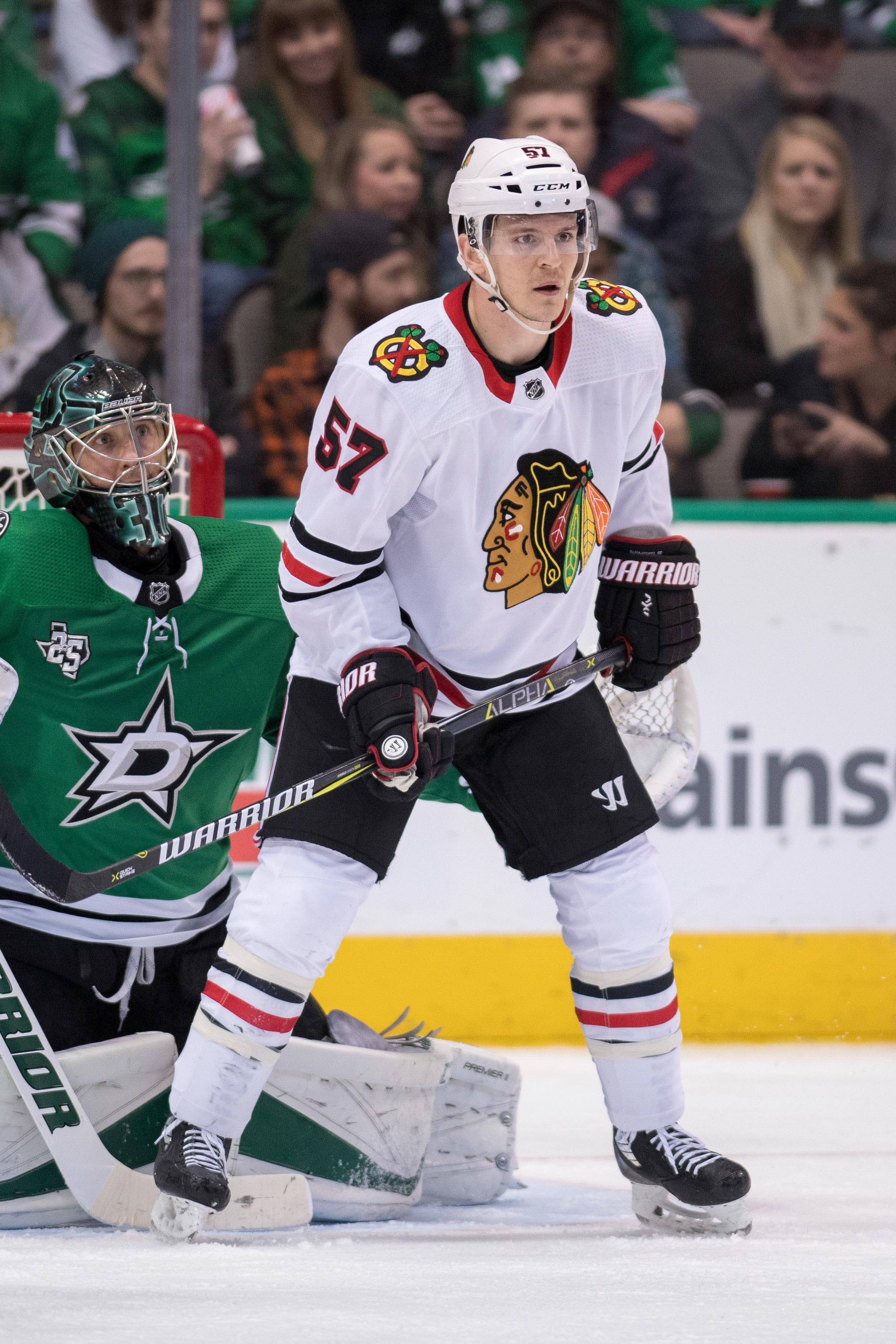 Wingels, who was a solid contributor for years with the San Jose Sharks as a bottom-six forward, signed with the Chicago Blackhawks last offseason who were in desperate need of depth. Wingels performed well, but as Chicago’s season began to go south, the team instead opted to trade him, sending him to the Boston Bruins for a conditional 2019 fifth-round pick.
Wingels provides teams with that gritty edge and experience that many teams covet for their fourth line. On top of that, he has the ability to produce some offense despite his limited minutes. He posted two goals and five points in 18 games when he arrived in Boston, but failed to produce in four playoff games as he missed time after taking a hit to the head from Toronto’s Nazem Kadri. Wingels is also only four years from two 30-point seasons. In all, he totaled nine goals, 17 points, 179 hits and 45 penalty minutes in 75 games, while averaging 11:29 of ATOI.
Potential Suitors
The most obvious match would be for the Bruins to bring back Wingels. While the veteran helped fill in for an injury-plagued team in their stretch run, Wingels hardly dominated and with the plethora of young talent waiting in the wings, it’s hard to tell whether Boston would want to bring Wingels back. On top of that, the 2019 fifth-rounder they gave to Chicago would turn into a 2019 fourth-rounder if they brought Wingels back, although that may not be that significant if they wanted him.
While there are a number of teams that may look to add some grit to their depth, there are a few teams known to hoard depth, especially at the center position. The Nashville Predators are already deep, but there are some who believe the team might continue to look at a player like Wingels if they think they can pass him eventually through waivers.
A potential return to Chicago would also make sense as the Blackhawks, with their salary cap issues, are always in need for depth and are already familiar with Wingels. The team even has some cap room to afford a relatively cheap contract that Wingels would require.
Projected Contract
Wingels days of making big numbers are gone as he had to settle for $750K last year in Chicago and likely will sign a deal with similar numbers this offseason, which will make him a solid bargain. However, if he can’t get an official contract, the veteran may have to settle for a PTO.
Photo courtesy of USA Today Sports Images.
The Contract Each Team Would Most Like To Trade: Part II
Nearly every team has one of those players: a top talent they were excited to sign and never thought could do anything but help them. In hindsight, history shows that more often than not, expensive, long-term free agent contracts don’t work out. It may look good at first (or it may look bad right away to the outside observer), but players struggle to make their value last throughout a lengthy contract. Those contracts come back to bite teams and are hard to get rid of. As teams begin to finalize their rosters at this point in the off-season, many are struggling to make everyone fit under the salary cap and are regretting these past signings that exasperate a cap crunch that can be tough for even a mistake-free club. We already took a look at the first third of the league; here are the contracts that each team would most like to trade, from Detroit to Ottawa:
Detroit Red Wings: Frans Nielsen – four years, $21MM remaining
As speculated by some readers in the comments section, it was no mistake that Part I ended with Dallas. Detroit deserved both some extra consideration and to lead off an article about poor contracts. There is an argument to be made that almost every single player age 28 and over on the Red Wings roster is signed to a bad contract for one reason or another. Detroit is a team that ranks towards the bottom of the standings and towards the top of the salary cap and that is not just bad luck. However, some are much worse than others and they are so bad that it is tough to choose between them. Take this scenario: Player A scored 35 points in 75 games last season. It was 14 points more than the season prior, including six more goals, and Player A also led the team in hits. He is 31 years old and signed for five more years at $4.25MM per. Player B scored 33 points in 79 games last season. It was eight points less than the season prior, and Player B also had the worst face-off percentage among the team’s centers. He is 34 years old and signed for four more years at $5.25MM per. Still undecided about which contract the team would rather trade? Player A is a Michigan native and career Red Wing and Player B is entering only his third year after signing a lucrative free agent contract. Player A of course is perennial whipping boy Justin Abdelkader. Yes, the Abdelkader contract is terrible. At no point in his career has he been worth his current contract value. Yet, he improved last season, is younger and brings a defensive element to his game, and is also loyal to the current administration – the call of the question after all is which contract the team would most like to trade. That would instead be Player B, Frans Nielsen, who at 34 is predictably declining and last year made more than Abdelkader for less production and there is no reason to believe that trend won’t continue. The team rewarded Adbelkader for years of service, whereas they took a gamble on Nielsen that hasn’t paid off. One of those moves is far more regrettable. Nielsen is the guy, but he only narrowly edged out Abdelkader and defenseman Danny DeKeyser, who also has relative age and Detroit roots to his advantage.
Edmonton Oilers: Milan Lucic – five years, $30MM remaining
The Oilers can refute trade rumors surrounding Milan Lucic all they want. The truth of the matter is that GM Peter Chiarelli signed Lucic hoping that he could both produce with and protect Connor McDavid in Edmonton as he did for David Krejci in Boston. The only problem is that the 30-year-old power forward can no longer keep up with a player of McDavid’s caliber. Lucic managed to score 34 points last season, tied for fourth on the team, but that is nowhere near what is expected of a $6MM player, especially when he scored 50 in year one with the Oilers and topped that mark many times with the Bruins. Edmonton still may be holding out hope that Lucic can turn it around and be just as much of a scoring threat as he is a physical threat, but make no mistake that the team would be quick to get rid of his contract if the right deal came along. In contrast, the team would be far more hesitant to move a hefty contract like defenseman Andrej Sekera who has been good and injury-prone, rather than healthy and underwhelming.
Florida Panthers: Roberto Luongo – four years, $18.13MM remaining
Florida is a tough one. Dale Tallon has done a good job of locking up his core long-term and, despite being right up against the cap, there are few egregious contracts on the roster right now. Give it a few years and maybe Michael Matheson will hold this title, but for now it goes to Roberto Luongo by default. Of course, Luongo is beloved in Florida and the team doesn’t even have to carry the whole of his cap hit, with the Vancouver Canucks retaining $800K each year. However, the reality is that Luongo will turn 40 this season and it will be only the first of four years left on his deal. The Panthers have almost $8MM committed to two goalies for the next few years and the other, James Reimer, is younger and outplayed Luongo in 2016-17 and in more games to boot. While they both fought injuries this past season, it was Luongo back on top performance-wise, but the impressive numbers he did post came in just 35 appearances versus Reimer’s 44. Florida paying over $4.5MM per year to a backup goalie in his forties just doesn’t make sense and the team would be better off moving forward with just Reimer and Michael Hutchinson if they could find a way to trade Luongo. Another reason this contract is bad: both the Panthers and Canucks will be hit with cap recapture penalties if Luongo retires prior to 2022.
Los Angeles Kings: Dustin Brown – four years, $23.5MM remaining
For the first time in years, Kings fans are feeling good about Dustin Brown. That is why now is the perfect time to trade him. Brown had been the bane of L.A.’s existence for four years, registering no more than 36 points each year while eating up $5.875MM in cap space, when he finally broke out of his funk in 2017-18 with a massive 61-point season and one of the league’s best plus/minus ratings. The question now is whether the past four years were an aberration with this season setting a new baseline or will Brown regress back to his bottom-six production. With a cap-strapped roster full of expensive contracts for older players, L.A. can’t take the risk of keeping Brown around if the right opportunity presents itself. They would be forced to trade the career King if a taker came forward rather than hold out hope that he doesn’t revert back to his old ways of being drastically overpaid.
Minnesota Wild: Zach Parise – seven years, $52.77MM remaining
When the Wild signed 28-year-old’s Zach Parise and Ryan Suter to matching 13-year contracts worth almost $100MM apiece, they knew that those deals would have dark days at some point in the future. However, they never could have imagined that Parise’s decline would come so soon. Parise remains one of the most popular players on the team, but injuries have kept him off the ice and affected his play when on the ice over the ice and his stock is falling quickly. Parise has never been able to reach the peaks he enjoyed in New Jersey, but he still produced at a high level over his first four seasons with the team. The past two years have been a different story and Parise appears to be trending in the wrong direction. Now 33, Parise isn’t totally beyond help and could turn it around. If back at 100%, Parise has enough natural ability and enough talent around him to still be a $7.5MM player. However, it would be nearly impossible for Minnesota to ever move the behemoth that is his contract so, if somehow they received an offer, they would take it without a second thought. Fan favorite or not, there is too much risk associated with Parise moving forward.
Montreal Canadiens: Shea Weber – seven years, $55MM remaining
I know what you’re thinking and yes, the Carey Price contract doesn’t look great right now. However, an extension of any length and value for any player coming off an injury-riddled season would bring a skewed perception. Price has been one of the best goalies in the league for years and one bad season doesn’t change that. Will he lose that title in the next eight years? For sure, but it would be a shock to see the Canadiens move their poster boy any time soon. Their #1 defenseman is another question though. When Montreal acquired Shea Weber for P.K. Subban, they never could have anticipated that his body would break down so soon after. Injuries cost Weber all but 26 games last season and he will miss the beginning of 2018-19 as well. Weber doesn’t seem like the type of player who will retire early, but there is no guarantee that these injuries won’t slow him down significantly for the remainder of his contract. In fact, the only guarantee is that he will slow down over the next seven years. At $7.86MM, the Canadiens need Weber to be his dynamic two-way self. The team already has one overpaid stay-at-home defenseman in Karl Alzner and can’t afford another. If they could move Weber, they would.
Nashville Predators: None
GM David Poile flat out doesn’t sign bad contracts. Criticize the deals for Ryan Johansen and Kyle Turris if you like, but the bargain contracts throughout the rest of the lineup have allowed Poile to overpay for reliable centers and that is a team-building model that anyone can get behind.
New Jersey Devils: Corey Schneider – four years, $24MM remaining
The easy answer is that the Devils don’t feel any pressure to trade anyone on the roster. They currently have the lowest payroll in the league with nearly every player signed to a fair deal. Those who are overpriced – Travis Zajac and Andy Greene – play important leadership role and the only player signed to a substantially long-term deal is electric young blue liner Damon Severson. The one and only player that sticks out as a potential long-term cap problem is starting goaltender Corey Schneider. This may surprises some; after all Schneider trails only Tuukka Rask among active save percentage leaders. Schneider had been elite since arriving in New Jersey, but something started to change in 2016-17. His SV% fell to .908 and his GAA inflated to 2.82 and then things only got worse last season with a SV% of .907 and a GAA of 2.93. He was also limited to just 40 appearances this year and was outplayed by journeyman Keith Kinkaid. The Devils can’t count on Kinkaid to repeat his 2017-18 performance moving forward and if Schneider’s back-to-back bad years are more than a fluke, they can’t depend on him for four more years either. He’s not going to be a $6MM backup either. New Jersey will give Schneider the time he needs to return to form, but they may not hesitate if the right trade comes their way as well.
New York Islanders: Andrew Ladd – five years, $27.5MM remaining
The Islanders without John Tavares are a totally different animal. A six-year, $30MM extension for Josh Bailey now looks bad. A $5.75MM cap hit this season for free agents Leo Komarov and Valtteri Filppula signed to make up for Tavares’ lost production looks bad. The likes of Cal Clutterbuck, Casey Cizikas, and Matt Martin now look worse on a team that needs more offense and less grit. However, the one contract that looked miserable well before Tavares bolted to Toronto is Andrew Ladd and it is only going to get much worse. The veteran forward was intended to find chemistry with Tavares when he was signed to a seven-year, $38.5MM contract two years ago. Instead, Ladd has just 60 points over the past two seasons combined and has by all accounts been relegated to a bottom-six role. The 32-year-old will now be asked to take a bigger role in Tavares’ stead and that is a scary proposition. The Islanders aren’t in any cap trouble, but the team should be thinking rebuild and would likely take any offer at all to rid themselves of Ladd.
New York Rangers: Brendan Smith – three years, $13.05MM remaining
Has any free agent contract in recent memory soured as quickly as Brendan Smith’s? Smith signed a four-year deal with the Rangers last June and was expected to play a top-four role for the team for years to come. By February, he had been placed on waivers and buried in the AHL. Smith played in only 44 games with New York and saw less and less ice time as the season wore on and he continued to turn the puck over at an alarming rate and cost his team goals. Now what? One would assume that Smith will be given a second chance this season, but the relationship between he and the team may be beyond repair. There is no doubt that the Rangers would take a re-do on that deal and would move him if possible. Marc Staal is another player that New York wouldn’t mind moving, but as a player who can eat minutes and provide solid play most of the time, his $5.7MM contract seems like nothing next to Smith’s $4.35MM deal.
Ottawa Senators: Bobby Ryan – four years, $29MM remaining
No contract in the league has become as notorious for being labeled a “bad deal” that the team is desperate to trade like Bobby Ryan’s. The Senators are so determined to move on from Ryan that they are trying to force Erik Karlsson trade suitors to take the overpaid forward as well. At one point in time, $7.25MM per year for Ryan seemed like a fair deal. At 23 years old he was a 71-point player with the Anaheim Ducks and even after moving to Ottawa, Ryan started his tenure with three straight seasons in the 50-point range. However, the last two years have been very different. Ryan has only suited up for 62 games in each campaign and has looked like a different player on offense. At his best, he looks disinterested and lucky to be in the right place at the right time and at his worst he costs his team goals. Ryan has managed to register only 58 points combined over the past two years; he had 56 alone in 2015-16. Ryan may just need a change of scenery to jump start what used to be dynamic goal-scoring game, but the Senators don’t care about that. All he is to them is a waste of cap space and of owner Eugene Melnyk‘s dwindling wealth. They want him gone at any cost.
Look out for Part III of this three-part series early next week…
The Contract Each Team Would Most Like To Trade: Part I
Nearly every team has one of those players: a top talent they were excited to sign and never thought could do anything but help them. In hindsight, history shows that more often than not, expensive, long-term free agent contracts don’t work out. It may look good at first (or it may look bad right away to the outside observer), but players struggle to make their value last throughout a lengthy contract. Those contracts come back to bite teams and are hard to get rid of. As teams begin to finalize their rosters at this point in the off-season, many are struggling to make everyone fit under the salary cap and are regretting these past signings that exasperate a cap crunch that can be tough for even a mistake-free club. Here are the contracts that each team would most like to trade, from Anaheim to Dallas:
Anaheim Ducks: Corey Perry – three years, $25.875MM remaining
Corey Perry is no doubt a fan favorite in Anaheim. The big winger is a career Duck who has always played with an edge and a knack for finding the back of the net. However, the former 50-goal scorer has just 19 and 17 in the past two years respectively to the tune of $8.625MM per year. His lack of speed is apparent to even the most inexperienced hockey fan and he has drawn criticism from both GM Bob Murray and coach Randy Carlyle for the drop-off in his skating ability and production. The Ducks aren’t quite up against the salary cap just yet, but have three restricted free agents still unsigned and some big decisions on the horizon. Things are about to get tight in Anaheim and, as much as Ducks fans may not want to hear it, trading Perry away in the right deal would be the easiest solution.
Arizona Coyotes: None
The Coyotes trade for bad contracts, as the perennial salary cap floor dwellers rarely sign or acquire an expensive, long-term deal with an actual asset who may not be worth it.
Boston Bruins: David Backes – three years, $18MM remaining
On July 1st, 2016, it was leaked that Boston would sign David Backes to a one-year, $6MM contract and the Bruins were praised for bringing the veteran forward in as a hired gun. That celebration was short-lived, as the report was soon corrected to being a five-year deal with the same yearly salary and many questioned adding a 32-year-old with 727 games to his credit on a contract of that length and value. Two years later, the doubters have been proven right for the most part. Backes has not been bad in Boston (71 points in 131 games) and injuries have certainly affected his game, but it appears that his 50-point upside and Selke-caliber high-energy play are a thing of the past. Backes doesn’t have a defined role with the Bruins going forward and, as a team that doesn’t need the extra leadership and locker room presence and does need as much cap space as it can get, Boston would be better off if Backes were elsewhere.
Buffalo Sabres: Zach Bogosian – two years, $10.286MM remaining
The Sabres are finally trending in the right direction and have even used other teams’ bad salary cap situations to bring in some nice players this off-season. Buffalo themselves are in fine shape with the cap. However, there is still one contract that is bringing them down and that is Zach Bogosian. If Bogosian was fully healthy, his cap hit of just over $5.1MM would not be too bad. The 28-year-old defenseman has been a very capable two-way player in his career. Unfortunately, he just hasn’t been healthy enough during his time in Buffalo to be worth that salary. Bogosian played in only 18 games last year due to injury – and when he did play it showed that he wasn’t 100% – and has never topped 64 games in a season with the Sabres. The team has several young defenseman that could use as much ice time as possible and a beat up Bogosian isn’t helping anyone in Buffalo. Chances are the Sabres could still get a good return for the rearguard if he does show signs of being back at full-strength.
Calgary Flames: Troy Brouwer – two years, $9MM remaining
Calgary is in a really difficult salary cap situation with little space as is and five restricted free agent situations still to sort out. The team simply can afford to be paying Brouwer $4.5MM in each of the next two years for what he brings to the table. Many were skeptical of the Brouwer contract when signed and they were correct. The veteran power forward has only 25 and 22 points respectively in his first two years in Calgary, including just six goals last season, and at 32 years old he is unlikely to improve. Brouwer has even lost some of his trademark physical edge and recorded a career-low average time on ice last season when he was simply a non-factor in most games. With multiple players filing for salary arbitration, the Flames have been awarded an extra buyout period and it would not come as a shock to see Brouwer fall victim to it.
Carolina Hurricanes: Scott Darling – three years, $12.45MM remaining
The argument here is not that the Hurricanes should trade Darling because they need the cap space but that they should trade Darling because they need a better starting goaltender. Carolina is in fine salary cap shape, but so long as Darling is making more than $4MM per year, the team is likely to stick with him as the top guy. They have already committed to giving him another chance as the starter next season. Unfortunately, Darling’s first season in Raleigh hardly convinced anyone that this contract would work out. Moving from backup to starter, Darling seemed to crumble under the pressure even behind a stout defense, posting an .888 save percentage and 3.18 GAA as one of the worst keepers in the NHL. Perhaps his play will improve in year two, but the Hurricanes can’t be happy with the early results.
Chicago Blackhawks: Brent Seabrook – six years, $41.25MM remaining
When the Blackhawks made Patrick Kane and Jonathan Toews the highest paid players in the league back in 2014, who would have figured that a different contract would be causing the team problems? Brent Seabrook’s eight-year, $55MM extension is already a nightmare for Chicago with the bulk of the contract still to come. Seabrook is a fine defenseman, but that doesn’t cut it when you’re paid like one of the top defenseman in the league, but your play is slipping and your team is finishing last in the division. This past season especially, it was clear that Seabrook has lost a step. Both his scoring and checking have diminished and he no longer resembles the player who was regularly posting 40+ points and garnering Norris Trophy votes. Seabrook will turn 34 later this season and it seems guaranteed that this contract only gets worse unless the team finds some way to trade him.
Colorado Avalanche: Erik Johnson – five years, $30MM remaining
The Avalanche have one of the lowest payrolls in the league with superstar Nathan MacKinnon locked up long-term at a reasonable rate. Their distance from the cap ceiling this season makes egregious contracts with just one year remaining – like streaky starter Semyon Varlamov and invisible forward Colin Wilson – somewhat tolerable. However, several major contributors are set to be restricted free agents after next season, Colorado will need to add another goaltender, and could still stand to add another difference-maker up front. Things could get tighter for the Avs moving forward and the one contract that could become a problem is Erik Johnson. Johnson eats up minutes and plays a defensively sound game, but the veteran defenseman is injury prone and does not create enough offense to warrant a $6MM cap hit. If the Avalanche were offered a reasonable deal for Johnson today they may not take it, but this time next year that same deal will be far more attractive.
Columbus Blue Jackets: Brandon Dubinsky – three years, $17.55MM remaining
The Blue Jackets pay Brandon Dubinsky like a second-line center and last season got fourth-line production from the veteran. Yes, Dubinsky has had his fair share of injuries, but a consistent 40+ point scorer dropping to just 16 points on the year was alarming. Columbus is no longer a small market team still figuring things out; the Jackets are a contender and like most contenders are close to the salary cap limit. The team can’t afford to have Dubinsky continuing to produce at this level while costing them $5.85MM against the cap. They hope that he bounces back this year, but even a slow start could have Columbus taking their best offer.
Dallas Stars: Martin Hanzal – two years, $9.5MM remaining
It may be too early to judge last summer’s Martin Hanzal contract, but if Dallas was offered a re-do right now, they would take it. Hanzal’s first season with the Stars was a disaster. Injuries limited him to just 38 games and even when active he contributed only ten points – a 22-point pace over a full season – and somehow finished with the second-lowest plus/minus rating on the team. If Hanzal gets healthy, which is a big if, he could return to form next season, but if not the Stars could be quick to deal him away. The team desperately needs to bounce back from a devastating slump that cost them a playoff spot and have been rumored to be interested in big (expensive) names all off-season. That plan doesn’t mix well with a $4.75MM player who brought almost nothing to the team last year.
Keep an eye out for Part II of this three-part series coming soon…
Snapshots: Offer Sheets, Hall, O’Gara
With a limited pool of quality unrestricted free agents this year and quite a few impressive names among restricted free agents available, one has to wonder whether this might be the year that a team makes an attempt to pry away one of them with an offer sheet.
Sure, no team has used an offer sheet since 2013 when the Calgary Flames attempted to sign center Ryan O’Reilly away from the Colorado Avalanche. It didn’t work and since then, there hasn’t been one. Yet with names like Noah Hanifin, Dylan Larkin and William Nylander still available, you would think a team might attempt to go the offer-sheet route.
However, Craig Custance of The Athletic (subscription required) writes that won’t be happening this year, if again. The scribe informally polled nine general managers, who all collectively said there would be no offer sheets handed out this summer. One reason is that general managers see it as a way to drive up salaries, which they don’t want, and since almost all offer sheets are matched, then what would be the point? Custance adds that the compensation for offer sheets must be changed, so teams might be more willing to let a player go.
- Chris Ryan of nj.com analyzes the success of Hart Trophy winners the following year they won, as he wonders how New Jersey Devils Taylor Hall will respond next season after winning the Hart Trophy with a 39-goal and 93-point season. While most of the previous winners (going all the way back to the 2006 season) saw a decline in their play the following year, most of them still put up solid numbers and still were in the voting for the Hart Trophy the following year, even if they didn’t win it. Edmonton’s Connor McDavid finished fifth in the voting the following year, while 2016 Hart Trophy winner Patrick Kane finished sixth the next season.
- Fluto Shinzawa of The Athletic (subscription required) writes that former Boston Bruins defenseman Rob O’Gara, who was traded at the trade deadline to the New York Rangers as part of the Nick Holden trade felt the trade was bittersweet. The 25-year-old blueliner was still on his entry-level contract and had only played 11 NHL games before the trade, but the four-year Yale University product had already lost some faith in him. In a league where youth thrives, O’Gara had already run out of time as he failed to crack Boston’s rotation and was often passed over for promotion by younger defenseman. In New York, however, he got a legitimate chance to take on a more permanent role, as he played in 22 games, a role he hopes to hold onto this season.