
Logan O’Connor Signs Three-Year Extension With Avalanche
Logan O’Connor‘s ice time has slowly gone up the last couple of seasons and he has been rewarded for his improvement as the Avalanche announced that they’ve signed the winger to a three-year contract extension. Peter Baugh of The Athletic adds (Twitter link) that the deal carries a $1.05MM AAV. GM Joe Sakic released the following statement:
Logan is a high-energy player who works hard, competes and brings grit and depth to our lineup. He is a strong skater and penalty killer and has continued to improve his game every year as a professional.
O’Connor was frequently shuffled back and forth to and from the taxi squad last season while also dealing with a lower-body injury but still got into a career-best 22 games with Colorado last season where he picked up three goals and two assists in just under 11 minutes a game in playing time. He also saw action in a pair of playoff contests where he was held off the scoresheet. To this point in his career, the 25-year-old has primarily been used in a checking role over his 43 total NHL appearances but with the departures of Joonas Donskoi and Brandon Saad this summer, there will be an opportunity for O’Connor to have a bigger role on the depth chart.
The fact that Colorado has handed him this deal now suggests that they expect O’Connor to be more of a regular player this coming season and have opted to sign him now over potentially needing to pay him more had they waited until next offseason. Either way, O’Connor picks up a nice raise as he is scheduled to make the league minimum of $750K in salary in 2021-22 while actually carrying a cap hit below that price tag at $725K.
Snapshots: Rielly, Tkachuk, Canucks, Memorial Cup
Maple Leafs defenseman Morgan Rielly is heading into the final year of his contract and with a $5MM price tag on his current deal, it’s safe to say that he’s heading for a sizable raise on his next deal. The blueliner spoke with reporters today including TSN’s Kristen Shilton to discuss his situation:
My approach this year is that I don’t really want to discuss it publicly. …You know how I feel about being a Leaf, but at the same time, it’s a business. But being a Toronto Maple Leaf is special to me. … I’m not going to put any rules on [my agent]. And I’ll take care of what I can do hockey-wise. That’s the best approach for me.
With the price tag for number one defensemen going up considerably this summer, Rielly’s camp could push for a contract upwards of $8MM. With nearly $68MM in commitments to just 14 players for 2022-23 per CapFriendly, they may have a hard time fitting that contract in with the Upper Limit likely only increasing by $1MM for that season.
Elsewhere around the hockey world:
- In his latest 32 Thoughts column, Sportsnet’s Elliotte Friedman wonders if the delay in discussions for Senators restricted free agent Brady Tkachuk is more about structure than actual dollars. Year-to-year distribution has become more important with a high escrow rate now while it declines in future years while signing bonuses and trade protection are always important elements in talks for core players. Tkachuk is only eligible for trade protection in the UFA-eligible seasons of a long-term agreement and he’s four years away from getting to that point.
- Canucks forward Justin Bailey will not be available at the start of training camp following a positive COVID-19 test, reports Postmedia’s Patrick Johnston (Twitter link). The 26-year-old played in just three games with Vancouver last season; he spent most of the first month of the year on the taxi squad before suffering a season-ending shoulder surgery. Meanwhile, GM Jim Benning also indicated that center Brandon Sutter is dealing with some fatigue with the team not fully sure of what the cause of it is at this time but ruled out the possibility of it being the COVID-19 virus.
- After the event wasn’t held the last two seasons due to the pandemic, the CHL announced that the Memorial Cup will return in 2022 and will be held in Saint John, New Brunswick, a QMJHL city. The event pits the host city against the champions from the QMJHL, OHL, and WHL in a short tournament that will take place in early June.
Cal Foote Will Miss Start Of Regular Season After Surgery
There have been several injury updates throughout the league today as training camps get underway and one of them came from Tampa Bay. GM Julien BriseBois told reporters, including Joe Smith of The Athletic (Twitter link) that defenseman Cal Foote recently underwent surgery to repair a torn tendon in his finger. He’s expected to miss all of training camp plus the first two-to-four weeks of the season as a result.
The 22-year-old spent most of last season with the Lightning, playing in 35 games during the regular season although he didn’t suit up in the playoffs. The 14th pick in 2017, Foote was expected to push for a spot on the third pairing in camp and now that he’s waiver-eligible, his days in the minors were likely over. Instead, he’ll be on the outside looking in once the regular season gets underway next month.
The timetable for a return is noteworthy here. Tampa Bay is protected to have a roster that’s right up against the Upper Limit even with Brent Seabrook’s eventual transfer back to LTIR and it’s one that will be below the maximum size of 23. If Foote is expected to return within the first two weeks of the season, he won’t miss enough time to be eligible for LTIR; players need to be out for three weeks or ten games to qualify. If he’s projected to be out that long, they’ll be able to place Foote on there and bring up a replacement that carries roughly the same $850K AAV that he does.
While there were some injuries from the playoffs for Tampa Bay, Foote is the only Lightning player expected to miss the start of the season. In a pair of other tweets, Smith notes that defenseman Victor Hedman has fully recovered from his meniscus surgery while winger Alex Killorn is still rehabbing from his broken fibula but is expected to be ready for opening night.
Senators Re-Sign Logan Brown
The Senators have taken care of one of their remaining restricted free agents, announcing the signing of center Logan Brown to a one-year, two-way deal. The contract pays the league minimum of $750K in the NHL and $100K in the AHL. GM Pierre Dorion released the following statement about the move:
Logan is among the most talented prospects in our organization. He possesses many of the tools that could ultimately help him find success in the NHL. We’re hopeful that a productive summer translates into a good training camp for him here beginning next week.
The 23-year-old has shown flashes of upside since being the 11th-overall pick in 2016 but it hasn’t translated to any consistent success in the NHL. While he has been productive in the minors (including nine points in 13 games in 2020-21), he has just a goal and eight assists in 30 career NHL contests; just one of those NHL appearances came last season. Brown’s camp hasn’t hidden a desire for a trade and Ottawa has made him available but clearly, the right return hasn’t come around yet which has led to this deal.
Brown is eligible for waivers this season which makes the fact that he took less than his $874K qualifying offer a bit interesting. While it guaranteed him a bit more money if he cleared and was sent to the minors but at the league minimum price tag, he will be easier for other teams to fit in should a trade or waiver placement materialize. In the meantime, Brown should get a long look at camp where he’ll battle for a spot at the end of the roster. Knowing the waiver eligibility is there now, he’ll be one to keep an eye on in the preseason.
Snapshots: Canucks, Brown, Warner
The Canucks remain a team to watch for with training camp fast approaching with their two prominent unsigned players in defenseman Quinn Hughes and forward Elias Pettersson. Speaking with Sportsnet’s Iain MacIntyre, GM Jim Benning indicated that “there’s no angry sides” as they continue to talk either every day or every second day. Vancouver has enough cap room to potentially sign one of the two to a long-term contract and the other a bridge deal but MacIntyre reports that at this point, short-term contracts for both are the current focus. With both being represented by CAA, the discussions are basically intertwined. Benning expressed a desire to have both stars signed before training camp starts so agreements will need to be in place soon for that to happen.
Elsewhere around the hockey world:
- Senators Logan Brown is one of 11 remaining restricted free agents in the NHL but that shouldn’t be the case much longer. While both sides wouldn’t mind a change of scenery, Postmedia’s Bruce Garrioch reports that the expectation is that Brown will soon accept his qualifying offer and be at the start of training camp. The offer, which technically has expired although players can still sign for that amount, is a two-way deal worth just over $874K. Brown will require waivers to be sent back to the AHL this season and if he doesn’t make Ottawa’s roster in training camp, a waiver claim could wind up being how he goes elsewhere.
- Former Wild defensive prospect Hunter Warner retired late last month at the age of 25 but as it turns out, he’s not leaving sports entirely. Instead, he has taken up boxing, notes Dane Mizutani of the Pioneer Press. Warner was undrafted but signed with Minnesota in 2014 and played in parts of six professional seasons with AHL Iowa before hanging up his skates.
PHR Mailbag: Maple Leafs, Olympics, Flyers, Panthers, Surprises, Futa, Kings, TV, Penguins
Topics in this edition of the PHR Mailbag include Toronto’s playoff potential, Philadelphia’s summer shuffle and goaltending situation, predictions for some surprises this season, and much more. If your question doesn’t appear here, check for it in next weekend’s mailbag.
jimmertee: Can the Leafs ever win in the playoffs with Matthews on the team and the core that’s getting paid so much money but don’t produce in the playoffs? How long do the Leafs stick with that core?
I think they can definitely win a round although that’s about as far as I’m willing to go this season; Tampa Bay is in their division after all and would be the likely favorite in what would be a second-round matchup. They’ve come close enough in recent years and have done some things well; a good bounce here and there and they’d have won a series already. So no, this core isn’t doomed to lose forever and they can definitely get over the proverbial hump.
There really isn’t an easy jumping-off point with this core, especially among their four high-priced forwards. High-paid players are hard enough to move and getting top value for them will be even harder. It’s not that those players aren’t any good but moving and matching money is going to be tough for a while. The overall core group will weaken as the flattened salary cap ultimately prevents players from re-signing but I believe they’re locked into this team structure for a few more years yet.
wreckage: Do you see anyone declining an invite to play at the Olympics?
I’m assuming you’re asking on the political and public pressure fronts. Lots can change as we get closer to February so this answer may not hold up in the end but I’m going to say no. There hasn’t been a chance for an NHL player to participate in eight years so it’s going to be the first opportunity for many and the last chance for many others. It’s hard to pass up on that.
There’s also the fact that the NHL isn’t overly enthusiastic about long-term participation in this event. There’s a commitment to try for 2026 but after that, if they can rekindle and make money off the World Cup, they’re going to push for that so Olympic participation is hardly a guarantee. With the opportunities being so infrequent, I just can’t see anyone declining for that reason. Players will withdraw/decline due to injury but I think that will be the only reason.
Black Ace57: After a busy offseason, is this going to be the make-or-break year for the Flyers? At this point, if they can’t play up to expectations is there really any option but retooling for a year or two?
It sure feels like there’s a lot riding on this season, doesn’t it? GM Chuck Fletcher has made several key changes to their roster with the additions of Cam Atkinson, Ryan Ellis, and Rasmus Ristolainen with the sole design of getting back to the playoffs and doing some damage when they get there. If that doesn’t happen, changes are going to be made.
Claude Giroux is an unrestricted free agent next summer and he’s someone whose odds of returning will likely directly be tied to Philadelphia’s success. Once James van Riemsdyk moves to being an expiring contract which happens next summer, he’s likelier to be gone as well. Those two leaving would be another significant retooling. We’ll see what happens with Ristolainen, another pending UFA, as well.
With the commitments they have on the books already – nearly $66MM in a dozen players per CapFriendly – a big overhaul seems less likely so while there could be a big name or two coming and going again, most of the core would stay intact so I like your classification of a retool instead of a rebuild in that situation.
Emoney123: Do the Flyers have a goalie problem? Hart is coming off a down year so should he be looking over his shoulder at Sandstrom, Ersson, Ustimenko, Ross, Tomek, and Fedotov? Is there a generational talent in there somewhere or just prospects hyped by the organization?
I’ll answer the second one first. No, there isn’t a generational goalie in the pipeline. I’m not even sure there’s an NHL starting goalie in there let alone a rare elite talent. Samuel Ersson has some upside but he needs to do well in North America before calling him good enough to potentially push Carter Hart for playing time.
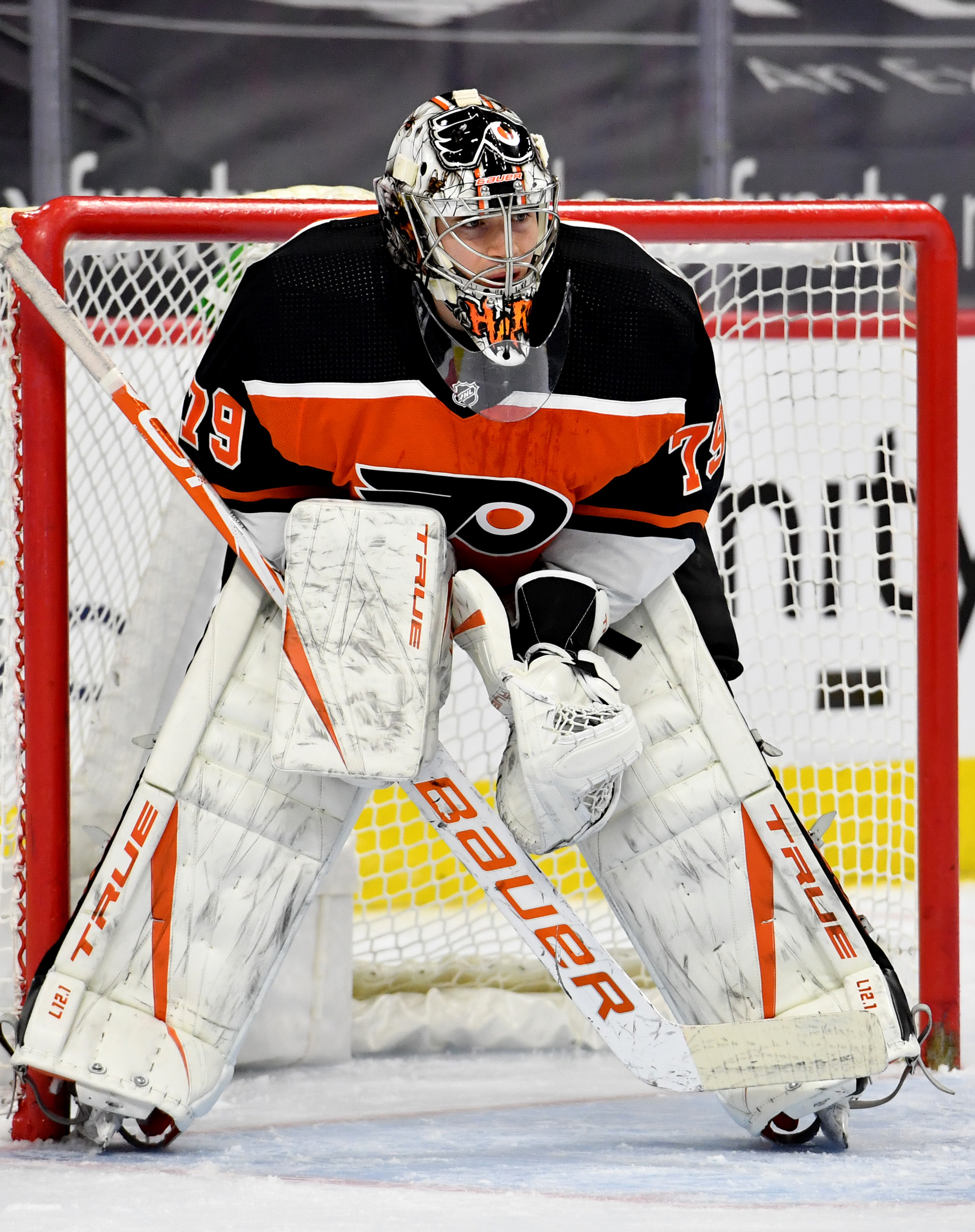 So, is that a problem? I’m not ready to call it that yet. I expect Hart to bounce back playing behind an improved defensive group and even if he isn’t a long-term star netminder, they’ll settle for someone that’s capable of being a decent starter. He’s 23, signed for three years and under team control for four. That’s a good foundation and finding a capable second goalie is certainly doable although I don’t think they necessarily landed one in Martin Jones who they’re also hoping will benefit behind a better defense. If they have to reallocate some cap space to goaltending, they should be able to get a better backup to push Hart and, in the process, give them at a minimum a serviceable tandem. If you have that, it’s not a problem.
In the meantime, adding a quality goalie prospect should be fairly high on the priority list.
YzerPlan19: Predictions for Bennett and Reinhart in Florida’s top six? Can Reinhart get 30 goals playing on Barkov’s wing? Did they bring him in to add more offense or does he slot in at 3C? Can Bennett exorcise his demons and continue on a point per game clip as 2C with Huberdeau?
I can’t see Florida paying a first-round pick and a pretty good goalie prospect in Devon Levi to have Sam Reinhart play on the third line. He’s there to be an impact scorer and will be in their top six, potentially on the wing alongside Aleksander Barkov. I think he’s absolutely capable of scoring 30 this season. Very quietly, he scored at a 38-goal pace last season on a Buffalo team that was bereft of offense. Put him in a more offensive-oriented environment while still being with a high-end center and 30 is definitely attainable.
Bennett, to me, is one of the biggest wildcards in the league. I don’t think he’s going to be able to keep playing at a point-per-game pace as he did after the trade. 10 regular season games is a pretty small sample size as is five playoff contests. But he absolutely can put up more than he was providing with Calgary. If he had a 45-50-point season while being a capable center and playing with plenty of grit, I think they’d take that. If he can hover closer to that point per game mark though, his contract will wind up being one of the better bargains in the league.
pawtucket: What are your top surprises in each division? Could be team, player, standings, whatever.
Atlantic: Will Butcher (Buffalo) gets back to being an impact offensive defenseman. He was a bit better down the stretch in New Jersey but was still given away (with retention). He’s not going to a winning environment but he will have a chance to play a bigger role and has the offensive skills to be a real weapon. With his lowered price tag ($2.822MM after retention), he becomes one of the most sought-after rentals at the trade deadline.
Metropolitan: Columbus doesn’t bottom out and finish last in the division. They’ve blown up their roster and at some point, one of their two pending UFA goalies is going to have to go as well. The end result is a mishmash of players that are supposed to have the Blue Jackets contending for the top pick. They’re not making the playoffs but they’ll be more competitive than many realize at and the end of the day, someone else is last in the Metro.
Central: Vladimir Tarasenko (St. Louis) is still with the Blues after the trade deadline. There’s a mutual desire for a change of scenery and he has been in all sorts of trade speculation but they don’t want to give him away in case he bounces back. Tarasenko produces close to a 20-goal level which still isn’t a good return on a $7.5MM AAV but it’s enough that they decide to hold onto him. Many expect him to move – particularly since they need to re-sign Robert Thomas – but someone else becomes the cap casualty to make that happen.
Pacific: Nolan Patrick is this year’s Chandler Stephenson. Stephenson’s trade to Vegas gave him a chance to play a bigger role and he certainly made the most of it. Now, Patrick, freed somewhat from the expectations that come from being a second-overall pick, has a similar opportunity and puts up 35-40 points, giving the Golden Knights the center depth they’ve lacked lately. He’s not going to be the number one that would make a huge difference but he’ll be a big part of their secondary core, not too shabby for a reclamation project.
RFA Profile: Elias Pettersson
Elias Pettersson burst onto the scene in 2018-19, immediately becoming a top-line player on the Canucks. He has been a fixture in that role since then, putting him in line for a substantial raise once he signs his second contract which should be at some point over the next few weeks with training camps fast approaching.
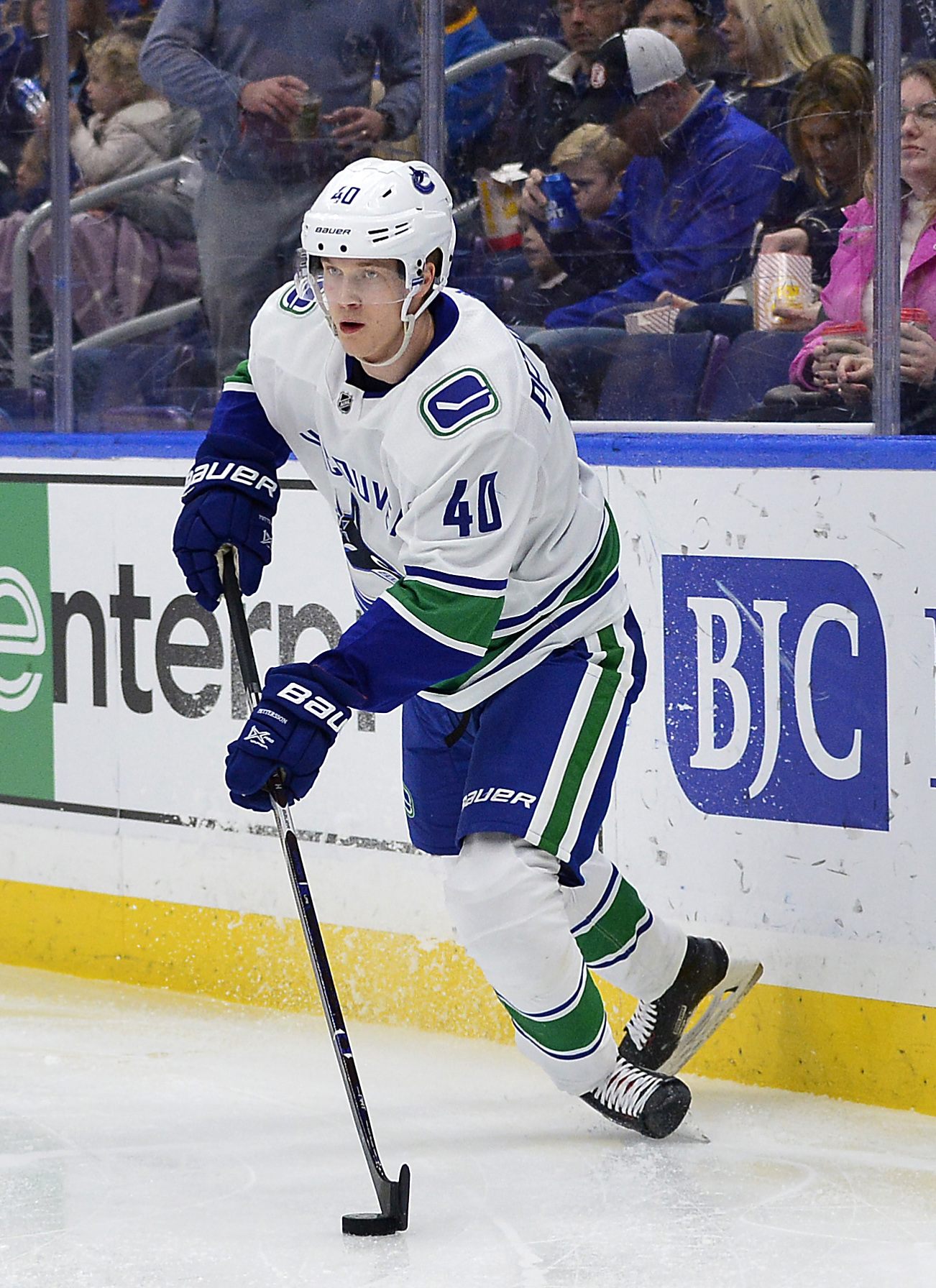 Drafted as a center, the 22-year-old has split time between playing down the middle and on the wing which expands the pool of comparable players to work from. Either way, Pettersson is going to be staying on the top trio.
There are a couple of elements that are going to be at play in these talks. One is that he missed the last 30 games with a wrist injury and while no one is saying he had something to prove there, he’s basically working off of two years worth of NHL games played whereas many of his comparables had three full years under their belt. It’s not going to drastically affect his value but it’s going to be something to keep in mind.
The other is Vancouver’s cap situation. By the time they whittle their roster down and place Micheal Ferland on LTIR, they’re going to have around $15MM to spend. That’s plenty for Pettersson but there’s also Quinn Hughes that needs to be signed. They can’t both get long-term deals; at least one of them is getting a bridge. How talks go with one will play a big role in negotiations for the other. (Both happen to be represented by CAA’s Pat Brisson as well.)
Statistics
2020-21: 26 GP, 10-11-21, even, 66 PIMS, 63 shots, 18:34 ATOI
Career: 165 GP, 65-88-153 (0.93 points per game), +19, 36 PIMS, 369 shots, 18:24 ATOI
Comparables
Brayden Point (Tampa Bay, 2019) – Let’s look at a couple of bridge options first. Point was basically stuck signing one due to Tampa’s cap situation, a situation that Pettersson could be in as well depending on what happens with Hughes. Point’s trajectory is different than Pettersson’s in that he started slower but had a dominant platform year which wasn’t an option for Pettersson but the per-game average numbers are somewhat close overall.
Platform Year Stats: 79 GP, 41-51-92, +27, 28 PIMS, 191 shots, 18:55 ATOI
Career Stats at ELC Expiration: 229 GP, 91-107-198 (0.86 points per game), +49, 66 PIMS, 530 shots, 18:38 ATOI
Contract: Three years, $20.25MM
Cap Hit Percentage: 8.28%
Current Equivalent: Same as above
Mathew Barzal (NY Islanders, 2021) – Barzal wasn’t able to repeat his rookie-season performance over his second and third years but still notched at least 60 points each time, a level of production Pettersson hit in his first two years, albeit with fewer games played. Like Point, this deal was basically forced by New York’s cap situation and as it was signed earlier this year, it also stands as the most recent comparable out there.
Platform Year Stats: 68 GP, 19-41-60, +5, 44 PIMS, 171 shots, 20:03 ATOI
Career Stats at ELC Expiration: 234 GP, 59-148-207 (0.88 points per game), -1, 126 PIMS, 520 shots, 18:25 ATOI
Contract: Three years, $21MM
Cap Hit Percentage: 8.59%
Current Equivalent: Same as above
Those are basically the only two comparable players in the price range that it’s going to cost on a short-term contract so let’s look at a few longer-term deals. The cost gets a lot higher with some UFA years being bought out as a result.
Jack Eichel (Buffalo, 2017) – Yes, this is a big contract but the offensive output between the two at the end of their entry-level deals is pretty close. Eichel had the strength of a higher draft seed (second) and the fact he was basically Buffalo’s franchise player from the moment he was drafted. Those gave him a bit of a boost that Pettersson might not be able to get but the numbers – which matter the most in contract talks – arguably have Pettersson in this range. This contract was also viewed as a reach at the time but it’s still usable as a comparable.
Platform Year Stats: 67 GP, 25-39-64, -25, 32 PIMS, 246 shots, 20:09 ATOI (deal was signed pre-platform)
Career Stats at ELC Expiration: 209 GP, 73-104-177 (0.85 points per game), -54, 76 PIMS, 733 shots, 19:41 ATOI
Contract: Eight years, $80MM
Cap Hit Percentage: 13.33%
Current Equivalent: Eight years, $86.91MM ($10.864MM AAV)
Mikko Rantanen (Colorado, 2019) – The two players had very different trajectories – Rantanen started slow and then became a high-end performer while Pettersson has been more consistent – but again, the totals at the end of their respective entry-level deals are certainly comparable. It’s fair to question if Pettersson has the offensive ceiling that Rantanen does which is an argument GM Jim Benning would certainly use in talks when this comes up as a possible comparable deal.
Platform Year Stats: 74 GP, 31-56-87, +13, 54 PIMS, 193 shots, 20:51 ATOI
Career Stats at ELC Expiration: 239 GP, 80-129-209 (0.87 points per game), -19, 112 PIMS, 513 shots, 18:53 ATOI
Contract: Six years, $55.5MM
Cap Hit Percentage: 11.35%
Current Equivalent: Same as above
Mitch Marner (Toronto, 2019) – This one would certainly represent the high end of the scale but it’s important to get one player on here whose point per game average at the end of his entry-level deal is at the same mark as Pettersson’s. The only ones with a higher average that were recent high picks to sign long-term deals were Auston Matthews and Connor McDavid and Pettersson certainly isn’t in that range although that’s impressive company to be in. Again, Marner’s offensive trajectory was higher at this point than Pettersson’s is now which is why this basically represents a bar he won’t clear but he could come close.
Platform Year Stats: 82 GP, 26-68-94, +22, 22 PIMS, 233 shots, 19:49 ATOI
Career Stats at ELC Expiration: 241 GP, 67-157-224 (0.93 points per game), +21, 86 PIMS, 603 shots, 17:41 ATOI
Contract: Six years, $65.408MM
Cap Hit Percentage: 13.38%
Current Equivalent: Same as above
Projected Contract
If you were looking at those last few comparables and thinking that Pettersson isn’t in that range, it’d certainly be understandable. The fact is that he hasn’t played anywhere as many games as those players have thanks to the wrist injury and the last two years being shortened. But the point per game average is there and Brisson is going to hammer that home in talks and not settle for considerably less than that. Accordingly, a long-term deal that buys out at least a couple of UFA-eligible seasons could very well have an AAV starting with a nine.
That’s why the short-term contract is the easier play here. If they’re able to work out a long-term deal with Hughes, they should still be able to afford a two-year or three-year bridge around the high $6MM/low $7MM range without creating any significant cap casualties. Either way, while they don’t necessarily have to have a deal done with Hughes beforehand, the two basically need to get their deals done pretty much around the same time. At this point, it may make more sense for Pettersson to get the short-term deal.
Photo courtesy of USA Today Sports Images. Contract information via CapFriendly.
Teams Will Receive Cap Relief For COVID-Related Suspensions
One of the changes to the COVID protocols in the NHL for the upcoming season is the ability for teams to suspend players without pay who are “unable to participate in club activities” due to being unvaccinated. Deputy Commissioner Bill Daly confirmed to Postmedia’s Patrick Johnston that Section 50.10(c) of the CBA will apply in this scenario which means that teams who suspend an unvaccinated player under these protocols will receive corresponding cap relief for the day(s) the players are suspended for.
Among the scenarios where unvaccinated players could be suspended are government-imposed quarantine after crossing the border or the requirement of having the vaccine to be allowed to enter an arena which has popped up in a few states with NHL teams in recent weeks.
It has been suggested that the stricter protocols including the potential for suspension without pay have played a role in the high percentage of NHL players who have currently received the vaccine – a number that’s estimated to be at roughly 98%. With that in mind, the number of regular NHL players who aren’t vaccinated is quite low; Daly suggested to Ryan S. Clark, Mark Lazerus, and Joshua Kloke of The Athletic (subscription link) that they expect that 15 or fewer players fall under this category which means that they would be the only ones subject to this scenario.
It’s worth noting that while it could create an opportunity for teams to bank space during the season, it’d be an unwanted one as it would take a regular player out of the lineup and potentially force a recall from the AHL. Meanwhile, teams in LTIR would be able to bring a replacement up but wouldn’t be able to bank any cap space unless they were to dip under their respective Accruable Cap Space Limit as a result of the suspension. We’ll see over the coming months if this scenario winds up coming into play and whether it winds up having any sort of tangible salary cap impact for teams with an unvaccinated player.
Salary Cap Deep Dive: Seattle Kraken
Navigating the salary cap is one of the more important tasks for any GM. Teams that can avoid total cap chaos by walking the tightrope of inking players to deals that match their value (or compensate for future value without breaking the bank) remain successful. Those that don’t see struggles and front office changes.
PHR will look at every NHL team and give a thorough look at their cap situation heading into the 2021-22 season. This will focus more on players who are regulars on the roster versus those who may find themselves shuttling between the AHL and NHL. All cap figures are courtesy of CapFriendly.
Seattle Kraken
Current Cap Hit: $73,106,666 (under the $81.5MM Upper Limit)
Entry-Level Contracts
None projected to play a full-time role in the NHL this coming season.
One Year Remaining, Non-Entry-Level
F Mason Appleton ($900K, RFA)
F Colin Blackwell ($725K, UFA)
D Dennis Cholowski ($900K, RFA)
F Ryan Donato ($750K, RFA)
D Cale Fleury ($750K, RFA)
D Haydn Fleury ($1.4MM, UFA)
F Morgan Geekie ($750K, RFA)
D Mark Giordano ($6.75MM, UFA)
D Jeremy Lauzon ($825K, RFA)
F Kole Lind ($874K, RFA)
F Calle Jarnkrok ($2MM, UFA)
F Marcus Johansson ($1.5MM, UFA)
F Jared McCann ($2.94MM, RFA)
F Riley Sheahan ($850K, UFA)
F Carsen Twarynski ($750K, RFA)
McCann has shown flashes of being an above-average contributor in the past but hasn’t been able to do so consistently. He’ll get the chance to play a bigger role with Seattle and if it all comes together, he could be in line for a sizable pay bump next year. Jarnkrok has been on a bargain deal for the last five years and will also get to play a bigger role with a shot at bumping up his numbers before hitting the open market. Johansson and Sheahan are both coming off quiet years and have seen their value dip lately and will need stronger seasons to land guaranteed deals next summer. Appleton is coming off a strong season with Winnipeg and is already looking like a candidate to more than double his AAV next summer. A similar performance this season could triple it. Donato had to settle for a minimum contract after a tough year in San Jose but should be able to rebuild his value with the Kraken somewhat. Blackwell had a breakout year with the Rangers and is a candidate for a big jump in salary next summer. Geekie, Lind, and Twarynski will also be battling for depth roles but if they land a roster spot, it’s unlikely they’ll be able to land a big raise as they’d be in a limited role.
Giordano – who turns 38 next month – is nearing the end of his career but is still a capable top-four blueliner. He’s going to get an opportunity to play a bigger role than he probably should and he’s a candidate to be moved at the trade deadline to a contender who can cut his ice time. He’ll be going year to year from here on out and while his next deal will be cheaper than this, he could still command an AAV in the $5MM range. The Fleury brothers are at different stages of their careers. Haydn played close to the full season in 2020-21 and should be able to land a small raise a year from now while Cale was in the minors last season and is merely looking to stick on the roster. A limited role is likely which will yield a cheap deal next summer. Lauzon did well in Boston last year in his first stint of regular duty and with arbitration rights, he could double his current AAV next summer. Cholowski’s AAV is a little high for someone who may be on the fringes of making the roster but that may be by design in order to try to help sneak him through waivers next month.
Two Years Remaining
F Nathan Bastian ($825K, RFA)
D William Borgen ($900K, RFA)
F Joonas Donskoi ($3.9MM, UFA)
D Vince Dunn ($4MM, RFA)
D Carson Soucy ($2.75MM, UFA)
Donskoi hasn’t had a lot of consistent top-six opportunities but has surpassed the 30-point mark in each of the last four seasons. His price tag is a little high for his level of production but with a bigger role in Seattle, that could change. Bastian has basically just been an energy player in the early stages of his career and as long as he can hold down a spot on the roster, they won’t have any issues with his price tag. Gritty energy players can still land a pretty good payday as long as they can put up some production which is something Bastian will have to work on.
Dunn’s offensive production landed him a big raise this summer and it’s telling that Seattle opted for basically a second bridge contract to get one more opportunity to work out a long-term deal before he becomes UFA-eligible. He’s going to get the opportunity for a bigger role than he had with the Blues and if he can establish himself as a top-pairing player, that next deal could be quite a pricey one. Soucy is a serviceable third-pairing defenseman making a bit much for that role but Seattle has ample cap space to afford the small overpayment in the short term. Borgen is merely looking to establish himself as a regular NHL player so his next contract shouldn’t be much higher than this one unless he winds up in a big role fairly quickly.
Three Years Remaining
G Chris Driedger ($3.5MM, UFA)
F Jordan Eberle ($5.5MM, UFA)
F Alexander Wennberg ($4.5MM, UFA)
Eberle isn’t the top-line winger that he was in his prime but he’s still a fairly consistent secondary scorer. He’s going to be asked to do more than that in Seattle which could give him a chance to crack the 20-goal mark again, something he was on pace to do the last two shortened seasons. If he gets there, it may not be a bargain contract but they’ll get a reasonable return. Wennberg’s contract showed how difficult it is to land impact centers in free agency. He did well with Florida last season but was bought out by Columbus the year before after struggling in a top-six role and has only reached double-digit goals twice in his career. He’s going to have a big role with the Kraken and this is a contract that certainly carries some risk.
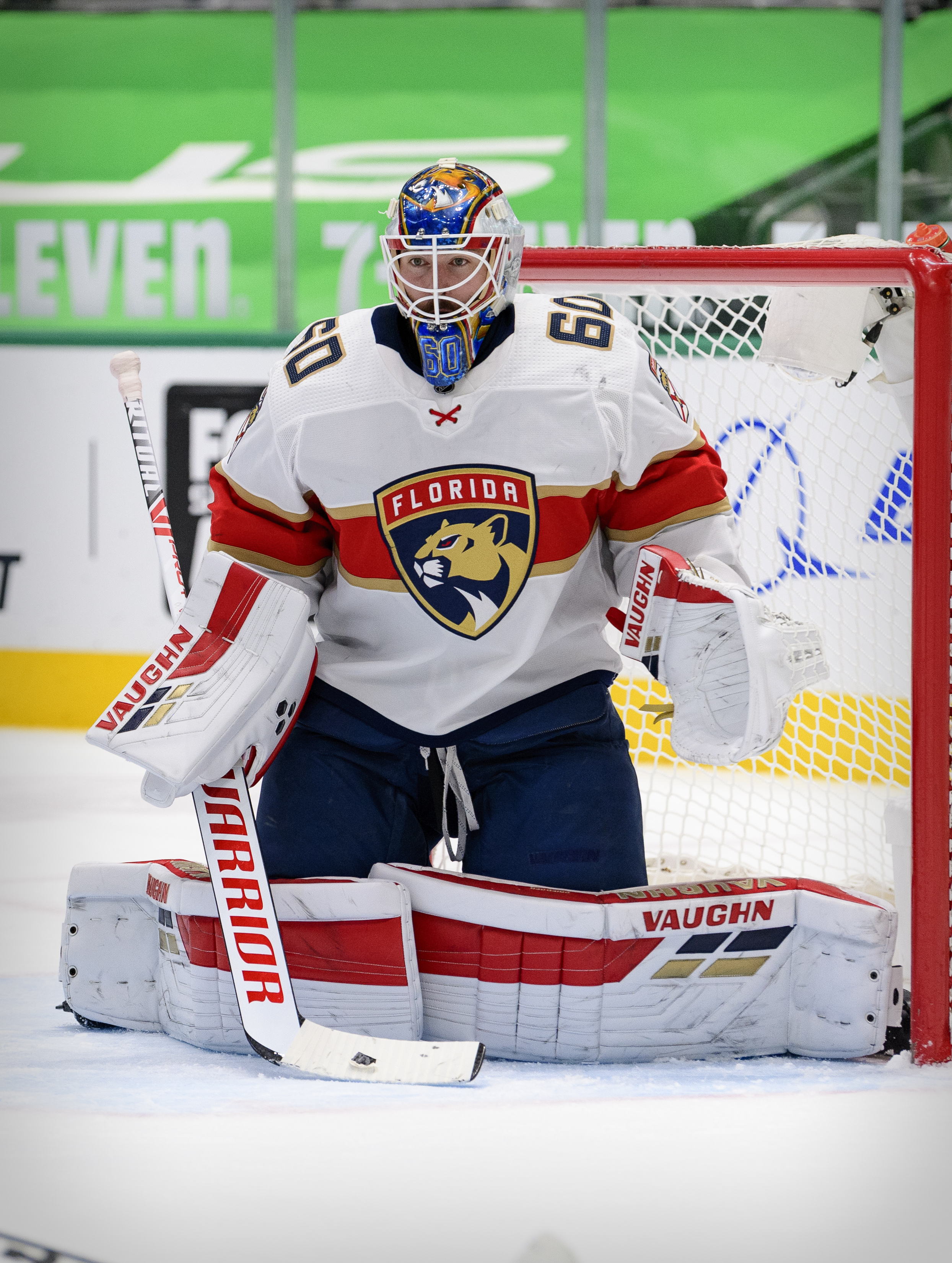 Driedger is one of the more impressive success stories in recent years. After bouncing around the minors, he finally got an opportunity with the Panthers and quickly became one of the better backups in the league. But with the late start, his track record is minimal – just 41 career NHL appearances and that includes playoff action. Landing a three-year commitment towards the upper echelon of price tags for a backup goaltender was pretty good, especially when it looked like he might be the starter. Of course, that changed early in free agency but Driedger should be able to still play enough games to justify the small premium for a backup netminder.
Vladislav Kotkov Signs In KHL
September 16: After seeing his contract terminated, Kotkov is headed back to the KHL as expected. The young forward has signed a two-year deal with CSKA Moscow of the KHL. An unrestricted free agent, if he ever wants to return to North America he will not be limited to the Sharks.
September 11: The Sharks are parting ways with one of their prospects as Sheng Peng of San Jose Hockey Now reports (Twitter link) that they have placed winger Vladislav Kotkov on unconditional waivers for the purposes of contract termination.
The 21-year-old went undrafted in 2018 but did well enough as an invite to San Jose’s development camp to earn an entry-level deal just two weeks after the draft. He spent last season playing his final year in the QMJHL, notching nine goals and ten assists in 16 games with Saint John while chipping in with four assists in five playoff contests. Kotkov also got into one AHL playoff game with the Barracuda.
With two years remaining on his contract, this news is a little surprising as Kotkov is still young enough to be considered a viable NHL prospect and with just two career AHL contests under his belt, it’s not as if he has played enough for San Jose to give up on him. Speculatively, there may be an offer waiting for him back home and if San Jose, who is fairly tight to the 50-contract limit once expected slides are factored in, didn’t want to loan him to play overseas where he’d still count against the limit, then this course of action makes sense. If Kotkov passes through unclaimed, the Sharks will be able to terminate his contract on Sunday.