
Will Depth Players Get Paid Again This Summer?
Something funny was happening in the summer of 2019. Depth players began getting serious term on multi-year deals to a level we’d rarely seen before.
Take the contract for depth forward Brandon Tanev, who signed a six-year, $21MM deal with the Penguins. At the time, that contract raised a lot of eyebrows, as Tanev had topped out at just 14 goals and 15 assists in any single season, and a $3.5MM average annual value was especially steep on such a long-term deal.
The deal was an outlier on July 1, 2019, with no close comparison other than the Panthers signing Brett Connolly to a four-year, $14MM deal. Connolly was coming off a 46-point season, which far exceeded any of Tanev’s offensive contributions.
There was a sense at the time that the NHL might shift, with depth players able to secure longer-term, higher-dollar contracts. When Colton Sissons signed his seven-year extension with the Predators a few weeks later, it certainly looked that way.
Sissons was two years younger than Tanev and an RFA, whereas Tanev was a UFA, yet their eventual contracts were comparable. However, the global pandemic in 2020 stalled the league’s growth and led to a flat salary cap, effectively shutting teams out of paying for depth and fringe players’ big-money deals.
The stars still got their money, as evidenced by 2020 free agency, when Alex Pietrangelo was still paid handsomely (seven years, $61.6MM), while depth players had to take one-year deals at or around the league minimum.
The stars have continued to get their money, and top salaries have escalated over the last few years, while second-line players have also been rewarded handsomely as the salary cap has eventually climbed. But the depth players in the NHL have continued to feel the squeeze to this point, and it does feel like that might change this summer, with another big cap jump coming, multiple teams with loads of cap space, and a very weak free agency market.
In previous summers, solid defenders such as Calvin de Haan and Matt Grzelcyk, as well as forwards Jack Roslovic and Evgenii Dadonov, have been part of a large group of NHL-caliber players who have experienced a very tight free-agent market when they have been available to all NHL teams. Now, it’s not unheard of for players to fall short of salary expectations in free agency, but it has become a common occurrence over the last six years, and it feels like this could be a summer where teams overpay for depth.
There has been a surge in signings in recent weeks, with the most recent being the Penguins locking up fourth-line center Blake Lizotte to a three-year deal worth $6.75MM total, and the Canadiens inking Alexandre Texier to a two-year deal worth $2.5MM per season. These deals were not massive signings, but they show that teams are moving to lock up their depth as they look to the summer UFAs and realize there isn’t much out there.
Center Christian Dvorak is another excellent example, having recently signed a five-year deal with the Flyers after settling for a one-year deal last summer. Dvorak has long been injury-prone and inconsistent, but the Flyers felt they had to ink him to an extension amid a career year in Philadelphia.
So, what depth players will get shocking contracts this upcoming summer, or will they? If you go by the old cliché that a rising tide raises all boats, it sure looks like the players at the bottom of the lineup will finally start to get a bigger slice of the pie.
Could a player like Ryan Shea, Connor Dewar, or Philipp Kurashev get a big-money, multi-year deal this summer? Or will teams continue to show restraint in the lower rungs of the free agency market, even though they have more wiggle room?
It’s hard to believe there won’t be some silly deals on July 1, 2026. There are always head-scratching choices NHL GMs make. But this could be a free agency unlike any we’ve seen in a decade or so.
July 1, 2016, is hard to forget for some teams, as massive mistakes were made that were clearly bad choices at the time. Loui Eriksson signed with Vancouver, Milan Lucic signed with Edmonton, and David Backes signed with Boston. Several other players were given ridiculous contracts relative to their future projections, which wasn’t anything new, especially for players with a history of being top-six NHL players.
However, some general managers watched those errors and learned a valuable lesson that carried through the COVID years, when there was a massive salary-cap squeeze. While teams didn’t have the salary-cap space to make the egregious contract offers, some GMs still did, and they usually paid the price for it.
A good example was Penguins GM Ron Hextall, who made some odd choices in free agency, particularly when he signed a Tanev replacement in the summer of 2021. Hextall inked Brock McGinn to a four-year, $11MM contract that was a poor value for the Penguins and was eventually traded along with a sweetener to the Anaheim Ducks in 2023.
That deal, along with contracts like Pierre Engvall’s, highlighted why many teams stayed away from giving terms to their depth players. But this summer, the stars are aligning for some wild contracts to be handed out to players who likely won’t last the length of the deal in the NHL. For fans of contending teams, or teams on the upswing who think they are just a player away from contention, you just have to hope your favorite team isn’t among the unlucky ones handing out the money.
Assessing The Canucks’ Direction
Reports surfaced earlier this month that the Canucks had re-engaged in contract talks with pending free-agent forward Kiefer Sherwood and were discussing a potential five- or six-year deal worth over $4MM per season. It’s hard to say whether the reports had merit, or whether the Canucks were serious about retaining Sherwood – or merely posturing to get a better trade return before the trade deadline.
Regardless of their true intentions, the Canucks’ direction is tough to figure out. They currently sit last in the NHL standings and, since New Year’s Day, are 0-7-2 and have been outscored 40-14. They don’t appear close to a winning run, yet there is little talk of a sell-off or a pivot into a rebuild. Their fans certainly like to talk on social media about embracing the tank, and the Canucks are reportedly willing to listen to offers for Elias Pettersson.
The truth about Vancouver is that it’s been a mess, off and on, for the better part of the last 10 to 15 years, from the top of the organization down to the players. There have been highs and moments of hope when it looked like the team was on the cusp of greatness, but those highs have been short-lived, followed by rapid declines.
The last two years are a clear example: the Canucks went from a team that was a win away from the Western Conference Final to one that missed the playoffs last season and appears destined to do the same this year. Those falls aren’t all that common (although the Rangers are living through a familiar descent) and are generally the result of self-inflicted missteps or a run of terrible luck.
In Vancouver’s case, it appears to be a mix of both, but there is no doubt that the J.T. Miller/Pettersson rift did irreparable damage that could have long-standing effects on Vancouver’s locker room.
Miller’s departure should have signaled the Canucks’ direction. Still, a quick trade for defenseman Marcus Pettersson and forward Drew O’Connor then implied that Vancouver intended to compete for a playoff spot last season, and the subsequent re-signing of both players certainly reinforced that notion.
Internal and external pressures aside, the trade to bring in Pettersson and O’Connor added to the Canucks’ depth, and they shed some bad contracts (Danton Heinen and Vincent Desharnais) in the deal with Pittsburgh. But the trades showed a lack of direction for Vancouver, and that carried into last year’s trade deadline as well as the summer, when the Canucks showed a lack of forward thinking. All of that leads us to this season, where Vancouver has spun its wheels despite rostering an ageing, expensive core.
The Miller trade to the Rangers had to happen, and while the return wasn’t great, it wasn’t awful either, as Miller has struggled to regain his form in the Big Apple. But the moves that followed the trade felt reactionary and forced, and ultimately proved in vain.
Pettersson was a top-pairing defender in Pittsburgh, but this season with the Canucks has been perhaps the worst of his career. The 29-year-old looks to be a shell of his former self and, like many players in Vancouver, has been terrible.
O’Connor has been fine in Vancouver, tallying 10 goals and seven assists in 47 games thus far while continuing to use his speed and size to be disruptive on the forecheck. That move, while tainted by Pettersson’s play this year, made sense at the time, but as the Canucks approached the trade deadline, some of management’s decision-making left a lot to be desired.
There was a moment after the Miller trade when the Canucks could have pivoted to a quick retool that might have been tough to stomach for the rest of last year and this season, but it would likely have yielded results next season. Instead, the Canucks did what they did, extended both Pettersson and O’Connor, and inked backup goaltender Kevin Lankinen to a deal that pays him $4.5MM per season for five years. All of it was reactionary, in the hope of getting the Canucks into the postseason last year. They didn’t.
The Canucks also tried to trade Brock Boeser last year at the deadline, but weren’t able to come to terms on a deal. It seemed all but certain he would bolt elsewhere in free agency last summer, but there he was on July 1, surprisingly signing a seven-year agreement with Vancouver that appears set to age like milk.
The Canucks added to their forward depth in another move, acquiring Evander Kane via trade from Edmonton. It was an acceptable deal in a vacuum; however, given Vancouver’s overall roster construction, it was a head-scratcher, as the Canucks used much of their cap space to fix the wing while watching their already thin center position get worse when Pius Suter departed in free agency.
Vancouver spent the rest of the summer making small roster changes in hopes that the core would find its mojo again. Still, a few months into the season, it was clear that wasn’t going to happen, which sparked trade rumours for their star defenseman, Quinn Hughes, whom they eventually dealt to Minnesota towards the end of 2025. The Hughes deal was actually a great haul for Vancouver given the circumstances, but it has officially put them into a hybrid retool that probably should’ve happened a year ago.
Hindsight is 20/20, but had Vancouver pivoted in early 2025 after trading Miller, they might have avoided some of the mistakes they’ve made over the past year, which have effectively set them back a few years. Instead, Vancouver is locked into long-term deals with underperforming forwards, a talented yet expensive goalie tandem that has injury and inconsistency issues, and a defense core that is now average at best.
Sure, they do have some nice young players who will likely become NHLers, but they will be surrounded by an old, pricey core unless the Canucks can start moving out from under some of the contracts they’ve locked in. No one is taking Boeser’s deal this year; the same could probably be said for Elias Pettersson’s.
But Vancouver could move their pending UFAs before the trade deadline and have nearly $17MM in cap space next summer to sign just two roster players (as per PuckPedia). That type of wiggle room could allow for additions before next season, but it’s not clear whether Vancouver should do that in the midst of what appears to be either a retool or a rebuild.
Patience might be the best thing for the president of hockey ops, Jim Rutherford and general manager Patrik Allvin to exercise, but given their track records, that has not been their strong suit, and it is a big part of the reason the Canucks find themselves where they are.
The Maple Leafs Are At A Crossroads
The Maple Leafs are on a heater at the moment, and while it’s made some fans forget about their awful stretch of play to start the season, it was clear that the team was going through something, and it’s hard to put a name to it. Some might call it an identity crisis: the team is full of offensive talent yet chooses to play low-risk, safe hockey.
Others might say it’s the apparent outcome of losing Mitch Marner and not replacing him with another offensive star. Or maybe it was the injuries, which have tested the team’s depth. Whatever it was, Toronto is facing a crossroads, and the future of the roster is murky.
The team struggled to get off to a good start, but has been much better as of late. Where they go from here is anyone’s guess, as the team has been unpredictable up to this point in the season.
Even though they are finally winning, many Leafs fans seem indifferent as the team sits outside of a playoff spot. Toronto fans could be fatigued by a team that always seems to let them down when games matter most, or many folks in Ontario who are Maple Leafs fans may have had their interests shift after the magical run MLB’s Toronto Blue Jays went on just a few months ago. Whatever it is, the Maple Leafs – the organization and roster – likely won’t go on for the rest of the season the way they are, which means something has to give.
Toronto is 7-1-2 in its last 10 games and has a positive goal differential on the year. But the results of late have been more of the same. They are great at home and terrible on the road, play great offense and below-average defense, and don’t play fast or tough enough. The Maple Leafs are the perfect candidate to make a shake-up move to change their fortunes, but what would that kind of move even look like?
Many fans would have liked to see Craig Berube fired before their most recent hot streak, but he is a highly respected Stanley Cup-winning coach who knows how to win. Would that kind of move change the fortunes of the Maple Leafs?
It could. It has happened before to other talented teams lumbering through mediocre seasons despite gifted rosters. The 2009 and 2016 Penguins come to mind as two examples of teams that fired their coach midseason and went on to win the Stanley Cup. More recently, the Blues fired head coach Mike Yeo in 2018, only to go on and win the Stanley Cup in 2019 with a new coach behind the bench – Berube.
But is firing Berube really the right move? It probably never was, and it definitely isn’t after their most recent stretch of play, especially given that the coaching market isn’t exactly ripe with great options for Toronto, and they would most likely be recycling a less-than-desirable option through Toronto, which probably makes it the wrong move.
What about a big trade? Well, that’s another issue for Toronto. They don’t have much to trade to acquire a player who can help now. Their prospect system is among the worst in the league, and they have just three picks in this year’s draft, none of which are in the first two rounds. They also don’t have a first-round pick in 2027 or a third-rounder.
This is before we even get to cap space, which they have very little of. Toronto could do some cap gymnastics, but at the moment, they have less than $3.4MM available at the deadline (per PuckPedia), which likely makes any significant move out of the question. Plus, do you want to move out more futures for short-term rentals when you don’t even know if this group is a playoff team?
The following month will say a lot about the Maple Leafs. If they continue to hover outside of a playoff spot in the Eastern Conference, they are probably best off seeing if they can move their UFAs and punt on this season. But if they continue the current run they are on, that will change the calculus going forward and put any coaching change talk among the fanbase to bed.
How can Toronto turn the corner and make sure it remains a consistent team? Simply put, they need to figure out which style of play maximizes the talent on their roster. Scott Laughton has been a black hole offensively since arriving in Toronto late last season, with just six goals and two assists in 30 games this year.
The same could be said for Calle Jarnkrok, who was once a consistent 30-to-40-point player but has just six goals in 29 games this season. They also need to figure out how to manage injuries to key players, including defenseman Chris Tanev and goaltender Anthony Stolarz.
It’s never easy to replace top players; however, teams find ways to do it and tread water until their players return. The Penguins faced a stretch this season without their entire second line, yet they remained in the playoff hunt despite arguably having a worse roster than the Maple Leafs. Teams rely on structure, work ethic and a next-man-up philosophy to overcome injuries, and Toronto needs to dig deep to do the same.
Lastly, there is the Marner issue, and it is perhaps the biggest. Fans had a close-up last night of Marner in Vegas’ overtime win over the Maple Leafs. Toronto never replaced Marner, and to be honest, they never could.
Stars leave massive holes in rosters when they depart, but good management groups find ways to plug the gaps, and the Maple Leafs haven’t done that. Some fans and pundits have suggested Toronto make a move for Stars forward Jason Robertson, but that move doesn’t have legs for many of the reasons previously stated (lack of cap space, lack of assets, etc.). But there are players out there that Toronto could look at as potential assets to add before the trade deadline, should they be in the hunt for a playoff spot.
At this stage of their contention window, the Maple Leafs can ill afford to finish in the middle and miss the playoffs entirely, losing their first-round pick. The best course for them is to make the postseason this year and try to make a run, but if they are going to miss the playoffs, it would likely be better to finish low enough in the standings to get a top 5 pick, retain their first-round pick for this season, and retool in the summer. This situation would push them to give up first-round picks in 2027 and 2028, but the hope would be that they could get a top prospect this year who could make an immediate NHL impact.
The Senators Have Some Tough Decisions To Make
The Senators are facing a midseason crossroads. The season has not gone as planned, and they are well out of a playoff spot.
They could stand pat and hope James Reimer provides steady goaltending, push for short-term moves to improve the team, or pivot to a sell-off for this season and hope to reload in the summer. It’s a real dilemma in Ottawa, as the Senators are too flawed to contend but too good to tank.
Even if they wanted to aim for an impact prospect in the 2026 draft, they don’t have their first-round pick this year thanks to the Evgenii Dadonov debacle. The Senators are effectively in the worst possible situation this year, and the next few weeks will be crucial in determining where they go from here.
There will be no easy answers for a club that has dramatically underperformed. Rebuilding is absolutely out of the question, given how much long-term money Ottawa has spent on extensions over the last few years.
However, a quick retool could inject much-needed draft capital or prospects into the Senators’ pipeline and net them a fair amount of assets, given how tight the standings are and how few teams appear set to become sellers before the trade deadline. If Ottawa wanted to dump some of its pending UFAs, it could effectively set the trade market on its own terms rather than responding to what other clubs do.
If the Sens start shipping out veteran talent, they have a decent stockpile of players on expiring deals that could be made available, including several former Stanley Cup champions among the forwards: Lars Eller, David Perron, and Nick Cousins. On top of the trio of former winners, forward Claude Giroux and defenseman Nick Jensen are also pending UFAs, giving Ottawa a healthy list of potential players to move should they slide completely out of playoff contention.
But can the Senators move all of those veterans this year?
Giroux is having another solid season, with 32 points in 46 games. However, at 38 years old and playing close to home, does he really want to serve as a deadline rental?
It’s hard to say. On the surface, it seems unlikely, but Giroux is nearing the end of his career and is missing the one thing every NHL player covets: a Stanley Cup ring.
If Giroux agreed to a trade, he could theoretically make the move for a few months and then return next summer to Canada’s capital, or somewhere else close to home. That has happened in the past, albeit not for a long time.
Mark Recchi did it back in 2006 when he accepted a trade from the Penguins to the Hurricanes, only to return to Pittsburgh the following summer. Keith Tkachuk had a similar sequence when he was traded by the Blues in February 2007 to the Thrashers, only to be returned in a separate trade in June.
Jensen is another interesting case and would have been a highly sought-after trade piece before this year, given that right-shot defensemen are always in demand. But this season has been one to forget for Jensen, who was a healthy scratch just a couple of weeks ago and has been trying to find his game for much of the season.
Ottawa has attempted to manage the 35-year-old’s workload, dropping his playing time from over 20 minutes a night to just north of 16 minutes per game in an effort to keep him fresh, but it hasn’t done much to improve Jensen’s play. The biggest knock on Jensen at the moment is that his once-fluid skating now looks disjointed and robotic, which isn’t surprising given his injury history and the fact that he had offseason hip surgery and missed Ottawa’s training camp in September.
Jensen hasn’t looked like himself this year, and the Senators’ goaltending has been terrible, which has only magnified his struggles and dropped his trade stock and, ultimately, his future contract prospects significantly.
Returning to Eller, he is a low-maintenance, plug-and-play fourth-line center who doesn’t contribute much offensively anymore but can still skate and has reasonable puck-handling ability. The 36-year-old has just two goals and four assists in 32 games this year, but has buried himself in a defensive role, which suits his skill set at this late stage of his career.
Eller is the perfect low-cost veteran for contending teams looking to add depth. He is making just $1.25MM on a one-year deal, and with such a low cost, if the Senators move him before the deadline, they should be able to grab a mid-round draft pick.
As for Cousins, no one should want to acquire him, given that he was voted by the players as the NHL’s most punchable player. That said, he is likely only disliked until he plays on someone’s team.
Cousins is the kind of player that teammates love, and opposing players despise. He has a unique skill set that is often overlooked, but he adds physicality, plays a pest-like game, and brings energy that can spark a team, particularly in the playoffs.
The Belleville, Ontario native has historically drawn a lot of penalties and can chip in with offense (six goals and six assists in 45 games this year), although his defensive work leaves a lot to be desired. Cousins is on a one-year deal, making just $825K this season, so, like Eller, there should be demand given that he can fit into almost any team’s salary-cap structure.
Finally, there is Perron, who has been much better this season after posting just 16 points in 43 games last year. The 37-year-old already has nine goals and 14 assists in 46 games this year, and his underlying numbers are much better than they were a year ago.
Perron is no longer a perennial 20-goal, 50-point scorer, but he remains a useful depth scorer and should be in demand if Ottawa makes him available. He’s one of, if not the, slowest players in the NHL, but he hits and is reasonably productive offensively at this late stage of his career.
Perron isn’t going to net Ottawa a first-round pick, but it’s entirely possible they could get a second-rounder should they opt to trade him. He will likely want to stay close to home, but his 15-team no-trade list covers less than half the league and would leave the Senators with plenty of potential suitors for Perron. It’s also possible that he would embrace the move to a team on his no-trade list if Ottawa is out of the playoff picture and a team is appealing enough to him.
Ottawa has rattled off a couple of wins in the last few days, which could be the start of a turnaround. Ironically, the Senators have been deploying Cousins, Eller and Perron as their de facto fourth line in those two games, and they’ve been terrific as a unit.
But even with four points in their pocket, the Senators sit five points back of a playoff spot, with six teams to leapfrog for the final playoff spot. There is also the consideration that those two wins came against the teams sitting at the bottom of both conferences, the Canucks and Rangers.
If Ottawa is going to go on a run, it will need to beat some outstanding teams in the coming weeks. The next two to three weeks will be crucial for the Senators and could ultimately dictate their short-term intentions.
The Full Teardown Rebuild Doesn’t Work Anymore
A few years ago, it was common for NHL fanbases to call for their favorite team to bottom out when it came time to rebuild the organization’s roster, and for good reason. The bottom-out rebuild had become trendy because most Stanley Cup champions during the 2010s had used that method of roster construction, and other teams began copying it, as is often the case.
However, late in the decade, another trend began to surface: the teams that were bottoming out couldn’t turn the corner in their rebuilds and remained in a perpetual state of losing. That leads us to the past couple of seasons, when some of those teams, namely the Sabres, have remained at the bottom of the NHL standings, while others, such as the Capitals, have successfully orchestrated softer retools.
At this point, it’s becoming evident that the bottom-out rebuild no longer works in today’s NHL.
There are many reasons it doesn’t work. Most notably, the draft is no longer a safe bet for bottom-feeders to land generational talent. Ten years ago, high picks were nearly a guarantee if you finished at the bottom of the standings, and now, with the new draft odds, it’s much harder to win a top pick.
Teams can no longer rely on a top draft pick to secure elite talent, which has reduced the incentive to tank via roster construction. After all, you still need fans to buy tickets and merchandise, and they won’t do that if your club is getting beaten every night.
This leads to another point about tearing down the roster. If you do acquire young talent who have no one else to play with and play in a culture of losing, that type of environment does seem contagious.
You can simply look at Edmonton and Buffalo in the 2010s. They couldn’t shake the stink of a losing culture, and it seeped into much of their young talent. Buffalo is a particularly egregious example, as many of their top draft picks more or less forced their way out of Buffalo to go on and win Stanley Cups in other cities.
This culture also shapes the development outcomes for younger players and explains why some young players get drafted late but, once in an NHL environment, find new levels in their games they had never reached before. It was no accident in the 1990s and 2000s that the Red Wings consistently found stars late in the draft. They had built a development machine and a culture of excellence that brought out the best in all of their young players. That dynamic can go the other way if you have a culture of losing. There is a real irony to all of it. The worse your team is, the less equipped your organization is to develop the players who might save your franchise.
Even if you hit the lottery and draft elite players, it doesn’t compound year after year the way it used to when the Penguins could grab Marc-André Fleury, Evgeni Malkin, Sidney Crosby, and Jordan Staal. The new rules from 2022 mean that a team cannot win the lottery more than twice in five years. Now, technically, that wouldn’t change things in the case of Pittsburgh, as they traded up to draft Fleury and drafted Malkin and Staal second overall, but it does reduce the incentive to ice a poor roster.
It’s also difficult to sustain the financial costs of an NHL roster in the salary-cap era while intentionally fielding a poor roster for several seasons. Back when Pittsburgh and Chicago were building their bottom-feeding rosters, they could literally sign every player to the league minimum (and they almost did) because the salary-cap floor they had to meet to be cap-compliant was much lower. Now, with an elevated floor, very few NHL teams could afford to reach the floor and ice a poor roster year after year without suffering a significant drop in gate revenue.
Speaking of money, another wrinkle in the bottom-out rebuild is that if you somehow draft elite players and develop them into NHL stars, they are set to exit their entry-level contracts and cash in big. Young stars can demand bigger extensions earlier, meaning the cheap years of their careers are behind them, and the team has to allocate massive amounts of cap space to them and can’t insulate them with other players. Stated differently, once your rebuild starts to bear fruit, the discounted years are over.
Then there is the issue that it’s tough to deconstruct an NHL roster, and even when you try to tear it down, you might end up with a team that falls into the mushy middle. This has happened to the Penguins this season: they tried to trade many of their veterans this past summer (Rickard Rakell, Bryan Rust, Erik Karlsson) but weren’t able to, and now find themselves in a playoff hunt.
It would have been foolish for Pittsburgh to give away its top players for very little, and whether they were serious about moving them is known only to management. Still, they elected to hold onto them and continue to ice a team that is competing for a wild-card spot. This is different from 20-plus years ago, when there was no salary cap, and Pittsburgh could simply call the Rangers or the Capitals to dump their star players.
Finally, there is the difference that social media and modern society make in rebuilding a team. Twenty years ago, entertainment options were much more limited, so fans stuck around to watch their favorite team, even when it was bad. This meant that management and coaches had a longer leash to rebuild and develop young players, as ownership had more patience because supporters were more committed and less distracted by other forms of entertainment. Nowadays, though, fans have a million choices for their leisure time, and if their favorite club is bad, they can do other things to fill their time.
Social media also plays into this, as fans have a louder voice than ever, which can put pressure on ownership if the naysayers get too noisy or create their own narratives. A rebuild used to be allowed to breathe for months at a time with minimal criticism, but nowadays it is litigated on social media daily. This can accelerate impatience and force management and ownership to show progress more quickly, making the long, painful rebuild a near impossibility.
Then there is self-preservation, which is often the primary motivator in management, leading to avoiding the long rebuild or not fully committing to a teardown. GMs notoriously shorten their own timelines and make job-saving trades that often turn out to be poor moves for the organization and for themselves (Kevyn Adams in Buffalo, for example).
The modern reality of a rebuild is that it is no longer about losing for a long time and collecting top picks. You can do that and still go nowhere, as evidenced by many teams in the last ten years. Rebuilds have become about timing long-term contracts.
They’ve become about layering prospects so they arrive in consistent waves year after year, keeping your depth intact when your internal players become too expensive to retain. They’ve become about patience and development, avoiding giving up on players too early, moving them prematurely, getting impatient with your current roster, and making a bad move. And finally, they’ve become about protecting your assets, draft picks, roster players, and cap space.
The teams that win now are no longer the ones that lose their way to the top; they are the disciplined ones that build the right way.
Ottawa’s Contention Window Could Be Short
The Senators have struggled to start the year, despite high hopes and promises that this would be the year they finally made some noise. However, some three months into the season, the only noise out of Ottawa is the collective sighs as the team’s inconsistency drives its most loyal supporters up the wall.
The Sens have a relatively young team, and with youth comes growing pains. But this group has been together for quite a while now, and it’s fair to wonder if this is who they are: a talented group of individual players who, together, form a flawed team with a window to win that grows smaller by the day.
When the Senators began tearing apart their core in 2018, it was clear that dark days lay ahead, but in the background, there was always hope for a brighter future, and for good reason. Many of the teams that tore down their roster to the studs rebuilt their systems and competed for Stanley Cups.
Whenever fans discussed the bottom-out rebuild, they would bring up the Penguins, Blackhawks, Kings and Lightning, and the collective 10 Stanley Cups those four teams won over 12 years. However, tearing down the roster was never a guarantee of success.
For every Chicago or Pittsburgh, you had a Buffalo or Edmonton. Teams that had bottomed out, but never built anything worth talking about. And now, with the Senators nearing the halfway point of the season at the bottom of the Eastern Conference standings, it’s fair to start asking whether they are more Buffalo than Chicago.
Ottawa is still framed as a team on the rise. They are young, talented, and one would think poised to break through once the pieces fall into place.
But aren’t the pieces already in place? You would think so, given the players they’ve brought in over the past five years, such as Jakob Chychrun and Alex DeBrincat, two men who were brought in for a season or two and shuffled out quickly. Ottawa likely pounced too early when they brought in those players, sensing they were closer to winning than they actually were, and exposing some of the problematic elements of a rebuild that are often forgotten.
The Senators have a ton of talent in their core. There is no doubting that.
Just because a core is talented doesn’t mean there is synchronicity. Ottawa has some pieces nearing their prime, while others have long passed it, and some are just learning what it takes to be a full-time NHLer and are being asked to do too much. Talent isn’t really the issue in Ottawa; timing is.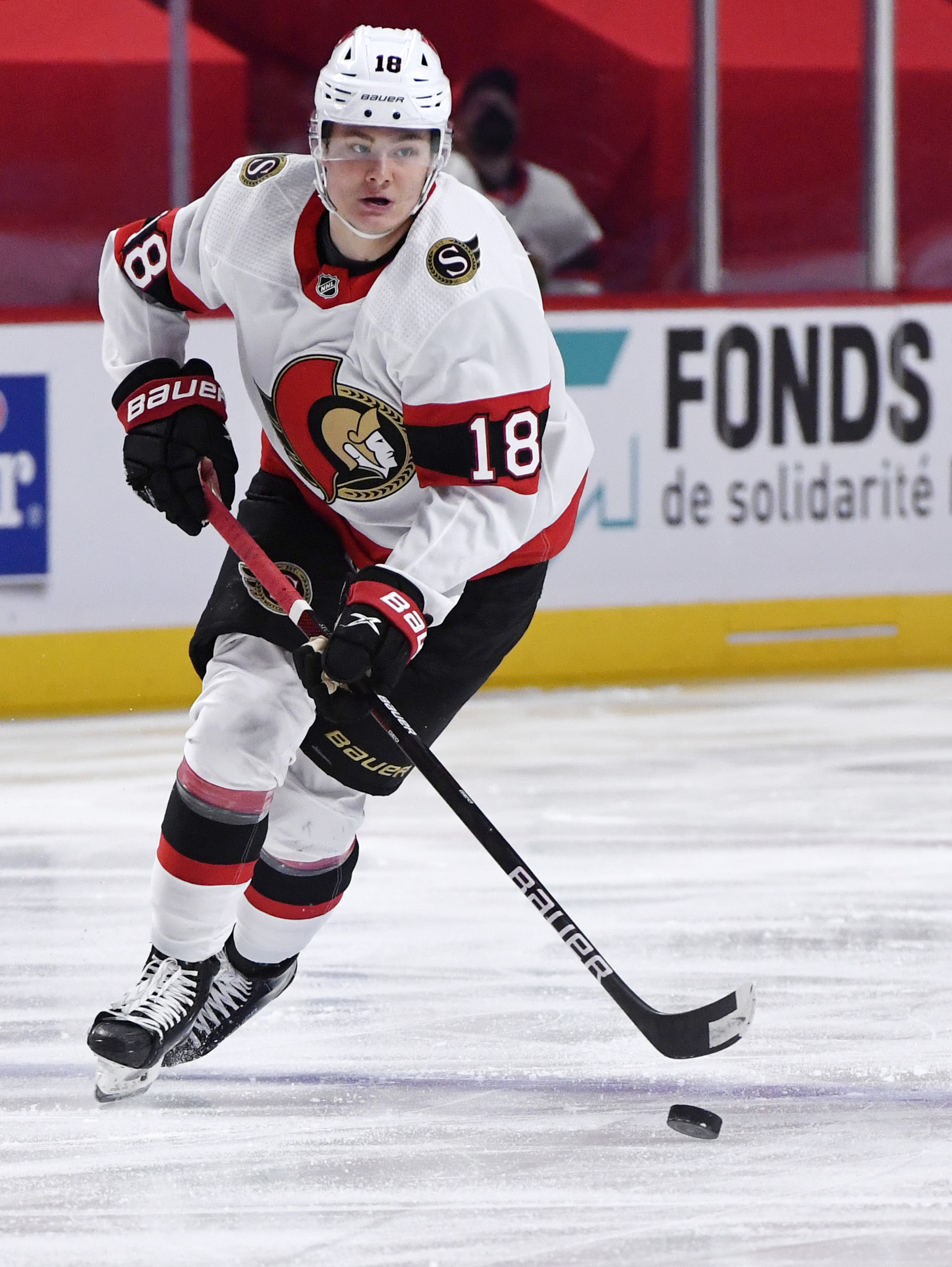
In fairness to the Senators, they did most of what a rebuilding team is supposed to do. They hit on their top picks (Brady Tkachuk, Tim Stützle), had some big trade wins by shipping out veterans (Erik Karlsson), and signed their top stars to very reasonable contracts (Jake Sanderson, Stützle, Tkachuk). But once those players are signed, it becomes much more challenging to layer the roster with inexpensive depth, and that is generally done through drafting, which the Senators have struggled with outside the first round. This has begun to rear its head.
There has long been a mentality among Senators fans that the team would figure out who to surround their stars with later on, but the time to figure it out is now, and they don’t look like they have the solutions. The trouble with a competitive window in the case of the Senators is that when you make big bets and lose, the window to win doesn’t get delayed or kicked down the road; it shrinks. The Senators could be in the midst of finding that out.
The Senators’ stars have been out of the development stage for a few years now, and one has to wonder how long their star players will remain patient. They were supposed to be past the learning years and into the progression years, and while last year felt like a step in the right direction, this year feels like two steps back, with little help on the way in the form of prospects or significant additions.
Ottawa’s farm system ranks bottom-10 in the league (23rd on Elite Prospects, 25th on Daily Faceoff), and they are without a first-round pick this year. They have a healthy stash of draft picks outside of that, but don’t have a ton of cap room to make major splashes.
Speaking of the salary cap, Ottawa has $23MM available next summer with eight players to sign (per PuckPedia). Assuming defensive prospect Carter Yakemchuk makes the jump to the NHL, that leaves Ottawa with around $22MM and seven players to sign to NHL deals.
That’s not a bad number by any stretch, but realistically, they will be looking to sign a top-four right-handed defenseman, a top-six winger, a backup goaltender, and a few bottom-six forwards. It’s not a daunting task, but it doesn’t leave much wiggle room, and you have to wonder whether their roster will be much better next year.
And make no mistake, the years are about to matter a whole lot more to the players on the roster and the team. Drake Batherson has one year remaining on his deal after this one, as does defenseman Artem Zub, while the likes of Tkachuk and defenseman Thomas Chabot have two.
Batherson has been a massive bargain on his current deal, carrying a cap hit of just $4.975MM on a six-year deal and delivering 60-plus points per season. Batherson is also consistently in the lineup, having dressed for 82 games in each of the previous three seasons. His defensive play, on the other hand, is not something to write home about, but that can be said for many goal-scoring wingers in the NHL.
Batherson has given Ottawa a ton of value over the life of his current contract, and like it or not, he’s going to want to claw a lot of that back on his next deal, which figures to be a seven-year deal and will probably top teammate Shane Pinto’s $7.5MM deal. Does Ottawa want to pay Batherson $8MM or more annually? Hard to say, but they can’t get that deal wrong, and what kind of message would it send to trade him right before the Tkachuk negotiations start?
Speaking of Tkachuk, he is the heart of the team and one heck of a competitor. You have to believe that if Ottawa can’t show forward progress in the next 18 months, he won’t be in a hurry to sign a long-term deal with the Senators when he is eligible to do so in July 2027.
Tkachuk negotiated in a very tactical and aggressive way during the last round of contract talks, and you have to believe he won’t be an easy player to lock up long-term if real results aren’t shown. Tkachuk is being paid handsomely at the moment, carrying an AAV north of $8.2MM. Steve Warne of The Hockey News has reported previously that his father, Keith Tkachuk, doesn’t believe he will leave Ottawa, but losing does a lot, as does winning, and Ottawa’s results will have a lot of say in what Tkachuk does.
The Senators have no choice but to win often and soon. They can ill afford to let the years go by without success. Windows to win don’t usually slam shut; they close quietly when contracts age poorly, teams fail to develop players, and depth erodes. It happened to those aforementioned Stanley Cup champions, in Chicago’s case, much earlier than expected and in Pittsburgh’s case, much later. It will happen to Ottawa at some point, and the question is whether they will win before it does. Much of that will be determined over the next 18 months.
Photo by Eric Bolte-USA TODAY Sports
Ryan Shea Is Going To Get A Big Raise This Summer
Saying that Penguins defenseman Ryan Shea is having a career year would be a massive understatement. The 28-year-old has two goals and 14 assists in 41 games, is a +15, and averages over 19 minutes a night.
While plus/minus is a flawed statistic, it is eye-opening to see it that high. Shea has played up and down the Penguins’ defense this season, pairing with the likes of Kris Letang, Jack St. Ivany, Harrison Brunicke, and Parker Wotherspoon. No disrespect to any of those players, but St. Ivany has been a tweener to this point in his career, Brunicke is back playing in the World Juniors, and Letang has been a mess defensively for most of the year, making the +15 all the more impressive.
Shea spent much of the season paired with Letang, but in the last week, Shea and St. Ivany have formed an effective shutdown pairing for the Penguins, coinciding with an intense stretch of play for the team. Shea’s adaptability and offensive emergence couldn’t have come at a better time for the three-year NHL pro, as he is slated to be an unrestricted free agent on July 1 and is set to earn a healthy raise from the $900K he is making this year.
Shea signed that one-year deal last March, and it seemed like an odd bit of business for the Penguins at the time, as they were busy selling off at the trade deadline and Shea was a candidate to be moved. Pittsburgh general manager Kyle Dubas clearly saw something he liked in Shea’s game and gave him a raise and guaranteed NHL money for this season in an extension that has been a windfall for Pittsburgh at a time when they needed a left-handed defenseman to step up and fill a massive weakness.
 Not only did Shea step up, but he also effectively became the type of player Pittsburgh needed to acquire if they wanted to contend for a playoff spot, which may or may not have been the plan. Regardless of the intentions, Pittsburgh is in the playoff hunt, and Shea has been a massive part of that.
So, what is the plan for Shea now? That is the million-dollar question, or in Shea’s case, the multi-million-dollar question.
At the beginning of the season, AFP Analytics projected a one-year deal worth $1.075MM for Shea next season. That number is obviously going to be different now, but it’s fair to wonder how different it will be.
Shea has a lot working in his favor in his contract negotiations. He is still relatively young, doesn’t have a lot of NHL mileage on his body, and capable defensemen are always in demand.
Just look at one of his predecessors as Letang’s partner, Brian Dumoulin, who is much older and worn down, and who got three years and $12MM as a UFA last summer. On the flip side, Shea doesn’t have a long NHL resume, having played 111 games and entering his third season.
He also doesn’t have a track record as an impact defender outside this year. Shea had pedestrian results last season in 39 games, posting two goals and three assists, but he was leaned on heavily defensively. He didn’t have too many opportunities to chip in offensively.
His free agency is going to get interesting over the next two months, particularly if the Penguins stay in contention for a playoff spot and opt to hold onto him. Pittsburgh gave Shea his NHL opportunity, signing him to NHL money before he ever played an NHL game, demonstrating faith in his ability to become an NHL defenseman.
That 2023 signing showed absolute trust from Dubas and the Penguins, and it makes one wonder whether Shea will reward the team with a discount in negotiations. There is also a precise fit for both Shea and the team.
He fills a need well, and even on an extension, he won’t cost more than a potential replacement would in free agency or a trade. That said, there is always a risk in signing a one-hit wonder, as his play could be a mirage, and you end up locked in long-term with a player who can’t cut it in the NHL.
If the Penguins fall out of contention, on the other hand, it could change the complexion of Shea’s future, particularly if they deal him to a different team. Therein lies the risk for Shea, because if he gets traded elsewhere and falls flat on his face, it would pretty much tank his prospects for a long-term deal on the open market. But if he gets moved and succeeds, it removes a significant question mark surrounding him.
It remains to be seen whether Pittsburgh will even deal Shea if they fall out of contention. They didn’t last year, when Shea was more of an unknown, and it would seem silly to trade him now, when you have a better idea of what he can be in the NHL.
Pittsburgh might just sign him even if they fall out of contention, because they have the cap space and know what they have in Shea. They also have a ton of other pending UFA defensemen who don’t figure to be part of their future, and they could move those instead.
What could Shea be looking at in terms of a contract extension? It’s hard to predict, given the current economic climate.
Still, there are a couple of comparables, such as the Flyers’ Emil Andrae and the Flames’ Jake Bean. AFP Analytics has Bean pegged for a two-year deal worth $2.25MM per season, while Andrae is projected at $1.7MM AAV on a two-year deal. Declan Chisholm of the Capitals is another decent comparison in terms of career numbers. He signed his contract extension as an RFA, inking a two-year deal worth $1.6MM annually.
The issue with the Chisholm comparison is that he was an RFA, while Shea is unrestricted. However, using the framework of all the aforementioned contracts, it seems likely that Shea is headed for a two-year deal, possibly three, at a rate that probably tops the Bean projection.
However, this is the NHL, and it wouldn’t be shocking to see Shea sign a four-year deal worth $3MM or more annually, given the surging salary cap and teams’ desperation for reliable defenseman.
Image courtesy of Charles LeClaire-Imagn Images.
The Blackhawks Already Have A Top Line Winger On The Way
Since the Blackhawks selected Connor Bedard first overall in 2023, the most glaring holes on their depth chart have been the two wing spots next to him.
Bedard’s most common linemates at 5-on-5 in year one were Nick Foligno and Philipp Kurashev. In year two, amid a never-ending rotation, Ryan Donato and Ilya Mikheyev eked out the honors.
This year, it’s André Burakovsky and rookie Ryan Greene. The 20-year-old’s continued emergence into a top-tier superstar and increased defensive commitment this season have helped fuel a resurgence for the former, with Burakovsky’s nine goals and 23 points in 34 games on pace for his highest totals in three years. Greene, only one year older than Bedard, is up to 14 points in 39 games after a recent hot streak.
Of course, Bedard’s 44 points on the year are still nearly twice what his best support man, Burakovsky, has posted, despite missing the last several games with a shoulder injury. While Chicago’s early hot start offered some promise, it’s clear now that was a Spencer Knight-fueled mirage as they’ve slipped back to being one point out of last place. As for Bedard and his support system, the talent gap has never been more apparent – even Kurashev and Donato finished within spitting distance for the team lead in points in 2023-24 and 2024-25, respectively.
With a top-two pick spent on Artyom Levshunov and an elite young netminder acquired in Knight, Chicago has stars lined up at every position – except for Bedard’s linemates, if only looking at the NHL roster for the past few years is any indication.
In reality, the pieces to complete an era-defining forward line for the Hawks are already in place and won’t necessarily require the big free-agent splash that some were hoping for this year or last. One of them comes down to a math problem. In the early stages of their careers, Chicago has preferred to keep Frank Nazar separate from Bedard at 5-on-5 and have them each center their own lines. That’s largely worked out well with Nazar on a 52-point pace in his second NHL season.
Center Anton Frondell is on the way as well after being drafted third overall last year. With 10 goals and 15 points in 25 games for Djurgårdens IF in a challenging European pro environment in the SHL, he will almost certainly be a top-six option for the Blackhawks in 2026-27. Neither he, Bedard, nor Nazar is suited for third-line duties long-term. One of them will slot in on Bedard’s wing next season.
The premise of this article could all be for naught if the Hawks end up with another lottery pick in this year’s draft. Their selection would almost undoubtedly be either Gavin McKenna or Ivar Stenberg, both wingers with the skill level to drop in as a Bedard running mate out of camp. But if the balls don’t bounce their way, there’s an in-house candidate who will likely get a shot with a mix of Bedard, Frondell, and Nazar next fall.
Roman Kantserov has long been overlooked as an impact piece. Perhaps that’s simply because Chicago’s wealth of draft picks over the past several years has created one of the deepest pools in recent memory.
The 2023 second-round pick wasn’t viewed as much of a draft steal at the time. He was the 16th-ranked European skater by NHL Central Scouting, and only one major public scouting service had him as a late first-rounder (some even had him in the third).
No longer can he be ignored. Fast forward three years, and the 21-year-old is already a champion and an All-Star in Russia’s Kontinental Hockey League, a top-three competition in the world. Even that doesn’t give proper credence to what the undersized but extremely high-motor winger has brought to the table this season. With a 26-19–45 scoring line in 38 games, he’s third in the KHL in scoring and is first in pure goal-scoring. If that holds, he will break Kirill Kaprizov‘s record as the youngest single-season goal-scoring leader, albeit only by a few months.
McKeen’s Hockey tabbed Kantserov as the No. 8 prospect in the Hawks’ pool entering the season and profiled him as a “high-energy, third-line grinder with the potential to contribute offensively.” He’s answered the bell on the last part of that sentence as best as he possibly can before making the jump from Russia. Pairing two sub-6’0″ players on a top line may be an area of concern, but his pace and physicality make him a near-perfect stylistic complement for Bedard, with his historic overseas production suggesting he boasts much more upward mobility in their lineup than some thought.
Kantserov is in the final season of his contract with Metallurg Magnitogorsk. Technically, his contractual obligations won’t conclude until May 31, but KHL clubs have shown some degree of willingness to release players a few weeks early – assuming their season is over – to sign NHL entry-level contracts. Whether that’s something Chicago wants to pursue to get Kantserov in the lineup for the final few games of the regular season remains to be seen. It should be a foregone conclusion, though, that he will be given a lengthy runway to add his name to Chicago’s long list of young, NHL-ready stars come September.
Big Hype Prospects: Zharovsky, Barlow, Nestrasil, Zajicek
Welcome to PHR’s Big Hype Prospects series. Like the MLB Trade Rumors series of the same name, we’re taking a look at the performances of top prospects from across the hockey world. We’ll look at drafted prospects who are rising, others who are struggling, and prospects for the upcoming draft who are notable.
Four Big Hype Prospects
Alexander Zharovsky, RW, Montreal Canadiens (Ufa Salavat Yulayev, KHL)
31 GP 11G 17A 28pts
The Montreal Canadiens are currently benefiting greatly from the nightly performances of star rookie Ivan Demidov, a hugely talented Russian winger with the kind of offensive ability that can dazzle fans on a nightly basis. Demidov’s excellent rookie season does not come as a huge surprise to most, as just last season he managed to lead his KHL team in scoring — a hugely impressive feat for an 18-year-old player.
And yet Demidov may not be the only Canadiens prospect to accomplish that feat. Zharovsky, the club’s top selection at the 2025 NHL Entry Draft, currently leads the KHL’s Ufa Salavat Yulayev in scoring with 28 points in 31 games. The next-highest scorer, veteran Jack Rodewald, has 25 points in 39 games. Just one other player on the team has reached the 20-point mark.
The fact that Demidov led SKA in scoring last season threatens to leave Canadiens fans somewhat jaded at the prospect of another youngster leading his KHL team in scoring. But they should be reminded that the KHL, Russia’s top professional league, is a circuit with a longstanding reputation of being notoriously difficult for teenage players to gain a foothold in. Demidov himself had to contend with this, sometimes finding himself in an extremely limited role in SKA’s lineup despite his obvious talent.
Zharovsky’s brilliant 2025-26 campaign thus far has served as a clear indication that the Canadiens likely nabbed a first-round caliber talent in the early portion of the second round of the draft. Zharovsky was one of the fastest-rising players of last year’s draft process. He barely registered on scouting radars early last season. NHL Central Scouting did not include him on their preliminary watch list last October, nor was he ranked in the midterm rankings in January. Central Scouting caught onto Zharovsky by the end of the season, ranking him No. 5 among international skaters in their final rankings.
Most public-facing outlets had Zharovsky ranked in the early to middle portion of the second round of the draft, as high as No. 35 (TSN’s Bob McKenzie) and as low as No. 49 (Corey Pronman of The Athletic). In his ranking, Pronman wrote that while Zharovsky’s MHL production “needs to be looked at with a grain of salt,” due to the fact that he managed those numbers “in the clear worst division in that league.” He finished writing Zharovsky “could be a bottom six wing,” but it’s clear the Canadiens disagreed.
In their media availability following the draft, the Canadiens’ co-directors of amateur scouting Nick Bobrov and Martin Lapointe indicated to the media that not only did they project Zharovsky as a future top-six winger, but they also had him ranked on their draft board inside the first round, right around the slot of the two first-round picks they ultimately dealt to the New York Islanders in the Noah Dobson trade.
While it’s still far too early to tell whether Zharovsky will live up to the Canadiens’ expectations or fall more in line with Pronman’s projection, the early returns have been extremely promising for Montreal. Just as he did in the MHL, Zharovsky’s KHL performance will likely be met with some skepticism due to the fact that the division Zharovsky plays in, the Chernyshev Division, is arguably the league’s weakest.
But it is nonetheless extremely impressive to see a winger of Zharovsky’s age lead his team in scoring in his rookie KHL campaign. Zharovsky was named a KHL All-Star and the league’s rookie of the month for October and November. He ranks second in scoring in the KHL among all players aged 22 and younger, behind only Chicago Blackhawks prospect Roman Kantserov, who is 21 years old. While we won’t know for some time whether Zharovsky will truly end up as the top-six offensive talent the Canadiens believe he can be, his progression at the moment has been highly encouraging.
Colby Barlow, RW, Winnipeg Jets (Manitoba Moose, AHL)
25 GP 2G 3A 5pts
Of the first 20 picks of the 2023 NHL Entry Draft, just four selected players have yet to make their NHL debut: No. 5 pick David Reinbacher (MTL), No. 14 pick Brayden Yager (PIT, traded to WPG), No. 18 pick Barlow (WPG), and No. 20 pick Eduard Sale (SEA). While the pace of a prospect’s development is no sure indicator of that player’s future NHL success, and it must be repeatedly emphasized that player development is not a linear process, it is still notable when a highly-drafted prospect begins to fall behind his peers.
In Barlow’s case, he appears to have fallen behind quite considerably. This is actually not the first time Barlow has appeared in the Big Hype Prospects series, as he also was covered in a September 2024 article written by colleague Gabe Foley. Foley correctly noted that Barlow was a lock to be traded from his OHL team at the time (the Owen Sound Attack) and expressed some hope that the expected OHL trade would provide Barlow with some much-needed momentum in his final year before turning pro.
While OHL trades provided a spark for other CHL first-rounders to have hugely productive final campaigns in junior hockey (Conor Geekie and Matthew Savoie were two names specifically referenced by Foley) that didn’t happen for Barlow, who scored 32 goals and 61 points in 62 games as a member of the Oshawa Generals.
While Barlow did score at a higher rate in the second half of the year, and did follow up the regular season with a stellar postseason run (33 points in just 21 games), it appears he hasn’t been able to translate that momentum into tangible production to start his pro career.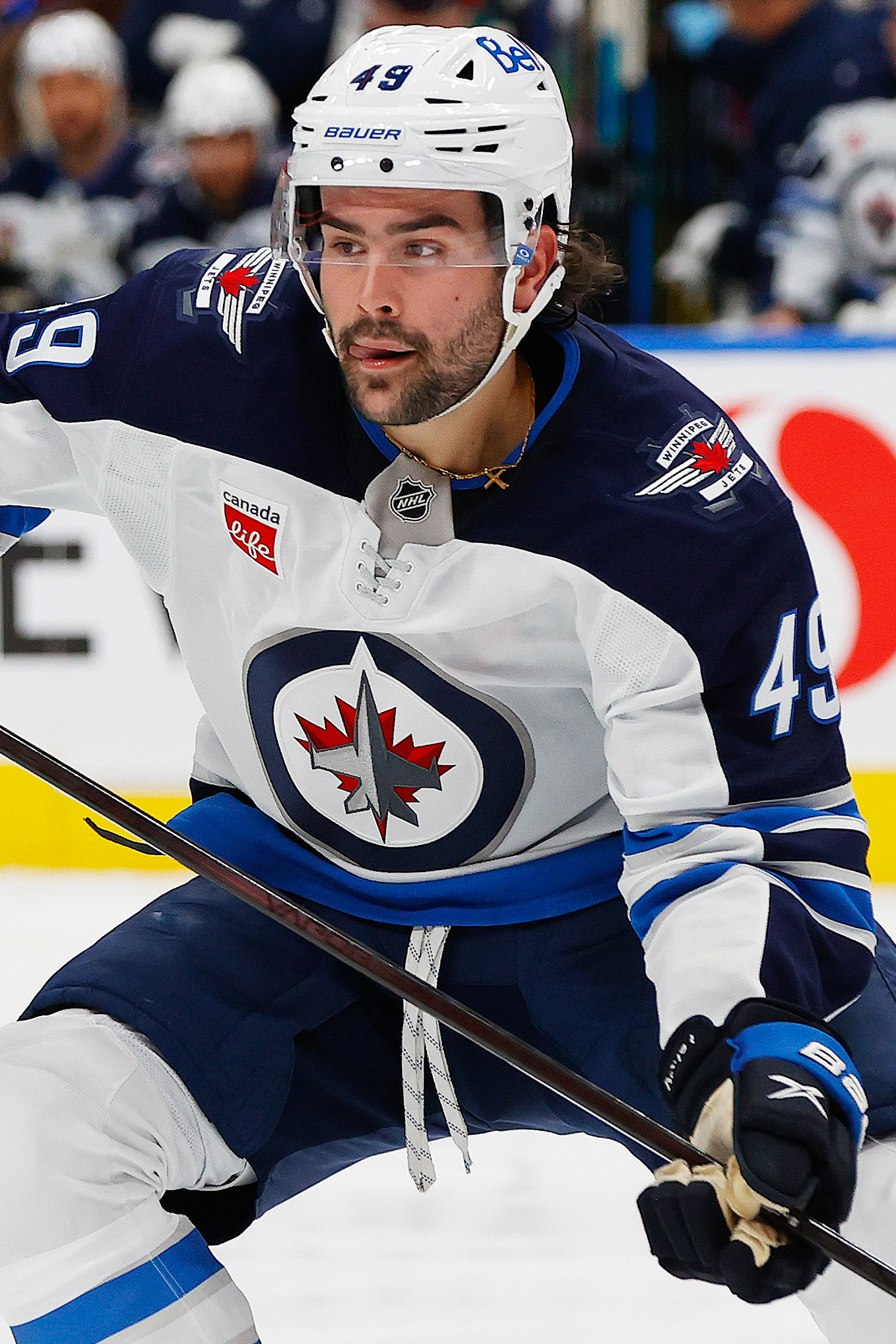
Barlow is now 25 games into his first full season in the AHL, and he’s managed just five points.
The 20-year-old has long been viewed as a potential NHL sniper, with his shot credited as one of his standout tools. Pronman wrote in August that “Barlow’s calling card is his shot” but noted that “his offensive inconsistency is a concern.”
Elite Prospects’ Lauren Kelly wrote around the same time that Barlow’s “playmaking showed significant growth” in Oshawa, and that the development “bodes well for his move to the AHL.”
Breaking down exactly why Barlow’s offensive momentum appears to have stalled at the AHL level isn’t a simple task. He does get to play with some talented linemates, currently skating alongside 2022 first-rounder Brad Lambert and 2021 second-rounder Nikita Chibrikov.
But neither Lambert nor Chibrikov have been particularly productive this season. Despite having linemates that are, on paper, of high quality, Barlow hasn’t had the chance to play all that much this season. He ranks last in average ice time per game among all Moose skaters with at least 20 games played this season.
Given Barlow’s struggles in his rookie AHL campaign and the Moose’s apparent reluctance to play him higher in the lineup on a regular basis, it could be that a change of scenery ends up the best outcome for both Barlow and Winnipeg.
Barlow has, without question, thus far failed to live up to the Jets’ investment of a first-round pick in him. And Barlow could argue that the Jets have similarly failed to give him the kind of high-minute AHL role that would allow him to build momentum early in his pro career.
As the Jets look to plot their way forward amidst a deeply disappointing 2025-26 NHL campaign, they could seek to acquire reinforcements for their NHL roster via trade. If they end up doing so, Barlow could be one of the top prospects the Jets elect to trade in one of those transactions.
Vaclav Nestrasil, RW, Chicago Blackhawks (UMass Amherst, NCAA)
18 GP 10G 10A 20pts
If there’s one single player archetype that is most widely coveted across the NHL, a strong argument could be made that it’s a forward who combines devastating size and physicality with a high level of offensive skill. Those players come few and far between, and when one manages to establish himself at the NHL level, there’s usually no shortage of teams trying to line up to acquire his services.
Selected No. 25 overall at the 2025 NHL Entry Draft, Nestrasil has a very real chance of becoming that kind of player at the NHL level. The 6’5″, 190-pound winger still has a ways to go in terms of his physical development to reach that point, but the start to his collegiate career has been extremely impressive.
The Blackhawks’ selection of Nestrasil No. 25 overall was met with some skepticism. The player managed only 42 points in 61 USHL contests as a member of the Muskegon Lumberjacks, which is below the typically expected level of production for a first-round pick.
Though Nestrasil’s 13 points in 14 playoff games did help Muskegon win the Clark Cup Championship, his eventual draft ranking varied wildly in the public sphere. The team at Elite Prospects ranked him No. 26 on their board, but most other outlets ranked him somewhere in the 35-45 range. He was even ranked as low as No. 65, by TSN’s Craig Button.
While most scouts commended Nestrasil’s energy level, non-stop motor, and ability to impact a game even when he couldn’t score, many questioned whether he’d be able to bring a level of consistent production that would justify the investment of a first-round draft choice.
Nestrasil’s first 18 games of college hockey have gone a long way towards addressing — but not permanently silencing — those skeptics. He has managed 10 goals and 18 points, good for second on the team behind undrafted 22-year-old Jack Musa.
Because other freshmen players are also having an incredible start to their NCAA career (Pittsburgh Penguins 2025 first-rounder Will Horcoff has 19 goals in his first 20 games, for example), Nestrasil’s sharp improvement in offensive production over last season has flown more under the radar than it perhaps deserves to. But if any Blackhawks fans decide to tune into Amherst games this season, it’s possible they could be watching a long-term linemate for franchise face Connor Bedard.
The team is still searching for long-term pieces to pair Bedard with, and Nestrasil’s compete level, size, physicality, and offensive touch could complement the star center quite well. There’s still a ways to go before Nestrasil reaches that point, but so far in his NCAA career, Nestrasil’s stock appears to be rapidly rising.
Simon Zajicek, G, Boston Bruins (Providence Bruins, AHL)
12 GP 10-1-1, .934 sv% /1.93 GAA
The history of free agent imports from European professional leagues is a spotty one. Where there have been teams that have found considerable success bringing over star players from top European pro circuits, others have seen their investments flame out and quickly return to the other side of the Atlantic. For every Karel Vejmelka or Alexander Radulov there appears to be five Jan Kovar‘s or Jakub Jerabek‘s.
The Bruins have traded away a considerable number of draft picks over the last half-decade as a result of the organization’s push to win the Stanley Cup within that time frame. Those moves have depleted the Bruins’ prospect pool, and left their scouts with fewer resources at their disposal to replenish that pool of prospects.
One route organizations in that sort of a position often take to try to maintain a pipeline of young players despite having fewer draft picks is signing free agent players from the NCAA, the CHL, or the European pro circuit. Edmonton Oilers GM Stan Bowman is an example of a hockey operations executive that has been aggressive in his targeting of European free agents, and he had some success doing so with the Chicago Blackhawks, landing long-term NHL players such as Antti Raanta, Erik Gustafsson, and most notably, Artemi Panarin.
The Bruins appeared to try to replicate his approach this past summer when they signed Zajicek, a netminder from the Czech Extraliga. In his age-23 season, Zajicek led the Extraliga in save percentage, putting up a .930 mark across 29 games played. The year prior, he posted a .909 save percentage across 20 games for HC Litvínov.
Zajicek was signed to form a tandem with AHL star Michael DiPietro, and despite his inexperience in North American pro hockey, Zajicek has been stellar to start his AHL career. Through 12 games, Zajicek has gone 10-1-1 with a .934 save percentage. His performance, along with the strong performances of DiPietro, have helped Providence rank No. 2 in the AHL in fewest goals surrendered so far in 2025-26.
While it’s too early to tell whether Zajicek’s performance is truly a reflection of a promising NHL future or more of a product of a high-quality defensive environment around him, his stellar form to start the year does suggest that he may end up making a push for an NHL role in Boston or somewhere where there is more of a pressing need for goaltending.
Photos courtesy of Perry Nelson-Imagn Images
2025-26 In-Season NHL Trades
Pro Hockey Rumors will keep track of all trades made during the 2025-26 campaign, right up until the last day of the regular season, updating this post with each transaction.
Trades are listed here in reverse-chronological order, with the latest at the top. So, if a player has been traded multiple times, the first team listed as having acquired him is the one that ended up with him. If a trade has not yet been formally finalized, it will be listed in italics. The terms or structures of those deals could still change before they’re officially completed.
For our full story on each trade, click on the date above it. We’ll continue to update this list with the latest specific details on picks and other compensation, as they’re reported.
You can reference this post under the “Pro Hockey Rumors Features” menu on the right sidebar on desktop or under the Flame icon on our mobile menu.
Here’s the full list of the NHL’s 2025-26 in-season trades:
- Kings acquire F Jan Jeník
- Islanders acquire D Samuel Bolduc
- Red Wings acquire F Michael Milne and F Wojciech Stachowiak
- Lightning acquire D Ian Mitchell
- Predators acquire F Dalton Bancroft and F Massimo Rizzo.
- Bruins acquire F Navrin Mutter.
- Senators acquire F Graeme Clarke.
- Capitals acquire F Wyatt Bongiovanni.
- Flames acquire F Brennan Othmann.
- Rangers acquire F Jacob Battaglia.
- Sabres acquire F Tanner Pearson.
- Jets acquire the Sabres’ 2026 seventh-round pick.
- Avalanche acquire F Nazem Kadri and the Flames’ 2027 fourth-round pick.
- Flames acquire F Victor Olofsson, F Max Curran, Avalanche’s 2028 first-round pick, and the Avalanche’s 2027-second round pick.
- Capitals acquire D Timothy Liljegren.
- Sharks acquire Golden Knights’ 2026 fourth-round pick.
- Red Wings acquire D Justin Faulk.
- Blues acquire D Justin Holl, F Dmitri Buchelnikov, the Red Wings’ 2026 first-round pick, and the Sharks’ 2026 third-round pick.
- Bruins acquire F Lukas Reichel.
- Canucks acquire Bruins’ 2026 sixth-round pick.
- Capitals acquire F David Kampf.
- Canucks acquire Capitals’ sixth-round pick.
- Kings acquire F Scott Laughton.
- Maple Leafs acquire Kings’ conditional 2026 third-round pick.
- Note: Pick becomes a second-round pick if Kings make the playoffs.
- Flames acquire F Ryan Strome.
- Ducks acquire Flames’ 2027 seventh-round pick.
- Kraken acquire F Bobby McMann.
- Maple Leafs acquire Kraken’s 2027 second-round pick and 2026 fourth-round pick.
- Blackhawks acquire D Derrick Pouliot.
- Rangers acquire F Aidan Thompson.
- Penguins acquire F Elmer Soderblom.
- Red Wings acquire Sharks’ 2026 third-round pick.
- Islanders acquire F Brayden Schenn.
- Blues acquire F Jonathan Drouin, G Marcus Gidlof, Avalanche’s 2026 first-round pick, Devils’ 2026 third-round pick.
- Hurricanes acquire F Nicolas Deslauriers.
- Flyers acquire Flyers’ 2027 seventh-round pick.
- Panthers acquire F Vinnie Hinostroza.
- Wild acquire future considerations.
- Lightning acquire F Corey Perry.
- Kings acquire Tampa Bay’s 2028 second-round pick.
- Wild acquire F Nick Foligno.
- Blackhawks acquire future considerations.
- Flyers acquire F Brett Harrison and D Jackson Edward.
- Bruins acquire F Alexis Gendron and F Massimo Rizzo.
- Wild acquire F Bobby Brink.
- Flyers acquire D David Jiříček.
- Ducks acquire D John Carlson.
- Capitals acquire the Ducks’ 2026 first-round pick and the Ducks’ 2027 third-round pick.
- Note: the Ducks can choose to defer the first-round pick to 2027 if they fail to qualify for the 2026 Stanley Cup Playoffs.
- Sabres acquire D Logan Stanley and D Luke Schenn (50% retained).
- Jets acquire F Isak Rosen, D Jacob Bryson, the Sabres’ 2027 second-round pick, and the better of the Sabres’ or Oilers’ 2026 fourth-round pick.
- Sabres acquire F Sam Carrick.
- Rangers acquire the Sabres’ 2026 third-round pick and the Blackhawks’ 2026 sixth-round pick.
- Blue Jackets acquire F Conor Garland.
- Canucks acquire the Blue Jackets’ 2028 second-round pick and a third-round pick.
- Red Wings acquire F David Perron.
- Senators acquire the Blue Jackets’ 2026 fourth-round pick.
- Note: the pick only transfers if Perron plays at least one game for Detroit. If the Red Wings reach the second round of the playoffs and Perron plays in at least half their games in the first round, the pick upgrades to Detroit’s 2026 third-round selection.
- Senators acquire F Warren Foegele and a conditional 2026 third-round pick.
- Kings acquire the Sabres’ 2026 second-round pick and a conditional 2026 third-round pick.
- Note: view the article for the explanation of the conditions.
- Stars acquire F Michael Bunting.
- Predators acquire the Kraken’s 2026 third-round pick.
- Canucks acquire D Jack Thompson.
- Sharks acquire D Jett Woo.
- Wild acquire D Jeff Petry.
- Panthers acquire the Wild’s 2026 seventh-round pick.
- Note: the pick upgrades to Minnesota’s 2026 fifth-rounder if the Wild win at least two playoff rounds and Petry plays in 50% of playoff games.
- Avalanche acquire F Nicolas Roy.
- Maple Leafs acquire the Avalanche’s 2027 first-round pick (top-10 protected) and the lowest of the three fifth-round picks owned by the Avalanche in the 2026 draft (their own, the Bruins’, and the Flyers’).
- Golden Knights acquire F Nic Dowd.
- Capitals acquire G Jesper Vikman, the Sharks’ 2027 third-round pick, and the Golden Knights’ 2029 second-round pick.
- Oilers acquire F Jason Dickinson (50% retained), F Colton Dach.
- Blackhawks acquire F Andrew Mangiapane and the Oilers’ 2027 first-round pick (top-12 protected).
- Note: the Oilers’ 2027 first-round pick becomes unprotected if Edmonton trades away its 2028 first-round pick before the 2027 draft.
- Avalanche acquire D Nick Blankenburg.
- Predators acquire the Avalanche’s 2027 fifth-round pick.
- Mammoth acquire D MacKenzie Weegar.
- Flames acquire D Olli Määttä, signing rights to F Jonathan Castagna, and the Mammoth’s, Rangers’, and Senators’ 2026 second-round pick.
- Stars acquire D Tyler Myers (50% retained).
- Canucks acquire the Stars’ 2027 second-round pick and 2029 fourth-round pick.
- Golden Knights acquire F Cole Smith.
- Predators acquire the Golden Knights’ 2028 third-round pick and D Christoffer Sedoff.
- Wild acquire F Michael McCarron.
- Predators acquire the Wild’s 2028 second-round pick.
- Oilers acquire D Connor Murphy (50% retained).
- Blackhawks acquire the Oilers’ 2028 second-round pick.
- Flyers acquire F Boris Katchouk.
- Wild acquire D Roman Schmidt.
- Penguins acquire D Samuel Girard and the Avalanche’s 2028 second-round pick.
- Avalanche acquire D Brett Kulak.
- Islanders acquire F Matt Luff.
- Blues acquire F Julien Gauthier.
- Kings acquire F Artemi Panarin.
- Rangers acquire F Liam Greentree, a conditional 2026 third-round pick, and a conditional 2028 fourth-round pick.
- Conditions: The Rangers will receive the better of the Kings’ or the Stars’ 2026 third-round pick. The selection will upgrade to the Kings’ 2026 second-round pick if L.A. wins at least one playoff round. The Kings’ 2028 fourth-round pick will only transfer if they win at least two playoff rounds in 2026.
- Devils acquire F Nick Bjugstad.
- Blues acquire F Thomas Bordeleau and a conditional 2026 fourth-round pick.
- Condition: the Blues will receive the latest of the Devils’, Stars’ or Jets’ 2026 fourth-round pick.
- Stars acquire D Jeremie Poirier.
- Flames acquire D Gavin White.
- Islanders acquire F Ondřej Palát, the Devils’ 2026 third-round pick, and the Devils’ 2027 sixth-round pick.
- Devils acquire F Maxim Tsyplakov.
- Islanders acquire D Carson Soucy.
- Rangers acquire the Islanders’ 2026 third-round pick.
- Sabres acquire D Gavin Bayreuther.
- Hurricanes acquire F Viktor Neuchev.
- Penguins acquire D Ilya Solovyov.
- Avalanche acquire F Valtteri Puustinen and the Penguins’ 2026 seventh-round pick.
- Sharks acquire F Kiefer Sherwood.
- Canucks acquire D Cole Clayton, the Sharks’ 2026 second-round pick, and the Sharks’ 2027 second-round pick.
- Golden Knights acquire D Rasmus Andersson (50% retained).
- Flames acquire D Zach Whitecloud, the Golden Knights’ 2027 first-round pick, a conditional 2027 second-round pick, and the signing rights to D Abram Wiebe.
- Condition: The 2027 second-round pick will upgrade to Vegas’ 2028 first-round pick if they win the Stanley Cup in 2026.
- Hurricanes acquire D Kyle Masters and the Sharks’ 2026 fourth-round pick.
- Sharks acquire the Blackhawks’ 2027 fifth-round pick.
- Ducks acquire F Jeffrey Viel.
- Bruins acquire the Flyers’ or Red Wings’ 2026 fourth-round pick.
- Condition: The Bruins will acquire the highest of the two available draft selections.
- Sharks acquire D Nolan Allan, G Laurent Brossoit, and the Blackhawks’ 2028 seventh-round pick.
- Blackhawks acquire D Ryan Ellis, D Jake Furlong, and the Sharks’ 2028 fourth-round pick.
- Hurricanes acquire D Juuso Välimäki.
- Mammoth acquire future considerations.
- Penguins acquire D Egor Zamula.
- Flyers acquire RW Philip Tomasino.
- Penguins acquire RW Yegor Chinakhov.
- Blue Jackets acquire LW Danton Heinen, the Blues’ 2026 second-round pick, and the Capitals’ 2027 third-round pick.
- Wild acquire LW Boris Katchouk.
- Lightning acquire LW Michael Milne.
- Blue Jackets acquire LW Mason Marchment.
- Kraken acquire the Blue Jackets’ 2027 second-round pick and the Rangers’ 2026 fourth-round pick.
- Canadiens acquire C Phillip Danault.
- Kings acquire the Blue Jackets’ 2026 second-round pick.
- Wild acquire D Quinn Hughes.
- Canucks acquire D Zeev Buium, C Marco Rossi, LW Liam Ohgren, and the Wild’s 2026 first-round pick.
- Oilers acquire G Tristan Jarry and C Samuel Poulin.
- Penguins acquire G Stuart Skinner, D Brett Kulak, and the Oilers’ 2029 second-round pick.
- Oilers acquire D Spencer Stastney.
- Predators acquire the Oilers’ 2027 third-round pick.