
The NHL’s Worst Value Contracts Of 2025-26: Costliest Per-Point Production Among Forwards
Earlier this week, PHR looked at the forwards who gave their teams the cheapest cost per point in the NHL last season. Today, we flip the list over. These are the ten forwards whose points came at the highest price in 2025-26, and unlike the bargains, whose seasons mostly yielded big paydays, almost everyone here is still on the books. For their teams, the question isn’t what these players will cost next; it’s how many years of their current contracts remain.
This list excludes players on their entry-level contracts and includes forwards who appeared in at least half (42) of games during the 2015-26 season.
The list:
- Brandon Tanev ($833K Per Point) — No forward’s points cost more last season. Tanev went goalless across 56 games in his first season in Utah, and his three assists against a $2.5MM cap hit worked out to roughly $833K apiece, the worst rate in the league by a comfortable margin. The Mammoth signed him to a three-year deal last July expecting energy and penalty killing, and the physicality showed up (135 hits), but the offense vanished entirely, and by late season he was a nightly healthy-scratch candidate. While Tanev, along with many of the other players on this list, hasn’t made a career off offensive production, his three-point campaign in 2025-26 is an alarming drop-off from his ten-goal, 22-point season just one year prior. Tanev has two years remaining at $2.5MM.
- Garnet Hathaway ($800K Per Point) — Hathaway’s game has never been about scoring, but three points in 66 games stretched even that job description. His $2.4MM hit priced those points at $800K each in his final full season in Philadelphia, though he did lead the Flyers with 252 hits, ninth-most in the league. Similar to Tanev, Hathaway’s production took a huge hit from the year prior, when he tallied ten goals and 21 points. For Flyers fans, Hathaway’s lackluster regular season was all but forgotten when he stepped up with a goal and an assist in a Round 1 Game 2 win against Pittsburgh. Hathaway moved on in June, with the Flyers trading him to Florida while retaining half his deal, so the Panthers get his final year at an effective $1.2MM.
- Maxim Tsyplakov ($563K Per Point) — Nobody on this list traveled more. Tsyplakov opened the year on Long Island, was dealt to New Jersey in January, and by June had been packaged to Calgary alongside Simon Nemec, three organizations in six months for a player who managed four points in 49 games between the Islanders and Devils, about $563K per point on his $2.25MM hit. The production ability is there; Tsyplakov was a 30-goal scorer for Spartak Moskva in the KHL before coming to North America. In his rookie season on Long Island, the Russian had a ten-goal, 35-point season. The Flames, who finished dead last in the NHL in goals for during 2025-26, are hoping that a fresh start will re-ignite some offensive production.
- Trent Frederic ($550K Per Point) — The scariest entry here isn’t the rate, it’s the runway. Frederic produced seven points in 74 games in his first full season in Edmonton on a $3.85MM hit, while never quite looking recovered from the high-ankle sprain he carried into the eight-year, $30.8MM extension the Oilers gave him last summer. The St. Louis native will look to find the game that made him a former 40-point scorer in Boston, and Edmonton would welcome the added depth scoring, which has been a weakness for them the past several seasons. That deal has seven years left, the longest remaining commitment on this list by a wide margin.
- Jesperi Kotkaniemi ($536K Per Point) — The strangest season on the list: Kotkaniemi is a Stanley Cup champion who didn’t play a single second of Carolina’s championship run. Scratched frequently through a nine-point, 42-game regular season ($536K per point at a $4.82MM hit), he then sat for all 19 playoff games as the Hurricanes won it all. Four years remain, and the buyout-versus-trade debate has hung over him all summer. Kotkaniemi’s name has been attached to Alexander Nikishin trade rumors, with some speculation Carolina wants to attach the forward to any deal in hopes of unloading his contract.
- Frank Vatrano ($508K Per Point) — Two years removed from a 37-goal season, Vatrano’s offense collapsed to nine points in 50 games, about $508K per point on his $4.57MM hit, though he has a better excuse than most: a fractured shoulder in late December cost him 22 games, and Anaheim’s emerging young forwards squeezed his role even when healthy. With Anaheim in a bit of a cap crunch and rumors circulating about Verbeek looking to move some contracts, Vatrano’s name has been in the mix along with Alex Killorn and Chris Kreider. Two years remain on the deal.
- Ryan Reaves ($450K Per Point) — The list’s elder enforcer and its lone expiring contract. Reaves gave San Jose three goals and nothing else across 50 games at 39 years old, playing under eight minutes a night for $450K per point on a $1.35MM hit. That deal is now up, and he’s an unsigned free agent who has said publicly he’d like to finish his career as a Shark. San Jose currently has $12MM in cap space with 13 forwards signed so it will be interesting to see if GM Mike Grier looks to bring Reaves back.
- Jonathan Huberdeau ($420K Per Point) — The biggest name and the biggest number. Huberdeau’s 25 points in 50 games came at $420K apiece on his $10.5MM cap hit, but the context matters: he played the entire season through a chronic hip problem, was shut down at the Olympic break, and underwent hip resurfacing surgery in March. Calgary still owes him five more years at $10.5MM with a no-movement clause, making his recovery the most consequential rehab of the Flames’ offseason. Before the 2025-26 season, Huberdeau’s production has been steady during his time in Calgary; however, the Flames have long hoped to find the former 115-point scorer they acquired in the Matthew Tkachuk trade during the 2022 offseason.
- Ondrej Palat ($400K Per Point) — Palat’s season is permanently linked to the No. 3 entry on this list: New Jersey shipped him to the Islanders in January in the trade that sent Tsyplakov the other way. Between the two stops, he managed 15 points in 80 games, about $400K per point at a $6MM hit. One year remains on the deal he signed off back-to-back Cups in Tampa, a contract that never even produced a 40-point season.
- Phillip Danault ($324K Per Point) — The cheapest bad value in hockey, if that’s a title. Danault went goalless through 30 games in Los Angeles before a reportedly messy December with LA sent him back to Montreal, where his game stabilized somewhat; he finished with 17 points in 75 combined games, around $324K per point on his $5.5MM hit. The Canadiens have him for one more season before the deal expires in 2027. Montreal is certainly hopeful Danault can find another gear in 2026 and provide depth production in that 40-point range that the 32-year-old center has for much of his career.
All contract information provided by Puckpedia.
East Notes: Kotkaniemi, Malenstyn, Red Wings
Widely speculated to be a buyout candidate, it doesn’t appear that Hurricanes center Jesperi Kotkaniemi will suffer that fate. Frank Seravalli of Victory+ and Hockey 24/7 reports (Twitter links) that the current sense is that Carolina won’t buy him out and instead is still attempting to move him. The 25-year-old had a very rough 2025-26 season and was limited to two goals and seven assists in 42 games while being a frequent healthy scratch, including through the entire playoff run. With four years left at $4.82MM and a one-third buyout cost for this summer only (it will go to two-thirds after), Carolina had an easy out to get out of most of the contract. Instead, they’re banking on Kotkaniemi being viewed as a reclamation project in a market with few centers available. If that doesn’t happen, then they’ll try to get him going again next season.
Elsewhere in the East:
- Pending unrestricted free agent winger Beck Malenstyn is interested in returning to the Sabres, mentions Matthew Fairburn of The Athletic. However, given that this is probably going to be his best shot at free agency, Buffalo will likely need to give him a longer-term deal to get something done. Buffalo currently has around $13.7MM in cap room, per PuckPedia, but needs to re-sign forward Peyton Krebs and newly-acquired defenseman Olen Zellweger. That should take up more than half of their space but that still leaves enough to keep Malenstyn in the fold if they want to make a longer-term commitment.
- The Red Wings haven’t decided which route they plan to take for their soon-to-be-vacant backup position, notes MLive’s Ansar Khan. With Cam Talbot set to hit unrestricted free agency on Wednesday and likely moving on, they could look to sign a replacement on the open market, trade for one, or go with an internal option. Michal Postava didn’t see a ton of action with AHL Grand Rapids this past season but he was dominant when he played and took over as the starter in the playoffs. He could be ready to make the jump or they may opt for a short-term veteran to allow him and Trey Augustine to split time with the Griffins.
The Common Denominator Among Elite Teams
The NHL has long been a copycat league, as every offseason teams look at the organizations that had the most on-ice success and ask themselves, “What do they have that we don’t?” Now, as the Carolina Hurricanes and Vegas Golden Knights compete in the Stanley Cup Finals, there appear to be glaring differences between their rosters, given that they took different paths to build them. While the Hurricanes have relied on drafting and development, using free agency and trades to supplement their homegrown talent, the Golden Knights have been aggressive in free agency and on the trade market, using future assets to grab talent that helped them win immediately. As glaring as their differences are, there is one obvious similarity, and that is that both teams have avoided handing out disastrous contracts, and it’s clearly a big reason why they are where they are.
Sure, you can point to the elite players, fantastic coaching, and strong drafting and development, but those factors are buoyed by the fact that both Carolina and Vegas have spent relatively wisely as it pertains to the salary cap. In fact, if you look back at all four conference finalists, there aren’t many albatross contracts to be found. The Colorado Avalanche and Montreal Canadiens have a couple of tough cap hits in Josh Anderson of the Habs and Ross Colton of the Avalanche, but both men have just one year left on their respective deals, at a $4MM AAV for Colton and $5.5MM for Anderson. Carolina also has a problematic contract in Jesperi Kotkaniemi, but the remainder of his deal can be bought this summer for 1/3 of the cost because of his age.
Even going back to last season, when the final four featured the Florida Panthers, Carolina Hurricanes, Edmonton Oilers, and Dallas Stars — those teams had relatively efficient salary cap structures, with their highest-paid players generally performing at or above the value of their cap hits, allowing management to build deeper rosters around them.
If you look at Edmonton as an example, they have quite a few bad contracts on the books now and have taken on arguably two of the worst contracts in the last 12 months, signing Trent Frederic to an eight-year deal and trading for what is left of goaltender Tristan Jarry’s albatross of a deal. Those poor contracts hurt the Oilers this season and could become very problematic going forward if Edmonton can’t find a way to navigate them.
It’s been a long-standing issue in the NHL, as countless teams have signed bad contracts that killed their contention window. The Pittsburgh Penguins likely shut the door on their window of contention eight years ago when they signed defenseman Jack Johnson in free agency and, the following season, traded for Erik Gudbranson. That left the Penguins paying two of the worst defensemen in the league north of $7MM combined during the 2018-19 season, before they were promptly swept in the first round by the New York Islanders.
Those bad contracts in the $3MM-$5MM add up over time, especially if you pile a few of them onto your ledger. In a hard cap league, every dollar matters, and the teams contending this season know that and have been keenly aware of how not to spend cap dollars. A $4MM cap hit tied up in an underperforming veteran isn’t horrible in a vacuum, but two of them could be a top-four defenseman, or a top-six winger, or even a second-line center.
The Hurricanes have long been accused of not spending big money, but the truth is that the team has avoided many long-term mistakes. Their core players, who were drafted and/or developed in the organization, are well compensated but still provide surplus value. Sebastian Aho remains a legitimate first-line center and is making just $9.75MM long term. Andrei Svechnikov continues to be a top-six impact winger at just $7.75MM per season. Both men remain on the right side of 30, continuing Carolina’s tradition of regularly paying players based on future value rather than past performance.
The Golden Knights have always been spenders during their short existence, but they, too, have paid for future performance and haven’t been shy about trading away popular players if it means freeing up cap space to improve the team. The team had no issue dumping goaltender Marc-Andre Fleury just a year after he won the Vezina Trophy. Fleury was beloved in Vegas, but the team was in the game of paying for future production and saw the writing on the wall with his play.
Hockey fans like to point to Vegas’ hidden competitive advantage, but the truth is that their advantage has been not handing out disastrous long-term contracts. And while every contract they have isn’t a bargain, no one is significantly underperforming relative to their cap hit, showing that championship teams are often built by avoiding big mistakes, coupled with making solid moves.
Over the next few weeks, nearly every general manager who did not win the cup will make a rash decision, justifying it by saying their team is one move away from being a contender. Some of these GMs will be praised for winning the summer, convincing themselves that the big-money contract was necessary to elevate the club. And while not every UFA signing will be a disaster, some teams will get into bidding wars and sign a player to a contract that will be bought out by their successor. But that is the price of giving top money to the wrong players, and it’s something the best teams in the NHL have managed to avoid.
Assessing This Summer’s Buyout Candidates
Every summer, several NHL teams issue buyouts to veteran players who have significantly underperformed on their often high-priced contracts. It is usually difficult for a team to admit this mistake and make such a move, as it often reflects poorly on management’s initial decision to acquire the player. As Kyle Dubas once said, “buyouts are a last resort.”
There will undoubtedly be some this year, though, and it’s probably not who you would expect to see be bought out. Most fans might expect Darnell Nurse, Jonathan Huberdeau, Tristan Jarry, Elias Pettersson, or even Ryan Graves among the buyout candidates. However, those five players all have contracts with large signing bonuses, making their buyout prospects slim. Still, several underperforming players on big contracts could find themselves in the buyout discussion.
The first player has become a lightning rod for criticism within the Toronto Maple Leafs. No, it isn’t Auston Matthews; it’s defenseman Morgan Rielly. The 32-year-old Rielly was once a top offensive defenseman, but he’s never been particularly strong defensively.
Now his offensive game has declined, exposing many of his defensive flaws even more. When Rielly led Toronto’s transition game, you could accept everything he sacrificed defensively as the cost of his offensive contributions, but without elite offense, he’s a middle-tier offensive defenseman who struggles in his own zone.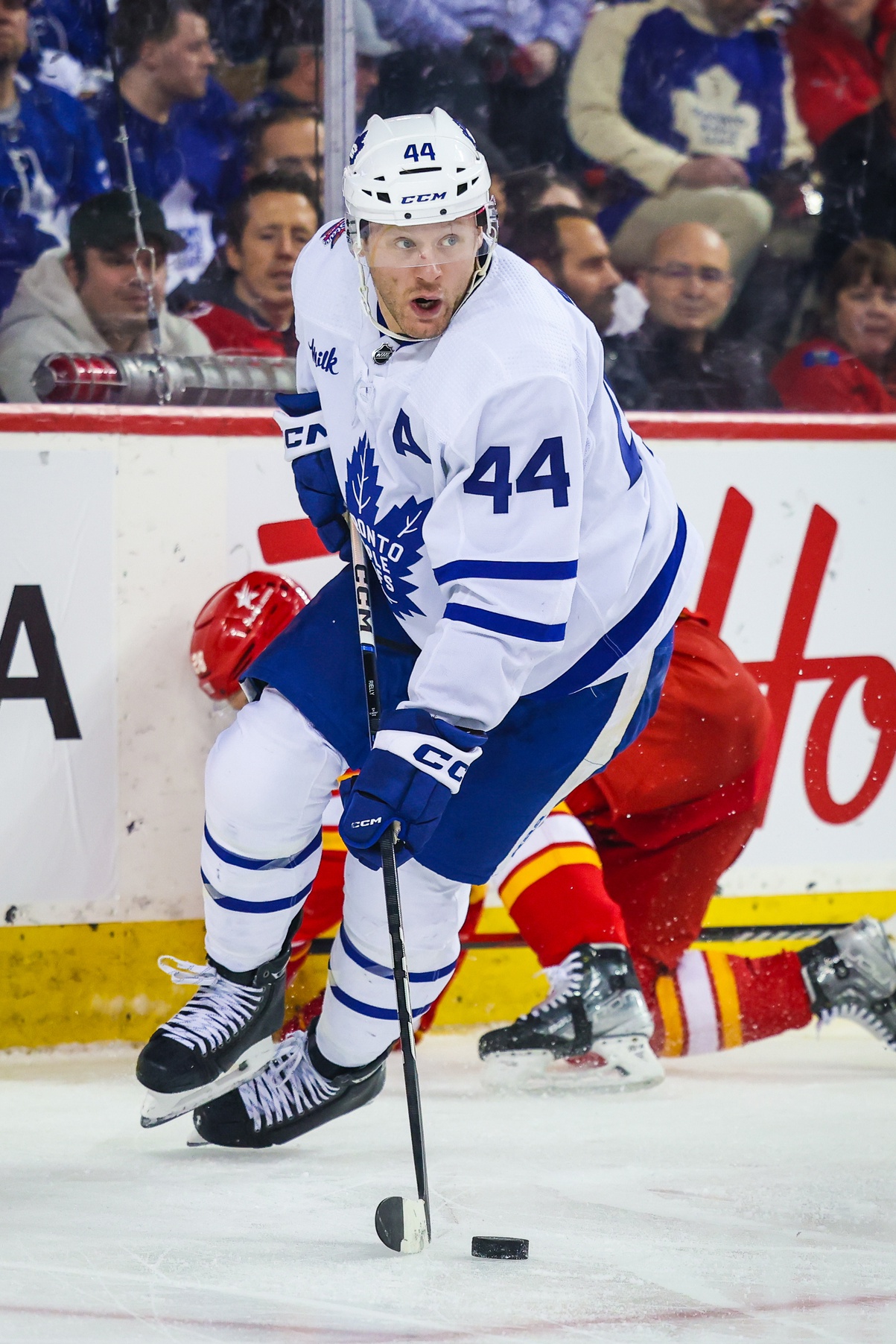
You could argue that Rielly’s defensive struggles are mainly due to being on a poor defensive team, but the truth is that he wasn’t strong defensively even when the Maple Leafs had a solid possession numbers. Still, is it worth buying him out? Probably not. Rielly currently earns $7.5MM a year and has four years left on his contract. Despite the cost, he might be worth keeping or trading.
A Rielly buyout would have Toronto paying him $3.5MM per season for the next four years, followed by $2MM annually for the subsequent four years. Sure, the cost savings over the next four years would be $4MM annually, but then the team needs to find a top four defender to replace Rielly, and the Maple Leafs likely won’t find one for less than the savings amount. A trade would be the best option for Toronto, but Rielly still has the leverage for the next two years with a full no-movement clause, which could complicate any potential trade.
Sliding east of Toronto, the Canadiens have a potential buyout candidate in veteran forward Brendan Gallagher. Including the 33-year-old on this list will upset some, but his decline since 2021 has been well-documented.
Prior to 2021, Gallagher was one of the most consistently effective 5-on-5 scorers in the NHL. However, Father Time is undefeated, and Gallagher is no longer a top-nine forward, even though he still earns like one. With just six goals and 16 assists in 76 games this season, he has been a healthy scratch for Montreal this week, which could be a sign of what’s to come. Montreal boasts a strong group of forwards, with more young prospects on the way, and it could become a numbers game that Gallagher loses.
The other side of the argument with Gallagher is that he has only one year left on his contract, with a cap hit of $6.5MM, but he is owed just $4MM in actual salary. It’s possible he could be traded to a team trying to reach the salary cap floor or swapped for another problematic contract. If Montreal considers a buyout, it would save them $2.67MM next season but add a $1.33MM cap charge in 2027-28.
Since Montreal has most of its core signed and over $12MM in cap space available this summer, it has no immediate need to part ways with Gallagher unless it plans a major move. There’s also a potential morale issue if the Canadiens decide to release a popular veteran who has given everything to the organization, the fans, and the city.
Staying in Canada shifted the focus westward. Oilers forward Trent Frederic and his contract sent shockwaves through the NHL just 12 months ago when it was signed. Many pundits were left scratching their heads when the Oilers inked Frederic to an eight-year, $30.8MM contract extension just days before free agency opened.
The $3.85MM cap hit was a bit high for many people’s tastes, but not outrageous, given that Frederic was a pending UFA. However, the length of the deal seemed excessive for a role player, especially one who wasn’t very effective last season.
This year, Frederic has four goals and three assists in 70 games. That’s poor offensive production for anyone, let alone a player earning nearly $4MM annually. Some of this can be attributed to an unusually low shooting percentage of 5.7%, about half of his typical success rate. If he regresses to the mean next season, he should score more goals, but it’s not just his offensive numbers this season that are concerning.
Aside from one season when he tallied 40 points, Frederic has never been a significant offensive contributor or a player who drives or controls the pace of play, making the eight-year contract a particularly poor decision.
There is just a lot wrong with Frederic’s game, and in an era where making mistakes on mid-tier contracts can be disastrous due to the parity in the NHL, this one is particularly bad. That said, Edmonton would have to absorb a 14-year cap hit if it bought out the 28-year-old, which means he’s probably staying beyond this season.
Finally, we come to the most obvious candidate: Jesperi Kotkaniemi, who is somehow still just 25 years old. When the Hurricanes sent an offer sheet to Kotkaniemi back in August 2021, they were betting on his potential to become a top-six center.
After all, Kotkaniemi was a third overall pick in 2018 and had the skill set to elevate his game and move up the lineup. However, the offer sheet was very ill-advised, with the idea reportedly coming from Hurricanes owner Tom Dundon in response to the Montreal Canadiens’ offer sheeting Sebastian Aho two years prior.
Kotkaniemi never really developed an offensive side to his game, and at this stage of his career, he is what he is – a reasonably good defensive center (although his numbers there have dipped this season as well) who doesn’t score much. This year, Kotkaniemi has two goals and seven assists in 38 games. Although he put up 43 points a few years ago, it doesn’t seem likely that he’ll become a consistent 40-point player. At $4.82MM a year for four more seasons, the Hurricanes have an opportunity to save some serious cash by buying him out.
Due to his age, Carolina could buy out Kotkaniemi this summer for just 33% of the remaining money on his deal, which is about $6.8MM. That would save Carolina almost $4MM next season, and $4.35MM in each of the three years after that.
Now, the Hurricanes are usually not a cap team, but they have only $14MM available this summer (as per PuckPedia) and four players to sign. If they want to add to the lineup and improve their chances in the quest for the Stanley Cup, this could be a way to create some much-needed breathing room under the salary cap.
Photo by Sergei Belski-USA TODAY Sports
Hurricanes’ Eric Robinson Could Be Out Through Olympic Break
The Carolina Hurricanes could face an extended stretch without one impactful winger. Eric Robinson could be out until the team returns from the Winter Olympics break on February 26th, head coach Rod Brind’Amour told Chip Alexander of the Raleigh News & Observer. Robinson left Carolina’s Monday win over the Buffalo Sabres in the first period after he was knocked awkwardly into the ice by Sabres captain Rasmus Dahlin. He was nursing his left shoulder on his way off the ice and has since appeared at practice with that arm in a sling.
Robinson has returned to the utility role he carved out in the Hurricanes lineup last season. He has 10 goals, 15 points, and an offense-best plus-seven in 44 games this season. Those marks are well in-line with the 14 goals, 32 points, and plus-14 – all career-highs – that Robinson posted in his first year with Carolina. Even from a bottom-six role, the 30-year-old winger has proven to bring a routine, positive impact.
The Hurricanes brought Jesperi Kotkaniemi back into the lineup after a healthy scratch, following Robinson’s injury. Kotkaniemi made good work of the return, recording one assist, two shots, and three hits in Thursday’s shootout loss to the Chicago Blackhawks. He could stick in the lineup for at least six more games should Robinson indeed sit out through the Olympics. Carolina could also see this as a chance to reward one of their top prospects with the AHL’s Chicago Wolves. The Wolves are led in scoring by Justin Robidas, Bradly Nadeau, and Felix Unger-Sorum – all candidates to earn a brief recall if Robinson lands on injured reserve.
Central Notes: Robertson, Wild, Ott
With a big contract negotiation on the horizon this summer, Stars winger Jason Robertson has switched agents. Sportsnet’s Elliotte Friedman reported on the latest 32 Thoughts podcast (audio link) that Robertson (and his brother Nicholas Robertson) are now being represented by Octagon’s Andy Scott; they had both been previously repped by CAA’s Pat Brisson. The winger has 56 points in 49 games with Dallas this season, putting him on track to hit the 80-point mark for the fourth straight season. He’s owed a qualifying offer of $9.3MM with arbitration rights in late June but will likely make a few million more per season than that. Notably, Scott also represents Mikko Rantanen, Wyatt Johnston, and Thomas Harley, all of whom have signed long-term deals with the Stars within the last year.
More from the Central Division:
- After moving out a young center as part of the return for Quinn Hughes, it appears the Wild are keeping tabs on another young middleman. David Pagnotta of The Fourth Period reports that Minnesota is a team that’s believed to have some interest in Hurricanes center Jesperi Kotkaniemi, though he’s not viewed as their top choice to add down the middle. Kotkaniemi is believed to be getting shopped by the team, recognizing that he needs a change of scenery after recording just seven points in 29 games so far this season. However, the 25-year-old still has four years left on his deal after this one with a $4.82MM cap charge, a price tag the Wild can’t afford at the moment.
- The Blues have made a coaching change with their AHL affiliate in Springfield. The team announced that Steve Ott will take over as head coach with the Thunderbirds, replacing Steve Konowalchuk, who has been let go. This will be Ott’s first time as head coach after serving as an assistant or associate coach in St. Louis since 2017. He has been a speculative head coaching target over the past couple of offseasons and some experience running a bench might help give him a boost for future vacancies. Konowalchuk, meanwhile, departs with a 47-50-12 record over parts of two seasons with the Thunderbirds.
Carolina Hurricanes Shopping Jesperi Kotkaniemi
The Carolina Hurricanes are reportedly considering trade offers for center Jesperi Kotkaniemi, Sportsnet’s Elliotte Friedman reported this morning.
According to Friedman, the Hurricanes “recognize [Kotkaniemi] needs a fresh start” and are considering trade offers for the 25-year-old pivot at this time. 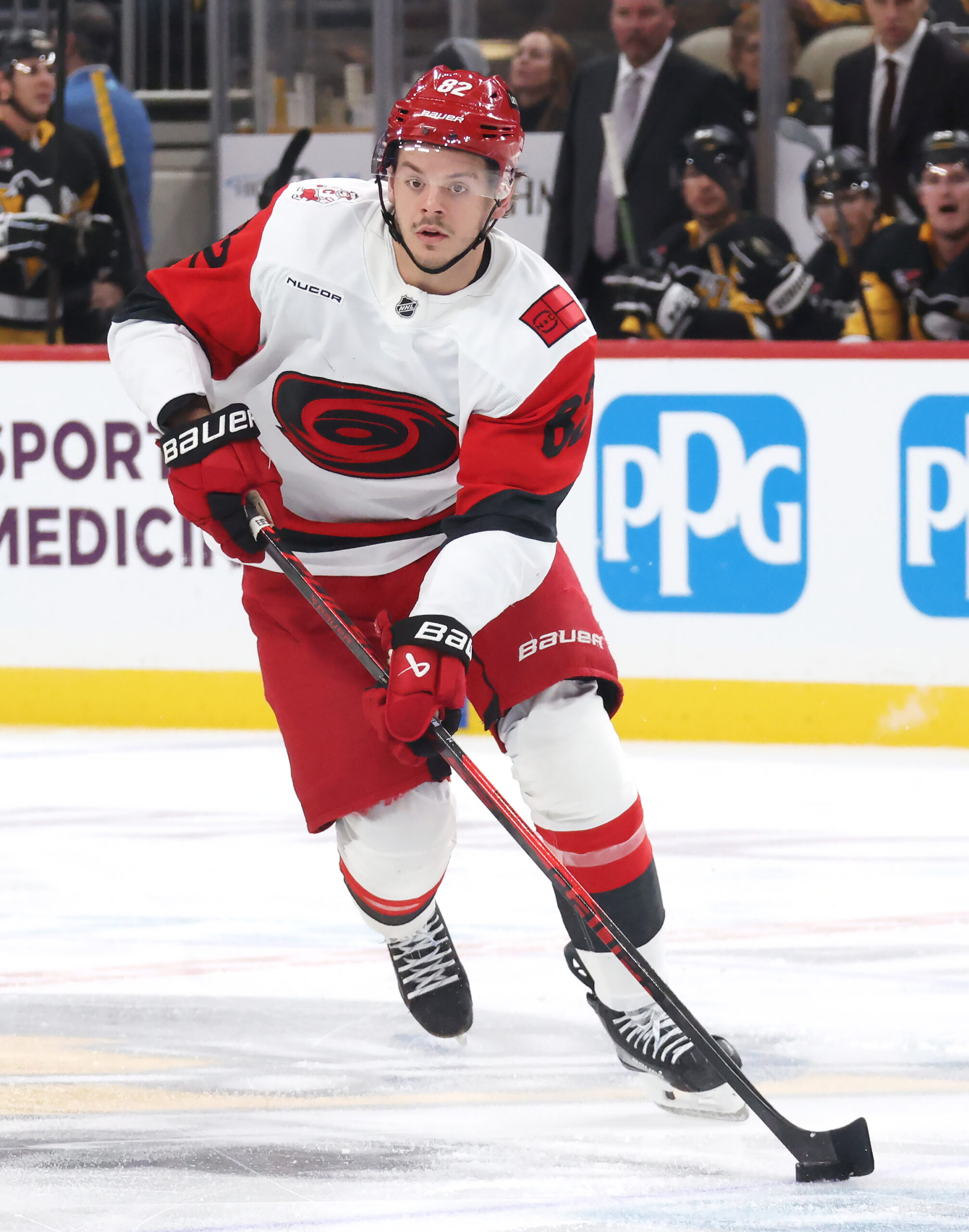
He also added that he believes “there is legit interest” in Kotkaniemi, and that the Hurricanes already included Kotkaniemi in their trade talks for Quinn Hughes and Phillip Danault, who were ultimately dealt to the Minnesota Wild and Montreal Canadiens, respectively.
Kotkaniemi, the No. 3 pick in the 2018 NHL Entry Draft, has had an up-and-down pro career and his time in Carolina has been no different. At times, the 6’3″ center has flashed the kind of coveted attributes that made him a top prospect in the first place, but finding consistency has been a massive issue.
Kotkaniemi had a strong 34-point season as an 18-year-old rookie in Montreal, but his inability to build on that campaign and live up to the pressure of being such a high draft choice ultimately led to his exit from the Canadiens. He left Montreal via an offer sheet from Carolina.
The offer sheet, seen by many as retribution for the Canadiens’ own offer sheet of Hurricanes star Sebastian Aho (a characterization the Hurricanes strongly denied, to be clear), was followed up by an eight-year, $4.82MM contract extension. Kotkaniemi has four years remaining after this one on that deal.
There were times in his tenure in Carolina that Kotkaniemi looked to be becoming the quality middle-six two-way pivot he was long projected to be. He scored 18 goals and 43 points in 2022-23, and added seven points in 15 playoff games. But ultimately, that season stands as a career-high, and Kotkaniemi proved unable to seize on the repeated opportunities he was provided to become Carolina’s trusted No. 2 center behind Aho.
After scoring 33 points last season, Kotkaniemi is on pace for a career-low level of offensive production. His six points in 25 games this season give him a 20-point 82-game scoring pace, though it’s worth noting he has missed some time with injuries. Kotkaniemi is averaging 11:08 time on ice per game this season without any regular special teams usage.
Given his inconsistency and inability to seize his opportunity in Carolina, it’s fair to question whether the Hurricanes will be able to receive a significant return in a Kotkaniemi trade. On one hand, he doesn’t appear to be a player worth a huge amount, especially with four additional years left on his deal at a $4.82MM AAV.
But on the other hand, there are reasons to believe Kotkaniemi, for all of his flaws, remains a coveted asset. For one, the supply of available centers on the market is extremely low, something Philadelphia Flyers GM Danny Briere confirmed after signing center Christian Dvorak to a recent extension. As a result, a team in need of a center might not have many superior options available than Kotkaniemi.
Additionally, to some, Kotkaniemi’s contract might be seen as a negative, or even a deal breaker. To others, they might see it as an opportunity. If Kotkaniemi could simply get back to his level of play from 2022-23, for example, he would be providing surplus value on that cap hit with team control until the end of the decade. If a team truly believes its staff can get the most out of Kotkaniemi, the chance to have him under control at that rate would be a positive, not a negative.
At this point, we can only speculate as to what that all means for the Hurricanes’ current efforts to trade Kotkaniemi. One thing is clear, though: the 2018 No. 3 pick is looking increasingly likely to continue his career, at some point in the near future, with another franchise.
Photos courtesy of Charles LeClaire-Imagn Images
Hurricanes Reportedly Tried To Swap Kotkaniemi For Danault
In a recent episode of Oilersnation Everyday, The Fourth Period’s David Pagnotta reported on a recent trade that didn’t go through. Pagnotta suggested that before ultimately dealing him to the Montreal Canadiens, the Los Angeles Kings had conversations regarding Phillip Danault with the Carolina Hurricanes.
Even more fascinating about Pagnotta’s report is that the Hurricanes wanted to include former third-overall pick Jesperi Kotkaniemi in the package for Danault. The Kings were reportedly less turned off by Kotkaniemi’s $4.82MM salary than they were by the five years remaining on his contract.
Presently, the savings would have been negligible at best. Kotkaniemi is earning roughly $680K less than Danault for this year and next, which wouldn’t even have been enough for Los Angeles to recall another player making the league minimum salary if they needed. Additionally, since Kotkaniemi’s contract runs three years longer than Danault’s, the Kings would have added around $14.5MM in future costs.
There isn’t much separation in their offensive contributions either, despite Danault’s disappointing start to the year. Kotkaniemi has two goals and six points in 20 games for the Hurricanes this season, whereas Danault registered five assists in 30 games before the trade. Furthermore, Danault has the edge in faceoff percentage and on-ice save percentage at even strength, which are critical metrics for supposed middle-six centers.
All that suggests that the Hurricanes were merely looking to include Kotkaniemi in what would have been a larger package. Carolina doesn’t own their second-round pick this season, but could have attached next year’s second-rounder, or even one of their additional thirds, in a package with Kotkaniemi.
Still, the scrapped trade for Danault is at the very least indicative of how the Hurricanes view Kotkaniemi. As the upper limit of the salary cap continues to rise and Carolina keeps most of their core on relatively team-friendly contracts, Kotkaniemi’s deal isn’t as much of a drain as it has been in years past. However, given the value he provides, or lack thereof, it’s unsurprising to see a competitive team like the Hurricanes looking to move him for an upgrade.
Any deal involving Kotkaniemi will likely be for another underperforming player, similar to Danault’s situation in Los Angeles. Despite not living up to his draft selection, he’s only 25 years old, and some teams may believe they’ll have a chance to squeeze the last bit of development out of him.
Hurricanes Activate Jesperi Kotkaniemi From Injured Reserve
The Carolina Hurricanes have activated forward Jesperi Kotkaniemi from injured reserve. He missed the last nine games with a lower-body injury sustained while blocking a shot from Vancouver Canucks defenseman Filip Hronek on November 14th. He was placed on injured reserve on November 25th.
Kotkaniemi is expected to return to the lineup in Saturday night’s match against the Nashville Predators. He has two goals, five points, 11 blocked shots, and 26 hits through 15 games this season. He’s alternated between the center and left-wing roles on Carolina’s fourth-line for much of the year. That rotation has limited him to only 115 faceoffs so far this season – of which he has only won 47 percent. That’s a far fall from the 51 percent he posted through his first four seasons in Carolina.
Carolina made room for Kotkaniemi’s return when they reassigned Justin Robidas on November 29th. Robidas stepped into two games on his last recall and posted one assist, one shot block, and three hits. Jordan Martinook stepped into the lineup in Robidas’ spot while Carolina waited for Kotkaniemi to return to full health. Martinook will now step back out of the lineup, having posted nine ponits in 26 games this season.
Hurricanes Reassign Justin Robidas Amid Injury Updates
The Carolina Hurricanes saw a wave of roster updates come through during Saturday morning’s practice. Notably, winger Justin Robidas was not at practice, as he’s been reassigned to the AHL’s Chicago Wolves. Robidas won’t skate in Saturday’s match against the Manitoba Moose but should be back in time for Sunday’s rematch.
Forward William Carrier also missed practice. It is unclear if he has sustained a new injury after appearing in Friday’s win over the Winnipeg Jets. Goaltender Pyotr Kochetkov did sustain a lower-body injury that forced him out of Friday’s game, and Saturday’s practice. Defenseman Jaccob Slavin also remained out, per NHL.com’s Walt Ruff.
In better news, Ruff adds that forward Jordan Staal participated in practice despite being questionable with an illness, and center Jesperi Kotkaniemi continued to work in a non-contact jersey.
Carolina continues to face a heap of injuries despite getting Shayne Gostisbehere and K’Andre Miller back into the lineup recently. They have been forced to play hot potato with much of their lineup, routinely cycling through their lines. The Hurricanes have had six different forward lines, and 10 different defense pairings, play in at least 50 minutes of even-strength ice time this season. Their most-used forward line has been Jordan Martinook, Staal, and Carrier – a trio that could be broken up if Carrier sustained another injury. The most-used defense pairing has been Miller and Sean Walker, who reunited recently after Miller missed six games.
The Hurricanes have felt the brunt of that shuffle over November. They started the month with a 4-1-0 record, but have fallen into a back-and-forth over the last two weeks. Carolina is 4-3-2 in their last nine games, and haven’t won back-to-back games since Novmber 8th and 9th.
Injuries have forced Carolina’s healthy skaters to step up. Sophomore winger Jackson Blake ranks fourth on the team in scoring with 15 points in 24 games. Robidas was also contributing to the offense, netting one assist and a 50 percent faceoff percentage through two games in a bottom-six role.
Robidas now have three points in the first four games of his NHL career, including a pair of games he played in last season. He has been an electric scorer in the minor leagues and currently ranks third on the Wolves with 12 points in 16 games. Chicago is trying to break out of their own November slump, posting a 2-4-0 record over their last six games but winning last Wednesday’s game against the rival Rockford IceHogs by a lofty 8-4. Robidas should help the Wolves keep that offense rolling as they look for better outcomes in December.