
Senators, Jake Sanderson To Discuss Extension Later This Summer
The Senators took care of one important piece of business earlier this week with the signing of Vladimir Tarasenko to a one-year contract to help fill the void created by the departure of Alex DeBrincat to Detroit. While they’re pretty much capped out, GM Pierre Dorion is hoping to have another big contract in the works as Postmedia’s Bruce Garrioch reports that the Sens and defenseman Jake Sanderson are set to sit down for extension discussions later this summer.
The 21-year-old had an impressive rookie season in 2022-23, collecting 32 points for Ottawa in 77 games while logging nearly 22 minutes a night of ice time. The fifth-overall pick in 2020, Sanderson is projected to be a cornerstone piece for the Sens on their back end so it’s not surprising that the team wants to sit down and talk about a new deal early.
But it will be tricky to find a number that both sides are happy with considering that Sanderson’s NHL experience is limited to just those 77 games; that’s not a large sample size to work with. There will be a lot of projecting with a long-term contract which makes it more difficult to lock down a year before it expires.
If the two sides look at a long-term agreement, they have a reasonable in-house comparable in Thomas Chabot, a player who makes the type of impact now that they believe Sanderson can down the road. His eight-year deal carries an AAV of $8MM; from a cap percentage standpoint, that agreement is worth $8.2MM per season today. Miro Heiskanen’s $8.45MM AAV in Dallas would likely be the high point of any discussions.
Notably, Sanderson will have five years of club control remaining next summer; while he burned the first year of his entry-level deal in 2021-22, that doesn’t count as a year of service time toward UFA eligibility. Assuming that they’d want to add at least a couple of years of control on a long-term deal, that basically takes a five-year or six-year agreement off the table.
While Ottawa has had the reputation of not being a high-spending team, that isn’t really the case anymore. Per CapFriendly, they already have $65.77MM in commitments for 2024-25 to just 13 players and while there is an expectation of a bigger cap increase next summer than the $1MM it has been lately, they’re still looking at needing to sign seven to ten players with around $20MM in room to work with. A big-ticket long-term deal with Sanderson will start to put the squeeze on.
To that end, perhaps the two sides might ultimately be inclined to look toward a bridge deal that buys the two sides more evaluation time and the Sens a bit more short-term flexibility. But if that’s the direction one or both sides are leaning, it’s unlikely that an agreement will be reached this summer. In that case, one extra year of results would be quite useful for both Ottawa and Sanderson.
With Tarasenko in the fold, Dorion can check off one more item from his to-do list. Sooner than later it seems, he’ll start working on the next item to see if an early agreement can be reached with one of his top blueliners.
Atlantic Notes: Tkachuk, Veleno, Chiasson
In a recent appearance on Sportsnet 590 (audio link), Panthers winger Matthew Tkachuk indicated that he is almost back to normal as he works his way back from a fractured sternum sustained during the playoffs. At this point, he’s expected to be fully ready for training camp. Tkachuk had a dominant first season in Florida, collecting 40 goals and 69 assists in 79 games, good for seventh in NHL scoring. He followed that up with 24 points in 20 playoff contests, leading all Eastern Conference players in that department.
More from the Atlantic:
- One of the items still on Detroit’s to-do list this summer is re-signing center Joe Veleno. Max Bultman of The Athletic suggests (subscription link) that Ducks middleman Isac Lundestrom, a fellow 2018 first-rounder might be a good comparable. Last summer, Lundestrom inked a two-year, $3.6MM deal coming off a similar platform year and fairly close career numbers. Veleno is coming off a nine-goal, 20-point campaign so $1.8MM might be a bit on the high side but a bridge deal in that range would make sense for both sides.
- Still with Detroit, MLive’s Ansar Khan notes that the Red Wings expressed interest in re-signing Alex Chiasson at the beginning of free agency but were only offering a two-way deal at that time. The 32-year-old spent a good portion of last season on a tryout deal with AHL Grand Rapids and was productive, notching 20 points in 29 games. That got his contract converted to an NHL agreement down the stretch where he picked up six goals and three assists in 20 contests. Chiasson, a veteran of 651 NHL games, is no stranger to tryout routes and he may have to go that away again in the fall if he wants a shot at securing a one-way NHL agreement.
Finding A Match For A John Gibson Trade
There has been trade speculation around Ducks goaltender John Gibson for several years now with that only intensifying following a trade request that was reported back in early June. His agency denied a report earlier this month which suggested he had informed the club he wouldn’t play for them again but it’s still believed he wouldn’t mind a change of scenery. However, most of the annual goalie shuffle is now complete and the veteran remains with Anaheim, at least for the time being.
 The 29-year-old had posted a 3.99 GAA last season, leading the league in goals allowed (200) and losses (31) while putting up a .899 SV%. Over the last four seasons, Gibson’s best save percentage has been .904 after putting up four straight campaigns of .917 or better so it’s not as if this was a one-time dip. Of course, that also coincides with Anaheim entering a rebuild so at least some of the decline in performance could be attributed to that. It’s possible that in a better situation, he could rebound.
That said, it won’t be a cheap gamble to make. Gibson has four years left on his contract with a $6.4MM AAV. That will be difficult for most teams to fit in now; fewer than ten teams in the league have that much cap space and several of those are of the rebuilding variety. On top of that, the Ducks aren’t going to give their starter away either; there will be a fairly sizable price to pay in terms of assets to get his services. What teams might those be? Let’s look at some possible options, some admittedly more speculative than others.
New Jersey
The Devils have a tandem of Vitek Vanecek and Akira Schmid which, on the surface, isn’t all that bad. Vanecek had a career-low 2.45 GAA with a career-high .911 SV% last season in 52 games, perfectly reasonable numbers for a starter. Schmid, meanwhile, was even better in limited duty and even took over as the starter at one point in the playoffs.
That last point is why they’re on this list though. When it mattered most, Vanecek struggled and with a core group that’s clearly built to win now, a possible upgrade between the pipes could be the missing piece to the puzzle. A package that includes Vanecek would offset Gibson’s net added cost to no more than $3MM which would be affordable within their cap space, assuming they fill out their roster with low-salaried options. More importantly, he’d cost less moving forward on the cap than Connor Hellebuyck based on his asking price.
Winnipeg
While the Jets have moved out Pierre-Luc Dubois and bought out Blake Wheeler, that shouldn’t be construed as them heading for a rebuild. Look no further than the return they received for Dubois – one that had multiple roster pieces as they look to stay in the playoff mix. Moving Hellebuyck would open up a big hole to fill in goal and Gibson would be a logical one to turn to, assuming either Winnipeg isn’t on his 10-team no-trade list or he’d be willing to waive to go there.
One thing the Jets don’t have in this scenario is another netminder of some significance to flip the other way so their return would likely have to be more futures-based. Considering where Anaheim is in their rebuild cycle, that might even be preferable on their end. The Hellebuyck domino has to fall first for this to be an option though.
Buffalo
The Sabres have been speculatively linked to a veteran goaltender for a few months now. Craig Anderson has called it a career and Eric Comrie isn’t the solution as the starter either. Meanwhile, the team has high hopes for Devon Levi and Ukko-Pekka Luukkonen but the pair have 54 career NHL appearances between them. There seems to be an expectation of Buffalo making a real playoff push in 2023-24 after really making it interesting in April before just coming up short so while there is an element of upside if Levi and Luukkonen do well, there is certainly some risk as well if they struggle.
Gibson could be a way of hedging that risk, giving Levi a veteran partner to work with and allow him to try to ease his way into a longer-term starting role. Luukkonen, meanwhile, could be an intriguing part of a swap for Anaheim to start a young tandem of their own alongside Lukas Dostal. Buffalo has enough cap space to take on Gibson’s contract outright but with pricey extensions a year off for Rasmus Dahlin and Owen Power, either seeking some retention or sending some sort of salary offset would be beneficial.
Edmonton
After signing Jack Campbell last summer with the hopes of finally finding themselves a legitimate starting goaltender, they find themselves in a familiar spot – still looking for that goalie. Campbell had his moments last season as did Stuart Skinner but neither are in a spot where they can be counted on as a sure-fire starter when it matters most. For a franchise that has two of the top players in the league in Connor McDavid and Leon Draisaitl, their contention window is now. They improved the defense at the deadline so finally landing that reliable starter could be the final piece of the puzzle.
Cap space is at a premium for Edmonton, however, with most of their remaining cap room heading to RFAs Ryan McLeod and Evan Bouchard. To make a move work, they’d need to match money. That would mean Campbell and his $5MM AAV would almost certainly need to be part of the swap. The Oilers could ask Anaheim to retain enough on Gibson’s deal to get him down to that same $5MM price point although that will only increase the acquisition price. Fit-wise, Gibson would certainly be an intriguing addition but it would take some creativity to make it work.
Los Angeles
If you look at the Kings’ roster right now, there is one big question mark and that’s between the pipes. Pheonix Copley has been more of a third-stringer than a legitimate NHL option for most of his career and veteran Cam Talbot is coming off an injury-plagued campaign that saw him struggle when he was in the lineup. David Rittich is also in the mix but his track record isn’t the greatest either. Going cheap at that position has certainly given Los Angeles the flexibility to bolster their lineup but it’s not without its risks either.
To get Gibson (assuming he’s open to going to a long-term division rival), they’d be in a situation where they’d need to match money like Edmonton. A veteran on an expiring contract like Viktor Arvidsson or Matt Roy could help on that front while someone like Copley would need to be involved as well. But none of those players will be of much interest to the Ducks so they would need to find a futures-based package to add to those players to include to make it worth Anaheim’s while.
Columbus
This one is admittedly a bit off the board but things did not go well in goal for the Blue Jackets last season as Elvis Merzlikins certainly struggled which played a big role in Columbus plummeting down the standings. Their offseason activity so far has been geared toward shoring up the back end in the hopes that upgrades there will also help in goal and Mike Babcock is certainly not a rebuilding type of coach. There’s an internal expectation for big improvement so it wouldn’t be shocking to see them at least kick the tires.
Merzlikins is signed for four more years like Gibson is at $1MM less so if Anaheim was open to taking him back in a swap, the Blue Jackets can fit Gibson onto the books. They have a strong prospect pool that they could deal from, giving them an edge over some other teams who don’t have as deep of a group to work with when it comes to building a futures-based package.
Of course, it’s still quite possible that Gibson remains with the Ducks at the start of 2023-24 and they revisit the possibility of a trade in-season or next summer when teams will have more cap flexibility at their disposal. But if there is still mutual motivation to find a deal that works for both sides, there are at least a few teams that could be an option for the veteran netminder.
Photo courtesy of USA Today Sports Images. Cap information courtesy of CapFriendly.
Assessing Ottawa’s Cap-Cutting Options
The signing of Vladimir Tarasenko earlier this week certainly is a boost to an Ottawa attack that had taken a step backward following the trade of Alex DeBrincat earlier this month. But the move also puts them very close to the salary cap with the team still needing to re-sign Shane Pinto and leave themselves some wiggle room for in-season movement. They have less than $1MM to do so, per CapFriendly, with Pinto’s contract almost certain to cost more than the space they have coming off a 20-goal season.
As a result, GM Pierre Dorion is now faced with trying to clear up money in a market where cap space is hard to come by and there aren’t many teams that appear to be willing to take money on at this point.
Further complicating things is that Ottawa doesn’t exactly have a long list of contracts to realistically move. It’s highly unlikely that they would move any of their core pieces after moving Tarasenko and they already have five other projected roster players that are making under $1MM that really aren’t going to move the needle in terms of creating cap room when you consider that they’ll need to add someone else on the roster to fill their spot.
As a result, they only have a handful of players that stand out as potential trade candidates. They all project to be regulars but it’s plausible that their role could be filled either internally by someone cheaper or by pursuing someone still in the free agent market. Here is an overview of those potential trade options:
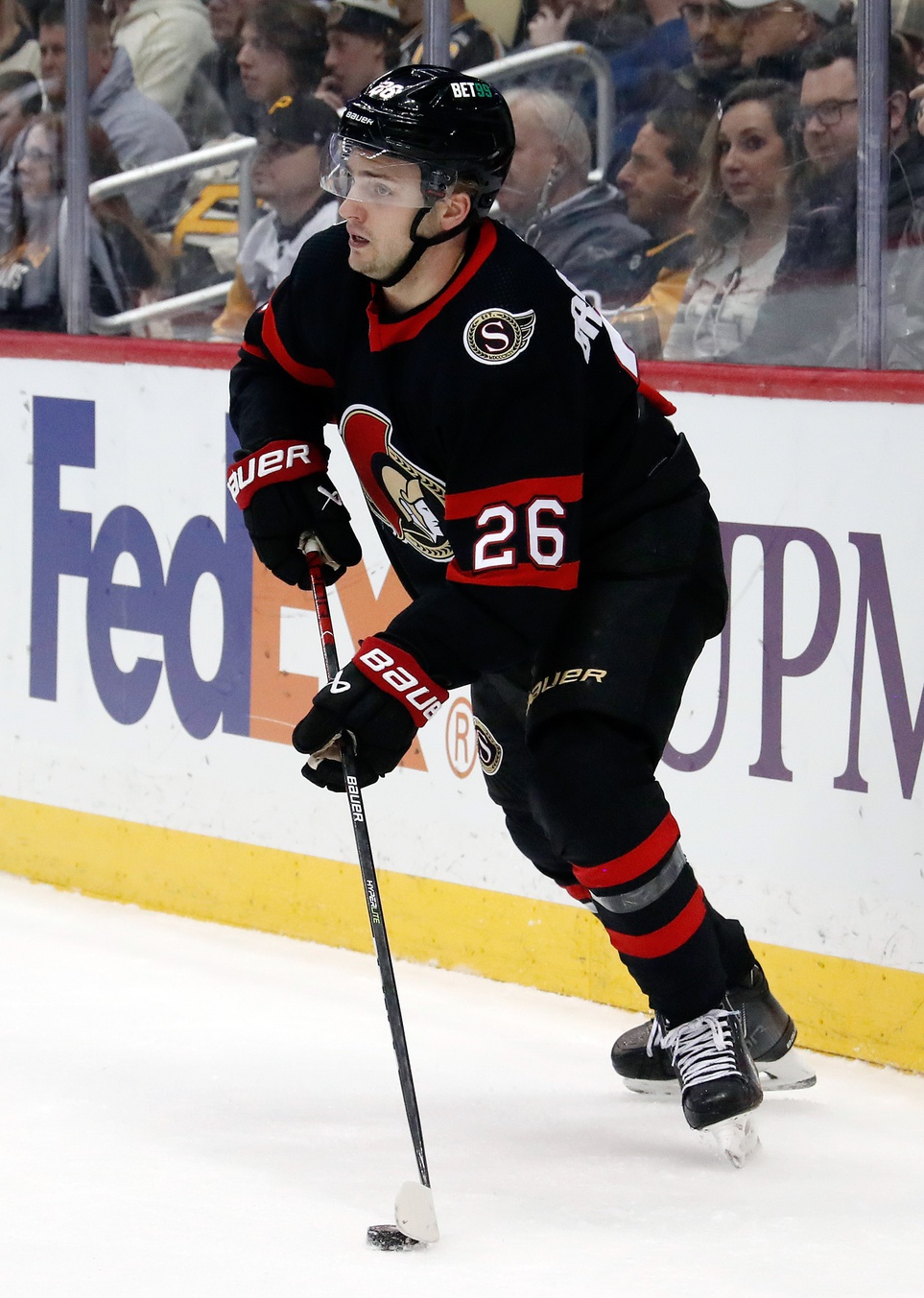 Erik Brannstrom – Originally acquired as the headline piece of the Mark Stone trade, the 23-year-old hasn’t exactly been able to live up to the hype. However, Brannstrom has shown slow but steady improvement and is coming off an 18-point season despite seeing his playing time dip by over four minutes per night. The two sides were able to reach a one-year, $2MM deal early in July that basically works as a second bridge contract and buys a little more time.
However, with Thomas Chabot and Jakob Chychrun in the fold, there isn’t really much of an opportunity for the blueliner to move up the depth chart on the left side. Where he sits now – as a clear third-pairing option – is more or less his ceiling in Ottawa for the foreseeable future. Brannstrom is young enough that he could be appealing to even a rebuilding team and the Sens could look to back-fill his spot with someone like Tyler Kleven who held his own down the stretch last season. They also may want to open a roster spot for 2019 first-round Lassi Thomson who, although he is a right-shot option, is now waiver-eligible.
Anton Forsberg – With Ottawa adding Joonas Korpisalo on a five-year contract at the beginning of the month, it’s clear that the Sens envision him as the starter of both the present and the foreseeable future. Forsberg, who had a shot at securing that role for himself, is coming off a down season, one that saw him tear his MCLs in both knees which now has him squarely in the number two role.
With a cap hit of $2.75MM, the 30-year-old is right in that mid-tier second-string territory. It’s not that his contract is well above market value or anything but it’s conceivable that Dorion could look to move Forsberg and bring in a one-year veteran (Jaroslav Halak and Martin Jones are among the remaining unsigned UFAs) at a cheaper rate, using the savings on Pinto in the process. However, it’s an idea that makes sense in theory but is going to be harder to execute as at this point, there aren’t many teams left with an opening between the pipes.
Mathieu Joseph – After being acquired in 2022, Joseph lit up the scoresheet, notching four goals and eight assists in 11 games, helping him earn a four-year deal for his troubles. Unfortunately for both sides, Joseph had fewer goals last season (three) despite suiting up 56 times. That’s not good bang for their buck on a deal that carries a $2.95MM cap hit. On the surface, he’s the most logical player to try to move.
That being said, in this marketplace, that’s not going to be a contract that will be easy to move with both the AAV and the term being a concern relative to others still available on the open market. One possible outcome could be the Sens waiving Joseph and if he clears, they’d free up $1.15MM in cap room. They’d need another player to take his place on the roster, however, so the net savings would be $375K or less. Still, that would give them a little more wiggle room to work with.
Dominik Kubalik – Kubalik was part of the DeBrincat trade earlier this month but with Tarasenko now on the roster, the 27-year-old may find himself in a bottom-six role, one he might not be the best suited for. He’s coming off a nice bounce-back year with Detroit, notching 20 goals and 25 assists in 81 games although he was quiet after the bye week, picking up just 11 points in 33 contests.
Kubalik has one year left on his contract at $2.5MM which might be movable in this cap environment based on the season he had and the short-term commitment. Again, some of the savings here would have to be offset by a replacement player on the roster but they could net enough room to re-sign Pinto and carry a 12th forward.
Each of these players has some value but it has been difficult for teams this summer to both move money and extract fair market value for a player. It’s likely that Dorion will run into the same situation here with these players. With more than two months before next season gets underway, he’ll have some time to try to find the right trade but if he hasn’t started calling teams about clearing money already, he’ll almost certainly be doing so soon.
Photo courtesy of USA Today Sports Images.
West Notes: Pettersson, Nill, Jets
One player that was likely intrigued by the eight-year, $78MM extension that Sebastian Aho signed yesterday was Canucks center Elias Pettersson. Postmedia’s Ben Kuzma suggests that Aho’s deal should only bolster Pettersson’s asking price when discussions about a new deal get underway. Pettersson had a much better platform season, picking up 39 goals and 63 assists while Aho had 36 tallies and 31 helpers. Pettersson is also averaging just shy of a point per game for his career while Aho checks in at 0.9. However, Aho has nearly 200 more NHL appearances under his belt and all eight years of his contract are UFA seasons while Pettersson will have one RFA-eligible year on his next deal. Despite that, it wouldn’t be surprising to see Pettersson’s camp aiming higher than Aho’s contract when he and the team sit down to discuss a potential extension.
Elsewhere in the Western Conference:
- In an interview with Sean Shapiro of D Magazine, Stars GM Jim Nill acknowledged that he has had discussions with owner Tom Gaglardi about eventually moving into a new role and allowing someone else to take over as GM. Nill signed a two-year extension earlier this week that keeps him under contract through 2025-26 and has been on the job in Dallas since 2013. But at 65, there has been a belief for a few years now that he’s in the back half of being in that role but since it appears that he’s open to holding a more senior front office position down the road, he could still have a big impact in Dallas beyond his newly-extended contract.
- While the Jets are likely facing a logjam on the back end next season, Scott Billeck of the Winnipeg Sun doesn’t expect the team to be moving away one of their veterans to open up a spot for a younger player. As things stand, Winnipeg has their top six intact from last season, leaving youngsters Logan Stanley, Ville Heinola, Kyle Capobianco, and waiver-eligible Declan Chisholm on the outside looking in. Currently, the more probable scenario is Capobianco being waived and Heinola, who is waiver-exempt, being sent down, leaving Stanley and Chisholm as projected scratches. That’s not ideal for a team that could benefit from developing some of their younger options but with the Jets looking to stay competitive in the short-term, them moving a veteran would go against that intent.
Atlantic Notes: Matthews, DeBrusk, Montour
For a while now, there has been plenty of speculation that Maple Leafs center Auston Matthews intends to set a new benchmark for the highest AAV when he signs his next contract. In a recent appearance on Sportsnet 590 (audio link), Nick Kypreos suggested that the two sides are believed to be in agreement on a cap hit at or around $13.5MM which would come in well above Nathan MacKinnon’s $12.6MM price tag. At this point, the discussions between the two sides are focused on term. Matthews took a five-year deal off his entry-level contract instead of a max-term agreement and it wouldn’t be surprising to see him take a shorter-term pact again with an eye on landing one more significant contract down the road.
More from the Atlantic:
- While the Bruins are right now focusing on the pending arbitration hearings for Jeremy Swayman and Trent Frederic, Steve Conroy of the Boston Herald opines that Boston also needs to get a sense of what Jake DeBrusk’s next contract is going to cost. Now extension-eligible as he’s in the final year of his deal, the winger could theoretically be used in a trade for a center if they decide to try to make a move to replace Patrice Bergeron if they find themselves too far apart in discussions. The 26-year-old has a $4MM AAV for next season and stands to be in line for a raise on that next summer after recording 27 goals and 23 assists in 64 games in 2022-23.
- In an appearance on the Cam and Strick podcast (video link), Panthers defenseman Brandon Montour provided an update on his recovery from shoulder surgery. He was recently able to remove the sling but anticipates he’s still at least a month away from being able to lift weights and he doesn’t expect to be able to hit the ice until sometime in September. Recovery from labrum surgeries typically carry a four-to-six-month recovery time so while it’s possible that Montour could be back early next season, his return could also be pushed back as far as into December.
Senators Sign Vladimir Tarasenko
The Senators have brought in some help up front, announcing the signing of winger Vladimir Tarasenko. The veteran receives a one-year, $5MM contract. Tarasenko also receives a full no-trade clause. GM Pierre Dorion released the following statement about the signing:
Vladimir’s a natural goal scorer. He’s a dynamic player who can score from anywhere in the offensive zone, as well as an underrated playmaker who’s made a career out of driving offence for he and his linemates. An established performer in the regular season and in the playoffs, we’re thrilled to add a player of his calibre to our lineup.
The 31-year-old was the top free agent forward left on the open market despite coming off what would be considered a down year by his standards. Tarasenko started the season with St. Louis, picking up 10 goals and 19 assists in 38 games before the Blues moved him to the Rangers a little before the trade deadline. He wasn’t able to maintain that level of production, however, notching eight goals with 13 helpers in 31 regular season contests while adding three goals and an assist in their first-round loss to New Jersey.
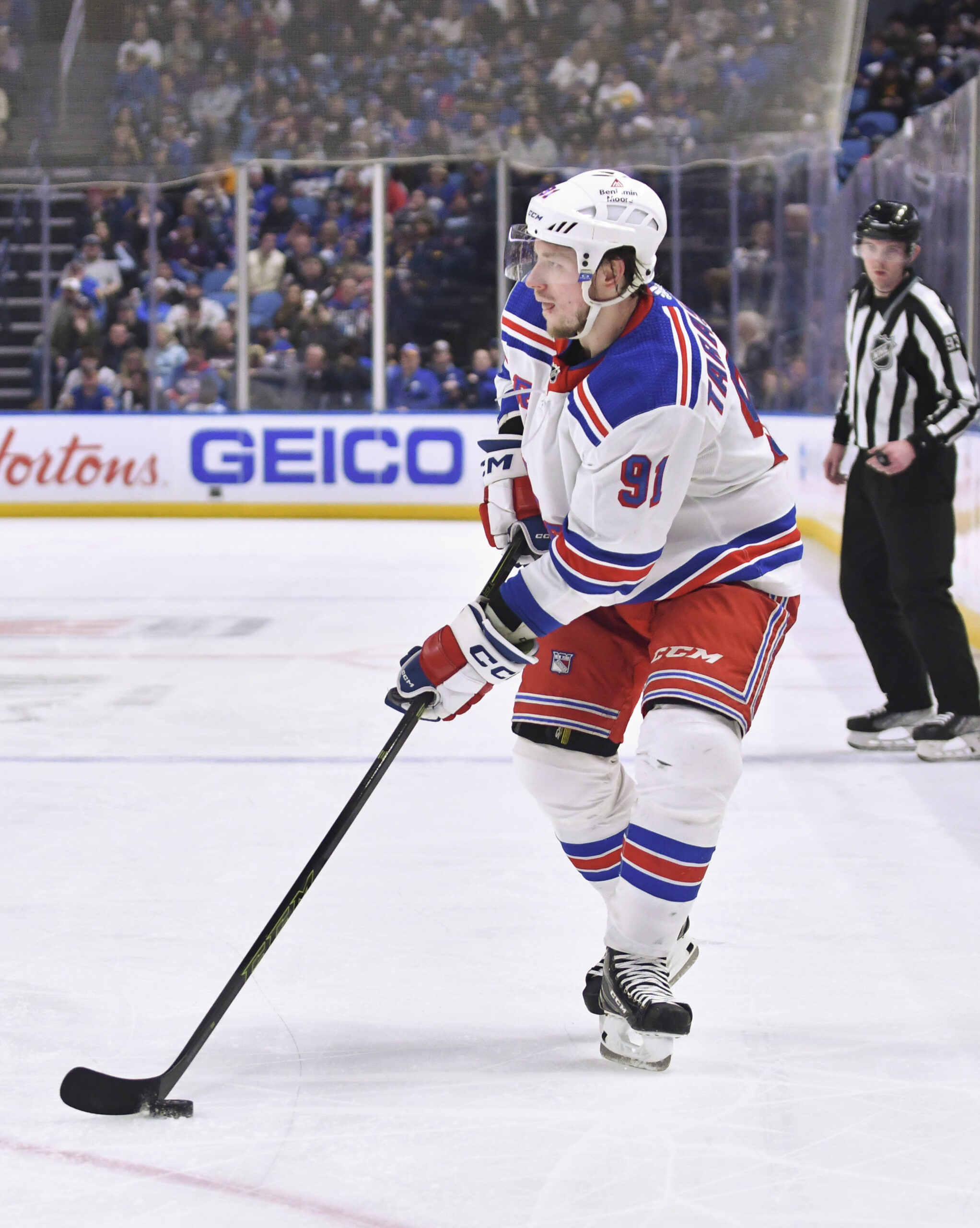 However, despite the quieter year, Tarasenko is still viewed as a strong scoring threat as Dorion alluded to. He has surpassed the 30-goal mark six times since 2013-14 while dealing with considerable injury trouble in two of the years that he didn’t get to that level. That helped slot him in third in our annual Top 50 UFA list.
While Tarasenko might not be a full-time top-liner anymore, the Senators don’t necessarily need him to fill that role as they’ll count on Brady Tkachuk, Tim Stutzle, and Josh Norris to carry the bulk of the scoring load. Instead, they’ll be turning to him to help replace Alex DeBrincat, who was moved to Detroit earlier this month. Tarasenko and veteran Claude Giroux will likely fill in some of the gaps in the top six, giving the Sens a group that looks relatively deep on paper as they look to get to the playoffs for the first time since 2016-17.
However, it’s also a group that is fairly expensive on paper as this basically puts Ottawa at the $83.5MM Upper Limit of the salary cap based on CapFriendly’s projections. That’s particularly notable as the team still needs to re-sign center Shane Pinto this summer. It also seems likely that they’d prefer to carry 13 forwards on the active roster so they’ll need to create some cap room in the coming weeks to do so while their preference now might be to do a one-year deal to help keep his cap hit as low as possible. While Toronto will be able to get cap relief from placing Matt Murray on LTIR when the season begins, the Senators will not receive any cap relief for the portion of Murray’s contract that they’re carrying on their books from trading him last summer.
Meanwhile, it’s an interesting end to a contract saga that has been a bit odd for Tarasenko. He had strong interest early in free agency but wasn’t able to come to terms on a new deal and less than a week into the open market, he dismissed Paul Theofanous, hiring Pat Brisson and J.P. Barry instead. At the time, the speculation was that he had multiple multi-year deals worth a little more than he ultimately wound up signing for. That’s good news for Ottawa as they’ve now landed a capable scoring threat who will be motivated for a big year with the hopes of cashing in on what’s projected to be a more favorable free agent market next summer, making it a possible win-win contract for both sides.
Photo courtesy of USA Today Sports Images.
West Notes: McLeod, Addison, Dunn
The Oilers don’t have a lot of financial flexibility right now. Per CapFriendly, they have around $5.6MM in room at the moment but with defenseman Evan Bouchard and center Ryan McLeod both needing new deals, that might not be enough. To that end, Daily Faceoff’s Frank Seravalli suggested (audio link) that Edmonton might have been the biggest losers from the Philipp Kurashev arbitration award, one that saw the Chicago forward get $2.25MM per season. Seravalli believes that the Oilers were likely hoping to get McLeod’s deal done for a little less than $2MM but that might be hard to do now. McLeod (11 goals, 12 assists in 57 games) is coming off a better platform year than Kurashev (nine goals, 16 assists in 70 contests) so if his case gets to a hearing, it’s safe to say they’ll be using the Kurashev contract as a comparable.
More from the West:
- The Wild are hoping to get defenseman Calen Addison signed for just above the league minimum, Joe Smith and Shayna Goldman of The Athletic note (subscription link). Minnesota tendered him a qualifying offer of $787,500 and it would appear that they’re holding firm to that offer for now. They have around $5.93MM of cap room per CapFriendly with the bulk of that earmarked for goaltender Filip Gustavsson whose arbitration hearing is scheduled next Friday. By pushing for Addison to take a one-year agreement, GM Bill Guerin is hoping to have enough cap space left over after Gustavsson gets his new deal to allow them to have a reasonable-sized cushion for in-season movement.
- Kraken defenseman Vince Dunn met with the media today including Geoff Baker of The Seattle Times following his four-year, $29.4MM contract from last week. The medium-term agreement raised some eyebrows and Dunn acknowledged that a factor was the possibility to try to land another sizable deal when he’s 30 in what should be a bigger salary cap environment. Dunn did make it clear that he has no desire to leave Seattle when his contract expires in the 2027 offseason.
Examining Toronto’s Further Cap-Cutting Options
While today’s news that the Maple Leafs would be placing goaltender Matt Murray on LTIR to start the season helps to alleviate Toronto’s salary cap situation, they still have some work to do. Using CapFriendly’s numbers, they still sit a little more than $2MM above the Upper Limit of the salary cap (even with Jake Muzzin being LTIR-bound himself) which means they have some paring down to do.
The recent arbitration award to Ilya Samsonov has opened up a second buyout window that they can utilize within the next 48 hours. However, there are specific rules in place as to who can be bought out in this second window. The player must make at least $4MM and have been on the roster last season. Most of the other Toronto players that meet the criteria (and there aren’t many) have a zero percent chance of being bought out.
One possible exception is defenseman T.J. Brodie. While they certainly wouldn’t want to part with the 33-year-old, the back-loaded structure of his contract would actually see the Maple Leafs clear the full $5MM AAV off the books for next season, clearing that gap and actually giving them some flexibility to add. On the flip side, it would add $2.5MM onto the books for 2024-25 which certainly isn’t ideal with Auston Matthews and William Nylander needing pricey new deals next summer. Speculatively, if they were open to parting with Brodie, a trade with 50% retention would free up $2.5MM in cap room and could yield a positive-value return, even in a market that doesn’t have a lot of financial wiggle room.
Assuming that’s not a route Toronto wants to take, let’s move on to some of the smaller cost-cutting options, sticking with the defense first. Conor Timmins has a two-year deal that begins next season, one that carries a $1.1MM AAV. While it’s generally viewed as bad form to trade a player that soon after signing an extension, Treliving wasn’t the one that gave him that deal. Even if a trade option isn’t available, the contract can be fully buried in the minors without a lingering cap charge. That might be their best option, actually, allowing them to keep Timmins in the organization a little longer and if another LTIR-eligible injury arises, he could then be brought up.
However, if head coach Sheldon Keefe wants to hold onto Timmins in the NHL, then Timothy Liljegren could become a cost-cutting candidate. Signed for a reasonable $1.4MM next season, the 24-year-old has shown enough that they could get a solid return for his services although it would take another perceived part of their long-term plans out of the system, joining Rasmus Sandin who was moved at the deadline last season.
If Toronto parts with Brodie, it becomes much less likely that they’ll do something with Timmins or Liljegren as they’ll need them in the lineup on a regular basis.
Up front, there are presently 14 forwards on their projected roster. They only need 12 so some savings can come from here. Nicholas Robertson is coming off another shoulder injury and is waiver-exempt so his $797K is an easy one to pare down.
The other one isn’t as easy. Sam Lafferty ($1.15MM) could be a luxury they could no longer afford and his contract could be fully buried in the minors if he was to clear waivers. With the year he had, there could be a taker in training camp but with several capable role players still unsigned, his trade value right now would be limited. Dylan Gambrell ($750K) is someone who might pass through unclaimed but he’d yield the fewest cap savings. Pontus Holmberg ($800K) and Matthew Knies ($925K) are waiver-exempt and would save a bit more money than Gambrell but in a perfect world, they’re both in the opening lineup.
The other possible cap casualty could be winger Calle Jarnkrok. At $2.1MM, his cap hit is hardly above market value but it might be a value that they can’t afford anymore while moving him outright would get them back into compliance. However, the trade market for him might not be the best right now with other bottom-six players available in free agency and not necessarily needing the three years that Jarnkrok has left on his deal.
As you can see, there are certainly multiple paths that the Maple Leafs can take to get compliant. But one way or the other, they will need to either part with some serviceable veterans or carry a minimum-sized roster to get there. Treliving has added some pieces this summer including veterans John Klingberg, Tyler Bertuzzi, and Max Domi but some subtraction should now be coming.
Snapshots: Comtois, Johnson, Hockey Canada
Max Comtois remains unsigned nearly four weeks into free agency after being non-tendered by Anaheim who opted not to give him a $2.445MM qualifying offer. Speaking with TVA Sports’ Louis Butcher, the 24-year-old called the parting of ways a mutual decision. Back in 2021-22, Comtois looked to have a breakout year, picking up 16 goals and 17 assists in 55 games but has struggled offensively since then, tallying just 15 goals and 20 helpers in 116 contests over the last two years.
Despite the struggles, Comtois revealed that a handful of teams have shown interest in him thus far, giving him confidence that he’ll have a place to play when training camps open up in mid-September. While he wouldn’t reveal which ones have shown interest, he did indicate that his hometown Canadiens are not among the teams that have reached out to his camp to express any interest in signing him.
Elsewhere around the hockey world:
- Free agent winger Luke Johnson has decided to try his hand overseas as Metallurg Magnitogorsk of the KHL announced they’ve signed the 28-year-old to a one-year deal. Johnson, a veteran of 32 NHL games dating back to 2018-19, has spent most of his professional career in the minors, suiting up in 333 AHL contests. That plus his NHL time now qualifies him for veteran status in the AHL – teams are capped with how many veteran-status players they can dress per game – so it’s not entirely surprising to see Johnson look elsewhere. Last season, he had 18 points in 67 games with San Jose’s farm team.
- Hockey Canada didn’t hold an in-person summer evaluation camp as they often do but they revealed the list of players that took part in their virtual meetings. The majority of the 45 players on the list have already been drafted while 2024 top prospect Macklin Celebrini is also on there. Canada’s roster in the December World Juniors will likely be comprised of many players on this list.