
Sharks Reassign Nick Leddy, Activate Vincent Desharnais
Jan. 19th: According to Sportsnet’s Elliotte Friedman, Leddy has made it through waivers unscathed. A few moments later, the Sharks announced that Leddy has been reassigned to AHL San Jose, and that Desharnais has been activated from the injured reserve.
Jan. 18th, 2:01 p.m.: Sharks head coach Ryan Warsofsky confirmed today, per Peng, that it’ll be Vincent Desharnais, not Mukhamadullin, who is the injured Sharks defenseman set to take Leddy’s spot in the lineup. Desharnais has been sidelined since late November with an upper-body injury.
Jan. 18th, 1:13 p.m.: The San Jose Sharks have placed veteran defenseman Nick Leddy on waivers. The news was first reported by San Jose Hockey Now’s Sheng Peng.
By placing Leddy on waivers today, the Sharks open up the possibility for Leddy to be reassigned to their AHL affiliate, the San Jose Barracuda. Reassignment to the AHL is contingent on Leddy clearing waivers.
Last week, The Hockey News’ Max Miller reported that defenseman Shakir Mukhamadullin would travel with the team on their four-game road trip. It appears, as a result, that Mukhamadullin is nearing the point where he’ll be able to be activated off injured reserve. Since the Sharks already have a full 23-man active roster, waiving Leddy today provides the Sharks with an additional amount of roster flexibility in advance of Mukhamadullin’s return. The Sharks would have just six healthy defensemen with Leddy removed from the roster, so it’s easy to tie Leddy’s waiver placement with an impending Mukhamadullin activation.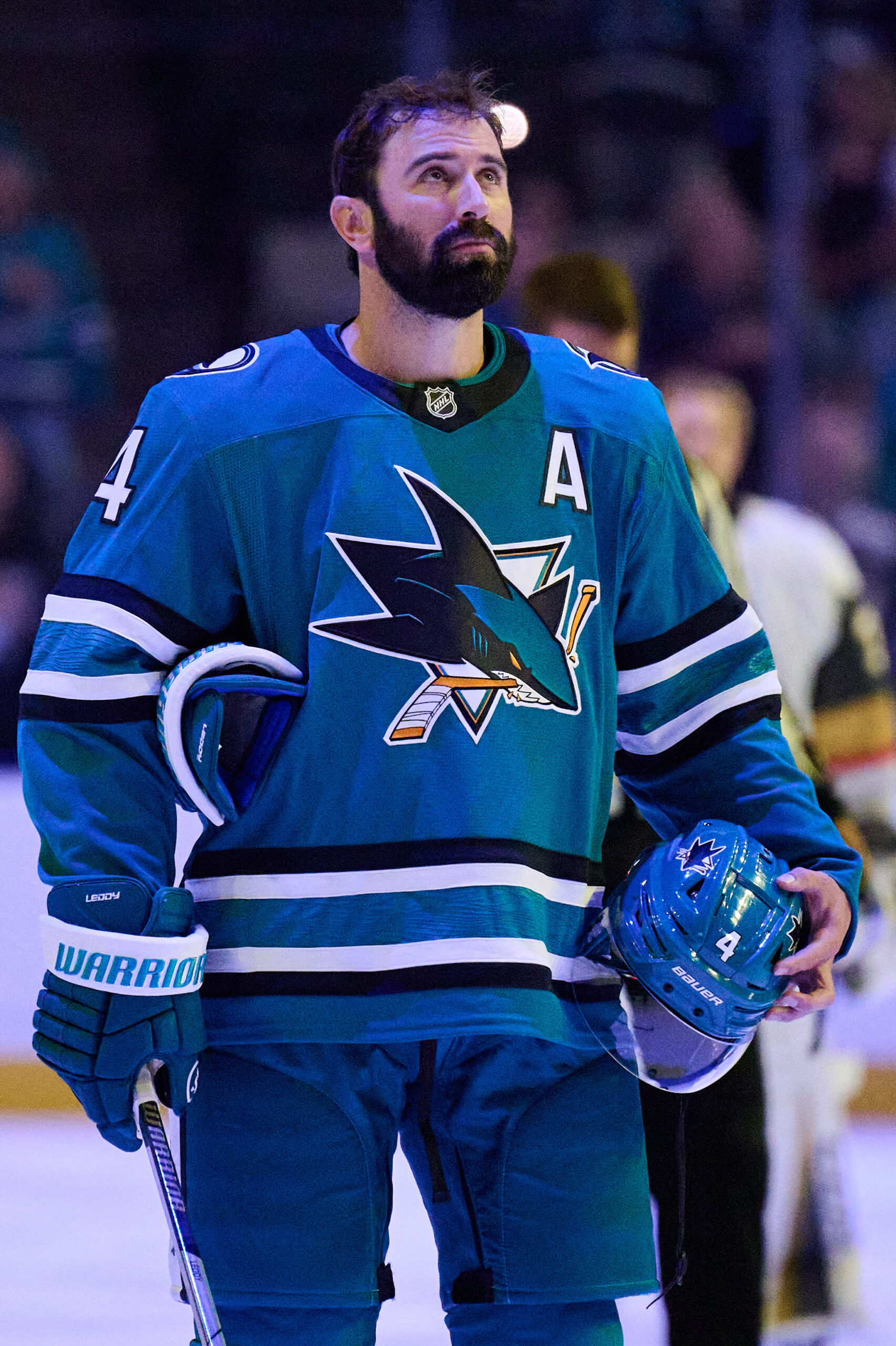
If Leddy clears waivers, he can be reassigned to the Barracuda, opening up the necessary roster spot for Mukhamadullin’s activation. If Leddy is claimed off waivers, the same goal is achieved — a roster spot is opened up for Mukhamadullin.
Today’s development is an unfortunate one for Leddy, who, at 34, is a veteran of 1,061 NHL games. He hasn’t played in the AHL in more than a decade, his most recent AHL experience coming in 2012-13 with the Rockford IceHogs. His play in 2025-26 has, unfortunately, paved the way for this sort of transaction. He’s struggled this season, frequently finding himself a healthy scratch as the Sharks linger in the Western Conference playoff race.
Leddy’s time on ice per game is down to 17:30, including no power play time and 1:31 of penalty-killing time per game. That’s a distinct decline from how much he was played as recently as 2023-24. That season, Leddy was the St. Louis Blues’ No. 2 defenseman, averaging 22:21 time on ice per game and serving as a top penalty-killer alongside Colton Parayko.
Leddy’s form in San Jose has made those days seem like a distant memory, but his compensation ($4MM cap hit through the end of the year) is still commensurate with his former steady top-four role.
That mismatch between Leddy’s current on-ice value and his level of compensation is likely to keep him from being claimed off of waivers. Although there might be some teams who believe they can get more out of Leddy than he’s provided San Jose, his cap hit likely means he carries too much risk to be claimed.
There are other possibilities on the table to keep Leddy in the NHL, such as a trade, but the Sharks only have one slot left to retain salary, so they might only look to find a trade where the other team can take on the full freight of Leddy’s remaining salary.
Leddy could also elect to sacrifice the remaining portion of his salary and agree on a mutual contract termination, paving the way for him to freely sign with any team willing to offer him a guaranteed NHL role. Two players have already taken that path this season: Egor Zamula and Alexandre Texier. That option worked quite well for Texier in particular, as he seized on the NHL opportunity he sought and got a two-year, $2.5MM AAV contract extension as a result.
If Leddy and the Sharks were to take this route, Leddy would almost certainly sacrifice the remaining pro-rated portion of his $3MM salary for what is left of 2025-26.
There’s no firm indication at this point as to what lies ahead for Leddy. It’s still possible a team could elect to claim him off waivers, and it’s also possible he feels no great pressure to avoid an AHL reassignment at any cost. In any case, today’s move by the Sharks makes Leddy a name to watch in the near future, especially for a team in need of more experienced defensive depth such as the Buffalo Sabres.
Photos courtesy of Robert Edwards-Imagn Images
Los Angeles Kings Reassign Andre Lee
According to a team announcement, the Los Angeles Kings have reassigned forward Andre Lee to the AHL’s Ontario Reign. The transaction reduces the Kings’ active roster to 21, with only 12 forwards, indicating that another roster move is coming.
Lee, 25, was originally recalled on January 7th. The 6’4″, 190lbs winger appeared in all seven of the Kings’ games since, scoring one goal and one assist while averaging 10:17 of ice time in a bottom-six role.
It’s a similar fashion to how Los Angeles utilized him last year, too. Lee made his NHL debut during the 2024-25 campaign, finishing the season with one goal and three points in 19 games, averaging 9:10 of ice time. He delivered solid physicality, averaging nearly two hits per game.
Despite being a depth forward in the Kings’ depth chart, Lee has carved out a decent career for himself after being a seventh-round pick in the 2019 NHL Draft. After completing his collegiate career at the University of Massachusetts-Lowell, Lee has primarily played for AHL Ontario since then.
He’s understandably provided much more offense with the Reign. Throughout the last five years, Lee has scored 35 goals and 71 points in 185 games, becoming a decent secondary scorer for the club. He has helped Ontario reach the Calder Cup playoffs on three occasions, scoring four goals in 12 postseason contests.
San Jose Sharks Acquire Kiefer Sherwood
One of the trade deadline’s most sought-after rentals is now off the board. The Vancouver Canucks announced that they’ve traded winger Kiefer Sherwood to the San Jose Sharks for defenseman Cole Clayton, a 2026 second-round pick, and a 2027 second-round pick.
The Sharks’ interest in Sherwood has been known for some time. In late December, Sportsnet’s Elliotte Friedman reported that San Jose was one of the teams involved in Sherwood’s market.
Given the capital needed to acquire Sherwood, it would make sense for the Sharks to begin extension negotiations immediately. The Canucks were known to have been seeking a first-round pick for Sherwood’s services, though acquiring two second-round picks is hardly settling. Still, even if he is only a rental, Sherwood’s particular brand of hockey should help the Sharks considerably as they look to return to the postseason for the first time in seven years.
Vancouver originally signed Sherwood ahead of the 2024-25 season to a two-year, $3MM agreement. Their inspiration for signing him came a year earlier, when Sherwood, then playing for the Nashville Predators, totalled 33 hits against the Canucks in the opening round of the 2024 Stanley Cup playoffs. He finished the campaign with 10 goals and 27 points in 68 games.
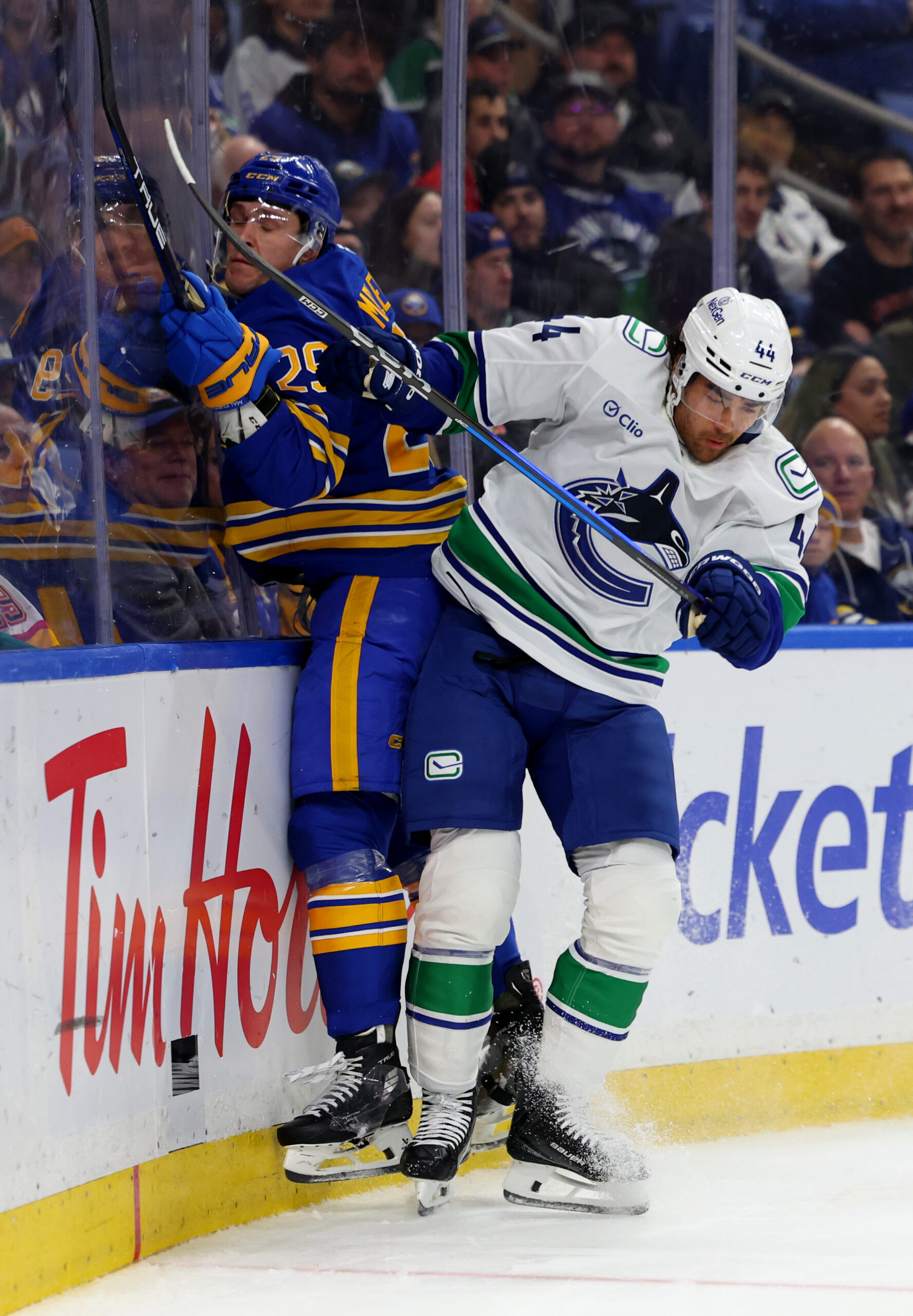 His offense continued to develop in British Columbia. Throughout the past year-and-a-half with the Canucks, Sherwood has been a reliable scorer, registering 36 goals and 63 points in 122 games. Additionally, his physicality has truly been off the charts, averaging 5.5 hits per game — 672 in total.
That makes his fit with the Sharks remarkably clear. Outside of Ryan Reaves, who has been a healthy scratch on multiple occasions, and Ty Dellandrea, who is currently on the team’s injured reserve, San Jose doesn’t have too many physical forwards in their lineup. Additionally, the team desperately needed to add secondary scoring behind phenom Macklin Celebrini.
Given their value to the team, Sherwood would be a perfect option to play on the top line next to Celebrini and Will Smith, allowing the Sharks to shelter some of their younger wingers on the bottom two lines. If opposing teams aim to counter Celebrini and Smith physically, San Jose can now respond similarly.
Meanwhile, on the other side of the transaction, the Canucks continue to grow their stockpile of draft picks. Entering the season with five picks in the upcoming draft, Vancouver now has seven this year, and eight next.
Clayton, 25, is a big-bodied right-handed shot defenseman. A product of the WHL’s Medicine Hat Tigers program, Clayton had spent the last four years with the AHL’s Cleveland Monsters before signing with the Sharks last summer. Throughout his five-year professional career, the Alberta native has scored 14 goals and 66 points in 257 games with a -13 rating.
Photo courtesy of Timothy T. Ludwig-Imagn Images.
Capitals Reassign Brett Leason, Activate Justin Sourdif
Jan. 19th: According to Sammi Silber of DC Backcheck, Sourdif will be the one coming off the IR for today’s game against the Colorado Avalanche. Sourdif was informally placed on IR on January 16th, but has not played since January 11th after taking a puck to the face.
Jan. 18th: The Washington Capitals announced today that forward Brett Leason has been reassigned to their AHL affiliate, the Hershey Bears.
The move opens a roster spot for the Capitals, a notable development as the team has three forwards on IR who would need to be activated before they can return to the lineup: Tom Wilson, Justin Sourdif, and Pierre-Luc Dubois. Dubois is expected to be out long-term, but Wilson or Sourdif could return on a shorter timeline.
The Washington Post’s Bailey Johnson wrote that Leason’s reassignment is a “good indication” that Wilson “is getting close to returning,” perhaps as soon as Monday against the Colorado Avalanche.
While Wilson’s impending return is undoubtedly good news for the Capitals — the 31-year-old has scored 22 goals and 42 points in 41 games this season, and was named to Canada’s Olympic roster — it’s more difficult news for Leason, whose most recent stint in the NHL has now concluded.
Leason, 26, was recalled on Jan. 7 and ended up playing in six games for the Capitals. While he wasn’t able to land on the scoresheet, his size and heft (he stands 6’5″, 220 pounds) earned him a small amount of power play time in three separate contests.
It’s not the most common occurrence for bottom-six call-ups to get any look on an NHL power play, so Leason at the very least got a more significant opportunity than many other players in similar situations.
In total, Leason averaged 8:34 time on ice per game, registering 10 hits in six games, but just one shot on goal. Washington went 2-4-0 with Leason in the lineup. He’ll now return to Hershey, the team where he made his professional debut as a second-round pick in 2019-20.
Leason has scored a healthy 14 points in 20 games for the Bears, a solid scoring rate and one to be expected for a player who has mostly played in the NHL over the last few years. Washington lost Leason on waivers to the Anaheim Ducks in 2022, and Leason went on to skate in 184 NHL games for the Ducks.
The Ducks non-tendered Leason after he scored 17 points in 62 games last season, leading to the player’s return to the Capitals organization. Leason signed with Washington on Oct. 27 after spending the preseason on a PTO with the Minnesota Wild and a brief stint on an AHL PTO with the Charlotte Checkers.
This year is a significant one for the pending UFA, especially from a financial perspective. While he made $1.05MM on his most recent Ducks contract, the deal he signed with the Capitals after being non-tendered not a one-way contract. Leason’s one-year, two-way deal carries a $775K NHL salary and a $250K AHL salary. Undoubtedly, Leason will want to continue his level of production for the Bears in order to earn as many recalls back to Washington as possible this season.
Not only will recalls back to the NHL hold an immediate financial benefit, but the more time he can spend in the NHL, the better-positioned he’ll be to get back to a one-way contract as a free agent in the summer.
Red Wings Interested In Canucks’ Elias Pettersson
As the Vancouver Canucks look to retool their roster, speculation has begun to grow surrounding the availability of forward Elias Pettersson. Speaking on Sportsnet’s Canucks Central last week, Frank Seravalli reported that the Detroit Red Wings are one of the interested teams if Vancouver becomes serious about moving Pettersson.
The news follows a report from last week indicating that the Canucks are willing to consider offers for Pettersson, although they are not yet actively committed to trading him. Regardless, given the multiple hurdles present in his contract, trading Pettersson would be one of the most complicated in-season trades to manufacture, and is likely better suited for an offseason move.
In our write-up, PHR’s Ethan Hetu clearly articulated these hurdles, saying, “Pettersson’s situation is quite a bit more complicated. First and foremost, the full no-move clause on his $11.6MM AAV deal gives the player and his representatives (led by CAA’s Pat Brisson) full control over where he is dealt to. Pettersson needs to sign off on any trade before it can be completed.”
Still, of all the competitive teams this season, the Red Wings are one of the few that could add Pettersson’s large cap hit outright. Additionally, given their success with Swedish players for the last three decades, Pettersson may be more apt to sign off on a trade to HockeyTown.
Pettersson’s fit in Detroit’s lineup is less obvious. Even with a return to his 2022-23 form, there’s no chance he’d usurp Dylan Larkin as the Red Wings’ top center, meaning he would become one of, if not the highest-paid, second-line center in the league. Throughout the past two years with Vancouver, Pettersson has scored 28 goals and 74 points in 104 games played, whereas Larkin has registered 54 goals and 114 points in 132 contests.
This season, the team has been utilizing Andrew Copp to center their second forward unit. Although he’s been best used as a third-line center for most of his career, he’s been one of the league’s top scorers for over a month. Since the calendar turned to December, Copp has scored seven goals and 21 points in 24 games with a 51.2% faceoff percentage, giving Detroit a formidable duo in their top six.
Furthermore, and what is the most important point for Detroit specifically, is that General Manager Steve Yzerman has historically held his cards very close to the vest. Given that there have been very few leaks coming from the Red Wings organization since Yzerman took over, a larger grain of salt must be consumed when Detroit is tied to a particular player. Still, given their lack of moves at recent trade deadlines and current spot in the standings, it would make a ton of sense for the Red Wings to take a shot or two leading up to this year’s deadline.
Sabres Activate Alex Lyon, Place Joshua Norris On IR
The Buffalo Sabres will again carry three netminders on their active roster. According to Rachel Lenzi of The Buffalo News, the Sabres have activated goaltender Alex Lyon from the injured reserve and have placed forward Joshua Norris on it in a corresponding roster move.
Although unfortunate, Norris’ placement on the IR was expected. After suffering an upper-body injury on Wednesday, Norris had his recovery timeline downgraded to week-to-week, following initial reports that it would only be a few days.
Still, it doesn’t appear that a week-to-week timeline is set in stone yet. According to Mike Harrington of the Buffalo News Sports, there’s no sense that Norris will be held out of Buffalo’s lineup through the Olympic Break, with head coach Lindy Ruff saying, “This can turn around in a day or two.”
Meanwhile, Lyon will return to the Sabres lineup after missing several weeks of action due to a lower-body issue. Before losing nearly a month due to injury, Lyon was arguably Buffalo’s best option in net, managing a 10-6-3 record in 21 games with a .906 SV% and 2.82 GAA.
Still, regardless of the stability that he’s provided between the pipes, his tenure in Buffalo could be nearing its end. In his introductory press conference, General Manager Jarmo Kekäläinen stated that he has little interest in carrying three netminders on the roster for the rest of the season.
Given his play this season and an affordable contract through the 2026-27 season, Lyon projects as the most movable netminder if the Sabres go that route. Additionally, Buffalo still has youngster Devon Levi knocking on the door in the AHL, meaning there could be a few goaltenders moved out of upstate New York by the end of the season.
Blue Jackets Reassign Mikael Pyyhtia
According to a team announcement, the Columbus Blue Jackets have assigned forward Mikael Pyyhtia to the AHL’s Cleveland Monsters. Pyyhtia was originally recalled on January 7th.
Pyyhtia, 24, is in his fourth season in the North American professional circuit after being selected by the Blue Jackets with the 114th overall pick of the 2020 NHL Draft. The Turku, Finland native had played for the Finnish Liiga’s TPS for a few years after the draft, scoring 28 goals and 55 points in 103 games between the 2021-22 and 2022-23 seasons.
Since moving to Ohio, he has primarily played for the Monsters. Still, after being brought to North America toward the end of the 2022-23 campaign, Pyyhtia featured in two games for the Blue Jackets to close out the regular season, registering one assist.
Throughout the 2023-24 season, he appeared in 17 games with Columbus, tallying two assists while playing in a bottom-six role. He understandably performed much better in the AHL, scoring seven goals and 28 points in 60 games, his highest offensive production to date.
Last season, Pyyhtia enjoyed his longest run in the NHL so far, though it didn’t go particularly well. He finished the campaign with four goals and seven points in 47 games with a -11 rating, averaging 12:06 of ice time per game. Additionally, his possession metrics didn’t indicate any bad luck on the offensive side of the puck, as he finished with a 43.2% CorsiFor% at even strength.
Back in AHL Cleveland this year, Pyyhtia is one of the team’s best performers, scoring seven goals and 22 points in 23 games. This has made him a quick recall candidate whenever the Blue Jackets have needed him. Largely serving as an extra forward, Pyyhtia has tallied one goal in five games with Columbus this season.
Maple Leafs Recall Jacob Quillan
The Maple Leafs announced they’ve added forward Jacob Quillan back to the NHL roster. They’ll need to make a corresponding move to open a spot on the active roster. That could be yet another injured reserve placement for William Nylander, who’s already missed one game after reaggravating his lower-body injury and won’t be in the lineup tonight, either.
Quillan gives the Leafs some extra forward depth amid yet another major injury concern up front – this time concerning top left-winger Matthew Knies. He’s missed the last couple of skates due to maintenance, but did not take part in this morning’s gameday skate preceding tonight’s matchup with the Wild, per David Alter of The Hockey News. If he’s unavailable, Quillan would be needed in the lineup to give the Leafs 12 healthy forwards.
It’s the third NHL stint this season for the 23-year-old Quillan. Across the past two seasons, the undrafted free agent pickup out of Quinnipiac had logged his first four big-league appearances with a +2 rating but is still looking for his first NHL point. The 6’0″, 205-lb pivot has been quite productive in the minors, though. That’s especially true this season, boasting an 8-19–27 scoring line in 28 games with the AHL’s Toronto Marlies.
His waiver-exempt status, plus his strong AHL showing, means Quillan will continue being Toronto’s most frequented call-up option down the stretch. A pending restricted free agent, it won’t be much of a surprise if he finds his way onto the Leafs’ opening night roster next fall.
Panthers Reassign Noah Gregor
The Panthers announced this morning that they reassigned forward Noah Gregor to AHL Charlotte. They’re now left with an open roster spot, which could be earmarked for Brad Marchand to come off injured reserve or for Matthew Tkachuk to come off long-term injured reserve, although the latter move would require clearing more cap space.
Gregor, 27, departs Florida after appearing just twice in the Cats’ last 11 games. He was placed on waivers over a week ago and cleared, but wasn’t immediately sent to Charlotte. Since he’s still within a 30-day window from clearing waivers, he can be sent down today without needing to go through the process again.
The Alberta native is in his seventh NHL season and has accumulated over 300 games of experience. However, after a tumultuous couple of campaigns, it appears he’s on the path toward being more of a call-up option than a bottom-six fixture. The 6’0″, 201-lb winger’s high-end speed and skating have always carried some intrigue, but he’s rarely converted it into meaningful production, only topping the 20-point mark once with the Sharks back in 2021-22.
Now, Florida is his fourth stop in the past three seasons. He’s also logged time with the Maple Leafs and Senators since 2023 and had a second stint in San Jose, needing PTOs to land contracts late in the offseason twice during that span. His waiver placement earlier this month was the first one of his career, signaling a more formative end to his days as a bottom-six/press box lock.
In 24 games this season, Gregor has scored once and added only two assists while averaging 8:05 of ice time per game. He is averaging a career-low 1.13 hits per game and has been a significant drag on Florida’s possession game, controlling 46.0% of shot attempts at 5-on-5 despite starting nearly 60% of his shifts in the offensive end. It was abundantly clear he would be the next odd man out when the Cats needed a roster spot.
Assessing The Canucks’ Direction
Reports surfaced earlier this month that the Canucks had re-engaged in contract talks with pending free-agent forward Kiefer Sherwood and were discussing a potential five- or six-year deal worth over $4MM per season. It’s hard to say whether the reports had merit, or whether the Canucks were serious about retaining Sherwood – or merely posturing to get a better trade return before the trade deadline.
Regardless of their true intentions, the Canucks’ direction is tough to figure out. They currently sit last in the NHL standings and, since New Year’s Day, are 0-7-2 and have been outscored 40-14. They don’t appear close to a winning run, yet there is little talk of a sell-off or a pivot into a rebuild. Their fans certainly like to talk on social media about embracing the tank, and the Canucks are reportedly willing to listen to offers for Elias Pettersson.
The truth about Vancouver is that it’s been a mess, off and on, for the better part of the last 10 to 15 years, from the top of the organization down to the players. There have been highs and moments of hope when it looked like the team was on the cusp of greatness, but those highs have been short-lived, followed by rapid declines.
The last two years are a clear example: the Canucks went from a team that was a win away from the Western Conference Final to one that missed the playoffs last season and appears destined to do the same this year. Those falls aren’t all that common (although the Rangers are living through a familiar descent) and are generally the result of self-inflicted missteps or a run of terrible luck.
In Vancouver’s case, it appears to be a mix of both, but there is no doubt that the J.T. Miller/Pettersson rift did irreparable damage that could have long-standing effects on Vancouver’s locker room.
Miller’s departure should have signaled the Canucks’ direction. Still, a quick trade for defenseman Marcus Pettersson and forward Drew O’Connor then implied that Vancouver intended to compete for a playoff spot last season, and the subsequent re-signing of both players certainly reinforced that notion.
Internal and external pressures aside, the trade to bring in Pettersson and O’Connor added to the Canucks’ depth, and they shed some bad contracts (Danton Heinen and Vincent Desharnais) in the deal with Pittsburgh. But the trades showed a lack of direction for Vancouver, and that carried into last year’s trade deadline as well as the summer, when the Canucks showed a lack of forward thinking. All of that leads us to this season, where Vancouver has spun its wheels despite rostering an ageing, expensive core.
The Miller trade to the Rangers had to happen, and while the return wasn’t great, it wasn’t awful either, as Miller has struggled to regain his form in the Big Apple. But the moves that followed the trade felt reactionary and forced, and ultimately proved in vain.
Pettersson was a top-pairing defender in Pittsburgh, but this season with the Canucks has been perhaps the worst of his career. The 29-year-old looks to be a shell of his former self and, like many players in Vancouver, has been terrible.
O’Connor has been fine in Vancouver, tallying 10 goals and seven assists in 47 games thus far while continuing to use his speed and size to be disruptive on the forecheck. That move, while tainted by Pettersson’s play this year, made sense at the time, but as the Canucks approached the trade deadline, some of management’s decision-making left a lot to be desired.
There was a moment after the Miller trade when the Canucks could have pivoted to a quick retool that might have been tough to stomach for the rest of last year and this season, but it would likely have yielded results next season. Instead, the Canucks did what they did, extended both Pettersson and O’Connor, and inked backup goaltender Kevin Lankinen to a deal that pays him $4.5MM per season for five years. All of it was reactionary, in the hope of getting the Canucks into the postseason last year. They didn’t.
The Canucks also tried to trade Brock Boeser last year at the deadline, but weren’t able to come to terms on a deal. It seemed all but certain he would bolt elsewhere in free agency last summer, but there he was on July 1, surprisingly signing a seven-year agreement with Vancouver that appears set to age like milk.
The Canucks added to their forward depth in another move, acquiring Evander Kane via trade from Edmonton. It was an acceptable deal in a vacuum; however, given Vancouver’s overall roster construction, it was a head-scratcher, as the Canucks used much of their cap space to fix the wing while watching their already thin center position get worse when Pius Suter departed in free agency.
Vancouver spent the rest of the summer making small roster changes in hopes that the core would find its mojo again. Still, a few months into the season, it was clear that wasn’t going to happen, which sparked trade rumours for their star defenseman, Quinn Hughes, whom they eventually dealt to Minnesota towards the end of 2025. The Hughes deal was actually a great haul for Vancouver given the circumstances, but it has officially put them into a hybrid retool that probably should’ve happened a year ago.
Hindsight is 20/20, but had Vancouver pivoted in early 2025 after trading Miller, they might have avoided some of the mistakes they’ve made over the past year, which have effectively set them back a few years. Instead, Vancouver is locked into long-term deals with underperforming forwards, a talented yet expensive goalie tandem that has injury and inconsistency issues, and a defense core that is now average at best.
Sure, they do have some nice young players who will likely become NHLers, but they will be surrounded by an old, pricey core unless the Canucks can start moving out from under some of the contracts they’ve locked in. No one is taking Boeser’s deal this year; the same could probably be said for Elias Pettersson’s.
But Vancouver could move their pending UFAs before the trade deadline and have nearly $17MM in cap space next summer to sign just two roster players (as per PuckPedia). That type of wiggle room could allow for additions before next season, but it’s not clear whether Vancouver should do that in the midst of what appears to be either a retool or a rebuild.
Patience might be the best thing for the president of hockey ops, Jim Rutherford and general manager Patrik Allvin to exercise, but given their track records, that has not been their strong suit, and it is a big part of the reason the Canucks find themselves where they are.