
Salary Cap Deep Dive: Calgary Flames
Navigating the salary cap is one of the more important tasks for any GM. Teams that can avert total cap chaos by walking the tightrope of inking players to deals that match their value (or compensate for future value without breaking the bank) remain successful. Those that don’t see struggles and front office changes.
PHR will look at every NHL team and give a thorough look at their cap situation heading into the 2019-20 season. This will focus more on those players who are integral parts of the roster versus those who may find themselves shuttling between the AHL and NHL. All cap figures are courtesy of CapFriendly.
Calgary Flames
Current Cap Hit: $73,743,375 (under the $81.5MM Upper Limit)
Entry-Level Contracts
D Rasmus Andersson (one year, $756K)
D Oliver Kylington (one year, $731K)
D Juuso Valimaki (two years, $894K)
Potential Bonuses
Andersson: $57.5K
Kylington: $82.5K
Valimaki: $450K
These three players project to be a big part of Calgary’s back end in the near future but only Andersson has a full NHL season under his belt. Accordingly, he’ll likely wind up with the biggest second contract among the three but it shouldn’t break the bank. Valimaki, a 2017 first-rounder, probably has the most overall upside of the group but he still has to lock down a full-time NHL spot first. Assuming they don’t go and add a veteran depth piece. There were questions surrounding Kylington going back to his draft year which caused him to slide but he has shown some NHL upside as well. He’ll also get a chance to push for a full-time spot this coming season. At this stage, short-term post-ELC deals are likely on the horizon for all three.
One Year Remaining, Non-Entry-Level
D T.J. Brodie ($4.6504MM, UFA)
F Austin Czarnik ($1.25MM, UFA)
F Michael Frolik ($4.3MM, UFA)
D Travis Hamonic ($3.857MM, UFA)
F Mark Jankowski ($1.675MM, RFA)
G Cam Talbot ($2.75MM, UFA)
Frolik has been part of trade speculation for quite a while now after his agent opted to up the pressure on Calgary for a perceived lack of playing time. While he hasn’t really been able to live up to the offensive potential he showed as a youngster, he has still been an effective middle-six forward. However, given what transpired last year plus their cap situation, he’s a prime candidate to be dealt and won’t be able to land similar money on his next deal. Jankowski followed up his rookie year with a decent sophomore campaign as he set a new career-best in points despite playing less than 13 minutes a night. Unless his role increases, another short-term pact (this time with arbitration rights) could be on the horizon next summer. Czarnik was one of two Group VI UFAs that landed surprisingly rich deals in free agency last summer and like Matthew Peca in Montreal, this didn’t really pan out well as Czarnik struggled to hold down a regular spot in the lineup and was frequently on the fourth line when he was in. Unless he takes a step forward in 2019-20, he’ll be in tough to match his current AAV.
Calgary was reported to be listening to offers on both Brodie and Hamonic earlier this summer. It’s not that they’re not pleased with their play but rather facing the reality of their situation. The odds of keeping both beyond this season are low. The cost to sign both will be considerably higher than their current price tag and they do have the youngsters that will be pushing for more minutes before too long. And, of course, there’s the fact that they still need to clear salary. A strong season from Brodie could push him towards the $5.5MM-$6MM range while one from Hamonic would push him closer to $5MM as his offensive upside (or relative lack thereof) limits his ceiling in terms of a big contract.
Talbot signed a one-year deal with the hopes that he can take over the starting job (or least get the higher split of a platoon workload) in an effort of restoring some value around the league. He spent most of last season behind a poor defense in Edmonton and now comes to a strong unit in Calgary so there’s a good chance his numbers will rebound accordingly. However, if he doesn’t do enough to show that he can be a legitimate starter, his next deal probably won’t be much higher than this one.
Two Years Remaining
F Sam Bennett ($2.55MM, UFA)
G David Rittich ($2.75MM, UFA)
F Derek Ryan ($3.125MM, UFA)
Bennett continues to be a perplexing player. He has shown flashes of being an impact player over the years but has also had stretches of play where he didn’t move the needle much. The end result is three nearly identical underwhelming seasons which has resulted in another bridge deal. More repeat performances will only add to trade speculation but if he puts it together, a much better contract could be on the horizon. Ryan managed to equal his output from his career year with Carolina despite averaging two minutes less of ice time per night. He’s an effective third liner but it’s hard to see him getting much more than he is now when his contract is up.
Rittich surprised many last season by staking claim to the number one spot for several stretches although he struggled a bit in the second half. Given his limited track record, Calgary opted for this short-term deal. If Rittich can lock down the number one job for these two seasons, he could double his AAV on the open market but if he stays in a platoon role, he will largely be capped like Talbot in terms of what his earning upside may be.
Three Years Remaining
F Johnny Gaudreau ($6.75MM, UFA)
F Mark Giordano ($6.75MM, UFA)
Gaudreau bypassed the bridge contract and opted to sign what was at the time considered to be a pretty big post-ELC deal just before the 2016 regular season started. With only two full years of NHL experience under his belt, the signing was considered to be a little bit of a risk even though he was coming off a near point-per-game season. Now, as RFA contracts have exploded, it’s turned into a pretty good bargain after Gaudreau took his offensive game to another level last season. He should be pushing for $10MM or more three years from now.
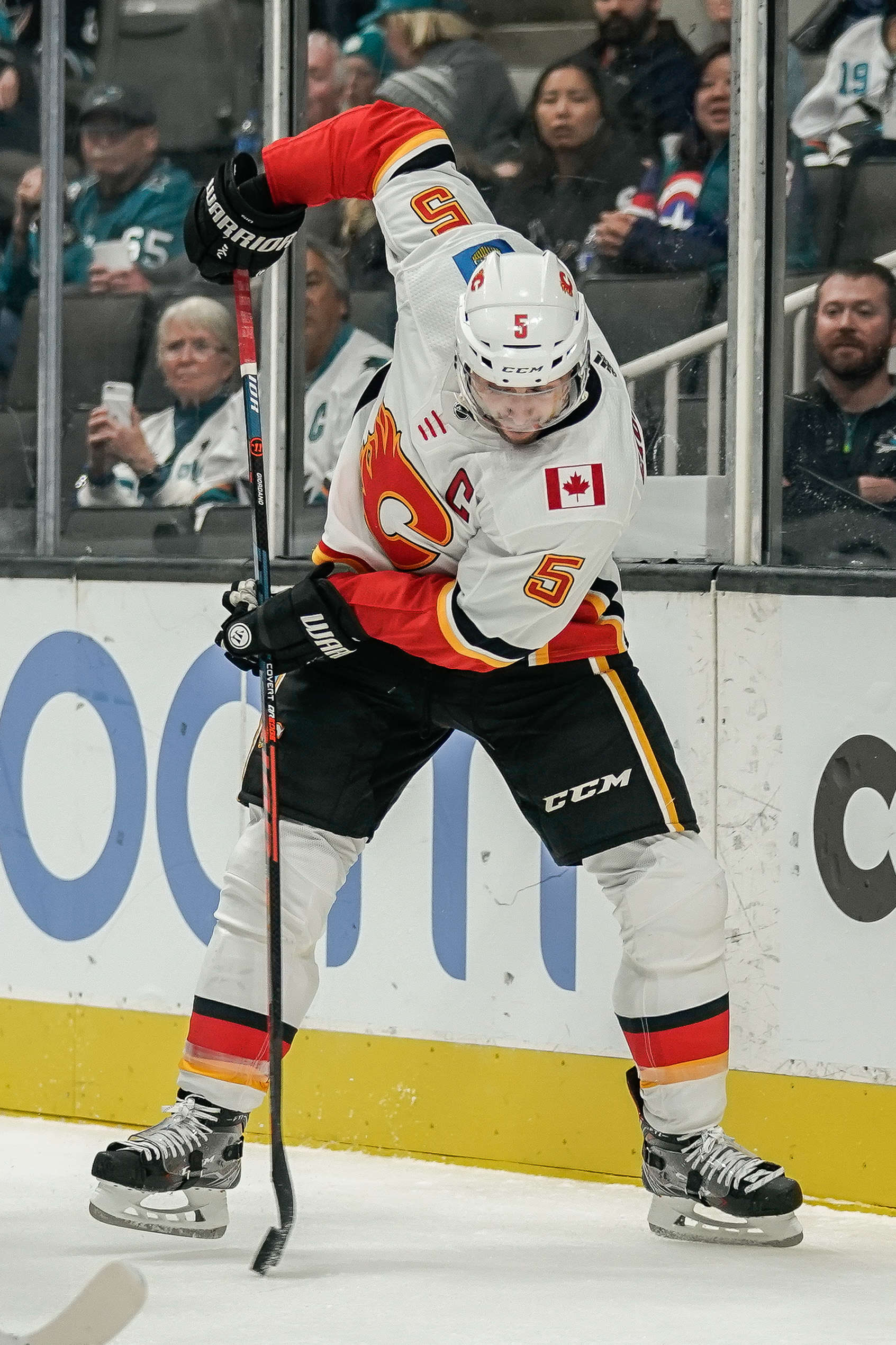 Giordano was a late bloomer but has certainly blossomed into a legitimate number one defenseman and was a worthy recipient of the Norris Trophy. Certainly, his deal has to be considered as well below market value after seeing what some of his peers have signed for in recent years. His contract was once held as the standard in terms of how much their top-paid player could make but that’s highly likely to change in the near future. Having said all that, it’s unlikely that Giordano will get much more than this on his next deal, if there is a next deal. He’ll be turning 39 in October of 2022 when his next contract would kick in and while he’s the type of player that could still be an impact defender at that time, it’s hard to imagine him still being able to log 24+ minutes a night.
Four Or More Years Remaining
F Mikael Backlund ($5.35MM through 2023-24)
D Noah Hanifin ($4.95MM through 2023-24)
F Elias Lindholm ($4.85MM through 2023-24)
F Milan Lucic ($5.25MM through 2022-23)*
F Sean Monahan ($6.375MM through 2022-23)
* – Edmonton is retaining the other 12.5% of Lucic’s contract
Monahan has emerged as a legitimate number one center and is at a price tag that second liners are starting to get. He might not be able to hit double-digits in terms of per-season salary but he could come close four years from now. Lindholm, the other player alongside Monahan and Gaudreau, had a career year and is making that deal appear to be very team-friendly. Like Monahan, he’ll still be in his 20’s when he reaches the open market and at this point, he’ll be seeking a significant raise. Backlund has settled in nicely behind Monahan on the depth chart and is a dependable two-way center. He’s not a bargain at that price tag but he certainly isn’t overpaid either. He’ll be 35 when his deal is up so this could wind up being his highest-priced contract.
Then there’s Lucic. His signing with Edmonton can only be classified as disastrous. Calgary is clearly banking that a change of scenery can get him going but even at that, it’s still going to be a drag on their books for the next four years. The structure of his deal makes a buyout rather prohibitive so he’s probably going to play the deal out.
While Hanifin may not become the true number one defender that his draft status might suggest, he continued to show improvement last season and should easily slot in as a number two or three for their long-term future. Getting someone in that role for that long is certainly a bargain.
Buyouts
F Troy Brouwer ($1.5MM per year through 2021-22)
D Michael Stone ($1.167MM per year through 2020-21)
Retained Salary Transactions
None
Still To Sign
F Andrew Mangiapane
F Matthew Tkachuk
Tkachuk is one of the more prominent players in this RFA class and as he has established himself as a high-quality power forward, he’s in line for one of the bigger deals in the weeks to come. In doing so, he will almost assuredly exceed Giordano and Gaudreau’s $6.75MM threshold and will quite likely put the Flames back over the Upper Limit even with Stone’s recent buyout. As for Mangiapane, he impressed over his part season but he doesn’t have much in the way of leverage. In order to trim as little from the roster as possible, Calgary will likely want to pursue a one-year pact at or around his $766.5K qualifying offer.
Best Value: Gaudreau
Worst Value: Lucic
Looking Ahead
In the short term, there’s clearly some work that still needs to be done. They will need to free up some extra payroll room for their remaining RFAs and will almost assuredly be tiptoeing around the Upper Limit in 2019-20. They have a decent chunk of money coming off the books which will give them a bit of flexibility next summer although they’ll have a few important spots that they’ll need to fill with that money. While things may not be quite as tight after this season, don’t expect the Flames to have plenty of salary cap space for quite a while.
Photo courtesy of USA Today Sports Images.
East Notes: Chabot, Sabres, Galchenyuk
While there are plenty of impact restricted free agents still needing to sign, it’s never too early to look ahead to the 2020 crop. Among those slated to become RFAs is Senators defenseman Thomas Chabot. GM Pierre Dorion acknowledged to Sportsnet’s Wayne Scanlan that there have been discussions about a new deal for the blueliner although he didn’t want to get into any specifics. Chabot had a stellar sophomore season, collecting 55 points in 70 games while seeing his average ice time go up by nearly seven minutes a night. He’ll undoubtedly be keeping an eye on the current RFA market for blueliners (headlined by Zach Werenski, Charlie McAvoy, and Ivan Provorov) as the asking price could very well come in higher than what they get.
Elsewhere in the East:
- While the Sabres are currently sitting over the salary cap, don’t expect them to be making a move anytime soon. In an appearance on WGR 550 (audio link), GM Jason Botterill indicated that the team doesn’t need to make a trade to get back into cap compliance. Instead, it appears that their plan is to demote a veteran player or two to the minors, freeing up $1.075MM per player in the process while Botterill also brought up LTIR as a possible avenue. The team currently is in the middle of their second buyout window but it appears that they won’t be taking advantage of it.
- It doesn’t appear as if the Penguins plan to try to sign recently-acquired winger Alex Galchenyuk to an extension right away. Matt Vensel of the Pittsburgh Post-Gazette notes that at this point, the team is content to let him play out the season and then make a decision about whether or not to re-sign him next summer or let him walk in unrestricted free agency. The 25-year-old is in the final year of his deal that carries a $4.9MM AAV but has dipped below the 20-goal mark in three straight seasons now so it’s understandable that they will want to take a wait-and-see approach with their new forward.
PHR Live Chat Transcript: 08/08/19
Click here to read a transcript of this week’s live chat with PHR’s Gavin Lee.
Pittsburgh Penguins Sign John Marino
After acquiring him recently from the Edmonton Oilers, John Marino has signed a two-year entry-level contract with the Pittsburgh Penguins. Marino has decided not to return to Harvard for his senior season. Penguins GM Jim Rutherford released a short statement:
Adding a young defenseman like John to our organization will be very helpful. His development was accelerated last year and he became a top-10 defenseman in college hockey, giving himself a chance to play at the NHL level.
The Penguins will now send Edmonton a 2021 sixth-round pick to complete the trade. Marino could have become an unrestricted free agent next summer if he chose to return to the NCAA for his senior season. PuckPedia reported the details of the contract, tweeting that Marino can earn up to $850K in performance bonuses.
Selected in the sixth round back in 2015, Marino developed into one of the core leaders at Harvard and was set to wear the captain’s “C” this season. He’ll now jump right into the professional level and compete for a spot on the Wilkes-Barre/Scranton Penguins blueline—provided the team doesn’t make subsequent moves to open up a spot in the NHL right away. The 22-year old has plenty of time to become acclimated to the professional level before being thrust into the spotlight, but he does give the team another option to consider when deciding whether or not to extend Justin Schultz. The 29-year old Schultz is heading into the final year of his current contract and will be an unrestricted free agent in 2020.
Marino recorded 42 points in 101 games at the NCAA level and has a good mix of size and skating ability. He shouldn’t be limited by either at the next level, though his real upside is still to be determined. The Penguins have mined the collegiate ranks for years to boost their organizational depth and Marino is just the latest to be given a chance.
Minor Transactions: 08/08/19
As August continues and we get further into contract negotiations, teams continue to fill our their organizational depth charts. Here are some minor moves from around the hockey landscape. We’ll keep updating as more come in:
- Anthony Florentino has signed a one-year contract with the Worcester Railers of the ECHL, continuing his professional career after two seasons with the Cincinnati Cyclones. Originally selected in the fifth round by the Buffalo Sabres in 2013, Florentino stayed at Providence College for all four years and never did get an NHL contract. Last year saw the defenseman record eight points in 62 games for Cincinnati.
- The Kingston Frontenacs of the OHL have convinced one of their import selections to sign for the 2019-20 season, inking Vitali Pinchuk according to his agent Dan Milstein of Gold Star Hockey. Pinchuk was the 62nd pick in the CHL Import Draft earlier this year and will leave Belarus to start his North American career. The 17-year old is eligible for selection in the 2020 NHL Entry Draft.
- Peter Worrell has been a member of the amateur and youth hockey community in Florida since his retirement more than a decade ago, and will now join the Panthers organization directly. The former NHL enforcer has been named the director of the Florida Panthers IceDen where he will continue to help build the hockey community in the state. Worrell played 342 games for the Panthers during his career, racking up 1,375 penalty minutes.
Columbus Blue Jackets Sign Marko Dano
The Columbus Blue Jackets have brought back a former top prospect, signing Marko Dano to a one-year two-way contract. Dano was originally selected 27th overall by the Blue Jackets in 2013, but has bounced around the league since. The 24-year old did not receive a qualifying offer from the Winnipeg Jets this summer and became an unrestricted free agent. Aaron Portzline of The Athletic reports that the deal carries an $800K salary at the NHL level.
Dano came into the NHL with the Blue Jackets in 2014-15 with all the hype of a first-round selection and actually performed up to the expectations for a little while. In that first season he recorded 21 points in 35 games and looked like he was going to grow into a legitimate option for their top-six. That summer however the Blue Jackets were given an opportunity to acquire Brandon Saad from the Chicago Blackhawks—who had just put up 52 points in the regular season and been a dominant playoff force on the Stanley Cup winner—so off went Dano along with Artem Anisimov to the champions. His time in Chicago was brief and less than a year later he ended up in another trade to Winnipeg in order for the Blackhawks to reacquire Andrew Ladd.
The last several years in Winnipeg (and a short stint with the Colorado Avalanche between waiver claims) have not gone well, leaving Dano somewhere between prospect and player, looking for a fresh start. He won’t turn 25 until the end of November, but there is a long way to go for the Austrian forward before he becomes an impact NHL player. His 30 points in 51 AHL games last season was a good start—at least in terms of consistent playing time—but he’ll need to show more than that to turn his career around.
The Blue Jackets of course are looking for help up front following an offseason that saw Artemi Panarin, Matt Duchene and Ryan Dzingel all depart in unrestricted free agency. The team brought Gustav Nyquist in to replace some of that offense, but will certainly have opportunity for players like Dano to take advantage of. He’ll need to clear waivers again in order to be sent to the minor leagues.
Latest On Jesse Puljujarvi
The fourth overall pick from 2016 is still without a contract for the 2019-20 season. Jesse Puljujarvi has made it clear he wants a fresh start somewhere other than with the Edmonton Oilers and is willing to wait for that opportunity. Today Finnish outlet MTV Uutiset reports (via Google translate) that if Puljujarvi can’t find a deal in the NHL he will play for Karpat this season. According to his agent Markus Lehto, several NHL clubs have expressed interest but he would not speculate on whether a trade will actually happen.
Puljujarvi has ties to Karpat going back years, as he was developed in their junior system and played two seasons for the Liiga club before joining Edmonton. Playing there likely wouldn’t be as financially rewarding, but it could get the 21-year old back onto a solid development path. That has to be the biggest worry for any interested NHL clubs right now. Puljujarvi hasn’t shown enough to indicate he’s ready for full-time NHL action, but he also can’t go to the minor leagues without first clearing waivers. There’s no way anyone wants to give up something of value just to risk him to the entire league afterwards, meaning the offers for the young forward are likely underwhelming for Oilers GM Ken Holland.
In fact, letting him play in Finland for a year may not actually be the worst course of action for the Oilers. While he won’t be helping their club try to get back to the playoffs, he may be able to build up a little more value by having a solid season. He’s already shown in the past that he can compete at the Liiga level, and he’s still young enough that playing overseas wouldn’t get him a year closer to unrestricted free agency.
There is of course always a chance that he ends up signing with Edmonton after this game of chicken ends. If that happens, it will be extremely interesting to see if new head coach Dave Tippett can turn around his career or if the bridges have already been burned to the ground through this holdout.
Salary Cap Deep Dive: Arizona Coyotes
Navigating the salary cap is one of the more important tasks for any GM. Teams that can avert total cap chaos by walking the tightrope of inking players to deals that match their value (or compensate for future value without breaking the bank) remain successful. Those that don’t see struggles and front office changes.
PHR will look at every NHL team and give a thorough look at their cap situation heading into the 2019-20 season. This will focus more on those players who are integral parts of the roster versus those who may find themselves shuttling between the AHL and NHL. All cap figures are courtesy of CapFriendly.
Arizona Coyotes
Current Cap Hit: $81,321,901 (under the $81.5MM Upper Limit)
Entry-Level Contracts
F Christian Fischer (one year, $822K)
F Barrett Hayton (three years, $894K)
F Clayton Keller (one year, $886K)
Potential Bonuses
Fischer: $212.5K
Hayton: $1.35MM
Keller: $850K
Keller took a considerable step back in his second NHL season, dropping from 67 points to 45. A comparable performance could have him in line for a bridge contract a year from now but if he shows some chemistry with newly-acquired winger Phil Kessel, he could have a big boost in output next season to make him one of the top restricted free agents of the 2020 class. How they get paid will largely be determined by what happens over the coming weeks to the current RFA class but right now, his next deal could range from anywhere from around $4MM on a short-term pact to twice that much on a contract that buys out some UFA eligibility, something the Coyotes have preferred based on recent history.
Fischer is also coming off of a rough season, recording just 18 points in 71 games, well off his 33 from the year before. He’s more of a secondary piece on their roster so a short-term second contract is likely on the horizon. Hayton briefly made the Coyotes last season (spending one day with them before being returned to junior) and as their consensus top prospect, he’ll likely get a long look in training camp. Even if he does make the team though, it’s too early to forecast what his post-ELC contract will look like.
One Year Remaining, Non-Entry-Level
F Vinnie Hinostroza ($1.5MM, RFA)
G Darcy Kuemper ($1.85MM, UFA)
D Ilya Lyubushkin ($874K, RFA)
F Brad Richardson ($1.25MM, UFA)
F Carl Soderberg ($4.75MM, UFA)
Hinostroza’s first season in Arizona was a successful one as he became a consistent top-six forward. The Coyotes hoped that he’d be able to become a part of their young core when they got him and he’s trending in that direction. He’s technically on his bridge deal but could still sign another short-term pact and still have RFA rights and given their longer-term cap outlook, that’s a likely outcome. Soderberg was brought in to provide some extra depth down the middle and is coming off a resurgent season with Colorado that saw him collect 49 points. A repeat performance could have him pushing for a similar price tag a year from now but if he reverts back to his play from the previous two years, he’ll be looking at a notable pay cut. Richardson tied for the team lead in goals last season which made him one of the better bargains on the team. It’s unrealistic to expect him to produce like that again but he still should be looking at a raise on his next deal.
Lyubushkin accepted his qualifying offer after an up-and-down rookie campaign. He’s clearly no higher than seventh on the depth chart and if his price tag goes much higher, they’ll likely move on from him. Kuemper wound up having a stellar season, one that saw him thrive with a number one workload on the way to posting a career year. He won’t get as much playing time in 2019-20 but there will be teams remembering his performance when he hits the open market in July where he’ll land a decent raise.
Two Years Remaining
D Jason Demers ($3.9375MM, UFA)*
F Conor Garland ($775K, RFA)
D Alex Goligoski ($5.475MM, UFA)
F Michael Grabner ($3.35MM, UFA)
D Niklas Hjalmarsson ($5MM, UFA)
F Marian Hossa ($5.275MM, UFA)
D Jordan Oesterle ($1.4MM, UFA)
G Antti Raanta ($4.25MM, UFA)
F Derek Stepan ($6.5MM, UFA)
* – Florida is retaining the other 12.5% of Demers’ contract
This is where the bulk of Arizona’s commitments are. Let’s get Hossa out of the way first. He won’t play again and will go on LTIR if the Coyotes need to free up extra room. However, the risk in doing so is that it would set them up for the possibility of having to carry over any bonus overage penalties into 2020-21.
Stepan had a very disappointing season and only managed a career-low 35 points. They were hoping he could be their number one center but it hasn’t happened. At this point, it’s hard to envision him landing $6.5MM on his next contract. Grabner was reasonably productive when he was healthy last year but he missed half of the season due to injury. His speed is a big weapon now and his ability to maintain that will ultimately determine if he gets another deal in this price range down the road or if he’ll be looking at a cut as well. Garland has his flaws but has shown an ability to score in his limited NHL experience. If he produces like he did last season (a 23-goal pace over a full season), this could be a nice bargain for the Coyotes.
Goligoski was yet another player whose production dipped considerably as his output was the lowest since the lockout-shortened 2012-13 campaign. He has settled into more of a second pairing role and considering he’ll be 36 when his next contract kicks in, he’ll be hard-pressed to get a raise two years from now. Hjalmarsson doesn’t put up many points but the Coyotes liked his defensive presence enough to give him this deal a year ago. Even so, he’ll be 34 two years from now and as the league trends towards more skill on the back end, that doesn’t bode well for his chances. Demers battled injuries last season but is a serviceable fourth or fifth defender when healthy. His $4.5MM price tag (between the two teams) isn’t enough to justify that. Oesterle took advantage of being a regular for the first time and posted a career year. Maintaining that over the next couple of years would give him a much better track record for teams as he enters the open market for the first time.
Raanta, when healthy, has played well for the most part in recent years (despite some struggles last season). The Coyotes clearly believe he can be a starter but he has still played more than 30 games in a single season just once. If he wants a chance to beat (or even equal) his current deal two years from now, he’ll need to stay healthy and help lead this team to the postseason.
Three Years Remaining
F Lawson Crouse ($1.533MM, RFA)
F Phil Kessel ($6.8MM, UFA)*
* – Toronto is paying the other 15% of Kessel’s contract
Kessel was brought in this summer to give Arizona a legitimate top-line forward with a track record of production. He immediately becomes the best scoring threat they’ve had in quite some time. However, his all-around game has long been questioned and he’ll be turning 35 at the start of the 2022-23 season which will be his next contract. Accordingly, he probably will struggle to land an $8MM deal in free agency. Crouse held his own in a bottom six role last season but has developed slowly thus far. The three-year bridge deal gives the team some time to see if he can progress into a legitimate top-six threat.
Four Or More Years Remaining
D Jakob Chychrun ($4.6MM through 2024-25)
F Christian Dvorak ($4.45MM through 2024-25)
D Oliver Ekman-Larsson ($8.25MM through 2026-27)
F Nick Schmaltz ($5.85MM through 2025-26)
Schmaltz was the return in the somewhat-questioned trade with Chicago that saw Dylan Strome and Brendan Perlini go to Chicago. Clearly, GM John Chayka has plenty of confidence in him considering that extension was signed only a few months after the trade. He was productive during his limited time with Arizona (injuries limited him to 17 games) while he played at a 50-point pace overall. There is some risk to this deal given the lack of track record but there is some potential for reward as well. Dvorak’s contract was a big surprise considering he was coming off a pair of seasons with 15 goals. Clearly, they’re banking on him taking a step forward although injuries limited him to just 20 games last season. Right now though, that deal looks to be on the expensive side.
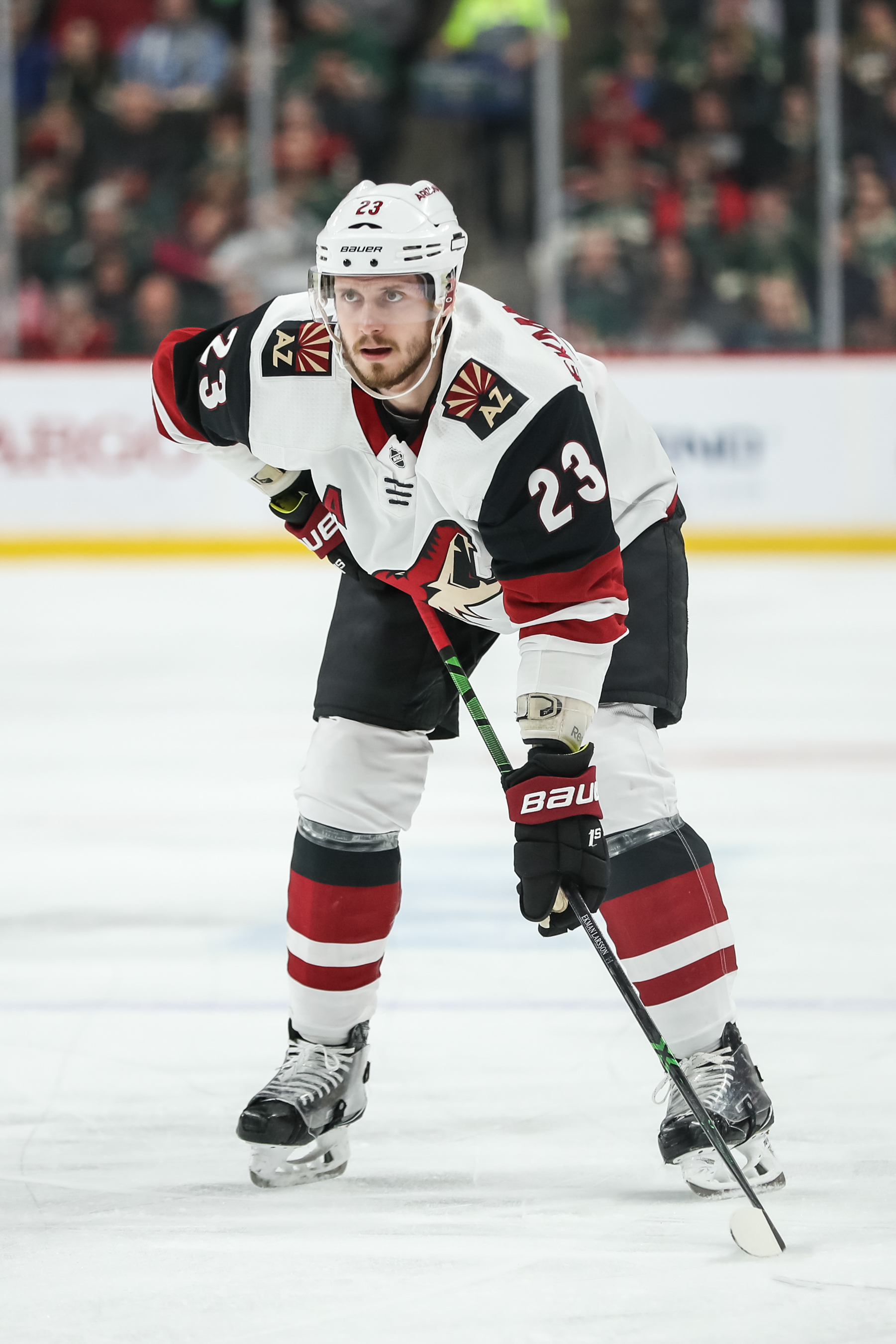 Last offseason, Ekman-Larsson was looking like he’d be one of the top defenders available in free agency but instead, he opted to sign the extension. For the next few years, the high price tag shouldn’t be an issue as he’s a legitimate number one defender but as he ages, it could become a bit of an overpayment (although that can be said about a lot of long-term extensions given to pending UFAs). Chychrun has had trouble staying healthy in his career as he has missed at least 14 games in each of his first three seasons. That creates some risk with the deal but when healthy, he’s a legitimate top-four defender that’s locked in at a pretty good rate.
Buyouts
F Mike Ribeiro ($1.944MM, final year)
Retained Salary Transactions
None
Still To Sign
None
Best Value: Kuemper
Worst Value: Dvorak
Looking Ahead
Seeing Arizona potentially being in cap trouble is something we’re not used to seeing. Moving Hossa to LTIR will help but if bonuses are hit, that will hurt them for next season at a time where they’re going to need a lot of room for a new deal for Keller (and potentially Kuemper if they’d like to keep their goalie tandem intact).
The good news is that the crunch is going to be relatively short. Two summers from now, a lot of big-ticket contracts will be off the books and not a lot of those players will be in line for raises. That will give Chayka plenty of flexibility to work with and accordingly, expect a lot of turnover to come at that time. Some short-term cap pain is on the horizon but they’ll be in good shape before too long.
Photo courtesy of USA Today Sports Images.
East Notes: Copley, Wahlstrom, Senators
At first glance, it would certainly be reasonable to think that Pheonix Copley’s three-year, $3.3MM extension that he signed with the Capitals back in February would give him some job security. However, NBC Sports Washington’s J.J. Regan suggests that this may not be the case. As Washington looks to trim down their cap issues without making a trade or losing anyone of significance off the roster, swapping out Copley’s $1.1MM AAV for one of their AHL netminders would save them a little bit of space. He also notes that the Caps will likely want to see their top goalie prospect in Ilya Samsonov get a chance at some point this coming season in order to evaluate his readiness with Braden Holtby’s deal expiring at the end of the season. Having Copley pass through waivers makes that easier to do. He may have some stability in terms of his contract but where he plays may ultimately be in the air.
Elsewhere in the Eastern Conference:
- It came as a bit of a surprise when Islanders prospect Oliver Wahlstrom decided to leave Boston College after his freshman year. However, the winger told NHL.com’s Brian Compton that he had some challenges adapting to the lighter college schedule and that he wanted to focus solely on hockey and not be split between the rink and the classroom. Wahlstrom signed immediately after his season which allowed him to get an early taste of the pros with AHL Bridgeport where he adapted rather well with seven points in ten games between the regular season and playoffs.
- The Senators aren’t expected to name a captain for the upcoming season, notes Postmedia’s Bruce Garrioch. While Ottawa has a few veteran players left on their roster, almost all of them are on short-term deals which doesn’t make them viable candidates for the role. Meanwhile, while there is a young core in place, most of them aren’t really experienced enough to take on the extra responsibility just yet.
More On Don Waddell’s Position With Carolina
Wednesday: While Waddell has interviewed for the Minnesota job, Dundon fully believes that his current general manager will remain with the team. He told NHL.com’s Tom Gulitti that he expects Waddell to be Carolina’s GM for a while and that he intends to continue with Waddell not being under any sort of formal contract.
Tuesday: For those who weren’t aware that GM Don Waddell had not yet signed a new contract with the Carolina Hurricanes, especially some Hurricanes fans, it came as a painful revelation this morning when the news broke that Waddell had interviewed for the same role with the Minnesota Wild. The resulting question obviously becomes: why hasn’t a General Manager of the Year candidate, whose team made a surprise run to the Eastern Conference Final, been re-signed?
As Luke DeCock of the Raleigh News & Observer writes, Waddell’s continued free agency is just one of a series of odd moves – or really non-moves – made by the Hurricanes organization this off-season. In addition to the GM and President operating without a contract, Carolina has also allowed several executives and scouts to depart, as well as Calder Cup-winning AHL coach Mike Vellucci, and goalie coach Mike Bales, who has yet to be replaced. This all comes from what DeCock describes as owner Tom Dundon‘s belief that “everyone and everything is replaceable”.
Dundon himself addressed the situation, speaking honestly with DeCock about his mindset when it comes to front office staffing:
Even if [Waddell] had a contract I would let him interview, so what’s the difference? It’s not going to stop somebody from doing whatever’s better for them. If they’re going to pay somebody more money, I’m not going to stop them. I told him he’s got to do what’s best for him… I’m not going to pay what other guys pay GMs, so me having a contract with a GM doesn’t really help me. Don in essence has a contract. I already told Don, ‘I’m not going to fire you. If I did, I’d tell you a year in advance.’ My life’s pretty good. I want people to do what’s best for their life. If this is what’s best for Don, the Hurricanes will be fine.”
It’s a bold strategy by the owner and one that might frighten some fans about in the direction of the franchise. At the same time, Waddell has seemed agreeable to the premise and it could be that this is simply Dundon’s style and many are content to operate as such. DeCock writes that Waddell has continued in a “business as usual” manner ever since his contract expired in June and interviewing with the Wild is the first sign that he may be unhappy with his current at-will status. The GM himself talked to DeCock about the situation, and seemed open to the arrangement though:
Tom doesn’t believe in a lot of contracts. Tom’s told me I have a job for life. But he’s also encouraged me to explore other opportunities to see what the market will pay. We started something here, I love it here, but when the job opened up and Tom said you should explore it, that’s what I’m doing.
It remains to be seen whether, as Waddell mentioned, this interview in Minnesota was more or less a way to gauge the market for use as leverage in eventual contract talks or if the GM really is interested in moving on after such a strong first season in Carolina. It is a very strange and unique situation and this is certainly not the last of this story.