
These RFAs Will Fetch Surprising Contracts This Summer
The UFA class this summer is looking rather sparse at this point, which will put pressure on teams to lock up their restricted free agents, particularly if they are eligible to sign an offer sheet. While Dallas Stars forward Jason Robertson will get much of the chatter among the RFA class, there are a handful of lesser-known players who are on the cusp of signing eye-popping contracts over the next few months. These candidates are largely under the radar for the more casual fan, but they have put in the work to secure a healthy payday this summer. The rising salary cap, coupled with a lack of UFAs, is going to give arbitration-eligible RFAs unprecedented leverage, and it will be on full display this summer.
The Vegas Golden Knights are on a heater in the postseason, thanks to their stars, including Mitch Marner. However, one lesser-known contributor is forward Pavel Dorofeyev, who is finishing a season in which he made just $1.835MM. The 25-year-old just had a career year, posting 37 goals and 27 assists in 82 games, after tallying 52 points in 82 games a year ago. Dorofeyev is a potential offer sheet candidate, given the Golden Knights’ precarious cap position this offseason, his age, and his recent run of success. An offer of $9.5MM per season isn’t out of the question for Dorofeyev, and if Vegas didn’t match, they would receive a first, second, and third-round draft pick.
Would a team be willing to pay that much for Dorofeyev’s services? It’s entirely possible, given the thin free-agent market and the sheer number of teams sitting on absurd amounts of cap space for the first time in years. Couple those factors with GMs in several markets fighting to keep their jobs, and you have a recipe for some wild RFA contracts. But a $9.5MM AAV for Dorofeyev isn’t out of the question, and projections from AFP Analytics have come in around $9MM annually on a long-term deal. Goal scorers almost always get paid (see Brock Boeser), and with Dorofeyev entering his prime, someone somewhere will pay handsomely if Vegas can’t or won’t.
Another forward who is sure to get paid this summer is Connor McMichael of the Washington Capitals. The 25-year-old was a late first-round pick (25th overall) in 2019 and took his time developing, but has become a bona fide middle-six forward over the last two years after establishing himself as a full-time NHLer at 23. McMichael took a step back offensively this season, dropping from 57 points to 46, with much of the decline coming from a nearly five-percentage-point drop in shooting percentage. AFP has McMichael receiving just shy of $6.5MM on a six-year deal if he signs long term, which isn’t out of the realm of possibility given his offensive production over the last two years. McMichael might have more to give as he continues to approach his prime, which could add an additional bit of intrigue to a contract negotiation that could come with some sticker shock when it concludes.
Winnipeg Jets forward Cole Perfetti took a major step back this season in offensive production, dropping from 50 points to just 32, although his PPG drop wasn’t as dramatic given the time he missed. Perfetti was an obvious long-term extension candidate a year ago, but after this year’s setback, he could be looking at a bridge deal of one year, in the $4MM to $4.5MM range. However, given his age (24) and talent, it would not be shocking to see him signed long-term if the Jets (or another team) feel they could buy low and get him at a discount before he breaks out. AFP Analytics has him tabbed for a long-term AAV of $6.395MM, a number that would send shockwaves around the NHL. However, that price tag is the cost of buying upside, and teams have done it before and had it work, making it a real possibility.
Next, we head to Florida to examine the case of Panthers forward Mackie Samoskevich, who is set to join a long list of Florida players who have cashed in on their success over the last few seasons. Coming off his second full NHL season, the 23-year-old isn’t going to get big money long term, but he will likely receive a bridge deal worth around $3MM per season, which should get some people’s attention. Last summer, Samoskevich took a one-year deal at the league minimum ($775K), but this summer will be a very different story. The Panthers have some business to attend to in the crease, as both their goalies are UFAs, but they do have a decent amount of cap space, so it’s unlikely that Samoskevich is moved out.
One look at Braden Schneider’s offensive stats and the casual observer might not believe he is due for a big payday, but he is. It’s typical for defensive defensemen are often overlooked as they don’t appear on the scoresheet or draw headlines in the media. But NHL teams pay a premium for defenders who can take on tough defensive assignments against their opponents’ top players, and that’s what the New York Rangers rearguard is capable of. Whether Schneider can actually do that is up for healthy debate, as it pits the analytics crew against the eye-test crowd. But debate or not, the 24-year-old is getting paid this summer. AFP Analytics has him at a $4MM AAV on a short-term deal and $6MM if he goes long term, both numbers that will have some folks mouthing the word, “Wow.”
Lastly, we come to Ottawa Senators defenseman Jordan Spence, who is also due a large payday that will surely surprise some people. Spence quietly had a terrific first season in Ottawa and is projected by AFP Analytics to receive either a one-year deal worth just over $3MM or a longer-term deal for nearly $5MM. That number is eye-popping, but given the rising cap, Spence’s untapped potential, and his previous work, $5MM isn’t outrageous, even though it is surprising. Spence’s contract could be one that wakes fans up to the new economic reality in the NHL, where defenders who can play the minutes he can will be receiving north of $5MM fairly regularly. There are some unique circumstances with Spence. He is a right-handed offensive defenseman who can play up and down the defensive unit. He drives play offensively and has sparkling underlying numbers.
This list isn’t exhaustive, as there are a handful of other players who will receive eye-popping extensions as RFAs, including the likes of Jet Greaves and Peyton Krebs. In terms of projecting things out, these seem to be the most obvious candidates to get big raises this offseason, but there are always surprises, and given the plethora of teams with money this offseason, some wild numbers will surely be thrown around.
Claude Giroux To Continue Playing For 2026-27 Season
Veteran scorer Claude Giroux will not hang up his skates for at least one more season, reports Pierre LeBrun of The Athletic. According to LeBrun, Giroux “needed some time after the season to mull over his future” as he was considering retirement, but now the 38-year-old “has decided he wants to come back and play another season.”
Giroux’s decision means a 1,345-game NHL career that began in 2007-08 will continue for at least one more campaign. Complicating Giroux’s situation is the fact that he is a pending unrestricted free agent. Giroux has been playing for his hometown Ottawa Senators since 2022, arriving there from the Florida Panthers. Giroux was on the Panthers as a rental trade addition. Before that, he was a top scorer and face-of-the-franchise player for the Philadelphia Flyers.
One of the greatest Flyers in the franchise’s modern history, Giroux is no longer the star scorer he once was. At 38 years old, that’s to be expected. But he has shown himself to still be a productive scoring winger for the Senators even as he’s aged. In 2025-26, he scored 14 goals and 49 points. That’s not quite at the level of his debut season in the Canadian capital (35 goals, 79 points in 2022-23) but still more than strong enough to make him worth his cap hit of $2MM. (Base cap hit, he also earned $1MM in performance bonuses)
Looking ahead to next season, it seems overwhelmingly likely that Giroux will remain in Ottawa. Another one-year contract with a relatively low base salary and stocked full of performance bonuses, similar to the contract he played last season on, seems most appropriate.
Playing at least one more year, Giroux will be able to help the Senators try to win their first playoff series since their run to the Eastern Conference Final in 2017. He’ll also be chasing some individual milestones, like 1,400 games played, 400 goals, and 1,200 points.
Senators Eyeing External Backup Goaltender Acquisition
While free agency is still more than a month away, that isn’t stopping teams from starting to put together their offseason wish lists. To that end, an upgrade at the backup goalie position is an obvious item for the Senators. Leevi Merilainen (a pending restricted free agent) struggled mightily early on in the season and while James Reimer (a pending unrestricted free agent) was a serviceable midseason replacement, they should be setting their sights higher heading into the summer.
With that in mind, Postmedia’s Bruce Garrioch relays that one of the netminders they’re expected to consider is pending UFA goaltender Stuart Skinner. He added that there is a belief that the veteran will be one of their top targets in free agency, especially with the expectation that he won’t return to Pittsburgh.
Skinner had established himself as the starting goaltender for several years, at least for most of that stretch. He was surpassed at times when he struggled but found his way back before long to the number one role. The 27-year-old helped lead the Oilers to back-to-back Stanley Cup Final appearances, although they lost both times.
Edmonton opted to keep their goalie tandem intact from last spring, a decision that ultimately didn’t work out. Skinner was inconsistent to start the season and was ultimately moved to Pittsburgh with the hopes that Tristan Jarry would be an upgrade. (That wound up not being the case.) Meanwhile, following the swap, he held his own in the back half of the year with the Penguins, posting a 2.99 GAA with a .885 SV% in 27 starts and played the first three games of their first-round loss to Philadelphia.
Skinner certainly isn’t going to be entering the UFA market as a sure-fire starting goaltender but the fact he has logged starter’s minutes would be appealing to a team like Ottawa. While the Sens have a number one in Linus Ullmark, he has never played 50 games in a season before. That makes getting someone capable of making 30-plus starts more important so Skinner would fit the bill.
It appears Ottawa GM Steve Staios isn’t just considering free agent options, however. ESPN’s Kevin Weekes reports (Twitter link) that Sabres goaltender Devon Levi is a name of interest for the Senators.
Levi was once viewed as Buffalo’s goalie of the future, especially after a strong showing in college and a 2023 debut that nearly led the Sabres to a playoff spot. But things haven’t gone well since then with the team ultimately deciding the following two years that more time in the minors would be beneficial. Coming into this season, the 24-year-old had a 3.29 GAA and a .894 SV% in 39 career NHL appearances.
He didn’t add to those totals in 2025-26. In his final year of waiver exemption, Levi played exclusively with AHL Rochester, posting a 2.83 GAA and a .904 SV% in 52 games. The 24-year-old is signed for next season already with his $812.5K AAV checking in below the minimum salary which will make him appealing.
With Buffalo already having Ukko-Pekka Luukkonen, Alex Lyon, and Colten Ellis all under contract, there really isn’t room for Levi on the NHL roster next season. And if they believe that they won’t be able to get Levi through waivers, looking to move him for some value in the coming weeks makes sense for them.
Levi would certainly represent a riskier pickup for Ottawa, however. They hoped that they had a young goalie ready for the role in Merilainen this season but that didn’t work out. Levi is only eight months older and while he has a bit more of a track record, he has yet to make it through a full NHL season yet. There would be some upside for sure but the risk would be higher as well.
Staios will undoubtedly have other external pickups on his wish list heading into the annual offseason carousel of backups. These are two of the younger players who could be in play; it will be interesting to see if they’ll consider some older shorter-term options as well or if their preference will be to aim for someone who could be in that spot for a few years.
Senators Reportedly Targeting Defense In Offseason
One of the primary offseason objectives of the Ottawa Senators’ hockey operations department will be to secure the services of “a big defenceman who can play big minutes,” Bruce Garrioch of the Ottawa Citizen reported last week.
Garrioch had previously reported that the Senators considered making a play for St. Louis Blues defenseman Colton Parayko at the trade deadline, and he could be a possibility if he would consider waiving his no-move clause for Ottawa.
The Blues agreed to a deal with the Buffalo Sabres for Parayko near the deadline, but Parayko declined to waive his no-move clause to head to Western New York. Garrioch also noted that the Senators “pushed hard” to acquire Philadelphia Flyers veteran Rasmus Ristolainen at the deadline but couldn’t finalize a deal. Like Parayko, Ristolainen could remain an option for the summer but the Flyers may also not have much interest in subtracting such an important piece from their roster after making a run to the second round of the playoffs this spring.
As the Senators’ reported targets before the deadline indicated, the team’s clear need for a defenseman is specifically for a right-shot blueliner. The team’s top two defensemen, Jake Sanderson and Thomas Chabot, both play on the left side. 
Chabot is under contract at an $8MM AAV for the next two seasons, while Sanderson is signed at $8.05MM AAV through 2029-30. They have been the anchors of Ottawa’s defense, and veteran Artem Zub, who is under contract through next year at $4.6MM is the team’s top right-shot blueliner.
Adding one more right-handed defenseman to the mix would give Ottawa an enviable set of top-four defensemen.
Of course, the hope to add a big, minutes-eating right-shot defenseman isn’t something unique to the Senators. Players who check those boxes are often among the most coveted assets in the NHL.
What is most interesting about the Senators’ aggressive pursuit of such a blueliner at the trade deadline is what it says about how they view their internal options for the role. Ottawa invested the No. 7 overall pick at the 2024 draft in a dynamic right-shot blueliner, Carter Yakemchuk. Now 20, he could be close to NHL-ready after a solid debut professional season. In addition, Ottawa has 25-year-old Jordan Spence, who enjoyed a strong 31-point debut season with the Senators. He is set to become a restricted free agent, but remains club property for the time being.
On paper, it might make sense for the Senators to simply stand pat, and trust in that duo of internal options alongside Zub to make up the right side of their defense. But after getting pushed around in a first-round series against the Hurricanes, Ottawa appears set to redouble their efforts to acquire a top-four defenseman of a specific mold, one that is traditionally viewed to be best-suited for the rigors of playoff hockey.
While the upcoming free agent class appears deepest at the position of right-shot defensemen, there are some caveats. Rasmus Andersson appears likely to re-sign in Vegas while Darren Raddysh and John Carlson aren’t quite built in the same mold as Parayko and Ristolainen. While both players would certainly represent an upgrade over Spence, they may not be enough of a stylistic departure for the Senators. Additionally, the league-wide interest each is expected to receive could remove them as an option for Ottawa, as the market has traditionally struggled to attract the league’s very best free agents.
The best fit for the Senators could be veteran Jacob Trouba, who has had a bounce-back stint with the Anaheim Ducks after a difficult end to his time as captain of the New York Rangers. It remains to be seen if Trouba will end up hitting the open market, or if he even would have interest signing with the Senators. But of all of the upcoming free agents, he is the one most stylistically comparable to the defenders Ottawa reportedly attempted to acquire at the deadline. After Trouba, the next-best fit might be Connor Murphy of the Edmonton Oilers, a 6’4″ rearguard who is able to weather substantial time on the penalty kill.
Photos courtesy of Marc DesRosiers-IMAGN Images
Senators Unlikely To Re-Sign Lars Eller
On the opening day of free agency last summer, the Senators decided to bring in some veteran depth down the middle when they signed Lars Eller to a one-year deal. However, it appears that they won’t be bringing him back for a second season as Postmedia’s Bruce Garrioch reports that Ottawa is expected to move on from the pending unrestricted free agent.
The 37-year-old was a very reliable two-way middle-six center in his prime, having some success in that role during long stints with Montreal and Washington. Even his first year in Pittsburgh in 2023-24 saw him surpass the 30-point mark before becoming more of a fourth liner in the second season of that contract, one that ultimately saw him get moved back to the Caps.
That was the role that Eller ultimately played for Ottawa this season. He suited up in 68 games for the Sens this season, notching five goals and ten assists while logging just 11:27 per game of ice time, his lowest ATOI since his rookie season with Montreal back in 2010-11. That role was further reduced in their first-round sweep at the hands of Carolina, as Eller played under nine minutes per contest in that series.
With Stephen Halliday emerging as a viable fourth-line option in his stints with Ottawa this season, the writing on the wall became a lot clearer for Eller’s future when Halliday inked a two-year deal earlier this week. Halliday will now become a full-timer on that line, taking the spot that was Eller’s at the beginning of the season.
Eller is a veteran of 1,184 career regular season games over parts of 17 years. He should have a chance to extend that to 18 seasons but after playing on a deal that ultimately netted him $2MM after factoring in achieved performance bonuses, he’ll likely need to cut that price tag in half for 2026-27.
Lassi Thomson Signs Two-Year Contract With HC Lugano
A former first-round pick of the Ottawa Senators is headed overseas for the second time in his professional career. According to a team announcement, the NL’s HC Lugano has signed defenseman Lassi Thomson to a two-year contract through the 2027-28 season.
Thomson, 25, began his professional career in North America in 2019, when the Senators selected him with the 19th overall pick of that summer’s NHL Draft. He was coming off an impressive season with the WHL’s Kelowna Rockets, scoring 17 goals and 41 points in 63 games.
Hoping to keep his development in an upward trajectory and in a comfortable environment, Ottawa loaned Thomson to the Finnish Liiga’s Ilves for the 2019-20 and 2020-21 campaigns. Unfortunately, the transition back to his native Finland wasn’t as smooth as hoped, as Thomson finished his two-year run with seven goals and 15 points in 57 games.
Regardless, the Senators brought Thomson to North America toward the end of the 2020-21 campaign, and he began his playing time with the organization with the AHL’s Belleville Senators. This became the only place Thomson would excel.
Across four seasons, Thomson registered 24 goals and 93 points in 202 games with the AHL Senators, becoming a fairly consistent two-way defenseman, at least on the offensive side of the puck. He managed a -28 throughout that time, which is especially glaring given that Belleville was a playoff team in two out of his four seasons, and would have been in the 2020-21 campaign had the Calder Cup playoffs been held.
He didn’t have many opportunities in Ottawa, either. Between the 2021-22 and 2022-23 seasons, Thomson registered five assists in 18 games in the NHL with a -10 rating. His defensive metrics became so unsettling that the Senators chose to leave him in the AHL for the entire 2023-24 season.
It was after the 2023-24 campaign that Thomson felt he had more to offer and returned to the Scandinavian Peninsula to continue his professional career, this time with the SHL’s Malmö Redhawks. He played particularly well, scoring 17 goals and 29 points in 50 games with a +2 rating.
Feeling inspired, Thomson returned to the Senators organization this past season, but again spent most of his time in the AHL. Thomson finished the season with 14 goals and 25 points in 55 AHL games, and three assists in 11 NHL contests. Assuming his departure today is for similar reasons, it’s unlikely that Thomson will return to the North American landscape anytime soon.
Senators Sign Stephen Halliday To Two-Year Extension
The Ottawa Senators have gotten some offseason work done early, signing center Stephen Halliday to a two-year extension with a $1.075MM AAV.
Halliday, who is repped by Kevin Magnuson of Magnuson Hockey Agency, was set to become a restricted free agent this summer.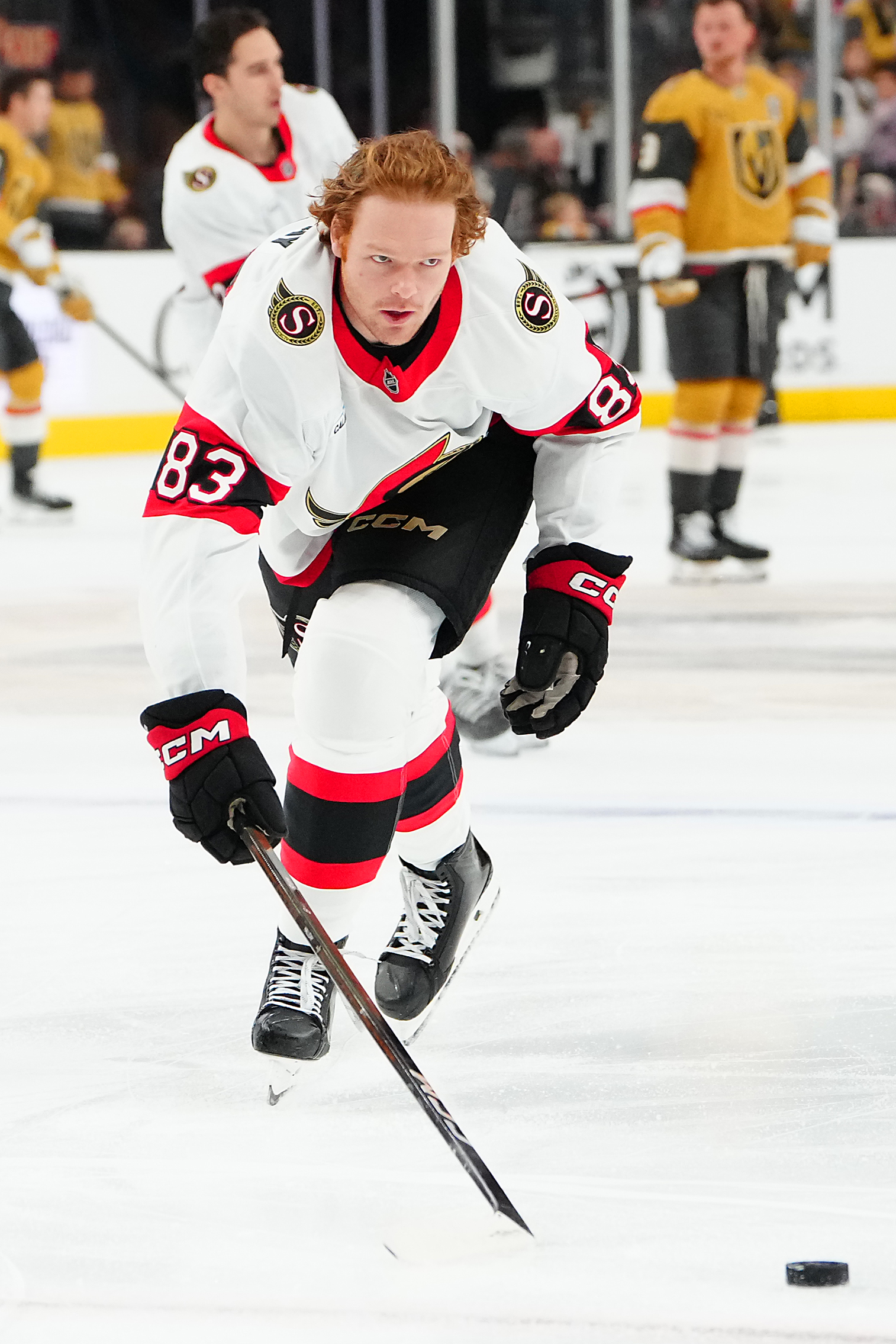
The two-year entry-level contract Halliday signed in March of 2024, one that confirmed his exit from Ohio State University, was set to expire July 1.
Halliday, 23, has been a real draft-and-develop success story for the Senators. He was picked in the fourth round of the 2022 draft in his final year of eligibility, after he scored 35 goals and 95 points in 65 games for the USHL’s Dubuque Fighting Saints. He was an instant-impact contributor for the Buckeyes, leading the team in scoring both seasons he played there. Halliday ended his college career with 77 points in 78 games played.
Since turning pro, Halliday has made real strides in his two seasons in the Senators organization. He signed with the AHL’s Belleville Senators at the conclusion of his sophomore NCAA campaign, and ended up scoring nine points in seven playoff games. That set the stage for his AHL rookie season, where he scored 19 goals and 51 points in 71 games.
That performance as an AHL rookie raised Halliday’s stock in the organization. He entered 2025-26 ranked as the No. 7 prospect in Ottawa’s system by Elite Prospects. The outlet projected him as a potential “top-nine playmaking power forward” at the NHL level if he could improve his “skating, pace, and inside-contact play.”
Halliday showed real flashes of that kind of upside this past season. He continued his strong track record as a scorer in the AHL, putting up a point-per-game scoring pace. But he was limited to just 29 games in Belleville because of NHL call-ups, and he ended up getting into 30 games for Ottawa.
Despite a severely restricted workload, (he averaged just 6:34 per game at even strength and had an additional 1:55 per game on the power play) Halliday managed four goals and 11 points. His performances suggested some promise, that there could be more to come down the line if he can continue to develop. Now, with a two-year extension in hand, Halliday will get the chance to turn that promise into reality.
Photos courtesy of Stephen R. Sylvanie-Imagn Images
Senators’ Ridly Greig Suspended Two Games
5/4: Greig has been suspended for two games for his sucker punch on Walker, per TSN’s Bruce Garrioch. With Ottawa’s season wrapped up, Greig will need to serve the suspended games at the start of the 2026-27 regular season. That will require that he is on Ottawa’s active roster, rather than assigned to the AHL. Greig signed a four-year, $13MM contract extension in January.
4/26: Senators forward Ridly Greig‘s season is over following Ottawa’s sweep at the hands of the Hurricanes, which was finished off yesterday. He’ll now be facing a delayed start to his 2026-27 campaign as well. The NHL’s Department of Player Safety announced Sunday that Greig will have a hearing for roughing Carolina defenseman Sean Walker in their Game 4 loss.
Obviously, there’s no rush to make the decision. Still, it shouldn’t be more than a few days until Greig learns his fate. It’s not an in-person hearing, so his looming supplemental discipline won’t be any longer than five games.
Greig wasn’t penalized on the play, which was largely missed in the moment. At the midpoint of the second period in one of the many after-the-whistle scrums on Saturday, Walker and Ottawa winger Warren Foegele were engaged in a pseudo-fight near center ice. Greig, who didn’t have a sparring partner, came over and delivered a sucker punch square to Walker’s chin while he had his head down (video via Sportsnet).
In what was a silent series offensively for the Sens, Greig was one of only seven Ottawa skaters to record a point. His primary assist on Dylan Cozens‘ game-tying goal late in regulation in Game 2 was only the second postseason point of his career. He had a goal in six games against the Maple Leafs last season.
The 23-year-old will be kicking off his fourth full NHL season in the fall, whenever he does end up getting into the lineup. He’s already established himself as one of the Sens’ most physical forwards while posting some remarkably consistent offensive totals. He’s hit exactly 13 goals in each of his three full-time campaigns, with his point totals ranging from 26 to a career-high 35 this season.
Walker didn’t sustain an injury on the play, which certainly contributed to the non-call on the play. Walker took matters into his own hands later in the frame, earning a minor penalty for boarding Greig.
Cole Caufield, Anže Kopitar, Jake Sanderson Named Lady Byng Finalists
The NHL has announced the finalists for the 2026 Lady Byng Memorial Trophy. The trophy is presented annually to the player who exhibits a high standard of sportsmanship, gentlemanly conduct, and playing ability. This year’s finalists are Montreal Canadiens winger Cole Caufield, Los Angeles Kings centerman Anže Kopitar, and Ottawa Senators defenseman Jake Sanderson.
Kopitar has won the Lady Byng three times, including in 2023 and 2025. He has exemplified sportsmanship and leadership through 10 seasons as the Kings’ captain. That run came to a peak this season as the 38-year-old Kopitar went on his final tour around the league. In what was the planned finale to his career, he scored 12 goals and 38 points in 67 games and helped Los Angeles push into their fifth consecutive playoff berth. After a first-round exit at the hands of the Colorado Avalanche, Kopitar officially announced his retirement after 20 seasons in the league. He was a perennial 60-point scorer who reached as high as 92 points at his peak.
While Lady Byng voting will be based on this season, it will be hard not to consider Kopitar’s legacy in Los Angeles. One more Lady Byng win would tie him with Pavel Datsyuk for the most since 2000. Red Kelly also won four times between 1951 and 1961. Wayne Gretzky won the Lady Byng five times between 1980 and 1999. The all-time record holder is Frank Boucher, who won the trophy seven times in eight years between 1928 and 1935. Boucher’s run of wins let him take home the original Lady Byng Trophy and prompted the creation of the Memorial Trophy.
Caufield receives his first finalist bid for the Lady Byng this season, after finishing 64th and 34th in voting in the last two seasons respectively. The Canadiens’ star winger is predominantly known for big smiles and great goal-scoring, two traits that ramped up as he achieved a breakout 51 goals and 88 points in 81 games this season. Caufield became the first Canadiens player to cross the 50-goal mark since Stephane Richer in 1990. He also led the league with 12 game-winning goals. That performance helped boost Canadiens center Nick Suzuki to his first 100-point campaign and brought Montreal into their second consecutive postseason. Caufield does not wear a letter for Montreal but the impact of his personality on and off of the ice is still top class. Even if he does not win the Lady Byng this season, a nomination at the age of 25 speaks to Caufield’s chances at one day cementing the trophy.
The same can be said for the 23-year-old Sanderson, who stepped into Ottawa’s top defense role with a breakout season. Sanderson finished the year with 14 goals and 54 points in 67 games. He averaged nearly 25 minutes of ice time a night, in part thanks to the string of injuries that plagued fellow top defenseman Thomas Chabot – who missed 25 games. Only seven players averaged more ice time than Sanderson at even-strength. He also ranked in the top-15 of penalty-killing time per game. His ability to step into a major role for Ottawa, intermixed with a Gold Medal win with Team USA at the 2026 Winter Olympics, make Sanderson a great candidate for multiple nominations this award season.
Breaking Down The Senators’ Options For Drake Batherson
The Ottawa Senators powered through an up-and-down season to sneak into the playoffs, only to be decisively bounced by the Carolina Hurricanes. The result was a disappointment, but it was a true measuring-stick series that showed the Senators how far they are from being a true Stanley Cup contender. Now the team enters the offseason with a lot of uncertainty around their captain, their netminding, and pending UFAs. However, one player whose future could also be decided is forward Drake Batherson, who can become a UFA himself on July 1st, 2027.
Batherson was one of the few Senators forwards to contribute offensively to the first round of the playoffs, scoring three goals and an assist in four games. This production came on the heels of a career year, in which the 28-year-old tallied 33 goals and 38 assists in 79 games.
That kind of production will almost certainly land Batherson a rich new contract when he reaches free agency in just over 14 months, but if you are the Ottawa Senators, do you want to pay upwards of $9MM for a player who will be entering his 30s in the second year of a potential six- or seven-year deal? It’s hard to say, but it’s something Ottawa has to think about over the next few weeks, with just a single year left on Batherson’s contract at just $4.975MM ($6.55MM in actual salary).
After a career year and a strong showing in a brief playoff window, Batherson’s stock is unlikely to be any higher, meaning a potential trade could yield the Senators a pretty healthy return, especially given how poor the free-agent market is. Any team looking to acquire Batherson will almost certainly want to do so with an extension in place, but there is risk in that, as many teams have found out the hard way.
PHR released a piece three months ago about several instances of the trade-and-sign move backfiring on teams that acquire a player and quickly extend them, without seeing them play with their group for an extended period. Jonathan Huberdeau, Timo Meier and Pierre-Luc Dubois are great examples of that approach going sideways, but just because there are cautionary tales doesn’t mean Batherson will become one. The flip side is also true, given that Matthew Tkachuk was a trade-and-extend as well, but that also doesn’t suggest Batherson will be an instant fit on a new team. These are considerations that a potentially acquiring team will have.
The other major consideration, and likely the biggest, is what assets the team will need to move to acquire him, along with the cash required to extend him. If Batherson posts another 30+ goal, 70+ point season, $9MM annually will certainly be in play on a six- or seven-year deal. But if Ottawa gets out in front of things and trades him this season, what will it take to acquire him?
As mentioned earlier, the trade market will be robust this summer, making Batherson an expensive trade target with few comparables, although one recent trade candidate could offer a glimpse into the trade market for forwards. The Pittsburgh Penguins tried to trade Rickard Rakell last summer and potentially asked for a top-tier prospect, a first-round pick, and additional assets. The caveat is that Pittsburgh never received an offer for Rakell to their liking, but they had their sights set high for a Rakell trade.
Batherson, a younger and more consistent scorer than Rakell, would have higher trade value even though he has just a year left on his deal. Batherson is four years younger than Rakell was last summer and has four consecutive 60+ point seasons to his credit, while Rakell has just three 60+ point seasons in his entire career. Another issue with comparing last summer’s trade request to this year’s potential request for Batherson is that the Penguins were looking to the future with their requests, whereas the Senators would probably prefer roster players who can help them win now. This would not be an easy trade to facilitate.
There are many other factors at play as well. If Ottawa trades Batherson, it creates an offensive hole for a team that already needs more offense up front and shifts their hunt from potentially needing two top-nine forwards to needing three. Given the thin free-agent market and their poor farm system, Ottawa might find their options limited when it comes to upgrading their forward group, even if they hold onto Batherson.
Then there is the fact that Batherson is a homegrown talent, having been drafted by the Senators in the fourth round of the 2017 NHL Entry Draft (121st overall). He is clearly loved by the franchise, which was quick to shoot down trade rumours last spring when they emerged in the media. Ottawa has historically had issues hanging onto homegrown talent and has watched many players move on and win in other cities. That may be a consideration if and when both sides begin talks on a contract extension.
Couple the Batherson conundrum with the drama surrounding captain Brady Tkachuk and goaltender Linus Ullmark, and you have the makings of a wild offseason in Ottawa as the team tries to move on from a difficult season. Batherson’s next contract will likely not age gracefully, particularly as he approaches his mid-30s, but the Senators might not have a choice but to extend him as they try to find some success with their current core group of players.