
Clayton Keller Signs Eight-Year Extension
The Arizona Coyotes have locked up top young forward Clayton Keller to an eight-year extension. The deal will carry a cap hit of $7.15MM. Keller was scheduled to become a restricted free agent next summer, but instead will sign long-term with the Coyotes. Arizona GM John Chayka released this statement:
Clayton is elite in every sense of the word. He is not only an All-Star and one of the premiere offensive playmakers in the league, but he is equally special as a person with his drive and determination to be great. We are thankful to Clayton for believing in our future and look forward to him playing a vital role on this team for many years to come. We are also very appreciative of Mr. Meruelo’s willingness to invest in our future and solidify one of our core players here in Arizona for a long time.
In an unprecedented move, agent Scott Barlett released the full breakdown of the contract extension on Twitter. The deal will pay out as follows:
- 2020-21: $2.5MM salary + $3.0MM signing bonus
- 2021-22: $7.0MM salary
- 2022-23: $4.5MM salary + $3.0MM signing bonus
- 2023-24: $6.0MM salary
- 2024-25: $7.0MM salary + Full no-trade clause
- 2025-26: $7.0MM salary + Full no-trade clause
- 2026-27: $6.5MM salary + Full no-movement clause
- 2027-28: $6.7MM salary + Full no-movement clause
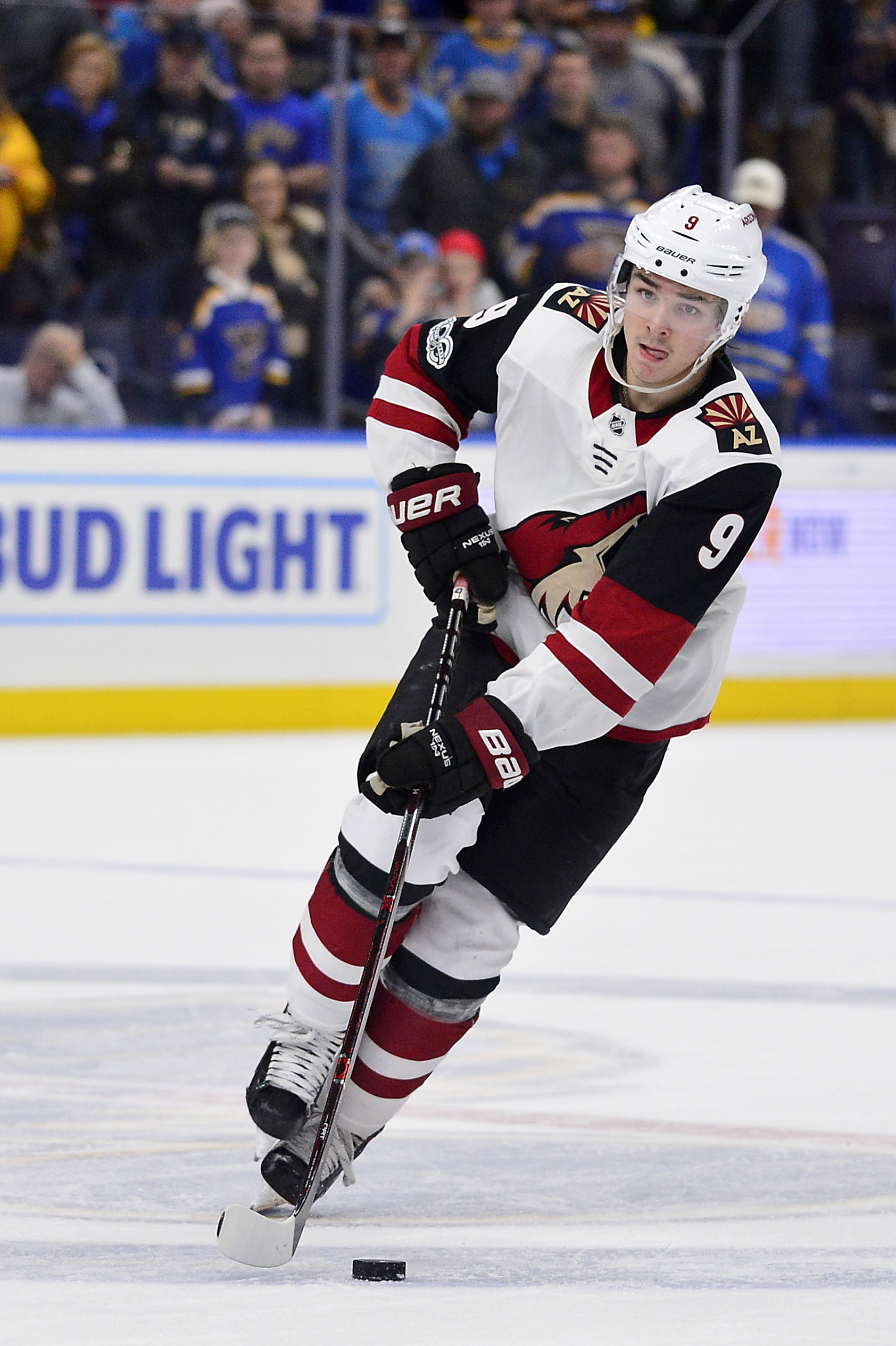 The 21-year old Keller has shown how good he can be in his young career, but this contract certainly doesn’t lack risk for the Coyotes. In his rookie year in 2017-18 the 2016 seventh overall pick exploded onto the scene with 65 points in 82 games, but Keller took a large step backwards last season. With just 14 goals and 47 points in 82 games, his production fell far short of expectations and put him in a points-per-game bracket alongside players like Brett Connolly, Josh Anderson and former teammate Alex Galchenyuk. That was even despite seeing slightly more ice time on the powerplay and overall.
Still, the Coyotes are betting that Keller’s first year is more indicative of his performance moving forward and it’s easy to see why. After shooting 10.8% as a rookie, a more than reasonable number for a player of his skill, Keller’s shooting percentage dropped all the way to 7.0% last season and should rebound considerably in the future. You can also bet on some natural development given his still very young age—he turned 21 just over a month ago. With strong possession numbers and a tantalizing skill set, the Coyotes may have a bargain down the line if he can continue to take steps forward.
That bet is exactly how the Coyotes have done business under Chayka. The GM has signed young players like Nick Schmaltz, Christian Dvorak and Jakob Chychrun to long-term deals before they really “proved themselves,” knowing that if he waited they might price themselves right out of Arizona’s market. The team can’t throw money around like bigger organizations like the Toronto Maple Leafs and New York Rangers, but have shown a willingness to assume some risk on long-term deals in order to get who they believe are core players under contract.
Part of this contract is also likely a reaction to the restricted free agent market this summer. A dozen teams are in limbo waiting for their young players to sign, something that Chayka will now not have to worry about with regards to Keller. The team still has some who will need new deals, but if Keller performs as many believe he can he would have been the centerpiece of the entire 2020 offseason for Arizona. That time can now be focused on other things as they try to establish themselves as a playoff contender in the Western Conference with new additions Phil Kessel and Carl Soderberg giving them some more depth up front.
As for what this means for that current RFA market, it’s unclear. We’ve heard all offseason how this class is set to re-establish the market for players coming off their entry-level deals, but Keller just sold four years of unrestricted free agency at a relatively low point in his negotiating leverage. Coming off a difficult season and still a year away, he decided to lock in long-term for a number that while substantial, is likely less than he could have gotten if he rebounded this year.
With Kessel now in the fold and Keller locked up, the Coyotes will now be expending quite a bit of capital on their forward group starting in 2020-21. The team will have more than $30MM tied up in five players including Kessel, Keller, Schmaltz, Dvorak and Derek Stepan, which doesn’t leave a lot of extra money for the rest given their hefty expenditures on defense. It very well could mean there is a move coming at some point down the line to free up some space, especially with several veterans who are set to become unrestricted free agents in 2021.
Photo courtesy of USA Today Sports Images
Niklas Kronwall Announces Retirement, Joins Detroit’s Front Office
The Detroit Red Wings brought one franchise legend back to run their front office in Steve Yzerman, and he’ll be joined by another one. Niklas Kronwall has announced his retirement as a player and will now move to the front office as an advisor to Yzerman. Kronwall and the team released a four-minute video explaining his decision and thanking everyone that has been involved in his long career.
The 38-year old Kronwall was an unrestricted free agent after his last contract with the Red Wings expired, but it never seemed like he would sign anywhere else. Selected 29th overall in 2000 out of the Swedish Elite League, Kronwall spent his entire career with Detroit, playing in 953 regular season games and winning the Stanley Cup in 2008. In that playoff run Kronwall was one of the Red Wings’ best players, recording 15 points in 22 games and leading the entire postseason with a +16 rating.
Known best for his punishing open-ice hits, Kronwall was an extremely effective player at both ends of the rink. Three times he recorded at least 44 points in a single season with his career-best of 51 coming in 2008-09 as part of a three-headed monster on defense along with Nicklas Lidstrom and Brian Rafalski. When Lidstrom and Rafalski would eventually retire, Kronwall took on the mantle of top dog for the Red Wings defense corps and reached new heights in ice time and responsibility. For three consecutive seasons from 2012-2015 he received Norris Trophy votes as one of the best defensemen in the league, while averaging more than 24 minutes of ice time.
To go along with his incredible NHL resume, Kronwall also consistently performed well internationally. In 2006 he took home an Olympic gold medal with Sweden to go along with his Stanley Cup and World Championship gold, putting him in the rare “Triple Gold Club.” Add in his two Swedish championships before coming to the NHL, another pair of silver medals at the Olympics and Worlds, and Kronwall is one of the most decorated hockey players of his era in terms of team success.
Even last season as age and injury started to catch him, Kronwall recorded 27 points and averaged nearly 20 minutes a night for the Red Wings. Losing him from the blueline eventually was inevitable, but his departure will likely have a fairly substantial impact on how the team performs next year. The Red Wings will now look to some of their young players to start taking on more responsibility while veterans like Mike Green, Jonathan Ericsson and Trevor Daley all enter their finals years under contract.
Justin Williams “Taking A Break” From Hockey
Those waiting on a decision from Carolina Hurricanes captain Justin Williams finally have one, although it’s not so much a “yes” or “no” answer on coming back for another season. The Hurricanes have announced on Williams’ behalf that the 37-year-old is “taking a break” from playing hockey and will not begin the 2019-20 campaign with the team:
This is the first time in my life that I’ve felt unsure of my aspirations with regards to hockey. For as long as I can remember, my whole off-season until this point has been hockey and doing what was necessary to prepare for the upcoming season. Because of my current indecision, and without the type of mental and physical commitment that I’m accustomed to having, I’ve decided to step away from the game. It’s important to me that the focus of attention is on the current, very talented group the Carolina Hurricanes have assembled, as they prepare to build on the momentum and growth we established last season.
It is important to note that neither Williams nor the team have used the word “retirement” in discussing this announcement or his future plans. It very well could be that Williams will contemplate calling it a career officially during this break, but more likely he is keeping his options open for a reunion later in the season. The situation is very similar to that of Mike Fisher and the Nashville Predators in 2017-18. Following a run to the Stanley Cup Final, Fisher opted to extend his off-season and maximize his rest and rehab before re-joining the team in February for the stretch run and postseason. The same scenario could be in the cards for Williams, whose comments make it clear that he is still committed to the Hurricanes as Fisher was to the Predators.
Of course, if this is it for Williams, he has certainly done enough in his decorated career. A three-time Stanley Cup champion with the Hurricanes and Los Angeles Kings, “Mr. Game Seven” is one of the most clutch postseason performers in NHL history and has a Conn Smythe Trophy to show for it. He’s also transformed into an iron man of sorts late in his career, missing just three regular season games since the end of the 2010-11 season. Williams is also one of the NHL’s quintessential leaders; a respected presence on the ice and in the locker room wherever he plays. A hard-working and dedicated player, if Williams feels 786 points in 1244 games and three titles isn’t enough, he will definitely be back. But he doesn’t owe the hockey world anything and could easily hang up his skates and move into a coaching or front office role with the Hurricanes if he so chooses.
Williams’ next step remains to be seen, but for now Carolina will have to enter the season without him and lean on the young core that the captain speaks so highly about. The Hurricanes have less than $2.5MM in projected cap space per CapFriendly and would have needed to get creative to re-sign Williams prior to the start of the season. His decision will allow the team to re-focus their efforts into re-signing forward Saku Maenalanen and defenseman Roland McKeown, who remain unsigned restricted free agents. As Carolina stockpiles some cap space over the course of the season, they should be more than capable of adding Williams back to the roster if his passion for the game returns in time for another shot at the Cup.
Jesse Puljujarvi Signs One-Year Deal In Finland
10:55am: Mark Spector of Sportsnet spoke with Holland, who explained that there has been new interest in Puljujarvi around the league but nothing is imminent:
I don’t know that him signing in Finland has a huge effect on the situation. I’ve had conversations with numerous clubs that have had interest, some interest, in acquiring Jesse. And I have had, probably in the last 10 days, two or three new teams reach out to me. Teams whose position have changed and are checking into the Puljujarvi situation.
I’ll do a deal if I feel good that I’m making a deal in the best interests of the Edmonton Oilers.
Holland basically has all the leverage here, as Puljujarvi playing a year in Finland can only really improve his value to the Oilers. There’s no rush to get a trade done from their perspective unless a team comes forward with an offer that can help them right away.
7:30am: Jesse Puljujarvi will at least have somewhere to play in 2019-20, even if things don’t get worked out with the Edmonton Oilers. The disgruntled young forward has signed a one-year deal with Karpat in Finland, though the contract includes an option to leave for the NHL before December 1st. In the NHL, if a restricted free agent is not signed before that date they are not eligible to play for the rest of the season.
Puljujarvi’s free agent status will not be changed by this contract. Even if he decides to play the entire year in Finland, the Oilers will still own his exclusive negotiating rights.
 This is not necessarily the end of the story for Puljujarvi and the Oilers, but at least it provides some sort of a resolution for the time being. The 21-year old has not been able to establish himself in the NHL since being the fourth overall pick in 2016 and needed a place to see regular playing time. He wasn’t going to get that in the AHL given that he has said he does not want to play in that league and the fact that he would need to clear waivers in order to be sent down. Finland may actually be the best place for his development to continue if the Oilers weren’t willing to give him a regular shift in the NHL.
For new GM Ken Holland and head coach Dave Tippett, giving him that top-six role seems out of the question. Puljujarvi has scored just 37 points in 139 NHL games, and though those have been about as inconsistently distributed as possible he simply hasn’t been good enough to deserve more playing time. He and his agent Markus Lehto have been clear about their desire for the Oilers to trade Puljujarvi to a team that would give him that opportunity, but that situation may not actually exist anywhere in the league. There is also likely a hesitation from Holland to move the young forward given the huge draft capital that has been invested in him, since he would be selling at an extremely reduced value.
Finland does not represent the same competition level as the NHL, but Liiga is still a solid professional league where Puljujarvi will be tested. He played one full season there before coming to the NHL and recorded 28 points in 50 games, but will hopefully be able to do even more now that he has some additional professional experience under his belt. Technically the Oilers will lose his negotiating rights on his 27th birthday, but since that is almost six years away one would expect the situation to be resolved before that happens.
Photo courtesy of USA Today Sports Images
Minnesota Wild Hire Bill Guerin
The search is over for the next Minnesota Wild GM. Michael Russo of The Athletic (subscription required) reports that the team has hired Bill Guerin, taking him away from the Pittsburgh Penguins where he served as assistant GM. The Wild fired Paul Fenton from the position in July after just 14 months on the job.
This will mark the second assistant GM that the Penguins have seen take over their own team in the last two years, after Jason Botterill was hired by the Buffalo Sabres in 2017. When Botterill departed, Guerin was given even more responsibility in the Penguins organization, most notably taking over as GM of the Wilkes-Barre/Scranton Penguins of the AHL.
Though he will not come with any experience as a GM of an NHL franchise, there was little doubt that Guerin was on the path towards running his own front office somewhere around the league. The 48-year old had a long and productive playing career that ended with the Penguins in 2010 and quickly transitioned into a front office role with the team, first as a development coach. His ascension up the ranks in Pittsburgh showed just how capable he was in his new career.
In Minnesota however, Guerin will be given a very different task than in Pittsburgh. He must try to rescue a ship that has taken on water over the last two years and start sailing it back in the right direction. The team still has some good young players and veteran talent but have seemed to waver between rebuilding and contending without accomplishing either. Fenton for instance was allowed to sign Mats Zuccarello to a five-year, $30MM deal just before being relieved of his duties, a deal that comes with quite a bit of risk for a club that found itself out of the playoff race last season.
The fact that the new GM is coming in just a few weeks from training camp makes it an even more difficult task, and one that is rarely seen around the NHL. What this means for head coach Bruce Boudreau and the rest of the front office is unclear, though Russo notes that Tom Kurvers who had been working as the interim GM is expected to stay on in some capacity.
Photo courtesy of USA Today Sports Images
Ottawa Senators Sign Colin White
The restricted free agent market might finally be showing some cracks. The Ottawa Senators have signed RFA forward Colin White to a six-year contract. The contract will carry an average annual value of $4.75MM and breaks down as follows:
- 2019-20: $4.0MM
- 2020-21: $4.0MM
- 2021-22: $4.75MM
- 2022-23: $4.75MM
- 2023-24: $4.75MM
- 2024-25: $6.25MM
White, 22, was one of the players ineligible for an offer sheet this summer and will lose just a single year of unrestricted free agency with this deal. At $28.5MM it will however take the title of the largest contract Senators GM Pierre Dorion has ever given out, eclipsing the four-year, $20.75MM deal he signed Mike Hoffman to in 2016 (the Senators would pay out just $9.45MM before trading Hoffman).
The team’s trade history when it comes to expensive players will be the first thing coming to mind for many Senators fans, but there is no doubt that this contract is a step in the right direction for the franchise. White, selected 21st overall in 2015, broke out last season with 14 goals and 41 points in 71 games during his first full NHL season. That production will only likely increase in the coming years as White takes on more and more responsibility for the Senators as their presumptive first-line center.
A $4.75MM cap hit ties White as the second highest paid player on the Ottawa roster, behind only Bobby Ryan and right alongside goaltender Craig Anderson—as long as you don’t count the injured Ryan Callahan and Marian Gaborik contracts. It means there will be plenty of pressure on the young forward to continue his development as a top-line player and puts a good chunk of the offensive burden squarely upon his shoulders.
With White signed, the team can start to look towards their next big name inching closer to free agency—Thomas Chabot. The 22-year old is heading into the final year of his entry-level contract and is already one of the premier defensemen in the league. If Ottawa is truly committed to retaining their stars and building a competitive roster in the next few years, signing Chabot to a long-term deal is key.
Elliotte Friedman of Sportsnet was first to report the two sides were close.
New York Rangers Buy Out Kevin Shattenkirk
Thursday: The Rangers have made the buyout official. Shattenkirk is now an unrestricted free agent.
Wednesday: The New York Rangers earned a second buyout window after settling all of their arbitration cases and will use it to open up some cap room. Brett Cyrgalis of the New York Post reports that the Rangers intend to buy out veteran defenseman Kevin Shattenkirk. He will not require unconditional waivers as he currently holds a no-movement clause. Shattenkirk had two years left on his deal which carried a $6.65MM cap hit. He will now become an unrestricted free agent while the Rangers will carry the following cap hits:
- 2019-20: $1,483,333
- 2020-21: $6,083,333
- 2021-22: $1,433,333
- 2022-23: $1,433,333
 Shattenkirk, 30, signed a four-year deal with the Rangers in the summer of 2017 as one of the very best available unrestricted free agents. He was supposed to come in and provide the team with an offensive presence from the blue line, but struggled mightily in his own end and saw his production drop significantly. In 119 games with the Rangers over two seasons Shattenkirk recorded 51 points and was a -29. The right-handed defenseman also didn’t fit in to the timeline the team had put together with their new young core, though his performance and lack of trust from head coach David Quinn likely made that a moot point.
For the Rangers, cap relief is the name of the game right now. After signing Artemi Panarin and Jacob Trouba to long-term contracts worth nearly $20MM per season, the team suddenly found themselves above the $81.5MM ceiling. A trade or buyout was necessary to get them back under that number and this will accomplish that. With Chris Kreider, Vladislav Namestnikov and others coming off the books after this season the team will be able to absorb the inflated cap hit of Shattenkirk in 2020-21, though it means they won’t be able to do a ton of shopping next offseason.
Even though he’s being cut loose by the Rangers, don’t expect Shattenkirk to be unemployed for very long. The defense market didn’t have a ton of talent in it this summer and while names like Jake Gardiner and Ben Hutton still remain unsigned, Shattenkirk immediately becomes the best right-handed option on the market. Even if he is no longer the play-driving force he was in St. Louis, there’s still more than enough reason to believe that the 30-year old can still contribute in the right situation. Where that will be is unclear, as the Rangers tried and failed to trade him over the last several weeks (and perhaps months) without any luck.
Photo courtesy of USA Today Sports Images
Samuel Girard Signs Seven-Year Extension
The Colorado Avalanche have locked up one of their young defensemen before he ever gets close to restricted free agency. Samuel Girard has signed a seven-year extension which will keep him under contract through the 2026-27 season. Girard is on the final year of his entry-level contract currently. PuckPedia reports that the deal will carry a $5MM salary in each year with no signing bonuses, and includes a nine-team no-trade clause the final three seasons.
While it is easy to see how much skill Girard possesses, this contract does come with its fair share of risk for the Avalanche. The 21-year old defenseman was acquired as part of the Matt Duchene trade in 2017 and has played 150 games for Colorado so far in his young career. He has just 47 points in those games including 27 last season despite getting ample powerplay time and averaging close to 20 minutes a game. The undersized puck-mover has tremendous skating ability and offensive upside, but hasn’t quite been able to reach the lofty expectations put on him when he came over from the Nashville Predators.
Still, there’s reason to be excited for the Avalanche. He turned 21 just over two months ago and has already proven he can at worst be a capable middle-pairing defender on a playoff team. If the offense does ever click or if he continues to develop in his own end a $5MM cap hit could be a bargain down the line. The deal buys out three unrestricted free agent seasons and takes him to age-29, essentially covering his entire prime at a fixed salary. That kind of cost certainty is valuable, especially for a team like Colorado that has so much uncertainty still to come. Mikko Rantanen is still unsigned and could be looking at a huge contract, while others like Cale Makar and Tyson Jost will need new deals down the line. Even captain Gabriel Landeskog only has two years remaining on his current contract, meaning the Avalanche needed some locked in numbers to build around moving forward.
That $5MM cap hit will give Girard something to live up to however and put even more pressure on the young defenseman. With Erik Johnson and Ian Cole out with injuries to start the season there will be huge responsibility placed on Girard and fellow youngster Makar. For a team that expects to compete for the Stanley Cup this season they need Girard to take another step forward in his development.
The contract gives the Avalanche 11 players signed to one-way contracts for the 2020-21 season. They have committed more than $48MM in those deals.
Paul Fenton Fired By Minnesota Wild
The Minnesota Wild have fired GM Paul Fenton after just one season according to Michael Russo of The Athletic (subscription required). The move is obviously a stunning development this far into the offseason, especially after Fenton has made sweeping changes to the roster by trading players like Nino Niederreiter, Mikael Granlund and Charlie Coyle while also committing a long-term contract to Mats Zuccarello this offseason. Russo expects assistant GM Tom Kurvers to take over in the interim as the team conducts a search for Fenton’s replacement.
Fenton’s time with Minnesota ends 14 months after it started when he was hired away from the Nashville Predators in May, 2018. The decision was made after a lengthy interview process by Wild owner Craig Leipold which included other highly touted assistants like Tom Fitzgerald and Bill Zito as well as more experienced names like John Ferguson Jr. and Dave Nonis. Fenton had been with the Predators since the beginning of their franchise, working with Leipold who was the team’s original owner. He was heralded as a solid replacement for the outgoing Chuck Fletcher, who had taken the Wild to the playoffs consistently but struggled to get them deep into the tournament.
Amazingly, the biggest free agent contract given out by Fenton was completed just a few weeks ago when he signed Zuccarello to a five-year, $30MM deal. That matched the extension he’d handed Mathew Dumba in 2018 and just eclipsed the one he signed Jason Zucker to. Less than a year after signing Zucker to that five-year extension, Fenton tried to trade the speedy winger multiple times, first to Calgary at the deadline and recently to the Pittsburgh Penguins in an eventually nixed Phil Kessel deal.
Very recently, team leader Zach Parise spoke out about how at his age he isn’t ready for a rebuild and has started to wonder about his decision all those years ago to sign with the Wild—though he stated clearly that he didn’t regret it. That kind of an interview, in which Russo also reported that Fenton had explored if teams had interest in Parise, likely only stoked the flames for Leipold, who needs to get the organization back on track. He has a huge task before him now to find the right man for the job and quickly get the Wild back to a playoff contender or commit to a rebuild.
Ottawa Senators Acquire Ryan Callahan
The Tampa Bay Lightning won’t be placing Ryan Callahan on long-term injured reserve after all. The Lightning have traded the contract of the injured forward along with a 2020 fifth-round pick to the Ottawa Senators in exchange for Mike Condon and a 2020 sixth-round pick. Callahan was diagnosed with a degenerative back disease and will not play again. He has one year left on his contract that carries a $5.8MM cap hit.
Like many trades involving the Senators recently, this deal is about saving money. While Callahan is owed $4.7MM this season much of that will likely be covered by insurance thanks to the career-ending injury. Condon meanwhile has a $3MM salary this season and the Senators did not plan on using him in the NHL given the re-signing of Anders Nilsson as the backup for Craig Anderson. The team also has several young goaltenders that need playing time in the minor leagues.
That situation also seems to be the case in Tampa Bay however, as the team now has four goaltenders on one-way contracts making at least $1.15MM. Curtis McElhinney is the presumed backup after signing a two-year $2.6MM deal in free agency, but now Condon and Louis Domingue are also in the fold. The Lightning also have Scott Wedgewood and Spencer Martin under contract for the minor leagues. The team will have to sort out who is going where to start the year, meaning more moves may be coming for the Lightning.
None of that however is the real issue being addressed for Tampa Bay. The team still has Brayden Point sitting as a restricted free agent (along with Adam Erne) but had very little cap space to get him signed. Though the team can go over the salary cap ceiling by up to 10% during the offseason, if they wanted to take full advantage of long-term injured reserve for Callahan’s cap hit they would have had to be compliant by the start of the season before designating him for LTIR. This transaction will remove that cap hit entirely giving the Lightning a good deal more flexibility to sign Point.
Tampa Bay now projects to have just under $9MM in cap space to get Point in and will obviously be burying at least two of their goaltenders before the start of the year if they are still with the organization. Fitting Point in even at a salary approaching $10MM wouldn’t be a problem, though it is still unclear how the two sides are going to approach his next contract. With Nikita Kucherov, the Lightning agreed to a three-year bridge deal after his entry-level contract expired which gave them a little more flexibility before locking him up long-term. They could do the same with Point, though the restricted free agent market has changed considerably since Kucherov signed his bridge deal in 2016.