
Stanley Cup Final Preview
The 2026 Stanley Cup Final is set, with the Carolina Hurricanes hosting the Vegas Golden Knights in Game 1 on Tuesday night at the Lenovo Center. Both teams are four wins away from hoisting the Cup, and both arrive playing their best hockey of the season. Carolina returns to the Cup Final for the first time since winning it in 2006, while Vegas makes its third appearance in nine years as a franchise, having last lifted the trophy in 2023.
Paths to the SCF
Carolina has been the juggernaut of the postseason. The Hurricanes defeated the Ottawa Senators in four games and the Philadelphia Flyers in four games in Rounds one and two, respectively. In the Eastern Conference Final, Carolina found themselves on their heels in game one coming off a two-week break, and lost to the Montreal Canadiens 6-2. However, the Canes were able to quickly get back on track in ‘gentleman’s sweep’ fashion, winning the next four games and thus deciding the series in five games. Carolina enters the cup with 12 wins and 1 loss in 13 playoff games. Allowing 1.62 goals per game on average, far and away the fewest of any team this postseason, the Canes have smothered opponents defensively while overwhelming them at the other end.
Vegas’s path was very different, although impressive in its own right. After a midseason swoon that saw the Golden Knights lose six of their final seven games heading into late March, general manager Kelly McCrimmon fired head coach Bruce Cassidy on March 29 and replaced him with John Tortorella. Under Tortorella, the team righted itself, captured the Pacific Division title at 39-26-17, and is now four wins away from a championship. The Golden Knights took six games to defeat both the Utah Mammothand the Anaheim Ducks in rounds one and two, respectively. Then in the Western Conference Final everything seem to click and Vegas was running on all cylinders. Vegas absolutely stunned the Presidents’ Trophy winning Colorado Avalanche in a four game sweep, looking unstoppable in doing so.
Vegas last played May 26, Carolina May 30, meaning both teams should be well rested heading into game one.
Head-to-Head
The two teams have never met in the postseason. The Golden Knights went 2-0 in the 2025–26 regular-season series, but Carolina is 9-7 all-time against Vegas. The two regular-season meetings came in a one-week window in late October 2025.
Vegas took the first matchup 4-1 at T-Mobile Arena on October 20, handing Carolina its first loss of the season after a 5-0 start. Jack Eichel, Pavel Dorofeyev, Ivan Barbashev, and William Karlsson all scored for the Golden Knights, with Mitch Marner adding two assists. The teams were essentially even in shots (Vegas 26, Carolina 27), but Vegas’s finishing edge proved decisive. Sebastian Aho scored Carolina’s lone goal.
The rematch in Raleigh on October 28 was a wilder affair, with Vegas pulling out a 6 to 3 comeback win. Eichel, celebrating his 29th birthday, scored twice in the final 4:59, including a breakaway goal off a Barbashev pass after forcing a turnover on Taylor Hall at the blue line. Dorofeyev added two more, Marner notched two more assists, and Tomas Hertl sealed it with an empty-netter. Carolina was depleted: Shayne Gostisbehere left after the first period, Joel Nystrom took a puck to the mouth in the second, and the Hurricanes were down to four defensemen for stretches of the third.
Frederik Andersen started both games for Carolina and surrendered eight goals on 59 shots (.864 save percentage), numbers that look nothing like his current playoff form. In the two games, Vegas saw production from across the lineup: Dorofeyev had three goals, Eichel had three points, Marner had four assists, and Barbashev had three points. Aho was the only Carolina skater with multiple points. With both teams now at full strength, the regular season series carries limited weight heading into the Final, but the formula Vegas used to win remains relevant: finishing the chances they got, capitalizing on turnovers, and forcing Andersen to be perfect.
Key Players
Carolina has gotten production from up and down the lineup, but the Stankoven, Hall, and Blake line has been their defining unit. Hall leads the Hurricanes with 16 points in 13 games and is the third leading scorer in the entire postseason. Jackson Blake has 15 points, and Logan Stankoven has 12, with nine goals. Three of those goals have been game winners in Carolina’s first 12 wins. Meanwhile, the traditional top line of Aho, Seth Jarvis, and Andrei Svechnikov has been quieter than expected but began finding its form against Montreal. On the back end, K’Andre Miller has been a revelation defensively, and Jaccob Slavin continues to be one of the NHL’s premier shutdown defensemen.
For Vegas, this is the Mitch Marner show. Marner leads the NHL playoffs in points (21), primary assists (11), shorthanded points (4), and multipoint games (6), fully justifying the eight-year, $96 million contract he signed after a sign and trade from Toronto last summer. The Golden Knights also boast the postseason leaders in goals, with Dorofeyev and Brett Howden tied at 10 each, and assists, with Jack Eichel’s 16. The supporting cast is the same group of past Stanley Cup champions that built the 2023 Cup roster: Eichel, Mark Stone, Shea Theodore, Karlsson, Barbashev, Brayden McNabb, and Noah Hanifin. Theodore has been the linchpin from the back end with 16 assists in 16 games.
Goaltending
This may be the most goaltending-dependent Cup Final in years, with Carter Hart having played every minute in all 16 of Vegas’s playoff games and Andersen the same in all 13 of Carolina’s.
Frederik Andersen has been one of the postseason’s defining stories. He’s posted a 1.41 goals against average, .931 save percentage, and three shutouts through 13 starts, leading the NHL in all three categories among goalies who advanced past the first round. He remains one of the Conn Smythe favorites alongside Mitch Marner. Andersen’s regular season was uneven, but he’s been a different goaltender since the playoffs began, allowing two or fewer goals in all but one of his 13 starts and giving up just 17 total goals against through three rounds.
Carter Hart has matched him stride for stride. After joining Vegas in December and going 18-4 with a .922 save percentage under Tortorella, Hart has carried that form into the playoffs to the tune of a 12-win, 4-loss record with a 2.22 GAA and .924 save percentage. Per NHL Edge data, he leads NHL goalies who advanced past round one in high danger save percentage at .873, with Andersen fourth on that list at .857. Hart was the difference in Vegas’s Western Conference Final sweep of Colorado, repeatedly turning aside high-quality looks from one of the league’s most dangerous offenses and giving his team a chance every night.
If both goaltenders continue at this level, the series will come down to which team can find one or two more bounces. If either one falters, his team’s championship hopes likely go with him.
Two Paths to the Same Place
On the surface, the Hurricanes and Golden Knights have similarities. Both are structurally sound, defensively responsible teams that have excelled with elite goaltending and proven playoff cores. Dig a layer deeper, though, and they couldn’t be more different in how they actually win games.
Carolina is a volume team. As previously mentioned in the Eastern Conference Final Preview, Carolina has been the NHL’s premier shot-suppression team for nearly a decade under Brind’Amour, leading the league in 5-on-5 Corsi at 59.77% during the regular season (via moneypuck.com) and allowing just 23.9 shots against per game, also a league best. Their aggressive forecheck applies pressure on both the strong and weak sides of the ice, an approach that’s rare in the modern NHL. The result is a team that spends almost no time in its own end and forces opponents into low-danger looks. Through three rounds of the playoffs, Carolina has outshot their opponent in every single game. They overwhelm you with chances and trust that the volume will eventually break through.
Vegas does the opposite. They’ve been outchanced and out-attempted in plenty of games this postseason and still found ways to win. Their 5-on-5 shot attempts percentage was just 48.5 through the first two rounds before they swept Colorado. Where Carolina wins through pressure, Vegas wins through finishing. They lead the NHL in high danger goals this postseason with 34. Howden and Dorofeyev are tied for the most goals in the playoffs (10 each) and the most high-danger goals (six each), while Marner (five) and Stone (four) also rank in the top 10. Per NHL Edge IQ data, Vegas has the highest “Projected Goal Rate” For this postseason (6.62%) and the lowest Projected Goal Rate Against (4.78%), meaning they’re generating the highest quality chances and allowing the lowest quality ones. They have the most goals of any playoff team (58), six comeback wins, and an 8-0 record when leading after two periods.
That contrast sets up the central question of the series. Carolina’s playoff identity has been built on burying opponents under volume, and they’ve done it against three Eastern Conference teams already. Vegas hasn’t faced anyone like them. The Avalanche came closest in terms of possession dominance during the regular season, but couldn’t sustain it once Carter Hart and the Vegas structure took over. Whether Vegas can survive Carolina’s chance generation for an entire series, and whether Carolina can finally finish at a rate that justifies their volume, will define how this Final unfolds.
X-Factors
The X factors for these two teams are linked but operate in opposite directions.
Finishing (Carolina): Carolina’s volume game only works if it produces. The question now is whether both of their scoring lines fire at once. If the Stankoven, Hall, and Blake line keeps producing and the Aho, Jarvis, and Svechnikov trio finds another gear against Vegas’s top defensive pairings, the Hurricanes have more high end finishing depth than they’ve had in years. If only one is producing, the volume alone won’t be enough against Carter Hart and the rest of the Vegas lineup.
Possession Sustainability (Vegas): Vegas has gotten away with being outchanced for stretches of these playoffs thanks to Hart, opportunistic finishing, and Marner driving offense from the wing. But Carolina is a different animal than anyone they’ve faced. If the Golden Knights’ underlying numbers slip too far against the Hurricanes’ relentless forecheck, they’ll be relying on Hart to bail them out shift after shift. Even his historic run has limits.
In a way, both teams have to take a page out of one another’s book: Carolina capitalizing on and creating higher danger chances, and Vegas finding ways to improve their possession game to try to be on par with Carolina. Whichever finds more success in their attempts could see that as being the biggest reason they are lifting Lord Stanley when it is all said and done.
Storylines
Beyond the tactical matchup, several narrative threads make this Final particularly compelling.
- Eichel and Hanifin are chasing USA Hockey History: Both Jack and Noah were on the gold medal-winning United States men’s hockey team at the 2026 Winter Olympics. A Vegas Cup would make them just the second and third American players in history to win Olympic gold and the Stanley Cup in the same year, joining Ken Morrow of the 1980 Miracle on Ice team and the Islanders’ Cup-winning roster that June.
- Brind’Amour finally breaks through: The Hurricanes’ coach had lost three Conference Finals in his tenure (2019, 2023, 2025), and his system’s playoff ceiling has been the central question hanging over the franchise. Twenty years after captaining Carolina to its only Cup in 2006, he’s back in the Final, this time behind the bench.
- Marner’s Toronto exit: After nine years and 741 points with the Maple Leafs without ever advancing past the second round, Marner was signed and traded to Vegas on June 30, 2025, signing an eight-year, $96 million deal. He has responded by leading the entire NHL playoffs in points and emerging as the Conn Smythe co-favorite alongside Andersen.
- Tortorella’s unusual hire and a Devils parallel: Tortorella was hired with eight games left in the regular season to coach the rest of the year and the playoffs, with his future to be determined in the offseason. The closest historical parallel is the 2000 New Jersey Devils, when Lou Lamoriello fired Robbie Ftorek on March 23rd while New Jersey was leading their division, promoted assistant Larry Robinson, and won the Cup that June. A Tortorella Cup would put him in a small club of coaches to win the Stanley Cup after a mid-season hiring, becoming just the eighth all-time, according to Sportnet.ca.
- Staal chasing NHL history. Hurricanes captain Jordan Staal won the Cup with Pittsburgh in 2009 as a 20-year-old third-line center playing behind Sidney Crosby and Evgeni Malkin. Now 37 and in his 14th season with Carolina, he’s four wins away from a second championship. Per NHL.com, a Carolina Cup win would also see Staal break the NHL record for the longest gap between Stanley Cup wins by any player; Chris Chelios currently holds it at 16 years (1986 with Montreal, 2002 with Detroit).
Wrap Up
This is the most evenly matched Cup Final in years on paper. Both teams have elite goaltending, structural identities, and proven playoff performers. Carolina has been the better team analytically all postseason. Vegas has been the more clutch one. The Hurricanes will try to win the series the way they’ve won the first three rounds: possession, suppression, and trusting Andersen to bail them out on the rare breakdowns. Vegas will try to do what they did to Colorado: weather the storm, finish the chances they get, and let Hart do the rest. Andersen versus Hart may end up being the deciding factor. Whichever goaltender holds his postseason form longer is probably the one whose team wins the Cup. Game 1 drops Tuesday night in Raleigh, and it is shaping up to be one heck of a Stanley Cup Final.
Multiple Players Have NHL Draft Rights Expire
According to PuckPedia, multiple prospects had their draft rights expire at the deadline today, meaning they’ll re-enter the 2026 NHL Draft or become unrestricted free agents.
Two distinct groups are impacted by this deadline. Prospects playing in the Canadian Major Junior leagues (OHL, QMJHL, or WHL) or those playing in Europe.
Of those players from the CHL who have played through their age-20 seasons, they’ll re-enter the 2026 NHL Draft, or become unrestricted free agents if they go undrafted. For the European players, they’ll become unrestricted free agents, though many typically stay in Europe to continue their professional careers.
The only other prospect whose draft rights expired, and didn’t meet either of the above requirements, was Toronto Maple Leafs 2025 draftee Matthew Hlacar. Hlacar was taken with the 217th overall pick of last year’s draft, and scored six goals and 12 points in 51 games for the OHL’s Kitchener Rangers this season. Toronto didn’t issue him a bona fide offer, which is simply tendering the player a league-minimum, entry-level deal to extend their signing rights.
The remaining prospects who will re-enter the 2026 NHL Draft or become UFAs are as follows:
D Ales Cech (Mammoth, 5-153, 2024)
D Simon Forsmark (Hurricanes, 4-101, 2022)
F Max Graham (Penguins, 5-139*, 2024)
F Petr Hauser (Oilers, 5-141**, 2022)
F Nils Juntorp (Hurricanes, 6-188***, 2022)
F Gustav Karlsson (Sabres, 6-187, 2022)
F Maximilian Kilpinen (Red Wings, 4-129, 2022)
D Kasper Kulonummi (Predators, 3-84, 2022)
F Hunter Laing (Flames, 6-170, 2024)
G Ryerson Leenders (Sabres, 7-219, 2024)
D Nathan Mayes (Maple Leafs, 7-225, 2024)
G Landon Miller (Red Wings, 4-126, 2024)
F Kaden Pitre (Lightning, 6-181, 2024)
F Joel Ratkovic Berndtsson (Sabres, 7-202, 2022)
F Santeri Sulku (Flyers, 7-197, 2022)
D Albin Sundin (Oilers, 6-183, 2024)
F Riku Tohila (Blackhawks, 7-199, 2022)
G Jakub Vondras (Hurricanes, 6-171, 2022)
* Originally drafted by the New Jersey Devils; traded to the Penguins in March 2025.
** Originally drafted by the New Jersey Devils; traded to the Oilers in March 2025.
*** Originally drafted by the Chicago Blackhawks; traded to the Hurricanes in January 2025.
Free Agent Focus: Carolina Hurricanes
Free agency is just over a month away, and teams are looking ahead to when it opens. Even with the UFA crop being thinned out in recent months, there will be some quality veterans set to hit the open market in July, while many teams also have key restricted free agents to re-sign. We continue our look around the NHL with an overview of the free agent situation for the Hurricanes.
Key Restricted Free Agents
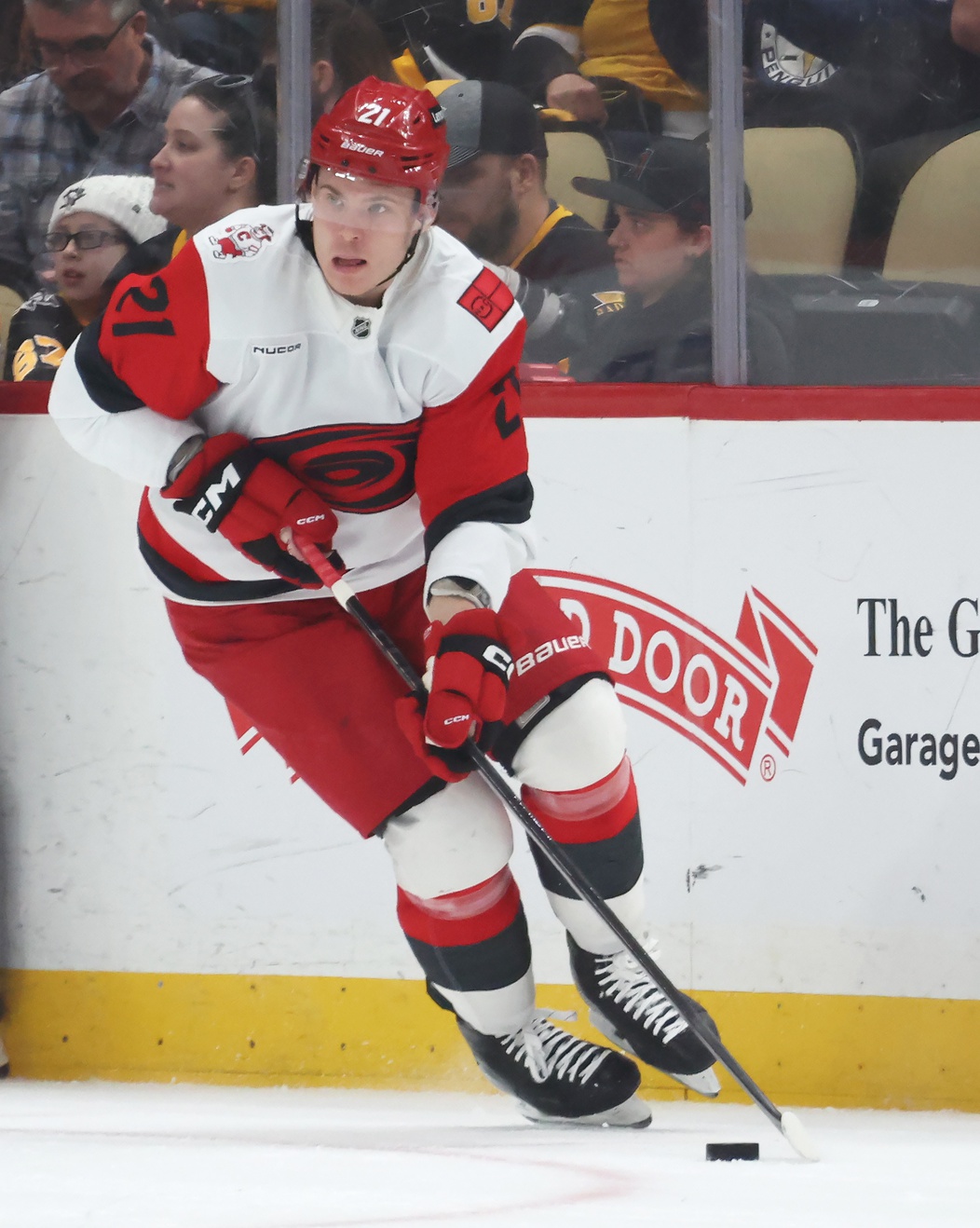 D Alexander Nikishin – Nikishin may not have lit up the NHL like he did the KHL in recent years but he still had a very strong rookie season. He finished second in rookie scoring for a defenseman after potting 11 goals and 22 assists in 81 games while averaging over 18 minutes per night of playing time. That performance earned him a seventh-place spot in Calder Trophy voting. On a deep back end, the Hurricanes were able to ease him in a bit which could impact contract talks. If Nikishin’s camp feels he has another level to get to over the next couple of years, they may prefer to work on a bridge contract and position the blueliner to cash in later. That deal could fall in the $4MM range. If both sides are content to do a longer-term pact that buys out some UFA eligibility, the market value could be closer to $7MM.
G Cayden Primeau – The word ‘key’ probably doesn’t apply here but Primeau has seen NHL action now in seven straight years, although he spent most of this season with AHL Chicago. He’s no longer viewed as a potential full-time NHL backup but the market for third-stringers with NHL experience who can come up and play a few games in a pinch has gone up lately. He should at least be able to land another one-way pact but it may have to come from elsewhere. Because Primeau has played in 58 NHL games but is more of an AHL player at this point, he’s a strong non-tender candidate to avoid giving him the chance to test salary arbitration.
F Justin Robidas – Another one who doesn’t really fit the ‘key’ descriptor (Carolina’s RFA list is pretty thin), Robidas is one of Carolina’s more intriguing youngsters. He hasn’t seen much NHL action so far (just four games) but he has been quite productive with AHL Chicago over the past two seasons, tallying 115 points in 128 games. The 23-year-old will no longer be waiver-exempt in 2026-27 and his minor-league production could make him a candidate to be claimed. It will be interesting to see if he’s able to land a one-way deal as a result.
Other RFAs: F Skyler Brind’Amour, D Domenick Fensore, F Noel Gunler, D Aleksi Heimosalmi, D Kyle Masters, F Viktor Neuchev, G Nikita Quapp, D Ronan Seeley
Key Unrestricted Free Agents
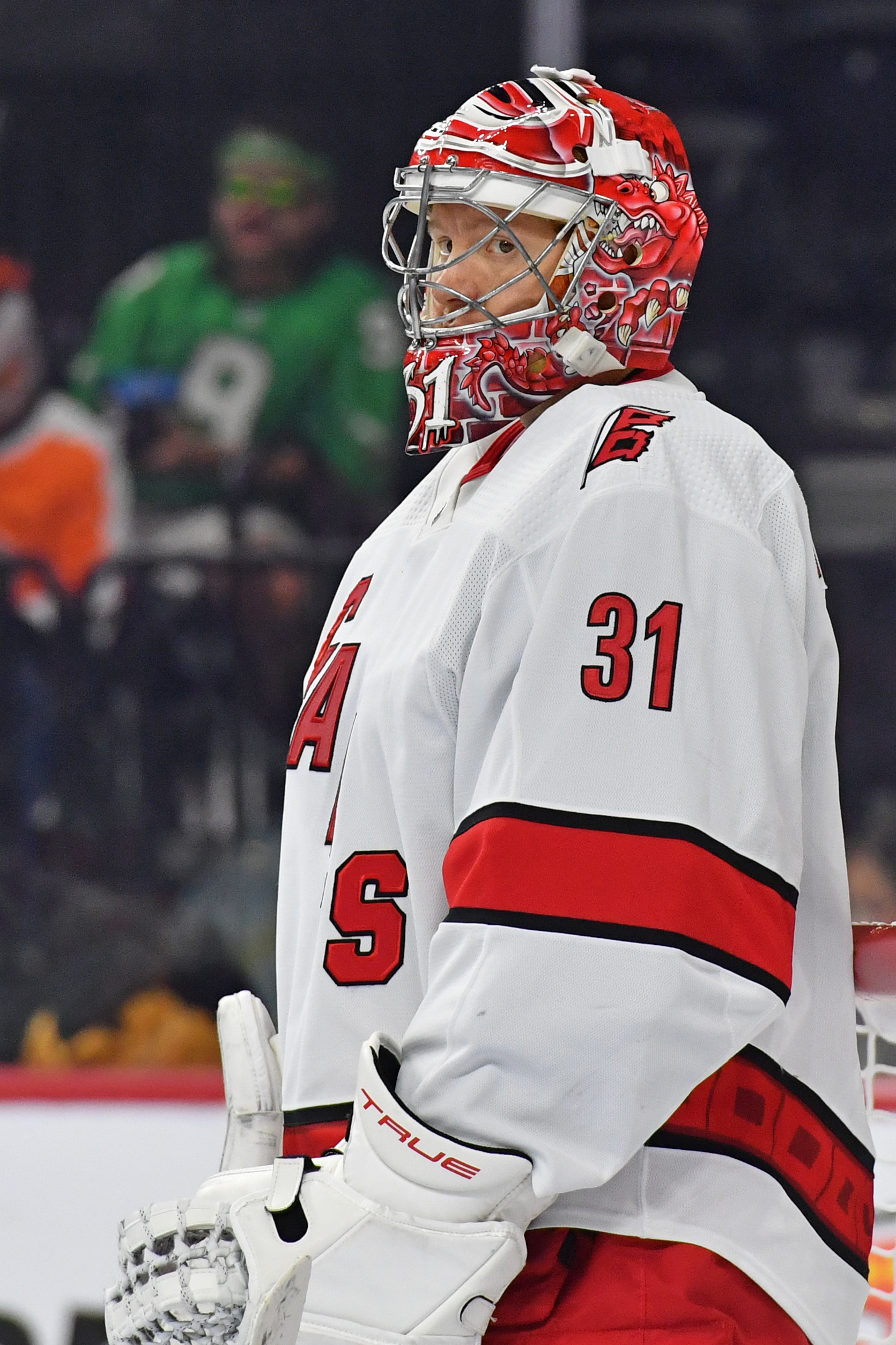 G Frederik Andersen – There may not be a player in the playoffs who has flipped the script as much as Andersen has. After a below-average regular season, he has been stellar in the postseason to the point of being a viable Conn Smythe Trophy as the most valuable player of his team in the playoffs. In doing so, he has certainly bolstered his marketability. He’ll be 37 in early October but it’s not unfathomable that Andersen could land a two-year contract around the $3.25MM he made this season (including performance bonuses). Alternatively, another one-year pact that makes him eligible for performance incentives is the other option. He should be able to at least match his current deal if he goes that route.
F Nicolas Deslauriers – Deslauriers is no longer the every-game tough guy he was in the first half of his contract a few years ago. Now, the 35-year-old profiles as more of a 13th forward who can step in against more physical teams. The market for more enforcer-type players isn’t what it used to be so while he should be able to land more than $850K minimum salary, it’s doubtful that he’ll be able to land the $1.75MM he has made in each of the last four years. Something closer to the middle is more realistic.
F Noah Philp – Philp passed through waivers and finished up the year with the Wolves but he won over 56% of his faceoffs between Edmonton and Carolina when he was in the NHL this season. The 27-year-old profiles as a minimum-salaried player this summer but he might be able to secure a one-way deal and could make a push to stick at the back of a roster in training camp.
D Mike Reilly – After missing most of 2024-25 after undergoing heart surgery, Reilly stayed healthy this season which was good to see. However, he had a fairly limited role overall, getting into just over half of Carolina’s games while logging just under 15 minutes per night of ice time and in the playoffs, he has suited up just twice so far. Profiling as more of a seventh option moving forward, Reilly is likely going to land another deal around his current $1.1MM price tag and it wouldn’t be surprising to see his streak of one-year contracts continue for a fourth consecutive season.
Other UFAs: G Amir Miftakhov, F Josiah Slavin, F Givani Smith, F Ryan Suzuki, D Juuso Valimaki
Projected Cap Space
There aren’t many teams with less cap space than the Hurricanes, who will enter the summer with a little under $12MM in room. They have room to re-sign Nikishin and Andersen (if they want to carry three goalies full-time next season) and enough space to replace Reilly as a depth defender. They might not be able to do too much beyond that, but they also don’t have a lot of holes to fill, as evidenced by a roster that’s a win away from advancing to the Stanley Cup Final.
Photos courtesy of Charles LeClaire (Nikishin) and Eric Hartline (Andersen) – Imagn Images. Contract information courtesy of PuckPedia.
Hurricanes Adjustments Ahead of Game 3
With the Eastern Conference Final series tied at one game a piece, the Carolina Hurricanes are expected to maintain several key aspects of their game while tinkering with a few key areas. For the Hurricanes, maintaining an unblemished road record will depend on a few critical tactical and personnel factors highlighted ahead of puck drop.
Penalty Kill
Carolina’s penalty kill is performing at a near-historic level this postseason, killing 23 of 24 opposing power plays (95.5%). As noted by The North State Journal, since 2000, only the 2004 Detroit Red Wings (96%) have put up a better PK percentage over a minimum of 10 playoff games.
Defenseman K’Andre Miller credited the success to “iron sharpening iron,” stating that going up against their own high-end power play units in practice every day keeps them sharp.
Line Matchup War
With the Canadiens holding home-ice advantage, head coach Martin St. Louis gets the luxury of the last change. Montreal will actively try to pull the Nick Suzuki–Cole Caufield–Juraj Slafkovsky top line away from Jordan Staal‘s suffocating checking line. However, while Staal’s line held Montreal’s top trio to just three 5-on-5 shots on goal in Game 2, even if Montreal avoids Staal on home ice, Rod Brind’Amour can still counter by hard-matching his elite shutdown defensive pairing of Jaccob Slavin and Jalen Chatfield against Suzuki’s wingers.
Battling the Bell Centre Noise
While Montreal has gained a reputation as road warriors in the playoffs, the Hurricanes are an absolute juggernaut away from home this postseason, carrying a 4-0 road record into Game 3. Carolina’s only two postseason games with more than three goals scored both happened on the road (in Ottawa and Philadelphia).
Unsung Heroes
Right winger Jackson Blake is completely altering his identity for the postseason. While he has been known primarily for offense, Blake matched his regular-season career-high in blocked shots just 11 minutes into Game 2, finishing the night with 5 blocks.
Despite the adjustments in their tactics, the Hurricanes are keeping an eye on Montreal’s bottom six. Following a costly failed overtime dump-in that led to Nikolaj Ehlers‘ Game 2 winner, morning skate reports indicate Montreal is scratching Oliver Kapanen in favor of the heavier Joe Veleno to counter Carolina’s relentless speed and physical forecheck.
Hurricanes Sign Noel Fransen To Entry-Level Contract
According to a team announcement, the Carolina Hurricanes have signed defenseman Noel Fransen to a three-year entry-level contract.
The 20-year-old will make $850,000 in 2026-27, $900,000 in 2027-28, and $950,000 in 2028-29 at the NHL level. If in the AHL, he will receive $85,000 for all three seasons. The deal will include signing bonuses worth $270,000. He signed this deal after finishing his 2025-26 season between two teams in Sweden. In the SHL, he scored two points in 13 games with Farjestad BK and also posted six goals for 14 points in 38 games on loan with BIK Karlskoga in HockeyAllsvenskan.
General Manager Erik Tulsky said in the team’s release, “Noel has all of the attributes we look for in a Carolina Hurricanes defenseman. He has the mobility to close quickly on a play, as well as the speed to be active on offensive transitions. We’re looking forward to seeing him in North America next season.”
Leading into the 2024 NHL Draft, Fransen profiled as a prospect who prioritizes offense through his skating in both transition and in the offensive zone on the blue line. That mobility is emphasized in his transition ability to connect a play from defense through the neutral zone. Fransen was selected as a third-round pick at 69th overall by the Hurricanes in the 2024 NHL Entry Draft.
He dominated in the junior levels of his native country. In the J18 South and West regions he participated in, Fransen led his counterparts in scoring and overall points by a defenseman. Those same honors followed as he progressed into J20 Nationell play, where he led all defenders in the league in scoring in 2023-24. An honor previously held by other Swedish NHL defenders, including Erik Karlsson (2007-08) and Alexander Edler (2004-05), dating back to 2000.
Fransen graduates from a list of unsigned Hurricanes defensive prospects like Kurban Limatov, Timur Kol, and joins the likes of fellow 20-year-old defender Dominik Badinka in the system, and will compete as a potential NHL roster player on the Hurricanes’ back-end, like another former third-round pick in Alexander Nikishin, who Carolina will consider as a top-priority RFA signing this offseason.
Before this signing, the Hurricanes had around $11.9MM in cap space for the offseason that they’ll have to address towards their unrestricted free agents, which include Nicolas Deslauriers in the forward group, as well as defenseman Mike Reilly and goaltender Frederik Andersen.
Eastern Conference Final Preview
The Eastern Conference Final is set, with the Carolina Hurricanes hosting the Montreal Canadiens in Game 1 on Thursday night at the Lenovo Center. Both teams are four wins away from a trip to the Stanley Cup Final, and both arrive playing some of their best hockey of the season. Carolina returns to the Conference Final for the third time since 2022-23 under Rod Brind’Amour, while Montreal is back at this stage for the first time since their unexpected run in 2021, and the first with their head coach, Martin St. Louis.
Paths to the ECF
Carolina has been the story of the postseason. The Hurricanes swept the Ottawa Senators in Round 1 and followed it up with a four-game sweep of the Philadelphia Flyers in Round 2, becoming the first team to sweep the first two rounds since the NHL went to a best-of-seven format in all four rounds in 1987. Through eight playoff games, they’re 8-0 with a plus-14 goal differential, allowing just 10 goals total and never more than two in a single game.
That dominance comes with a question, though: will 12 days off be a gift or a curse? Carolina last played on May 9, and the layoff is the longest of any team in the conference finals. The history of teams with extended layoffs in the playoffs is mixed. Extra rest can mean fresh legs and full health, but it can also mean a loss of rhythm against a team that’s been in playoff intensity for weeks. Brind’Amour’s group used the time to get fully healthy, run extra video sessions, and skate without the wear of a daily playoff schedule. The Hurricanes have been playing the most cohesive, structured hockey of any team in the postseason, and there’s a real question about whether that timing holds up against an opponent that has been playing high-intensity playoff games for over a month.
Montreal’s path has been the opposite. The Canadiens needed seven games to put away the Tampa Bay Lightning in Round 1, including four overtime games, before grinding out another seven-game series against the Buffalo Sabres in Round 2. That series included an 8-3 Game 6 loss before the Habs bounced back in Game 7 on Monday night, where Alex Newhook was yet again the game seven hero, scoring the game-winner 11:22 into overtime. Montreal has played 14 games to Carolina’s eight; they arrive battle-tested but on shorter rest, with less than 72 hours between their Game 7 in Buffalo and Game 1 in Raleigh.
Head-to-Head
The 2025-26 regular season series belonged entirely to Montreal. The Canadiens swept Carolina 3-0-0, winning all three games in regulation and outscoring the Hurricanes 15-8. Nick Suzuki, Cole Caufield, Juraj Slafkovsky, and Ivan Demidov each posted five points in the three games, with Slafkovsky scoring the game-winning goal in two of them. Lane Hutson added four points from the back end. Sebastian Aho led Carolina with six points (two goals, four assists), five of which came in one game, and Andrei Svechnikov added five (two goals, three assists).
The two franchises have met twice previously in the playoffs since Carolina’s relocation from Hartford, with the Hurricanes winning both. The most recent meeting was the 2006 Eastern Conference Quarterfinals, a series in which Carolina trailed 2-0 before rookie goaltender Cam Ward took over the crease and helped the Hurricanes win the series in six games en route to a Stanley Cup. This is the first time these two have met in a Conference Final.
Key Players
For Montreal, scoring has come from across the lineup. Suzuki has 13 points (four goals, nine assists) in 14 playoff games, while Newhook (seven goals), Slafkovsky, and Caufield (four goals each) have all chipped in up front. On the back end, Hutson leads the entire team in points with 14, has been logging 26-plus minutes per game, and is the engine of the Canadiens’ transition offense. Mike Matheson and Noah Dobson round out a mobile defensive group.
Carolina’s depth has been the calling card. Taylor Hall has found another gear in his game, playing some of his best hockey since his MVP season back in 2018, and leads the team in scoring with 12 points. Additionally, Jackson Blake, Seth Jarvis, Nikolaj Ehlers, Logan Stankoven, and Andrei Svechnikov all give the Hurricanes scoring threats across the top three lines. Defensively, Jaccob Slavin remains one of the NHL’s premier shutdown defensemen, and rookie Alexander Nikishin has emerged as a real puck-mover in his first full NHL postseason.
Goaltending
Frederik Andersen has been one of this postseason’s biggest stories. He’s 8-0 with a 1.12 GAA and .950 save percentage, leading all playoff goaltenders in both categories. He’s allowed only 10 goals in eight starts and has two shutouts. The catch: Andersen’s regular season was uneven. He went 1-9-2 over a 12-game stretch earlier in the season before bouncing back with a 9-4-0 record after the Olympic break. His two starts against Montreal came during that rough patch where he went 0-2-0 with a 3.73 GAA and .806 save percentage.
For Montreal, Jakub Dobes has stabilized the crease. He started all three regular-season games against Carolina and went 3-0-0 with a 2.67 GAA and .922 save percentage. His postseason numbers are more pedestrian (.910 SV%, 2.52 GAA), but he’s won when it has mattered and, aside from the full team collapse in game 6, was at his best in the Buffalo series. Dobes leads all goaltenders in saves through two rounds with 363.
Transition vs Forecheck
The cleanest stylistic clash of the postseason runs through the neutral zone. Carolina has been the NHL’s premier shot-suppression team for nearly a decade under Brind’Amour, leading the league in 5-on-5 Corsi at 59.77% during the regular season (via moneypuck.com) and allowing just 23.9 shots against per game, also a league best. The mechanism is their aggressive forecheck, which applies pressure on both the strong and weak sides of the ice, an approach that’s rare in the modern NHL. Their wingers crash hard, their weak-side defenseman pinches down the wall, and their defensive zone coverage relies on man-to-man assignments. The result is a team that spends almost no time in its own end and forces opponents into low-danger looks when they do break out.
Montreal is built to attack that structure in the one place it can be exploited. When Carolina’s forecheck is beaten with a clean first pass, their forwards play so deep in the offensive zone that recovery becomes difficult, and odd-man rushes in the other direction are the most common result. The Canadiens have the personnel to take advantage. They have one of the fastest lineups in the NHL: Suzuki, Newhook, Anderson, and Hutson all rank in the 90th percentile or better at their position in 20-plus mph speed bursts, per NHL Edge. The engine, though, is Hutson. The 22-year-old defenseman ranks among the NHL’s most prolific puck-transporters from the back end, but he’s 5-foot-9 and can be worn down on extended defensive shifts where physicality takes its toll. Carolina’s forecheck with guys like Stankoven, Jarvis, and Martinook is specifically designed to dump the puck to a defenseman’s side and hound him through long retrievals. If Hutson handles that pressure cleanly, Montreal’s offense unlocks. If Carolina grinds him down and forces turnovers in his own zone, the Habs’ best weapon becomes a liability.
The Canadiens’ three regular-season wins over Carolina were very likely powered by exactly this dynamic: clean breakouts, fast transitions, and high-quality looks generated against a team that thrives on grinding opponents down in the offensive zone. The shift-by-shift battle to watch: how Carolina’s forecheckers recover after offensive zone turnovers, and whether Montreal’s forwards consistently arrive in the neutral zone in time to punish those breakdowns.
X-Factors
The X-factors for these two teams are essentially mirror images of each other, both rooted in a longstanding tension between chance generation and chance conversion.
Finishing (Carolina): The Hurricanes are perpetually in this conversation, and 2025-26 was no exception. They led the NHL in shot attempts, scoring chances, and high-danger scoring chances at 5-on-5, yet finished with the 19th-best shooting percentage. The pattern showed up in the regular-season series with Montreal in vivid fashion; Carolina outshot the Canadiens 103-60 across three games and lost all three. Through eight playoff games, the Hurricanes’ shooting percentage has trended back toward the league average, which is a big reason they’re 8-0. Sustaining that against a goalie who has owned them is the question. If Carolina reverts to its season-long shooting struggles, the volume of chances they generate may not be enough to outscore Montreal’s opportunism.
Limiting Chances Against (Montreal): The flip side of Carolina’s chance-generation problem is Montreal’s chance-suppression problem. The Canadiens have been consistently outshot and outchanced through the first two rounds, surviving on goaltending and finishing rather than defensive structure. In the regular season, they ranked fifth-worst in the NHL in high-danger shots against (via moneypuck.com). That’s a manageable issue against the Lightning and Sabres, both of whom run conventional offensive systems. It’s a far bigger problem against a Carolina team specifically built to bury opponents under shot volume. Montreal doesn’t need to flip the underlying numbers; they need to keep Carolina to the perimeter, force them into the low-danger looks that have defined their finishing struggles all season, and trust Dobes to handle the rest.
Wrap Up
On paper, Carolina has every analytical advantage: better possession metrics, better penalty kill, dramatically more rest, and the hottest goaltender in the playoffs. But Montreal arrives with history on its side and a blueprint that’s already worked. They are the youngest team to reach a Conference Final in 33 years, since the 1993 Canadiens, and that team won the Stanley Cup. Add in the regular-season sweep, a stylistic matchup that gives Montreal a real path, and a young core playing with no fear, and the makings of a series far more competitive than the oddsmakers expect are all there. Game 1 drops Thursday in Raleigh.
Hurricanes To Wait Until After Playoffs To Talk New Deal For Frederik Andersen
The Hurricanes find themselves on a long break between rounds. As a result of starting the second round early, sweeping Philadelphia, and seeing Montreal and Buffalo go to seven games, they now find themselves with the longest break between series in modern NHL history, according to The Athletic’s James Mirtle (Twitter link).
But while that leaves ample time for the team to work on some looming contracts for pending unrestricted free agent goaltender Frederik Andersen, that isn’t going to be the case. Speaking with NHL.com’s Tom Gulitti, GM Eric Tulsky indicated that their plan is to wait until after the playoffs before beginning those discussions. By contrast, Carolina re-upped Mark Jankowski, who was a pending UFA himself, to a new two-year deal earlier this week.
It has been an up-and-down year for the 36-year-old. Thanks to a long-term injury to Pyotr Kochetkov, Andersen made 35 starts during the regular season, his highest total since 2021-22, the year he finished fourth in Vezina Trophy voting. But his overall numbers weren’t particularly impressive as he posted a 3.05 GAA with a .874 SV% on a team that finished first in the Eastern Conference. Kochetkov (in limited action) and Brandon Bussi both put up considerably better numbers than he did.
But with Bussi faltering a bit down the stretch and Kochetkov only getting into some brief AHL action on a conditioning stint before the regular season ended, Andersen got the nod to start the playoffs. It’s fair to say that decision has worked out tremendously for both Andersen and the Hurricanes. He has won all eight of Carolina’s postseason games thus far, allowing just 10 goals on 201 shots in the process.
If he can even come close to continuing that type of play in the next round (or two, should they advance to the Stanley Cup Final), that would certainly be a huge boost to his stock heading to free agency. But on the flip side, if the long layoff results in him reverting to his regular-season form, it could be one of the other two netminders getting a shot at some point in their next series.
Accordingly, it makes sense for Tulsky and the Hurricanes to wait to see how the rest of the postseason goes before starting talks on a new contract. After all, Bussi begins a new three-year contract next season while Kochetkov is signed through 2026-27 as well. Technically, they have their goalie tandem in place already, at a combined cost of just $3.9MM.
But Carolina has been one of the few teams that has been unafraid to carry three netminders on a regular basis which could create an opening for Andersen to return, albeit at a price tag likely below his current $2.75MM plus bonuses ($250K of which has been met with another $250K likely). Tulsky indicated that they “would love to have him back.” We’ll have to wait a little while yet to see if that will ultimately happen.
Juuso Valimaki In Talks With SHL Brynas
For several years, defenseman Juuso Valimaki was a regular at the NHL level. However, he didn’t see any time at the top level this season, playing exclusively in the minors. A pending unrestricted free agent, it appears he’s not waiting to see what options await him on the open market. Instead, Expressen’s Mattias Persson and Johan Svensson report that the blueliner is in extended discussions to join SHL Brynas next season.
The 27-year-old was a first-round pick by Calgary back in 2017, going 16th overall. He saw action in parts of three seasons with the Flames and after a 49-game showing in 2020-21, they saw fit to sign him to a $1.55MM per season bridge deal. That contract wound up helping him clear waivers the following season but in 2022, he wasn’t able to sneak through, instead being claimed by Arizona.
With the Coyotes, he became a full-timer on their back end, playing in 78 games after being picked up, earning himself a one-year extension in the process. Then, after logging over 19 minutes a night in 2023-24, Valimaki received a two-year, $4MM pact and it looked as if he was finally going to get some stability.
Instead, Utah (after the Coyotes moved) bolstered its back end, pushing Valimaki down to the seventh spot last season and off the roster altogether in 2025-26. History repeated itself with the blueliner being waived in training camp and clearing, sending him off to AHL Tucson where injuries limited him to three games in as many months. Then, the Hurricanes acquired him in January to give themselves some extra defensive depth although he has yet to see action with Carolina. Instead, his regular season ended with 23 points in 27 games while he has four points in six playoff contests with AHL Chicago so far.
It appears that Valimaki will be taking quite a pay cut on this eventual deal. Persson and Svensson note that he was seeking a EUR300K deal initially (worth around $349K in USD) but that the contract is expected to come in for considerably less. Given his NHL experience and AHL success, it stands to reason that he easily could have been that on even a two-way deal in North America this summer. Accordingly, it appears that Valimaki will be leaving some money on the table to play closer to home.
Hurricanes Sign Charlie Cerrato To Entry-Level Deal
According to a team announcement, the Carolina Hurricanes have signed forward prospect Charlie Cerrato to a three-year, entry-level contract. The deal includes $2.525MM in total salary at the NHL level, $85K per season in the AHL, and $220K in signing bonuses.
Cerrato, 21, was drafted with the 49th overall pick of the 2025 NHL Draft by the Hurricanes. He was finishing up his freshman year with the upstart Penn State Nittany Lions, scoring 15 goals and 42 points in 38 games with a +16 rating.
Remaining with Penn State for his sophomore campaign, Cerrato’s scoring dissipated somewhat, but he missed a decent chunk of the season due to injury. He finished the NCAA season with seven goals and 27 points in 23 games with a +3 rating.
Although he didn’t play in the regular season, Cerrato signed an amateur tryout agreement with the AHL’s Chicago Wolves after his season with Penn State finished. He appeared in one contest in Chicago’s recent series against the Texas Stars, going scoreless.
Throughout his time in the Big Ten Conference, Cerrato typically played well in a support role and on the defensive side of the puck. He’s relatively physical and somewhat of a pest with his stick. On offense, most of his production comes from reading the defense quickly and charging the net or dropping back to be the third man in.
Given the depth that the Hurricanes have on offense, it’s unlikely that Cerrato will begin the 2026-27 campaign on the opening night roster for Carolina. Despite his competitive nature, it’ll likely serve him better to get a full season with the Wolves to continue his development, as Carolina typically does with their prospects.
Hurricanes Sign Mark Jankowski To Two-Year Extension
According to a team announcement, the Carolina Hurricanes have signed forward Mark Jankowski to a two-year extension through the 2027-28 season. The two-year extension is worth $3.7MM ($1.85MM AAV). Jankowski is in the final season of a two-year, $1.6MM ($800K AAV) contract that he originally signed with the Nashville Predators.
In the announcement, General Manager Eric Tulsky said, “Mark has been an excellent fit for our organization throughout his time here. He’s proven he can contribute in different ways, and we are glad he’s chosen to remain with the organization.”
Jankowski has spent his career bouncing between the NHL and AHL, including stints with the Calgary Flames, where he tallied a career-high 32 points in the 2018-19 season. He then played a year in Pittsburgh and Buffalo before signing with the Predators, playing between their farm system in Milwaukee and Nashville. This extension eclipses his previous highest contract value of $3.35MM ($1.68MM AAV) with the Flames in 2018-19.
The 31-year-old forward finished the 2025-26 regular season with 11 goals and 21 points in 68 games. He’s added an assist in eight playoff games so far this postseason. The Hamilton, Ontario native has been a mainstay for Carolina in their bottom-six since last year. The Hurricanes acquired Jankowski in a deal at the 2025 trade deadline that sent him from the Predators to the Hurricanes in exchange for their fifth-round pick in 2026.
The Hurricanes still have around $12.4MM in cap space entering this summer. Their unrestricted free agents include Nicolas Deslauriers in the forward group, as well as defenseman Mike Reilly and goaltender Frederik Andersen, with only Alexander Nikishin as a restricted free agent to round out their expiring deals. Carolina will also have Jusso Valimaki’s buried contract coming off the books, which will free up a small $850K.