
Detroit Red Wings Sign Filip Hronek
The Detroit Red Wings have locked up an important restricted free agent, signing Filip Hronek to a three-year contract. The young defenseman was not eligible for salary arbitration. Elliotte Friedman of Sportsnet reports that the deal will carry an average annual value of $4.4MM. PuckPedia provides the full breakdown:
- 2021-22: $2.7MM salary + $500K signing bonus
- 2022-23: $4.5MM salary
- 2023-24: $5.5MM salary
Hronek, 23, may not yet be a household name because of the Red Wings’ lack of recent success, but he certainly should be. Originally selected 53rd overall in 2016, the Czech defenseman has quickly established himself as one of the team’s most important players. Even as a rookie in 2018-19 Hronek was impressive, averaging 20 minutes a night and racking up 23 points in 46 games. That performance has only improved, with 26 points this season and a whopping 23:23 every night. Those 26 points led the entire Red Wings roster.
It’s easy to look at his +/- numbers and see someone that has been -66 through three seasons, but Hronek is exactly the reason why that statistic has fallen out of favor with so many. His on-ice impact has been excellent, even while taking tough deployment with less than stellar linemates. In his three seasons, the most common defense partners for Hronek have been Danny DeKeyser, Patrik Nemeth, and Jonathan Ericsson, while routinely being matched against the opponent’s best (Hronek faced no forward more than Patrick Kane in 2020-21).
As the team around him improves, Hronek should settle into a role a little lower than the one he’s holding right now, averaging three minutes more than any other player on the team. Make no mistake though, this is a key building block for GM Steve Yzerman to work with as a legitimate top-four defenseman now locked up for three years.
Notably, Yzerman has maintained his future flexibility with the three-year bridge deal instead of locking Hronek in long-term. The Red Wings don’t have a single player signed past the 2023-24 season, meaning if this version of the rebuild doesn’t go perfectly, the team can still pivot and doesn’t have to deal with any contract anchors moving forward.
PHR Panel: Offer Sheet Opining
Tomorrow, there is a deadline for the Montreal Canadiens to decide whether or not to match the offer sheet signed by Jesperi Kotkaniemi and the Carolina Hurricanes. The decision they have is a simple one on its face–pay Kotkaniemi $6.1MM for the 2021-22 season, or take Carolina’s first- and third-round picks to let him go.
But it’s much more than just a one-year decision and it has implications that reach much further than just one player. Canadiens GM Marc Bergevin has been completely silent since the agreement was announced just under a week ago, though there has been some reporting that the team is testing the market on replacement options should Kotkaniemi end up in Carolina.
With this uncommon situation, we’ve decided to unearth one of our former features: The PHR Panel. This time we’re welcoming Josh Erickson to the panel after he joined PHR earlier this offseason, but I, Brian La Rose, and Zach Leach will all give our thoughts as normal on what Montreal should do.
Q: Should Montreal match the Jesperi Kotkaniemi offer sheet?
Brian La Rose:
There are two key questions where the answer determines what Montreal should do. Is there a capable second-line center that can be acquired via trade that will be around for more than a year or two? Also, if there is indeed the possibility of an extension below that AAV with Carolina as has been suggested including by Sportsnet’s Elliotte Friedman on the latest 31 Thoughts podcast, is that also available to Montreal?
If they are unable to land an impact center elsewhere, they may have to bite the bullet as their younger internal options aren’t ready to step into that type of role; the Jonathan Drouin experiment didn’t work the last time they tried it and there’s no reason to think it will now. And on the extension front, if there’s an acceptable one that can effectively be worked out – nothing can be made official until January – then matching for this season knowing a better contract is on the horizon becomes more palatable.
If there’s a reasonable trade waiting for Bergevin that lands him a capable second center behind Nick Suzuki, then walking away and taking the two picks makes sense. Otherwise, with how weak their depth down the middle would be (and there aren’t any impact centers in the pipeline either), they may very well have to match despite the overpayment and the potential for a much messier cap situation moving forward. With things dragging out this long, it doesn’t seem like a viable trade is presenting itself so matching starts to look a bit more viable as a result for the Canadiens but it will undoubtedly be a tough pill to swallow.
Zach Leach:
The Canadiens should match the Kotkaniemi offer sheet. Yes, it may not be the more reasonable of the two choices, but then again this was not a reasonable move in the first place. The Hurricanes clearly have interest in Kotkaniemi, but this offer sheet is all about revenge and embarrassment. Carolina made that perfectly clear with the manner in which they announced and subsequently responded to the news of the offer sheet on social media. If Montreal does not match the offer, then they are making the Hurricanes just the second team to successfully offer sheet a player since the turn of the century. They are admitting that Carolina did a better job of poaching a young impact player than they did two years ago. They are surrendering.
Even if Kotkaniemi is not worth $6.1MM, which no one believes that he is right now, the Canadiens are giving up a promising, 21-year-old prospect who they selected with the No. 3 pick just three years ago, and moreover, he is going to what is suddenly a bitter rival. The Hurricanes may already have a handshake agreement on a more accurately-priced extension with Koktaniemi as well. The young center has tremendous possession numbers, has shown flashes of immense scoring ability, and is filling out his frame and becoming a more physical presence. Kotkaniemi could still be a star in the NHL, even if the early results at a very young age have been unspectacular. He is certainly worth more than late first- and third-round picks, especially to a Montreal team that is thin down the middle. Even if the Canadiens flip that draft pick compensation for a replacement for Kotkaniemi, they are doing so with the rest of the league knowing exactly what is going on and will not receive fair value and likely not adequately address the departure.
Sure, there are serious cap implications for the Canadiens. However, in the short term, they can make room for Kotkaniemi to begin the year, even with a full 23-man roster, by placing Shea Weber on LTIR and burying Paul Byron and Cedric Paquette. Montreal could also keep Kotkaniemi, a center they desperately need, and instead trade a superfluous winger such as Artturi Lehkonen. Might things be tight, short-term and long-term, by accommodating Kotkaniemi’s cap hit? Definitely. But if the Hurricanes are willing to make adjustments, then so too should the Canadiens. Allowing Kotkaniemi to walk and replacing him with another high-cost trade acquisition doesn’t make much cap sense either.
Any result in which the Canadiens do not match the offer sheet is a win for the Hurricanes and a loss for the Canadiens, and frankly, Montreal needs a win. This all began with a poorly constructed offer sheet two years ago for Sebastian Aho that ended up being a favor to the Hurricanes. A better offer could have landed the team the franchise center that they have been looking for. Montreal moved on, made different choices with their forwards, and surprised everyone with a run to the Stanley Cup this season. However, they fell short and now are set to return to the lion’s den that is the Atlantic Division with the Tampa Bay Lightning, Boston Bruins, Toronto Maple Leafs, and Florida Panthers. Their off-season has been defined by a controversial draft choice and several free agent contracts whose values were worthy of skepticism. The Canadiens do not need another blemish this season. Maybe Kotkaniemi doesn’t pan out in the long term, but this is about more than just one player. It is about the image of the club and the morale in the locker room. The Canadiens need to assert themselves and demand some respect when the Hurricanes showed little. They can do that by matching the offer.
Josh Erickson:
There are so many reasons why Montreal’s matching of the Kotkaniemi offer sheet would be completely nonsensical.
Cap space is the most obvious and pressing issue. While Montreal could currently accomodate Kotkaniemi’s $6.1MM cap hit with their LTIR situation, they wouldn’t be able to all season. Byron won’t be out the entire year and will come off LTIR at some point, leaving only Weber’s $7.85MM cap hit on LTIR. With Montreal already spending $2.27MM into their LTIR pool, an additional $6.1MM caused by Kotkaniemi wouldn’t make the team cap-compliant. Even as it stands, Montreal’s active roster only has 19 skaters (Chris Wideman being the likely healthy scratch).
It also doesn’t make a lot of sense to drastically change the team’s makeup to retain Kotkaniemi. The team’s demonstrated a commitment to head coach Dominique Ducharme, who hasn’t developed the best relationship with Kotkaniemi at this point in his career. Selling off assets in order to retain a player who’s future with the club remains uncertain past this season, especially one with a $6.1MM qualifying offer, doesn’t seem like the best position to take from an asset management standpoint.
It all stands to say that the first- and third-round picks are far more valuable to the team at this point in time than Kotkaniemi at a $6.1MM cap hit and qualifying offer. There’s no guarantee that Montreal would be able to receive that return for Kotkaniemi in a future trade.
Gavin Lee:
As you can see from my colleagues, this situation has produced drastically different opinions. That’s exactly what a well-constructed offer sheet is supposed to do; make it a difficult decision on the original team, who then will have to take a gamble one way or the other. There’s no clear answer here for the Canadiens like there was with the Aho offer sheet two years ago.
The simple fact is that Montreal is trying to win right now. You don’t go out and sign Mike Hoffman and David Savard if you’re willing to spend a year developing young talent. The Canadiens want to give Carey Price the best chance to win a Stanley Cup right now, and frankly, I don’t see how letting Kotkaneimi walk helps in that pursuit. Unless there is a legitimate difference-maker out there that you think you can land with those additional assets–someone like Jack Eichel–sure, let him walk and flip the picks. But if you’re going to turn around and trade for someone like Christian Dvorak? Just match the offer and take your chances with an extension negotiation down the road.
The idea that Kotkaniemi is a bust is misguided. If anything, it’s just that his development was rushed by the Canadiens in the first place due to how much they believed in his talent. He turned 21 in July and has already played in 200 NHL games, including 29 postseason contests. He may never become the Anze Kopitar that people compared him to in his draft year–which was always a bit ridiculous–but the idea that he’ll never become more than a third-line center is still very premature.
There is also a mechanism that could get the $6.1MM qualifying offer down a bit, though that may provide little comfort to fans that have already made up their mind on Kotkaniemi. If he fails to live up to that kind of a contract, the Canadiens could elect salary arbitration in the usually unused first window in lieu of a qualifying offer and retain his rights with 85%–$5.185MM–of his contract value. Suddenly that becomes a little more palatable, though it can only be done once in a player’s career and it doesn’t guarantee that salary.
It’s not a situation I’d want to be in, but unless Montreal has a replacement–and a good one, not just a middle-six player–waiting in the wings, they should match the offer.
USA Hockey Announces Olympic Coaching Staff
Now that the NHL has officially agreed to go to the 2022 Winter Olympics, work can start on selecting the rosters. Just a few hours after news broke about NHL participation, USA Hockey has introduced the full coaching staff that will travel to Beijing. It had already been announced that Mike Sullivan of the Pittsburgh Penguins will serve as head coach; he will be joined by John Hynes, David Quinn, Todd Reirden, and Ryan Miller.
The U.S. Olympic team general manager Stan Bowman released a statement on the staff:
We’ve got a great coaching staff in place. It’s a group that knows what it takes to be successful, and through their unique and varied backgrounds will help put our team in the best position to win the gold medal.
Hynes, who is also the head coach of the Nashville Predators, will serve as an assistant and was an obvious addition. He has a long track record with the program, including being part of gold medal-winning efforts at the U18 and U20 World Juniors. Hynes was the head coach of the 2016 World Championship squad, an assistant at the 2016 World Cup, and an assistant at the 2019 World Championship. He also spent several seasons as the head coach of the National Team Development Program.
Many of the same things could be said about Quinn, who will also serve as an assistant on Sullivan’s staff. He has been an assistant several times at the World Championship and was in the NTDP at the same time as Hynes. Quinn was previously head coach of the New York Rangers for three seasons and was an extremely successful college coach.
Reirden will bring a certain level of familiarity for Sullivan, given as he serves as an assistant with the Penguins already. He actually has not made an appearance coaching internationally in the past, which makes this appointment somewhat surprising. Not many coaches get a chance to step right into the Olympics, but that’s what Reirden, a Stanley Cup-winning assistant with the Washington Capitals, will do next spring.
Even more impressive is Miller, who not only is going to the Olympics as an assistant coach for the first time, but it is his first experience as a coach at any level. The veteran goaltender only announced his retirement earlier this year after a long, successful career that included two Olympic performances as a player. He won the silver medal at the 2010 Vancouver Olympics and was named the most valuable player of the tournament.
Ottawa Senators Sign Drake Batherson
The Ottawa Senators have locked up one of their young forwards, signing Drake Batherson to a six-year contract. The deal will carry an average annual value of $4.975MM, and keeps Batherson under contract through the 2026-27 season. The full breakdown is as follows:
- 2021-22: $2.5MM
- 2022-23: $3.5MM
- 2023-24: $5.4MM
- 2024-25: $5.4MM
- 2025-26: $6.5MM
- 2026-27: $6.55MM
Included in the Senators press release is a statement from general manager Pierre Dorion:
Drake represents an integral component of our future at forward. Dating to his first pro season, he has steadily progressed to the point where he is now widely recognized as a bonafide top line NHL winger. He possesses a strong ability to play at both ends of the ice, is a key powerplay contributor and someone we expect to be a prominent player for us for several years to come.
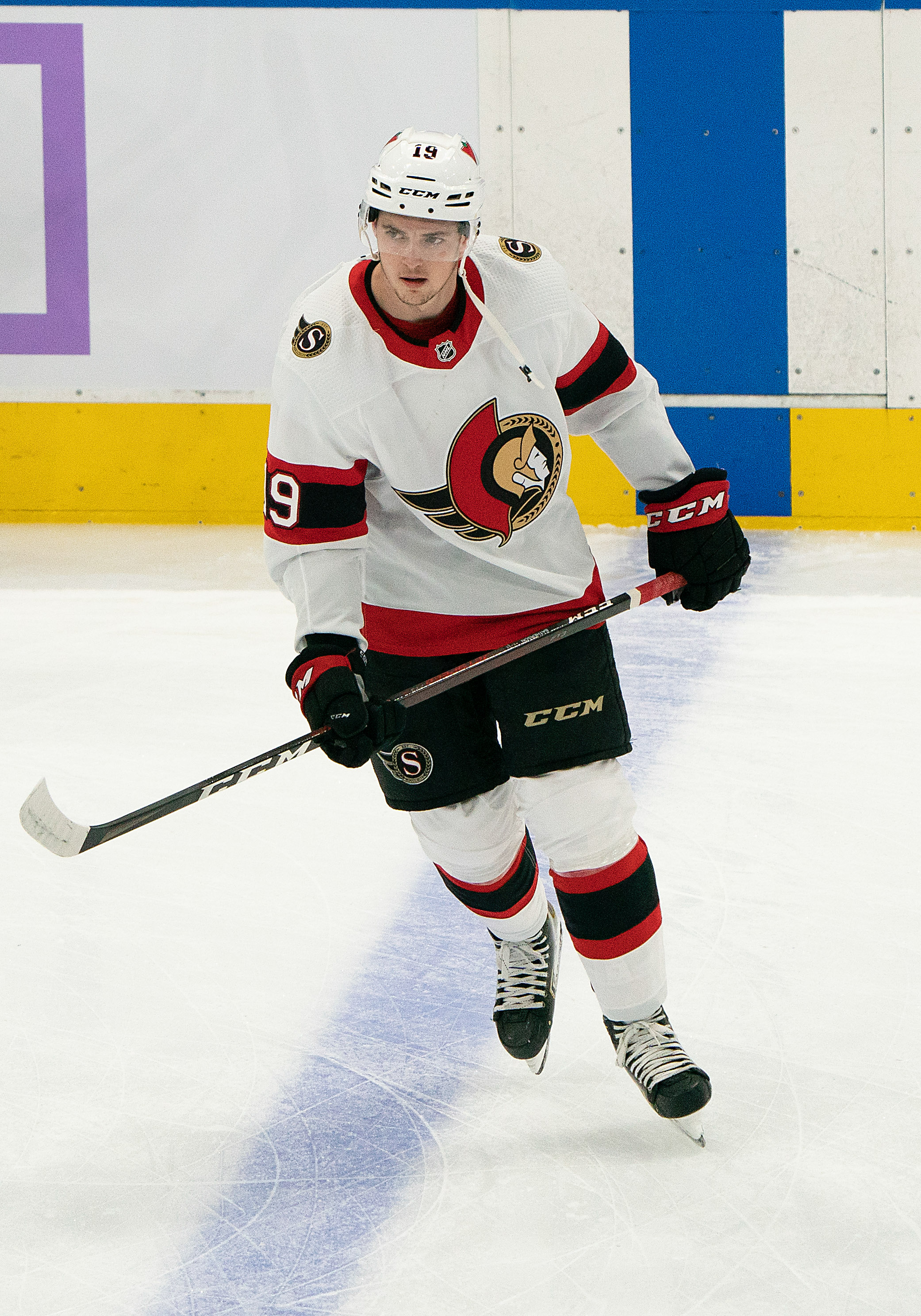 Widely recognized may not be entirely accurate as the Senators haven’t generated a ton of attention over the last few years, but there’s no doubt that Batherson was one of the team’s brightest stars this season. The 23-year-old forward scored 17 goals and 34 points in 56 games, showing that the outstanding offensive play he has produced at the AHL level could translate to the NHL.
Originally selected in the fourth round in 2017, Batherson has done nothing but score since he pulled on a Senators sweater. In 2018-19, during his first professional season, he registered 62 points in 59 games for the Belleville Senators and earned himself 20 NHL contests. In 2019-20 he put up 54 points in 44 AHL games while playing another 23 games with Ottawa. This year it was all the NHL, as he suited up for every game and finished just two points behind Brady Tkachuk for the team lead.
For fans of junior hockey, Batherson’s rise to the top of the Senators lineup won’t be surprising. Despite not competing much internationally as a young player, in 2017 he made the Canadian World Junior roster after an outstanding start to his QMJHL season and ended up scoring seven goals in seven games to help take home the gold medal.
He’s now getting rewarded with a healthy contract that buys out two unrestricted free agent years and keeps Batherson in Ottawa through his prime. As the team turns the corner on their rebuild and starts contending for a playoff spot, it will be young, homegrown forwards that lead the way. This deal takes him just ahead of Colin White to make Batherson the highest-paid forward on the team, though that will not likely last very long. Tkachuk still needs a contract of his own, and given the speculation about an eight-year deal, will certainly come in ahead of this $4.975MM AAV.
Normally contracts of this length come with plenty of risks, but for the Senators, who aren’t in the same zipcode as the cap ceiling, it doesn’t pose much of a threat. Sure, the team doesn’t really have the financial power to pay players more than what they’re worth, but betting on Batherson’s development is a worthwhile gamble at this point. Should he continue to improve, there’s a good chance he’s providing surplus value for several years of the contract as he grows into his own as a top-six player in the NHL. The Senators are still under the cap floor for the time being, though Tkachuk’s deal will soon fix that issue.
Photo courtesy of USA Today Sports Images
Jayce Hawryluk Signs In Sweden
For fringe NHL players sitting unsigned now into September, European offers are starting to look pretty tempting. For Jayce Hawryluk, it’s Sweden that will be the setting for the next chapter in his hockey career. The young forward has signed a one-year deal with Skelleftea AIK in the SHL.
Hawryluk, 25, played in 30 games for the Vancouver Canucks last season, taking his NHL total to 98 thus far. He was not issued a qualifying offer at the end of the year, making him an unrestricted free agent, and now he’s headed overseas to find playing time. It’s an interesting choice for a player who has substantial NHL playing time in each of the last three seasons, but it certainly doesn’t mean Hawryluk’s North American career is over.
Selected 32nd overall by the Florida Panthers in 2014 during an outstanding junior career, he has shown an ability to drive play in the minor leagues. In 2018-19, the last time he spent regular time in the AHL, he had 32 points in 31 games for the Springfield Thunderbirds. In fact, Hawryluk actually does have 27 points in his 98-game NHL career, pretty good production for a player that has averaged fewer than ten minutes of ice time. He’ll be a player to keep an eye on after his contract with Skelleftea expires, as a return to the NHL is certainly possible at some point, even as a depth player.
NHL Agrees To Olympic Participation
The NHL is going to the Olympics. The league sent out a memo to players today (via John Hoven of SiriusXM NHL) outlining their agreement with the IIHF and IOC to send NHL talent to the 2022 Olympic Winter Games in Beijing, China. There has been a break built into the schedule, allowing for players to depart North America on February 6. As Elliotte Friedman of Sportsnet reports, the league retains the right to withdraw participation if the COVID situation worsens or if their regular schedule has been disrupted by outbreaks, leaving no room to reschedule games.
The 2022 Games will be the first true best-on-best action since 2016, when the World Cup was held just prior to the start of the season. This will be the first time the NHL has participated in the Olympics since 2014, when Canada defeated Sweden for the gold medal. The tournament scoring leaders that year were Phil Kessel and Erik Karlsson, two players that would be hard-pressed to repeat that feat this time around.
Olympic participation was one of the sticking points in last summer’s CBA negotiation, though the league only agreed to work as hard as possible to find an agreement with the IIHF and did not guarantee the NHL would go. They have proven true to their word, securing insurance for the players at the cost of the IIHF. There is no COVID-related insurance, according to the memo, but the IIHF has created a $5MM fund to help cover lost NHL salaries for any athlete that contracts COVID at the event (provided they were following protocols at the time).
One note that may be of interest is the size of the rink. The Games will be played on regulation NHL-sized rinks and officiated by NHL referees and linesmen.
PHR Live Chat Transcript: 09/02/21
Click here to read a transcript of this week’s live chat with PHR’s Gavin Lee.
Louis Domingue Signs With Pittsburgh Penguins
The Pittsburgh Penguins have found a third-string goaltender, signing Louis Domingue to a one-year, two-way contract. The deal will carry an NHL salary of $750K and according to CapFriendly, a $300K AHL salary.
Domingue, 29, is the epitome of an NHL journeyman backup, having played for four different teams since 2019. It’s been several years since he was a tandem option, but does bring 140 games of NHL experience to the table, more than you can say for many of the league’s third-string options. That’s exactly what he’ll be if nothing else changes in Pittsburgh, where Tristan Jarry and Casey DeSmith are obviously ahead of him on the depth chart.
Quite removed from the goaltender that went 21-5 for the powerhouse Tampa Bay Lightning in 2018-19, Domingue represents a veteran option for the Penguins as they try to once again contend for the Stanley Cup. He cleared waivers in each of the last three seasons, so there is little risk of losing him unless a team finds themselves desperate at the end of training camp.
The question now is whether he can still be an effective option after playing so little last season. He appeared in just one game with the Calgary Flames and three with the Stockton Heat, spending most of the year on the taxi squad instead. His career save percentage of .904 is heavily weighted by early-career results, as he has just an .882 in 18 appearances since the end of 2018-19.
Minor Transactions: 09/02/21
The KHL season is underway and hockey in North America is right around the corner. As always, well keep track of all the notable minor moves as they come in.
- The Toronto Marlies have signed Zach O’Brien and Marcus Power to AHL contracts, bringing back two members of the Kelly Cup-winning Newfoundland Growlers group from 2019. Both forwards took their talents to Germany in 2020-21, lighting up the second tier of the DEL with EV Landshut. O’Brien recorded 40 goals and 83 points in 49 games, while Power had 29 goals and 69 points.
- Mitch Reinke, who actually played a single game in the playoffs earlier this year for the St. Louis Blues, has signed an AHL contract with the Wilkes-Barre/Scranton Penguins for 2021-22. The 25-year-old defenseman became a Group VI unrestricted free agent this summer after suiting up just twice for the Blues since starting his professional career. In 18 games for the Utica Comets in 2020-21, Reinke scored 12 points.
This page will be updated with further transactions
Buffalo Sabres Sign Henri Jokiharju
The Buffalo Sabres have locked up a second restricted free agent after inking Casey Mittelstadt to a three-year, $7.5MM deal earlier today. Henri Jokiharju has agreed to a deal with the same terms, signing through the 2023-24 season at a $2.5MM average annual value. PuckPedia reports the full breakdown:
- 2021-22: $2.4MM
- 2022-23: $2.5MM
- 2023-24: $2.6MM
Jokiharju, 22, was the player acquired from the Chicago Blackhawks in exchange for Alexander Nylander in 2019 and has played 115 games for the Sabres over the last two seasons. His performance in those games has been passable, though the young defenseman has still not taken the step forward some expected after making the NHL as a teenager in Chicago.
Selected 29th overall in 2017, Jokiharju was in the NHL by 2018, playing big minutes for the Blackhawks at the age of 19. In fact, he averaged 21:30 in his first 20 games in the league and racked up nine points. Unfortunately, the high ceiling he flashed during that stretch as a top-end two-way defenseman hasn’t been matched in the years since, with Jokiharju registering just eight points in 46 games this season in Buffalo.
Still, with the current situation of the Sabres, young talent that can hold their own at the NHL level will be given plenty of opportunities to show what they can do. With this contract Jokiharju becomes the only defenseman in the entire organization signed to a one-way contract for 2022-23, as Colin Miller, Will Butcher, Robert Hagg and Mark Pysyk are all scheduled for unrestricted free agency next summer. Rasmus Dahlin will join Jokiharju whenever his contract is finalized, as the two pillars to build around on the Buffalo blueline. Owen Power will likely join them before long, though he won’t be around to help when the season gets underway next month.
With Rasmus Ristolainen out of the picture, the path is clear for Jokiharju to log big minutes once again this year and prove that he is a legitimate top-four option at the NHL level. If he does, this contract will suddenly look like a steal; if he struggles, there’s not a ton of risk for the Sabres who won’t be anywhere near the cap ceiling as they continue a scorched earth rebuild.