
Offseason Checklist: Ottawa Senators
The offseason has arrived for three-quarters of the NHL for teams that either missed the playoffs or were eliminated in the first round. Accordingly, it’s now time to examine what they will need to accomplish over the coming months. Next up is a look at Ottawa.
Expectations were high for the Senators heading into the season. While they moved Alex DeBrincat, they brought in Vladimir Tarasenko to help cover DeBrincat’s production. They’d have a full season of Jakob Chychrun this time around and they hoped that Joonas Korpisalo would stabilize things between the pipes. Not much went according to plan, however, resulting in both GM and coaching changes. Steve Staios recently checked one big item off their to-do list with Travis Green being named as their new head coach but there is still plenty to work on in the coming months.
Add Defensive Help
On paper, the Senators have a solid top four on the back end but that hasn’t translated to much success on the defensive side of things. The last time they finished better than 20th in goals allowed was back in 2016-17; they were 26th in that regard this season. Part of that is goaltending – which has its own section coming up – but defensive structure has been a consistent issue for them. That was part of the reason Jacques Martin was brought in as the interim coach down the stretch, to help bring in some more defensive fundamentals.
When it comes to their back end, Ottawa has some openings for upgrades. Erik Brannstrom isn’t a guarantee to be tendered a $2MM qualifying offer with arbitration eligibility while Travis Hamonic is more of a seventh option at most at this point of his career. Jacob Bernard-Docker is still developing and could become a reliable defender at some point but his spot isn’t entirely secure either.
One complicating factor Staios might encounter is Chychrun’s situation. He’s entering the final year of his contract, one that pays a team-friendly $4.6MM. It’s going to cost considerably more than that to re-sign him, however, and Chychrun didn’t exactly give off the impression that he’s eager to sign a long-term extension this summer. If that is indeed the case, Staios might have to look at the possibility of moving him which won’t exactly help the state of their blueline.
There’s some reason for optimism when it comes to Ottawa’s back end. A return to health for Thomas Chabot should help things while continued improvement from Jake Sanderson is also likely. But even if they keep Chychrun, more help is needed. And if they don’t keep him, they’re probably going to need to try to dip into the free agent waters to try to replace him.
Re-Sign Pinto
It was a strange year for Shane Pinto. After being unable to come to terms on a new contract, he wound up being suspended for the first half of the season for violating the NHL’s sports wagering rules. The Sens then rescinded all previous offers and in the end, he had to settle for the pro-rated league minimum upon being cleared to return, an amount that was lower than his qualifying offer last summer.
To his credit, Pinto didn’t show any signs of rust upon his return in January. Instead, he became an impact player right away and recorded nine goals and 18 assists (a career-high) in the final 41 games while seeing his ice time jump to over 18 minutes a night.
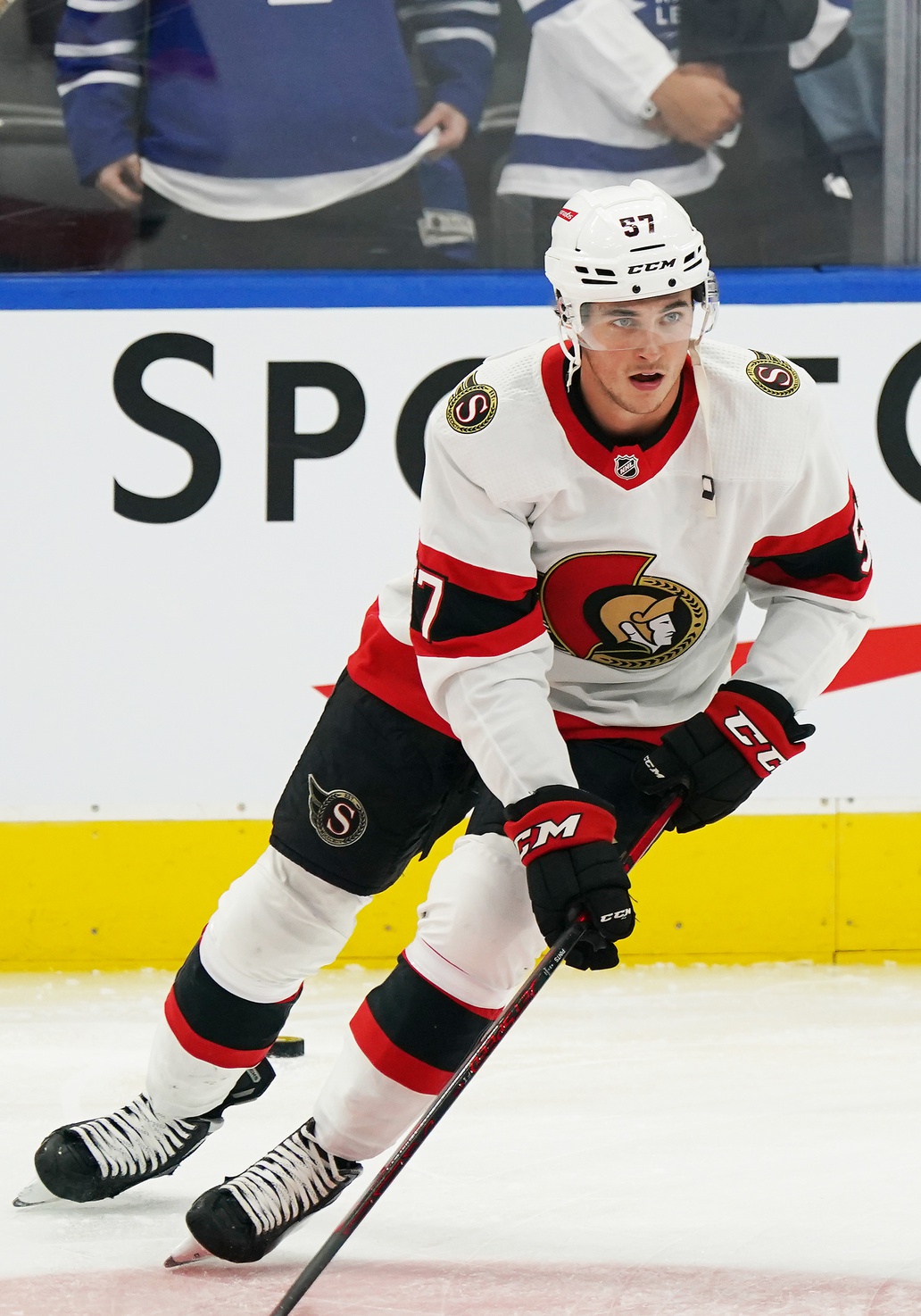 Now, Pinto finds himself in exactly the same situation as he did a year ago. He’s a restricted free agent and still doesn’t have salary arbitration rights. He also didn’t truly get the chance to prove that his 20-goal, 35-point showing wasn’t an outlier as while he impressed in the final three months of the year, it’s still only a half-season sample size.
Have the Sens seen enough to commit a long-term agreement to him? If they’re trying to buy extra years of club control, that should push the AAV past at least the $5MM mark, possibly even past the $6MM threshold on a max-term deal. He’s 140 games into his NHL career, however, with just 70 points to his name. Suffice it to say, going that approach comes with some risk, albeit with a higher reward if he’s able to establish himself as a full-time top-six middleman.
With Ottawa’s cap situation and the fact they have other needs to fill, the safer route might be the one they ultimately take which would be a bridge deal. Pinto is still four years away from UFA eligibility so they could work out a two-year agreement in the $3MM-plus range, giving him an opportunity to demonstrate that he can maintain that level of production over a full season and giving Staios a chance to address some other needs in the coming months.
Look For Goalie Upgrade
On top of looking for help on the back end, Staios should also be looking for an upgrade between the pipes. This has been somewhat of an annual exercise in recent years as former GM Pierre Dorion tried several different options, none of which have panned out as well as they hoped for.
Last summer, they brought in Korpisalo on a five-year, $20MM contract. Both the term and price point seemed particularly high for someone who had to take a greater than 50% pay cut the year before. Having said that, there was a bit of an upside play with the contract if he could have maintained his level of performance from 2022-23. He didn’t. Instead, Korpisalo’s numbers were worse than his career averages, resulting in some very inconsistent play from their starter. With four years left on that deal, it’s hard to see there being much of a trade market for him.
Anton Forsberg, who they thought could be part of their longer-term plans after a breakout year in 2021-22, has also struggled the last couple of years. He doesn’t have much trade value either but he’s at least on an expiring contract so his spot is the one they can try to upgrade on.
Yes, Mads Sogaard is waiting in the wings (and needs a new deal this summer) but he has another year of waiver exemption left so they can keep him stashed at AHL Belleville getting as much playing time as possible. He’s undoubtedly part of the longer-term plans but for 2025-26 and beyond.
That’s a small window for Staios to work with as they’ll either be looking for a one-year deal in free agency or trying to trade for one on an expiring contract, using Forsberg’s $2.75MM as an offset. They’re probably not getting a legitimate starter in this scenario but someone with a track record of even consistently average goaltending would help to shore up a long-standing weakness and would go a long way toward trying to get them back into the playoff picture.
Consider Core Shakeup
On paper, the Senators have a pretty strong core of now-young veterans who were supposed to represent the anchor points of their rebuild and help move them past it. Despite that, it hasn’t exactly led to much offensive success. The last time the Sens were in the top half of the NHL in goals scored was back in 2015-16 when none of their current players were in the fold.
At first glance, there’s reason to believe that there is room for internal growth and they’ll be banking on Green helping make that happen. But should they run it back with the same core group and hope that Green taking over and the team ideally staying healthier – particularly Josh Norris – will be enough of a difference to get them into the postseason?
There are cases to be made both for and against doing that. This team should be better than it has been based on the talent it has assembled. It’s certainly plausible that one day, things will come together. And if it does, they’ll have some key pieces on market-value (or below market-value) deals for multiple years to come. That’s a good spot to be in.
On the other hand, at some point, running the same core group out there and simply hoping things will work out better this time around has its risks. It also doesn’t generally have the greatest track record of success. And this is Dorion’s core group so it stands to reason that Staios might want to put his own stamp on the team.
Fortunately for him, if he does want to shake up the core, the majority of their core pieces are on deals that already are or should be team-friendly at some point. The exception would be Norris due to injuries but if he can stay healthy, that can still change. That will give him options as most of the core players would have several suitors, positioning them to receive a significant return. Would a move like that help or at least be worth trying? That’s what Staios and his management team will need to decide in the coming weeks.
Photo courtesy of USA Today Sports Images.
Offseason Checklist: NHL Utah
The offseason has arrived for three-quarters of the NHL for teams that either missed the playoffs or were eliminated in the first round. Accordingly, it’s now time to examine what they will need to accomplish over the coming months. Next up is a look at Utah.
The hockey operations staff that formerly comprised the Arizona Coyotes entered the 2023-24 campaign looking to take a measured step forward. They’d last made the playoffs in 2012, excluding the COVID bubble, and had already seen one season of improvement under head coach André Tourigny.
Early on, it looked like they may have had a prayer of ending their playoff drought, keeping pace in the wild-card race with a 19-14-2 record on New Year’s Day. Without a suitable arena plan in place by the All-Star break, though, relocation rumors again surged and, as players and staff have since admitted, fueled a long run of losing play.
They still ended the season with a respectable 36 wins, their most since 2019, and look a step closer to playoff contention. Under new ownership in Utah and a relatively endless supply of cap space and draft picks this summer, general manager Bill Armstrong has the opportunity to accelerate the yet-to-be-named roster’s rebuild in a big way.
Take Care Of Their Own
As a result of their previous situation, Utah has one of the lowest amounts of standard player contracts signed for next season in the league (22). That impact is felt mostly on defense, where not a single NHL-ready player is signed for 2024-25.
The good news is only two of their NHL regulars on the back end, Josh Brown and Travis Dermott, are unrestricted free agents. Everybody else is under team control, including their youthful top pairing of Sean Durzi and J.J. Moser.
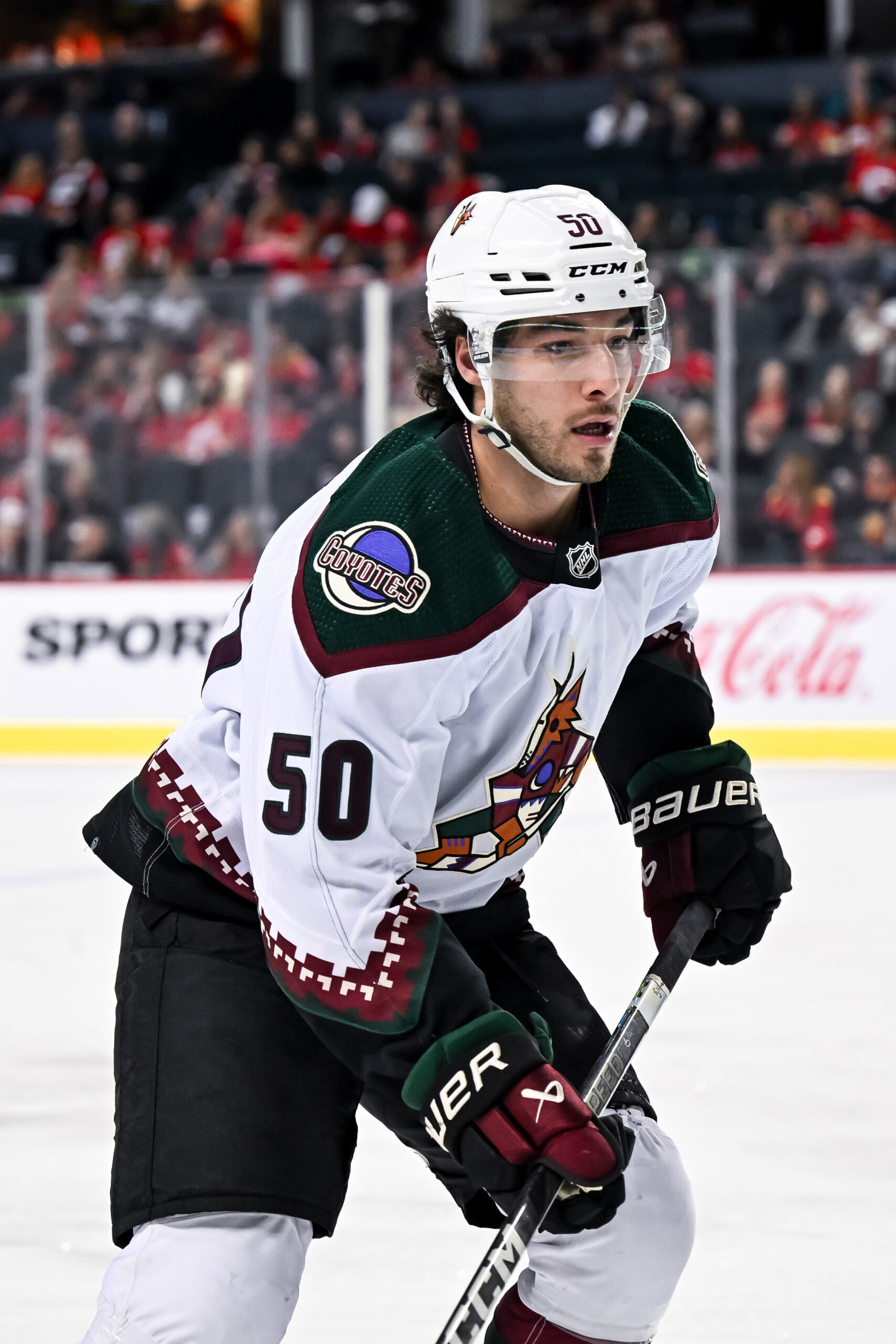 The former relished the opportunity of being the Coyotes’ number-one defenseman last season, his first in the desert after they acquired him from the Kings last June. He responded with a career-best 41 points and a -1 rating in 76 games, averaging 22:43 per game and quarterbacking their top power-play unit. His possession impacts at even strength were among the best on the team, and while he may not be a long-term number-one guy on a championship team, he solidified his status as a first-pairing piece for the present. Evolving Hockey projects Durzi to receive a four-year deal worth around $5.9MM per season, an agreement both sides should be happy with.
Moser, who was also solid this season with 26 points in 80 games riding shotgun with Durzi, also needs a new deal. The 23-year-old has completed his entry-level contract. Michael Kesselring and Juuso Välimäki, who each held top-four roles for a decent chunk of the season, are also RFAs.
Utah has much less contractual work to do with their forwards. Among NHL regulars, only Barrett Hayton is an RFA, while enforcer Liam O’Brien is headed for unrestricted free agency but seems a good bet to re-sign. Nonetheless, gearing up for a big offseason spending spree will require a better indication of what their salary cap picture will look like with their RFAs and other returning players taken care of – especially if Armstrong and owners Smith Entertainment Group plan on gracing the $87.7MM upper limit.
Land An Impact Defenseman
The Coyotes’ biggest improvement last season was their offense. Ranking 16th in the league at 3.10 goals per game, it was certainly good enough to get them into the playoffs if their defense saw a marked improvement from last season.
Obviously, that wasn’t the case. Outside of Durzi and Moser, it was a rough go for most Coyotes blue-liners last season. Even Välimäki and Kesselring had some good moments throughout the year, but other regulars like Dermott and Mathew Dumba, prior to his trade to the Lightning, were bleeding quality chances against on a nightly basis.
Reports earlier in the month indicated that a top-four defenseman, along with a second-line center and a top-six winger, was on Armstrong’s shopping list for Utah’s roster this summer. A cursory look suggests it should be his biggest priority.
Kesselring and Välimäki proved last season they could stay afloat, each logging possession metrics slightly better than the team average. But having both of them in a top-four isn’t ideal, especially with a solid but pedestrian first pairing in Durzi and Moser. Adding a right-shot defenseman to complement Välimäki to slot in behind Durzi on the depth chart, allowing Kesselring to be increasingly effective in third-pairing minutes, would have a considerable domino effect. Can Armstrong land a Brett Pesce or Matt Roy on the UFA market? He’ll certainly have the cash.
Complement Cooley
Priority number two behind adding a defenseman among Armstrong’s already-dictated targets is adding a complement for Logan Cooley as a top-six center. The 2022 third-overall pick struggled early on in the season, getting caved defensively and failing to drive play, but settled in throughout the season en route to a solid 20-goal, 44-point rookie campaign. Averaging nearly 16 minutes per game, he’s not quite ready to be a bonafide first-liner between Clayton Keller and Nick Schmaltz, but he’s getting there. They’ll need some help to avoid overextending him too early in his career, though.
Adding a 1B center who can split top-six duties with Cooley would allow Nick Bjugstad and Hayton to center the club’s third and fourth lines, suddenly creating extremely solid depth considering they both rose to the occasion when relied upon for top-six usage this season. They can occupy top-six minutes to ease the burden on Cooley if necessary, but it’s not ideal if Armstrong and Smith believe playoffs should be in the conversation for Utah in 2024-25. The production wasn’t there for Hayton, who had just three goals and 10 points in 33 games despite spending most of his time when healthy next to Keller, but his 54.9 CF% at even strength was the best on the team, and he looks to be a reliable, two-way pivot to anchor their third line in the long term.
Jack McBain is also in the mix at center but, like the others, is much more comfortable in a bottom-six role. There aren’t many bonafide top-six options on the free agent center market this summer, so if Armstrong is looking to leverage some of Utah’s many upcoming second-round picks, it would be wise to do so.
Image courtesy of USA Today Sports.
Offseason Checklist: Montreal Canadiens
The offseason has arrived for three-quarters of the NHL for teams that either missed the playoffs or were eliminated in the first round. Accordingly, it’s now time to examine what they will need to accomplish over the coming months. Next up is a look at Montreal.
With the Canadiens still in the build-up portion of their rebuild, expectations were still low heading into the season. They finished in the same spot as the year before – 28th – while making marginal improvements in goals, goals allowed, and points. With them now missing the postseason three years in a row after making the Cup Final, expectations should start to creep higher now with the team likely to try to emerge from its rebuild soon. Accordingly, GM Kent Hughes will likely be looking to make some moves both for the future and next season.
Clear Defensive Logjam
The Canadiens have one of the deeper defensive groups in the league when it comes to team depth. They’re only a year removed from dressing four (and sometimes five) rookies in a game but until the next wave was ready to push for playing time, they didn’t necessarily have to make a move.
That next wave is now pretty close to being ready. Jayden Struble was expected to be in the minors this season but wound up playing 56 games with the big club. Lane Hutson and Logan Mailloux both received a taste of NHL action down the stretch and held their own. David Reinbacher, the fifth-overall pick last spring, will play full-time in North America next season and should see a handful of games at a minimum.
A total of eight blueliners played at least 44 games for Montreal this season. All are either under contract or controllable through restricted free agency. Even without the prospects being on the verge of pushing for roster spots, there was already a bit of a logjam. But if they think one of Hutson or Mailloux is ready for full-time duty or close to it, they might be inclined to look at moving two of their blueliners.
Some expect David Savard, a 2025 unrestricted free agent, to be moved but they could elect to hold him until closer to the trade deadline to keep him working with the young core as long as possible. At first glance, Jordan Harris could be the odd one out. The 23-year-old can play on both sides, is signed for one more year at an affordable $1.4MM, and can log upwards of 18 minutes a night. Speculatively, Justin Barron could also be in play as he’s now waiver-eligible and can’t be returned to the minors as he was for most of the second half of this season. A pending RFA, the 22-year-old was a former first-rounder and has close to 100 career NHL games under his belt which should give him good value if they decide to move him.
Extension Discussions
Last offseason, the focus was on Cole Caufield’s contract as he was entering RFA eligibility for the first time. They don’t have anyone quite as impactful needing a new deal this time around which should position Hughes to turn his focus to trying to sign a pair of key youngsters to early extensions.
 At the beginning of the season, Juraj Slafkovsky struggled mightily to the point where many felt he should have been assigned to the minors. Instead, Montreal went the other way and put him on the top line and things clicked for him from there. The top pick in 2022 went on to put up 35 points in the final 40 games of the season, moving him from a sure-fire bridge candidate to one they’ll likely try to sign long-term. Given Montreal’s salary structure, it’s reasonable to infer they’d prefer to slot him behind Nick Suzuki whose deal checks in at $7.875MM per season. However, with what first-overall picks typically get on long-term agreements (generally more than this), will he be amenable to that or will he push for more? If it’s the latter, it wouldn’t be surprising to see the two sides wait until the 2025 offseason to see if his second half was an outlier or a sign of things to come.
The other notable extension-eligible candidate is Kaiden Guhle. The 22-year-old blueliner made the jump from junior two years ago and has logged over 20 minutes a night in his first two seasons. With a bit of a limited offensive game, his earnings ceiling will be limited but he could still push past $6MM per season on a max-term deal. Having said that, Guhle has battled injuries both years so an extension would be somewhat of a shared risk scenario. Guhle would be risking leaving some money on the table if he’s able to stay healthy and have a big year next season while Montreal would be risking a significant commitment to a thus-far injury-prone player but if he stays healthy, they could potentially get him at a team-friendly rate. Seeing if there’s a number where both sides are content should be fairly high on the to-do list.
Add Scoring Help
The last time Montreal finished in the top half of the league in goals scored was back in 2018-19. They’ve finished 26th the last two seasons and 27th the year before that. Only two players scored more than 20 goals this season, Suzuki and Caufield. Even if they feel the top line from the second half of the year (those two with Slafkovsky) is a legitimate top trio, they need a lot of secondary scoring behind them.
The return of Kirby Dach should help after he missed almost the entire season with a knee injury while they will bank on Alex Newhook taking another step forward in his development. Accordingly, it’s reasonable for them to hope that some improvement will come internally. That said, internal improvement alone won’t be enough to propel them back into a playoff race let alone the actual playoffs.
Under this management group, the Canadiens have avoided adding players in free agency, preferring to build via the trade market. They’ve flipped a first-round pick in back-to-back years to add Dach and Newhook and, armed with an extra first-rounder again for next month’s draft, many expect them to do so again, whether that’s for another player of that ilk or as part of a bigger swing.
Beyond that, this might be the time for them to look at a shorter-term unrestricted free agent as well, one that can augment the scoring depth for a few years and serve as somewhat of a mentor to what is a fairly young group. Having said that, they will have a decision to make before July 1st if they intend to go that route.
Escape Or Utilize LTIR
Two years ago, Montreal elected to go into offseason LTIR, giving them the flexibility to take on Sean Monahan from Calgary, receiving a 2025 first-round pick for their troubles. That worked out well for the Canadiens considering they signed him to a cheap one-year deal last spring and then flipped him for another first-rounder earlier this season.
Last summer, they elected not to do that, instead waiting until in-season to put Carey Price on LTIR. That move gave them more flexibility but they then didn’t do much of anything with that flexibility.
Accordingly, that might not be the best approach to take this time around. Price still has two years left on his $10.5MM contract although his playing days are over. Flipping him will be difficult considering there is still $11MM in signing bonuses still left to be paid on it.
So, Hughes needs to determine if he wants to go back into offseason LTIR or not. If he does, they could be players either in free agency or perhaps taking on a short-term pricey contract as they did with Monahan two years ago. Even with the cap set to rise by more than $1MM this time around, there will be teams looking to move out some salary. The benefit would be more future than current as they’d likely be compensated with a draft pick but if they’re not in a spot where they think they can push for a playoff spot – which would be a lofty goal – then they wouldn’t be concerned about that.
If they don’t want to go into offseason LTIR, it might be worth them trying to dip out of it altogether. They currently have about $78.6MM in commitments, per CapFriendly, with Barron and Arber Xhekaj being the only two RFAs on the roster who could command a seven-figure contract. That would still leave them room to try to add a piece while also staying under the cap ceiling (meaning Price would be on regular IR), allowing them to bank money for in-season flexibility or to try to avoid incurring a seven-figure bonus overage for the third straight year, a move that would help them cap-wise heading into 2025-26. They’ll want to have their direction picked out by the time free agency opens up.
Photo courtesy of USA Today Sports Images.
Big Hype Prospects: Eiserman, McKenna, Hemming, Beaudoin
The 2024 World U18 Championships have ended with a bang, with Team Canada scoring four goals in the final 10 minutes of the Gold Medal game against Team USA. The charge was led by the incredible pairing of star prospects Tij Iginla and Gavin McKenna, who combined for four of Canada’s six goals. The duo headlined what was a historic U18 tournament worth breaking down. So we’ll once again borrow the Big Hype Prospects series from MLB Trade Rumors and take the time to break down some of the top performers from one of the best pre-draft tournaments of the season.
Four Big Hype Prospects
Cole Eiserman, RW, USA U18 (NTDP)
56 GP – 57 G – 31 A – 88 TP – 6 PIM – 6 +/-
There were some amazing records broken during this year’s U18s. Cole Hutson (2024) became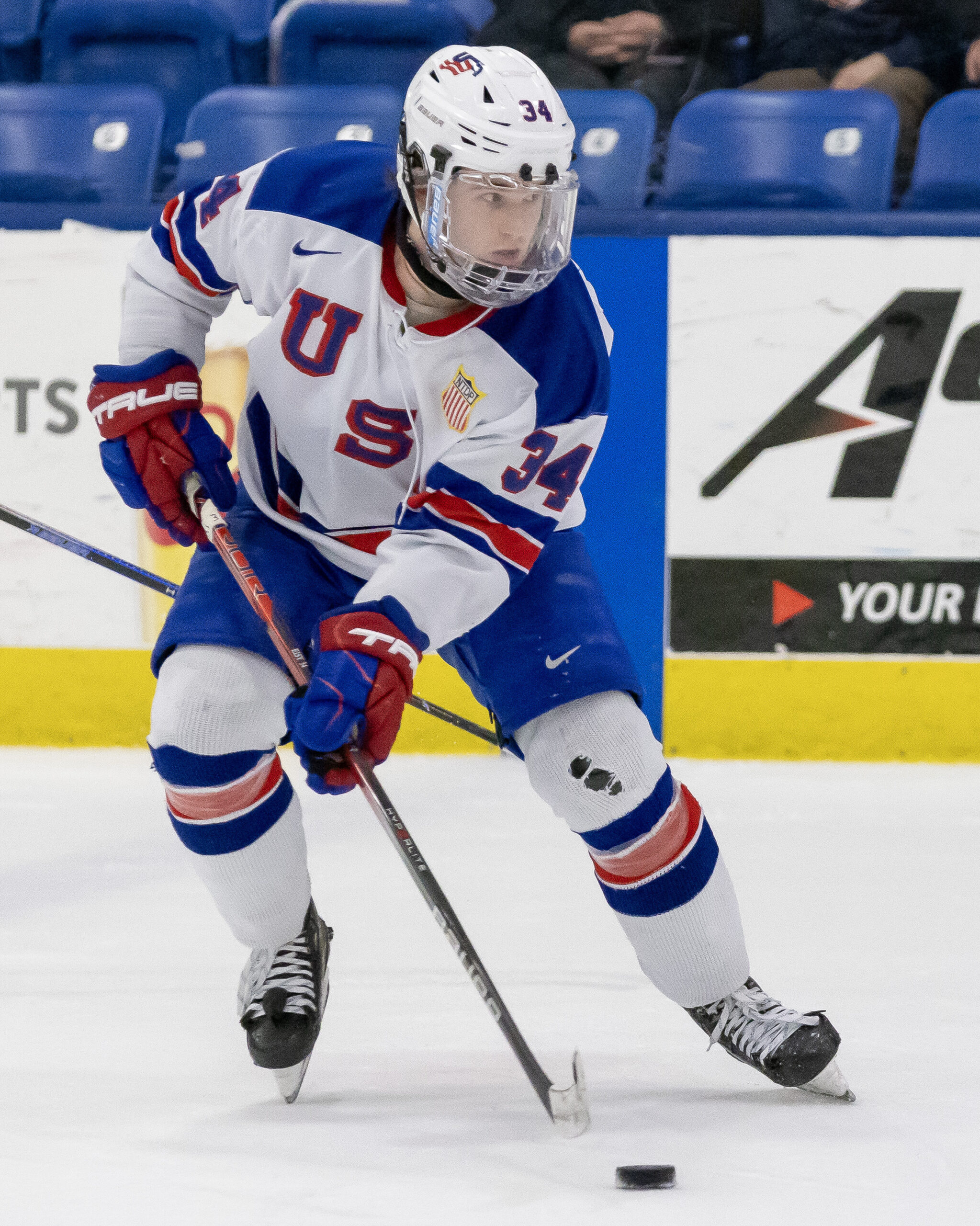 the highest-scoring defenseman in National Team Development Program history, James Hagens (2025) broke Nikita Kucherov‘s tournament scoring record, and Gavin McKenna (2026) became the highest-scoring Canadian in the event’s history. But it’s Cole Eiserman‘s shattering of the NTDP’s goal-scoring record that sticks out as the most pertinent. Eiserman has totaled 127 goals in 119 games with the U.S. NTDP, breaking Cole Caufield‘s record of 126 goals in 123 games. Eiserman now sits atop a highly decorated list, after scoring at a dazzling 1.07 goals-per-game pace. And yet, he faces undoubted questions ahead of the 2024 Draft – with many doubting Eiserman’s consistency and energy off the puck. Eiserman certainly showed the intensity he can bring at U18s, looking like America’s most effective forechecker in their semi-finals matchup with Team Slovakia. But he struggled to bring the same north-to-south pressure consistently, and was even held without a goal during USA’s bouts with Switzerland and Finland – a rarity for Eiserman. He’s been a star since he was nine-years-old, looking like the standout in a Brick Invite that featured multiple members of Team USA and Team Canada’s lineup. Having the spotlight for that long places a heavy weight on draft-year prospects – made evident by Oliver Wahlstrom‘s continued growth. Eiserman will face similar challenges, as he tries to build out the rest of his skillset around a goal-scoring ability that’s historically-great.
Gavin McKenna, LW/RW, Medicine Hat (WHL)
61 GP – 34 G – 63 A – 97 TP – 21 PIM – -4 +/-
The U18s skyrocketed the draft stock of many of 2024’s top prospects. But it was the 2025 and 2026 classes that had the strongest showings – with Hagens and McKenna fighting to one-up each other every single game. And while Hagens took home the tournament’s MVP award, it was McKenna’s hat-trick that sealed Canada’s Gold Medal win. The performance was a perfect close to what’s been an amazing season for McKenna, who came just three points shy of cousin Connor Bedard‘s WHL U17 scoring record. McKenna is an incredible prospect who simply sees the game quicker than anyone else. He’s able to work the puck through the smallest of gaps and make hockey moves in the tightest of spaces, helping him cut around defenders and score from anywhere. McKenna never stops moving, either – making sure he makes a mark every single shift and standing up to the call for added minutes when his team needs him. He is simply a star – and one that isn’t draft-eligible for another two seasons. There’s no telling just how good he’ll be if this is where he’s at at 16. Medicine Hat may have had an early exit this season, but they’re undoubtedly eager for next year – and the prospects of reuniting McKenna with top 2024 prospects Cayden Lindstrom and Andrew Basha.
Emil Hemming, LW, TPS (Liiga)
40 GP – 7 G – 4 A – 11 TP – 0 PIM – 3 +/-
Looking away from the glitz-and-glamor of this year’s tournament, it was maybe Emil Hemming who showed the most pro-ready traits. He was incredibly smooth all tourney, making plays cleanly and confidently in the offensive zone and using slick skating to create space off of defenders. And he had plenty of chances to show off just how hard his shot was – with opponents giving him plenty of space at the tops of the circles. The tournament was an encouraging showing from Hemming, who’s looked prone to playing slow or unengaged in the Liiga. But that’s a pro league – and among his peers, Hemming made crisp plays and matched pace beautifully. He’s showed pro-ready traits all season, flexing strong positional awareness and working with teammates well, but Hemming’s newfound tempo could be a substantial boost to his hefty style. Hemming has been considered a first-round prospect for much of the season, but his responsible and reliable U18s could now push him into the high-20s for teams looking for impact players sooner rather than later.
Cole Beaudoin, C, Barrie (OHL)
67 GP – 28 G – 34 A – 62 TP – 27 PIM – 2 +/-
If any player were to rival Hemming’s title as the U18’s most impactful power-forward, it’d be Cole Beaudoin – who looked absolutely locked-in in every one of Canada’s games. Beaudoin is another hefty forward, who made up for a lack of speed with an unmovable strength and frame. He’s powerful in every aspect of his style, driving down the boards hard and doing well at taking opponents out of play with big hits. Beaudoin was a dynamic penalty killer too, squaring up to opponents well and using a quick, long reach to break up plays. Combined with his heavy frame and sharp processing, Beaudoin was simply hard to beat at the U18s. He was a key matchup against Team USA’s Hagens and Eiserman, and shut both players down well. While his offense could certainly be more inspiring, Beaudoin’s ability to shut down play and win back possession in his own zone could be strong enough to get some NHL teams looking at him early.
Photos courtesy of USA Today Sports.
Offseason Checklist: Columbus Blue Jackets
The offseason has arrived for half of the league’s teams that aren’t taking part in the playoffs plus several others who have already been eliminated. Accordingly, it’s now time to examine what they will need to accomplish over the coming months. Next up is a look at Columbus.
After a tough 2022-23 season, there was supposed to be some reason for optimism for the Blue Jackets this year. GM Jarmo Kekalainen picked up a pair of impactful defensemen while some younger players were expected to take the next step. Mike Babcock was brought in as head coach to help shepherd the team back towards competitiveness at a minimum.
By now, you know what happened next. Babcock was gone before ever coaching a game, resulting in Pascal Vincent, a first-time bench boss, taking over behind the bench. The team then battled a litany of injuries throughout the year while there was some inconsistency in the performances from their young core, resulting in just a seven-point improvement while once again finishing last in the Metropolitan Division. Eventually, Kekalainen was ousted with a lengthy search for his replacement underway. That headlines a busy checklist for Columbus this summer.
Hire A GM, Make Coaching Decision: Let’s get the obvious one out of the way first. Before the team can do any sort of heavy lifting, they need to hire Kekalainen’s replacement. While team president John Davidson is handling the day-to-day operations for the time being, they can’t run with an interim option for too much longer.
The belief is that they’ve cast a very wide net as they look for a replacement with experience being a key characteristic they’re looking for. However, that doesn’t have to come in the form of NHL GM experience but rather someone who has a lot of time working in an NHL front office.
Once they get that hire in place, the first decision that will need to be made is on the coaching front. Vincent has one year left on his contract; is he going to be their coach of the future and get an extension? Will the new GM want to make their own hire? Or will they opt to stick with the status quo and keep Vincent in place in his walk year, allowing for extra time for evaluation with perhaps a reshaped roster? Knowing this is the time of year when most coaching searches are completed, it’s important to get this file closed quickly which means a general manager needs to be hired sooner than later.
Upgrade In Goal: One of the ideas behind Kekalainen’s additions of Ivan Provorov and Damon Severson last summer was that an upgraded back end would go a long way toward helping stabilize things between the pipes. Elvis Merzlikins was coming off a disastrous year while Daniil Tarasov – now the full-time backup after Joonas Korpisalo was moved at the trade deadline – didn’t have much NHL experience so there was certainly some logic in the idea that a better defense corps would benefit the goaltenders.
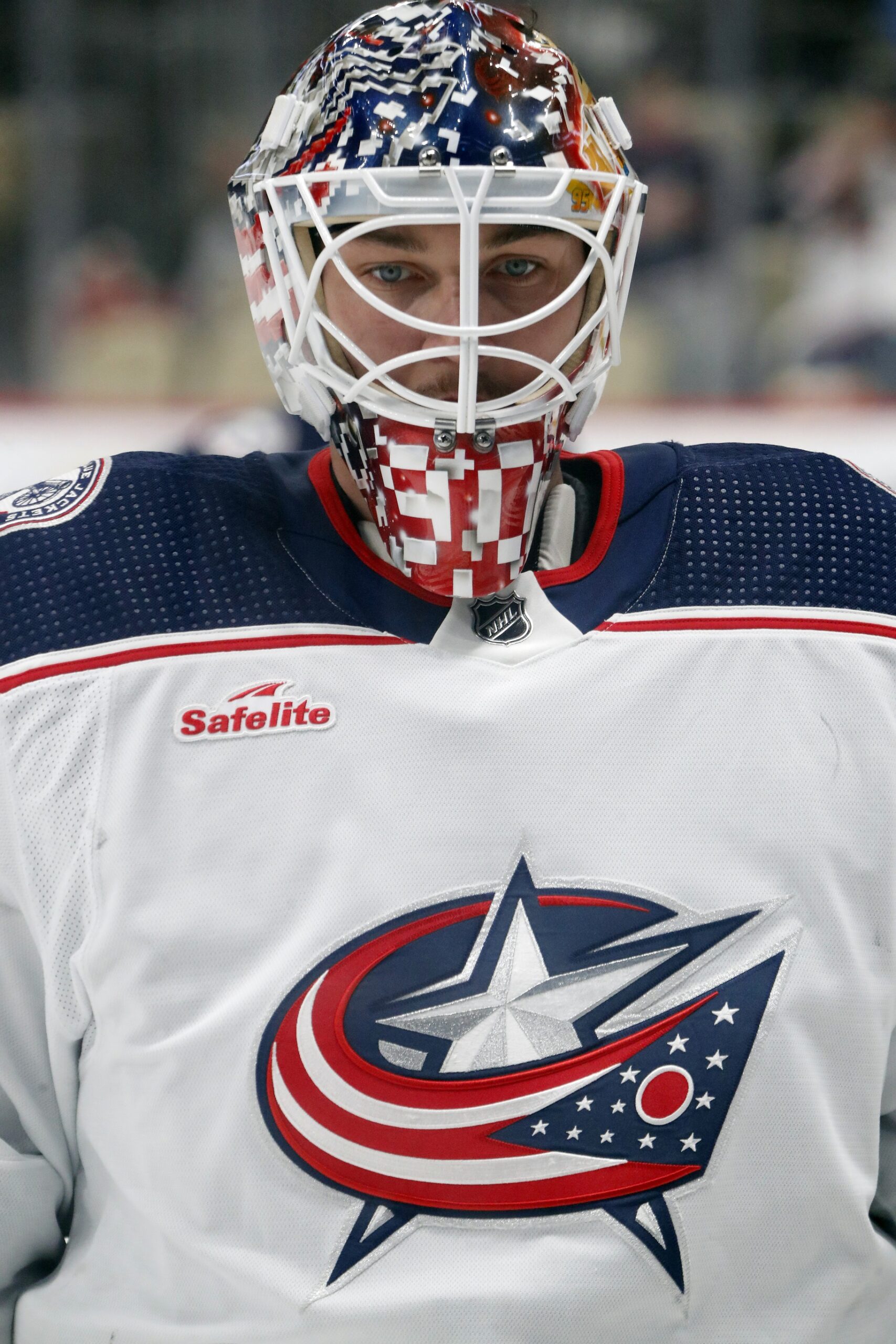 Despite the good intentions, the results weren’t much better. Yes, Merzlikins improved his save percentage by 31 points this year compared to last. However, he still checked in at .897, well below average for one of the higher-paid starters in the league. Meanwhile, Tarasov improved his rate by 16 points to .908 but he still has just 45 career NHL appearances under his belt. He could be part of the future plans for them but he’s not ready for the number one role.
However, Merzlikins’ performance over the past couple of years has shown that he’s not a viable option for the number one role either, at least not with Columbus. Accordingly, it would be quite difficult to run it back with this tandem and expect any sort of material improvement in the standings.
The good news for Columbus is that it looks like this could be a summer where there is more activity than normal on the goalie transaction front with some notable names in play. While it’s unreasonable to think they’ll be in the mix for the likes of Jacob Markstrom and possibly Juuse Saros, there should be a domino effect once the swaps begin, potentially giving them an opportunity to try another starter.
They’re not in a situation where they’ll be able to get good value for Merzlikins. Frankly, they might not be able to get any value for him. But if they want to try to take a step forward next season, it may very well be in the best interest of both sides to have a new starter in place working with Tarasov when the puck drops in October.
Defensive Decisions: After making some big moves last summer on the back end, whoever takes over as GM will have some decisions to make and could look to shake things up again.
Is Provorov going to be part of their long-term plans? The change of scenery didn’t kickstart his game from an offensive standpoint although he had a decent year overall. But he’s entering the final year of his contract with a $6.75MM AAV (the Blue Jackets are only responsible for $4.75MM of that) and will likely be looking for a long-term agreement around that price tag. If he’s not willing to sign or the team isn’t ready to make that type of commitment, it might make sense to see what is available for him this summer over an in-season swap closer to the trade deadline.
Another decision will have to be made on the RFA front with Jake Bean. A couple of years ago, it looked like he was going to be a key part of their future plans after putting up 25 points in 2021-22 while logging over 20 minutes a night. However, since then, he has struggled to stay healthy and when he has played, he has had a much more limited role, predominantly on the third pairing. The 25-year-old has one year of club control remaining but to use it, the Blue Jackets would have to tender him a $2.9MM qualifying offer and give him arbitration rights. Would that money be better utilized elsewhere? They’ll have to decide by the end of June.
Whoever takes over as GM will also likely pick up the efforts to move Adam Boqvist. Brought over as part of the Seth Jones trade, the 23-year-old has shown flashes of being an above-average producer from the blueline but struggles with injuries and defensive zone issues have limited him thus far. He played in just 35 games this season which isn’t ideal considering he’s carrying a $2MM cap charge. With David Jiricek expected to make a full-time jump to the NHL next season and Nick Blankenburg no longer waiver-exempt, something has to give roster-wise. Moving Boqvist would help ease the roster crunch.
On top of those, trying to upgrade the back end should also be on the to-do list if the new GM comes in and elects to keep pushing forward with this core. It was a busy offseason last year for defensive activity and this one could be as well.
Bridge Or Long-Term Deals: The Blue Jackets have several young forwards in line for their second contracts this summer – centers Cole Sillinger and Kent Johnson along with winger Kirill Marchenko. While a long-term contract for any of them would likely be an overpayment at the beginning, it could also be a bargain later on if they pan out as expected. With a young group, balancing things out with some long-term agreements among the short-term bridge ones makes sense from a salary cap perspective.
Sillinger had a nice bounce-back season after a rough sophomore campaign. The 20-year-old set new career bests in assists (19) and points (32) while making strides as a two-way player. If they think he’s poised to take a big step forward offensively next season, they could take a look at trying to work out a longer-term deal although a bridge agreement feels like the more probable outcome.
The same can be said for Johnson whose second full professional season had some struggles. After putting up 40 points in his rookie year, he notched just six goals and ten assists in 42 games this year with a shoulder injury ending his campaign early. Had he been able to take a step forward, he’d have been an easy candidate for a long-term pact but now, both sides need more time to evaluate things.
As for Marchenko, he very quietly led the Blue Jackets in goals this season with 23, his second straight 20-goal campaign after notching 21 in his rookie year. Consistent scoring threats are hard to come by, particularly on a Columbus team that has underwhelmed offensively; they’ve only been better than 25th in goals once over the last five seasons. A longer-term agreement shouldn’t break the bank with some comparables around the league checking in around the $5MM-plus range. If that’s something Marchenko is amenable to, that’s a deal that could work out well for both sides.
Photo courtesy of USA Today Sports Images.
Offseason Checklist: Anaheim Ducks
The offseason has arrived for half of the league’s teams that aren’t taking part in the playoffs plus several others who have already been eliminated. Accordingly, it’s now time to examine what they will need to accomplish over the coming months. Next up is a look at Anaheim.
As expected, this season was a rough one for the Ducks who didn’t exactly improve their fortunes much from 2022-23. While they finished seventh in the Pacific instead of last, they only had one more point than the year before with a mixed bag of performances from their young core. GM Pat Verbeek made one big move to shake up that core in-season when he moved Jamie Drysdale to Philadelphia and it’s quite possible that another significant swap could be on the way. That’s one of the items on their checklist for the coming months.
Add Impact Pieces: Verbeek indicated in his end-of-season press conference that he’s looking to add some impact players this summer, including a top-six forward and a top-four blueliner so let’s start here. They did this last offseason, signing Alex Killorn to a four-year, $25MM contract and Radko Gudas to a three-year, $12MM deal. Both players got a bit more money than expected but they felt the overpayment was worth it to get them into the fold.
While they could look to add those types of players again over the summer (bringing in veteran leaders to fill a specific role and overpaying a bit in terms of AAV), it wouldn’t be surprising to see them try to aim a little higher this time around. Instead of culture builders, they could look to add more productive pieces to take some pressure off the young core and then when that core is a bit more ready in a couple of years, they’ll be a deeper team which should line up with when they want to try to get back into contention.
Additionally, Verbeek will likely want to add to Anaheim’s bottom-six group as well. They tried several younger players with varying levels of success this past season but if they intend to try to be more competitive, bringing in a veteran that can play some heavy checking minutes would help accomplish that. The days of just being sellers should be over now and they will have more cap room than most other teams.
Examine Zegras Options: Of course, while they’re going to start being buyers more often, it doesn’t mean Verbeek won’t look to sell in the right situation. One of those could involve Trevor Zegras, a player who, at a minimum, Anaheim would be wise to explore their options with.
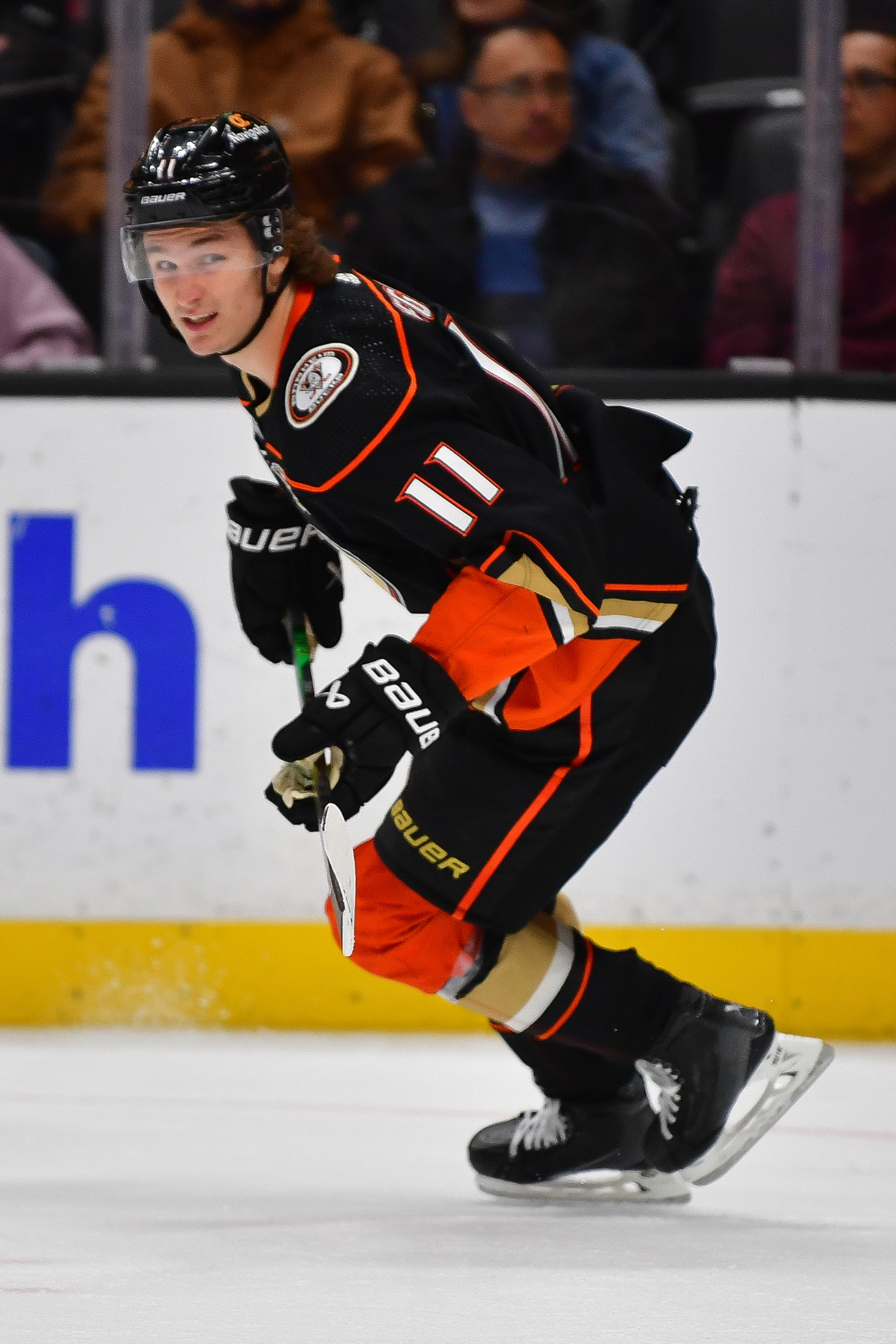 Drafted as a center, Zegras may not be there much longer. The team explored moving him to the wing at times this season. With Mason McTavish and Leo Carlsson in the fold and needing top-six minutes, that made sense over dropping Zegras to the third line. In a season that saw him battle injuries, it would be difficult to fully assess his ability to handle the switch.
However, ready or not, that switch could be permanent if he stays in Anaheim with Cutter Gauthier now under contract; he’ll likely play down the middle as well before too long until he’s ready for full-time top-six duty when one of him, Carlsson, or McTavish will need to shift to the wing full-time as well.
From a value perspective, is it better for the Ducks to see if Zegras can overcome a down year and thrive with a full-time switch to the wing or cash in on him now as a center, a position always in high demand? The year he had means he wouldn’t be getting moved at his peak value but he’s a 23-year-old with two 60-plus seasons under his belt, signed at a reasonable $5.75MM price for two more years with two more seasons of club control after that. That’s still a pretty valuable trade chip if Verbeek wants to make another move to shake things up. Is the time right to play that chip? They’ll have to figure out that answer within likely the next couple of months.
Look Into Moving Gibson: The question of when will the Ducks move goaltender John Gibson has been around for several years now. There has been speculation at times that the team would have liked to move him while other times had some suggesting he’d like to leave. Each time it looked like something could happen, it didn’t.
This might be the summer when that changes. There are a handful of teams who either will be looking to move their starter while a couple of others might be looking to simply shake things up between the pipes. If all of those moves wind up coming to fruition, it could be a situation of musical chairs for veteran starting goalies. Perhaps that will be able to help spark a move.
Gibson will have three years left on his contract heading into next season at a $6.4MM cap hit. That’s still on the pricey side; he has the sixth-highest AAV among netminders for 2024-25 and one of the ones he’s behind is Carey Price who is going to be on LTIR until his contract expires. At a time when a lot of teams are shifting more toward lower-cost platoons, that makes him a little harder to move.
But some teams have potential ‘change of scenery’ candidates with a price tag that’s somewhat close to Gibson’s. At first glance, Pittsburgh, Seattle, and Columbus all have netminders who are being paid like a starter but lost the starting role at some point; all three goalies have an AAV within $1.025MM of Gibson’s and three or more years left on their respective contracts. Is it possible that one or more of them might be willing to make a change? (And would Anaheim in that circumstance?)
The idea of getting a high-end return is off the table at this point. Between the other goaltenders available, Gibson’s struggles (he’s coming off a career-low .888 SV%), and his price tag, the market conditions aren’t there for a big return. But if the Ducks want to give Gibson a chance to try to win somewhere else and are willing to roll the dice on a new partner for Lukas Dostal, this might be the summer where a move actually happens.
Tender Decisions: It wasn’t that long ago that the Ducks were hoping that forwards Isac Lundestrom and Max Jones were going to be a big part of their future plans. Now, they need to decide if it’s worth even tendering them qualifying offers next month, an idea that would have seemed crazy just a couple of years ago.
Lundestrom was a first-round pick back in 2018 and profiled as a potential two-way pivot. After a quality 2021-22 campaign that saw him put up 16 goals and 13 assists, the expectation was that his value would be on the rise. However, he scored just four times in 61 games in 2022-23 and then tore his Achilles tendon in offseason training, costing him 36 games this past season. When he returned, Lundestrom notched just five goals and six assists. One good season followed by two tough ones; is that worth tendering a $1.8MM qualifying offer and giving him arbitration rights? They have the cap room to give him one more look but, like Max Comtois last year, they could prefer to simply move on.
As for Jones, he was a 2016 first-round selection but hasn’t become the impactful power forward they were hoping for. Instead, when healthy, he has strictly been a depth player and barely logged 12 minutes a game this season. Jones has yet to reach the double-digit goal or 20-point marks in his six professional campaigns and is coming off a five-goal, ten-assist showing in 52 games this past season. He’s owed a $1.5MM qualifying offer with arbitration eligibility that could push that a little higher. Again, they have the money to afford to give him one more look but could earmark his spot for a different prospect or a free agent signing.
A few years ago, both Lundestrom and Jones were viewed as potential longer-term pieces for the Ducks. Now, there’s a possibility that neither is with the team two months from now. Verbeek will need to decide if the time is right to cut bait or to give one or both of them one more opportunity.
Photo courtesy of USA Today Sports Images.
Poll: Should The Lightning Re-Sign Steven Stamkos?
In case you’ve missed the discourse after the Lightning’s first-round elimination last night (or haven’t read our preview of this summer’s top UFA left wings), Steven Stamkos is on an expiring contract. The future Hall-of-Famer has now wrapped up the eight-year, $68MM extension he signed in 2016 and will go to market on July 1 if not signed to an extension.
Over the course of his extension, the now 34-year-old Stamkos has overseen the greatest sustained period of success in franchise history. The club only missed the postseason once – the first season of his deal, 2016-17, in which a torn lateral meniscus in his right knee ended his campaign in November. Back-to-back Stanley Cups in 2020 and 2021, a third straight Finals appearance in 2022, and an additional Eastern Conference Final showing in 2018 have cemented the Lightning as arguably the most successful squad over the past 10 years, notwithstanding the three other ECF/SCF appearances Stamkos made with the team before his extension (2011, 2015, 2016).
Overall, injuries limited him to 513 of 618 possible regular-season games (83.8%) during his last contract, but he’s remained a capable top-of-the-lineup scorer and is money in the bank for over a point per game. He had 81 in 79 this season, including 40 goals – his seventh time hitting the milestone.
Stamkos has transitioned into a less-taxing role on the wing at even strength in his later years with the emergence of Anthony Cirelli and Brayden Point, as well as the extremely well-advised Nick Paul pickup, making his slightly negative possession impacts over the last two seasons easier to swallow. He was never a beacon of defensive excellence, but he did at least routinely post Corsi shares at even strength above the team’s overall share without him on the ice. That hasn’t been the case since 2021-22.
He’s still an extremely effective player, and given the precedent of other Lightning stars like Point and Nikita Kucherov taking slight discounts on their market value, it likely wouldn’t be prohibitively expensive to re-sign him. But Tampa’s lack of bottom-six scoring and poor defensive depth – especially without a fully healthy Mikhail Sergachev – was exposed in their rather decisive series loss to the Panthers.
The club has $10MM in projected cap space next season, with extensions/replacements also needed for Anthony Duclair, their best secondary scorer since his trade deadline pickup from the Sharks, and blue-liner Mathew Dumba. They’re also losing the $6.875MM of long-term injured reserve flexibility they’ve had from retired defenseman Brent Seabrook‘s contract over the past couple of seasons.
Point is still 28. Kucherov is 30. Cirelli is 26. Hedman is 33. Sergachev is 25. Vasilevskiy is 29. Even without Stamkos, it’s a playoff-caliber core for at least two to three more seasons with the right moves. Will that make general manager Julien BriseBois seriously consider prioritizing better depth adds over re-signing the best player in franchise history?
Stamkos said before the 2023-24 season started that he was disappointed in the lack of extension conversations with BriseBois. The six-year GM said in January that he still envisioned Stamkos as part of the roster moving forward but would wait until the offseason to evaluate where the roster stood. The results are as follows: Tampa scored just 36.9% of 5-on-5 goals in the series, a worse share than even the Capitals, who were swept at the hands of the Presidents’ Trophy-winning Rangers. Nine players, including most of their bottom six forwards, failed to score a point. Given they got everything they could ask for from their stars – seven points from Hedman, seven assists from Kucherov and five goals from Stamkos, that may very well swing the balance.
So, PHR readers, we now ask you: Are the Lightning better off keeping Stamkos or using offseason cap space to prioritize rebuilding their depth scoring and defense? Have your say in the poll below:
(poll link for app users)
What should the Lightning do with Steven Stamkos?
-
Extend/re-sign him 60% (538)
-
Let him walk 40% (353)
Total votes: 891
Offseason Checklist: Chicago Blackhawks
The offseason has arrived for half of the league’s teams that aren’t taking part in the playoffs. Accordingly, it’s now time to examine what they will need to accomplish over the coming months. Next up is a look at Chicago.
The Blackhawks had a rough 2022-23 season but were big winners in the lottery, allowing them to get a franchise piece in Connor Bedard. However, GM Kyle Davidson stayed the course with the end result being another rough season in the standings. Regardless of whether the ping pong balls fall their way on May 7th, Chicago will need to focus more on the near-term future this summer compared to the long-term future. Here’s what should be on their checklist in the coming months.
Start Building Up: Frankly, this could be the only item on their checklist this summer. The Blackhawks have only made the playoffs once in the last seven years, really leaning into a longer-term rebuild under Davidson. In that time, they’ve amassed a strong group of prospects that should form the nucleus of a long-term core.
But playing them all at the NHL level at once is a recipe for trouble. It’s a mistake that other teams have made as well, not providing enough veteran support. To his credit, Davidson attempted to hedge against that this past season with the additions of Taylor Hall, Corey Perry, and Nick Foligno, moves that had varying degrees of success.
Is the time right to throw caution to the wind and make some big splashes this summer? Probably not. But they can follow the path they took last summer, adding some shorter-term veterans to allow their core prospects to have ample time to develop properly. Ideally, this wouldn’t just be with forwards this time around but also a quality veteran defender.
In his end-of-season presser, Davidson indicated that the Blackhawks need to start taking some steps forward in the win-loss column but was quick to indicate that he doesn’t want to take on some big contracts and lose long-term flexibility. Accordingly, it would make sense to look to see if there’s another Hall-type trade available to take on a shorter-term deal while adding a future asset (for relieving the other team of a contract they can no longer afford). Failing that, turning to free agency to add a handful of pieces to up the level of competitiveness will need to happen.
These moves, which likely will be the bulk of their offseason activity, won’t get them back into the playoffs but it would be a step toward playing more competitive games later into the season while allowing some prospects more time to develop in lower roles. If they do that, they’ll be better off for it down the road.
Decide On Reichel’s Future: On the free agent front, most of the heavy lifting has been done. The team re-signed several veterans in-season while Alex Vlasic inked a six-year contract earlier this week, taking their most prominent RFA off the table.
Among the ones that remain, Lukas Reichel stands out. He has been viewed for a while now as one of the pieces of their long-term core. A first-round pick in 2020 (17th overall), the Blackhawks were patient with him in his first two seasons in North America, giving him 50-plus games with AHL Rockford each time. He was quite productive in those appearances, averaging just shy of a point per game.
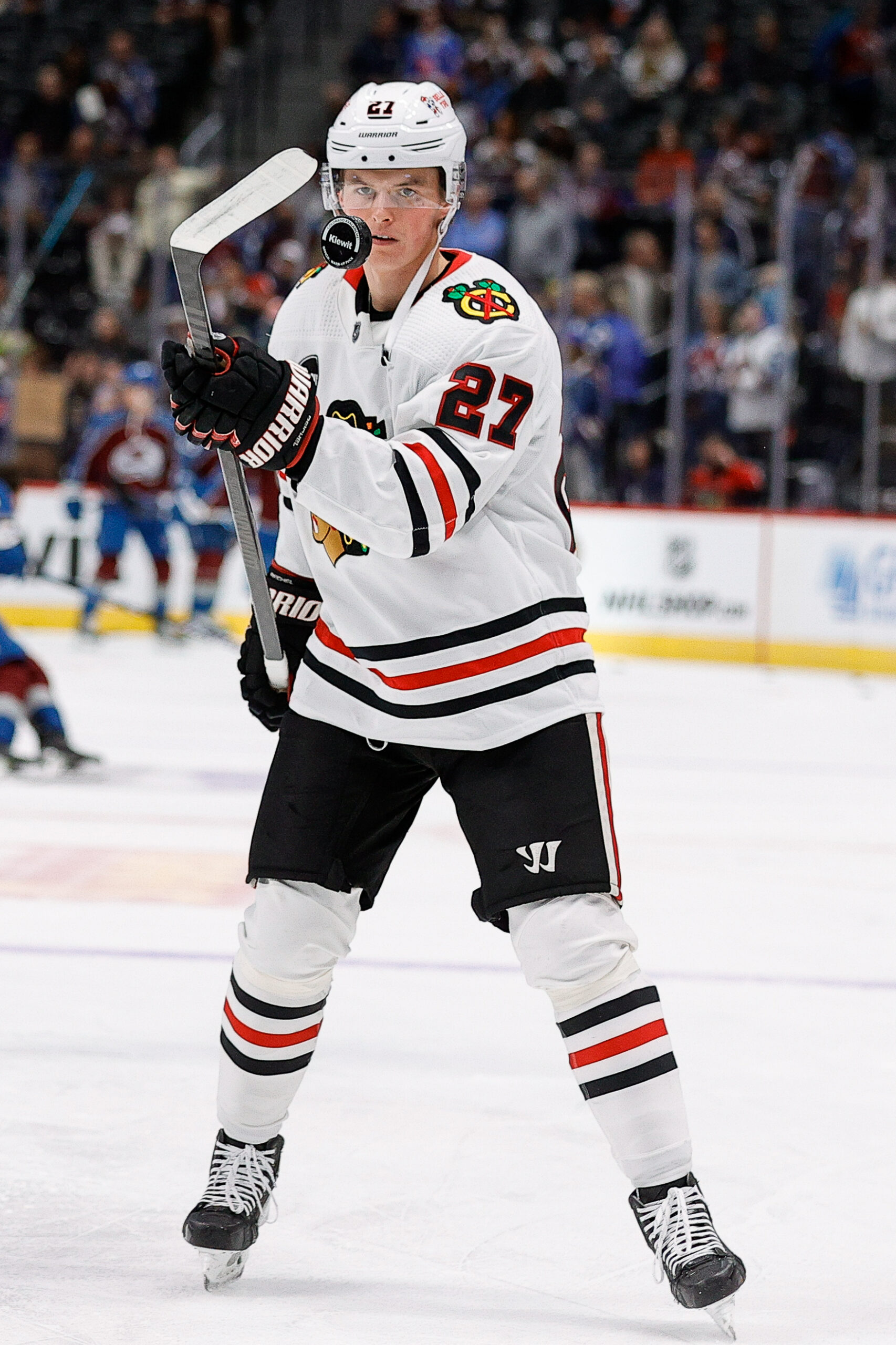 However, NHL success has been harder to come by. He impressed in a late-season stint in 2022-23, cementing a spot on Chicago’s roster to start this season. However, Reichel struggled mightily in the NHL this season, notching just five goals and 11 assists in 65 games. Along the way, that has caused some to wonder if he’s more of a trade chip over being part of their long-term plans.
It’s a question that Davidson and the Blackhawks will have to ponder as well. It’s not a matter of signing him to a long-term deal like Vlasic, that’s clearly off the table. It’s a given that he’s getting a short-term bridge contract. But are they better off giving him another chance on what should be a deeper roster or moving him while his value should still be relatively high? There are quite a few teams who would be willing to take a flyer on the idea that a change of scenery will get him going.
It might seem a bit early to have this thought but Reichel is waiver-eligible heading into next season so there’s no opportunity to have him playing big minutes with the IceHogs if he struggles out of the gate. And if he has another season like this one in 2024-25, his value will drop considerably. While Chicago can certainly kick this decision down the road, there’s some risk to doing so if they’re not convinced that Reichel can rebound. Accordingly, this is something they’re likely to be deciding on, particularly closer to the draft in June.
To Tender Or Non-Tender: This time last year, to say that the Blackhawks would have any sort of thinking to do when it comes to tendering Taylor Raddysh would have seemed crazy. After all, he was coming off a breakout year, notching 20 goals in his first full season with Chicago. At a minimum, it looked like they had a capable middle-six winger on their hands and that he’d be heading for a nice raise for 2024-25.
But this season, things didn’t go as well. He stayed in that middle-six role pretty much all season, even spending some time on the top line. But this time, Raddysh scored just five goals and added only nine assists in 73 games. A shooting percentage of 4.2% is certainly one that stands out as an outlier but that alone isn’t enough to say he can get back to his 2022-23 form.
The value of Raddysh’s qualifying offer itself isn’t an issue – it’s a little under $815K. However, he’s arbitration-eligible this time around and that 20-goal campaign will be a factor. If it goes to a hearing, it’s quite possible that he gets somewhere around the $2.25MM teammate Philipp Kurashev received from an arbitrator last year; more than that is a real possibility. Is it worth giving him a one-year deal in that neighborhood to see if he can rebound?
Or, would they be better off using someone like Frank Nazar in that role for around 16 minutes a night? Failing that, is that a lineup spot that could be earmarked for a veteran addition, one who can be a bit more of a contributor offensively? But on the flip side, is walking away from a 26-year-old who’s one year removed from a 20-goal season the right course of action for a rebuilding team? These are questions they’ll have to ponder before the tender deadline two months from now.
Add A Veteran Goalie: This is something that don’t necessarily have to do but they could certainly benefit from doing so. Yes, Petr Mrazek made a career-high 53 starts this past season but he also has a long track record of injuries. Meanwhile, backup Arvid Soderblom’s first full NHL campaign was one to forget. He’s young enough to still be a part of their future plans if he can turn things around though so they’re probably not inclined to walk away from him now.
However, it would be beneficial to perhaps add some competition for that backup spot or at least a capable option if Mrazek’s injury woes return. We’ve seen some teams become open to the idea of carrying three goalies and perhaps the Blackhawks could be one of them.
There will be several free agent netminders who are in that ‘tweener’ area where they might not quite be full-time NHL material but would be strong starters in the minors, serving as capable depth. The acquisition of a player like that would help allow Drew Commesso to keep playing big minutes with Rockford while working with a quality veteran. If the veteran stays up with Chicago in a full-time third-string role, then there’s still a spot for Jaxson Stauber, another pending RFA, to stick around.
Between the four that are either signed or under club control, the Blackhawks have enough goalies that they don’t need to add another veteran to the mix. However, when you factor in the player-specific circumstances, they could certainly stand to add one over the coming months.
Photo courtesy of USA Today Sports Images.
2024 Unrestricted Free Agency Preview: Left Wings
The regular season is behind us, meaning many teams have already turned their main focus toward the draft and free agency. As the postseason schedule continues for the other half of the league, PHR will join those front offices in identifying the top targets expected to be available on the open market in July.
We kicked off our UFA previews early this month with the men between the pipes, outlining what looks to be an incredibly mild goalie class in July. Next up is a look at the forward options currently set to be available on the market, starting with left wings.
Note: only players on NHL rosters in 2024 are included in this exercise. Pending UFAs who play multiple positions are listed with their most frequent one in the 2023-24 season, not necessarily the position they’re listed as playing by the league. The listed ages are as of July 1, 2024.
Bonafide First-Liners
Jake Guentzel, 29
2023-24 team: Pittsburgh Penguins/Carolina Hurricanes
Guentzel isn’t just the best LW available. He likely has the highest market value of any forward – assuming he doesn’t extend with the Canes over the next two and a half months. He was again over a point per game as Sidney Crosby‘s wingman through the first three-quarters of the season in Pittsburgh, and he’s been even better since a deadline blockbuster sent him south to Raleigh.
In 16 games since the trade, he’s erupted for eight goals and 16 assists for 24 points, leading the Canes in post-deadline scoring and tying for 10th league-wide. He’s a remarkable +16 in that span, too, quickly earning a promotion to first-line duties alongside Sebastian Aho and Seth Jarvis after starting his Carolina tenure on the second line. The 2013 third-rounder has clinched another season over the point-per-game threshold, his fourth time in the last five seasons. His 1.15 per-game rate and his +18.5 expected rating are both career highs, as is his 56.9 CF% at even strength. He was dominating shot attempts before the trade as well – he’d be the Penguins leader in CF% had he not been dealt.
His recent consistency and his sub-30 age mean he’s in line for a significant increase on his $6MM cap hit. He likely won’t reach eight figures – nor will any forward available. But he’s nearly a first-line lock anywhere he could end up and is the only left-winger on the market to average north of 20 minutes per game this season.
Steven Stamkos, 34
2023-24 team: Tampa Bay Lightning
Stamkos is slowly shifting away from center ice, primarily lining up at wing this season alongside either Nikita Kucherov and Brayden Point or Anthony Cirelli and Brandon Hagel. He’s still good for a fair amount of draws, winning 55.6% of his 619 attempts, most of which have still come at even strength. While the Lightning captain is getting up there in age, he’s one of three forwards, including Guentzel and in-state rival Sam Reinhart, to log over a point per game this year.
Seeing Stammer outside of a Tampa jersey remains unbelievable for some, and understandably so. He’s far and away the franchise leader in points (1,134), passed Vincent Lecavalier earlier this season for the games played record (1,080), and is only eight assists back of Martin St. Louis (580). The 2008 first-overall pick has done well to bolster those totals this season, recording 39 goals and 39 assists for 78 points in 77 games. His play away from the puck is starting to suffer as he enters his mid-30s, though, posting a team-worst -21 rating, the same number as the squad’s shockingly poor 5-on-5 goal differential. The shot attempt and possession metrics don’t paint as dire of a picture, but they’re the worst we’ve seen from him in a healthy season in five years.
Admittedly, giving him the “bonafide first-line” designation may be a bit ambitious if the aging curve takes an aggressive toll moving forward, but he’s still a true superstar name for now. There’s been no indication of meaningful extension talks since Stamkos expressed disappointment pre-season in the lack of communication. GM Julien BriseBois indicated that he wouldn’t commence talks until the season ended, a position that hasn’t changed.
Potential Top-Six Options
Jonathan Drouin, 29
2023-24 team: Colorado Avalanche
The former Canadiens top-six winger has found his groove again in Colorado, scoring 19 goals, 37 assists and 56 points with a +12 rating in 79 games played. He set career-highs in assists and points playing alongside former junior hockey teammate Nathan MacKinnon, averaging 18:11 per game in a top-line role. Drouin had only 17 goals in 163 games with Montreal over the past four seasons combined, so his laundry list of recent injuries, inconsistent play, and the uncertainty of his level of play away from MacKinnon will dampen his market value. Don’t expect anything too lengthy – Michael Bunting‘s three-year, $13.5MM deal ($4.5MM AAV) with the Hurricanes last summer is a solid comparable.
Teuvo Teräväinen, 29
2023-24 team: Carolina Hurricanes
Like Drouin, Teräväinen had a nice rebound after a 2022-23 campaign that fell short of expectations. Injuries limited him to 68 games last year, and he wasn’t productive when healthy – his 0.18 goals per game were his lowest in a Carolina uniform. His playoff resume was also abbreviated after sustaining a broken hand in Game 3 of last year’s first-round win over the Islanders. Turbo is all healed up this season, though, and is back to his usual tricks – 25 goals, 28 assists and 53 points in 76 games for the Canes to rank third on the team in scoring. His possession metrics were around the team average (a remarkable 60.1 CF% at even strength), and he averaged over 16 minutes per game for the eighth straight season.
Adam Henrique, 34
2023-24 team: Anaheim Ducks/Edmonton Oilers
Henrique has been a consistent middle-six producer throughout his prime, even if the Ducks would have had you think otherwise by nonsensically placing him on waivers and assigning him to the taxi squad briefly in 2021. He’s aging like fine wine, putting up one of his best NHL seasons at age 33/34. He appeared in 82 games for the fourth time, putting up 24 goals, 27 assists and 51 points for the Ducks and Oilers. An incredibly versatile talent who can truly play both center and wing (53.3 FOW% this season in over 1,000 draws), he also logged significant time on the power play and penalty kill for Anaheim this season. His usage dropped to under 15 minutes per game with Edmonton after the trade, but that’s more due to their high-end top-six group than anything else. For now, Henrique is still absolutely capable of second-line minutes.
Anthony Mantha, 29
2023-24 team: Washington Capitals/Vegas Golden Knights
Mantha once looked like money in the bank for 25 goals a season, but his tenure with Washington after a 2021 trade from the Red Wings resulted in nothing but injuries and dwindling ice time. He got his groove back in 2023-24, though, putting up some of the best possession numbers among Caps forwards with a solid 20 goals and 34 points in 56 games. He was solid down the stretch after Vegas picked him up before the trade deadline with three goals and 10 points in 18 games, more conservative point production from him that should be expected going forward. Mantha shot 22.2% with Washington, an obviously unsustainable rate, even considering his strong 12.6% career average. He may not be a surefire bet for second-line duties at even strength like Henrique and Teräväinen, but he has the upside on a weaker team and will be a solid secondary scoring option wherever he ends up.
Anthony Duclair, 28
2023-24 team: San Jose Sharks/Tampa Bay Lightning
Duclair can play either wing comfortably, but his deployment with Kucherov and Point since Tampa picked him up before the trade deadline has firmly planted him on the left side for now. He’s got great goal-scoring upside and good wheels, as evidenced by his 31 goals with the Panthers two seasons ago, but is prone to injuries and inconsistent showings from season to season. He did what he could for a severely understaffed Sharks offense this season, potting 16 goals and 27 points in 56 games with them after they took on the last year of his $3MM AAV contract from Florida for cap relief. Again thrust into a top-six role on a playoff team in Tampa, Duclair was on fire down the stretch, posting eight goals and 15 points in 17 games with the Bolts after the trade. He’s a career 13.8% shooter over 500 games and should be good for around 25 goals for the next few seasons – if he can stay healthy. Injuries limited him to 20 games in 2022-23.
Tyler Bertuzzi, 29
2023-24 team: Toronto Maple Leafs
Bertuzzi struggled heavily to begin the season after signing a one-year, $5.5MM pact in Toronto but rebounded well down the stretch. He finished the campaign with 21 goals and 43 points in 80 games – not quite as much as the Leafs were expecting, but still solid for a secondary scorer. The real win was getting him to stay healthy – those 80 games were a career-high, and injuries limited him to 68 and 50 games over the last two seasons, respectively, with the Red Wings and Bruins. He’s proven he can handle top-six minutes with ease and hasn’t had negative possession impacts since his rookie season, adding an appealing pot-stirring element to his game as well. Some ill-advised penalties do limit his value somewhat – his 53 PIMs this year were a career-high – but he remains a good secondary scoring and power-play option.
Middle-Six Wingers
James van Riemsdyk, 35
2023-24 team: Boston Bruins
The Bruins signed van Riemsdyk to a one-year, $1MM deal last summer that proved to be a solid value bet. He spent most of the season in third-line minutes, scoring 11 goals and 27 assists for 38 points in 71 games. He opened their first-round series against the Maple Leafs as a healthy scratch, and aging curves remain a risk, but he’ll be eligible for a 35+ contract this summer that could allow a team to keep his cap hit low while offering performance bonuses to match his current market value, likely around the $2.5MM to $3MM range after a bounce-back year in Beantown.
Max Pacioretty, 35
2023-24 team: Washington Capitals
Pacioretty missed the first half of the season rehabbing from his second Achilles tendon injury in the past two years, struggling to look the part in his first 40-plus game showing since 2020-21. It’s been a difficult stretch for the six-time 30-goal scorer with Montreal and Vegas, who had just four tallies in 47 games with the Caps. His overall point production was still passable with 23, but it’s clear he’s no longer the first-line threat he was two years ago. Despite his -14 rating, he still maintained decent possession metrics on a poor puck-control Washington squad with a 46.9 CF% and 51.1 xGF% at even strength.
Dakota Joshua, 28
2023-24 team: Vancouver Canucks
The former minor-league mainstay has had a spectacular breakout season with Vancouver, forcing his way into a third-line role. His 18 goals and 32 points in only 63 games made him one of their most important depth scorers in their unexpectedly strong regular season, averaging 14:32 per game. After doing decently well with 23 points in 79 games in fourth-line minutes in Vancouver last year, it’s clear he’s earned a full-time spot in the league and will almost certainly fetch upward of $3MM annually on the open market.
Danton Heinen, 28
2023-24 team: Boston Bruins
Heinen began his second stint in Boston on a PTO, not signed to an NHL contract until late October. He’s proven to be a solid depth piece, much like JVR, but with better wheels and more upward mobility. Slotting in opposite David Pastrňák on the Bruins’ first line in the playoffs thus far, he had 17 goals and 36 points in 74 regular-season contests.
Warren Foegele, 28
2023-24 team: Edmonton Oilers
The Ontario-born winger wrapped up his third season in Edmonton, setting career-highs across the board while playing in all 82 games for the second time in his career. Averaging 13:59 per game and seeing spot duty on their second line, he was fifth on the squad with 20 goals and added 21 assists for 41 points. His per-game point output has steadily climbed in Edmonton, increasing from 0.32 in 2021-22 to 0.50 this year. His 10.0% shooting percentage this year was in line with his career average, so it’s feasible he’ll be able to maintain this level of production for another few seasons.
Jason Zucker, 32
2023-24 team: Arizona Coyotes/Nashville Predators
Zucker’s one-year, low-risk pact with the Coyotes just didn’t work. Signed to a rather pricey $5.3MM cap hit, he had 25 points in 51 games with Arizona and only garnered a sixth-round pick from the Preds at the deadline, with the Yotes’ front office reportedly unwilling to allow GM Bill Armstrong to retain salary. His production wasn’t much better with Nashville down the stretch, adding five goals and seven points in 18 games, and played just over 13 minutes per night. While his six 20-goal seasons suggest second-line upside, Zucker is more firmly suited for third-line minutes at this stage of his career.
Jordan Martinook, 31
2023-24 team: Carolina Hurricanes
Martinook remains an invaluable checking winger for a truly terrifyingly dominant Canes forward group in all three zones. The 10-year veteran has managed 132 points in 394 games with the Canes since joining in 2018 and has broken the 30-point plateau in each of the past two seasons while playing in all 82 games. He broke out with an incredible playoff performance last season, too, stepping up with 12 points in 15 games while main scoring options Teräväinen and Andrei Svechnikov were injured. He controls shot attempts in a dominant manner, too, posting a CF% at even strength above 60 since 2022-23.
Depth Options/Rebound Hopefuls
Stefan Noesen, 31
2023-24 team: Carolina Hurricanes
Noesen has been impeccable in a fourth-line role for Carolina the past two years, racking up 27 goals and 73 points in 159 games. He’s untested in tougher minutes, though, and he’s played in a rather advantageous system under head coach Rod Brind’Amour. Still, that level of production while managing over 100 shots on goal each season in his low-end usage is impressive, and the AHL mainstay just two years ago is in line for a seven-figure deal this summer.
Kiefer Sherwood, 29
2023-24 team: Nashville Predators
Sherwood has a similar career profile to Noesen but is two years younger and less productive. A top-line threat at the AHL level for a number of years, Sherwood earned a long runway in Nashville this season and responded well with 10 goals and 27 points in 68 games, all career-highs. His +17 rating shouldn’t be considered too much by suitors – his possession metrics were quite average and don’t point to it being sustainable. He’ll cost less than Noesen, though, and is a strong option for teams looking to put together an offensively-inclined fourth line.
Mike Hoffman, 34
2023-24 team: San Jose Sharks
A 36-goal man with the Panthers five years ago, Hoffman is likely a PTO candidate this summer – if he stays in the NHL at all. He already has to overcome his reputation as a one-dimensional winger, and an injury-dotted season with 10 goals and 23 points in 66 games for the Sharks didn’t help restore his market value. By failing to secure top-six minutes on the worst team in the league, he may have written his ticket to professional hockey in Europe in 2024-25.
Tomáš Tatar, 33
2023-24 team: Colorado Avalanche/Seattle Kraken
Tatar had a difficult campaign in every department. His nine goals and 24 points in 70 games between Colorado and Seattle were career lows for him in a full season, as was his 12:27 ATOI. The 2009 second-round pick has been criminally underrated in Selke Trophy voting over the past few seasons and often had some of the best possession quality metrics in the league, but his 49.2 xGF% this year was his worst since 2017-18. He’ll likely find another home somewhere, but he didn’t land a contract until September last summer, meaning he could be destined for a PTO if he wants to extend his NHL career.
Offseason Checklist: San Jose Sharks
The offseason has arrived for half of the league’s teams that aren’t taking part in the playoffs. Accordingly, it’s now time to examine what they will need to accomplish over the coming months. First up is a look at San Jose.
Following a summer where the Sharks moved their best player in Erik Karlsson, expectations were quite low heading into the season. That said, some might argue that they still underachieved as they were run out of the rink a lot of nights while not many of their younger players wound up in prominent roles. GM Mike Grier won’t be looking to make this group a playoff team for 2024-25 but they will be looking to add some pieces while deciding the future of a franchise fixture as well. Here’s what should be on their checklist in the coming months.
Hire A Head Coach: When meeting with reporters at locker clean-out day recently, Grier expressed an intention to evaluate his head coach David Quinn. That evaluation came to a head earlier today with the decision to fire the bench boss, adding themselves to the list of teams looking for someone else to lead the team.
While some teams have some appeal in terms of where they are from a competitive standpoint, that will quite likely be a tougher sell for Grier. Quinn led the Sharks to a 41-98-25 record over two years and it could be argued that they didn’t underachieve all that much. With San Jose embracing a full-scale long-term rebuild, the team has been stripped of the majority of its veteran core in recent years and no immediate impact replacements are on the horizon as the focus is on player development. In other words, things aren’t exactly looking up from a short-term competitive standpoint.
Accordingly, it wouldn’t be surprising if a first-time NHL bench boss is brought in, one with a history of working with younger players and having some success. Several teams have tried that in recent years with Anaheim’s Greg Cronin, Chicago’s Luke Richardson, and Montreal’s Martin St. Louis among them. Someone along those lines who can help key youngsters continue to develop while also developing as a coach would make a lot of sense for the Sharks at the moment.
Determine Vlasic’s Future: It’s a moment that has been coming for a couple of years now but the Sharks might now be at the proverbial crossroads with long-time blueliner Marc-Edouard Vlasic. When he signed his current eight-year, $56MM extension back in 2017, there was an expectation that the final couple of seasons could be rough but if San Jose was a contender for the first half of the deal or longer, it might still work out somewhat well in the end. Instead, the Sharks have struggled for most of this contract, missing the playoffs in five straight years. Meanwhile, Vlasic’s usefulness dropped sharply only a couple of years into the contract and has been a highly-paid sixth defender the last few seasons.
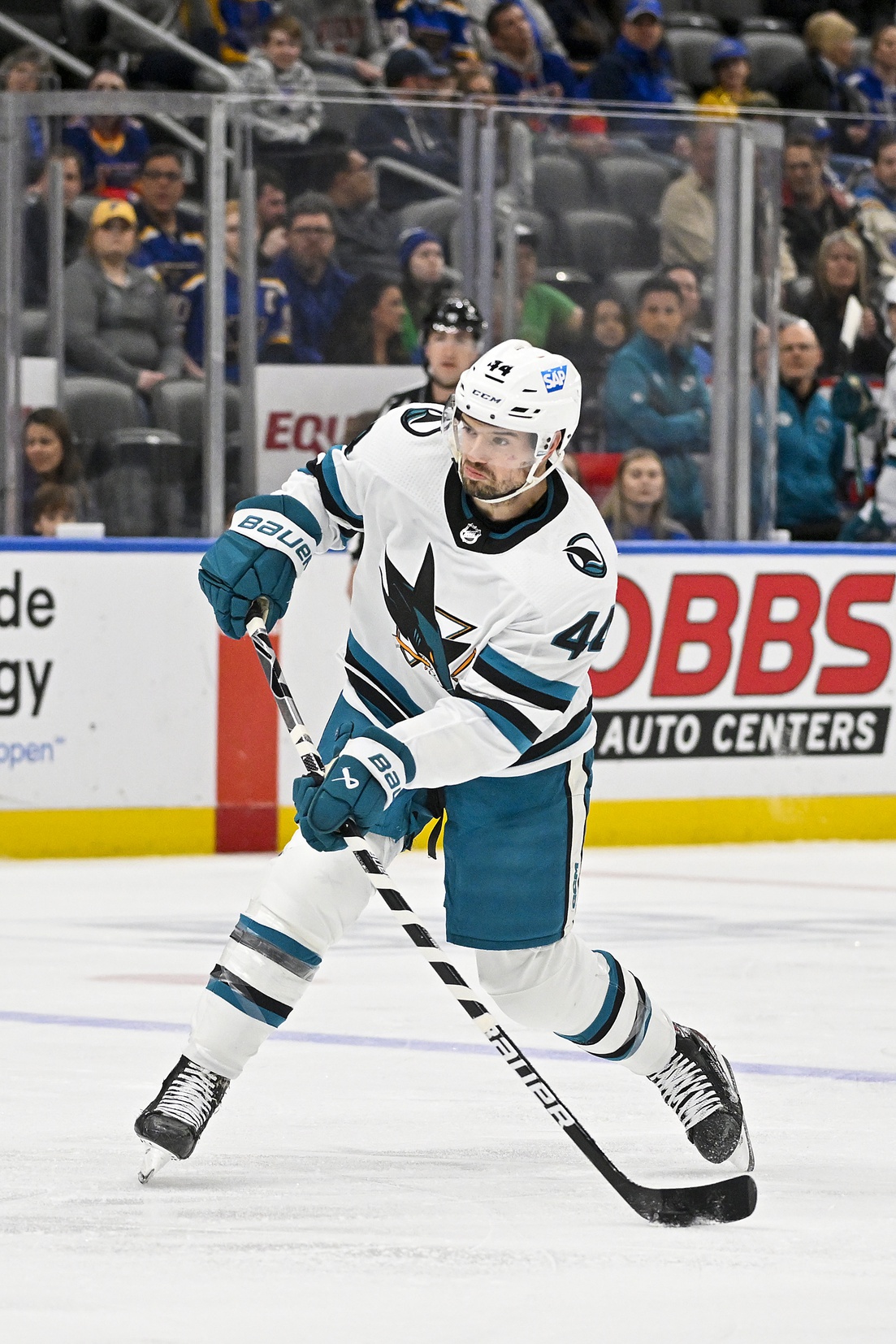 This past season, the Sharks made Vlasic a healthy scratch on numerous occasions and while they could simply opt to do so for two more years, that’s not necessarily the way they want to treat someone who was a pillar on their back end for so long. But that is one option that Grier can consider.
The other is a buyout. Such a move wouldn’t necessarily save them much cap space or money but would open up a roster spot and a contract slot while giving Vlasic a chance to try to catch on elsewhere if he wants to. Instead of a $7MM cap charge for the next two years, a buyout would cost $3.833MM next season, $4.833MM in 2025-26, and $1.333MM in 2026-27 and 2027-28.
In theory, there’s always the possibility of a trade but unless they’re taking another high-priced underachieving contract back, that seems quite unlikely to happen. The same can be said about waiving him and sending him to AHL San Jose; that doesn’t seem like something they’d want to do to Vlasic.
Can the Sharks keep doing what they’ve been doing with Vlasic for the last couple of years, using him in a very limited role? Or do they give him a chance to move on? Grier will have a couple of months to decide as the first buyout window doesn’t close until close to the start of the new league year which starts July 1st.
Cash In On Granlund: As part of the Karlsson trade, the Sharks had to take back Mikael Granlund to help make the money work. At the time, the center’s value was at arguably an all-time low; a late-season trade to Pittsburgh at the deadline in 2023 was ill-fated as Granlund managed just one goal and four assists in 21 games. That type of production for $5MM for two more seasons wasn’t of particular value to any team last summer.
But a strange thing happened this season. At a time when pretty much every Sharks player had a rough year offensively, Granlund somehow had one of his best. He led the team in scoring, notching 12 goals and 48 assists (a career-high) in 69 games. He had a hand in 33% of San Jose’s goals on the season. That’s solid production for anyone let alone someone who was thrown into a trade as a salary cap dump.
This summer, teams will take a run at signing some impact free agents but those who come up short will have to look for a fallback option. Now on an expiring contract and coming off a 60-point year, Granlund should have some positive value for a team looking for a short-term upgrade up front. That should give Grier a chance to get some extra future value, a scenario that didn’t seem likely back in the fall.
Granted, one challenge Grier will face is that he can’t pay down any of Granlund’s deal as his three retention slots are already all used up for next season. However, if he’s willing to take another pricey contract back, they should be able to make something happen. Speaking of which…
Leverage Cap Space: One thing that the Sharks have an abundance of is cap space, a by-product of selling off most of their core and having four of their five highest-paid forwards on expiring contracts. Three of those four are UFAs and the fourth – Luke Kunin – could be as he’s owed a $3MM qualifying offer and is coming off an 18-point campaign so he’s not a guarantee to be tendered in June. Suffice it to say, San Jose will have to add to their roster one way or the other.
They could elect to be aggressive in free agency but from a longer-term standpoint, they might be better off being one of the clearinghouses for unwanted contracts this summer. Utilizing some of that cap space to take on a pricey deal or two would also net the Sharks some extra draft picks or prospects for their troubles. That’s not an option when they sign free agents, unless it’s a one-year agreement with the possibility of flipping him in-season.
They’re at the point where a good chunk of their roster is either untradeable due to being part of the rebuild plans or not having enough value to bring back a return of significance. They have a few exceptions – Granlund among them as noted earlier – but there aren’t a lot of true trade chips remaining. As a result, there may not be many opportunities to add those future assets in-season or at the trade deadline. With that in mind, taking on those bad deals now could be their best bet to add pieces. Considering how many teams will be looking to open up flexibility this summer, Grier and the Sharks could be quite popular in the weeks to come.
Photo courtesy of USA Today Sports Images.