
Predators Retaining Andrew Brunette
Don’t add the Predators to the list of teams making a coaching change this offseason. General manager Barry Trotz told reporters today, including Alex Daugherty of the Tennessean, that head coach Andrew Brunette will be back behind the bench for a third season in 2025-26.
This was the default and expected outcome. Pierre LeBrun of TSN and The Athletic reported back in March that Brunette is under contract with Nashville through 2026-27 plus an additional option year, and that a change likely would have been made midseason if one was happening.
A runner-up for the Jack Adams Award for Coach of the Year in his first two seasons as a head man, the wheels came off for Brunette and the Predators in 2024-25. While the longtime NHL winger guided the Panthers to a Presidents’ Trophy in 2022 as their interim head coach and then helped Nashville to a 47-win season last year, Brunette’s Preds had the third-worst record in the league and the second-worst record in franchise history this year.
The regression was also against the expectations Trotz set for this year with his gargantuan spending spree in free agency last offseason. But the two have a long-standing relationship dating back to Brunette’s playing days under Trotz as a coach in the mid-1990s with the Predators and the AHL’s Portland Pirates, and the latter made a long-term commitment when he brought him in as Nashville’s head coach a year ago.
Trotz’s overall vision for the club hasn’t wavered despite the team’s plunging record, something he made clear today during his media availability. He’ll continue trying to retool the roster via trades to push Nashville back into wild-card contention next season, although expect free agency to be quiet (via the team’s Brooks Bratten). It would make sense that his original pick for coach, when he assumed his GM post, would be given the benefit of the doubt in that case.
Marc-André Fleury Joining Canada For World Championship
While his last NHL game is behind him, future Hall-of-Fame goaltender Marc-André Fleury isn’t hanging up the skates just yet. He told reporters during today’s end-of-season media availability that he’s accepted an invite to join Canada at this year’s World Championship (via Michael Russo of The Athletic).
It’s unclear whether he plans on entering any game action, but there’s a decent chance he could. Canada’s only rostered one of three goalies for the tournament so far. That’s Rangers prospect Dylan Garand, who will likely serve as a No. 3 option behind Fleury and another NHL option. The latter could be the Blues’ Jordan Binnington after St. Louis was eliminated in last night’s Game 7 loss to the Jets, but that’s speculation.
As for the 40-year-old Fleury, it’ll be his first time at the Worlds. Despite his lengthy list of accolades, Fleury’s only gotten the call to play for the senior Canadian national team once. That was the 2010 Winter Olympics, and he didn’t get into game action there as the third-stringer behind Roberto Luongo and Martin Brodeur. His unavailability for the Worlds has usually been due to playoff obligations, but with his Wild being bounced by the Golden Knights in the first round, he’s free to join his countrymen in Denmark and Sweden. He did suit up at the World Juniors in 2003 and 2004, though, posting a .923 SV% in 10 appearances en route to back-to-back silver medals.
He’s still technically a gold-medal winner on that Olympic team, so a gold at the 2025 Worlds could make him the first goaltender to gain entry into the Triple Gold Club. The most recent Canadian to enter the ranks was defenseman Jay Bouwmeester, thanks to his 2019 Stanley Cup win with the Blues.
Fleury, a first-overall pick and a three-time Stanley Cup champion with the Penguins, will also get to bookend his career by being teammates with Pittsburgh captain Sidney Crosby once again. With Fleury’s lack of international experience, they haven’t been on the same side of a matchup since Vegas selected Fleury from the Pens in the 2017 expansion draft.
Kings, Rob Blake Mutually Part Ways
The Kings are mutually parting ways with general manager Rob Blake, sources tell Sportsnet’s Elliotte Friedman (X link). Los Angeles quickly confirmed the news.
 For now, team president Luc Robitaille is staying on. He’ll lead a search for Blake’s successor beginning immediately, the Kings said. They haven’t named an interim GM, but it’s likely Robitaille or director of hockey operations Jake Goldberg will handle day-to-day duties for now. L.A. didn’t have any assistant GMs on Blake’s staff.
Blake’s contract was up after signing a three-year extension in May 2022. That extension came after the Kings ended a three-year playoff drought and pushed the Oilers to seven games in a first-round loss. Fast forward to 2025, and L.A. has now lost four consecutive playoff series – all to Edmonton, all in the first round. This year, they had a 2-0 lead in the series and held home-ice advantage for the first time, but dropped four straight games en route to another early exit.
A Hall-of-Fame defenseman who spent the majority of his playing career in Los Angeles, Blake took a few years off after retiring in 2010 before resurfacing as an assistant GM with the Kings for the 2013-14 season. He’s remained in L.A.’s front office ever since and was promoted to GM in the 2017 offseason following the end of Dean Lombardi’s 11-year tenure in the role.
Blake compiled a 309-238-71 (.557) regular season record in his eight seasons as the Kings’ top decision-maker, 19th in the league during that stretch. In the postseason, the Kings are just 8-20 for a .286 win percentage. Among teams who have made the playoffs since 2018, only the Ducks (0-4) have won a lesser share of their games.
“On behalf of the entire organization, I would like to thank Rob for his dedication to the LA Kings and the passion he brought to his role,” Robitaille said. “Reaching this understanding wasn’t easy and I appreciate Rob’s partnership in always working toward what is best for the Kings. Rob deserves a great deal of credit and respect for elevating us to where we are today. He has been an important part of the Kings and will always be appreciated for what he has meant to this franchise.”
While there wasn’t much advance reporting that Blake’s job was in peril if the Kings failed to advance past the first round again, the change is far from out of the blue. L.A.’s rebuild is far in the rearview now, and the club has exhausted nearly all of the high-end prospects Blake accumulated during his tenure. After peaking as one of the league’s deepest pools a few years ago, the Kings dropped to No. 26 in Scott Wheeler of The Athletic’s prospect pool rankings earlier this year.
Blake leaves his successor with a favorable salary cap structure. The Kings have over $23MM to spend this summer with just four roster spots to fill, per PuckPedia. Their only notable pending restricted free agent is winger Alex Laferriere. They’ll have plenty of room to accomplish that, work toward extending pending UFA defenseman Vladislav Gavrikov, and add some scoring depth via trades or free agent signings.
Image courtesy of Kirby Lee-Imagn Images.
Devils’ Jesper Bratt, Luke Hughes Undergo Shoulder Surgery
Devils winger Jesper Bratt has opted to undergo offseason shoulder surgery and will miss the World Championship, the team announced. Star defenseman Luke Hughes also recently underwent surgery to repair the shoulder injury he sustained in Game 1 of the first round against the Hurricanes. New Jersey expects both to be ready for training camp in the fall.
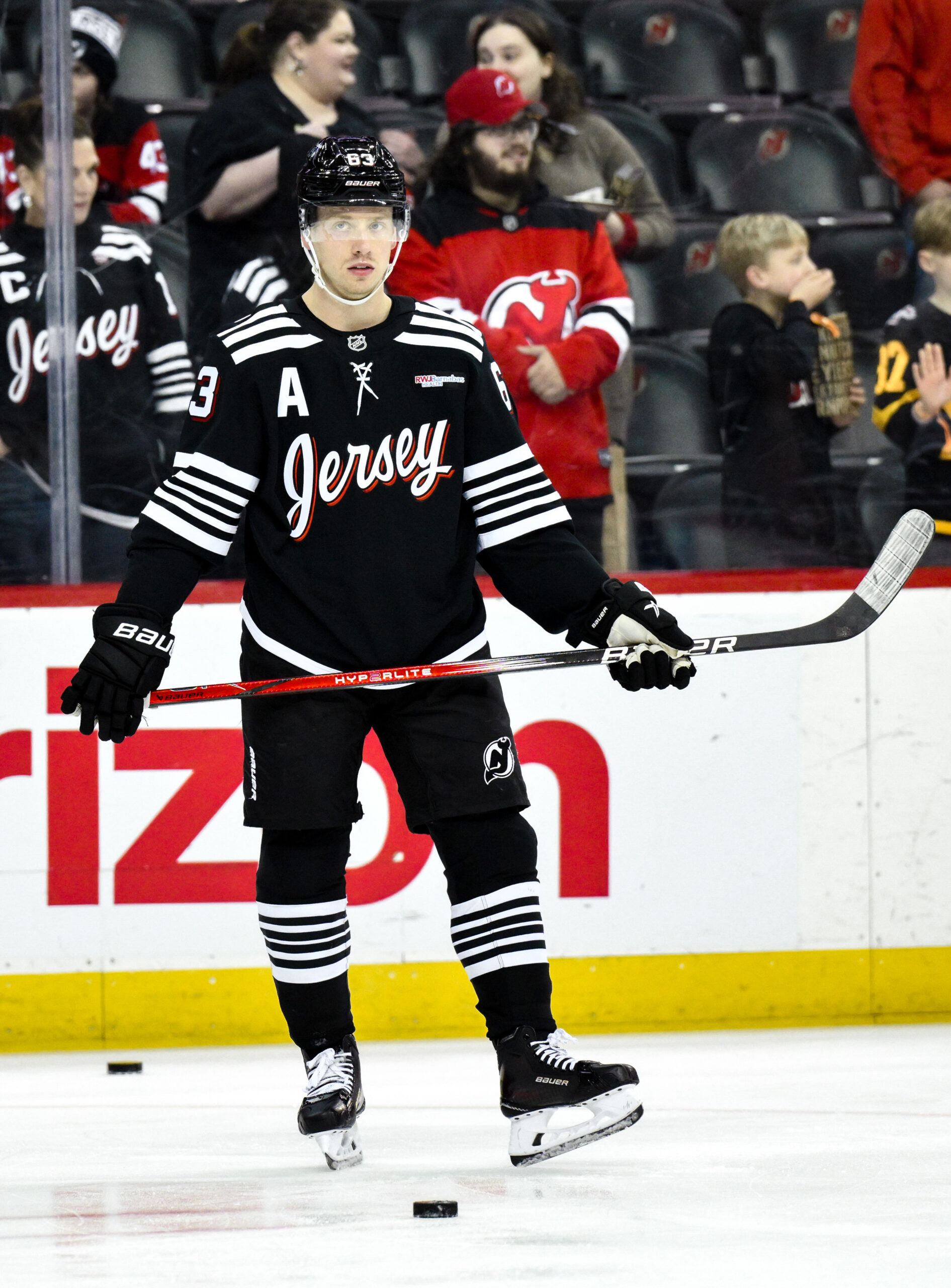 It’s unknown whether Bratt suffered his injury on a specific play or if he’s got wear-and-tear issues he wanted to correct. He didn’t miss a game all season aside from sitting out New Jersey’s final regular-season contest for rest.
If Bratt was playing hurt for a while, it certainly didn’t show. The 26-year-old led the Devils with a career-high 67 assists and 88 points in the regular season before adding a goal and two assists in five games in New Jersey’s first-round loss.
Entering the third season of his eight-year, $63MM contract, Bratt has topped the 70-point mark in four consecutive seasons and has been remarkably durable. That final regular-season game was the first one Bratt missed since the 2021-22 season. Assuming he hits the ground running as expected in 2025-26, he’s got a chance at becoming the first Devil with three straight 80-point seasons in franchise history.
Hughes’ injury was far more apparent. He re-injured his left shoulder in a collision with Hurricanes center Jesperi Kotkaniemi and didn’t play the final four games of the series. He suffered an injury to the same shoulder last offseason but opted not to have surgery to accelerate his recovery timeline and diminish the amount of time he missed at the beginning of 2024-25. Now, with a full summer ahead of him, he goes for more serious intervention.
In need of a new deal this summer as a pending restricted free agent, Hughes has 93 points and a -34 rating through his first 155 NHL games since being drafted fourth overall in 2021. He’s led Devils defenders in scoring each of the past two years and is likely in line for an extension well north of $8MM per season if New Jersey opts to hammer out a long-term deal.
Image courtesy of John Jones-Imagn Images.
Canadiens Notes: Hutson, Laine, Free Agents, Dach
Lane Hutson put up historic numbers in his rookie season, and the Canadiens will look to capitalize on that by discussing a long-term extension as he enters the final season of his entry-level contract, general manager Kent Hughes said today (writes Marco D’Amico of RG). He’s not eligible to put pen to paper on a deal until July 1, but doing so immediately would prevent Hutson from a potentially testy ride through restricted free agency in 2026 and allow the Habs to achieve long-term cost certainty before he potentially increases his value in his sophomore campaign.
Hutson’s likely Calder-winning campaign needs no introduction. The 5’9″ defenseman exploded for 66 points in all 82 regular-season games, tying Lightning star Victor Hedman for sixth in the league in scoring among rearguards and leading all rookies in scoring. Not only does that make him the highest-scoring rookie defenseman in Montreal’s 107-year NHL history, but his 60 assists also tied Larry Murphy for most by a first-year blue liner.
Regardless of when they reach an extension, it’s a foregone conclusion they won’t be able to keep him under the internal salary hierarchy they stuck to when negotiating star winger Cole Caufield‘s eight-year extension two summers ago. They’ve yet to sign a deal eclipsing captain Nick Suzuki‘s $7.875MM cap hit since he signed that deal in 2021. Patrik Laine is technically the team’s highest-paid player at an $8.7MM cap hit, but they acquired that contract via trade. After seeing youngsters like Flames winger Matthew Coronato land a long-term deal at $6.5MM annually, Hughes will almost certainly have to go into the $8-9MM range on a new deal for Hutson.
There’s more on the Canadiens:
- While it wasn’t a glowing end to the season for Laine, Hughes credits his impact earlier in the year as instrumental in Montreal’s postseason berth (per D’Amico). The 27-year-old managed 20 goals and 33 points in 52 games after a quicker-than-expected return from a preseason knee injury, but 75% of his goals and 63% of his points came on the power play. His 5-on-5 possession numbers were among the worst on the club with a 43.0 CF% and led to diminished usage in Games 1 and 2 of their first-round series against the Capitals before a broken finger sidelined him for the final three games of their season.
- Hughes hasn’t made a decision either way on whether to pursue contract extensions with the team’s slate of pending unrestricted free agents, notes D’Amico. Luckily for him, he doesn’t have many of those decisions to make. One has already been made for him on defenseman David Savard, who announced his retirement. The comprehensive list of others includes NHL-rostered forwards Joel Armia, Christian Dvorak, and Michael Pezzetta; minor-league centers Alex Barré-Boulet and Brandon Gignac; and depth netminder Connor Hughes.
- The Canadiens “haven’t given up” on 24-year-old center Kirby Dach after a second major procedure on his right knee in as many years, D’Amico writes. Nonetheless, he relays executive vice president Jeff Gorton “didn’t look overly confident” when discussing Dach and notes he’ll need an eye-opening training camp to regain a top-six role. After playing just twice in the 2023-24 campaign, Dach’s performance wasn’t pretty in 2024-25 before the knee injury ended his campaign in February. He scored 22 points with a team-worst -29 rating in 57 games.
Predators’ Barry Trotz Needs To Have A Much Better Summer
Nashville Predators general manager Barry Trotz had an illustrious career behind the bench as a head coach, winning a Stanley Cup in 2018 with the Washington Capitals and accumulating many other accolades. He was also the first and longest-tenured coach in the Predators’ history.
But his short time in Nashville as a GM has been eventful, to say the least. Trotz had orchestrated a significant roster turnover that resulted in one of the worst teams in the NHL this season, despite major free agent signings less than a year ago. Given all that has gone on and the direction of the Predators, it is fair to wonder if he is on the hot seat.
Trotz started his reign in Nashville by moving out considerable salaries in Matt Duchene and Ryan Johansen, who both made $8MM annually on long-term deals signed by the previous management regime led by longtime GM David Poile. Johansen was traded to Colorado, with Nashville retaining half of his cap hit ($4MM) while Duchene was bought out, resulting in a cap charge for the next season of $6.55MM.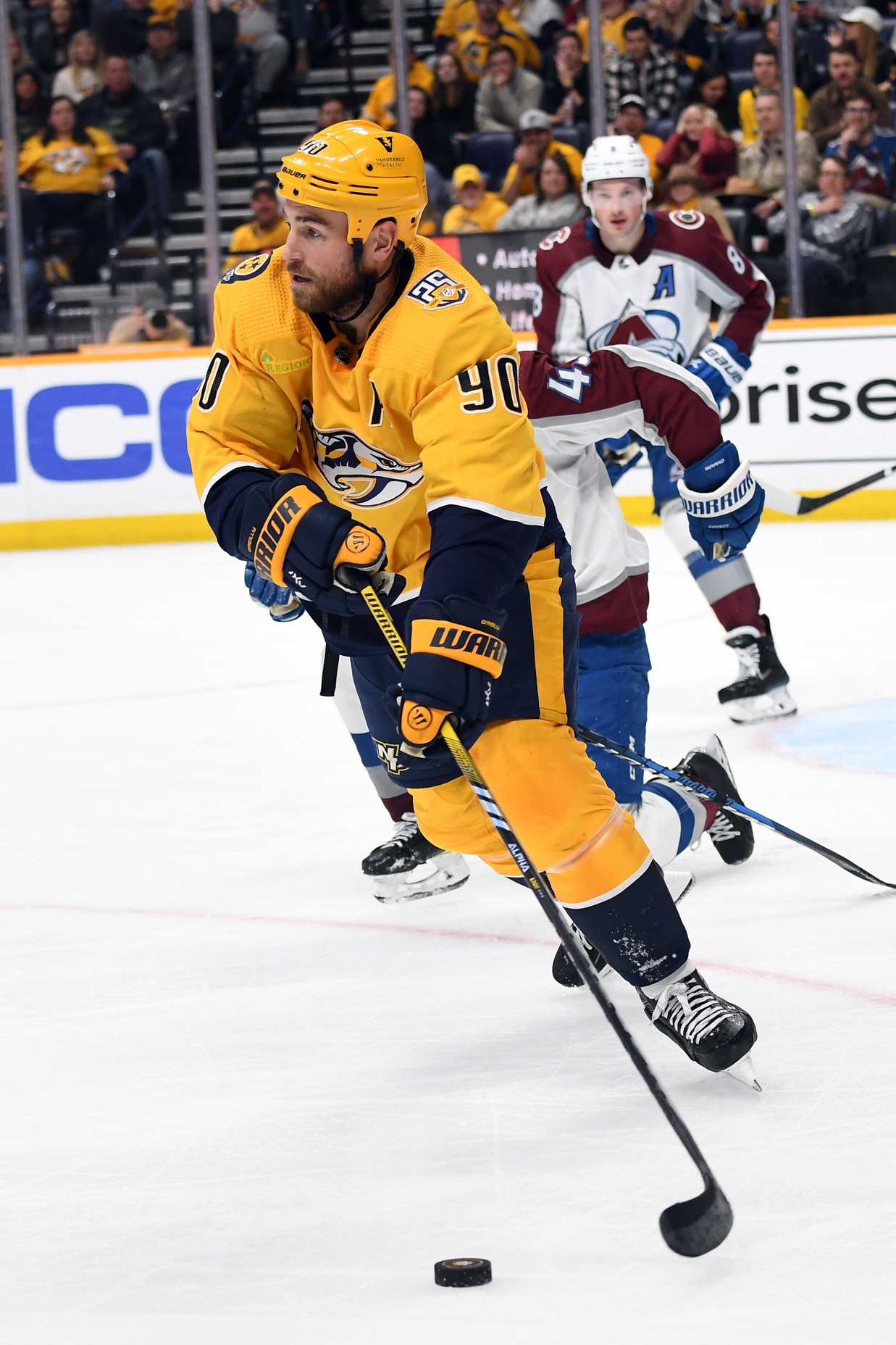
Trotz used the cap space to retool his roster in the summer of 2023, signing Ryan O’Reilly to a four-year deal worth $18MM and inking Gustav Nyquist and Luke Schenn to multi-year deals in free agency. The initial results were solid as the Predators made the playoffs in Trotz’s first year at the helm and were bounced in the first round. Overall, it was a good albeit unspectacular first year of work as a GM for Trotz, but that is where things began to go off the rails.
If you looked strictly at the trades Nashville made with the Pittsburgh Penguins over the past year, it would be enough to question the Predators’ direction. But there were signings and moves outside those that have already aged poorly, which may hurt the team for years. Trotz traded Cody Glass to the Penguins last August, along with a third and sixth-round draft pick, for Jordan Frasca, a prospect who might not even be an AHLer at this point.
The move was a salary dump after the Predators’ shopping spree on July 1 that saw them sign Steven Stamkos, Brady Skjei and Jonathan Marchessault to lucrative long-term deals. Glass was owed one more year on his contract at $2.5MM. The Penguins were happy to take that on and flipped him at the NHL Trade Deadline to New Jersey for another third-round pick and two prospects. The trade tree must make one wonder what exactly Trotz thought last August.
Of course, the Philip Tomasino trade to Pittsburgh for a fourth-round pick looks like a massive win for the Penguins. Tomasino didn’t light up the score sheet, but he seems like a solid top-nine piece for the Penguins’ retool. The 23-year-old was the Predators’ 2019 first-round pick (24th overall) and had a terrific rookie season in Nashville, posting 11 goals and 21 assists in 76 games in 2021-22. However, after two uneven seasons, Trotz opted to move on and sent Tomasino to the Penguins. After arriving in Pittsburgh, the Mississauga, Ontario native tallied 11 goals and 12 assists in 50 games. He doesn’t look like a superstar, but he should be a promising young player for the Pens.
Finally, there is the trade deadline acquisition of Michael Bunting from Pittsburgh. The Predators moved Thomas Novak and Luke Schenn for Bunting and a fourth-round pick. The trade was puzzling at first, but then a day later, Pittsburgh flipped Schenn out for a second and fourth-round pick, and it became clear what their motive was. They added a younger (possibly more effective) player in Novak and a second-round pick, which was icing on the cake.
These trades with Pittsburgh show Trotz’s inexperience as a GM and indicate he should probably block Kyle Dubas’ phone number before this summer. The player evaluation from the Nashville side has got to be troublesome for fans as they struggle to comprehend that series of moves. But that wasn’t all that went wrong in Trotz’s second year on the job.
The aforementioned free agent spending spree on July 1, 2024, made a lot of waves around the NHL. Nashville handed Stamkos a four-year deal for $8MM per season, Skjei got $7MM annually on a seven-year contract, and Marchessault received a $5.5MM AAV for five seasons. None of those moves in a vacuum were terrible signings, although paying three players on the wrong side of 30 a total of $20.5MM annually is hard to digest. The thought process made sense, given that Nashville has a lot of draft pick capital, but the free agent signings failed to gel in Nashville, and the result was one of the worst seasons in franchise history.
Trotz hasn’t been without his solid moves. He hasn’t been afraid to undo prior mistakes or move on from players he’s acquired if they aren’t working in Nashville. That ability to adjust on the fly and course correct will come in handy and could be the tool that helps Trotz pivot if next season goes off the rails like last year did.
Now, much of Trotz’s future will depend on the upcoming season. If Stamkos, Skjei and Marchessault can find their respective games and lead Nashville back to contention, all will be forgotten, and Trotz will continue as Predators GM. Still, if they have a year like the previous one, and Trotz makes moves similar to the transactions over the last 12 months, Nashville may have to pivot and reimagine their roster under new management.
Photo by Christopher Hanewinckel-USA TODAY Sports
NHL Releases Second Round Schedule
This article will be updated as further start times are announced.
After the Jets dramatically saved their season in unprecedented fashion against the Blues last night, the second-round field is set. For the third time in the last four years, all four division champions made it through their first series, and only two series had upsets based on seeding. The league has now announced the full second-round schedule, with action kicking off tonight. Games are listed in Central Time, along with US broadcast details:
Monday, May 5
Panthers vs. Maple Leafs, Game 1: 7 p.m. on ESPN
Tuesday, May 6
Hurricanes vs. Capitals, Game 1: 6 p.m. on ESPN
Oilers vs. Golden Knights, Game 1: 8:30 p.m. on ESPN
Wednesday, May 7
Panthers vs. Maple Leafs, Game 2: 6 p.m. on ESPN
Stars vs. Jets, Game 1: 8:30 p.m. on ESPN
Thursday, May 8
Hurricanes vs. Capitals, Game 2: 6 p.m. on ESPN
Oilers vs. Golden Knights, Game 2: 8:30 p.m. on ESPN
Friday, May 9
Maple Leafs vs. Panthers, Game 3: 6 p.m. on TNT, truTV, and Max
Stars vs. Jets, Game 2: 8:30 p.m. on TNT, truTV, and Max
Saturday, May 10
Capitals vs. Hurricanes, Game 3: 5 p.m. on TNT, truTV, and Max
Golden Knights vs. Oilers, Game 3: 8 p.m. on TNT, truTV, and Max
Sunday, May 11
Jets vs. Stars, Game 3: 3:30 p.m. on TBS, truTV, and Max
Maple Leafs vs. Panthers, Game 4: 6:30 p.m. on TBS, truTV, and Max
Monday, May 12
Capitals vs. Hurricanes, Game 4: 6 p.m. on TNT, truTV, and Max
Golden Knights vs. Oilers, Game 4: 8:30 p.m. on TNT, truTV, and Max
Tuesday, May 13
Jets vs. Stars, Game 4: 7 p.m. on ESPN
Wednesday, May 14
Panthers vs. Maple Leafs, Game 5: 6:00 p.m. on ESPN
Oilers vs. Golden Knights, Game 5: 8:30 p.m. on ESPN
Thursday, May 15
Hurricanes vs. Capitals, Game 5: 6 p.m. on TNT, truTV, and Max
Stars vs. Jets, Game 5: 8:30 p.m. on TNT, truTV, and Max
Friday, May 16
*Maple Leafs vs. Panthers, Game 6: TBD on TNT, truTV, and Max
*Golden Knights vs. Oilers, Game 6: TBD on TNT, truTV, and Max
Saturday, May 17
*Capitals vs. Hurricanes, Game 6: TBD
*Jets vs. Stars, Game 6: TBD
Sunday, May 18
*Panthers vs. Maple Leafs, Game 7: TBD on TNT and Max
*Oilers vs. Golden Knights, Game 7: TBD on TNT and Max
Monday, May 19
*Hurricanes vs. Capitals, Game 7: TBD on ESPN
*Stars vs. Jets, Game 7: TBD on ESPN
Sidney Crosby Joins Team Canada, Nathan MacKinnon May As Well
“Captain Canada” has joined Team Canada for the upcoming 2025 IIHF World Championship. Sidney Crosby will join the team for the first time since 2015, per a Pittsburgh Penguins release.
Fresh off a victory at the 4 Nations Face-Off in February, Crosby will look to guide his home country to another victory in Europe. Crosby joins his general manager Kyle Dubas for the tournament, which is set to begin this upcoming week. This represents the third time Crosby will compete in IIHF Championships, and the first since captaining Canada to a 2015 victory. This will mark the ninth time Crosby, 37, has suited up for Canada in international play, and if it’s possible, his international résumé is every bit as impressive as his legendary NHL career. He has won gold medals at the Olympics (and scored the iconic “Golden Goal” in the 2010 games), the World Cup of Hockey (2016), the World Championship (2015), and the World Junior Championship (2005).
Crosby’s decision to join Team Canada for the tournament likely stems, at least in part, from the Penguins missing the playoffs again this season. After a career defined by deep postseason runs, the chance to play meaningful hockey well into May is surely appealing to the future Hall of Famer. Crosby’s addition makes him the oldest member of the team by nearly four years, with Ryan O’Reilly as the secondly oldest member of the team.
Crosby’s good friend and fellow Nova Scotia native Nathan MacKinnon may be joining the squad as well, after his Colorado Avalanche were eliminated in the first round by the Dallas Stars. TSN insider Darren Dreger is reporting that there is a “decent chance” MacKinnon joins Team Canada for the tournament. Like Crosby, MacKinnon is no stranger to deep playoff runs, but with an early first-round exit this year, he may seize an opportunity that’s rarely available to him.
Kirill Kaprizov, Marco Rossi Discuss Contract Talks With Wild
Wild star winger Kirill Kaprizov spoke to reporters today and hinted at his interest in signing an extension with the club this summer, per Joe Smith of the Athletic.
The Wild will be eligible to sign Kirill Kaprizov to a contract extension starting July 1, and owner Craig Leipold has made it clear the organization is prepared to do whatever it takes to keep their superstar in Minnesota. Judging by Kaprizov’s comments today, the feeling appears to be mutual.
“This is my agent’s job, so we will see. But I love everything here. It should be all good,” he said. “It’s all about winning. Everything is about winning. But I like everything about here.”
It will be fascinating to see what kind of deal Kaprizov lands—his next contract could rank among the richest ever signed by a winger, or by any player, in NHL history. While Kaprizov could land a massive deal on the open market, the Wild do have a ton of cap space available, making the path even clearer to sign an extension with Minnesota. No matter the cost of his contract, Kaprizov will more than likely prove to be worth it. At just 28, Kaprizov has lit up the league over five sensational seasons, racking up 386 points in 319 games. That production already places him fifth on the Wild’s all-time points list, while his 185 goals rank third, just 34 shy of Marián Gáborík’s franchise record. And the Russian also put to rest any concerns about the injury he sustained this season that required surgery and kept him out of the lineup for three-plus months, as Kaprizov posted five goals and nine points in the team’s 4-2 series defeat to the Golden Knights.
The tone was a little less positive from center Marco Rossi, who, like Kaprizov, deflected questions regarding his contract toward his agent, but also noted his disappointment in being relegated to a fourth-line role in the playoffs, per Dylan Loucks of The Hockey News.
“I was very disappointed. But I have been taught to respect those decisions. It’s always the team first,” he said. “We had an honest discussion about (my role). We were both honest. I won’t tell you everything that was said, but I need to respect it.”
Rossi, who is headed for restricted free agency this offseason, quietly put together a strong campaign with 24 goals and 60 points—impressive numbers on a team that often struggled to generate offense. Given that production, his limited role in the playoffs sparks questions about where he fits into the Wild’s long-term plans.
Robertson, Heiskanen Set To Return In Second Round For Stars
The Dallas Stars just knocked off the Colorado Avalanche in a nail-biting seven-game thriller—and they did it without their top goal-scorer and a top defenseman. Now, with Jason Robertson and Miro Heiskanen set to rejoin the lineup for Round 2, the big question is: what kind of damage can this team do at full strength?
According to Taylor Baird of NHL.com, we should get that answer soon. Both players are set to return at some point in Dallas’ second round series, although coach Pete DeBoer didn’t specify exactly when each player would return.
As DeBoer told reporters Saturday: “I believe you’re going to see them both play in the second round, but I don’t know if it’s going to be Game 1 or Game 3 or Game 5. I consider them both day-to-day now, but there’s still some hurdles. It depends on when we start the series, how much time we have between now and Game 1. We’ll have a little better idea as we get closer.”
Robertson injured his knee in the regular season finale and was listed as week-to-week at the time. The 25-year-old California native was a force all season, suiting up for all 82 games and racking up a team-best 35 goals. Already boasting an eye-popping 394 points in just 374 career games, Robertson has proven he’s more than just a regular-season star. With 38 points in 45 playoff appearances, he’s shown he can shine just as brightly when the stakes are highest. His return will no doubt aid an already potent offense.
Much the same can be said of Heiskanen’s return. Heiskanen’s 25 points in 50 games might not grab headlines like Robertson’s scoring totals, but the Finnish blueliner is still a cornerstone for the Stars when healthy. On the season, he led the team in average ice time, logging over 25 minutes a night. And like Robertson, Heiskanen has shown an ability to produce in the playoffs, as evident by his six goals and 16 points just last season during the team’s 19-game run. He has been out since January with a knee injury.