
Trade Deadline Primer: New York Rangers
With the Olympic break approaching, the trade deadline is about a month away. Where does each team stand, and what moves should they be looking to make? We continue our look around the league with teams that have clear plans at the extremes of the standings, next with the Rangers.
After missing the playoffs last season, it was becoming apparent that New York’s rebuild was not materializing as envisioned, but few would have expected “The Letter: Part Two”. Eager to turn the corner under new Head Coach Mike Sullivan, the Rangers had a strange start to the season, losing their first seven at home, but winning enough on the road to stay afloat at first. Then came the injuries, as the group was battered, numerous key players going down, dropping them to 30th in the league. On January 16, GM Chris Drury shared a letter to fans detailing the team’s plans to “retool”, soon dealing veteran defenseman Carson Soucy to the rival Islanders. Now, franchise cornerstone Artemi Panarin is headed out the door at any moment, as New York finds themselves back where they started seven years ago.
Record
22-28-6, 8th in the Metropolitan (0% playoff probability)
Deadline Status
Seller
Deadline Cap Space
$4.77MM on deadline day, 0/3 retention slots used, 47/50 contracts used, per PuckPedia.
Upcoming Draft Picks
2026: NYR 1st, CAR 1st, CAR 2nd, NYR 3rd, NYI 3rd, NYR 5th, NYR 6th, VAN 7th
2027: NYR 1st, NYR 3rd, NYR 5th, NYR 6th, NYR 7th
Trade Chips
It’s far from a secret who Drury has set in his first order of business. 12 days after waiving a white flag on 2025-26, the major headline dropped that Panarin would be sat for roster-related reasons. Since then, a third of the league has been reported as having interest, most notably the Panthers, Hurricanes, Kings, Sharks, and Capitals. Wednesday’s 3 PM EST Olympic roster freeze stands as a roadblock, but the superstar has unfavorably had to sit for the last three games, and a deal seems imminent, even if shortly after the Olympics.
Suitors are working through the need to extend Panarin, but New York holds all three retention spaces. They would be wise to send their star with retained salary, and an extension set up, to maximize a return with their biggest chip.
Already aggressive enough to add Kiefer Sherwood, San Jose would be a fascinating fit, showcasing their intent on serious contention sooner rather than later. Panarin’s interest in Florida is well known, as he could reunite with Sergei Bobrovsky, but it would require unfathomable gymnastics to work out a deal. Finally, Panarin could be the star Carolina has been patiently waiting to add after Mikko Rantanen didn’t work out.
Besides the Blueshirts’ leading scorer and his expiring $11.6MM contract, it’s not as immediately clear who could be next. In the interest of their retool, it would be ideal to move on from at least one of their three 32-year-old centers; Mika Zibanejad, J.T. Miller, and Vincent Trocheck.
Out of the bunch, Trocheck stands as the only real candidate, given his manageable $5.63MM cap hit. The contract runs through his age 35 season, not necessarily ideal, but given the majorly thin center market, Trocheck could bring a haul for the Rangers. The Pittsburgh native has 36 points in 42 games, enough that center-hungry teams such as the Hurricanes, Avalanche, and Red Wings could make a push. Minnesota is also in the market, however they would have to get creative given limited cap space and trade assets.

New York faces the challenge of having immovable contracts as they navigate a retool. Zibanejad, Miller, and the polarizing Alexis Lafrenière, aside, the issue extends on both ends of the lineup. Last summer’s big ticket, $7MM deal given to 30-year-old Vladislav Gavrikov doesn’t align with their latest plans, neither does 29-year-old Will Borgen’s $4.1MM, both defenders inked through 2029-30.
Jonathan Quick, 40, has an expiring deal worth $1.55MM, but the Stanley Cup winning Connecticut native may not have interest in moving on to a backup role on a contender. As Igor Shesterkin remains out with a lower body injury, Quick is in a favorable situation, able to play regularly as he closes the book on a tremendous career.
Brennan Othmann has been shopped throughout the season, as early as mid-October. The 23-year-old former first round pick is clearly not a traditional deadline piece, but no longer in the plans, he figures to be a “change of scenery” trade candidate, for a similar younger player in need of a new role.
Veterans Sam Carrick and Jonny Brodzinski could fetch middle round draft capital, both bringing strong results at the faceoff dot. Carrick is signed through next year at $1MM, while Brodzinski is a pure rental option, versatile enough to play center or wing.
Conor Sheary makes just $775k, but the 33-year-old has hardly been effective this year, with just one tally in 37 games, not to mention he is currently on LTIR with an upper body injury. When healthy, Sheary has respectable metrics and playoff experience, but he would not bring anything notable in return.
On the back end, Urho Vaakanainen, 27, could bring a bit of intrigue as a 6’2″ lefty penalty killing specialist, as he’s inked through next year at $1.55MM.
Team Needs
NHL-Ready Youth: Given Drury’s phrasing of “This will not be a rebuild. This will be a retool built around our core players and prospects” naturally, for better or worse, New York will seek young players capable of contributing as soon as next season, in all likelihood alongside veterans such as Miller and Zibanejad. Thankfully, as a result of the K’Andre Miller trade, they have an extra first round pick for the upcoming draft already, an asset always needed regardless of “rebuild” or “retool”. However, such a deal is indicative of Drury’s struggles as a whole, as it is players such as Miller who the Rangers are lacking if they can turn it around without entirely bottoming out. The club has a top heavy prospect pool, and a replenishment, especially on the blue line, would be beneficial.
Backup Goaltending: Although the Rangers aren’t in desperate need between the pipes, they could use a boost behind Shesterkin, with Quick’s days numbered. Prospect Dylan Garand’s development has stalled out a bit, still waiting on his NHL debut at age 23, and the Rangers are thin in the goaltending department elsewhere.
Image courtesy of Charles LeClaire-Imagn Images
Trade Deadline Primer: Vancouver Canucks
With the Olympic break approaching, the trade deadline is about a month away. Where does each team stand, and what moves should they be looking to make? We begin our look around the league with teams that have clear plans at the extremes of the standings, starting with the Canucks.
The worst possible outcome for Vancouver this season was another finish in the mushy middle, like their 38-30-14 record that put them in no man’s land at 10th in the Western Conference. Being clearly the worst team in the league through the first two-thirds of the season may not be a step forward, but it’s at least a step in a direction. They already made the biggest move any team will make this season by shipping off franchise defender Quinn Hughes to the Wild, ushering in yet another formal retool/rebuild in British Columbia. How aggressively they’ll tear down the rest of their roster over the next few weeks remains to be seen.
Record
18-31-6, 8th in the Pacific (~0% playoff probability)
Deadline Status
Seller
Deadline Cap Space
$3.78MM on deadline day, 1/3 retention slots used, 48/50 contracts used, per PuckPedia.
Upcoming Draft Picks
2026: VAN 1st, MIN 1st, VAN 2nd, SJS 2nd, VAN 4th, VAN 5th, VAN 6th
2027: VAN 1st, SJS 2nd, VAN 3rd, VAN 4th, PIT 4th, VAN 5th, VAN 6th, VAN 7th
Trade Chips
The Canucks’ braintrust of Patrik Allvin and Jim Rutherford has already thinned this list considerably by pulling the trigger on the aforementioned Hughes deal. They also shipped out pending UFA winger Kiefer Sherwood to the Sharks last month for a pair of second-round picks and a minor-league defender to make the contract math work for San Jose, so that’s another relatively high-value name gone.
That leaves Vancouver with four pending UFAs remaining on the NHL roster. While those names are the most traditional trade deadline fodder, none of them will net the Canucks a significant return. One of them – lefty defender Derek Forbort – has been on long-term injured reserve since October, so he’s likely not even an option to move.
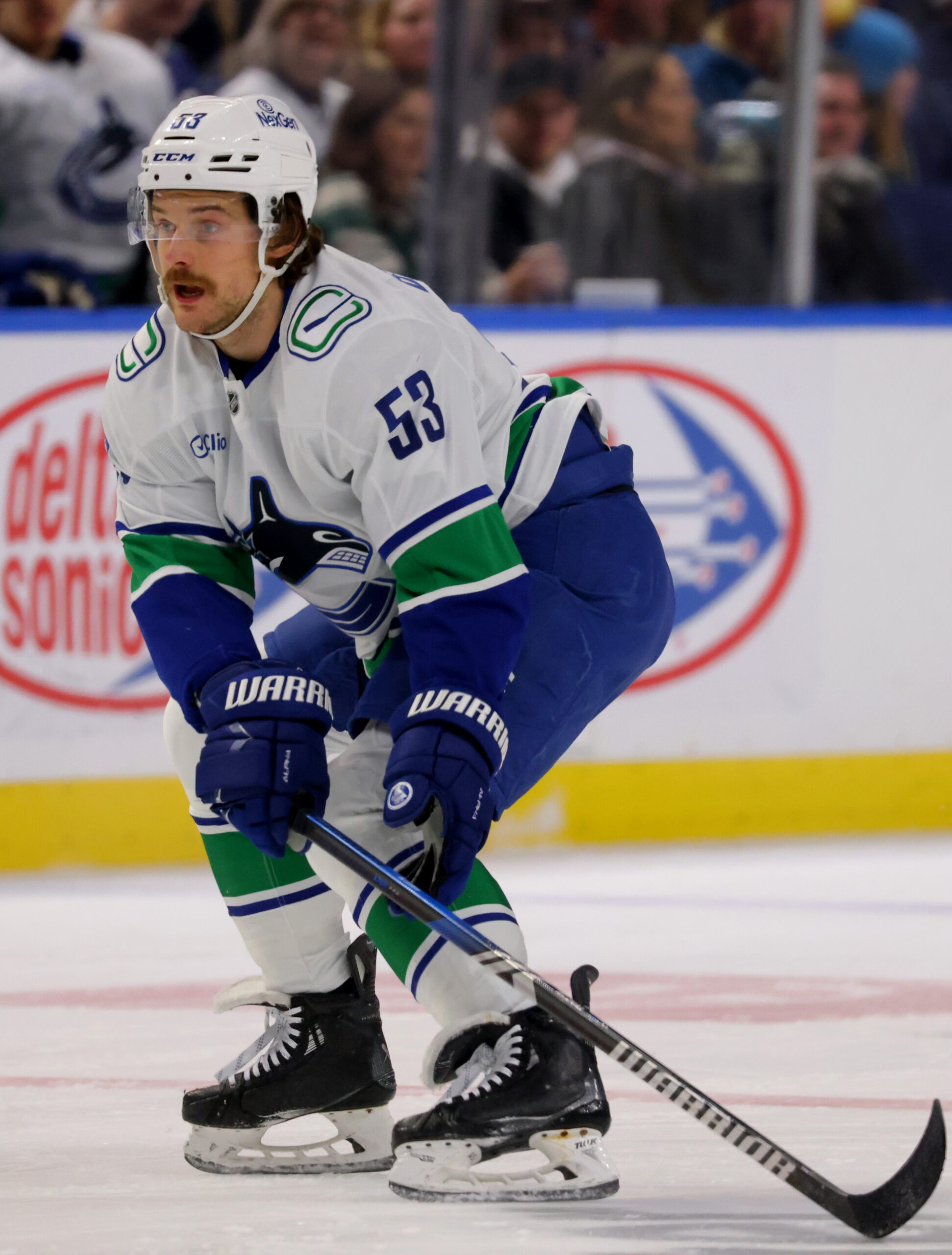 They have a pair of centers available, Teddy Blueger and David Kämpf, who might serve as added depth for a contender’s fourth line. The 31-year-old Blueger only recently returned to the lineup after missing over half the year with a lower-body injury, although he’s been hot in limited action with four goals in eight games. He’s found himself in a similar situation before, when the Golden Knights picked him up from the Penguins as a rental at the 2023 deadline, and he served mostly as an extra forward in their run to the Stanley Cup. His historical strength on draws, track record of 20-plus point seasons, and penalty killing ability all give him legitimate resale value at an affordable $1.8MM price tag. He’s the higher-value piece of the two, although he has a 12-team no-trade list that could complicate a move.
Kämpf likely won’t land more than a mid-to-late-round pick at best. Since having his contract with the Maple Leafs terminated after clearing waivers at the beginning of the season, he’s averaged over 15 minutes per night for Vancouver, but only out of necessity. The 31-year-old’s offense was already limited, but despite seeing increased deployment, he’s clicking at a career-worst 0.19 points per game rate with only six in 32 contests. His defensive game has been a legitimate benefit, though – his 50.5% shot attempt share at 5-on-5 is among the best on the team, and he’s done so in difficult matchups.
The name that’s been thrown around the most, though, is that of Evander Kane. At $5.125MM against the cap, his nine goals and 25 points in 54 games since being acquired from the Oilers last summer are certainly underwhelming. His track record of strong playoff performances when healthy, though, has seen him draw interest from contenders like the Avalanche and Stars. His high cap hit and the Canucks’ limited cap flexibility mean they’re unlikely to recoup more than the fourth-round pick they gave up for him, though.
Of course, there are the big names. Elias Pettersson‘s still available for the right price, although his $11.6MM cap hit has always meant an offseason move is likelier. He and Jake DeBrusk, signed through 2031 at $5.5MM per season, both control their own destiny with no-movement clauses. Vancouver signed Conor Garland to a six-year, $36MM extension that doesn’t kick in until next season, leaving him with no trade protection until July 1. But with him only churning out seven goals in 44 games this season, there’s likely not widespread interest in picking him up with such a commitment.
Team Needs
Cap Space: Normally, rebuilders can add assets by leveraging their cap space to take on bad deals from money-needy teams in exchange for futures. Vancouver is in no such position to do that, as they’ve been tight to the limit all year and have only accumulated a few million dollars in space as a result. Kane, Blueger, Kämpf, and Forbort coming off the books will give the Canucks about $10MM of reprieve in addition to the projected $8.5MM cap jump. They also don’t have any RFAs in need of big pay bumps. It’s still relatively uncommon for a team in Vancouver’s position to have as many anchor deals as they do (Pettersson, Brock Boeser, Filip Hronek, Thatcher Demko) above a $7MM price point. No one is expecting one of those names to get moved in the next four weeks, but if they decide to take on a more aggressive teardown, opening more infinite flexibility will be the way to go.
More Center Help: Save for Pettersson enjoying a rebound, Vancouver doesn’t have a true first-line center, nor do they have one on the way. Marco Rossi is a nice piece, but he has only two points in eight games since being acquired from Minnesota. Braeden Cootes looks like a nice value for the 15th overall pick in last year’s draft, early on, but projects as more of a second-line, two-way piece. They won’t get a bona fide No. 1 middleman with a top pick in the 2026 draft class, either, with both top forwards being wingers.
Image courtesy of Timothy T. Ludwig-Imagn Images.