
Senators Unlikely To Retain Nick Jensen
The “expectation is” that the Senators will not retain pending unrestricted free agent defenseman Nick Jensen, reports Bruce Garrioch of the Ottawa Citizen.
Senators GM Steve Staios told the media this week that the club has “not closed the door” on any of their pending unrestricted free agents. But while the team could still retain some of its pending UFA forwards, they reportedly won’t be doing so with Jensen.
If Garrioch’s expectation comes to fruition, and the Senators let Jensen walk, the decision would end the veteran’s two-year stint in the Canadian capital. Jensen’s season ended in March after he underwent surgery to repair a torn meniscus.
The 35-year-old blueliner is a veteran of nearly 700 NHL games and arrived in Ottawa as part of the Jakob Chychrun trade.
The longtime Capitals rearguard helped stabilize the right side of the Senators’ defense, and his arrival in Ottawa coincided with the team’s long-awaited return to the playoffs.
Ottawa had not made the playoffs since its run to the Eastern Conference Final in 2017 before Jensen arrived, but qualified for the postseason in each of the defenseman’s two seasons with the team.
There are a few factors that are contributing to the likelihood Jensen won’t return to Ottawa. Right-shot defenseman Jordan Spence emerged as a quality NHLer this season, scoring 31 points in 73 games while averaging 18:43 time on ice per game, including 1:16 per game on the power play. He’s due a new contract as an RFA and merits real consideration in a top-four role.
Veteran Artem Zub is already entrenched on the right side of Ottawa’s top four, meaning Jensen would likely have to settle for a third-pairing role if he re-signed in Ottawa. AFP Analytics projects Jensen’s next contract to be worth $3.575MM on a one-year deal, which could be too rich for the Senators if they’re signing him to slot in behind Zub and Spence.
Moreover, re-signing Jensen at that rate would box top prospect Carter Yakemchuk out of an opening-night lineup spot. Ottawa likely has every intention of letting the 2024 No. 7 pick legitimately compete for an NHL roster spot, and re-signing Jensen could work against that objective.
If Jensen and the Senators part ways, it might be a development that is mutually beneficial for both the player and club.
From Jensen’s perspective, he gets to exit a place where he saw his role decline sharply year-over-year. In his last season in Washington, Jensen was the team’s leading penalty-killer, averaging 2:46 time on ice per game on that unit. Jensen was a first-option penalty killer for nearly a half-decade with the Capitals. He largely maintained that status in his first campaign with the Senators, playing nearly two minutes per night on the penalty kill and 20:13 per game overall.
In 2025-26, Jensen saw that role diminish considerably. In 61 games, he spent just 0:48 per contest killing penalties. His overall time on ice per game declined over three minutes, to 17:00. He was Ottawa’s No. 4 defenseman in 2024-25, a role he also held in his time in Washington. This year, he was the team’s No. 6 defenseman.
While Jensen’s age likely has something to do with this decline in role – he’s not quite the same player he once was – Jensen’s perspective is likely to be that he still has more to give than he was called on to provide with the Senators.
That is likely a driving factor contributing to his projected departure from Ottawa, combined with the aforementioned financial and lineup considerations.
Photos courtesy of Bob Frid-Imagn Images
Atlantic Notes: Tkachuk, Free Agents, Hamonic
The Ottawa Senators’ quick elimination from the playoffs at the hands of the Carolina Hurricanes has prompted speculation about the future of captain Brady Tkachuk. Senators GM Steve Staios was asked about Tkachuk’s future in his end-of-season media availability today, and he made it clear the franchise has no interest in trading away – or even having a conversation about trading away – their star forward. When asked about whether he’d sit down with the player to discuss Tkachuk’s future, he said “there’s nothing that we have talked about or thought about where that conversation should happen.”
Bruce Garrioch of the Ottawa Citizen noted that Tkachuk, who has a full no-move clause on his contract, has “full control” over his future. Although Tkachuk is just two seasons away from being able to leave Ottawa as an unrestricted free agent, it’s somewhat difficult to imagine the Senators winning any trade involving him. The Calgary Flames’ decision to deal Tkachuk’s older brother, Matthew Tkachuk, serves as a cautionary tale. The deal immediately vaulted the Panthers to legitimate Stanley Cup contention while plunging the Flames into what would eventually become a true rebuild. The younger Tkachuk isn’t the same caliber of player as his brother, but he’s still, as Travis Green said, a winger that all 31 other NHL teams “would love to have.” But the no-move clause on Tkachuk’s contract means he could hand-pick a trade destination, and dramatically reduce the kind of return the Senators might receive. That’s a factor that has burned teams in the past trading players with no-move clauses. For that reason, and many more, Staios made it clear today that unless something changes, his hockey operations department has no interest in even entertaining trade discussions revolving around Tkachuk.
Other notes from the Atlantic Division:
- Staios also updated the media (including TSN’s Claire Hanna) on the status of the team’s pending unrestricted free agents, saying of the group “I have not closed the door on anyone.” He said he has spoken to each of the team’s pending UFA’s, but decided it best to “take a little bit of time and reflect” since the end of the season is still so fresh. The most significant name among Ottawa’s pending UFAs is veteran winger Claude Giroux. The 38-year-old, who is a veteran of over 1,300 NHL games, scored 49 points this season. He’s shown he can still be a productive member of an NHL middle-six, and it would not be a surprise if there is mutual interest in a contract extension.
- “It looks like” veteran defenseman Travis Hamonic‘s “time in Detroit is over,” writes Max Bultman of The Athletic. The 35-year-old defenseman, who has 926 career NHL games on his record, only got into 26 contests for Detroit after signing a UFA deal with the team last summer. Hamonic was squeezed out of head coach Todd McLellan’s lineup in large part due to the emergence of Axel Sandin Pellikka, a rookie who is among the Red Wings’ top prospects. When he did play, Hamonic averaged just 14:22 time on ice per game, the lowest mark of any Red Wings blueliner, and a solid step below where he was last season. (He averaged 17:04 time on ice per game as a Senator in 2024-25.) If Hamonic wants to continue his NHL career and make a push towards getting his 1,000th game, he’ll likely need to do so by signing with another team.
Kings To Reassign Jared Wright
The Los Angeles Kings are going to reassign forward Jared Wright to their AHL affiliate, the Ontario Reign, reports Anthony Collazo of Mayor’s Manor. The Kings telegraphed this move earlier in the year, when they made a paper transaction to reassign Wright to the AHL so he could be eligible to re-join Ontario in the postseason.
Wright, 23, spent most of this season in Ontario. 2025-26 is actually Wright’s first campaign as a full-time professional, as he signed with the Kings close to the end of last season. Before signing in Los Angeles last spring, Wright played three seasons of college hockey for the University of Denver Pioneers, where he won a national title in 2024.
In 54 games for the Reign, Wright scored 17 goals and 30 points. He began the season in the AHL but earned his first NHL recall in March. After a one-game reassignment, Wright was recalled on March 5 and didn’t play another game in the AHL past that point. Wright was a fourth-line player for the Kings, scoring four points in 23 games while averaging 11:25 time on ice per game.
In the AHL, Wright plays a more substantial role. He received middle-six deployment in Ontario this season and was one of the team’s top penalty-killing forwards. Wright was a regular penalty-killer in Denver as well, and will likely play on that side of special teams if he ends up carving out a long-term spot in the NHL.
In the immediate term, this expected reassignment will return a valuable defensive winger back to the Reign, who will stand to benefit from his penalty killing and secondary offensive production. He’s also fresh off of getting into his first set of NHL playoff games, and while they didn’t go too well for the Kings as a whole, the experience should help him for his time in Ontario.
The Reign will begin their Pacific Division Semifinal against the Coachella Valley Firebirds on Wednesday in Ontario, California.
Capitals Assign Terik Parascak To AHL
The Washington Capitals announced today that forward Terik Parascak has been reassigned to the team’s AHL affiliate, the Hershey Bears. The team also signed prospect Aron Dahlqvist to an ATO.
Parascak’s junior team, the WHL’s Prince George Cougars, fell in the second round of the league’s playoffs on April 19. This reassignment allows him to join Hershey for its playoff run, which continues Thursday against the Wilkes-Barre/Scranton Penguins. This won’t be Parascak’s first stint in Hershey. He joined them in a similar fashion last year and got into one regular-season game.
The 19-year-old was the No. 17 pick of the 2024 draft, picked out of Prince George, where he scored 105 points in his draft campaign. He’s remained in Prince George since that point, and has totaled 266 points across 192 career WHL games. Parascak was ranked as the No. 5 prospect in the Capitals’ system by Scott Wheeler of The Athletic, who wrote that Parascak has “middle-six upside” but added that “there is some wonder about what his next step is after two years of stagnant progression.” With this reassignment, he’ll get the chance to show his progress at a different level, in the high-intensity AHL playoffs.
Dahlqvist, who is also 19, was picked in the sixth round by the Capitals at the 2025 draft. He has spent the last two seasons mostly playing in Sweden’s top junior league, while also filling in for around 15 games at the SHL level for Brynäs’ senior team.
Elite Prospects scout Lassi Alanen wrote last year that Dahlqvist has “stay-at-home potential at the next level,” and that he believes in Dahlqvist as “potential NHL depth.” Compared to Parascak, it’s less likely Dahlqvist will see any game action during Hershey’s run seeing as he doesn’t have any experience playing pro hockey in North America.
Central Notes: Stars, Zuccarello, Honka
Dallas Stars head coach Glen Gulutzan updated the media on the status of multiple injured Stars players today. Star defenseman Miro Heiskanen did not skate today but that was only since it was a scheduled maintenance day – he will play in game five against the Minnesota Wild tomorrow. Nils Lundkvist, who suffered a deep facial laceration, won’t play tomorrow, but Gulutzan expressed optimism that he’d be back before the end of the series. Roope Hintz, who has been sidelined since March 8 with a lower-body injury, is progressing and skating on his own but doesn’t have an imminent expected return date.
With Lundkvist set to miss game five, the Stars will have to replace his spot in their lineup. He was partnered with Thomas Harley on Dallas’ second pairing. Gulutzan said the decision hasn’t been made as to who will take the open spot on the defense tonight. The Stars have three defensemen on their roster to choose from: right-shot blueliners Ilya Lyubushkin and Alexander Petrovic, and left-shot defenseman Kyle Capobianco. The front runner for the role is almost certainly Lyubushkin, a veteran of over 500 NHL games who got into 14 playoff games for Dallas last season.
Other notes from around the NHL:
- Injured Wild forward Mats Zuccarello practiced with the team today, something that head coach John Hynes told the media was a “good sign” for his availability for game five, relays Joe Smith of The Athletic. Zuccarello has played in just one game of the Wild’s first-round series and is day-to-day with an upper-body injury. Also day-to-day is veteran Yakov Trenin, who was forced out of game two with an upper-body injury. Zuccarello, 38, is one of the Wild’s top offensive options while Trenin is a bottom-six staple.
- 2014 Dallas Stars first-round pick Julius Honka signed a contract with HC Ajoie of the Swiss National League, according to a team announcement. The signing will allow Honka to join his younger brother, former Carolina Hurricanes prospect Anttoni Honka, who was also the team’s top scorer. The older Honka brother played last season with the NL’s Rapperswil-Jona Lakers, and has been in the Swiss league since 2023. Honka last played in North America in 2020-21, for the AHL’s Texas Stars, and last appeared in the NHL with Dallas in 2018-19.
Snapshots: Garand, Team Canada, Poirier
The New York Rangers are likely to give young goaltender Dylan Garand the inside track to become the team’s backup netminder next season, reports Vincent Z. Mercogliano of The Athletic. Veteran Jonathan Quick has been the No. 2 on Broadway for the last three seasons, but has played his final NHL game. Garand, 23, has been waiting in the wings, and it appears he’ll be given a strong chance to win the role at training camp next fall. The former CHL Goalie of the Year has been the No. 1 goalie for the AHL’s Hartford Wolf Pack for the last three years, and went 2-0-1 with a .948 save percentage in his first three NHL games this year. Garand was an AHL All-Star in 2024-25 and his playoff performances have been especially impressive, as he has a .927 save percentage in 17 games across two runs.
While Garand does seem ready for the NHL, Mercogliano did also say that Rangers GM Chris Drury will most likely add “some level of veteran competition” for Garand. The Rangers already have veteran Spencer Martin (72 career NHL games played) under contract at a one-way, league-minimum rate for next season. But Martin struggled this season (.864 save percentage in six NHL games, .873 in 22 AHL games) and isn’t likely to be a part of their long-term plans. According to Mercogliano, Drury could add another veteran beyond just Martin, “either on a cheap, short-term deal or a professional tryout contract,” to compete with Garand.
Other notes from around the hockey world:
- Hockey Canada has secured some significant commitments for its roster for the upcoming IIHF Men’s World Championship tournament, reports Darren Dreger of TSN. According to Dreger, Macklin Celebrini, Mark Scheifele, Mathew Barzal, and Morgan Rielly have all committed, landing the team some significant names from the NHL. Additionally, potential 2026 No. 1 overall pick Gavin McKenna will be on the roster as well. McKenna isn’t the first top prospect to play for Canada at Worlds in his draft year. Porter Martone played for Canada at last year’s tournament before he was selected No. 6 overall, while Adam Fantilli won the tournament in 2023 just shortly before he was selected No. 3 overall. Joining the team will give McKenna the chance to compete against men, something his main rival to be picked No. 1, Sweden’s Ivar Stenberg, has been able to do all year playing for Frolunda in the SHL.
- Carolina Hurricanes prospect Justin Poirier has transferred from the University of Maine to Penn State, reports Brad Elliott Schlossman of the Grand Forks Herald. The 19-year-old ranks as the No. 7 prospect in the Hurricanes’ system, according to Scott Wheeler of The Athletic. The Hurricanes selected Poirier in the fifth round, No. 156 overall, at the 2024 draft. That was a somewhat surprising result for a player who scored 69 goals across 85 regular season and playoff contests in his draft year. Poirier was able to translate his QMJHL scoring to the college level, posting 18 goals and 29 points in 27 games for Maine. There will be big shoes for him to fill in the Nittany Lions attack, as the team’s top three scorers from last season will all be playing pro hockey in the fall. Additionally, Penn State’s fourth-highest scorer, J.J. Wiebusch, transferred to Wisconsin.
Free Agent Stock Watch: Right Wing
With the regular season behind us, player movement between teams is now almost entirely restricted. Teams are in the thick of hotly contested playoff series, and many players with expiring contracts have either concluded their campaigns or are playing crucially important games. The players still in action are playing games that could help determine what magnitude of contract they might receive in the summer.
In a multi-part series, we’ll take a look at each position group of the upcoming free agent class, and do a rundown on how those upcoming unrestricted free agents have performed this year. Which players have increased their odds of scoring a jackpot on the open market? Which players have potentially hurt their earning potential with their play? What are the stakes for these free agents in the playoff games that remain? We’ll break it all down here.
The Marquee Names
Alex Tuch, Buffalo Sabres
As numerous pending free agents have signed extensions to remain with their current team, Tuch has emerged as one of the very best players remaining on the upcoming free agent market. While there is still a chance that the Sabres could come to an agreement with Tuch, who is repped by Brian and Scott Bartlett, the most recent reporting from the regular season indicates there is still a gap in those negotiations.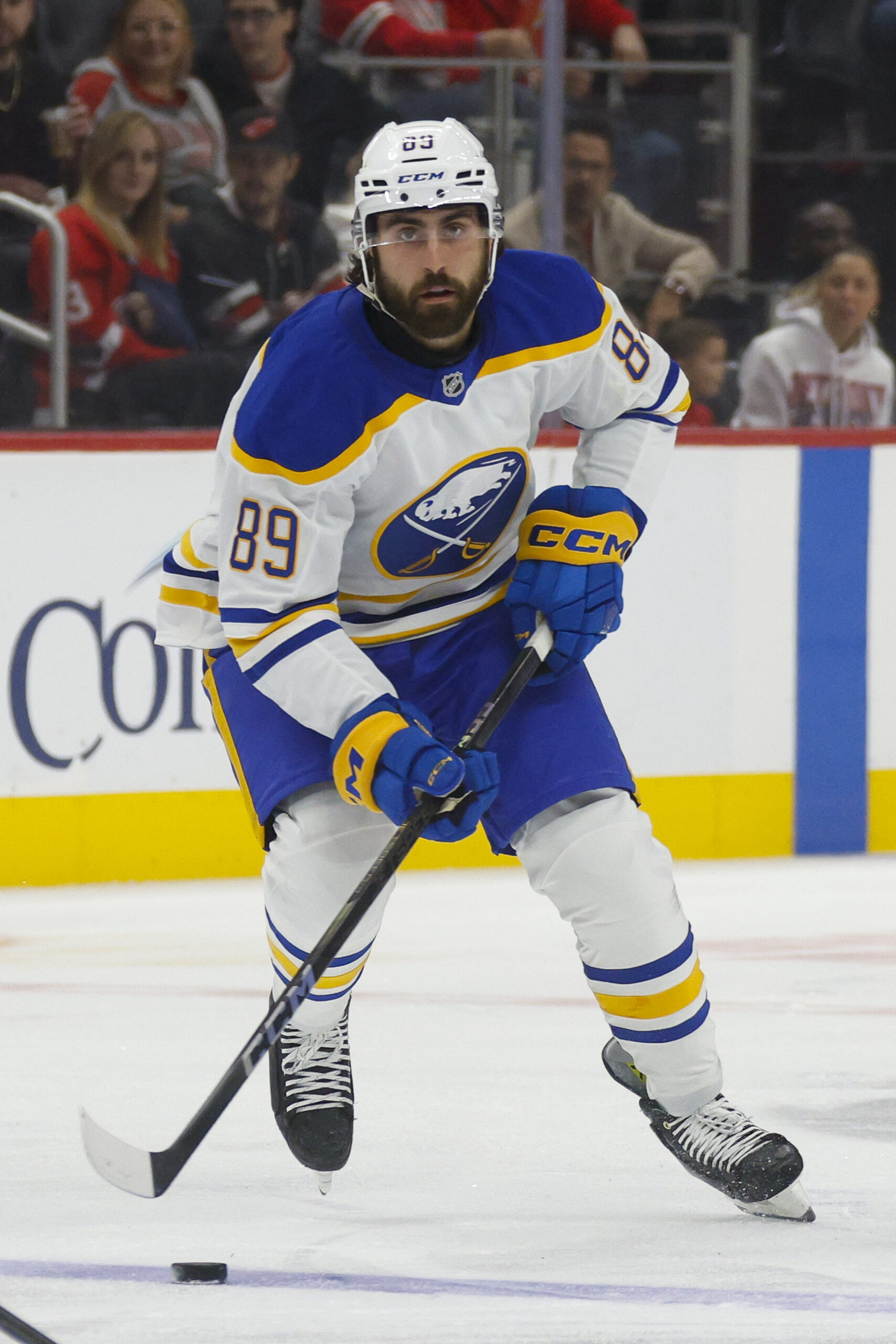
Unless substantive progress is made in those talks, it appears Tuch, a native of the Central New York region, which is just east of Buffalo, could be playing out his final campaign with the Sabres.
If he does hit the open market, he’d be one of the most in-demand players available. Tuch was a focal point of the Sabres’ return from the Vegas Golden Knights in the Jack Eichel trade, and has blossomed into a legitimate first-line winger for the team. He scored a career-high 36 goals last season and has scored at least 20 goals in each full season he’s played in Buffalo.
He concluded 2025-26 with 33 goals and 66 points in the regular season, and has two goals and two assists in the Sabres’ first three playoff contests.
With the Sabres hoping get past the Boston Bruins and make a deep playoff run, Tuch is in a position where he could author some big moments with the entire league watching.
While Tuch has been in form, there are factors beyond just his play that are contributing to his immense earning potential this summer. Firstly, the number of players who have signed extensions and taken themselves off of the free agent market means Tuch will be one of the few borderline star-level players left on the open market. Secondly, the sharp rise in the salary cap upper limit means there are quite a few teams with cash to burn this summer.
That means more teams will have the financial bandwidth to enter a bidding war for Tuch. The more teams that aggressively pursue an unrestricted free agent, the more money that free agent is often able to make. That bodes well for Tuch.
Patrick Kane, Detroit Red Wings
Like many other aging stars who have already made massive amounts of money in their career, Kane has prioritized on-ice fit and stability over maximizing his earnings in his last few trips to free agency. He found a good fit for himself in Detroit, and the Red Wings would not have come close to ending the league’s longest playoff drought without his efforts.
Now 37 years old, Kane likely has a place in Detroit for as long as he wants to continue playing. His contracts are loaded with performance bonuses, and it’s likely his next deal, in whatever form it takes, will be laden with bonuses as well. While he’s not as tied to Detroit as other similar free agents are to their teams, such as Alex Ovechkin with the Capitals or Jamie Benn with the Stars, it’s tough to imagine Kane entertaining a full free agency process at this stage of his career.
The Solid Contributors
Bobby McMann, Seattle Kraken
NHL history is littered with offensive players who have changed teams mid-season and had slow starts in their new NHL homes. So much of creating offense is about chemistry, and the inherent challenge that faces these players is the fact that they’re entering lineups with teammates whose styles and tendencies are entirely unfamiliar to them.
With that said, some players change teams and find themselves able to hit the ground running despite those inherent challenges; Bobby McMann is one of those players. In his 18 games in Seattle, he scored 10 goals and 14 points, bringing his full-season production to 29 goals, 46 points.
The 29-year-old was dealt from the Maple Leafs as the team could not reach an agreement with him on a contract extension. It was reported that McMann’s asking price on his next deal, said to be over $5MM per year, was a little above where Toronto was willing to go.
Having authored a second consecutive season with at least 20 goals, it appears McMann has given himself a real chance to earn the kind of contract offer Toronto reportedly wasn’t willing to extend him. While he’s not a one-to-one comparable, the fact that Kiefer Sherwood was able to earn a $5.75MM AAV on a five-year term has helped McMann’s case for his next deal. He’s an endearing winger, a player whose hard-working style allowed him to grab hold of an NHL role.
As an undrafted product of Colgate University, which is a quality ECAC program but not one with an overwhelming record of producing NHL players, McMann faced somewhat long odds of becoming an impactful NHL player. But with his compete level, work ethic, and knack for finding the back of the net, McMann managed to beat those odds and become a valuable NHL goal scorer. After making just over $1MM on his last deal, McMann has positioned himself to land a massive pay raise as a free agent this summer.
Vladimir Tarasenko, Minnesota Wild
While Tarasenko’s star has certainly faded since his trade from St. Louis in 2023, he remains a capable NHL scorer and one of the better offensive options set to be available on the open market this summer. He was a mid-season trade addition in back-to-back years, first with the Rangers and then with the Panthers the following year. In Florida, he showed he could still be a valuable player on a contending team, scoring 14 points in 19 regular-season games and chipping in nine points on the Panthers’ run to their first ever Stanley Cup championship.
Fresh off of the championship, Tarasenko signed a two-year, $4.75MM AAV deal with the Detroit Red Wings. But after he only managed 11 goals and 33 points in Detroit, his lowest scoring total in a healthy season of his career, Tarasenko was dealt to the Wild for future considerations. The Red Wings, it appeared, were content to be rid of Tarasenko’s $4.75MM cap hit without needing compensation from the Wild.
That deal has paid dividends for Minnesota, as the Russian forward finished the regular season with 23 goals and 47 points in 75 games. At 34 years old, though, getting term on his next deal could prove difficult. Going on another deep playoff run – provided the Wild can get past the Dallas Stars in the first round – would certainly help position him to potentially get one.
Mats Zuccarello, Minnesota Wild
When the Wild originally signed Zuccarello, back in 2019 during the tenure of former GM Paul Fenton, the deal was largely criticized. Although most outside observers acknowledged Zuccarello was still a quality player, and the $6MM per year price tag was seen as fair, the length of the deal (five years) was met with concern.
ESPN’s Greg Wyshynski wrote at the time that “there’s simply no defendable reason” why the Wild decided to sign Zuccarello for such a long term. The Hockey News’ Ryan Kennedy echoed the sentiment, adding “Zuccarello will eventually wear down and he will still have term on his contract when that happens.”
That concern from the media was not unreasonable, of course, as Zuccarello was into his thirties at that point. But the deal aged fabulously for Minnesota. Fenton’s successor, Bill Guerin, led the team to a quick turnaround, fueled in large part by the arrival of superstar Kirill Kaprizov from the KHL. Zuccarello found instant chemistry with Kaprizov.
After scoring 37 points in his debut campaign in the Twin Cities, Zuccarello managed 35 points in 42 games in 2021-22, Kaprizov’s rookie year.
Since Kaprizov arrived, Zuccarello has enjoyed the best, most productive years of his career even as he’s aged deeper into his thirties. He scored a career-high 79 points in just 70 games in 2021-22, which is a 92-point 82-game scoring pace. He scored 67 points the following year, and managed 63 points (in 69 games) in 2023-24.
His scoring rate has fallen a bit below where it once was as other Wild forwards have emerged as key focal points of the team’s attack (namely 2019 first-rounder Matt Boldy) but has still hovered at a clear top-six rate. This season, Zuccarello scored 15 goals and 54 points in 59 games, his games played total limited by upper-body injuries.
Over the course of his tenure with the Wild, Guerin has shown a willingness to invest in keeping his team’s core intact. His faith in this Wild core has been rewarded this season, without question. Given how well Zuccarello has played, it’d be tough to imagine Guerin letting him walk.
It’s unclear what Zuccarello’s expectations might be in free agency. Assuming he wants to continue his career and play his age-39 season, the fact that Zuccarello is able to be signed with performance bonuses means Minnesota has some flexibility in the route they decide to take with his extension.
Eeli Tolvanen, Seattle Kraken
There are many former top prospects who, after losing their spot on their original team and landing on waivers, have begun a downward spiral in their career. That spiral typically ultimately ends with the player leaving for the European pro ranks or the minor leagues. At one point, Tolvanen appeared to be at risk of following that path.
He was ranked as one of the top prospects in the game in 2018, and broke into the NHL in 2020-21 scoring 11 goals and 22 points in 40 games. But he wasn’t able to build on his rookie season in Nashville, and by late 2022, found himself on the waiver wire. The Kraken, in just their second season in franchise history, placed a claim on Tolvanen. The natural opportunity that comes with playing on an expansion franchise allowed Tolvanen to revive his career trajectory.
While he still isn’t the star he was once projected to be, he has finally begun to deliver some of the offensive upside that had tantalized scouts in years past. He scored 16 goals and 27 points in his first 48 games with the Kraken, and added eight points in 14 playoff games.
That first campaign with the Kraken showed what was to come for Tolvanen. He has become a reliable middle-six goal scorer, hitting a career-high 23 goals last season. This year, he scored 12 goals and 36 points.
Tolvanen has taken steps to round out his game this season, which bodes well for him entering free agency. He didn’t sniff the penalty kill when he began his tenure in Seattle, but is now playing over a minute per game short-handed. In a free agent class short on ascending options, Tolvanen, at 27 years old, will represent a relatively rare commodity.
Oliver Bjorkstrand, Tampa Bay Lightning
For much of his NHL career, Bjorkstrand has been a model of consistency as a second-line scoring forward. The Danish winger has been close to a lock to score at least 20 goals and between 45 and 55 points when healthy, but his fit in Tampa Bay hasn’t been perfect. Despite averaging over three minutes of power play time on ice per game, Bjorkstrand’s production has been below the standard he’s set earlier in his career. Bjorkstrand finished the regular season with 12 goals and 32 points, well below the 21 goals and 46 points he managed last season.
A contributing factor to Bjorkstrand’s decline in production has been his role outside the power play. While he was a top player for Tampa on the man advantage in the regular season, he’s often occupied a bottom-six role at even strength. His 10:30 time on ice per game at even strength is below career bottom-sixers such as Pontus Holmberg and Zemgus Girgensons.
The playoffs have not helped Bjorkstrand’s case. He’s been unable to secure a spot in head coach Jon Cooper’s lineup, serving as a healthy scratch for all three contests thus far. Cooper has even elected to play journeyman Scott Sabourin, who at 33 has played in just 73 career NHL games, over Bjorkstrand.
That puts Bjorkstrand on somewhat shaky ground entering free agency. At 30 years old, he is in a position where he could reasonably get a medium or even long-term deal. But with the way his role has declined in Tampa, he could face a challenge trying to reach his current cap hit, $5.4MM, in free agency.


Morning Notes: Tkachuk, Kero, Schnarr
The offseason has begun earlier than just about everyone in the Ottawa Senators organization had hoped, with the team swept out of the first round of the Stanley Cup Playoffs last night. With Ottawa’s loss, focus has shifted to the future of the organization – and more specifically, the future of the team’s captain and franchise face: Brady Tkachuk. Sportsnet’s Alex Adams wrote that “next season could even be a last dance of sorts for this core” of Senators players. More specifically, Tkachuk’s “future and the chatter around him will hang over the team until he’s signed to an extension, is traded or walks away from the nation’s capital.”
The 26-year-old is now just two years away from unrestricted free agency, putting a definitive time frame on the Senators’ hopes of competing for a Stanley Cup. As much as Tkachuk struggled to make his mark against Carolina, he remains one of Ottawa’s most important players and a uniquely coveted asset across the league. The team isn’t able to sign Tkachuk to an extension just yet, but once that window opens, every day that passes without his signature will likely only heighten the speculation that he could see his future elsewhere, the way his brother, Matthew Tkachuk, did before being traded from the Calgary Flames to the Florida Panthers. That’s obviously an outcome the Senators will be desperate to avoid, and their planning for this offseason is likely to reflect a level of aggression designed to quickly strengthen the team to show Tkachuk Ottawa is a place where he can win a Stanley Cup.
Other notes from around the hockey world:
- Former Dallas Stars and Chicago Blackhawks forward Tanner Kero will depart the DEL’s Kölner Haie and become a free agent, according to a team announcement. The 134-game NHL veteran has spent the last two seasons playing in Europe, spending 2024-25 with the SHL’s HV71 and this past year with Cologne. He has been solid at each stop, scoring 22 points in 52 games in the SHL and 29 points in 41 games in Germany. He helped Cologne finish in first place in the DEL’s regular season standings but the club fell to Berlin in six games in the league semifinals.
- 2017 Arizona Coyotes third-round pick Nate Schnarr has also decided to depart Cologne and become a free agent after just one year in Germany. The 184-game AHL veteran has spent the last three years playing in Europe, his first two as a top scorer in Finland’s Liiga and this past year as a point-per-game scorer in Germany. He’s proven to be a capable top-six scoring forward in two of Europe’s better leagues, and is likely to receive considerable interest from clubs across the continent this summer.
Transaction Notes: Miller, Okhotyuk, Robins
Montreal Canadiens prospect Quentin Miller transferred from the University of Denver to Western Michigan University a week ago, Brad Elliott Schlossman of the Grand Forks Herald reported. He is one of two Canadiens goalie prospects to transfer this week, as 2025 fifth-rounder Alexis Cournoyer left Cornell University to join the Wisconsin Badgers on April 20. Miller, 21, was a fourth-round pick of the Canadiens at the 2023 draft. He won a QMJHL title and Memorial Cup as a backup with the Quebec Ramparts, and has been a tandem goalie at multiple levels for much of his time since being drafted.
Miller went 12-10-2 in 25 games for Denver this season, posting a .916 save percentage and 2.39 goals against average, but lost the No. 1 goalie spot to freshman sensation Johnny Hicks. The Athletic’s Scott Wheeler recently ranked Miller the No. 14 prospect in the Canadiens’ system, writing “The Habs will likely want to see him be the guy somewhere before they commit to signing him.” Miller has a clear lane to being the undisputed No. 1 in Kalamazoo – last year’s starter Hampton Slukynsky has turned pro after two years in college and incoming freshman Owen Lepak hasn’t been a team’s starter since 2023-24, when he led the NAHL’s Maryland Black Bears to the Robertson Cup Final.
Other notes from around the hockey world:
- Former Calgary Flames and New Jersey Devils defenseman Nikita Okhotyuk signed a three-year contract extension in the KHL, keeping him in Russia through May 2029. The Flames still hold Okhotyuk’s signing rights since they qualified him when his last NHL contract expired. The 25-year-old defenseman played in nine games as a Flame and has played in 67 career games at the NHL level, split between Calgary, New Jersey, and San Jose. Over the last two seasons with CSKA Moscow, Okhotyuk has skated in 129 contests and scored 23 points.
- Former San Jose Sharks prospect Tristen Robins plans to sign in North America for 2026-27, according to an official announcement from his former club Rytíři Kladno. Robins was a second-round pick of the Sharks in 2020 and skated in a total of 150 AHL games while a member of the organization. Robins looked to be pushing for an NHL role as recently as 2023, when he scored 38 points in 62 games as an AHL rookie. He earned three NHL games that season and was ranked as the organization’s No. 7 prospect by Scott Wheeler of The Athletic. He wasn’t able to build on that rookie campaign and ended up dealt from the Sharks organization in 2025. Playing on a one-year deal in the Czech league, Robins scored 18 goals and 35 points in 45 games, and will hope to earn another shot in an NHL organization this fall.
Flyers’ Dan Vladar Questionable For Game 4
Philadelphia Flyers starting goaltender Dan Vladar‘s status is in question for game four against the Pittsburgh Penguins, head coach Rick Tocchet told the media today.
According to Kevin Kurz of The Athletic, Vladar “was shaken up” midway through the third period of game three after a collision with Penguins forward Bryan Rust. “He was seen flexing his right arm and hand while trainer Tommy Alva attended to him,” Kurz wrote. Vladar did not skate with the team today, though Tocchet indicated that was more of a maintenance absence than anything else.
Vladar’s status is of immense importance to both sides of the first-round Battle of Pennsylvania, as a healthy Vladar gives the Flyers the best possible chance of closing out a sweep against their arch-rivals on Saturday in game four. The 28-year-old won the Bobby Clarke Trophy as team MVP for his efforts this season, and his .946 save percentage in this series has backstopped Philadelphia to the precipice of a statement series victory. His performance in the regular season, his first campaign as a full-time No. 1, was similarly impressive. He went 29-14-7 with a .906 save percentage and 2.42 goals against average.
If Vladar is unable to dress on Saturday, 26-year-old Samuel Ersson would almost certainly get the start. Ersson was the Flyers’ No. 1 goalie for the last two years before ceding that job to Vladar. He has had his moments, but more often than not has struggled. His .870 save percentage in 33 games this season is the lowest of any goalie with at least 25 games played, and that’s even including a solid run of form he displayed after the Olympic break.
Although Ersson’s numbers have been less than ideal, Tocchet expressed faith in the Swedish netminder, telling the media “I’m not really worried if he had to play. I really wouldn’t. He’s locked in.” Ersson has yet to appear in the Stanley Cup playoffs but does have three postseason starts on record at the AHL level, from 2022-23.
If Ersson does end up getting a start, the elevated stage of the playoffs would provide him with a unique opportunity to put his sub-par regular season numbers behind him. Ersson is set to become an RFA with arbitration rights this summer, and his $1.6MM salary for this season makes him a legitimate non-tender candidate. The chance to impress in playoff hockey – however limited that chance may be – could help Ersson secure an NHL landing spot in case the Flyers do elect to cut him loose.