
With the trade deadline behind us, player movement between teams is severely restricted. Teams are jockeying for playoff position, and many players with expiring contracts across the NHL are playing games that could ultimately determine what magnitude of contract they might receive in the summer.
In a multi-part series, we’ll take a look at each position group of the upcoming free agent class, and do a rundown on how those upcoming unrestricted free agents have performed this year. Which players have increased their odds of scoring a jackpot on the open market? Which players have potentially hurt their earning potential with their play? What are the stakes for these free agents in the games that remain this season? We’ll break it all down here.
The Marquee Names
Charlie Coyle, Columbus Blue Jackets
That Coyle is arguably the top name set to be available at the center position in the upcoming UFA class speaks to two realities the NHL is dealing with: first, true top-six centers are an exceedingly rare commodity. Second, it’s especially uncommon to find them available on the free agent market.
Of course, that doesn’t mean Coyle isn’t a strong player in his own right. The Massachusetts native has enjoyed a resurgent year with the Blue Jackets.
He’s been the club’s No. 3 center this season, behind veteran Sean Monahan and 2023 No. 3 overall pick Adam Fantilli, but has outscored both of the pivots ahead of him on the depth chart.
Through 66 games, Coyle has managed 16 goals and 51 points, which is a 20-goal, 63-point 82-game pace.
If he can keep up this pace, he’ll set a new career-high in points production at the age of 34. In a league where the demand for quality centers often outpaces the supply, Coyle is well-positioned, despite his age, to cash in on the open market.
Beyond his offensive production, he offers a well-regarded two-way game. He’s been the top penalty-killing center for Columbus this season, and once received a fourth-place Selke Trophy vote as a member of the Boston Bruins.
As a free agent, Coyle represents a safer bet to provide steady, immediate contributions on both ends of the ice than perhaps any other free agent center available. While teams are likely to have some wariness to invest in him due to his age, the way he’s bounced back after an uneven 2024-25 season has demonstrably elevated his stock entering his free agency. AFP Analytics projects Coyle to receive a three-year, $5.8MM AAV deal.
Evgeni Malkin, Pittsburgh Penguins
Whether Malkin will actually remain on this list or instead sign an extension to remain in Pittsburgh figures to be one of the major storylines to track in Pittsburgh over the next few months. The Athletic’s Josh Yohe relayed word from Malkin’s agent, J.P. Barry of CAA, that Malkin would have a face-to-face meeting with Penguins GM Kyle Dubas to discuss his future.
Since that point, nothing concrete about Malkin’s status has been reported. Yohe reported that, “as of last summer,” the Penguins had decided Malkin would not be a part of the team’s plans past the expiration of his current contract.
The key question, then, is whether the Penguins’ team-wide resurgence this season, as well as notably improved play from Malkin, has changed the team’s mind in any way. There are undoubtedly key voices in Pittsburgh who would like to see Malkin return, the most likely of those being captain and franchise face Sidney Crosby.
While Crosby, as an active player, of course does not have any direct decision-making power within hockey operations, it has been widely reported that his input and influence is one Penguins management often considers. Additionally, Malkin himself has indicated that he would like to remain in Pittsburgh beyond this season, and feels he has earned another deal.
There is also public sentiment to consider. Malkin is a legendary figure in Pittsburgh, and the team risks deflating much of the positive momentum it has built over the last year if Malkin walks as a free agent. With that said, there is an argument in Pittsburgh to consider that the team’s future would be better-served turning over the valuable minutes Malkin plays to a younger player, such as breakout rookie Benjamin Kindel.
As far as Malkin is concerned, all he has done in 2025-26 (outside of a poor lapse in judgment that resulted in a five-game suspension) is improve his stock heading into free agency. The 40-year-old has 47 points in 46 games, his first season of point-per-game scoring since 2022-23. His ability to elevate his linemates, something that has defined his play throughout his career, is still intact. Nowhere has that been more evident than his chemistry with in-season trade addition Egor Chinakhov, who has 11 goals and 21 points in 28 games as a Penguin. He had six points in 29 games this season before joining with Malkin.
Given Malkin’s age, it’s extremely unlikely he’d receive much term on his next deal, and could very well be at the stage of his career where he’s only playing on one-year deals. AFP Analytics projects the value of his extension at $6.7MM, which would actually be a pay raise over the $6.1MM AAV he’s costing this season.
The Solid Contributors
Boone Jenner, Columbus Blue Jackets
In a thin center market, players such as Jenner enter free agency under extremely favorable conditions. While he’s never been a top scorer, the 32-year-old has long been one of the game’s most reliable two-way centers. He provides the Blue Jackets with strong work at the faceoff dot and valuable leadership qualities as their captain, as well as solid secondary scoring.
Jenner struggled with injuries over the last few years, but has found a way to remain productive. He scored 22 goals and 35 points in 58 games in 2023-24, and had 19 points in 26 games last season. He’s scored at least 20 goals on four occasions, and has hit at least 35 points five times.
This season, Jenner’s stock is trending in a neutral direction. He’s kept up his usual scoring rate, potting nine goals and 29 points in 51 games. That’s a 14-goal, 47-point 82-game scoring pace. He’s also kept up a role on Columbus’ penalty kill, though he’s not winning quite as many draws as he typically does.
The key storyline regarding Jenner this season has been how the Blue Jackets’ enviable depth at the center position has impacted his role. Where he once received middle-six or even top-six deployment in Columbus, he’s now been relegated to No. 4 center duty when all of Fantilli, Monahan, and Coyle are healthy.
Last season, Jenner averaged 18 minutes of time on ice per game, good for No. 3 among Blue Jackets forwards. The year before, he was Columbus’ most heavily-utilized forward. This season, he’s averaging 16:09 time on ice per game, which ranks No. 6 on the team.
While his points production does not appear to have been impacted, his declining role is something interested teams will have to interrogate when deciding whether to pursue him in free agency. Is it more of a matter of the Blue Jackets becoming uncharacteristically deep at the center position, something they were not known for for much of Jenner’s career? Or is it an early sign of age-related decline for the 32-year-old? That is the key question teams will have to answer when considering Jenner’s free agency case. AFP Analytics projects a $5.2MM AAV for Jenner on a three-year term.
Jonathan Toews, Winnipeg Jets
The legendary Chicago Blackhawks forward returned after a two-year absence to join his hometown Jets, but things have not gone according to plan in Manitoba. Last season’s Presidents’ Trophy winners have fallen down the league standings this season, and are more likely than not going to miss the upcoming playoffs.
While it’s essential to note that Toews is deserving of an immense amount of respect for returning to the NHL and occupying a regular role given the serious health challenges he faced, most would acknowledge he’s not the same player that starred in Chicago. If he elects to continue his career beyond this season, his free agent market is likely to reflect his current capabilities, rather than what he has achieved previously.
Some of what made Toews so effective previously remains intact. The Selke Trophy winner is still lethal at the faceoff dot, winning 61.6% of his draws this season. That’s the top rate in the NHL among regular centers. While he’s no longer a penalty killer, he still presents considerable value for key defensive-zone faceoffs, or in any case when winning a faceoff and establishing puck protection is crucial.
Toews’ offense hasn’t been at the level of prior years of his career. He has seven goals and 21 points in 65 games this season, despite averaging nearly two minutes of ice time on the power play per game. At this stage of his career, Toews’ value proposition to NHL teams is clear: he’s a trusted defensive center who presents an immense amount of value as a veteran leader, even if his on-ice production is now more muted. A one-year deal around his current cap hit of $2MM, perhaps laden with some bonuses, appears to be a fair expectation for Toews if he elects to continue his career.
Scott Laughton, Los Angeles Kings
If he had been able to hit the UFA market during his final few years as a member of the Flyers, it’s likely Laughton would have received interest from across the NHL. The 2012 first-round pick developed into one of the NHL’s better defensive centers over the course of his time in Philadelphia. By his late twenties, Laughton was scoring around 35 to 40 points per season, and even earned a Selke Trophy vote for his defensive play and contributions as a leading penalty killer.
It’s those on-ice qualities, as well as his reputation as a valuable veteran leader, that made the Toronto Maple Leafs interested enough to surrender a first-round pick along with prospect Nikita Grebenkin in order to acquire Laughton. On a team desperate to make a deep playoff run, Laughton reverted into being more of a defensive specialist, scoring just six points across 33 combined regular-season and playoff contests with the Maple Leafs.
Playing on a team more fully-stocked with offensive weapons compared to the Flyers made an impact on Laughton’s scoring. While he was once good for at least 30, and as many as 43, points in a season, he saw his production dry up in Toronto. Before his trade at the recent trade deadline to the Kings, Laughton managed just 12 points in 43 games for the Maple Leafs.
Since his trade to Los Angeles, Laughton has managed to score twice and register three points in five games. The fact that Laughton only netted the Maple Leafs a third-round pick just a year after he was worth a first-rounder suggests that his stock has declined somewhat.
With that said, he has a clear opportunity ahead of him in Los Angeles to re-write the book on him entering free agency, where he could be poised to sign a life-changing contract as a soon-to-be 32-year-old free agent. Laughton’s current contract carries a $3MM AAV, and his tenure with the Kings (and whether it contains a playoff run) will go a long way in determining what kind of raise, if any, he’ll receive over that cap hit on his next deal.
The Role Players
Jason Dickinson, Edmonton Oilers
Although he’s not the scorer anymore that he was very early in his tenure with the Chicago Blackhawks, Dickinson is valuable enough to be the centerpiece of a deal that netted Chicago a first-round pick at the recent trade deadline. His game fits the mold of many of the other names on this list: he’s a 30-year-old defensive specialist offering size, two-way responsibility, some moderate ability at the faceoff dot, and some Selke Trophy votes in his past.
The key for Dickinson, entering this summer’s free agent market, is his performance in what the Oilers hope will be a lengthy playoff run. If the Oilers’ past two playoff runs are any indication, Dickinson may yet get the chance to showcase his talents on some of the game’s biggest stages. As Connor McDavid chases that Stanley Cup championship that has thus far eluded him in his career, Dickinson could end up playing a high-profile reserve role. When the Oilers have to kill a penalty in a big moment in a game, or defend a narrow lead, it’s likely Dickinson’s skates will hit the ice.
While Edmonton could very well end up disappointing in the playoffs (they have been more uneven in 2025-26 than prior years), it’s clear what Dickinson has done this season for the Blackhawks is likely to be less relevant for his free agent case than what he could be set to do for the Oilers.
Colton Sissons, Vegas Golden Knights
With nearly 700 games played entirely for one team, the Nashville Predators, this season has been one of real change for Sissons. He’s playing for a new NHL organization for the first time in his professional career, and is also slated to hit unrestricted free agency for the first time in his career. Sissons’ last contract, signed by Hall of Fame GM David Poile, came all the way back in 2019, and locked Sissons into a $2.85MM AAV contract with a seven-year term.
For six of those seven years, Sissons was a key bottom-six piece for the Predators. He was a reliable defensive presence, regularly killing penalties. Later in his Predators tenure, he even developed real credibility as a secondary scorer, registering a career-high 15 goals and 35 points in 2023-24. 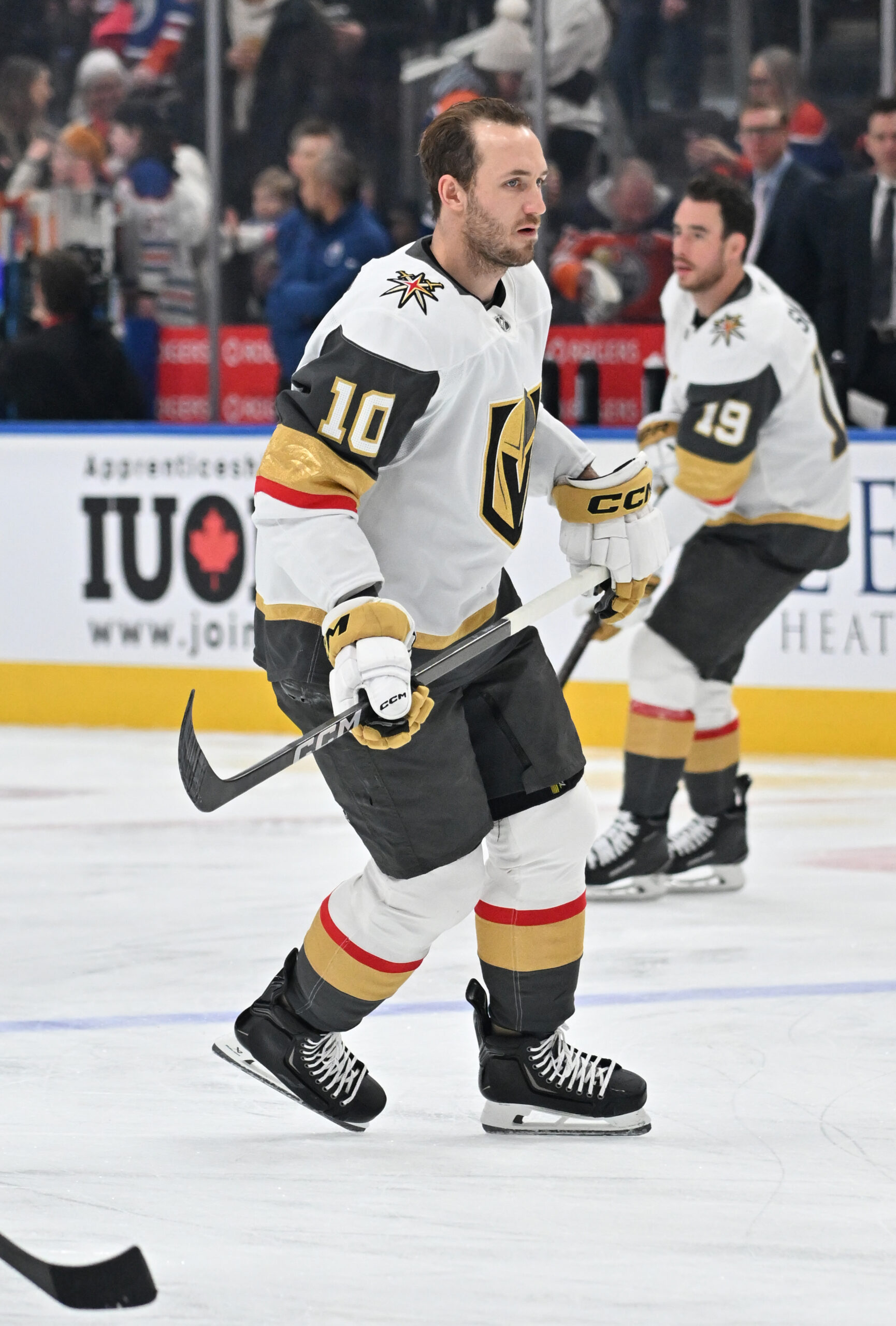
Sissons was not immune from Nashville’s team-wide struggles last season, and he also dealt with an injury.
He was then traded to Vegas, and while Sissons has maintained his status as a capable defensive fourth-line center, his offensive production has not rebounded to the level of earlier years in his career.
That Sissons will enter the market now two seasons removed from back-to-back years with at least 30 points is notable, as is the fact that he’s only scored nine points in 51 games as a Golden Knight.
He remains a key penalty killer in Vegas, but his offensive decline likely means his path towards earning a pay raise from his current $2.85MM AAV is considerably more narrow.
Alexander Kerfoot, Utah Mammoth
Heading into unrestricted free agency this summer, it’s clear the last two years have not been entirely kind to Kerfoot. During his one year with the since-relocated Arizona Coyotes, he scored a career-high 45 points, reminding the league of the player he was earlier in his tenure with the Toronto Maple Leafs and Colorado Avalanche.
He’s a player who has hit the 40-point plateau four times, but in Utah, that level of production has been nowhere to be found. Last season, he scored 11 goals and 28 points, his lowest result as a scorer, on a points-per-game basis, since entering the NHL. This season, Kerfoot has just four points in 19 games as he missed most of the first few months of the season with an injury.
In Utah, Kerfoot has morphed from being a steady middle-six two-way forward into more of a defensive specialist. He ranked second among all Utah forwards in short-handed time on ice per game last season, and has maintained a regular penalty-kill role this season. But his average ice time per game overall is down to just 11:13 per game, a steep decline from last season where he averaged 15:15 per game.
The injuries and inability to score on a consistent basis have likely damaged Kerfoot’s earning potential as a free agent. With that said, his stellar resume prior to arriving in Utah makes him an intriguing buy-low candidate for teams interested in strengthening their center position.
Kevin Stenlund, Utah Mammoth
Stenlund played 19 games in the AHL in 2022-23, and was viewed as somewhat on the NHL-AHL bubble. The Florida Panthers saw something in the 6’3″ Swede, though, and elected to sign the center with the plan of including him in their NHL plans. That move proved to be a great one for the Panthers, as Stenlund scored a career-high 11 goals and helped the franchise win its first-ever Stanley Cup championship.
He was able to cash in after that victory, earning a two-year, $2MM AAV deal with the Mammoth. He’s further elevated his stock in Utah, and at 29 years old, is poised to once again cash in as a free agent. Stenlund offers size, defensive ability, and some secondary goal-scoring qualities. Stenlund has been an excellent faceoff taker in Utah, winning 59.2% of his draws last season and 54.8% this season.
The key storyline to track for what remains of this season as far as Stenlund is concerned is his shooting. After scoring 14 goals and 28 points last season, Stenlund has managed only four goals this year. His shooting percentage has dropped from 13.7% to 7.3% year-over-year. If he can get some puck luck in what remains of the season, or at least help the Mammoth go on a real playoff run, he could enter this summer in very good shape.
Mark Jankowski, Carolina Hurricanes
Despite a trade sending him from Nashville to Carolina, Jankowski has maintained the traits in his game that have allowed him to carve out a nearly 500-game NHL career. The 6’4″ forward has the versatility to play both center and on the wings, can contribute as a secondary penalty killer, and offers the kind of size teams covet in fourth-line players.
Though he’s not an overly physical player, with just 33 hits to his name this season, he’s earned a regular role in head coach Rod Brind’Amour’s lineup, and is likely to add to his 23 games of career playoff experience later this season. While he’s likely to earn only a modest pay raise, perhaps in the $1MM to $1.25MM range at most, he could stand to earn even more depending on how the Hurricanes fare – perhaps experiencing something similar to what Stenlund experienced during his free agency after winning the Stanley Cup with the Panthers.
Teddy Blueger, Vancouver Canucks
Blueger, 31, has only played in 19 games this season, so he hasn’t amassed a huge sample of data points that could heavily impact his stock heading into free agency. With that said, his performance in those 19 games for the Canucks has been strong, scoring six goals and 11 points to go along with the defensive and penalty-killing contributions teams have grown to expect from Blueger at this stage of his career.
The development this season (or lack thereof) that is most likely to impact his upcoming free agency is the absence of a trade to a contending team. While playing out the string on a basement-dwelling Vancouver Canucks team likely means Blueger will receive more substantial minutes than he’d receive on a contender, it also means teams will approach any increased scoring he achieves this season with a clear caveat: he was producing within a workload he’d be unlikely to replicate in a playoff-bound lineup.
One could argue Blueger’s upcoming free agency would be better-served by him showcasing his talents in a fourth-line role for a contender, the kind of role most teams targeting him would pencil him into. But a trade didn’t materialize for him, and as a result, the best thing he can do is continue to take advantage of the opportunity in front of him in British Columbia.
Tyson Jost, Nashville Predators
The status of the No. 10 pick from the 2016 draft as an NHL player looked to be on shaky ground for the last few years, as Jost found himself on waivers repeatedly and lost his grip on a regular NHL role. He bounced between teams, and even saw time in the AHL in each of the last two seasons.
When the Predators signed Jost this past summer, the fact that the deal was of a two-way structure (albeit with a massive $600K guarantee) was notable – it was the first time in Jost’s NHL career, since his league-mandated entry-level contract, that he would play out a season on a two-way contract. That’s reflective of where his stock was at that point: in real decline.
While Jost hasn’t had an exceptional campaign by any means, his 2025-26 season has been a useful one as it has re-established him as a regular NHL player. He’s gotten into 52 games for the Predators, thus far avoiding any stints in the AHL. He’s playing a fourth-line role, but is getting some secondary penalty-killing time. His 11 points in 52 games aren’t on the high-end for a fourth-liner, but his ability to both earn, and hold, the trust of head coach Andrew Brunette is something that will help him return to one-way contracts this summer.
Adam Henrique, Edmonton Oilers
For much of his over 1,000 game NHL career, Henrique was a prototypical middle-six center, someone capable of producing secondary offense while holding down a staunch defensive role. Those days are in the past, as Henrique’s offensive production has fallen to the wayside. He scored 51 points in 2023-24, but has not been able to reach those heights as an Oiler. He scored 12 goals and 27 points last season, but has just two goals and 10 points in 50 games this year.
At 36 years old, Henrique is inching closer towards the end of his career. That’s not to say he doesn’t have gas left in the tank, of course, but teams will have to be measured in their approach to him this summer, given how much of an impact age appears to have had on him as an Oiler.
He’s still a valued veteran who has helped the Oilers win back-to-back Clarence S. Campbell bowls, and still regularly kills penalties in Edmonton. But at this stage, he’s a veteran fourth-line option, rather than the kind of middle-six two-way player he once was.
Lars Eller, Ottawa Senators
Eller is in many ways similar to Henrique, only he’s now playing his second consecutive year in the role Henrique now finds himself in. Eller, who turns 37 in May, is the Senators’ No. 4 center. He is a secondary penalty killer for the team, wins 57.5% of his draws, and costs just $1.25MM against the cap.
The offense he once showed, particularly as a third-line center on contending Washington Capitals teams, is no longer part of his game. But he’s shown this season that he can still hold down a role as a fourth-line center, and entering free agency, if he wants to continue his NHL career, he can expect to be compensated as one. The Senators’ late push for a chance to return to the playoffs will be a storyline to watch as it relates to Eller’s free agency.
Rodrigo Abols, Philadelphia Flyers
Abols, 30, has been a nice find for the Flyers’ scouting staff, turning into a legitimate NHL depth piece after four years as a solid SHL center. The 6’4″ pivot showed flashes of NHL potential in Europe and on the international stage, perhaps nowhere more than during Latvia’s historic bronze medal run at the 2023 IIHF Men’s World Championships.
2025-26 looked like it could be a big year for Abols. He split last season between the NHL and AHL, playing 47 games with AHL Lehigh Valley and 22 games with the Flyers.
This season, Abols has been able to carve out a regular role as the Flyers’ No. 4 center, and has thus far avoided reassignment to the AHL.
It’s unfortunate for Abols, then, that his momentum (especially from early in the season) was cut short by a lower-body injury.
He’s been out since January, and it’s unclear when, or if, he’ll be able to return this season. While the injury has cost him the chance to build an even stronger free agency case, the fact that he’s currently playing on a one-way $800K deal suggests he should at least be in a position to earn a one-way contract for next season.
David Kampf, Washington Capitals
Kampf, 31, found himself outside the Maple Leafs’ NHL plans early this season, and made the decision to terminate his contract in an effort to find an NHL role with a team. He latched on with the Canucks, and occupied his normal role as a fourth-line pivot and penalty-killer, something that earned him a trade to the Washington Capitals. He has yet to make his debut in Washington, and Washington faces long odds to return to the postseason.
But given the Capitals’ consistency as a regular in the Stanley Cup playoffs, it could be in Kampf’s best interest to sign an extension in Washington in order to potentially secure the fourth-line center role with the team. That’s a role Nic Dowd occupied to great success in recent years, and it’s one Kampf could find some stability in if he’s able to earn the trust of Washington’s coaches and management.
Curtis Lazar, Edmonton Oilers
Lazar took a pay cut last summer to sign with the Oilers, going from a $1MM AAV on his last deal to a league-minimum $775K this year. Injuries have stymied him over the last two seasons, as he managed just five points and 48 games for the Devils last season, and is currently out on a week-to-week basis this season.
He did score a healthy 25 points in 71 games for New Jersey in 2023-24, showing himself to be the kind of high-energy, physical fourth-liner teams often covet in those roles. This season with the Oilers has been more like his 2024-25 than his 2023-24, and as a result, Lazar isn’t heading into free agency in the strongest position. As with most players, though, a deep playoff run could always help change that.
Sam Lafferty, Chicago Blackhawks
When Lafferty was last with the Blackhawks, he proved himself to be a strong enough bottom-six center to be included in the Maple Leafs’ Jake McCabe trade, a deal that net Chicago first and second-round picks, among other assets. He was held in high enough regard to earn a $2MM AAV two-year contract in the summer of 2024, but he’s unlikely to receive that kind of deal this upcoming summer.
Lafferty averaged 13:15 time on ice per game, including sporadic usage on both sides of special teams, in 2022-23 with the Maple Leafs. The following year, he played a regular fourth-line role on a strong Canucks team, scoring a career-high 13 goals. Since signing his deal with the Sabres, Lafferty’s scoring has all but disappeared, and with it, his regular NHL role.
He managed just seven points in 60 games last season, and has just two points this year. He’s been a regular healthy scratch for the Blackhawks this season, and is averaging just 8:36 time on ice per game in contests he dresses for this season. On a per-game basis, he’s receiving a lighter workload than any other Blackhawks forward.
As a result, his stock is unquestionably trending in the wrong direction heading into free agency. In any case, he has accomplished enough as a bottom-six player over his nearly 400-game NHL career to suggest he will still receive a shot to earn an NHL role with a team for next season.
Others Of Note
Jonny Brodzinski, New York Rangers
Since he got into 35 NHL games with the 2017-18 Los Angeles Kings, Brodzinski has lived in one of the more volatile positions a pro hockey player can occupy: a place on the NHL-AHL bubble. He’s both captained AHL teams and played in NHL playoff games, but over the last two years, Brodzinski appears to have put his AHL days behind him.
After getting into the first playoff games of his career during the Rangers’ runs to the Eastern Conference Final, Brodzinski has carved out a full-time NHL role over the last two years as a versatile thirteenth forward option. He scored a career-high 12 goals in 2024-25, doing so in just 51 games. That’s a 19-goal 82-game scoring pace.
Had he been a free agent last summer, he could have earned a decent short-term guarantee. But he’s not been able to sustain his goal scoring this season, and as a result, the 32-year-old’s stock has to be considered to be down.
Kevin Hayes, Pittsburgh Penguins
A player who has hit at least 40 points in a season six times, Hayes was once a well-regarded middle-six offensive piece. He netted a first-round pick for the Rangers as a trade deadline asset in 2019, and signed a hefty free agent deal with the Philadelphia Flyers afterwards.
After scoring 54 points in 2022-23, Hayes was traded to the Blues, where he only managed 13 goals and 29 points in 2023-24. The Blues paid a second-round pick to the Penguins in order to rid themselves of Hayes’ cap hit, and he has been unable to restore his prior status as a middle-six scorer in Pennsylvania.
Hayes’ struggles as a Penguin (just five points in 25 games this season) leave him in a curious spot.
He’s an offensive player who built an entirely respectable NHL career as a scoring forward, but that scoring has since dried up. Is it realistic to expect him to rediscover his form as a secondary scorer? Or can he potentially reinvent himself to be more palatable as a bottom-six piece?
Those are the kinds of questions teams interested in Hayes might ask themselves this summer. In any case, he’s likely to have to settle for an inexpensive, prove-it contract wherever he signs.
Jansen Harkins, Anaheim Ducks
After playing in a career-high 77 NHL games for the Jets in 2021-22, it looked as though Harkins had secured a role as a full-time NHLer. The following season, though, Harkins only earned 22 NHL games, and by the end of 2023-24, he had changed NHL teams and gone 45 games without a goal.
The Ducks signed Harkins to an affordable two-year deal with a one-way structure for both years, and Harkins has been able to hold down a spot on the NHL roster on that deal. He scored 17 points in his 11 AHL games with the organization, and has played in 101 NHL games across the last two years in Orange County. At 28 years old, the fact that he’s solidified his grip on an NHL roster spot means he’s positioned himself to once again receive a one-way contract in the summer.
Luke Glendening, Philadelphia Flyers
At 36 years old, it’s clear the value proposition Glendening offers to NHL teams has become somewhat narrow: he’s still an adept face-off taker, but his impact as a defensive forward has waned, and his production is almost entirely gone.
With that said, his over 900 games of NHL experience and abilities as a faceoff taker were still intriguing enough to allow him to be claimed off waivers, and give him a chance to stick in the NHL beyond this season if he elects to continue his career.
Photos courtesy of Eric Hartline-USA TODAY Sport, Walter Tychnowicz-Imagn Images, Jerome Miron-Imagn Images and Charles LeClaire-Imagn Images
Ugh, the hemming and hawing. “… his offensive decline likely means his path towards earning a pay raise from his current $2.85MM AAV is considerably more narrow.” How about (using Sissons as an example) “His decline in all aspects of the game ensures that he’s going to have to take a pay cut to stay employed in the NHL.” I doubt any staff writer’s salary is going to depend on how accurate their predictions are. No one needs to weasel word in order to CYA.
I dont see an issue there. If you want something written a certain way, well, nothings stopping you.
And if you don’t want something written a certain way, well, nothings [sic] stopping you.
The line doesn’t make any more sense.
It makes sense. Stop being deliberately obtuse.
Some 3rd line centers but mostly 4th liners and a few that should retire or go to Europe. 2 of the best here, Coyle and Jenner should be re-signed.
Jenner, Laughton, Dickinson, Sissons, Kerfoot, And, Blueger all have value at the right price, As 3rd, And 4th liners, Jonathan Toews was a disaster, And should retire, Charlie Coyle played over his head this season in a contract year, He is a huge red flag moving forward.
Jenner has been playing wing the last 2 years
Please let Wilf run. He knows nothing about hockey, but he does it with incredible enthusiasm!
Slim Pickens was an actor. And also the description of the free agent class for centers (and overall NHL talent)
Charlie Coyle marquee LMAO